







Abstract
Cannabis has been used as a medicinal plant for over two thousand years and has played a significant role in the ethnopharmacological practices of numerous cultures throughout history. The aim of this study is to explore the medicinal uses of Cannabis as documented in the Arabic pharmacopoeia during the medieval period from the IXth to the XVIth century AD. This study is based on a historical and ethnopharmacological approach, analyzing a variety of Arabic medical manuscripts, treatises, and texts dating from the IXth to the XVIth century. The analysis revealed that Cannabis has properties to treat different ailments, including endocrine, nutritional, and metabolic diseases; disorders of the nervous system, respiratory system, digestive system, genitourinary system; conditions affecting the skin and subcutaneous tissue; diseases of the articular system and conjunctive tissue; as well as various undefined symptoms, signs, and morbid states. These therapeutic effects were achieved through the use of various parts of the Cannabis plant, such as seeds, leaves, roots, and flowering tops (inflorescences). However, its use was also related to cultural and religious considerations, influencing its utilization and acceptance of its properties. The historical study of Cannabis in the Arabic pharmacopeia highlights its significance as a key element in traditional medicine. Its diverse therapeutic applications, documented centuries ago, continue to resonate within modern medical research. By examining this ancient practice provides a deeper understanding of the enduring medicinal value of Cannabis and its lasting influence on contemporary therapeutic approaches.
Introduction
For centuries, hemp (a dioecious annual plant of the Cannabaceae family) coexisted in perfect harmony within Arabic–Islamic societies. It was used as a source of relief and healing for diseases, as food, and as a provider of fiber and textiles (Abel 1980; Petrovska 2012; Piluzza et al. 2013). It was a subject of great interest to the scientific community, and we find nothing no evidence in their writings to suggest that hemp was considered illicit. However, beginning in the XIIIth century, under the convulsed and troubled historical circumstances of the time, occurred that radically altered the previously harmonious relationships with hemp. During this period, Islamic scholars such as the Olemas and Alfaquis who were responsible for maintaining religious orthodoxy and social cohesion, turned their attention to hemp and initiated what can be described as an unprecedented crusade against it in Islamic history. Ideologically, this campaign was accompanied by a significant redefinition of Cannabis. What was once regarded as a source of food was later reclassified as a substance deemed “toxic and harmful,” and consequently declared illicit (haram), equivalent to wine in its prohibition (Clarke and Merlin 2016; Gedik and Avinc 2020; Gomez, Hu and Clarke 2021; Merlin 2003; Piluzza et al. 2013).
Before the rise of Islam, Arabs were already familiar with the use of hemp, influenced by both Eastern and Greek civilizations. Thousands of years earlier, the plant and its derivatives were widely used in China, India, Mesopotamia, Persia, and Egypt. Hemp served various purposes, including medicinal applications, textile and fiber production, nutritional uses (hemp seeds), and for both psychotropic and curative use (Abel 1980; Bouloc 2013; Gedik and Avinc 2020; Li 1974; Touw 1981; Turner, Elsohly and Boeren 1980).
The therapeutic and narcotic properties of Cannabis were recognized long before the Common Era with documented use in ancient China, India and the Middle East (Li 1974, 1975). One of the most important events in the transmission of ethnobotanical and ethnopharmacological knowledge about hemp was the IXth century Arabic translation of Dioscorides “Materia Medica” (originally written in the first century CE), particularly Liber II: simplicium medicamentorum temperamentis ac facultatibus. This work, along with the Xth century translation of the Aramaic Nabataean Agriculture, played a crucial role in preserving and disseminating ancient knowledge of medicinal plants, including hemp (Dawson 1934; Faulkner 1969).
From there, its use quickly spread to Africa, the Middle East, and Asia. In Morocco, hemp (Cannabis sativa L.) holds a significant place, especially in the Rif Mountains, where its cultivation and use have evolved over centuries. While the plant is believed to have first arrived in Morocco during the Arab invasions in the 7th century AD, it wasn't until the XVth century that its cultivation began in the Ketama region, located in the heart of the Rif, primarily among the Sanhaja Tribe (Bordes and Labrousse 2004). Cannabis cultivation gained formal recognition in the XIXth century under Sultan Moulay Hassan I, who authorized its cultivation for local consumption in five douars (villages) of the Ketama, Beni Seddate, and Beni Khaled tribes, likely as a strategy to pacify the region (Bachir et al. 2022; Chouvy 2008; Meklach et al. 2010, 2019; Merzouki and Molero Mesa 1999; Merzouki and Merzouki 2021; Merzouki, Edderfoufi and Molero Mesa 1994, 2002; Ouhtit et al. 2024). Although Cannabis cultivation was legalized in Morocco in 2021 for medical, cosmetic, and industrial purposes (Bulletin Official 2021).
This paper aims to explore and document the historical role and therapeutic applications of Cannabis in traditional Arabic medicine from the 9th to the 16th century AD. It provides a comprehensive overview of the plant's medicinal uses and its significance within the context of the Arabic–Islamic Golden Age.
Vernacular Cannabis Names
It is first necessary to briefly outline the Arab scientific terminology for Cannabis, which reflects both the diversity of linguistic traditions and the evolving knowledge surrounding its medicinal application. Lozano Camara (1996) analyzed and described the terminology found in Cannabis-related manuscripts, treatises, dictionaries, and botanical glossaries of the period. In the IXth century, Cannabis entered Arabe Countries through two main routes. The first was from India via Persia, leading to the Arabic term qinnab hindī (Indian hemp) (Taha 2010). The second route was through the transmission of Greek medical and cultural knowledge, particularly via translated texts (Hamarneh 1972).
The dual introduction of Cannabis into the Arab world through Persian-India and Graeco-Roman channels not only shaped the scientific understanding of the plant but also significantly influenced the lexicon used to describe it. As Cannabis became known to Arab physicians, lexicographers, and botanists, a rich vernacular and technical nomenclature developed. These names reflect the plant's geographical origins and botanical characteristics as well as the intercultural exchanges that informed Arab-Islamic science.
The main vernacular and scientific terms used in classical Arabic texts to designate Cannabis and it various forms are:
Materials and Methods
Literature Review
To investigate the ethnopharmacological uses of Cannabis during the Medieval period, a range of medicinal treatises, pharmacognosy texts, and herbal manuscripts written during the period under study. These sources span multiple languages, including Arabic, Spanish, English and French translations.
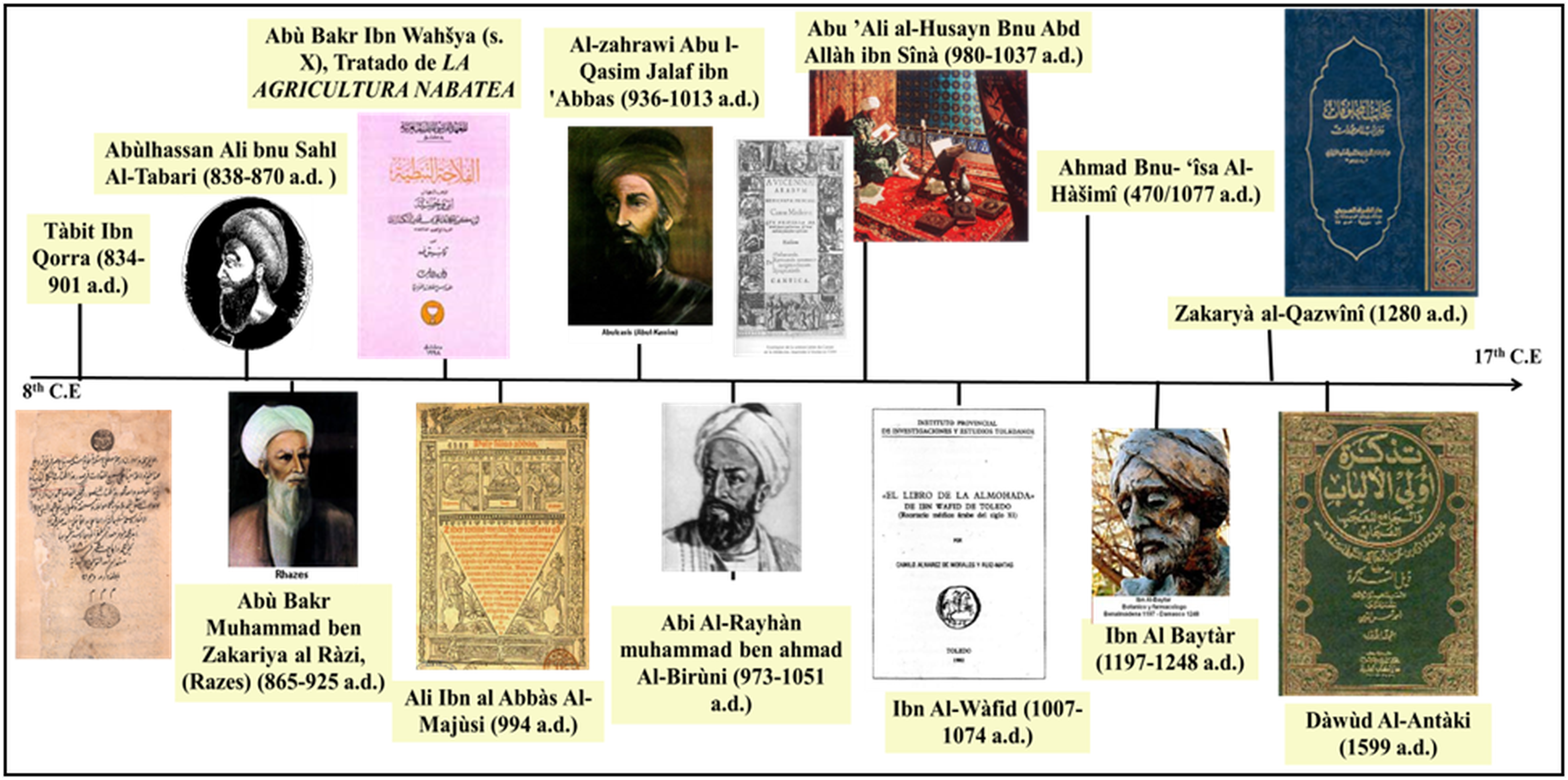
Key chronology of Cannabis ethnopharmacological uses in the Arabic Islamic Golden Age from the 09th to the 16th century C.E. (Merzouki, Edderfoufi and Molero Mesa 1994).
Selection Criteria for the Manuscripts
The manuscripts and treatises were selected based on several criteria:
The Content
Arabic manuscripts that mentioned Cannabis and its medicinal properties were included in the study. Original versions of the manuscripts are written in Arabic.
Authors
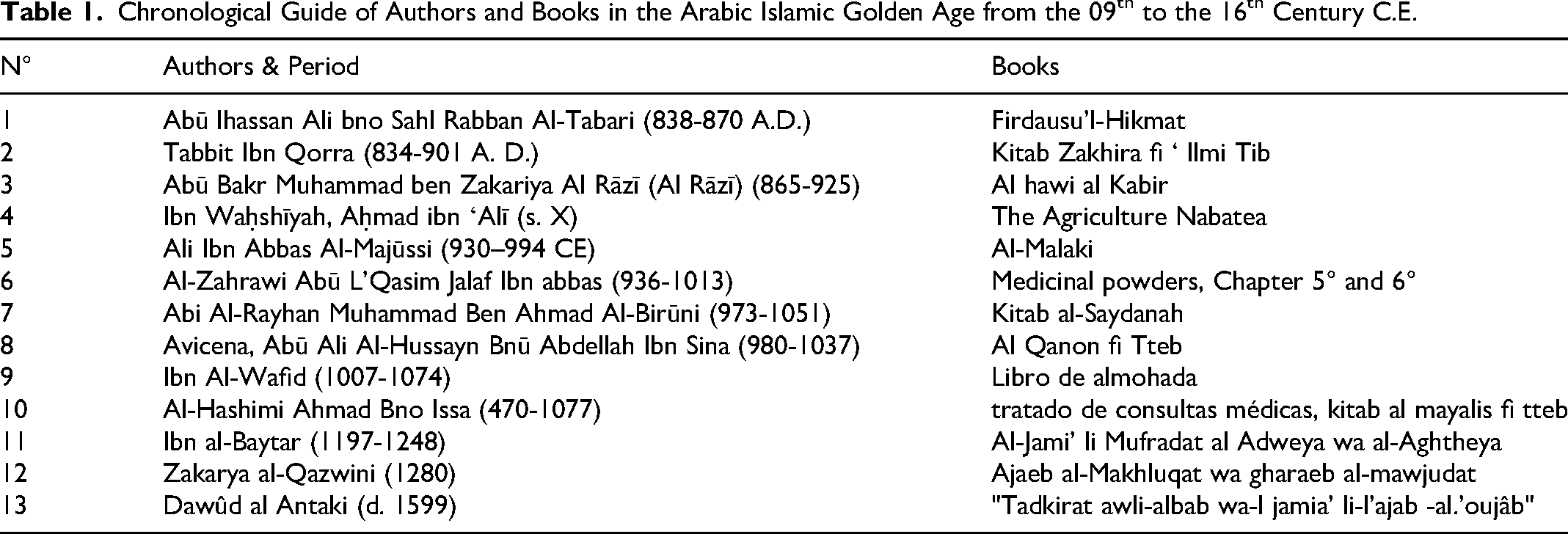
Arab physicians, botanists and pharmacologists, such as Avicenna (The Canon of Medicine), Al Rāzī (Al hawi), and Ibn al-Baytar (Treatise on simples) documented the therapeutic uses of Cannabis and contributed significantly to the translation movement. Their works played a crucial role in transmitting knowledge of medicinal substances from Arabic medical and botanical texts into Latin Europe (
Chronological Guide of Authors and Books in the Arabic Islamic Golden Age from the 09th to the 16th Century C.E.
Geographic Relevance
Manuscripts produced in regions with historical ties to both Arabo–Islamic and European medicinal traditions (Al-Andalus, the Islamic Golden Age, and Christian Europe) were included in the study.
Data Collection
The books listed in
The study of medieval sources of medical and pharmaceutical sources presents numerous challenges and requires an interdisciplinary approach. These sources were handwritten in Arabic script and use the scientific terminology and conceptual frameworks of their era, often complicating the accurate identification and interpretation of contemporaneous terms. This research relied on various reference works and dictionaries that compile lexicons of plants and disease, including Kitab Al–Taisir Fil–Mudawat Wal–Tadbir by Abū Marwan ibn Zohr (annotated by Michael Al-khouri, Dar al-Fikr, 1st edition 1982), and Tuhfat Al-Ahbab, a glossary of Moroccan medical material by an anonymous author.
Information on Cannabis and its application is widely scattered in various historical sources, necessitating a critical and cautions approach to the material. Accurate interpretation also requires thorough comparison with modern data, particularly in light of the morphological, ecological and bio-geographical characteristics of the plant species as described in medieval literature.
The Therapeutic Applications of Cannabis in Antiquity
Cannabis has been used therapeutically since antiquity, with documented applications dating back to approximately 3000 years BC. One of the earliest known references appears in China (2737 BCE) in the first medical text attributed to legendary Emperor Shen-Nung, who prescribed Cannabis extracts to treat various ailments.
Dioscorides, regarded by the Arabs as the greatest botanist of antiquity, also documented hemp in his influential work De Materia Medica. He noted its usefulness for making “good, strong ropes” and recommended its seeds to ‘quench geniture’ as well as its juice for treating earaches (De Materia Medica, Book III. 165, p. 390; English Translation by Gunther).
Following the translation of this work (
He also references Galen, who claimed that hemp seeds expel intestinal gases, reduce abdominal swelling, and greatly dry out semen. Avicena (Ibn Sina) affirmed that hemp seeds disrupt the balance of the bodily humors. Al-Dimachki classified Cannabis as warm in the second degree and dry in the first, noting its use in drying stomach disorders, eliminating internal worms, and purifying the brain when its juice is applied nasally. Ishak Ben Imrân, described Cannabis as indigestible, harmful to the stomach, and a cause of headache and bilious blood, associating its ingestion with migraines, constipation and diuretic effects. He also observed that it could lead to mental disturbances and mood instability due to excessive gas production in the brain. According to Ishak ben Souleiman, frying hemp seeds reduces their harmful effects, which can be further mitigated by consuming sweetened Oxymel (mixture of vinegar, alcohol and honey). As for external applications, hemp leaves were used to treat pityriasis (cutaneous disease affecting the scalp) by crushing the leaves and washing the head with their juice. Razes, in “Kitab-madhar Al-Aghdhiya”, reiterated that hemp seeds cause headache and visual disturbances, which could be alleviated by cold water, chewing ice, or acidic fruits. Ibn al-Baytar himself concluded that small quantities of Cannabis may cause intoxication, while larger doses can result in imbecility, mental instability, and even death. He also described the therapeutic uses of hemp oil, characterizing it as warm and dry, and effective in treating uterine contractions.
Discussion
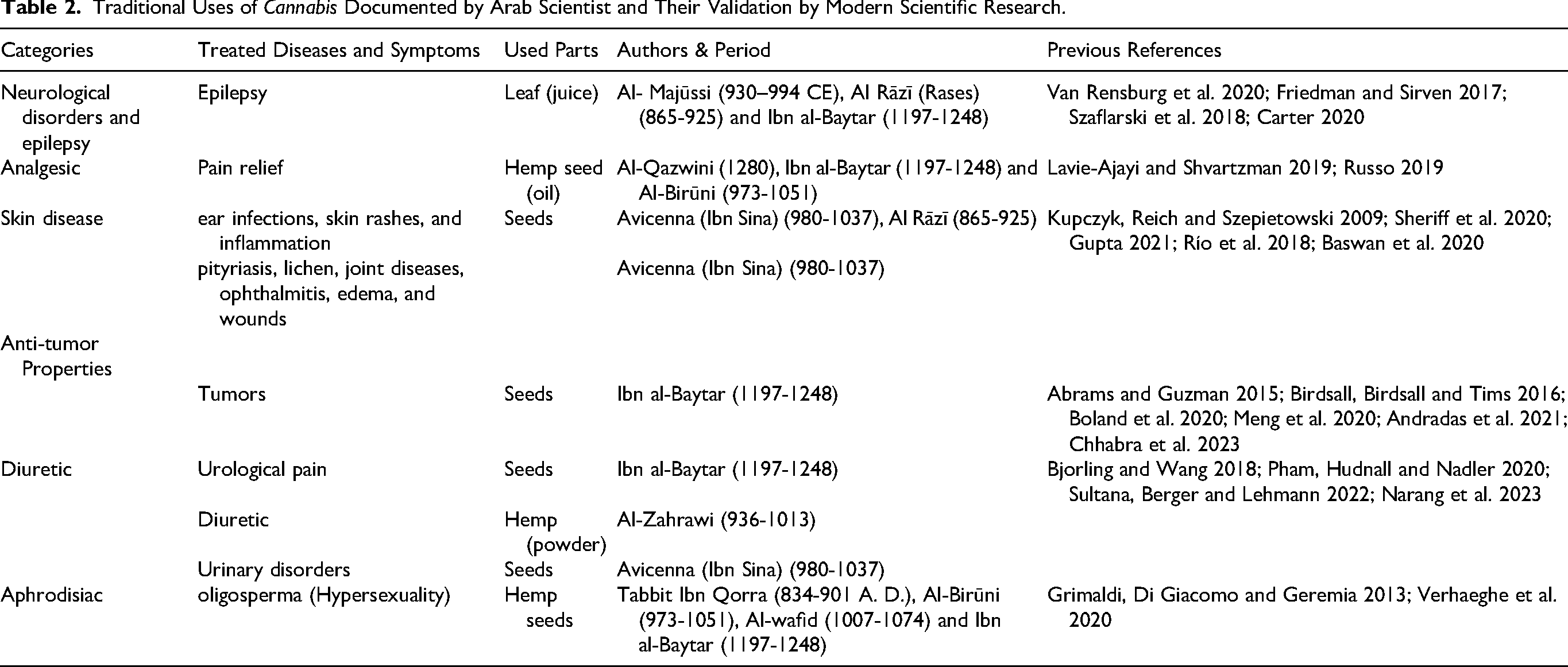
It is evident that the extensive efforts of Muslim scientists, achieved through the translations, assimilations, and interpretations of ancient ethnopharmacological and medical works firmly established the therapeutic applications of Cannabis. These scholars used different parts of the plant (leaves, seeds, and roots) to treat conditions not previously addressed in Chinese, Greeks, Romans, and Hindus traditions. Their work significantly expanded upon earlier knowledge by integrating empirical observations with clinical practices (Lozano 2001; Baker et al. 2003; Taha 2010). Cannabis based preparations were used to treat epilepsy and facial paralyzes, alleviate ocular pain and ear obstruction, and treat dermatological conditions such as scalp exfoliation and pityriasis. The plant was also used in the treatment of digestive disorders, due to its resolvent, siccative, choleretic, adipogenic, and antiemetic properties. These preparations were also used to treat respiratory ailments through their expectorant and curative effects on dry cough. Additionally, Cannabis was used to regulate urogenital disorders, including urinary tract inflammation, kidney stones, menstrual irregularities, and painful uterine contractions. It was also prescribed for conditions such as premature ejaculation, oligospermia, male sexual impotence, and, in certain cases, hypersexuality; it was even recommended as an aphrodisiac.
Traditional Uses of Cannabis Documented by Arab Scientist and Their Validation by Modern Scientific Research.
Cannabis has been used for medicinal purposes for centuries, with various methods of administration evolving over time. Traditionally, the medicinal preparations of Cannabis were administered orally, as juices, syrups, and infusions; or topically by applying compresses moistened with Cannabis extract (juice or oil), or by placing fresh or cooked leaves directly on the affected area; rectally in the form of linctuses; and through instillation of the juice into the ears or nose.
However, modern medical practice has introduced a broader range of administration methods, each with distinct pharmacokinetic profiles and therapeutic implications (Russo 2007; Loflin and Earleywine 2014; MacCallum and Russo 2018). Recent research has highlighted the therapeutic potential of cannabidiol (CBD), a non-psychoactive compound found in Cannabis, demonstrating its efficiency in treating various conditions (Nanni Alvarado, Martín del Campo Sánchez and Villamil Salcedo 2017; Chagas et al. 2014; Grotenhermen and Müller-Vahl 2012; Lowe et al. 2021).
Over 566 chemical compounds have been identified in the Cannabis plant, including 125 cannabinoids and 198 non-Cannabinoids compounds (Fordjour et al. 2023).
Conclusion
The ethnopharmacological use of Cannabis spans centuries, with its medicinal applications well-documented in the Arabic pharmacopoeia from the IXth to the XVIth century. This historical record underscores its importance as a therapeutic plant within Islamic medicine. Cannabis species are undoubtedly among the earliest plant-based remedies known to humanity. Over time, their use has evolved to encompass both hallucinogenic and medicinal proprieties. Cannabis was highly valued for its ability to treat a variety of conditions and symptoms, including psychiatric disorders, sexual health issues, physical pain, and digestive ailments. Given this rich historical context, it is reasonable to suggest that the vast information preserved in Arabic medical literature offers a valuable foundation for further research into the therapeutic properties of Cannabis and hemp seeds.
Footnotes
Acknowledgments
This paper is part of a Ghizlane Merzouki PhD study. I would like to express my gratitude to the General public Library of Tetouan. We also thank Prof. Abderrazzak Merzouki from the Polytechnic School of Montreal for linguistic review.

Funding
The authors received no financial support for the research, authorship, and/or publication of this article.
Declaration of Conflicting Interests
The authors declared no potential conflicts of interest with respect to the research, authorship, and/or publication of this article.