







Abstract
Ethnobiology has made significant strides in its ethical engagement with Indigenous Peoples and Local Communities. However, the discipline has largely overlooked the multidimensional risks and vulnerabilities that researchers themselves encounter. Ethnobiological fieldwork is inherently intersubjective and requires deep emotional engagement, which can impose profound psychological burdens, particularly in contexts marked by structural violence. These risks are not evenly distributed but are shaped by intersectionality; women and researchers from marginalized communities face disproportionate levels of harassment and insecurity. We argue that the current silence around researcher trauma compromises not only individual well-being but also the epistemic integrity of the data collected. To address this, we propose a “culture of care” framework that shifts responsibility from the individual to a collective system of accountability shared by supervisors and institutions. Central to this is a proactive risk management strategy that integrates contextual analyses and establishes clear trigger points for suspending activities. We conclude that fostering a culture of care is an affirmation of epistemic justice, essential for sustaining diverse participation and fostering a more resilient, inclusive, and ethically rigorous science, not only within ethnobiology but across all community-engaged disciplines.
Introduction
Ethnobiological fieldwork inherently involves engaging with people and environments beyond our typical institutional and working contexts. Moving “from theory into the field,” researchers transition from controlled laboratory and office settings to spaces they are often not yet intimately familiar with. While the discipline has rightly prioritized ethical interactions with Indigenous Peoples and Local Communities—the cultural “other”—to ensure respectful, noncolonial research that genuinely values local perspectives (Guber 2001; Posey 1999; Vandebroek et al. 2025), a critical aspect has been significantly overlooked: the emotional responsibility burdens, inherent risks, and diverse vulnerabilities faced by field researchers themselves.
Within the ethnobiological literature, the studies by Bridges and McClatchey (2006) and Narchi, Van der Plaat, and Toledo (2023a) represent rare instances that account for self-care measures in the field, particularly concerning physical emergencies.
This matter demands urgent attention, considering the multidimensionality of risks that could threaten the well-being of researchers. Beyond ethnobiology, many field-based scientific disciplines operate in environments where researchers face significant, yet often unaddressed, risks. A growing body of interdisciplinary literature demonstrates the widespread prevalence of harassment, discrimination, and violence during fieldwork, hazards that disproportionately affect women, early-career trainees and researchers, and individuals from marginalized backgrounds (Clancy et al. 2014; Dance et al. 2024; Hamylton et al. 2023). Addressing these pervasive challenges requires proactive, structural interventions from mentors and institutions to mitigate identity-driven risks and foster safe, equitable field experiences (Demery and Pipkin 2021; Wimpenny et al. 2024). While this broader literature provides a critical foundation for understanding structural vulnerabilities and institutional responsibilities (e.g., ADVANCEGeo Partnership 2026; Wimpenny et al. 2024), ethnobiology offers particularly valuable insights into these debates given the deeply relational, immersive, and intersubjective contexts in which it is grounded (Albuquerque et al. 2024).
Recent literature in ecology, geosciences, anthropology, and related fields has emphasized the importance of ethical engagement, not only with communities but also toward the researchers themselves, who may face multidimensional vulnerabilities during fieldwork (Azizi and Gundur 2025; Kamran and Jennings 2023; Peixotto et al. 2021; Rudzki et al. 2022; Silva et al. 2020; Wimpenny et al. 2024). For instance, there is accumulating evidence of escalating violence in both urban and rural settings in fieldwork contexts globally (Michaud 2010; Rettberg 2020), and particularly for researchers in certain disciplines, for example, conservation (Koot et al. 2025). Beyond physical safety, the mental health and well-being of researchers and their students are emerging as critical discussion points in shaping the future challenges of scholarly work (Hazell, Smail, and Staines 2021; Satinsky et al. 2021). Indeed, scenarios presenting manifold social, physical, environmental, and personal challenges can generate adverse situations that impede the proper continuation of research.
This opinion piece reflects on the necessity of discussing the risks and care for individuals conducting ethnobiological research. First, we examine the multifaceted nature of ethnobiological fieldwork, exploring how its intersubjective and transdisciplinary character creates unique vulnerabilities. Second, we address the specific risks researchers face, ranging from physical dangers to emotional and psychological burdens. Third, we define key concepts such as risk, threat, and vulnerability, with a particular focus on gender-based violence and intersectionality. Finally, we propose a comprehensive “culture of care” framework, detailing practical strategies for risk management, the importance of prefieldwork planning, and the need for institutional support systems to ensure the long-term well-being of researchers.
This is not solely a matter of physical safety, but one of holistic well-being, equity, and inclusion, conditions essential for producing high-quality science and sustaining diverse participation in field-based research (Nordseth et al. 2023).
The Multifaceted Nature of Ethnobiological Fieldwork
Fieldwork is a fundamental and direct practical experience central to contemporary ethnobiological research. It commonly involves rich human interaction through methods such as interviews, transect walks, participant observation, and participatory workshops (e.g., Albuquerque et al. 2014, 2019a). However, the scope of fieldwork is broader, encompassing the observation of nature, sample collection, measurements in diverse terrestrial or aquatic environments, visits to open-air markets, archaeological, historical, or heritage sites, and consultations of libraries, museums, and archives (e.g., Albuquerque et al. 2019a).
While numerous techniques are employed, observation, free, and (semi-)structured interviews are paramount. These activities often require extended stays of variable length in locales that can range from well-known to entirely novel and unfamiliar (Narchi, Van der Plaat, and Toledo 2023a, Narchi and Ruan-Soto 2023b). Researchers navigate a powerful dynamic in which unfamiliarity gives way to understanding, engaging in reciprocal knowledge exchanges that transform both the researchers and the communities they work with. Fieldwork is, by nature, a contextual and intersubjective experience, shaped by social relationships, guided by an unwritten code of conduct, and deeply rooted in the profound connections formed with the surrounding socioecological environment (Guber 2001). This process during fieldwork demands emotional exposure, empathetic listening, and ongoing negotiation of social, ethical, and institutional roles.
In ethnobiology, these challenges take on unique and layered dimensions (Narchi, Van der Plaat, and Toledo 2023a). Ethnobiology is a scientific field that investigates the interrelationships between human groups and the biota, taking into account the multiple factors that shape these relationships. These interrelationships are understood as being embedded within complex social–ecological systems, which emerge from the mutual interactions between two subsystems, such as the sociocultural system, formed by the beliefs, norms, and practices of a human group, and the ecological system, composed of biotic components, their interactions, and the physical environment in which they occur (Albuquerque et al. 2019b; Berkes and Folke 1998). As such, fieldwork in ethnobiology demands simultaneous engagement with both domains. This requires a hybrid sensibility, the ability to interpret a plant, for instance, as a food source, a medicine, a spirit, and an ancestral being, often all at once. Misreading or ignoring these dimensions can result in ethical breaches, cultural offense, or a breakdown in trust (McAlvay et al. 2021).
Importantly, ethnobiologists are not only observers of human–nature relationships, but they are also affected by them (Narayan 1993; Rodríguez Mega 2021). Participating in rituals, witnessing ecological loss, or hearing stories of displacement and ancestral connection can deeply move researchers, sometimes challenging their own ontologies, how they perceive knowledge, nature, and science itself (McAlvay et al. 2021; Posey 1999). For instance, being invited to a ritual honoring a sacred tree might provoke a profound emotional response, reshaping one's sense of ecological responsibility. Watching the destruction of a culturally significant forest patch may evoke grief and ethical distress (Blonder 2023; Warden 2013).
Ethnobiology often operates at the margins of institutional frameworks (McAlvay et al. 2021; Sluka 2018). Its interdisciplinary and intersubjective nature means that common ethical protocols, especially those based on biomedical models, may fail to account for the dilemmas faced in the field (Ghosh 2018; Vandebroek et al. 2025). Questions about community feedback or long-term reciprocity often fall outside the scope of formal ethics review boards (Albuquerque et al. 2024; SOLAE 2016). Academic institutions and funders may demand rapid, objective outcomes, while ethnobiological research requires slow, relational processes built on trust, care, and ethical reflexivity (Guber 2001; Silva et al. 2020). This tension underscores the urgent need for a “slow science” approach (Stengers 2013), which challenges the acceleration of academic production and prioritizes the necessary time for building safe, ethical, and reciprocal relationships in the field (Gandía 2013; Nordseth et al. 2023).
While the literature acknowledges the spatial diversity of ethnobiological research, ranging from archives to remote, unpredictable environments (Bridges and McClatchey 2006), it often fails to address the specific risks these contexts pose to early-career researchers. Beyond physical and logistical hazards, such as navigating remote field sites with dense vegetation, steep mountain terrain, large rivers, limited transport infrastructure, natural disasters, seasonal inaccessibility, and/or exposure to predators, parasites, and pathogens, alongside political instability (Kovats-Bernat 2002; Sluka 2018), fieldwork entails profound cognitive and emotional challenges, including isolation and emotional distress (Pollard 2009; Warden 2013).
In this sense, ethnobiology involves a particular kind of vulnerability for researchers, as it requires working across ecological and social contexts (Douglas-Jones et al. 2020; Narchi, Van der Plaat, and Toledo 2023a), and building close relationships that carry emotional and ethical responsibilities (Narayan 1993; Posey 1999; Warden 2013). Recognizing these dynamics is essential not only for responsible fieldwork but also for rethinking how we prepare, support, and care for researchers engaging with complex social–ecological realities (Demery and Pipkin 2021; Nordseth et al. 2023; Rudzki et al. 2022).
Fieldwork, in its many forms, has been described as a radical experience of displacement, estrangement, and, at times, suffering (e.g., Malinowski 2022). One of the most emblematic examples comes from Bronisław Malinowski, often regarded as one of the fathers of modern anthropology. In his field diary, written during research in the Trobriand Islands and published only posthumously, Malinowski reports intense feelings of isolation, loneliness, and frustration (Malinowski 1989). Some of his reflections have even become the subject of controversy for revealing personal and ambivalent comments regarding the people with whom he interacted. His notes show that the field is also a space for confronting one's prejudices, biases, limits, emotions, and vulnerabilities, a dimension often made invisible in academic texts and official methodological reports. When left unacknowledged, these challenges risk leaving novice researchers unprepared at best, and overwhelmed, disillusioned, or endangered at worst.
Furthermore, contemporary scholarship challenges the binary distinction between the “field” as a site of risk and “home” as a site of safety (Brigden and Hallett 2021; Hyndman 2001). Violence, harassment, and trauma experienced in the field often follow researchers back to their institutions, reshaping their personal and professional lives long after the fieldwork concludes.
However, for native and Indigenous anthropologists, the Malinowskian distinction between “the field” and “home” is an artificial construct. The field is not a distant location one visits and leaves behind; it is the place where one lives. Consequently, the political tensions inherent to the research context do not cease once data collection is over; they permeate daily life. This is vividly illustrated by the experience of one of the coauthors (A. Ladio), whose ethnobiological research with Mapuche communities has been met with public delegitimization. In a climate of increasing hostility, where the “foreignization” of Indigenous peoples creates a xenophobic discourse (Briones and Delrio 2007), researchers allied with these communities often face a secondary stigma—a reflection of the broader structural violence directed at the groups they study (Bleger and Yanniello 2025). Thus, the consequences of “the field” often resonate at home, as the tensions rooted in these territorial conflicts add a layer of personal and emotional complexity to one's professional practice.
Fieldwork, by its very nature, is also a formative space, especially at the undergraduate, Master's, doctoral, and postdoctoral levels (Hazell, Smail, and Staines 2021). Experiences in the field have the potential to profoundly shape academic trajectories, offering opportunities for learning, redefining meaning, and fostering scientific maturation. Just like laboratories and research institutions, field environments must be understood as spaces that require long-term support, careful planning, and a coresponsible attitude (Nordseth et al. 2023; Rudzki et al. 2022), both among team members (who can range from beginner students to experienced researchers) and in relationships with local interlocutors, guides, extension workers, health agents, government representatives, colleagues from other disciplines, and even individuals with whom interactions are unexpected, such as passersby or security forces (Sluka 2018; SOLAE 2016). In today's fast-paced academic climate, the development of such attitudes and skills is often undervalued and largely invisible in formal curricula and evaluations, despite requiring a substantial time investment and energy from researchers (Keller and Pierce 2023; Stengers 2013).
Breaking the Silence: Researcher Vulnerability in the Field
Despite often being romanticized as immersive and rewarding, ethnographic and ethnobiological fieldwork can entail significant risks that profoundly impact the physical, emotional, and ethical well-being of researchers. As Gandía (2013) observes, scientific fieldwork is often caught in a dialectic of “enjoyment and sacrifice,” where the romanticized love for the field can render the associated suffering and emotional labor invisible. This invisibility is partly rooted in the disciplinary persistence of the “heroic fieldworker” trope, a masculinized ideal of the solitary researcher who endures hardship without complaint (Douglas-Jones et al. 2020). Historically, fieldwork has been framed as a “trial by fire,” a rite of passage where survival is conflated with professional competence.
Pollard (2009) identifies the result of this pressure as a “field of screams,” where doctoral students and early-career researchers conceal traumatic experiences out of shame or a fear of professional incompetence. This disciplinary culture of silence prevents the community from learning from incidents and reinforces the harmful notion that struggling is a personal failure rather than a structural issue. Consequently, researchers often hide their distress, perpetuating a cycle that endangers future scholars.
While physical risks in fieldwork have been adequately addressed in the literature (Bridges and McClatchey 2006; Narchi et al. 2023a), ethnobiology involves levels of exposure and uncertainty not typically present in institutional environments (Hjorth Boisen 2018; Nordseth et al. 2023). We classify these challenges into the following four categories (see Table 1): (1) physical risks refer to threats to bodily integrity; (2) emotional/psychological risks encompass the internal mental health consequences or symptoms resulting from fieldwork stressors; (3) risks from social interactions arise from the external intersubjective dynamics and power relations with others in the field; and, (4) individual risks stem from the researcher's specific positionality, intersectionality, and internal cognitive processing, which are deeply influenced by one's gender, race, and academic status.
Types of Risks for Ethnobiologists in Different Workspaces.
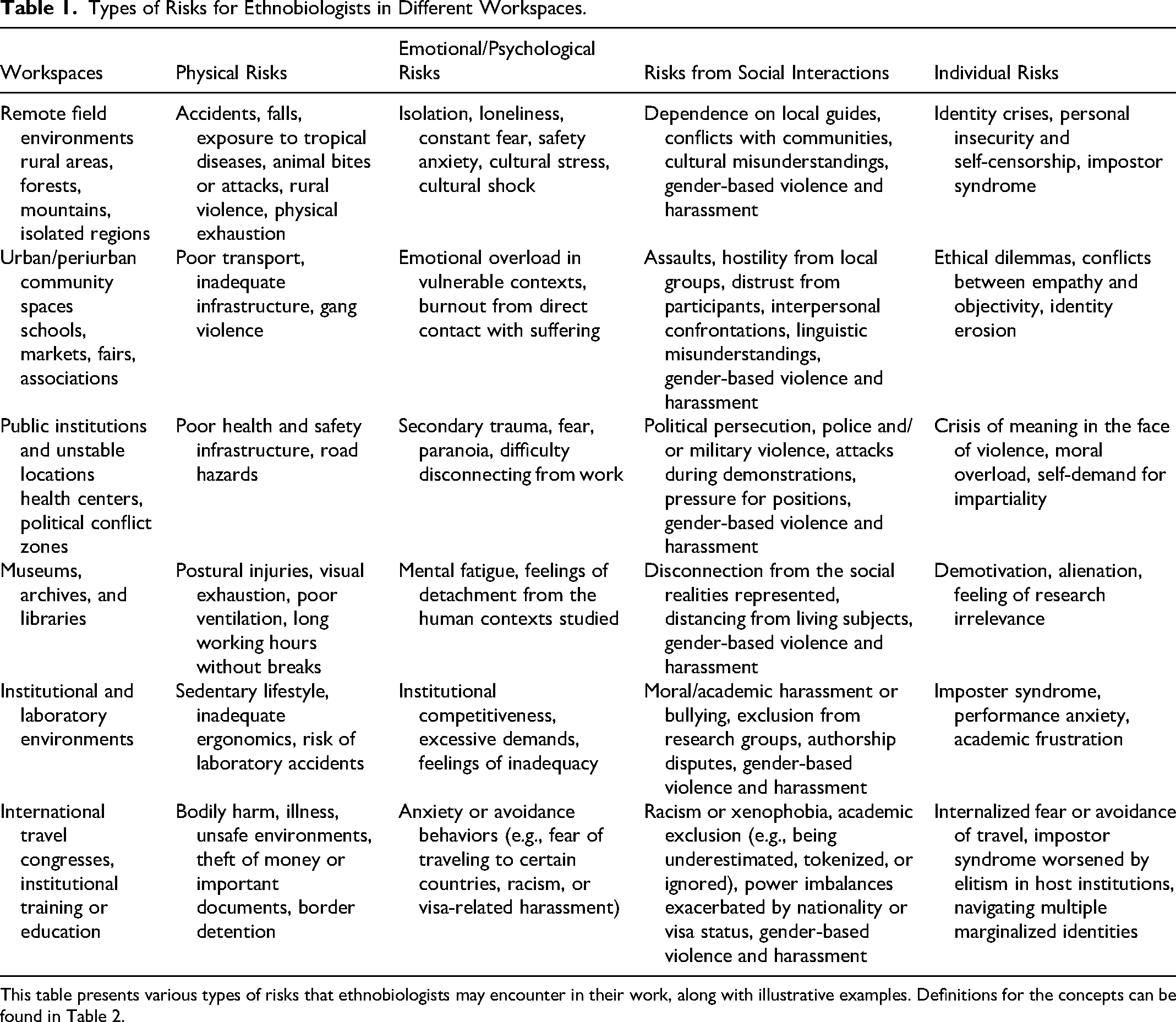
This table presents various types of risks that ethnobiologists may encounter in their work, along with illustrative examples. Definitions for the concepts can be found in Table 2.
In addition to these four analytical categories, it is important to recognize a set of cross-cutting risks that permeate all fieldwork contexts and cannot be contained within a single domain. These include climate- and environment-related stressors, such as extreme weather events, prolonged early-warning periods, or heat exposure; legal and administrative precarity, including revoked or delayed research permits and limited access to institutional legal support; and digital and data security risks, such as device theft, surveillance, breaches of confidentiality, and the long-term exposure of sensitive data. Rather than occurring in isolation, these risks accumulate over time and interact with physical, emotional, social, and individual vulnerabilities, often intensifying exposure and limiting researchers’ capacity to withdraw from unsafe situations. Because such cross-cutting risks shape anticipation, decision-making, and recovery before, during, and after fieldwork, they directly affect researchers’ cognitive focus, ethical judgment, and analytical rigor, with implications that extend well beyond the field itself.
Crucially, risk in ethnobiology is often interpersonally constructed. Johansson (2015) conceptualizes these dynamics as “dangerous liaisons,” arguing that essential relationships with gatekeepers or participants can paradoxically become sources of vulnerability. This is particularly acute for women researchers, where expectations of reciprocity can become sexualized or coercive (Silva et al. 2020; Steffen 2017). Recognizing this “relational risk” challenges the assumption that safety can be managed through checklists focused solely on physical or political hazards (Demery and Pipkin 2021; Rudzki et al. 2022).
Notably, contexts marked by structural violence and social vulnerability can lead to intense emotional burdens. Warden (2013), for instance, describes her fieldwork in Guatemala as characterized by secondary trauma and symptoms of posttraumatic stress disorder. She argues that the researcher's empathetic engagement is not merely a byproduct of the study but an integral component of the data-gathering process.
Such tensions were palpable in the initial fieldwork of one of this article's authors (U. P. Albuquerque) during research involving religions of African origin (Albuquerque 2014). To this young and methodologically inexperienced researcher, the field quickly revealed itself not merely as a site of data collection, but as an emotionally dense, symbolically charged, and psychologically demanding space. Entry into the “terreiro” (sacred ritual space) required constant vigilance over gestures, speech, bodily posture, clothing, and silence, since any inadvertent action could be interpreted as a serious breach of ritual etiquette or respect toward sacred entities and their representatives. This persistent self-surveillance produced a state of heightened tension, in which the researcher oscillated between the fear of transgression and the necessity of participation as demanded by ethnographic engagement.
Simultaneously, he confronted the practical limits of methodological training. Instruments initially conceived as neutral, such as questionnaires or direct interviews, proved inadequate in a context where knowledge about plants was inseparable from ritual narratives, life histories, secrecy, and situational trust. Information emerged obliquely, embedded in long conversations, ritual preparations, market interactions, and everyday practices, forcing the researcher to abandon rigid protocols and confront uncertainty, informational overload, and ethical dilemmas regarding what could or could not be recorded, disclosed, or later published.
These challenges were compounded by the emotional impact of culture shock. Although the researcher was conceptually familiar with this problem from anthropological literature, the lived experience within a religious universe historically marked by persecution and prejudice produced a profound sense of disorientation. He was confronted not only with alterity, but with his own preconceived fears, and moral discomforts—particularly during moments of ritual intensity, animal sacrifice, trance, and communal meals. Fieldwork thus demanded an ongoing negotiation between scientific curiosity, emotional endurance, ethical responsibility, and humility, revealing that participation in such contexts entails personal transformation as much as epistemic learning.
These individual vulnerabilities are exacerbated by institutional cultures. A survey of doctoral students (Hazell, Smail, and Staines 2021) revealed that the majority perceive poor mental health as a “normal” part of the Ph.D. process. This reflects what Santoro et al. (2023) describe as “vocational awe,” a systemic belief that the intrinsic value of the work justifies personal sacrifice. Similarly, Cech (2021) argues that the “passion principle” in science reproduces inequalities, as researchers are expected to endure precarious conditions as proof of commitment.
This mentality was vividly illustrated to the author I. Vandebroek, who was told by a senior academic during her graduate research: “if I haven’t seen your blood, sweat, and tears, it means you haven’t done a Ph.D.” Such pressure is particularly dangerous for early-career researchers, who often operate under intense institutional demands while managing the emotional burden of immersive fieldwork (Keller and Pierce 2023). Institutional reports confirm that fieldwork settings show a high incidence of preventable hazards, including gender-based violence and sexual harassment (Blonder 2023; Peixotto et al. 2021; Rodríguez Mega 2021), which can lead to the loss of years of academic productivity.
Neglecting these dimensions impacts individual well-being and compromises the integrity of research findings by delaying help-seeking. There is a clear need for ethical frameworks grounded in care and mutual respect, not just for local participants but within research teams as well. Ethical codes, such as those from the ISE (International Society of Ethnobiology 2006) and SOLAE (2016), Sociedad Latinoamericana de Etnobiología, emphasize nurturing trust-based relationships (Vandebroek et al. 2025). While primarily designed to address power dynamics with communities, these protocols must be expanded to address the vulnerability of researchers themselves, normalizing the reporting of difficulties as a standard component of professional practice.
Defining the Landscape: Risk, Violence, and Intersectionality
To effectively mitigate the risk of violence during fieldwork, it is crucial to clarify the distinct concepts of risk, threat, vulnerability, and the overarching concept of violence itself (Table 2), as highlighted by Hjorth Boisen (2018). Risk assessment incorporates the concept of impact—the potential harm arising from a materialized threat—but crucially depends on the interplay between exposure and vulnerability. While “exposure” refers to the extent to which a researcher is temporally or spatially in the path of a hazard, “vulnerability” describes the susceptibility to harm if that hazard materializes, often shaped by intersectional factors (Pillinger 2019; Rudzki et al. 2022). Therefore, effective mitigation is not merely about avoiding threats but requires a dual approach: reducing exposure (e.g., avoiding unsafe areas) and decreasing vulnerability (e.g., through training and support networks) (Demery and Pipkin 2021).
Key Concepts for Risk and Violence Assessment.
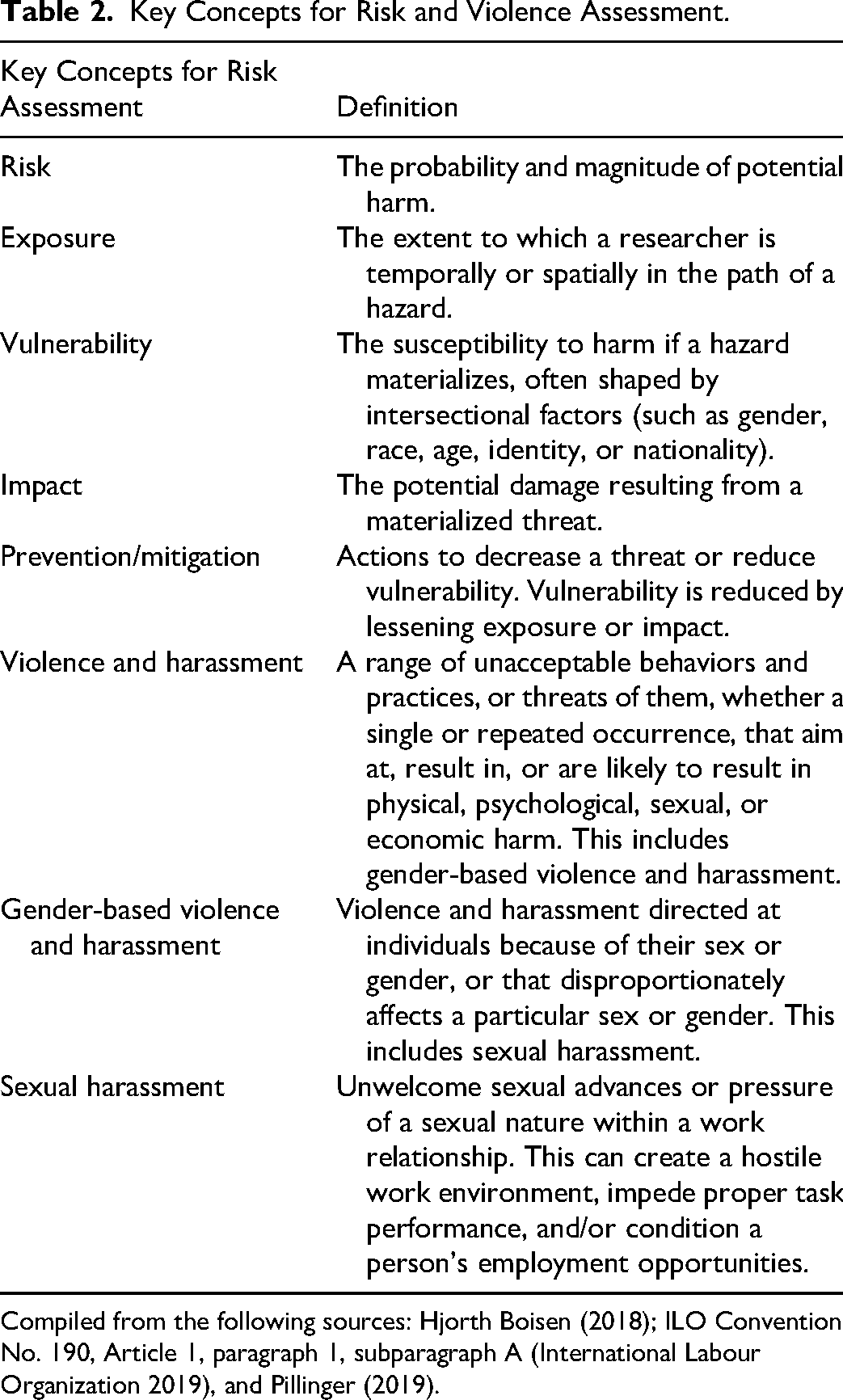
Compiled from the following sources: Hjorth Boisen (2018); ILO Convention No. 190, Article 1, paragraph 1, subparagraph A (International Labour Organization 2019), and Pillinger (2019).
Vulnerability to violence is multifaceted and intersectional (Crenshaw 1989). Intersectionality posits that various social and political identities (including but not limited to race, ethnicity, gender, class, sexuality, disability, nationality) combine to create unique modes of discrimination and privilege, with these facets interacting to produce complex and often compounded experiences of oppression or advantage. For instance, a Black woman may experience discrimination specifically as a Black woman, shaped by the intersection of both identities (Hooks 2020). Understanding team members’ personal characteristics and pre-existing relationships is crucial for effectively deploying risk mitigation resources during fieldwork, especially in insecure settings.
Fieldwork environments, much like any other professional setting, are unfortunately susceptible to various forms of violence and harassment. While we will not delve into the extensive literature and international legislation on workplace violence; Table 2 acknowledges and defines these issues.
It is common for there to be a reluctance to use the word “violence” in professional contexts. However, defining its manifestations in concrete terms is vital for individuals to recognize them more easily and for appropriate responses to be developed (Hamby 2017). This clarity is especially important because violence, in many settings, can become normalized (Hazell, Smail, and Staines 2021), making identification difficult as individuals grow accustomed to increasingly hostile scenarios.
Gender-based violence constitutes a specific form of abuse directed at individuals based on their gender, disproportionately affecting women and gender-diverse individuals (Pillinger 2019). It encompasses physical, psychological, sexual, or economic harm, including threats, coercion, and deprivation of liberty, occurring both within and outside the workplace (ILO 2019). Importantly, this violence operates on a continuum that includes “micromachismos” (Bonino Méndez 1998). These represent ingrained, often imperceptible forms of domination that are manifested through subtle gestures and daily behaviors that consciously or unconsciously perpetuate gender inequality.
The challenges for women working in the field are particularly stark, as concretely demonstrated by the experiences of one of this article's authors (A. Ladio). Across multiple sites in NW Patagonia—typically isolated locations characterized by rugged geography and lacking infrastructure or security—she endured gender-based harassment from interviewees, officials, and drivers who assumed a right to comment on her body or make sexual advances. Such incidents were disruptive enough to force the premature cessation of fieldwork, and her ability to proceed safely often depended on the presence of a male colleague. This fear of assault reflects a deeply embedded systemic issue: the pervasive understanding that independent movement in both urban and remote field environments poses a significant risk for women, unlike for their male counterparts (Clancy et al. 2014). This constant vigilance not only fosters professional uncertainty but also demands a significant cognitive burden, as women must prioritize personal safety alongside their intellectual work. Furthermore, this vulnerability can be compounded for researchers with intersecting identities, such as Indigenous women, women of Afro-descent, or members of the LGBTQIA+ community, who often face overlapping layers of discrimination and skepticism from both local communities and academic peers (Demery and Pipkin 2021).
Further evidence of the systemic nature of these gendered challenges comes from a study by Silva et al. (2019), which investigated the contemporary landscape of women's participation in ethnobiological research, combining a 28-year review of scientific publications with survey data from seventy-seven women ethnobiologists affiliated with the Brazilian Society of Ethnobiology and Ethnoecology. Particularly in relation to accounts of field experiences, their findings showed that over 60% of participants experienced disadvantages during data collection, including restricted access to key participants, sexual harassment, and gender-based devaluation of their work. Discourse analysis further illustrated that women researchers frequently face physical and emotional insecurity, limited autonomy in male-dominated field contexts, and skepticism from both community members and academic peers. Many were denied participation in culturally gendered activities (e.g., fishing fieldwork), saw their questions redirected to male colleagues, or witnessed acts of domestic violence and structural sexism in the communities they worked with (Silva et al. 2019). These findings highlight the multifaceted and systemic nature of gendered vulnerability in ethnobiological fieldwork.
The culture of silence is rooted in a historical legacy of victim-blaming, as illustrated by the Henrietta Schmerler case (Box 1). As noted by Steffen (2017), the institutional response to her murder was to pathologize her behavior rather than question the safety protocols. We include this case not merely as a historical record, but as a cautionary example of how attributing safety solely to “individual competence” absolves institutions of their duty of care.
In 1931, the young anthropology student Henrietta Schmerler, sent by Franz Boas and Ruth Benedict to conduct field research with the White Mountain Apaches in Arizona, was raped and murdered by a man from the community. Instead of acknowledging the violence and reflecting on the risks faced by female fieldworkers, part of the anthropological community at the time treated the case as the result of the victim's recklessness. Boas and Benedict, among others, suggested that Schmerler had transgressed cultural norms and overstepped the bounds of her role, as if her death were the result of an error of judgment rather than brutal violence. Decades later, anthropologist Megan A. Steffen revisited this case in an essay published by American Ethnologist, connecting it to her own experience of sexual violence during fieldwork in China. Steffen demonstrates how anthropology has created, and largely continues to perpetuate, a culture of victim blaming, especially when it comes to female researchers, as a means of preserving the fiction of neutrality and control in the field. Rather than acknowledging that relations of power and vulnerability permeate fieldwork, the discipline often chooses to minimize or silence the suffering experienced by its members. Reading this case in light of contemporary discussions about ethics and care in fieldwork reveals a perverse layer. By blaming Schmerler, anthropology has not only failed to protect her but has also instituted a model of addressing violence that makes it impossible to recognize the real risks that researchers, especially those who belong to historically vulnerable groups, face. Pain and trauma are thus not only silenced but also delegitimized as part of the scientific experience. It is essential to overcome this legacy and establish a research ethic that considers, with honesty and responsibility, the human risks associated with fieldwork.Case Study on Institutional Blame: The Henrietta Schmerler Tragedy (see Steffen 2017).
Similarly, rigid masculinity norms can pressure male researchers to conceal their emotions, avoid reporting feelings of fear or vulnerability, and take unnecessary physical risks in order to demonstrate “strength.” This is also a form of gender-based risk that warrants attention (Maffia 2007).
Researcher protection cannot be seen as an individual responsibility but rather as an ethical and institutional requirement. Demery and Pipkin (2021) present a robust set of practical recommendations aimed at researchers, supervisors, and institutions. Among these proposals is the creation of safety protocols adapted to individuals in the situations of greater vulnerability; the training of advisors (mentors) and academic leaders on the specificities experienced by minority and minoritized groups, without relegating to them the responsibility of educating their supervisors; the promotion of institutional support networks, with constant communication, psychological support, and effective channels for reporting incidents; the recognition of the legitimacy of the choice not to go into the field in unsafe situations; and the cultural change in scientific institutions, in order to encourage the reporting of experiences of violence or discrimination, breaking with the stigma of vulnerability and promoting a more ethical and inclusive science.
Hjorth Boisen (2018) specifically notes that individuals uncomfortable with a certain level of risk may limit their research activities to avoid exposure to dangers (real or perceived), or that emotional stress may restrict their work effectiveness or increase their vulnerability.
Risk Assessment: Contextual and Situational Analysis
Effective risk management relies on two complementary strategies: situational and contextual analysis. Situational analysis is practical and problem-oriented, focusing on the specific particularities of the project and the research team. This involves assessing internal factors such as team composition, power dynamics, interpersonal tensions, and the specific logistics of fieldwork (Figure 1). In contrast, contextual analysis is broader, analytical, and interpretive. It focuses on the wider social–political–ecological environment in which the research takes place, requiring an understanding of structural violence, crime rates, political instability, and local cultural norms that may impact safety (Figure 1). Both analyses are necessary to identify potential threats and vulnerabilities before entering the field.
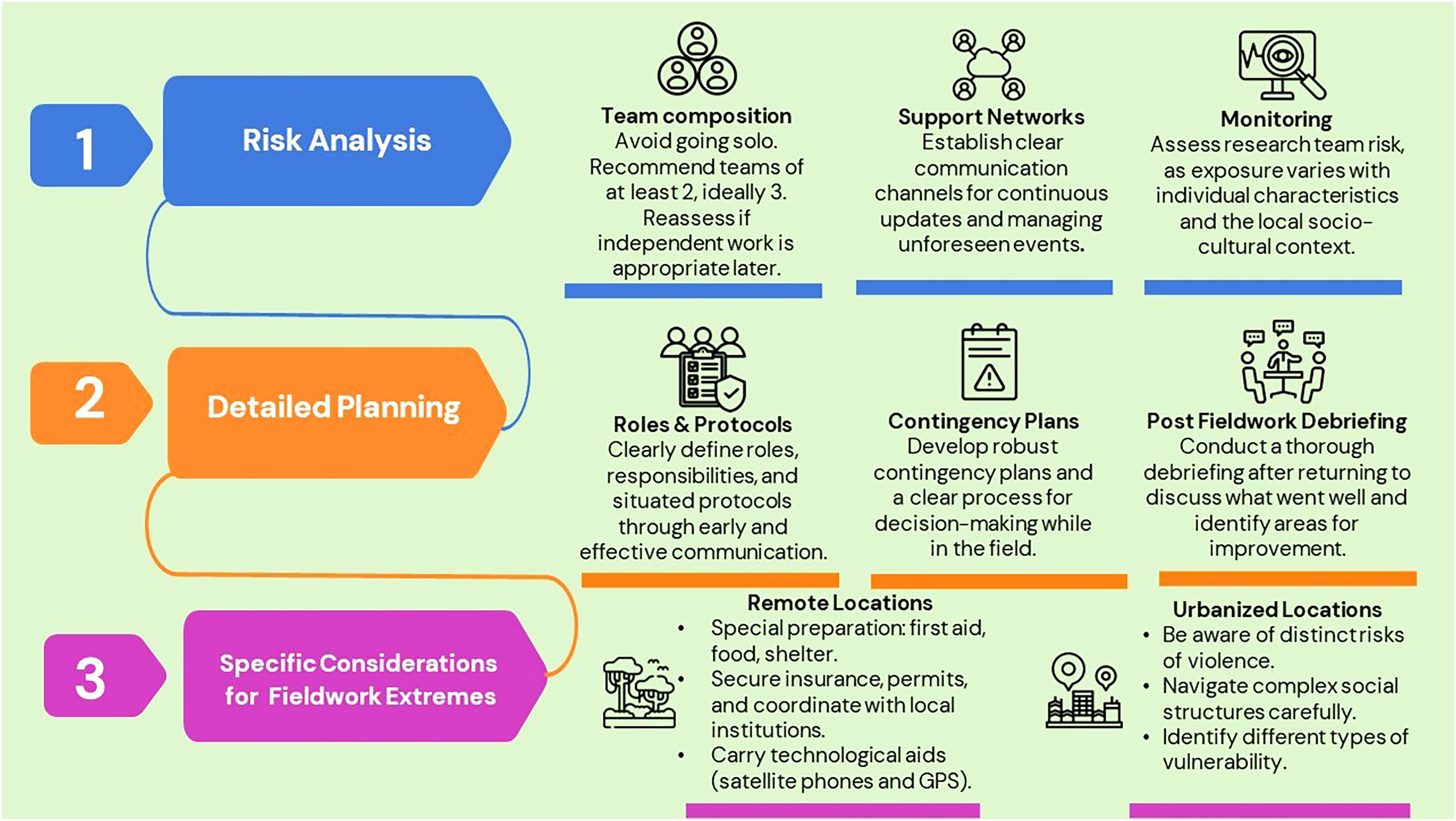
A comprehensive workflow for fieldwork risk management, organized into three key phases: (1) situational and contextual analysis, (2) detailed planning, and (3) specific fieldwork considerations tailored to remote or urbanized locations.
Therefore, predeparture planning must include gathering up-to-date information on both natural hazards and local sociopolitical dynamics (Figure 1). In areas with acute tensions, researchers should maintain proactive situational awareness and codesign safe routines with local collaborators. While institutional guidelines often mandate contacting local police during a safety breach, relying on state forces in regions with histories of structural violence or corruption can actually endanger both researchers and local partners. Consequently, safety planning must prioritize community-led strategies for mutual protection. Furthermore, when assessing these sociopolitical risks, we must avoid framing them merely as “threats.” Such language risks stigmatizing communities as “unsafe” and can be co-opted to justify state policing or the militarization of natural resources. Ultimately, our intention is to foster a paradigm of mutual care, ensuring risk assessments protect both researchers and the communities with whom they collaborate.
Building a Culture of Care: A Framework for Action
Effectively navigating these challenges is paramount for supporting researchers’ long-term engagement with their scientific work. The necessity of safety extends beyond physical integrity to the cognitive resources required for research. Applying Maslow's hierarchy of needs to the fieldwork context, John and Khan (2018) demonstrate that the mental focus necessary for rigorous inquiry, such as critical analysis, creativity, and problem-solving, cannot be effectively mobilized when researchers’ basic physiological and safety needs are compromised. When a researcher is in a constant state of hypervigilance or anxiety, their ability to observe nuances and interpret data is physiologically impaired. Therefore, institutional support for researcher safety is not merely a welfare measure but a fundamental prerequisite for maintaining scientific rigor and data reliability. Most recently, this was witnessed in Jamaica after the passing of Hurricane Melissa, the third most intense Atlantic storm on record, which wreaked havoc on the country. Professor Michael Taylor, Dean of the Faculty of Science and Technology at the University of the West Indies, Mona, observed that “climate change is not only reshaping the physical climate; it is also amplifying the emotional one. The mental fatigue of long warnings, the dread of the disaster, the trauma of storms that stack one upon another… and the despondency of sitting amidst the rubble not knowing where to turn or what to do – these, too, are climate impacts.” Even after university operations resumed, students reported anxiety, exhaustion, and emotional strain, illustrating that mental recovery lags behind physical restoration. Taylor emphasized that resilience must address mental health alongside infrastructure: “The mental toll begins before the storm hits and does not end when the rain stops. As we are also seeing, it only deepens in the aftermath. Emotional first aid must be treated every bit as essential as restoring infrastructure… Counselling support, faith-based outreach, school guidance programmes, circles of empathy… are not luxuries; they are now necessities for recovery” (Taylor 2025).
These challenges can be alleviated by establishing clear and effective communication processes within the team, ensuring members are adequately prepared and comprehensively informed about all foreseeable field scenarios. Equally important is cultivating a shared sense of responsibility for co-creating safe, respectful, and nonviolent work environments, both in the field and across other professional contexts.
The approach to caring for individuals and preventing violence during fieldwork must be multidimensional and integrative. Among the numerous strategies, the most critical include:
Recognizing Violence as Unacceptable
Acts involving workplace harassment, sexual harassment, personal mistreatment, or physical, verbal, psychological, symbolic, or economic violence within the context of fieldwork constitute unacceptable conduct (Table 2). Such acts can all be categorized as workplace violence because they occur within the framework of research involving individuals affiliated with an academic institution.
Knowing and Applying Relevant Normative Frameworks
International regulations promote respect for human rights and diversity, thereby prohibiting any form of discrimination or mistreatment based on academic hierarchy, gender, age, disability, physical appearance, race, ethnicity, nationality, religion, political ideas, or socioeconomic status. This commitment is underpinned by numerous international instruments and reflected in national laws that often draw from these global standards. For example, the Convention on the Elimination of All Forms of Discrimination against Women and the International Labor Organization's Violence and Harassment Convention (C190) advocate for environments free from discrimination and violence, reinforcing the principles of equality and respect across various spheres, including the workplace and academic research settings.
Operationalizing Safety: Trigger Points and Protocols
The risk management approach involves examining the threats present at the fieldwork location or during the activities conducted there, people's vulnerabilities to these threats, the potential negative impacts if each threat materializes, and the likelihood of their occurrence (Figure 1).
However, we must critically distinguish between genuine care and what Schneider (2020) terms “preparation bureaucracy.” In the neoliberal university, risk assessment protocols often function primarily to shield the institution from liability rather than to protect the researcher's physical and mental integrity. Sluka (2018) warns that these bureaucratic hurdles can act as gatekeepers, effectively banning research in “dangerous” zones and sanitizing the field in ways that hinder critical inquiry. A true culture of care moves beyond checking boxes on safety forms; it requires institutions to acknowledge that unpredictability is an inherent part of ethnobiological work, not a competitive disadvantage or a liability to be erased.
According to Hjorth Boisen (2018), a key aspect of risk management is for field teams to establish a clear threshold for canceling or suspending their activities. Such thresholds are often referred to as trigger points or decision points. This decision should take into account environmental changes, incidents, or the accumulation of previous violent or destabilizing events that significantly increase the level of risk. The circumstances that lead to such trigger points can vary. In some cases, they may involve one or more team members experiencing workplace harassment or gender-based violence from within the team, or from individuals in the local community. In others, increased risk may be the result of a gradual deterioration of conditions in the field site, such as rising political tensions, crime, or environmental instability, creating a broader context of insecurity. Proactively anticipating these potential risks through clear protocols and team communication can help prevent reaching a critical inflection point and protect the well-being of all participants (Figure 1). For example, in a situation of sexual harassment, if a sexual advance is perceived, one must immediately create distance, both physically and verbally. If these advances persist, the individual must decide that the trigger point has been reached; other participants should be alerted, and the potential cancelation of the fieldwork should be evaluated. Another example involves situations of violence and insecurity on roads and paths, which necessitate placing emphasis on travel safety, with team members remaining alert to the possibility of such incidents.
Ideally, these “trigger points” should be discussed transparently with local partners during the planning phase. Establishing a shared understanding of safety thresholds ensures that a sudden withdrawal by researchers is not perceived as abandonment, but as a preagreed safety measure that respects the well-being of all involved.
Unfortunately, not all risks can be anticipated, particularly those triggered by political developments. An example involves coauthor I. Vandebroek, who made the difficult decision to cancel fieldwork in 2010 when major political upheaval erupted in Bolivia following the government's controversial decision to construct a highway through the Indigenous Territory and Isiboro-Secure National Park (Wickstrom 2013). This major construction project, initiated without the Free, Prior, and Informed Consent of Indigenous communities, provoked widespread protests, road blockades, and confrontations between Indigenous groups, state authorities, and other political actors (Hope 2016). As tensions escalated—both among Indigenous communities themselves, due to differing opinions on the project, and between Indigenous groups and the State—it became increasingly evident that the security of researchers and students in the area could not be guaranteed. The field site, once characterized by mutual trust and long-term collaboration, had become a politically charged and volatile environment. Under these conditions, continuing research not only posed logistical and personal safety concerns but also raised serious ethical questions about the appropriateness of conducting fieldwork in the mid of conflict and contested sovereignty. Tragically, the conflict, driven by external political and economic interests, undermined and ultimately erased over a decade of carefully nurtured relationships between ethnobiologists and Indigenous community members. Long-standing collaborations were disrupted, key Indigenous collaborators moved away, trust was fractured, and the once-open channels for knowledge exchange and coproduction were closed, perhaps indefinitely. This case underscores the profound vulnerability of fieldwork relationships to forces beyond the control of researchers and highlights the ethical responsibility to prioritize the well-being and autonomy of local communities, as well as the safety of researchers, over data collection when tensions arise.
In environments marked by high instability or structural violence, standard ethical protocols designed for stable contexts often prove insufficient or even hazardous. Kovats-Bernat (2002) proposes a “localized ethic” which empowers researchers to prioritize immediate survival and the safety of all involved—through tactics such as strategic withdrawal or the temporary concealment of identity—over rigid adherence to institutional guidelines. Supporting this adaptive approach, Azizi and Gundur (2025) emphasize the value of collaborative research teams. By partnering with local researchers who possess deep cultural and linguistic capital, teams can navigate precarious landscapes more effectively while ensuring that knowledge generation remains both ethical and culturally grounded. These modifications are not deviations from scientific rigor; rather, they represent a pragmatic and essential recalibration of methodology to achieve a more nuanced understanding of complex field realities.
Crucially, we must acknowledge the asymmetry of risk. While ethnobiologists may face temporary dangers, the communities we work with often endure structural violence as a permanent reality. Unlike researchers, who usually possess the privilege and resources to withdraw from the field when safety is compromised, local community partners often remain on the frontlines. Thus, risk management protocols should never prioritize researcher safety at the expense of community vulnerability, but rather seek reciprocal protection strategies.
Ensuring Fieldwork Planning with Full Consent and Participation
For successful fieldwork, research teams must prioritize planning and dialogue to prevent conflicts and ensure collaboration. It is essential to collectively establish clear norms for coexistence, mutual respect, and well-being, as well as define work standards and responsibilities with the explicit consent of all members. To achieve this, groups can use tools from Nonviolent Communication (Rosenberg 2013), a method that facilitates open dialogue by encouraging individuals to express their feelings, needs, and requests. This approach fosters sincere expression and empathetic listening, which helps to address potential issues and build a foundation of cooperation and respect within the team.
Predeparture planning is essential for successful fieldwork (Figure 1). Research teams must collectively agree on the total duration, schedule, and potential for extended work periods, as excessive workloads increase risks of accidents and dissatisfaction. While fieldwork requires more flexibility than laboratory settings, discussions about intensive or overtime scenarios should secure the full, prior consent of all members. This ensures that all individuals are committed and that their needs are respected for the project to succeed.
Integrating a Gender and Diversity Perspective
Workplace harassment and violence disproportionately affect women and sexual dissidents, according to data compiled by the ILO from Convention 190 on Violence and Harassment in the world of work (C190) (Pillinger 2019).
Fieldwork settings, much like institutional workplaces, require affirmative actions aimed at protecting and preventing violence against women and diverse individuals. An active and reflexive practice is necessary to analyze all relationships established in the field—whether with group members or others—to ascertain if individuals’ conditions related to gender, race, class, or other factors place them or others at risk of violence.
To ensure equitable participation and prevent the exclusion of individuals with caregiving responsibilities, fieldwork schedules and roles should be designed collaboratively and with flexibility, allowing all team members to contribute while respecting their personal commitments. This is a critical consideration. Research by Santoro et al. (2021) has shown that female ethnobiologists often reduce or cease fieldwork when balancing it with caregiving duties. This burden is frequently compounded by the mental load, a common phenomenon highlighted by Emma (2018). Mental load refers to the invisible, uncompensated, and often relentless cognitive labor involved in managing household and family responsibilities. This includes planning, organizing, remembering, and delegating tasks, as well as anticipating needs and problem-solving, even when not actively performing a task. It is the constant “to-do list” running in one's mind, often disproportionately shouldered by women, leading to stress, exhaustion, and reduced well-being.
This invisible cognitive labor not only impacts women researchers’ well-being but also directly undermines their capacity for theoretical innovation and methodological creativity in the field, thereby posing a subtle yet powerful barrier to producing cutting-edge knowledge. It is important to foster diversity in fieldwork, incorporating a variety of perspectives to avoid a singular outlook in research (Maffia 2007). According to that author, the exclusion of women and members of the LGBTQIA+ community from science (in this case, from fieldwork) has a dual negative outcome: it prevents their participation in the epistemic communities that construct and legitimize knowledge, and it expels qualities considered “feminine” from such construction and legitimation, or considers these qualities as obstacles (Maffia 2007).
Finally, it is essential to acknowledge the specific vulnerabilities of students who must work part-time or full-time in order to afford university education or graduate studies. For these students, participation in fieldwork often involves hidden costs, including unpaid labor, lost income, inflexible schedules, and heightened physical and emotional exhaustion. The need to maintain paid employment alongside academic responsibilities can limit their ability to engage fully in predeparture planning, extend working hours in the field, or recover adequately after intensive fieldwork periods. Ensuring equitable and ethical fieldwork therefore requires institutions and research teams to explicitly consider students’ labor conditions, provide financial and temporal flexibility, and avoid normalizing expectations that privilege those who can afford to work without pay or with minimal economic security.
Institutional Support: Continuous Reflective Groups
Given the evidence of the physical, emotional, social, and ethical risks involved in fieldwork in ethnobiology and related fields—risks that range from isolation and physical exhaustion to profound ethical dilemmas and secondary traumas—we propose the creation of continuous reflective groups, with a broad therapeutic focus, to support the processing of researchers’ subjective experiences.
These initiatives would establish peer support groups focused on welcoming and listening to researchers’ experiences, particularly those in the early stages of their careers. The goal is to provide a safe space for verbalizing, processing, and redefining fieldwork experiences. The proposal involves the voluntary participation of researchers, who, guided by professionals trained in group facilitation and workplace well-being, can mentor and support others through challenges, anxieties, ethical dilemmas, and experiences of cultural displacement. This model has proven valuable in fostering well-being, as demonstrated by the experience of A. Ladio, who participates in a newly formed network for all science workers in the Bariloche area, Argentina (https://patagonianorte.conicet.gov.ar/espacio-de-atencion-violencia-laboral-y-de-genero/). Another option may be to establish these support groups in our professional societies. Specific sessions could be held periodically and continuously, promoted by institutional initiatives (such as universities and postgraduate programs) or by scientific societies (such as the ISE—International Society of Ethnobiology, SEB—Society for Ethnobotany, or regional societies such as SOLAE), functioning as a strategy for care, prevention of mental illness, and promotion of healthier professional relationships.
Conclusion: Fostering a Culture of Care in Ethnobiology
The ethics of ethnobiology, traditionally centered on protecting and respecting the communities involved in research, require expansion.
This new paradigm of the ethic of care requires that we begin to understand the subjects who conduct research not as neutral agents but as situated ones marked by their social trajectories, family histories, experiences of discrimination, and different degrees of privilege and vulnerability. Indigenous, Black, LGBTQIA+, women, and researchers with dissident experiences face additional layers of exposure and stress, often interspersed with racism, discrimination, homophobia, sexism, and/or other forms of oppression, including within academic environments. Thus, promoting care for researchers is more than a matter of individual well-being; it is an affirmation of epistemic justice, which recognizes the diversity of subjects who produce knowledge and their different ways of being affected by the field of research.
To effectively operationalize a culture of care, responsibilities must be explicitly distributed across different levels of the scientific ecosystem:
Individual researchers: Must actively engage in predeparture planning, transparently communicate their personal boundaries, and utilize reflective peer-support groups to process the emotional load of fieldwork. They should also participate in co-creating “trigger points” for safely suspending activities. Supervisors and mentors: Must shift away from the “heroic fieldworker” trope and actively normalize conversations about mental health and safety. They are responsible for co-creating intersectional risk assessments with their teams, ensuring equitable task distribution, and respecting a researcher's decision to withdraw from unsafe environments without penalizing their academic progress. Institutions and funding bodies: Must move beyond liability-focused “preparation bureaucracy” (Schneider 2020) by providing robust, flexible funding that accommodates delays or cancelations due to safety concerns. Institutions should mandate and fund specialized emotional and physical safety training, implement clear and safe reporting channels for harassment or violence, and recognize invisible cognitive labor in academic evaluations.
Central to this is fostering a culture of care where reporting fieldwork-related suffering is legitimized rather than stigmatized. By prioritizing researcher well-being, we enable a more ethical, pluralistic science that honestly acknowledges its position as a situated, relational human practice. This framework offers a vital blueprint far beyond our field, extending a much-needed culture of care to any community-engaged discipline seeking to protect its researchers.
Footnotes
Acknowledgments
We thank Dr. Álvaro Fernández-Llamazares and two anonymous reviewers for their valuable contributions. We also acknowledge the National Scientific and Technical Research Council (CONICET) for its support. Finally, we extend our gratitude to the members of the Committee for the Prevention of Workplace and Gender-Based Violence of the North Patagonia Scientific and Technological Center (CCT Patagonia Norte).

Author Contributions
Ana H. Ladio: conceptualization and writing—first draft preparation, reviewing, and editing. Ulysses Paulino Albuquerque: writing—draft preparation, reviewing, and editing. Ina Vandebroek: writing—draft preparation, reviewing, and editing. Washington Soares Ferreira Júnior: writing—draft preparation, reviewing, and editing.
Funding
The authors disclosed receipt of the following financial support for the research, authorship, and/or publication of this article: We would like to acknowledge the National Council for Scientific and Technological Development (CNPq) for the financial support provided to the international cooperation project Adaptive Strategies in the Face of Climate Change: A Tri-National Analysis of Traditional Ecological Knowledge (442678/2023-1). Ina Vandebroek gratefully acknowledges the support of the National Geographic Society (Grants #9339-13 and #HJ-161R-17) and the Mohamed bin Zayed Species Conservation Fund (Project #172517028) for funding ethnobiological fieldwork in Jamaica. We also acknowledge the support from CONICET (Argentina).
Declaration of Conflicting Interests
The authors declared no potential conflicts of interest with respect to the research, authorship, and/or publication of this article.