







Abstract
Suppose that ball-shaped sensors wander in a bounded domain. A sensor does not know its location but does know when it overlaps a nearby sensor. We say that an evasion path exists in this sensor network if a moving intruder can avoid detection. In ‘Coordinate-free coverage in sensor networks with controlled boundaries via homology', Vin de Silva and Robert Ghrist give a necessary condition, depending only on the time-varying connectivity data of the sensors, for an evasion path to exist. Using zigzag persistent homology, we provide an equivalent condition that moreover can be computed in a streaming fashion. However, no method with time-varying connectivity data as input can give necessary and sufficient conditions for the existence of an evasion path. Indeed, we show that the existence of an evasion path depends not only on the fibrewise homotopy type of the region covered by sensors but also on its embedding in spacetime. For planar sensors that also measure weak rotation and distance information, we provide necessary and sufficient conditions for the existence of an evasion path.
1. Introduction
In minimal sensor network problems, one is given only local data measured by many weak sensors but tries to answer a global question (Estrin et al., 2002; Gao and Guibas, 2012). Tools from topology can be useful for this passage from local to global. For example, Baryshnikov and Ghrist (2009) combine redundant local counts of targets to obtain an accurate global count using integration with respect to Euler characteristic. Coverage problems are another class of problems in minimal sensing: when sensors are scattered throughout a domain, can we determine whether the entire domain is covered? See Ahmed et al. (2005), Fan and Jin (2010), Ghosh and Das (2008), and Wang (2011) for surveys of coverage problems, and see de Silva and Ghrist (2006, 2007) for topological approaches.
We are interested in the following mobile sensor network coverage problem from de Silva and Ghrist (2006). Suppose that ball-shaped sensors wander in a bounded domain. A sensor cannot measure its location but does know when it overlaps a nearby sensor. We say that an evasion path exists if a moving intruder can avoid being detected by the sensors. Can we determine whether an evasion path exists? We refer to this question as the evasion problem. The evasion problem can also be described as a pursuit–evasion problem in which the domain is continuous and bounded, there are multiple sensors searching for intruders, and an intruder moves continuously and with arbitrary speed. We do not control the motions of the sensors; the sensors wander continuously but otherwise arbitrarily. We cannot measure the locations of the sensors but instead know only their time-varying connectivity data. Using this information, we would like to determine whether it is possible for an intruder to avoid the sensors. See Chung et al. (2011) for a survey of related pursuit–evasion problems, and see Liu et al. (2005) and Chin et al. (2010) for scenarios in which the motion of the sensors or intruders can be controlled.
After introducing the evasion problem, de Silva and Ghrist (2006) give a necessary homological condition for an evasion path to exist. Using zigzag persistent homology, we provide an equivalent condition that moreover can be computed in a streaming fashion. However, it turns out that homology alone is not sufficient for the evasion problem. Indeed, neither the fibrewise homotopy type of the sensor network nor any invariants thereof determine whether an evasion path exists; we show that the fibrewise embedding of the sensor network into spacetime also matters. Knowing this, we provide necessary and sufficient conditions for the existence of an evasion path for planar sensors that can also measure weak rotation and distance data.
In Section 2 we provide background material on fibrewise spaces. We define the evasion problem in Section 3, and in Section 4 we describe the work of de Silva and Ghrist. We introduce zigzag persistence in Section 5 and apply it to the evasion problem in Section 6. However, zigzag persistence does not give a complete solution to the evasion problem. Indeed, in Section 7 we show the existence of an evasion path depends not only on the fibrewise homotopy type of the sensor network but also on the ambient isotopy class of its embedding in spacetime. In Section 8 we restrict attention to planar sensors measuring cyclic orderings and provide an if-and-only-if result. We conclude in Section 9 and describe possible directions for future work.
2. Fibrewise spaces
Since we are studying mobile sensors, both the region covered by the sensors and the uncovered region change with time. In this section we encode the notion of time-varying spaces using the language of fibrewise spaces. We also consider fibrewise maps between fibrewise spaces, what it means for two fibrewise maps to be fibrewise homotopic, and what it means for two fibrewise spaces to be fibrewise homotopy equivalent. See Crabb and James (1998) for more information on fibrewise homotopy theory.
A fibrewise space is a space equipped with a notion of time. More precisely, let I = [0, 1] be the closed unit interval. A fibrewise space is a topological space Y equipped with a continuous map p: Y→I to time; see Figure 1 for an example. For any point y ∈ Y one can think of p(y) as the time coordinate associated to this point. Given two fibrewise spaces p: Y→I and p′: W→I, a continuous map f: Y→W is said to be fibrewise if p′○f = p. In other words, a fibrewise map is time-preserving. A section for a fibrewise space p: Y→I is a fibrewise map s: I→Y, that is, a continuous map s: I→Y with p(s(t)) = t for all t ∈ I.
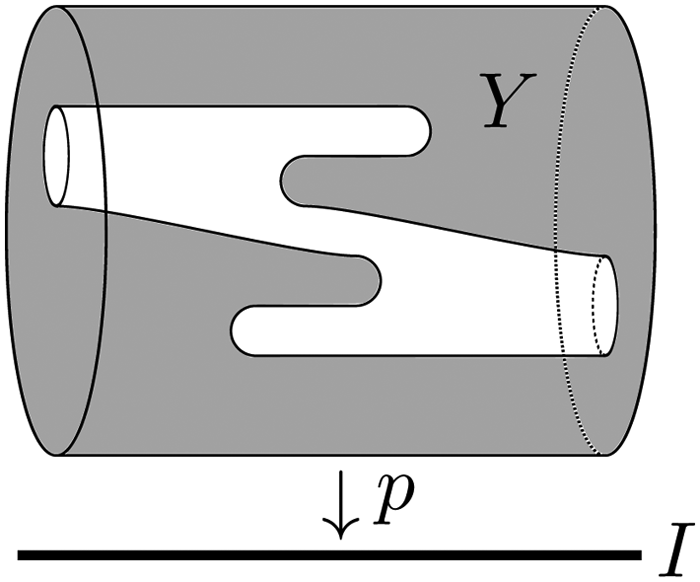
A fibrewise space p: Y→I.
Roughly speaking, two fibrewise maps are fibrewise homotopic when one can be deformed to the other in a time-preserving manner. More precisely, two fibrewise maps f0, f1: Y→W are fibrewise homotopic if there is a homotopy F: Y × I→W with F( , 0) = f0, with F( , 1) = f1, and with each F( , t) a fibrewise map. The homotopy F gives a continuous and time-preserving deformation from f0 to f1. Two fibrewise spaces are fibrewise homotopy equivalent when they are homotopy equivalent in a time-preserving manner. More explicitly, a fibrewise map f: Y→W is a fibrewise homotopy equivalence if there is a fibrewise map f′: W→Y with compositions f′○f and f○f′ each fibrewise homotopic to the corresponding identity map; in this case we say that fibrewise spaces Y and W are fibrewise homotopy equivalent.
3. The evasion problem
The evasion problem we consider is introduced by de Silva and Ghrist (2006), and we present it here with a few minor changes. Let
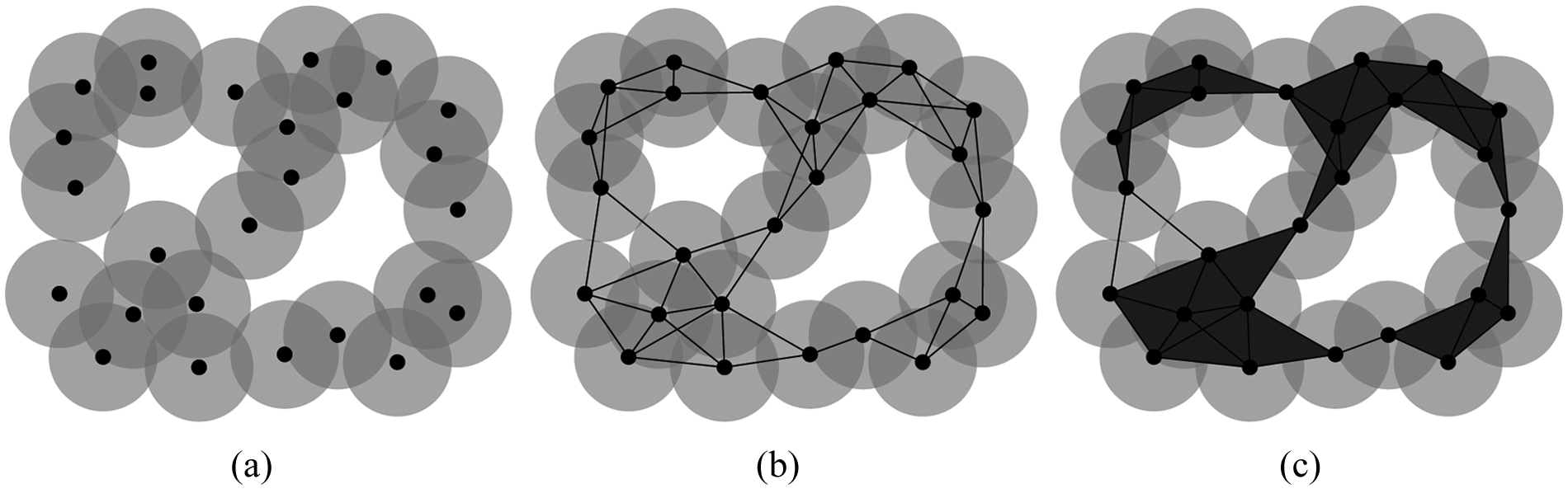
(a) A sensor network at a fixed point in time, (b) its connectivity graph, and (c) its
The union of the balls X(t) = ∪
v ∈ S
Bv(t)
is the region covered by the sensors at time t, and its complement

be the subset of spacetime covered by sensors, and let
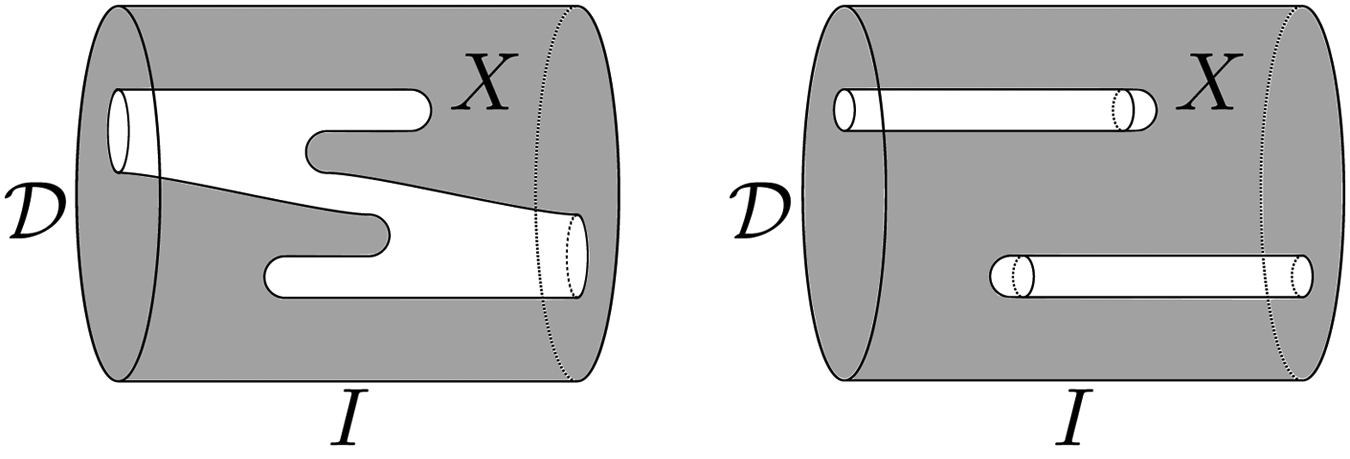
We have drawn two planar sensor networks with domain
Potentially there are also intruders moving continuously in this domain. The intruders would like to avoid being detected by the sensors, but an intruder is detected at time t if it lies in the covered region X(t). We say that an evasion path exists when it is possible for a moving intruder to avoid being seen by the sensors.
Given a sensor network, we would like to determine whether or not an evasion path exists. However, connectivity graphs alone cannot determine the existence of an evasion path. Consider the two sensor networks in Figure 4, and suppose that in each case all three sensors are immobile over the entire time interval. Then the two networks have the same connectivity graphs at each point in time, but the sensor network on the left contains an evasion path while the network on the right does not.
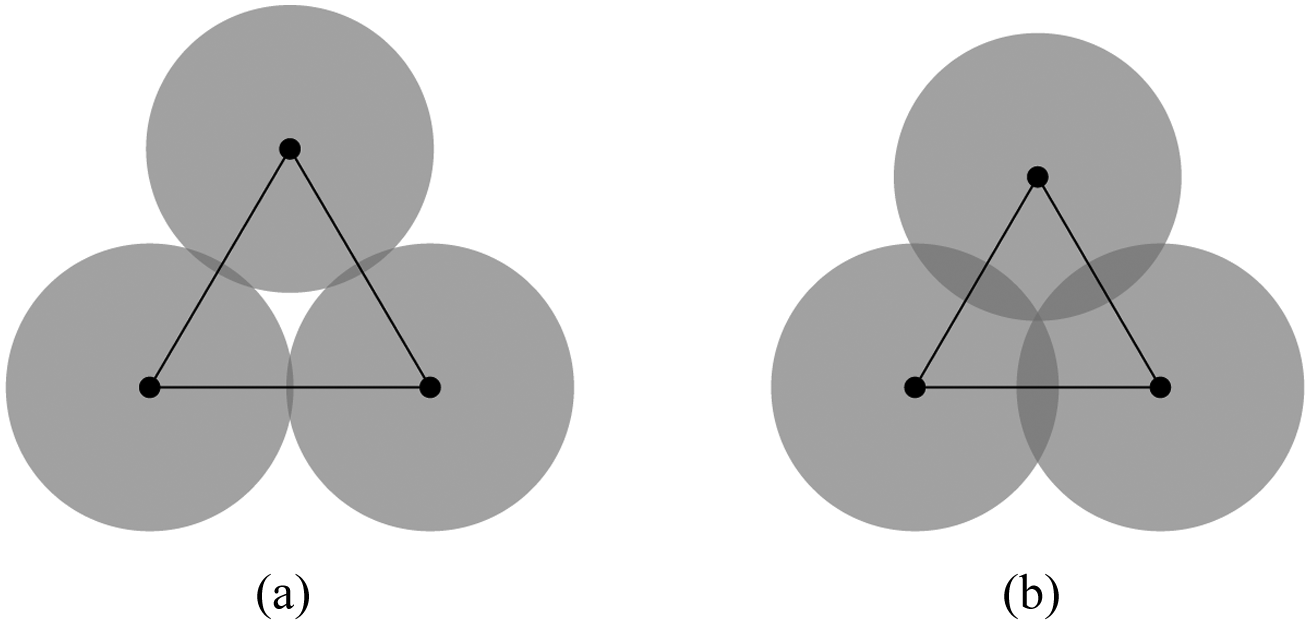
Let (a) and (b) be two different sensor networks. Imagine that no sensor moves over the entire time interval. Then network (a) has an evasion path while network (b) does not, even though the two networks have the same connectivity graph at each point in time.
Since connectivity graphs alone are insufficient, we consider

See Figure 2(c) for an example. Note that the 1-skeleton of C(t) is the connectivity graph at time t. An important property is that the
In applications it is generally unreasonable to assume that our sensors can measure
We make the simplifying assumption that each sensor covers a unit ball. With the exception of Section 8 on alpha complexes and the Appendix, all of our results also hold in the more general setting where each sensor covers an arbitrary convex set. In this setting the
4. The work of de Silva and Ghrist
In order to explain de Silva and Ghrist’s work on the evasion problem, we first define the stacked

when the
added at time ti when σ ∈ C(ti ) but σ∉C(t) for t ∈ (t i − 1,ti ); and
removed at time ti when σ ∈ C(ti ) but σ∉C(t) for t ∈ (ti , t i+1)
Choose interleaving times

C(s i − 1) × {ti } as a subset of C(si ) ×{ti }; if simplices are added at ti and
C(si ) × {ti } as a subset of C(s i − 1) × {ti } if simplices are removed at ti
Map p: SC→I is the projection onto the second coordinate, and note that p −1(t) = C(t).
This definition is similar to the definition of the stacked Vietoris–Rips complex in de Silva and Ghrist (2006). See Figure 5 for a small example.
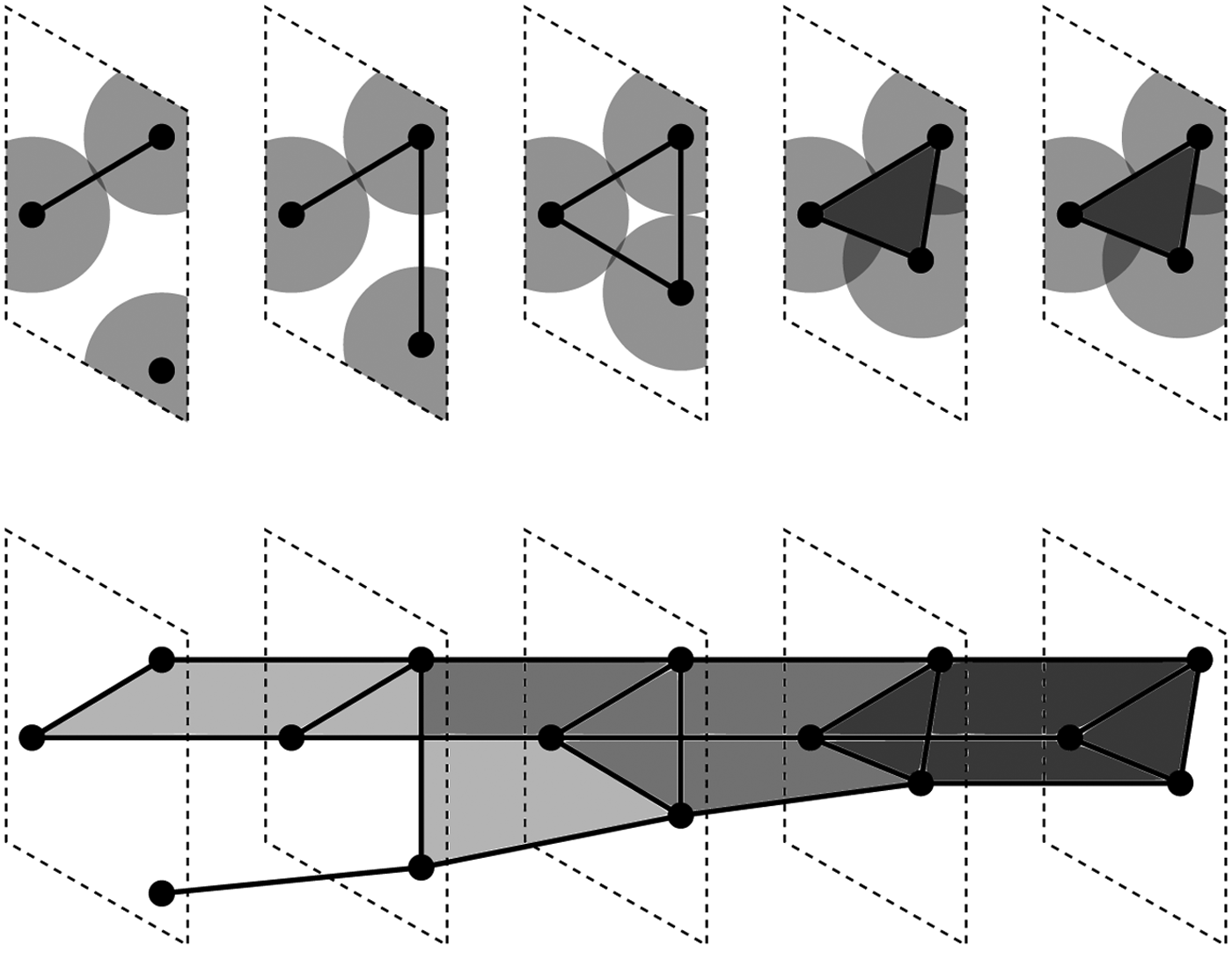
The stacked
A partial answer to the evasion problem is given in Theorem 7 of de Silva and Ghrist (2006). We state their result using the stacked
We explain the picture behind this theorem. Suppose there is some

with 0 ≠ [∂α]. Let α be a relative d-cycle in SC that represents the homology class [α]. The condition 0 ≠ [∂α] means that the boundary of α wraps a non-trivial number of times around F × [0, 1]. We think of α as a “sheet” in the region of spacetime covered by the sensors that separates time zero from time one; see Figure 6(a). If there is such a relative cycle α then no evasion path can exist. For example, Theorem 7 of de Silva and Ghrist (2006) proves there is no evasion path in the sensor network in Figure 6(b).
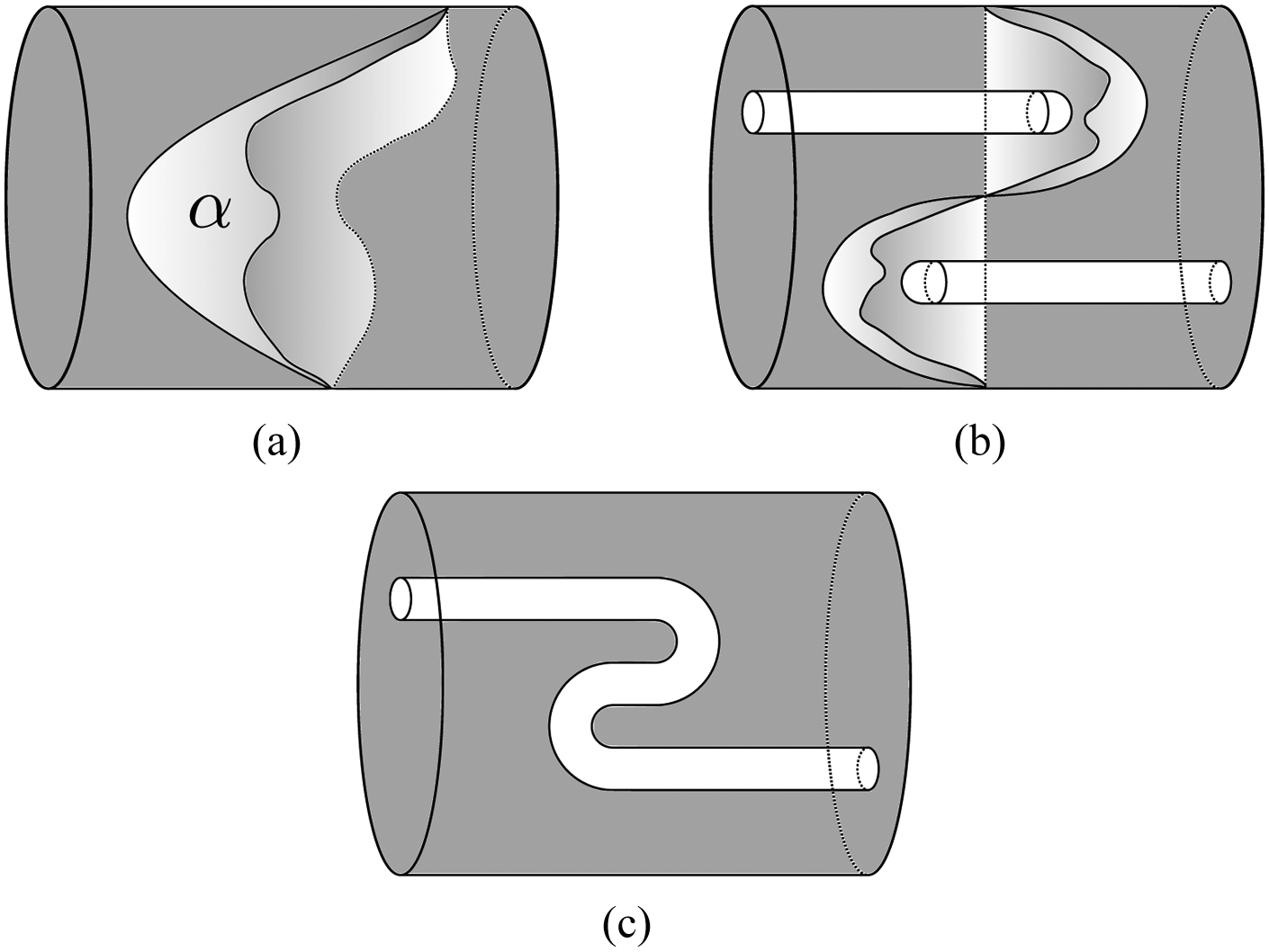
(a) A relative 2-cycle α from Theorem 7 of de Silva and Ghrist (2006). (b) Theorem 7 of de Silva and Ghrist (2006) proves that there is no evasion path in this sensor network. (c) Although there is no evasion path in this network, Theorem 7 of de Silva and Ghrist (2006) does not apply.
Theorem 7 of de Silva and Ghrist (2006) is equivalent to the following statement: if there is an evasion path in the sensor network, then every [α] ∈ Hd (SC,F × [0,1]) satisfies 0 = [∂α]. This homological criterion is necessary but not sufficient for the existence of an evasion path. The insufficiency is demonstrated by the sensor network in Figure 6(c): every [α] ∈ Hd (SC, F × [0, 1]) satisfies 0 = [∂α], but there is no evasion path since an intruder cannot move backwards in time. Can we sharpen this theorem to get necessary and sufficient conditions?
5. Zigzag persistence
We introduce zigzag persistence in this section before applying it to the evasion problem in the following section. Zigzag persistence (Carlsson and de Silva, 2010) is a generalization of persistent homology (Edelsbrunner et al., 2002; Zomorodian and Carlsson, 2005) in which the maps can go in either direction, and zigzag persistence is also the specific case of quiver theory (Gabriel, 1972; Derksen and Weyman, 2005) when the underlying quiver is a Dynkin diagram of type An .
A zigzag diagram is a directed graph with n vertices and n − 1 arrows

where each arrow points either to the left or to the right. Fix a field k. A zigzag module V is a diagram

where each Vi is a finite vector space over k and each qi is a linear map pointing either to the left or to the right. A morphism f between two zigzag modules V and W is a diagram
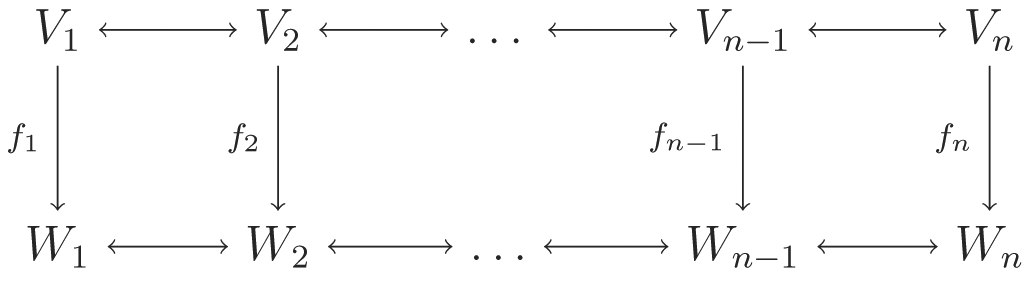
in which all of the squares commute. If each fi is an isomorphism of vector spaces, then f is an isomorphism of zigzag modules. In the language of category theory, a zigzag module is a functor from the free category generated by a zigzag diagram to the category of finite vector spaces, and a morphism between two zigzag modules is a natural transformation (Mac Lane, 1998).
The direct sum of two zigzag modules V and V′ is given by (V⊕V′)
i
= V
i
⊕Vi′, with connecting linear maps of the form qi
⊕qi′. For birth and death indices 1 ≤ b ≤ d ≤ n, the interval module

The connecting linear maps of

where the first k is in slot b and the last k is in slot d. As in persistent homology, a zigzag module is described up to isomorphism by its barcode decomposition (Gabriel, 1972; Carlsson and de Silva, 2010).

where the factors in the decomposition are unique up to reordering.
A barcode is a multiset of intervals of the form [b, d], and the barcode for a zigzag module
Given a fibrewise space p: Y→I and a choice of discretization

we build a zigzag module that models how the homology of fibrewise space Y changes with time. Let Y
i
= p
−1(si
) and let

of topological spaces and inclusion maps (Carlsson et al., 2009). See Figure 7 for an example.
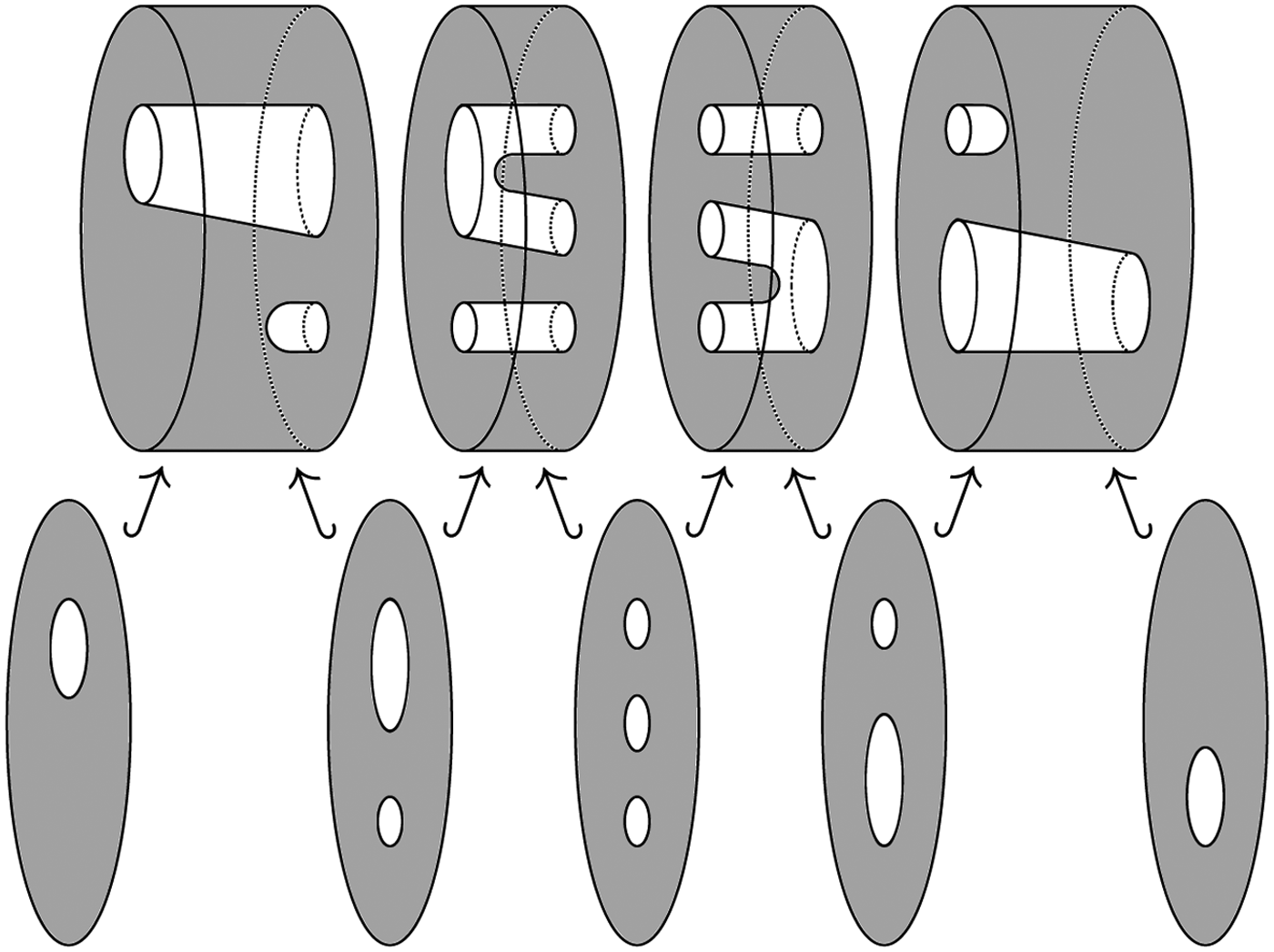
A zigzag diagram built from the fibrewise space in Figure 1.
We assume that each Yi
and

We denote this zigzag module ZHj (Y), leaving implicit the choice of discretization and the choice of coefficient field. Applying the j-dimensional cohomology functor H j to (1) gives the zigzag module

which we denote ZHj (Y). Note the directions of the arrows have been reversed because cohomology is contravariant.
The following lemmas will be useful in the proof of Theorem 2. The first lemma states that zigzag persistent homology and cohomology are invariants of fibrewise homotopy type, and the second lemma states that the barcodes for zigzag persistent homology and cohomology are identical.
Proof. Let f: Y→W be a fibrewise homotopy equivalence. This induces the commutative diagram in Figure 8(a) where each map fi
or
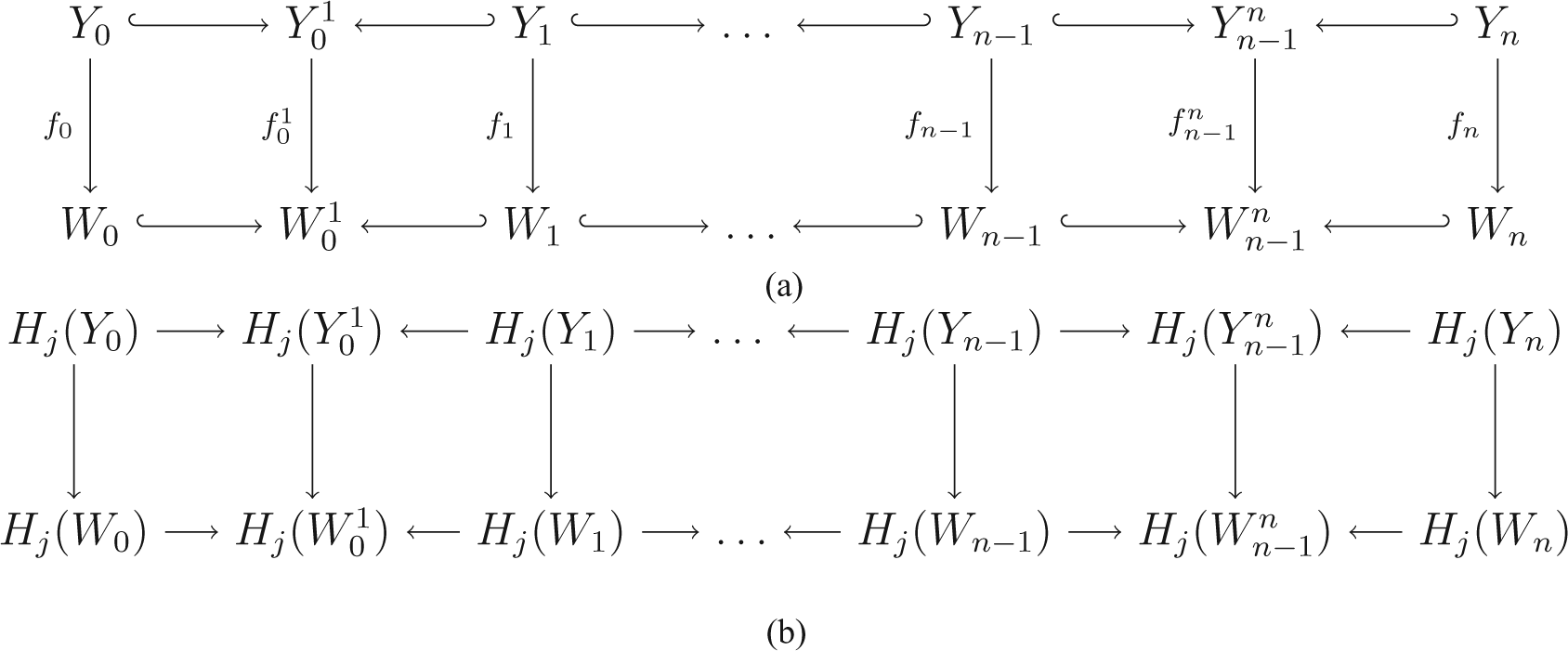
Commutative diagrams for the proof of Lemma 1.
Proof. The version of this lemma with persistent homology instead of zigzag persistence is given in Proposition 2.3 of de Silva et al. (2011), and our proof is analogous. Because their arrows point in different directions, the zigzag modules ZHj (Y) and ZH j (Y) live in different categories and cannot be isomorphic. However, consider the decomposition

from Theorem 1. Applying the contravariant functor Hom( ;k) produces the decomposition

where the directions of the arrows in the zigzag modules have been reversed. Naturality of the universal coefficient theorem (Hatcher, 2002, Theorem 3.2) with coefficients in a field gives ZH j (Y) ≅ Hom (ZHj (Y); k), and hence the barcodes for ZHj (Y) and ZH j (Y) are equal as multisets of intervals.□
6. Applying zigzag persistence to the evasion problem
We began studying the evasion problem with the goal of finding an if-and-only-if criterion for the existence of an evasion path using zigzag persistence, which in this setting describes how the homology of the region covered by sensors changes with time.
Consider the times 0 < t1 < … < tn
< 1 when the

We saw in Section 5 that the discretization 0 = s0 < s1 < … < sn
= 1 produces a zigzag diagram of spaces from any fibrewise space, and we will consider the fibrewise spaces X, Xc
, and SC. Figure 9 depicts the zigzag diagram built from a stacked
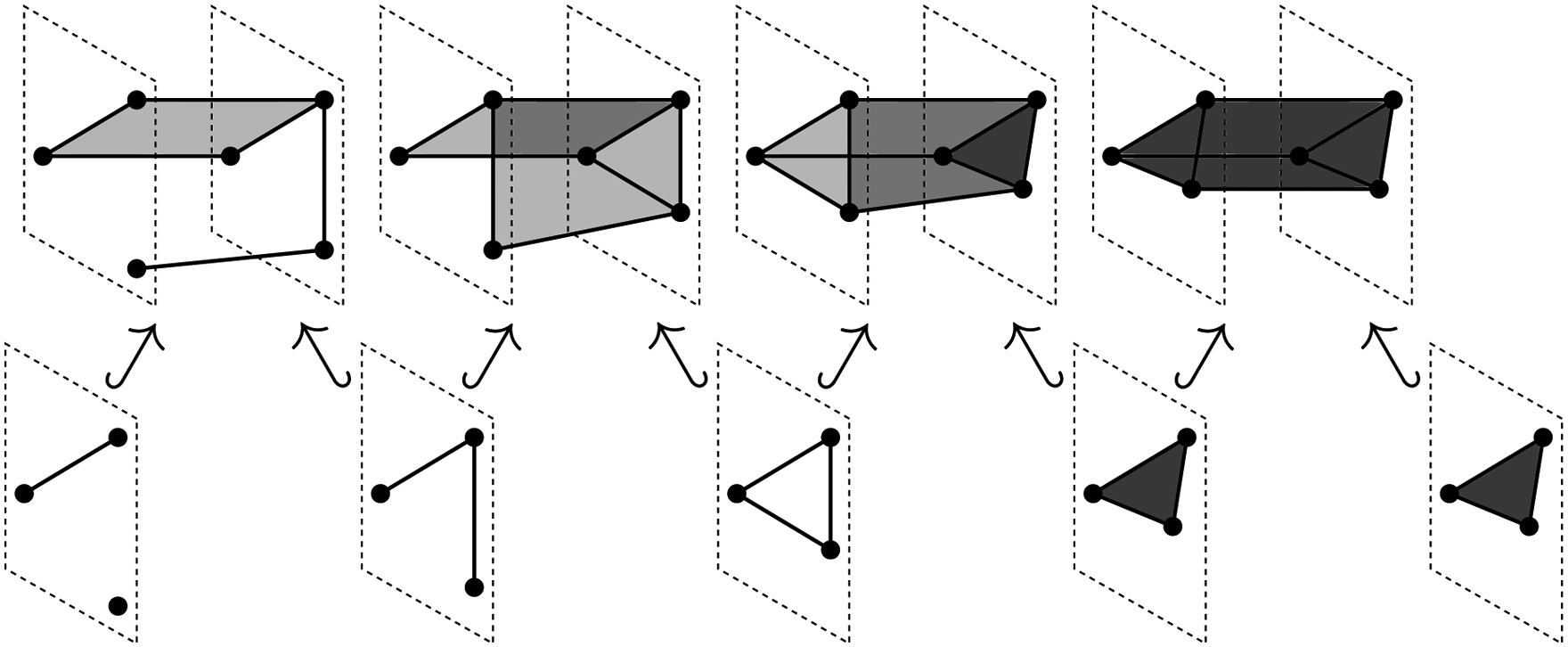
The zigzag diagram for the stacked
Proof. By the nerve lemma we have the commutative diagram in Figure 11 with each vertical arrow a homotopy equivalence. The remainder of the proof is identical to the proof of Lemma 1.□
Our initial hypothesis was that an evasion path would exist in a sensor network if and only if there were a full-length interval [1, 2n+1] in the barcode for ZH d − 1(SC). For example, network (a) in Figure 10 has both an evasion path and a full-length interval, and network (b) has neither. Only one direction of this hypothesis is true.
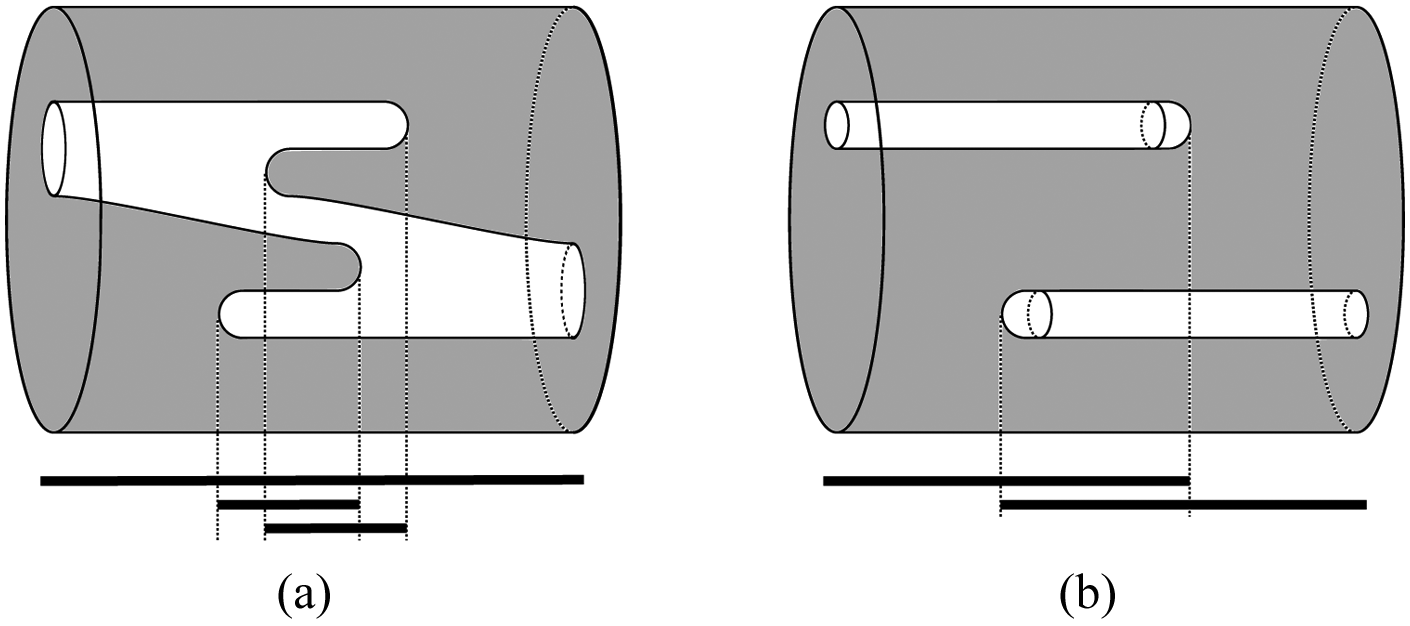
Two planar sensor networks and their barcode decompositions for ZH1(X).

Commutative diagram for the proof of Lemma 3.
Proof. An evasion path is a section s: I→Xc , that is, a commutative diagram
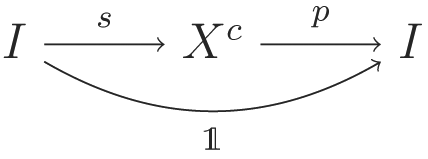
with
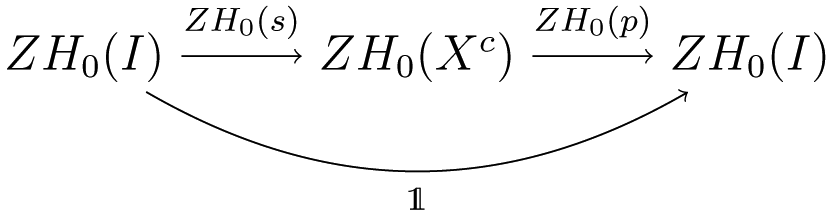
Since the identity map on
Interestingly, the converse to Theorem 2 is false. This is demonstrated by the sensor network in Figure 12(a). It is tempting to guess that the barcode for this network consists of the intervals drawn on top in black, but they are crossed out because they are incorrect. The correct barcode beneath contains a full-length interval [1, 2n+1] even though there is no evasion path. We explain this counterintuitive barcode in Figure 12(b), and we give a second explanation in Section 7.
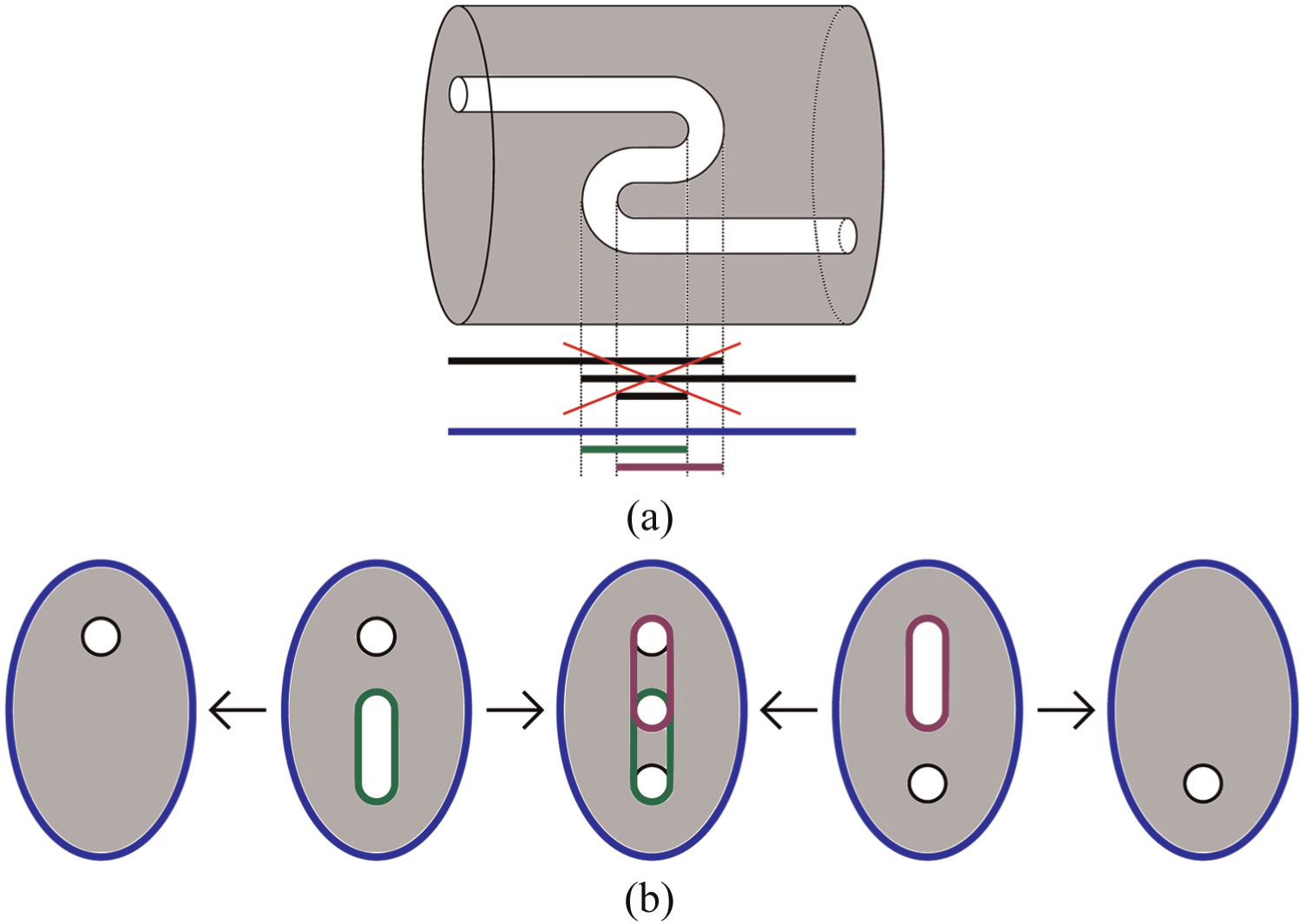
(a) It is tempting to guess that the barcode for ZH1(X) consists of the crossed-out intervals on top in black, but instead the correct barcode is drawn beneath in blue, green, and purple. Note there is a full-length interval [1,2n + 1] even though there is no evasion path in this network. (b) A coarsened version of the zigzag diagram for X. The cycles drawn in blue, green, and purple are generators for the three intervals in ZH1(X).
Caution 2.9 from Carlsson and de Silva (2010) explains that although every submodule isomorphic to an interval in a persistent homology module corresponds to a direct summand, the same is not true for zigzag modules. The sensor networks in Figures 10(b) and 12(a) are good examples of this caution. The zigzag modules for both sensor networks have a submodule isomorphic to the full-length interval module
7. Dependence on the embedding
It turns out that the answer to the evasion problem is no: in general, neither the time-varying
We demonstrate this impossibility result using the planar sensor networks (a) and (b) in Figure 13. Let us describe network (a). Initially, the bottom half of domain
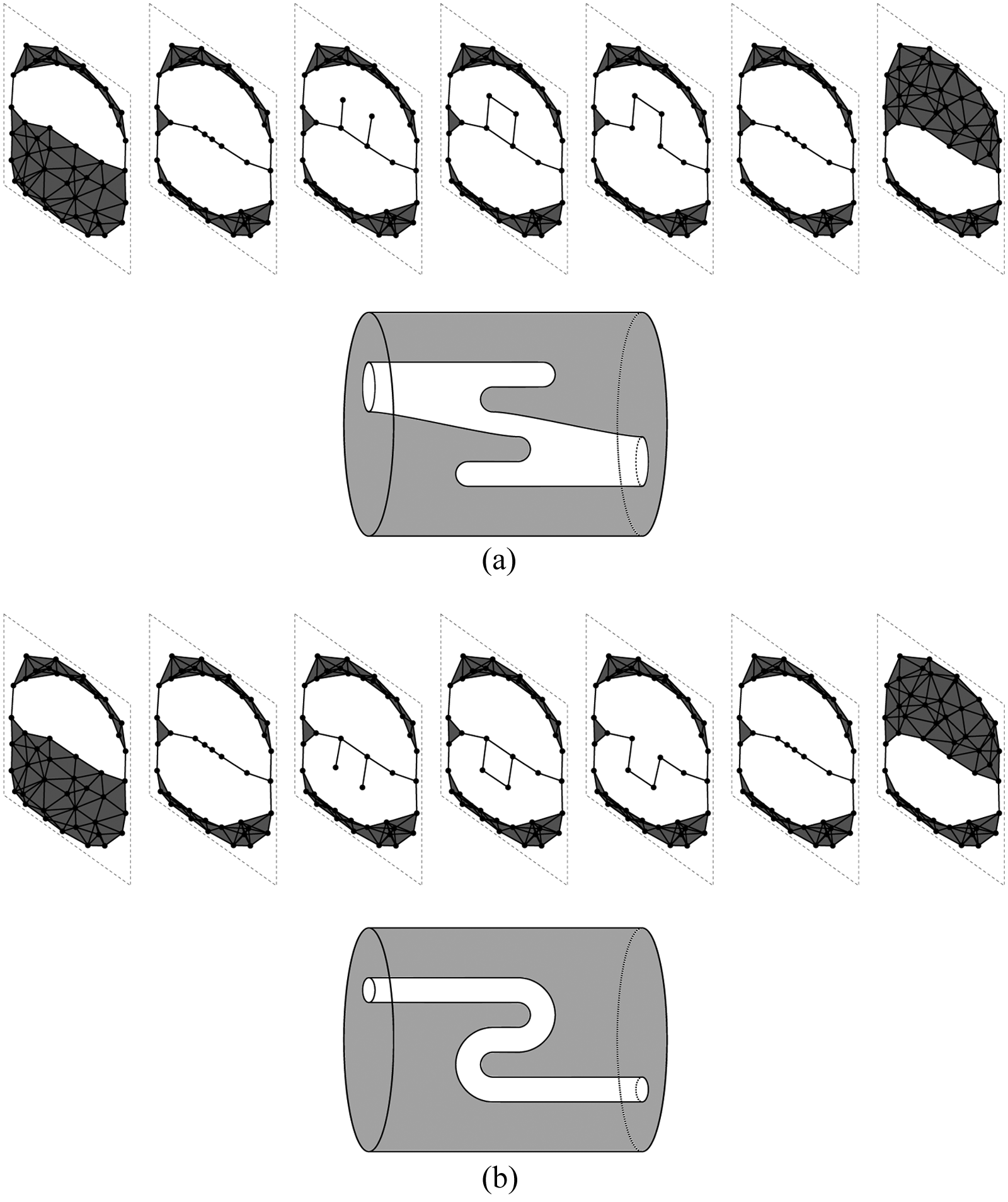
Each subfigure is a sensor network represented both as seven sequential
The time-varying
In Section 6 we promised a second explanation for the counterintuitive zigzag barcode in Figure 12(a), which we give now. The sensor network in Figure 12(a) is the same as the network in Figure 13(b), whose covered region is fibrewise homotopy equivalent to the covered region for the network in Figure 13(a). Hence by Lemma 1 their zigzag barcodes must be equal, and the zigzag barcodes for the network in Figure 13(a) are shown in Figure 10(a).
Embeddings are a central theme in topology. For topological spaces X and Y, an embedding f: X↪Y maps X injectively and homeomorphically onto its image. A typical goal is to classify the space of embeddings up to some notion of equivalence, such as isotopy or ambient isotopy, and the difficulty of this task depends heavily on the spaces X and Y. Knot theory considers the case when X is the circle and
8. Sensors measuring cyclic orderings
Since neither the time-varying
Theorem 3 relies on the alpha complex of the sensors. Let V v(t) be the Voronoi cell

of all points in
We assume there are only a finite number of times 0 < t1 < … < tn < 1 when the alpha complex changes. Hence for t and t′ in (ti , t i+1), [0, t1), or (tn , 1] we have identical alpha complexes A(t) = A(t′). Moreover, we assume that at each ti one of the following changes to the alpha complex occurs.
A single edge is added or removed.
A single 2-simplex is added or removed.
A free pair consisting of a 2-simplex and a face edge with no other cofaces is added or removed.
A Delaunay edge flip occurs.
We assume that each sensor measures the clockwise cyclic ordering of its neighbors in the alpha complex. This cyclic ordering data is necessarily fixed in each interval (ti , t i+1), [0, t1), or (tn , 1].
Proof. Let A
1(t) be the 1-skeleton of the alpha complex at time t. For each vertex v we have a cyclic permutation πv
acting on the incident edges, where πv
(e) is the successor of edge e in the clockwise ordering around v. This gives A
1(t) the structure of a rotation system (Mohar and Thomassen, 2001), also called a fat graph or ribbon graph (Igusa, 2002). A rotation system partitions the directed edges of A
1(t) into sets of boundary cycles. Each boundary cycle is a loop of directed edges (e1
e2…ek
) constructed so that if vi
is the target vertex of directed edge ei
, then
The boundary cycles of A
1(t) are in bijective correspondence with the connected components of
We will maintain labels on the boundary cycles of A
1(t) so that a boundary cycle is labeled true if the corresponding connected component of
If a single edge is added, then a single boundary cycle splits in two since X(t) is connected. Each new boundary cycle maintains the original label. If a single edge is removed, then two boundary cycles merge since X(t) remains connected, and the new cycle is labeled true if either of the original two cycles were labeled true.
If a single 2-simplex is added, then the label on the corresponding boundary cycle of length three is set to false. If a single 2-simplex is removed, then the label on the corresponding boundary cycle of length three remains false.
If a free pair consisting of a 2-simplex and a face edge is added, then a boundary cycle splits into two with one label unchanged. The other label corresponding to the added 2-simplex is set to false. If a free pair is removed, then the boundary cycle of length three corresponding to the 2-simplex is removed and the label on the other modified boundary cycle remains unchanged.
If a Delaunay edge flip occurs, then two boundary cycles labeled false are replaced by two different boundary cycles also labeled false.
An evasion path exists in the sensor network if and only if there is a boundary cycle in A 1(1) labeled true. Such a boundary cycle corresponds to a connected component of the uncovered region X(1) c at time one which could contain an intruder.□
Figure 16 shows that the connectedness assumption in Theorem 3 is necessary. It is an open question if the cyclic ordering information along with the time-varying
An answer to this open question would fill the gap between Theorem 7 of de Silva and Ghrist (2006) or equivalently our Theorem 2, which use only minimal sensor capabilities but are not sharp, and our Theorem 3, which is sharp but requires more advanced sensors measuring alpha complexes. One difficulty in working with the
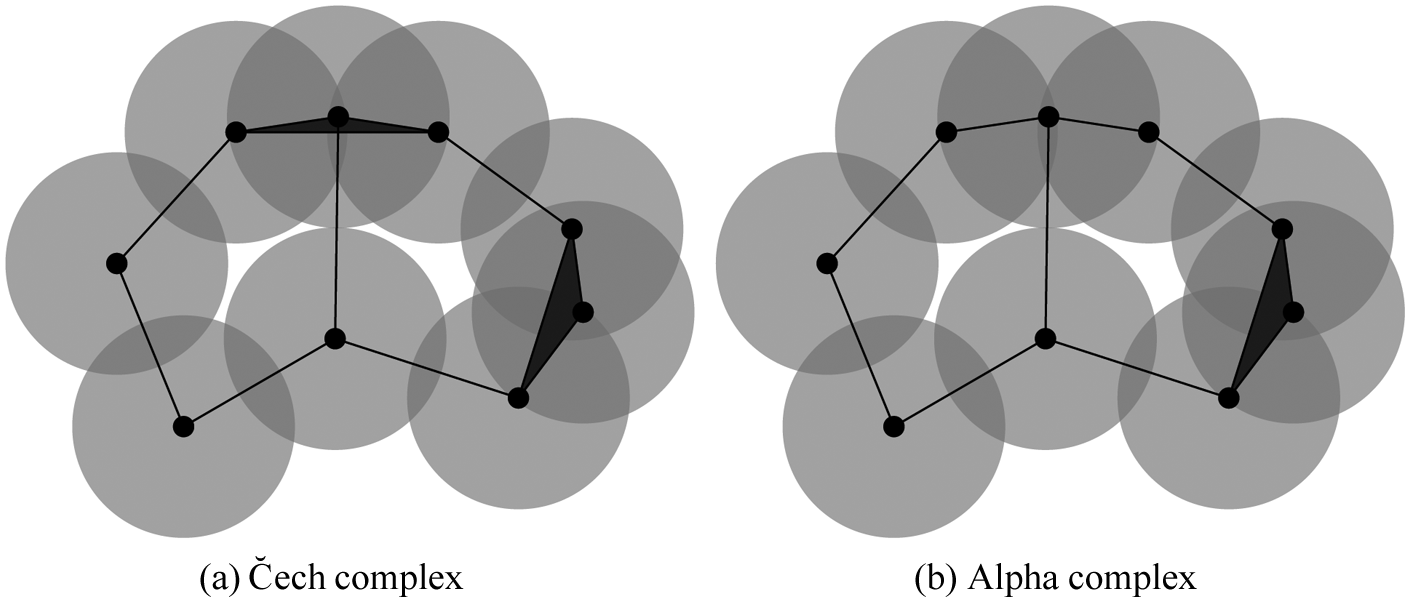
The alpha complex (b) is a homotopy equivalent subcomplex of the
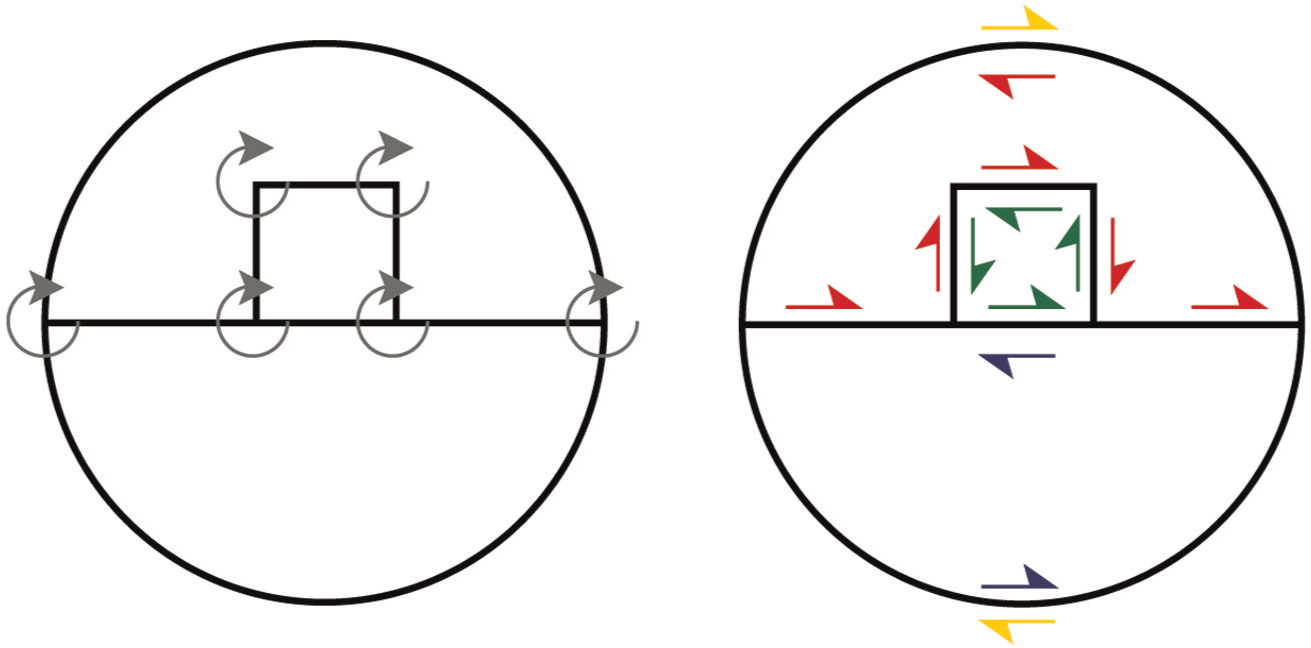
An example rotation system. The cyclic orderings are drawn on the left in gray, and the four boundary cycles are drawn on the right in red, green, blue, and yellow.
9. Conclusions
This paper addresses an evasion problem for mobile sensor networks in which the sensors do not know their locations and instead measure only local connectivity data. De Silva and Ghrist (2006) provide a homological criterion depending on this limited input which rules out the existence of an evasion path in many sensor networks. We use zigzag persistence to produce a criterion of equivalent discriminatory power that also allows for streaming computation, which is an important feature for sensor networks moving over a long period of time.
It turns out that no method relying on connectivity data alone can determine in all cases whether an evasion path exists. Indeed, we provide examples showing that the fibrewise homotopy type of the sensor network does not determine the existence of an evasion path; the embedding of the sensor network in spacetime also matters. We therefore consider a stronger model for planar sensors which measure cyclic orderings and alpha complexes, and given this model we provide necessary and sufficient conditions for the existence of an evasion path.
We end with two possible directions for future research. First, we are interested in the open question from Section 8: can one determine the existence of an evasion path using only
Footnotes
Appendix: C ⌣ ech complex approximations
In this appendix we explain the Vietoris–Rips approximation to the Cech complex. We still assume that each sensor covers a ball of radius one, but we now consider different communication distances between the sensors. Two sensors no longer detect when they overlap, but instead when their centers are within communication distance 2ϵ. Hence, the sensors measure a time-varying communication graph which at time t has an edge between sensors v and
The Vietoris–Rips complex VR(t,ϵ) is the maximal simplicial complex built on top of the connectivity graph with communication distance 2ϵ at time t. Equivalently, a simplex is in VR(t,ϵ) when its diameter is at most 2ϵ (Vietoris, 1927). Note a simplex is included in VR(t,ϵ) when all its edges are in the connectivity graph, and so the Vietoris–Rips complex can be constructed from the connectivity graph. See Figure 17 for an example.
By changing the communication distance of the sensors, we can approximate the
Let
Funding
This work was supported by the National Science Foundation (grant numbers DMS 0905823 and DMS 0964242), the Air Force Office of Scientific Research (grant numbers FA9550-09-1-643 and FA9550-09-1-0531), and the National Institutes of Health (grant number I-U54-ca49145-01). H. Adams was supported by a Ric Weiland Graduate Fellowship at Stanford University and by the Institute for Mathematics and its Applications.