






Abstract
Automating the act of grasping is one of the most compelling challenges in robotics. In recent times, a major trend has gained the attention of the robotic grasping community: soft manipulation. Along with the design of intrinsically soft robotic hands, it is important to devise grasp planning strategies that can take into account the hand characteristics, but are general enough to be applied to different robotic systems. In this article, we investigate how to perform top grasps with soft hands according to a model-based approach, using both power and precision grasps. The so-called closure signature (CS) is used to model closure motions of soft hands by associating to them a preferred grasping direction. This direction can be aligned to a suitable direction over the object to achieve successful top grasps. The CS-alignment is here combined with a recently developed AI-driven grasp planner for rigid grippers that is adjusted and used to retrieve an estimate of the optimal grasp to be performed on the object. The resulting grasp planner is tested with multiple experimental trials with two different robotic hands. A wide set of objects with different shapes was grasped successfully.
1. Introduction
Autonomous grasping in unstructured environments still remains an open challenge in robotics (Bohg et al., 2014), as it requires the development of advanced software (algorithms for grasp planning and control) and hardware (robotic hands and grippers). As robots get closer to humans, their ability to safely interact with unstructured environments proves to be much more important than their force or velocity performance, and the adoption of soft end-effectors becomes fundamental (Dollar and Howe, 2010). Compliant and underactuated robotic hands are mechanisms that have been studied since the late 1970s (Birglen et al., 2008; Hirose and Umetani, 1978). More recently, advancements in the field of soft robotics boosted the creation of the first completely soft manipulators and grippers (Hughes et al., 2016).
Along with the design of novel devices, new ways of implementing grasp planning and control strategies must be developed. In this respect, research on soft manipulation has significantly changed the way roboticists look at the problem of grasping. Thanks to the presence of passive compliance in their mechanical structures, soft hands are adaptable, versatile, and robust. Thus, part of the “intelligence” of the grasping system can be embodied in the hardware design, instead of being allocated exclusively to the planning and control algorithms. This is one of the main reasons why classic grasp planning methods, prescribing the exact position of fingers for ensuring force closure, need to be extended, or even overcome, so to exploit the intrinsic features of soft hands (Brock et al., 2016).
To effectively exploit the softness of end-effectors and achieve robust grasps, features of the environment such as flat surfaces, walls, edges, and others, can be used as a help, implementing strategies similar to those adopted by humans (Eppner et al., 2015). Environmental constraints exploitation (ECE) with soft hands opens up possibilities that were inconceivable with rigid grippers (Bimbo et al., 2019; Brock et al., 2016; Hang et al., 2019).
This work focuses on grasp planning strategies to let soft robotic hands perform power and precision grasps from the top (top grasps), possibly exploiting the surface of the table to increase the grasp robustness when grasping small objects. Eppner et al. (2015) defined this type of grasp as surface-constrained.
The main contributions of this article are (i) laying the theoretical foundations and (ii) proposing a practical implementation of grasp planning strategies for performing top grasps with soft robotic hands. The proposed grasp planner relies on a method for modeling hand closure, the closure signature (CS), whose computation was first introduced by Pozzi et al. (2018) and is detailed and analyzed extensively in this article, completing and extending our previous work to different robotic hands and different closures. The CS maps a given hand closing motion to the direction along which the largest deformation occurs. This direction is akin to the grasping direction of a parallel-jaw gripper. Based on these considerations, in this work, we show that it is possible to plan top grasps by aligning the CS of the robotic hand to a suitable direction on the object, computed using a grasp planner for parallel-jaw grippers. In particular, we integrated the CS-alignment (see Figure 1) with a state-of-the-art grasp planner for parallel-jaw grippers based on deep learning (Mahler et al., 2017). Experiments conducted with two soft hands, the Pisa/IIT SoftHand (Catalano et al., 2014) and the RBO Hand 2 (Deimel and Brock, 2016), attached to a collaborative robot arm, showed that this integration is feasible and that different CSs can be used to perform different grasps (power/precision).

Block scheme of the CS-alignment proposed in this article. Given a certain robotic hand and a possible closing motion that it can perform, the CS indicates a “preferred grasping direction” for that closure, that can be thought as the grasping direction of a parallel-jaw gripper and can be aligned with a suitable direction on the object.
2. Related work
Planning grasps with soft hands needs a radical shift from classic grasp planners designed for rigid hands. The underlying principle of “rigid” planners was to identify a set of possible contact locations on the object and search for possible hand configurations able to match goal contact areas with the actual contact points (Borst et al., 1999; Miller et al., 2003). In several planners, possible achievable grasps were evaluated in simulation and sorted according to a quality measure (Roa and Suarez, 2015). In this process, the environment was always considered as a disturbance and so any contact was avoided. Soft hands, instead, allow the exploitation of environmental constraints to reduce the uncertainty on object location and can easily adapt to different object shapes thanks to their intrinsic compliance. Grasp planners developed for fully actuated hands can hardly take advantage of the soft hands features and often cannot be used since they require hand models (Prattichizzo et al., 2013a) and grasp quality measures (Haas-Heger et al., 2018; Pozzi et al., 2017), which are still open research problems for soft underactuated hands. First attempts to exploit soft hands features in planners (Bonilla et al., 2015; Eppner et al., 2015) mostly focused on object and environment perception, and used simple strategies once the object/environment was parsed correctly. The main idea was that the hand can then autonomously cope with different object shapes.
In this work, we show that, by using the information encapsulated in the CS, we improve the number of successful grasps. We also demonstrate that the CS can also be exploited to achieve precision grasps. In the approach of Pozzi et al. (2018) the objects were represented by their bounding box (Barequet and Har-Peled, 2001). To cope with objects that can hardly be approximated by a single bounding box (e.g., hollow boxes, bowls), more advanced techniques can be used, e.g., bounding box object decomposition (Bonilla et al., 2015; Huebner et al., 2008). However, these techniques usually come with a high computational burden, and are not suitable for on-line grasp planning. In this work, we decided to use a grasp planner based on a convolutional neural network (CNN) that is not only very efficient, but also shows high success rates and advanced generalization capabilities over new objects (Mahler et al., 2017). This grasp planner outputs an estimate of the optimal grasp to be performed given an RGB-D image of the object. One of the contributions of this article is to show that such a grasp planner, designed for parallel-jaw grippers, can also generate successful grasps for more complex hands by applying the hand CS representation.
In the last decade, several works in which an artificial neural network provides the relevant information needed to command a robotic end-effector to perform successful grasps have been published. The input of the network is usually an RGB or RGB-D image of the object to be grasped. Earlier works that exploited this synergy between robotic grasping and artificial intelligence obtained only the grasp position (i.e., the cartesian coordinates) from the employed neural network. In this respect, Saxena et al. (2008) were the first to propose an algorithm for grasping novel objects when an object 3D model is not available. They collected synthetic training data and developed a machine able to predict grasping points from 2D images of the objects to be grasped. Recent works introduced deep learning for finding the optimal grasp given an RGB-D image of the object (Lenz et al., 2015). Physical grasp trials were performed by Levine et al. (2018) and Pinto and Gupta (2016) to collect training data for their networks. Some of the latest contributions in the field of deep learning applied to robotic grasping come from the Dex-Net project. 1 Starting from the Dex-Net 1.0 dataset (Mahler et al., 2016), grasp planners for parallel-jaw grippers (Mahler et al., 2017) and suction cups (Mahler et al., 2018) have been developed. Recently, also a work presenting “ambidextrous” robot grasping has been published (Mahler et al., 2019).
Despite their advantageous features, underactuated and compliant robotic hands also present open challenges (Brock et al., 2016; Catalano et al., 2014; Deimel and Brock, 2016; Dollar and Howe, 2010). Designing them is difficult, as well as predicting, modeling, and controlling their function. Recent research in this field focused on finding answers to the growing need of mathematical models and shared standards for dealing with soft manipulation. Grasp quality indexes for underactuated and compliant grasps have been studied in Pozzi et al. (2017), and the quasi-static model of the grasp was extended to include hand–environment and object–environment interactions in Salvietti et al. (2015). Other works focused on studying the exploitation of environmental constraints to achieve robust grasps (Eppner et al., 2015), whereas the model presented in Pozzi et al. (2018), answers to the need for simple and functional ways to model multi-fingered robotic hands.
To the best of the authors’ knowledge, there are relatively few works combining AI-driven robotic grasping and manipulation with soft underactuated hands. Gupta et al. (2016) combined learning by demonstration and reinforcement learning techniques to achieve different manipulation tasks with an RBO Hand 2. In Wang and Ling (2016), instead, a geometric model of a three-fingered soft hand is exploited to perform power grasps. Given its particular structure, the hand is modeled as a cube, and the point cloud representing the object to be grasped should be contained in the cube; the grasp to be executed is returned by a CNN. A different approach was adopted by Choi et al. (2018), where a CNN outputs the approaching direction and orientation for grasping objects. The proposed network is trained and tested with grasps performed with a four-fingered soft gripper. In that work, hand softness is not modeled explicitly, but is implicitly encapsulated in the CNN training set, which was retrieved by trial and error. The use of this procedure leads to hand-specific grasping strategies, strongly reducing the generalizability to different robotic set-ups.
3. Functional modeling of hand closures
Pozzi et al. (2018) introduced the closure signature (CS) as a model to describe a closure motion of a robotic hand. The CS model aims at capturing the hand function, rather than representing its kinematic structure. This results particularly suitable for the description of soft hands.
The CS is specific for a given hand and a given closing motion performed by the hand. It is a way to represent how the hand closes in free space, i.e., without considering interaction with a grasped object or an external surface. This choice has been made because we are interested in modeling the hand capabilities in the general case, without the definition of a specific set of graspable objects.
A set of reference points must be defined on the robotic hand to compute the CS. The position of the reference points changes according to the hand configuration during the closure motion to be modeled. Consider, for instance, a set of reference points defined on the fingertips of an anthropomorphic hand model. When fingers flex to perform a power grasp starting from the hand completely open, the position of reference points changes as they reach their final positions close to hand palm. Such position transformations can be represented as a 6D rigid displacement and a non-rigid deformation of the cloud of reference points (Salvietti et al., 2014).
The CS of a robot hand performing a closure motion is defined as the direction along which the set of reference points is most deformed and is characterized by an application point
In principle, the CS could be applied to any closing motion of any robotic hand. However, it is mainly conceived for soft hands for two main reasons. First, rigid hands can be modeled as kinematic chains using well-known kinematics and dynamics principles. Second, intrinsically soft hands can deal with uncertainties by self-adapting to possible collisions with the environment or with the object to grasp. This allows us to take advantage from a simple model, the CS, of a complex system to do grasp planning. In addition, soft hands are difficult to model with a unique formalism, as they have very different designs and actuation systems. The CS was introduced to fill this gap.
3.1. Computation of the CS
The computation of the CS requires the definition and tracking of a set of reference points on the hand. Motions of the reference points are then represented by the computation of an equivalent homogeneous transformation, indicated with
For a given robotic hand, let us consider

The method to compute the CS can be applied to different choices of reference point locations, as long as they suitably describe the hand’s motion during closure. As an example, if during a hand closure the palm is still, reference points should be placed in the fingers rather than in the palm. In Gioioso et al. (2013), it was demonstrated the low sensitivity to reference point positions for this representation of transformation. The rationale for reference points locations is to favor the parts of the hand that move more during the selected closing motion.
Let us indicate with

where the symbol ^ indicates the homogeneous representation of the vector. The
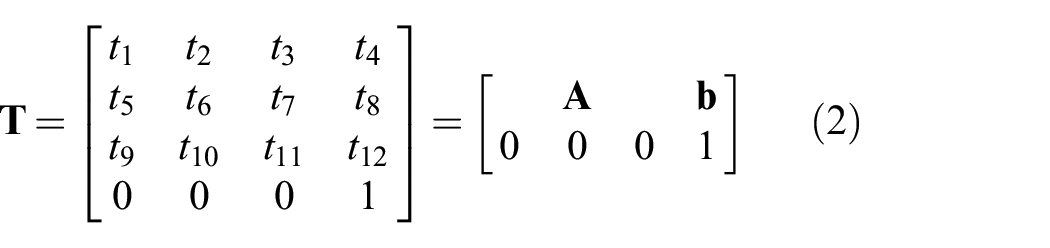
is a homogeneous matrix, where
Let us define the vectors
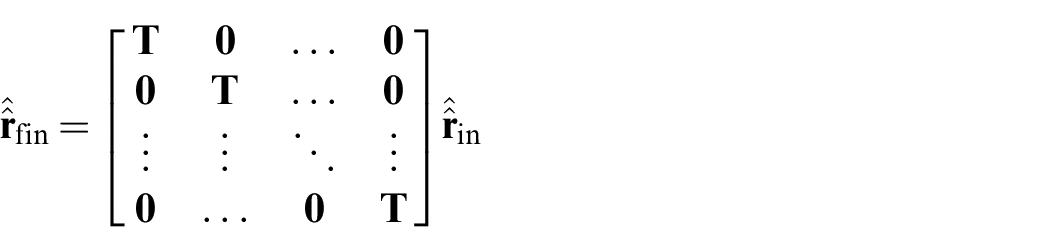
where the symbol

where matrix
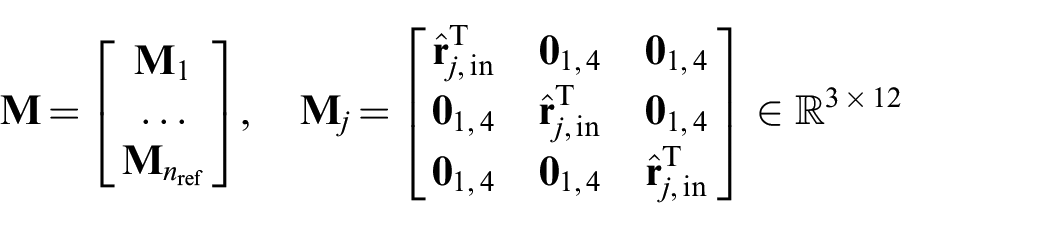
and vector

The resulting
The solution of the system depends on the properties of matrix
Case 1: if the rank of matrix
Case 2: if matrix
Case 3: if matrix
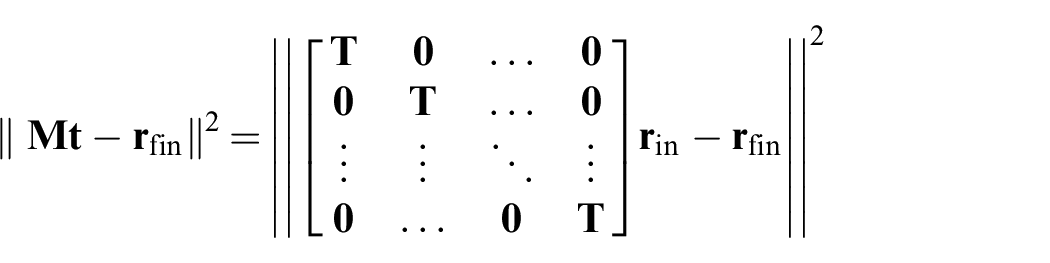
Then, in general, if we apply the average transformation

In this case, transformation
Matrix

The element

The element

where
The elements
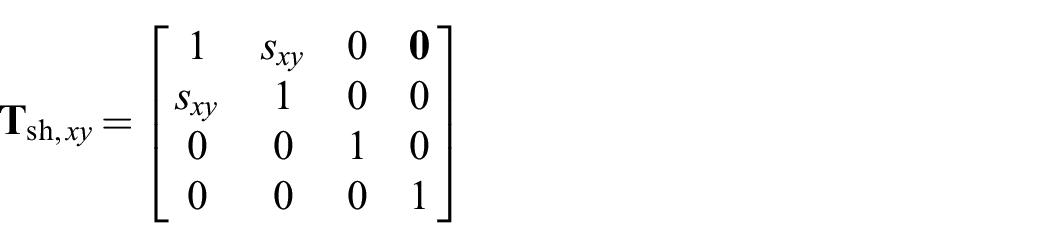
where
The element
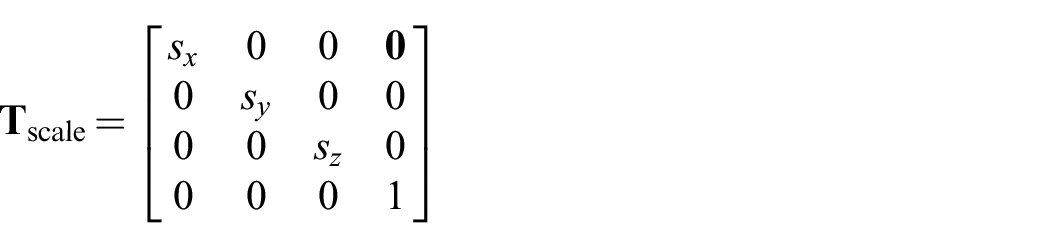
where
In this work, we are mostly interested in decomposing the overall transformation into a rigid-body motion

The transformation matrix

We relate the CS to

in which
Underactuated and compliant hands tend to perform power grasps (Pozzi et al., 2017), and this is why we initially focused on computing the CS of complete closures (Pozzi et al., 2018). The CS, however, can also be used to describe other types of closures, including other power grasps (e.g., lateral pinch defined by Cutkosky (1989)) and precision grasps.
3.2. Simplified example
To better describe all the steps that lead to the computation of the CS here we present a simple example with a set of six reference points initially placed in

If we apply a rigid rotation of

Example of CS computation for different points transformations. (a) Rotation of
Applying only a deformation along the

Then, we can compute

The smallest eigenvalue of
3.3. CS for power grasps
The CS of the Pisa/IIT SoftHand complete closing motion (i.e., from completely open to completely closed) was computed in Pozzi et al. (2018). The top grasps performed using this information had greater success rate and robustness with respect to a baseline method.
In this work, the generality of the CS computation is shown by applying it to another soft hand, the pneumatically actuated RBO Hand 2 (Deimel and Brock, 2016), that is significantly different from the Pisa/IIT SoftHand.
For the RBO Hand 2, a complete closure of all the fingers resembling the first hand synergy (see Salvietti, 2018) is considered. It is obtained by actuating all the hand degrees of actuation. Seven reference points, five on the fingertips and two on the palm, are chosen and tracked with a motion capture system (Motion Analysis). Figure 3a shows the initial and final position of the RBO Hand 2 during the tracking procedure from two different view points.

Power grasps with the RBO Hand 2. (a) Side (left) and top (right) views of the “heavy wrap” closing motion: from fully open to fully closed hand. Reference points are indicated with red dots over the open hand. (b) Example of “lateral pinch”.
From the same set of retrieved data we analyzed two different hand motions: one considering all the seven reference points and corresponding to a “heavy wrap” (Cutkosky and Kao, 1989), and one considering a subset of four reference points and corresponding to a “lateral pinch” (see Figure 3b). Figure 4 reports initial and final positions of the reference points and CS corresponding to these two different motions. Note that the second only considers the motion of the two points on the palm and of the fingertips of the thumb and index. In a reference frame placed on the hand wrist, with

RBO Hand 2: CS computation (
In both closures, taking the palm into account is fundamental, as it is actuated during the considered grasp, and it allows the hand to wrap objects. Without considering the two palm points in the heavy wrap, for example, the CS changes to

RBO Hand 2: CS computation for the complete closure considering reference points only in the fingertips, without considering the palm.
3.4. CS for precision grasps
Most of the soft hands described in the literature are designed to perform power grasps where fingers completely envelop the object. Using these hands to perform precision grasps is often an issue, due to the low number of controllable degrees of freedom (DoFs) and to the lack of accurate on-line proprioceptive measurements necessary to precisely place the fingertips over an object. In this article, we propose a CS-based approach to achieve precision grasps using soft hands. One possibility is to use only part of the hand and exploit the environment, as in the previously described lateral pinch (Figure 3b). Another possibility is to adjust hand preshape and distance from the object, in such a way that the hand touches it with the fingertips, achieving a precision grasp (Figure 6a).

Pisa/IIT SoftHand: partial closure for precision grasps. (a) Example of pinch grasp performed with this closing motion. (b) Initial configuration (partially closed hand) and final configuration (fully closed hand) of the partial closure motion.
To describe a precision grasp in terms of CS, it is important to choose a suitable closing motion. We can either track the motion of a part of the hand (e.g., index and thumb for pinch grasps), similarly to what we did for the lateral pinch with the RBO Hand 2, or track a partial closure of the hand, where the hand closes starting from a partially closed configuration (see, for example, Figure 6b). The first strategy considers only fingers that are important for precision grasps (e.g., thumb and index in the case of small objects), thus leading to having the center of the CS translated towards them. Hand pre-shaping is important to guarantee contacts at the fingertips. Approaching the object with the hand partially closed, in fact, allows a small closure to be performed near the object, without executing the whole closure, which might cause undesirable collisions with the object, often reorienting it and causing a grasp failure.
In this work, we combined the two approaches to compute the CS for a closing motion of the Pisa/IIT SoftHand that leads to a precision grasp.
We tracked the trajectories of the fingers in the Gazebo simulation of the hand. The closure motion that we considered starts with the hand partially closed (half of its range of motion), and ends with the hand fully closed (see Figure 6b). Two CSs related to this motion are depicted in Figure 7. Figure 7a shows the resulting CS when considering reference points in all the fingertips, whereas Figure 7b shows the resulting CS when considering reference points only in the thumb (fingertip, proximal phalanx) and the index (fingertip, middle phalanx). The latter was used in Experiment 3 to plan precision grasps with the Pisa/IIT SoftHand.

Pisa/IIT SoftHand: CS computation (
Assuming a reference frame placed on the wrist with the
4. Grasp planning
Our grasp planner is composed of two modules, one object-centric and the other hand-centric. The former module is related to grasp planning with the aid of AI, and we named it grasp quality convolutional neural network (GQ-CNN) module. Given a depth image of the object to be grasped, it exploits all the encapsulated information, and provides an on-line estimate of the optimal grasp (center and direction) to be performed. The latter module is related to soft hand modeling, and we termed it CS module. Chosen a robotic hand, it computes off-line the functional model of a certain closure motion (i.e., the previously defined CS), thus providing an estimate of the best way to align the hand to an object for performing top grasps. As shown in Figure 8, and detailed in the following, the two modules are put together to align the hand to the object. Then, the grasp can be executed.

Block scheme of the proposed approach.
As we mentioned previously, the idea behind this module integration is that the CS allows a hand closure to be approximated with a direction, and this direction can be thought of as the closing direction of an equivalent parallel-jaw gripper. In other words, the CS abstraction allows to use a planner that was trained for parallel-jaw grippers without retraining it, even if the end-effector is different.
In the proposed approach, the softness of the hand is not modeled explicitly, but it is the condition that actually allows us to apply such a simplified grasp planning strategy. The passive adaptability typical of soft hands allows us to compensate for the adopted simplifications (grasp planner for rigid parallel-jaw gripper, hand modeling as a jaw gripper), to cope with uncertainties, and to safely interact with the environment. This would not be possible with rigid hands, for which even small uncertainties in the fingers positioning might lead to unwanted and dangerous collisions with the environment (Brock et al., 2016).
4.1. GQ-CNN module
The GQ-CNN has been presented by Mahler et al. (2017). It is the core component of the so-called CEM-augmented DexNet 2.0 grasp planner, which can be used for grasp planning, since it provides an estimation of the most robust grasp under uncertainties in sensing and control. The planner considers a parallel-jaw gripper performing top grasps of objects resting on a planar surface. Given a depth image of the object to be grasped, a set of grasp candidates is sampled with the rejection sampling algorithm presented in Mahler et al. (2016), and the robustness of each candidate is evaluated by the neural network. This step is shown in the first image in Figure 9, where the different colors correspond to different robustness values. After this preliminary step, the most robust grasps, i.e., the “elite grasps”, are selected. Then, the cross-entropy method (CEM) iteratively computes a Gaussian mixture model of the most robust grasps, and new grasp candidates are sampled from this distribution (“sampled grasps”). This procedure is iterated for a predefined number of times, after which the most robust grasp is selected (see Figure 9). Its center (


Subsequent steps for finding the most robust grasp.
Uncertainties in sensing are included in the problem formulation, as explained in Mahler et al. (2017).
The approximation

where
Although the neural network was trained only on synthetic data, the CEM-augmented version of the planner achieved a
In addition to the grasp center
Among the points stored in
4.2. CS module
The CS module that we have implemented for the experimental validation described in this article involves the off-line computation of the CS corresponding to:
the complete closure motion (heavy wrap) of the Pisa/IIT SoftHand (computed by Pozzi et al., 2018);
the complete closure motion (heavy wrap) of the RBO Hand 2 (computed in the previous section);
a partial closure motion of the RBO Hand 2 leading to a lateral pinch (computed in the previous section);
a partial closure motion of the Pisa/IIT SoftHand leading to a precision grasp (computed in the previous section).
It is worth remarking that, in general, if the considered robotic hand can perform more than one closure motion (e.g., power and precision grasps), a list of CSs can be associated to the hand. In this case, the CS module could automatically perform an on-line selection of the most suitable CS to be used for grasp execution. The choice could be based on object size, computed, for example, as explained in the previous subsection. To select the best CS, one could either leverage intuitive rules as those that we applied in the experiments conducted for this article (e.g., heavy wrap for objects with a size that is comparable with that of the hand, lateral pinch and precision grasp for smaller objects), or rely on an algorithm that compares the object size with a certain size associated with the CS. A strategy could be as follows: among the CSs with sizes that are bigger than the object size, the CS whose size is the closest (or second closest) to the object size would be a good candidate for the grasp. Research on establishing this “CS size”, however, is still on-going, since it is not trivial to identify a general way of evaluating the size of a closure only based on the motion of the reference points, and taking into account that the hand has to achieve a certain orientation over the object.
4.3. Modules integration: grasp planning with soft hands
The CS provides a simplified way to treat soft hands characterizing a specific closing motion that the hand can achieve through a direction of maximum closure applied at a certain point. The obtained center and direction can be thought as the grasping center and direction of a parallel-jaw gripper. This is the fundamental principle of the proposed integration between the GQ-CNN module and the CS module. We use the term planning with soft hands for the resulting module, which was then integrated with the grasp execution module, allowing object approaching and grasping (Figure 8).
The GQ-CNN output data and the CS hand model are combined to perform the so-called CS-alignment, i.e., the alignment between the hand CS and the grasp angle and center retrieved by the neural network. In general, this can be achieved by computing the transformation

General CS-alignment procedure.
Let us consider a world reference frame
Let us indicate with
5. Experimental results
The experimental validation is divided into three experiments. Experiment 1 evaluates the capabilities of the grasping policy integrating CS-alignment and GQ-CNN module in terms of success rate over a large object dataset. This is demonstrated using the Pisa/IIT SoftHand for performing heavy wrap power grasps. Experiment 2 assesses the applicability of the proposed approach to heavy wraps performed with a different soft robotic hand, the RBO Hand 2. Results obtained with our grasp planner are compared with a baseline method, called S-alignment. Experiment 3 tests the functioning of the devised grasp planner for performing grasps that are not heavy wraps: lateral pinch and precision grasp.
While the advantages of using the CS when planning heavy wraps with the Pisa/IIT SoftHand, compared with aligning the hand straight with the object, has already been established in Pozzi et al. (2018) for a variety of objects, Experiment 1 aims to verify the success of its integration with the GQ-CNN module. The purpose of Experiment 3 is to show that the CS-alignment also works for grasps that are less commonly implemented with soft hands. As, to the best of the authors’ knowledge, there is no well-established baseline in the literature for such types of grasps performed with soft hands, comparison with other strategies remains an open problem.
5.1. Experimental setup
We performed experiments either with a 7-DoF Sawyer collaborative robot arm (Rethink Robotics) or with a LBR iiwa (KUKA AG), having an ATI Gamma

Experimental setup: (a) with Pisa/IIT SoftHand; (b) with RBO Hand 2. The RGB-D camera detects the object on the table and the robotic arm equipped with a force/torque sensor and a soft hand executes the grasp.
The two soft hands that we used have different features. The Pisa/IIT SoftHand is an underactuated tendon-driven anthropomorphic robotic hand with one motor and 19 DoFs, designed to reproduce the first human hand synergy (Santello et al., 1998). The RBO Hand 2 is an intrinsically soft hand made of seven pneumatic actuators, five for the fingers and two for the palm (Deimel and Brock, 2016). The actuators are made of silicon rubber, are reinforced by a 3D printed structure, and are surrounded by passive wires that constrain their motion. The model that we used has four degrees of actuation, i.e., four channels that can be inflated separately. One channel is for the little, ring, and middle fingers, one for the index, one for the thumb and the inner part of the palm and one for the outer part of the palm.
We tested our grasping policies on objects having different weights and shapes. Adversarial surface properties, e.g., reflectivity, smoothness, softness, and roundness, were also considered. Depending on the performed experiment, we used all or a subset of the objects that are shown in Figure 12, and whose properties are listed in Table 1.

Objects set (from back to front, from left to right): hollow box, sugar box, chips can, funnel, teddy bear, cuboid box, big funnel, plastic bowl, pudding box, bowling pin, strawberry, Lego Duplo piece, small cube, and plastic toy.
Physical properties of the objects used in the experiments. The chips can, the pudding and sugar boxes, the small cube, the Lego Duplo piece, and the strawberry are taken from the YCB Dataset (Calli et al., 2015). Note that
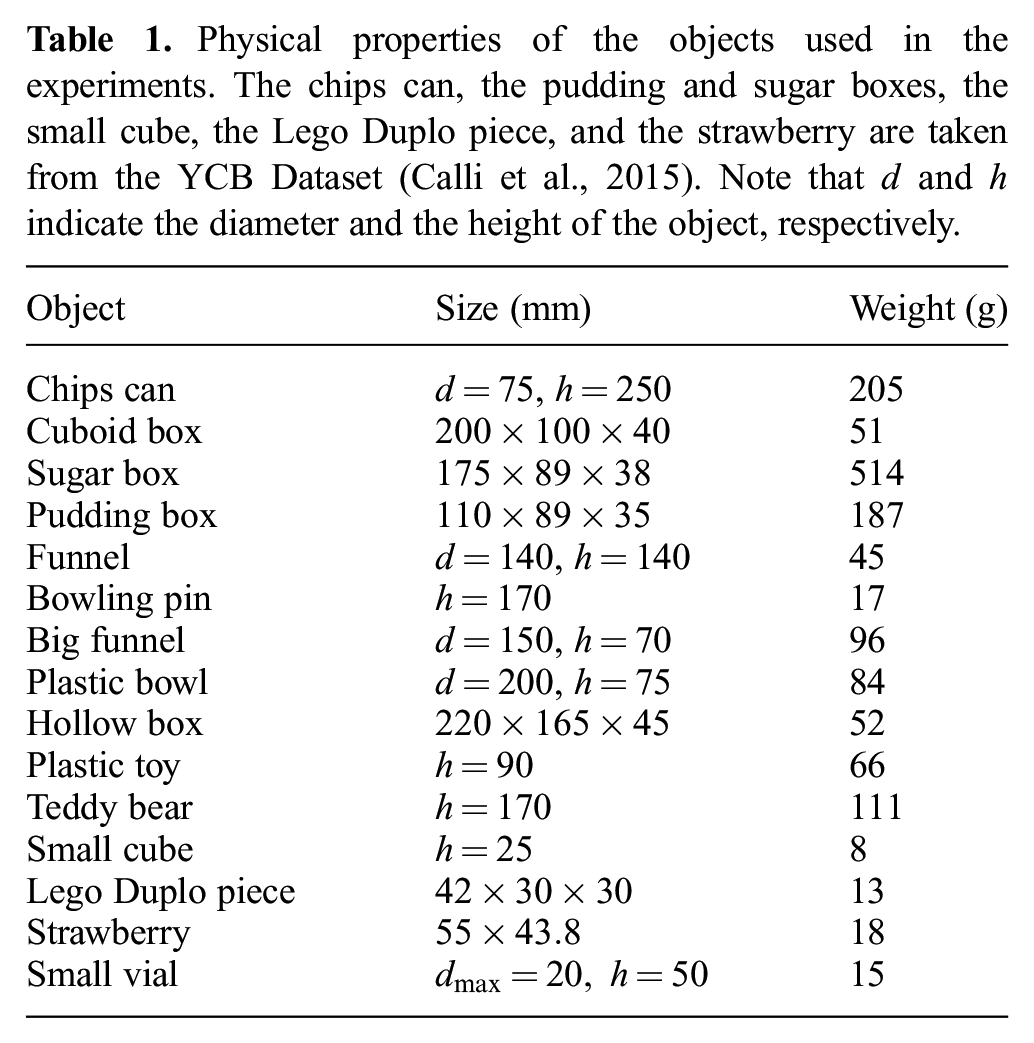
The cylindrical chips can and the cuboid boxes are objects with prototypical shapes. The funnel and the bowling pin are interesting because they can easily roll and generate unwanted dynamic behaviors when touched by the hand, owing to their roundness, non-regular shape, and lightness. The plastic bowl, the hollow box, and the big funnel are objects that should be picked up from their edges. The approach followed in Pozzi et al. (2018), based on building the bounding box of the entire object, would lead to failures in this case, because the grasp center would end up in the hollow part of the object. The plastic toy was chosen as it has a rather irregular surface. The teddy bear was selected because it is made of compliant material, but it is not soft and lightweight enough to undergo large deformations modifying its shape and spatial configuration when the hand touches it. The occurrence of such deformations would lead to results possibly unrelated to the output of the planning.
The first 11 objects were used in Experiment 1, and a subset of them was used in Experiment 2, as they are suitable to be grasped with heavy wraps. The small cube, the Lego Duplo piece, the strawberry, and the small vial are relatively small objects with respect to the used hands and might require delicate handling (strawberry). This is why they were used in Experiment 3, when testing lateral pinch and precision grasps.
Note that the chips can, the pudding and sugar boxes, the small cube, the Lego Duplo piece, and the strawberry are standard objects taken from the YCB Dataset (Calli et al., 2015).
5.2. Experiment 1: Evaluation of the modules integration
The aim of Experiment 1 was to evaluate the CS exploitation integrated with a grasp planner specifically designed for parallel-jaw grippers. We performed top-grasp experiments with a right Pisa/IIT SoftHand attached to a Sawyer robot arm to show the feasibility of the integrated approach shown in Figure 8, and to validate its robustness over multiple trials.
The hand–object alignment was executed at fixed height from the tabletop using the motion planning provided by MoveIt. 2 The robot motion was then controlled by means of a feedback-driven state machine, and the hand closed when a certain force threshold was exceeded due to the occurred contact between the hand and the object. During experiments, objects were placed in a random pose in the robot workspace.
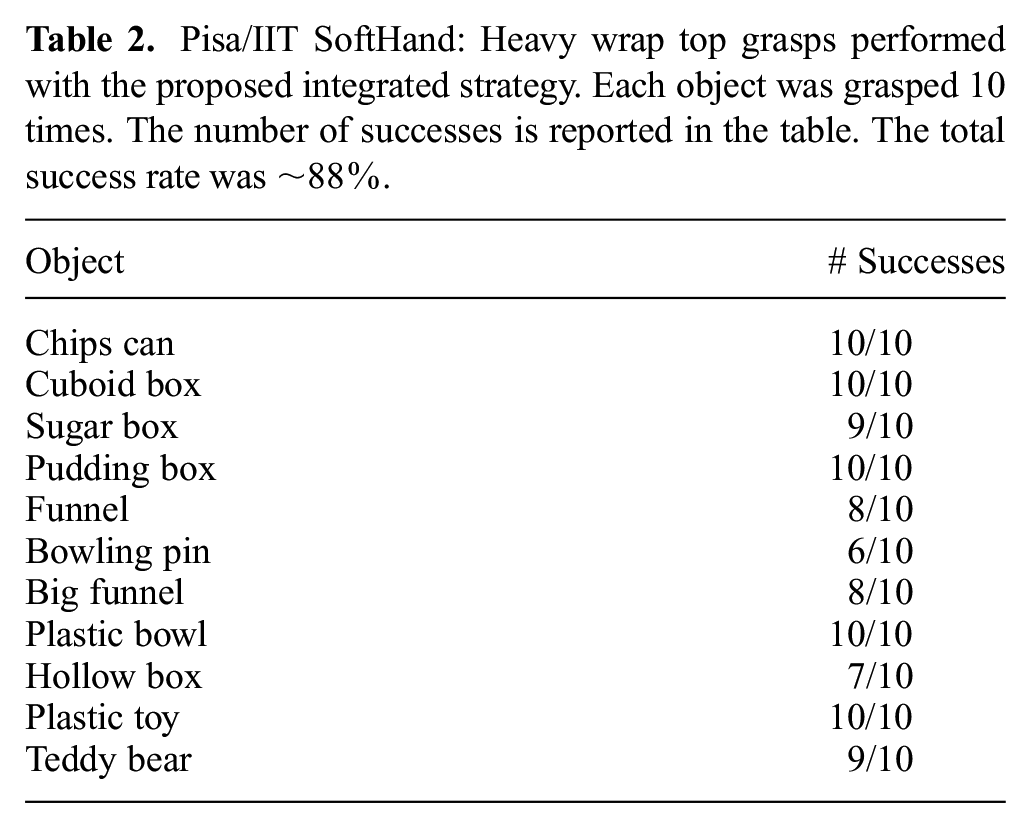
Figure 13 shows examples of planned grasps and Table 2 reports the results obtained for the chosen objects in terms of success rate.
3
A grasp was considered successful when the hand could stably hold the object while the arm was lifting for

Examples of planned grasps for some of the chosen objects.
Pisa/IIT SoftHand: Heavy wrap top grasps performed with the proposed integrated strategy. Each object was grasped 10 times. The number of successes is reported in the table. The total success rate was
5.3. Experiment 2: Application of the method to another soft hand
To test whether the proposed grasp planning strategy can be used also with other robotic hands, we applied it to the RBO Hand 2. First, we computed the CS of the complete closure of the RBO Hand, as explained previously. Then, we performed top grasps over four different objects, representative of three classes of objects that are present in Table 1: those with a prototypical shape (chips can, cuboid box), those that easily roll over the table top (bowling pin), and those that have a hollow part (bowl).
To investigate whether exploiting the RBO Hand 2 CS-alignment allows better grasping performance, we compared it with the baseline hand alignment that was used also in Pozzi et al. (2018). Such baseline has been called S-alignment (i.e., straight alignment) and consists of aligning the middle finger parallel to the chosen direction on the object, similarly to Bonilla et al. (2015) and Pozzi et al. (2018). The total success rate of the CS-alignment is
RBO Hand 2: Heavy wrap top grasps performed with the proposed integrated strategy. Each object was grasped 10 times. The number of successes for the CS-alignment and the S-alignment is reported in the table. The total success rate of the first is
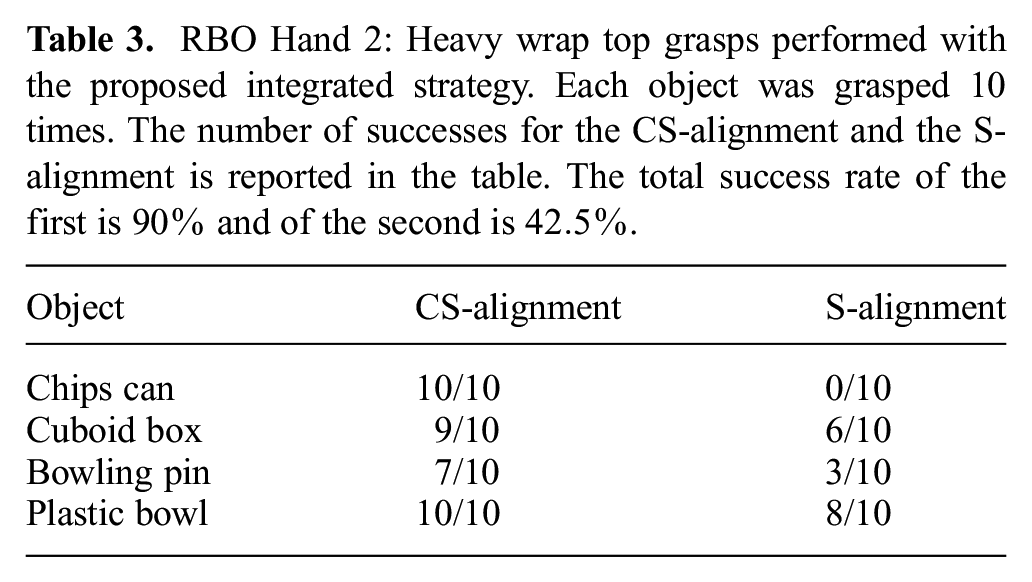
During the experiments, objects were placed in a random pose in the robot workspace and the hand–object alignment was executed at fixed height from the tabletop using MoveIt. Then, the hand approached the object at a fixed velocity, until a certain force threshold was reached at the wrist. This indicated that a contact with the object occurred and the hand started closing over the object. A grasp was considered successful if the hand was able to hold the object while the arm was lifting for
5.4. Experiment 3: Other types of grasps
5.4.1. Lateral pinch
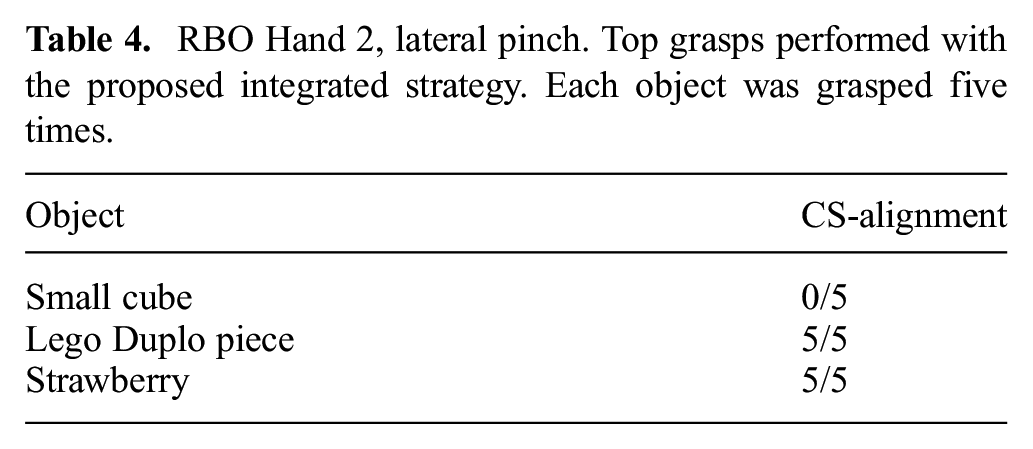
We implemented another type of power grasp with the RBO Hand, a lateral pinch (see Figure 3b), using the CS computed as in Figure 4b. We tested the strategy with two cuboid objects with different sizes (small cube and Lego Duplo piece) and one round object (strawberry). We observed that with the strawberry and the Lego Duplo piece, the grasp was always successful, while it always failed with the small cube (see Table 4). The trends were so clear that we limited the number of trials per object to five. The grasp execution was implemented as for the heavy wrap presented previously: the hand started closing when a certain force threshold was overcome. In this case, such event was determined by the contact with the table surface, that allowed the hand to slide and successfully pick up small objects.
RBO Hand 2, lateral pinch. Top grasps performed with the proposed integrated strategy. Each object was grasped five times.
5.4.2. Precision grasp
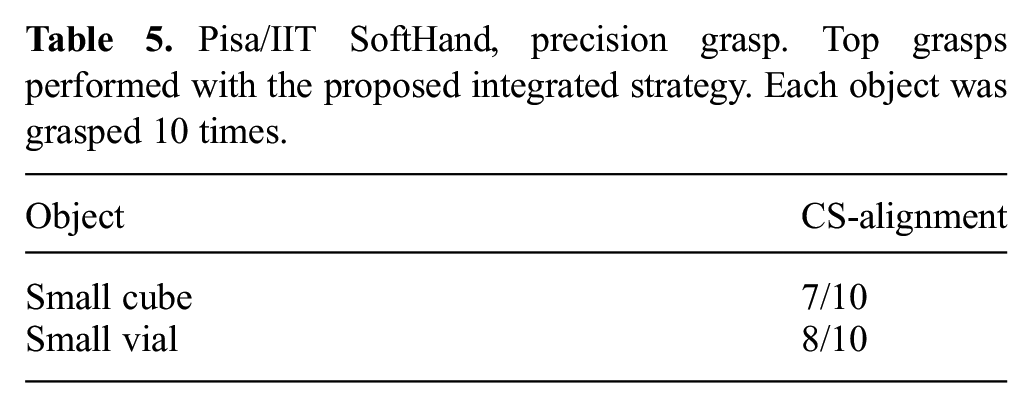
To show that the CS model can also be exploited for closures that lead to precision grasps, we tested the previously computed CS for the index and the thumb of Pisa/IIT SoftHand to plan precision grasps over a small cube and a small vial (see Table 1 for their properties). In this case, we chose two very small objects, requiring a precision grasp, one with a squared base and one with a round base. The hand pre-shaping and the height from the table were selected according to the object size. In particular, the hand was programmed to start closing at a height such that the fingers almost touched the table. Results in terms of success rates are reported in Table 5. In this case, we used a left Pisa/IIT SoftHand attached to a KUKA LBR iiwa robot arm.
Pisa/IIT SoftHand, precision grasp. Top grasps performed with the proposed integrated strategy. Each object was grasped 10 times.
6. Discussion of the results
6.1. Experiment 1: The module integration works well for planning top grasps with soft hands
The grasping task that we consider is mainly composed of two complementary sub-tasks: grasp planning (i.e., the problem of identifying which are the best contact point locations satisfying a given criterion) and the grasp execution (which relies on the closing motion of the chosen hand). The two parts have already been validated separately. The GQ-CNN module providing the grasp planning has been compared by Mahler et al. (2017) with other methods, namely image-based grasp quality metric, point-cloud registration, random forest, and support vector machine. The CS module providing the functional hand model involved in the grasp execution has been tested by Pozzi et al. (2018), by comparing the CS-alignment with the so-called straight alignment.
In this work, we show that the integration between the two modules not only is feasible, but also allows grasping objects that would have been impossible to grasp with the simple bounding-box-based grasp planner used in Pozzi et al. (2018). Planning how to grasp an object based only on its bounding box may lead to an oversimplification of the object, and cannot be successfully applied to object categories such as hollow objects, because the hand would end up on the empty part of the object instead of on an edge.
Failures and successes observed during the experimental trials depend on the interaction between the hand and the object, on the setup features (hand characteristics, robot workspace, etc.), and on the planned grasp. Examples of successful and unsuccessful grasps are shown in Figures 14 and 15, respectively.

Some of the successful grasps with the Pisa/IIT SoftHand.

Some of the unsuccessful grasps with the Pisa/IIT SoftHand.
Our approach was always successful for the objects with a prototypical shape. This is something that was expected for two reasons: (i) for these objects, the neural network typically outputs a grasping point that is very close to the object center of symmetry as seen from the top; and (ii) results described in Pozzi et al. (2018) show that, with the CS-alignment, regular objects are picked up most of the time. There was only one failure on the sugar box, owing to its weight. In addition the plastic toy was grasped as if it was a small box, and its irregular surface did not prevent grasps from being successful.
A high success rate was obtained also for objects that can be picked up from edges, i.e., the bowl, the hollow box, and the big funnel. Failures with the hollow box were due to collisions between hand wrist and object (see Figure 15), whereas those with the big funnel were due to the fact that the network output a grasp center on the small part of the funnel.
When more complex objects were considered, our approach still resulted successful most of the times, but additional considerations should be made.
The funnel was correctly grasped when either the fingers or the thumb were placed inside the cave part of the object (see Figure 15). One of the failures was due to the planned grasp, that was significantly laterally displaced from the center, thus leading to an unwanted object motion when the contact with the hand occurred. The other failure was caused by an accidental collision between the hand and the object, leading to a displacement of the funnel.
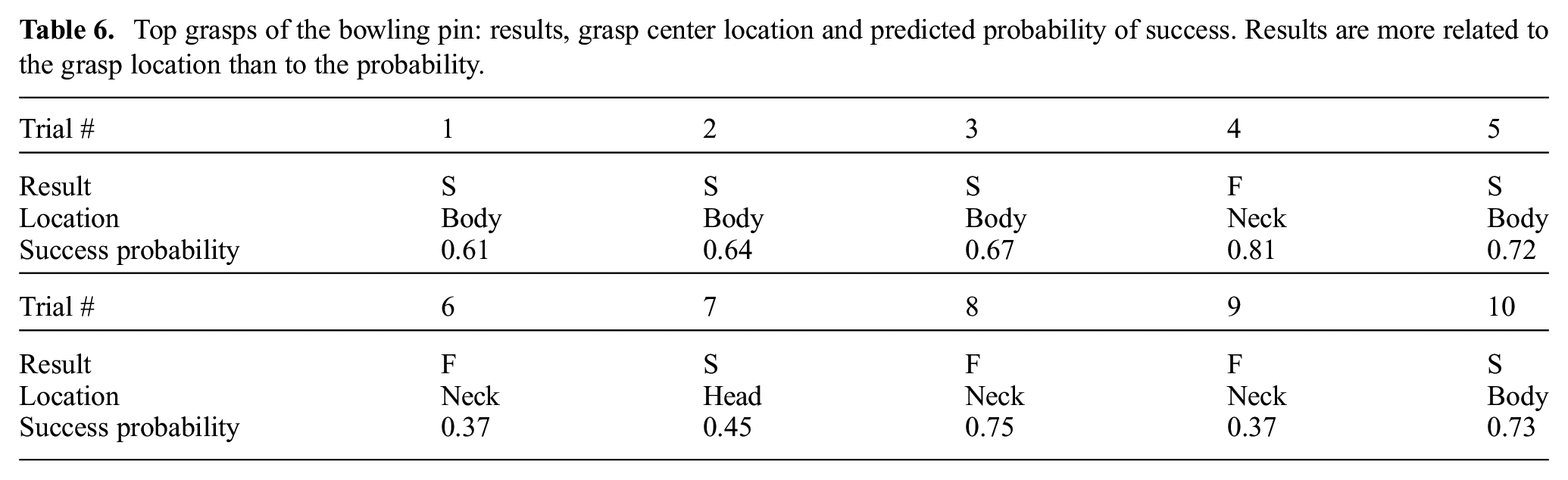
Bowling pin failures occurred when the grasp center was in proximity of the object neck (see Figure 15). In these cases, in fact, the hand entered in contact with the object in a region that was higher than the goal point, and remained stuck there. The force threshold was thus exceeded too soon and the hand closed without being in contact with the right grasp center and without caging the object.
For the teddy bear, the failure occurred because the planned grasp center was near to the ear, and this led to a lateral head displacement during the grasp execution.
As previously described, the GQ-CNN returns also a prediction of the grasp success probability, which is estimated by means of the learned grasp robustness function. By analyzing the performed grasps and the relative probability values, we found that, in general, the performance of our grasping system depends more on the relative geometric configuration between the hand and object, rather than on the predicted probability. In the following, we report the probability values for one of the objects with best grasp performance, i.e., the chips can, and the object with the worst performance, i.e., the bowling pin. For the chips can, the probability was always in the range
Top grasps of the bowling pin: results, grasp center location and predicted probability of success. Results are more related to the grasp location than to the probability.
6.2. Experiment 2: The CS computation and use generalizes well to other soft hands
The Pisa/IIT SoftHand and the RBO Hand 2 are different devices with different possible motion capabilities. This is reflected in the CS computation of the whole hand closure (heavy wrap (Cutkosky and Kao, 1989)). While the first hand generates a deformation that remains mainly in the

Pisa/IIT SoftHand CS-alignment for heavy wrap.
Examples of successful and unsuccessful grasps with the RBO Hand 2 are shown in Figures 17 and 18, respectively. The CS-alignment for the heavy wrap of the RBO Hand 2 is effective with prototypical objects, apart from a failure with the box which was due to the fingers touching the box and moving it before starting to close. In addition, the bowl was always grasped successfully. The bowling pin remains a difficult object to grasp (cf., results of Experiment 1), mainly due to the fact that sometimes the planned grasp center lies on the neck of the pin, or to object displacements resulting from unwanted collisions with the hand.

Examples of successful grasps with the RBO Hand 2.

Examples of failures with the RBO Hand 2.
Concerning the baseline method, we observed that (i) the performed grasps were not robust enough to stably lift the object, and (ii) regarding the chips can, the failures were due to its weight and to the fact that the palm could not envelop it properly, since the palm lied on the can and the finger rolling motion prevented the thumb from exploiting opposability.
6.3. Experiment 3: The CS can be used to plan different grasps with respect to heavy wraps
Experiment 3 shows that it is feasible to use the CS to model lateral pinches and precision grasps.
For the lateral pinch with the RBO Hand 2 there were two main factors influencing the grasp. First, the interaction with the environment allowed the caging of the object and was fundamental in order to achieve a successful grasp, as shown in Figure 19. Second, the height of the object determined the grasp success, as too small objects were not caged in time between the thumb and the index during the closing motion (see Figure 20). This is due to the fact that the fingers close with a certain velocity and with some delays between each other, so by tuning these parameters it could also be possible to obtain higher success rates.

Sequence of frames taken during the execution of a lateral pinch over a Lego Duplo piece.

Sequence of frames taken during the execution of a lateral pinch over a small cube.
When grasping small objects using a precision grasp even small uncertainties on the hand and object positions may lead to failures. This is why, particularly when using highly underactuated hands, it is important to consider a reduced set of fingers (e.g., thumb and index), and start from a partially closed initial position (CS depicted in Figure 7b). Preliminary experiments where we considered reference points in all the fingers (CS depicted in Figure 7a) led to unsuccessful grasps, as the center of the CS was too close to the middle of the palm and the objects were too small to be caged by the fingers. On the other hand, when considering just two fingers but starting from a completely open position, unwanted collisions with the objects occurred.
Figure 21 shows a successful grasp of a small cube. The hand starts from half of its total closure and then gently grasps the object between the fingertips of the thumb and index. Failures, such as that shown in Figure 22, were mainly due to misalignment between hand and object. In fact, the alignment of the planar components of the center of the CS to the center of the object is prone to uncertainties coming from the vision system and from the camera-to-robot calibration. When performing power grasps these are mitigated thanks to hand compliance and to the fact that the hand starts closing after the palm touches the object. In addition, in precision grasps, also uncertainties on the positioning in the direction normal to the plane are relevant.

Sequence of frames taken during the execution of a precision grasp over a small cube.

Sequence of frames taken during the execution of a precision grasp over a small vial.
6.4. General considerations
In addition to the discussion of experimental results, we conduct here a higher-level analysis of the proposed grasp planning approach. In particular, we want to characterize our system by means of the four key aspects of systems building suggested by Eppner et al. (2018), i.e., modularity versus integration, computation versus embodiment, planning versus feedback, and generality versus assumptions.
6.4.1. Modularity versus integration
Modularity allows a problem to be broken down in easier-to-solve sub-problems. As mentioned previously, our system is a result of a tight integration of different modules. The GQ-CNN module provides an estimation of the center and orientation of the most robust grasp, and the CS module provides a simple model of a closing motion of a chosen hand. The resulting integration is the grasp planning with soft hands module. Subsequently, it has been integrated with the grasp execution module, which, in turn, is given by the integration of a trajectory planning achieved with the standard module MoveIt and a force-feedback-guided state machine. Our system works on ROS, which allows us to achieve a great level of module integration. Note that the CS module plays a key role in the proposed method, as it allows the planning on the object to be decoupled, which can be performed with any grasp planner designed for parallel-jaw grippers, from the used end effector, whose closing motion can be described in terms of CS.
6.4.2. Computation versus embodiment
This aspect describes the relationship between software computation and the embodiment of some processes in the robot hardware in the system at hand. To characterize our system, we think that it is appropriate to split the entire process into two subsequent stages. The first stage includes the grasp planning and the hand alignment to the desired grasp, while the second stage includes only the hand closure. The first stage relies only on computation, while the second relies on the embodiment of the grasping capabilities of the soft hand, whose compliance allows safe interaction with the environment and high adaptability to objects.
6.4.3. Planning versus feedback
In Eppner et al. (2018), the difference between these aspects is centred on the type of solutions that they obtain: planning allows general solutions to be found, while feedback is involved in local solution search. Our approach is closer to planning than to feedback. In fact, after the acquisition of the object depth image, grasp planning, and robot end-effector alignment work without explicitly needing feedback from the scene. In Experiments 1 and 2, during the object approach, the execution is feedback-driven, since the robot motion stops and the grasp begins when the force exerted on the object exceeds a certain threshold.
6.4.4. Generality versus assumptions
When building robotic systems, it is crucial to find a trade-off between the generality of the proposed solution and the presence of underlying assumptions (Eppner et al., 2018). The assumption that mainly affects our system is that the neural network is trained for executing grasps with a parallel-jaw gripper. This assumption is clearly too restrictive in the case of grasping using a multi-fingered soft hand. However, modeling the hand through the CS, overcomes this difficulty, showing high generalizability to different robotic hands.
7. Conclusions
In this paper, we propose a general method for grasping objects from the top with soft robotic hands. The strength of the approach resides in the closure signature (CS), i.e., a model that associates a preferred grasping direction to a closure motion performed by a robotic hand. The CS is general enough to model power and precision grasps and its computation requires only the tracking of some chosen reference points on the hand during the motion that one wants to represent. The information provided by the CS can be used to suitably align the hand with the output of a grasp planner prescribing the best way to grasp a certain object (CS-alignment).
To validate the feasibility of the proposed approach, we tested different CSs of two different robot hands in combination with an AI-based grasp planner. Multiple experimental trials showed that: (i) the proposed integration generates successful power grasps from the top over a variety of objects (Experiment 1); (ii) the CS-alignment generalizes well to heavy wraps performed with different soft hands (Experiment 2); (iii) the CS model can be used also to perform grasps that are not heavy wraps, such as lateral pinch and precision grasp (Experiment 3). The road towards a dexterous use of soft hands is still long. Without a specific planner for soft hands, the complex interaction between hand, environment, and object largely determines the final obtained grasps. In this work, we have shown that the use of the CS model, that is computed for a certain intended closing motion, possibly combined with hand pre-shaping, allows us to plan the emerging grasp type.
The field of soft manipulation poses several challenges, regarding both the design of new hands and their control. There is a growing need of mathematical tools and shared standards to tackle these problems, devising methods general enough to be applicable to different robotic setups. However, it is important to find a balance between this quest for generality and the focus on specific device characteristics, because, in soft hands, design, control, and planning are inevitably strictly related. The CS follows this philosophy, as it can be computed for different robotic hands and, by modeling closure motions, it is able to describe the functioning of the chosen device. In the planning phase, the CS-alignment gives a way to increase grasp success independently from the adopted gripper, but the hand intrinsic compliance is exploited to gain adaptability to the object surface, safe interaction with the environment, and robustness to uncertainties coming from sensor inaccuracies.
Future work will focus on further applications of the presented results in real-world scenarios, as well as on their extension to deal with different problems, including environmental constraints exploitation. In a recent work, we already showed that the CS represents an important tool for well aligning the hand to the object in grasping strategies involving environmental constraints exploitation (Bimbo et al., 2019). We will also investigate the possibility of explicitly considering the interaction with the environment within the CS framework. In addition, the CS could play an important role in the open quest for standards and benchmarks in robotic manipulation.
Footnotes
Acknowledgements
We gratefully acknowledge Professor Oliver Brock and the members of the Robotics and Biology Laboratory of the Technische Universität of Berlin for having provided us with the data describing the trajectories of the reference points placed on the RBO Hand 2.
Declaration of conflicting interests
The author(s) declared no potential conflicts of interest with respect to the research, authorship, and/or publication of this article.
Funding
The author(s) disclosed receipt of the following financial support for the research, authorship, and/or publication of this article: We gratefully acknowledge the funding provided by the SOMA project (European Commission, Horizon 2020 Framework Programme, H2020-ICT-645599).
