






Abstract
Trust forms the bedrock of successful human interactions, and its integration into human–robot collaboration remains a critical challenge. Contemporary research predominantly explores human trust in robotic systems, focusing on refining the appearance and behavior of artificial agents to foster their acceptability in social settings. However, this systematic review centers on the less-explored dimension of trust mechanisms within autonomous robotic systems. Our aim is to survey what we define as Computational Trust models, which encompass a robot’s capability to both assess the trustworthiness of other agents (“Artificial Trust”) and to predict their levels of trust towards itself (“Natural Trust”). To achieve this objective, an initial set of 1916 papers, ranging from 2013 to 2023, was collected from IEEE Xplore, Scopus, and ISI Web of Science. Eligibility criteria were then applied to this set to select works that designed a Computational Trust model for a robotics application, which was validated through an experiment. These criteria were agreed upon by all authors to ensure unanimous decisions on whether to retain or remove results. At the end of this process, 101 key papers were identified. Following the selection process, we conducted thorough analyses to cluster these works based on the type of Computational Trust model used, the application domain, the robotic platforms employed in the validation, the experimental design, and the evaluation metrics. Finally, we identify common trends in this emerging branch of Human–Robot Interaction and provide guidelines for scholars wishing to contribute to this field.
1. Introduction
Rapid advancements in robotics and Artificial Intelligence (AI) are leading to the increasing integration of these technologies into our daily lives. AI systems already surround us and have emerged as a significant driving force in the global economy, with robotics expected to follow. As these autonomous systems become more pervasive, the necessity for them to be able to seamlessly interact with humans becomes even more critical. Effective interaction necessitates these machines to possess not only technical proficiency but also the nuanced social abilities inherent in human interaction. In other words, to integrate robots into our daily lives, we should equip them with similar social and cognitive skills as the ones that enable us to function as members of society.
This requirement is driving growing interest within both industry and academia. Researchers and scholars are focusing their efforts on developing computational models that are able to replicate some of our mental capabilities, in an effort to make these artificial entities a little more human-like (Vinanzi, 2021). One of these abilities is the one that allows us to reason about trust: a fundamental and inevitable component of social interactions.
Trust has proven difficult to define, because of the sheer range of situations in which it can be applied. For instance, it has profoundly different meaning in a financial relationship than a sentimental one. A broad definition, which is able to generalize across situations, comes from Mayer et al. (1995): trust is the willingness of one party (the trustor) to rely on the actions of another party (the trustee), with the former having no control over the latter. In essence, it represents the trustor’s willingness to delegate responsibility for a task to the trustee and to accept the associated risk. Trust permeates all types of social interactions and plays a pivotal role in fostering successful relationships, ensuring personal safety (Das and Teng, 2004), and facilitating team cooperation (Jones and George, 1998). The consequences of misplaced trust, stemming from an incorrect estimation of someone’s trustworthiness, can lead to severe damage, either economic, emotional, or even physical. Therefore, proficiency in this skill is a survival requirement for humans.
Given how important trust is for us (Khavas et al., 2020), researchers in the field of Human-Robot Interaction (HRI) have carried out a significant amount of research regarding this topic. Consequently, there have been attempts in providing standards to incorporate a trust component in HRI designs. For instance, Hancock et al. (2021) gave guidelines about the factors that affect trust during an interaction. In their work, they mainly explored a trust relationship in which the human is the trustor and the robot is the trustee. They listed and discussed these factors, dividing them into three categories: human-related factors (e.g., attitude towards robots and engagement), robot-related factors (e.g., dependability and adaptability), and environmental factors (e.g., team communication and physical environment). For many years, the core of research on trust in HRI has focused on identifying the parameters that empirically influence different levels of human trust.
Recently, researchers have started exploring the problem of mathematically modeling the trust of humans towards robots (Wang et al., 2023c). They identified two possible pathways, which make use of, respectively, deterministic and probabilistic methods. The former uses performance variables measured during the task, auto-regressive models, moving average ones or combinations of both. Probabilistic approaches model trust as a probability distribution influenced by other variables in a graph model. An example of the latter is OPTIMo (Xu and Dudek, 2015a), a probabilistic trust inference model based on Dynamic Bayesian networks. Other ways of modeling trust are inherited from other disciplines, like Machine Learning, formal methods and Game Theory (Kok and Soh, 2020). Although these models are seldom employed to influence a robot’s behavior during interactions (Wang et al., 2023c), researchers have recently started embedding trust awareness into robotic behavior. More recent research explores the possibility of enabling robots to trust humans. Indeed, some researchers have developed trust models that allow a robot to gauge trust towards users during interactions or collaborations (Sanders and Nam, 2021). A subset of this research even argues that trust models should be bilateral to capture the full spectrum of trust dynamics between humans and robots (Sanders and Nam, 2021; Zonca and Sciutti, 2021).
In this paper, we propose the use of the term Our definition of Computational Trust (CT) includes both Natural Trust (NT), where the robot estimates the trust of another agent toward itself, and Artificial Trust (AT), where the robot acts as a trustor toward another agent. The agent may be either a human or another robot.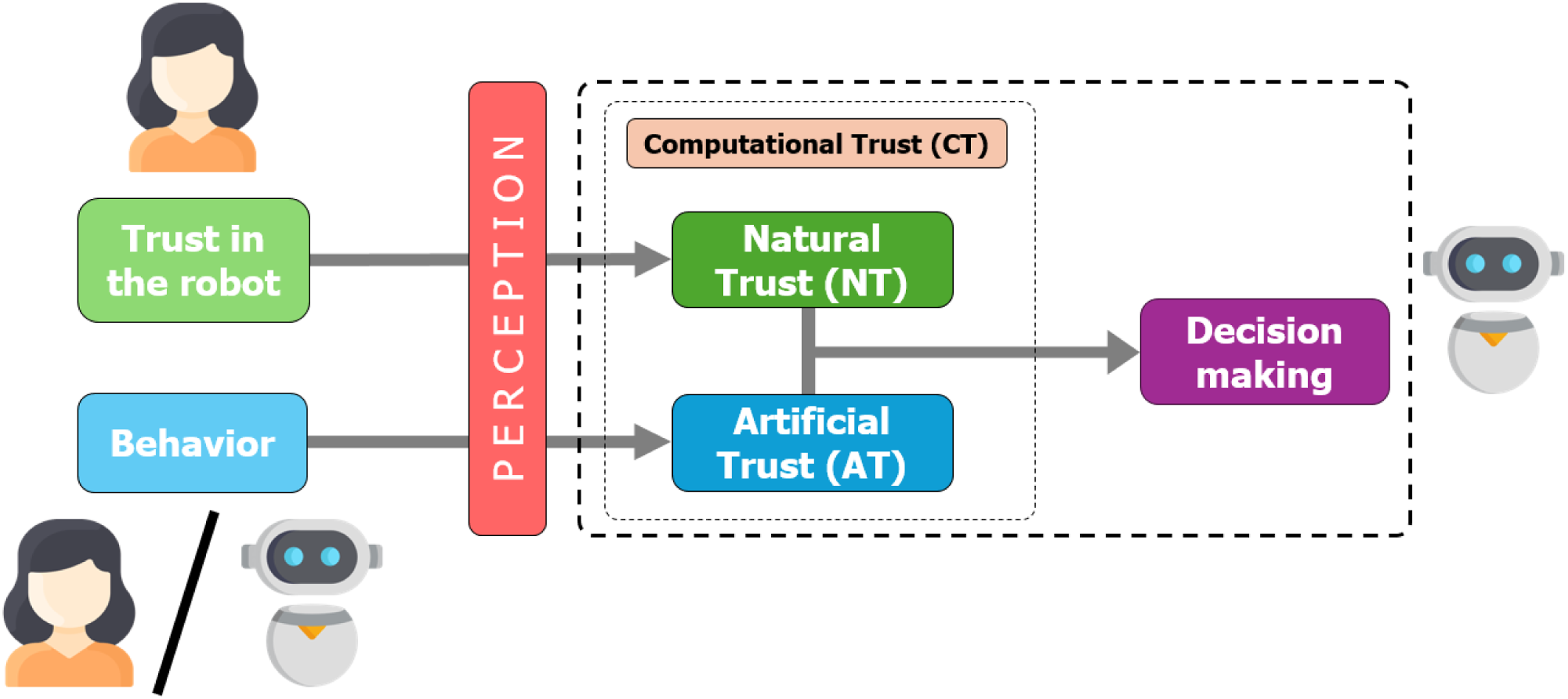
This fertile area of research is still in its early development but holds significant benefits, especially for collaborative or socially assistive service robots. For example, in the context of providing care to the elderly, robots could assess trust and use it in various aspects, such as determining when the user needs assistance (Wilson et al., 2023). Likewise, robots tasked with security and surveillance in a shop could employ trust estimation mechanisms to identify potentially suspicious behaviors, thereby aiding in threat detection and risk assessment (Kousar Nikhath et al., 2023). Trust can also be a critical factor in joint tasks where humans and robots depend on each other’s efforts to achieve a shared goal: whereas a robot can fail, so can a person, and for an artificial agent to know when to trust or distrust somebody and adapt its plans to this prediction can make all the difference in the success or failure of the task. Consider, for instance, a service robot assisting someone in setting up a table (Vinanzi and Cangelosi, 2024). If the robot learns that the individual frequently drops dishes while handling them, it may begin to distrust the person’s ability to perform that specific task. Consequently, the robot might offer to take charge of this role, suggesting the individual to take care of other tasks for which they are trusted, such as fetching and placing cutlery.
To the best of our knowledge, there is no previous attempt of producing a review with the purpose of collecting and formalizing the knowledge in this newborn field of study. Our main contribution is to summarize and synthesize existing research on CT, to provide an overview of the current state of knowledge, to identify trends and to offer insights for future research.
Although this review focuses on models of CT in robotics, it is essential to recognize that these models are ultimately grounded in human social cognition. Trust, as conceptualized in interpersonal and organizational psychology, is not merely a function of observed behavior or performance metrics: it is a relational, context-sensitive phenomenon. One of the most influential frameworks in interpersonal trust, proposed by Mayer et al. (1995), defines trust as a willingness to accept vulnerability based on perceived ability, benevolence, and integrity. These dimensions remain highly pertinent in HRI, where users frequently anthropomorphize artificial agents and rely on social heuristics to assess their trustworthiness. Lee and See (2004) extended this understanding to human–automation interaction, emphasizing trust calibration, how trust should dynamically align with system capabilities, and drawing directly from interpersonal trust theory. Bainbridge et al. (2011) further demonstrated that physical embodiment significantly shapes trust-related behaviors, echoing interpersonal dynamics such as personal space and compliance. More recently, Schaefer et al. (2016) synthesized decades of empirical work in a meta-analysis, identifying key antecedents of trust in automation, including transparency, reliability, and feedback. Building on this foundation, Schäfer et al. (2024) proposed a relational, trustor-centered definition of trust in robots, emphasizing intentionality and the asymmetry of trust as a directed relation. Together, these works underscore that trust in automation is best understood not as a novel phenomenon but as an extension of well-established interpersonal trust processes, adapted to the unique affordances and constraints of human–machine interaction. Consequently, CT models, particularly those that aim to predict or influence human behavior, must move beyond static, performance-based metrics and incorporate mechanisms for modeling reciprocity, repair, and social signaling. Embedding these human-centered principles into CT architectures is essential for developing robotic systems that are not only functionally competent but also socially intelligible and ethically aligned.
This paper is structured as follows. Section 2 reports the main criteria adopted to achieve a selection of paper suitable to highlight trends and challenges regarding the described topic. Section 3 discusses the domains of application of the experiments performed by the selected papers. Section 4 briefly introduces a taxonomy of robots that have been utilized in CT experiments. Section 5 provides insights in the computational models that have been used to endow robots with trust capabilities. Section 6 analyzes the different experimental settings that have been adopted by the community. Section 7 delves into the analysis of the most common evaluation metrics and the kind of results presented by the selected papers. Section 8 proposes an in-depth discussion about the findings and provides some research guidelines for scholars wishing to contribute to this field. Section 9 wraps up the main achievements of this paper.
2. Research methodology and overview
This section begins by describing the process of gathering the set of works that constitute the main references of this paper to provide trends and challenges of CT in robotics and autonomous agents. The selection process was performed by referring to the PRISMA 2020 guidelines (Page et al., 2021). High-level observations regarding the selection are then reported, followed by a more in-depth analysis in the subsequent sections.
2.1. Selection criteria
The term “trust” has multiple meanings according to the context in which it is used. Besides, many publications tend to strategically employ this term as a buzzword (Morgner, 2013). When searching for works in which trust is a key element of the query, a database is very likely to generate thousands of results, most of which are not pertinent to the actual focus of the investigation. Therefore, at the beginning of this work, several brainstorming sessions took place to identify a set of search hyper-parameters best suited for the purpose. This choice aimed to initially filter out unrelated works while preserving those related to the concept of CT in robotics.
After having identified the initial set of papers in January 2023, the authors agreed on a selection process, described below. At each stage of the selection process, every author individually reviewed each paper in the current selection, applying the criteria agreed upon for that stage and voting on whether to remove it or not. If a paper was unanimously voted for removal by all reviewers, it was immediately discarded. Otherwise, the authors gathered to discuss the specific contested entries until a unanimous decision was reached to either remove or retain them for the next phase. This search and selection procedure was repeated in December 2023 to include works released during that year. For simplicity, the selection process is reported with these two instances merged together. EndNoteTM20 (ClarivateTM, Philadelphia, USA) was utilized to organize the outcomes of every stage of the selection.
The following set of keywords was used: “trust*” AND “human” AND (“robot*” OR “autonomous vehicle*” OR “intelligent agent*” OR “cognitive agent*” OR “virtual agent*” OR “autonomous agent*”) AND
(“architecture” OR “model*”)
This combination was searched in the title, abstract, or keywords of works available on IEEE Xplore® (IEEE®, New York City, USA), ISI Web of ScienceTM (ClarivateTM, Philadelphia, USA) and Scopus® (Elsevier, Netherlands). From the results of these queries, works written in English and published from 2013 to 2023, inclusive, were retained. This initial set was composed of 1,916 papers: 526 from IEEE Xplore, 447 from ISI Web of Science, and 943 from Scopus. After merging the results of the three databases, duplicates, reviews, and early access papers were removed, reducing the set to 1,429 items.
At this point, the papers underwent a first screening phase. The works were skimmed by reading their titles and abstracts. They were included if they were accessible conference proceedings or journal papers, with an experimental validation involving trust with the presence of an artificial agent. They were instead discarded if trust was treated as a component of a bigger phenomenon, for example, acceptability (Semeraro et al., 2024a), or they were related to the fields of social networks, cybersecurity, trustworthy systems or explainable AI (XAI). The exclusion of the fields of social networks and cybersecurity is self-explanatory, as they fall outside the scope of robotics research. The rationale for excluding works on trustworthy systems and XAI is less immediate but still consistent with the focus of our investigation. Our review centers on the mathematical modeling of the trust variable, from both natural and artificial perspectives (see Section 1). Research on trustworthy systems primarily examines the factors (Hancock et al., 2021) that lead to the establishment of human trust in a system, which is not the objective of this review. Instead, we aim to explore studies that propose a priori mathematical models of trust and validate them through real-world deployment. For the same reason, XAI was excluded, as it primarily addresses how experts and end users perceive model explanations (Xu et al., 2019), rather than offering insights into the design of trust models themselves. This screening shrunk the set to 438 items.
A second screening then took place, in which the remaining set of papers was inspected with further depth. Papers were included in the set of studies to analyze if they provided a quantitative, mathematical CT model assessed through experimental validation. If multiple papers by the same authors presented methods and validations that were too similar, indicating a lack of novel contribution from one to another, only the most recent paper was retained and the other ones were discarded. Additionally, cases in which the CT model was obtained solely through regression analysis of trust measurements collected from a previous user study were excluded. This choice was again based on the fact that, in these works, the models were not conceived prior to interaction with another agent and therefore did not assist a robotic system in making more informed decisions. In contrast, if a model was developed following an initial user study and then validated in a second study using the newly derived trust model, the work was included in the final pool. As a result of this second screening, 101 papers were selected to constitute the final set upon which this review bases its discussions. The whole selection process is summarized in Figure 2. Selection process of the systematic review, according to the PRISMA guidelines (Page et al., 2021).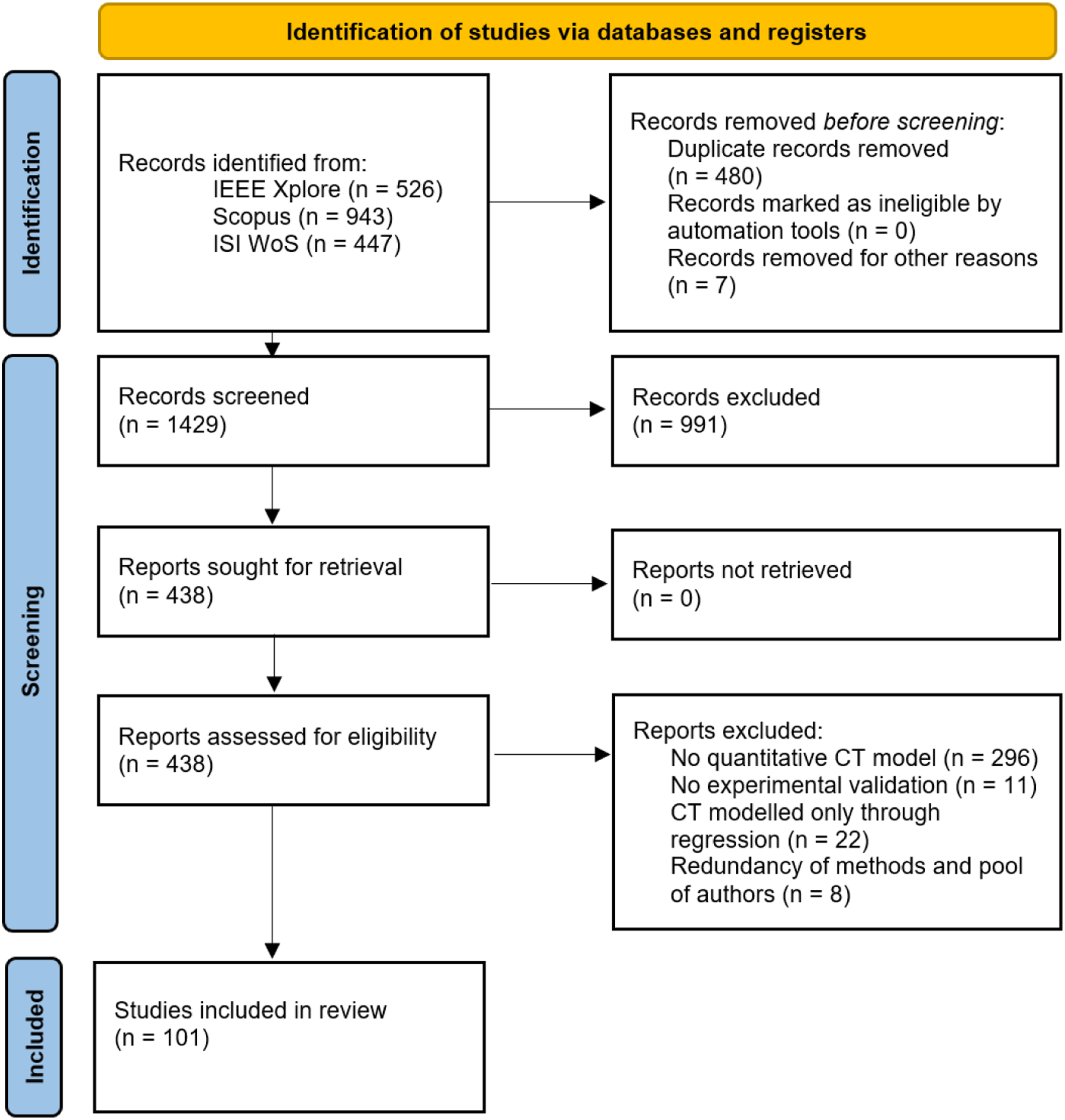
2.2. Result overview
Features extracted from the final set of papers. For the “CT” column, the legend is: AT = Artificial Trust, NT = Natural Trust, BT = Bilateral trust model (see Subsection 8.2). For the “Robot” column, the legend is: A = Humanoid, B = Unmanned Aerial Vehicle (UAV)/Drone, C = Autonomous Vehicles, D = Mobile robot, E = Manipulator, F = Autonomous Agents. The presence of a “,” means that the two agents were deployed separately in different experiments, while an “and” shows that they were present in the same experiment. For the “Trust model” column, A = Deterministic, B = Probabilistic, C = Machine learning, D = Game theory. For the “Domain” column, A = Human–robot collaboration (HRC), B = Reconnaissance, C = Navigation, D = Multi-agent systems, E = Autonomous vehicles, F = Human–robot interaction (HRI), G = Telerobotics, H = Miscellanea. For the “Experiment” column, A = Computer simulation, B = Real-world setting, C = Online. Regarding other abbreviations used in the table, ANN = Artificial Neural Network, ANOVA = ANalysis Of VAriance, HMM = Hidden Markov Model, MDP = Markov Decision Process, POMDP = Partially Observable Markov Decision Process, RF = Random Forest, RL = Reinforcement Learning, SVM = Support Vector Machine, UGV = Unmanned Grounded Vehicle.

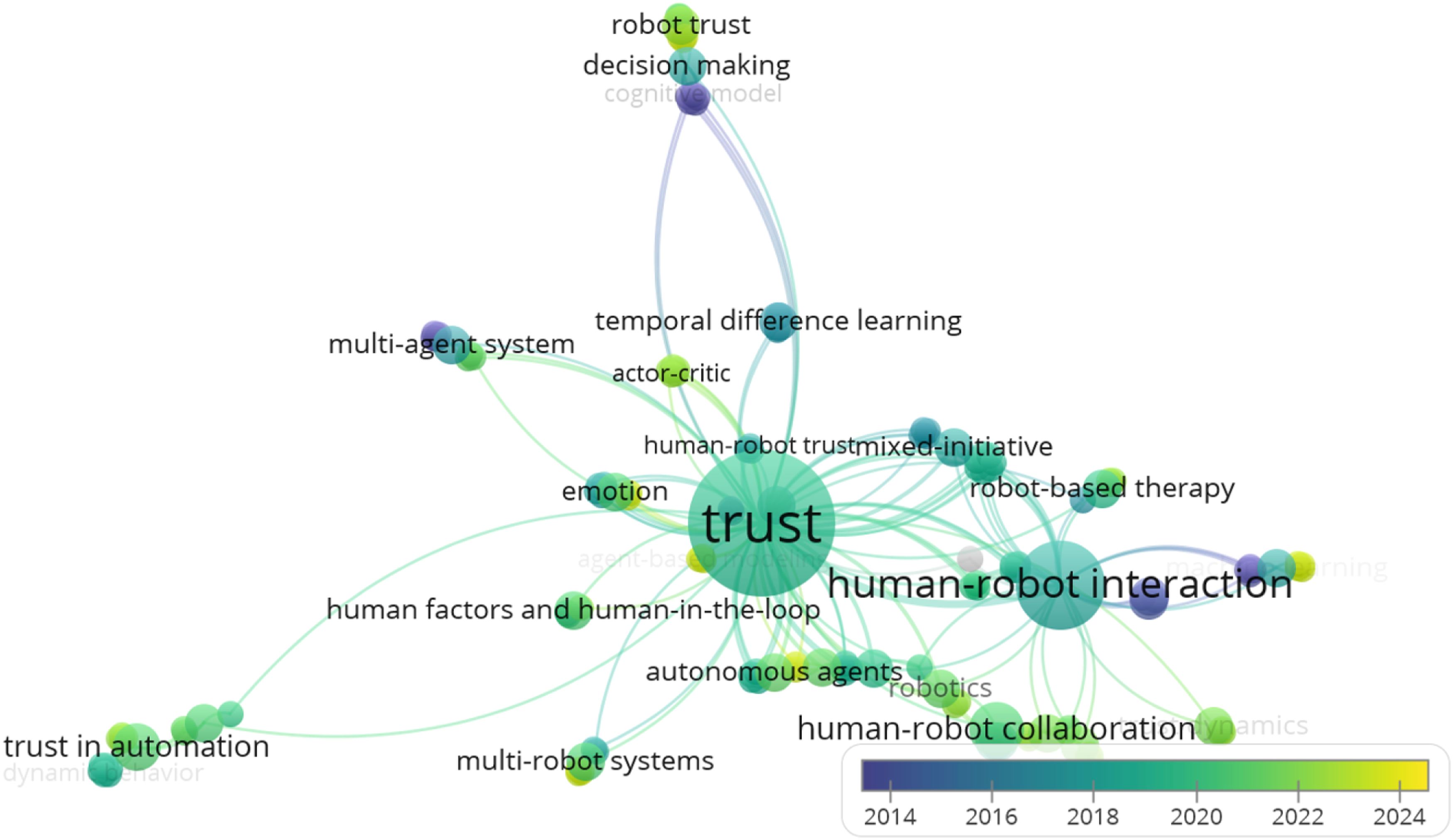
Keyword network of the selected set of papers (generated through VOSviewer (Van Eck and Waltman, 2010)).
Please note that, despite the clear focus found on human–robot collaboration, we did not want to limit our work to well-defined embodiments. Hence our inclusion of search keywords such as “intelligent agent*” or “autonomous agent*.” CT can be produced and studied for non-embodied agents, for example in simulation, with the aim to develop generalizable models to be then embedded in different robotics platforms.
A result of interest is the upper branch of the diagram. It contains the very recent keyword “robot trust,” which is closely related to CT. This term can be used to indicate research works that embed trust models into the robot’s behavioral model. In these works, trust is used as a variable that can affect the outcome of the interaction during the deployment of the robotic solution. The influence of trust on the robot’s behavior can also be seen by its connections to “decision making” and “cognitive model,” which indicate systems capable of gathering information from the environment and extrapolating high-level information, which is then used to tune the behavior of the robot according to the user’s behavior. This is evidence of the increasing importance given to incorporating trust dynamics in the behavior of robots, which justifies our attempt at providing standards in the design of trust models for robotics applications.
However, we argue that it is preferable to use the term CT to refer to this research sector, instead of robot trust, because the latter could be easily misinterpreted as the trust that users place into robots. While such conferred meaning to robot trust is a part of the research, it does not necessarily encompass all the possible ways in which trust dynamics can be modeled. Indeed, trust is a bidirectional relationship (Zonca and Sciutti, 2021); therefore, it is possible to model the trust of the user towards the robot, the trust the robot could have towards the users, or both simultaneously.
3. Domains of application
Understanding the importance of CT requires investigating the application domains in which it is used and how it could contribute to the field. In this section, we outline the different domains of application that could benefit from CT, based on the papers we reviewed. We have identified eight categories to classify these domains: (A) Human–Robot Collaboration; (B) Reconnaissance; (C) Navigation; (D) Multi-Agent Systems; (E) Autonomous Vehicles; (F) Human–Robot Interaction; (G) Telerobotics, plus a Miscellaneous category (H) for works that do not fit into any of the other categories and are not numerous enough to form one on their own. Inevitably, some works could fall into more than one category. In such cases, we chose to affiliate them with the domain in which they have the potential to be most impactful. Figure 4 summarizes our findings, which are discussed in detail in the rest of this Section. Distribution of the domains of application used by the selected papers. Computational Trust models appears to be used mostly in Human–Robot collaboration scenarios. Papers that span multiple domains have been classified as Composite.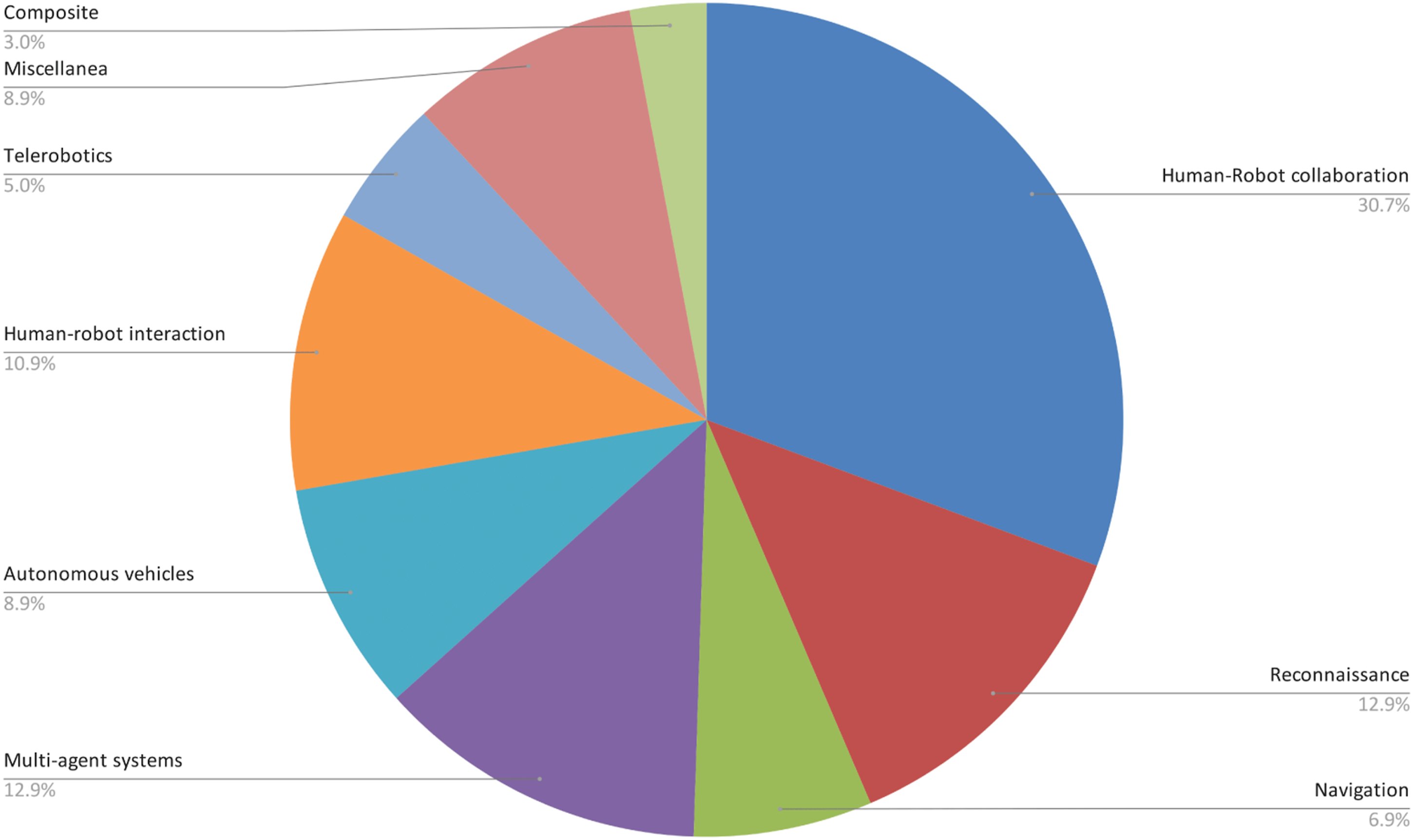
3.1. Human–robot collaboration
Human–Robot Collaboration (HRC) aims to understand what enables humans and robots to efficiently work together to complete a given task. Of the 101 papers in our review, 32 fall within this category, making it the most represented in this work. This high representation is due to the diverse nature of HRC research, encompassing various types of tasks that humans and robots can complete together. For example, one of the main areas linked to HRC is manufacturing (Almohamade et al., 2021). In industrial settings, the use of collaborative robots, or cobots, that physically interact with humans in a shared workspace is being explored for a variety of tasks (Wang et al., 2022; 2023a). Assembly tasks (Rabby et al., 2020; Rahman, 2019a; Rahman et al., 2016a; Sadrfaridpour et al., 2016; Sadrfaridpour and Wang, 2018) and object handover tasks (Rahman et al., 2016b; Tilloo et al., 2022) involve robots and their human partners sharing a static workspace. Examples of human and robot teams completing tasks in a shared static workspace include studies where the team coordinates to clear objects from a table (Chen et al., 2018, 2020). However, human–robot collaboration is not limited to static tasks, where the robot sits statically in one location. For example, in studies like Hannum et al. (2020) Sadrfaridpour et al. (2018) and Zheng et al. (2023b) the human–robot team needs to carry objects from point A to point B while avoiding obstacles in their path. In another study (Rahman, 2019c), they work together to lift an object to the desired vertical position.
Another common task in the HRC domain is trajectory tracking (Maithani et al., 2019; Xu and Dudek, 2015b). It can involve defining better trajectories for robot joints (Kumar and Dubey, 2017; Maithani et al., 2019) or fulfilling a patrolling task (Xu and Dudek, 2015a). Object collection is another prevalent problem in HRC (Mangalindan et al., 2023; Rahman, 2019b; Ranasinghe et al., 2015; Soh et al., 2020). For instance, in Rahman (2019b), the human and robot search a set of locations to retrieve objects of interest; in Soh et al. (2020), the human monitors the robot’s autonomous fetching capabilities; and in Ranasinghe et al. (2015), they work together to successfully retrieve objects from a shelf.
Within collaborative scenarios, task allocation is crucial, and CT could be fundamental in effectively dividing tasks among team members (Ali et al., 2022; Wu et al., 2017) and executing a plan towards a given goal (Scherf et al., 2022). To achieve the final goal, robots need to identify trustworthy and untrustworthy confederates who might potentially hijack the team’s mission. CT is used to enhance the robot’s identification capabilities in these scenarios (Lang et al., 2023a; Vinanzi et al., 2019, 2021).
Robots could use CT to understand their human partners and either predict their future decisions (Xu and Howard, 2020) or influence them. For instance, Losey and Sadigh (2019) specifically investigate whether a robot can leverage the trust of a human to directly influence them in a collaborative task. Finally, CT can also play an important role in scenarios where a human-robot team competes against another agent. For example, Ma et al. (2022) use a CT model to establish tactical coordination within a team competing against another robot in an object collection task.
Over the past decade, academic interest in CT for HRC has followed a clear upward trajectory. Beginning with just 3 publications in 2013, the number of relevant papers has increased steadily, reaching 19 in 2019. This consistent growth in publication volume is an indication of a sustained and expanding engagement with the topic across the research community, reflecting its growing importance and relevance. The observed pattern suggests that this trend is not due to isolated spikes in attention but reflects a wider and more lasting scholarly focus.
3.2. Reconnaissance
Reconnaissance scenarios, from search and rescue (Mahani et al., 2021; Zhou et al., 2021) to threats detection and clearance (Bhat et al., 2022; Floyd et al., 2014, 2015; Guo et al., 2021; Hoogendoorn et al., 2014), provide many opportunities for research in CT to test the need and efficacy of proposed models. Of the 101 papers included in our review, 14 are framed within the reconnaissance domain. Search and rescue scenarios include coal mine rescue robots (Zhou et al., 2021) and human-multi-robot UAV teams for search missions (Mahani et al., 2021). Reconnaissance missions can also involve the control and maintenance of specific areas (Guo et al., 2023a, 2023b; Wang et al., 2014; Guo and Yang, 2021; Akash et al., 2019) or missions where the goal is to reach predetermined destinations following precise trajectories (Pang et al., 2021). An example of area monitoring is given by Akash et al. (2019), where operators decide whether a building is safe based on information gathered by a robot. Similarly, Boer et al. (2013) use a CT model to estimate if a source of information is reliable.
3.3. Navigation
The category of Navigation includes works that focus on path planning and navigation missions not necessarily related to classic reconnaissance scenarios. Only 7 papers fall into this category. Examples of works discussing the use of CT for more efficient path planning include Alhaji et al. (2021), Dorbala et al. (2021), Dubey and Kumar (2019), and Mahani and Wang (2017), where humans and robots collaborate to find the best path to reach a target location. Carbo and Molina (2023) go a step further, framing their work within the logistics domain and examining agents that have to carry objects with different privacy concerns across two locations. Rutard et al. (2020) consider navigation within a maze-solving task, while Zahedi et al. (2023) incorporate CT in a simulated Mars rover navigation scenario.
3.4. Multi-agent systems
Multi-agent systems (MAS) refer to teams of more than two agents cooperating toward a common goal, where agents can be robots or humans. In this review, 14 papers fall within the MAS field. A common application domain for MAS is swarm robotics (Nam et al., 2017, 2020; Rishwaraj et al., 2017; Rishwaraj and Ponnambalam, 2017; Setter et al., 2017). In Nam et al. (2017, 2020), a swarm of UAVs need to locate a set of targets on a map, guided by a human operator. Similarly, Rishwaraj et al. (2017); Rishwaraj and Ponnambalam (2017) use a CT model for a swarm of mobile robots to locate targets on a map by communicating among themselves and dealing with sensor malfunctions during the task. Setter et al. (2017) use CT to help with the classic problem of swarm aggregation.
Outside the swarm robotics field, we see works on multi-agent teaming overlapping with navigation and surveillance tasks (Ponnambalam et al., 2021; Saeidi et al., 2017a; Spencer et al., 2016; Wang et al., 2018; Xu and Song., 2021; Zheng et al., 2018, 2023a). In particular, Ponnambalam et al. (2021) integrate a CT model into two robots collaborating to identify the positions of flags in an environment. Saeidi et al. (2017a) use CT to control the formation and motion of robots visiting different checkpoints. Spencer et al. (2016) and Wang et al. (2018) apply CT in navigation problems with obstacle avoidance. In Lin et al. (2023), a CT model is used by virtual agents to estimate trust from lexical and acoustic data. Similarly to what some works in HRC have done (see Subsection 3.1), CT in MAS can also help with improving real-time scheduling of tasks (Wang et al., 2015).
3.5. Autonomous vehicles
Autonomous Vehicles are attracting increasing effort from researchers in CT models, as their introduction in public spaces leads to a range of open problems that this domain might help solve. For example, Cheng et al. (2021) explore the possibility of improving an autonomous intersection management system, and Wang et al. (2023b) propose a generalized car-following model for mixed traffic flow. Work is still needed to fully understand how drivers’ trust can be predicted and used in autonomous vehicles. For this reason, studies such as Sun et al. (2023) and Cheng et al. (2023) use questionnaires to better understand which features drivers’ trust levels depend on. Additionally, works like Khattar and Eskandarian (2022), Hu et al. (2022), and Hsieh et al. (2022) assess how well CT models estimate the driver’s trust, even in the face of an abrupt decrease in performance (Hu et al., 2022). Finally, studies such as Mansoor et al. (2013) and Rjoub et al. (2023) try different models to find the best navigation system for autonomous vehicles. Overall, not many works fall into this category. Indeed, only 9 papers are directly related to Autonomous Vehicles.
3.6. Human–robot interaction
In this category, we included works that examine CT in the interaction between humans and robots without being particularly linked to a specific and generalizable application. 12 papers fall into this category. We can distinguish between works that try to estimate human trust in robots from their intentions and internal states (Abdulhussain and Aziz, 2022; Lang et al., 2023b) and works that try to estimate the trustworthiness of the human partner from facial features (Tjøstheim et al., 2019), behaviors (Kirtay et al., 2023; Patacchiola and Cangelosi, 2016), or conversational inputs (Li et al., 2023).
Another important aspect of trust and trust-building is the history of interaction between the human and the robot. For this reason, Lee et al. (2021) investigate human antecedents and familiarity as clues for CT, while Lee et al. (2013) explore whether a robot can successfully identify a trustworthy human it had not previously engaged with. The notion of history is also used to discuss and compare trust-based dynamics in teams carrying out tasks starting from different levels of trust (Hu and Wang, 2022).
Two works look at trust from a more theoretical perspective: Hale et al. (2019) attempt to formalize a mathematical model for trust-driven levels of privacy, while Patacchiola and Cangelosi (2022) focus on developing a biologically inspired CT model.
3.7. Telerobotics
Telerobotics concerns itself not with autonomous robots but with platforms that are controlled by a human operator. Out of the total 101 papers, 7 refer to teleoperated robots. In particular, works in this area focus on creating more efficient control strategies that yield or retain autonomy of the operated robot (Saeidi et al., 2016, 2017b; Saeidi and Wang, 2015, 2019; Wang et al., 2014). Specifically, Saeidi et al. (2016); Saeidi and Wang (2019) examine mixed-initiative control scaling and autonomy allocation strategies for a group of UAVs tracking the path of a mobile robot. A potential domain where telerobotics could improve processes is logistics. For instance, Aydoğan et al. (2015) explore how a CT model could enhance an airline decision-making process.
3.8. Miscellanea
This category includes all those application domains that were not represented enough to form a category of their own. These include robot-assisted therapy (Ab Aziz et al., 2017; Aziz and Abdulhussain, 2022), gaming (Carneiro et al., 2019; Razin and Feigh, 2021), recommender systems (Kang, 2018), smart devices and the Internet of Things (Sapienza and Falcone, 2023), robot-assisted vascular surgery (Yan et al., 2022), works on conceptual frameworks from Game Theory (Wagner et al., 2018), and CT-oriented dialogue systems (Kraus et al., 2021). A total of 9 papers fall into the Miscellanea category.
3.9. Insights
Although the domains in which CT contributes to shaping human-agent interactions are undoubtedly diverse, we can confidently identify the motif behind the decision to develop and study CT: collaboration. It is not only in line with what we found in this review, namely that the majority of the papers included fit within the HRC domain, but also with the definition of trust given by Mayer et al. (1995) which hints to the existence of a task to be completed for trust to even manifest. Whether it is in HRC scenarios involving cobots and manufacturing, surveillance or telepresence, CT is clearly central when a human-agent team needs to solve a shared problem. We have seen that such problems can span from identifying positions of targets in an environment (Ponnambalam et al., 2021) to object collection (Rahman, 2019b) and object handover tasks (Rahman et al., 2016b).
From the analysis of the domains, it is clear that CT is fundamental because it helps both the agents and the humans involved in the collaboration to understand whether their partner is trustworthy or not (not necessarily due to bad intentions) and accordingly make decisions to successfully complete the task they are assigned. To this end, we have found examples of works looking at reliability of information (Boer et al., 2013), at human characteristics that could identify a trustworthy or untrustworthy partner (Tjøstheim et al., 2019), and looking at agents characteristics that could be deemed trustworthy or not by their human partners (Sun et al., 2023). Ultimately, a way in which CT could be successfully employed is by using these results to develop more efficient control strategies that can rely on CT to decide whether to yield or retain the autonomy of the agents (Saeidi et al., 2017b).
Therefore, the important message that this scrutiny points to is that CT is mostly situated in those domains where there is a common goal to be reached and where the human-agent team need to find the best strategy to do so. Future work directions see CT more and more integrated in the decision-making modules of autonomous agents.
4. Robots
When discussing CT, it is important to analyze the different robotic platforms used over the years and across application domains to identify trends in the current literature. For this reason, we provide an overview of the types of robots used in the papers we have analyzed. We have identified the following categories: (A) Humanoids; (B) Aerial Robots; (C) Autonomous Vehicles; (D) Mobile Robots; (E) Manipulators; (F) Autonomous Agents. Some papers make use of different types of robots and are therefore included in multiple categories. The discussion highlights whether the robot in question acts as a trustor or a trustee. Figure 5 summarizes the distribution across these categories for both cases. Distribution of the types of robotic platforms used in the experiments covered in this review. The most common class is Autonomous Agents, which aligns with the fact that most experiments have been performed in simulation (see Section 6). (a) Robots that have been used as trustors, that is, those enabled with Artificial Trust capabilities. (b) Robots used as trustees, endowed with Natural Trust prediction skills.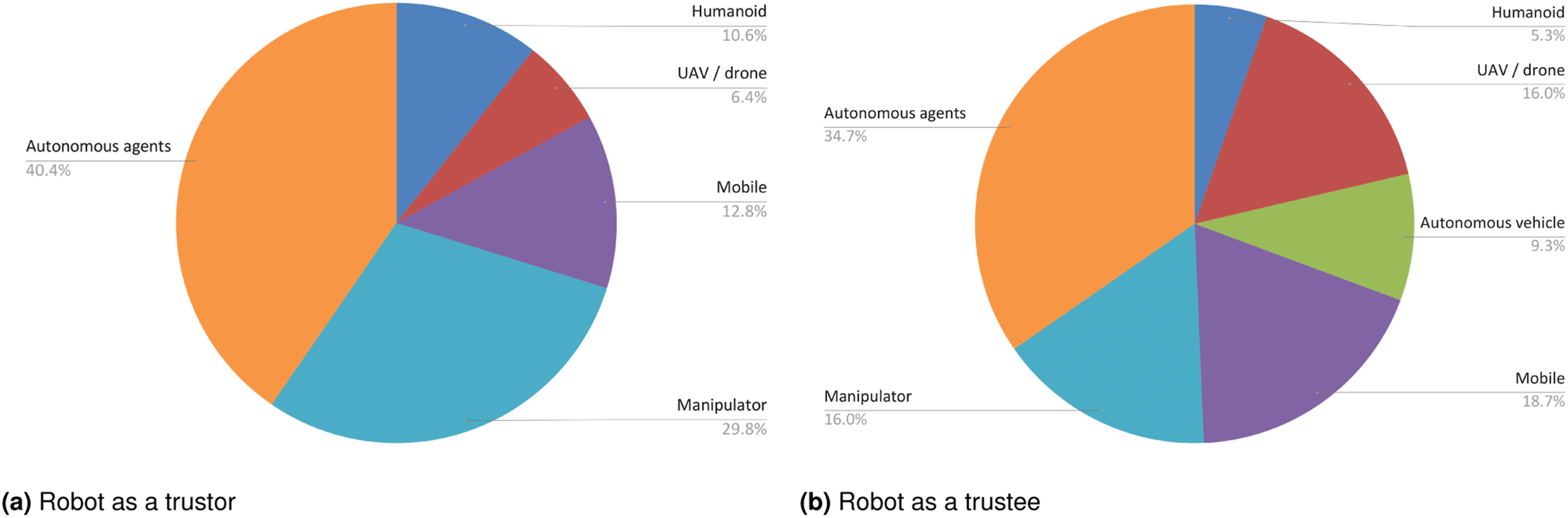
4.1. Humanoids
While there is no formal definition for humanoid robots, they are generally designed to resemble and mimic human form and behavior, often featuring a head, torso, arms, and legs. Their human-like appearance and capabilities make them particularly valuable for tasks that require social interaction and collaboration with humans, and for this reason they are mainly used for applications that span across HRI and HRC domains. Examples of humanoid robots are Pepper and Nao from Aldebaran, formerly known as SoftBank Robotics (Kirtay et al., 2023).
Humanoids have been used as trustors in 5 papers (Kirtay et al., 2023; Kraus et al., 2021; Patacchiola and Cangelosi, 2022; Rahman, 2019b; Vinanzi et al., 2019) spanning from 2019 (Rahman, 2019b; Vinanzi et al., 2019) to 2023 (Kirtay et al., 2023). Of this total, 2 fall into the HRC domain (Rahman, 2019b; Vinanzi et al., 2019), other 2 in the HRI domain (Kirtay et al., 2023; Patacchiola and Cangelosi, 2022) and one in the Miscellanea category (Kraus et al., 2021). Humanoids have been used as trustees in 4 papers (Kirtay et al., 2023; Rahman, 2019b; Wagner et al., 2018; Xu and Howard, 2020), the first of which dates to 2018 (Wagner et al., 2018). Also in this case, application domains are HRC (Rahman, 2019b; Xu and Howard, 2020), HRI (Kirtay et al., 2023), and Miscellanea (Wagner et al., 2018).
It is interesting to note that in 4 out of the 5 papers where humanoids take on the role of trustors, the authors present real-world experiments in which the multi-modal communication capabilities of the platforms are exploited to indicate their trust levels towards the trustees (Kirtay et al., 2023; Patacchiola and Cangelosi, 2022; Rahman, 2019b; Vinanzi et al., 2019). A similar trend can be observed for the papers in which humanoids play the trustee role, as 3 out of the 4 papers also present real-world experiments (Kirtay et al., 2023; Rahman, 2019b; Wagner et al., 2018). This use of multi-modal communication suggests that, possibly due to the nature of their embodiment and the application domains in which they are primarily used, where the other interacting agent plays a pivotal role, these robotic platforms are typically utilized for in-person evaluations.
4.2. Aerial robots
Aerial robots include drones and Unmanned Aerial Vehicles (UAVs): platforms capable of sustained flight with or without human intervention. These devices are most frequently used in human-in-the-loop scenarios, where a person modulates their degree of control over the robot based on how much they trust it. For this reason, there are only 3 papers, authored by Saeidi et al., that use aerial robots as trustors (Saeidi et al., 2016, 2017a; Saeidi and Wang, 2019). The latter present experiments in the domains of MAS and Teleoperation, proposing bilateral trust models. The majority of papers discussing CT in the context of aerial robots place them at the receiving side of the trust relationship (Guo et al., 2023b; Hoogendoorn et al., 2014; Mahani et al., 2021; Nam et al., 2017, 2020; Pang et al., 2021; Saeidi et al., 2017b; Xu and Dudek, 2015a). There are 12 papers that use aerial robots as trustees, the oldest of which is from 2014 (Hoogendoorn et al., 2014), and the latest from 2023 (Guo et al., 2023b). Four of these papers fall within the Reconnaissance application domain (Guo et al., 2023b; Hoogendoorn et al., 2014; Mahani et al., 2021; Pang et al., 2021), 4 within MAS (Nam et al., 2017, 2020; Saeidi et al., 2017a; Xu and Song., 2021), 4 within Telerobotics (Saeidi et al., 2016, 2017a, 2017b; Saeidi and Wang, 2019), and one within HRC (Xu and Dudek, 2015b).
Unlike the works outlined in Section 4.1, those that use aerial robots mainly present results from simulation-based studies, with 10 out of 12 papers falling into this category (Guo et al., 2023b; Mahani et al., 2021; Nam et al., 2017, 2020; Pang et al., 2021; Saeidi et al., 2016, 2017a; Saeidi and Wang, 2019; Xu and Dudek, 2015a, Xu and Song, 2021). This shift into simulated environments could be due to the fact that much of these works deal with teams (Guo et al., 2023b; Mahani et al., 2021; Pang et al., 2021; Saeidi et al., 2017a) or swarms (Nam et al., 2017, 2020; Xu and Song., 2021) of aerial robots, making real-life experiments more complex and resource-consuming. The tasks often involve patrolling (Guo et al., 2023b; Mahani et al., 2021; Nam et al., 2017, 2020; Xu and Dudek, 2015b, Xu and Song., 2021), path planning (Pang et al., 2021), and control allocation (Saeidi et al., 2016, 2017a; Saeidi and Wang, 2019), which are easily simulated without deploying aerial robots in real-world settings.
4.3. Autonomous vehicles
An autonomous vehicle is a self-driving vehicle capable of navigating and operating without human intervention. All the 7 papers that cover their use in the context of CT modeling assign them the role of trustees (Cheng et al., 2023; Hsieh et al., 2022; Hu et al., 2022; Rjoub et al., 2023; Soh et al., 2020; Sun et al., 2023; Wang et al., 2023b). As a very recent area of research, the oldest paper is from 2020 (Soh et al., 2020), while 4 are from 2023 (Cheng et al., 2023; Rjoub et al., 2023; Sun et al., 2023; Wang et al., 2023b). All of them fall into the Autonomous Vehicles application domain category, with Soh et al. (2020) also addressing HRC. The absence of CT models that use autonomous vehicle as trustors is notable and represents a gap in the current literature.
Similarly to what has been observed in the context of aerial robots in Section 4.2, most papers of this class (5 out of 7) present simulation studies (Cheng et al., 2023; Hu et al., 2022; Rjoub et al., 2023; Soh et al., 2020; Wang et al., 2023b). The exceptions are one paper from Hsieh et al. (2022), who collect trust measurements from the human during a real-world drive, and Sun et al. (2023) who run an online experiment, collecting data through a questionnaire to build a CT model.
4.4. Mobile robots
Mobile robots encompass all robotic platforms that are designed to move around an environment but do not classify as vehicles. Only 6 papers use mobile robots as trustors, with the oldest being (Mahani and Wang, 2017) from 2016 and the most recent (Ma et al., 2022) from 2022. The most common application domain, used by 3 papers, is Navigation (Dorbala et al., 2021; Dubey and Kumar, 2019; Mahani and Wang, 2017). The remaining 3 papers cover experiments that have been conducted in the realms of HRC (Ma et al., 2022) and MAS (Rishwaraj and Ponnambalam, 2017), plus one work classified as Miscellanea (Wagner et al., 2018).
Thirteen of the reviewed papers use mobile robots as trustees. The oldest is (Wang et al., 2014) from 2014, and the most recent are (Zahedi et al., 2023; Zheng et al., 2023a) from 2023. Application domains for mobile robots as trustees include: HRC (Soh et al., 2020; Zahedi et al., 2023), Reconnaissance (Bhat et al., 2022; Wang et al., 2014; Zhou et al., 2021), Navigation (Dubey and Kumar, 2019; Zahedi et al., 2023), MAS (the largest category, represented by 6 papers) (Ponnambalam et al., 2021; Rishwaraj and Ponnambalam, 2017; Spencer et al., 2016; Wang et al., 2018; Zheng et al., 2018, 2023a), and Miscellanea (Wagner et al., 2018).
Mobile robots have been used in robotics and AI research for a very long time. Modular platforms like TurtleBot make it easy for researchers to carry out real-world experiments. For this reason, we see an almost equal split of simulation-based validations and real-world experiments being presented in works using mobile platforms. Specifically, 6 works test their models through simulation studies (Ma et al., 2022; Mahani and Wang, 2017; Soh et al., 2020; Spencer et al., 2016; Wang et al., 2014, 2018), 3 use real-world experiments (Dubey and Kumar, 2019; Ponnambalam et al., 2021; Zhou et al., 2021), and 5 use a two-phase validation involving both simulations and real-world experiments (Dorbala et al., 2021; Rishwaraj and Ponnambalam, 2017; Wagner et al., 2018; Zahedi et al., 2023; Zheng et al., 2023a). Works requiring simulation-based evaluations mostly deal with multi-agent systems and teleoperation (Rishwaraj and Ponnambalam, 2017; Saeidi and Wang, 2015; Spencer et al., 2016; Wang et al., 2014, 2018; Zheng et al., 2018, 2023a).
4.5. Manipulators
With the term manipulators, we refer to industrial robots as arm-like structures that can manipulate materials and objects within their workspace. From our pool of selected papers, 14 employ them as trustors. The oldest are (Rahman et al., 2016a; Ranasinghe et al., 2015) from 2015, while the newest are (Lang et al., 2023a, 2023b; Wang et al., 2023a) from 2023. The most common application domain for manipulators is HRC, which received contributions from 14 papers (Almohamade et al., 2021; Hannum et al., 2020; Lang et al., 2023a; Maithani et al., 2019; Rahman et al., 2016a, 2016b; Rahman, 2019a; Ranasinghe et al., 2015; Scherf et al., 2022; Tilloo et al., 2022; Vinanzi et al., 2021; Wang et al., 2022, 2023a; Chen et al., 2018), but there are also works that use them for HRI (Lang et al., 2023b).
Manipulators are used as trustees in 12 papers, the oldest of which (Rahman et al., 2016a) from 2015 and the newest being (Mangalindan et al., 2023; Zheng et al., 2023b) from 2023. All these papers belong to the HRC application domain (Kumar and Dubey, 2017; Losey and Sadigh, 2019; Mangalindan et al., 2023; Rabby et al., 2020; Rahman, 2019a; Rahman et al., 2016a; Sadrfaridpour et al., 2016, 2018; Sadrfaridpour and Wang, 2018; Wu et al., 2017; Zheng et al., 2023b), with one of them, authored by Mangalindan et al. (2023), also being classified as HRI.
The application domains for manipulators, much like those for humanoid robots (Section 4.1), require the physical co-presence of the robotic platform and the agent they are collaborating with. For this reason, 16 papers describe real-world experiments (Losey and Sadigh, 2019; Rahman et al., 2016a, 2016b; Rahman, 2019a; Sadrfaridpour and Wang, 2018; Zheng et al., 2023b; Almohamade et al., 2021; Hannum et al., 2020; Lang et al., 2023a, 2023b; Maithani et al., 2019; Ranasinghe et al., 2015; Tilloo et al., 2022; Wang et al., 2022, 2023a; Chen et al., 2018), while 6 rely on simulations (Kumar and Dubey, 2017; Mangalindan et al., 2023; Rabby et al., 2020; Sadrfaridpour et al., 2018; Vinanzi et al., 2021; Wu et al., 2017), and only 2 present double validation (Sadrfaridpour et al., 2016; Scherf et al., 2022).
4.6. Autonomous agents
Papers that use robots not falling into any of the aforementioned categories, as well as those that do not refer to a specific type of platform but simply to “robots” or “agents,” fall into this category.
Our review has found 20 papers which use generic or unspecified robots as trustors, spanning from 2015 (Aydoğan et al., 2015) to 2023 (Li et al., 2023; Lin et al., 2023; Rjoub et al., 2023; Sapienza and Falcone, 2023). The most represented application domains are MAS (Lin et al., 2023; Rishwaraj et al., 2017; Setter et al., 2017) and HRI (Lee et al., 2021; Li et al., 2023; Patacchiola and Cangelosi, 2016; Tjøstheim et al., 2019), each with 4 papers. Other works fall into the domains of HRC (Ali et al., 2022; Kumar and Dubey, 2017), Navigation (Alhaji et al., 2021; Dorbala et al., 2021; Rutard et al., 2020), Autonomous Vehicles (Cheng et al., 2021; Khattar and Eskandarian, 2022; Rjoub et al., 2023), Telerobotics (Aydoğan et al., 2015), and Miscellanea, including gaming applications (Carneiro et al., 2019), recommender systems (Kang, 2018), and smart devices or Internet of Things (Sapienza and Falcone, 2023).
Similarly, 28 papers place generic or unspecified robots in the role of trustees, spanning from 2013 (Lee et al., 2013; Mansoor et al., 2013) to 2023 (Carbo and Molina, 2023; Guo et al., 2023a; Hu and Wang, 2022; Lin et al., 2023). Of this total, 3 fall into the HRC domain (Ali et al., 2022; Chen et al., 2020; Rahman, 2019c), 7 in Reconnaissance (Boer et al., 2013; Floyd et al., 2014, 2015; Guo et al., 2021, 2023a; Guo and Yang, 2021), 4 in MAS (Lin et al., 2023; Rishwaraj et al., 2017; Setter et al., 2017; Wang et al., 2015), 4 in HRI (Abdulhussain and Aziz, 2022; Hale et al., 2019; Hu and Wang, 2022; Lee et al., 2013), 2 in Autonomous Vehicles (Cheng et al., 2021; Mansoor et al., 2013), one in Navigation (Carbo and Molina, 2023), and 5 in Miscellanea, including robot-based therapy (Ab Aziz et al., 2017; Aziz and Abdulhussain, 2022), games (Carneiro et al., 2019; Razin and Feigh, 2021), and surgery (Yan et al., 2022).
Since most of the works in this category do not specify a robotic platform on which they deploy their CT models, it is not surprising that 37 of them rely on simulations (Ab Aziz et al., 2017; Abdulhussain and Aziz, 2022; Alhaji et al., 2021; Ali et al., 2022; Aydoğan et al., 2015; Aziz and Abdulhussain, 2022; Carbo and Molina, 2023; Chen et al., 2020; Cheng et al., 2021; Floyd et al., 2014, 2015; Guo et al., 2021, 2023a; Hale et al., 2019; Hu and Wang, 2022; Kang, 2018; Khattar and Eskandarian, 2022; Kumar and Dubey, 2017; Lee et al., 2021; Lin et al., 2023; Mansoor et al., 2013; Patacchiola and Cangelosi, 2016; Razin and Feigh, 2021; Rishwaraj et al., 2017; Rjoub et al., 2023; Rutard et al., 2020; Sapienza and Falcone, 2023; Setter et al., 2017; Tjøstheim et al., 2019; Wang et al., 2015) or online studies (Akash et al., 2019; Boer et al., 2013; Carneiro et al., 2019; Guo and Yang, 2021). The 3 papers that provide real-world evaluations feature human participants interacting with robotic platforms or autonomous systems that cannot be classified as humanoids, aerial robots, mobile robots, manipulators, or autonomous vehicles. For example, Rahman (2019c) tests their CT model on an in-house built power assist system. Similarly, Yan et al. (2022) conduct experiments using a novel robotic system for vascular intervention surgery they developed, while Li et al. (2023) develop a generic conversational agent to interact with their human participants. Dorbala et al. (2021) classify both in the Autonomous Agents and the Mobile Robots categories because they start their validation with a simulation using an unspecified agent and complement it with a real-world experiment using a mobile robot.
4.7. Insights
The decision of which robot platform to use when developing and evaluating CT depends on factors such as the scenario intended for their use, the feasibility of deploying the robotic platform in the intended scenario in real-world settings, and the availability of the platform at the different institutions.
Mobile robots have a long-standing presence in robotics research, as evidenced by the large number of papers that deploy their systems on such platforms. Mobile robots have consistently offered researchers reliable simulators and a cost-effective means to conduct in-person experiments. This is clearly reflected in our review, where mobile robots were used in an equal number of studies involving real-world deployments (Dubey and Kumar, 2019) and simulations (Ma et al., 2022).
In our analysis, humanoids and manipulators emerged as the most commonly used robot platforms for in-person experiments, likely due to the demands of scenarios that require multi-modal communication (Kirtay et al., 2023) or physical co-presence to complete a task (Losey and Sadigh, 2019). Interestingly, manipulators are more frequently used than humanoids. This may be due to the higher cost of humanoid robots and their association with an only recent industrial push compared to the longer established use of manipulators.
Aerial robots and autonomous vehicles are also vastly used by the community, but mostly in simulated experimental setups. Aerial robots are mostly used in human-in-the-loop scenarios, with their role being most frequently that of trustees (Guo et al., 2023b). Similarly, autonomous vehicles are usually the trustees when they are involved in a study (Cheng et al., 2023). These differences with respect to humanoids and manipulators are mostly due to the nature of the task and environments in which these type of platforms are meant to be deployed, generally involving a higher degree of risk for the platforms and the people involved.
It is less surprising to see that autonomous agents without a specific embodiment have also been mostly used in simulation (Alhaji et al., 2021). It is important to acknowledge works that do not necessarily use pre-defined platforms as they have the potential to generalize to more than one platform. For this reason, future works are welcome to test these solutions for CT in specific embodiments.
In general, looking at the choices of platforms, where they have been deployed and how, we can identify a clear area of improvement for the field: more in-person experiments are needed to test generalizability and specificity of the models proposed.
5. Computational models of artificial and natural trust
This section delves into the computational models used in the selected papers, aiming to identify trends in the state-of-the-art. We have categorized techniques into 4 clusters present across our pool of scientific publications: (A) Deterministic, (B) Probabilistic, (C) Machine Learning (ML), and (D) Game Theory, each discussed in detail in the subsequent subsections.
Figure 6 summarizes the frequency of adoption of these classes of techniques within our selected sample. Among the selected 101 papers, 92 fall within a single category. The majority of works (54 papers) belong to the Deterministic class, followed by Probabilistic (28 papers). Despite the contemporary popularity of ML and Deep Learning solutions to develop AI systems, only 8 papers belong to that group. Finally, 2 papers adopt Game Theory approaches of CT. For the purpose of this analysis, we have separated the papers that use multiple classes of computational models in a separate category, which we name Composite. Nine papers belong to this class, of which 6 combine Probabilistic and ML methods. The latter is the most common hybridization, which is expected due to the increasing popularity of Reinforcement Learning (RL) methodologies and their natural pairing with Markovian models. Deterministic methods have been combined with Probabilistic techniques twice (Sun et al., 2023; Zheng et al., 2023a) and with ML only once (Lin et al., 2023). Distribution of the computational model grouping across the selected papers. Deterministic models appear as the most common choice, followed by Probabilistic. Papers that make use of multiple models have been classified as Composite.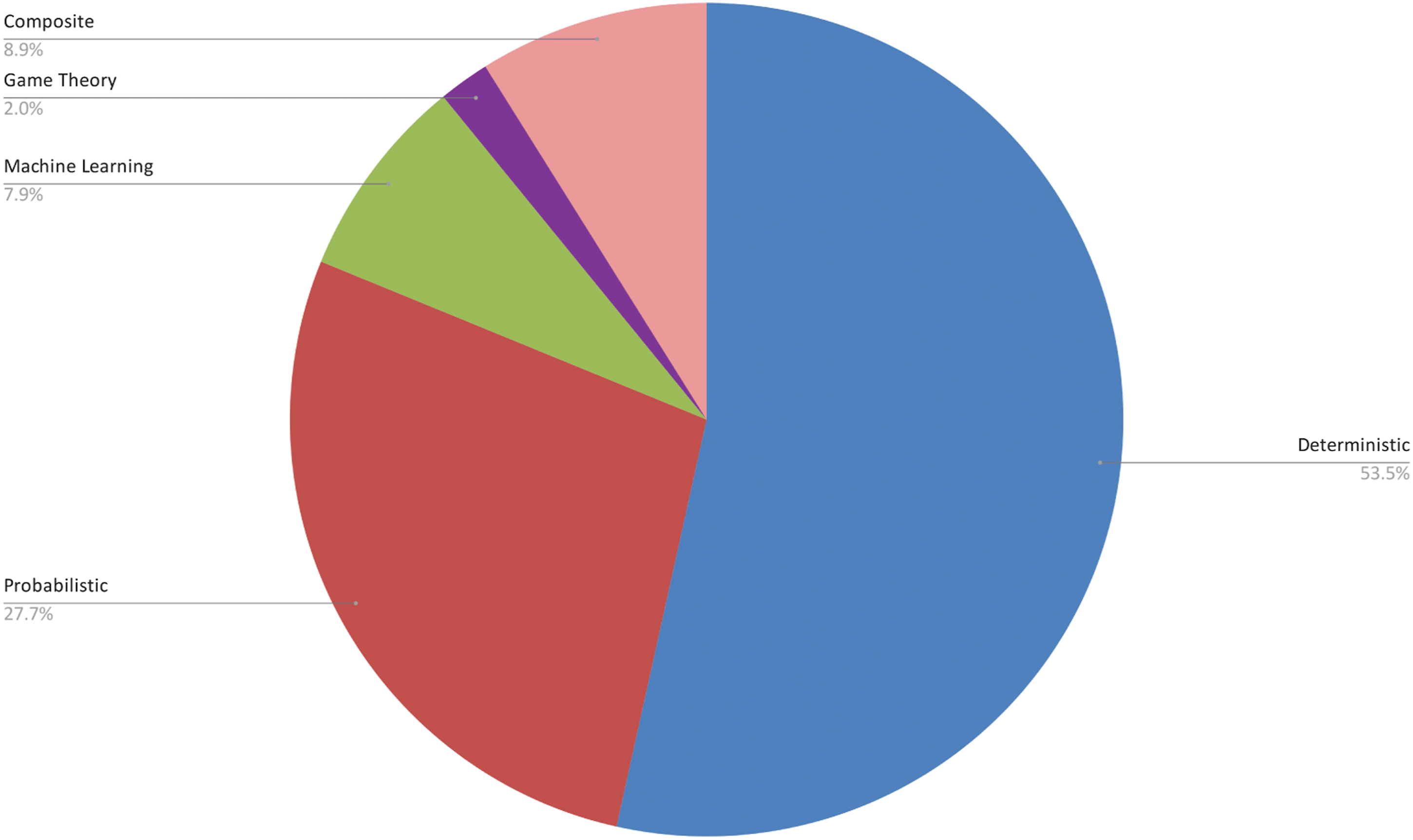
Figure 7 illustrates the trends in adoption of different classes of CT techniques during the years covered by this review, from 2013 to 2023. One notable observation from this graph is that Deterministic approaches have begun steadily, with moderate oscillations, indicating a consistent but not dominant preference within the field, and overall emerge as the most commonly adopted class of methods. It is closely followed by the Probabilistic category, which has gained momentum since 2018 and has managed to dominate the research landscape in CT for a few intermittent years. ML techniques had a spike in 2017 followed by a dip that lasted several years: only from 2021 they are seeing a slow but steady increase in popularity which seems to persist nowadays. Probabilistic and ML methodologies seem to exhibit comparable growth patterns, which align with the increasing popularity of RL solutions to complement Markovian models, as discussed previously. Overall, in the most recent years, Deterministic techniques seem to have re-emerged as prominent. CT models based on Game Theory appear sparingly, as do Composite models, which employ more than one class of techniques. Yearly trends in the choice of techniques to model Computational Trust. Deterministic models appear to be the most popular, despite a close competition from Probabilistic ones that in recent years appears to be turning in favor of the former. Computational Trust models based on Machine Learning are on a growing trend since 2021.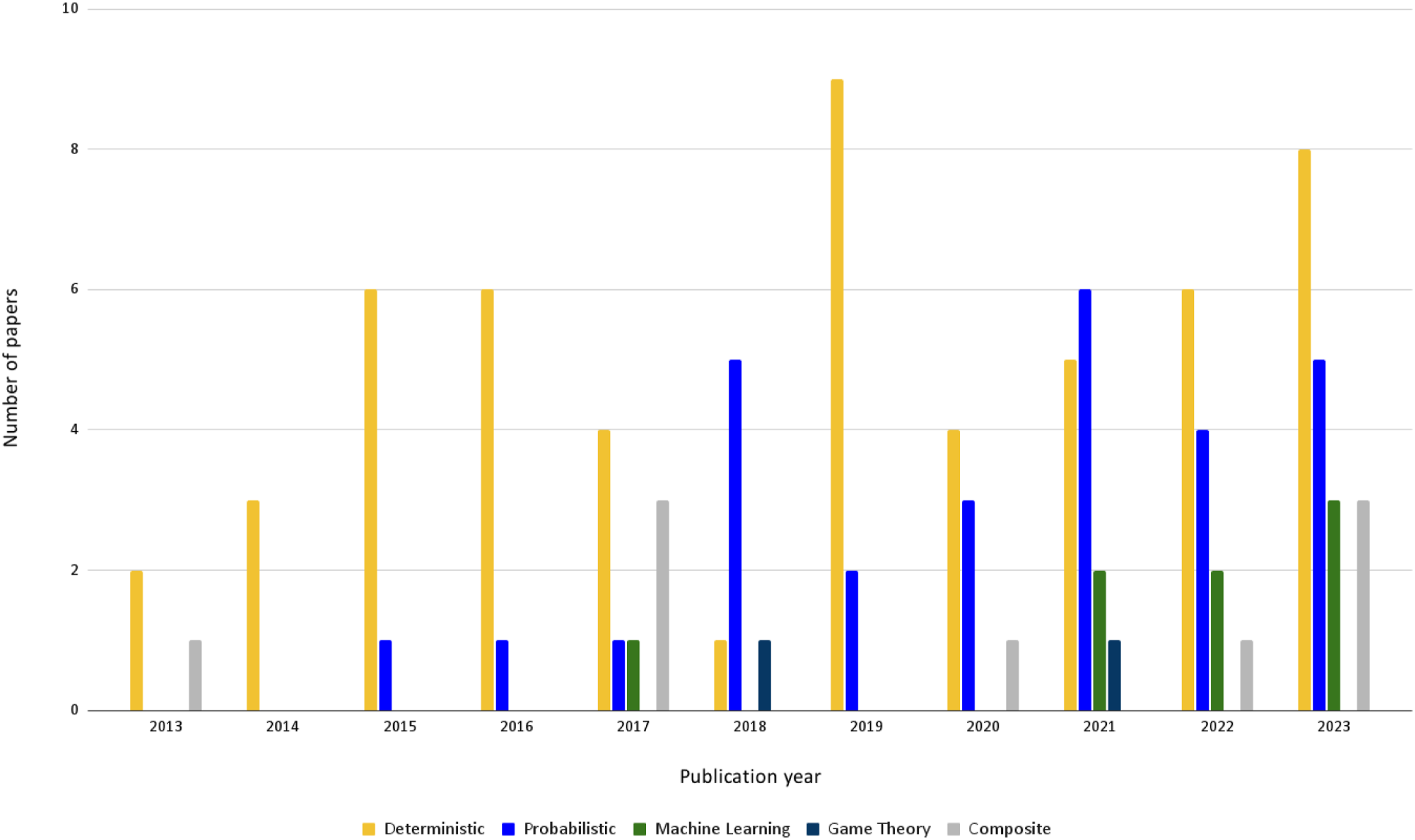
5.1. Deterministic models
Deterministic models are mathematical or computational models that predict the outcome of a system with certainty based on specific inputs or initial conditions. In deterministic models, there is no randomness or uncertainty involved in the prediction process, rather they are characterized by a cause-and-effect relationship which leads them to produce the same output every time they are run with the same set of input parameters. These models assume that the future behavior of the system is completely determined by its current state and the rules governing its dynamics.
As discussed in Section 5, deterministic models have been the preferred choice in CT for robotic agents for the past 10 years, and they still dominate the research landscape today. Out of 57 papers using deterministic models, 35 of them employ some form of linear combination. The latter refers to a mathematical operation where two or more terms are added together, each term being multiplied by a constant coefficient. For example, Ab Aziz et al. (2017) measure short- and long-term trust as a combination of factors including transparency, risk perception, behavior, competency, deception, and experience, while Boer et al. (2013) use a measure of past trust, subject to temporal decay, in combination with a factor expressing the perceived experience level of the other agent in the context of a question-answering task. A similar approach is adopted by Hale et al. (2019), whose system calculates trust based on previous trust values and the gradient of a cost function over the human’s privacy and cooperative attitudes. In general, the largest overall number of papers in the selected pool gravitates towards the use of a linear combination of factors that attempt to describe certain physical or mental characteristics of the trustee, such as performance-related factors (success rate, speed of execution, degree of attention, and so on) (Rabby et al., 2020; Rahman, 2019b; Sapienza and Falcone, 2023). These parameters are usually either measured during an experimental task (Floyd et al., 2015) or manually set as parameters for a simulation (Hu et al., 2022). A third option that has been utilized is to extract these values from user studies, that is conducting an experiment with human participants, collecting data from them through questionnaires, and using the latter to fine-tune a linear model (Mansoor et al., 2013).
Other works in the field make use of non-linear combinations. In contrast to linear ones, where terms are added together with constant coefficients, non-linear combinations involve operations such as multiplication, exponentiation, division, or other non-linear functions applied to the terms. For example, Alhaji et al. (2021) model the evolution of the robot’s trust in the human user utilizing an initial trust value T init and calculating the trust T t at time t as a function of a weighting factor ω ≥ 1, a risk factor r ∈ {0, 1}, and a dynamic measure of the human’s predictability.
Other techniques appear, albeit less commonly. Several papers make use of methodologies based on differential equations, which are used to describe trust in relation to derivative terms, like the change in an agent’s confidence value (Aydoğan et al., 2015). Tjøstheim et al. (2019) propose a biologically inspired computational model of the brain that is able to regulate its levels of trust towards a user following painful and gentle touches. The model is composed of a series of interconnected brain nuclei together paired with larger cortical regions. The nuclei are governed by a set of differential equations that model excitatory and inhibitory stimuli. Ranasinghe et al. (2015) make a robot guide a blindfolded user through a hard rein and model the follower’s dynamics (in terms of trust or distrust) using a time varying virtual damped inertial system. Finally, a few works model trust as piecewise functions, defined by different expressions over different intervals of their domain (Almohamade et al., 2021; Carbo and Molina, 2023; Cheng et al., 2021; Hu et al., 2022; Hu and Wang, 2022).
5.2. Probabilistic models
Probabilistic models are mathematical techniques that incorporate uncertainty by representing random variables and their associated probabilities. These models use probability theory to describe the likelihood of different outcomes or events occurring within a given system. Unlike deterministic models, which produce the same output for a given set of inputs, probabilistic models account for variability and uncertainty in the data or parameters.
Two different methodologies appear to be the most commonly adopted to develop CT capabilities in artificial agents: Bayesian and Markovian (respectively, 10 and 19 papers). The former refers to those classes of statistical models that use Bayesian probability theory to represent uncertainty and update beliefs or probabilities based on observed data. These models start with prior beliefs about the parameters, which are then updated using Bayes’ theorem to incorporate new evidence or observations. For example, Vinanzi et al. (2021, 2019) use a Bayesian Network to represent a robot’s belief about the human’s knowledge and intentions, which is then used to discriminate helpers from trickers in a sticker finding game. However, researchers make more often use of Dynamic Bayesian Networks, which extend the traditional framework to represent and analyze dynamic systems that evolve over time. Several papers (Mahani et al., 2021; Sadrfaridpour et al., 2018) formalize trust at time t as dependent on the performance of the robot at time t, other than trust and performance at the previous timestep t − 1. Wang et al. (2018) expand on this approach by explicitly modeling robot performance, human performance, and joint human-robot system faults.
Where Bayesian models focus on updating beliefs or probabilities based on evidence, Markovian models focus on modeling sequential dependencies and transitions between states in a system. They are based on the concept of a Markov process, which describes a stochastic process where the future state depends only on the current state and is independent of past states, given the present. There are three classes of Markovian models that are commonly adopted by researchers: Markov Decision Processes (MDPs), Partially Observable Markov Decision Processes (POMDPs), and Hidden Markov Models (HMMs). While all three deal with uncertainty and sequential data, MDPs focus on decision-making in fully observable environments, POMDPs address decision-making in partially observable environments, and HMMs are used primarily for modeling hidden states in observed sequences without involving decision-making.
MDPs represent decision-making problems where an agent interacts with an environment over time, making decisions to maximize expected cumulative rewards. They have been used to model the way in which trustworthy and untrustworthy humans would solve a given task, giving the robot a way to perform appropriate decision-making based on observation (Losey and Sadigh, 2019; Wu et al., 2017).
POMDPs extend MDPs by considering situations where the agent lacks complete information about the environment’s state, requiring the agent to maintain a belief state and make decisions based on partial observations. Akash et al. (2019) use them to describe the trust dynamics based on the observation of compliance and response time of the other agent and the adoption of a set of actions. Mangalindan et al. (2023) develop a framework that models the influence of trial complexity, experience gained, the robot’s action and previous trust on the current level of trust.
HMMs model time-series data where the underlying state of the system is hidden and must be inferred from observed emissions. Lee et al. (2013) model trust from the observation of physical cues, which they refer to as high-trust and low-trust cues, and their temporal evolution over time. Xu and Howard (2020) adopt a similar approach: they have a trial in which a human takes an action, the robot gives a recommendation and a final action is decided, and train an HMM to determine the underlying trust.
5.3. Machine learning models
ML is a branch of AI focused on developing algorithms and techniques that enable computers to learn from data and improve their performance on specific tasks without being explicitly programmed.
The majority of reviewed papers which use ML to implement CT capabilities rely on RL: specifically, 10 out of 15. RL is based on the idea of agents learning to make sequential decisions by interacting with an environment to maximize cumulative rewards. Unlike supervised learning, where the agent is provided with labeled examples, and unsupervised learning, where the agent must discover hidden patterns in data, RL relies on trial and error. Several papers (Lin et al., 2023; Ma et al., 2022) aim to calculate the robot’s trust in the human’s supervision during an exploration task. They propose a metric based on the agent’s state and capability, and the impact of decisions, then define a reward function based on the latter and finally fit a model through the Q-learning algorithm, through which the agent learns to make decisions by estimating the value of taking each action in a given state.
Where RL is designed to compute optimal policies, it often relies on Markovian models to provide a formal representation of the underlying dynamics of the environment, which it then exploits to efficiently explore and learn optimal strategies. For this reason, these two mathematical tools often work side-to-side. Rishwaraj and Ponnambalam (2017) develop a multi-agent system in which a robot is able to identify other trustworthy robots. To achieve this objective, they model the decision-making process of the agent to maximize the expected utility it would receive when moving to the next state after taking a specific action, and an optimal policy is computed through RL. Nam et al. (2017, 2020) use the same principle, but employ Inverse Reinforcement Learning (IRL): unlike traditional RL, where the goal is to learn a policy that maximizes cumulative rewards, in IRL the objective is to understand the reward function that best explains the observed behavior of an expert agent. Contextualized in the scope of their experiments with robot swarms, the computational model needs to infer the degree of trust of a human operator providing commands.
Despite RL appearing as the most common ML technique in the pool of selected papers, the presence of other techniques is also noteworthy. Pang et al. (2021) make use of an Artificial Neural Network (ANN): a computational model inspired by the structure and function of the human brain, consisting of interconnected nodes (neurons) organized in layers, capable of learning complex patterns from data. In particular, they use it to process flight and trajectory data from a drone and use it to predict the level of trust it would elicit in a human operator.
Hsieh et al. (2022) utilize an ensemble comprised of three models to quantify the trust of a human towards an autonomous vehicle: an ANN, a Support Vector Machine (SVM), and a Random Forest (RF). A SVM is a supervised machine learning algorithm used for classification and regression tasks, aiming to find the optimal hyperplane that separates different classes or fits the data with the maximum margin, while a RF is an ensemble learning method consisting of multiple decision trees: models consisting of a tree-like structure where each internal node represents a decision based on the value of a feature, and each leaf node represents the outcome or prediction. These three models were trained on vehicle data obtained during a user study with human participants. Kraus et al. (2021) also rely on three different ML models, but instead of using them as an ensemble, they train them separately on the same dataset and compare their ability to predict trust. In particular, they make use of a SVM, gradient boosting and a Gated Recurrent Unit (GRU) network, trained on an annotated data corpus of proactive dialogues. Gradient boosting is a technique that consists in sequentially combining the predictions of multiple weak learners, while GRU is a recurrent neural network, a type of ANN designed to process sequential data by maintaining a memory of previous inputs. Patacchiola and Cangelosi (2022) experiment on a biologically inspired cognitive architecture for CT that uses Bayesian networks and Self-Organizing Maps (SOM): unsupervised ANNs that reduce the dimensionality of input data while preserving its topological properties by organizing it into a lower-dimensional grid.
5.4. Game Theory models
A minority of papers (2 out of 101) are based on Game Theory: a mathematical framework used to study strategic interactions between rational decision-makers, known as players, in situations where the outcome of each player’s action depends on the actions of others, aiming to predict and analyze the optimal strategies and outcomes of such interactions. Game Theory formalizes the strategic interaction between two or more players as a payoff matrix: a tabular representation of the possible outcomes. Each cell in the matrix corresponds to a combination of strategies chosen by the players, and it contains the payoffs or utilities associated with those strategies. Wagner et al. (2018) compute several payoff matrices that represent different trust or no-trust situations which an agent can use to explain another agent’s behavior, and validate them through a user study. They then use this model on a robot to try and predict the levels of trust of the other party. Razin and Feigh (2021) also base their work on payoff matrices and use interdependence theory, which aims to determine which actor has power over which part of the total payoff structure. Through the latter, they define a set of variables which then proceed to compose in a “trust index” derived from Gottman’s.
5.5. Insights
The landscape of CT modeling is marked by both methodological diversity and uneven adoption patterns. While the field has matured in some respects, our review reveals several areas where further development and refinement are needed.
A clear trend is the predominance of deterministic models, particularly those based on linear combinations of trust-related factors. Their continued popularity suggests a strong preference for models that are interpretable and easy to implement. However, this reliance may also reflect a certain conservatism in the field, where simplicity is favored over expressiveness. As trust modeling increasingly intersects with complex, real-world scenarios, researchers may need to move beyond these traditional approaches.
Probabilistic models offer a compelling alternative, especially in contexts where uncertainty and temporal dynamics are central. Their growing use indicates a shift toward more flexible and realistic representations of trust. Despite the rising tendency, their adoption remains uneven, and their integration with other modeling paradigms is still limited. Probabilistic reasoning could then serve as a bridge between interpretable models and data-driven approaches, enabling systems that are both robust and adaptive.
ML, despite its transformative impact on broader AI, remains underutilized in CT. While promising, this approach is still relatively rare and often lacks standardization in terms of datasets, evaluation metrics, and experimental design. This suggests that the field has yet to fully embrace the potential of ML for modeling trust.
Game Theory models, though conceptually well suited to trust as a strategic phenomenon, are scarcely used. This underrepresentation is surprising, given their ability to formalize interdependence and rational behavior in MAS. Their limited presence may be due to the complexity of implementation, requiring precise formalization of agent strategies and payoffs or a lack of suitable experimental frameworks. Nonetheless, they remain a promising avenue for future exploration, particularly in competitive or cooperative scenarios.
One of the most significant gaps identified is the limited use of hybrid or composite models. While a few studies combine deterministic and probabilistic techniques with ML models, systematic efforts to integrate multiple modeling paradigms are rare. This is a missed opportunity: hybrid models could leverage the strengths of different approaches, combining the interpretability of deterministic models with the adaptability of ML or the uncertainty handling of probabilistic methods.
6. Experimental settings
This section is dedicated to exploring the different settings that researchers in the field of CT have utilized for deploying their models. We consider three different cases: (A) Simulation, (B) Real-world, and (C) Online, all of which are discussed in detail in the following subsections. Figure 8 shows the distribution of these categories across the selected pool of papers. Approximately half of them (55 out of 101) test their models in simulation. Thirty works deploy their computational architectures in the real world, while only a minority (8 papers) test them online. We have added the Composite category to group all those papers that utilize more than one experimental setting. There are 8 papers in this category, of which 7 adopt simulations that are then brought to the real world. Only one work uses both a physical and an online implementation (Wagner et al., 2018) and only one is performed in a mixture of simulated and online settings (Carneiro et al., 2019). Distribution of the experimental environments used by the selected papers. Trials performed in computer simulations are the most commonly adopted, followed by real-world experiments with physical robots. Papers that make use of multiple settings have been classified as Composite.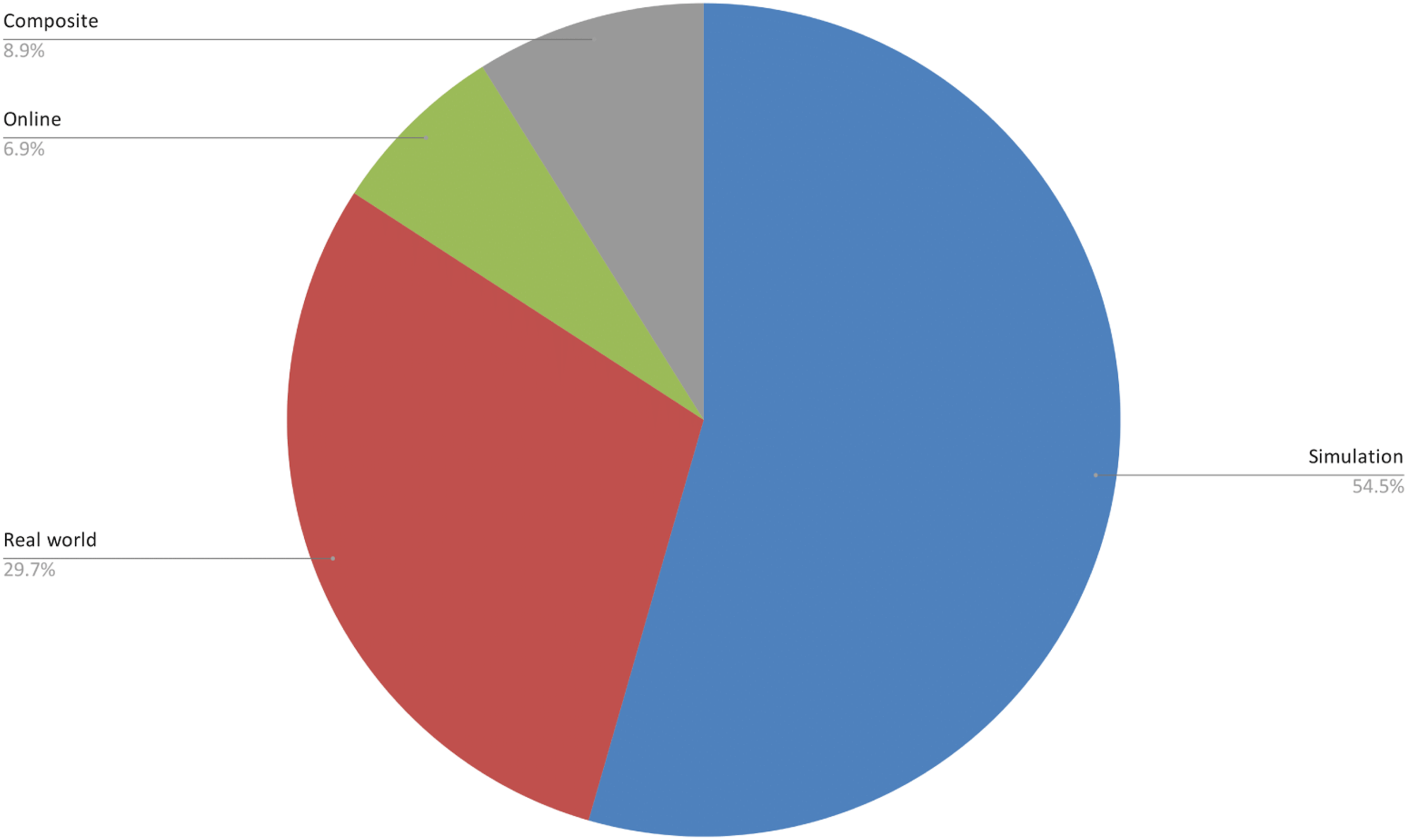
6.1. Computer simulations
This review highlights that the majority of CT research papers in literature tests their models in digital environments. This trend is unsurprising, given that digital settings are the most accessible, often not requiring specialized hardware such as robotic platforms. These environments are diverse, spanning from pure numerical simulations to fully developed graphical and physical environments.
We speak of numerical simulations when the authors do not leverage a fully sketched-out virtual world where an agent can move and interact, but rather a framework in which a model is tested against different combinations of parameters. Ab Aziz et al. (2017), for example, have developed a mathematical model that can predict trust based on the internal and external characteristics of the trustee, including but not limited to: reliability, transparency, and competency. They test different combinations of trustee characteristics, manually selected, to evaluate the output of their model, that is, the predicted level of trust towards that agent. The same approach is shared by several other works (Lee et al., 2021; Wang et al., 2015, 2023b).
Graphical simulations take one step further: in addition to emulating the model’s mathematical framework, they also provide a simple environment for the agent to interact with. This simplicity often takes the shape of a gridworld: a grid of cells where agents can perform discrete actions according to certain rules (Carbo and Molina, 2023; Rutard et al., 2020; Spencer et al., 2016), for example, to perform path planning or maze solving guided by teachers that are more or less trustworthy.
Finally, there are complete physical simulations. These are complex environments, often three-dimensional, where agents can perform both perception and action in a continuous fashion. Hu and Wang (2022) make use of the CarSim-Simulink platform, a software framework that offers a complete rendering of a vehicle and the surrounding road, in which they test their trust-aware cruise control system. Another example comes from Lin et al. (2023), who use the popular robotics simulator Webots to build an environment in which a small swarm of robots can navigate and communicate in the search for a set of items scattered around the world. Another commonly used simulator is Gazebo, adopted for instance in an experiment authored by Dorbala et al. (2021), in which the robot had to navigate an environment by accepting or rejecting human guidance.
6.2. Real-world experiments
Experiments using real robotic platforms are the second most common found in the pool of reviewed papers. All works that deploy their computational models on an embodied machine that physically interacts with the real world are categorized under this heading. The majority of these experiments take place within a laboratory setting. The advantage of this approach is that it provides researchers with a more structured environment in which to test their software. For example, Vinanzi et al. (2021) utilize a Pepper robot placed in front of a table interacting with special markers, while Patacchiola and Cangelosi (2022) deploy their cognitive architecture on an iCub robot that had to interact with sets of objects shown to it by the experimenter. The latter cases involve commercially available robots, but not in every case: Rahman (2019c) built a robotic power assist system and had it perform some lifting tasks with the assistance of human participants.
Less commonly, these experiments take place outside the boundaries of the laboratory, in a more unstructured environment. Because of the complexity involved in deploying a robot in such settings, these experiments are more scattered across the literature. Hsieh et al. (2022), for instance, collected trust data from users onboard a Tesla autonomous vehicle driving on a real road.
6.3. Online experiments
We have categorized experiments as “Online” when they entail user studies where participants watch videos or engage with simulations. Such studies typically involve observing users as they complete tasks, gathering feedback through interviews or surveys, and analyzing the data to address research questions.
Not all the experiments in this category are strictly conducted via online platforms. For example, Bhat et al. (2022) develop a graphical simulation using the Unreal Engine 4 game engine and test with in-person participants. Similarly, Guo and Yang (2021) require physical presence for their trials due to the use of a specialized joystick, which make a purely online execution unfeasible.
Other studies utilize cloud-based solutions like online crowd-sourcing platforms or custom servers. Hoogendoorn et al. (2014) use a custom graphical interface to allow their participants to interact with the image of an area, within which they have to detect threats. Xu and Howard (2020) utilize Amazon Mechanical Turk to collect user data regarding different scenarios involving robot providing suggestions. This same tool is used by other works (Akash et al., 2019; Wagner et al., 2018).
6.4. Insights
As noted in Section 4, most of the works in our review use simulations as the primary means of testing their models. This is unsurprising, given the accessibility and flexibility that simulation environments offer. The complexity of these simulations varies widely, ranging from mathematical framework solving (Ab Aziz et al., 2017) to fully developed, game-like three-dimensional environments (Hu and Wang, 2022). Simulations are fundamental for continuous testing, especially in the early stages of development, and for studying scenarios that would be too risky to investigate in real-world settings. However, the AI and robotics community is well aware of the sim-to-real problem that sees performances decline when models are deployed on physical robots due to the discrepancies between simulated environments and the real world. In addition, most of the real-world experiments are still run in lab environments, providing a structured and reproducible environment for researchers to test their solutions (Vinanzi et al., 2021) but shying away from the most complex and unstructured environments.
The research community now has a valuable opportunity to extend its work beyond simulations and laboratory settings, by pursuing more ecologically valid experimental designs. This shift will enable deeper insights into how results may change when environmental constraints are removed and high levels of uncertainty are introduced.
7. Evaluations and results
The analyses carried out and the type of results achieved in CT research within the selected set of papers are strictly dependent on the specific nature of the works. Therefore, a categorization like those pursued in the previous sections (see Sections 3, 4, 5, and 6) would produce overly granular clusters. However, it is still possible to gather useful qualitative insights on CT trends and challenges.
7.1. Evaluation metrics
Around a quarter of the works make use of trust-related measurements. More precisely, they use the trust computed by the CT model itself as a metric to assess the quality of their work. The use of the designed trust score specifically occurs when the robot assumes the role of trustor in the interaction. In these works, trust strongly affects the behavioral model of the robot, so it makes sense to directly use it as an interaction metric. For instance, Aydoğan et al. (2015) and Hannum et al. (2020) both use the trust value computed by their models to investigate how trust dynamics evolve throughout interactions with other agents. Slightly differently, Razin and Feigh (2021) use the mean squared error (MSE) of the computed trust value against a ground truth.
When the robot acts as a trustee, trust is most often measured through self-reported questionnaires. As the robot is the recipient of trust, the latter is evaluated from the other party, which in this case is the human user. In some studies, questionnaires are completed at the end of each condition (Sadrfaridpour and Wang, 2018), especially when statistical comparisons are made to assess which setting is perceived as more trustworthy. In other ones, particularly those aiming to validate a trust model, trust is measured at the end of each interaction iteration (Guo and Yang, 2021; Zheng et al., 2023a).
The majority of works use performance metrics that do not derive directly from the CT model estimate. In these cases, trust is used as a component of a more complex behavioral system. Most of these metrics are related to task performance, as the objective is often to prove that incorporating trust awareness improves efficiency in HRC (Xu and Song, 2021). When assessing human efficiency, a ratio of the number of correct actions to the total performed actions is chosen as the merit parameter (Boer et al., 2013; Vinanzi et al., 2021). When evaluating the efficiency of robotic agents (Xu and Song, 2021), the robot’s capability to plan and perform actions is also assessed. For instance, Dubey and Kumar (2019) register the number of best, fair, and unsuccessful plans achieved by the robot in the interaction cycles with another robotic agent of the same nature.
For probabilistic CT models, the aim is often to maximize an internal reward of the framework, which then becomes the evaluation metric of the work (Kirtay et al., 2023). In some cases, the reward is considered at the end of every interaction with the system (Dorbala et al., 2021), while in others, the mean value is used (Chen et al., 2020). When trust is modeled through supervised ML, the evaluation metric is most often the accuracy of the classifier (Hsieh et al., 2022; Kraus et al., 2021) or the prediction error (Lee et al., 2013; Li et al., 2023). Pang et al. (2021) use these metrics while performing ablation studies on their ML models.
7.2. Analyses and results
As commonly performed in research, CT models are validated through comparison with other baseline cases. The vast majority of these works compare the performance of the robotic system under their own experimental settings with and without incorporating trust into the behavioral model (Saeidi et al., 2017b; Zheng et al., 2023b). For example, Saeidi et al. (2017b) compare their trust-based mixed-initiative model with the same system that did not use trust, under three different settings. Since research on CT is in its early stages and there are not yet many validation standards, researchers predominantly prefer to define their own baselines against which to compare their solution’s performance.
In two cases, the authors compare their results with other frameworks in the literature. Rishwaraj and Ponnambalam (2017) test their trust evaluation control system against three other trust evaluation methods from different sources in the literature. All four methods were deployed in the same experimental settings and considered as independent variables of the experiment. In the other case, Xu and Dudek (2015a) compare their probabilistic trust model against regression techniques for trust estimation used in other studies.
Another example comes from Carbo and Molina (2023), who investigate how the introduction of different variables in the design affects the trust estimated by their CT model. More precisely, they studied its effect on task performance when it accounted for emotional variables present in the interaction design.
Looking at the results achieved in these papers, the majority primarily aims at validating their experimental hypotheses. In most cases, either the CT model is validated (Ab Aziz et al., 2017; Aziz and Abdulhussain, 2022; Bhat et al., 2022) or the statistical reduction of the user’s workload is demonstrated (Sadrfaridpour and Wang, 2018; Saeidi et al., 2016; Wang et al., 2023a). A few works take a step further by discussing the trade-offs associated with increased trust. For instance, Chen et al. (2020) demonstrate that in some instances of HRC, an increase in the user's trust can potentially lead to a loss of task performance when the robot makes mistakes. In Rahman (2019c), the relationship between trust and the level of assistance the robot provides to the user is investigated. Finally, on the human side of the interaction, Nam et al. (2020) and Pang et al. (2021) infer high-level human preferences for features of the robotic systems based on the estimates provided by their CT models.
7.3. Insights
It is important for this review to address common evaluation metrics and methodologies. As CT is still a relatively recent concept, there remains significant work to be done within the community to establish a consistent evaluation framework. Across the papers we reviewed, we observed a range of approaches used to assess CT: self-reported metrics via questionnaires (Sadrfaridpour and Wang, 2018); trust values computed by the CT models themselves (Aydoğan et al., 2015); and performance metrics that act as proxies for CT (Xu and Song, 2021). The choice of metrics varies considerably and is typically tailored to the specific task and experimental setup in which CT is tested. Currently, there is no consensus on the most appropriate metrics for evaluating CT models, highlighting the need for further work toward defining robust evaluation methodologies.
Regarding evaluation methodologies used to extract key insights from these metrics, the most common approach involves validating CT models by comparing them against baseline cases. The core issue, however, lies in defining what constitutes a valid baseline. Most of the works we analyzed compare system performance with and without the integration of trust into the agent’s behavioral model, using their own experimental settings (Saeidi et al., 2017b). This practice largely stems from the absence of established validation standards. While no two tasks or scenarios are identical, this lack of standardization poses challenges to both the reproducibility and generalizability of findings related to CT. Future work could benefit from community-wide efforts to define shared baselines that can serve as reliable controls for evaluating CT models.
8. Discussions
This survey highlights a growing trend in the domain of CT, as evidenced by the increasing number of papers published on the topic. In 2013, only 3 papers were published, whereas in 2023 alone 19 papers were made available to the public. The surge in interest can be attributed to recent articles highlighting the bidirectional nature of trust relationships (Azevedo-Sa et al., 2021; Vinanzi et al., 2021), which encourages researchers to explore this venue further. Additionally, the establishment of workshops, such as the International Workshop on Multidisciplinary Perspectives on Human-AI Team Trust (MultiTTrust) (Brandizzi et al., 2023; Centeio Jorge and Ulfert-Blank, 2023; Tielman et al., 2024, 2025), is bringing together scholars focused on the topic of trust in AI and robotics, including the newborn field of AT (Semeraro et al., 2024b).
After analyzing the individual features of the selected papers throughout Sections 3 to 7, we now perform a cross-analysis that may offer valuable guidance for future research in this sector. Comparing all possible combinations of features would make the discussion unnecessarily lengthy, consequently only the most informative pairings are discussed. We then present a comparison between different approaches to CT modeling, and offer recommendations and guidelines for researchers seeking to contribute to this field, drawing on the lessons learned throughout this review. Finally, we address ethical considerations of robots performing their own trust-based decision-making.
8.1. Distribution of models across domains and experimental settings
Figure 9 presents a cross-analysis of three dimensions from this review: each paper is plotted according to the class of its computational model, its domain of application, and the experimental setting it proposes. The analysis is limited to these specific features, as they provide the most informative value and useful guidance to design CT frameworks. Notably, we excluded the Game Theory class of computational models from this analysis, as it only encompasses two data points (see Subsection 5.4), to maintain clarity. Scatterplot of the selected works according to Computational Trust technique, application domain, and experimental setting. A bigger dot represents a higher percentage of works sharing the same triplet of features. For better visualization purposes, dots with the same color have the same application domain. Due to their limited amount, the two works that used a model based on Game Theory were omitted for better visualization. Regarding the abbreviations, ML = Machine Learning, HRC = Human–Robot Collaboration, Rec. = Reconnaissance, Nav. = Navigation, MAS = Multi-Agent Systems, AV = Autonomous Vehicles, HRI = Human–Robot Interaction, TLR = Telerobotics, Misc. = Miscellanea.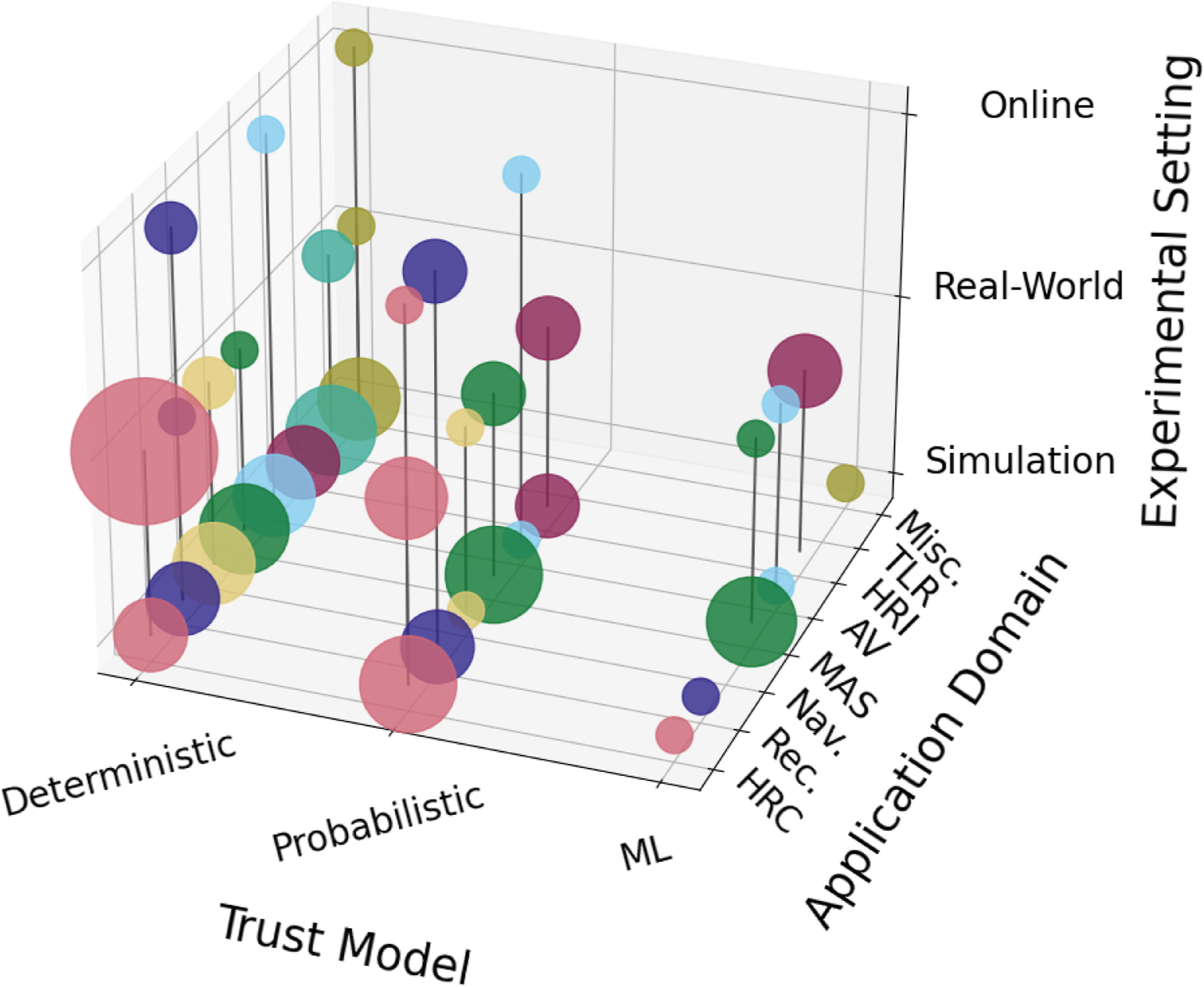
Figure 9 clearly demonstrates the dominance of Deterministic methods and Simulation experiments across the board, as confirmed in Sections 2 and 6. A new insight provided by this graph is the roughly equal distribution of Deterministic models across the application domains. It is significant because it indicates that this methodology is robust enough to be applied to a wide range of situations and scenarios. Conversely, real-world experiments, often involving an embodied and situated robot, tend to rely less on Deterministic methodologies and more on Probabilistic ones. This shift can be explained by the increased complexity of real-world environments and the need for mathematical models that can account for uncertainty. Probabilistic models tend to be more commonly deployed to computationally model trust in both HRC and MAS applications performed in simulation. On the other hand, ML models are primarily applied to AV experiments in simulators and HRI trials under laboratory conditions.
The most common point in the 3-dimensional space under consideration is the intersection of Deterministic models, real-world experiments, and HRC applications. It indicates a clear preference among scholars working in the field of CT. Finally, another insight from Figure 9 is that the field of Autonomous Vehicles still predominantly uses simulated environments, with a good distribution of all classes of methods.
8.2. Comparative analysis of trust modeling approaches
In this review, we have categorized CT models as NT or AT based on the directionality of the trust relationship. Each of these paradigms reflects a distinct epistemological stance on how trust is conceptualized and operationalized within robotic systems. NT models focus on the robot’s estimation of the human’s trust in it, typically inferred from behavioral cues, performance feedback, or self-reported measures. In contrast, AT models endow the robot with the capacity to evaluate the trustworthiness of its human partner, often to modulate its own behavior in collaborative or safety-critical contexts. While the majority of studies adopt a unidirectional perspective, some works have begun to explore scenarios in which both entities are engaged in a trust relationship. These bidirectional trust (BT) approaches attempt to capture the mutual and dynamic nature of trust, modeling both human-to-robot and robot-to-human trust simultaneously. Figure 10 shows the distribution of the papers selected for this survey across the three categories. The proportion of AT works is comparable to that of NT works. This result highlights the value of having conducted a systematic review that not only investigated computational models of trust, but also contributed to the conceptual framing of AT as a domain that now stands alongside NT in the broader discourse. Distribution of the selected works between Natural Trust, Artificial Trust, and Bidirectional Trust models.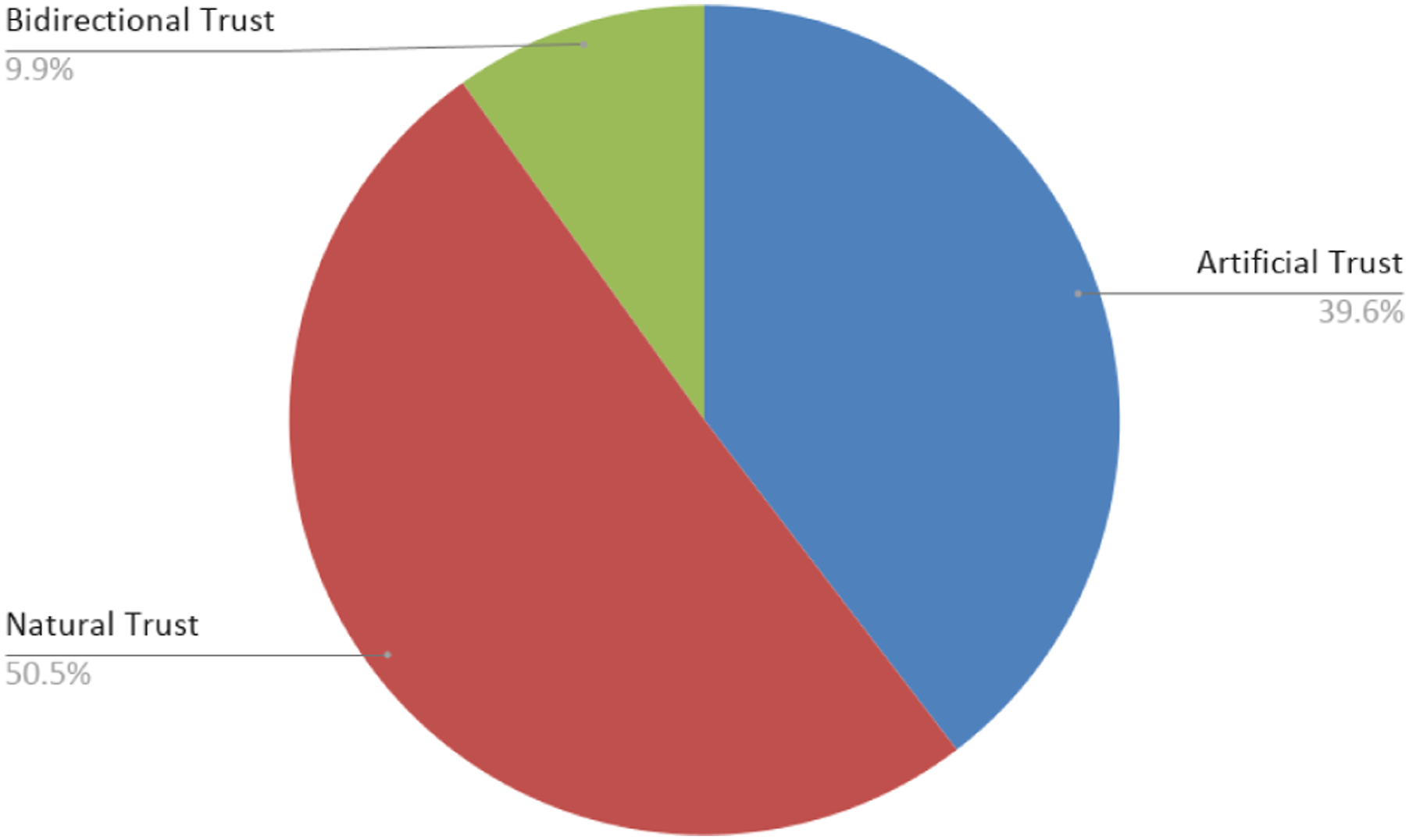
NT models are the most prevalent in the literature, appearing in approximately 50% of the surveyed papers. They are especially used in domains such as collaborative manipulation, autonomous driving, and reconnaissance. These models often rely on probabilistic frameworks such as Bayesian networks, dynamic Bayesian networks, or POMDPs, which allow the robot to update its belief about human trust over time based on observed interactions (Chen et al., 2018; Guo et al., 2021; Xu and Dudek, 2015b). Their popularity stems from their alignment with user-centered design principles and the relative ease of validation through user studies. However, NT models are inherently reactive: they estimate trust post hoc and may struggle to anticipate or mitigate trust breakdowns in real time.
AT models, while less common, offer a complementary perspective. Here, the robot actively assesses the human’s reliability, predictability, or intent, often using non-linear combinations of performance metrics, fuzzy logic, or RL (Alhaji et al., 2021; Lang et al., 2023b; Rjoub et al., 2023). These models are particularly valuable in scenarios where the robot must make autonomous decisions about whether to follow, assist, or override human input. Their proactive nature enables adaptive behavior that can enhance safety and task efficiency. Interestingly, ML techniques appear more frequently in AT models than in NT models, suggesting a growing reliance on data-driven approaches for trust estimation in autonomous systems. However, AT models face challenges in interpretability and generalizability, especially when deployed in unstructured environments or with diverse user populations.
This survey discovered only 10 papers that model BT, a more recent and ambitious direction in CT research. By simultaneously modeling both AT and NT, these approaches aim to support mixed-initiative interaction, dynamic role arbitration, and mutual adaptation (Rahman et al., 2016a; Xu and Song, 2021; Zhou et al., 2021). They are particularly well suited for multi-agent teaming and teleoperation, where trust must be continuously negotiated between agents. An interesting observation is that all bidirectional models identified in this review rely exclusively on deterministic methods. This co-occurrence may reflect the complexity of modeling mutual trust which might be hindering widespread adoption, but it also highlights a potential limitation in adaptability and expressiveness.
While NT models dominate current research due to their methodological maturity and alignment with human-centered evaluation, AT and bidirectional models offer critical capabilities for proactive and adaptive robot behavior. The choice among these approaches should be guided by the interaction context, the degree of autonomy required, and the desired balance between interpretability and adaptability. As the field progresses, hybrid models that allow bidirectional trust may offer the most robust and flexible solutions for trust-aware robotics.
8.3. Trust factors for AT design
Recent decades of research in human-robot trust have primarily focused on how people place trust in robots, something we have been referring to as NT. For a detailed analysis of the various factors, both human and beyond, that influence trust in robots, we refer to existing frameworks and reviews on the matter (Hancock et al., 2011, 2021; Hoff and Bashir, 2015). Having introduced AT, we now explore trust-related factors that researchers have identified as important for shaping a robot’s trust in other agents. These are summarized in Figure 11. AT can follow two main pathways: modeling a robot’s trust in a human or in another robot. Among the 50 AT studies reviewed (including both BT and pure AT), 40 focus on robots trusting humans, while 12 address trust between robots (two studies (Ali et al., 2022; Carneiro et al., 2019) investigate both pathways within the same research). Trust factors in Artificial Trust, divided by trust towards the human and another robot.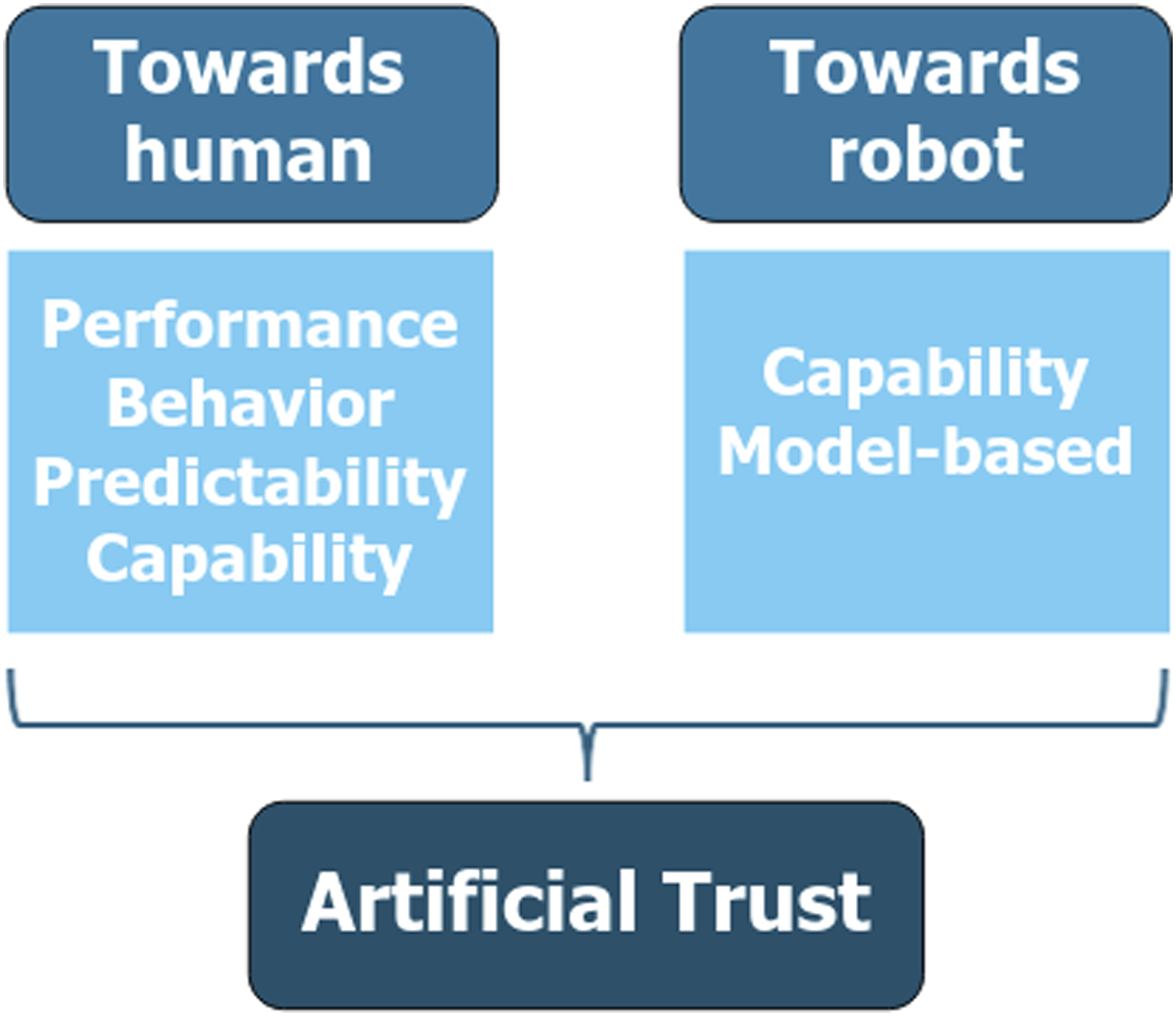
In the subset focused on robots trusting humans, a common approach is to model trust as a function of the human operator’s task performance. Seventeen studies, nearly half of this group, use performance as an input to their CT models (Mahani and Wang, 2017; Maithani et al., 2019; Rahman, 2019a, 2019b; Rahman et al., 2016a, 2016b; Wang et al., 2014, 2015, 2022, 2023a; Saeidi et al., 2016, 2017a; Saeidi and Wang, 2019; Sapienza and Falcone, 2023; Scherf et al., 2022; Xu and Song., 2021; Zhou et al., 2021). This is consistent with the prevalence of HRC scenarios, where operator performance is closely tied to task efficiency. A smaller number of studies incorporate human behavioral cues (Hannum et al., 2020; Scherf et al., 2022). These variables are typically collected after an initial interaction with the user, without relying on prior trust history. In applications where trust can be built over time, HRI practitioners may consider modeling these cues for AT towards humans.
Other variables are predictive, aiming to anticipate future human behavior. Several studies refer to predictability, defined as the likelihood of the human being in a particular state (Alhaji et al., 2021; Zhou et al., 2021). This concept is interpreted in various ways, such as detecting the user’s presence in the workspace (Almohamade et al., 2021) or using a HMM to infer user states (Khattar and Eskandarian, 2022). Capability is another predictive factor, representing the expected ability of the user to complete a task successfully (Ali et al., 2022; Saeidi and Wang, 2019). These variables can be modeled before interaction begins, making them suitable for scenarios where early performance in collaborative tasks is critical.
For AT towards robots, identifying consistent input patterns for CT models is more challenging due to the smaller number of studies, roughly four times fewer than those focused on trust towards humans. This suggests that robot-robot trust research is still in its early stages. Since the inputs now relate to robotic behavior, researchers often use variables specific to the trustee robot’s decision-making system (Rishwaraj et al., 2017; Rishwaraj and Ponnambalam, 2017; Setter et al., 2017), rather than ones referring to abstract concepts. A minor exception includes two studies that explicitly incorporate capability into their model design (Ali et al., 2022; Lin et al., 2023).
8.4. Recommendations for research
In light of the patterns and gaps identified in this review, several directions emerge that could meaningfully advance the field of CT. First, there is a clear need to move beyond siloed methodologies and embrace a more integrative modeling approach. Hybrid models combining the interpretability of deterministic frameworks, the uncertainty handling of probabilistic reasoning and the adaptability of ML offer a promising path forward. Such combinations could better reflect the complexity of trust as it unfolds in real-world, dynamic environments.
ML, while increasingly central to AI research, remains under-exploited in trust modeling. Expanding its use could unlock new capabilities, especially in data-rich or real-time applications. To support broader adoption, future work should prioritize transparency and reproducibility, including the open sharing of datasets, model code, and evaluation pipelines.
Some modeling paradigms, such as Game Theory and biologically inspired architectures, have received limited attention despite their potential to capture strategic or embodied aspects of trust. Revisiting these approaches, especially in multi-agent and physically grounded contexts, could yield valuable insights and diversify the methodological toolkit available to researchers.
Large Language Models also present a promising opportunity. Their ability to process and generate human-like language makes them well suited for modeling trust in communication-heavy contexts, such as dialogue systems or collaborative agents. However, it is important to avoid treating language models as complete cognitive systems. While they can simulate aspects of trust-related reasoning, they do not possess grounded representations of belief, intention, or emotion (Jokinen, 2024). Future research should explore how language models can be integrated into broader trust architectures without substituting the full cognitive process.
Equally important is the development of shared resources and evaluation standards. The current lack of standardized datasets, metrics, and experimental protocols makes it difficult to compare models or replicate findings. Establishing common benchmarks would not only improve reproducibility but also foster more cumulative progress across the field.
Another area that deserves greater emphasis is the validation of CT models in real-world settings. As shown in this review, most models are tested in simulation, which, while useful for early-stage development, often fails to capture the complexity of human–robot interaction. Real-world experiments, particularly in domains like healthcare, autonomous driving, and collaborative manufacturing, are essential to ensure ecological validity and uncover practical challenges in deployment.
The review also reveals an uneven distribution of CT research across application domains. While HRC and MAS are well represented, areas such as autonomous vehicles, telerobotics, and smart environments remain underexplored. These domains present unique trust challenges and could benefit from tailored CT frameworks that reflect their specific constraints and user expectations.
Robot morphology and embodiment also play a significant role in shaping trust dynamics. Humanoids and manipulators are more frequently used in real-world experiments, while aerial and mobile robots are often confined to simulation. This observation suggests that physical form might influence the nature of trust interactions. Future work should investigate how embodiment affects trust modeling and whether CT architectures need to be adapted based on the robot’s capabilities and appearance.
Finally, trust is not only a computational construct but also a deeply human one. Insights from psychology, neuroscience, and behavioral economics can enrich CT models by grounding them in empirically validated theories of human behavior. Interdisciplinary collaboration will be essential to develop models that are not only technically sound but also aligned with how trust operates in real-world human contexts.
8.5. Ethical considerations
The field of AT focuses on enabling robots, or artificial agents in general, to evaluate the trustworthiness of other agents, whether artificial or natural. The papers discussed in this systematic review propose various ideas and perspectives on how to model trust and how the latter can be quantified and reasoned upon. Fundamentally, they share the objective of enabling intelligent machines to evaluate the behavior of others, which introduces a constellation of ethical challenges.
The emerging field of “intelligent disobedience” (Briggs and Scheutz, 2017) seeks to blend AI and ethics to create smart robots capable of discerning when it is unsafe or unethical to comply with instructions. The idea is to incorporate ethical frameworks into the agent’s reasoning process in order to make it proactive, transparent and verifiable (Bremner et al., 2019). For example, should robots be allowed to say “no” to a human when they do not trust them? Should they blatantly refuse to obey commands, or should they limit themselves to strongly advising against a certain course of action? If an autonomous vehicle detects signs of impaired driving from its driver, should it be allowed to cut off manual control, potentially saving lives, or should it prioritize the driver’s freedom? The domains of CT and intelligent disobedience could mutually benefit each other, as trust is a critical component in evaluating instructions provided by the other party.
Moreover, it is important to remember that AI models are subject to potential biases in their design or training. If we plan to allow robots to judge people’s actions in order to make decisions, it is paramount that we ensure these systems are as transparent and unbiased as possible. This issue should be proactively addressed through fairness audits and diverse participant sampling. Privacy is another critical concern: robots equipped with the ability to evaluate trustworthiness may need to collect and process significant amounts of personal data. Ensuring that these data are handled in a way that respects individuals’ privacy rights and complies with relevant regulations is vital. Finally, there is the question of consent. People interacting with trust-aware robots should be aware that their actions are being monitored and evaluated, especially when trust estimation is implicit or continuous. Designers must consider how to make trust assessments explainable and contestable, especially in cases where trust influences autonomy, access, or intervention. Informed consent is a fundamental principle that should be upheld to respect individuals’ autonomy.
The integration of these considerations into the design, development, and deployment of autonomous trust systems is crucial. It is not enough to create technically proficient systems; they must also be ethically sound and aligned with societal values to support responsible and trustworthy human–robot collaboration. To that end, we recommend that future research on CT actively adopt ethical design frameworks such as Value-Sensitive Design (VSD) (Friedman et al., 2013) and Design-for-Values (DfV) (Van Den Hoven et al., 2015). These approaches offer concrete methodologies for embedding societal values, including transparency, fairness, privacy, and accountability, into the core of system development.
For example, VSD encourages early engagement with stakeholders to identify value tensions, which is particularly relevant for trust models that may influence behavior or decision-making in high-stakes contexts. A CT system that infers human reliability from task errors, for instance, should involve users in defining what constitutes a “meaningful” error and what information can be collected ethically.
DfV, by contrast, emphasizes aligning technical systems with publicly endorsed values or institutional norms. A CT system deployed in healthcare or public service contexts might draw from DfV principles by integrating constraints that reflect legal and cultural norms around dignity, consent, and non-discrimination. This coupling would ensure that trust evaluations are not only accurate but also socially acceptable and regulatable.
We therefore call for a shift in CT research: from a predominantly performance-focused paradigm to one that balances technical achievement with ethical accountability already from the design stage. This shift includes incorporating user perspectives, making trust models interpretable, and ensuring that design choices support users’ rights and dignity.
9. Conclusion
In this paper, a systematic review of computational models of trust in robotics was performed. Through thorough analysis and selection criteria, 101 works were selected as representatives of this research field, ranging from 2013 to 2023. The increasing number of papers over time highlights the growing relevance of this topic within the robotics community.
After selection, these entries were categorized according to the type of Computational Trust (CT) model used, the application domain, the robotic platform employed and the nature of the experimental validation. Insights regarding the results, metrics, analyses, and evaluations were also provided. Among the main observations, it was noted that the majority of CT models are deterministic, followed by probabilistic models and machine learning models. Additionally, most of the models are validated in a simulated environment, with only a third of the selected works involving real-world validation.
After analyzing the individual features, these were cross-analyzed to identify more in-depth trends. It is worth mentioning that deterministic models are applied equally across almost every identified application domain, establishing a solid corpus of methods to be employed in robotics applications. Finally, discussions about the ethical implications of CT are encouraged, including the ties of the topic with intelligent disobedience.
Footnotes
Acknowledgments
We would like to express our sincere gratitude to Carolina Centeio Jorge for her invaluable early feedback on this paper. Her insightful comments and suggestions greatly contributed to the enhancement of our work and its alignment with the Computational Trust community.
Funding
The authors disclosed receipt of the following financial support for the research, authorship, and/or publication of this article: Samuele Vinanzi’s work was partially supported by Sheffield Hallam University’s Early Career Research and Innovation Fellowship. This material is based upon work supported by the Air Force Office of Scientific Research, Air Force Materiel Command, USA. Funder awards no. FA9550-19-1-7002 and FA8655-24-1-7046. For the purpose of open access, the authors has applied a Creative Commons Attribution (CC BY) license to any Author Accepted Manuscript version arising from this submission. Marta Romeo’s work was supported by the UKRI Node on Trust (EP/V026682/1)  . Angelo Cangelosi’s work was partially supported by the Horizon/UKRI PRIMI project (Ref. 101120727). This material is based upon work supported by the Air Force Office of Scientific Research, Air Force Materiel Command, USA. Funder award no. FA8655-24-1-7047. Francesco Semeraro’s work was supported by the UKRI DTP CASE-conversion “Human-Robot Collaboration for Flexible Manufacturing” (Ref. 2480772), sponsored by UKRI Engineering and Physical Sciences Research Council and BAE Systems plc., and the Horizon project MUSAE (Ref. 101070421).
Declaration of conflicting interests
The authors have no relevant financial or non-financial interests to disclose.
