






Abstract
Background
Only few studies have described patients’ health-related quality of life (QoL) after periacetabular osteotomy (PAO). Thus, there is a lack of data on the self-assessed outcome of patients operated with PAO, and none of the existing studies correlate the results from Medical Outcomes Short Form-36 questionnaire (SF-36) with the radiological parameters.
Purpose
To investigate the health-related QoL for patients with hip dysplasia operated with PAO and to investigate whether QoL is associated with the acetabular angles or hypermobility.
Material and Methods
Out of 388 patients, 228 patients (mean age, 40.5 years; mean follow-up, 7.1 years) returned the SF-36 and Beighton questionnaires. The patient’s QoL was compared to reference data from a Danish population. Center-edge (CE) and acetabular index (AI) angles were measured before and after PAO and the association with the patients’ QoL was tested with logistic regression.
Results
For both men and women the postoperative SF-36 score was significantly lower than for the reference data for a Danish population, especially for those dimensions concerning physical health. No association was found between the patients’ CE or AI angles before or after PAO and their subsequent QoL. Significant associations were found between both Physical Component Score (PCS) and physical function (PF) and follow-up time after the operation. The adjusted OR for a PCS ≥ 50 was 0.87 (95% CI 0.76–0.99) and for a PF ≥ 85 0.81 (95% CI 0.71–0.91). No association between hyper mobility and PCS, PF, or bodily pain (BP) was found.
Conclusion
The physical components of QoL in patients undergoing PAO are significantly lower than the Danish population used as reference. Furthermore, the results suggest that physical function after PAO decreases with longer follow-up time. Neither the acetabular angles nor hypermobility is associated with the physical components of QoL.
Introduction
Developmental hip dysplasia is one of the most common hip disorders among children and adults and the prevalence for the adult population is estimated to be around 4%, with a higher prevalence among women compared to men (1,2).
The periacetabular osteotomy (PAO) aims to increase coverage of the femoral head by a reorientation of the acetabulum (3). This change of hip biomechanics is believed to delay or prevent the development of osteoarthritis (4,5).
The center-edge (CE) angle according to Wiberg (6) and the acetabular index (AI) angle according to Tönnis (7) are used as tools to diagnose hip dysplasia (1,8). Several studies show that PAO results in a significant improvement of the radiographic parameters and a short-term improvement of physical function (PF) (8–10). However, only few studies have correlated radiographic parameters with the clinical outcome after surgery (11–13).
Siebenrock et al. reported that a postoperative AI angle outside the interval of 0–10° negatively influenced the outcome after PAO at 10 years of follow-up (13), although they were not able to verify this correlation at 20 years of follow-up (5). Two retrospective case studies found that a postoperative CE angle outside the range of 30–40° predicted conversion to total hip arthroplasty (THA) (14,15). In contrast, other studies found no association between acetabular correction and patient satisfaction or PF despite a significant change in the radiographic parameters (5,11).
Several previous studies describing the outcome after PAO have used the surgeon-assessed Merle d’Aubigné and Postel score or the Harris Hip score (13,16). Only few studies have described the patients’ quality of life (QoL) after the operation using the Medical Outcomes Short Form-36 questionnaire (SF-36) (10,15,17). Thus, there is a lack of data on the self-assessed outcome of patients operated with PAO, and none of the existing studies have compared the results from SF-36 with the radiological parameters.
The purpose of this study was: (i) to describe the health-related QoL for patients with hip dysplasia operated with PAO compared to reference data for a Danish population; (ii) to estimate a possible correlation between the radiographic parameters and the patients’ health-related QoL; and (iii) to examine if the health-related QoL differs between hypermobile and non-hypermobile patients.
Material and Methods
The patients were identified from a clinical database at the Department of Orthopedics at Aarhus University Hospital in Denmark. All patients operated with PAO at this department from January 1999 to December 2010 (n = 529) were assessed for eligibility in the study. Initially, 141 patients were excluded, 80 patients because of subsequent THA operation, 40 patients were excluded from the study because of Legg-Calve-Perthes (LCPD) and other syndromes causing hip dysplasia, two patients due to death, two patients emigrated, 10 patients were from countries outside Denmark, and for seven patients it was impossible to retrieve their addresses. During April 2012, SF-36 and Beighton score were sent to 388 patients and 228 of these returned the questionnaire (59%).
Patients with bilateral PAO involvement (n = 66) only entered into the study once and data were measured at the first operated hip. If both hip joints were operated at the same time, the right hip was chosen (n = 3). Preoperative data consisted of body mass index (BMI) calculated from body weight and height at the time of the operation, diagnosis, and date of operation and were retrieved from medical records. BMI was measured in a standardized manner before surgery by a nurse. BMI was missing for 35 patients.
The patients’ self-reported assessments of health were evaluated by SF-36. This is a general health assessment tool validated for measuring the global functional outcome (18). It consists of 36 items in eight dimensions which are summarized in the two summary measures of physical and mental health. For each dimension, item scores were coded, summed, and transformed to a scale from 0 (worst health) to 100 (best health). Data from the questionnaire were dichotomized in high and low QoL. Cut-off points to define high versus low QoL were calculated a priori using the first quartile of SF-36 data from a Danish reference population. Data from the questionnaire were entered into Quality Metric Health Outcomes Scoring Software 4.5 and compared with reference data from a Danish population collected in 1994. The reference data were derived from a Danish study based on a representative group of 6000 persons aged over 15 years (19). To control for confounding, we controlled for the following parameters: age at follow-up, gender, follow-up time, BMI at the time of the operation, working status, and level of education.
Beighton score is a test to diagnose general joint hypermobility and consists of five different tests. Four of these tests are performed bilaterally. Each positive Beighton test counted as 1 point, giving a maximum of 9 points. Since there is no universally accepted cut-off level for the diagnosis of general joint hypermobility, we defined a Beighton score of five or more positive tests out of nine to be the criterion for hypermobility (20,21). Along with the questionnaires the patients were asked to specify their education after high school classified into one of five categories (none, student, short [1–2 years], medium [3–4 years], long [≥ 5 years]) and their working status classified into one of three categories (employed, unemployed, and student/retired).
On preoperative and postoperative antero-posterior (AP) digital radiographs of the pelvis, the CE and AI angles were measured by two readers blinded for the data on the patients’ QoL. The radiological angles were based on either lying or weight-bearing images. The weight-bearing images were first choice, but if these were not available lying pictures were used. Both the lying and the weight-bearing images were based on standardized protocols. The CE angle was obtained by drawing a vertical line through the femoral head perpendicular to the horizontal inter-ischial-tuberosity-line (22). A line was then drawn from the center of the femoral head to the most supero-lateral point of the acetabulum (Fig. 1). The AI angle was formed by a line parallel to the inter-ischial-tuberosity-line and a line from the lateral point to the medial point of the weight-bearing portion of the acetabulum (Fig. 1).
The CE and AI angles measured on an AP radiograph of a patient with bilateral hip dysplasia. The right hip has a CE angle of 20° and an AI angle of 15°. The left hip is severely dysplastic with a CE angle of –17° and an AI angle of 33° and a large os acetabuli is seen (encircled).
Radiographs of poor quality were excluded if two of the authors agreed that measurements of angles were not possible.
Inter-observer and intra-observer variability of CE and AI angles.

Statistical analysis
Data are presented as means with standard deviation (SD) when normally distributed and as medians with interquartile ranges (IQR) when not normally distributed. The categorical data are presented as prevalence. In the normally distributed data the Students t-test was used to evaluate differences from pre- to postoperative. Before the t-test the assumptions of the model were tested. Distribution of the data was assessed by qq-plots, histograms, and scatterplots. When testing differences between the study group and the reference data, binomial test was used. A logistic regression analysis was performed to estimate a possible association between the different exposures and QoL. The odds ratios were adjusted for age, sex, follow-up, BMI, working status, and level of education. The assumptions for the logistic regression were met: all the observations in the sample (n) were independent; had the same probability of event; the response variable (SF-36) was dichotomized; and the sample sizes (n) were determined in advance. Stata software version 11.0 (StataCorp, College Station, TX, USA) was used for statistical computations.
Results
Demographic and radiographic data for the study population of 388 patients with hip dysplasia operated with PAO. Data are shown for the group of responders and non-responders and presented as mean (range) or numbers (%).

BMI is missing for 35 patients.
Preoperative data is missing for seven responders and 11 non-responders. Postoperative data is missing for two responders.
QoL assessed with SF-36 for women and men in the study group and in a database of reference data.

Data are reported as median (IQR). The differences between the two groups are calculated with test for binomial distribution. The reference data are from a Danish population of men and women aged above 18 years, respectively.
Reference data for a Danish population from 35–45 years.
BP, bodily pain; GH, general health; MCS, Mental Component Score; MH, mental health; PCS, Physical Component Score; PF, physical function; RE, role emotional; RP, role physical; SF, social function; VT, vitality.
Crude and adjusted odds ratios (ORs) for high QoL with different radiological angles.

The table shows the OR for high QoL (PCS ≥50, PF ≥85, BP ≥62) for a CE angle <30° or >40° compared to one 30–40° and for an AI angle >10° compared to one <10°. OR is calculated with logistic regression analysis.
The crude OR adjusted for sex, age, follow-up, BMI, working status, and level of education.
Association between follow-up and QoL.
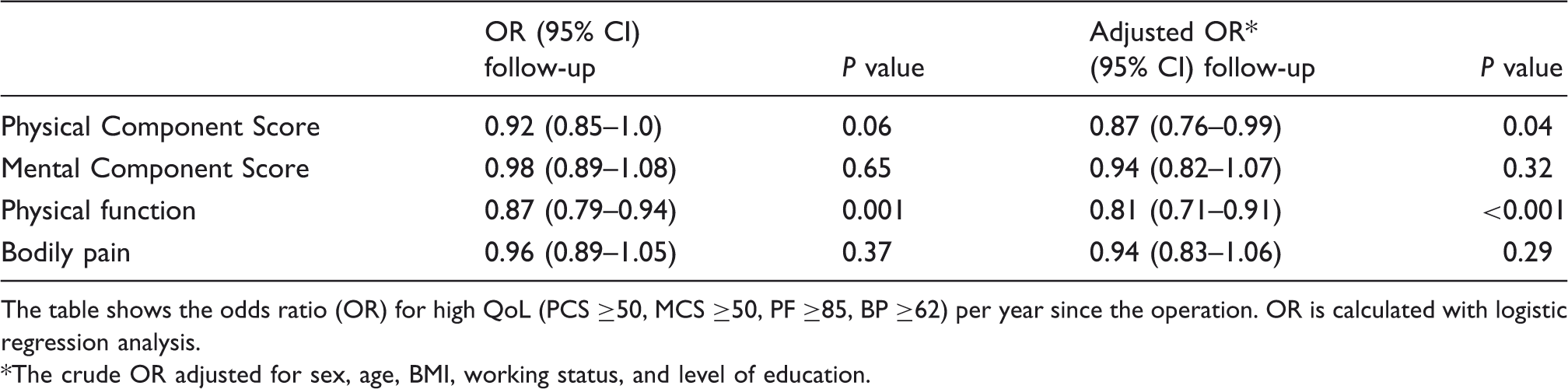
The table shows the odds ratio (OR) for high QoL (PCS ≥50, MCS ≥50, PF ≥85, BP ≥62) per year since the operation. OR is calculated with logistic regression analysis.
The crude OR adjusted for sex, age, BMI, working status, and level of education.
The prevalence of patients with hypermobility in the study group was estimated to be 16.3%. There were no significant differences in PCS, PF, and BP for hypermobile patients compared to non-hypermobile patients after adjustment for gender, age, follow-up, BMI, working status, and level of education.
Discussion
The aim of this study was to describe the self-assessed QoL in patients with hip dysplasia after PAO; to estimate a possible association between the CE and AI angles and the self-assessed QoL; and finally to examine if the health-related QoL differs between hypermobile and non-hypermobile patients.
As expected the SF-36 score was lower for the PAO group compared to the reference data from the Danish population. For women in particular, the differences were considerable. The medians score differences in the four physical subscales (PF, RP, BP, and GH) were between 10 and 22 points. The scores of the women differed in general more from the reference data than for the men, suggesting that men achieve a QoL closer to the reference data after a PAO. The Minimal Clinical Important Difference (MIREDIF) in SF-36 was in the sample size calculation a priori set at 10 points, since a difference of 10 points between reference data and patients with a chronic disease is considered clinically important (19). Hence, we consider the results from this study both significant and clinically relevant. However, the Mental Component Scores (MCS) were comparable, suggesting that physical health has no negative influence on the mental QoL for PAO patients at a medium-term follow-up.
Only few studies have described the QoL among patients undergoing PAO with the generic questionnaire SF-36 (10,15,17). Van Bergayk and Garbuz reported a mean PCS of 49.2 and a mean MCS of 54.7 for 22 patients with a follow-up of 2.0–3.5 years after PAO (10). Our results are comparable to these scores. At mean follow-up of 7.1 years we found a mean PCS and MCS of 46.9 and 53.7, respectively. However, this study shows that the PCS decrease over time after PAO and the follow-up in our study is substantial longer than in the study of van Bergayk and Garbuz (10). Troelsen et al. reported a median PCS of 48.31 and a MCS at 57.95 for 87 PAO patients with a mean follow-up of 6.8 years after the PAO (15). Those scores are comparable with the combined median scores for men and women in this study (49.66 and 56.34, respectively).
The PAO operation aims to relieve pain, improve the PF, and extend the lifetime of the patients’ own hip and to improve the patients’ PF. The SF-36 PCS has shown to increase from preoperatively 33.9 to 49.2 2.0–3.5 years postoperatively (10) however, this study suggests that the physical improvements achieved by the PAO will not last. The association between follow-up and the PF and follow-up and the PCS was statistically significant. After adjustment the odds of having a PCS ≥ 50 become 13% lower for every year after the operation and the odds of having a PF ≥85 becomes 19% lower. Based on the results we cannot conclude that PF decreases for the individual but for the group as a whole PF decreases with longer follow-up.
It was not possible to find other studies investigating self-assessed QoL over time after a PAO surgery, but Steppacher et al. reported a drop in PF measured with Merle d’Aubigne and Postel score from 16.7 at 10-year follow-up to 15.8 at 20-year follow-up (5). The same pattern is found for patients after a THA surgery due to osteoarthritis (26,27). Söderman et al. found that the SF-36 PF scores both 3 and 10 years after THA were lower than the general populations and that the scores decreased from 2 to 10 years of follow-up (27) A possible reason for the drop in PF and the PCS in this study may be progression of osteoarthritis after the operation and a weak but significant correlation between the postoperative grade of OA and the SF-36 score has been established (17).
In contrast to our hypothesis the results in the present study showed no association between the radiological parameters and the physical aspect of SF-36. A possible explanation might be that the study group consisted only of patients with preserved hips at a mean follow-up at 7.1 year and those with conversion to THA were excluded. If these patients had been asked to fill out the SF-36 before their THA operation we might have been able to find an association.
Excessive joint laxity in children with hip dysplasia has been described in one study (28). Hypermobility results in an increased Beighton score. However, Engesaeter et al. found no association between Beighton hypermobility score or EQ-5D and hip dysplasia in 2081 19-year-old Norwegians (29). General joint hypermobility is claimed to be present in 5–15% of the general population. It occurs more frequently in children compared to adults and girls are slightly more affected than boys (30). The prevalence of hypermobility in the present study was estimated to 16%. There is no universally accepted cut-off level for the diagnosis of general joint hypermobility but in Denmark the most used cut-off point is ≥4. To ensure that the Beighton score was not overestimated by the patients, we defined the cut-off level to be ≥5 instead of ≥4. As for Engesaeter et al., no association between hypermobile patients and self-assessed QoL was found and the prevalence of general joint hypermobility was only slightly higher than in the general population.
There are some limitations in this study. First, only 228 patients out of the 388 eligible patients returned the SF-36 questionnaire. This means that the self-assessed QoL for 41% of the cohort is unknown. However, we did not find any statistical significantly difference in demographic or radiographic data between patients returning the questionnaires and those who did not return it. Hence we consider the data obtained representative. Second, the SF-36 was not sent to the patients before the PAO. Thus, it was not possible to evaluate if the SF-36 score of the participants had changed over time but merely to compare the SF-36 score for the group of patients with reference data from a Danish population. Due to the size of the study group, we presume that these data give a valid estimation of the individuals’ QoL during the years after the operation. Third, the indications for PAO have changed during the study period. From 2003 hips with moderate osteoarthritis (Tönnis grade 2) were no longer offered PAO.
In conclusion, this study shows that the physical components of the QoL in patients undergoing PAO due to hip dysplasia are significantly lower than the Danish population used for reference. Furthermore, the improvements in PF after PAO seem to be temporary and decrease over time. We found no association between the radiological angles and QoL. Finally, the QoL among hypermobile patients with symptomatic hip dysplasia treated with PAO is not different from the QoL for non-hypermobile patients.
Footnotes
Funding
We would like to acknowledge the Danish Rheumatism Association for funding this study.