







Abstract
Objective
To assess the causal effects of specific eating habits on ischemic stroke risk and functional outcomes using Mendelian randomization.
Methods
This two-sample Mendelian randomization study used genetic variants associated with 32 eating habits as instrumental variables. Summary-level data were obtained from large-scale genome-wide association studies of individuals of European ancestry. The primary analysis used the inverse-variance weighted method, supplemented by sensitivity analyses to assess pleiotropy and multivariable Mendelian randomization to evaluate mediation via lipids and blood pressure.
Results
After multiple-testing correction, genetically predicted higher intake of cheese (odds ratio = 0.70, 95% confidence interval: 0.57–0.86), dried fruit (odds ratio = 0.57, 95% confidence interval: 0.41–0.80), and muesli (odds ratio = 0.20, 95% confidence interval: 0.07–0.54) showed potential protective associations with ischemic stroke risk. Sensitivity analyses supported the robustness of the findings, and multivariable Mendelian randomization indicated that the effects of cheese and muesli remained significant after adjustment for cardiovascular risk factors. No causal associations were observed for post-stroke recovery.
Conclusion
This study provides genetically derived causal evidence suggesting that higher consumption of cheese, dried fruit, and muesli may reduce the risk of ischemic stroke. Further studies are warranted to validate these food-specific dietary recommendations.
Introduction
Ischemic stroke remains the leading cause of death and long-term disability worldwide, accounting for 62.4% of all stroke events in 2019. 1 Its underlying pathophysiology is complex and remains incompletely understood, posing significant challenges for treatment. Although acute interventions such as thrombectomy are associated with improved outcomes, their efficacy is limited by a narrow therapeutic window, leaving many patients with severe and persistent neurological impairments. 2 This underscores a critical need to identify modifiable risk factors and novel therapeutic targets to improve both primary prevention of ischemic stroke and post-event prognosis.
Alongside established risk factors such as hypertension 3 and smoking, 4 eating habits are increasingly recognized as important modifiable contributors to stroke risk. 5 A substantial body of observational evidence supports this association. For example, large-scale studies have linked healthy dietary patterns such as the Mediterranean diet with a significantly reduced risk of stroke.6,7 In primary prevention, comparisons of a low-fat diet with two variants of the Mediterranean diet, one enriched with mixed nuts and the other with olive oil, have demonstrated significant reductions in cardiovascular events with both dietary patterns. 8 Similarly, a recent Japanese cohort study reported significant associations between intake of oranges, fresh fish, and yogurt and stroke risk. 9 However, the effects of other specific foods, particularly those with contested health implications such as cheese and processed foods, remain unclear in observational studies.10,11 Furthermore, such observational findings are subject to inherent limitations, including residual confounding (e.g. socioeconomic status and other lifestyle behaviors) and reverse causation. Consequently, whether these associations are truly causal remains uncertain, thereby limiting the development of robust, evidence-based dietary recommendations for stroke prevention.
To address these challenges, Mendelian randomization (MR) has emerged as a powerful analytical approach for causal inference. 12 By using genetic variants as instrumental variables for an exposure, MR minimizes the impact of confounding factors and reverse causation that typically affect observational studies. 13 The random allocation of alleles from parents to offspring at conception mimics the randomization process of a randomized controlled trial (RCT), thereby strengthening causal inference. 14 Although MR has been successfully applied to investigate causal relationships of lifestyle factors, including smoking and alcohol consumption, with stroke outcomes, the genetically predicted causal effects of a wide range of specific dietary components remain largely unexplored. In particular, no MR study to date has systematically evaluated the causal effects of individual eating habits on functional outcomes after ischemic stroke.
By leveraging large-scale genetic data, we aimed to overcome the limitations of traditional observational studies and provide more robust evidence on the role of diet in the etiology of ischemic stroke. Furthermore, through multivariable Mendelian randomization (MVMR), we sought to explore the extent to which observed effects may be mediated by established cardiovascular risk factors, thereby providing insight into underlying biological pathways.
Material and methods
Study design
This study employed a two-sample MR design to investigate the causal effects of 32 eating habits on ischemic stroke risk and functional outcomes after ischemic stroke. The validity of our MR analysis relies on three core assumptions (Figure 1): 15 (a) Relevance. The instrumental variables (IVs), consisting of single nucleotide polymorphisms (SNPs), must be robustly associated with the exposure (eating habits); (b) Independence. The IVs must be independent of confounding factors that may influence the relationship between exposure and outcome; and (c) Exclusion restriction. The IVs must influence the outcome only through the exposure and not via alternative (pleiotropic) pathways. The reporting of this study conforms to the Strengthening the Reporting of Observational Studies in Epidemiology using Mendelian Randomization (STROBE-MR) guidelines.15,16
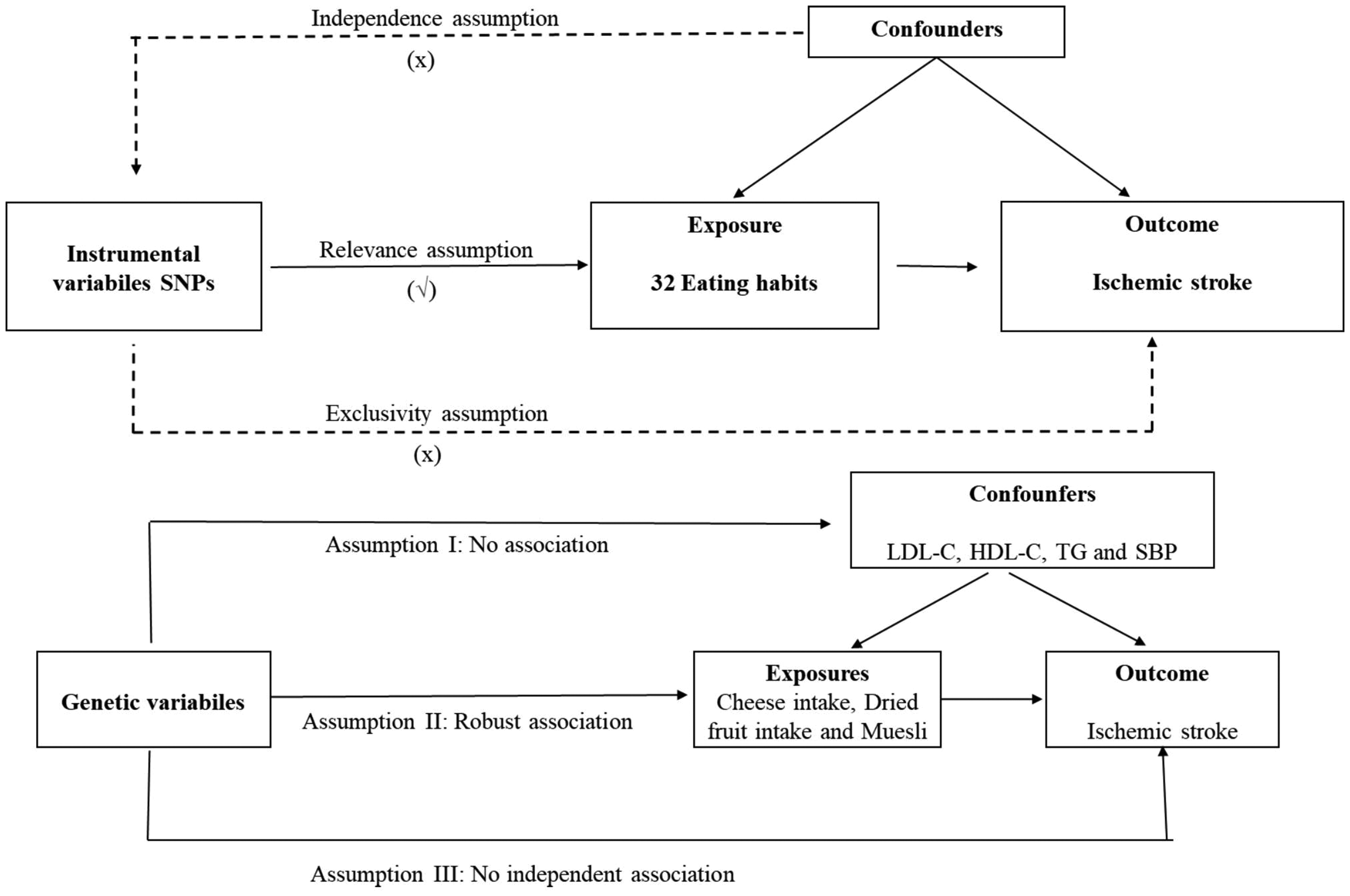
Conceptual framework of the two-sample Mendelian randomization study. The schematic illustrates the three core assumptions required for a genetic variant (SNP) to serve as a valid instrumental variable (IV) for an exposure (eating habit) and an outcome (ischemic stroke): (a) the relevance assumption, in which the SNP is robustly associated with the eating habit; (b) the independence assumption, in which the SNP is not associated with confounders; and (c) the exclusion restriction assumption, in which the SNP influences ischemic stroke risk only through the eating habit.
Data source
Summary statistics for 32 genetically predicted eating habits were obtained from large-scale genome-wide association studies (GWAS). Data on alcohol consumption patterns were sourced from the integrative epidemiology unit (IEU) OpenGWAS database, 17 whereas data for the remaining 30 eating habits (e.g. cheese intake, dried fruit intake, and cereal types) were obtained from the UK Biobank (UKB) Open GWAS Project. Dietary information in the UKB was primarily collected using self-administered touchscreen questionnaires.
Summary-level data for ischemic stroke were obtained from the MEGASTROKE consortium, comprising 34,217 cases and 406,111 controls (https://megastroke.org/). Summary data for functional outcomes after ischemic stroke (defined by the modified Rankin Scale) were obtained from the Genetics of Ischemic Stroke Functional Outcome (GISCOME) network (https://megastroke.org/), including 6021 participants.
This study was conducted in accordance with the Declaration of Helsinki (1975, as revised in 2024). As it exclusively used publicly available, deidentified summary-level data with no individual patient information, and all written informed consent had been obtained in the original GWAS, the present analysis was exempt from institutional review board approval. All GWAS summary statistics used in this study were derived from individuals of European ancestry. A detailed list of all GWAS datasets is provided in Table S1.
IVs’ selection
MR studies used SNPs associated with the exposure as IVs. We selected SNPs strongly associated with each exposure at a genome-wide significance threshold of p <5 ×10⁻⁸. 18 For exposures with an insufficient number of SNPs at this threshold (dark chocolate intake, bran cereal, biscuit cereal, and oat cereal), we used a more relaxed threshold of p <5 × 10⁻⁶. 19 In addition, a minor allele frequency (MAF) threshold of >0.01 was applied.
To ensure independence of IVs, we performed linkage disequilibrium (LD) clumping using a strict threshold of r2 <0.001 within a 10,000 kb window.20,21 Exposure and outcome datasets were harmonized to ensure that the effects of each SNP on the exposure and outcome corresponded to the same allele. Palindromic SNPs with intermediate allele frequencies were excluded. For SNPs unavailable in the outcome GWAS, we used proxy SNPs with high LD (r2 > 0.8) where available. 22
The strength of the selected IVs was assessed using the F-statistic, calculated as follows:

MR analysis
The primary analysis for evaluating the causal relationship between eating habits and ischemic stroke/functional recovery following ischemic stroke used inverse-variance weighting (IVW), providing odds ratio (OR) with 95% confidence interval (CI). 24 To reinforce the reliability of our results, we further applied three supplementary MR techniques: MR-Egger regression, the weighted median estimator, and the weighted mode method.25,26 By grouping SNPs into subsets based on similarity of causal effects, this method focuses on the most consistent signals among genetic variants. The implementation of these sophisticated MR techniques was facilitated by the ‘Two Sample MR’ package in R version 4.3.2. This software enabled us to conduct rigorous and reproducible analyses, ensuring the robustness of our results. To control the false-positive rate resulting from multiple testing, we employed the Benjamini–Hochberg method to estimate the false discovery rate (FDR), with FDR <0.05 considered statistically significant.
Sensitivity analysis
Horizontal pleiotropy was assessed using the MR-Egger intercept test 27 and the MR-PRESSO global test. 28 Any outliers flagged by the MR-PRESSO global test were excluded, and robustness was evaluated using a leave-one-out approach to confirm the findings. To quantify heterogeneity, we employed both IVW method and MR-Egger regression, utilizing Cochran’s Q statistic. A Q statistic exceeding the number of instruments minus one or a significant Q statistic at a p value <0.05 suggests the presence of heterogeneity or invalid instruments.
MVMR analysis
To investigate whether the observed causal effects of dietary habits on ischemic stroke were mediated by major cardiovascular risk factors, we conducted MVMR analysis. 29 This approach estimates the direct causal effect of an exposure on an outcome after adjusting for genetic effects of potential mediators. The validity of this method relies on the key assumption that genetic instruments influence the outcome solely through the included exposure (dietary habit) or the potential mediators rather than through alternative pleiotropic pathways.
We performed MVMR for dietary habits that showed significant associations in the primary analysis (cheese, dried fruit, and muesli). The potential mediators included low-density lipoprotein cholesterol (LDL-C), 30 high-density lipoprotein cholesterol (HDL-C), 30 triglycerides (TG), 30 and systolic blood pressure (SBP). 31
For the MVMR analysis, we constructed a combined set of instrumental variables by selecting SNPs associated with either the dietary exposures or the mediators at genome-wide significance (p < 5 × 10 − 8) (Table S1). 32 This combined SNP set was then subjected to LD clumping (r2 < 0.001; 10,000 kb window) to ensure independence. 21 We then extracted the association statistics for all instruments from the corresponding GWAS summary datasets. The independent causal effect of each dietary habit on ischemic stroke, adjusted for mediators, was estimated using the random-effects MVMR-IVW method. All MVMR analyses were conducted using the ‘TwoSampleMR’ package in R.
Results
IVs’ selection
In this study, 1028 IVs related to 32 eating habits were identified. All F-values were greater than 10 (Table S2). When MR analyses were performed using ischemic stroke and functional outcome after ischemic stroke as outcomes, all SNPs were successfully matched to the outcome summary datasets. All SNPs included in the outcome datasets are presented in Table S3.
Causal effects of eating habits on ischemic stroke
Following analysis of 32 dietary habits and FDR multiple-testing correction, we identified three dietary patterns significantly associated with ischemic stroke risk (FDR < 0.05) (Table 1, Supplementary Table S4). Genetically predicted higher intake of cheese (OR = 0.70, 95% CI: 0.57–0.86, p = 0.001, PFDR = 0.032), dried fruit (OR = 0.57, 95% CI: 0.41–0.80, p = 0.001, PFDR = 0.034), and muesli (OR = 0.20, 95% CI: 0.07–0.54, p = 0.002, PFDR = 0.034) was associated with a protective effect. Additionally, specific drinking patterns, including alcohol usually consumed with meals (OR = 0.60, 95% CI: 0.39–0.91, p = 0.017) and average weekly red wine intake (OR = 0.62, 95% CI: 0.42–0.91, p = 0.016), showed nominal associations with ischemic stroke risk; however, the results failed to pass the FDR test (PFDR = 0.182, Table 1, Supplementary Figures S1 and S2).
Causal effects of genetically predicted eating habits on ischemic stroke risk.
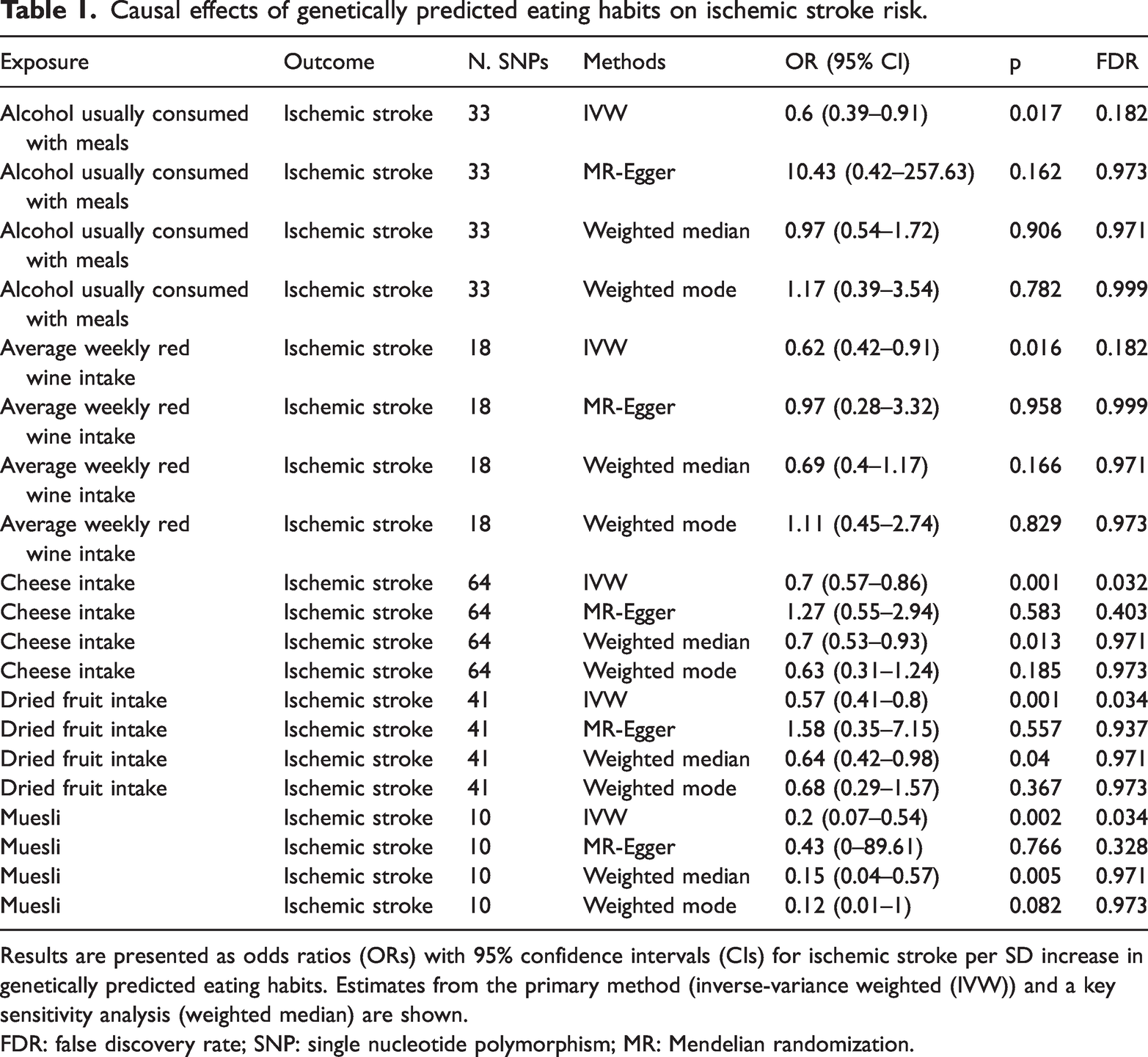
Results are presented as odds ratios (ORs) with 95% confidence intervals (CIs) for ischemic stroke per SD increase in genetically predicted eating habits. Estimates from the primary method (inverse-variance weighted (IVW)) and a key sensitivity analysis (weighted median) are shown.
FDR: false discovery rate; SNP: single nucleotide polymorphism; MR: Mendelian randomization.
These significant associations showed no evidence of heterogeneity or pleiotropy (Supplementary Figures S3 and S4). However, for the initially null results, MR-Egger regression suggested potential pleiotropy for poultry intake as an exposure, identifying rs9997448 as an outlier (Supplementary Table S5). In addition, the MR-PRESSO test identified outliers for several exposures with ischemic stroke: one outlier for hot drink temperature (rs17024335), two for salt added to food (rs2521501, rs35271178), one for other cereals (e.g. cornflakes and frosties) (rs4024198), and one for bran cereal (rs13274406) (Supplementary Table S6).
After excluding these identified outliers and performing subsequent reanalysis, a nominal association was observed between genetically predicted higher intake of other cereals (e.g. cornflakes and frosties) and ischemic stroke risk (OR = 5.42, 95% CI: 1.40–20.95, p = 0.014); however, the results failed to pass the FDR correction (PFDR =0.182, Supplementary Table S7). Sensitivity analyses after outlier removal confirmed the robustness of these finding (Supplementary Tables S8 and S9).
Causal effects of eating habits on functional outcome after ischemic stroke
In the analysis of functional outcome after ischemic stroke, no significant causal associations were identified for any of the 32 eating habits (all p > 0.05) (Supplementary Table S4).
MR-Egger regression indicated potential pleiotropy for hot drink temperature as an exposure, identifying several outliers (rs1260326, rs1680349, rs12132579, rs58391518, rs1568452, rs12622811, and rs2472297) (Supplementary Table S5). However, the MR-PRESSO test did not provide evidence of horizontal pleiotropy (Supplementary Table S6). After removal of these outliers, the association remained nonsignificant (Supplementary Table S7).
MVMR analysis for potential mediation
To examine whether the effects of each dietary habit on stroke identified in the univariable MR analysis were independent of cardiovascular risk factors, we conducted an MVMR analysis.
The analysis revealed distinct patterns across food items (Table 2). The protective effect of cheese intake on ischemic stroke remained significant after adjustment for TG (OR = 0.028, 95% CI: 0.0032–0.2455, p = 0.0012) and SBP (OR = 0.726, 95% CI: 0.5381–0.9808, p = 0.0369). Similarly, the protective effect of muesli intake remained significant after adjustment for HDL-C (OR = 0.0012, 95% CI: 0.000–0.1247, p = 0.0046). These findings suggest that the benefits of cheese and muesli are at least partially independent of traditional risk pathways. We note that the effect estimate for muesli adjusted for HDL-C was extreme and should be interpreted with caution (OR = 0.0012).
Multivariable MR results.
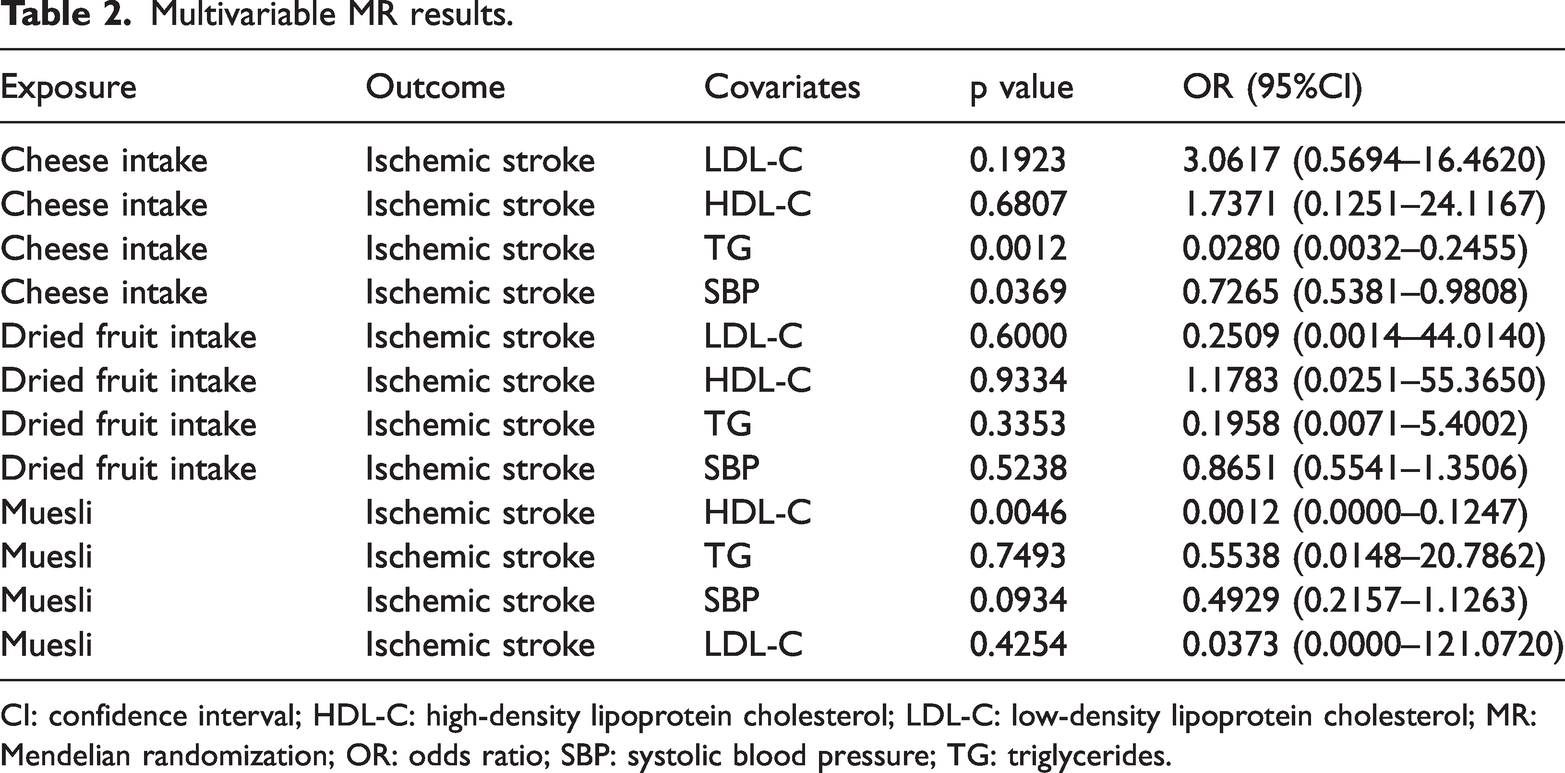
CI: confidence interval; HDL-C: high-density lipoprotein cholesterol; LDL-C: low-density lipoprotein cholesterol; MR: Mendelian randomization; OR: odds ratio; SBP: systolic blood pressure; TG: triglycerides.
In contrast, the protective association of dried fruit intake was attenuated to null after adjustment for SBP and other mediators, suggesting that the beneficial effect on stroke risk is likely mediated through established cardiovascular risk factors.
Discussion
In this two-sample MR study, we systematically investigated genetically inferred causal associations between 32 eating habits and the risk and functional outcomes of ischemic stroke. Following FDR correction, our primary analysis provided genetic evidence supporting protective effects of cheese, dried fruit, and muesli against ischemic stroke risk. In addition, alcohol consumption usually with meals, average weekly red wine intake, and intake of other cereals (e.g. cornflakes and frosties) demonstrated nominal causal associations with ischemic stroke. MVMR results indicated that the protective effects of cheese and muesli remained robust after adjustment for cardiometabolic confounding factors, whereas the effect of dried fruit appeared to be mediated by blood pressure and lipid profiles. Overall, these findings suggest that specific dietary patterns are linked to ischemic stroke through complex, multilayered causal pathways, providing a genetic perspective that may help elucidate underlying pathophysiological mechanisms.
The protective effect of cheese intake is particularly noteworthy. The persistence of this effect after adjustment for TG and SBP suggests that these factors are unlikely to be the primary mediators. However, interpretation becomes more complex when considering lipoprotein metabolism. After adjustment for LDL-C, the protective association was attenuated and the point estimate reversed, although with a very wide CI, indicating substantial model instability. This suggests that a simple mediation framework may be insufficient. Instead, the findings may reflect complex genetic pleiotropy, whereby genetic variants associated with cheese intake exert overlapping but distinct effects on LDL-C metabolism that are not fully aligned within a single causal pathway from diet to disease. This observation supports the food matrix hypothesis, 33 suggesting that the overall protective effect of cheese may operate through mechanisms not fully captured by LDL-C–associated genetic variation. 34 The complex nutritional composition of cheese, rich in calcium, protein, and probiotics, may confer cardiovascular benefits that potentially counterbalance the traditionally assumed risks related to saturated fat content. 35
In contrast, attenuation of the dried fruit association in MVMR models suggests that its protective effect is likely fully mediated through established cardiometabolic risk factors. Dried fruits are rich in dietary fiber, polyphenols, and antioxidants, 36 all of which have been shown to improve endothelial function, 37 reduce oxidative stress, 38 and favorably modulate lipid and glucose metabolism. 39 The disappearance of the association after adjustment for blood pressure and lipid-related traits supports a biologically plausible pathway, indicating that the observed reduction in stroke risk is not direct but rather occurs through cumulative improvements in intermediate phenotypes. This underscores the importance of accounting for mediation pathways in nutritional MR studies and reinforces the value of targeting these intermediate risk factors in public health interventions.
The robustness of muesli intake as a protective factor, even after adjustment for HDL-C, suggests a more complex and potentially independent mechanism of action. As a whole-grain cereal often containing oats, nuts, seeds, and dried fruits, muesli represents a composite dietary exposure.40,41 Its benefits may extend beyond traditional lipid pathways, potentially involving modulation of the gut microbiota via soluble fiber (e.g. beta-glucan), 42 anti-inflammatory effects of phytonutrients, and improved insulin sensitivity. 43 The persistence of its protective effect after adjustment for HDL-C indicates that these alternative biological mechanisms may play an important role. It is important to note that the pronounced effect size observed for muesli after HDL-C adjustment, although statistically significant, warrants cautious interpretation due to its magnitude. This may reflect a strong true biological effect or, alternatively, an artifact of model instability or residual pleiotropy not captured in sensitivity analyses.
Our initial MR analysis suggested a potential protective association between certain patterns of alcohol consumption, particularly alcohol usually consumed with meals and moderate weekly red wine intake, and ischemic stroke. These findings were broadly consistent with prior observational studies. 44 However, after applying FDR correction for multiple testing, these associations no longer remained statistically significant, indicating that the observed protective effects may be susceptible to false-positive findings and should be interpreted with caution.45,46 This underscores the importance of rigorous statistical correction in genetic epidemiology. Although observational studies have often suggested benefits of red wine, our results, after adjustment for multiple testing, do not support a robust protective effect, warranting caution in public health messaging based on potentially confounded associations. 46 Moreover, these post-correction null findings are consistent with growing evidence that the relationship between alcohol consumption and stroke is complex, with even moderate intake potentially conferring risk in certain populations. 47
Beyond positive associations, it is equally important to consider the null findings in our study, both for ischemic stroke risk and post-stroke functional outcomes. Although observational literature has frequently reported the detrimental or beneficial effects of various specific dietary factors (e.g. high intake of processed meats or sugar-sweetened beverages) on stroke risk, 48 many of these well-studied dietary habits did not demonstrate significant causal associations in our MR analysis. This discrepancy may be explained by several methodological considerations. First, observational studies capture a snapshot of dietary intake, which is highly susceptible to unmeasured residual confounding, including socioeconomic status, physical activity, and overall health consciousness. 49 In contrast, MR uses genetic variants as proxies for lifelong exposure, thereby minimizing environmental confounding and reverse causation. 12 Second, dietary habits are complex behavioral traits, and for some well-known dietary risk factors, the available genetic instruments may only explain a small proportion of the variance in actual food intake, leading to limited statistical power to detect a causal effect in MR. Therefore, null findings in our study do not definitively exclude a biological effect but rather indicate a lack of strong genetic evidence for a causal pathway independent of confounding. Consistent with the lack of causal evidence for dietary factors on stroke onset, a key finding of our study is the absence of an association between the 32 eating habits and functional outcomes after ischemic stroke. This aligns with previous MR studies on alcohol consumption and smoking behavior. 4 This null result suggests that although dietary habits may be important determinants of primary stroke risk, their role in modifying the complex pathophysiological cascade after an acute ischemic event (e.g. neuronal injury, inflammation, and neuroplasticity) may be limited or absent, at least through pathways captured by our genetic instruments. Recovery is likely influenced by other determinants, including baseline stroke severity, acute medical management, rehabilitation intensity, and genetic factors influencing neural repair. 50 Future MR studies should focus on specific nutrients or circulating biomarkers involved in post-stroke recovery rather than broad dietary patterns.
This study has several notable strengths. To the best of our knowledge, it is the first comprehensive two-sample MR study to investigate causal relationships between a wide range of specific eating habits and both ischemic stroke risk and functional outcomes. The robust methodological framework, including the use of large-scale GWAS data, stringent IV selection criteria, and extensive sensitivity analyses, strengthens the validity of our causal inferences. Another key strength is the application of MVMR analysis, which enabled preliminary exploration of potential mediating pathways.
However, our study is subject to several limitations. First, exposure data were based on self-reported dietary questionnaires, which are susceptible to measurement error and recall bias. Second, to ensure sufficient instrument strength, we used a relaxed significance threshold (p < 5 × 10⁻⁶) for some exposures, which may introduce weak instrument bias, although high F-statistics mitigate this concern. Third, the analysis was restricted to individuals of European ancestry, limiting the generalizability of the findings to other populations. Furthermore, our MVMR analyses, particularly for cheese, yielded estimates with very wide CIs after adjusting for certain mediators. This suggests that although MVMR is a powerful tool, our analysis may have been underpowered to precisely disentangle independent effects from mediated pathways, highlighting the need for larger GWAS datasets in future studies. Finally, our study assessed lifelong genetic predisposition to certain eating habits, which may not fully capture the effects of dietary modifications later in life.
In conclusion, this two-sample MR study provides genetic evidence that cheese and muesli intake may be causally associated with reduced ischemic stroke risk, with effects robust to multiple-testing correction and adjustment for cardiometabolic factors. The protective effect of dried fruit appears to be fully mediated by blood pressure and lipid metabolism, whereas associations for red wine and other foods did not withstand multiple-testing correction. No significant associations were observed with post-stroke outcomes, suggesting that these dietary habits primarily protect against stroke onset rather than recovery. These findings highlight the potential value of food-specific, mechanism-based dietary strategies for cardiovascular prevention, although validation in diverse populations and further mechanistic studies are warranted.
Supplemental Material
sj-pdf-1-imr-10.1177_03000605261452935 - Supplemental material for Causal effects of 32 eating habits on ischemic stroke risk and post-stroke functional outcome: A Mendelian randomization study
Supplemental material, sj-pdf-1-imr-10.1177_03000605261452935 for Causal effects of 32 eating habits on ischemic stroke risk and post-stroke functional outcome: A Mendelian randomization study by Xiaolu Xu, Xuefeng Zang, Hengheng Liu, Xianxian Zhang, Ningjie Yu, Wenqi Wang, Lijian Han, Cong Chen and Fei Chen in Journal of International Medical Research
Supplemental Material
sj-pdf-2-imr-10.1177_03000605261452935 - Supplemental material for Causal effects of 32 eating habits on ischemic stroke risk and post-stroke functional outcome: A Mendelian randomization study
Supplemental material, sj-pdf-2-imr-10.1177_03000605261452935 for Causal effects of 32 eating habits on ischemic stroke risk and post-stroke functional outcome: A Mendelian randomization study by Xiaolu Xu, Xuefeng Zang, Hengheng Liu, Xianxian Zhang, Ningjie Yu, Wenqi Wang, Lijian Han, Cong Chen and Fei Chen in Journal of International Medical Research
Supplemental Material
sj-pdf-3-imr-10.1177_03000605261452935 - Supplemental material for Causal effects of 32 eating habits on ischemic stroke risk and post-stroke functional outcome: A Mendelian randomization study
Supplemental material, sj-pdf-3-imr-10.1177_03000605261452935 for Causal effects of 32 eating habits on ischemic stroke risk and post-stroke functional outcome: A Mendelian randomization study by Xiaolu Xu, Xuefeng Zang, Hengheng Liu, Xianxian Zhang, Ningjie Yu, Wenqi Wang, Lijian Han, Cong Chen and Fei Chen in Journal of International Medical Research
Supplemental Material
sj-pdf-4-imr-10.1177_03000605261452935 - Supplemental material for Causal effects of 32 eating habits on ischemic stroke risk and post-stroke functional outcome: A Mendelian randomization study
Supplemental material, sj-pdf-4-imr-10.1177_03000605261452935 for Causal effects of 32 eating habits on ischemic stroke risk and post-stroke functional outcome: A Mendelian randomization study by Xiaolu Xu, Xuefeng Zang, Hengheng Liu, Xianxian Zhang, Ningjie Yu, Wenqi Wang, Lijian Han, Cong Chen and Fei Chen in Journal of International Medical Research
Supplemental Material
sj-xlsx-5-imr-10.1177_03000605261452935 - Supplemental material for Causal effects of 32 eating habits on ischemic stroke risk and post-stroke functional outcome: A Mendelian randomization study
Supplemental material, sj-xlsx-5-imr-10.1177_03000605261452935 for Causal effects of 32 eating habits on ischemic stroke risk and post-stroke functional outcome: A Mendelian randomization study by Xiaolu Xu, Xuefeng Zang, Hengheng Liu, Xianxian Zhang, Ningjie Yu, Wenqi Wang, Lijian Han, Cong Chen and Fei Chen in Journal of International Medical Research
Supplemental Material
sj-xlsx-6-imr-10.1177_03000605261452935 - Supplemental material for Causal effects of 32 eating habits on ischemic stroke risk and post-stroke functional outcome: A Mendelian randomization study
Supplemental material, sj-xlsx-6-imr-10.1177_03000605261452935 for Causal effects of 32 eating habits on ischemic stroke risk and post-stroke functional outcome: A Mendelian randomization study by Xiaolu Xu, Xuefeng Zang, Hengheng Liu, Xianxian Zhang, Ningjie Yu, Wenqi Wang, Lijian Han, Cong Chen and Fei Chen in Journal of International Medical Research
Supplemental Material
sj-xlsx-7-imr-10.1177_03000605261452935 - Supplemental material for Causal effects of 32 eating habits on ischemic stroke risk and post-stroke functional outcome: A Mendelian randomization study
Supplemental material, sj-xlsx-7-imr-10.1177_03000605261452935 for Causal effects of 32 eating habits on ischemic stroke risk and post-stroke functional outcome: A Mendelian randomization study by Xiaolu Xu, Xuefeng Zang, Hengheng Liu, Xianxian Zhang, Ningjie Yu, Wenqi Wang, Lijian Han, Cong Chen and Fei Chen in Journal of International Medical Research
Supplemental Material
sj-xlsx-8-imr-10.1177_03000605261452935 - Supplemental material for Causal effects of 32 eating habits on ischemic stroke risk and post-stroke functional outcome: A Mendelian randomization study
Supplemental material, sj-xlsx-8-imr-10.1177_03000605261452935 for Causal effects of 32 eating habits on ischemic stroke risk and post-stroke functional outcome: A Mendelian randomization study by Xiaolu Xu, Xuefeng Zang, Hengheng Liu, Xianxian Zhang, Ningjie Yu, Wenqi Wang, Lijian Han, Cong Chen and Fei Chen in Journal of International Medical Research
Supplemental Material
sj-xlsx-9-imr-10.1177_03000605261452935 - Supplemental material for Causal effects of 32 eating habits on ischemic stroke risk and post-stroke functional outcome: A Mendelian randomization study
Supplemental material, sj-xlsx-9-imr-10.1177_03000605261452935 for Causal effects of 32 eating habits on ischemic stroke risk and post-stroke functional outcome: A Mendelian randomization study by Xiaolu Xu, Xuefeng Zang, Hengheng Liu, Xianxian Zhang, Ningjie Yu, Wenqi Wang, Lijian Han, Cong Chen and Fei Chen in Journal of International Medical Research
Supplemental Material
sj-xlsx-10-imr-10.1177_03000605261452935 - Supplemental material for Causal effects of 32 eating habits on ischemic stroke risk and post-stroke functional outcome: A Mendelian randomization study
Supplemental material, sj-xlsx-10-imr-10.1177_03000605261452935 for Causal effects of 32 eating habits on ischemic stroke risk and post-stroke functional outcome: A Mendelian randomization study by Xiaolu Xu, Xuefeng Zang, Hengheng Liu, Xianxian Zhang, Ningjie Yu, Wenqi Wang, Lijian Han, Cong Chen and Fei Chen in Journal of International Medical Research
Supplemental Material
sj-xlsx-11-imr-10.1177_03000605261452935 - Supplemental material for Causal effects of 32 eating habits on ischemic stroke risk and post-stroke functional outcome: A Mendelian randomization study
Supplemental material, sj-xlsx-11-imr-10.1177_03000605261452935 for Causal effects of 32 eating habits on ischemic stroke risk and post-stroke functional outcome: A Mendelian randomization study by Xiaolu Xu, Xuefeng Zang, Hengheng Liu, Xianxian Zhang, Ningjie Yu, Wenqi Wang, Lijian Han, Cong Chen and Fei Chen in Journal of International Medical Research
Supplemental Material
sj-xlsx-12-imr-10.1177_03000605261452935 - Supplemental material for Causal effects of 32 eating habits on ischemic stroke risk and post-stroke functional outcome: A Mendelian randomization study
Supplemental material, sj-xlsx-12-imr-10.1177_03000605261452935 for Causal effects of 32 eating habits on ischemic stroke risk and post-stroke functional outcome: A Mendelian randomization study by Xiaolu Xu, Xuefeng Zang, Hengheng Liu, Xianxian Zhang, Ningjie Yu, Wenqi Wang, Lijian Han, Cong Chen and Fei Chen in Journal of International Medical Research
Supplemental Material
sj-xlsx-13-imr-10.1177_03000605261452935 - Supplemental material for Causal effects of 32 eating habits on ischemic stroke risk and post-stroke functional outcome: A Mendelian randomization study
Supplemental material, sj-xlsx-13-imr-10.1177_03000605261452935 for Causal effects of 32 eating habits on ischemic stroke risk and post-stroke functional outcome: A Mendelian randomization study by Xiaolu Xu, Xuefeng Zang, Hengheng Liu, Xianxian Zhang, Ningjie Yu, Wenqi Wang, Lijian Han, Cong Chen and Fei Chen in Journal of International Medical Research
Footnotes
Acknowledgments
We would like to express our gratitude to the participants and researchers of the MEGASTROKE consortium, the GISCOME network, the UK Biobank, and all other contributing GWAS consortia for making their summary-level data publicly available. Their efforts have made this research possible. Artificial intelligence tools were used for English language editing and improvement.
Author contributions
Xiaolu Xu, Xuefeng Zang, and Hengheng Liu carried out the study, participated in data collection, and drafted the manuscript. Xianxian Zhang, Ningjie Yu, and Wenqi Wang performed the statistical analyses and contributed to study design. Lijian Han, Cong Chen, and Fei Chen contributed to data acquisition, analysis, and interpretation and assisted in drafting the manuscript. All authors read and approved the final manuscript.
Consent to participate
Not applicable.
Consent for publication
Not applicable.
Data availability
The GWAS summary statistics used in this study are publicly available. Data for ischemic stroke can be accessed through the MEGASTROKE consortium (https://megastroke.org/). Data for functional outcomes after ischemic stroke were obtained from the GISCOME network, also available via the MEGASTROKE website. Data for alcohol consumption habits were sourced from the IEU OpenGWAS project ( ). Data for other eating habits were obtained from UK Biobank GWAS data, accessible through the IEU OpenGWAS project. Detailed information on the specific GWAS dataset IDs is provided in Table S1.
Declaration of conflicting interest
The authors declare no conflicts of interest in this work.
Ethical considerations
This study used publicly available, deidentified summary-level data from previously published GWASs. All original studies that generated these data obtained appropriate ethics approval and informed consent from participants. Therefore, no additional ethical approval was required for this analysis.
Funding
This work was supported by the Elderly Health Research Project of Jiangsu Province (No. LKM2024050); Key Medical Research Project of Yancheng Health Commission (No. YK2025064); the Special Project of Clinical Medicine of Nantong University (No. YXY-Z2023003); and the Special Funds for Science Development of Yancheng Third People’s Hospital, Jiangsu Medical College (20229117).
Supplemental material
Supplemental material for this article is available online.
References
Supplementary Material
Please find the following supplemental material available below.
For Open Access articles published under a Creative Commons License, all supplemental material carries the same license as the article it is associated with.
For non-Open Access articles published, all supplemental material carries a non-exclusive license, and permission requests for re-use of supplemental material or any part of supplemental material shall be sent directly to the copyright owner as specified in the copyright notice associated with the article.
