






Abstract
Objective
To explore the value of neutrophil extracellular traps biomarkers (myeloperoxidase and citrullinated histone H3) in patients with bronchial asthma.
Methods
A total of 66 patients with bronchial asthma (stratified into mild, moderate, and severe lung function obstruction subgroups according to predicted forced expiratory volume in 1 second) and 60 healthy controls were enrolled. Plasma levels of myeloperoxidase and citrullinated histone H3 were measured. Spearman correlation analysis and receiver operating characteristic curve analysis were used to evaluate correlations and diagnostic performance.
Results
Compared with healthy controls, patients with bronchial asthma had significantly higher plasma levels of myeloperoxidase and citrullinated histone H3 (all p < 0.001). Myeloperoxidase and citrullinated histone H3 levels increased with the severity of lung function obstruction (severe > moderate > mild; all p < 0.05). Receiver operating characteristic analysis showed that the area under the curve for myeloperoxidase and citrullinated histone H3 alone in diagnosing bronchial asthma was 0.824 and 0.867, respectively.
Conclusion
Plasma myeloperoxidase and citrullinated histone H3 are elevated in patients with bronchila asthma and are closely associated with the severity of lung function obstruction.
Introduction
Bronchial asthma (BA) is a heterogeneous chronic inflammatory airway disease characterized by airflow limitation, airway hyperresponsiveness, and persistent inflammation, affecting more than 300 million people worldwide. 1 Although eosinophilic inflammation and type 2 (T2) cytokines have been well studied as core mechanisms in T2-high asthma, the role of neutrophils and their derived mediators in T2-low or severe asthma remains insufficiently elucidated.2,3
Neutrophil extracellular traps (NETs), web-like structures composed of decondensed chromatin and histones, are key mediators of innate immunity that were initially identified for their antimicrobial activity. 4 However, accumulating evidence indicates that dysregulated NET formation contributes to the pathogenesis of chronic inflammatory and allergic diseases, including BA.5,6 This study aimed to explore the value of the NET biomarkers myeloperoxidase (MPO) and citrullinated histone H3 (CitH3) in patients with BA and their correlation with lung function parameters.
Methods
Study design and participants
This observational study was conducted at the Linping Branch of The Second Affiliated Hospital of Zhejiang University between April 2025 and April 2026. The study protocol was approved by the Ethics Committee (Approval Number: 2025044). Written informed consent was obtained from all participants. The reporting of this study conforms to the Strengthening the Reporting of Observational Studies in Epidemiology (STROBE) guidelines. 7
A total of 66 patients with BA were enrolled and stratified into mild, moderate, and severe lung function obstruction subgroups. Sixty healthy individuals served as controls.
Inclusion and exclusion criteria. Inclusion criteria for the BA group were as follows: (a) discontinued glucocorticoid use 2 weeks before examination; (b) no smoking history or other allergic diseases; (c) no comorbid psychiatric diseases or cognitive disorders; (d) voluntary participation with written informed consent; and (e) recorded baseline treatment including inhaled corticosteroids (ICS), with no systemic corticosteroid use within 4 weeks.
Exclusion criteria for the BA group were as follows: (a) other lung diseases (tuberculosis or bacterial/fungal lung infections); (b) comorbid endocrine or immune system diseases or malignant tumors; (c) cardiac, hepatic, or renal dysfunction; and (d) long-term use of immunosuppressants.
Baseline data collection
Demographic and clinical data, including sex, age, body mass index (BMI), asthma duration, acute exacerbation frequency, and asthma control test (ACT) score, were recorded. Fasting peripheral blood samples were collected. Plasma was separated and stored at −80°C until analysis. Plasma levels of MPO and CitH3 were measured using enzyme-linked immunosorbent assay (ELISA) kits.
Statistical analysis
Data were analyzed using Statistical Package for the Social Sciences (SPSS) version 26.0 and GraphPad Prism version 7. Continuous data were presented as the mean ± SD or median (P25 and P75). Between-group comparisons were performed using the t-test, Mann–Whitney U test, or Kruskal–Wallis H test. Correlations were analyzed using Spearman correlation. Receiver operating characteristic (ROC) curves were used to evaluate diagnostic efficacy. A two-sided p <0.05 was considered statistically significant.
Results
Baseline characteristics
A total of 66 patients with BA and 60 healthy controls were included in this study. No significant differences were observed in age, sex, or BMI between patients with BA and healthy controls (all p > 0.05). Detailed baseline data are presented in Table 1.
Baseline characteristics of BA subgroups and healthy controls.
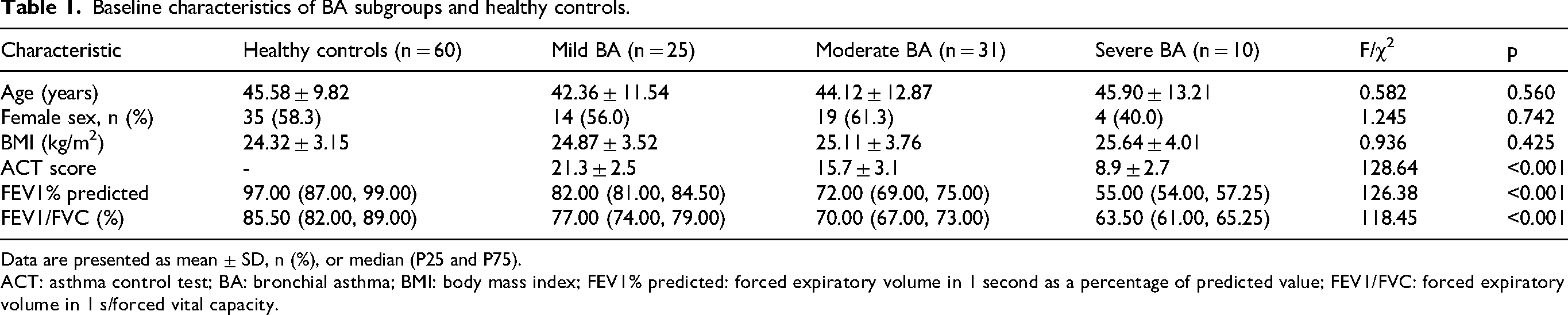
Data are presented as mean ± SD, n (%), or median (P25 and P75).
ACT: asthma control test; BA: bronchial asthma; BMI: body mass index; FEV1% predicted: forced expiratory volume in 1 second as a percentage of predicted value; FEV1/FVC: forced expiratory volume in 1 s/forced vital capacity.
Plasma levels of MPO and CitH3
Plasma levels of MPO and CitH3 were significantly higher in patients with BA than in healthy controls (both p < 0.001). Compared with the mild obstruction subgroup, patients in the moderate subgroup showed significantly elevated MPO and CitH3 levels (p < 0.05). These findings are summarized in Tables 2 and 3.
Comparison of MPO and CitH3 between patients with BA and healthy controls.

Data are presented as mean ± SD.
BA: bronchial asthma; CitH3: citrullinated histone H3; MPO: myeloperoxidase.
Comparison of MPO and CitH3 among BA subgroups with different lung function obstruction severity.
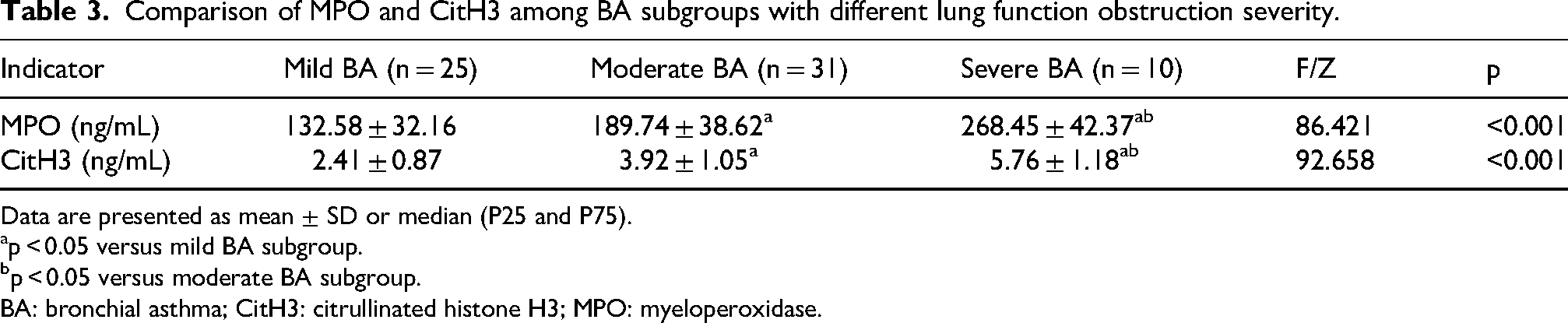
Data are presented as mean ± SD or median (P25 and P75).
ap < 0.05 versus mild BA subgroup.
bp < 0.05 versus moderate BA subgroup.
BA: bronchial asthma; CitH3: citrullinated histone H3; MPO: myeloperoxidase.
Correlations between MPO, CitH3, and lung function
Spearman correlation analysis revealed that both MPO and CitH3 were negatively correlated with key indicators of lung function in patients with BA. Plasma MPO levels were inversely correlated with predicted forced expiratory volume in 1 second (FEV1)% and FEV1/forced vital capacity (FVC) (both p < 0.001; Figure 1).
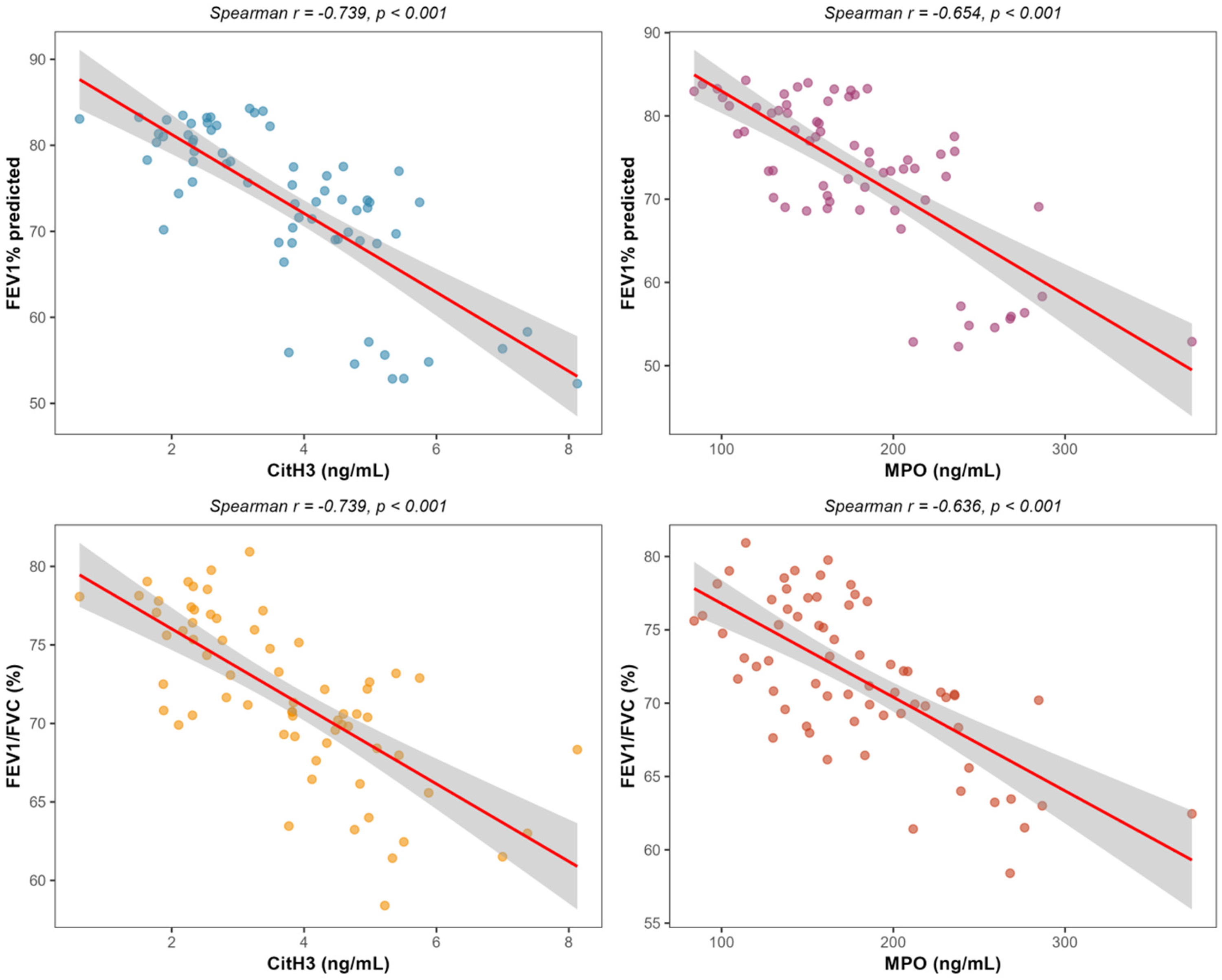
Correlation between NETs biomarkers and lung function indicators in BA patients.
Diagnostic performance of MPO and CitH3
For the diagnosis of BA, the area under the curve (AUC) was 0.824 for MPO and 0.867 for CitH3. The combined detection of MPO and CitH3 improved the diagnostic performance, yielding an AUC of 0.923.
For the assessment of severe lung function obstruction, the AUC values were 0.902 for MPO and 0.945 for CitH3. Combined detection of MPO and CitH3 achieved the highest diagnostic performance, with an AUC of 0.986.
Discussion
This study demonstrated that plasma levels of MPO and CitH3 were significantly elevated in patients with BA and were closely associated with the severity of lung function obstruction. Furthermore, combined detection of MPO and CitH3 showed excellent diagnostic performance for BA diagnosis and severe obstruction assessment. In the present study, plasma MPO and CitH3 levels were significantly higher in patients with BA than in healthy controls and gradually increased with the severity of lung function obstruction. These results suggest that excessive NET formation is involved in the pathological process of BA and is closely related to the progression of airflow limitation. Consistent with our findings, previous studies have confirmed that abnormal NET activation contributes to the development of chronic inflammatory airway diseases and is associated with impaired lung function.6,8 Compared with patients with mild obstruction, those with severe obstruction had the highest levels of MPO and CitH3, implying that NET biomarkers may help identify patients with severe or refractory BA, who are usually characterized by persistent airflow limitation and poor response to conventional treatments.9,10
Correlation analysis showed that both MPO and CitH3 were negatively correlated with predicted FEV1% and FEV1/FVC in patients with BA. The stronger negative correlation between CitH3 and lung function parameters indicates that CitH3, as a specific structural component of NETs, is more closely related to the deterioration of ventilatory function.11,12 Previous studies have reported that NET components can damage airway epithelial cells, promote airway remodeling, and aggravate airflow limitation, supporting our findings that elevated MPO and CitH3 levels are closely associated with worse lung function.8,13 Therefore, monitoring plasma levels of MPO and CitH3 may help clinicians evaluate the severity of lung function obstruction and improve risk stratification for patients with BA.
From the perspective of diagnostic value, ROC curve analysis confirmed that detection of MPO or CitH3 alone showed favorable efficacy in BA diagnosis. More importantly, combined detection of MPO + CitH3 further improved diagnostic performance, with an AUC of 0.923 for BA diagnosis and 0.986 for severe obstruction assessment, which was superior to single biomarkers. These results indicate that the combined biomarker panel may compensate for the limitations of single-biomarker detection and improve the accuracy of clinical evaluation. 14 Early identification of patients with severe lung function obstruction is of great clinical significance for timely intervention and optimization of treatment strategies. 15
This study has several limitations. First, this was a single-center study with a relatively small sample size, which may limit the generalizability of the findings. Second, only peripheral plasma biomarkers were measured, whereas local airway NET levels may more directly reflect airway inflammation. Finally, the dynamic changes in MPO and CitH3 during disease progression and treatment were not observed. Future prospective, multicenter and large-sample studies are needed to verify the stability of these biomarkers and their value in longitudinal monitoring.
In conclusion, plasma MPO and CitH3 levels are closely associated with lung function obstruction in patients with BA. Combined detection of MPO and CitH3 provides high diagnostic efficacy for the diagnosis of BA and the assessment of severe obstruction and may serve as a novel noninvasive biomarker panel to assist in the clinical diagnosis, severity evaluation and individualized management of BA.
Footnotes

Ethics approval and consent to participate
The study protocol was approved by the Ethics Committee of Linping branch The Second Affiliated Hospital of Zhejiang University (approval number: 2025044) and was performed in accordance with the Declaration of Helsinki. Written informed consent was obtained from all participants or their legal representatives prior to enrollment.
Patient and public involvement
It was not appropriate or possible to involve patients or the public in the design, conduct, reporting, or dissemination plans of this research.
Authors’ contributions
Yueyan Mao contributed substantially to writing and editing the original manuscript as well as acquisition and interpretation of the data. Yueyan Mao and Xiaoping Fan contributed to acquisition and interpretation of data and writing and editing the original manuscript. All authors read and approved the final manuscript.
Funding
The authors disclosed receipt of the following financial support for the research, authorship, and/or publication of this article: This study was supported by the Zhejiang Traditional Chinese Medicine Health Science and Technology Program (Grant No. 2026ZL0708), and the Hangzhou Medical and Health Science and Technology Program (Grant No. B20262289 and B20262199).
Declaration of conflicting interests
The authors declare no potential conflicts of interest with respect to the research, authorship, and/or publication of this article.
Clinical trial number
Not applicable.