





Abstract
There is an increasing trend towards using oral antitumoral agents in oncological patients. Compared to parenteral therapy, oral treatment offers convenience for both the patient and the healthcare system, with similar efficacy. However, the benefit deriving from oral drugs will be obtained only if patients adhere strictly to the treatment. Medical oncologists must therefore seek to optimize patient adherence. Breast cancer patients, particularly, are often treated with oral hormonal anticancer agents. In this review, we summarized evidence about adherence of breast cancer patients to oral hormonal anticancer agents and the consequences of poor compliance, the barriers to oral treatment and strategies to overcome them.
Introduction
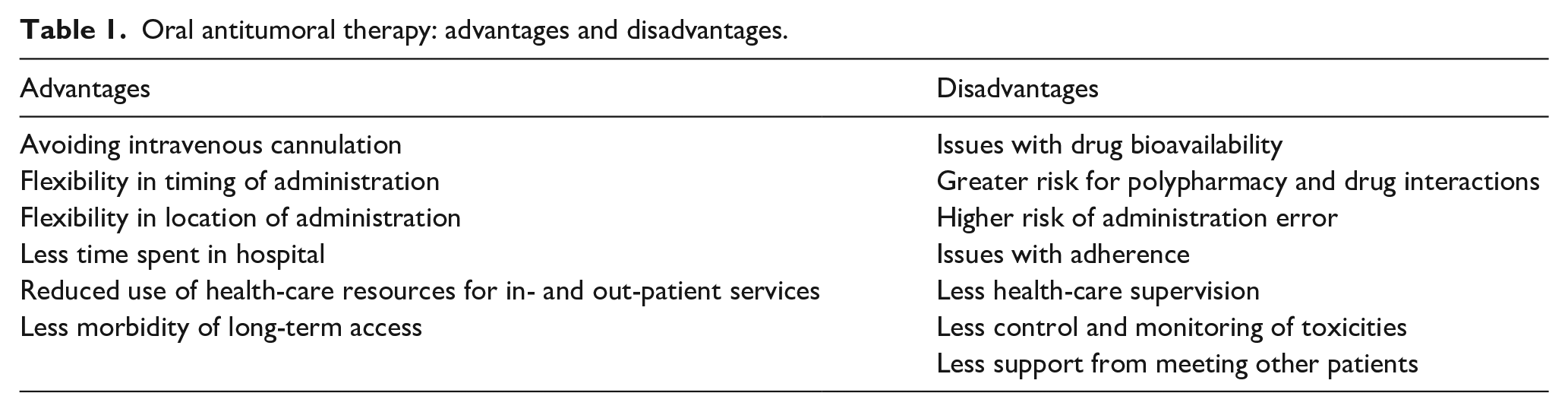
The development of numerous oral antitumoral agents and the increased use of these treatments have revolutionized cancer care. 1 In the last few years the number of oral antitumoral drugs has increased considerably compared to parental drugs, 2 from 5% in 2003 to 20-25% in 2010. Oral antitumor agents have a definite benefit for patients, the ease of taking medication at home,3 -5 the flexibility in timing administration, less time spent in hospital, the reduction of both discomfort and stress of intravenous treatments (Table 1). However, there are also some disadvantages, including a higher risk of medication administration errors, issues with drug bioavailability, greater risk of polypharmacy and drug interactions, less control and monitoring of toxicities, and issues with adherence (Table 1).
Oral antitumoral therapy: advantages and disadvantages.
Adherence, generally defined as the extent to which patients take medications as prescribed by health providers, is crucial for the success and the safety of the treatment.
The World Health Organization (WHO) considered non-adherence such a relevant problem that it was cited as the most important modifiable factor that compromises treatment outcomes. WHO evidence-based guidelines for clinicians, health care managers and policymakers have been published to improve strategies for medication adherence. 1
On the other hand, physicians often underestimate the problem of adherence to oral antitumoral therapies. A recent study, focused on physicians’ perspectives, showed that oncologists, specialists (i.e. urologists for prostate cancer, dermatologists for melanoma and gynecologists for breast cancer) and primary care physicians often do not have the time, expertise, or resources to address health promotion with patients to highlight the importance of adherence to oral treatment. 6
Therefore, it is crucial to understand the evidence about adherence to oral antitumoral agents, consequences of poor adherence, barriers to oral treatment and strategies to overcome them to improve treatment outcomes. The present review is focused on adherence of breast cancer patients to hormonal anticancer agents.
Definition of adherence
Medication adherence can be defined as the degree or extent of compliance to the recommended day-to-day treatment by the healthcare provider, concerning timing, dosing and drug schedule. 7
Various definitions of adherence are reported in different studies (Table 2), but the full benefit of the many oral effective medications will be achieved only if patients follow the prescribed treatment regimens reasonably closely.
Adherence to oral therapy: definitions.
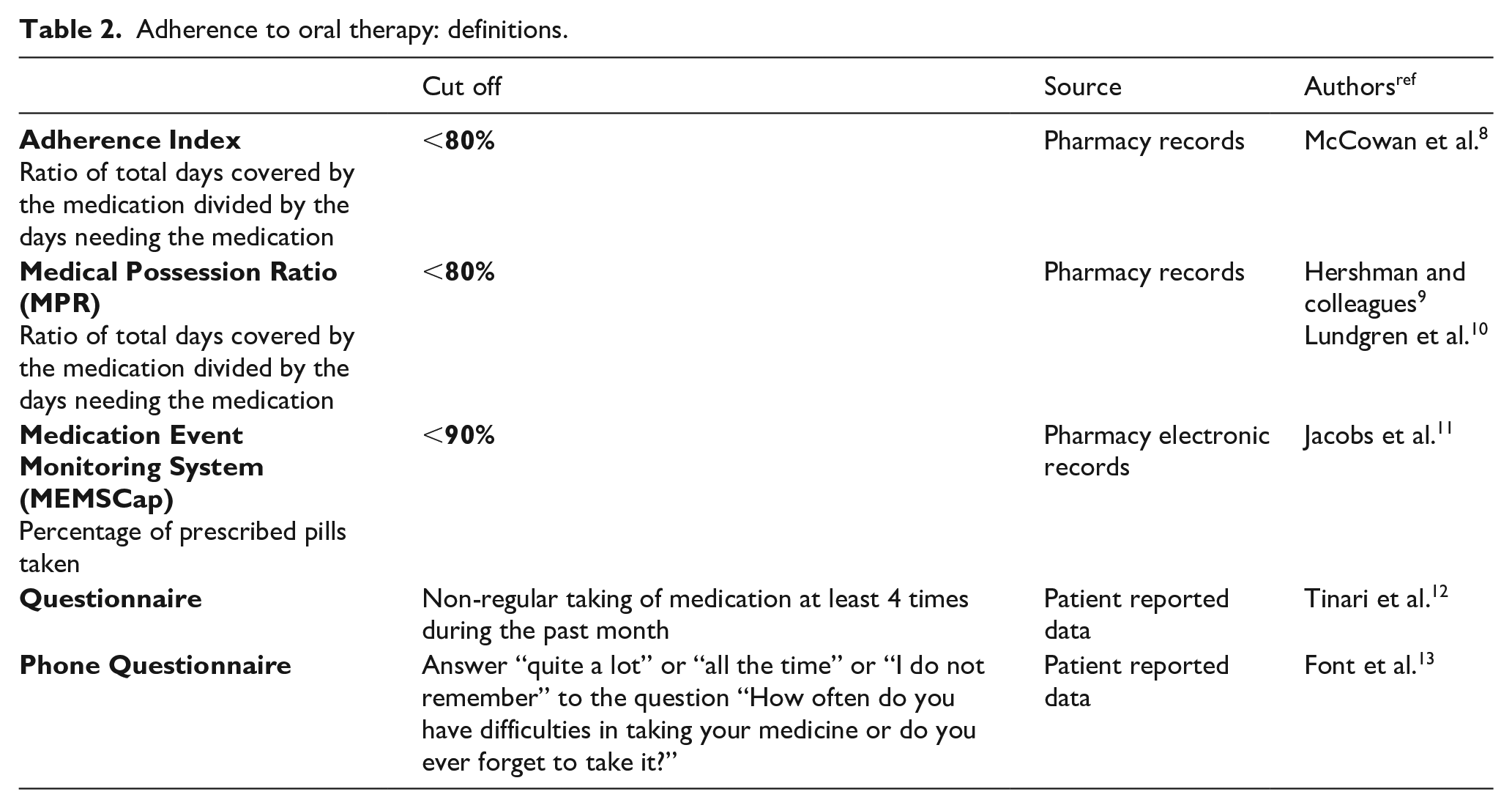
Adherence rates for individual patients are usually reported as the percentage of the prescribed doses of the medication taken by the patient over a specified period. Acute conditions are frequently associated with higher rates of adherence compared to chronic ones. 14
Over the decades, adherence definition has been refined to include dose taking (taking the prescribed number of pills each day) and timing of dose (taking pills within a prescribed period).15,16
Besides, adherence should not be confused with persistence, adherence refers to the frequency of drug use during therapy (how well a patient is taking the prescribed drug), persistence refers to the overall duration of therapy (how long a patient has been taking the drug). 17
More realistic is the concept of “adequate” adherence, which can deviate from the optimal adherence but without compromising the effectiveness of the treatment. Despite the significant clinical relevance of this issue, to date, there is no consensus about it. Several authors consider as acceptable rates variable thresholds between 80% and 95% for the optimal.7,13,18 -21
Methods of measurement
Adequate adherence is necessary to achieve a favorable outcome but to date, there is not a gold standard for measuring and/or monitoring adherence and every method has advantages and disadvantages. Moreover, the ability of physicians to recognize non-adherence is poor, therefore mixing the different measures of adherence could improve adherence itself. Methods of adherence assessment can be indirect and direct (Table 3).
Adherence to oral therapy: Methods of measurements (modified by Osterberg L et al. 14 ).
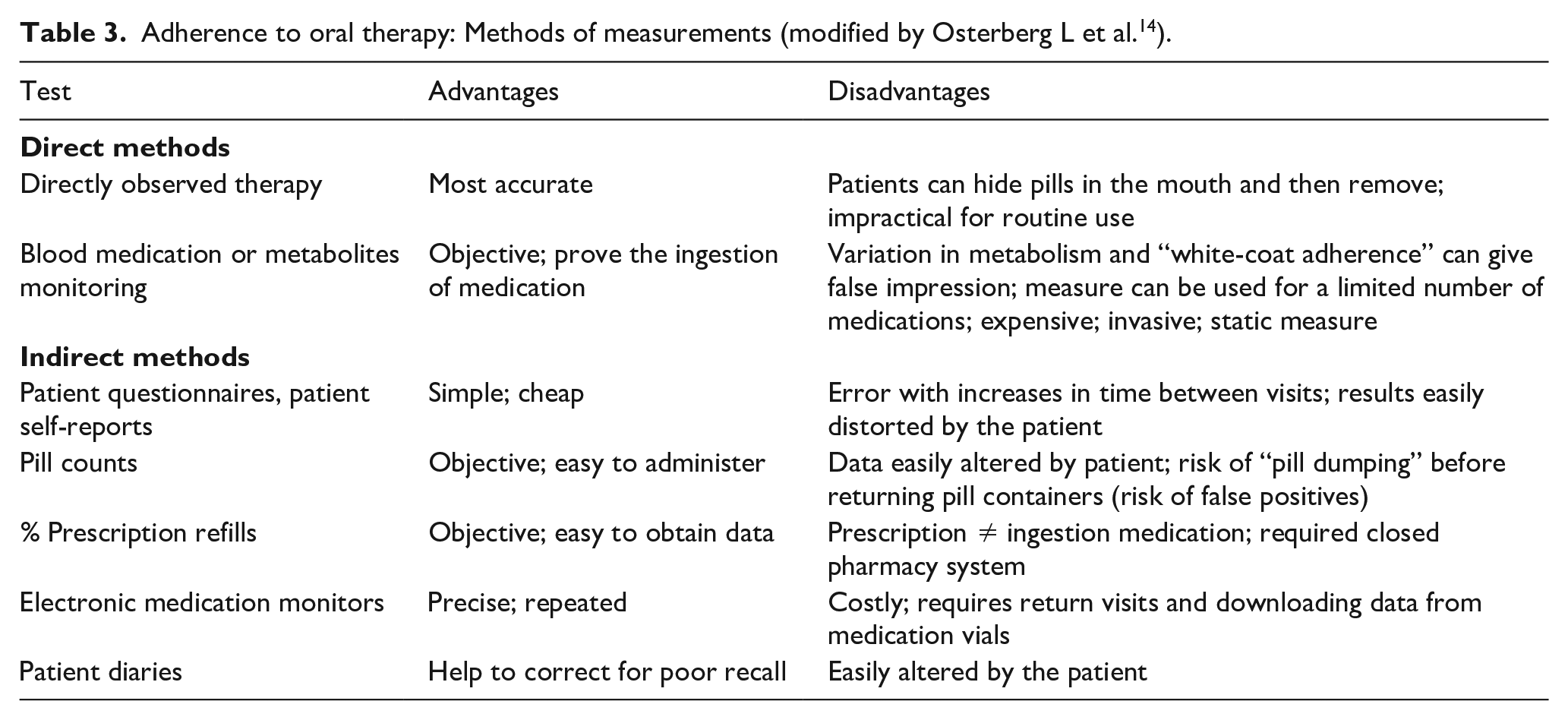
The most common indirect methods are represented by patient questionnaires and patient diaries. These methods are relatively easy to use but questioning the patient can result in overestimation of the patient’s adherence by the health care provider. Ratings from subjective questionnaires on adherence behavior of patients present potential problems with inaccuracy, overestimation and lack of standardization due to the patient’s reluctance to admit “bad” behavior to the health care team. 22 Another simple and easy indirect method of adherence is represented by the assessment of the patient’s clinical response to oral therapy, but many factors other than adherence to a medication regimen can account for clinical outcomes. Assessment of adherence using combined resources, including pharmacy database, microelectronic monitoring system (MEMS), pill diaries and pill counting, in addition to questionnaires, patient-report and clinician assessment could be acceptable. Although it is simple, performing pill counts (i.e. counting the number of pills that remain in the patient’s medication bottles) can also be unreliable and has some disadvantages, such as pill manipulation by patients and lack of information about adherence to dosing schedule.23 -26 MEMS is a newer and more precise method based on the use of a table bottle that electronically records the time and date when the cap is removed. Problems with this system include the cost and impracticability on a large scale, in addition to no documentation about the real ingestion of the correct drug and/or dose.27,28
Directly observed therapy, measurement of concentrations of a drug or its metabolite in blood or urine and detection or measurement in the blood of a biologic marker added to the drug formulation are examples of direct methods of measures of adherence. 14 Direct approaches are expensive and susceptible to distortion by the patient. Although, drug or metabolite levels in serum or urine may be altered by various dietary and pharmacokinetic parameters, measuring these levels is a good, commonly used tool of assessing adherence for some drugs. Of interest, there is some evidence to show that patients commonly improve their medication-taking behavior in the five days before and after an appointment with the health care provider, as compared with 30 days after, in a phenomenon known as “white-coat adherence”29,30 and this could influence the serum levels. A French study was the first to assess adherence by measuring serum levels of tamoxifen. 31 The study included patients with early (stage I-III) breast cancer enrolled in a large prospective study (CANTO cohort), investigating the long-term side effects of breast cancer treatments in around 12,000 participants. The researchers focused on the sub-group of 1177 premenopausal women on adjuvant hormonal therapy, assessing their adherence to tamoxifen by measuring serum levels at one, three and five years and comparing them with patients’ self-reports of adherence. Tamoxifen serum level <60 ng/mL was referred to biochemical non-adherence, assessed one year after prescription. Results showed that nearly one in five (16.0%) of the premenopausal women were below the set adherence threshold, despite a 12.3% patient-reported rate of non-adherence. Notably, 55% of patients who were non-adherent by serum assessment did not openly declare their non-adherence.
Another direct method is pill-counting during clinic visits but counting inaccuracies can occur and there is a lack of information on dosage timing and patterns of missed dosage.
Adherence to hormonal anticancer agents in breast cancer patients
Oral adjuvant hormonal therapy is an integral component of hormone-sensitive breast cancer treatment, resulting in an impressive reduction in disease recurrence and death. 32 Approximately 80% of all breast cancers are classified as luminal subtypes, which express one or both of two hormone receptors: the estrogen receptor (ER) and/or the progesterone receptor (PR) in the primary tumor. Therefore, a high proportion of breast cancer patients receive endocrine adjuvant treatment i.e. tamoxifen (Tam) or aromatase inhibitors (AI). Guidelines for ET include five or 10 years of Tam and/or AI. Previous studies suggested that non-adherence is a prevalent issue for patients taking ET,9,18 constituting a major obstacle to optimal treatment and survival outcomes.33,34 In particular, different studies showed that the declared non-adherence of women to ET is in the range of 15% to 50%.19,35 This large variability of adherence rate is widely dependent on the different assessment methods 36 and non-adherence is often higher in real life than in the clinical trial setting. 19
The rate of adherence appears to decrease with the increasing duration of therapy 20 and in premenopausal patients, especially those younger than 40 years, non-adherence to adjuvant endocrine therapy seems to be a major issue compared with older patients, suggesting poorer survival outcomes. 37 In particular, Huiart et al. 38 created a cohort of 288 women, using the French National Health Insurance System database, in order to describe discontinuation and non-compliance with Tam treatment in a population-based cohort of patients who developed primary breast cancer before the age of 40. This study showed that treatment discontinuation may occur over the entire follow-up period: it increased during the first two years and remained high thereafter. After multivariate adjustment, Tam discontinuation increased significantly with low social support and self-reporting of non-compliance behavior.
Of interest, in a study conducted in US, Hershman and colleagues 9 investigated the effects of early discontinuation and non-adherence to ET (Tam or AI) on mortality in women diagnosed with hormone-sensitive stage I–III breast cancer between 1996 and 2007. Automated pharmacy records were used to identify prescriptions and dates of refill. Patients were categorized as having discontinued ET early if 180 days elapsed from the prior prescription, whereas adherence to oral therapy was defined by taking 80% or more of the drug in one year. Among the 8769 women who filled at least one prescription, 31% discontinued therapy and of those who continued ET 28% were non-adherent. The estimated survival at 10 years was 80.7% for women who continued ET versus 73.6% for those who discontinued (p < 0.001). Of those who continued, survival at 10 years was 81.7% in adherent women and 77.8% in non-adherent (p < 0.001). Adjusting for clinical and demographic variables, both early discontinuation (HR 1.26, 95% CI 1.09–1.46) and non-adherence (HR 1.49, 95% CI 1.23–1.81), among those who continued, were independent predictors of mortality. These results demonstrated that patients with high annual adherence (taking no less than 80% of the medication given) had better survival rates than those who were not adherent to the treatment. 9
More recently, the prescription patterns, trends of initiation and five-year adherence to adjuvant ET were evaluated in a retrospective observational study conducted on 80,224 women with breast cancer. 39 Adherence was defined as having a medication possession ratio of ⩾80% during the treatment period. The standardized initiation rate was 87.5% and increased from 84.6% in 1999 to 90% in 2015. The five-year adherence rate increased slightly from 61.7% among women diagnosed in 1999-2004 to 65.8% for women diagnosed in 2011-2012. Finally, regarding prescription patterns, the authors showed that AI rapidly replaced Tam among postmenopausal women as Tam use dropped from 100% in 1999 to about 20% in 2004, stabilizing around 10% in more recent years.
To provide tools that clinicians might use effectively and to assess the different sources of variability in measurements of adherence and persistence, Huiart et al. 40 conducted a meta-regression analysis that summarizes results on adherence and persistence to ET, based on the data selected in the review by Murphy et al. 41 This analysis illustrates the importance of considering data sources (medical records, self-reported data, population-based database, specific health-coverage database) in the assessment of adherence and persistence, as it constitutes the major source of variability between studies. 40
TAM and AIs have several significant adverse effects. Common side effects of TAM are hot flushes, depression, weight gain and low libido and less common but severe conditions such as the increased risk of venous thromboembolism and endometrial disorders including cancer. AIs can cause joint pain, hot flushes and an increased risk of fractures and osteoporosis. There is consistent evidence that side effects play an important role in patients’ decision-making either to adhere and endure treatment or to intentionally discontinue treatment. 42
It is now widely recognized that young patients must be regarded as a vulnerable group of women, because of greater affective distress and greater difficulties in coping with their disease, mainly due to the perceived loss of femininity and fertility associated with side effects of ET.43,44
Patient-reported factors influencing adherence/non-adherence include physician-patient relationship and communication, side effects, social and emotional support, information exchange and continuity of follow-up care.45,46 The results of an Italian survey, conducted among women on adjuvant ET for breast cancer with the aim of identifying subgroups with the higher prevalence of non-adherence, indicated that unmarried women, employed women and housewives have a high likelihood of non-adherence. 12
Physicians who can effectively communicate information about ET treatment benefits, purpose and expectations in a way that patients can understand is a critical aspect of care, playing an important role in both the beginning and the prolonged continued use of ET. 46
Barriers to adherence and strategies to overcome
Research on adherence has typically focused on the barriers patients must overcome to take their medications. Health care systems contribute to patients’ poor adherence by prescribing complex regimens, using a restricted formulary and/or switching to a different formulary, failing to adequately explain the benefits and side effects of a medication, not giving consideration to the patient’s lifestyle or the cost of the medications, and having poor therapeutic relationships with their patients. 14 In order to establish interventions capable of improving therapeutic adherence, some indicators of poor adherence were sought. One of these involves the doctor asking patients how many times they forget to take the drug dose. Patients generally try to tell their doctor what they think he wants to hear to please him. The doctor may also ask if they have experienced any side effects during treatment or if they are they aware of why they are taking that treatment and its potential benefits. Thus, it is critical to identify and target a range of modifiable factors to develop innovative behavioral interventions. 47
Barriers were categorized as either patient-reported or physician-reported and grouped into the three main categories: socio-demographic factors, general psychosocial factors and factors specific to therapy (i.e. ET). 48
Side effects are the major barrier in both patient-reported and physician-reported surveys. Effective management of side effects, including both pharmacological and non-pharmacological strategies, is essential to improve long-term adherence to therapy. 49 Adequate and patient-tailored education of the potential side effects may better prepare the survivors with an understanding of prevention or treatment strategies. Similarly, communication about the benefits of oral therapy in reducing the risk of recurrence and mortality to improve adherence by providers may prove critical in improving the adherence. 50
Given the many factors contributing to poor adherence to medication, a multifactorial approach is required, since a single approach will not be effective for all patients. Several methods can be used to improve adherence, including patient education, improvement of dosing schedules and communication between physicians and patients. In this perspective, educational interventions involving patients, their family members, or both can be effective in improving adherence. Studies have revealed that improved provider skills in communication, such as expressing empathy, providing all necessary information clearly and checking if the patient understood, were associated with increased adherence to ET. 46
Increased involvement of health care professionals such as the use of pharmacists, nurses, and general physicians can help to improve adherence to ET. Nurses and pharmacists can validate the information provided by physicians and offer an additional opportunity for discussing patient issues or concerns. Further, they can monitor side effects and help change beliefs about the medication. 51
Finally, enhancing communication between the physician and the patient is a key and an effective strategy in boosting the patient’s ability to follow a medication regimen. A recent systematic review showed that although various behavioral, educational, integrated care and self-management risk communication interventions have been implemented to improve medication adherence, none of them have shown promising impact. 52 On the other hand, some studies suggested that reminders of any form, such as setting an alarm on a regular daily basis at home or have family reminding the patient to take medication, have a positive influence on medication adherence in cancer patients. Moreover, as mobile phone ownership continues to increase, there is a great potential to utilize this technology to overcome adherence barriers and optimize therapeutic effects.53,54
Conclusions
Poor adherence to medication regimens is common, contributing to substantial worsening of disease, death and increased health care costs. Practitioners should always look for poor adherence and enhance adherence by emphasizing the value of a patient’s regimen, making the regimen simple and customizing the regimen to the patient’s lifestyle.
Asking patients nonjudgmentally about medication-taking behavior is a practical strategy for identifying poor adherence. A collaborative approach to care augments adherence.
Patients who have difficulty in maintaining adequate adherence need more intensive strategies than patients who have less difficulty with adherence.
Innovative technologies, such as reminders through cell phones, personal digital assistants and pillboxes with paging systems, may be needed to help patients who have difficulty to achieve the goals of a regimen.
Footnotes
Declaration of conflicting interests
The author(s) declared the following potential conflicts of interest with respect to the research, authorship, and/or publication of this article: Antonio Russo reported personal fees from Bristol, Pfizer, Bayer, Kyowa Kirin, Ambrosetti for advisory board activity; speaker honorarium from Roche Diagnostics.
The remaining authors declare no potential conflicts of interest.
Funding
The author(s) received no financial support for the research, authorship, and/or publication of this article.
