






Abstract
In the present research, we investigated whether the red-attraction relation that has been observed for men viewing women may also be observed with regard to women’s facial redness. We manipulated facial redness by slightly increasing or decreasing the redness on the faces of baseline pictures of target women, and then had men judge the attractiveness of the women. We also examined healthiness perceptions as a mediator of the redness-attraction relation, along with several other candidate mediator variables. A series of experiments showed that increased redness led to increased ratings of attractiveness, and decreased redness led to decreased ratings of attractiveness. Perceived healthiness was documented as a mediator of the influence of female facial redness on male perceptions of attractiveness, and this mediation was independent of other candidate mediator variables. The findings highlight the importance of attending to facial coloration as an attraction-relevant cue and point to interesting areas for subsequent research.
The color red is associated with love, sex, and passion across a diversity of cultures (Aslam, 2006). This red-romance link has been present for millennia and is particularly strong with regard to women. Red was used to symbolize lust, passion, and fertility in ancient mythology and ritual (Greenfield, 2005; Hutchings, 2004; Knight, Powers, & Watts, 1995), and red lipstick and rouge were used to enhance women’s appearance as early as 10,000 years ago in ancient Egypt (Ragas & Kozlowski, 1998). The red-romance association remains strong and pervasive in contemporary society, as seen in the red of Valentine’s Day hearts and roses, the red of “red-light districts,” red in the arts (literature, film, stage, song, e.g., The Lady in Red), red in fashion (lingerie, little red dress), and the red of cosmetics such as lipstick and rouge.
Noting the strength and pervasiveness of the red-romance link for women, researchers have posited that heterosexual men are particularly likely to find a woman attractive if she is displaying red (i.e., is wearing red clothing or lipstick, or is framed in or holding something red). Empirical support has been found for this premise, using both self-report and behavioral indicators of attraction (Elliot & Niesta, 2008; Elliot, Tracy, Pazda, & Beall, 2013; Guéguen, 2012a, 2012b, 2012c; Guéguen & Jacob, 2012, 2013, 2014; Lin, 2014; Pazda, Elliot, & Greitemeyer, 2012, 2014; Re, Whitehead, Xiao, & Perrett, 2011; Roberts, Owen, & Havlicek, 2010; Stephen & McKeegan, 2010; cf. Lynn, Giebelhausen, Garcia, Li, & Patumanon, 2013). 1
Moderators of this red-attraction relation have also been documented; red on or near a woman enhances men’s attraction only when the woman has feminine features (Wen, Zuo, Wu, Sun, & Liu, 2014), is at least moderately attractive (Young, 2015), and is in her fertile years (Schwarz & Singer, 2013).
The face is a salient source of social information, and faces naturally undergo changes in color as a consequence of underlying physiological processes linked to both enduring conditions (e.g., physical health) and short term states (e.g., emotions). Such color changes are often subtle, but recent research suggests that human vision is particularly well-suited for detecting them (Changizi, Zhang, & Shimojo, 2006; Tan & Stephen, 2013). Surprisingly little research has examined the impact of manipulations of female facial redness on males’ attractiveness perceptions. A few studies have focused on the lips, showing that redder female lips are viewed by males as particularly attractive (Guéguen, 2012c; Guéguen & Jacob, 2012; Stephen & McKeegan, 2010). Re et al. (2011) showed that slight increases in the redness of female faces increased their attractiveness to perceivers, but the number of males in the sample was small (seven), and this relation was not the central focus of their investigation (which was discrimination thresholds for different facial characteristics).
In the present research, we designed experiments to explicitly test whether the red-attraction relation that has been documented for men viewing women extends to red displayed on the face. Specifically, we manipulated facial redness by slightly increasing or slightly decreasing the redness on the faces of baseline pictures of target women and then had men judge the attractiveness of the women. We predicted that facial redness would positively influence men’s perceptions of the women’s attractiveness.
In addition to investigating the direct influence of female facial redness on male attraction, we also examined healthiness perceptions as a mediator of this relation. Reddened facial skin is objectively linked to women’s physical health in several ways. Good physical fitness and healthy estrogen levels increase the vascularization and blood oxygenation of the skin, making it appear redder (Armstrong & Welsman, 2001; Charkoudian, Stephens, Pirkle, Kosiba, & Johnson, 1999; Johnson, 1998; Stephen, Law Smith, Stirrat, & Perrett, 2009). On the other hand, diabetes, hypertension, and cardiac illness impair the vascularization and blood oxygenation of the skin, making it appear less red (Changizi, 2009; Charkoudian, 2003; Panza, Quyyumi, Brush, & Epstein, 1990). Thus, skin redness might be an indicator of a woman’s healthiness. Furthermore, a few experiments have shown that men appear to be cognizant of this link between women’s facial skin redness and their healthiness. For instance, in a study in which male participants were instructed to manipulate the color of women’s facial skin in digital photographs to make them appear maximally healthy, they increased the redness on the faces (Stephen, Coetzee, Law Smith, & Perrett, 2009; see also Re et al., 2011; Stephen, Law Smith, et al., 2009). In accord with these findings, in the present work we predicted that an increase in red would raise and a decrease in red would lower men’s perceptions of women’s healthiness.
It is widely assumed that men’s perceptions of a woman’s healthiness contribute to (i.e., positively predict) their perceptions of her attractiveness because healthiness is an indicator of overall quality and reproductive potential (Etcoff, 1999; Perrett, 2010; Weeden & Sabini, 2005). Indeed, Rhodes et al. (2007) argued and provided evidence to support the premise that perceptions of healthiness underlie the documented positive links between facial symmetry, averageness, and sexual dimorphism on the one hand, and attractiveness judgments on the other. In accord with these findings, in the present work, we predicted that men’s perceptions of women’s healthiness would positively predict their perceptions of women’s attractiveness.
Furthermore, we predicted that the effect of female facial redness on males’ attractiveness perceptions would be mediated by these healthiness perceptions.
The present research comprised four experiments. In Experiments 1 and 2, male participants chose which of two simultaneously presented female faces containing differing amounts of redness was more attractive and sexually attractive. In Experiments 3 and 4, male participants rated both the healthiness and the attractiveness of female faces containing differing amounts of redness. We tested the indirect effect of red on attractiveness via perceived healthiness and did so while controlling for the potential influence of other mediator variables. Healthiness is an indicator of a relatively enduring condition (compared with a temporary state, such as an emotional experience). While it is possible for attractiveness judgments to be influenced by transient states, such as emotion expression (Tracy & Beall, 2011) or sexual receptivity (Pazda, Elliot, & Greitemeyer, 2014), we chose to focus on alternative mediator candidates that likewise reflected an enduring condition (i.e., personality characteristics and values) for consistency.
Experiment 1
In Experiment 1, we conducted our initial test of the effect of female facial redness on males’ perceptions of the female’s attractiveness. We used two facial-color conditions, one in which facial redness was slightly increased, and one in which facial redness was slightly decreased, and examined the influence of this manipulation on judgments of attractiveness and sexual attractiveness.
Method
Participants
One hundred and thirty three men (mean age = 31.0, range = 18–67) were recruited from Amazon’s Mechanical Turk and paid $.10 for participating. We did not restrict our sample by geographic area, but the majority of participants (68%) resided in the United States. Sample size was determined a priori by calculating the minimum number of participants required to detect a small-to-medium effect (Cohen’s d = .35) at 80% power (n = 67), and then establishing a minimum of 100 participants as our target sample size. Each of our experiments uses the same basic design, so meeting or exceeding 100 participants was the sample size guideline that we used for each experiment. Participation in this and all subsequent studies was restricted a priori to heterosexual and bisexual individuals without a color-vision deficiency. This was assessed through categorical self-report measures (e.g., “what is your sexual orientation?; are you red- green colorblind?”).
Procedure
In each experiment, all data were collected before any analyses were conducted, and all data exclusions, manipulations (i.e., experimental conditions), and variables analyzed are reported. Participants followed a web link to gain access to a study entitled “ratings of human faces” which was said to entail judging faces on various characteristics. Participants completed six trials of a force-choice task in which they were instructed to select which of two faces appeared more attractive. Within each trial, the faces were of the same individual, but one version had increased facial redness, and the other had decreased facial redness. Faces were presented side-by-side, and each version had an equal probability of being displayed on the left or right side of the screen. The order of presentation for the six face identities was randomized. After completing trials for all six faces, the procedure was repeated, but participants were instructed to select the face that they found more sexually attractive.
Stimuli
Six target faces, all female, were used as face stimuli. Each target face was a composite of three moderately attractive Caucasian women in their early 20s. Matlab was used to produce color masks that were applied to the skin areas of the faces (i.e., excluding the hair, eyes, clothing, and background). Each face was manipulated on the CIELAB a* (redness) color axis by + 5 units or –5 units. See Figure 1 for examples of the face stimuli used. A change of a* = 5 reflects a supra threshold color difference (the average Δa* threshold for facial redness discrimination is 0.67, SEM = 0.16, according to data from Re et al., 2011, although the precise threshold undoubtedly varies somewhat by context and sample).2 CIELAB is considered to be a perceptually uniform color space, meaning that a change in one unit is equivalent in perceptual magnitude across the entire space. Lightness, yellowness, hair, eyes, clothing, and background remained constant for each target.
Example of the face stimuli used. Faces were manipulated on the CIELAB a* (redness) color axis by –5 units (left) or + 5 units (right).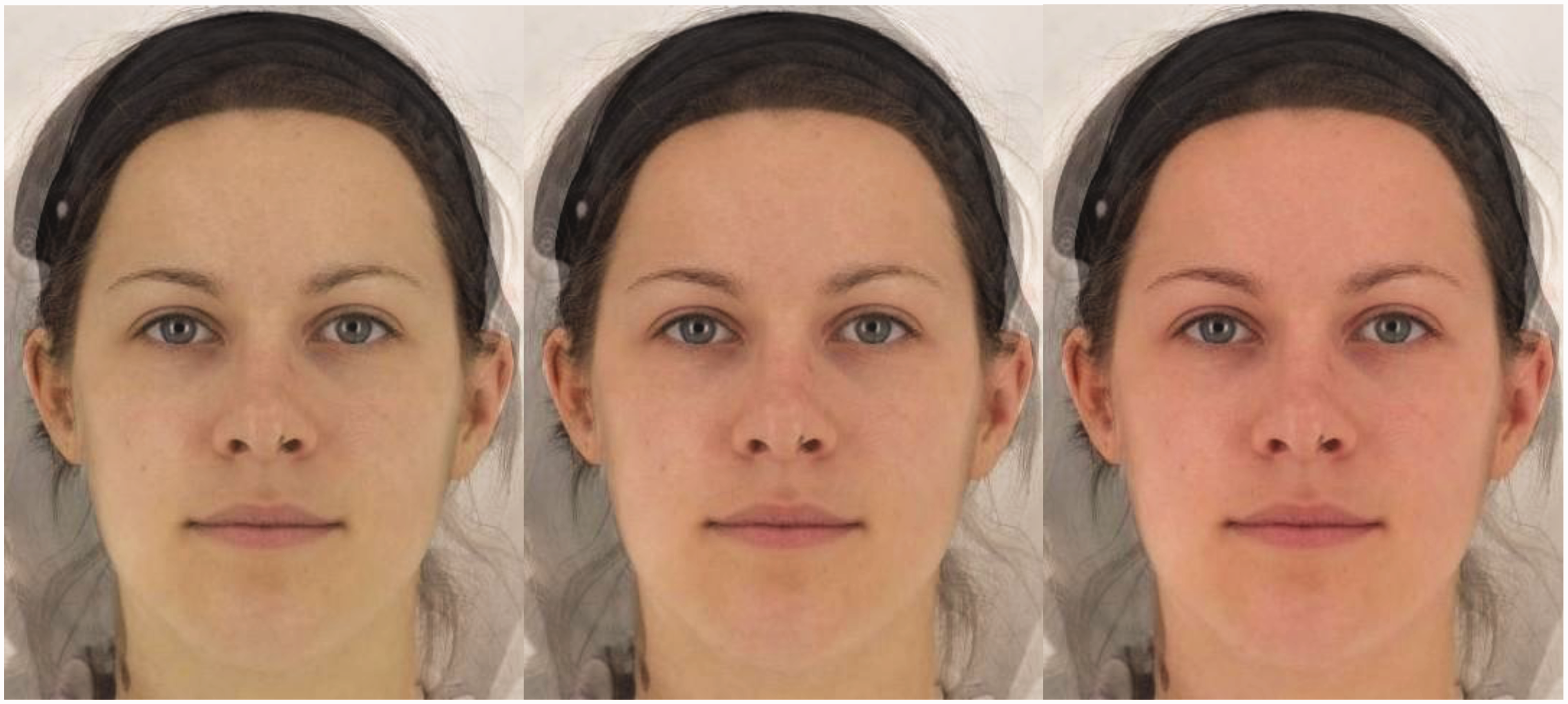
Results
For each trial, the selection of the face with increased redness was coded as 1, and the selection of the face with decreased redness was coded as 0. Selections for each participant were averaged across the six trials for each dependent variable (attraction and sexual attraction), representing the proportion of increased redness selections over decreased redness selections.
A one-sample t test was performed against 0.5 (chance; Rosenthal & Rosnow, 1991), with the proportion of redder face selections for attractiveness as the dependent variable. The results showed that redder faces were selected (M = 0.72, SD = 0.34) significantly above chance level, t(132) = 7.59, p < .001, d = .65, indicating that participants perceived increased facial redness as more attractive than decreased facial redness.
We conducted another one-sample t test (against .5) with the proportion of redder face selections for sexual attractiveness. The results showed that redder faces were selected (M = 0.71, SD = 0.35) significantly above chance level, t(132) = 7.04, p < .001, d = .60, indicating that participants perceived increased facial redness as more sexually attractive than decreased facial redness.
These results provide support for our hypotheses. Specifically, faces with increased facial redness were perceived as more attractive and more sexually attractive than the same faces with decreased facial redness.
Experiment 2
In Experiment 2, we focused on the direction of the observed effects. Specifically, it is not clear from the results of Experiment 1 whether increasing facial redness enhanced attractiveness or whether decreasing facial redness reduced attractiveness, or both. For instance, faces with decreased redness may be perceived as equally attractive to neutral faces, with increased redness bolstering attractiveness. However, it is conceivable that the opposite may be true, such that faces with increased redness are no more attractive than neutral faces, but decreased redness undermines attractiveness perceptions. In other words, the question of whether an increase of facial redness or a decrease of facial redness influences attractiveness perceptions remains to be tested. Thus we included a neutral condition in Experiment 2 to address this directionality question.
Method
Participants
One hundred and twenty seven men (mean age = 32.5, range = 18–70) were recruited on Amazon’s Mechanical Turk and paid $.10 for participating. We did not restrict our sample by geographic area, but the majority of participants (63%) resided in the United States.
Procedure
The procedure was nearly identical to that of Experiment 1, except that participants made four types of judgments rather than two. Specifically, all participants judged the attractiveness and sexual attractiveness of the six pairs of faces for two separate comparison types: increased redness versus neutral and decreased redness versus neutral. This means that the difference in redness units between faces (i.e., original image vs. original image plus a* = +5) was much smaller than the difference in redness units from the previous experiment (i.e., original image plus a* = + 5 vs. original image plus a* = –5). The order of presentation across the six face pairs was randomized, and the order of the color-comparison types was randomized. Participants judged all faces for both comparison types on attractiveness, then repeated the procedure judging sexual attractiveness.
Results
For each trial, a selection of the face with more redness was coded as 1, and a selection of the face with less redness was coded as 0. This means that the neutral faces were sometimes coded as 1 or 0, depending on whether the comparison face had increased or decreased redness. Scores were averaged across trials for each comparison type (increased vs. neutral and decreased vs. neutral) and for each question type (attractiveness and sexual attractiveness). A series of one- sample t tests were conducted (against a value of .5), one for each question type at each level of comparison.
Attractiveness
For the increased redness versus neutral comparison, participants were more likely than chance to select the redder faces as more attractive (M = .62, SD = .30), t(126) =4.38, p < .001, d = .40. For the decreased redness versus neutral comparison, participants were also more likely than chance to select the redder (i.e., neutral) faces (M = .77, SD = .26), t(126) = 10.95, p < .001, d = 1.04.
Sexual attractiveness
For the increased redness versus neutral comparison, participants were more likely than chance to select the redder faces as more sexually attractive (M = .63, SD = .32), t(126) = 4.60, p < .001, d = .41. For the decreased redness versus neutral comparison, participants were also more likely than chance to select the redder (i.e., neutral) faces (M = .78, SD = .27), t(126) = 11.46, p < .001, d = 1.04.
In ancillary analyses, we tested whether the effect was different for the increased redness versus neutral or the decreased redness versus neutral comparisons. We also tested whether there was any difference between general attractiveness and sexual attractiveness ratings. Specifically, we conducted a repeated measures analysis of variance with two within-subjects factors (type of color-comparison and type of rating) on the proportion of trials the redder face was selected. A main effect of comparison type was observed, F(1, 126) = 35.27, p < .001, indicating that the effect was stronger for the decreased redness versus neutral comparison (M = .77) relative to the increased redness versus neutral comparison (M = .62). No difference was observed between the response types (F = .90, p = .35), and no interaction was observed between comparison type and response type (F = .04, p = .85).
These results provide further support for our hypothesis. Increasing facial redness, relative to a neutral baseline, enhanced perceptions of attractiveness and sexual attractiveness. Likewise, decreasing facial redness, relative to a neutral baseline, reduced perceptions of attractiveness and sexual attractiveness. These effects were stronger in the decreased redness versus neutral comparison, indicating that decreased facial redness may undermine perceived attractiveness more than increased facial redness enhances it.
Experiment 3
In Experiment 3, we expanded our focus to include the effect of increased facial redness on perceived healthiness and examined whether perceived healthiness mediates the effect of facial redness on perceived attractiveness. We also measured perceptions of intelligence and conservatism to determine whether the effect of red would be specific to perceived healthiness, would increase perceived positive characteristics in general, or would increase perceptions of any characteristic. Intelligence is a characteristic that men across countries value highly in women (Buss, 2008) but is not typically conceptually linked to facial redness. If reddened faces are found to be perceived as more intelligent, as well as attractive, this might indicate the presence of a halo effect. Facial redness could influence perceived conservativism, because in the United States red is the color most strongly associated with the conservative political party (but does not necessarily contain a positive or negative valence). Including these variables should help clarify whether facial redness influences attractiveness specifically via perceived healthiness, or whether facial redness exerts its influence on perceptions of other characteristics (positive or neutral) as well. We examined increased versus decreased facial redness in this experiment.
Method
Participants
One hundred and fifty two men were recruited on Amazon’s Mechanical Turk and paid $.10 for participating. We did not restrict our sample by geographic area, but a plurality of participants (49%) resided in India and 36% resided in the United States. Data on participant age were not collected in Experiment 3.
Procedure
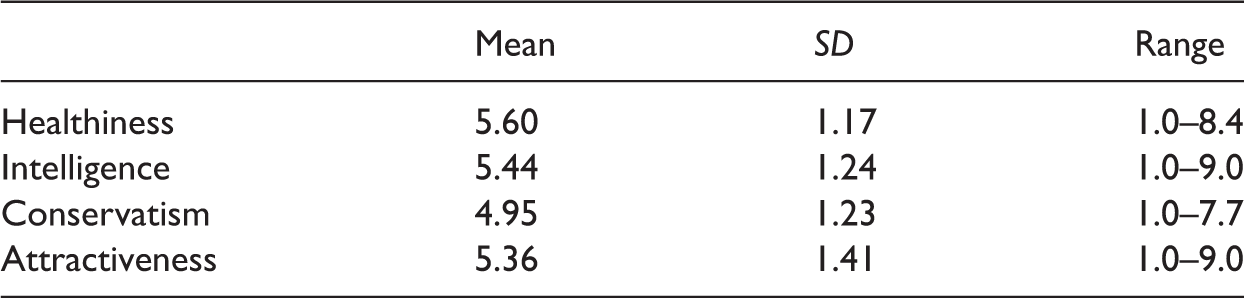
Descriptive Statistics for Variables in Experiment 3 Averaged Across Faces and Color Conditions.
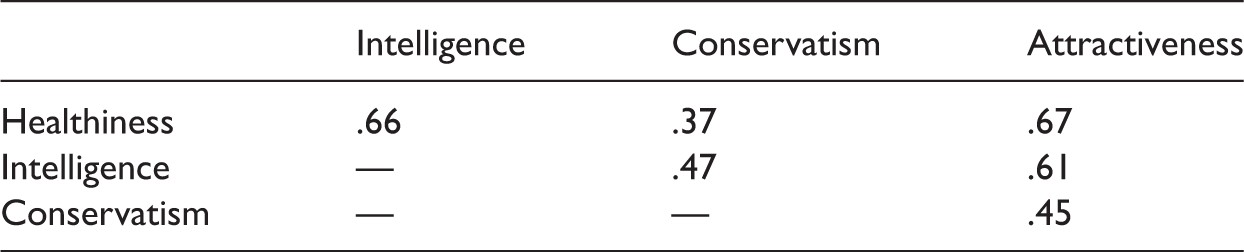
Correlations Between Variables in Experiment 3.
Results
We used MEMORE (Montoya & Hayes, 2015) for SPSS to test the effect of facial redness on attractiveness through several parallel mediators. MEMORE uses ordinary least squares regression in a path-analytic form, following the methodology of Judd, Kenny, and McClelland (2001). It is optimal for data sets with repeated measurements of the dependent variable in within-subjects designs, and it has the advantage of examining the indirect effect of each mediator while controlling for the indirect effects of the others. This is ideal in cases where mediating variables may potentially be correlated with each other. MEMORE also allows the size of indirect effects to be directly compared, which provides insight regarding which mechanisms have the strongest influence on the dependent variable (Montoya & Hayes, 2015). Ninety-five percent confidence intervals were generated from 5,000 bootstrap samples and are reported in brackets for each result below. Color condition was entered as a dummy coded variable (1 = increased redness; 0 = decreased redness).
Total effect (c path)
The total effect of increased redness on perceived attractiveness was significant, (c = .95 [.71, 1.19], p < .001), meaning that the faces with increased redness, on average, were rated as .95 points higher on attractiveness than faces with decreased redness.
Individual effects (a paths are effects of the independent variable on potential mediators; b paths are effects of mediators on the dependent variable)
The faces with increased redness were perceived as healthier (a1 = 1.54 [1.23, 1.84], p < .001) and more intelligent (a2 = .38 [.16, .61], p = .001) than the faces with decreased redness (see Figure 2). A significant difference was not observed for political conservatism (a3 = .10 [–.17, .38], p = .47). Perceived healthiness was positively related to perceived attractiveness (controlling for the effect of redness and the other potential mediating variables; b1 = .36 [.26, .46], p < .001). A similar relation was found between perceived intelligence and perceived attractiveness (b2 = .41 [.27, .54], p < .001). No significant relation was observed between perceived political conservativeness and attractiveness (b3 = .03 [−.07, .14], p = .56).
*p < .05; **p < .01. Effects of increased redness on perceived attractiveness through three potential mediators in Experiment 3; coefficients are unstandardized estimates and the coefficient in parentheses is the total effect. Indirect effects of redness on perceived attractiveness through each potential mediator [95% confidence intervals in brackets] are as follows. Healthiness: .55 [.37, .77]; Intelligence: .16 [.05, .30]; Conservativism: .00 [–.01, .04].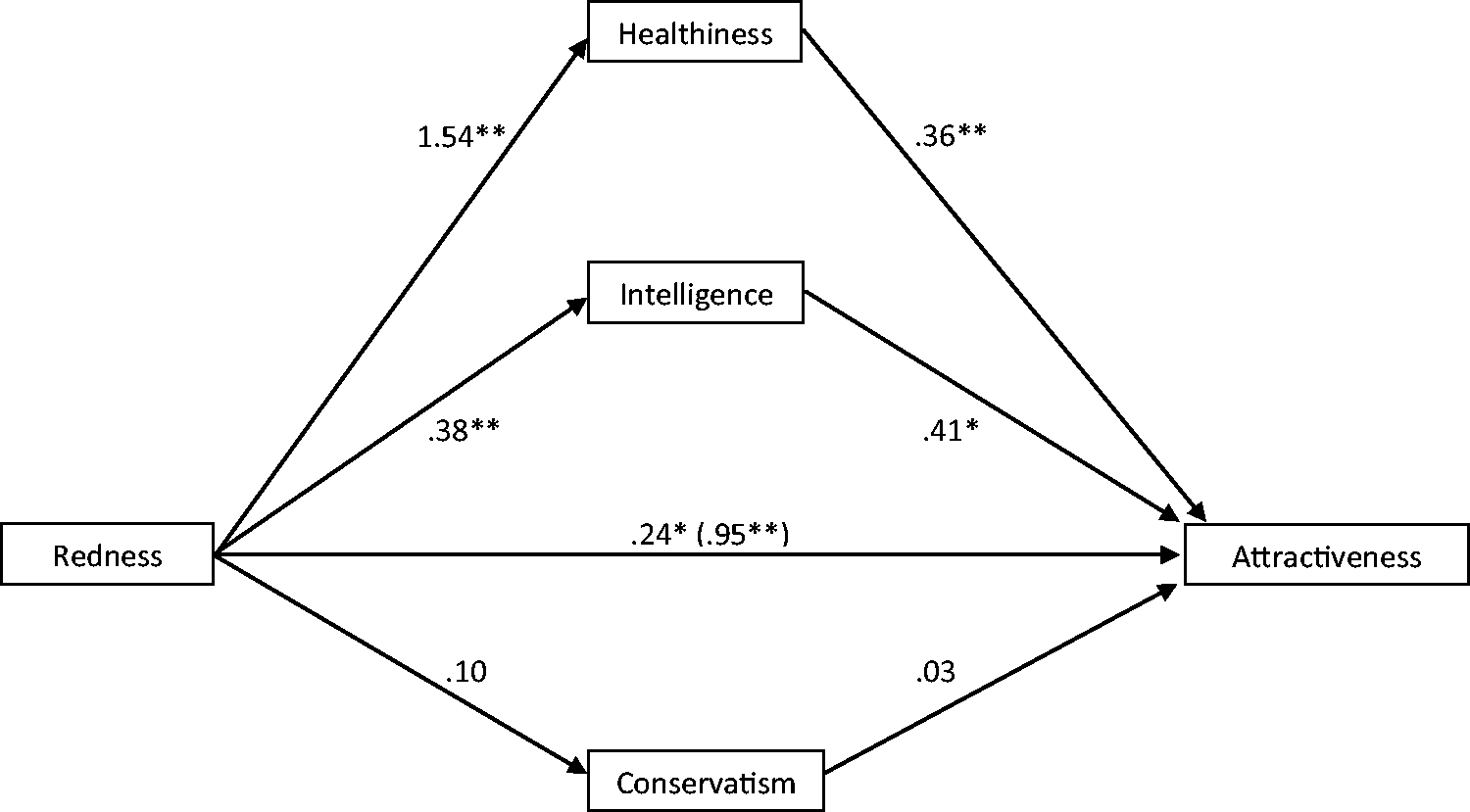
Indirect effects (a paths*b paths)
Pairwise Contrasts of Indirect Effects in Experiment 3.

Direct effect (c path after accounting for the influence of mediating variables)
The direct effect of facial redness on perceived attractiveness (controlling for the influence of the mediators) remained significant (c’ = .24 [.01, .46], p = .04), indicating that facial redness still accounts for variance in perceived attractiveness over and above the effect of the mediators.
In accord with our hypothesis, we found that perceived healthiness mediated the relation between facial redness and perceived attractiveness. We also observed an unexpected indirect effect through perceived intelligence, although this effect was smaller than the path through perceived healthiness.
Experiment 4
In Experiment 4, we again examined perceived healthiness as a mediator variable, this time focusing specifically on the contrast between increased redness and the neutral baseline. We also added an additional potential mediator variable, perceived honesty; like intelligence, honesty (and, more broadly, trustworthiness) is a characteristic that men across countries value highly in women (Fletcher, Simpson, Thomas, & Giles, 1999). Thus, examining whether perceived honesty is a mediator of the relation between facial redness and perceived attractiveness should provide more information regarding a possible halo effect of female facial redness. Finally, we conducted the experiment in the lab rather than on the web to afford more rigorous control of color presentation (see Elliot, 2015).
Method
Participants
One hundred and one men (mean age = 20.1, range = 18–35) were recruited from a university in the northeastern United States and compensated with extra course credit for participating.
Procedure
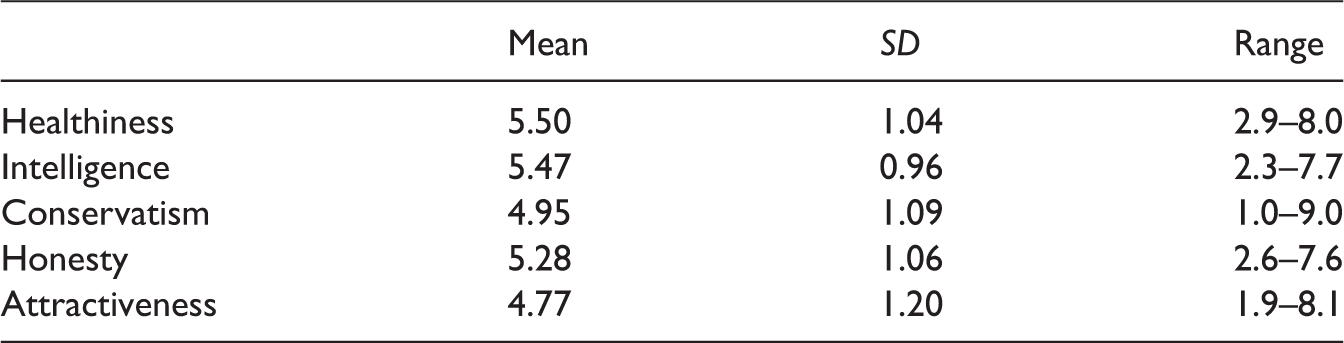
Descriptive Statistics for Variables in Experiment 4 Averaged Across Faces and Color Conditions.
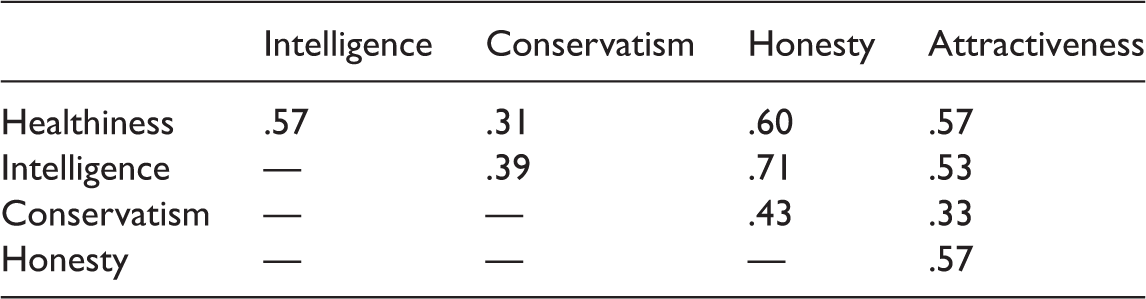
Correlations Between Variables in Experiment 4.
Results
We used MEMORE (Montoya & Hayes, 2015) for SPSS to test the effect of facial redness on attractiveness through several parallel mediators. Ninety-five percent confidence intervals were generated from 5,000 bootstrap samples and are reported in brackets for each result below.
Total effect
The total effect of increased redness on perceived attractiveness was significant, (c = .47 [.26, .68], p < .001), meaning that the faces with increased redness, on average, were rated as .47 points higher on attractiveness than the neutral faces.
Individual paths
The faces with increased redness were perceived as healthier (a1 = 1.24 [.95, 1.53], p < .001) and more honest (a4 = .53 [.28, .78], p < .001) than the neutral faces (see Figure 3). No significant differences were observed for perceived intelligence (a2 = .12 [–.09, .34], p = .25) or conservatism (a3 = –.16 [–.41, .09], p = .22). Perceived healthiness was positively related to perceived attractiveness (controlling for the effect of redness and the other mediators; b1 = .37 [.25, .49], p < .001). A similar relation was found between perceived intelligence and perceived attractiveness (b2 = .22 [.05, .38], p = .01). No significant relation was observed between perceived conservatism and attractiveness (b3 = .11 [–.02, .24], p = .10) or perceived honesty and attractiveness (b4 = .11 [–.03, .24], p = .13).
*p < .05; **p < .01. Effects of increased redness on perceived attractiveness through four potential mediators in Experiment 4; coefficients are unstandardized estimates and the coefficient in parentheses is the total effect. Indirect effects of red on perceived attractiveness through each potential mediator [95% confidence intervals in brackets] are as follows. Healthiness: .46 [.28, .63]; Intelligence: .03 [–.02, .11]; Conservatism: –.02 [–.06, .03]; Honesty: .06 [–.05, .22].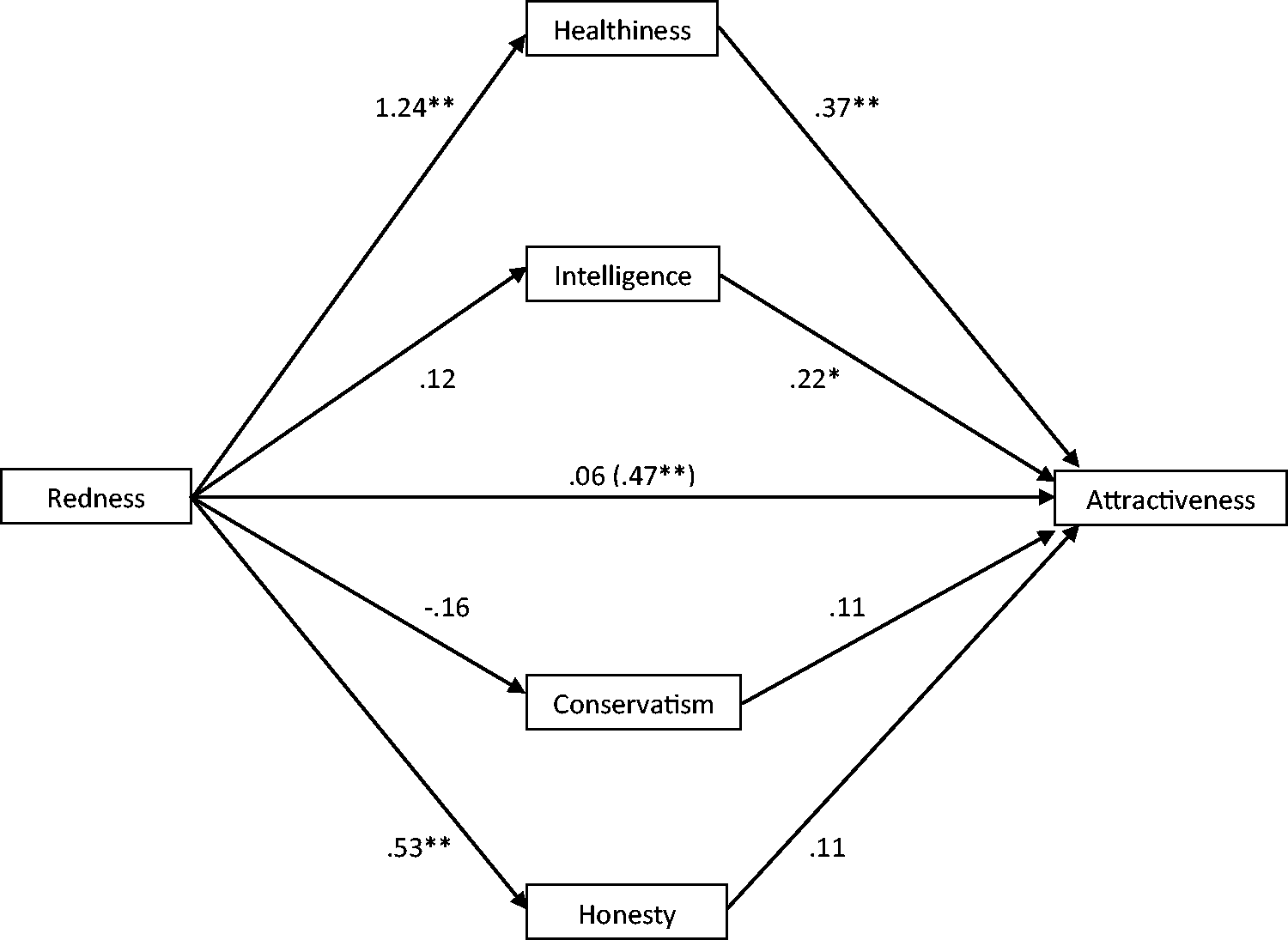
Indirect effects
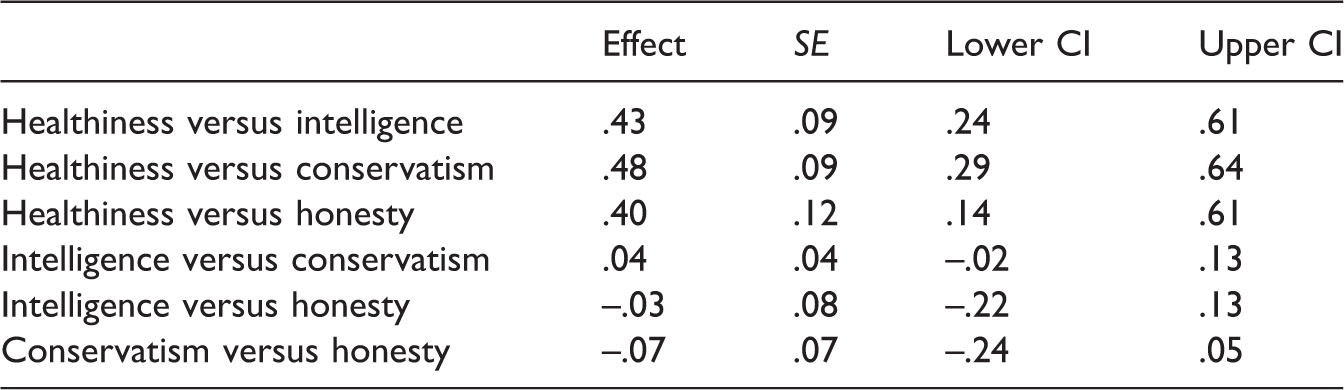
Pairwise Contrasts of Indirect Effects in Experiment 4.
Direct effect
The direct effect of increased facial redness on perceived attractiveness (controlling for the influence of the mediators) was not significantly different from zero (c’ = –.06 [–.28, .16], p = .61), indicating that perceived healthiness accounted for most of the variance in the redness-attraction relation.
These results are mostly consistent with those of the previous experiments. Facial redness was a strong predictor of perceived attractiveness, and perceived healthiness was responsible for this relation. In contrast with the results from Experiment 3, none of the other potential mediating variables had a statistically significant effect on perceived attractiveness.
General Discussion
The results of the present research provide support for the premise that female displays of red on the face are viewed positively by heterosexual male perceivers. Increased redness on the face of female targets led to increased ratings of attractiveness and sexual attractiveness, and decreased redness on the face of female targets led to decreased ratings of attractiveness and sexual attractiveness. This same pattern of findings was also observed for perceived healthiness. Finally, perceived healthiness was documented as a mediator of the influence of female facial redness on male perceptions of attractiveness, and this mediation was shown to be independent of other candidate mediator variables.
In social situations, including mate evaluation situations, the face is a focal point of attention, and facial cues convey important information that can influence person perception (Perrett, 2010; Rhodes, 2006). The present work shows that color on the female face can be perceived by men to convey healthiness information, and this has implications for attractiveness judgments. These findings both highlight the importance of attending to facial coloration as an attraction-relevant cue in general (see Stephen & Perrett, 2015, for a review of this growing area of research), and extend prior work on the red-attraction relation (see Pazda & Greitemeyer, 2015, for a review) to the domain of the face.
Perceived healthiness was documented as a mediator of the red-attraction link herein, but there was some evidence, albeit inconsistent evidence (from one of two experiments), that intelligence also served a mediational role. That red might influence another positive characteristic (or characteristics) beside healthiness should not be surprising, because good health is undoubtedly integrally intertwined with and necessary for optimal functioning, including intellectual functioning. It is also possible that there is a halo effect surrounding healthiness, such that “what is healthy is good” (much like “what is beautiful is good”; Dion, Berscheid, & Walster, 1972); this might lead to multiple positively valenced variables being documented as mediators, with none standing out as more important than the others. Importantly, in both of our mediation experiments, perceived healthiness was statistically documented as the strongest of all of the mediators tested. So, regardless of any possible conceptual overlap or halo bias, our data clearly support perceived healthiness as the most potent mediator of the variables measured.
In our research, we focused on mediator variables that represent enduring characteristics of the person, namely healthiness, intelligence, honesty, and conservatism. In each of these instances, facial redness would represent a relatively consistent, stable indicator of the relevant characteristic. However, facial redness can also represent immediate, emotion-based reactions to temporary events or situations. For example, women (and men) often blush when experiencing sexual interest or excitation, which is manifest as a reddening on the face, neck, and upper chest. Research has shown that males’ perceptions of women’s sexual receptivity can mediate the influence of women’s red clothing on men’s attractiveness judgments (Guéguen, 2012a; Pazda et al., 2012, 2014). Subsequent research would do well to integrate these different lines of work on stable and ephemeral color cuing. Furthermore, subsequent work would also do well to attend to the issue of the context in which person judgments are taking place (Elliot, 2015). For example, if in the present research we had informed participants that the target persons were photographed while experiencing an interpersonal conflict, increased redness may have been viewed as a negative cue of anger and danger, rather than a positive cue of health and attractiveness.
Manipulating context would undoubtedly lead to a deeper, more nuanced understanding of the effects that we observed.
We manipulated facial color in our experiments with an increment or decrement of a* = 5. This value represents a relatively small change in redness but, critically, it also represents a change that clearly exceeds human visual detection thresholds (Re et al., 2011). Additional research is needed to examine a broader range of changes and their effects. With regard to lower limits, there is certainly a point at which the degree of change in redness would be so small as to be undetectable (for related work, see Tan & Stephen, 2013), and there may be a point above the detection threshold that is nevertheless so minimal that it has no effect on perceptions of health and attractiveness. With regard to upper limits, there is certainly a point at which increments in redness shift from conveying healthiness (Stephen, Coetzee et al., 2009) to conveying something negative (e.g., anger) or unhealthy (e.g., fever), and likewise there is certainly a point at which additional decrements in redness would no longer produce additional decrements in healthiness and attractiveness perceptions (i.e., the curve would asymptote). Documenting these parameters would nicely extend the present findings.
The present research has limits that may be used to guide subsequent work. First, we exclusively utilized Caucasian target stimuli and did not systematically collect data that would afford rigorous investigation of the influence of same versus other ethnicity on target judgments (e.g., Coetzee, Greeff, Stephen, & Perrett, 2014; Stephen, Coetzee, & Perrett, 2011). We also used a small number of female targets, which were relatively young and moderately attractive. This may limit the generalizability of our findings across different age groups and attractiveness levels. Second, the target stimuli that we used were static pictures with red added throughout the face; video clips with precisely imputed redness would be difficult to produce, but may be seen as a worthy aim given the enhanced ecological validity of such stimuli. Third, several of our studies were conducted online, meaning the color presentation could not be rigorously controlled. Specifically, each participant’s computer monitor undoubtedly displayed color in a unique manner, which led to deviations in the color presentation across participants. Importantly, Experiment 4 was conducted on a single color-calibrated monitor in a laboratory setting and yielded results similar to the web-based experiments. Nonetheless, we recommend interpreting the present (and all) web-based color research with this limitation in mind. Finally, each of our experiments utilized a within-subjects design, where the same participants rated numerous faces in multiple color conditions. This has the drawback of potential carry-over effects, such that ratings of one stimulus influence ratings on subsequent stimuli. The order in which the target faces were presented in these experiments varied randomly, which helps address, but does not eliminate, this issue.
In conclusion, the present research contributes to our growing understanding of color’s influence on social perception. This work particularly highlights the value of investigating facial coloration as an influence on important, adaptation-relevant evaluative judgments. Facial coloration seems a rich, relatively underexplored research area that could yield many important insights in the future.
Footnotes
Acknowledgements
We would like to thank Daniel Re and Miron Zuckerman for their helpful comments on an earlier version of this manuscript.
Declaration of Conflicting Interests
The author(s) declared no potential conflicts of interest with respect to the research, authorship, and/or publication of this article.
Funding
The author(s) received no financial support for the research, authorship, and/or publication of this article.