







Abstract

Robert Addams (1789–1875) described the waterfall illusion following observation of the Falls of Foyers (Figure 1) in 1834. It is a special case of the motion aftereffect (MAE). Addams’s brief article introduced paradoxes about processes, history and interpretations of motion aftereffects, some of which remain with us.
The lower Falls of Foyers (artist T. Allom, hand-coloured engraving by E. Radclyffe and published by George Virtue, London, 1836). A monochrome version of this engraving was printed in Beattie (1838). Addams would have observed the waterfall from the platform shown.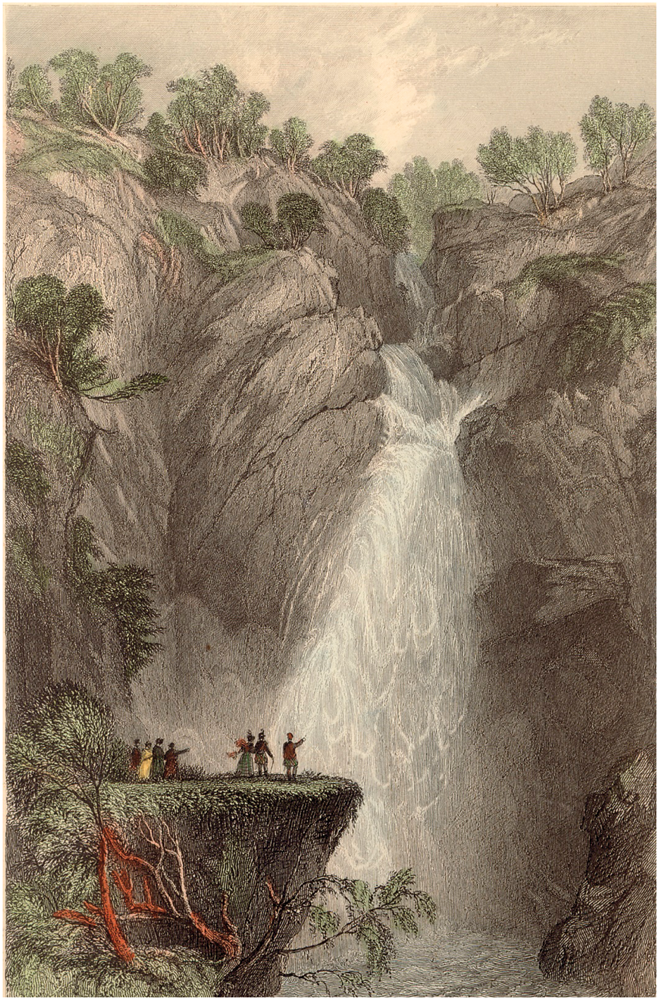
The waterfall illusion, and MAEs generally, stimulated a torrent of research since the 19th century. Addams (1834) wrote: Having steadfastly looked for a few seconds at a particular part of the cascade, admiring the confluence and decussation of the currents forming the liquid drapery of waters, and then suddenly directed my eyes to the left, to observe the vertical face of the sombre age-worn rocks immediately contiguous to the water-fall, I saw the rocky face as if in motion upwards, and with an apparent velocity equal to that of the descending water, which the moment before had prepared my eyes to behold this singular deception. (p. 373)
Waterfalls must have been observed throughout human history. This leads to a second paradox: Why was it so late in descriptions of visual phenomena that attention was directed to the aftereffect evident following viewing waterfalls? Two thousand years ago, MAEs were reported by Aristotle and Lucretius in flowing river waters (see Wade & Verstraten, 1998). The critical distinction between their observations and Addams’s is that fixation aids were available in the former. Aristotle was able to fixate on stones beneath the water and Lucretius could look at the leg of his horse partially submerged in the fast flowing river. The natural response when viewing descending water is for the eyes to follow the descent and return – optokinetic nystagmus. There needs to be a reason to look steadfastly ‘for a few seconds at a particular part of the cascade’. This reason could have been the emerging appreciation that the methods of physics could be applied to perception. Only one year earlier instruments for inducing apparent motion had been described by Plateau (1833) and Stampfer (1833) and these involved maintaining a steady eye position. Moreover, these instruments had been stimulated by observations reported by Faraday (1831) who was a scientific acquaintance of Addams. The shift of visual observations from the natural environment into the laboratory was made explicitly by Addams who suggested that the phenomenon ‘is also producible by mechanical means, such as by a rapid unrolling of pieces of calico having some pattern or markings on them’ (p. 374). Downward moving horizontal gratings were the stimuli later used by Bowditch and Hall (1881) and Wohlgemuth (1911) in their investigations of MAEs.
The third paradox concerns the eye movement interpretation of the phenomenon adopted by Addams: Apparent motion of the rocks was considered to be a consequence of unconscious pursuit eye movements when viewing descending water. Eye movements are almost always initially invoked for interpreting novel visual motion phenomena (Wade, 2017). The paradox is that an aftereffect of eye movements cannot be restricted to an isolated part of the visual scene, as was pointed out by Mach (1875) and Thompson (1880). In his interpretation, Addams provided one of the earliest estimates of the time course of optokinetic nystagmus. I conceive the effect to be owing to an involuntary and unconscious muscular movement of the eyeball, and thus occasioning a displacement of the images on the retina. Supposing the eyes to be intently gazing at any point in a transverse plane passing through a vertically moving body, they will naturally and even irresistibly tend to follow the motion of that body; nor can the muscular apparatus of the eye maintain a stable equilibrium when the sight is fatigued and bewildered with a rapid change of moving forms before the eye. Now in the case of the descending water, the eyes, being directed to a particular part in a horizontal section of it, cannot be prevented moving downwards through a small space: every new form in the moving scene invites the eyes to observe, and for that reason to follow it; but the voluntary powers are engaged to raise the axes of the eyes again to the section. This depression of the axes below the intentional point of sight seems to be repeated three or four times per second, whilst looking at the water-fall. Then, when the eyes are suddenly turned upon the rock, the muscles, having been brought into a kind of periodic contraction, will perform at least one of these movements after the exciting cause ceases to act; and thus the axes of the eyes, by moving downwards, will occasion a motion of the image of the rock over the retina in a direction from above downwards, and consequently the object giving that image will appear to move the contrary way, that is, upwards, agreeably to observation. (Addams, 1834, p. 374)
Footnotes
Declaration of Conflicting Interests
The author(s) declared no potential conflicts of interest with respect to the research, authorship, and/or publication of this article.
Funding
The author(s) received no financial support for the research, authorship, and/or publication of this article.