







Abstract
An experiment required younger and older adults to estimate coherent visual motion direction from multiple motion signals, where each motion signal was locally ambiguous with respect to the true direction of pattern motion. Thus, accurate performance required the successful integration of motion signals across space (i.e., accurate performance required solution of the aperture problem) . The observers viewed arrays of either 64 or 9 moving line segments; because these lines moved behind apertures, their individual local motions were ambiguous with respect to direction (i.e., were subject to the aperture problem). Following 2.4 seconds of pattern motion on each trial (true motion directions ranged over the entire range of 360° in the fronto-parallel plane), the observers estimated the coherent direction of motion. There was an effect of direction, such that cardinal directions of pattern motion were judged with less error than oblique directions. In addition, a large effect of aging occurred—The average absolute errors of the older observers were 46% and 30.4% higher in magnitude than those exhibited by the younger observers for the 64 and 9 aperture conditions, respectively. Finally, the observers’ precision markedly deteriorated as the number of apertures was reduced from 64 to 9.
Many previous studies have found that older adults are less able to discriminate differences in the speed of moving patterns (e.g., Bidwell, Holzman, & Chen, 2006; Norman, Burton, & Best, 2010; Norman, Ross, Hawkes, & Long, 2003; Raghuram, Lakshminarayanan, & Khanna, 2005; Snowden & Kavanagh, 2006). For example, Norman et al. (2003) found that the difference thresholds of older adults (age range: 65–82 years) for speed were 71% larger than those obtained for younger adults (mean age was 21.8 years). Later studies, such as Raghuram et al. (2005), had very similar findings (older adults exhibited 67.8% higher speed discrimination thresholds than younger adults). Another set of studies have found age-related deteriorations in the ability to detect, discriminate, and recognize three-dimensional (3-D) shape from motion (Andersen & Atchley, 1995; Norman et al., 2012; Norman et al., 2013; Norman, Adkins, Dowell, Hoyng, et al., 2017; Norman, Bartholomew, & Burton, 2008; Norman, Clayton, Shular, & Thompson, 2004; Norman, Dawson, & Butler, 2000). As an example, consider a study by Norman, Adkins, Dowell, Hoyng, et al. (2017): Experiment 1 required observers to recognize dotted 3-D surfaces portrayed by the kinetic depth effect, while Experiment 2 required observers to recognize solid objects that were presented with or without motion (rotation in depth). The results of their Experiment 1 revealed that the recognition performance of younger adults was 31.5% higher than that of older adults. Experiment 2 demonstrated that while the recognition abilities of older adults do benefit from object motion, this facilitation in performance was much smaller than that obtained for younger adults.
A large body of research demonstrates that increases in age also adversely affect the perception of motion direction (e.g., Atchley & Andersen, 1998; Ball & Sekuler, 1986; Bennett, Sekuler, & Sekuler, 2007; Billino, Bremmer, & Gegenfurtner, 2008; Gilmore, Wenk, Naylor, & Stuve, 1992; Pilz, Miller, & Agnew, 2017; Roudaia, Bennett, Sekuler, & Pilz, 2010; Trick & Silverman, 1991). Atchley and Andersen (1998) evaluated what proportion of coherently moving points was needed to detect the direction of translation (left or right). They found that their older observers possessed higher coherence thresholds (than those of younger observers) for some stimulus speeds and eccentricities. Ball and Sekuler (1986) evaluated the discrimination of motion direction. On any given trial, observers sequentially viewed two patterns of moving dots and were required to judge whether the two patterns moved in the same direction or moved in different directions. Ball and Sekuler found that for angular separations of 4° and 6°, younger observers significantly outperformed older observers. In a later study, Bennett et al. (2007) required observers to estimate motion direction for patterns of moving dots. They found that the estimates of older adults were much less accurate—their error magnitudes were more than twice as high as those of the younger adults (see Figure 1(b) of Bennett et al., 2007).
An example that illustrates the aperture problem. In the left panel, a polygonal solid object (located behind an occluding surface) translates to the right and is viewed through apertures. Because of the aperture problem (e.g., see Mingolla et al., 1992; Nakayama, 1985; Wallach, 1935), the visible object boundary contours only move perpendicular to their own orientation.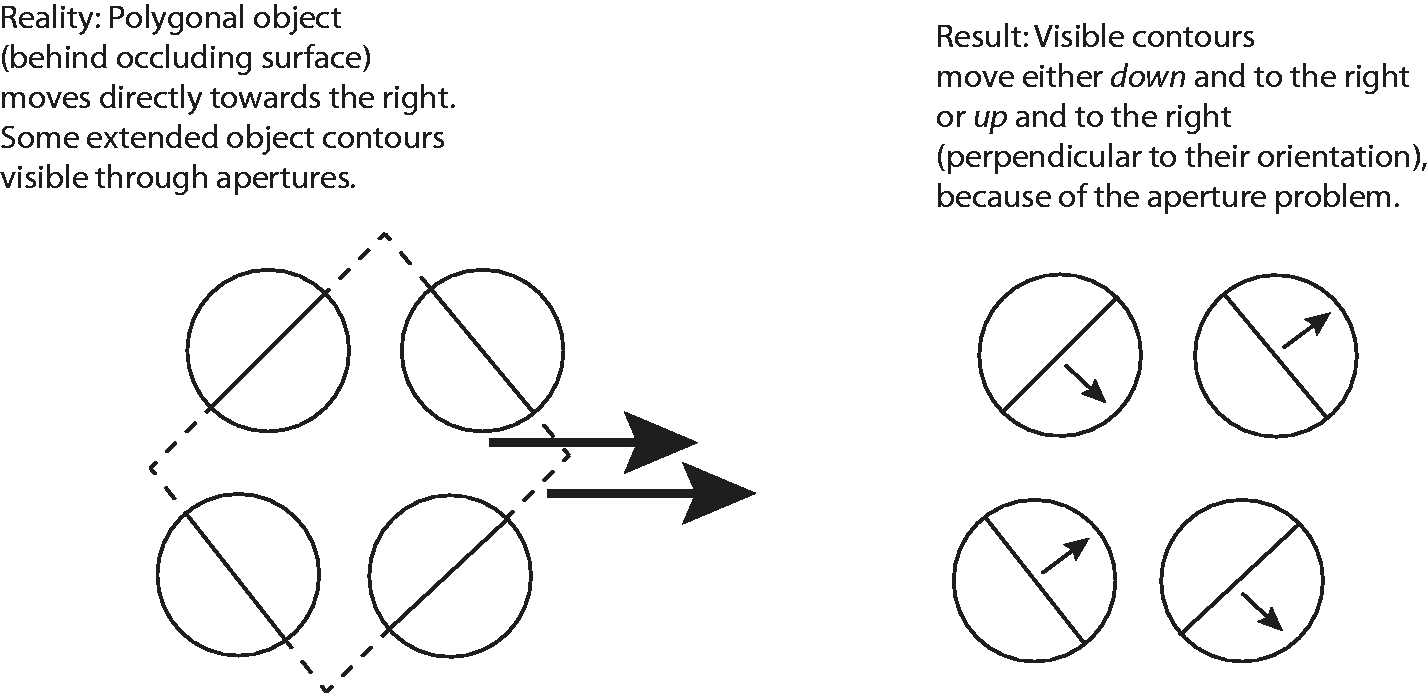
In real-life scenes containing objects and contours, the determination of motion direction is subject to the aperture problem (e.g., Adelson & Movshon, 1982; Braddick, 1993; Burr & Thompson, 2011; Ferrera & Wilson, 1990; Gilbert, 2013, pp. 609–613; Mingolla, Todd, & Norman, 1992; Stumpf, 1911; Wallach, 1935). Individual visual motion detectors only respond to motion occurring within small receptive fields (e.g., Barlow & Levick, 1965; Koenderink, van Doorn, & van de Grind, 1985; Lappin & Bell, 1976; Reichardt, 1961; Todd & Norman, 1995). An essential ambiguity (the aperture problem) results: The motion of object contours can only be detected in a direction perpendicular to their orientation (motion of a contour parallel to its orientation cannot be detected). For an illustrative example, consider Figure 1, which depicts a polygonal object moving directly to the right behind an occluding surface; some of the object contours are visible through apertures. Even though the object itself moves directly rightward, none of the visible contours moves to the right: The visible contours either move diagonally upwards or downwards (the visible motions differ by 90°!). Figure 1’s purpose is only illustrative; the aperture problem does not only exist during situations where one object moves behind another. Because visual (i.e., cortical) motion detectors possess limited or small receptive fields, the detection of motion direction for all extended contours present in visual images is subject to the aperture problem (e.g., Braddick, 1993; Burr & Thompson, 2011; Gilbert, 2013, pp. 609–613). Since the true direction of contour motion cannot be determined by a single motion detector, spatial pooling is necessary. Various pooling mechanisms have been proposed to account for how the visual system solves the aperture problem and thus permits the coherent perception of motion direction (e.g., Adelson & Movshon, 1982; Amano, Edwards, Badcock, & Nishida, 2009; Mingolla et al., 1992; Wilson, Ferrera, & Yo, 1992). Note, for example, that a vector average of the visible motions shown in the right panel of Figure 1 would result in the correct determination of the true object motion indicated in the left panel. In this study, we evaluate and compare younger and older observers’ ability to estimate coherent motion direction from multiple locally ambiguous motion signals (contours moving behind apertures). We know from past research (e.g., Mingolla et al., 1992) that younger observers can effectively integrate across space and perceive coherent pattern direction from a set of locally ambiguous motion signals—whether and to what extent older observers can do the same is presently unknown.
Method
Apparatus
The visual stimuli were generated by an Apple dual-processor (1.42 GHz) PowerMacintosh G4 computer and displayed using a 22-inch Mitsubishi Diamond Plus 200 color monitor (1,280 × 1,024 pixels). The rendering was accelerated by a Radeon 9000 graphics accelerator (ATI Technologies, Inc.) and hardware line antialiasing was employed. The individual frames of the apparent motion sequences were refreshed at 85 Hz. The viewing distance from the observers to the monitor was 100 cm.
Experimental Stimuli
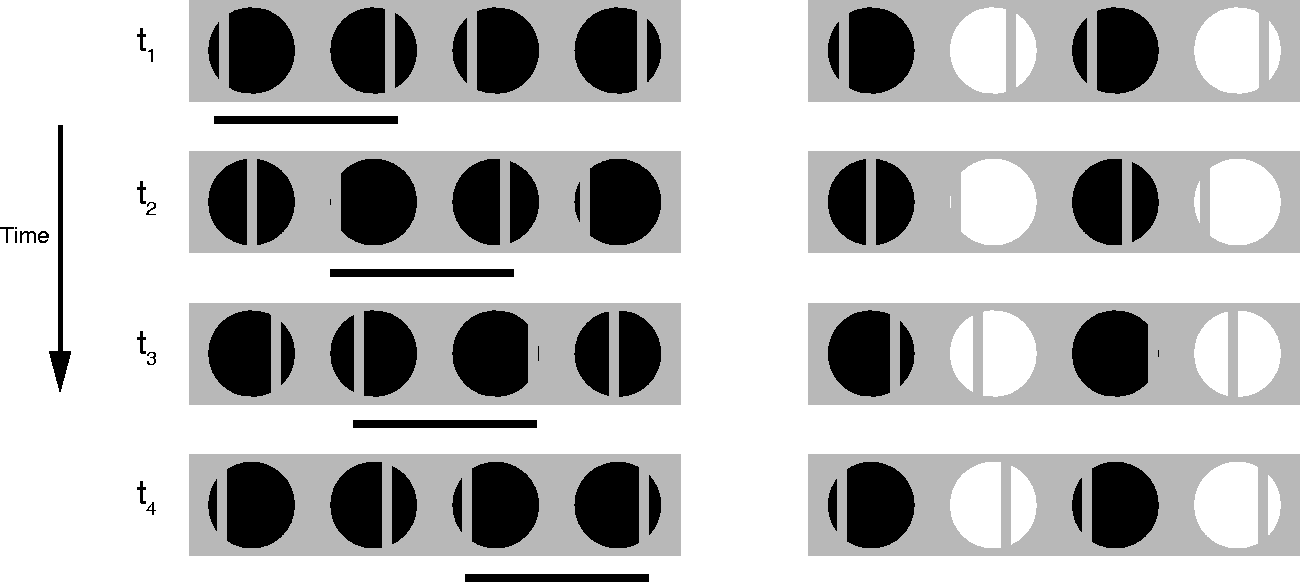
The experimental stimuli (see Figure 2) were essentially identical to those used by Mingolla et al. (1992). An array of either 64 or 9 circular apertures was presented on any given trial. Mingolla et al. previously demonstrated that 64-aperture (8 × 8) stimulus arrays produce compelling impressions of global motion (see their Experiments 1 and 2); this study utilized those same stimuli but also reduced the number of apertures by 86% (to 3 × 3 arrays) to determine whether effective perceptions of global motion direction can occur with far fewer local motion samples. The vertical and horizontal size of the stimulus arrays was 13.4° visual angle. The overall stimulus background was blue; as in Mingolla et al., the aperture backgrounds alternated in color across space and were either black or white for each aperture (the alternating black and white backgrounds prevent the perception of an undesirable secondary motion, see Figure 3; also see the Appendix and Figure 16 of Mingolla et al.). The background color of each aperture remained black or white throughout the duration of each trial (i.e., apparent motion sequence). The diameter of the individual circular apertures was 2 cm (1.15°). A moving (translating) line segment was presented within each aperture; the orientation of each aperture’s line segment was randomly determined on every trial. The speed of the global translating pattern was 2.4 deg/s. It is important to note, though, that because of the aperture problem described earlier, the apparent speeds of the line segments within the apertures varied from 0 to 2.4 deg/s depending upon the orientation of each individual line segment. In particular, each line segment appeared to move perpendicular to itself at a speed that was proportional to the sine of the angle between the global direction of motion and the orientation of the line segment (or proportional to the cosine of the angle between the line segment perpendicular and the global direction of motion). Therefore, line segments with an orientation perpendicular to the direction of pattern motion moved at 2.4 deg/s, line segments with an orientation parallel to the direction of pattern motion appeared stationary within their aperture, and line segments with intermediate orientations moved with intermediate apparent speeds (see Nakayama, 1985; Wallach, 1935). As in Mingolla et al., at the beginning of each trial, the location (or phase) of each line segment within its aperture was randomly determined. During the apparent motion sequences, once the moving line segments reached the edge (or boundary) of their respective apertures, they were “recycled back” to the opposite side of the aperture to begin their journey again. The stimulus apparent motion sequences consisted of 200 frames; given that the frames were updated at 85 Hz, the duration of each trial was 2.35 seconds.
An example of a 64-aperture stimulus; such stimuli are essentially identical to those used by Mingolla et al. (1992). Within each circular aperture is presented a single randomly oriented moving line segment. Although all line segments move together as a group in a single global direction behind the apertures, each line segment appears to move only in a direction perpendicular to its own orientation because of the aperture problem. Left panel: Each row indicates four adjacent circular apertures. At the beginning of an apparent motion sequence (top row), the initial phases (positions of the line segments within the apertures) are determined at random. When each line segment moves (toward the right in this example) and reaches the edge of its aperture, its position is cycled back to the beginning (this cycling can be seen in all depicted apertures as time progresses from t1 to t4). Note that if all of the apertures were black (as shown in the left panel, unlike our actual stimulus patterns), there is a dark blank space, highlighted by horizontal bars, that would appear to move at an average speed that is faster than that of the stimulus line segments. Right panel: Alternating the polarity (or color) of adjacent apertures across space (white, black, etc.) in the current stimuli (e.g., see Figure 2) abolishes this unwanted illusory perception of dark motion. This same stimulus manipulation (alternate polarity, or color, of apertures across the stimulus pattern) was also performed by Mingolla et al. (1992).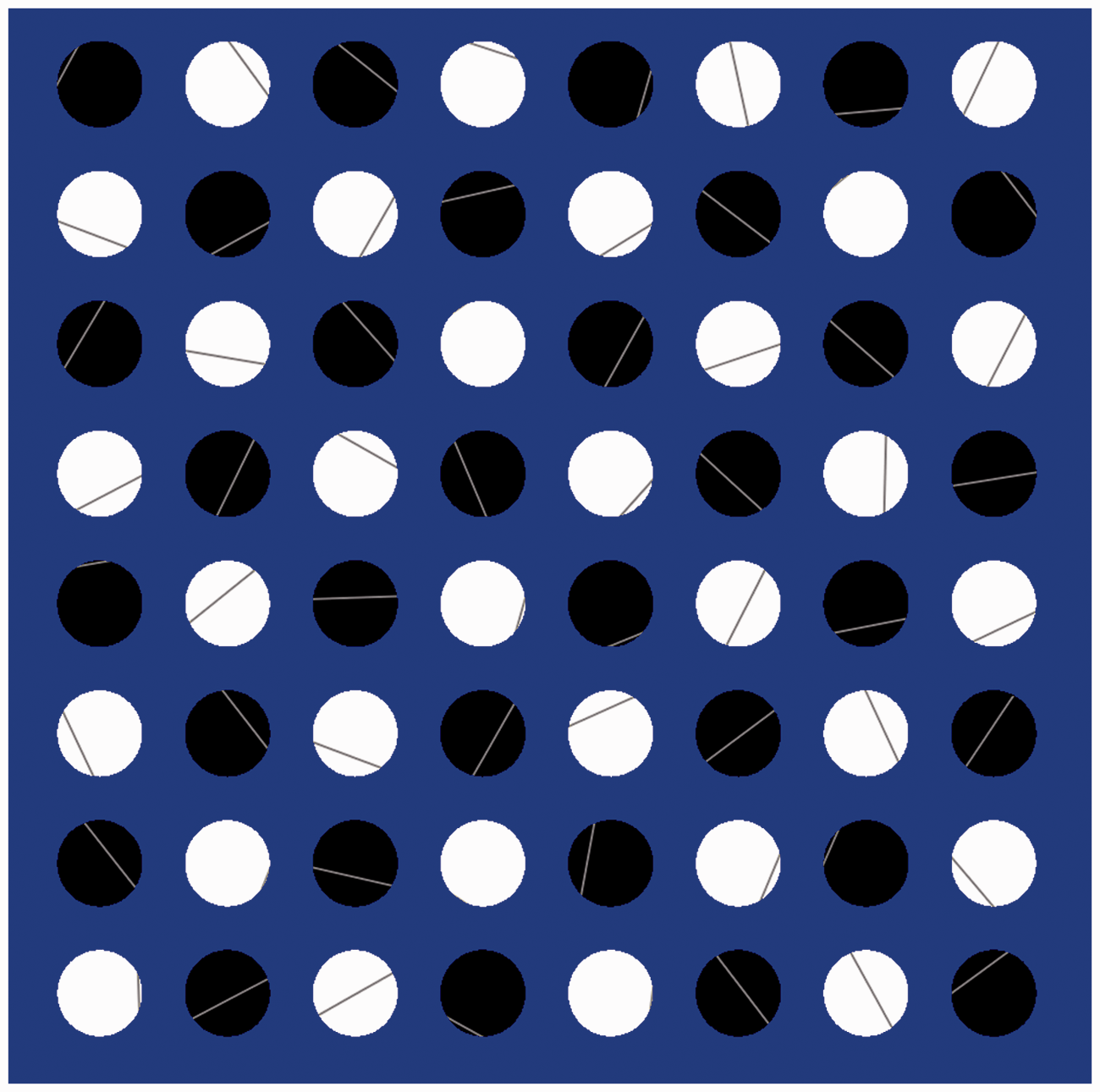
Procedure
Five trials were judged by each observer for each of the 24 combinations of apertures (64 vs. 9) and global pattern direction of motion (0°, 30°, 60°, 90°, 120°, 150°, 180°, 210°, 240°, 270°, 300°, or 330° counterclockwise from vertical up); thus each observer made a total of 120 judgments. The trials were blocked by aperture number, thus a block of 60 trials were run for 64 apertures and a subsequent block of 60 trials were run for 9 apertures. To ensure maximal performance, the 64 aperture block was run first for each observer because the global perception of motion was more compelling with 64 motion signals. Within each block of trials, the selection of global pattern direction was determined at random on every trial. Following the presentation of each trial’s apparent motion sequence, the observers rotated an arrow presented on the computer monitor (in 1° or 5° increments) so that the arrow pointed in the direction of the perceived global motion direction (the observers pressed one key on the computer keyboard to rotate the response arrow clockwise and another key to rotate the response arrow counterclockwise). The observers could take as much time as they wished to make their estimates of the global motion direction, but typically made their judgments within about 3 seconds. Given that no single aperture contained a line segment that moved exactly in the global stimulus direction (because of the randomly determined line segment orientations and the aperture problem), the observers were instructed to attend to the entire stimulus display at all times (i.e., fixate the center of the overall display) and to not attend to the apparent motions occurring in any specific aperture(s). The observers received no feedback about their performance during the experiment.
Observers
There were a total of 32 observers: 16 older adults (mean age was 74.3 years, SD = 6.0, range: 62–80 years) and 16 younger adults (mean age was 21.9 years, SD = 2.4, range: 18–27 years). Half of the younger and older adults were male, while the remaining half were female. The observers’ visual acuity was good (mean acuity for the younger and older adults was −0.069 and 0.044 logMAR, respectively). The mean acuities of the younger and older observers did differ significantly, t(30) = 3.2, p = .003, although in absolute terms, the older adults’ acuity was very good (approximately equivalent to 20/22). It is interesting to note that in the past, Ball and Sekuler (1986) have demonstrated that effective motion direction discrimination persists even with substantial reductions in acuity. All observers gave written consent prior to participation in the experiment. One of the 16 younger observers was the first author (L. M. S.). One potential older observer (female, age = 66 years) was excluded because she was unable to perceive coherent pattern motion from the individual motions of the spatially separated line segments (she said that the stimulus displays “looked like a kaleidoscope”). The experiment was approved by the Western Kentucky University Institutional Review Board. Our research was carried out in accordance with the Code of Ethics of the World Medical Association (Declaration of Helsinki).
Results
Correlation and Regression Analyses for Individual Observers
Individual results from four younger and older adults are shown in Figure 4. The top row depicts results from a younger and older observer in the 64-aperture condition who had similar Pearson r correlation coefficients (correlations between actual global direction of motion and judged direction of motion, r = .989 vs. r = .972), but whose regression line slopes differed. Similarly, the bottom row of Figure 4 depicts analogous results (identical correlation coefficients, but different slopes) from a younger and older observer in the nine-aperture condition. The similarity of correlation coefficient magnitude for younger and older adults that is illustrated in Figure 4 was also true overall. A 2 (age: younger and older) × 2 (number of apertures: 64 and 9) analysis of variance (ANOVA) found that while there was an effect of the number of apertures (or motion signals) upon the magnitude of the Pearson r correlation coefficients, F(1, 30) = 17.7, p = .0002; Individual results for two younger and two older adults. The top row indicates (for one younger and one older observer) judged directions of motion for the 64-aperture stimuli plotted as a function of the actual global directions of motion. The solid line within each plot indicates the best-fitting linear regression line, while the dashed line indicates accurate performance. The bottom row similarly indicates (for one younger and one older observer) judged directions of motion for the nine-aperture stimuli plotted as a function of the actual global directions of motion. The solid line within each plot indicates the best-fitting linear regression line, while the dashed line indicates accurate performance.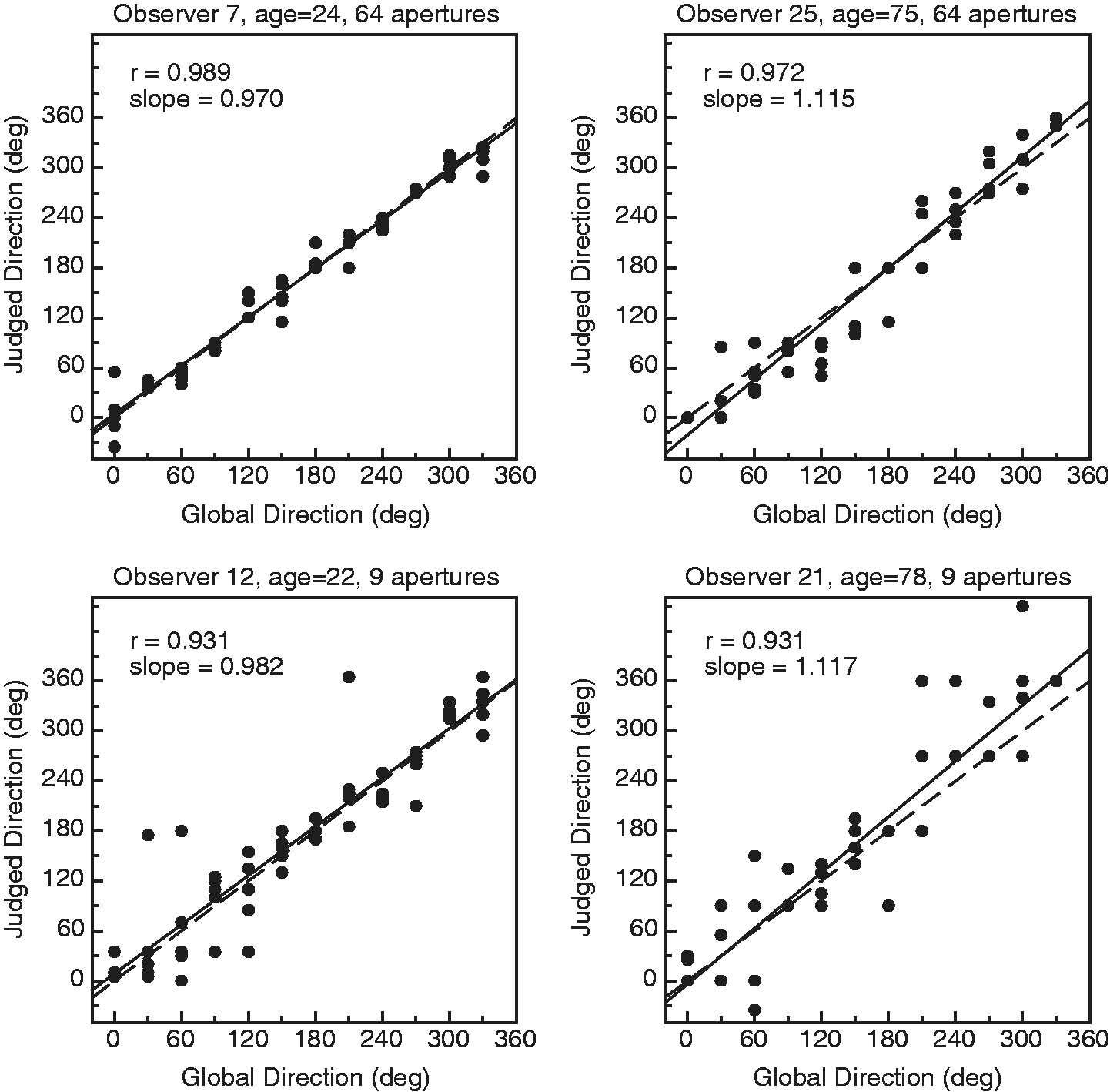
While there was no difference in correlation coefficient magnitude between the younger and older observers (rs were .970 and .965, respectively), there was a significant age-related difference in how much (absolute value) the slopes of the obtained regression lines deviated from 1.0 (accurate performance would be reflected by a slope of 1.0), as revealed by a 2 (age) × 2 (apertures) ANOVA, main effect of age: F(1, 30) = 7.8, p = .009, A plot illustrating how the slopes of the regression lines (for examples of the regressions, see Figure 4) obtained for the younger and older observers deviate from 1.0. The error bars indicate ± 1 SE.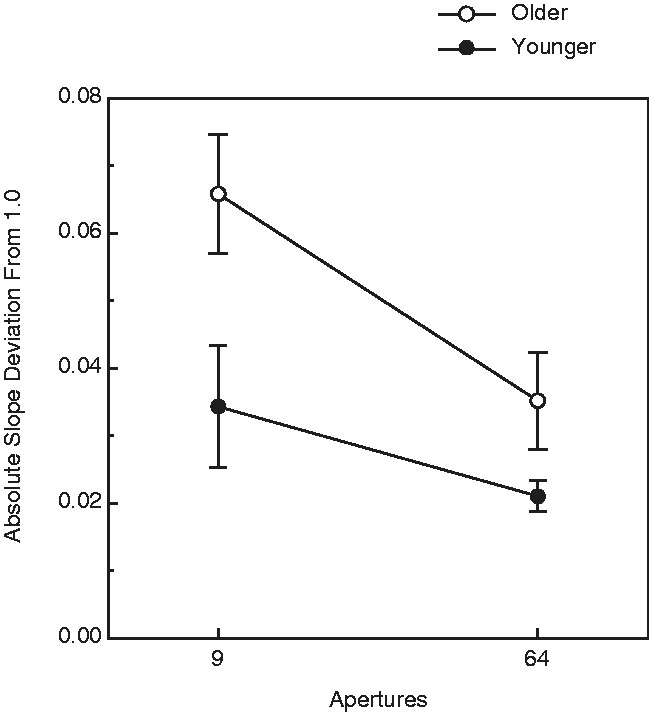
Analyses of Absolute Error Magnitudes (Effects of Apertures, Global Directions of Motion, and Age)
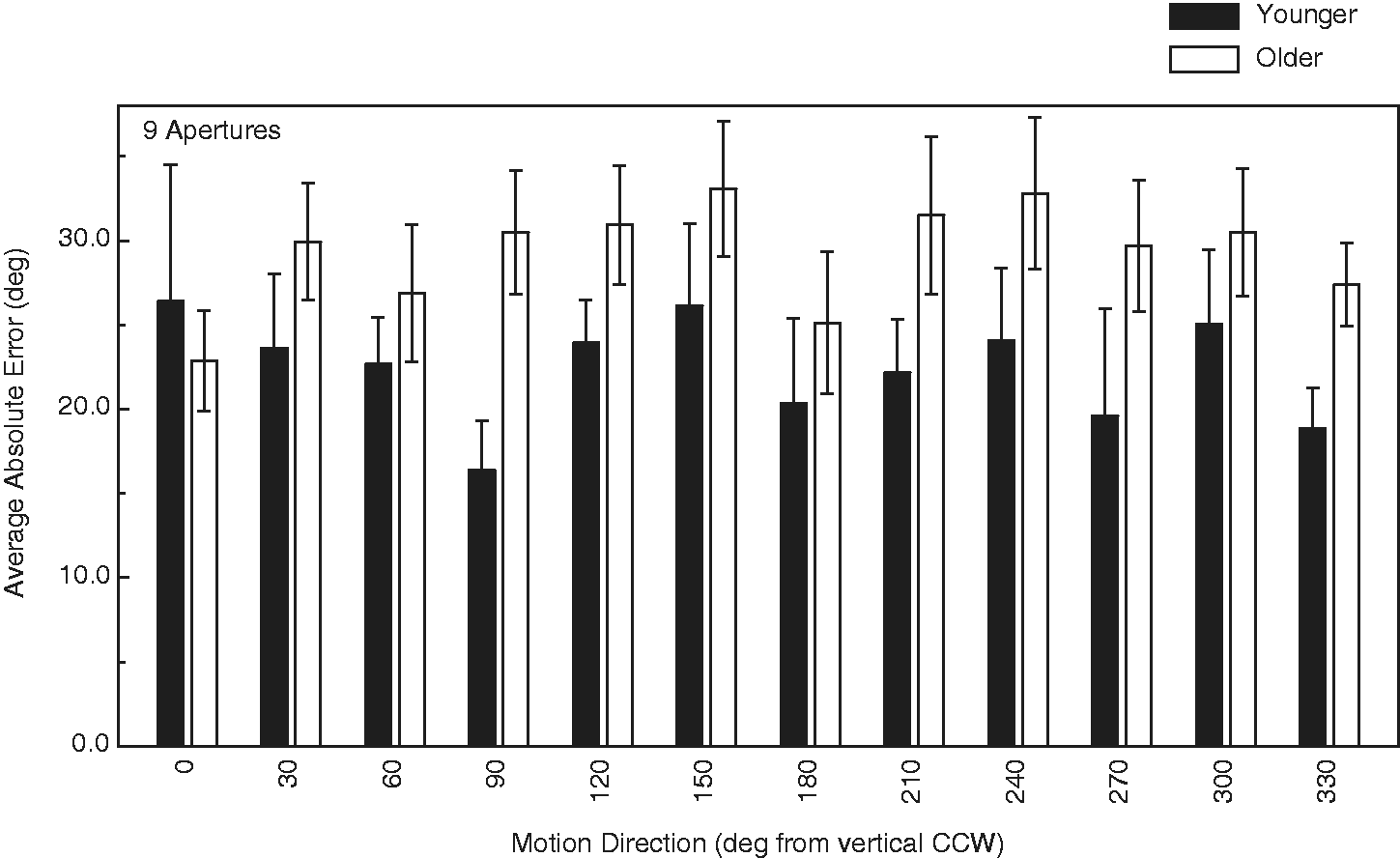
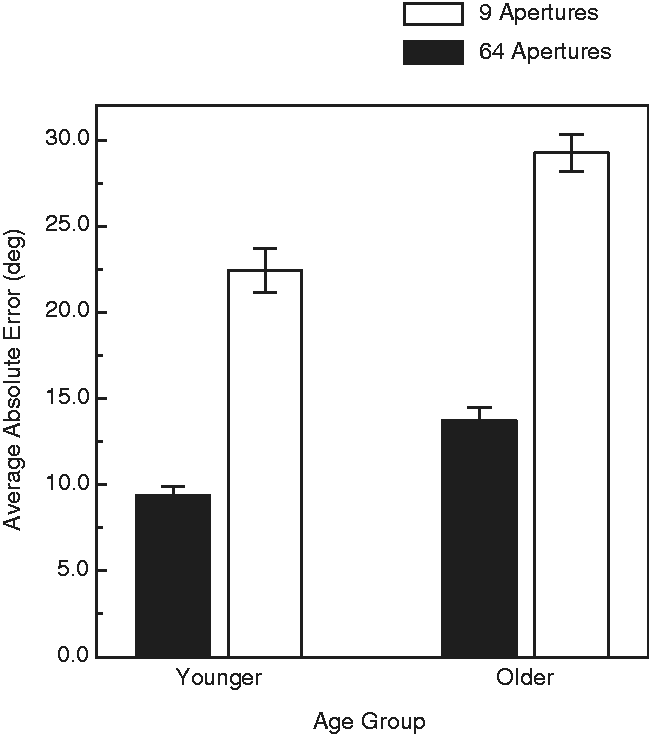
The younger and older observers’ average absolute errors (this dependent variable was previously used by Bennett et al., 2007; see their Figure 1(b)) are shown in Figures 6 and 7 for the 64-aperture and 9-aperture stimuli, respectively. In these figures, the observers’ average absolute error (absolute value of the difference between the true global direction of motion and the perceived, or estimated, direction of motion, in degrees) is plotted as a function of stimulus direction and age-group. A 2 (age) × 2 (apertures) × 12 (global directions of stimulus motion) ANOVA was conducted upon the observers’ average absolute errors. A comparison between Figures 6 and 7 illustrates a significant effect of the number of apertures, F(1, 30) = 62.1, p < .000001; Overall results of the younger and older observers for the 64-aperture stimulus displays. The observers’ average absolute errors (in degrees) are plotted as a function of the global motion direction. The error bars indicate ± 1 SE. Overall results of the younger and older observers for the 9-aperture stimulus displays. The observers’ average absolute errors (in degrees) are plotted as a function of the global motion direction. The error bars indicate ± 1 SE. Overall results: The observers’ average absolute errors (in degrees) are plotted as a function of the number of apertures for each age-group. The error bars indicate ± 1 SE.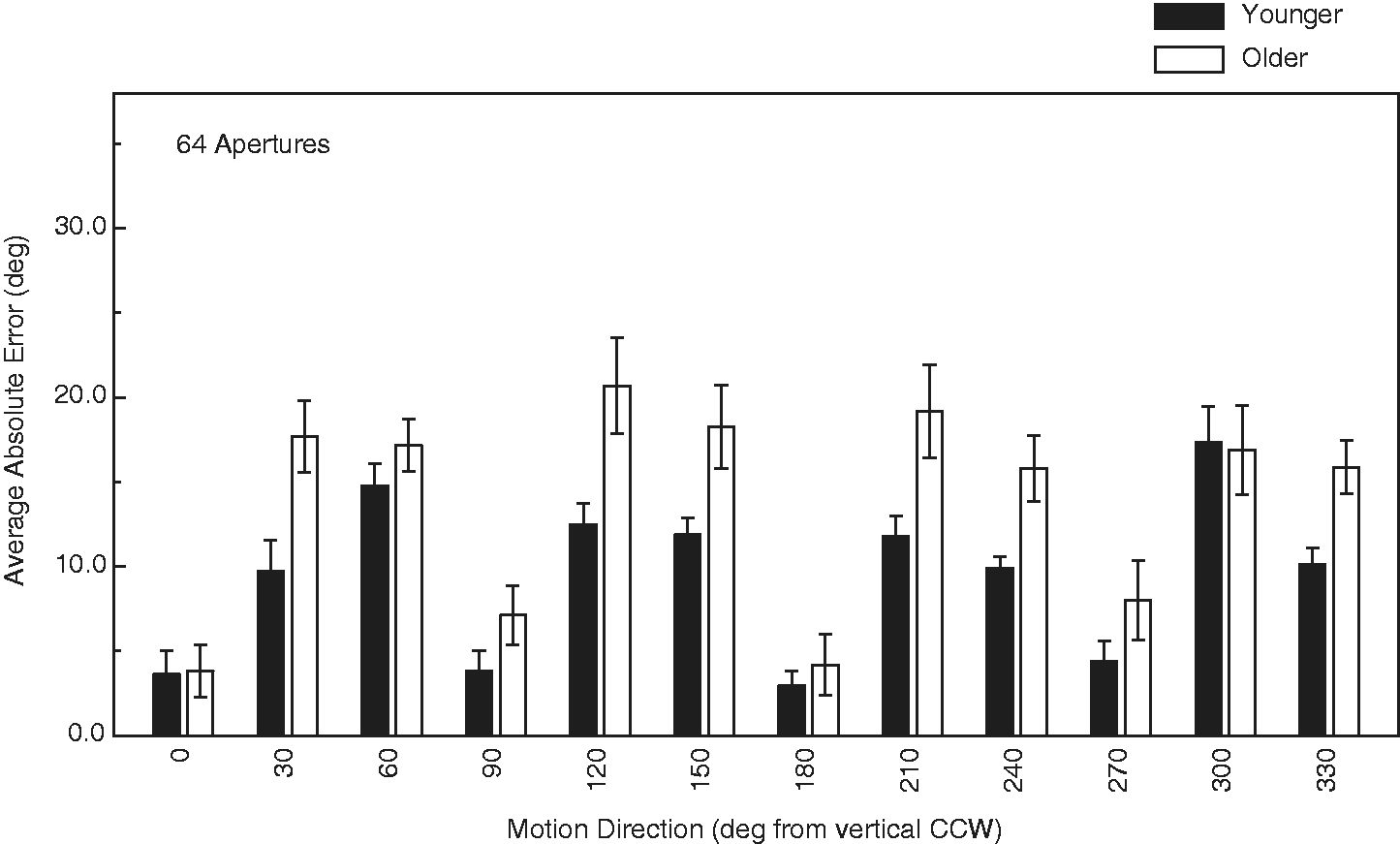
Additional Analyses Involving Global Motion Direction (Oblique Effect and Horizontal Versus Vertical
Ball and Sekuler (1986) investigated motion direction discrimination and found a superiority for discriminating motion direction deviations from cardinal directions (up, down, left, right); motion direction deviations from oblique directions (directions oriented 45° away from cardinal) were less discriminable. Given that we investigated (in this study) every possible motion direction in the fronto-parallel plane in 30° steps, we wondered whether the oblique effect documented by Ball and Sekuler (also see Gros, Blake, & Hiris, 1998; Krukowski, Pirog, Beutter, Brooks, & Stone, 2003; Loffler & Orbach, 2001) would extend to our task of motion direction estimation. To that end, we compared the average absolute errors made by our observers for cardinal directions (0°, 90°, 180°, and 270° counterclockwise (CCW) from vertical up) with those errors for oblique directions (30°, 60°, 120°, 150°, 210°, 240°, 300°, and 330°). Those average absolute errors are plotted in Figure 9 for the younger and older observers. A 2 (age) × 2 (apertures) × 2 (direction types: cardinal and oblique) ANOVA was conducted upon the observers’ absolute errors. There were significant main effects of apertures, F(1, 30) = 59.7, p < .000001; Overall results of the younger (left panel) and older (right panel) observers. The observers’ average absolute errors (in degrees) are plotted as functions of the motion direction type (cardinal vs. oblique) and number of apertures. The error bars indicate ± 1 SE.
In previous research, Pilz et al. (2017) found an age-related effect for discriminations of motion direction away from different cardinal directions (up vs. right). In particular, older observers exhibited no deficit when making discriminations relative to upwards motion, but they were deficient in performing discriminations relative to rightwards motion. It is important to keep in mind that in the experiment of Pilz et al., each individual observer judged stimuli with individually determined amounts of motion coherence; it is nevertheless true that older adults exhibited a deterioration in performance for horizontal directions relative to younger adults. We wondered whether a similar asymmetry occurred with regard to the current task of motion direction estimation. Figure 10 accordingly plots our younger and older observers’ average absolute errors in direction estimation for upwards and rightwards motion; the younger and older observers performed similarly for upwards motion (black bars), but the older observers clearly performed worse (i.e., exhibited larger errors) for rightwards motion (white bars). Not surprisingly, a 2 (age) × 2 (apertures) × 2 (direction: upwards vs. rightwards motion) ANOVA demonstrated that the Age × Direction interaction shown in Figure 10 was significant, F(1, 30) = 8.4, p = .007; Overall results (average absolute errors, in degrees) of the younger and older observers for upwards (black bars) and rightwards (white bars) motion. The error bars indicate ± 1 SE.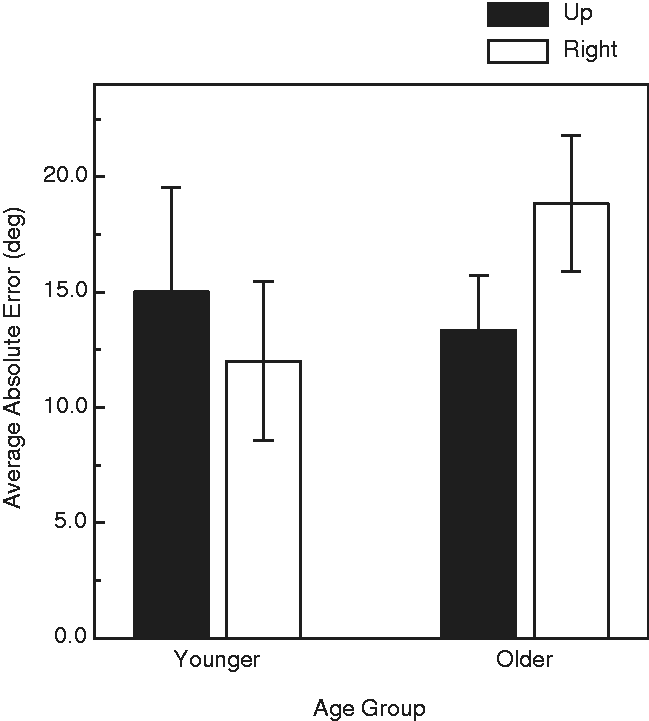
Discussion
In this study, we evaluated the ability of younger and older adults to estimate motion direction for many different directions in the fronto-parallel plane (covering the entire 360°, in 30° steps). Most of the past experiments investigating the potential effects of aging upon motion perception have used a limited set of stimulus directions. Many studies have utilized translations to the left and right (e.g., Atchley & Andersen, 1998; Billino et al., 2008; Gilmore et al., 1992; Roudaia et al., 2010). Others have included motions in a vertical direction, in addition to horizontal directions (e.g., Pilz et al., 2017; Trick & Silverman, 1991). Only a few studies have investigated both cardinal and oblique directions (e.g., Ball & Sekuler, 1986; Bennett et al., 2007). While Bennett et al. did include both cardinal and oblique motion stimuli in their experiment, when their observers’ average absolute errors were calculated, the results were collapsed across all stimulus directions; we do not know, therefore, whether an oblique effect (e.g., see the current Figure 9) was present in their results. Ball and Sekuler did document the presence of a strong oblique effect (Ball & Sekuler, 1986, pp. 178–179) for motion direction discrimination. Interestingly, however, they found that the magnitude of the observed oblique effect was similar (not significantly different) for both younger and older adults. Our current findings for motion direction estimation were comparable: while we did find an overall adverse main effect of age, the magnitude of the obtained oblique effect (Figure 9) was quite similar for younger and older adults (i.e., there was No Age × Direction Type interaction).
As we have seen, past research has often investigated the effects of aging upon the perception of translational motion (Atchley & Andersen, 1998; Ball & Sekuler, 1986; Bennett et al., 2007; Billino et al., 2008; Gilmore et al., 1992; Pilz et al., 2017; Roudaia et al., 2010; Trick & Silverman, 1991). It is interesting that our current results (Figure 10) appear to confirm the recent findings by Pilz et al. (2017) of age-related asymmetries in the perception of horizontal and vertical motion. Nevertheless, our current research is fundamentally different than that conducted in the past. In the earlier studies, the younger and older observers typically judged the motion direction of signal dots that were embedded in a background of randomly moving dots. Since all of these previous studies used stimulus displays consisting of moving dots (whose individual motion direction is not ambiguous), they were not subject to the aperture problem (see Figure 1). Successful vision and motion recovery in natural environments (where extended object contours abound) requires the solution to the aperture problem (e.g., Adelson & Movshon, 1982; Braddick, 1993; Burr & Thompson, 2011; Ferrera & Wilson, 1990; Gilbert, 2013, pp. 609–613; Hildreth & Koch, 1987; Mingolla et al., 1992; Pack & Born, 2001). This is because many environmental object contours are large relative to the small receptive field sizes of motion-sensitive neurons in early levels of the visual system. In order to derive an unambiguous estimate of motion direction, the visual system must integrate (across space, see Figure 1) many ambiguous local motion signals (e.g., Adelson & Movshon, 1982; Amano et al., 2009; Mingolla et al., 1992; Weiss, Simoncelli, & Adelson, 2002; Wilson et al., 1992). In this study, we have shown that while there are significant effects of increased age (Figures 5, 8–10), the older visual system is still capable of the effective integration across space that is needed to perceive coherent global motion (Figures 4 and 6). Given that this study is the only one to date that has evaluated the ability of older adults to perceive motion direction from sets of locally ambiguous motion signals, it fills a void in the scientific literature devoted to aging and the perception of motion direction.
In this study, we required observers to estimate global motion direction from sets of locally ambiguous motion signals spread across space. We knew from previous research (Mingolla et al., 1992) that 64 motion signals (or apertures) were sufficient to produce compelling perceptions of global motion. As a part of this study, we decided to see if compelling perceptions of global motion (with the resulting ability to accurately judge global motion direction) could occur with drastic reductions in the number of motion (signals or apertures); we therefore included a condition where we reduced the number of motion signals (or apertures) by a severe 86% (i.e., the number of apertures was reduced from 64 to only 9). At the same time, we wanted to obtain the best possible estimates of our observers’ abilities. As described earlier in the method section, we therefore deliberately decided for our participants to begin their judgments with the 64-aperture stimuli, where the global perceptions of motion were phenomenally most compelling and to judge the nine-aperture experimental stimuli afterwards. It is theoretically possible that our observers could become fatigued and perform worse for the nine-aperture stimuli simply because those stimulus displays were judged last. We believe that this possibility is most unlikely. In the past (e.g., see Ball & Sekuler, 1986; Norman et al., 2014), older observers have performed as many as 600 to 900 judgments in a single day (or session) and did not become fatigued. In this study, each observer made only a total of 120 judgments and this took only an average of about 20 to 25 minutes. We therefore believe that the detrimental effects of the reductions in the number of apertures (see Figures 4–9) were due solely to the reductions in the number of motion signals available for the visual system to estimate the global direction of pattern motion.
It is true that sizeable directional anisotropies exist in the perception of motion direction (e.g., Ball & Sekuler, 1986, Pilz et al., 2017, also see Figures 6 and 9). Nevertheless, the current results indicate that human observers retain an effective ability to perceive motion direction well into their later years—indeed, we found in this study that about 93% of the variation in older observers’ judged global motion direction can be accounted for by variations in actual global motion direction (Pearson r2 = .931).
Conclusion
Aging, stimulus direction of motion (cardinal vs. oblique), and the number of apertures all influence the ability to estimate global direction of motion from a set of ambiguous motion signals.
Footnotes
Declaration of Conflicting Interests
The author(s) declared no potential conflicts of interest with respect to the research, authorship, and/or publication of this article.
Funding
The author(s) received no financial support for the research, authorship, and/or publication of this article.