







Abstract
Perception of possibilities for behavior reflects the task-specific fit between action capabilities and environmental properties. We investigated whether this is so for a behavior that requires spontaneously and temporarily coordinating anatomical components and inert objects into a person-plus-object action system—stepping over an expanse with crutches. We found that perception of this affordance (a) scaled to an anthropometric property of primary relevance to performing this behavior (leg length), (b) reflected the ability to perform this behavior, and that (c) variability in perception decreased with practice perceiving this affordance. The results are consistent with the proposal that perceiving affordances for a given behavior requires assembling a task-specific perceptual instrument.
Affordances are possibilities for behavior emerging from the task-specific fit between action capabilities and environmental properties (Gibson, 1979/2015). Perception of affordances for a given behavior reflects this fit—Perceivers are generally sensitive to the boundary at which they must transition from one mode of performing a given behavior (e.g., stepping over an expanse) to another (e.g., leaping) (Day, Wagman, & Smith, 2015).
Importantly, there are a multitude of means by which to perform any given behavior. A person might traverse an expanse by stepping, hopping, leaping, crawling, or swinging. Performing such behaviors requires flexibly and temporarily assembling a task-specific device capable of achieving the behavioral goal (Kugler & Turvey, 1987/2015). In some cases, doing so requires spontaneously and temporarily coordinating anatomical and inert components into a person-plus-object action system. A person might also traverse an expanse by means of a prosthetic limb, platform shoe, crutch, pogo stick, or wheelchair.
Flexibility in performing behaviors can only be supported with analogous flexibility in perceiving affordances for such behaviors. Doing so requires spontaneously and temporarily assembling a task-specific perceptual instrument capable of detecting stimulation patterns informative about such affordances (Carello, Fitzpatrick, Domaniewicz, Chan, & Turvey, 1992). Accordingly, perception of affordances reflects the task-specific fit between action capabilities and environmental properties even for behaviors that require coordinating anatomical and inert components into a person-plus-object action system. For example, perceivers are sensitive to the minimum passable aperture width when an object is attached to their bodies (Franchak & Adolph, 2014; Higuchi, Cinelli, Greig, & Patla, 2006; Stoffregen, Yang, Giveans, Flanagan, & Bardy, 2009), and perceivers are sensitive to the maximum expanse that they could swing (i.e., launch themselves) across using their arms on “monkey bars” (Cole, Chan, Vereijken, & Adolph, 2013).
We attempted to generalize the latter findings to perception of affordances for a behavior that is, to some extent, the lower body equivalent of swinging with the arms—stepping (i.e., swinging) over with crutches. We expected that, despite the “on the spot” assembly of the required task-specific perceptual instrument, perceived maximum step-with-crutches distance would reflect the task-specific fit between action capabilities and environmental properties and would thus scale to an anthropometric property of primary relevance to performing this task—leg length. We expected that perceived maximum step-with-crutches distance would occur at longer distances for participants with long legs than with short legs but at the same ratio of perceived-maximum-step-with-crutches-distance-to-leg-length for both groups (cf. Carello, Grosofsky, Reichel, Solomon, & Turvey, 1989). Moreover, we expected that perceived maximum step-with-crutches distance would reflect the actual ability to perform this behavior.
Participants (N = 32) were fitted with crutches, stood on their preferred foot at one end of a mat, and reported maximum step-with-crutches distance by instructing the experimenter to adjust the distance of a remote-controlled toy car along a track adjacent to the mat (Figure 1(a)). “Step-with-crutches” was defined as placing both crutches at some distance from the body, shifting the body weight from preferred foot to crutches, swinging the body and preferred foot forward, landing on the preferred foot, and standing upright on the preferred foot and crutches, coming to a full stop and without falling over. The car was moved toward and away from the participant on 12 alternating trials.
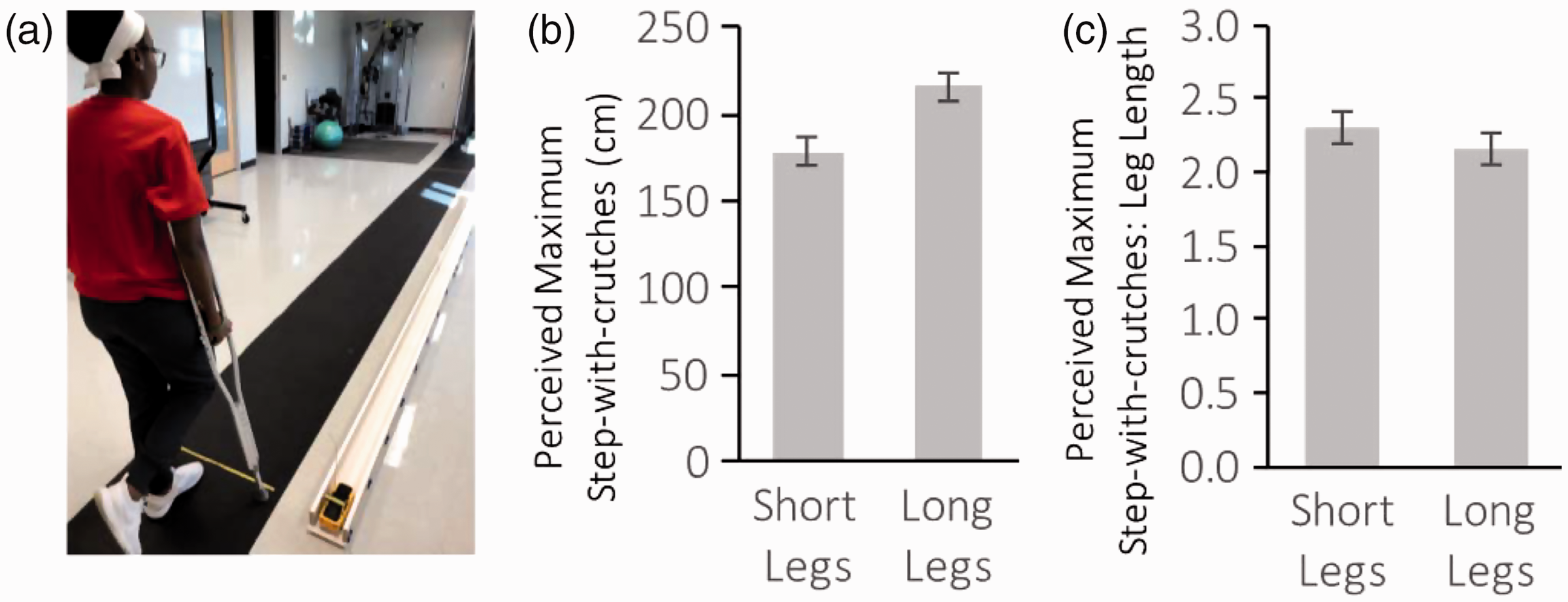
(a) The experimental set up, (b) perceived maximum step-with-crutches distance, and (c) perceived-maximum-step-with-crutches-distance-to-leg-length for both groups.
Given that participants were not recruited on the basis of extreme anthropometric properties (cf. Carello et al., 1989), we compared the quartile of participants with the longest legs (n = 8, the Long Leg Group) to the quartile with the shortest legs (n = 8, the Short Leg Group). As expected, mean perceived maximum step-with-crutches distance was longer for Long (M = 215.5 cm, SD = 24.8 cm) than for Short Leg (M = 177.8 cm, SD = 22.9 cm) groups, t(14) = 3.16, p < .01, Cohen’s d = 1.57 (see Figure 1(b)), and ratios of perceived-maximum-step-with-crutches-distance-to-leg-length did not differ across groups (Long: M = 2.15, SD = .32; Short: M = 2.31, SD= .31), t(14) = 1.02, p = .33, Cohen’s d = 0.51 (see Figure 1(c)). Moreover, ratios of mean-perceived step-with-crutches distances-to-actual-step-with-crutches distances also did not differ for Long (M = .99, SD = .08) and Short Leg (M = 1.03, SD = .13) groups, t(14) = .817, p = .43, Cohen’s d = 0.37, nor did these ratios (collectively) differ from 1.0, t(15) = .56, p = .59, Cohen’s d = .14.
Next, linear regression analyses (using data from all participants) found that leg length accounted for a small but significant amount of variance in perceived maximum step-with-crutches distance (r2 = .12, p < .05) but no variance in ratios of perceived-maximum-step-with-crutches-distance-to-leg-length (r2 = 0.02, ns). Finally, variability (i.e., variable error) decreased from the first (M = 11.1 cm) to second half (M = 7.5 cm) of trials, t(31)= 4.49, p < .001, Cohen’s d = 0.83, while accuracy (i.e., absolute error) remained unchanged (first = 23.7 cm; second = 23.1 cm), t(31) = 0.44, ns, Cohen’s d = .08.
Despite the “on the spot” assembly of the required task-specific perceptual instrument, perceived maximum step-with-crutches distance reflected the task-specific fit between action capabilities and environmental properties. Perceived maximum step-with-crutches distance both (a) scaled to leg length and (b) reflected the actual ability to perform this behavior. As expected, perception of affordances for this behavior reflected the action capabilities of a task-specific person-plus-object action system. Moreover, variability decreased with practice performing the perceptual task.
The results are consistent with the proposal that perceiving affordances for a given behavior requires spontaneously and flexibly assembling a task-specific perceptual instrument and that mere use of such an instrument may be sufficient to tune that instrument (Stoffregen et al., 2009). A task in which there is an obstacle and/or action consequences is an important topic for future research. The results are also consistent with the proposal that a given affordance is perceived as an emergent, complex particular rather than inferred, constructed, or computed by combining perceptions of lower order properties (Thomas & Riley, 2014).
Footnotes
Acknowledgement
We thank Vince Cialdella for help with data collection.
Declaration of Conflicting Interests
The author(s) declared no potential conflicts of interest with respect to the research, authorship, and/or publication of this article.
Funding
The author(s) received no financial support for the research, authorship, and/or publication of this article.