







Abstract
Of the many effects that eye contact has, perhaps the most powerful is the stare-in-the-crowd effect, wherein faces are detected more readily when they look directly toward you. This is commonly attributed to others’ eyes being especially salient visual stimuli, but here we ask whether stares-in-the-crowd might arise instead from a deeper property that the eyes (but not only the eyes) signify: the direction of others’ attention and intentions. In fact, even simple geometric shapes can be seen as intentional, as when numerous randomly scattered cones are all consistently pointing at you. Accordingly, we show here that cones directed at the observer are detected faster (in fields of averted cones) than are cones averted away from the observer (in fields of directed cones). These results suggest that perceived intentionality itself captures attention—and that even in the absence of eyes, others’ directed attention stands out in a crowd.
One of the most striking things that we can perceive is the direct gaze of another person—as when we are eating in a restaurant and suddenly notice that someone across the room is staring right at us (yikes!). Such direct gaze cues have profound influences on many aspects of our mental lives (for a review see Emery, 2000). For example, we remember people better when they are looking at us (e.g., Mason et al., 2004); we see faces making eye contact as more competent (e.g., Wheeler et al., 1979); and faces with direct gaze also elicit increased mimicry during conversations (e.g., Wang et al., 2011). But perhaps the most fundamental way in which eye contact influences us is simply that we detect it so readily in the first place: direct gaze (in contrast to averted gaze) captures our attention (e.g., Böckler et al., 2014; Miyazaki et al., 2012; Senju & Hasegawa, 2005) from the very first few days of life (e.g., Farroni et al., 2002), and even when it is not consciously perceived (e.g., Chen & Yeh, 2012; Rothkirch et al., 2015; Stein et al., 2011).
Perhaps the most powerful demonstration of attention capture by direct gaze is the stare-in-the-crowd effect, wherein a face staring at the observer (surrounded by faces looking away) is detected faster than a face looking away (surrounded by faces staring at the observer; Conty et al., 2006; Doi & Ueda, 2007; Doi et al., 2009; Framorando et al., 2016; Palanica & Itier, 2011; Shirama, 2012; von Grünau & Anston, 1995; cf. Cooper et al., 2013). This visual-search advantage for stares has been attributed to “special physiological mechanisms for the processing of straight-gaze stimuli” (von Grünau & Anston, 1995, p. 1312) or a “face detection system [. . .] using contrast information between the circular dark iris and the white sclera” (Palanica & Itier, 2011, p. 13).
Direct gaze is important, however, not because of what it signals about the eyes per se, but because of what it signals about the deeper properties of other agents: where they are attending, and perhaps what their intentions are. For example, we typically look at people we are listening to (Foulsham et al., 2010), or objects we desire (King et al., 2011), or the locations we are about to act on (Ballard et al., 1997). So might the stare-in-the-crowd effect not be specific to the eyes after all? Might it instead reflect a more general effect on the efficiency of visual search of a broader class of cues related to agents’ attention and intentions?
Here we employed a standard stare-in-the-crowd task (Senju et al., 2005; Experiment 1), but we replaced the faces with directed cone stimuli that in no way resemble eyes—but which are nonetheless readily seen as facing toward or away from the observer (see Figure 1A and B). Of course it might initially seem odd to talk about directed cones as reflecting intentions, since after all one can easily tell from their shapes that they are not biological entities at all. Nevertheless, we speculate that the coordinated orientations of many such stimuli may in fact serve as a powerful cue to the presence of agency. Imagine walking down a forest trail and suddenly noticing that a single tree branch is pointing right at you; this would in no way signal the presence of an agent, since it could just be a coincidence. (In a dense forest with many branches, surely some just happen to be pointing at you.) Similarly, imagine that you come upon some flowers all of whose stems are pointing in the same direction (e.g., toward the east); this also would not suggest the presence of an agent, since these uniform orientations might just reflect the operation of an external factor (perhaps a strong wind). But now imagine walking in the forest and suddenly noticing that while all of the branches on the surrounding trees are pointing in different absolute directions, they are nevertheless all pointing directly at you. This sort of stimulus cannot be due to a simple coincidence; such arrangements thus signal the presence or action of an agent, and have several downstream effects that are social in nature (e.g., Gao et al., 2010; Takahashi et al., 2013). (This principle is especially apparent in the sculptures of the renowned British land artist Andy Goldsworthy, who re-arranges materials found in natural environments in a way that readily suggests the presence of a designer; see for examples “Hole covered with small pointed rocks” [https://www.goldsworthy.cc.gla.ac.uk/image/?id=ag_01380&t=1] or “Woven branch circular arch” [https://www.goldsworthy.cc.gla.ac.uk/image/?id=ag_03744&t=1]. Indeed, one of the factors that makes such artwork so striking is the stark contrast between the nonagentic materials and the agentic arrangements.)
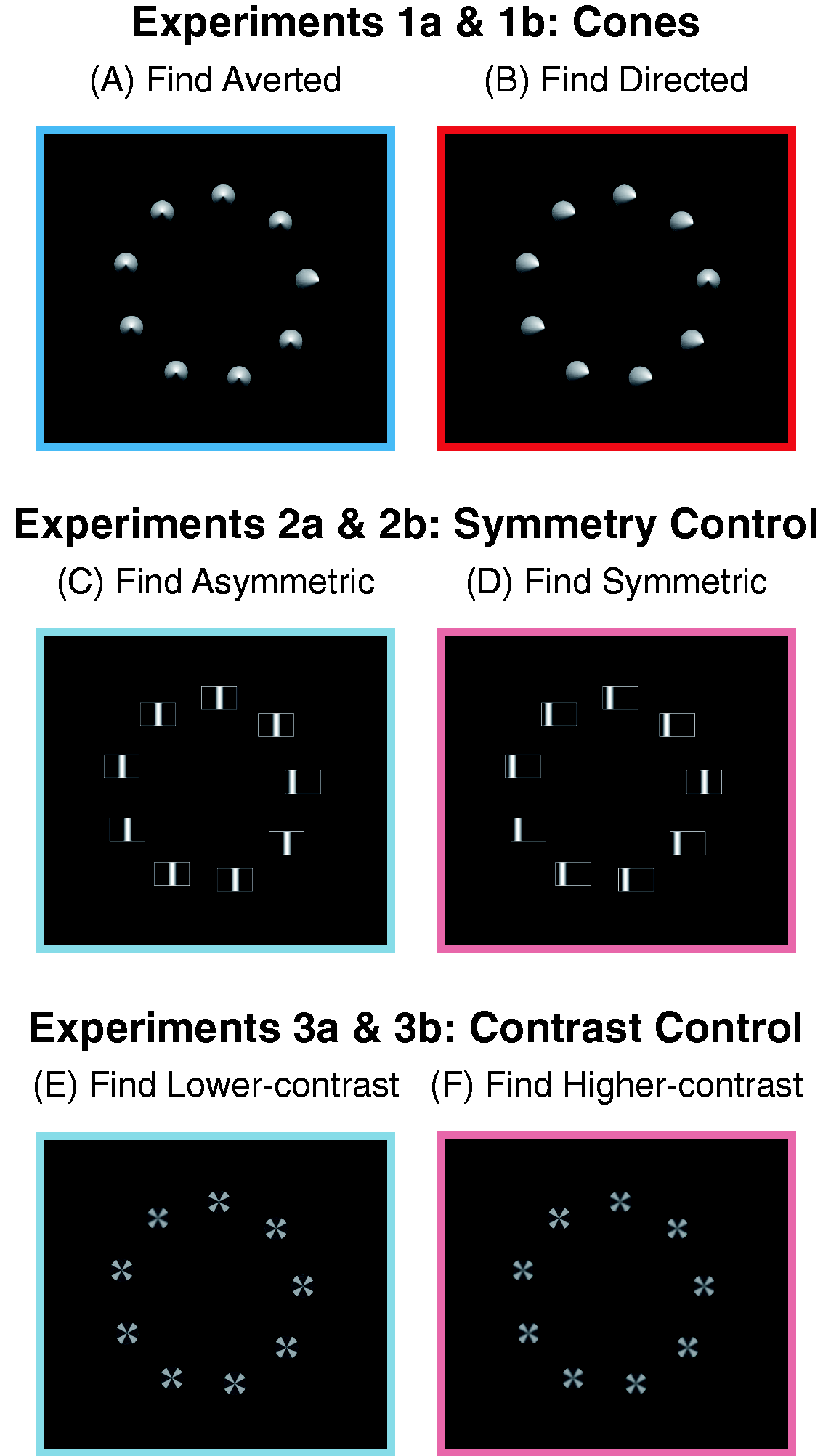
Sample Displays From Target-Present Trials of Each Experiment. A: A sample display from Experiments 1a and 1b in which observers must find an averted target in a field of directed cones. B: A sample display from Experiments 1a and 1b in which observers must find a directed target in a field of averted cones. C: A sample display from Experiments 2a and 2b in which observers must find an asymmetric target in a field of symmetric poles. D: A sample display from Experiments 2a and 2b in which observers must find a symmetric target in a field of asymmetric poles. E: A sample display from Experiments 3a and 3b in which observers must find a lower contrast target in a field of higher contrast pinwheels. F: A sample display from Experiments 3a and 3b in which observers must find a higher contrast target in a field of lower contrast pinwheels.
Given that coordinated-orientation stimuli may signal the presence of agency, we predicted that such stimuli might also give rise to stare-in-the-crowd effects—despite the absence of eyes.
Experiment 1a: Staring Without Eyes?
Following Senju et al. (2005, Experiment 1), observers viewed circular arrays of cones, and simply had to detect either an averted cone (in a field of directed cones) or a directed cone (in a field of averted cones), as depicted in Figure 1A and B, respectively.
Method
Observers
Ten members of the Yale community (with an average age of 22.4 years) participated in exchange for monetary compensation. This sample size was determined before data collection began (arbitrarily rounded up from the sample of eight in Senju et al., 2005) and was fixed to be identical for each of the four studies reported here.
Apparatus
Stimuli were presented on a Dell M992 CRT monitor with a 75 Hz refresh rate, using custom software written in Python with the PsychoPy libraries (Peirce, 2007). Observers sat in a dimly lit room without restraint approximately 60 cm from the display, which subtended 33.57°×25.49°; all visual extents reported below were computed based on this viewing distance.
Stimuli and Procedure
Each trial began with a central white fixation cross (0.60°×0.60°) on a black background for 500 ms, followed by a display depicting an array of gray cones (see Figure 1A and B). Each cone was rendered in Blender (Blender Foundation, version 2.76) with simulated point lighting from above and a simulated camera directly in front of it, with the resulting stimuli matched for mean luminance using the SHINE toolbox in MATLAB (MathWorks, version R2017a). As depicted in Figure 1A, directed cones thus had their points directly in the middle of their bounding circular bases, with a three-dimensional appearance due to the simulated lighting. These cones were then rotated in Blender such that the resulting Averted stimuli (see Figure 1B) had their points directly on the perimeter of their bounding circular bases. Each display included either five or nine cones subtending 1.94°×1.94° each, and arranged on equidistant points of an imaginary circle (centered in the display) with a diameter of 16.73° (with one of the cones always present at 45°).
On half of trials, observers searched for an averted cone among directed cones (Find Averted; Figure 1A), and on the other half of trials they searched for a directed cone among averted cones (Find Directed; Figure 1B)—with the target present on half of the trials of each type, and the target absent on the remaining half (i.e., with all cones directed in Find Averted trials, and all cones averted in Find Directed trials). Observers indicated whether the target was present or not by pressing one of two keys. Upon response, feedback then appeared on the screen (“Good job!” or “—”) for 500 ms—and if a response was not made within 1.5 s, the trial ended, and a display appeared (for 5 s) reminding them to respond faster. The next trial then started after a 1 s blank delay.
Following Senju et al. (2005), each observer completed four blocks of trials (2 Target Orientations [Find Averted, Find Directed] × 2 Averted Directions [left, right]), presented in a different random order for each observer, and with the relevant target displayed prior to the beginning of each block. Each block consisted of 40 trials (2 Array Sizes [5/9] × 2 Correct Responses [present/absent] × 10 Repetitions), presented in a different random order for each observer. Observers completed four blocks (one of each type) of 20 practice trials each prior to the start of the experiment (in order to acquaint them with the task, the key mappings, the time pressure, and all trial types), and they completed eight additional practice trials at the beginning of each block (to entrain them to the new target)—the data for which were not recorded.
Results and Discussion
Trials in which observers failed to respond, responded inaccurately, or responded in less than 100 ms were discarded (with these exclusion criteria adopted directly from Senju et al., 2005). (This resulted in an average number of analyzed trials of 151.40 out of the possible 160.) As depicted in Figure 2A, responses were faster for Find Directed displays compared to Find Averted displays (0.64 vs. 0.75 s, t(9) = 3.85, p = .004, d = 0.79). We also categorized each response (excluding trials in which observers failed to respond) as a hit, miss, false alarm, or correct rejection, and then computed dʹ (a measure of sensitivity, as distinct from response bias; Green & Swets, 1966) for all conditions. As depicted in Figure 2C, sensitivity was higher for Find Directed displays compared to Find Averted displays (3.76 vs. 3.27, t(9) = 2.58, p = .030, d = 0.74). These initial results suggest that the stare-in-the-crowd effect may indeed not be specific to eyes.
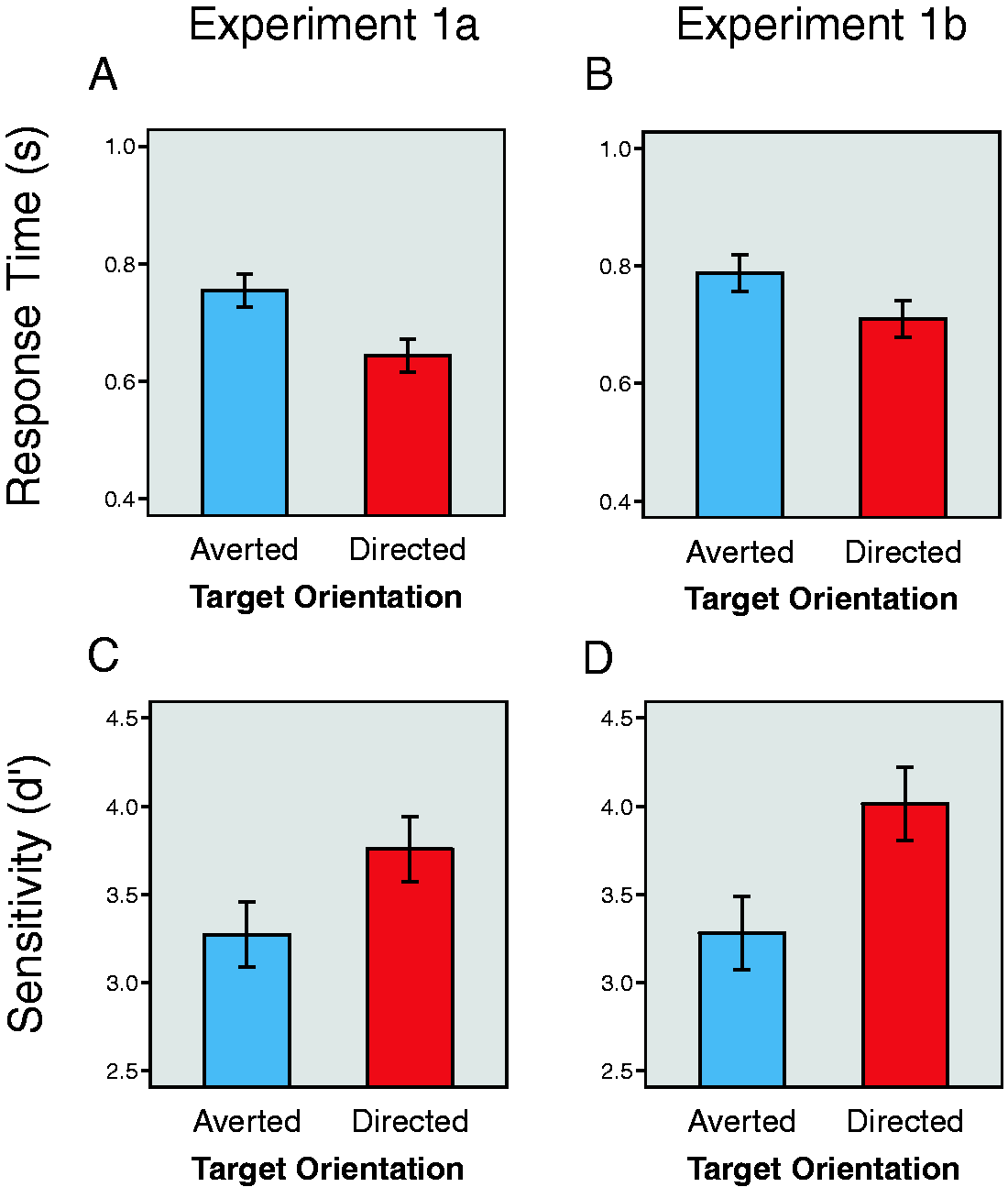
Results From Experiments 1a and 1b. A: Average response times for Find Averted versus Find Directed displays in Experiment 1a. B: Average response times for Find Averted versus Find Directed displays in Experiment 1b. C: Sensitivity (measured as d′) for Find Averted versus Find Directed displays in Experiment 1a. D: Sensitivity (measured as d′) for Find Averted versus Find Directed displays in Experiment 1b. Error bars reflect 95% confidence intervals, subtracting out the shared variance.
Experiment 1b: Direct Replication
Given the importance of direct replications, we reran the experiment on another group of 10 observers (Mage = 22.1), analyzing an average of 150.70 nonexcluded trials per observer. As depicted in Figure 2B, responses were again faster for Find Directed (compared to Find Averted) displays (0.71 vs. 0.79 s, t(9) = 2.46, p = .036, d = 0.68). And as depicted in Figure 2D, sensitivity was again higher for Find Directed (compared to Find Averted) displays (4.01 vs. 3.28, t(9) = 3.46, p = .007, d = 1.05).
Experiment 2a: Symmetry Control
The results of Experiment 1 suggest that stare-in-the-crowd effects might occur even for eye-less stimuli that may nevertheless convey a sense of directed attention or intention. However, our directed and averted stimuli also differed in another way that did not signal agency: might the directed cones have been more readily detected simply because they were more symmetric? To find out, we replicated Experiment 1, but now the cones were replaced with stimuli that retained the same differential symmetry but did not convey any directedness in the first place (as depicted in Figure 3A).
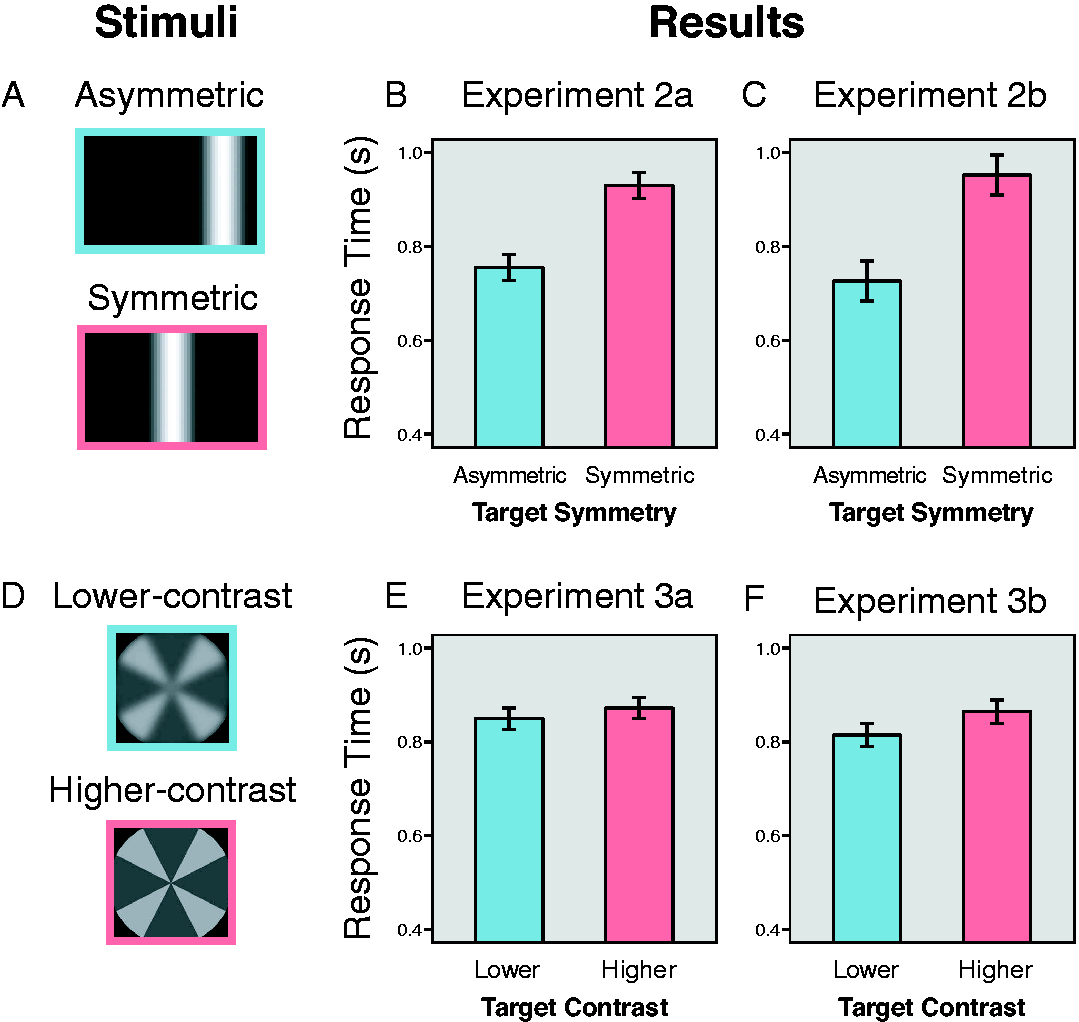
Stimuli and results from Experiments 2a, 2b, 3a and 3b. A: Asymmetric and symmetric targets employed in Experiments 2a and 2b. B: Average response times for Find Asymmetric versus Find Symmetric displays in Experiment 2a. C: Average response times for Find Asymmetric versus Find Symmetric displays in Experiment 2b. D: Lower- and Higher contrast targets employed in Experiments 3a and 3b. E: Average response times for Find Lower- versus Find Higher contrast displays in Experiment 3a. F: Average response times for Find Lower- versus Find Higher contrast displays in Experiment 3b. Error bars reflect 95% confidence intervals, subtracting out the shared variance.
Method
This experiment was identical to Experiments 1a and 1b, except as noted here. Ten members of the Yale community (Mage = 19.1) participated in exchange for course credit (with this sample size chosen to exactly match that of Experiments 1a and 1b). Instead of cones, each stimulus consisted of a horizontally oriented dark-gray rectangle (2.94° × 1.94°, with a 0.04° white border segmenting it from the darker background), with an inset vertical bar (0.78° wide). The bar’s center was colored white, with a continuous gradient from light to dark on either side of this vertical line. (Each bar appeared as a gradient in this way in order to match the sort of gradual shading and three-dimensional appearance employed in the cones from Experiment 1. Indeed, the extreme shades of this gradient were chosen to exactly the match the lightest and darkest regions of the cones.) For symmetric stimuli (Figure 3A, bottom), the vertical bar was horizontally centered in the rectangle; for asymmetric stimuli (Figure 3A, top), the bar was shifted (either to the left or right) by 0.91°. These displays thus consisted of clearly symmetric versus asymmetric patterns, but without any sense of directedness as in Experiment 1. (Due to the gradient of each bar, these stimuli also looked three-dimensional, but instead of a cone that was pointing in a specific direction, each bar simply appeared as a kind of vertical pole viewed through an aperture.)
Results and Discussion
We analyzed an average of 141.00 nonexcluded trials per observer. As depicted in Figure 3B, responses were faster for Find Asymmetric (compared to Find Symmetric) displays (0.76 vs. 0.93 s, t(9) = 6.29, p < .001, d = 1.87). Critically, this effect was significantly different (and of course was in the opposite direction) from those of both Experiment 1a (0.11 vs. –0.17 s, t(18) = 7.14, p < .001, d = 3.19) and Experiment 1b (0.08 vs. –0.17 s, t(18) = 6.00, p < .001, d = 2.68). Sensitivity (again computed as d′) was also higher for Find Asymmetric (compared to Find Symmetric) displays (3.89 vs. 2.34, t(9) = 6.47, p < .001, d = 2.32). And this effect was also significantly different (and again in the opposite direction) from those of both Experiment 1a (–0.48 vs. 1.54, t(18) = 6.68, p < .001, d = 2.99) and Experiment 1b (–0.73 vs. 1.54, t(18) = 7.13, p < .001, d = 3.19).
These results clearly indicate that the search advantage for directed (vs. averted) cones in Experiment 1 was unlikely to be due to their differential (a)symmetry. Indeed, if anything the current results suggest that Experiment 1 may have underestimated the magnitude of the stare-in-the-crowd effect with cones, since the brute effect of symmetry went so strongly in the opposite direction.
Experiment 2b: Direct Replication
Given the importance of direct replications, we reran the experiment on another group of 10 observers (Mage = 19.1), analyzing an average of 143.30 nonexcluded trials per observer. As depicted in Figure 3C, responses were again faster for Find Asymmetric (compared to Find Symmetric) displays (0.73 vs. 0.95 s, t(9) = 5.21, p < .001, d = 2.04). Critically, this effect was significantly different (and again in the opposite direction) from those of both Experiment 1a (0.11 vs. –0.23 s, t(18) = 6.47, p < .001, d = 2.89) and Experiment 1b (0.08 vs. –0.23 s, t(18) = 5.66, p < .001, d = 2.53). Sensitivity (again computed as d′) was also again higher for Find Asymmetric (compared to Find Symmetric) displays (3.96 vs. 2.37, t(9) = 12.26, p < .001, d = 3.01). And this effect was also significantly different (and again in the opposite direction) from those of both Experiment 1a (–0.48 vs. 1.59, t(18) = 9.10, p < .001, d = 4.07) and Experiment 1b (–0.73 vs. 1.59, t(18) = 9.35, p < .001, d = 4.18).
Experiment 3a: Contrast Control
The Directed and Averted stimuli employed in Experiment 1 differed not just in their symmetry, but also in their contrast; might the directed cones have been more readily detected simply because of their higher contrast? To find out, we replicated Experiment 1, but now the cones were replaced with stimuli that had clearly differential contrast but did not convey any directedness in the first place, as depicted in Figure 3D.
Method
This experiment was identical to Experiments 1a and 1b, except as noted here. Ten members of the Yale community (Mage = 21.5) participated (with this sample size chosen to exactly match that of Experiments 1a, 1b, 2a, and 2b). Instead of cones, each stimulus consisted of a pinwheel (1.94°×1.94°), subdivided into four light-gray (base width: 0.58°) and four dark-gray (base width: 0.86°) alternating wedges (Figure 3D, bottom). For lower contrast stimuli, a global 0.06° Gaussian blur filter was applied (Figure 3D, top). These displays thus consisted of clearly higher- versus lower contrast patterns, but without any sense of directedness as in Experiment 1.
Results and Discussion
We analyzed an average of 131.60 nonexcluded trials per observer. As depicted in Figure 3E, response times for Find Higher Contrast versus Find Lower Contrast displays did not differ (0.87 vs. 0.85 s, t(9) = 0.99, p = .349, d = 0.12). Critically, this effect was significantly different from those of both Experiment 1a (0.11 vs. –0.02 s, t(18) = 3.60, p = .002, d = 1.61) and Experiment 1b (0.08 vs. –0.02 s, t(18) = 2.56, p = .020, d = 1.15). Sensitivity (again computed as d′) also did not differ between Find Higher Contrast and Find Lower Contrast displays (2.19 vs. 2.60, t(9) = 1.73, p = .117, d = 0.33)—and of course this effect was numerically in the opposite direction from that in Experiments 1a and 1b. And this effect was also significantly different from those of both Experiment 1a (–0.48 vs. 0.42, t(18) = 2.95, p = .009, d = 1.32) and Experiment 1b (–0.73 vs. 0.42, t(18) = 3.59, p = .002, d = 1.60).
These results clearly indicate that the search advantage for directed (vs. averted) cones in Experiment 1 was unlikely to be due to differential contrast.
Experiment 3b: Direct Replication
Given the importance of direct replications, we reran the experiment on another group of 10 observers (Mage = 21.4), analyzing an average of 135.30 nonexcluded trials per observer. As depicted in Figure 3F, responses for Find Higher Contrast versus Find Lower Contrast displays did not differ (0.86 vs. 0.81 s, t(9) = 1.97, p = .080, d = 0.26)—and this marginal effect was in the opposite direction from that in Experiment 1 (consistent with the idea that if anything, Experiment 1 may have underestimated the effect of perceived intentionality). Critically, this effect was significantly different from those of both Experiment 1a (0.11 vs. −0.05 s, t(18) = 4.19, p = .001, d = 1.87) and Experiment 1b (0.08 vs. −0.05 s, t(18) = 3.15, p = .006, d = 1.41). Sensitivity also did not differ between Find Higher Contrast and Find Lower Contrast displays (2.67 vs. 2.73, t(9) = 0.46, p = .657, d = 0.06). And this effect was also significantly different from those of both Experiment 1a (–0.48 vs. 0.06, t(18) = 2.34, p = .032, d = 1.05) and Experiment 1b (–0.73 vs. 0.06, t(18) = 3.14, p = .007, d = 1.40).
General Discussion
This study makes a simple but important point: the stare-in-the-crowd effect obtains not only with faces and eyes (as has been demonstrated in dozens of previous experiments) but also with directed cone shapes that appear to be facing you. (And since the effect vanished—or even reversed—with the control stimuli in both Experiments 2 and 3, it seems unlikely that this effect could merely reflect an influence of differential symmetry or contrast.) These cone stimuli are radically different from faces at the level of superficial visual features—and of course they are entirely eye-less, by design. But they nevertheless have one critical property in common: because of their coordinated orientations, the cones may also convey a sense of directed attention and intention. Accordingly, we conclude that the advantage of direct stares in visual search is not specific to eyes after all: it can also arise with staring shapes. 1 And this kind of empirical pattern might itself generalize even beyond visual search and the stare-in-the-crowd effect. Indeed, we may have been incorrectly limiting the scope of a much wider class of effects to only eye contact, when in fact they also generalize to other types of intentional cues. Based on the present results, for example, we suspect that effects of direct eye gaze on cognitive control (Conty et al., 2010) and working memory (Wang & Apperly, 2017) might similarly also arise with directed (but eye-less) shapes (for an example, see Colombatto et al., 2019). In other words, all of these kinds of effects of direct eye contact might instead reflect a more general phenomenon of mind contact.
Footnotes
Acknowledgements
The authors thank Julian Jara-Ettinger, Matt Jordan, Michael Lopez-Brau, Brynn Sherman, the members of the Yale Perception & Cognition Laboratory, and two anonymous reviewers for helpful conversations and/or comments on previous drafts.
Declaration of Conflicting Interests
The author(s) declared no potential conflicts of interest with respect to the research, authorship, and/or publication of this article.
Funding
The author(s) disclosed receipt of the following financial support for the research, authorship, and/or publication of this article: This project was funded by ONR MURI #N00014-16–1-2007 awarded to B. J. S.
