







Abstract
With the exception of super recognizers and forensic examiners, people make a surprising number of errors when deciding whether photographs of unfamiliar faces belong to the same person or different people. Training protocols designed to improve professionals’ (e.g., passport officers) performance often include photography. We evaluated the influence of life-time photography experience on the ability to distinguish matched versus mismatched face pairs. Expert photographers were not more sensitive to identity than hobbyists or novices—despite specializing in human subjects; Hobbyists were more liberal (more same responses) than Experts. We conclude that photography experience is not a route to expertise.
Barkeepers, passport officers, and cashiers are charged with a challenging task: Matching photos of unfamiliar faces or matching a photo to a live person. Within-person variability in appearance (e.g., changes in lighting, expression, make-up) coupled with similarity across faces (e.g., Natalie Portman and Keira Knightley) makes this task error-prone (Burton, 2013). Although trivial in some contexts (even perceived as positive by the minor who successfully uses a sibling’s ID), errors can have serious consequences in law and security. The discovery that passport officers are as error-prone as untrained undergraduates (White et al., 2014) sparked interest in improving individuals’ ability to distinguish between matched (photos of the same person) versus mismatched (photos of two people) face pairs.
Face matching tasks in the lab approximate checking photo-ID in applied settings. Signal detection theory is an ideal estimate of performance. Sensitivity (d′) accounts for both hits and false alarms (i.e., responding same on match and mismatched pairs, respectively) and criterion (c) accounts for response bias (Stanislaw & Todorov, 1999). Professional training protocols have been largely unsuccessful in increasing sensitivity to facial identity (Towler et al., 2019), increasing performance on match or mismatch trials, but not both (i.e., shifting c; Ritchie & Burton, 2017). One component of several training protocols is photography (Towler et al., 2019). The logic is that learning how photographic conditions alter appearance improves performance; photographers can manipulate lighting, viewpoint, and lenses to make someone look like a saint, criminal, or anything in between. This assumption is consistent with evidence that artistic ability is linked to unfamiliar face-matching performance (Devue & Barsics, 2016; Hsaio et al., 2021). We provide the first examination of whether photography experience provides effective training by examining whether life-time photography experience influences d′ and c.
Ninety-five Caucasian participants (Women: n = 58; MAge = 47.84, 1 SDAge = 17.02) completed 80 trials (50% match) of the Ambient Image Face Matching Task (AIFMT; Baker et al., under review). Images were obtained from the Face and Ocular Challenge Series (Phillips & O’Toole, 2014; Phillips et al., 2011) and Brock University’s Let’s Face It database. Images were ambient (incorporating natural variability in appearance) color photographs, photoshopped to have flat gray backgrounds, and cropped to 275 × 295 pix (See Figure 1).
After completing the AIFMT, participants indicated their photography experience on a 9-point scale: Novices(1−3; n = 28), Hobbyists(4−6; n = 33), and Experts(7−9; n = 33). Thirty in our Expert category self-identified as professional (Mexperience = 18 years); most specialized in human subjects (n = 21). Participants also indicated the extent to which they specialized in human subjects (e.g., faces, portraits) on a 9-point scale. A significant effect of photography group confirmed that Experts specialized in human subjects more than both Hobbyists and Novices, F(2,91) = 5.12, p = 0.008, η2 = 0.10, who did not differ from each other (p = 0.85).
A one-way ANOVA showed that d′ did not vary across groups, F(2,91) = 0.23, p = 0.79, η2 = 0.005. A Bayesian ANOVA (JASP (2021) default priors) confirmed that these data were more likely to occur with the null hypothesis (BF10 = 0.10). Consistent with our analyses of dʹ, Novices (M = 65.04%, SD = 9.64), Hobbyists (M = 66.10%, SD = 8.48), and Experts (M = 66.86%, SD = 9.01) did not differ in percentage correct, p = 0.74. The ANOVA for c was significant, F(2,91) = 4.33, p = 0.02, η2 = 0.09. A Bayesian ANOVA confirmed that these data were more likely to occur with the alternate hypothesis (BF10 = 3.01). Tukey’s HSD revealed that Novices did not differ significantly from the Hobbyists or Experts, ps > 0.19. Hobbyists were more liberal (i.e., made more same responses) than Experts, p = 0.01 (See Figures 2).
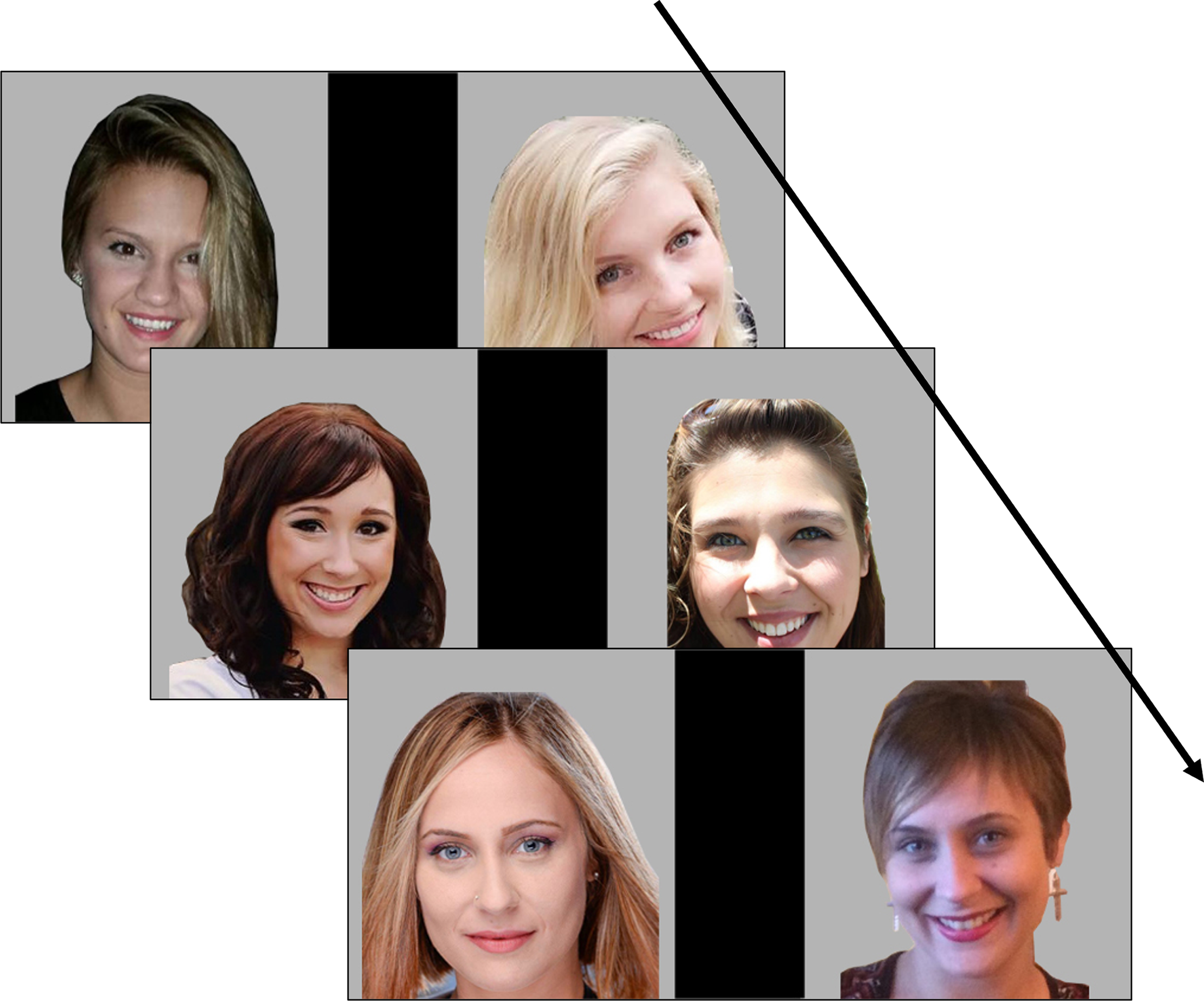
Depicts AIFMT trials.
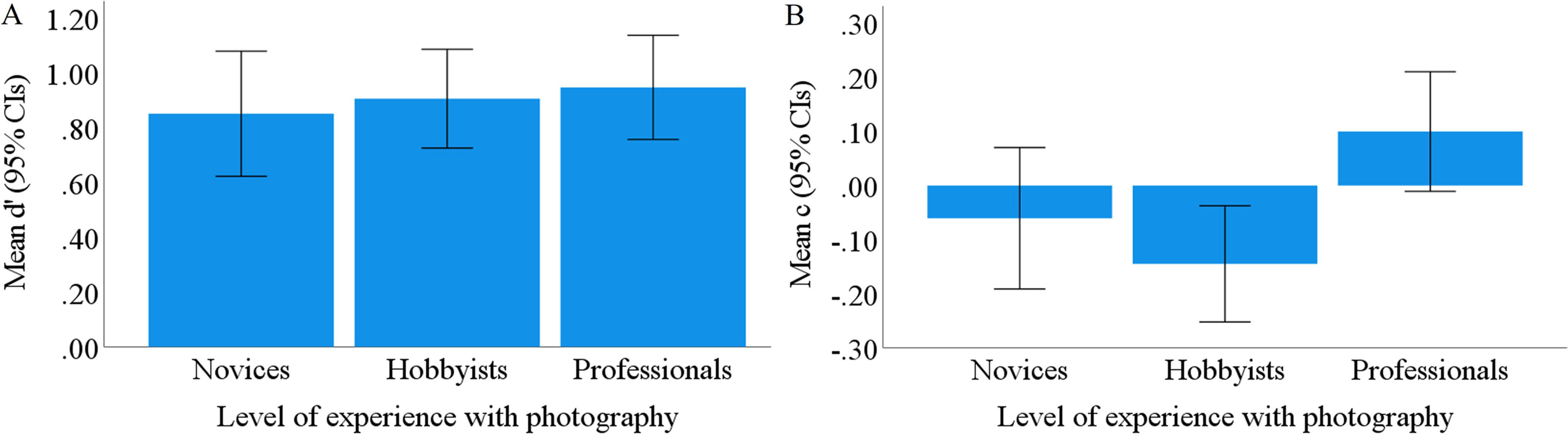
Mean d′ (A) and c (B) for Novices, Hobbyists, and Experts.
Photography experience changes the type, but not the number of errors. This aligns with evidence that performance is attributable to genetics (Wilmer, 2017) and early life experience (Balas & Saville, 2017), but is not easily shifted by experience beyond that gained by most adults (e.g., passport officers: White et al., 2014). Our finding that Hobbyists and Experts differed in response bias is similar to Towler et al.’s (2021) finding that super recognizers do not differ from forensic examiners in accuracy, but are more liberal in response bias. Hobbyists might be more liberal because they take multiple photos of the same people (e.g., friends, family) while manipulating lighting and perspective (see Alenezi & Bindemann, 2013 for evidence that feedback shifts criterion). Experts are more likely to take a few photos of many different people.
Future research should examine why individuals with artistic experience are more sensitive to identity (see Devue & Barsics, 2016; Hsaio et al., 2021) whereas Expert photographers are not. We suggest that the difference lies in process. Whereas artists create faces, painstakingly drawing the details of every feature, photographers’ capture face images in an instance. Artists might adopt a feature-based approach and/or a slow and serial process to face identification. Artists’ approaches might reflect innate skills that foster their artistic success or training, much like forensic examiners (Towler et al., 2021; White et al., 2015).
In summary, we provide evidence that expert photography experience does not improve sensitivity to identity. We recommend reconsidering the utility of including photography in training courses. We encourage practitioners and researchers to develop models of face identification to account for both sensitivity to identity and response bias. Capitalizing on stable individual differences in sensitivity to identity (e.g., see Baker et al., under review) is one route to improved face identification in applied settings; relying upon photography experience is not. Indeed, the local hobbyist might readily accept a higher number of fraudulent ID cards.
Footnotes
Acknowledgements
The authors thank Meryl Ochoa for help recruiting participants.
Declaration of Conflicting Interests
The authors declared no potential conflicts of interest with respect to the research, authorship, and/or publication of this article.
Funding
The authors disclosed receipt of the following financial support for the research, authorship, and/or publication of this article: This work was supported by an NSERC Discovery Grant awarded to CJM (412323).
