







Abstract
When intercepting moving targets, people perform slightly better if they follow their natural tendency to pursue the target with their eyes. Is this because the velocity is judged more precisely when pursuing the target? To find out, we compared how well people could determine which of two sequentially presented moving bars was moving faster. There was always also a static bar on the screen. People judged the moving bar's velocity about 10% more precisely when pursuing it than when fixating the static bar.
If people want to intercept a target, they are reluctant not to follow it with their eyes (Cámara et al., 2020). This is understandable because they can intercept a target that they are following with their eyes slightly more precisely (Brenner and Smeets, 2011). Is this because the target's velocity is judged more precisely when pursuing it with one's eyes? To find out, we used stimuli that consisted of two vertical black bars (2° by 0.2°), each with a red square at its centre. One of the bars was moving to the right while the other was static. We compared how precisely 12 participants (7 male) estimated the velocity of the moving bar when instructed to either fixate the red square on the static bar or pursue the red square on the moving one.
Participants sat 57 cm from a screen. The static bar appeared 5° above the screen centre. The moving bar (target) appeared at the same height and moved to the right for 1.3 s (Figure 1a). It appeared to the left of the static bar such that its displacement was symmetric with respect to the static bar. On every trial the participant saw two stimuli. The first was the standard stimulus, in which the moving bar moved for 1.3 s at 5, 10 or 20°/s. The second was the comparison stimulus, in which the moving bar moved for 0.8 s at a speed that was 10, 30 or 50% slower or faster than that of the preceding standard presentation. We used different presentation times for the standard and comparison to discourage participants from relying on duration or total displacement for their judgments. We did not vary them across trials because different values are likely to lead to different biases (Goldstein, 1957; Ryan and Zanker, 2001), which would contaminate the measured precision. Participants had to decide which of the two moving bars was faster by pressing ‘1’ or ‘2’ on a keyboard. We presented each standard velocity in a separate block and distributed the comparison velocities randomly within the blocks. Participants saw the same 360 pairs of stimuli (in a different random order) in two sessions. The only difference between the sessions was whether participants were instructed to fixate the static bar (Fixation) or follow the moving bar with their gaze (Pursuit). We counterbalanced the order of the sessions across participants. The Scientific and Ethical Review Board of the Faculty of Behavioural and Movement Science at VU University approved the study.
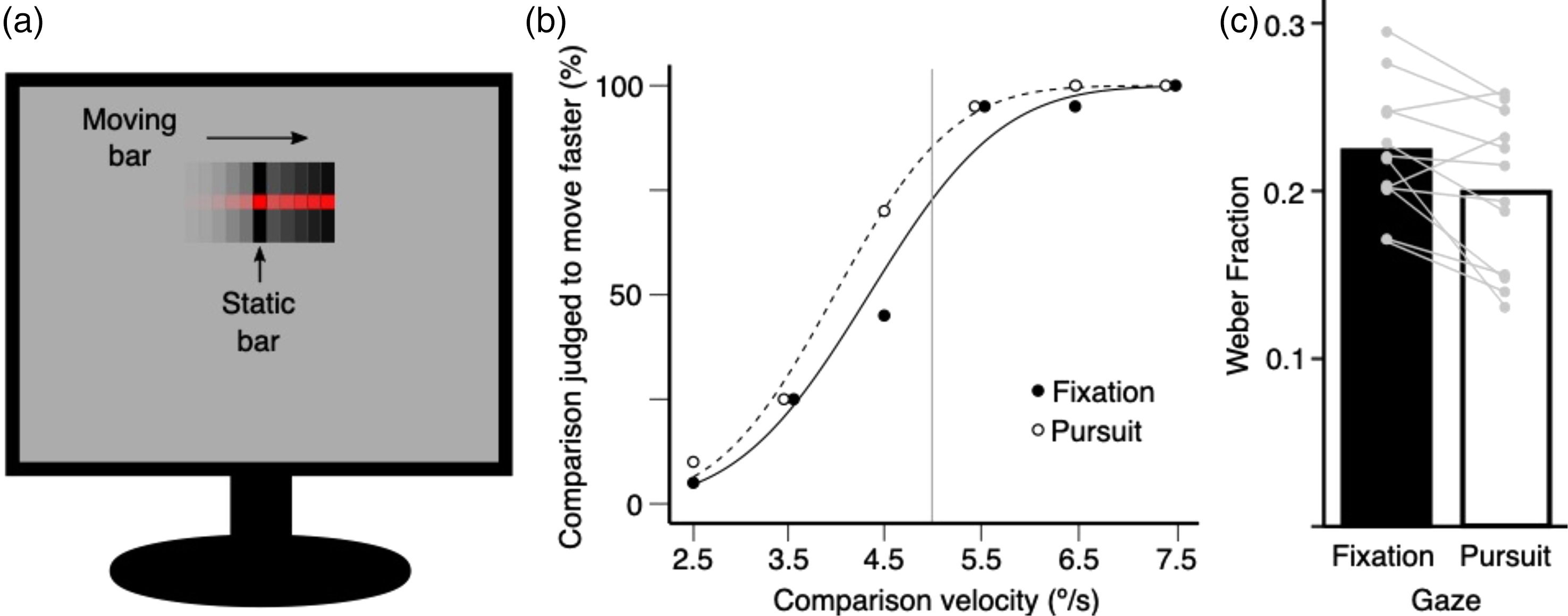
(a) schematic representation of a stimulus. Participants fixated the red square on either the static or the moving bar and judged the speed of the latter. (b) Example of results for one standard velocity (5°/s; vertical line) and participant. Dots indicate the percentage of trials in which the comparison was judged to move faster than the standard. The curves are fit cumulative normal distributions. In this example, judgments were more precise (steeper slope; smaller standard deviation of the fit distribution) when pursuing the moving bar (white dots and dashed curve) than when fixating the static bar (black dots and continuous curve). (c) Individual mean Weber fractions for judging target velocity (grey dots) and their average (bars) when fixating the static bar or pursuing the moving target.
We fit cumulative Gaussian distributions to the fraction of trials in which the comparison bar was judged to move faster than the standard bar for each speed of the comparison bar (Figure 1b). We did so for each participant and standard velocity. The means of the fit Gaussian distributions provide estimates of the points of subjective equality. We divided the standard deviations of the fit Gaussian distributions by the corresponding means to obtain Weber fractions for judging velocity. We then averaged these Weber fractions across the three standard speeds. We used a one-sided paired t-test to test our hypothesis that participants were consistently more variable when fixating the static bar than when pursuing the moving one.
The mean Weber fraction was clearly larger when fixating the static bar (0.22 ± 0.01; mean ± SEM) than when pursuing the moving one (0.20 ± 0.01; t11 = 2.75, p = 0.009; Figure 1c). Following the moving bar with their eyes improved the precision with which participants judged the moving target's velocity by about 10%. If retinal and extra-retinal information are combined to maximize precision, the precision of the extra-retinal information that is only available during pursuit would have to be about half that of the retinal information (the relative motion that was matched in the two conditions) to obtain the observed improvement. This is consistent with the average difference that was found by Freeman et al. (2010) for isolated extra-retinal and retinal precision. In interception, the benefit of pursuing the target seems to be larger: the temporal precision was almost halved for perfect pursuit in comparison with perfect fixation (Brenner and Smeets, 2011). Psychophysical studies may underestimate the difference in precision in judging velocity because of the need to remember the velocity, and because the presentation duration and total target displacement might influence performance. Moreover, judging velocity more precisely may not be the only reason why interception is more precise when pursuing the target. Furthermore, in the present study, participants may not have fixated and followed the bars exactly as instructed. In any case, we can confidently conclude that in daily life, following a target with one's eyes allows one to judge its speed more precisely.
Footnotes
Author Contribution(s)
Declaration of Conflicting Interests
The author(s) declared no potential conflicts of interest with respect to the research, authorship, and/or publication of this article.
Funding
The author(s) disclosed receipt of the following financial support for the research, authorship, and/or publication of this article: This work was supported by grant NWO 464-13-169 from the Dutch Organization for Scientific Research to EB and by grant PID2020-116400GA-I00 funded by MCIN/AEI/10.13039/501100011033 to CM.
