







Abstract
Research on media's effects on body perception has mainly focused on the role of vision of extreme body types. However, haptics is a major part of the way children experience bodies. Playing with unrealistically thin dolls has been linked to the emergence of body image concerns, but the perceptual mechanisms remain unknown. We explore the effects of haptic experience of extreme body types on body perception, using adaptation aftereffects. Blindfolded participants judged whether the doll-like stimuli explored haptically were thinner or fatter than the average body before and after adaptation to an underweight or overweight doll. In a second experiment, participants underwent a traditional visual adaptation paradigm to extreme bodies, using stimuli matched to those in Experiment 1. For both modalities, after adaptation to an underweight body test bodies were judged as fatter. Adaptation to an overweight body produced opposite results. For the first time, we show adiposity aftereffects in haptic modality, analogous to those established in vision, using matched stimuli across visual and haptic paradigms.
Negative attitudes toward the body and dissatisfaction with the size and shape of the body are pervasive in modern society. Dolls and mass media portrayals, including “size zero” models and the unrealistic Barbie dolls, are thought to contribute to the development of body image concerns (Boothroyd et al., 2021; Derenne & Beresin, 2006; Jellinek et al., 2016; Rice et al., 2016), occurring at a young age (Truby & Paxton, 2002). Playing with dolls provides children with a tactile and intimate sense of the shape and proportions of bodies (Thompson et al., 1999; Urla & Swedlund, 2007). While existing research has predominantly examined the visual aspect of media's influence on body perception, other sensory perceptual modalities, such as haptics, have been neglected. Here we investigate how haptic experience of extreme body shapes affects body perception, and how this compares to experience in the visual domain. We first explore the effects of haptic adaptation to underweight or overweight dolls on the subsequent perception of the shape (adiposity) of bodies. We then investigate how the magnitude of such haptic aftereffects relates to corresponding adaptation in vision.
Adaptation aftereffects are systematic changes in perception resulting from prolonged exposure to specific types of stimuli. They have been called “the psychologist's microelectrode” (Frisby, 1979) on account of the revealing window they provide into the organization of perceptual processes. Adaptation aftereffects resulting from visual exposure to extreme body types have been widely studied and found to affect judgments of body attractiveness (Boothroyd et al., 2012; Mele et al., 2013; Winkler & Rhodes, 2005) and normality (Glauert et al., 2009; Hummel et al., 2012; Winkler & Rhodes, 2005). These effects have been found to transfer across identities: adaptation to the thin/fat body of another person produces aftereffects on visual judgments of one's own body size (Ambroziak et al., 2019; Brooks et al., 2016; Hummel et al., 2012). Adaptation, therefore, can change people's perceptions of bodies and may lead to developing mental disorders (Stephen et al., 2018). These studies demonstrate that perceptual adaptation is a rich tool for probing the effects of extreme body types on body perception. Accordingly, Brooks et al. (2020) have recently argued that short-term visual adaptation aftereffects may function as an experimental model of the well-established effects of mass media depictions of bodies on body image.
In vision, the finding of adaptation aftereffects for body size had provided clear evidence that the visual system rapidly and automatically processes features of bodies specifying individual differences in body size. It is unknown whether similar adaptation aftereffects emerge following haptic experience of extreme body types. From a theoretical standpoint, it may be that haptics provides different types of information about bodies than vision. The visual and haptic modalities have different limitations and advantages given the fundamental differences in how they encode physical stimuli. Compared to vision, haptics appears to code features of the physical substance of objects, such as how hard/soft or smooth/rough they are, more effectively than more global object shape (Klatzky et al., 1987). This haptic bias for coding texture rather than shape has also been found in the case of haptic face recognition (Kilgour & Lederman, 2002). From this perspective, adaptation aftereffects for body shape would be expected to be absent, or at least substantially reduced compared to those found in vision.
Alternatively, it may be that both vision and haptics code individual differences in body form in similar ways, which would predict that comparable adaptation aftereffects may be found in both modalities. There is substantial evidence that visual and haptic object perception involve similar neural mechanisms. Neuroimaging studies have shown that regions of the ventral visual pathway, such as the lateral occipital complex, are activated by haptic object perception in a similar way as in vision (Amedi et al., 2001, 2002; James et al., 2002). The same appears to be true of category-selective regions of the ventral pathway originally identified with visual stimuli, which show similarly category-selective responses in haptics (Pietrini et al., 2004). This pattern has been found in the fusiform face area (James et al., 2006; Kilgour et al., 2005; Kitada et al., 2009), the parahippocampal place area (Wolbers et al., 2011), and for body parts in the extrastriate body area (Costantini et al., 2011; Kitada et al., 2009). Similarly, there are numerous cases in which object recognition deficits (agnosia) following brain damage occur for both visual and haptic stimuli (Feinberg et al., 1986; Ohtake et al., 2001; Sirigu et al., 1991). At the same time, however, agnosia in the two modalities can be doubly dissociated, with reports of modality-specific agnosia in both vision (Allen & Humphreys, 2009; Riddoch & Humphreys, 1987; Snow et al., 2015) and haptics (Reed et al., 1996; Veronelli et al., 2014). Together, these results indicate that there are deep similarities between haptic and visual object recognition, but also important differences.
Answering whether similar adaptation aftereffects to vision emerge following haptic experience of extreme bodies has important implications for understanding the mechanisms underlying body perception. It also has more practical implications in understanding the factors underlying the emergence of body dissatisfaction given that haptic experience is a major way in which children perceive dolls. While no research has investigated haptic adaptation aftereffects for bodies, there is evidence that similar aftereffects emerge following visual and haptic exposure to facial expressions of different emotions (Matsumiya, 2012, 2013) or of different identities (Dopjans et al., 2009). We thus hypothesized that comparable adaptation aftereffects would occur following haptic and visual exposure to extreme body types.
To answer this question, we used 3D printed physical figures that varied in body adiposity in a biologically-realistic way to create a continuum of body shapes from underweight (body mass index [BMI] = 13) to overweight (BMI = 35). In Experiment 1, we adapted female participants either to an underweight (BMI = 13) or to an overweight (BMI = 35) figure explored haptically, and then asked them to judge whether subsequently presented body models were fatter or thinner than an average female body. In Experiment 2, we used a similar procedure with matched visual stimuli to directly compare the magnitude of adaptation aftereffects in the two modalities. To anticipate our results, we find clear adaptation aftereffects following adaptation to both underweight and overweight bodies in both the haptic and visual modalities.
Experiment 1
Method
Participants
Forty female members of the Birkbeck community participated, 20 in each of the two adaptation groups. Due to the nature of the stimuli all representing female body shapes, only women were recruited. Participants in the underweight adaptation group were on average 25.3 years old (SD: 4.8) and 19 were right-handed as assessed by Edinburgh Handedness Inventory (Oldfield, 1971; M: 77.5, SD: 41.5). Participants in the overweight adaptation group were on average 24.6 years old (SD: 7.6), and 3 were ambidextrous and the rest were right-handed (M: 74.0, SD: 26.6). All participants gave informed consent and were paid for their participation. The procedures were approved by the Department of Psychological Sciences Research Ethics Committee at Birkbeck, University of London.
Our sample size was chosen to be in line with our previous study using a similar paradigm with visual body stimuli (Ambroziak et al., 2019). We used a sample-size weighted average of the effect sizes in the three experiments of that study (using paired t-tests comparisons across the point-of-subjective-equality (PSE) means in the adaptation and baseline conditions). Note that Self versus Other means were collapsed in all experiments of that study. This gave a mean of dz = 2.225, a very large effect size. A power analysis using G*Power 3.1 software (Faul et al., 2007) using this effect size and alpha of .05 showed that only four participants were needed for power of .95. Indeed, our sample size would give power of more than .95 even if the effect size for haptic adaptation was only half that we found for visual stimuli in our earlier study.
Stimuli
We created tactile stimuli using a 3D printer (Ultimaker 2+, Ultimaker B.V.) from the 3D avatars which were designed for our previous study investigating visual adaptation aftereffects (Ambroziak et al., 2019). Full details about the creation of these visual models can be found in Ambroziak et al. (2019). To briefly summarize, we used Daz Studio 4.8 software to manipulate the default Genesis 3 avatar to have different body shapes by manipulating waist-to-hip ratio to approximate BMIs based on formulas provided by Cornelissen et al. (2009). Note that the BMIs given to the avatars are approximations and may not align exactly with real BMIs in the physical world. Indeed, these virtual BMIs are overestimated when compared to real bodies. These discrepancies in the adaptation protocols across modalities might influence the observed strength of adaptation aftereffects, which appeared similar across modalities in this study. Future research could explore this further to systematically investigate how specific modifications impact the magnitude and characteristics of aftereffects across different sensory modalities.
To prepare the models for printing, Meshmixer (Autodesk Inc.) and Cura (Ultimaker B.V.) software were used. The height of each figure was 15 cm. The range of haptic stimuli was between BMI 13 and BMI 35 with a step size of two units, resulting in 12 stimuli in total (see Figure 1). The underweight adaptor stimulus had BMI 13 and the overweight adaptor had BMI 35. The 3D printed stimuli were based on the same underlying 3D models as the visual stimuli, making them closely matched in terms of body shape. We did, however, slightly change the posture of the arms, bringing them closer to the body with the hands touching the hips. This change was required to maintain the structural integrity of the body stimuli during the 3D printing process. In addition, the hair and clothing in the visual stimuli were added during visual rendering of the 3D model, and so were not included in the haptic stimuli.
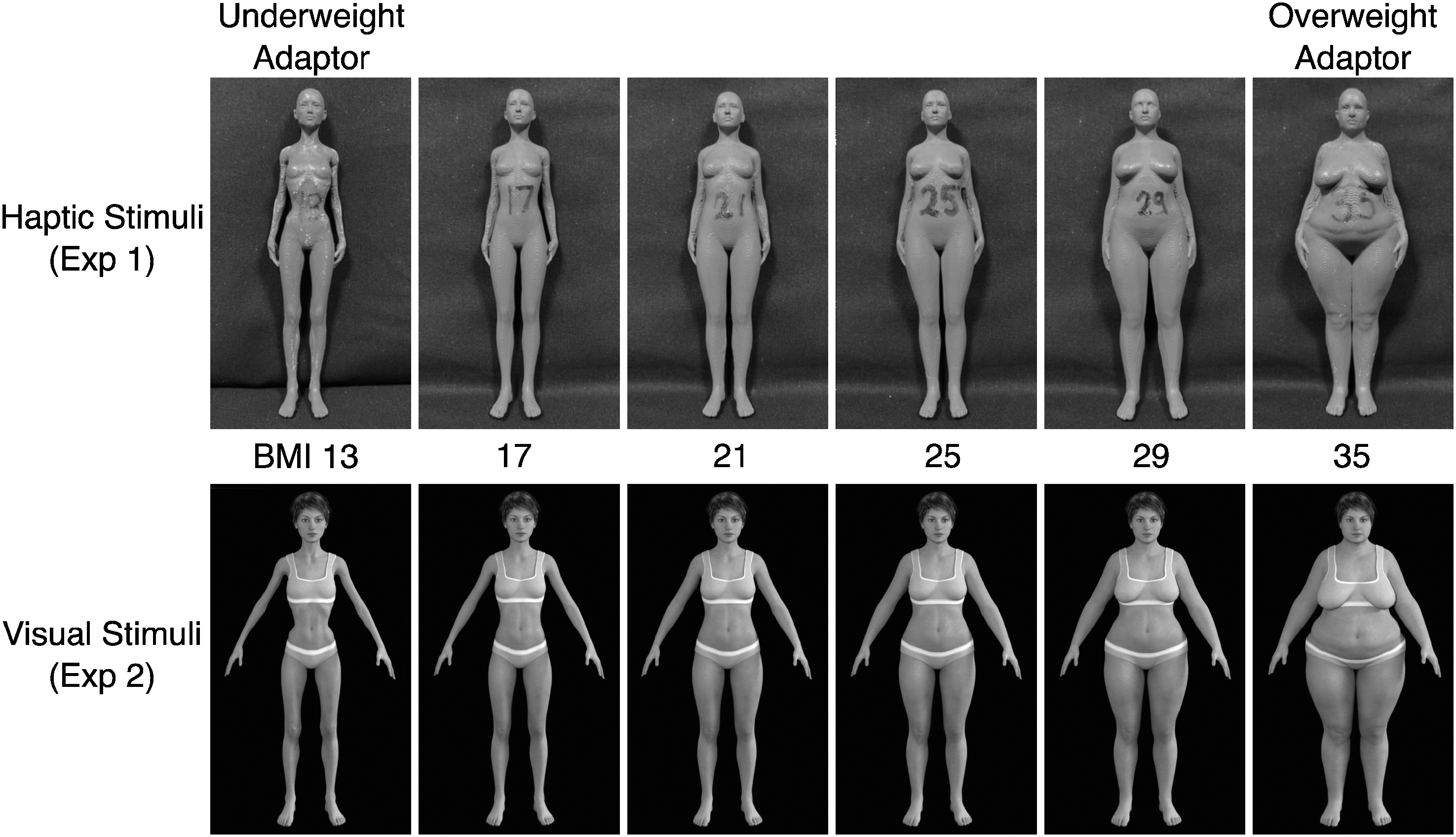
Example of stimuli used in experiments 1 (top panel) and 2 (bottom panel). Both modality stimuli represent the same identity, haptic stimuli were 3D printed based on 3D models of visual stimuli. Stimuli ranged from 13 to 35 in steps of two BMI units (12 in total) for the haptic adaptation experiment, and in steps of 0.25 for the visual adaptation experiment (89 in total). BMIs 13 and 35 were used as adaptors in the underweight and overweight adaptation groups, respectively.
Procedures
Participants were blindfolded and sat at a table in front of the researcher, who handed the stimuli to them. Participants were not allowed to see the stimuli at any point until the end of the experiment. There were 120 trials in total, 60 in each of the baseline and adaptation blocks. The baseline condition was always presented first to avoid the transfer of adaptation aftereffects across conditions.
Participants were not informed using the terms “adaptor” or “test stimuli.” Instead, references were made to “the first and second doll.” Additionally, participants were not informed about the size of the adaptor. They were consistently instructed to evaluate only the second stimuli in each pair, independently of the characteristics of the first doll. In the baseline block, on each trial, the participant was handed a figure to explore haptically with both hands for 5 s. Informal pilot testing showed that this amount of time was sufficient, and participant became frustrated if forced to explore the stimuli for more time before responding. Previous research on haptic object recognition has found that more than 90% of responses in a freely timed task were made in less than 5 s (Klatzky et al., 1985). Other research has shown that haptic object recognition remains highly accurate even when duration of exploration is severely constrained (Klatzky & Lederman, 1995). After verbal instruction from the experimenter that 5 s passed by, they returned the stimulus and made a verbal judgment of whether the body that they touched was fatter or thinner than an average female body of their age. We narrowed the age criterion to avoid possible confusion from trial to trial as to which ‘average’ the test body should be compared to. For instance, the average female body of a woman of 20 years will differ significantly from the average body of a woman in her 50s. Thus, by refining the age of an average body to which test stimuli were compared to, we minimized data variability. Participants responded verbally and the experimenter entered their responses into the computer.
In the adaptation block, participants first spent 1 min haptically exploring the adapting stimuli. N = 20 participants received the underweight adaptor and the other n = 20 the overweight adaptor. Each trial started with 6 s of “top-up” adaptation before the participant was handed the test stimulus for that trial.
The experiment was controlled by a script written in MATLAB (Mathworks, Natick, MA). The test stimulus for each trial was chosen by the Bayesian QUEST algorithm (Watson & Pelli, 1983) implemented in the Psychtoolbox (Brainard & Vision, 1997; Kleiner et al., 2007), taking into consideration the participant's previous judgements to identify the most informative stimulus to present. Two staircases of 30 trials each were presented interleaved on a trial basis in a randomized order. One “staircase” started with a prior estimate of a BMI of 19 and the other with a BMI of 31. The BMI of the body perceived as average was calculated as the mean of the posterior probability density function (i.e., a possible threshold value relative to the prior guess, taking under consideration information about assumptions, prior estimates and data), using the QuestMean function in the Psychtoolbox (algorithm by Watson & Pelli, 1983). To make sure that participants understood the difference between baseline and adaptation tasks, they performed four practice trials before starting the adaptation condition.
Analysis
Four PSEs for each participant were calculated using QUEST (Watson & Pelli, 1983) to estimate the BMI at which participants were equally likely to respond thinner or fatter: two for the baseline condition, each corresponding to the results of one interleaved staircase (pre-test dependent variable) and two for the adaptation condition (post-test dependent variable). Next, the two PSE values for each condition were averaged. Paired sample t-tests were used to compare these two values, with Cohen's dz as a measure of effect size.
A 2 × 2 mixed analysis of variance (ANOVA) was used to compare the two conditions. The factors were adapting body type (underweight, overweight) as a between-subjects factor, and adaptation (baseline, adaptation) as a within-subjects factor.
All data and analysis scripts have been made publicly available via OSF and can be accessed through the following link https://osf.io/gaefz/?view_only=1cac93d5ec794f79ab46324635cb1280. The design and analysis plan for the experiments were not preregistered.
Results
Clear aftereffects were apparent in both the thin and fat adaptation groups, as shown in Figure 2. Adaptation to an underweight body produced subsequent bodies to be judged more often as overweight. This was observed by a shift of PSE in the direction of the adaptor. In particular, the mean PSE decreased from 25.1 (SD: 2.2) to 22.2 (SD: 3.1), t(19) = 4.78, p < .001, dz = 1.068. Conversely, following adaptation to an overweight body, the mean PSE increased from 24.9 (SD: 1.7) to 27.4 (SD: 2.0), t(19) = 5.78, p < .001, dz = 1.292, which indicates that participants judged subsequent bodies more frequently as slimmer as compared to baseline. These results show the characteristic “contrastive” adaptation aftereffects which have been repeatedly found for visual adaptation to images of underweight and overweight bodies (e.g., Ambroziak et al., 2019; Brooks et al., 2016; Hummel et al., 2012).
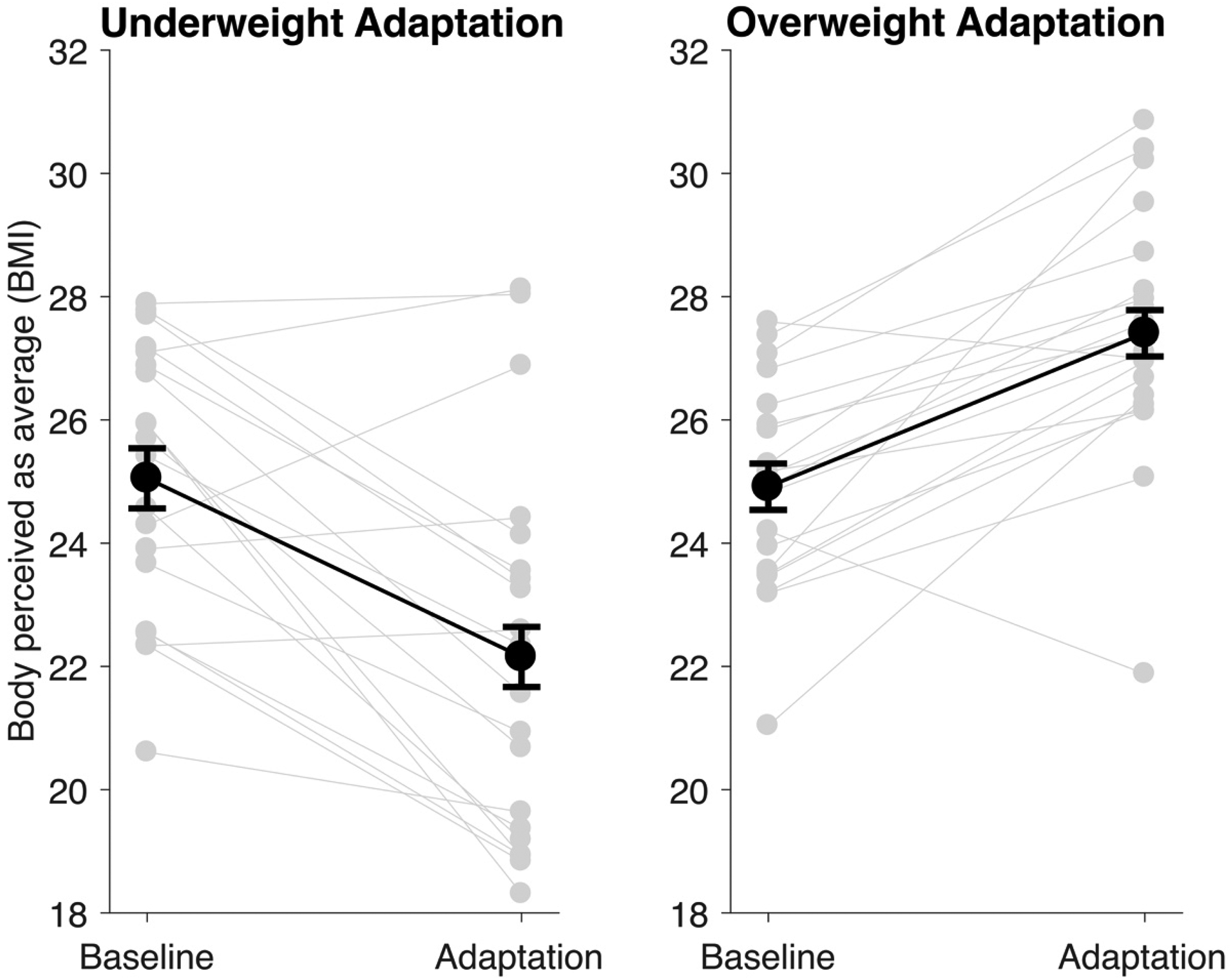
Results for underweight and overweight adaptation in the haptic modality. The gray lines indicate individual participants, and the means are shown in black. Left panel: there was an effect of adaptation in the underweight adaptation group, such that the PSE after adaptation significantly decreased, as compared to baseline. Right panel: there was an effect of adaptation in the overweight adaptation group: there was a significant increase in PSE after adaptation, as compared to baseline.
An ANOVA revealed a significant main effect of adapting body type, F(1, 38) = 16.71, p < .001, ηp2 = .305, with higher values in the overweight adaptation group than in the underweight adaptation group. Importantly, we also observed a significant interaction between the two factors, F(1, 38) = 52.42, p < .001, ηp2 = .580. Post-hoc comparisons with Holm–Bonferroni correction for multiple comparisons showed that this interaction was driven by a difference between conditions following adaptation, t(38) = 6.37, p < .001, d = 2.013, but no difference at baseline, t(38) = 0.22, p = .83, d = 0.070. As expected, no significant main effect of adaptation (i.e., baseline vs. adaptation) was observed because of the contrastive aftereffects in the two adaptation groups which canceled out the effect of adaptation, F(1, 38) = 0.30, p = .59, ηp2 = .008.
These results provide clear evidence for adaptation aftereffects of body size following haptic exploration. As discussed in the Introduction, numerous recent studies have demonstrated aftereffects following visual adaptation to extreme body shapes. This experiment extends these results to haptics.
Experiment 2
The haptic adaptation aftereffects reported in Experiment 1 are qualitatively similar to those found in several previous studies of visual adaptation aftereffects from underweight and overweight bodies (e.g., Ambroziak et al., 2019; Brooks et al., 2016; Hummel et al., 2012). There are, however, a range of differences between each of these studies and Experiment 1, which makes it difficult to quantitatively compare the magnitude of aftereffects following visual and haptic adaptation. We therefore conducted a second experiment using visual stimuli based on the same 3D modules used to create the haptic stimuli in Experiment 1 and using similar procedures.
Method
Participants
An additional 40 women participated in Experiment 2, 20 in each of the two adapting body type groups. This sample size was chosen to be consistent with Experiment 1. Note in addition, that the effect size calculated for Experiment 1 was based on data obtained in a previous study (Ambroziak et al., 2019), using visual body stimuli similar to that employed in Experiment 2. Participants in the underweight adaptation group were on average 28.8 years old (SD: 9.3) and all were right-handed (M: 83.5, SD: 20.1). Participants in the overweight adaptation group were on average 26.4 years old (SD: 7.3), and all but one were right-handed (M: 73.7, SD: 44.2).
Stimuli
In this experiment, we used visual stimuli created for our previous study (Ambroziak et al., 2019). The stimuli were 89 images of female bodies on a black background facing straight ahead. The height of each image was approximately 667 pixels (18 cm; placed in the middle of the 1074 × 882 image, 20.4° visual angle). The BMIs of female stimuli ranged from 13 (underweight) to 35 (overweight), in increments of 0.25 BMI units between each stimulus (see Figure 1, bottom panel). Note that there were a larger number of stimuli in the visual experiment compared to the haptic experiment. This was due to the practical advantage of creation and presentation of the visual stimuli over the haptic ones.
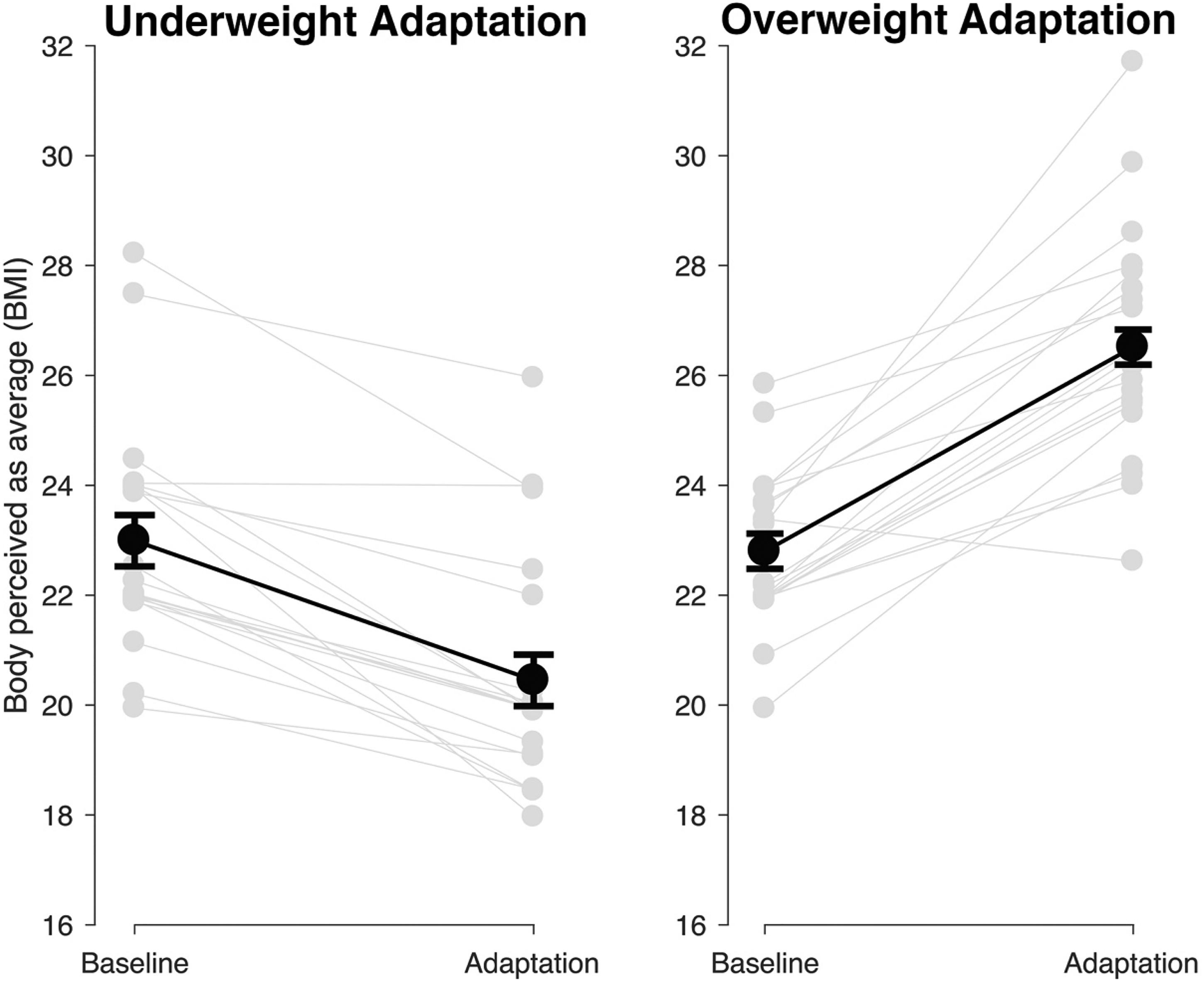
Results for underweight and overweight adaptation in the visual modality. The gray lines indicate individual participants, and the means are shown in black. Left panel: there was an effect of adaptation in the underweight adaptation condition, the PSE after adaptation significantly decreased, as compared to baseline, which indicates that participants judged subsequent bodies as fatter than during baseline. Right panel: there was an effect of adaptation in the overweight adaptation condition: there was a significant increase in PSE after adaptation, as compared to baseline.
Procedures
The experimental design was similar to the first experiment, but instead of haptic stimuli, we used visual images of female bodies based on the same underlying 3D models used to create the figures in Experiment 1 and which we also used in our previous study (Ambroziak et al., 2019). Participants were seated in front of a 24-inch monitor (resolution: 1,600 × 1,200 pixels, refresh rate: 75 Hz), with eyes away approximately 56 cm from the screen. In the baseline condition, an image of a female body appeared on the screen for 0.5 s and participants made a verbal judgment of whether the body that they saw was fatter or thinner than an average female body of their age. To match the response mode to Experiment 1, participants responded again verbally and the experimenter entered their responses into the computer. In the adaptation condition, before starting the task, participants were adapted to images of underweight or overweight female bodies for 60 s. On each trial, after a 6-s “top-up” adaptation, they saw a test image for 0.5 s and indicated their answer to the experimenter. The prior estimates used for the “ascending” and “descending” staircases were 18 and 30, respectively.
Analysis
The main analyses were the same as in Experiment 1.
In addition, we performed further analyses comparing results in the haptic and visual modalities. We first compared judgments of body normality between haptics and vision in the baseline, before any adaptation, using a two-sample t-test. We next quantified the magnitude of adaptation as the difference in BMI between the body judged as most normal after adaptation compared to baseline. We analyzed this data using a two-way ANOVA with factors modality (haptic, visual) and adapting body type (underweight, overweight).
Results
As in Experiment 1, there were clear aftereffects in both conditions, as shown in Figure 3. Following visual adaptation to an underweight body, participants judged subsequent bodies as more overweight as compared to baseline. This was observed by a shift of PSE in the direction of the adaptor. In particular, the mean perceived BMI decreased from 23.0 (SD: 2.1) to 20.5 (SD: 2.13), t(19) = 7.92, p < .001, dz = 1.771. Following adaptation to an overweight body, the mean perceived BMI increased from 22.8 (SD: 1.4) to 26.5 (SD: 2.1), t(19) = 8.62, p < .001, dz = 1.928, suggesting, that participants perceived following bodies as slimmer more often than before adaptation.
A 2 × 2 ANOVA revealed a significant main effect of adapting body type, F(1, 38) = 27.44, p < .001, ηp2 = .419, which was modulated by a significant interaction between the adapting body type (underweight or overweight) and the adaptation condition (baseline vs adaptation), F(1, 38) = 135.69, p < .001, ηp2 = .781. Post-hoc comparisons with Holm–Bonferroni correction showed that this interaction was driven by the conditions differing after adaptation, t(38) = 9.03, p < .001, d = 2.85, but not at baseline, t(38) = 0.34, p = .736, d = 0.106. In addition, a modestly significant main effect of adaptation, F(1, 38) = 4.77, p = .035, ηp2 = .112 was observed.
Between-Experiment Comparisons
Because the haptic and visual stimuli were constructed using the same underlying 3D body models, we can ask whether there are any systematic differences between the perception of averageness in the two modalities. We thus compared the body perceived as most average in the baseline blocks of the two experiments. As the baseline block occurred before any adaptation, we collapsed across the underweight and overweight adaptation groups in each experiment. A 2-sample t-test revealed that the body perceived as most average was significantly larger for haptic stimuli (M: 25.0, SD: 1.9) than for visual stimuli (M: 22.9, SD: 1.8), t(78) = 5.05, p < .001, dz = 1.128 (see Figure 4, left panel).
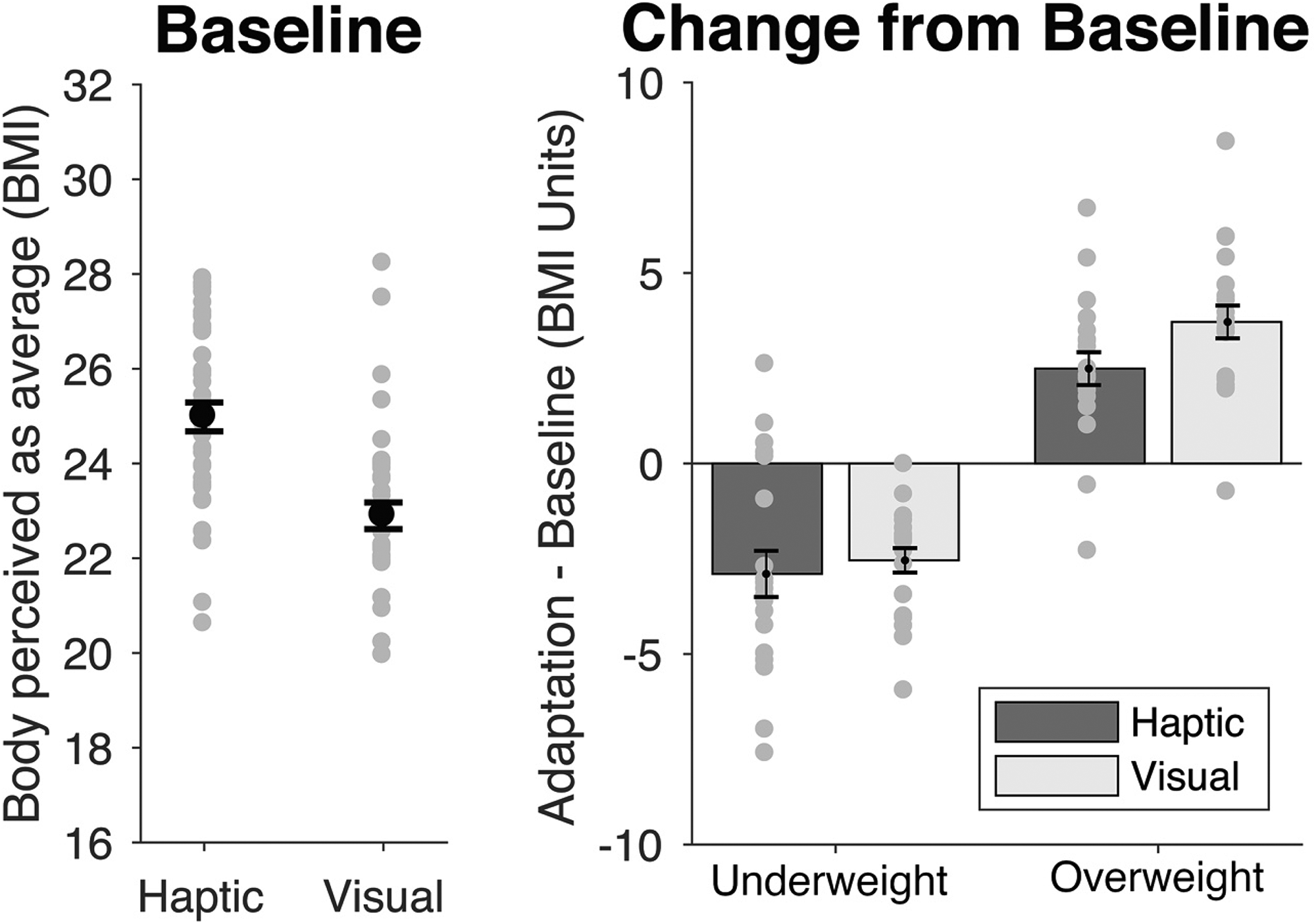
Left panel: comparison of haptic and visual perception across diverse body shapes relative to average. The body judged as average via touch was significantly larger than the body judged as average via vision. Right panel: Results showing aftereffect magnitude comparison between haptics and vision. There were no significant differences in the effects of adaptation to underweight and overweight bodies between the two modalities. Gray dots indicate individual participants and error bars represent standard errors in both panels.
We next compared the two modalities in terms of magnitude of adaptation, quantified as the difference in BMI following adaptation compared to baseline (see right panel of Figure 4). We then conducted a 2 × 2 between-subjects ANOVA with factors modality (haptic, visual) and adapting body type (underweight, overweight). There was a highly significant main effect of adapting body type, F(1, 76) = 160.97, p < .001, ηp2 = .679, with changes in opposite directions for underweight versus overweight adaptors. This is consistent with the results already shown for each modality individually in Experiments 1 and 2, respectively. There was no significant main effect of modality, F(1, 76) = 2.96, p = .089, ηp2 = .038, nor an interaction between modality and adaptation type, F(1, 76) = 0.90, p = .347, ηp2 = .012. Thus aftereffects following adaptation to extreme body types are highly similar in both the haptic and visual modalities, both in terms of the basic nature of the effect and in terms of magnitude.
General Discussion
Exposure to extreme body types produces clear aftereffects in both haptics and vision. These effects are found for both underweight and overweight adapting bodies, and appear to operate similarly in the two modalities. These effects have been extensively researched in vision, and such visual adaptation to extreme bodies has been claimed to provide an experimental model of the established effects of media depiction of bodies on body image (Brooks et al., 2020). Our results extend this work to the haptic modality. This suggests that the effects of exposure to extreme body types are not a purely visual phenomenon, but reflect a broader representation of bodies. It is thus crucial to emphasize the role of haptics as a mechanism contributing to the creation of perceptual body image. Future research, such as exploring cross-modality effects between vision and haptics, could provide further insights into their impact on body perception.
One of the ways that girls from a young age gain their experience of what a “normal” body feels like through play with dolls. Consequently, our results have important implications for understanding the effects of playing with dolls on body perception. While our study focused on female body shape, the same point could clearly also be made about boys’ experiences playing with dolls and action figures. Despite numerous studies have investigated the effects of playing with unrealistic dolls such as Barbie (Boothroyd et al., 2021; Jellinek et al., 2016; Worobey & Worobey, 2014), a little attention has been given to isolate haptic effects specifically. Indeed, some studies have investigated the effects of dolls entirely by having children look at, but not touch, the dolls (Dittmar et al., 2006; Worobey & Worobey, 2014). Also, when actual play with the dolls was included in the experimental paradigm, the participant's attention was directed more on the situational play with the dolls (e.g., acting the storyline, Rice et al., 2016), rather than concentrating on the effects of perceived adiposity of the viewed and touch bodies. It will be important for future research to try to isolate the visual, haptic, and multisensory contributions of playing with dolls to children's developing body representations.
A range of evidence from neuroimaging and patient studies has provided evidence that visual and haptic object recognition rely on at least partly overlapping neural mechanisms. Of particular relevance to this study, two studies (Costantini et al., 2011; Kitada et al., 2009) have shown that the extrastriate body area in the ventral visual pathway is activated by haptic exploration of body parts, complementing its well-established visual responsiveness to body parts (Downing et al., 2001). To our knowledge, however, this is the first study to investigate the perceptual processes involved in haptic perception of body size. The present results do, however, complement existing research on haptic perception of facial expressions. There is evidence that people can accurately recognize through haptic exploration of faces both personal identity (Casey & Newell, 2007; Dopjans et al., 2009; Kilgour & Lederman, 2002) and facial expressions of emotion (Lederman et al., 2007). Haptic face perception has also been found to show inversion effects as in vision (Kilgour & Lederman, 2006) and impaired in individuals with prosopagnosia (Kilgour et al., 2004). Moreover, aftereffects have been reported in this recognition following adaptation to specific emotions (Matsumiya, 2012, 2013).
A strength of the present study is that the same underlying 3D models of body shape were used to create both haptic and visual stimuli. This allowed us to match the stimuli in both modalities, to compare the nature and magnitude of adaptation aftereffects. There are, however, some important limitations of our study. Whereas visual stimuli had hair and were seen from a single frontal perspective, haptic exploration allowed participants to experience bold body stimuli from many angles. There is evidence, however, that vision and haptics show different sensitivities to viewpoints; while visual recognition is best from frontal views of objects, haptic recognition is best from the back (Newell et al., 2001). The frontal perspective used in Experiment 2 should therefore be optimal for vision, while the free exploration in Experiment 1 allowed participants to explore stimuli in an optimal manner, although the position of arms against the sides of the body in the haptic stimuli might have hindered proper exploration of the sides of the body figures. Moreover, even where the absolute duration of adaptation and exploration time is matched across modalities, the amount and nature of information obtained in haptics and vision is nearly impossible to quantify, let alone match between conditions. At some level, these simply reflect intrinsic differences between the haptic and visual modalities. These discrepancies in the adaptation protocols across modalities might influence the observed strength of adaptation aftereffects, which appeared similar across modalities in this study. Future research could explore this further to systematically investigate how specific modifications impact the magnitude and characteristics of aftereffects across different sensory modalities. Despite promising, these findings cannot be generalized to children or adolescents as well as men. The results were obtained mostly from young adult women with already-shaped body normality perceptions. Even though we did not set any restriction in terms of nationality or level of education, our sample is biased to female students from Europe and Asia, which are mostly studying in universities around central London. Further studies focusing on children, male and female with a broader nationality rage are therefore suggested.
In conclusion, we showed, for the first time using matched stimuli across visual and haptic modalities, analogous body shape aftereffects. These results may contribute to developing new paradigms in therapeutic work (e.g., targeting eating disorders) as well as designing new prevention programs addressing body disturbances in women. For instance, promoting satisfaction with one's body from a young age through play with various doll sizes and shapes as part of kindergarten learning may help women deal with body image pressures in future. Education can play a key role in this regard.
Footnotes
Author contribution(s)
Declaration of Conflicting Interests
The authors declared no potential conflicts of interest with respect to the research, authorship, and/or publication of this article.
Funding
The authors disclosed receipt of the following financial support for the research, authorship, and/or publication of this article: This research was supported by a grant from the British Academy (SRG21\210187) to MRL, EA, and ERF; a grant from the Royal Society to ERF and MRL; and a grant from Bial Foundation to EA and KAM (296/2018).
