







Abstract
There has been an explosion of interest in sonic seasoning in recent years, building on the emerging literature concerning the existence of consensual crossmodal correspondences between sonic and gustatory properties. However, to date, a musical match for the metallic taste has not been reported (nor looked for). Here, based on the authors’ intuition, we tested, and by so doing demonstrate, that the sound of the theremin, associated with old sci-fi movies is strongly associated with a metallic taste.
The theremin, an electronic musical instrument named after its inventor, Leon Theremin, who patented the device in 1928 (see Figure 1), was often used to provide the musical accompaniment to early sci-fi and horror movies. Due to its characteristic electronic timbre, it has often been associated with the ‘futuristic’ soundscapes of the aliens of that era (Wierzbicki, 2002; cf. Murphy, 2006; Schmidt, 2010). Here, we investigate whether people would associate the sound of this electronic instrument with a metallic taste compared with other basic tastes. We further hypothesize that this crossmodal correspondence is explained by learned associations linking the theremin and sci-fi movies, where metallic materials are often used.
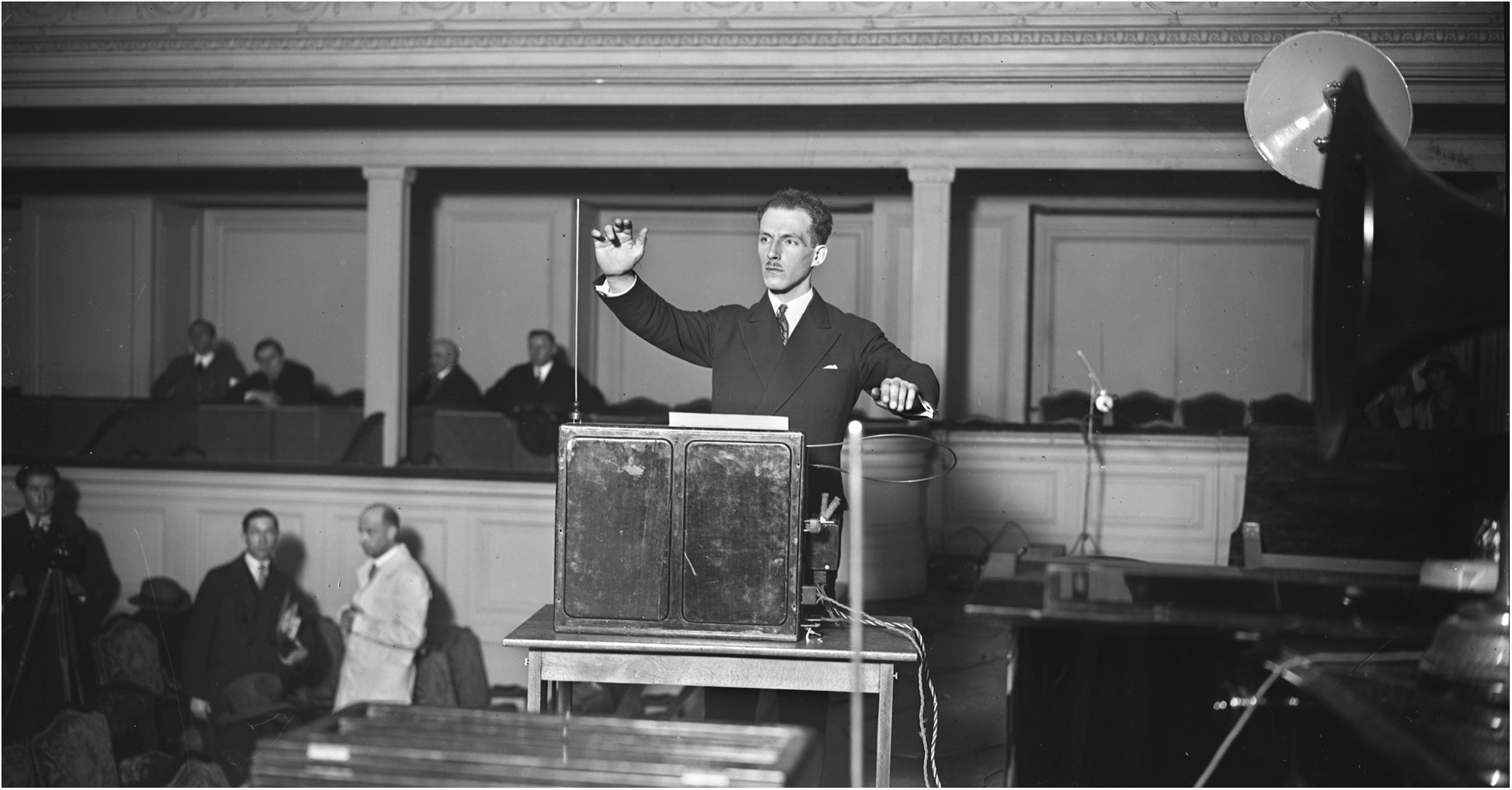
Leon Theremin playing the theremin, an instrument that he invented. Photo by Agence Rol, 1927 (https://gallica.bnf.fr/ark:/12148/btv1b53193183b/). In the public domain.
The auditory stimulus consisted of a 10-s segment of a theremin music demo taken from a 1950s science fiction film (video: https://www.youtube.com/watch?v=nYaT704C7_w; clip from 00:35 to 00:45). 100 participants (Mage = 43.72 years, SDage = 13.21 years, 50% female) were recruited through Prolific Academic, a widely used online research platform that ensures responses from verified users (see Woods et al., 2015, on online research). The target population were UK residents aged 18 years and older, with a minimum 95% approval rating on Prolific, ensuring reliable responses. Participants were told that this was a study on the perception of a piece of soundtrack and they were compensated in line with the minimum hourly rate in UK. Data was collected via Qualtrics, where built-in bot detection was enabled to minimize fraudulent internet robot responses (Liem, 2025). All participants reported that they were able to hear the sound used as the stimulus in the study. Participation was voluntary with informed consent provided, and responses were collected anonymously.
Participants were instructed to listen to the sound clip using headphones and to adjust the volume on their device so that they could hear it clearly. They were then presented with two forced-choice questions: ‘When you hear this sound, which taste do you associate it with?’ with six taste options (sweet, bitter, salty, sour, umami or metallic); and ‘What type of movie do you associate this sound with?’ with six movie-type options (romance, crime, horror, sci-fi, comedy or western). Note that the choices for each question were presented in a random order, and the movie-type question was presented on a separate page after participants had evaluated the associated taste, to avoid any potential confounding effect from the movie association. Lastly, participants indicated whether they heard the sound, as well as their age and gender. The task took about one minute to complete, and participation was compensated.
A chi-square goodness-of-fit test compared the observed distribution of choices to an equal-probability model. The results revealed a significant deviation from chance, χ2 (5, N = 100) = 165.8, p < .001, indicating that participants did not select the taste labels equally. As shown in Figure 2A, participants most frequently selected ‘metallic’ (62%), followed by ‘sour’ (18%), ‘bitter’ (16%), ‘umami’ (2%), ‘salty’ (1%) and ‘sweet’ (2%). A one-tailed binomial test further assessed whether metallic associations occurred more frequently than expected by chance. Inspection of standardized residuals showed that the ‘metallic’ association was chosen far more frequently than expected by chance (standardized residual = 12.16), confirming that the participants did indeed associate the distinctive sound of the theremin with metallic taste at a rate far exceeding random expectations. For the rest of taste options, salty (−4.20), sweet (−4.20) and umami (−3.94) were selected less frequently than would be expected by chance, whereas sour (0.36) and bitter (−0.18) were chosen at rates that approximated chance.
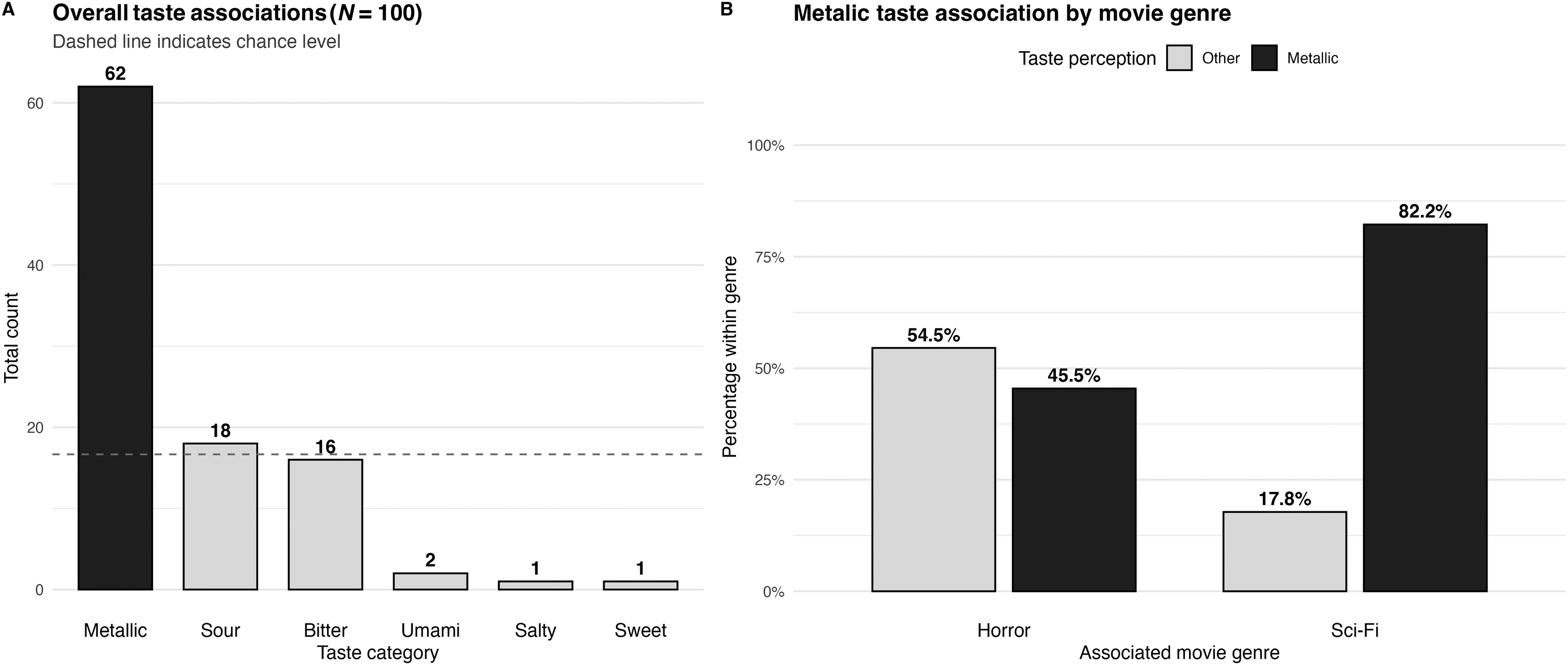
The taste quality (A) and the movie genre (B) that was associated with the timbre of the Theremin.
Participants associated the theremin sound with two primary movie genres: horror (55%) and science fiction (45%). A 2 × 2 Chi-square test of independence was performed to investigate whether the likelihood of perceiving a ‘metallic’ taste depended on this genre association. The results indicated that the association between the theremin and metallic taste was significantly stronger for participants thinking of sci-fi movies (82.2%) than for those thinking of horror movies (45.5%), χ2 (1, N = 100) = 14.2, p < .001, see Figure 2B. The results further solidify our sci-fi association assumption. This confirms that while metallic taste is the most common association overall, it is disproportionately driven by participants who view the theremin through the lens of sci-fi.
Collectively, these findings support the suggestion that the distinctive sound produced by the theremin, that is often used in early sci-fi movies, is predominantly associated with a metallic taste. Intriguingly, while musical matches for the four most common basic tastes (sweet, bitter, salty and sour; Knöferle et al., 2015; Wang et al., 2021; Wang et al., 2017b), creamy mouth sensations (e.g., associated with chocolate melting in the mouth; Reinoso Carvalho et al., 2017), as well as for the pungent heat of chili peppers (i.e., capsaicin) are now well-established (Wang et al., 2017a), no musical matches have as yet been proposed for metallic taste sensations. This is perhaps because metallic has never been included as a response option in prior sound-taste crossmodal correspondences research. Nevertheless, the results of the present study clearly demonstrate a robust crossmodal association between the sound of the theremin, and metallic taste.
Neither a statistical nor a hedonic, account of the crossmodal correspondence of this finding seems plausible (Knöferle & Spence, 2012; Wang et al., 2016). Rather, associative learning that the theremin is associated with aliens, which often appear in metallic form (remember the Daleks in Dr. Who, for those living in the UK; Perryman, 2008) would seem more plausible. Interestingly, our data shows that the theremin sound was primarily associated with horror (55%) and sci-fi (45%) films. Further analysis revealed a difference in taste responses between those participants who associated the sound of the theremin with horror versus sci-fi. Specifically, those participants who associated the sound of theremin with sci-fi movies were significantly more likely to link metallic taste to the sound of theremin, thus supporting sci-fi association explanation.
According to a reviewer, metallic tastes might be considered ‘inorganic’ or ‘not natural’. According to the same reviewer, electronic sounds and especially the theramin, produce patterns of harmonics (high spectral centroid, strong high overtones without turbulence/noise, etc.) that are quite rare or even non-existent in nature. We find this suggestion of an ‘unnatural’ basis for the auditory-chemosensory crossmodal correspondence unlikely given the various ways in which people experience metallic sensation. For instance, wet coins are often said to ‘smell metallic’, when you bite your lip the blood tastes metallic, and so in a way organic and natural. All that before you get to the taste of liver and bacon, where, once again, the metallic taste is evident despite the foodstuff being entirely natural (if not necessarily popular nowadays).
Another suggestion put forward by the reviewer concerns the possibility of a structural account of these findings. In particular, from a timbral perspective, the sound of the theramin has quite strong upper harmonics, which have been associated with sour/bitter in previous literature (consistent with the findings reported here, whereby sour/bitter are more represented than the other basic tastes). The ‘sharpness’ of metallic tastes might be linked to the ‘sharpness’ of sound of instruments that produce sounds with high spectral centroids. In addition, the theramin has a strikingly smooth onset (no attack). Worth noting here, different metal salts can give rise to metallic tastes, though we are not aware of any research on the temporal parameters of metallic sensations, for example, when compared to other taste qualities (Skinner et al., 2017).
It should, though, be noted that without a control sound it is difficult to know whether what's important in this study is that participants judged theramin music, or that people were given the option to indicate metallic as a taste sensation. Relevant here, previous works did not include metallic as a response option. This raises the possibility that if they had, many other sound qualities might have been associated with metallic sensations. While it is difficult to rule out this possibility on the basis of the research reported here, we think it is unlikely, given that metallic is not normally a sensation that comes to many consumers’ minds under normal circumstances.
In the future, it will be interesting to determine whether food can be sonically seasoned by the metallic taste of the timbre of the theremin, perhaps enhancing the metallic taste that is sometimes experienced when, for example, eating liver. Though such an example of sonic seasoning is, we readily admit, unlikely to appeal to everyone.
Footnotes

Author Contribution(s)
Funding
The author(s) disclosed receipt of the following financial support for the research, authorship and/or publication of this article: This work was supported by the Arts and Humanities Research Council (grant number AH/L007053/1).
Declaration of Conflicting Interests
The author(s) declared no potential conflicts of interest with respect to the research, authorship and/or publication of this article.