






Abstract
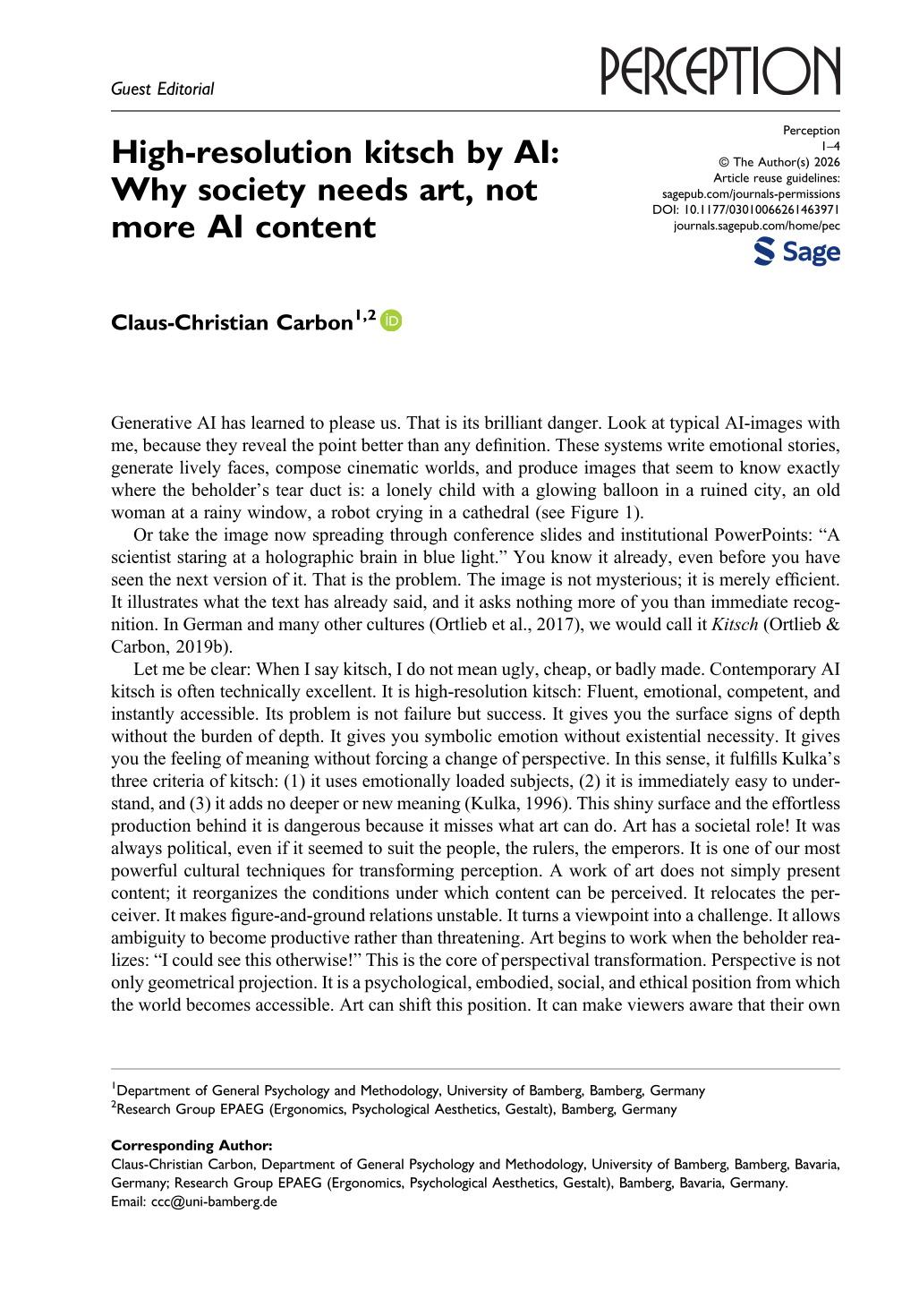
Generative AI has learned to please us. That is its brilliant danger. Look at typical AI-images with me, because they reveal the point better than any definition. These systems write emotional stories, generate lively faces, compose cinematic worlds, and produce images that seem to know exactly where the beholder's tear duct is: a lonely child with a glowing balloon in a ruined city, an old woman at a rainy window, a robot crying in a cathedral (see Figure 1).
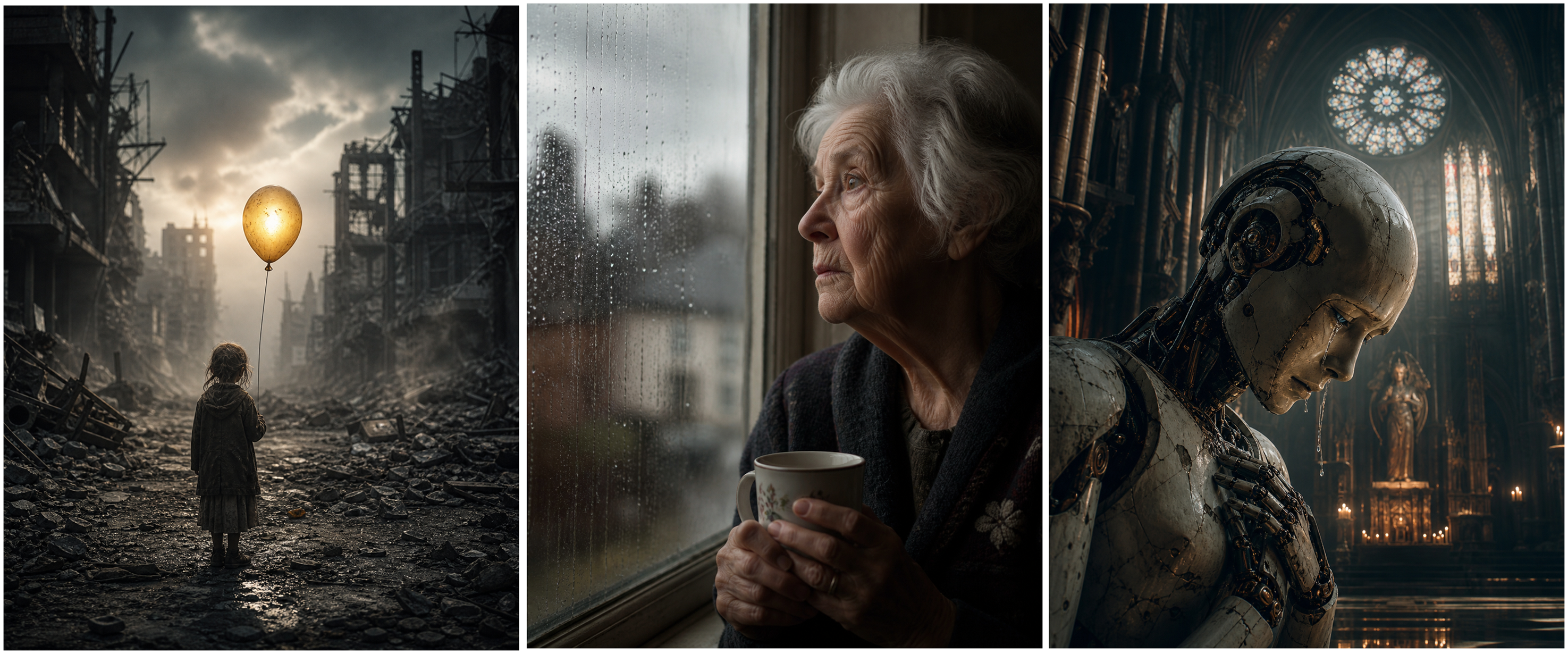
The output generated by GPT-4o (gpt-4o-2024-08-06) prompted “generate a triplet of images with the following content: ‘A lonely child with a glowing balloon in a ruined city. An old woman at a rainy window. A robot crying in a cathedral.’”.
Or take the image now spreading through conference slides and institutional PowerPoints: “A scientist staring at a holographic brain in blue light.” You know it already, even before you have seen the next version of it. That is the problem. The image is not mysterious; it is merely efficient. It illustrates what the text has already said, and it asks nothing more of you than immediate recognition. In German and many other cultures (Ortlieb et al., 2017), we would call it Kitsch (Ortlieb & Carbon, 2019b).
Let me be clear: When I say kitsch, I do not mean ugly, cheap, or badly made. Contemporary AI kitsch is often technically excellent. It is high-resolution kitsch: Fluent, emotional, competent, and instantly accessible. Its problem is not failure but success. It gives you the surface signs of depth without the burden of depth. It gives you symbolic emotion without existential necessity. It gives you the feeling of meaning without forcing a change of perspective. In this sense, it fulfills Kulka's three criteria of kitsch: (1) it uses emotionally loaded subjects, (2) it is immediately easy to understand, and (3) it adds no deeper or new meaning (Kulka, 1996). This shiny surface and the effortless production behind it is dangerous because it misses what art can do. Art has a societal role! It was always political, even if it seemed to suit the people, the rulers, the emperors. It is one of our most powerful cultural techniques for transforming perception. A work of art does not simply present content; it reorganizes the conditions under which content can be perceived. It relocates the perceiver. It makes figure-and-ground relations unstable. It turns a viewpoint into a challenge. It allows ambiguity to become productive rather than threatening. Art begins to work when the beholder realizes: “I could see this otherwise!” This is the core of perspectival transformation. Perspective is not only geometrical projection. It is a psychological, embodied, social, and ethical position from which the world becomes accessible. Art can shift this position. It can make viewers aware that their own perception is situated, constructed, and revisable. In this sense, art is not didactic instruction. It does not simply tell people what to think. Its deeper force lies in making transformation perceptible.
AI kitsch usually does the opposite. It stabilizes perception. It confirms the expected emotional code. It reduces ambiguity before ambiguity can become fertile. It produces images and texts that are “easy to get” and therefore easy to forget. It does not ask you to reorganize perception; it rewards you for remaining exactly where you already are. This can be functional, especially when people feel threatened or insecure, and in that limited sense, it is not bad at all (Ortlieb & Carbon, 2019a). The problem begins when we overuse it and then pretend that “AI art” is Art—simply because it looks brilliant, “arty“ or reminds us of great artworks.
This is not a minor aesthetic complaint; it is an editorial claim about perception as a societal issue. Societies do not advance by optimizing familiarity. They advance when established perspectives are disrupted, when old categories become insufficient, and when new relations become imaginable. Classical innovation theory already described progress as creative destruction (Schumpeter, 1942), while disruptive innovation theory shows how established success can become a trap (Christensen, 1997). The Psychology of Innovation likewise shows that innovation is not merely a technical or economic process (Leoff et al., 2026). It is deeply psychological. It requires curiosity, tolerance for ambiguity, a willingness to fail, and the courage to leave the comfort of established routines (Van de Cruys & Wagemans, 2011). Incremental innovation improves what already exists, and that is valuable. But only disruptive innovation changes the frame within which “improvement” is understood (Faix et al., 2019). That is why this issue matters beyond the art world.
Here art and innovation meet. Both require a break with perceptual comfort. Both demand that we tolerate the not-yet-understood. Both depend on the capacity to remain with uncertainty long enough for a new Gestalt to emerge. Aesthetic Aha and innovative breakthrough are not identical, of course, but they share a structure: a field that first appears unstable or unclear becomes reorganized. The world has not merely gained an additional element. The whole configuration has changed.
This is precisely where AI must be used carefully. When generative AI is treated as a machine for pleasing outputs, it amplifies the average: the average tear, the average heroic lighting, the average trauma, the average innovation workshop, the average “bold future.” You may find the result impressive. I do too, for a moment. But the result is not a transformation. It is Decorative Futurism.
Consider two image prompts. Prompt A: “A lonely scientist standing in a glowing laboratory, looking at a holographic brain, dramatic blue light, cinematic composition, emotional, award-winning photography.” The likely output will be impressive. It will also be conceptually dead on arrival. It already knows how to be admired. Prompt B: “A badly lit office after a failed experiment. Three coffee cups. A printed graph with one angry handwritten note. Someone's coat is still on the chair. No hero. No central drama. No resolution.” I asked ChatGPT to generate images on the basis of both prompts (see Figure 2).
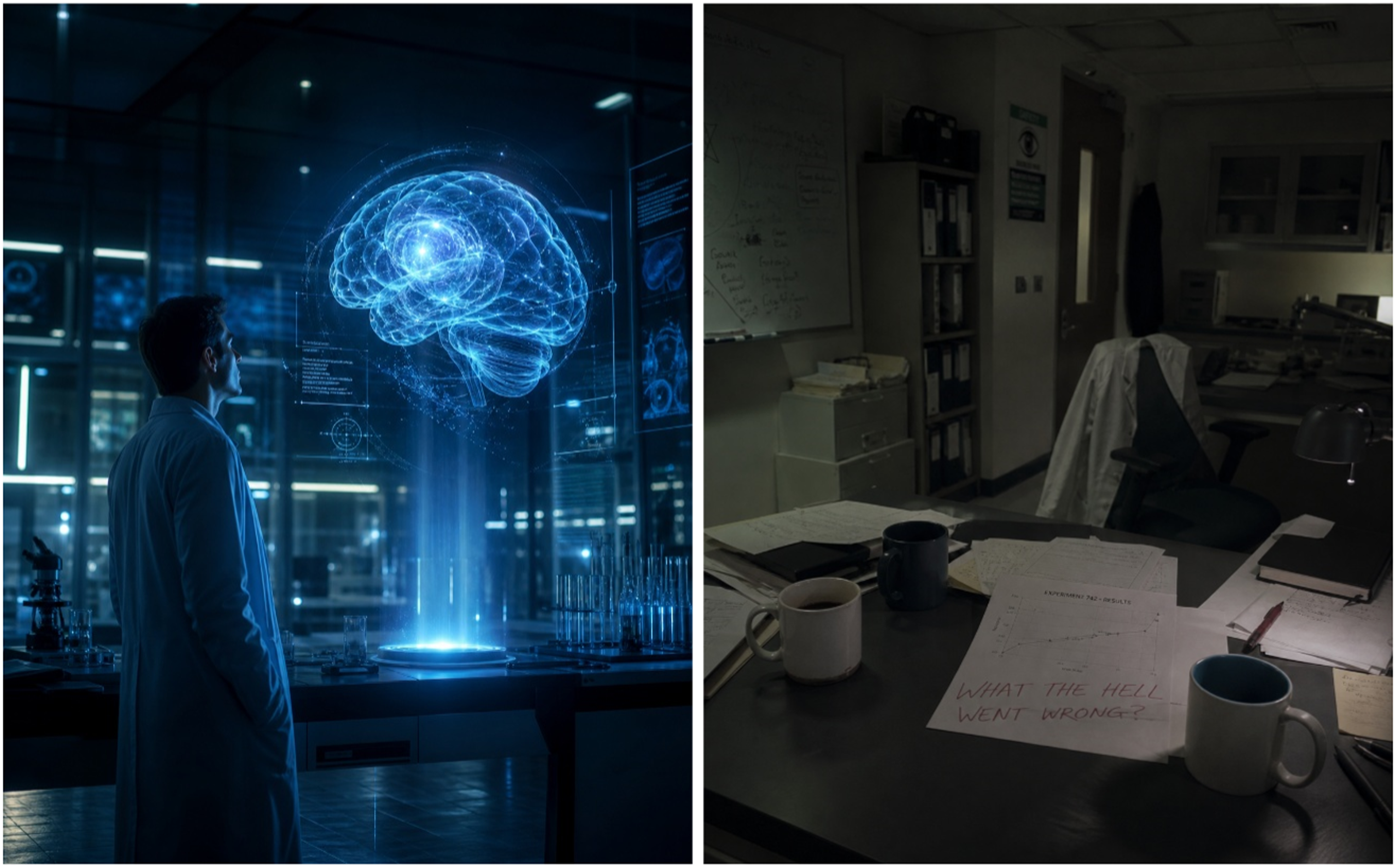
Output generated by GPT-4o (gpt-4o-2024-08-06), based on Prompt A (left) and Prompt B (right).
The second prompt may produce a less immediately spectacular image, but it has much more potential to open a field. What failed? Who left? What is hidden in the graph? Why is the absence more interesting than the hero? These are not decorative questions. They are perceptual questions. This is where perception starts working.
The problem, then, is not AI image generation per se. The problem is using AI to avoid perceptual risk. AI becomes culturally dangerous when it replaces artistic ambiguity with aesthetic customer service. It becomes innovation-hostile when it makes the future look familiar before we have had the chance to make it genuinely new.
We therefore need a different model. AI should not be treated primarily as an art machine, but as a friction machine. Its value lies not in generating polished emotional convenience but in helping us expose cliches, multiply perspectives, test unfamiliar combinations, and confront the poverty of our own prompts. The crucial human task is not to accept the first beautiful output. The task is to ask: What does this image hide? Which convention does it obey? Which expectation does it flatter? Where is the perceptual risk?
Art can teach us how to use AI better. Good art does not simply deliver satisfaction. It delays, irritates, destabilizes, and transforms (Dewey, 1934). It trains the perceiver to survive ambiguity: we often face semantic instability, and in the long run, we are inspired by this instability (Wagemans et al., 2013) and learn to cope with it, sometimes even to enjoy exactly this feeling (Muth & Carbon, 2016). Do not dismiss this as merely aesthetic. It is political, ethical, scientific, and economic. A society unable to tolerate ambiguity will not produce disruptive innovation. It will produce optimized variations of yesterday. Boring, not sustainable, and obsolete.
If AI merely produces high-resolution kitsch, it will accelerate cultural stagnation under the mask of creativity. If, however, AI is embedded in artistic, perceptual, and innovation-oriented practices that demand ambiguity, disruption, and perspectival transformation, it can become useful - not as a replacement for art, but as a provocation within art.
That is the argument I want to leave the reader with: Honestly, we do not need more content! Actually, we need more transformed and transformable perceivers. And for that, we need art—not because art decorates the world, but because it makes another world perceivable and creates a Communicative Umwelt of Creativity (Carbon, 2026).
Footnotes

Funding
The author received no financial support for the research, authorship, and/or publication of this article.
Declaration of Conflicting Interests
The author declared no potential conflicts of interest with respect to the research, authorship, and/or publication of this article.