






Abstract
High-temperature smelting, rolling, and room-temperature tensile testing were conducted on high-strength rebar steels containing 0∼0.01% rare earth cerium. The rolling start temperature is 1128°C∼1160°C and the rolling start temperature for pass nine is 840°C∼850°C. The carbon/sulfur analyzer, oxygen/nitrogen determinator, inductively coupled plasma mass spectrometer and scanning electron microscopy with energy-dispersive spectroscopy were employed to detect steel composition. With increasing Ce amounts, inclusions were primarily composed of MnS, accompanied by oxides/ sulfides, as well as their MnS-complex counterparts, which is consistent with thermodynamic predictions. The addition of cerium significantly promoted ferrite formation. In the steel without Ce, the ferrite fraction was relatively low at 29.9%, whereas the steel with 0.01% Ce exhibited the highest ferrite content at 37.3%. Trace amounts of Ce facilitated grain refinement by forming Ce-Al-O inclusions, which served as nucleation sites for austenite. The Ce-Al-O inclusions also contributed to the precipitation of VN, enhancing ferrite formation and achieving an optimized balance between strength (874 MPa) and toughness (17.88%). However, excessive cerium content adversely affected steel cleanliness, leading to the formation of coarse Ce-O-S inclusions that compromised elongation to 7.37%.
Introduction
High-strength rebar, which combines excellent strength and ductility, is widely used in construction, bridge, and marine engineering.1–3 For equivalent strength requirements, using high-strength steel bars significantly reduces the quantity of reinforcement needed and enhances spatial efficiency. Therefore, promoting the application of high-strength steel bars in practical engineering projects is essential. In addition to higher strength, the future development of rebar is expected to evolve toward multifunctionality. Systematically exploring seismic resistance, 4 corrosion resistance, 5 and low-temperature tolerance to meet the demands of extreme environmental conditions.6–8
At present, research on ribbed steel bars primarily focuses on micro-alloying,9–10 hot rolling and controlled rolling-controlled cooling technology,11–12 and properties optimization.13–16 Vanadium (V), niobium (Nb), and titanium (Ti) are commonly added as microalloying elements in high-strength rebar. The precipitation strengthening of carbonitrides and the grain refinement effect significantly enhance the strength of steel, while maintaining excellent ductility and toughness. Mao et al. 17 showed that 0.2% Ti in HRB400E rebar refines inclusions and improves grain uniformity. TiO₂ particles nucleate austenite and pin grain boundaries, suppressing growth and enhancing performance. Dai et al. 18 found that increasing Nb content in 20MnCr5 steel (to 0.0241 wt%) reduced abnormal grain growth, shrinking the mixed-grain zone from 70% to a 2.5 mm surface layer. Zeng et al.4–5 systematically studied how trace Nb affects the corrosion resistance of high-strength seismic rebars in simulated marine environments. Trace Nb improved the compactness and stability of the corrosion product layer, with corrosion resistance increasing proportionally to Nb content. Zhang et al. 19 showed that V-N microalloying promotes intragranular ferrite (IGF) formation in 600 MPa steel rebars. Isothermal treatment (450–600 °C) increased IPF content from 0.5% to 13.5%, with V(C,N) particles serving as dominant nucleation sites. To achieve multifunctionality, multi-element microalloying is commonly employed.
Environmentally friendly rare earth elements have been found to enhance the corrosion resistance of metals significantly. An et al. 20 found that cerium conversion coatings improve rebar corrosion resistance, with 35°C as the optimal temperature. Liu et al. 21 identified 0.053% Ce as optimal for enhancing spring steel's pitting resistance via fine Ce₂O₂S inclusions. Excess Ce (0.083%) formed coarse inclusions (>5 μm), reducing resistance by over 40%. Zhu et al. 22 conducted experimental and theoretical analyses on the shear performance of steel-concrete-steel (SCS) composite structures with perforated steel webs, proposing a theoretical approach to quantify the influence of openings. Wei et al. 23 developed an eco-friendly ultra-high-performance concrete (UHPC), determining the optimal blending ratio of recycled steel fibers through systematic testing, achieving synergistic enhancement of mechanical properties. Additionally, Yan et al. 24 challenged conventional understanding by demonstrating that medium-manganese steel treated with quenching and partitioning exhibits superior wear resistance to martensitic steel at −50°C due to the transformation-induced plasticity effect. Although extensive research has been conducted on microalloying, controlled rolling and cooling processes and properties optimization of high-strength rebar, systematic studies on the effects of rare earth cerium on inclusions, microstructure, and mechanical properties remain limited. Furthermore, although extensive laboratory studies and theoretical investigations have been conducted on the mechanisms of rare earth elements, industrial practice in this field remains relatively limited, and their engineering application potential warrants further exploration and validation.
In this paper, the high-strength rebar steel was smelted in a vacuum induction furnace according to formulated compositions. After rolling the ingots, compositional analysis, non-metallic inclusion assessment, microstructural characterization, and room-temperature tensile testing were conducted. The effects of rare-earth cerium on inclusion modification and microstructural refinement in high-strength rebar steel were systematically examined to determine its optimal addition level. This investigation establishes critical control parameters for cerium-mediated inclusion and microstructure regulation and provides guidance for industrial production of high-strength rebar steel.
Materials and experimental procedure
Specimens
High-temperature smelting and rolling processes were conducted as follows: Alloys were melted according to designed compositions in a 25 kg vacuum induction furnace. After loading charge materials through the furnace lid and positioning the ingot mold, alloying elements were placed in the feed hopper before sealing the furnace. The control cabinet was energized, and the power knob was adjusted to approximately 50 kW output. Simultaneously, the rotary vane vacuum pump was activated to evacuate the chamber to around 0.08 MPa, followed by engagement of the Roots pump. After 3–4 min of evacuation when the vacuum gauge reached “F” or “P” range, pumping ceased. The argon gas valve was opened for backfilling until the vacuum gauge indicated approximately 0.06 MPa, after which the gas valve was closed. The power knob was then set to maximum (100 kW) to initiate melting. Upon complete melting of the charge in the crucible, alloy additions were introduced and held for 10–20 s to ensure dissolution. The molten steel was subsequently poured into the ingot mold. After the power shutdown, the ingot was held under vacuum for 40 min before extraction. The resulting as-cast ingot (as shown in Figure 1) was demolded after cooling.

The sampling schematic diagram.
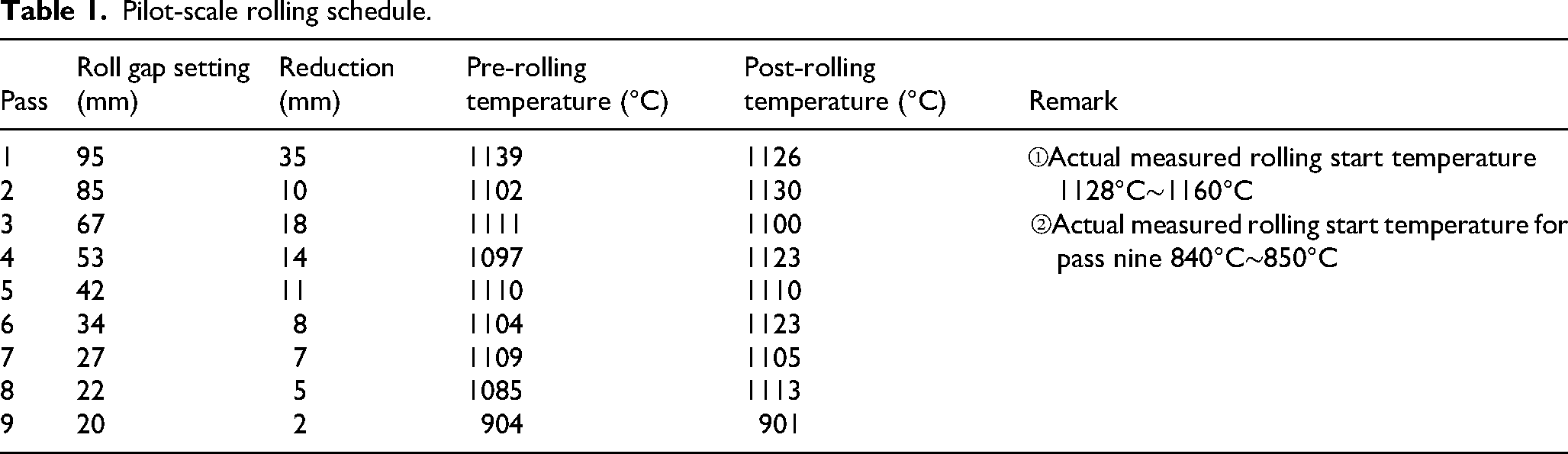
Following complete melting during the smelting stage, ferrocerium alloy, vanadium-nitrogen alloy, ferrosilicon, and ferromanganese were introduced. The rare earth additive used was a low-oxygen ferrocerium alloy containing 10% cerium (oxygen content:0.0075%). The ingot underwent homogenization in a heating furnace before being rolled on a Φ750 mm × 550 mm two-high rolling mill. Through nine passes, the ingot was reduced to a 20-mm-thick plate, with the final pass simulating finish rolling. The rolling schedule specified: heating temperature 1200°C, initial rolling temperature 1150°C, as listed in Table 1. To replicate finish-rolling conditions, the final pass was executed at 900°C after temperature descent following the eighth pass.
Pilot-scale rolling schedule.
Composition characteristics
Composition analysis primarily encompasses the determination of elements including C, Si, Mn, P, S, Cr, Ni, Cu, Ce, V, N, and O. Carbon and sulfur contents were measured using a carbon/sulfur analyzer (EMIA-220V2, Horiba, Japan), while oxygen and nitrogen levels were quantified via an oxygen/nitrogen determinator (TC-600, LECO, USA). Alloying elements and rare earth components in steel were analyzed, employing an inductively coupled plasma mass spectrometer (ELAN9000, PerkinElmer, USA). The morphology and composition of the inclusions were analyzed by scanning electron microscope equipped with an energy spectrum analyzer (Phenom, Pro X). Key chemical compositions of the rare earth-treated steel are presented in Table 2. Among the two sets of cerium-free samples, one group was designated as RE00, while the other group with low vanadium content was named RE00-LVN. The remaining three groups, containing 0.0032%, 0.0079%, and 0.01% cerium, were labeled as RE32, RE79H, and RE100, respectively.
The major chemical components during the smelting of rare earth steel, wt%.

The observation surface of the metallographic sample prepared by wire cutting was sequentially ground with 240 to 2000-grit sandpaper. Subsequently, mirror polishing was performed for approximately 5 min using W2.5 diamond polishing paste. Immediately after polishing, residual matter on the surface was rinsed with deionized water, followed by rapid cleaning with anhydrous ethanol. To prevent oxidation, the sample surface was thoroughly dried using a hot air gun and then placed in a 50–80°C oven for 3–5 h of drying. To investigate the regulatory mechanism of rare-earth cerium content on sulfides in threaded steel, the following analyses were performed on the prepared samples. Observation of dried specimens using a Zeiss optical microscope and random acquisition of 20 typical micrographs at 100× magnification. Statistical classification and quantitative comparative analysis of sulfide types using Image-Pro Plus software. Characterization of inclusion types and their chemical composition using scanning electron microscopy with energy-dispersive spectroscopy.
Microstructure and mechanical properties
To investigate the influence of rare-earth cerium on the matrix microstructure and inclusion distribution in threaded steel, the polished specimens were etched using a 4% nitric acid alcohol solution. Metallographic images were subsequently captured via optical microscopy for observation, and the proportion of microstructures in selected images was statistically analyzed employing Image-Pro Plus software. The spatial relationship between inclusions and microstructures was then examined using an electron probe microanalyzer.
The sampling location and preparation of tensile specimens complied with the GB/T 2975 standard. Tests were conducted using an electronic universal testing machine (Instron 60 T 5989) to obtain mechanical properties, including tensile strength, yield strength, and elongation after fracture. The tensile tests were conducted at a standard room temperature of 21°C with a strain rate of 10−3/s until specimen fracture. Post-test specimens were properly preserved for fracture surface morphology observation via scanning electron microscopy, with compositional analysis performed on precipitates within the fracture surfaces.
Results and discussion
Thermodynamic analysis of precipitates
Based on the measured main chemical compositions of the rare earth steel smelting presented in Table 2, the primary components of the five experimental steel groups (RE00, RE00-LVN, RE100, RE79, and RE32) were found to be similar. And the aluminum content in the five groups of experimental steels is similar, set at 0.005%. Notably, the vanadium and nitrogen contents in RE00-LVN were significantly lower than those in the other four groups, while the rare earth cerium contents in RE100, RE79, and RE32 measured 0.01%, 0.0079%, and 0.0032%, respectively. Thermodynamic calculations for inclusion and microstructure evolution in threaded steel were performed using FactSage software. 25
Figure 2 illustrates the evolution of inclusions and microstructure during the cooling process of conventional threaded steel. Al₂O₃ inclusions precipitate directly from molten steel. During solidification, when the temperature drops to 1490°C, high-temperature ferrite δ-Fe begins to form, followed by the peritectic reaction Liquid + δ-Fe → γ-Fe. As the temperature further decreases to 1410°C, MnS inclusions start to precipitate in the steel. At 1170°C, vanadium nitride (VN) precipitates. The diagram reveals that VN precipitation contents in RE00 and RE00-LVN experimental steels reach 0.2% and 0.0045%, respectively, due to significantly lower vanadium and nitrogen levels in RE00-LVN compared to RE00. Finally, α-Fe forms as the temperature declines to approximately 800°C.

Inclusion and microstructure evolution in high-strength rebar.
As shown in Figure 3, the evolution of inclusions and microstructure during the cooling process of threaded steel with varying rare earth contents is illustrated. Figures 4(a), 4(b), and 4(c) present the equilibrium phase diagrams for the RE32, RE79, and RE100 experimental steel groups, respectively, which represent three of the five tested compositions. For the RE32, RE79, and RE100 experimental steel groups, Al-Ce-O inclusions initially precipitate directly from the molten steel. As the rare earth cerium content increases, Ce-O-S inclusions precipitate earlier and in greater quantities. When the temperature further decreases to 1410°C, MnS inclusions begin to precipitate in the steel, followed by VN precipitation at 1170°C. The later precipitation timing and reduced quantity of VN in RE79 correlate with the nitrogen content in the steel. As the temperature drops to approximately 800°C, α-Fe forms.

Inclusion and microstructure evolution in rare earth high-strength rebar.

Size distribution of inclusion in high-strength rebar with various rare earth content.
Inclusions characteristics
Figure 4 depicts the size distribution of inclusions in threaded steel bars with varying rare earth contents. All five specimen groups exhibit similar distribution patterns, with inclusions measuring 2 to 3 μm constituting the highest proportion. The fraction of larger-sized inclusions demonstrates an increasing tendency with rising cerium concentrations. For the two experimental steels RE00 and RE00-LVN without rare earth cerium but with different vanadium-nitrogen contents, the inclusion content in RE00-LVN is significantly lower than that in RE00. Across the groups, the inclusion content increases with higher rare earth cerium concentrations.
Figure 5 presents the inclusion density, average area, and area fraction of inclusions in threaded steel bars with varying rare earth contents. These three parameters demonstrate similar variation trends with increasing cerium concentrations. Specimens RE00 and RE00-LVN exhibit moderate reductions in inclusion density, average area, and area fraction due to decreased vanadium and nitrogen content. Figure 5 presents the inclusion density, average area, and area fraction of inclusions in threaded steel bars with varying rare earth contents. These three parameters demonstrate similar variation trends with increasing cerium concentrations. Specimens RE00 and RE00-LVN exhibit moderate reductions in inclusion density, average area, and area fraction due to decreased vanadium and nitrogen content. With increasing cerium content, the inclusion density, average area, and area fraction progressively increase. Specimen RE100 exhibits the maximum values across all parameters: average inclusion area (11.7 μm2), equivalent diameter (3.41 μm), density (250 mm−2), and area fraction (0.27%). RE32 registers the lowest inclusion density (188 mm−2), while RE00-LVN demonstrates minimal values in equivalent diameter (2.94 μm), area fraction (0.16%), and average area (11.7 μm2). Regarding sub-5μm inclusions, RE00-LVN contains the highest proportion (91%), followed by RE00 (89%), RE32 (87%), and RE79 (86%). Conversely, RE100 displays the largest percentage of inclusions exceeding 5μm (18%).

Inclusion characterization in high-strength rebar with various rare earth content.
Figure 6 displays the two-dimensional morphology and composition of typical inclusions in rare-earth-free threaded test steel. The predominant inclusion type is MnS, accompanied by minor Al₂O₃, O-Al-Ca inclusions, and their MnS-containing composite variants. In Figure 6, MnS appears in gray contrast while oxide inclusions manifest as dark-contrast regions. Certain inclusions exhibit a composite structure with alumina cores enveloped by manganese sulfide shells. After rolling, the MnS inclusions deform into elongated shapes parallel to the rolling direction.

Two-dimensional morphology of inclusions in RE00 high-strength rebar test steel.
Figure 7 illustrates the two-dimensional morphology and composition of typical inclusions in rare-earth-free threaded test steel with reduced vanadium and nitrogen content. The predominant inclusion type is MnS, accompanied by minor Al₂O₃, O-Al-Ca, O-Al-Mg inclusions and their MnS-containing composite variants. In Figure 7, MnS exhibits gray contrast while oxide inclusions appear as dark-contrast regions. Following rolling, MnS inclusions deform into elongated shapes parallel to the rolling direction.

Two-dimensional morphology of inclusions in RE00-LVN high-strength rebar test steel.

Two-dimensional morphology of inclusions in RE100 high-strength rebar test steel.
Figure 8 presents the two-dimensional morphology and composition of typical inclusions in threaded test steel containing 0.01% rare earth. Predominant inclusion types include MnS, CeAlO₃-MnS, and Ce₂S₂O-MnS. The gray regions in Figure 8 correspond to MnS, while bright-contrast areas represent cerium-containing inclusions. Manganese sulfide and cerium-bearing inclusions form composite structures. After rolling, MnS inclusions deform into elongated shapes parallel to the rolling direction; however, composite inclusions of MnS and cerium aluminate exhibit negligible deformation.

Two-dimensional morphology of inclusions in RE79 high-strength rebar test steel.
Figure 9 displays the two-dimensional morphology and composition of typical inclusions in threaded test steel containing 0.0079% rare earth. Predominant inclusion types comprise MnS and CeAlO₃-MnS composites, with minor occurrences of Al₂O₃-MnS. Gray regions correspond to MnS, bright areas represent CeAlO₃, and dark-contrast zones denote oxide inclusions. Manganese sulfide and cerium aluminate form composite inclusions. Following rolling, MnS inclusions deform into elongated shapes parallel to the rolling direction; however, composite inclusions of MnS and cerium aluminate exhibit negligible deformation.
Figure 10 illustrates the two-dimensional morphology and composition of typical inclusions in threaded test steel containing 0.0032% rare earth. The primary inclusion types comprise MnS and CeAlO₃-MnS composites. Manganese sulfide and cerium aluminate form composite inclusions. Subsequent to rolling, MnS inclusions deform into elongated shapes parallel to the rolling direction.

Two-dimensional morphology of inclusions in RE32 high-strength rebar test steel.
In summary, steels without rare earth cerium primarily contain MnS inclusions, with minor occurrences of Al₂O₃, Al-Ca-O, Al-Mg-O inclusions, and their MnS composites. At 0.0032% Ce, dominant inclusions are MnS and CeAlO₃-MnS composites, accompanied by minor Al₂O₃-MnS. For 0.0079% Ce, MnS and CeAlO₃-MnS constitute the principal inclusions. With 0.01% Ce, the inclusion system consists mainly of MnS, CeAlO₃-MnS, and Ce₂S₂O-MnS composites. These experimental observations show broad consistency with FactSage thermodynamic calculations.
Microstructure characteristics
Figure 11 presents the microstructural morphology and distribution of test steels treated with varying rare earth contents at magnifications of 100×, 200×, and 500×, respectively. Specimens were first etched with 4% nital solution after grinding and polishing, followed by metallographic imaging using optical microscopy. Quantitative phase fraction analysis was performed on selected micrographs using Image-Pro Plus software. In the images, pearlite appears with dark-gray contrast while ferrite exhibits white contrast. Figures 11(a)-(c) and 11(d)-(f) correspond to RE00 and RE00-LVN steels, respectively. Reduced vanadium-nitrogen content in RE00-LVN steel resulted in decreased ferrite fraction. Figure 11(g)-(i), 11(j)-(l), and 11(m)-(o) represent RE100, RE79, and RE32 steel groups, respectively. Increasing cerium content led to refined ferrite grain size and elevated phase fraction, though microstructural evolution between RE32 and RE79 groups showed no significant change.

Microstructure of high-strength rebar test steel with different rare earth contents.
Table 3 displays the ferrite fraction in test steels treated with varying rare earth contents. Statistical results indicate ferrite proportions of 31.8%, 29.9%, 37.3%, 35.5%, and 34.0% in RE00, RE00-LVN, RE100, RE79, and RE32 steel groups, respectively. The ferrite fraction progressively increases with rising cerium content, while vanadium-nitrogen content also significantly influences ferrite proportion.
Ferrite ratio of high-strength rebar test steel with different rare earth contents%.

Mechanical properties
Figure 12 presents the room-temperature tensile fracture morphologies of test steels with varying rare earth contents. The yellow arrows indicate dimples and microcracks.

Tensile fracture of high-strength rebar test steel with different rare earth contents.
Through SEM fractographic analysis of the tensile fracture surfaces of five specimens, distinct differences in fracture characteristics were identified across the samples. Figure 12(a)-(c) and 12(d)-(f) correspond to RE00 and RE00-LVN steels, respectively. The RE00 specimen exhibited predominantly irregular tear ridges with sparsely distributed shallow dimples, indicative of a quasi-ductile fracture mode. In contrast, the RE00-LVN specimen showed a marked increase in void density, with well-rounded void morphologies suggesting that a void nucleation-growth-coalescence mechanism governed the fracture process, demonstrating superior ductility relative to RE00. Figure 12(g)-(i), 12(j)-(l), and 12(m)-(o) correspond to RE100, RE79, and RE32 test steels, respectively. The RE100 specimen displayed extensive lamellar cleavage facets and quasi-cleavage features, with faint river patterns and a near-complete absence of dimples, signifying a transition to quasi-cleavage brittle fracture and pronounced embrittlement of the matrix. The RE79 specimen presented a coexistence of voids and locally planar fracture regions, with both tear ridges and cavities observed, reflecting a mixed ductile-brittle fracture mode with intermediate toughness between RE00-LVN and RE100. The RE32 specimen exhibited the largest void dimensions and deepest dimples among all tested samples, accompanied by the most pronounced surface undulation and extensive plastic deformation, consistent with fully ductile fracture and the highest toughness of the series. Overall, a systematic transition in fracture mode from ductile to brittle was observed with varying Ce content; the high modification ratio in RE100 led to significant toughness degradation, whereas RE32 and RE00-LVN effectively preserved or even enhanced the plastic fracture capacity of the material.
Figure 13 shows the tensile stress and strain curves for five groups of experimental steels: RE00, RE00-LVN, RE100, RE79, and RE32. The maximum tensile strengths of RE00, RE00-LVN, RE100, RE79, and RE32 are 865, 700, 859, 839, and 874 MPa, respectively. In addition, the yield strength, tensile strength, elongation, and Young's modulus are presented in Table 4.

Tensile stress–strain curve of high-strength rebar test steel with different rare earth contents.
Mechanical property test record data.

The tensile strength of the RE00-LVN group is significantly lower than that of the other four groups, which may be related to the precipitation strengthening of VN. Additionally, when the cerium content increases to 0.0032%, the tensile strength of the RE32 experimental steel samples is nearly unchanged compared to RE00, while the plasticity and toughness are improved. However, as the cerium content further increases, the strength decreases, and the plasticity relative to RE32 decreases as well. It is noteworthy that the vanadium content in the RE32, RE79, and RE100 experimental steels is all lower than that in the RE00 experimental steel. Comparing the RE00 and RE32 experimental steels, although the micro-alloyed vanadium content in RE32 is lower than that in RE00, the tensile strengths of the two groups are comparable, and the plasticity of RE32 is increased. In comparison between the RE100 and RE32 experimental steels, both the vanadium and cerium contents in RE100 are increased, while the plasticity decreases, leading to brittle fracture, indicating that excessive rare earth cerium will reduce the mechanical properties of the experimental steel.
Effect of rare earth Ce on high-strength rebar
Through the regulation of inclusions and microstructure in high-strength rebar by rare earth cerium, research findings indicate that the inclusions in the test steel transitioned from predominantly Al₂O₃ and its complex inclusions to CeAlO₃ and its composite inclusions with MnS. Additionally, the addition of rare earth cerium promotes an increase in the proportion of ferrite microstructure within the steel.
Heterogeneous nucleation effects of Ce-containing inclusions
The addition of appropriate rare earth elements to steel typically promotes grain refinement. This phenomenon is primarily attributed to heterogeneous nucleation induced by in-situ formed rare earth inclusions, solute effects, or a combination of both. Researchers employing electrolytic extraction methods quantitatively detected the solid-solution fraction of rare earth elements in steel, revealing that it constitutes less than 10% of the total rare earth content.
26
Liu et al.
27
hold the point that Ce atom can be dissolved on Fe surface and sub-surface in the form of solid solution. Furthermore, first-principles calculations demonstrate that the substitutional solution enthalpy of cerium/lanthanum atoms in both body-centered cubic (bcc) and face-centered cubic (fcc) iron matrices is positive (lanthanum: 2.46 eV, cerium: 0.94 eV in bcc-Fe; lanthanum: 3.39 eV, cerium: 1.73 eV in fcc-Fe), consistent with the anticipated low solid solubility.
28
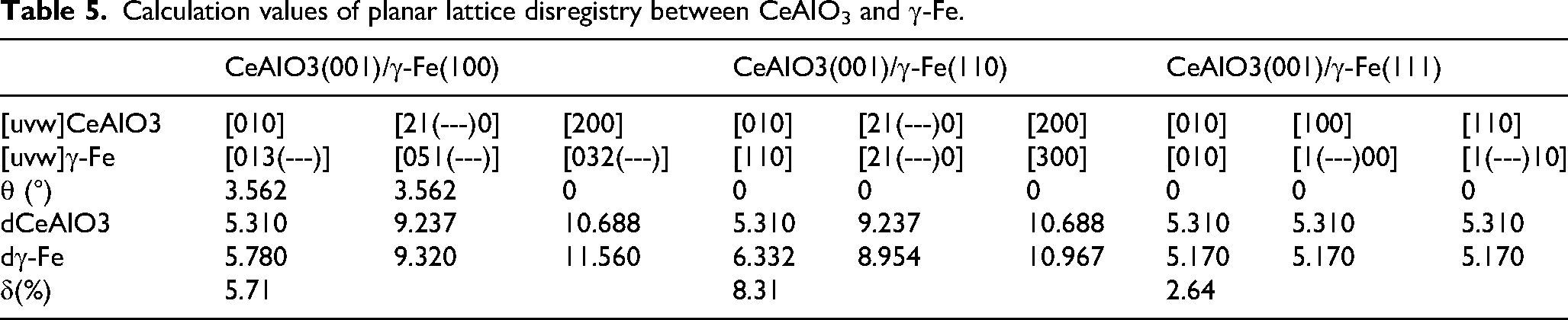
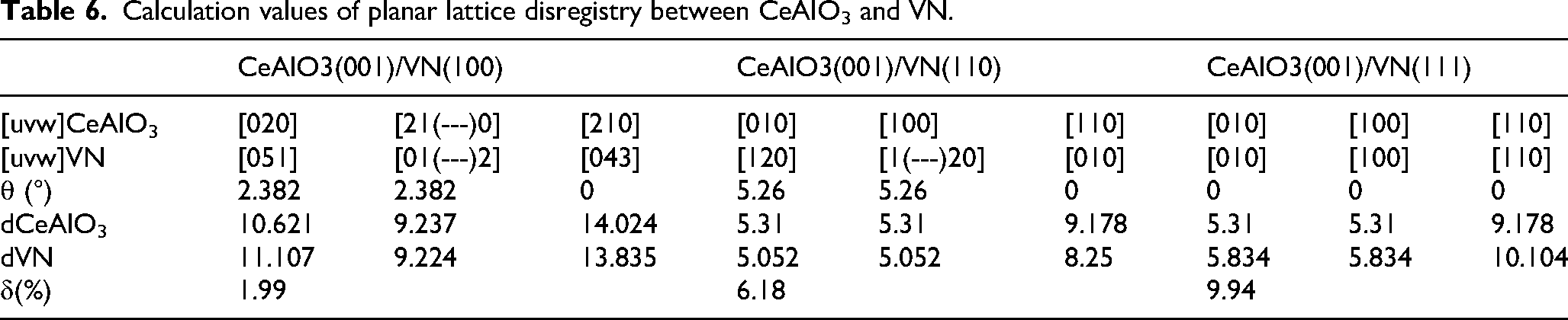
Therefore, this study focuses on elucidating the influence mechanisms of different inclusions on the heterogeneous nucleation behavior of γ-Fe during grain refinement. Previous studies have identified CeAlO₃ and Ce₂O₂S as typical rare earth inclusions in steel before and after cerium treatment. With the exception of MnS, these inclusions exhibit high melting points and readily form during the initial solidification stage, serving as effective heterogeneous nucleation sites for γ-Fe and thereby enhancing grain refinement. However, the efficacy of inclusions in promoting nucleation critically depends on their lattice compatibility with γ-Fe. To quantitatively evaluate the lattice matching between CeAlO₃ inclusions and the γ-Fe matrix, Bramfitt's planar disregistry model was employed for lattice mismatch calculations,
29
expressed as:
As shown in Table 5 and Table 6, it is the interface relationship between CeAlO3 and γ-Fe, CeAlO3 and VN. Generally, the planar lattice disregistry within 6% between substrate and nucleation phase is the most effective heterogeneous nucleation core, 6%∼12% the moderate nucleation core, beyond 12% the invalid one. The planar lattice disregistry results suggest that the CeAlO3 act as an effective heterogeneous nucleation site for γ-Fe and VN.
Calculation values of planar lattice disregistry between CeAlO3 and γ-Fe.
Calculation values of planar lattice disregistry between CeAlO3 and VN.
Nucleation of intragranular ferrite
Classical nucleation theory demonstrates that the standard normalized energy barrier for intragranular ferrite nucleation,
As depicted in Figure 14, the normalized nucleation barriers for intragranular and grain boundary ferrite nucleation exhibit size-dependent variations with VN precipitates. Under specific thermodynamic driving forces at given temperatures, heterogeneous nucleation barriers consistently remain lower than homogeneous barriers. When the nucleation barrier at grain boundaries falls below that of precipitate-induced intragranular ferrite nucleation (where the dashed line exceeds the solid line in the diagram), VN precipitates cannot preferentially initiate ferrite nucleation over grain boundaries. However, when VN precipitates maintain dimensions within a critical size range, they effectively serve as nucleation sites for intragranular ferrite. This phenomenon promotes both increased ferrite fraction and microstructural refinement.

The nucleation energy barrier of grain boundary ferrite and intragranular ferrite.
In summary, trace rare earth cerium facilitates grain refinement through the formation of Ce-Al-O inclusions acting as austenite nucleation sites. Additionally, it promotes dispersed distribution of VN precipitates, thereby increasing the ferrite fraction. However, excessive cerium content leads to formation of large-sized inclusions such as Ce-O-S in steel, compromising material ductility. The solid solution strengthening effects of rare earth elements require further research. As shown in Figure 15, it is the effect of rare earth Ce on the inclusion and microstructure of high-strength rebar. After Ce addition in steel, the Ce-Al-O particles generated can act as the nucleation sites of the steel matrix and VN. On the one hand, the Ce-Al-O particles facilitate grain refinement, contributing to fine ferrite and pearlite microstructure. On the other hand, VN promotes intragranular ferrite nucleation, increases ferrite content, and enhances ductility. When the Ce content exceeds 0.0079%, the inclusion content increases sharply, and large-sized Ce-O-S inclusions are formed, which act as stress concentration sources and deteriorate the steel toughness.

Effect of rare earth Ce on inclusion and microstructure of high-strength rebar.
Conclusion
In the current study, high-temperature melting experiments, rolling process, and room-temperature tensile testing were performed to investigate the effect of rare earth cerium on inclusions, microstructure and mechanical properties in high-strength rebar.
In steels without rare earth Ce, inclusions primarily consist of MnS with minor amounts of Al₂O₃, O-Al-Ca, and O-Al-Mg inclusions along with their MnS-complex counterparts. At 0.0032% Ce, the dominant inclusions are MnS and CeAlO₃-MnS composites, accompanied by limited Al₂O₃-MnS. With Ce increased to 0.0079%, MnS and CeAlO₃-MnS remain predominant. When Ce reaches 0.01%, the inclusion profile shifts to MnS, CeAlO₃-MnS, and Ce₂S₂O-MnS composites findings consistent with FactSage thermodynamic calculations. Two-dimensional disregistry calculations confirm that CeAlO₃ inclusions exhibit favorable lattice matching with both the matrix and VN, serving as effective heterogeneous nucleation sites for both phases and thus promoting microstructural refinement and optimizing VN distribution. Classical nucleation theory further supports that VN induces intragranular ferrite nucleation, refining the ferrite microstructure and increasing its volume fraction. The precipitation strengthening of VN dominates steel strength, CeAlO₃ inclusions act as heterogeneous nucleation sites for VN, promoting ferrite nucleation and refining the microstructure, thereby improving both strength and ductility-toughness. However, excessively coarse Ce-S-O inclusions intensify matrix splitting and significantly deteriorate ductility, making precise control of inclusion size and distribution essential for balanced mechanical performance.
Footnotes
Acknowledgements
The authors gratefully express their appreciation to Collaborative Innovation Center of Steel Technology, University of Science and Technology and Technology Center, Inner Mongolia Baotou Steel Union Co., Ltd for providing the necessary facilities and resources for scanning electron microscopy/ energy-dispersive X-ray spectroscopy, universal testing machine, and vacuum induction furnace.

Funding
The authors received no financial support for the research, authorship, and/or publication of this article.
Declaration of conflicting interests
The authors declared no potential conflicts of interest with respect to the research, authorship, and/or publication of this article.