







Abstract
This is an inquiry into natural disasters with insights from disaster diplomacy and the English School theory, departing from a debate sparked by France’s call to invoke the R2P in 2008 when Myanmar (Burma) refused to accept international aid following Cyclone Nargis. This call was perceived as turning disasters into a tool of Western interventionism and a new doctrine, the Responsibility to PROVIDE emerged which re-affirmed the consensual nature of disaster assistance. But the debate on coercive humanitarian assistance continues and my contribution links consensual versus coercive disaster response to pluralist and solidarist conceptions of international society, and then points to a new disaster solidarism emerging through (i) Resolution 2165 which authorized coercive aid delivery into Syria and constituted a significant step in the rejection of “apolitical humanitarianism”; (ii) draft articles of the International Law Commission that mention a “duty” to accept disaster aid; (iii) a new transboundary approach to disasters in the UN Sendai Framework; and (iv) robust new climate-disaster projections by climate scientists enabled by artificial intelligence and machine learning.
Keywords
From time to time, nature has a way of making a mockery of the artificial borders drawn by competing nations (Keridis, 2006, p. 210).
This is an inquiry into natural disasters with the use of concepts from the English School of International Relations theory (ES henceforth) and the field of disaster diplomacy. Its main question is whether more destructive and frequent disasters induced by climate change such as droughts, flooding, heatwaves, and wildfires can generate new forms of solidarism and new grounds for interventionism in international society in the near future. Disasters, defined by the UN Office for Disaster Risk Reduction (nd) as “a serious disruption of the functioning of a community” which leads to human, material, economic, and environmental impacts, have had a devastating impact on humanity as figures in the widely used Emergency Events database (EM-DAT) reveal. For example, between 1974 and 2003, EM-DAT recorded 6367 natural disasters (excluding epidemics) which killed more than 2 million individuals, affected 5.1 billion and caused an estimated damage of US$ 1.38 trillion (Guha-Sapir et al., 2004, p. 14). Droughts killed the highest number of individuals during this period and they continue to have a devastating impact. Using EM-DAT data, Donatti et al. (2024) focus specifically on climate-related disasters and record 4623 cases between 2000 and 2020 that affected over 3 billion individuals and killed 472.000 around the world. In 2023, 399 natural disasters caused 86.473 deaths and affected 93.1 million with over US$202 billion in damages. The deadliest disasters in 2023 were the Turkey/Syria earthquake followed by Storm Daniel in Libya that killed 59.000 (Delforge et al., 2024). Cascading disasters, where a primary event leads to a chain of equally strong secondary ones (Pescaroli & Alexander, 2015, p. 65), bring further devastation. An earthquake that triggered a tsunami in Japan on 11 March 2011 which led to an accident in the Fukushima Daichi nuclear power plant is a stark example of a cascading disaster. Compound disasters, where a number of events occur simultaneously like dry weather, wildfires and dengue fever outbreak in Rio de Janeiro between 2014 and 2015, are particularly complex events that strain disaster response. As the Intergovernmental Panel on Climate Change (Field et al., 2012, p. 116) emphasized, compound disasters involve correlation but not necessarily causality and new methods are required to understand their complexity.
As Wu et al. (2023) project a two to threefold increase in compound disasters for the period 2050–2099 over the 1950–1999 period, the subject of disaster diplomacy takes on a renewed urgency. Disaster diplomacy studies the conditions under which disasters may start or enhance cooperation between states, regional or international organizations, and other entities in international society, and a broad conclusion is that disaster-related cooperation is limited to the short-term unless other bases for cooperation exist. This article highlights the key legal, political, and technological developments within the last two decades that signal a shift toward more structured disaster-related cooperation and offers a theoretical framework for conceptualizing this. It therefore places disasters, humanitarianism, and International Relations theory into a closer dialogue. The ES theory is particularly suitable for this dialogue from among the various theories of International Relations as one of its main research questions is the tension between the state-centric rules and institutions of the international system, and cases that transcend these rules like natural disasters.
I start in the first section by offering a review of the key conclusions of the disaster diplomacy literature and establish in the second section the relevance of the ES concept of “world society” (Bull, 1995) to disasters. In simple terms, world society refers to our common humanity which, as Kerridis (2006) notes, disasters put to the fore. Humanitarian interventions are another closely related subject: how do we help fellow humans during great urgencies such as disasters? This question takes me to examining several cases out of which critical legal and political developments emerged: Cyclone Nargis (2008) in Myanmar (Burma), 1 Resolution 2165 (2014) on Syria and the Turkey/Syria earthquake in February 2023.
The initial refusal of Myanmar (Burma) to accept international aid after of Cyclone Nargis in 2008 led the then French foreign minister Bernard Kouchner to argue that the Responsibility to Protect (R2P) doctrine could apply to disasters and that aid could be coercively delivered into Myanmar (Burma). Kouchner’s call was not well-received. China as well as several regional actors like Thailand and Vietnam accused him of turning disasters into a potential tool of Western interventionism. As Tan (2017) explains, the R2P debate around Cyclone Nargis sparked regional institution building in Southeast Asia for disaster governance and led to the development of a new Asian doctrine: Responsibility to Provide. This doctrine, which Tan (2017) advances using Emmanuel Levina’s concept of responsibility, links the delivery of aid to the consent of the recipient country and emphasizes regional leadership in disaster response. I proceed by relating consensual response to pluralist international society and coercive response to solidarist international society in ES theory terms, and then examine the tension between them in the context of the unique coercive aid delivery mechanism for Syria created in July 2014 by Security Council Resolution 2165 but collapsed shortly before the February 2023 earthquake. After the earthquake, rebel-held northwest Syria was deprived of aid for days due to the Syrian government’s obstructive stance and turned, in the words of one UN official, to the “epicenter of neglect” (Pinheiro, 2023). How can the international community access disaster survivors in such cases?
I maintain in this contribution that cases such as the February 2023 earthquake are increasing the prospects for disaster interventionism and more structured disaster cooperation in international society, and highlight the following developments to substantiate this claim: (i) A new transboundary approach to disasters linked with climate change in the UN Sendai Framework for Disaster Risk Reduction (2015-2030). (ii) A new legal approach to disasters under consideration by the UN’s International Law Commission (2016) that implies a shift from strictly consent-based assistance to a “duty” to accept assistance. (iii) Resolution 2165 which sets a legal precedent for coercive aid delivery. (iv) A new pursuit toward a more principled approach to humanitarianism that replaces “apolitical humanitarianism” (Duffield, 2007) underpinned by the norms of neutrality, independence, and impartiality.
2
Duffield contrasted apolitical humanitarianism with a new “political humanitarianism” that has been emerging since the mid-1990s. The chief distinction between apolitical/old and political/new humanitarianism is that old humanitarianism construes humanitarian aid as an end in itself and is a “prophetic” approach to aid. The new political humanitarianism ties aid to a larger goal of peace-building and post-conflict sociopolitical transformation and it is a “consequential” approach to aid (Duffield, 2007).
3
Especially in view of the humanitarian situation in the Gaza Strip after 7 October 2023, critics say that apolitical humanitarianism is no longer fit for purpose and we need a fundamentally different approach that acknowledges the set of historical injustices built into the international system (Elnakib et al., 2024). (v) The emergence within the last decade of Single Model Initial-Condition Large Ensembles (SMILEs) as a new method offering robust climate-disaster projections using artificial intelligence and machine learning. Maher et al. (2021) note that SMILEs herald a new era in climate science with the use of large datasets, the ability to conduct multivariate analyses for understanding compound disasters especially and prepare detailed Regionally Downscaled Climate Models for specific parts of the world.
States, Disasters, and Diplomacy: An Overview of the Literature
The field of disaster diplomacy examines the impact of disasters on patterns of conflict and cooperation in international society. Its main finding is that disasters lead to short-term or ad hoc cooperation which does not necessarily lead to longer-term cooperation (Kelman, 2007). Cases ranging from Cuba–USA cooperation in the aftermath of hurricanes in the Gulf of Mexico, India–Pakistan cooperation in the aftermath of earthquakes to Russia–Norway cooperation in the aftermath of oil spills in the Arctic corroborate this pattern. Three conditions help explain disaster-related cooperation in more advanced terms: (i) pre-existing diplomatic baseline, (ii) authority-recognition issues in the disaster-hit region, and (iii) the differential impact of the disaster on different actors.
Pre-Existing Diplomatic Baseline
Disaster diplomacy scholars have established that disaster-related cooperation often builds on a pre-existing diplomatic momentum and may not create one by itself. An often-cited case, the Greek-Turkish cooperation following the devastating earthquake in the Marmara region in northwestern Turkey on 17 August 1999, was no exception. It followed already warming relations between the two countries due to developments in Kosovo and the Balkans in 1999. 4 Numerous spontaneous cases of cooperation can also be identified between countries that have no diplomatic relations or are formally at war. Indirect cooperation between Eritrea and Ethiopia, which only recently restored diplomatic relations, for the displaced Eritrean victims of the Nabro volcano eruption in 2011 is an example (Donovan & Oppenheimer, 2019). Operation Good Neighbor by the Israel Defense Forces (2017), which started spontaneously in June 2016 when an injured Syrian civilian approached the border for help and the Israeli commander on the spot instantly decided to help, is another example of humanitarian cooperation between nations that are formally at war. Still, as Kelman et al. (2018, p. 1133) write, disasters have “the potential (not inevitability) for improving inter-state and other relations only in the short-term and only if a non-disaster related pre-existing basis if available.” The pre-existing diplomatic baseline can be shaped by historical conditions. One recent example is the refusal of Morocco to accept aid from former colonial power France in the aftermath of a strong earthquake in September 2023 (The Telegraph, 2023). In November 2017, Iran turned down offers of help from Israel when a 7.3-magnitude earthquake caused devastation in its border area with Iraq (Anatolian Agency, 2017). The stark contrast to the 1962 Qazvin region earthquake is worth mentioning to demonstrate the force of the pre-existing diplomatic baseline condition. As Feniger and Kallus (2016) explain in detail, pre-Islamic revolutionary Iran’s Qazvin region was re-built by Israeli experts after the earthquake upon the invitation of the Iranian Shah; the Qazvin re-building project even evolved into a larger urban re-construction project of the entire area managed by teams of Israeli architects.
Authority-Recognition Issues
Disaster diplomacy is shaped by authority-recognition issues and the presence of para-diplomatic actors which may control disaster affected areas. In the ES, Bull (1995, p. 156) called these actors “entities with standing in world politics” and included them in his definition of diplomacy. The uneven response to the COVID-19 pandemic (a public health disaster) in the West Bank, East Jerusalem, and the Gaza Strip between March and September 2020 illustrates the salience of this issue. As Lehrs (2021) explains, the initial wave of COVID-19 generated some cooperation between HAMAS and Israel in the Gaza Strip although lack of recognition between the two soon terminated this. In the contested East Jerusalem where some neighborhoods that lie outside the separation barrier turned into “no man’s lands” (Lehrs, 2021, p. 10), the COVID response generated additional conflict between Israel and the Palestinian Authority. Tension built up as Israeli authorities were unwilling to provide services to Palestinians residents. The Palestinian Authority stepped in only to spark harsh responses from the Israeli police like the closure of Palestinian-operated COVID-19 clinics. There was more cooperation in the West Bank where jurisdiction issues, while disputed, are nonetheless clarified under the Oslo Accords (1993) (Lehrs, 2021).
Differential Impact
The same disaster can have differential impacts on different actors. For example, a disaster can weaken some while empowering others and this relative new power of the actor can necessitate a re-adjustment of its policies. Following the Indian Ocean tsunami in 2004, a peace treaty was concluded between the Indonesian government and GAM Rebels that controlled the Aceh province in the country. In this case, both the government and GAM Rebels were equally weakened by the tsunami. Yet the opposite scenario unfolded in Sri Lanka where the Tamil Tigers were able to effectively organize tsunami aid as the government failed to do so. Tamil Tigers could even force the government to agree to an aid-sharing agreement but this agreement collapsed shortly and the prospects for peace in Sri Lanka further declined after the tsunami (Enia, 2008).
Pre-existing diplomatic baseline, authority-recognition issues, and differential impact are major conditions that shape disaster diplomacy. There are several other conditions that are worth noting. Reciprocity or “tit-for-tat” disaster diplomacy is one which occurs when one country helps a disaster-hit country from which it had received help in an earlier disaster (Kelman, 2007, p. 301). The case of Greece and Turkey is again illustrative. In September 1999, a strong earthquake occurred in Greece and Turkey, which had received help from Greece just one month earlier in the August 1999 earthquake, was among the first countries to offer help to Greece (Ganapati et al., 2010). Strategic considerations also impact disaster assistance. A report commissioned by the World Bank Group found that the decision to donate is not only related to the severity of the disaster but to the perceived strategic importance of the affected country (Raschky & Schwindt, 2009). Finally, the involvement of militaries in delivering aid can also become a factor in disaster diplomacy. This was the case in October 2005 when Pakistan declared that it would accept Indian aid following a powerful earthquake only if delivered by civilian Indian actors. 25 tons of civilian Indian aid was then delivered to Pakistan for which the then Pakistani prime minister publicly thanked India. As Kelman et al. (2018) predicted, however, post-earthquake cooperation was short-lived and violence soon erupted along the line of control in Kashmir.
Research in the field of disaster diplomacy also intersects closely with the ES agenda in two main respects: (i) Disasters and world society: disasters reflect the ES concept of world society as they transcend the state-centric structure of the world in politico-moral terms and reveal the underlying emotional bonds between humans. (ii) Disasters and interventionism: the post-cyclone Nargis debate on the boundaries of interventionism in international society links closely with the pre-existing interventionism debate between solidarist and pluralist conceptions of international society within the ES. In the second section, I reconsider disasters within the context of the ES theory by connecting the Responsibility to Protect (R2P) doctrine to solidarist international society and the more recent Responsibility to Provide (R2Provide) doctrine to pluralist international society in the aftermath of disasters.
Between R2P and R2PROVIDE: Pluralism, Solidarism, and the Question of Humanitarian Aid Delivery
I again solemnly appeal to the Burmese authorities to lift all restrictions on the distribution of the aid by the most efficient channels. The specialized United Nations agencies and NGOs must immediately be able to have access to the victims. To address human suffering, wherever it may be, is precisely what is meant by the ‘responsibility to protect’ accepted by the international community and initiated by France. This is what we wanted to remind the Security Council (quoted in Relief Web, 2008; emphasis added).
On 8 May 2008, six days after Cyclone Nargis made landfall in Myanmar (Burma), the then French foreign minister Bernard Kouchner invoked the R2P doctrine as the government there refused to allow the delivery of international aid into the country. The situation was being debated at the UK parliament at around the same time. One member of the Parliament stated that: The Burmese Government must give unfettered access for the international humanitarian relief effort. A key lesson from the tsunami is the need for the international response to dovetail with the local relief effort; trying to go against the grain does not work. We need to persuade the Burmese authorities to be as co-operative as possible. This House can assure the Government of Burma today that the aid workers are there for non-political humanitarian reasons, to save lives, rather than for political positioning (quoted in Mitchell, 2008).
As Junk (2016) notes, the idea that withholding humanitarian aid constitutes a crime against humanity and therefore constitutes a legitimate ground for launching a military intervention as a last resort under R2P finds support from international legal scholars. For Barber (2009, p. 3), even if Cyclone Nargis itself did not justify a military intervention, “it is possible to envisage situations where… a government’s refusal to allow access to survivors might be so complete, and the humanitarian needs so immense, that the use of force may be warranted.” While genocide, war crimes, ethnic cleansing, and crimes against humanity pass the “just cause” threshold for invoking the R2P, Barber (2009) reminds that the definition of “crimes against humanity” in Article 7 of the Rome Statute of the International Criminal Court includes “other inhumane acts of a similar character intentionally causing great suffering or serious injury to body or to mental health” next to enslavement, rape, torture, and other crimes. Withholding aid from disasters victims can fall within the scope of “other inhumane acts” in Barber’s (2009, p. 19) analysis. International law also requires that this inhumane act be widespread and systematic with “knowledge of the attack” or the intention to harm to warrant an international intervention. In this case, the authorities took some limited action to deal with Cyclone Nargis and while part of their actions may have been pre-planned, Barber (2009) believes that these criteria were not fully met to classify Nargis as a possible R2P case. This does not, however, preclude the applicability of R2P to other post-disaster situations when all the criteria are clearly present.
Thakur (2008), one prominent expert involved in the creation of R2P, argued that natural disasters in general and Nargis in particular do warrant invoking the doctrine. As he reasoned: Morally, there is no difference between large numbers of people being killed by soldiers firing into crowds or the government blocking help being delivered to victims of natural disasters. To the extent that R2P is rooted in solidarity with victims of atrocity crimes, the sophistry of the distinction between a lakh killed by troops or through deliberate government neglect is morally repugnant (quoted in Thakur, 2008).
Thakur also reminded that the initial formulation included “overwhelming natural or environmental catastrophes” as a just cause for invoking the R2P although this was dropped later. He advocated invoking the R2P after Cyclone Nargis with the involvement of foreign soldiers on the ground as the only other option left was to drop aid parcels from the air which the military junta would likely seize anyway. Still, he acknowledged that it would start looking like a military occupation to the Asians to see Western military forces on the ground and this would alienate the Asians from the very concept of “R2P” (quoted in Thakur, 2008).
In the immediate run, a regional response was mobilized as China in particular exerted strong diplomatic pressure on Myanmar (Burma) to be more cooperative with the international community in responding to Cyclone Nargis. Cook (2010) explains how ASEAN soon stepped in and formed the Tripartite Core Group which mediated between Myanmar (Burma) and the international community. The Core Group facilitated the entry of UN aid workers and collected disaster-related data for use by international aid agencies. The immediate impasse was thus resolved through diplomatic channels.
In the longer run, the debate on the applicability of R2P to disaster situations continued after Nargis and a new doctrine, the Responsibility to Provide (R2Provide) developed in Asia which emphasizes consensual-regional (Asian) response to disasters (Tan, 2017). As Junk (2016) reminds, some objections to invoking R2P maintained that natural disasters are not a threat to international peace and security with which the doctrine is concerned, and disasters should be dealt with at a regional level as a result. Yet the catastrophic impact of climate change-related disasters is likely to invalidate this objection as climate change itself has already been identified as a threat to international peace and security (Brown & McLeman, 2009). There is more on the climate change-conflict nexus in the concluding section. Other objections to applying R2P to disaster situations included twisting the meaning of the concept to the point of rendering it inapplicable. Evans (2008) another architect of the R2P doctrine, warned against this possibility as the debate over Cyclone Nargis continued: If it comes to be thought that R2P, and in particular the sharp military end of the doctrine, is capable of being invoked in anything other than the context of mass atrocity crimes, then such consensus as there is in favor of the new norm will simply evaporate in the global South. And that means that when the next case of genocide or ethnic cleansing comes along we will be back to the same old depressing arguments about the primacy of sovereignty that led us to the horrors of inaction in Rwanda and Srebrenica in the 1990s (quoted in Evans, 2008).
It is possible to link R2P and R2Provide to solidarist and pluralist conceptions of international society, respectively, in the ES theory (Bull, 1966). Solidarism is a more universalist, interventionist, and justice-oriented type of international society while pluralism is less universalist, less interventionist, and an order-oriented one. In this specific context, solidarism would further link with universal disaster interventionism while pluralism would remain on the side of consensual-regional responses. The possibility of conceptual overstretch raised by the opponents of invoking R2P in disaster situations resonates strongly with the pluralist literature within the ES theory. Indeed, Bull was precisely concerned with the prospects raised later by Evans (2008) and others that pushing already fragile concepts to their limits could destroy the original consensus built around them. We would thus be “imposing upon international society a strain which it cannot bear” according to Bull (1966, p. 70). The typical solidarist response to this has been to assert that pluralism is a status quo oriented approach that closes off the possibility of moral progress in international society. The pluralist-less interventionist approach to disaster response is established in UN practice through Resolution 46/182 adopted on 19 December 1991: The sovereignty, territorial integrity and national unity of States must be fully respected in accordance with the Charter of the United Nations. In this context, humanitarian assistance should be provided with the consent of the affected country and in principle on the basis of an appeal by the affected country (Guiding Principles 3, Resolution 46/182, 1991).
“State capacity” to respond to disasters has been a key concept in this issue. The fifth guiding principle in Resolution 46/182, while acknowledging that disaster response may really exceed the capacity of states, insists that other states, international and non-governmental organizations should keep “working impartially and with strictly humanitarian motives” to “make a significant contribution in supplementing national efforts” (Guiding Principles 5, Resolution 46/182, 1991). Resolution 46/182 therefore adopts a solid pluralist stance in international disaster response.
A nascent solidarist approach, however, may be emerging as the increasing scale, severity, and frequency of disasters has led the International Law Commission (2016) to propose a new legal framework. The Draft Articles on the Protection of Persons in the Event of Disasters link the absence of “response capacity” to a “duty” to accept aid: Article 11: To the extent that a disaster manifestly exceeds its national response capacity, the affected State has the duty to seek assistance from, as appropriate, other States, the United Nations, and other potential assisting actors (International Law Commission, 2016, p. 4 emphasis added).
The draft articles are still under discussion and as Valencia-Ospina (2012), the UN Special Rapporteur emphasizes, many developing states in particular expressed concerns over the ambiguous wording of draft Article 11 while also conceding that linking aid strictly to consent could stand in the way of rapid disaster response.
Departing from the term of this debate, we can come up with the following continuum that matches disaster diplomacy with the ES concepts of pluralism and solidarism. The spectrum starts with the pluralist origins of disaster response as expressed in Resolution 46/182, moves forward with the International Law Commission’s Draft articles, and reaches a solidarist endpoint with the possibility of a direct military intervention to deliver aid (Figure 1). Pluralist-solidarist disaster response spectrum.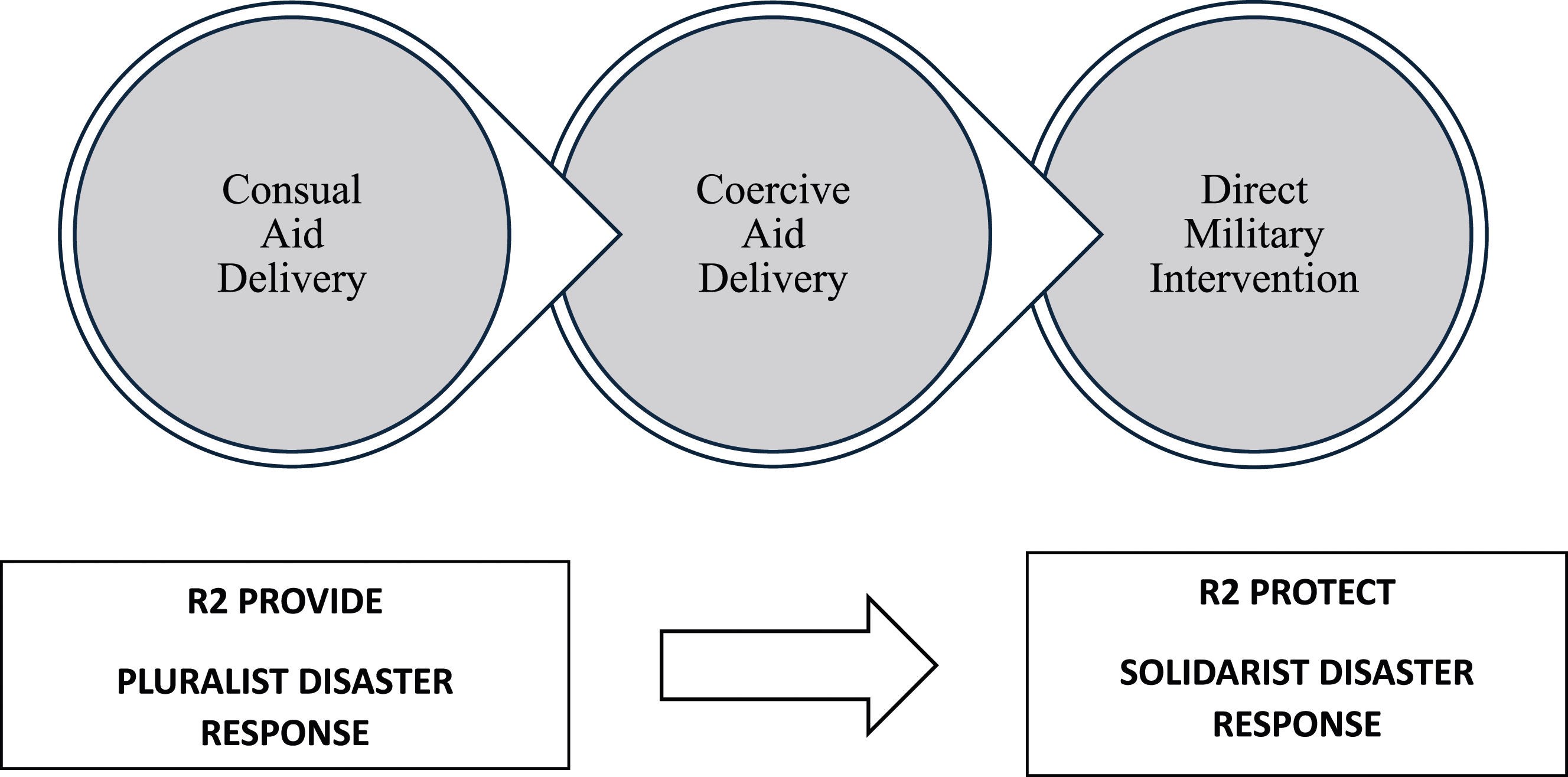
Post-Cyclone Nargis developments are further pushing our response to disasters towards the solidarist end of the spectrum. These include Resolution 2165 on Syria whose significance resurfaced during the February 2023 Turkey–Syria earthquake. In this case, access to rebel-held northwest Syria turned into a major issue that brought heavy criticism to the UN. Earlier, Resolution 2165 introduced a solidarist-coercive aid delivery mechanism into Syria which by-passed the Syrian government’s consent and worked through the consent of Syria’s neighbors. Yet this mechanism fully collapsed in July 2023 and was replaced with a pluralist one that placed the Syrian government back in control (expect for a temporary post-earthquake period).
Adopted unanimously on 11 July 2014; Resolution 2165 was very strongly worded in its condemnation of the Syrian government’s “arbitrary and unjustified withholding of consent to relief operations” in Syria. It subsequently decided that “United Nations humanitarian agencies and their implementing partners are authorized to use routes across conflict lines and the border crossings of Bab al-Salam [Turkey], Bab al-Hawa [Turkey], Al-Yarubiyah [Iraq], and Al Ramtha [Jordan].” Resolution 2165 thus created a coercive aid delivery mechanism linked to the consent of Syria’s neighbors rather than Syria itself and the government of Syria was to be “notified” only of aid deliveries. Shortly after the adoption of the Resolution, the Syria Cross-Border Humanitarian Fund was set up and truckloads of food and goods started entering Syria. This cross-border aid became a lifeline for the displaced communities in and around Idlip area in the northwest especially, the same communities also hit during the February 2023 earthquake, who have no local procurement substitutes.
Resolution 2165 was a landmark decision. As three experts underline, international law mostly regulates humanitarian access to civilians in cases of international armed conflict between two or more states. The Fourth Geneva Convention (1949) in particular is relevant which requires all belligerents to “allow the free passage of all consignments” such as food and medical supplies to all civilians in need (Article 23). International humanitarian law is weaker, however, in cases of non-international armed conflict which involves non-state groups or “entities with standing” in ES theory terms. Additional Protocol (1977) and Rule 55 of customary International Humanitarian Law attempt at regulating certain rules of humanitarian access during non-international conflict but these nonetheless remain state-centric and largely preclude the possibility of cross-border aid from being delivered (Harmer et al., 2018). Rule 55 states that: The parties to the conflict must allow and facilitate rapid and unimpeded passage of humanitarian relief for civilians in need, which is impartial in character and conducted without any adverse distinction, subject to their right of control (emphasis added) (International Humanitarian Law Databases, nd).
Resolution 2165 targeted this “right of control” through which states are able to obstruct humanitarian aid deliveries. It is a particularly significant resolution amid a growing recognition that the three main principles of impartiality, neutrality, and independence that underpin humanitarian work no longer function. Indeed, as Belloni (2007) reminds, the well-known NGO Doctors without Borders was founded in reaction to the inaction of the International Committee of the Red Cross in the Biafra (formerly part of Nigeria) conflict in the 1970s in the name of neutrality. As subsequent conflicts from Rwanda to Bosnia further revealed the limits of these principles, Belloni (2007) notes that a mental transformation has taken place in favor of a more proactive and interventionist approach to humanitarianism. For Harmer et al. (2018), these principles have already become invalid on the ground as access to vulnerable communities requires diplomatic negotiations with various sub-state groups. New principles to reflect the new circumstances of conflict are therefore urgently required.
A recent international commission has embarked on the task of redefining the three core principles of humanitarianism as not only the nature of conflict has changed but also the widespread imposition of unilateral sanctions has started interfering with humanitarian work (Spiegel et al., 2024). This last point on sanctions is becoming more urgent as a UN special rapporteur who examined their impact concluded that they cause “overcompliance” by the organizations in the imposing countries and prevent even legitimate humanitarian aid from being transferred to target countries such as Cuba or Syria (UN General Assembly, 2021). Several other scholars have urged the members of the new commission to recognize immediately that apolitical humanitarianism is an illusion and that a fresh “principled engagement” with existing systems and structures of politics is required to re-define humanitarianism, particularly in view of the post-October 7 situation in the Gaza Strip. Three specific reasons have been advanced for a more principled approached to humanitarianism; the first is that the existing “apolitical” approach is Eurocentric and based on a legacy of racism, colonialism, and white savourism. The second and related reason is that apolitical humanitarianism ignores marginalized communities and the systems of oppression that perpetuate their marginalization. The third reason is that apolitical humanitarianism fails to prevent states from using and weaponizing aid for their own geopolitical advantage (Elnakib et al., 2024). The weaponization of aid has been acutely the case in Syria where the government even interfered with the water and hygiene infrastructure and criminalized medical care provision in opposition-held areas in the northwest. This led to an increase in cholera outbreaks which risks becoming endemic in these areas. The closure of the Yarubiya (Iraq) crossing in the northeast earlier 2020 had already prevented the entry of cholera detection kits and rehydration solutions to Syria (Tarnas et al., 2023).
Calls for a more principled humanitarianism align closely with solidarist thinking in the international society literature which is based on the premise that there is a corpus of moral truth, derived out of natural law, that is beyond dispute (Bull, 1966). It is simply wrong beyond dispute, for instance, to intentionally cause cholera outbreaks or to withhold aid from cyclone or earthquake victims and we need to take a stance against such injustices. This new thinking around humanitarianism is turning into a practical reality on the ground as Carpi (2020) demonstrates through ethnographic research between 2011 and 2013 with Syrian refugees and a mixture of international and Arab Gulf-funded NGOs in Lebanon’s Akkar village. Through interviews with refugees and NGO workers, Carpi (2020) finds that a gap has emerged between Geneva-style neutrality or old/apolitical humanitarianism adopted by NGOs such as the Norwegian Refugee Council and new/political humanitarianism adopted by Qatari and other Gulf-funded NGOs that support and advocate for the opponents of the Syrian regime. Meanwhile, a resentful interview with a wounded Free Syrian Army fighter who was denied medical assistance by an international NGO in the name of not taking sides in the Syrian civil war demonstrates how individuals expect to be supported by humanitarian workers (Carpi, 2020, p. 421).
Still, the solidarist / coercive aid delivery mechanism to Syria which was re-authorized every six months started collapsing in July 2020 when Russia forced the closure of three out of the four authorized crossings, leaving the Bab al-Hawa / Cilvegözü crossing from Turkey as the only operational one. Except for a brief post-earthquake re-opening of additional crossings between 13 February and 13 May 2023, the coercive aid delivery mechanism to Syria came to an end on 11 July 2023 as Russia vetoed its renewal. Together with Syria, Russia argued that the delivery of aid across the border from Turkey, Iraq, and Jordan undermined Syrian sovereignty and that only Syrian government could distribute aid inside its territory. This was called cross-line aid which would be delivered from government held areas into opposition-held areas (Security Council Report, 2023).
The collapse of Resolution 2165 came under the spotlight on 6 February 2023 when a magnitude 7.8 earthquake struck southeast Turkey at 04:15 a.m. local time, followed by a magnitude 6.7 aftershock 11 minutes later and another 7.5 aftershock 9 hours later (US Geological Survey, 2023). The earthquake sequence affected over 16 million citizens in 11 provinces in southeast Turkey and five governorates in Syria. 50.783 Turks and 5900 Syrians were killed (Delforge et al., 2024).
While international aid started arriving in Turkey immediately, access to rebel-held northwest Syria was not possible as the Syrian government did not authorize aid agencies. The UN was heavily criticized during these critical hours for not bypassing Syrian government’s consent and delivering aid “coercively.” As Garthwaite (2023) underlines, it is already possible under a permissive reading of international humanitarian law for “impartial” actors to deliver aid without authorization under such circumstances. Yet the UN waited, and its aid to northwest Syria was both delayed and insufficient in the end that met only between 5% and 10% of what local hospitals needed to serve a population of 4.5 million (Alkhalil et al., 2023).
Aid to rebel-held northwest Syria was also affected by some of the fundamental conditions that shape disaster diplomacy: pre-existing diplomatic baseline and authority-recognition issues. At the time of the earthquake, Turkey and Syria had no diplomatic relations for over a decade and authority in northwest Syria was split between the central government of Syria, the group Hayat Tahrir al-Sham, and the Turkish armed forces which maintains troops in the region under a “de-escalation zone” as agreed at a regional summit in Astana, Kazakhstan in 2017. 5 It remains unclear, however, who the relevant authority was in the northwest pocket of Syria.
Disasters such as the February 2023 Turkey–Syria earthquake sequence stand at the intersection of diplomacy, the ES concept of world society and pluralist-solidarist conceptions of international society. Increasingly, they are turning into test cases of interventionism and the R2P doctrine which may apply to post-disaster situations. The final section below discusses whether the increasing scale, severity, and frequency of climate-related disasters can lead to thicker forms of solidarism in the foreseeable future. The non-binding UN Sendai Framework for Disaster Risk Reduction (2015–2030) provides the basic conceptual tools for approaching disasters in more solidarist-universalist terms.
The Sendai Framework and Enhanced Climate-Disaster Decision-Making Through New Machine-Learning Methodologies
As UN Framework Convention on Climate Change underlines, climate change and conflicts are inter-related: conflicts exacerbate the impacts of climate change through land and soil destruction caused by explosives (and landmines in some cases) and climate change drives conflict indirectly. A more hostile climate leads to more climate-related disasters like droughts and food insecurity which can initiate new conflicts between displaced persons and host communities in a vicious cycle (UNFCC, 2022). On the bright side, the number of deaths decreased nearly threefold in the 2010s thanks to early warning systems and more advanced disaster management tools despite a five-fold increase in mainly climate-related disasters between 1970 and 2019 (UN News, 2021).
Pelling and Dill (2010), meanwhile, point to the possibility of disasters becoming major “tipping points” for sociopolitical change and alter a society’s social contract. Two relevant examples are the 1985 Mexico City and 1972 Nicaragua earthquakes after which more egalitarian social structures were created. More frequent and devastating disasters can create a new tipping point in disaster diplomacy for a new global contract in our climate change-stricken future where disaster solidarism becomes a new fundamental norm that holds irrespectively of complex authority-recognition issues or pre-existing diplomatic baseline between the actors impacted by a disaster.
Moreover, the prospects for more structured disaster cooperation have increased by the recent emergence of robust climate-disasters projections enabled by SMILEs. These provide reliable Regionally Downscaled Climate Models to develop targeted regional climate-disaster adaptation plans for use by regional organizations especially. Regional models use output from Global Climate Models which are, however, not detailed enough in representing the climate of a specific part of the world. Regionally Downscaled Climate Models offer detailed high spatial resolution models of a region which can potentially reveal new region-specific information for use by local decision-makers. Some examples of regional studies include the Large Ensemble Of Regional Climate Simulations For Europe (LAERTES-EU) which reanalyzes and downscales all relevant data for the twentieth century to assess the risks of extreme flooding in Europe (Ehmele et al., 2020). There are caveats, however, involved in these scientific projects. As Maher et al. (2021) emphasize, the computational costs of running SMILEs models are extremely high at the moment. In addition, the coordination of the activities of the various research groups is an issue that needs to be tackled. Since 2011, the Coordinated Regional Downscaling Experiment (CORDEX) by the World Climate Research Program (nd) has been trying to build global partnerships under a common framework.
More robust climate-disaster projections serve the goals of the Sendai Framework for Disaster Risk Reduction (2015–2030) which places a stronger emphasis on early warning and prevention compared to the previous Hyogo Framework for Action (2005–2015). Sendai is structured around the concept of disaster resilience and represents a paradigm shift from recovery and reactive disaster governance to preemptive governance which can be enhanced with the help of advanced climate-disaster models. Climate change receives a special emphasis throughout the Sendai framework which stresses the transboundary impact of climate-related disasters. This new approach has been endorsed in a number of regions in the world, including by the Arab members of the UN who, after recognizing the climate urgency and the increasing frequency of disasters, endorsed a “paradigm shift from disaster risk management to a more comprehensive and risk-resilient development practice through a coherence with sustainable development and climate change policies” (Rabat Declaration, 2021).
Sendai deals more extensively with the sensitive subject of mass displacement of persons due to natural disasters which was mentioned only in passing in the Hyogo Framework. The displacement of humans and the emergence of migrants-refugees have become particularly contentious subjects in contemporary international society and the Sendai Framework adopts a balanced approach on this issue. It highlights the primary responsibility of states for disaster risk reduction while also calls on all relevant non-state actors to contribute their share. The puzzle of how to reconcile the responsibilities that lie beyond the purview of states with rules and institutions that are designed for a state-centric world lies at the center of the ES theory and indeed at the center of the question of how to respond to climate-related natural disasters. This article took an initial step in synthesizing these subjects for a wider debate.
Conclusion
The projected increase in the scale, severity, and frequency of climate-related disasters is paving the way for transforming the established patterns of disaster diplomacy and its short-term nature in particular. This article compiled a review of recent developments in international law, climate science, and humanitarianism to advance the claim that climate-related disasters are likely to lead to more structured disaster cooperation and more disaster interventionism in the international society. One of its key contributions is the structuring of these different topics around a suitable IR theoretical framework.
By taking Cyclone Nargis, the civil war in Syria, and the Turkey–Syria earthquake as case studies, the article linked consensual versus coercive aid delivery to the ES theory concepts of pluralism and solidarism, and to the R2P and R2Provide, respectively. The paradigm shift towards disaster preparedness articulated in the Sendai Framework, the draft articles of the International Law Commission that mention a “duty” to accept disaster assistance and Resolution 2165 which set a legal precedent for coercive aid delivery were pointed to as the key developments in international law that aim to strengthen the prospects for disaster solidarism/interventionism. The search for new humanitarian principles was cited as further strengthening the solidarist narrative.
As the Myanmar (Burma) example shows, the concepts involved such as R2P and R2Provide are fiercely contested among the various actors and there are reversals from solidarism as the collapse of the coercive aid delivery mechanism into Syria shows. Indeed, we should underline this contested nature of humanitarianism and notice how the solidarist/coercive narrative encroaches upon state sovereignty. As Ekengren et al. (2006) note, disaster response is entangled with “sovereignty sensibilities” even in the EU where there are particularly advanced practices of sharing sovereignty in numerous other policy areas. Berchtold et al. (2020) recently demonstrated through interviews with officials from seven EU member states that different governance structures, organizational cultures, legal conditions, and preferences keep constituting obstacles to cooperation in this field despite a strengthening of Union-level disaster response mechanisms in 2019. Disaster-related sensibilities are compounded by a fear of interventionism in the global South with the use of disasters as a pretext. The pluralist-solidarist debate in the ES theory can further structure the debate on disaster interventionism following the initial steps taken in my discussion.
Finally, the article highlighted the potential of emerging climate-disaster models through artificial intelligence and machine learning in enabling targeted information for regional adaptation plans in particular. The computational costs and coordination among various research groups working on these advanced models remain issues to be addressed. Building on the developments reviewed in this article, future research may benefit in particular from evaluating the ethical and policy implications of these new models that herald major advances in climate science.
Footnotes
Acknowledgments
A preliminary outline of this article was presented at the SECURE EU Jean Monnet Network Final Conference at Koç University in Istanbul, Turkey on 29 September 2023. A first full draft was presented at the 11th European International Studies Association workshops at Kadir Has University in Istanbul, Turkey between 3 and 5 July 2024.
Declaration of Conflicting Interests
The author(s) declared no potential conflicts of interest with respect to the research, authorship, and/or publication of this article.
Funding
The author(s) received no financial support for the research, authorship, and/or publication of this article.