Abstract
This article investigates how the securitisation of migration and the concept of b/ordering-borderism have shaped official European Union (EU) discourse on migration between 2015 and 2022. Drawing on narrative analysis, complemented by computational tools (sentiment analysis and lexical frequency/word cloud techniques), we examine 133 speeches and statements delivered primarily by the presidents of the European Commission, with a particular focus on the State of the Union addresses. Building on the Copenhagen School and van Houtum and van Naerssen’s triad of bordering-ordering-othering, we introduce the notion of w/ordering to capture the specifically textual and performative ways in which words enact borders between ‘We’ and ‘Other’. Our findings show a gradual shift from a moral and humanitarian framing (‘beacon of hope’, “humanity’ and ‘dignity’) and an emphasis on legal pathways towards an increasingly managerial and security-driven vocabulary centred on ‘management’, ‘control’, ‘returns’ and the ‘protection of external borders’. In parallel, solidarity is progressively reoriented from refugees towards member states, and the narrative of a ‘borderless Europe’ increasingly gives way to that of a reinforced ‘Fortress Europe’. We argue that this evolving w/ordering does not merely describe migration but actively participates in legitimising new border infrastructures, surveillance practices and restrictive asylum policies. The article thus highlights the constitutive role of language in European border-making and the ways in which textual othering precedes and underpins physical bordering.
Introduction
The European Union has been experiencing a significant inflow of migration since 2011, although the intensity of this influx has varied over time. In 2015, compared to 2013, the continent experienced a 500% increase in arrivals, reaching a total of 1.25 million migrants (Greussing & Boomgaarden, 2017). As a result, both the Schengen and the Dublin systems immediately collapsed and the representatives of the different governments blamed each other’s failed policies and reacted to the crisis by closing their national borders even within the Schengen zone where six member states have been permanently breaching the Agreement (European Court of Auditors, 2022). Besides legal restrictions, also physical barriers have been emerging during the last decade.
Prior to the migration crisis, the total length of border walls and fences in Europe reached 318 km. In 2022, the same value exceeded 1,929 km, and a further 628 km-long fences were under construction (Dumbrava, 2022). The newly erected fences especially demarcate the external borders of the Union (representing 83% of the 1,929 km) reinforcing the Fortress Europe concept.
The 2015 migration crisis, driven by conflicts in Syria, Afghanistan, and elsewhere, brought this tension to the forefront. It exposed the limitations of existing policies and divisions among EU members regarding burden-sharing, responsibility, and solidarity.
In the present study, the authors analyse the changes in the European migration narrative, focussing on the official statements of European political leaders to illustrate these tendencies. They articulate their research question as: 'How does the securitisation of migration, in conjunction with the concept of b/ordering-borderism, shape the narratives and language used in official EU discourse on migration?'
The study has a double objective. First, the 2015 migration crisis, coupled with the ongoing turbulence and conflict in the Middle East and North Africa region, has significantly reshaped migration and border control mechanisms and re-thematised the political discourse within the European Union. The crisis not only intensified border control measures but also deepened political divisions both among EU member states and within their societies (Fähnrich et al., 2017; Koneska, 2018; Zeitlin & Nicoli, 2020). These divisions are manifested in highly polarising debates on national sovereignty, humanitarian responsibility, and security concerns (Furedi, 2020). By researching the evolving migration narratives that have emerged in response to these developments, the study can provide valuable insights into the forces shaping EU policies, the securitisation of migration, and the broader societal shifts that contribute to political polarisation. Second, a deeper exploration of securitisation and border-making processes can offer a more comprehensive understanding of the policy responses to migration and their wider implications. The increasing securitisation of migration (Bello, 2022; Stivas, 2024), often framed through a lens of national security and crisis management, has led to the reinforcement of border infrastructures, the expansion of surveillance technologies, and shifts in asylum and refugee policies (Léonard & Kaunert, 2019; Martins & Jumbert, 2022; Stępka, 2022). Examining migration through the lens of the securitisation narrative could help us to contextualise its political, social, and economic effects, shedding light on both the intended and unintended consequences. Furthermore, understanding these dynamics is crucial for assessing the long-term trajectory of EU migration policies, the integration of migrants, and the challenges of balancing security concerns with humanitarian obligations.
To answer the research question, the authors aim to focus on the official declarations of the EU leaders. Our research starts with a literature review on migration and securitisation from a narrativist perspective which provides the theoretical framework for our research. In the third chapter, we briefly present the applied methods and the basis of information used. The fourth chapter includes the key findings revolved around five basic narrative topics of security political discourse, with a special focus on the statements made by Jean-Claude Juncker and Ursula von der Leyen, the two presidents of the European Commission, along with, to a lesser extent, statements from other high representatives of the Commission. In the discussion and conclusion chapter, the authors address, within the context of the research question, the changes in the European migration discourse, and its impacts on the borders and explain the term W/ordering.
Literature Review and Theoretical Framework
The phenomenon of migration can be analysed from different angles. Some well-known theoretical works apply the economic/utilitarian approach, which emphasises the importance of various economic factors, such as higher earnings, wage differences, labour market imbalances, and the structures of capitalism (e.g. Bhagat, 2020; King, 2012; Massey, 2009; Piore, 1979; Wallerstein, 1974). Another approach is the functionalist one, where the role of institutions and organisations is emphasised in managing migration (e.g. Massey, 2009; Mihai, 2016). The third approach highlights social aspects, including migrant networks, socio-economic enclaves and behavioural elements such as trust and reciprocity (e.g. Stark & Bloom, 1985). The fourth stream is the geopolitical approach, according to which (civil) wars, rebellions, authority breakdown (Crawley et al. 2016, 2017), and failed states push millions of people into highly vulnerable conditions (Klaus, 2017; Park, 2015; Yazgan et al., 2015) with migration appearing as a survival option. The fifth approach concentrates on the technological aspects, specifically highlighting the role of the internet, technology, and telecommunication as important factors in digitalising refugees’ lives (Alencar, 2020), such as in navigation (Dekker et al., 2018) or resettlement (Kaufmann, 2018). Moreover, environmental approaches are becoming increasingly relevant, focussing on the movement of people driven by environmental changes, such as natural disasters, climate change, and resource scarcity (e.g. Black et al., 2011; Mcleman, 2013). In other words, migration can be influenced by one factor or by a combination of multiple factors at the same time.
While these perspectives provide a comprehensive understanding of migration, our study focuses on the securitisation of migration and its discursive implications. The concept of securitisation has its roots in the works of the so-called Copenhagen School. This social constructivist concept emphasises the textual features of threat and the discursive character of security-making. By adapting Austin’s speech act theory, Barry Buzan, Ole Wæver, and Jaap de Wilde (1998) have brought into focus the narratives on security and how these narratives generate conditions for interventions. From this perspective, security is not an objective condition but the “outcome of a specific social process: the social construction of security issues (…) through which threats become represented” (Williams, 2003, 513).
The migration crisis in 2015 has been profoundly interlinked with the securitisation narrative, forming part of a broader discursive process (Gyelník, 2021). At this point, the discourse becomes immensely important. Subsequently, human beings discover and interpret the world around them through discourses including different narratives and institutions, power relations, practices or knowledge production means (Foucault, 1981; Powers, 2007). In other words, discourse is “an ensemble of ideas, concepts, and categories through which meaning is given to phenomena” (Hajer, 1993, 45). Michel Foucault (1978, 100) goes further and establishes a power structure within discourses, “Indeed, it is in discourse that power and knowledge are joined together.” Similarly, Edward W. Said (1979) describes discourse as a system of knowledge, representation and power that can legitimise dominance, while Derek Gregory (2004) expands on this idea, arguing that discourse is not only about words, but also represents power and simultaneously frames how places, people, and events are understood and acted upon.
When adapting the concept of securitisation to explain migration, it is essential to analyse the narratives that shape the discourse defining the rules of inclusion/exclusion, inside/outside, and the Self/Other distinction (e.g. Neumann, 1996). In this discourse of distinction, the demarcation of borders plays a prominent role (Horvath et al., 2022). In this context, the terminological triad of ‘bordering, ordering and othering’, introduced by van Houtum and van Naerssen (2002), serves as an important analytical framework. They argue that borders are not merely physical artefacts, but rather social constructs with a meaning of spatial differentiation, “Borders do not represent a fixed point in space or time, rather they symbolise a social practice of spatial differentiation” (van Houtum & van Naerssen, 2002, 126). Consequently, bordering is understood as the process of creating distinctions within space and society (Scott, 2021).
In this study, we examine the migration crisis from the securitisation point of view, in close relationship with the b/ordering-borderism concept. Both of them have substantial relation to language, textuality and narratives. As Chouliaraki et al. (2017, 5) put it: “securitization relies on the symbolic power of communication to produce and circulate meanings about different populations,” while according to van Houtum (2021, 35) “the fiercest borders are made out of paper” – meaning visa regimes. Building on van Houtum and van Naerssen’s triad of bordering-ordering-othering, we introduce the notion of “w/ordering” to capture the specifically textual and discursive ways in which borders are enacted. By w/ordering we refer to the creative and performative power of words in constituting borders between “We” and “Other,” as well as between security and insecurity, legality and illegality.
The present European discourse on migration reflects two opposing perspectives. On the one hand, proponents of open migration policies emphasise the moral obligation to help, highlighting economic (labour market contributions) and cultural (enhancing diversity) benefits. On the other hand, critics focus on concerns over integration, security, and social cohesion. EU member states and their citizens have been drawn into amplified political rhetoric and media narratives, widening the gap between ordinary people and fuelling societal polarisation (Furedi, 2020; Zeitlin & Nicoli, 2020).
Previous research approaches conducted a thorough analysis of migration from various angles of narrative analysis. A major part of these analyses concentrates on national-level narratives through press articles (e.g. Berry et al., 2015; Chouliaraki et al., 2017; D’Amato & Lavizzari, 2019; Greussing & Boomgaarden, 2017), social media posts (e.g. Krzyżanowski, 2018; Lucchesi, 2020), or, much less often, the testimonies of the asylum seekers (e.g. Gunesch et al., 2016; Wodak, 2017). Others analyse the EU-level discourses but with a special focus on selected topics, such as human smuggling (Fassi, 2020) or the relationship between European peoplehood and migration (Hase, 2023). Nevertheless, research on the official statements and expressions by the highest authorities of the European Union remains underdeveloped. Official statements shape the narrative space enabling policy action, and in migration they are inseparable from the evolving notion of Fortress Europe. Consequently, the authors decided to bridge this underdeveloped gap by focussing their research on the official declarations of the leaders of the European Union. In other words, this study focuses on the statements of the EU leaders to provide an overview of the changing topoi and accents at the official level, from a general perspective. When doing this, unlike other papers (e.g. Krzyżanowski et al., 2018; van Houtum & Bueno Lacy 2020), the authors tend to avoid normative reflections. This way, we intend to avoid politicising the migration discourse which has been ruled by ideological debates (Krzyżanowski et al., 2018).
Data and Methods
As a basis for our analysis, all speeches and statements by the European Commission’s presidents between 2015 and 2022 were collected from the official databank of the European Commission. In total, 133 such documents were found and included in the analysis, with a special focus on the State of the Union speeches. These speeches, delivered by the President of the European Commission to the European Parliament, address the EU’s most pressing challenges, outline ideas that may shape its future, highlight the achievements of the past year, and present the main objectives in the upcoming year.
Additionally, we analysed some other speeches and statements from members of the European Commission addressing the former messages’ topics. Most of the space was devoted to the issue of migration in 2015 and 2016, while the significance of the topic becomes tangibly narrower in 2017, and between 2020 and 2022.
In researching the speeches and official statements, we employ the methods of narrative analysis, namely the intricate interplay of language, power dynamics, and socio-political contexts, unveiling how narratives shape and are shaped by discourses.
Apart from the literature review and document analysis, the authors also applied computational methods and tools in order to illustrate the changes in the discourse.
First, a sentiment analysis was performed using the SpeakAI software. This computational process was applied to determine the emotional tone or sentiment expressed in these speeches and statements. The utterances were classified as positive, negative, or neutral based on the sentiments or emotions conveyed by the words and phrases used. This method helped extract subjective information from the texts and understand the overall sentiment or attitude of the speaker.
Second, the main topics of the State of the Union speeches have been analysed after having grouped into 5 major contextual clusters.
Finally, following Nie’s methodology Nie (2017) the MAXQDA software’s various functions (such as keyword-in-context, wordcloud, word combination, and interactive word tree) were used in order to present the emphatic changes of the terms used the most.
Findings – The 2015 Migration Crisis as the Major Challenge to the Ideal of Borderless Europe
Sentiment Analysis
The 2015 Migration Crisis was a defining moment for the European Union, placing the ideal of a borderless Europe under significant strain. Sentiment analysis of statements and speeches by European Commission presidents and experts between 2015 and 2022 reveals a transformation in discourse. While neutral statements initially dominated at around 50% in 2015, their share steadily declined to approximately 40% by 2022. This shift was accompanied by an increase in both positive and negative sentiments, indicating a growing polarisation in the debate. Positive utterances, which accounted for roughly 35% in 2015, grew to nearly 45% by 2022, suggesting efforts to frame migration-related challenges in a constructive or solution-oriented manner. Meanwhile, negative sentiments, which were around 15% in 2015, increased to just above 20% in 2022, reflecting persistent concerns and criticisms. The findings underscore how the migration crisis shaped political narratives, leading to a more pronounced divergence in perspectives rather than a unidirectional shift towards either optimism or scepticism. The steady rise in positive sentiment, despite ongoing challenges, suggests that EU leadership sought to reinforce a vision of resilience and cooperation, while the moderate increase in negative sentiment highlights the enduring complexities of European migration policy and the tensions between humanitarian values and security concerns.
This sentiment classification is based on an automated analysis conducted using SpeakAI, a natural language processing tool that employs machine learning models to evaluate textual data. SpeakAI categorises statements as positive, neutral, or negative by assessing linguistic markers such as word choice, syntactic structures, and contextual sentiment. The system leverages a combination of rule-based lexicons and deep learning algorithms trained on large datasets to determine the overall emotional tone of a statement. For instance, a sentence such as “I commend Alexis for his commitment to increase reception capacity in Greece to 30,000 places by the end of the year, with the UNHCR to help provide at least 20,000 more places in Greece” (Speaking Points of President Juncker – Press Conference on Western Balkans Route Leaders’ Meeting Brussels, 26 October 2015) is classified as positive due to the presence of affirming verbs like “commend” and the emphasis on proactive policy measures helping the refugees. Meanwhile, expressions of concern or threat, such as “Terrorism knows no borders, and so our response must be global” (Speech by President Juncker at the EP Plenary – Preparation of the European Council meeting of 17-18 December 2015), are categorised as negative due to the use of alarm-inducing terminology like “terrorism” and the implicit reference to a security risk. In contrast, a statement like “The focus of today’s Council meeting is once again on refugee policy” (Joint Press point ahead of the European Council by President Juncker and President Schulz – Remarks by President Juncker, Brussels, 17 December 2015) remains neutral, as it merely states an agenda without conveying any sentiment (see Figure 1). Sentiment analysis of the assessed allocutions (own edition based on SpeakAI analysis)
Topology
The security political discourse relating to migration can be separated into 5 basic narrative topics. The first is the issue of morality and solidarity of the European continent towards the migration crisis. The second topic refers to the relation between border and security since migration as a mass movement phenomenon has a significant impact on both factors. Migration and terrorism are the objects of the next topic since the uncontrolled migration flow influences everyday perceptions of security and safety. The fourth one looks at the issue of asylum, return and relocation as elements of the securitisation concept and quest for security, while the last topic targets the migration through the lenses of ‘legality’ and its shift towards the notion of ‘management'.
The Question of Morality and Solidarity as a Key Determinant of Openness/Borderless or Fortress Concepts
The idea of ‘morality’ is a narrative element which received a significant space in the EU narrations, especially in the first two years of the migration crisis. During these two years, the 'moral approach' was present almost in every document and statement. The State of the Union speech of 2015 narrates the role of the European Union in the migration crisis as an actor of humanity, seeing migration as a moral issue. The moral line was powerfully set in 2015, “It is Europe today that represents a beacon of hope, a haven of stability in the eyes of women and men in the Middle East and in Africa. (…) So it is high time to act to manage the refugee crisis. There is no alternative to this. (…) Europe is the baker in Kos who gives away his bread to hungry and weary souls. Europe is the students in Munich and in Passau who bring clothes for the new arrivals at the train station. Europe is the policeman in Austria who welcomes exhausted refugees upon crossing the border. This is the Europe I want to live in. (…) in spite of our fragility, our weaknesses, our self-perceived weaknesses, today it is Europe that is sought worldwide as a place of refuge and exile” (State of the Union, 2015e, 7, 8, 11, 49), the President of the European Commission continues to emphasise a moral approach, like “The crisis is testing our values, and it is testing our will. And it is reminding us that solidarity is not only a moral virtue but an essential part of our European Union. A European Union shoes original mission – to promote peace…” (Speech by President Jean-Claude Juncker at the 2016 Spring Meetings of the IMF, World Bank flagship event on 'Forced Displacement: A Global Development Challenge, 2016b). This moral line was followed also by the First Vice-President, Frans Timmermans, “Everyone who needs sanctuary should find it in Europe” (European Commission makes progress on Agenda on Migration 2015a, 2015b). Subsequently, the moral line goes hand in hand with obligation, “These are human lives at stake, and the European Union as a whole has a moral and humanitarian obligation to act (…) what we need is immediate actions to prevent further loss of life” (European Commission Statement on developments in the Mediterranean 2015c).
In the following years, the moral imperative shifted to the idea of ‘solidarity’. The Presidents articulated it, “Europe is and must remain the continent of solidarity where those fleeing persecution can find refuge” (State of the Union, 2017), “We need more, better organised, lasting solidarity – today and forever more” (State of the Union, 2018a), “We will take a human and humane approach. Saving lives at sea is not optional. (…) must be able to rely on the solidarity of our whole European Union” (State of the Union, 2020c).
The Quest for Border and Security
The State of the Union speech of 2015 (10) underlined that open borders, which is a unique symbol of integration, have reduced border controls, but the reduced controls have their other side, namely, a need to closely work together, thus to assure the management of the external borders of the community. Subsequently, the President underlined (State of the Union, 2016c; 2017) the need to have strong and effective protection mechanisms for external borders in order to preserve Schengen. This means that the EU needs to take steps to develop a European Border and Coast Guard, “We need to know who is crossing our borders (…) I want to see at least 200 extra border guards and 50 extra vehicles deployed at the Bulgarian external borders as of October” (Ibid. 2016, 17). In July 2018 at the European Parliament, Juncker underlined the need to manage the external borders more effectively, “I want a standing corps of 10,000 in place by 2020 ready to support the over 100,000 national border guards (…) We need to establish a genuine, efficient EU border guard” (in Arostegui, 2018). Thus, he pushed for carrying out effective border controls equipped with the latest technology, establishing a network of surveillance centres and checkpoints, permanent air and land patrols, strengthening cooperation with non-EU countries and promoting enhanced cooperation with the EU asylum agency, like cooperation in the field of hotspots, controlled centres to manage asylum requests and implementing a stronger mandate on return tasks (State of the Union, 2018). Moreover, to “strengthen Frontex significantly and develop it into a fully operational European border and coast guard system. It is certainly feasible” (Ibid. 2016, 17) that is capable of implementing dynamic border protection which would be moved around ‘hot spots’ as requested by member states.
The Issue of Migration and Terrorism
The public was shocked by the coordinated attacks across Paris in November 2015 resulting in 137 deaths and at least 413 injured persons. A few months later, the events continued with the Brussels bombings in March 2016, at least 34 people were killed and 190 wounded. It was followed by the Nice truck attack in July 2016. A large truck deliberately drove into a large celebration on Bastille Day, a national day in France that resulted in 84 dead people and hundreds of injured. Furthermore, the public was shocked by the murder of an 85 year old priest, Jacques Hamel, as he was celebrating Mass. In other words, terrorism experienced a significant increase between 2015 and 2018. These shocking events brought tangible insecurity and the approach of the European Commission was slightly shifted, as the President of the European Commission expressed in 2016, “tolerance cannot come at the price of our security (…) We need to know who is crossing our borders. (…) we will defend our borders, as well, with strict controls, adopted by the end of the year, on everyone crossing them. Every time someone enters or exits the EU” (State of the Union, 2016c, 17).
Asylum, Return, and Relocation
With the arrival of migrants, the question of asylum, return, and relocation gained attention. As the 2015 State of the Union document expresses, “Common asylum standards are important, but not enough to cope with the current refugee crisis.” Moreover, the President urged to reform the European asylum system thus “laying down all the elements necessary for a more humane, fair, coherent and efficient common policy” (State of the Union, 2016c, 42). The next important step came in 2020 with the proposal of the EU’s New Pact on Migration and Asylum, aiming to create more efficient and sustainable migration and asylum processes. As a result, the European Asylum Support Office was replaced by the European Union Agency for Asylum. The new agency expanded tools, including a permanent asylum reserve pool, an asylum training curriculum, complaints and monitoring mechanism and strengthened collaboration with non-EU countries (Regulation (EU) 2021/2303 of the European Parliament and of the Council of 15 December 2021 on the European Union Agency for Asylum and repealing Regulation (EU) No 439/2010). The new pact ensures a closer link between asylum and return, aiming to differentiate between those who have the right to stay and those who do not.
Regarding the return, nearly every State of the Union document supports the return of those who do not require international protection (2015), the returns and readmission processes need to be more effective with the new EU list of safe countries of origin (2016), to accelerate the return of irregular migrants (2018) and/or to return those who have no right to stay (2021). Moreover, a permanent relocation mechanism was highly proposed that would allow to deal with crises in the future. However, “the 40,000 figure was never reached. Not a single person in need of protection has been relocated yet and Italy and Greece continue to cope alone” (State of the Union, 2015, 24). The State of the Union 2016 expresses (2016, 25), “Europe has shown solidarity with 1 million Syrian refugees (…) we have relocated and resettled over 13 000 refugees in the past year alone. Clearly, this is not enough and can only be a beginning.” Thus, new migration partnerships were proposed with the key third countries, like Ethiopia, Mali, Niger, Nigeria, or Senegal. Subsequently, the European Border and Coast Guard system was formalised as a tool for 'regaining control of irregular migration flows', and to reinforce Europol. For the effective implementation of this issue, there is a need to harmonise the asylum conditions across the EU.
Migration as a Legal Issue and Its Shift towards the Notion of ‘Management'
Amid the crisis, the European Commission proposed legal and orderly migration. Migration was deemed a key challenge, urging the EU to attract the best talents, as emphasised by the President of the European Commission in 2015, “A truly united, European migration policy also means that we need to look into opening legal channels for migration. Let us be clear: this will not help in addressing the current refugee crisis. But if there are more, safe and controlled roads opened to Europe, we can manage migration better and make the illegal work of human traffickers less attractive. Let us not forget, we are an ageing continent in demographic decline. We will be needing talent. Over time, migration must change from a problem to be tackled to a well-managed resource. To this end, the Commission will come forward with a well-designed legal migration package” (State of the Union, 2015, 10). One year later, he stipulated that “we made proposals aimed at better managing legal migration and establishing an EU framework for resettlement” (State of the Union, 2016, 42). Again: “We will also work on opening up legal pathways. Irregular migration will only stop if there is a real alternative to perilous journeys. (…) legal migration is an absolute necessity for Europe as an ageing continent.” (State of the Union, 2017, 4), “I would also like to remind Member States again of the need to open legal pathways to the Union. I renew my call. We need skilled migrants” (State of the Union, 2018, 8). Ursula von der Leyen has joined the message, “We will take action to fight smugglers, strengthen external borders, deepen external partnerships and create legal pathways” (State of the Union, 2020, 20).
In 2018, the President of the Commission supported the idea of opening legal migration channels, but by 2020 this emphasis faded, replaced by narratives focused more on migration ‘management’. To be more specific, “we simply must be able to manage the question of migration together” (State of the Union, 2020c); “it is so important for the European Union to build a system that manages migration in the long term and which is fully grounded in European values” (Speech by President von der Leyen at the High-level conference on migration and asylum in Europe, 2020b); “Trust for Europeans that migration can be managed (…) we should welcome those who come here legally and make such a vital contribution to our society and economy” (State of the Union, 2021, 16, 17), but the articulation of the idea that there is a need for legal pathways is definitely missing. While the document in 2022 writes, ‘I want a Europe that manages migration with dignity and respect” (State of the Union, 2022).
Discussion
The empirical results demonstrate that the official discourse of the European Commission’s presidents between 2015 and 2022 evolves along several partially overlapping axes: from legality to management, from humanitarian moral language to security and control, and from solidarity with refugees to solidarity among member states. In this section, it is discussed how these shifts can be understood as elements of a broader securitisation narrative and as central mechanisms in the discursive reconfiguration of European borders.
Analysing the most frequently used word combinations allowed for identifying those topics in the speeches and statements that could serve as guiding trends throughout the changing narratives. The most frequently used thematically relevant word combinations were ‘protection of the external border’, ‘the rule of law’, ‘open and close’, ‘to ensure the safety’, ‘adapt and intensify the European…’, ‘suppression of terrorist act’, ‘break in solidarity’, ‘Europe be proud to welcome’, and ‘mandatory system of relocation’.
Showing the numeric frequency of the building blocks of these concepts allows one to better assess the emphasis that was assigned to the different aspects of the changing narrative by the presidents of the European Commission. Undoubtedly, ‘migration’ was the most often used word (245 times), peaking in 2016 (89 times), which is very closely followed by ‘border’ in the same year (77 times) showing the interconnectedness of these two concepts. ‘Solidarity’ was another aspect that frequently came up in the utterances (161 times between 2015–2022). However, ‘terror’ was also mentioned (91 times between 2015–2022), mostly in 2015 (39 times) and 2016 (27 times) when the terrorist attacks in Paris and Brussels have been interlinked with the migration phenomena by many news platforms.
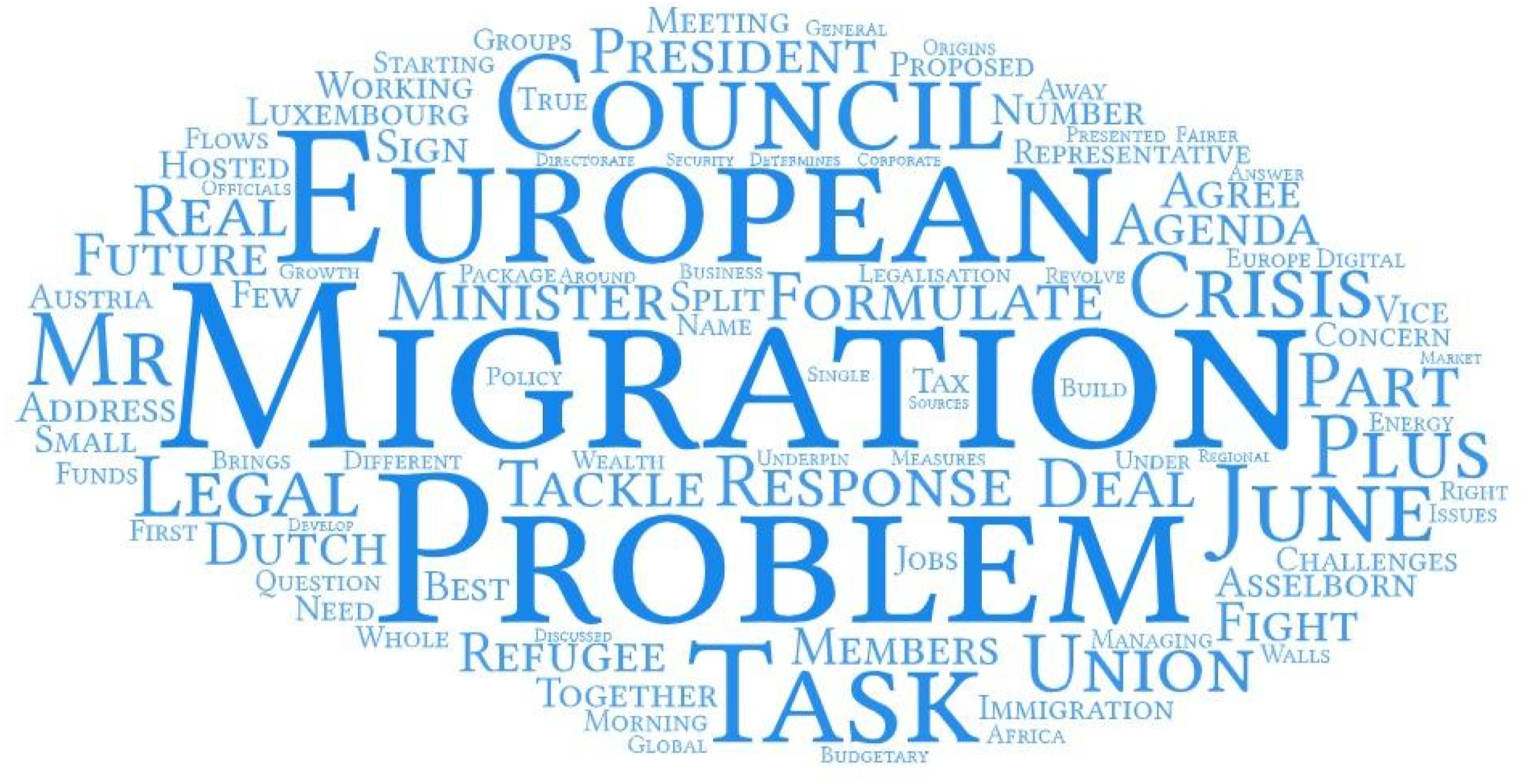
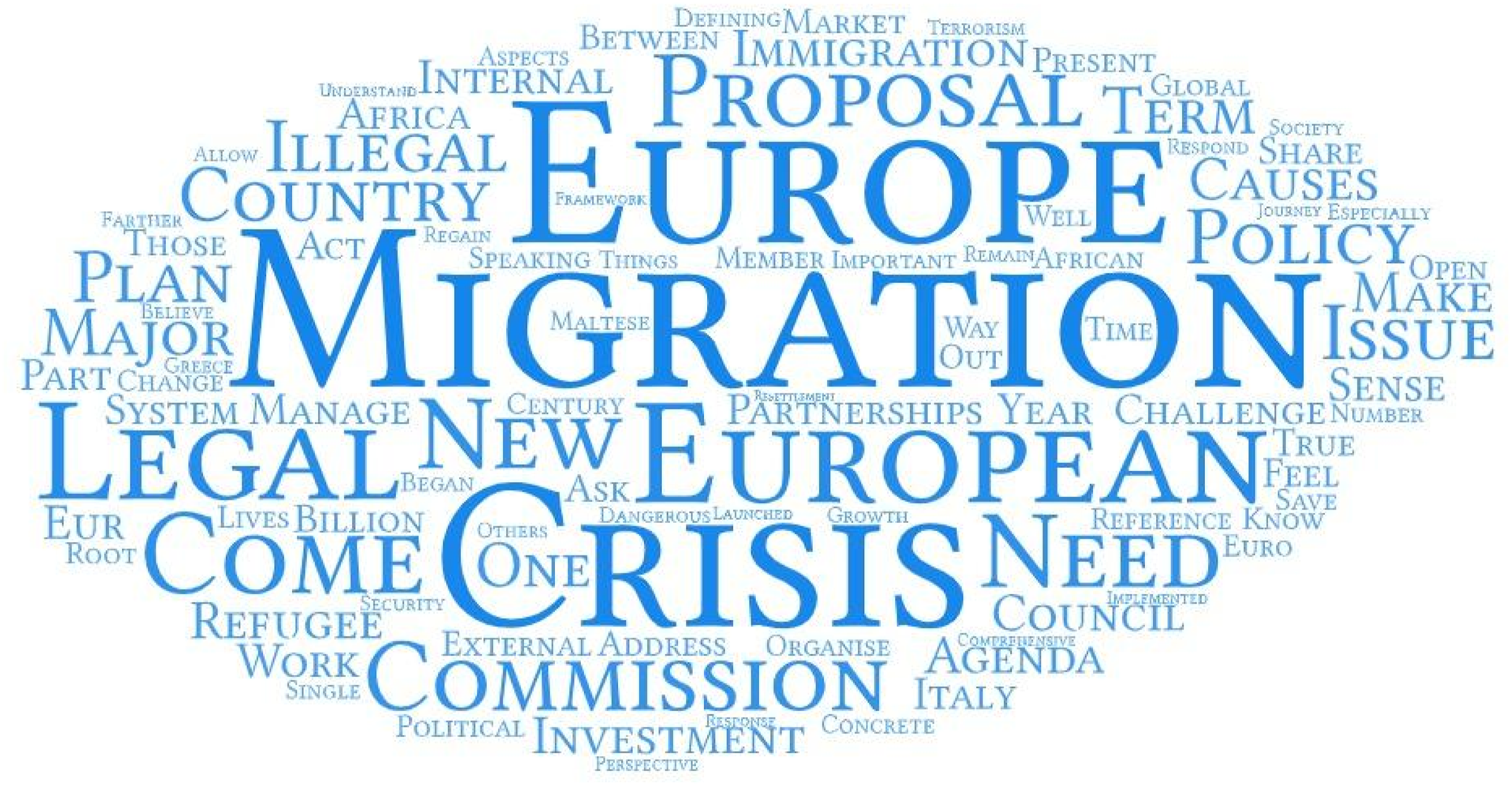
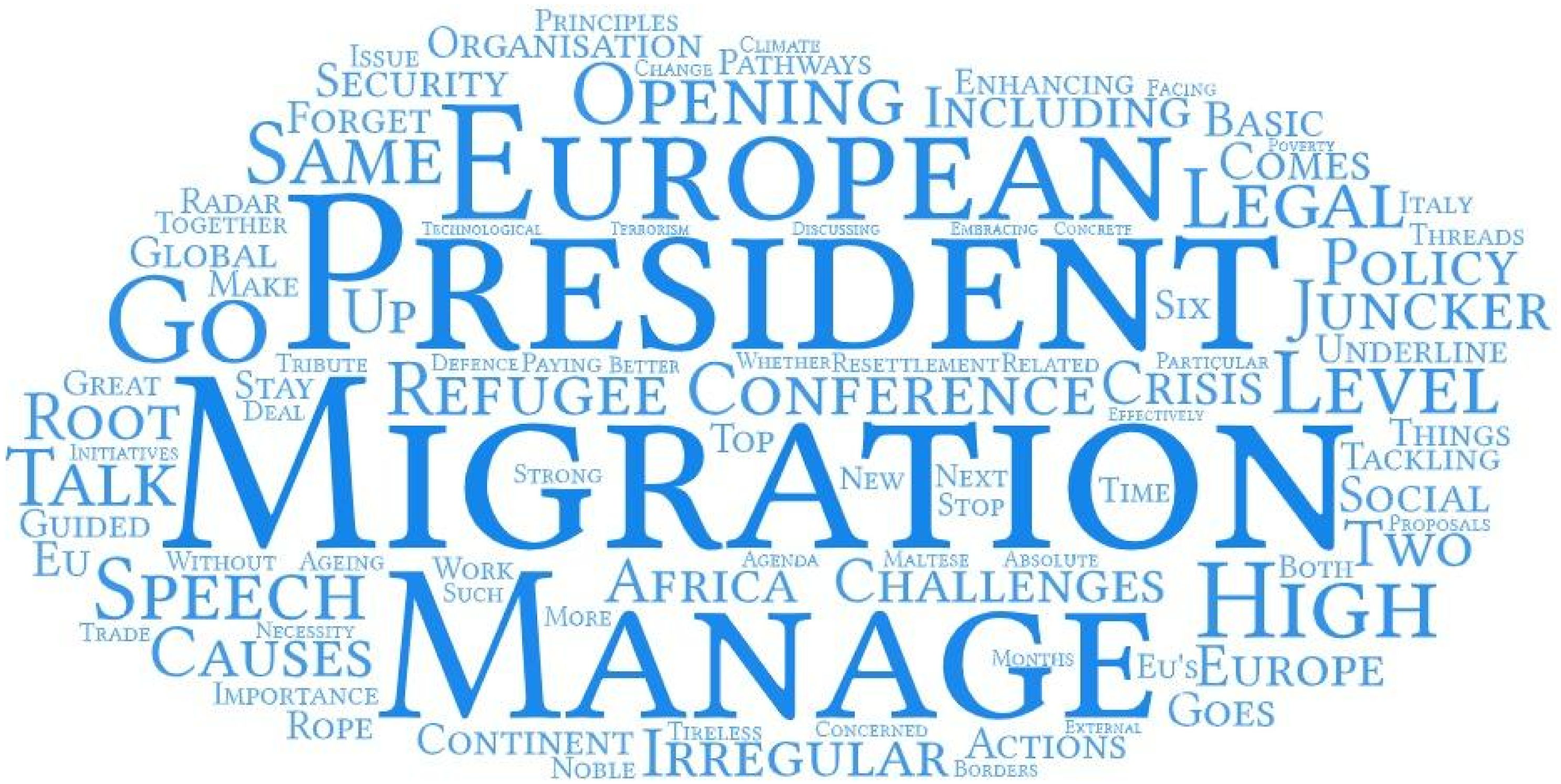
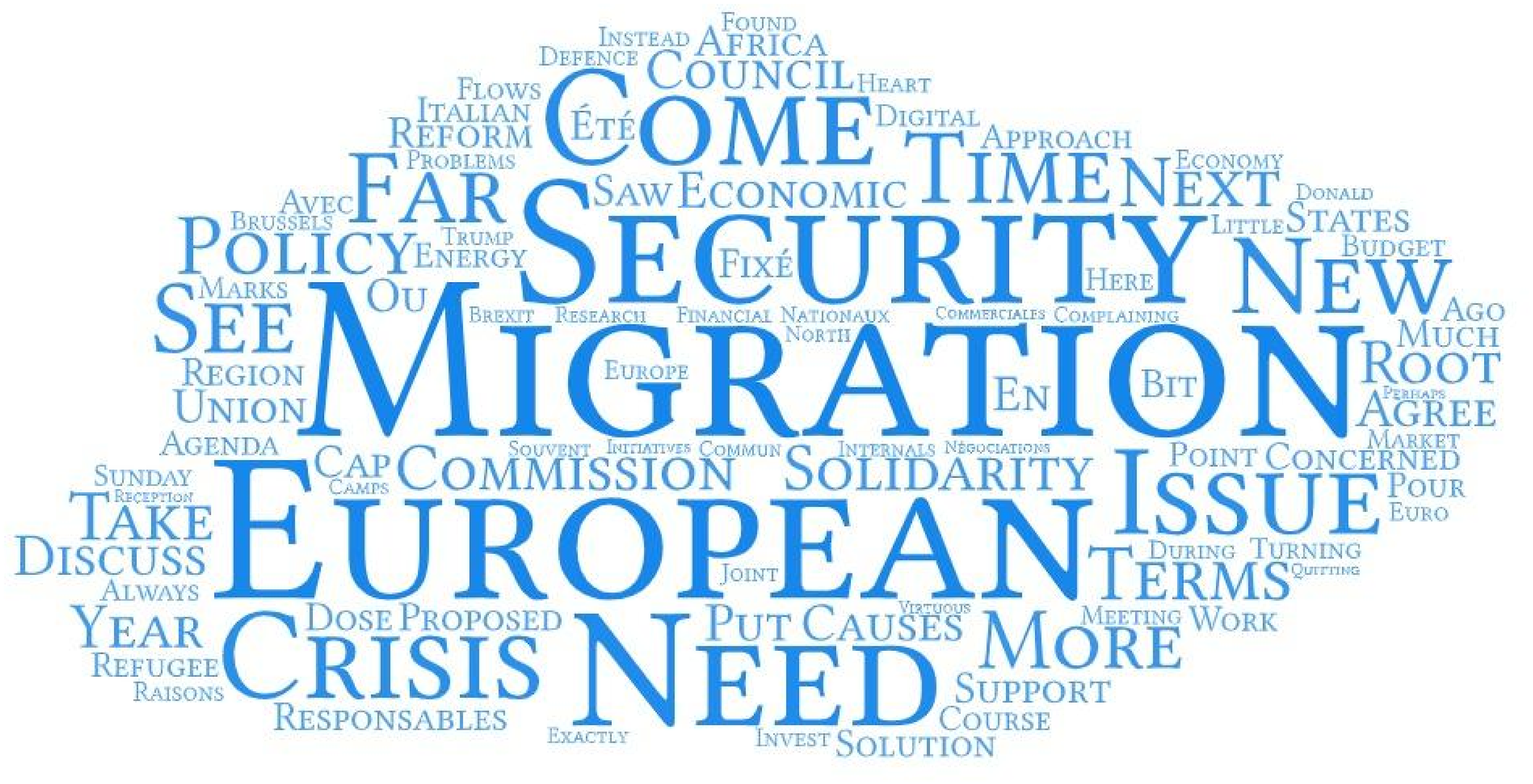
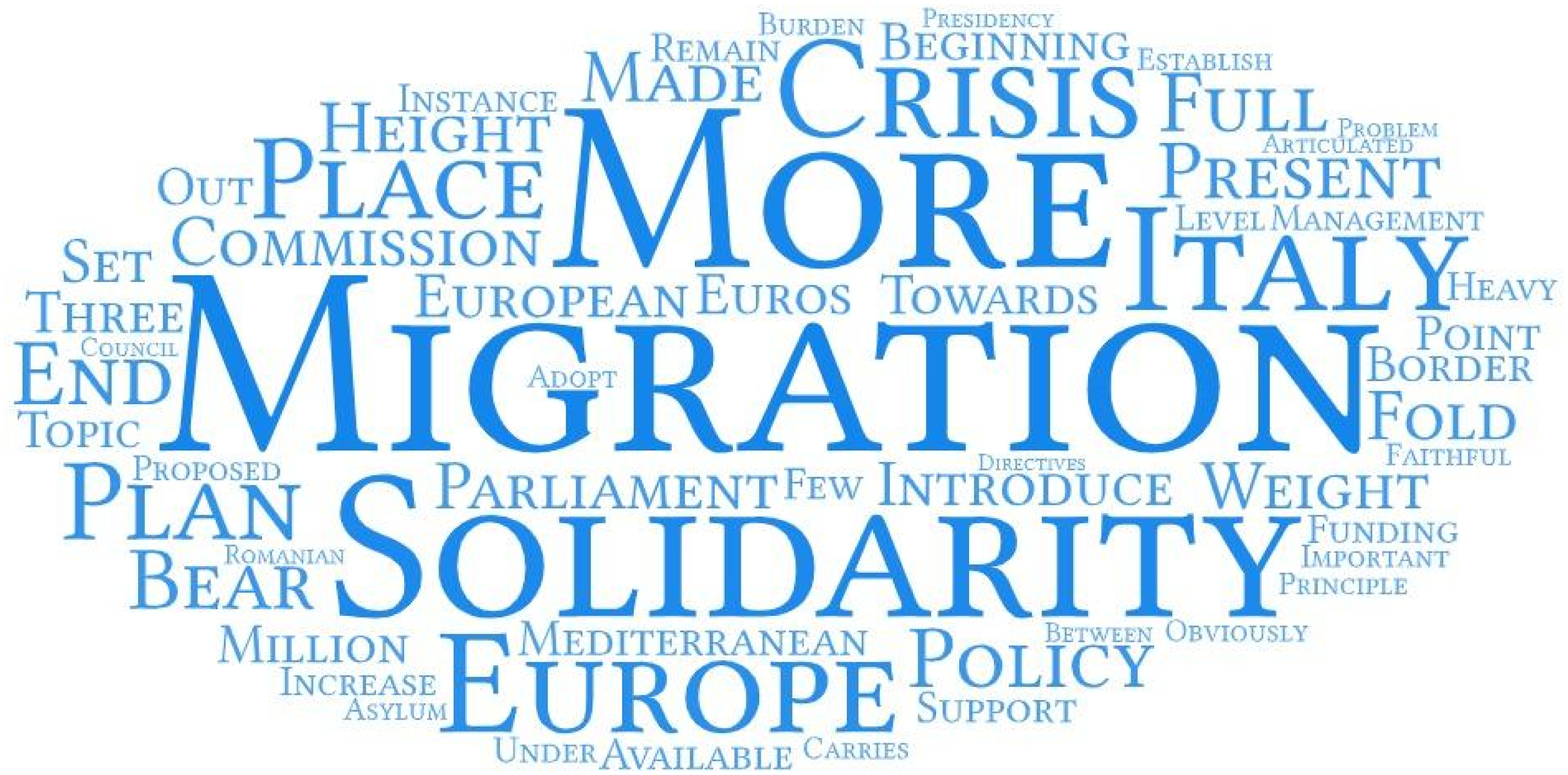
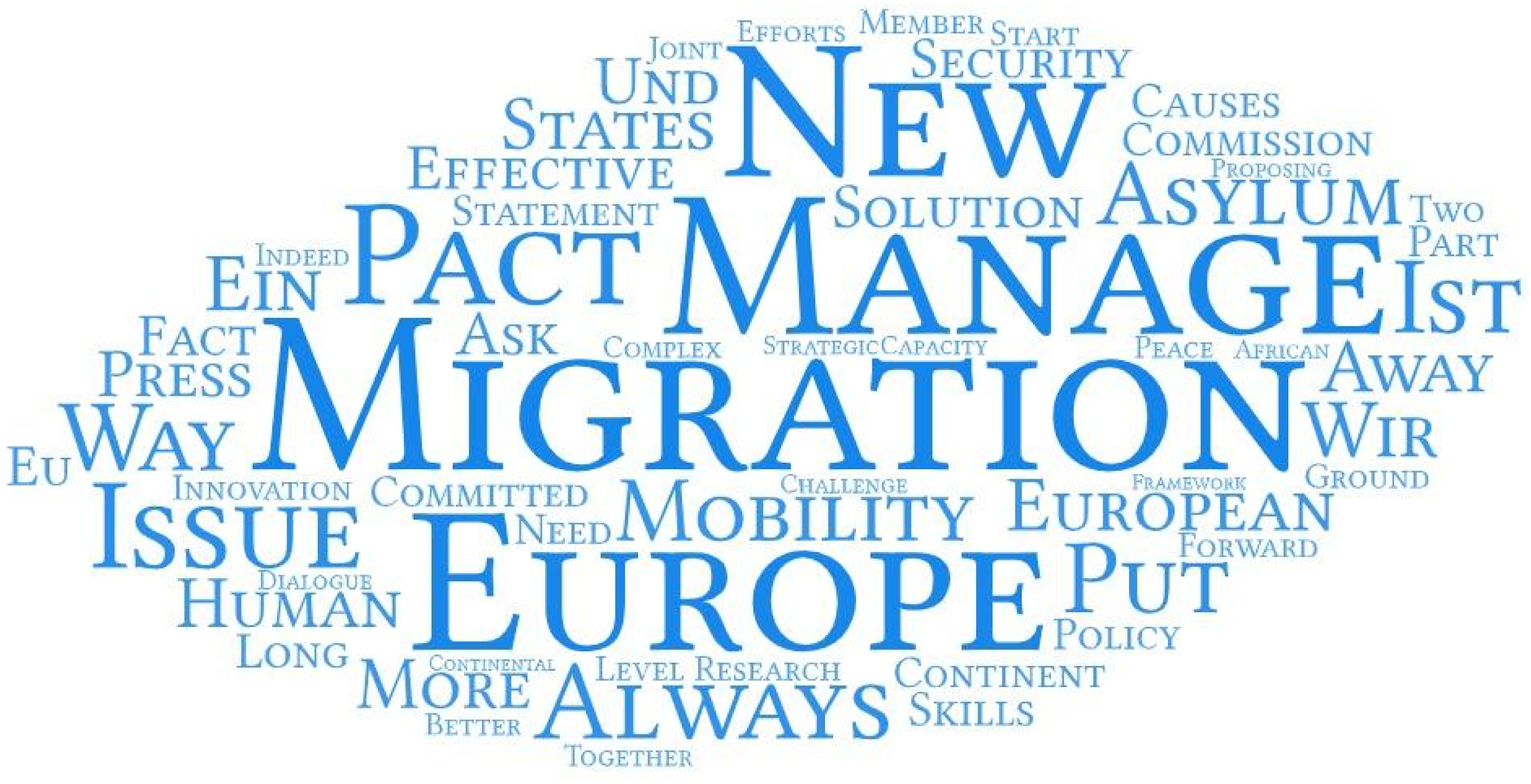
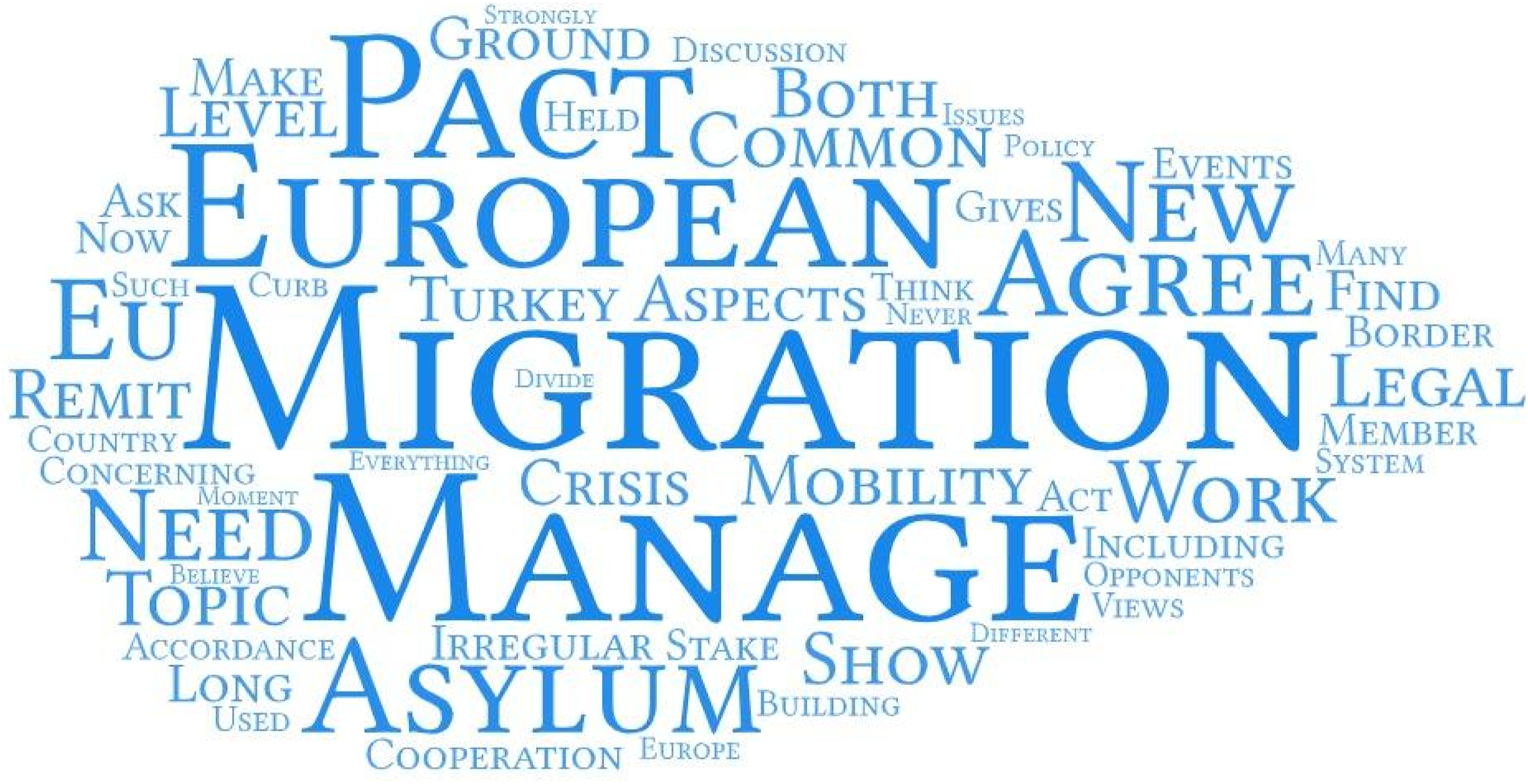
When zooming in on the utterances of the European Commission’s Presidents that contain the term ‘migration’, out of the 20 most frequent words, ‘crisis’ was by far mentioned the most, peaking in 2016, but being present all over the years. In the earlier years, such as 2015 and 2016, terms like ‘crisis’, ‘legal’, ‘policy’, and ‘refugee’ dominated discussions, revealing a focus on the legal and policy dimensions of managing the migration challenge. The emphasis on ‘security’, ‘solidarity’, and ‘pact’ grew stronger in subsequent years, illustrating a shift towards addressing security concerns and fostering cooperation. Terms like ‘mobility’ and ‘asylum’ gained prominence, indicating a broader consideration of humanitarian aspects and the pursuit of equitable solutions. The call for ‘manage’ and ‘invest’ underscores the ongoing efforts to find comprehensive approaches that balance national interests and shared responsibilities. The concepts of ‘solidarity’ and ‘together’ emerged as key points of emphasis, reflecting the aspiration for coordinated action among European member states. The evolving vocabulary, from ‘legal’ to ‘solidarity’ mirrors the nuanced evolution of strategies and attitudes towards the migration crisis, highlighting a growing recognition of the need for holistic, cooperative, and sustainable solutions
1
(see Figure 2 and Figures A_1–A_8). The 20 most often used words in the sentences of the European Commission’s Presidents containing ‘migration’ between 2015 and 2022. Source: Own edition
These word combinations and their frequencies are already illustrative to some degree. Between 2015 and 2022, a dynamic narrative shift unfolded across a tapestry of key terms encompassing the ever-evolving challenges faced by the European Union. The concept of ‘border’ underwent a metamorphosis, reflecting a growing emphasis on safeguarding external borders. While in 2015 it was clearly stated that “Closing borders is not the solution” and even in 2016 it was stated that “It is regrettable that border access has been restricted by Austria, as this basically closes the border” and Hungary’s fence was frowned upon, by 2020 the narrative arrived to the point of promising actions, such as “We will take action to fight smugglers, strengthen external borders, deepen external partnerships.” Consequently, initially tied to the protection of these borders from external threats, the discourse gradually shifted to prioritising not only security but also the need for joint Coast Guard efforts. This transition marked the inception of a strengthening narrative surrounding the notion of ‘Fortress Europe'.
The term ‘migration’, interwoven with complex societal threads, underwent a parallel transformation. The dialogue initially gravitated towards managing migration flows (2016: “migration will continue, we need a permanent distribution mechanism between the 28 Member”) and addressing its origins (2016: “And so we will also have to tackle the real causes of migration, which is why we, as the Commission, have launched the proposal to outsource the Investment Plan, an external EFSI with a budget of EUR 44 billion”), urging a holistic approach (2020: “Europe has to move away from ad hoc solutions and put in place a predictable and reliable migration”) to confront the multifaceted challenge. At the beginning of the crisis, there was a much bigger focus on inclusion and integration, underscoring the necessity of weaving newcomers into the fabric of European societies and portraying them as assets rather than risks (2015: “Immigration brings wealth” or 2016: “If we do not organise legal migration to Europe, if we do not allow those who come from farther to bring us energy and talent through the main door, we should not be surprised when, in an illegal and unorganised way those who come from farther come in through the window.”), by 2020 these aspects were dropped and instead the speeches emphasised that sustainable solutions are needed as “the 2015 migration crisis caused many deep divisions between Member States.”
A crescendo of ‘solidarity’ emerged as a common motif, transcending temporal boundaries. While discussions began with calls for shared responsibility for the newcomers and cooperation in welcoming them (2015: “And I ask the countries of Europe, the citizens of Europe, to show solidarity with those people who have fled their homes, seeking safety.”), the narrative's focus shifted over time. The theme of solidarity became a unifying thread, weaving through the discourse on borders, migration, and security, and it underscored the EU's aspiration to reinforce its collective strength, akin to the strengthening walls of a fortress, against external challenges, thus the target of solidarity was moved from the newcomer to the fellow European (2018: “As far as migration policies are concerned, of course we need an additional dose of solidarity. This is why we need to ensure that a new asylum system takes place in Europe. We need to reform a system, the Dublin system, which does not work”).
‘Security’ and ‘safety’ were interwoven into the evolving narrative, reflecting the growing concerns regarding terrorism and internal threats. Initially, the focus was on combating external dangers, but the conversation transitioned towards bolstering internal security measures. The narrative expanded to encompass counter-terrorism efforts, echoing the need to fortify the fortress’ walls (although in 2015 the standpoint was that “the right answer to the migration problem is not to build walls”) against both external and internal threats, thereby creating a haven of safety within its bounds.
Amidst these shifting narratives, the overarching tapestry of the ‘Fortress Europe’ began to gain more strength. The gradual strengthening of this metaphorical fortress is also symbolised by the continuous debate around Schengen which used to be viewed as one of the main achievements of the European project, but by 2021 it was seen as something that needs to be changed (2021: “this week, we proposed changes to the Schengen Borders Code, covering both the external as well as the internal borders”).
Although in 2002 the constructivist view of borders was not a new stream of thinking, van Houtum’s and van Naerssen’s concept of b/ordering and othering had a spectacular career among border scholars. Scott (2021) even considers the publication of the study as a milestone with the impact of transforming the border literature and paving the way for new approaches (e.g. that of ‘borderscaping’).
Since 2015, subsequent crises of the European project resulting in re-bordering and re-nationalising tendencies have made the explanatory power of this theory salient. As, in his disappointed statement, van Houtum (2021, 34) formulated the sad diagnosis: “Surely, there was a small dip in the number of such fortified borders after 1989, when The Wall fell, and when for a short moment in time the mantras of ‘global village’ and ‘borderless world’ became popular, but that fall in the growth of walls, because of the further opening up of borders (debordering) and the global utopian spirit of a borderless world (disbordering), was only short-lived.”
Indeed, after decades of an optimistic climate, since the so-called migration crisis in 2015 (followed by several terrorist attacks, Brexit, the COVID-19 pandemic and the war in Ukraine) the normative distinction between We and Other has been reinforced. As we illustrated, the discourse of othering is present not only in social media and the newspapers but also in the documents produced by the highest representatives of the Union – even if their tune is milder.
Conclusion
This article examined how the securitisation of migration and the concept of b/ordering-borderism shape the narratives and language of official EU discourse on migration between 2015 and 2022. By analysing speeches and statements of the presidents of the European Commission and selected members of the Commission, we traced how the migration crisis was framed, how key notions such as borders, solidarity, security, and legality were articulated, and how these discursive patterns evolved over time. Our analysis showed that migration was consistently problematised as a challenge to the European project, but that the preferred solutions and the targets of political responsibility shifted: from moral appeals and legal pathways to an increasingly managerial and security-driven vocabulary, from solidarity with refugees to solidarity among member states, and from “borderless Europe” to a strengthened Fortress Europe.
Seen through the lens of securitisation theory, these shifts are not merely descriptive; they are performative. In line with the Copenhagen School, we treat the speeches of Commission presidents as speech acts that contribute to constructing the securitisation of migration that requires exceptional measures. When official discourse repeatedly names migration as a ‘crisis’, emphasises ‘threats’ and ‘risks’, and links mobility to terrorism and loss of control, it helps to legitimise the expansion of border infrastructures, surveillance technologies, and restrictive asylum policies. The growing reference to the ‘protection of external borders’, the promise of a standing border and coast guard, and the normalisation of fences and controls are generated through the words used to describe migration.
This is where the concepts of textual b/ordering and othering become central. Building on van Houtum and van Naerssen, we showed that the EU’s official discourse constantly draws distinctions between inside and outside, between those who belong and those who pose a potential risk. The repeated juxtaposition of ‘Europeans’ and ‘migrants’, or of ‘our citizens’ and ‘those who have no right to stay’, is part of a narrative practice that marks certain bodies as legitimate and others as questionable. Initially, this distinction is mitigated by a strong moral vocabulary; Europe as ‘a beacon of hope’, ‘a haven of stability’, and an actor of ‘humanity’ and ‘dignity’. Over time, however, this moral register is increasingly supplemented, and partly displaced, by a focus on ‘management’, ‘control’, and ‘effective returns’. In discourse, the line between ‘We’ and ‘Other’ thus becomes more sharply drawn and more tightly linked to security and order.
Our notion of w/ordering aims to capture precisely this creative power of language. W/ordering refers to the way words themselves participate in ordering social space and political possibilities. Official statements do not simply comment on the existence of a border; they enact the border in and through narrative. When Commission presidents declare that ‘we will defend our borders’ or that ‘we must manage migration’ and simultaneously call for the strengthening of external controls, they are not merely describing policy options. They are performing acts that help to stabilise the idea of an EU ‘inside’ that must be protected and managed, and of a mobile ‘outside’ that must be filtered, sorted, returned or, exceptionally, welcomed.
From this perspective, the proliferation of physical fences and walls around the EU can be read as the material crystallisation of earlier discursive w/ordering. Before steel and barbed wire, there are speech acts, metaphors and frames. The narrative shift from ‘legal pathways’ and ‘immigration brings wealth’ to a more technocratic vocabulary of ‘management’, ‘returns’, and ‘safe countries of origin’ illustrates how speech gradually narrows the horizon of imaginable responses. Textual othering precedes and legitimates physical bordering: by repeatedly presenting migrants primarily as a ‘challenge’ to security, cohesion, and control, official discourse prepares the ground for the acceptance of fences, detention infrastructures, and increasingly restrictive rules as reasonable, even necessary, policy responses.
At the same time, the analysis also reveals the persistence of alternative strands within EU discourse. Moral appeals, invocations of human dignity, and references to Europe’s humanitarian obligations have not disappeared; they coexist with security-driven and managerial language. This coexistence suggests that the EU’s migration narrative is not monolithic but contested and internally plural. The concept of w/ordering allows us to see that different wordings – emphasising solidarity with refugees, solidarity among member states, or security and control – do not merely reflect different ‘opinions’ but propose different orders of priority and different distributions of vulnerability and responsibility.
These findings have both analytical and normative implications. Analytically, they show the value of combining narrative analysis with computational tools to uncover patterns in high-level political discourse and relate them to broader processes of securitisation and border-making. Normatively, they remind us that the future of EU migration policy is not only decided in legal texts and policy plans, but also in the everyday w/ordering of speeches and statements. How migration is named, which crises are highlighted, which solidarities are invoked and who is included in the ‘We’ of Europe all contribute to shaping the options that become thinkable and legitimate.
In conclusion, this study aimed to illustrate the increasing influence of the securitisation narrative in the official European discourse, primarily through the statements of the two last presidents of the Commission and, to a lesser extent, some other Commission members. The applied narrativist approach enabled the authors to highlight the significance of the textuality of b/ordering and othering of this discourse: although, the appearance of new and new fences across the continent offers a more direct, more tangible representation of the discourse – still, these fences are consequences of the narrative of securitisation. Textual othering always pre-exists the physical one. By 2026, more than 2,500 km of fences are forecasted to be set around Fortress Europe. These fences are built of texts, phrases, and words.
Footnotes
Acknowledgements
The authors gratefully acknowledge funding for the database research from the Social Sciences and Humanities Research Council (Twenty-First century borders - Emergent challenges within and among states, award number: 895-2021-1002) and the Jean Monnet Network (Jean Monnet Network Borders, Human to Military Security, Database, award number: 620606-EPP-1-2020-1-CA-EPPJMO-NETWORK).

Funding
The authors disclosed receipt of the following financial support for the research, authorship, and/or publication of this article: The authors gratefully acknowledge funding for the database research from the Social Sciences and Humanities Research Council (Twenty-First century borders - Emergent challenges within and among states, award number: 895-2021-1002) and the Jean Monnet Network (Jean Monnet Network Borders, Human to Military Security, Database, award number: 620606-EPP-1-2020-1-CA-EPPJMO-NETWORK).
Declaration of Conflicting Interests
The authors declared no potential conflicts of interest with respect to the research, authorship, and/or publication of this article.
Note
Author Biographies
Appendix
Wordcloud based on the sentences of the EC Presidents in 2015 containing the word ‘migration’. Source: Official Digital Library of the European Commission. Own edit using MAXQDA Wordcloud based on the sentences of the EC Presidents in 2016 containing the word ‘migration’. Source: Official Digital Library of the European Commission. Own edit using MAXQDA Wordcloud based on the sentences of the EC Presidents in 2017 containing the word ‘migration’. Source: Official Digital Library of the European Commission. Own edit using MAXQDA Wordcloud based on the sentences of the EC Presidents in 2018 containing the word ‘migration’. Source: Official Digital Library of the European Commission. Own edit using MAXQDA Wordcloud based on the sentences of the EC Presidents in 2019 containing the word ‘migration’. Source: Official Digital Library of the European Commission. Own edit using MAXQDA Wordcloud based on the sentences of the EC Presidents in 2020 containing the word ‘migration’. Source: Official Digital Library of the European Commission. Own edit using MAXQDA Wordcloud based on the sentences of the EC Presidents in 2021 containing the word ‘migration’. Source: Official Digital Library of the European Commission. Own edit using MAXQDA Wordcloud based on the sentences of the EC Presidents in 2022 containing the word ‘migration’. Source: Official Digital Library of the European Commission. Own edit using MAXQDA