






Abstract
This article examines Islamo-leftism not as a coherent ideology or organizational alliance, but as a floating signifier whose meaning shifts across political contexts. Drawing on Laclau and Mouffe’s theory of hegemony, it traces how a term that emerged in France as a stigmatizing label linking Islam, the radical left, decolonialism, and anti-Zionism is rearticulated in South Korea. There, the term itself remains marginal, yet the discursive elements it indexes are reassembled around Palestinian solidarity as a new nodal point. The article argues that “Palestine,” rather than Islamo-leftism, functions as an empty signifier in the South Korean case, condensing heterogeneous demands—refugee rights, Muslim minority rights, migrant labor rights, and anti-militarism—into a chain of equivalence. The article contributes to Islamo-leftism scholarship by moving beyond its French-centered frame, refining the concept of the traveling signifier, and offering a lens for understanding Palestinian solidarity in South Korean civil society.
Keywords
Introduction
“Islamo-Leftism” (French: Islamo-gauchisme) is a term that emerged in French political and intellectual discourse in the early twenty-first century. It began as a rhetorical expression criticizing what was perceived as an alliance between Islamism and the radical left. Although it was initially used without a clear ideological or organizational foundation, it was subsequently mobilized repeatedly by conservative right-wing political forces, the media, and government officials in France as a symbol of a threat to republican identity, academic freedom, and the secular order. When Frédérique Vidal, the French Minister of Higher Education, referred in 2021 to the spread of Islamo-Leftism (Clavery, 2021), thereby elevating the concept to the level of official political discourse, the term ceased to function merely as a critical label. Instead, it was transformed into a political instrument for surveillance of academia and society. As a result, claims were advanced that academic research must be clearly separated from Islamo-Leftist activism (Gontier & Sénéjoux, 2020).
However, Islamo-Leftism is not confined solely to a specific cultural conflict within French politics. Over time, the concept has evolved into a floating signifier that is received and reconfigured differently across diverse national and political contexts. As a result, particularly in South Korea, the discursive elements associated with the term have acquired political meaning and tangible effects, even though the term itself remains marginal. Whereas in France “Islamo-Leftism” functioned as a stigmatizing signifier that associated Islam, the radical left, postcolonial critique, and anti-Zionism with hostility toward the republican order, the term itself has not acquired comparable salience in South Korea. This contrast raises the central question of this article: what happens when the elements condensed by a stigmatizing signifier travel without the label itself?
This article argues that Islamo-Leftism does not travel to South Korea as a named ideology, organizational identity, or actor category. Rather, what travels are the discursive elements condensed and stigmatized by the French discourse of Islamo-Leftism: Islam, the left, anti-Zionism, anti-imperialism, minority politics, and critiques of Western power. In South Korean progressive civil society, these elements are rearticulated around Palestinian solidarity. In this process, “Palestine,” rather than Islamo-Leftism, functions as the empty signifier that links heterogeneous demands—refugee rights, Muslim minority rights, migrant labor rights, anti-militarism, criticism of arms trade, and opposition to the military-industrial complex—into a chain of equivalence. The South Korean case therefore does not show the diffusion of Islamo-Leftism as a label; it shows the reassembly of the elements indexed by that label around a different political signifier. By analyzing this process, the article fills a gap in the existing literature on Islamo-Leftism, which has remained largely centered on the French debate. It combines Laclau and Mouffe’s theory of hegemony with an empirical analysis of rally speeches, civil society statements, coalition documents, and anti-arms-trade campaigns in South Korea. Rather than asking whether Islamo-Leftism “exists” in South Korea, the article examines how the elements stigmatized under this label in France are resignified through Palestinian solidarity as a language of justice, anti-militarism, minority rights, and transnational solidarity.
The central research questions are as follows. First, how was the signifier Islamo-Leftism constructed within French political discourse, and why can it be understood as a floating signifier? Second, how are the discursive elements indexed by Islamo-Leftism in the French debate rearticulated around Palestinian solidarity in the South Korean context, where the term itself remains marginal? Third, how does “Palestine” function as an empty signifier that links refugee rights, Muslim minority rights, migrant labor rights, anti-militarism, criticism of arms trade, and opposition to the military-industrial complex into a chain of equivalence? Fourth, what does this rearticulation reveal about traveling signifiers, empty signifiers, and the formation of transnational solidarity in non-Western civil society?
The South Korean case is analytically valuable precisely because the rearticulation of these discursive elements around Palestine remains in a fluid process of formation prior to being fixed as a completed hegemony. In Laclau and Mouffe’s theory, the political mechanisms of articulation are revealed more clearly in moments of formation than in their fully consolidated state. Accordingly, the contemporaneity and incompleteness of the South Korean case should be understood not as limitations of the analysis, but rather as a theoretical advantage that makes it possible to capture how the elements indexed by a floating signifier are rearticulated around a different empty signifier in a new context. The South Korean case is selected because it offers a theoretically significant non-Western context in which the term Islamo-Leftism itself remains marginal, while the elements condensed by the French debate—Islam, the left, anti-Zionism, anti-imperialism, anti-racism, and minority politics—are rearticulated through Palestinian solidarity. The case therefore allows this article to examine not the diffusion of a label, but the local reassembly of its indexed elements within a different field of political struggle.
Methodology
This study adopts an interpretive comparative discourse analysis, using Laclau and Mouffe’s theory of hegemonic discourse as its analytical framework in order to examine how the discursive elements indexed by Islamo-Leftism are rearticulated as they move from the French debate to the South Korean context. This approach reads texts not as transparent records of fact, but as sites of political meaning-making, and interprets how the elements condensed by this signifier are reassembled under different discursive conditions in the two cases. The selection of cases, data collection, and analytical procedures are structured as follows.
This study establishes France and South Korea as two comparative cases. The French case represents the original context in which Islamo-Leftism was constructed and institutionalized as a political term of stigmatization. The South Korean case represents a reception context in which the constituent elements indexed by this term are rearticulated around Palestine with different political meanings. The comparison is therefore asymmetrical. The French case is concerned with tracing the formation and institutionalization of Islamo-Leftism as a stigmatizing floating signifier, whereas the South Korean case focuses on analyzing the local reassembly of its indexed elements around Palestine as an empty signifier. This asymmetrical design is consistent with the theoretical premise of the study: the object of inquiry is not the diffusion of a label, but the process through which elements condensed by a stigmatizing signifier are reconfigured in a different field of political struggle.
The theoretical rationale for selecting South Korea has been introduced above. Methodologically, the South Korean corpus was constructed through purposive sampling of publicly available materials produced by actors and organizations that repeatedly addressed Palestine through statements, rally speeches, articles, campaigns, and joint actions. The purpose of this sampling is not to represent South Korean public opinion as a whole, but to identify key sites where Palestine is articulated with anti-militarism, arms-trade criticism, anti-imperialism, refugee rights, Muslim minority rights, and migrant labor rights.
The analytical materials of this study are divided broadly into two categories. The first category consists of academic literature and official documents addressing the conceptual formation of Islamo-Leftism and its discursive development in France. This includes the works of major scholars such as Pierre-André Taguieff (2002; 2024), Abdellali Hajjat (2025), Philippe Marlière (2023), Corinne Torrekens (2020), Raphaël Liogier (2018), Ibrahim Bechrouri (2023), Christophe Bourseiller (2018), and Georges Gachnochi (2004), as well as official statements from the French Ministry of Higher Education, Resolution No. 315 (2024) submitted by the National Rally (RN), and the 2021 statement issued by the French National Centre for Scientific Research (CNRS). These materials are used to trace how Islamo-Leftism in France evolved from a rhetorical device into an instrument of institutional surveillance.
The second category consists of discursive materials related to Palestinian solidarity in South Korea since 2023. These materials are composed of four types: (1) speech texts and statements delivered at Palestinian solidarity rallies held in Seoul between October 2023 and December 2025; (2) official materials produced by the “Urgent Action by South Korean Civil Society in Solidarity with Palestine,” including the list of 150 participating organizations as of January 2024; (3) relevant commentaries and press releases issued by People’s Solidarity for Participatory Democracy, labor organizations, and human rights groups; and (4) Palestine-related articles and the category classification system of Workers’ Solidarity. These materials are used to identify the structure of the chain of equivalence formed around Palestine and to analyze how different agendas are articulated in relation to one another.
Summarizes the core analytical corpus directly examined in this article
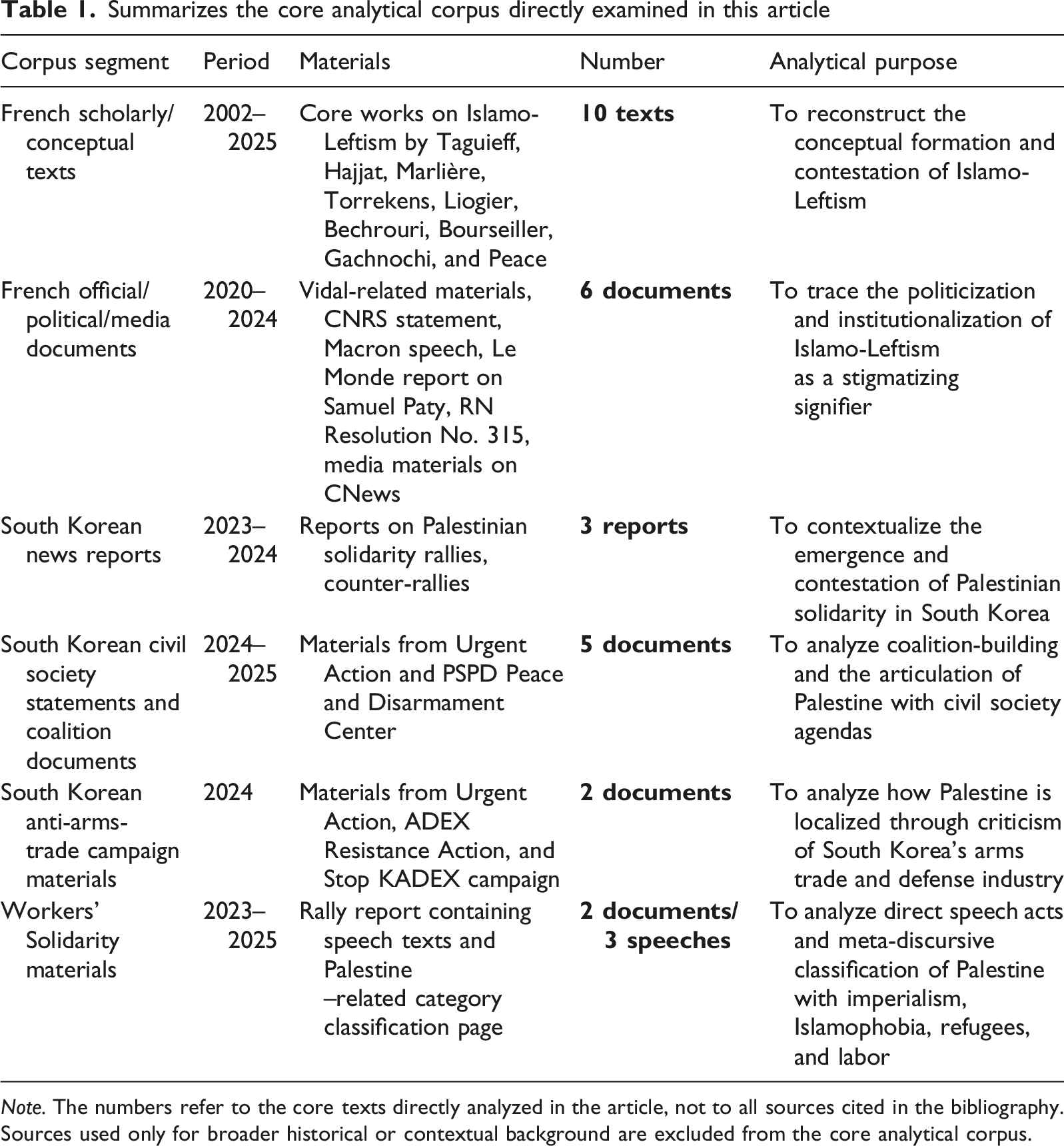
Note. The numbers refer to the core texts directly analyzed in the article, not to all sources cited in the bibliography. Sources used only for broader historical or contextual background are excluded from the core analytical corpus.
This study does not employ quantitative content analysis, computational text mining, or frequency-based coding. The term “coding” is therefore not used here in a positivist or statistical sense. Instead, the analysis proceeds through theory-guided close reading. The texts are read with attention to four interpretive categories derived from Laclau and Mouffe’s discourse theory: the elements articulated by a signifier, the equivalential links among heterogeneous demands, the constitutive outside that structures antagonism, and the signifier that comes to condense these demands. This procedure is designed to make the interpretive process transparent without reducing discourse analysis to numerical coding.
This study conducts its analysis using Laclau and Mouffe’s theory of hegemonic discourse as its analytical framework. The analytical procedure consists of three stages. The first stage is the identification of the constituent elements of the signifier. In the materials from each case, the study examines which elements are linked together by the signifier Islamo-Leftism, or how the constituent elements of that signifier are arranged. In the French case, it traces how elements such as Islam, the left, postcolonialism, anti-Zionism, and gender studies are rendered equivalent as a single bloc of threat. In the South Korean case, it examines how elements such as Muslim rights, solidarity with Palestine, refugee rights, migrant labor rights, anti-militarism, and anti-imperialism are linked together.
The second stage involves analyzing the chain of equivalence and the constitutive outside. In the materials from each case, the study examines how different social demands form a chain of equivalence around a shared antagonism. At this stage, particular attention is paid to identifying which demands occupy the center of the chain of equivalence, which remain at its periphery, and what constitutes the constitutive outside—that is, the object of antagonism—that makes the chain possible. In the South Korean case, the analysis focuses specifically on how Palestine functions as an empty signifier, binding heterogeneous demands together within a single field of solidarity.
The third stage is a comparative analysis of the travel and rearticulation of the signifier. By comparing the French and South Korean cases, the study examines how the constituent elements of the same signifier are rearranged in opposing directions across different contexts. At this stage, it demonstrates that the travel of the signifier is not a matter of simple replication or importation, but a process of reconfiguration shaped by the historical memory of the receiving society, political cleavages, and the practices of movement actors shaped by political cleavages, movement practices, civil society coalitions, and issue-specific campaigns in the receiving context.
The object of analysis in this study is not public opinion in South Korean society as a whole, but rather the networks of progressive civil society and social movements that articulate Muslim rights, anti-imperialism, anti-racism, and anti-militarism through solidarity with Palestine. Within South Korean society, discourses critical of Hamas’s attacks and emphasizing Israel’s right to security coexist alongside discourses of solidarity with Palestine, while Islamophobic and refugee-exclusionary discourses also persist. Accordingly, the findings of this study should be understood not as describing the overall discursive landscape of South Korean society, but as explaining the structure of discursive articulation that emerges within specific social movement networks.
In addition, this study takes the form of an exploratory case study. Solidarity with Palestine in South Korea has developed rapidly since 2023, and its hegemonic articulation remains a process in formation rather than a completed condition This constitutes a limitation of the analysis, but it also offers a theoretical advantage: it makes it possible to capture the process through which the elements indexed by a floating signifier are rearticulated around a different empty signifier in a new context. Future research should verify and expand the exploratory findings of this study through in-depth interviews with movement participants, analysis of online discourse, and comparison with other non-Western cases.
Literature Review: The Formation and Discursive Development of the Concept of Islamo-Leftism
The term Islamo-Leftism first emerged not as a reference to a clearly defined ideological alliance or practice, but rather as a rhetorical device within French political discourse. The concept was first popularized by Taguieff in 2002, when he argued that anti-Zionist, anti-Semitic, and anti-capitalist discourses were converging into a new political threat through the alliance between Islamist actors and the radical left (Taguieff, 2002; 2024).
Taguieff interprets Islamo-Leftism not as a mere derogatory label, but as a substantial and increasingly consolidated political and cultural bloc, thereby presenting it as a distinct ideological formation (Taguieff, 2024). This position is maintained in Taguieff’s more recent discussions as well. He understands Islamo-Leftism as a combination of Third-Worldism, anti-colonialism, anti-Zionism, and the left’s moral indulgence toward Islamism (Taguieff, 2002). Taguieff further argues that, since the 2010s, the concept has merged with currents such as “wokism,” “intersectionality,” and “cancel culture,” transforming into what he terms “Islamo-decolonial leftism” (Taguieff, 2024). From his perspective, Islamo-Leftism is no longer merely a rhetorical expression, but a substantive threat to the foundational principles of French politics: universalism, republicanism, and secularism.
However, many scholars criticize this ontological approach. Hajjat (2025) traces the historical origin of the term to the Lebanese scholar Béchara Ménassa in 1978. Although it was initially used to describe a concrete alliance between leftist groups and Islamists, once introduced into France it shifted from denoting an actual alliance to constructing a symbolic enemy. Hajjat argues that Islamo-Leftism functions as a discursive strategy that defines Islam, the political left, anti-Zionists, postcolonial producers of knowledge, and gender theorists as a unified bloc of threat within French society (Hajjat, 2025). According to Hajjat, this goes beyond mere ideological critique and reflects mechanisms of racialized power structures and academic control (Hajjat, 2025).
Marlière (2023) analyzes the concept from a more pragmatic and political perspective. He defines Islamo-Leftism as “a concept without substance but with real political effects,” and describes it as a kind of political nudge. In other words, the term serves to justify conservative policies by mobilizing emotions such as fear, anger, and anxiety, even in the absence of a clear theoretical or organizational foundation. As a result, it constrains academic freedom, the independence of the press, and social movements. Marlière (2023) thus characterizes Islamo-Leftism as both an instrument of cultural warfare and a symbolic tool employed by the French right.
These critical analyses generally regard Islamo-Leftism as a constructed signifier. Torrekens (2020) points out that since the 2000s, the term has functioned as a discursive mechanism that indiscriminately conflates various social phenomena associated with Islam—such as the hijab controversy, gender debates, anti-colonial activism, and anti-racist discourse—and designates them as “enemies of the Republic.” Likewise, Liogier (2018) analyzes Islamo-Leftism as a symbolic product of moral panic in French society, defining it as an affective and rhetorical strategy that exaggerates a threat to universalism rather than reflecting any actual social trend.
Ultimately, this concept has functioned not only as an academic category, but also as a mechanism of power for protecting the republican order of French society, reconstituting Muslims, the left, and scholars as objects of surveillance and exclusion. Notable examples include the call by Frédérique Vidal, the French Minister of Higher Education, for an investigation into “Islamo-Leftism” within academia (Clavery, 2021), as well as the legislative proposal submitted in 2024 by the far-right party National Rally (RN), Resolution No. 315, to identify Islamo-Leftist rhetoric. In response to these developments, the French National Centre for Scientific Research (CNRS) issued a statement making clear that the term functions as a political stigma entirely lacking any scientific foundation (CNRS, 2021).
By contrast, when the analytical lens of Islamo-Leftism is brought into non-Western contexts, it reveals not the direct circulation of the term itself, but the different ways in which its constituent elements may be rearranged. In the South Korean case, these elements—Islam, the left, anti-Zionism, anti-imperial critique, anti-racism, minority politics, and criticism of Western power—are not organized under the name of Islamo-Leftism. Rather, they are articulated through Palestinian solidarity as a discourse of justice, anti-militarism, arms-trade criticism, minority rights, and transnational solidarity. Rather, they are articulated through Palestinian solidarity as a discourse of justice, liberation, anti-militarism, and resistance. In particular, following Hamas’s attack on Israel in 2023 (Barnea, 2024; Bisset, 2024), the global pro-Palestinian solidarity movement has contributed to the resignification of Islamo-Leftism as a symbol of justice, liberation, and resistance, thereby revealing its contradictory meanings. This fluidity and mobility of the signifier can be effectively analyzed through Laclau and Mouffe’s theory of hegemony (Laclau and Mouffe, 2012 trans. Lee, 2023).
Theoretical Framework: Floating Signifier, Empty Signifier, and the Localization of Discourse
This article does not assume Islamo-Leftism to be a fixed ideology or a substantive political alliance. The central question is not whether this signifier “actually exists,” but rather who invokes it, in what context, and what political effects such invocation produces. To address this question, this section presents three theoretical distinctions. First, Islamo-Leftism is a floating signifier rather than an empty signifier. Second, in the South Korean case, what functions as the empty signifier is not Islamo-Leftism but “Palestine.” Third, Islamo-Leftism should be understood as a traveling signifier whose indexed elements are reconfigured through movement practices, civil society coalitions, and issue-specific campaigns in the receiving context.
Floating Signifier and Empty Signifier: A Conceptual Distinction
Laclau and Mouffe argue that social identities and political order do not originate from fixed essences. Categories such as class, nation, and religion do not possess complete meanings in themselves; rather, they acquire meaning through articulation with other elements within specific political contexts. Politics, in this sense, is the process through which a provisional order is constructed through such articulations (Laclau and Mouffe, 2012 trans. Lee, 2023).
In Laclau’s later discussions, a distinction must be made between the empty signifier and the floating signifier. An empty signifier is the central signifier that represents the totality of different social demands when they form a chain of equivalence. It is partially empty because it cannot be fully reduced to any single demand, and it is precisely through this emptiness that it is able to encompass a variety of demands. Signifiers such as “democracy,” “the people,” and “liberation” are examples of this. A floating signifier is different. It is a signifier whose meaning is contested among competing discursive projects, acquiring contradictory meanings depending on the context without ever being stably fixed within any one hegemony.
Applying this distinction, it is more appropriate to conceptualize Islamo-Leftism as a floating signifier rather than an empty signifier. In France, this signifier functions as a language of stigmatization that binds Islam, the left, postcolonialism, and anti-Zionism into a single bloc of threat. In South Korea, however, the same constituent elements are rearranged into a language of solidarity and resistance. If a single signifier produces contradictory effects of meaning—stigma in one context and solidarity in another—it is better understood as a floating signifier than as an empty signifier.
“Palestine” as an Empty Signifier
If Islamo-Leftism is a floating signifier, then what functions as the empty signifier in the South Korean case? This article argues that it is “Palestine.” Since 2023, among South Korean progressive actors involved in Palestinian solidarity, “Palestine” has not remained merely the name of a specific region or people in the Middle East. Rather, it has functioned as a central signifier condensing occupation, colonialism, refugeeization, anti-Muslim hatred, the U.S.-centered international order, South Korea’s arms exports, state violence, and solidarity with minorities all at once. Calls for Palestinian liberation are linked to the anti-war and peace movement; the anti-war and peace movement extends into criticism of the South Korean defense industry; and solidarity with Muslim Palestinians is articulated with discourses on refugee rights, migrant labor rights, and anti-racism. In this way, movements with different histories and agendas form a chain of equivalence through the single signifier “Palestine.”
This chain of equivalence constitutes a hegemonic articulation in the Laclau-Mouffean sense (Laclau and Mouffe, 2012 trans. Lee, 2023). Different demands come to be recognized as equivalent insofar as they share a common antagonistic structure—Israel’s military actions, U.S. military support, the double standards of the Western international order, the South Korean government’s arms trade, and anti-Muslim hatred. At this point, each object of antagonism is signified as part of a single constitutive outside through broader terms such as “colonial violence,” “imperial order,” and “racialized oppression.” “Palestine” thus functions as the empty signifier that names this entire complex antagonistic structure.
Yet this chain of equivalence is neither entirely seamless nor stable. The gender conservatism of Islamism, evaluations of Hamas’s violence against civilians, the boundary between anti-Zionism and anti-Semitism, and strategic differences within progressive civil society all constitute potential fractures. The task of analysis, therefore, is not only to ask how this articulation is formed, but also to examine how it is sustained by suturing or suspending its internal tensions.
The Traveling Signifier and Local Rearticulation
Although Islamo-Leftism is a signifier that was formed in France, its meaning is not fixed within the French context. A signifier travels to other regions through media coverage, academic debate, social movements, and international political events. In the course of that movement, its indexed elements are reconfigured by political cleavages, movement practices, civil society coalitions, and issue-specific campaigns in the receiving context.
Said’s (1983) traveling theory demonstrated that theory is transformed as it moves geographically. This article extends that insight to the movement of political signifiers, while applying it in a narrower sense. A “traveling signifier” refers to the process by which a signifier, originally constituted as a language of stigma in a specific political context, travels to another region, where its constituent elements are rearranged within the historical conditions of the receiving society and come to produce meaning effects contrary to those of the original context (Lloyd, 2015; Said, 1983). Unlike Said’s concept, which addresses the academic movement of theory, this formulation focuses on the concrete process through which a political signifier of stigma is reversed into a language of solidarity within the field of movement politics.
The Politicization and Institutionalization of Islamo-Leftism in France
The concept of Islamo-Leftism has historical origins and a process of formation deeply rooted in the discursive landscape of Western society, particularly in France (Taguieff, 2002; 2024). As discussed above, the concept has functioned as a rhetorical tool for defending French republican universalism and national identity, and has operated as part of a political strategy aimed at constructing Islamism and leftist groups as a single, unified “bloc of antagonism.” In particular, Stamenkovic (2022) and Wagener (2022) analyze the concept as functioning within academia as both a tool of “political stigmatization” and a means of “discursive warfare,” emphasizing its role in controlling intellectual authority and exerting pressure on academic freedom. In the Western context, Islamo-Leftism is often described as an “anti-republican ideology” and a “risk factor for social division,” and is used as a means of inciting conservative values and moral panic.
To examine concrete cases, it is necessary to look back to the period when the number of Muslim immigrants in France was increasing rapidly. The social conflicts within Europe caused by the rise of ISIS and the influx of refugees in 2015 accelerated the growth and visibility of far-right movements (Lazaridis, 2016). Before Islam emerged as a major social issue in Europe, far-right forces had primarily targeted Jewish communities as their principal object of hostility (Birnbaum, 2006). However, as the presence of Muslim immigrants in Europe became more visible and Islamophobia spread, the far right shifted its focus toward Islam (Froio, 2018). As a result, leftist groups expressing solidarity with Muslims also became targets of far-right criticism. Such targeting was not confined to the far right alone. In fact, whenever Islamist terrorism or related social conflicts occurred in Europe, organizations associated with Islam became objects of criticism from both politicians and the media.
The murder of Samuel Paty in October 2020 marked a major turning point in French public perceptions of Islam and sharply accelerated the politicization of Islamo-Leftism. Paty, a secondary school teacher in Conflans-Sainte-Honorine, a suburb of Paris, was brutally murdered by an eighteen-year-old Chechen refugee after showing caricatures of the Prophet Muhammad during a classroom discussion on freedom of expression (Bendersky, 2023). The incident shocked the entire country and provoked immediate and intense reactions from both state authorities and civil society.
In the aftermath of the attack, President Emmanuel Macron characterized the incident as an attack on the French Republic itself and announced a series of measures intended to strengthen secularism and combat what he termed “Islamist separatism” (Macron, 2020). These measures included intensified surveillance of mosques and religious organizations, the closure of Islamic NGOs deemed “radical,” and broad legislative initiatives targeting actors identified by the government as threats to secularism and republican values (Macron, 2020). In this heightened atmosphere of tension, Islamo-Leftism reemerged as a central point of controversy, no longer framed merely as a cultural concern but increasingly as a political danger.
The Paty incident served to legitimize claims already advanced by right-wing politicians and the media that Islamism, together with leftist forces perceived as sympathetic to it, posed an existential threat to the Republic. Calls grew louder for close scrutiny and regulation of academia, especially in the humanities and social sciences (Marlière, 2023; Perroud, 2020). Government officials, including the Minister of Higher Education Frédérique Vidal, capitalized on this heightened sensitivity to portray Islamo-Leftism as a real and dangerous ideology that had infiltrated the university system (Clavery, 2021). In this context, Islamo-Leftism ceased to be merely a rhetorical provocation and became a mobilizing political signifier capable of legitimizing institutional intervention, ideological surveillance, and the exclusion of dissenting voices. The murder of Samuel Paty thus functioned both as a discursive catalyst and as a political accelerator, propelling Islamo-Leftism to the center of debates on state policy and reinforcing its function as a symbol of moral panic, ideological boundary-drawing, and the defense of republicanism.
The controversy in earnest had already begun on June 10, 2020, when President Macron publicly criticized academic discussions related to Islam and declared that “academia is guilty,” thereby heightening tensions between politics and the academy (Stromboni, 2020). On February 14, 2021, Vidal, the French Minister of Higher Education, further intensified the controversy by appearing on CNews and accusing academia of being influenced by Islamo-Leftism (Clavery, 2021). Vidal argued in particular that academic research must be clearly distinguished from Islamo-Leftist activism (Gontier & Sénéjoux, 2020). This politically and media-driven use of the concept pushed it to the center of public controversy even before it had been subjected to thorough scholarly debate. Although the concept, as proposed by Taguieff in the aftermath of the Second Intifada, was originally intended to highlight the strategic alliance and tacit cooperation between “alter-globalists” and “Islamic extremists opposed to American-Zionism” (Marlière, 2023), its use rapidly expanded in political and media circles to portray an alliance between Muslims and the left as a threat to mainstream society. Scholars, however, interpreted this phenomenon as an extension of Islamophobia, arguing that unfounded fears had produced the spurious concept of Islamo-Leftism (Marlière, 2023). Moreover, they viewed it as a rhetorical device designed to undermine the legitimacy of leftist forces alongside Islamists (Marlière, 2023).
In addition to these political controversies, legislative measures targeting Islamo-Leftism were also introduced within the French Parliament, demonstrating that this discourse had become effectively institutionalized. In particular, in October 2024, the far-right party National Rally (RN) submitted a resolution (Seventeenth Legislature, Resolution No. 315) calling for an official investigation into the spread of Islamo-Leftist ideology within French universities (Tivoli, 2024). The RN argued that Islamo-Leftism posed a serious threat to the foundational values of the French Republic, including secularism (laïcité), national unity, and academic neutrality. The resolution asserted that Islamo-Leftist theory had infiltrated and was exerting influence within academia, and it explicitly called for measures to identify, document, and counter it (Tivoli, 2024). Although the resolution was not ultimately adopted, the proposal illustrates how Islamo-Leftism evolved beyond a rhetorical device into a practical political instrument used to advance conservative agendas and strengthen ideological control within academic institutions.
Korean Localization: The Localization of Palestinian Solidarity and the Chain of Equivalence
Hamas’s attack on Israel on October 7, 2023, and Israel’s subsequent assault on Gaza (Barnea, 2024) functioned as a global trigger that generated a discourse of solidarity with Palestine within South Korean civil society. This event was not received simply as a military conflict in the Middle East, but was translated into questions of occupation, colonialism, racism, the U.S.-centered international order, Western double standards, and the anti-war and peace movement. In this process, Palestine came to function among South Korean progressive actors involved in Palestinian solidarity not as an object of international politics, but as a central signifier of solidarity and resistance.
The most immediate manifestation of this was the Palestinian solidarity rallies held in Itaewon, Seoul, and around the Seoul Central Mosque in October 2023 (Lee, 2023). On October 15, 2023, Palestinian youth residing in South Korea and civic groups supporting them held a rally near Itaewon in Seoul, calling for an end to Israel’s attacks on Palestine (Lee, 2023). According to a Yonhap News report, the rally was attended by Palestinian youth, Arab foreign nationals, and members of civic organizations, and the participants marched from Noksapyeong Station through Itaewon Station toward the Seoul Central Mosque (Lee, 2023).
On October 20, 2023, another Palestinian solidarity rally was held in front of the Seoul Central Mosque and in the Itaewon area. Kyunghyang Shinmun reported that approximately 700 people, including members of Workers’ Solidarity and foreign nationals from Arab countries, held a rally condemning the explosion at a hospital in Gaza and marched from the front of the Seoul Central Mosque toward Itaewon Station (Yun & Oh, 2023). The report also noted that, during the same period, counter-rallies criticizing Hamas’s attack were held domestically, indicating that conflicting political positions surrounding the Israel–Palestine issue were also being formed within South Korean society.
This point is important. South Korean society as a whole did not converge around a discourse of solidarity with Palestine. Rather, there also coexisted a current that criticized Hamas’s attacks on civilians and emphasized Israel’s right to security (Yoon, 2023). Accordingly, the object of analysis in this article is not public opinion in South Korean society as a whole, but the networks of progressive civil society and social movements that articulated Muslim rights, anti-imperialism, anti-racism, and anti-militarism through solidarity with Palestine. When the scope of analysis is thus delimited, the South Korean case can serve as an empirical case that demonstrates the local reconfiguration of the elements indexed by Islamo-Leftism while avoiding the risk of overgeneralization.
The fact that solidarity with Palestine in South Korea since 2023 did not remain limited to one-off rallies or affective expressions of support can be seen in the formation of the “Urgent Action by South Korean Civil Society in Solidarity with Palestine.” According to materials released by People’s Solidarity for Participatory Democracy on January 7, 2024, a total of 150 organizations had joined this coalition as of January 3, 2024 (Urgent Action by South Korean Civil Society in Solidarity with Palestine, 2024). The significance of this coalition does not lie merely in the large number of participating organizations. More importantly, different social movement agendas began to be articulated under the single signifier of Palestine.
The chain of equivalence analyzed here should not be inferred merely from the organizational co-presence of different civic groups. Coalition membership and numerical expansion provide evidence of the widening of a discursive field, but they do not by themselves demonstrate equivalential articulation. For this reason, the following analysis focuses on the specific discursive practices through which movement actors link Palestine to other demands: rally speeches, civil society statements, anti-arms-trade campaigns, and classificatory practices in movement publications. The question is not simply who participated, but how Palestine was articulated as a signifier capable of connecting otherwise heterogeneous demands.
According to Laclau and Mouffe’s theory, different social demands form a chain of equivalence through the sharing of a particular antagonism or lack. In South Korean solidarity with Palestine, the object of antagonism extends beyond Israel’s military actions to include occupation, colonialism, U.S. military support, South Korea’s arms exports, racism, anti-Muslim hatred, refugee exclusion, military capital, and state violence. As a result, Palestine functions not simply as a signifier referring to a particular territory or people in the Middle East, but as a central signifier that binds together multiple movement agendas within South Korean civil society.
This articulation differs sharply from the French debate over Islamo-Leftism. In French conservative and right-wing discourse, Islamo-Leftism is often used to configure Islamism, anti-Semitism, postcolonialism, gender theory, and left-wing intellectuals as a single bloc of threat. By contrast, in the South Korean field of solidarity with Palestine, Palestine, refugees, Muslims, migrant workers, labor rights, and the peace movement are articulated not as a single bloc of threat, but as a single bloc of solidarity. In this respect, the South Korean case demonstrates how the appropriation and reversal of a signifier become possible.
The formation of the chain of equivalence can also be observed in other discursive texts. The speech texts delivered at the first Palestinian solidarity rally held at Cheonggye Plaza in Seoul on October 11, 2023 clearly reveal the structure of this articulation. In his speech, Lee Won-ung, an activist from Workers’ Solidarity, reformulated the Palestinian question not as a bilateral conflict between Israel and Palestine, but as a problem of an imperial structure of violence “armed with every kind of Western support and advanced weaponry” (Workers’ Solidarity, 2023. 10. 11). Within this single speech, the Palestinian question is articulated in one language together with militarism, the U.S.-centered international order, and critiques of imperialism. Here, “Palestine” functions not as a specific conflict zone in the Middle East, but as a signifier condensing the entirety of anti-imperialist discourse.
A member of the Hyundai Heavy Industries branch of the Korean Metal Workers’ Union also took leave from work in order to participate in the rally. His speech demonstrates how worker identity and solidarity with Palestine coexist within a single discursive field (Workers’ Solidarity, 2023. 10. 11). Different subject positions—workers, refugees, and an occupied people—thus enter the same field of solidarity through the signifier “Palestine.”
This articulatory structure can also be identified in the category system of Workers’ Solidarity. The publication operates a separate section for Palestine-related articles while simultaneously cross-classifying them under categories such as “Discrimination → Migrants → Refugees,” “Discrimination → Islamophobia,” “Imperialism,” and “Labor Movement” (ws.or.kr/bundle/8468). This classificatory system itself constitutes meta-discursive evidence of the agendas with which the Palestinian question is perceived as equivalent. Palestine functions as the nodal point that binds Islamophobia, the refugee question, critiques of imperialism, and the labor movement within a single classificatory framework.
Materials produced by the Peace and Disarmament Center of People’s Solidarity for Participatory Democracy provide important evidence that this chain of equivalence was formed not only within a specific organization such as Workers’ Solidarity, but also broadly within the institutional mainstream of South Korean civil society. People’s Solidarity for Participatory Democracy is one of the largest civil society organizations in South Korea, encompassing a wide range of issues including judicial, legislative, and administrative oversight, labor, taxation, welfare, and peace and disarmament. The fact that this organization adopted solidarity with Palestine as a core agenda of its Peace and Disarmament Center and continuously carried out related activities demonstrates that the discourse of solidarity with Palestine expanded beyond a particular radical faction of the South Korean progressive movement and into the broader network of institutionalized civil society.
What is most noteworthy in the materials produced by People’s Solidarity for Participatory Democracy is that the scale of the “Urgent Action by South Korean Civil Society in Solidarity with Palestine” continued to expand over time. The coalition, which began with 150 organizations in January 2024, had grown to 219 organizations by November 2024, and it remained active as an organizing body for rallies as of October 2025 (People’s Solidarity for Participatory Democracy, Peace and Disarmament Center, 2024b. 11. 2). The composition of this coalition was not limited to peace movement organizations. The fact that Emergency Action for the Climate Crisis, the Climate Justice Alliance, the Ulsan Regional Headquarters of the Korean Confederation of Trade Unions, and the Climate Special Committee of the Korean Confederation of Trade Unions jointly organized the “International Day of Action Denouncing Korea National Oil Corporation and Dana Petroleum” in November 2025 (People’s Solidarity for Participatory Democracy, Peace and Disarmament Center, 2025a. 11. 26) shows that solidarity with Palestine also formed a chain of equivalence with environmental and climate movements as well as with labor movements. This demonstrates that the signifier Palestine was not confined merely to anti-war and peace-related agendas, but was also articulated with domestic agendas such as resource extraction, climate justice, and labor rights.
It is also important to note that solidarity with Palestine in South Korea did not remain limited to criticism of Israel or the United States. It expanded into the question of the responsibility of the South Korean government and the South Korean defense industry. On January 19, 2024, the “Urgent Action by South Korean Civil Society in Solidarity with Palestine” and ADEX Resistance Action held a rally in front of the Defense Acquisition Program Administration and delivered a petition calling on the South Korean government to halt arms trade and military cooperation with Israel, disclose records of arms transactions, and undertake diplomatic efforts for an immediate ceasefire and an end to the massacre (Urgent Action by South Korean Civil Society in Solidarity with Palestine and ADEX Resistance Action 2024). According to materials from People’s Solidarity for Participatory Democracy, approximately 160 citizens participated in the rally, and a petition bearing the signatures of 10,000 citizens from South Korea and abroad was delivered to the Defense Acquisition Program Administration (Ibid.).
This case reveals the core of South Korean localization. Solidarity with Palestine does not remain at the level of moral sympathy for victims in the distant Middle East. Rather, it is transformed into a political practice that interrogates how the South Korean government and South Korean corporations are implicated in the global military order. In other words, the question of Palestine is translated not as “a war over there,” but as a matter of “weapons produced and exported here,” “the diplomatic choices of the South Korean government,” and “the involvement of South Korean capital in war.”
Such cases demonstrate that the localization of the elements indexed by Islamo-Leftism cannot be reduced simply to “anti-Western sentiment.” In South Korean solidarity with Palestine, anti-imperialism appears not as an abstract rejection of the West in general, but as a self-critical practice that asks how South Korea is implicated in structures of global violence. Accordingly, the core of this movement lies not so much in an ideological fusion of Islamism and leftism as in the process through which the agendas of labor, human rights, peace, and anti-militarism within South Korean society are rearranged through the mediation of the signifier Palestine.
The statement issued by People’s Solidarity for Participatory Democracy in January 2025 reveals even more clearly the articulatory structure of the discourse of solidarity with Palestine. The statement defined Israel’s assault on Gaza as both “genocide” and “colonial rule,” criticized the arms support provided by Western states, including the United States, as an act of complicity, and at the same time directly raised the issue of South Korea’s responsibility. It presented specific figures, noting that South Korea had continued military cooperation and arms trade with Israel even after October 7, 2023, and that the value of arms exported to Israel from January to August 2024 amounted to approximately 8.5 billion won (People’s Solidarity for Participatory Democracy, Peace and Disarmament Center, 2025b. 1. 16). Here, the question of Palestine is translated not as “a conflict over there,” but as a matter of “South Korea’s arms industry and foreign policy.” This discursive structure clearly demonstrates how Palestine is linked in a single chain of equivalence with the agendas of anti-militarism, opposition to the military-industrial complex, and peace diplomacy within South Korean civil society.
In addition, the serial contributions published by ADEX Resistance Action show concretely how the discourse of solidarity with Palestine is articulated with movements critical of South Korea’s defense industry. Written as part of the campaign opposing the 2024 Korea Army International Defense Industry Exhibition (KADEX), this series characterizes Israel’s assault on Gaza as a site for testing weapons performance and links the expansion of South Korea’s defense industry with Israel’s massacre of Palestinians as part of a single global structure of arms trade (People’s Solidarity for Participatory Democracy, Peace and Disarmament Center, 2024a. 10. 7). At the time of its launch in September 2024, this coalition brought together 18 civil society organizations from Seoul, Daejeon, and Busan, demonstrating that the movement for solidarity with Palestine was connected not only to the Seoul metropolitan area but also to regional civil society networks.
The anti-arms-trade campaigns are especially important because they localize the antagonism. Through these campaigns, Palestine is no longer framed only as a humanitarian crisis or a distant geopolitical conflict. It becomes a way of naming South Korea’s own implication in global violence. The demand to halt arms trade with Israel links Palestinian solidarity to the critique of the South Korean state, the defense industry, military exhibitions, and corporate profit. This localization gives the chain of equivalence a concrete institutional target and prevents anti-imperialism from remaining an abstract moral position.
The joint declaration issued at the “National Mobilization Condemning Two Years of Israel’s Genocide in Gaza,” held in front of Bosingak in Seoul in October 2025, most succinctly reveals the linguistic structure of this chain of equivalence. Under the slogan “We Are All Palestine,” the declaration binds together genocide, colonial rule, forced displacement, blockade, violations of international law, Western complicity, and the responsibility of the South Korean government within a single system of language (People’s Solidarity for Participatory Democracy, Peace and Disarmament Center, 2025c. 10. 18). In this statement, “Palestine” functions not as a geographical designation, but as a universal signifier of solidarity that interpellates the oppressed as a whole. The declaration “We Are All Palestine” offers the most condensed linguistic expression of this chain of equivalence. It does not indicate that the chain has become fully stabilized or hegemonically completed. Rather, it marks a moment of temporary condensation in which different subjects are invited to occupy a shared political position through the signifier Palestine.
Taken together, these materials from Workers’ Solidarity and People’s Solidarity for Participatory Democracy indicate that the structure of the chain of equivalence is not limited to a single organization. Although the two organizations differ substantially in ideological orientation and organizational form, both construct a chain of equivalence around Palestinian solidarity, linking anti-militarism, anti-imperialism, opposition to the military-industrial complex, refugee rights, Muslim minority rights, migrant labor rights, and anti-racist activism. This commonality once again confirms the empty character of the signifier Palestine. Despite their differing ideological positions and agendas, Palestine functions as the central signifier that enables these actors to enter a shared field of solidarity.
In Laclau and Mouffe’s theory, a chain of equivalence is formed as different demands come to share a common antagonism. The common antagonism identified in the texts above is not a single object. Israel’s military actions, U.S. military support, Western double standards, the South Korean government’s pro-Israel stance, South Korea’s military cooperation and arms trade with Israel, the defense industry, anti-Muslim racism, and the exclusion of refugees and migrants are bound together within a layered antagonistic structure. These elements are not identical, but they are articulated as equivalent insofar as they are represented as parts of a broader structure of militarized, racialized, and imperial violence. In this context, “Palestine” functions as the empty signifier that names this complex antagonistic structure, binding heterogeneous demands—anti-imperialism, anti-militarism, arms-trade criticism, refugee rights, Muslim minority rights, migrant labor rights, and anti-racist activism—into a single chain of equivalence.
Taken together, these cases suggest that Islamo-Leftism has not been institutionalized in South Korea as a political stigma in the French sense. Nor would it be accurate to describe South Korean solidarity with Palestine as a simple alliance between Islamism and the left. What emerges instead is a discursive field in which the elements stigmatized under the French label of Islamo-Leftism—Islam, the left, anti-Zionism, anti-imperialism, anti-racism, and minority politics—are reassembled around Palestine as an empty signifier.
In this field, Palestine links Muslim minority rights, refugee rights, migrant labor rights, anti-Islamophobia, labor activism, peace activism, anti-militarism, arms-trade criticism, and opposition to the military-industrial complex. This does not mean that Islamo-Leftism exists in South Korea as a named ideology, organizational identity, or actor category. Rather, Islamo-Leftism is used here as an analytical category for tracing how the elements condensed by the French debate are rearranged in a different political field.
This rearticulation should not be generalized as the dominant discourse of South Korean society as a whole. Discourses criticizing Hamas’s attacks and emphasizing Israel’s right to security coexist with Palestinian solidarity, while Islamophobic hostility toward Muslim refugees and migrants also persists. Within progressive civil society itself, the boundary between anti-Zionism and anti-Semitism, the evaluation of Hamas’s violence against civilians, and the ethics of armed resistance remain points of tension. The South Korean case should therefore be understood not as a completed hegemony, but as a partial and unstable articulation in formation.
The significance of the South Korean case lies precisely in this partial and unstable articulation. It shows that the elements indexed by Islamo-Leftism can be reassembled outside France without the label itself becoming popularized or institutionalized. In South Korea, “Palestine” functions as the signifier through which these elements are translated into the language of solidarity, anti-militarism, minority rights, and criticism of global military structures. The case therefore demonstrates not the diffusion of Islamo-Leftism as a label, but the local reassembly of its indexed elements around a different empty signifier.
Conclusion: Floating Signifiers, Empty Signifiers, and Transnational Solidarity
This article has analyzed Islamo-Leftism not as a coherent ideology, stable political alliance, or actor category, but as a floating signifier whose meaning is contested across political contexts. The central question has not been whether Islamo-Leftism “really exists,” but how the signifier is invoked, how its elements are articulated, and what political effects it produces. In the French context, Islamo-Leftism has functioned primarily as a stigmatizing signifier. It has linked Islam, the left, anti-Zionism, postcolonial critique, anti-racism, and minority politics into a single bloc of threat, thereby helping to construct Muslims, left-wing intellectuals, and critical scholars as objects of suspicion, surveillance, and exclusion.
The South Korean case does not repeat this French configuration. In South Korea, Islamo-Leftism has not become a widely used political label, institutional stigma, organizational identity, or self-description among activists. The South Korean case should therefore not be understood as the diffusion of Islamo-Leftism as a term. Rather, it shows how the elements indexed by the French discourse of Islamo-Leftism are reassembled around a different political signifier: Palestine. In this sense, Islamo-Leftism is used in this article as an analytical category for comparative discourse analysis, not as a label applied to South Korean actors.
The article has argued that, in the South Korean case, “Palestine,” rather than Islamo-Leftism, functions as the empty signifier. Palestine does not simply name a territory or a people in the Middle East. Within South Korean progressive civil society, it condenses heterogeneous demands—anti-militarism, criticism of arms trade, opposition to the military-industrial complex, refugee rights, Muslim minority rights, migrant labor rights, anti-racism, and anti-imperialism—into a chain of equivalence. This chain is not produced automatically by the organizational co-presence of civic groups. It is produced through concrete discursive practices: rally speeches, civil society statements, coalition documents, movement classification systems, and anti-arms-trade campaigns.
This finding also clarifies the theoretical contribution of the article. The French case shows how Islamo-Leftism operates as a floating signifier of stigma, while the South Korean case shows how the elements condensed by that signifier can be rearticulated around Palestine as an empty signifier of solidarity. The movement of the signifier is therefore not a simple process of importation or replication. What travels is not the label itself, but the constellation of elements that the label condensed in the French debate. The South Korean case demonstrates how these elements can be rearranged within a different field of political struggle and made to produce different political effects.
At the same time, this rearticulation remains partial and unstable. South Korean society as a whole has not converged around Palestinian solidarity, and discourses emphasizing Hamas’s violence, Israel’s right to security, Islamophobic hostility, and refugee exclusion continue to coexist with pro-Palestinian activism. Within progressive civil society itself, the boundary between anti-Zionism and anti-Semitism, the evaluation of violence against civilians, and the ethics of armed resistance remain unresolved points of tension. The South Korean case should therefore be understood not as a completed hegemony, but as a process of articulation in formation.
The article makes three contributions. First, it extends the study of Islamo-Leftism beyond its France-centered frame by examining how its indexed elements are reassembled in a non-Western context. Second, it refines the distinction between floating and empty signifiers by showing that Islamo-Leftism remains a floating signifier, while Palestine functions as the empty signifier in the South Korean case. Third, it contributes to the study of transnational solidarity by showing how a distant geopolitical crisis becomes localized through criticism of South Korea’s own arms trade, defense industry, foreign policy, and civil society politics. Future research can build on this analysis through interviews with movement participants, online discourse analysis, and comparison with other non-Western cases such as Japan, Indonesia, and Turkey.
Footnotes

Funding
The author disclosed receipt of the following financial support for the research, authorship, and/or publication of this article: This work was supported by the Ministry of Education of the Republic of Korea and the National Research Foundation of Korea (NRF-2024S1A5C2A02046241).
Declaration of Conflicting Interests
The author declared no potential conflicts of interest with respect to the research, authorship, and/or publication of this article.