






Abstract
This historical account traces the beginnings of the Society for Education, Music and Psychology Research (SEMPRE) to the founding of the Society for Research in Psychology of Music and Music Education (SRPMME) in 1972, which in turn had evolved from Arnold Bentley’s Research in Music Education conferences instituted in 1966. The paper charts the growth and development of SRPMME through to its transformation into SEMPRE in 2002. In conclusion there is a discussion of the society’s achievements and influences which augur well for the future of research in the fields of music, education and psychology.
The roots of the Society for Education, Music and Psychology Research ( SEMPRE) can be traced back to 1966, when Arnold Bentley instituted twice-yearly conferences of Research in Music Education, held at the University of Reading. In 1972 these conferences evolved into the Society for Research in Psychology of Music and Music Education (SRPMME), which in turn was transformed into SEMPRE in 2002.
The following historical account, which celebrates the 40th anniversary of the founding of SEMPRE, commences with a brief survey of the contexts in which the society was established. This is followed by a review of developments through the succeeding decades until the present, and some discussion of SEMPRE’s achievements and influence. Although consideration is given to the ever-increasing international profile of SEMPRE and Psychology of Music, as a historical study the paper focuses mainly on the United Kingdom (UK) where the society commenced and developed its work initially.
1. The background: Music psychology and music education research in the 1960s and 1970s
In the field of music psychology little research had been completed in UK universities before 1960. There were some research studies submitted for masters’ degrees and a few at doctoral level. These were somewhat sporadic, although they sometimes resulted in journal articles. 1 The main thrust of research had been in the United States of America (USA), with important texts by Farnsworth (1938, 1958), Lundin (1949, 1953), Mursell (1937), Schoen (1923, 1940), and Seashore (1919/1938). Much of this early work had followed the pattern set by Wilhelm Wundt at the first psychological laboratory established in Leipzig in the late 19th century, where investigators conducted experiments on human perception and developed standards for empirical research. Predominant interests at that time were concerned with quantifying aspects of human perception, establishing the limits of peripheral perception, difference-limens and scalings for the five senses. These early studies came to have a dominating influence on the subsequent development of music psychology, generating a mind-set in researchers that was long-enduring.
The titles of studies completed in the three decades 1930–1960 tell us much of the concerns of their authors who use words such as Talents, Tests, Abilities, Measures, Musicality, and Accomplishment. There was a pervading belief that the qualities and abilities being measured were innate and that their possessors were just ‘gifted’. One outcome of this view was a concern to use educational resources to optimum effect, and not expend them unproductively on children who did not have sufficient capacity. 2 It seems strange now that little attention was given to the predictive validity of the various ability tests.
All this coincided with interest in the systematic development of curricula for music. The Tanglewood Symposium – a two-week seminar in 1967 sponsored by the Music Educators National Conference (MENC) at Tanglewood, Massachussets – led to the establishment of a national working group chaired by Paul Lehman tasked with drawing up clear goals and objectives for the music curriculum. These were subsequently adopted by the MENC. There followed in 1978, 1979, and 1981 the Ann Arbor Symposia on the Applications of Psychology to the Teaching and Learning of Music at the University of Michigan, again sponsored by the MENC under Lehman’s leadership, with the purpose of exploring the relationship between research in behavioural psychology and music education (see Mark & Gary, 1992).
Research in music education during the 1960s was also in its infancy, and what studies there were had been mostly carried out by individuals working in isolation. In North America, the MENC together with the Society for Research in Music Education had founded the Journal of Research in Music Education in 1953, and this was followed in 1963 by the founding of the Council for Research in Music Education (CRME) which published its Bulletin (see Mark & Gary, 1992). But as Price (2004) has indicated, research in the USA only became properly established in the late 1960s and early 1970s. He cites the writings of Phelps (1969) and Madsen and Madsen (1969) together with the appearance of new journals as being important landmarks.
In the UK the optimistic educational climate of the 1960s provided an appropriate setting for new initiatives and directions. These were years of rapid change in educational provision with policy strongly influenced by reconstructionist ideals as set out in the influential Newsom Report (Central Advisory Council for Education, 1963). In schools, the arts disciplines were being given more prominence largely as a result of recommendations put forward in the Norwood (Secondary School Examination Council [Great Britain], 1943) and McNair (Board of Education, 1944) reports and duly endorsed by Newsom. The term music education, rather than music teaching or music in schools, came in to regular usage and implied a broader and more serious view of the subject than had been the case hitherto. Much attention was given to the principles and teaching methods advocated by those who Kenneth Simpson (1976) described as ‘Great Music Educators’, with the systems of Curwen, Kodály, Orff, and Dalcroze becoming widely disseminated through publications and in-service courses. These educators based their methodological ideas on their own research and could be seen as early pioneers of the research and development (R&D) movement.
During this period of growth, staff in colleges of education and university departments of education were producing a range of curriculum materials, and various innovators and professional bodies outlined plans for the organization and practice of music teaching in schools and colleges. The idea of actually researching aspects of music education was in keeping with the aims of the Schools Council for Curriculum and Examinations which had been set up by the government in 1964 for the purpose of supporting teachers through research and development. Two music projects, namely ‘Music Education for Young Children’ (1970–1976) directed by Arnold Bentley, and ‘Music in the Secondary School Curriculum’ (1973–1980) directed by John Paynter, received wide publicity (see Cox, 2002). The former was very much in the R&D tradition. Members of the project team carried out research into the state of music teaching in infant and junior schools and as a result of their findings produced materials that could be used by any general class teacher. This approach to curriculum development was welcomed by many as one that would replace, or at least complement, methodological advocacy and prescription based largely on individual ideals and experiences. In the case of the secondary school project, the focus was on curriculum development through the exchange of ideas and information arising from case studies and action research. It could be said that these two projects represented contrasting views of curriculum development and in particular the relationship between research and practice. This relationship became increasingly controversial and is an issue that continues to occupy the minds of researchers, theorists and practitioners in all subject fields.
The 1960s and 1970s were years of far-reaching changes in the initial and in-service education and training of teachers in the UK. Following the Robbins Report (Committee on Higher Education [Great Britain], 1963) the training colleges were renamed as colleges of education. The study of education was no longer what Lawrence Stenhouse (1975) called an ‘undifferentiated’ field but an area of inquiry based on the distinct foundation disciplines of philosophy, psychology and sociology, with the addition of some historical and comparative perspectives. Robbins also recommended an expansion of research and advanced courses. Accordingly, an increasing number of university departments of education offered advanced diplomas and higher degrees with research being a required component in the course of study. Music education was no longer solely a form of practice. It had also become a scholarly pursuit. In these circumstances it was perhaps almost inevitable that there would be a move towards greater professional communication and dialogue.
2. The formation and early years of SRPMME (1966–1982)
Arnold Bentley, described by Kemp (1988, p. 7) as ‘a father-figure of research in music education’, neatly summarized, in retrospect, the sequence of events which led to the founding of a new society:
By 1963 I had completed the first stage of this work [Bentley, 1963], much of which was published in 1966 [Bentley, 1966]. Meanwhile some other people had become interested in what I was doing. So at the end of 1965 I wrote to any I knew who were, or might be involved, and called the first meeting for early 1966, of a conference on research in Music Education. The first meeting was successful enough for the 24 participants to request more. As a result we met twice yearly until 1972, when it was decided to formalize the regular meetings, and use the title ‘Society for Research in the Psychology of Music and Music Education’. (Bentley, 1959/1999, p. 115)
At the first of these Reading seminars four short papers were presented: ‘The Factor of Musical Cognition in Wing’s and Seashore’s Tests’ (John McLeish), ‘Music as a Liberal Study’ (Leon Crickmore), ‘Apparatus to Assist the Researcher’ (Aubrey Hickman), and ‘Hereditary and Environmental Factors in Musical Ability’ (Rosamund Shuter). The background interests of the four speakers might be viewed as the seeds from which both SRPMME and SEMPRE were to grow: psychometrics – Aubrey Hickman; psychology – Rosamund Shuter; education – John McCleish; and philosophy and aesthetics of music – Leon Crickmore.
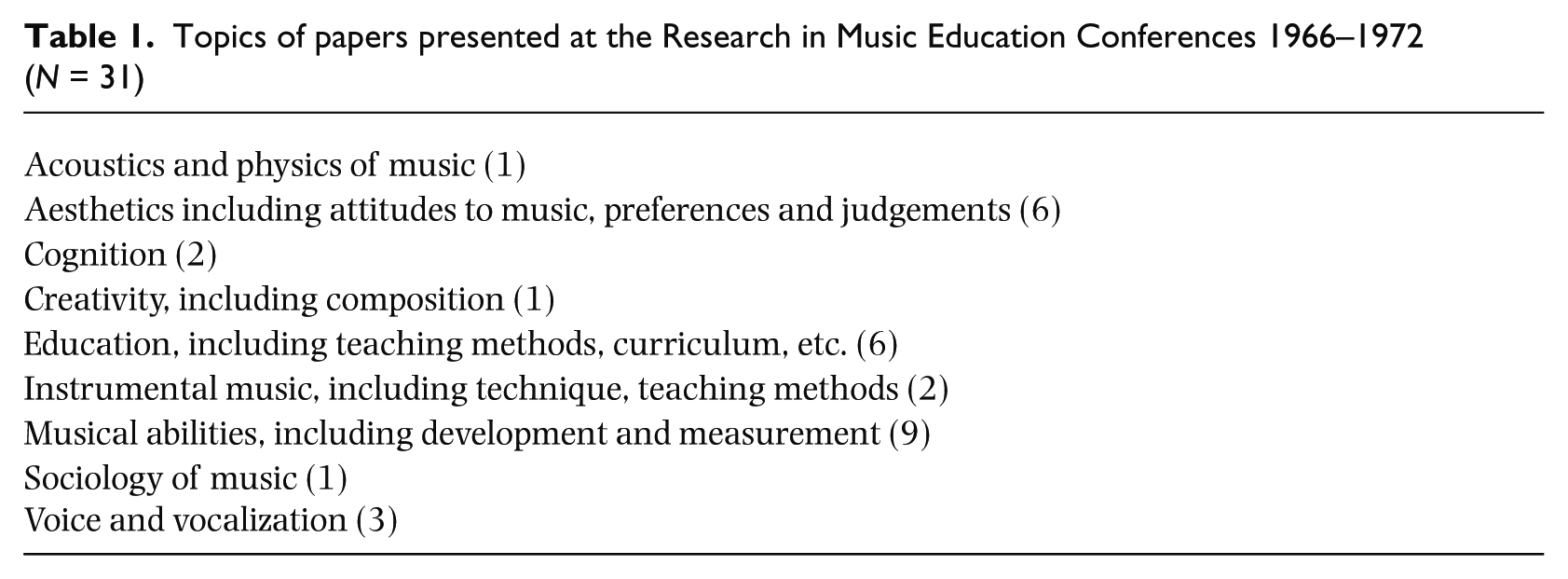
Altogether 31 papers were presented at the 14 Research in Music Education conferences (see Bentley, 1974). As might be expected the psychometric paradigm dominated, with a particular focus upon the assessment of musical ability. The other main topic areas were education and aesthetics (see Table 1).
Topics of papers presented at the Research in Music Education Conferences 1966–1972 (N = 31)
By 1971 Desmond Sergeant, then a lecturer in the Froebel Educational Institute, College of Education, had become aware of the limited opportunities for publication in the fields of music education and the psychology of music. At the October meeting of the Reading conference in that year, he put forward a proposal that was to have far-reaching consequences. Sergeant pointed out that Bentley’s Reading conferences had established a continuing association of academics, musicians and music educators, with attendance at meetings regularly in the 40–60 range. Delegates were generating a supply of high-quality papers and a new arena for dissemination could well be created by producing a publication. Sergeant recollects:
I remember making the proposal from a seat in the back row of the meeting, watching anxiously for reactions to my idea. At first it was met with a general silence – not encouraging – but then a few grunts were audible that seemed to be noises of approval and some heads nodded. The discussion that followed ended with my being charged to make necessary approaches, obtain estimates for printing and distribution costs, and if these were satisfactory we might go ahead. (Sergeant, 2012, p. 2)
A year later, on 28 October 1972, Sergeant made a second proposal; namely, that some organization or body was essential to support a journal, with a publication address and sound financial arrangements. The meeting agreed that it was time to form a society to provide a more permanent foundation, and that it was to be named the Society for Research in Psychology of Music and Music Education (SRPMME). Sergeant stated that the title was not meant to be discouraging to research in music education, but it was necessary to make it clear that the society’s interests were much wider. Bentley never approved of the name, which he thought was over-long, and emphasized psychology without mentioning other aspects of education, for example historical, philosophical and survey research. However, he accepted that the majority wanted it (Bentley, 1959/1999, p. 115).
Arnold Bentley was unanimously elected Chairman, and committee members included Desmond Sergeant, Rosamund Shuter, Sam Taylor, Rupert Thackray, Leon Crickmore, and Aubrey Hickman. At the same meeting Desmond Sergeant reported that a journal would be published twice annually, with the title Psychology of Music. There was to be an annual charge for personal membership of the society, not too large to be daunting, but enough to meet outgoings. Sergeant recalls that ‘to my delight, at the end of the meeting most people came forward to press money into my hands, and I returned home confident that the first issue [of Psychology of Music] was financially viable’ (Sergeant, 2012, p. 3).
The aims of the society were fourfold:
to bring together through conferences, researchers in the field of music education and contingent fields and at the same time to foster a positive relationship between practising music teachers and research workers;
to support the research undertaken in psychology of music and music education by members of the society;
to enable individuals to inform others about their work;
to publish periodically the society’s journal Psychology of Music. (SRPMME minutes, 25 October 1975)
The work of the society gathered pace during the remaining years of the decade. It grew from a membership of 228 in 1974 to 452 in 1979. Arnold Bentley resigned as Chairman in 1974 and was succeeded by Leon Crickmore. 3 In 1979 the journal editorship passed from Desmond Sergeant (who became Chairman) to Rosamund Shuter, whose authoritative book The Psychology of Musical Ability had been published in 1968.
A recurring issue in the society’s minutes during the 1970s was the balance that needed to be kept between psychological and educational topics. In October 1977 some concern was expressed at the apparent fall in numbers attending the conference. Especially noted was the lack of support from school music teachers who may have felt, so it was thought, that the topics were ‘above their head’. In the following year (SRPMME minutes, 3 June 1978) a special committee meeting was convened to discuss the future of the society, occasioned by the departure of Leon Crickmore who had been appointed as one of Her Majesty’s Inspectors of Schools (HMI). The committee emphasized that it was of paramount importance to find means of bridging the gap between the research workers and teachers. Accordingly, in 1979 it was proposed that Diana Champion, a practising school teacher, be co-opted on to the committee.
Desmond Sergeant’s first issue of the journal in January 1973 largely comprised papers that he solicited from authors he knew had completed significant work or, as in the case of Rupert Thackray and John Rowntree, who were able to report on work that was either currently in progress or at a positive stage of planning. These contributions were of sufficient quality to draw others to send in papers so that, by the following year, Sergeant was receiving more than could be accommodated. Increasingly, submissions came from the USA and Australia and reflected wider research interests. Of particular note was a submission on brain functioning by Peter Scheid and John Eccles, two eminent researchers from the Max-Planck Institute at Göttingen (Scheid & Eccles, 1975). Only at that stage was Sergeant able to impose some sense of direction and house-style on the journal, and thereby create its identity
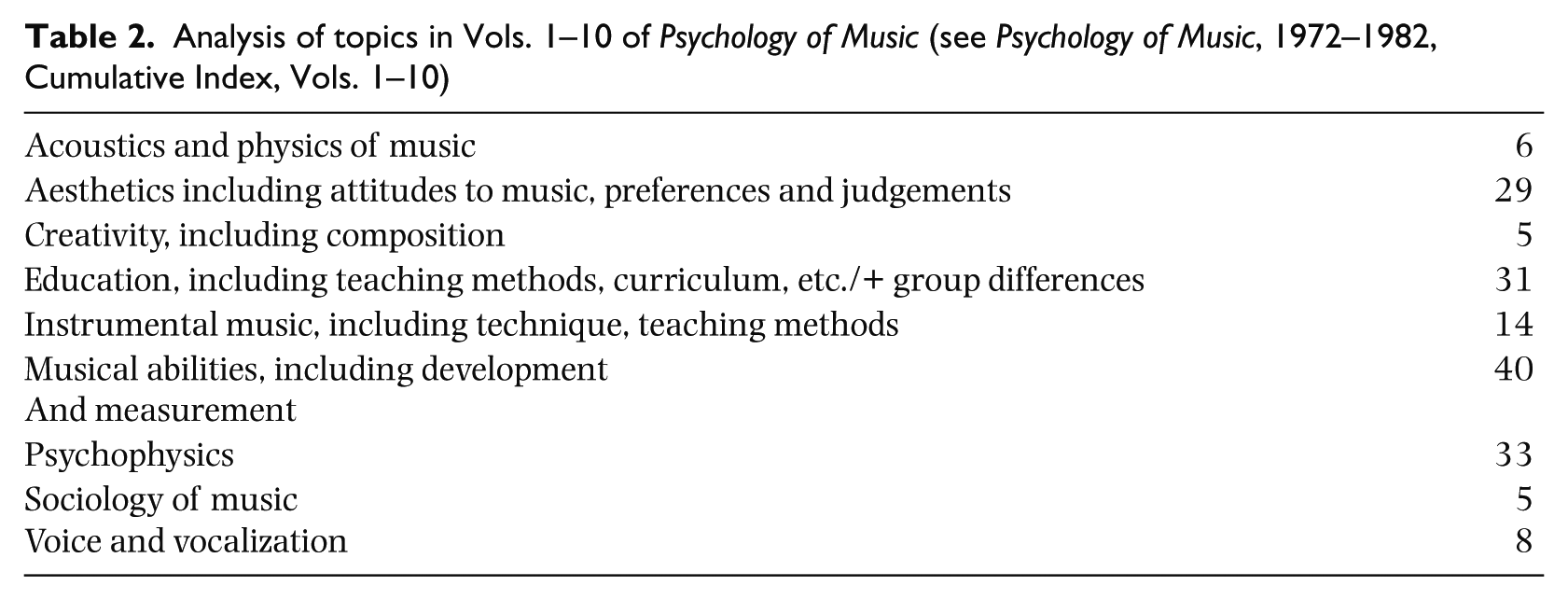
In the following table (Table 2) we see the main topics represented in the first 10 years of the journal. It is clear that, like the Reading conference papers, the field is dominated by measurement, education and aesthetics, but also that psychophysics had overtaken the last two of these topics.
Analysis of topics in Vols. 1–10 of Psychology of Music (see Psychology of Music, 1972–1982, Cumulative Index, Vols. 1–10)
In 1982, to crown the tenth anniversary of SRPMME, and in order to consolidate its international status, the society hosted the Ninth International Society for Music Education (ISME) Research Commission under the chairmanship of Aubrey Hickman. The conference papers were published in a special issue of Psychology of Music in the same year (Psychology of Music, 1982).
3. Theory and practice: Debates in the 1980s
As far as music in schools in England and Wales was concerned, the most significant and far-reaching development in the 1980s was the passing of the Education Reform Act (1988) in which a National Curriculum was proposed, with music as a compulsory foundation subject for all pupils. A climate conducive to such a curriculum had already been created by Music from 5 to 16, an HMI Discussion paper (Department of Education and Science [DES], 1985), which set out aims and objectives for music education in schools, based upon the practical activities of listening, performing and composing. Preceding this development was the founding in 1984 of the British Journal of Music Education which was to provide a platform specifically for music education researchers and in a format that was perhaps closer to Arnold Bentley’s original preferences for the society’s journal.
In terms of music psychology, there developed a general acceptance of the idea that the musical abilities measured by tests might be the products of successful musical engagement rather than ‘a priori’ determinants. Research interests came to be increasingly concerned with the nature/nurture debate, and many studies focused on observation of developmental patterns of musical behaviours. The broader development of psychological study often provided the context for these new endeavours, with the theories of Jean Piaget and Jerome Bruner being particularly influential. Musical parallels to the Piagetian notion of conservation were identified through the work of Marylin Pflederer-Zimmerman and Mary Louise Serafine. These trends are reflected in the pages of Psychology of Music.
By the mid-1980s, as Hargreaves, Marshall and North (2003) have pointed out, there was an unfolding of the main strands of music psychology: the cognitive, the developmental and the social. The advance lay in moving away from the domination of psychometric and acoustical studies, many of which had little to do with real-life musical experience. Music psychology was undergoing a significant change which had the potential to strengthen the relationship between researchers and practitioners:
Psychologists increasingly work in real-life settings . . . Music educators are called upon to deal with difficult issues such as developmental change and assessment, and they need to draw upon psychological theories and methods in making practical decisions. (Hargreaves, 1990, p. 116)
At the meeting of the committee on 9 March 1985, the new incoming editor, John Sloboda, outlined his plans for the journal. He proposed five main areas of research which might provide a clearer focus than hitherto. They comprised experimental music psychology, experimental education, experimental aesthetics, curriculum, music theory and analysis. A sixth category he labelled ‘general’ (SRPMME minutes, 9 March 1985). For each of the main categories he requested an associate editor well-versed in that area.
In his second issue of Psychology of Music as editor (vol. 14 [2]), Sloboda (1986) put down his thoughts in an open letter about how the society might achieve its aims in music education research. He wrote ‘in some perplexity’, because as editor he had had to respond ‘usually negatively’ to submissions made in the area of music education. This was in spite of a desire on his part to understand how scientists could best contribute to music education. The unpalatable situation was that the large body of psychological research had not influenced the educational community in the ways that had been hoped for. Sloboda’s point was ‘it is clearly not adequate to carry on as before in the hope that somehow things will get better’ (Sloboda, 1986, p. 144). He called for a debate and dialogue.
It was David Hargreaves who made a measured contribution to the debate in an article entitled ‘Developmental Psychology and Music Education’ (Hargreaves, 1986). The very title of the society, he argued, acknowledged the intention of covering the whole spectrum of music psychology and music education, but the problem was that contributions tended to be either psychological or educational: ‘the end result is something of a shotgun wedding’. However, if the issue was approached from a developmental perspective it might enable psychological researchers to organize the findings of their research ‘in a way that is more amenable to practical application’ (p. 85). Developmental theory could guide pedagogical practice.
In his final salvo as editor in 1990, Sloboda concluded that the two aspects of addressing educational practice, alongside papers addressing theoretical aspects of music psychology, needed to be held firmly together with neither being allowed to dominate: ‘This was one of the founding ideals of the society, and it remains as relevant a challenge today as it ever has been!’ (Sloboda, 1990, p. 3). His successor in the editorial chair, David Hargreaves pronounced ‘we are in full agreement’ (Hargreaves, 1990, p. 116): there was a need to develop an increasingly applied psychology of music.
4. The 1990s: ‘A growing optimism’
In the UK, the Further and Higher Education Act (1992) brought the short-lived binary system of higher education to an end. Possibly the most immediate effect of this legislation was on the music conservatoires which, until that time, had operated on the margins of the higher education system. Henceforth they were to become an integral part of it, with the specific mission of training performing musicians to the highest national and international standards. Some of the conservatoires in the UK established research centres in which the psychology of music was to play a central role. Over this decade there was a steady growth of music education research in the universities with an increasing number of students registering for research degrees. By the 1990s the founding of Research Studies in Music Education (1993) and Music Education Research (1999) were signs of an ever-expanding field. (However, it was not until the following decade that significant research interest began to be evidenced in UK teaching and learning in higher music education [e.g. Burt-Perkins, 2008; Welch & Papageorgi, 2008] particularly in relation to the education of music teachers [Mills, 2005; Welch, Purves, Hargreaves, & Marshall, 2011].) There were also major developments in the areas covered by the psychology of music, including: creativity; composition and improvisation; individual differences, personality and temperament; instrumental learning and practice; the effects of music on non-musical aspects of development and behaviour; musicality in infant development and communication; and social and sociological aspects of musical behaviour (Hargreaves et al., 2003, p. 149). In particular, as far as music education was concerned, Hargreaves’s and North’s (1997) shift towards the social perspective in musical development and education augured well for some firm conceptual foundations for the developmental social psychology of music and music education.
Two influential music psychology journals appeared in the 1990s: Music Perception (1993) initially edited by Diana Deutsch of the University of California, and Musicae Scientiae (1997) the journal of the European Society for the Cognitive Sciences of Music (ESCOM). Together with Psychology of Music they have come to represent a broad church characterized by inter- disciplinary and eclectic approaches within music psychology. This trend is also reflected in the conferences and seminars organized by the International Conference of Music Perception and Cognition (ICMPC) which was first staged in 1988 (see Ockelford, 2009).
In 1994 Eric Clarke, from the University of Sheffield, became the new Chair of the society. There seemed to be a growing sense of confidence and a desire to further relationships already established some years previously with ISME, and also with ESCOM. In 1997, SRPMME, with Jane Davidson as Conference Secretary, jointly organized a two-day conference at the University of Cambridge with ISME and ESCOM, with the subject ‘Perspectives on Music, Mind and Education’. Designed to encourage inter-disciplinary links, this expanded conference structure has now become a regular feature of the society’s life, bringing the conferences closer in line with the scope of the journal. It was followed in 1998 at Sheffield by a conference whose theme revisited familiar territory: ‘Measuring Music: From Psychometric to Cooperative Enquiry in Music Education and Music Psychology’. The inspiration behind it lay in the research of Herbert Wing who had devised standardized tests to measure what he called ‘musical intelligence’. A former editor of the journal, Rosamund Bourke (Shuter-Dyson), entitled her contribution ‘In the Footsteps of Herbert Wing’. We may recollect that Wing’s work was the subject of a paper presented by McLeish at the first Reading meeting in 1966.
In 1999, a special issue of the journal marked the 50th anniversary of the establishment of music education at the University of Reading. Anthony Kemp, Bentley’s successor at Reading, was the guest editor. He was forthright in his introductory comments:
If the contents of this special issue take some of its regular readers somewhat by surprise, then this may be symptomatic of the gulf that we have allowed to develop between research in psychology of music and that of music education, particularly concerning methodology. (Kemp, 1999, p. 111)
He went on to argue that failure to adopt the more descriptive and ethnographic approaches meant that several fundamental questions relating to music curricula issues would remain unaddressed, or investigated in inappropriate ways. However, in a related cautionary note at a Special Committee Meeting on 26 June 1999, the journal editor, Jane Davidson, raised afresh what seemed to be a perennial concern for editors of the journal. She observed a tension in the difference in quality of papers put forward by psychologists and those from educationists, whereby the latter would tend to be rejected by psychological standards. Nevertheless, she maintained that it should continue to be recognized that several research traditions fed into the journal.
As far as music psychology was concerned, however, there was growing optimism, nicely expressed by David Hargreaves:
Music psychology is a vigorous, youthful discipline which continues to expand and diversify at an ever-increasing rate, and whose inter-disciplinary connections now extend well beyond education. (Hargreaves, 1997, p. 3)
In his valedictory statement in 1999, Eric Clarke reported that ‘the society is in a very healthy state in terms of membership and finances, the attendance at and diversity of its meetings, and the continual flow of interesting and high quality papers in the journal’ (SRPMME minutes, 13 September 1999).
5. The emergence of SEMPRE
The new millennium saw some important changes in the society. From 1 May 2000, Eric Clarke was succeeded by Graham Welch as Chair and in 2002 Susan Hallam succeeded Jane Davidson as editor of the journal. At the annual general meeting (AGM) on 19 May 2001, it was agreed that the name of the society would benefit by being changed to something more memorable. Susan Hallam explained further developments that had taken place in an editorial in Psychology of Music:
Since being appointed as incoming editor I have been working with the committee of SRPMME to negotiate with the publishers, SAGE, over the future of the journal. I am delighted to be able to tell you that, as on 5th December [2001], Professor Graham Welch on behalf of the society signed a contract with SAGE who from January 2003 will publish the journal. (Hallam, 2002, p. 3)
The benefits of this new arrangement were that there would now be four issues of the journal per year (since increased to six issues from 2012); there would be full editorial control by the society; and the financially attractive package would enable some charitable objects such as bursaries to be set up (SRPMME minutes, 19 May 2001). The choice of a suitable name became urgent. There were several acronyms suggested, POMMES, PRIME, SPEM, PEM, PRME, MUS and SEMPRE (SRPMME minutes, 20 October 2001). At the AGM on 12–13 April 2002, the deal was finalized, as follows:
The committee recommend and the trustees resolved to seek approval of the membership that we become known as the ‘Society for Education, Music and Psychology Research’ with the corresponding acronym ‘SEMPRE’, reflecting our unique international position in integrating these three disciplines. (SRPMME minutes, 12–13 April 2002)
The new constitution retained the fourfold aims of the original, and added a fifth, namely ‘to do all other things, as shall further the objects of the society’ (SRPMME minutes, 17 April 2002).
At the AGM of the society on 23 April 2004, Graham Welch announced a new SEMPRE awards programme including the Aubrey Hickman Award, the Arnold Bentley New Initiatives Award, the Gerry Farrell Travelling Scholarships, the SEMPRE Lifetime Achievement Award, and SEMPRE conference awards. In 2009 the committee initiated a new post-doctoral award in honour of the contribution that Molly and Reg Buck had made to the society.
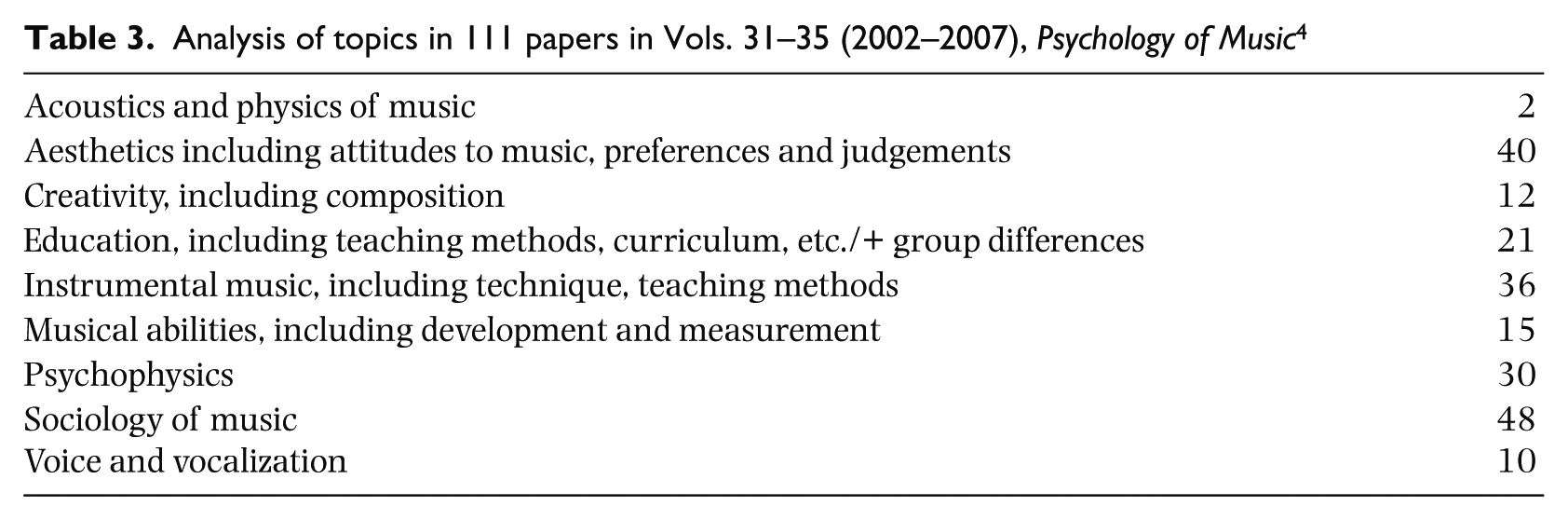
Over the years, the journal has gone from strength to strength. SAGE reported in March 2005 that its institutional reach now exceeded the 500 mark. Under the editorship of Susan Hallam and her successor, Raymond MacDonald (from 2007), between 2002 and 2007 the articles contained more sophisticated statistics and complex diagrams compared to the earliest volumes. They are empirical, ‘at the intersection of psychology, music and music education . . . [and] draw on a wide range of methodological approaches’ (Hallam, 2003, p. 5; see Table 3).
Analysis of topics in 111 papers in Vols. 31–35 (2002–2007), Psychology of Music 4
Of particular note was a special issue, relating to ‘mapping music education research- international perspectives’ guest-edited by Graham Welch (2004). This arose from an event organized jointly by three key figures in the society, Graham Welch, Anthony Kemp and David Hargreaves. The resulting research review was published by the British Educational Research Association (BERA) in an occasional paper called ‘Mapping Music Education Research in the UK’ in 2001. To extend the audience for this venture, BERA agreed that a revised and updated version of the mapping exercise could be published in Psychology of Music alongside shorter articles by authorities from Australia, Germany, Hong Kong, Scandinavia, and USA, providing an impressive international perspective (Hallam & Welch, 2004). In the conclusion to their paper on ‘Learners: Their Characteristics and Development’, Hallam and Lamont (2004) called for a greater understanding of the relationship between enculturation and the acquisition of generative skills, an understanding which might begin to answer the fundamental question of what musical ability is. Finally, in 2008, SEMPRE took over as the publisher of Research Studies in Music Education (RSME), regarding it as a separate but complementary journal to Psychology of Music in the sense that each focus on psychology, music and education. Both are now published in partnership with SAGE.
6. Developments, achievements and influences
In conclusion we consider the broadening development of the relationships between the psychology of music and music education, and between theory and practice within the context of SEMPRE’s history over the past forty years.
Today, the society’s contribution to research is recognized internationally, but it has been pointed out that in any historical review it is important to bear in mind the various factors that, over a period of time, have had a bearing on the scope and feasibility of empirical research. In the 1960s, there were no personal computers and the hand-held calculator was yet to be developed. The only computational aid available was a small mechanical device with a turn-handle tumbrel that was little more than a mechanical abacus. Even the simpler small-scale statistical tests such as a t-test could take an entire afternoon to compute if subject numbers were large. The computational work required for some studies represented many days of labour; nowadays the same computations can be completed on a laptop computer in a few minutes. Software such as the Statistical Package for the Social Sciences (SPSS) has made highly complex processes simple to perform and readily available. The result has been an exponential expansion in applications of advanced statistical procedures that would have been unthinkable in pre-computer days. A recent paper by Daniel Müllensiefen (2012) lists the wide range of highly complex statistical designs that are currently employed, including multifactorial analysis of variance (ANOVA), linear regression, multidimensional scaling, classification trees, functional data analysis and Bayesian modelling.
Data itself can now be generated and collected quickly on-line, without presence or intervention from the researcher. Brain functioning data of a kind that two decades ago would have been beyond imagination can now be obtained relatively easily by functional magnetic resonance imaging (fMRI) and positron emission tomography (PET) scans. As a consequence research has become increasingly resource-based and complex, and published reports necessarily far longer with the inclusion of complex detail. In this connection, it is worth noting that music has been found to be a powerful resource for psychological and neurological research. This is primarily because it is a non-verbal language whose texture is embedded with complex hierarchical structures, thus demanding perceptual and cognitive processing, and is also capable of eliciting emotional response. Many researchers – scientists who are not themselves practising musicians – are regularly using music as an agency for invocation of neural activity. This has led to output from researchers working in medicine and science that is ideally suited to journals such as Psychology of Music.
As we have seen, one of the issues that members have had to face, especially in the early years, is the connection between music education and psychology of music. The problem raised by Sloboda in his open letter, referred to in section 3, was also an example of a wider issue that had been much discussed in educational circles over a long period. With the rise of educational studies in the 1960s and 1970s (see, e.g., Tibble, 1966) it was frequently stated that educational practice needed to be based on a firmer theoretical framework. This framework, so it was held, would be derived mainly from philosophy, psychology and sociology. Such a position was made explicit in the writings of Paul Hirst (1974) and Terry Moore (1974) and in the objectives model of curriculum outlined in a famous monograph by Ralph Tyler (1949).
The view that educational theory should be a guide to practice was strongly criticized by a number of curriculum specialists and notably by Richard Pring (1978), who argued that educational transactions are characterized by their particularity. In any one practical situation there are so many variables that it is impossible to follow a guideline as set out in a general theory. This is not to imply that theory is irrelevant to practice. On the contrary, it is vital since informed practice requires the teacher to theorize about his or her professional endeavours. One of the respondents to Sloboda, Rosamund Shuter-Dyson (1986), was making a very similar point when she referred to the importance of the indirect influence of academic research in fostering a climate of opinion. On this view, it is obviously important for teachers in training to be introduced to a range of theories and research findings relevant to their area of subject expertise.
In spite of the differences of opinion regarding the relationship between research, theory and practice, there is widespread agreement that there are various ways in which psychological theory and research can and does have an impact on the practice of music education in its many forms. Members of the society and journal editors have done much to make the connections explicit so that, by 1990, as we have seen, Sloboda was able to adopt a more optimistic tone. There is an increasing number of publications dealing with the theory–practice issue, with books by Lehman, Sloboda and Woody (2007), Hallam (2011) and the extensive two-volume compendium edited by McPherson and Welch (2012) being good examples of the ways in which psychologists are applying research findings in educational settings. The SEMPRE Studies in the Psychology of Music series, established in 2007 and published in collaboration with Ashgate Press, covers a wide range of topics and is intended to bring the latest research findings to different audiences: teachers, policy makers, and parents. It is hoped that this strategy will have a positive impact on practice and lead to greater dialogue between researchers and practitioners.
None of the developments in the society’s reputation and authority would have been possible without the dedication of the chairpersons, journal editors and committee members who have given so much time to the promotion of the society’s values and objectives. It is impossible to mention them all, but the outstanding figure in the story of SEMPRE must surely be Arnold Bentley, for it was he who had the vision of a community of researchers who through their studies and inquiries would improve the practice of teaching and make music a powerful and meaningful force in people’s lives. Bentley never believed that research would transform practice, but he maintained that practice informed by findings objectively obtained through good research could be of value to practitioners. He was always hopeful that teachers in schools would be encouraged to engage in research. This hope has not been realized to any great extent, although the gap between researchers and practitioners is certainly not as wide as it was in the 1960s. Bentley was very much committed to research in disciplines beyond psychology and one of the society’s notable achievements has been in bringing together a greater number of people whose interests cross and merge in what is now a multi-disciplinary enterprise. This has not always been easy but the outcomes are recognized as being both academically rewarding and professionally beneficial.
At the present time SEMPRE is acknowledged as one of the most prominent of academic associations and a leading international body for the advancement of studies in its three major fields. It is widely appreciated by the membership that the success and sense of confidence presently enjoyed would not have been achieved without the commitment and energy of the current Chair, Professor Graham Welch. He works tirelessly to publicize the society and maintain its academic standards and professional significance. His negotiation of the partnership with SAGE Publications has increased the circulation of the SEMPRE journals and raised their profiles. Current circulation includes over 2,000 institutions, with another 4,000 plus worldwide having access to the journals at little or no cost. Over 7,000 individuals have signed up for email alerts as new articles are published. In addition, the increasing use of electronic media has meant that there are around 100,000 full-text downloads of published articles annually (SAGE report to SEMPRE Committee, December 2011). Most importantly, the partnership has ensured financial security and enabled the society to award scholarships and bursaries to young researchers and, in particular, colleagues from countries in the developing world. By the time of the 40th anniversary conference in September 2012, the SEMPRE awards programme will have provided £234,000 in total grants and bursaries since their inception in 2004 (SEMPRE minutes, 15 May 2012). Such achievements are to be celebrated and augur well for the future of research in the fields of music, education and psychology.
Footnotes
Acknowledgements
We would like to thank the following for their help in the preparation of this paper: Chris Dalladay, Lucy Green, Susan Hallam, David Hargreaves, Anthony Kemp, Kate Laurence, Adam Ockelford, and Graham Welch.
Funding
This research received no specific grant from any funding agency in the public, commercial, or not-for-profit sectors.