







Abstract
Involuntary musical imagery (INMI) is a ubiquitous cognitive phenomenon. The present study comprises six intensive interviews that examine the subjective phenomenology of INMI for individuals of varying musical experience. Grounded theory analysis was used to establish themes regarding both the form and feelings ascribed to INMI episodes. All the respondents felt that their INMI experiences had high fidelity including some complex musical arrangements. INMI form could be unstable over time according to cognitive demands. Individuals with musical experience reported concurrent sensations of visual and motor imagery as well as involuntary extemporizations of their INMI. Motivators for positive and negative appraisals of INMI were identified such as nostalgia and entertainment, and repetitive cycling with loss of control, respectively. We discuss interpretations from auditory memory theory and develop hypotheses for future INMI empirical investigation.
The ubiquity of music means that we are surrounded by it as we go about our everyday life (Greasley & Lamont, 2011; Juslin, Liljeström, Västfjäll, Barradas, & Silva, 2008; Krause & North, 2012; Sloboda, O’Neill, & Ivaldi, 2001). The music does not necessarily stop in silence either; nearly 90% of people report experiencing the mental phenomenon of involuntary musical imagery (INMI) at least once per week (Liikkanen, 2012; Williamson et al., 2012). This everyday phenomenon, also known as “earworms,” is characterized by experiencing sections of music in the absence of an external source that goes on to repeat outside of conscious control.
The majority of INMI research to date comprises diary studies or large internet-based surveys that aim to delineate quantitative patterns in the experience. Beaman and Williams (2010) studied diaries from 12 individuals who recorded 269 INMI episodes. Over half consisted of fragments of music although 28% featured a whole song. The majority, 66% of episodes, did not interfere with daily life and passive acceptance was reported to be a more successful strategy for INMI control than active attempts at blocking. The INMI studied by Halpern and Bartlett (2011) ranged in length from 30 s to 195 min (average 8.22 min) although some people recorded all-day INMI.
One consistent finding across both diary and survey studies has been an association between musical experience and INMI. Beaman and Williams (2010) found a positive relationship between the frequency of INMI and self-rated importance of music, and Liikkanen (2008, 2012) reported that people with more extensive musical practice experienced more frequent and longer episodes of INMI that were more instrumental. The later finding is in line with Bailes (2007) who found high levels of musical imagery in university music students.
Liikkanen (2008, 2012) reported an exception to this linear relationship between musical experience and INMI in trained musicians who have high levels of practice (over 15 years); they reported experiencing less frequent INMI that is less annoying relative to individuals with less musical experience. Liikkanen postulated that extensive musical practice may promote strategies that provide a degree of control over INMI, rendering it less common and less agitating.
Floridou, Williamson and Müllensiefen (2012) surveyed 332 individuals on INMI and general musicality using the Goldsmiths Musical Sophistication Index (Gold MSI; Müllensiefen, Gingras, Stewart, & Musil, 2011). Five of the seven Gold MSI factors (Importance, Production and Perception, Creativity, Emotions, and Body) correlated positively with INMI frequency but Musical Training did not. This finding suggest that the musical behaviours which correlate with INMI are more complex and multi-dimensional than years of practice or self-rated musicianship (Williamson & Müllensiefen, 2012)
In summary, diary studies and surveys have detailed the general features of INMI and indicated that these may differ in those with higher levels of musical training or engagement. A less- explored question is what INMI actually “sounds” like to different people. The perceived phenomenological experience of involuntary imagery in the “inner ear” (Smith, Reisberg & Wilson, 1992) will be referred to hereon in as INMI form. Brown (2006) reported on the INMI form of his own experiences, and Bailes (2006, 2007, 2009) studied the phenomenology of general musical imagery in music students. These studies provide a basis for the present work which seeks to understand the phenomenological experience of INMI across multiple individuals with different musical backgrounds.
Findings from studies of voluntary auditory imagery provide a basis for the prediction that people with more musical experience may experience a different form of imagery compared to non-musicians, as well as different general characteristics such as frequency and length. Trained musicians perform better on voluntary musical imagery tasks in dimensions such as pitch, rhythm and timbre compared to individuals who have had little or no musical training (Aleman, Nieuwenstein, Böcker, & De Haan, 2000; Halpern, 1992; Hubbard, 2010; Janata & Paroo, 2006), suggesting that their mental representations may be more robust and/or more veridical. There are also differences in the patterns of neural activations seen during voluntary mental imagery of music in musicians as compared to people with little musical training (Coffey, Herholz & Zatorre, 2012; Herholz, Lappe, Knief & Pantev, 2008; Lotze, Scheler, Tan, Braun, & Birbaumer, 2003; Janata, 2012), a finding commonly ascribed to musicians’ increased use of their imagery abilities (Highben & Palmer, 2004; Zatorre & Halpern, 2005).
The above evidence provides a rationale for predicting differences in the form of imagery experienced by individuals with differing musical backgrounds. In the present study we define musical background in terms of musical engagement and habits as well as training (Williamson & Müllensiefen, 2012). One method holds promise for gaining initial insights into the nature of INMI form. Intensive interviews allow for a more in-depth exploration of each person’s INMI episodes than a survey or diary. Interviews also expose personal reactions and interpretations of INMI which cannot be accessed so effectively by other more short hand methods. Interview studies rely on introspection but at the present stage of research into INMI this technique is one of few that could access the rich data needed to guide future empirical work (Charmaz, 2006).
The present study comprises interviews with six individuals about their experiences of INMI. The six individuals were assigned to three groups; “High,” “Moderate” and “Low Musical Experience,” based on reports of their previous musical background. 1 The aim of this design was not to look for group differences but to ensure that the first in-depth exploration of INMI phenomenology across several individuals included an overview of how the phenomenon may be experienced by people with varying musical backgrounds.
In summary, an in-depth interview study of INMI in individuals with different musical experiences has the potential to make a unique contribution to our understanding of INMI, by complementing and extending the findings within previous diary and survey studies, and by providing additional testable hypotheses about the form of INMI experiences for future work. Put concisely, an interview study allows us to go beyond the quantities ascribed to INMI (frequency and length) and explore the quality of those experiences.
Method
Participants
L1 (female 2 ) and L2 (male; 46) had “Low Music Experience” since they had little or no formal training and were only tangentially involved in musical activities. M1 (female; 37) and M2 (male; 42) had “Moderate Music Experience” since they both had musical training in childhood and were involved in occasional musical activities as adults. H1 (female; 49) and H2 (male; 39) had “High Music Experience” since they both had extensive formal training and are currently employed in occupations that demand high levels of “receptive musical skills” (music critic and radio presenter) (Levitin, 2012).
L1 was an opportunity participant who was visiting the University for other purposes while L2, M1 and H2 had previously completed the earwormery.com survey (Williamson et al., 2012) and volunteered for further INMI studies. M2 is a public associate of the research group, while H1 is an academic colleague. Although there are limitations to a convenience sample, we took care never to ask about the extent of an individual’s INMI before the study and took only as our criteria that an individual experienced INMI to some extent.
The interview
“Intensive interviewing” was chosen for the present study as it permits an in-depth exploration of a mental experience and is thus a useful instrument for interpretive inquiry (Charmaz, 2006). Open, interpretive inquiry was the most appropriate method as there have been few explorations of INMI experiences beyond quantitative analysis of their characteristics (Brown, 2006) and as such, little is known about the form of INMI or how this varies across individuals.
An intensive interview requires the construction of a semi-structured schedule, which comprises a small number of questions formulated in such a way as to maximize flow during discussion of a topic while still focusing on the participants’ specific experience; the schedule in the present study encouraged the participant to explore and interpret their own phenomenological experience of INMI. The interview schedule and questions were designed based on a grounded theory approach (Charmaz, 2008; Glaser & Strauss, 1967), which allows for structured but flexible examination of selected aspects of the INMI experience, thereby illuminating individual differences in everyday INMI episodes. Intensive qualitative interviewing and grounded theory are appropriate and complementary methodologies for such a study as they are both “open-ended yet directed, shaped yet emergent, and paced yet unrestricted” (Charmaz, 2006, p. 28).
The present interview schedule began with an introductory discussion of participants’ music habits, experiences and the importance of music for them, before proceeding into a semi-structured exploration of INMI. The broad open-ended questions that comprised each section of the schedule were designed as minimal prompts to allow the participant to engage in storytelling, to foster reflection and to encourage them to articulate their impressions and reactions, as well as to give detailed discussion and/or examinations of their INMI experiences (Charmaz, 2006). The body of the interview was not designed as preconceived categories that would limit data interpretation (Glaser, 1978) but rather provided a structured and focused examination of different aspects of INMI.
In the first section (Form), participants described the mental experience of hearing INMI in their “inner ear.” They were prompted to reflect on the experience as compared to hearing real music, considering the melody, the timbres, the rhythms and the complexity. They also considered whether the imagery altered as a function of their physical or mental state. In the second section (Feeling), participants were asked how experiencing INMI made them feel and how consistent these feelings were as a function of concurrent physical and mental state (see Appendix A).
The two interviewers followed a semi-structured style when delivering the schedule. The structure of the INMI section of the interview was flexible, so it could be adapted to the line of discussion taken by the participant. One interviewer led the discussion while the other waited for the end to ask any questions that had emerged during the interview. At all times, the questions were delivered in a conversational but focused manner by the main interviewer, including vocal and bodily gestures of agreement and encouragement (head nodding and smiling) as well as verbal prompts to clarify details or further explore raised issues, where appropriate to the context of the interview (see schedule for prompts). The interviews lasted between 30 and 45 minutes.
The analysis
Interview analysis began with the transcription of the audio recordings into text files. The files were then divided into two sections, separating out the introduction from the main body of the interview. The initial stages of coding were carried out by one researcher to ensure consistency across the large amount of data. The final stages of the inductive analysis and theme generation were shared between the researchers in order to reach consensus and minimize individual differences in interpretation.
The interview introduction contained discussion of the participants musical background and current level of musical engagement, and was analysed first. The aim of this analysis was to summarize and confirm variables that contributed to the division of the participants into three groups (Low, Moderate and High Musical Experience) including music listening, musical training, current musical engagement and self-rated importance of music. These variables had been briefly outlined at the time of selection but were explored here in greater depth.
The main body of the INMI interview was then analysed using Grounded Theory principles based on descriptions by Payne (2007) and Charmaz (2008). Grounded theory analysis results in an interpretation of the data that can be taken to an abstract level but that is profoundly grounded on and emergent from the empirical data (Charmaz, 2006). In the present study, the focus was on generating theories, upon which testable hypotheses about INMI could be developed. The emergent themes and resulting visual models of INMI experiences were constructed from the descriptions provided by the participants.
The method for grounded theory analysis was based on Williamson et al. (2012). The first step was line-by-line marking of the text with codes, the aim being to summarize segments of the data in as few words as possible. During this first step of analytical interpretation, each researcher took individual notes as connections developed between the emerging themes, dominant themes and higher theoretical abstract categories. In the second stage of the protocol, each researcher generated concrete themes to “sort, synthesise and organise [the] large amounts of data” that resulted from the line-by-line coding (Charmaz, 2008, p. 92). This more focused stage allowed the researcher to frame their codes within each of the sections of the questionnaire (Form and Feeling) as specifically as possible. Finally, the two researchers came together to combine their analysis and develop abstract themes from their individual codes, culminating in the visual representations that summarize the findings (see Figures 1 and 2, in the Results section).
Results
The results are presented in three sections; 1) Musical experience; 2) General INMI features; and 3) INMI Form and Feeling.
Musical experience
On average, the interviewees listen to music for 3.33 h per day (range = 2–8 h). M1’s estimate applied to a typical working day but this time increased on a non-work day from a maximum of 3 h up to 7 h. Conversely, L2 listened to up to 8 h of music during an average working day, dropping to a maximum of 3 h on non-work days.
The participants detailed both the media by which they preferred to listen to music and also the situations in which music listening occurred (see Table 1).
Participants’ descriptions of preferred music listening methods and situations.
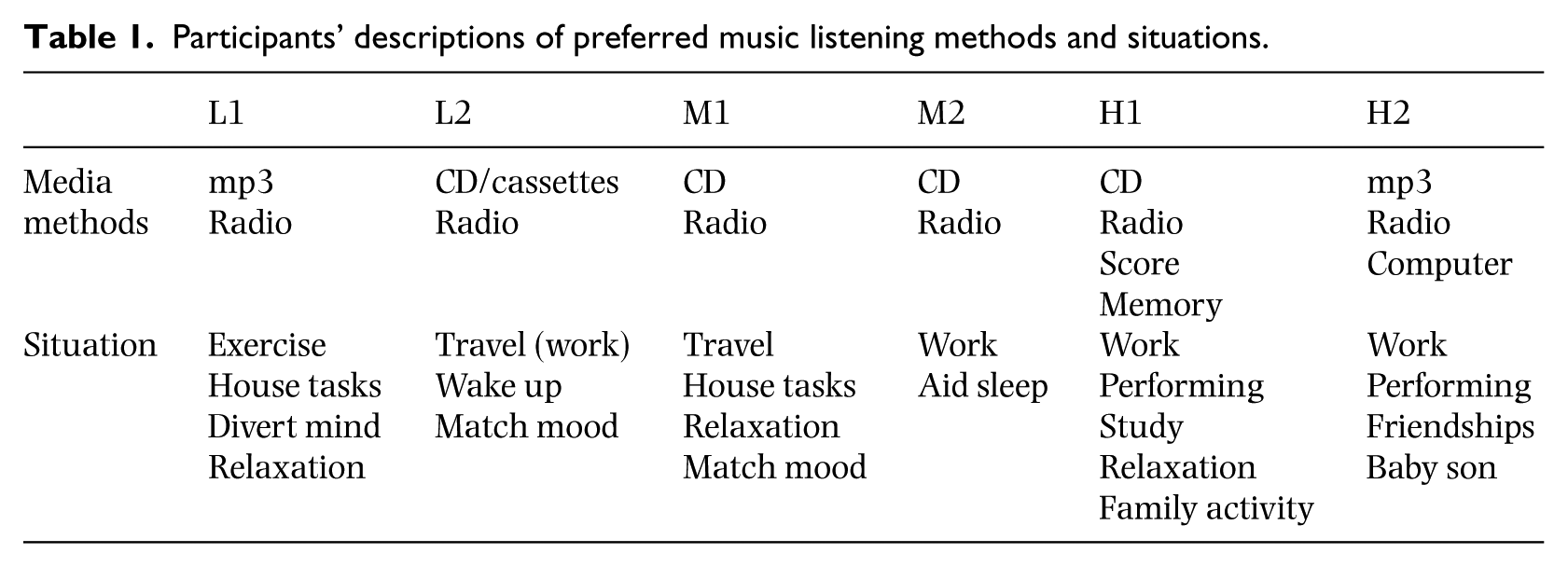
A typical first response was to discuss methods of personal music choice, such as CDs, mp3 players and computer playlists. The most popular form of music-listening was the radio with participants mentioning most of the UK national stations (Radio 2, 3, 4, 6Music, and Classic FM). The participants also identified situations that are typically associated with music-listening such as matching mood, aiding relaxation, adding entertainment to tasks such as household jobs and driving, and a means to bond with friends and family (Krause & North, 2012; North, Hargreaves & Hargreaves, 2004). In addition, H1 and H2 identified the role of music for their work (music lecturer and radio presenter, respectively) and their hobbies (classical singer and band member, respectively).
L1 and L2 had little or no formal musical training in their lives. M1 trained on piano up to Grade 8 level (Associated Board; UK) until the age of 18. She has since taught herself bass guitar but was not actively playing at the time she was interviewed. M2 trained up to Grade 5 (Associated Board; UK) on the piano as a child and has occasionally sung in choirs as an adult. H1 trained as a professional singer, completing a conservatoire degree in Vienna and keyboard exams for her degree. She is a music academic and professional music critic. As well as training to be a radio presenter, H2 is a self-taught guitarist. He has played guitar for 25 years, including 5 years in a band.
L1 is a language teacher and sometimes uses music in her classes. L2 sings in church and takes part in occasional dance lessons. M1 enjoys teaching music to her nieces and nephews. M2 is a member of various choirs. H1 analyses music when planning her lectures and studies scores for her research. She writes as a music critic and has regular singing lessons. H2 actively listens to, reads about and discusses music every day on the radio and performs in bands. He also plays music with his son.
All the participants stated that music was either “very important,” “extremely important” or “essential” to them. In particular, L2 stated that music was important for his self-expression and M1 and H1 stressed that music was an important part of their identity.
General INMI features
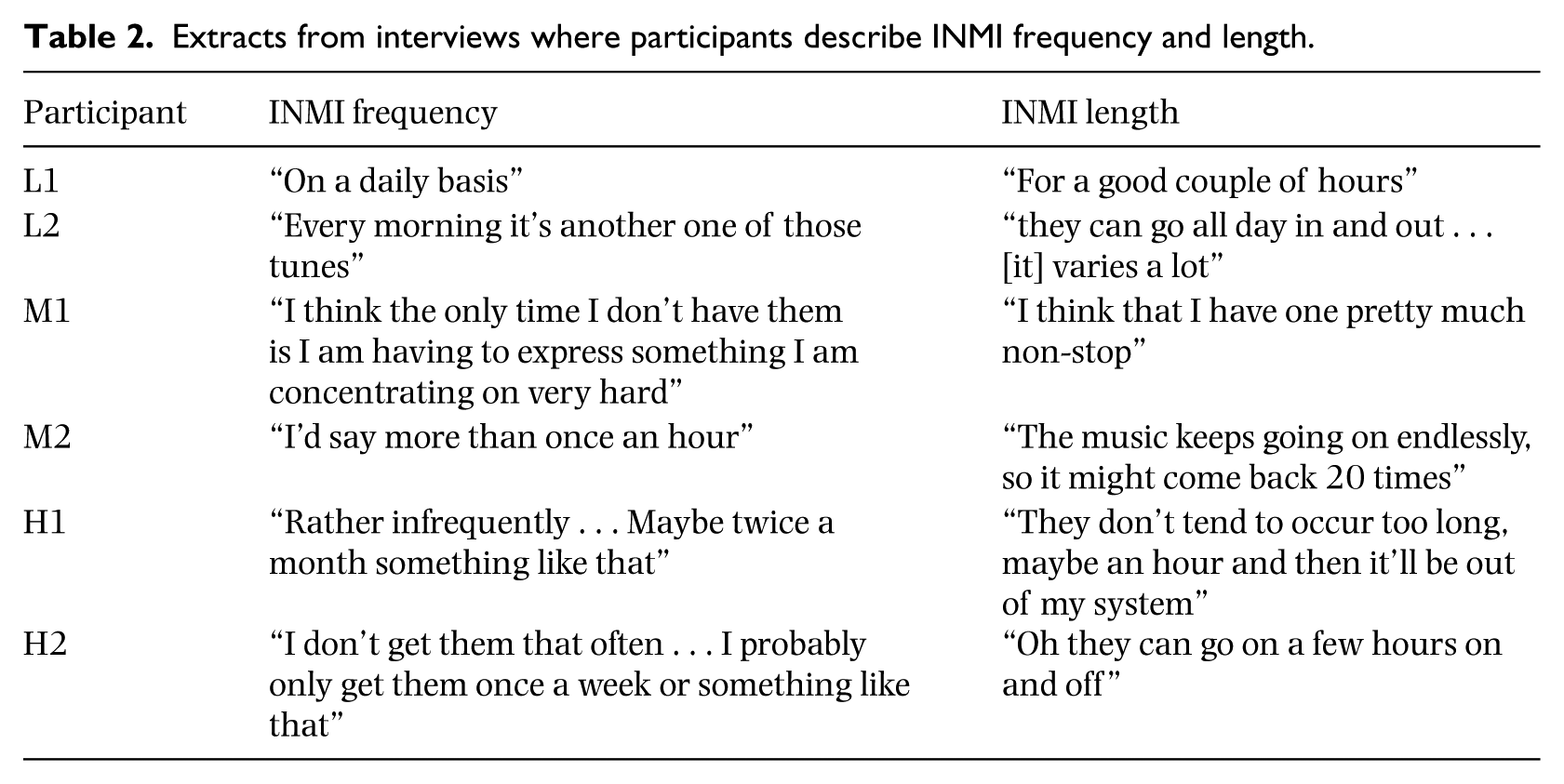
All participants were familiar with the definition of INMI (“earworms”) presented in the interview (Appendix A) and were able to describe the frequency, patterns and length of their experiences. Participants’ descriptions of the frequency and length of their INMI episodes are presented in Table 2, in the form of direct quotations from the interviews. The responses illustrate the regular and repetitive nature of INMI episodes for all individuals, with the exception of H1 and H2 who reported less frequent INMI compared to other participants.
Extracts from interviews where participants describe INMI frequency and length.
INMI qualities
1) Form
From this point onwards, all theme labels are identified in italics. First, participants were asked to reflect on their INMI and to compare it to the experience of hearing music. Within “Form,” three dominant themes emerged; Fidelity, Instability and Complexity. These are listed below alongside the original description of the theme that was developed and used by the researchers during coding. A model of the dominant themes and their relationships to subdominant themes (also in italics) is presented in Figure 1.
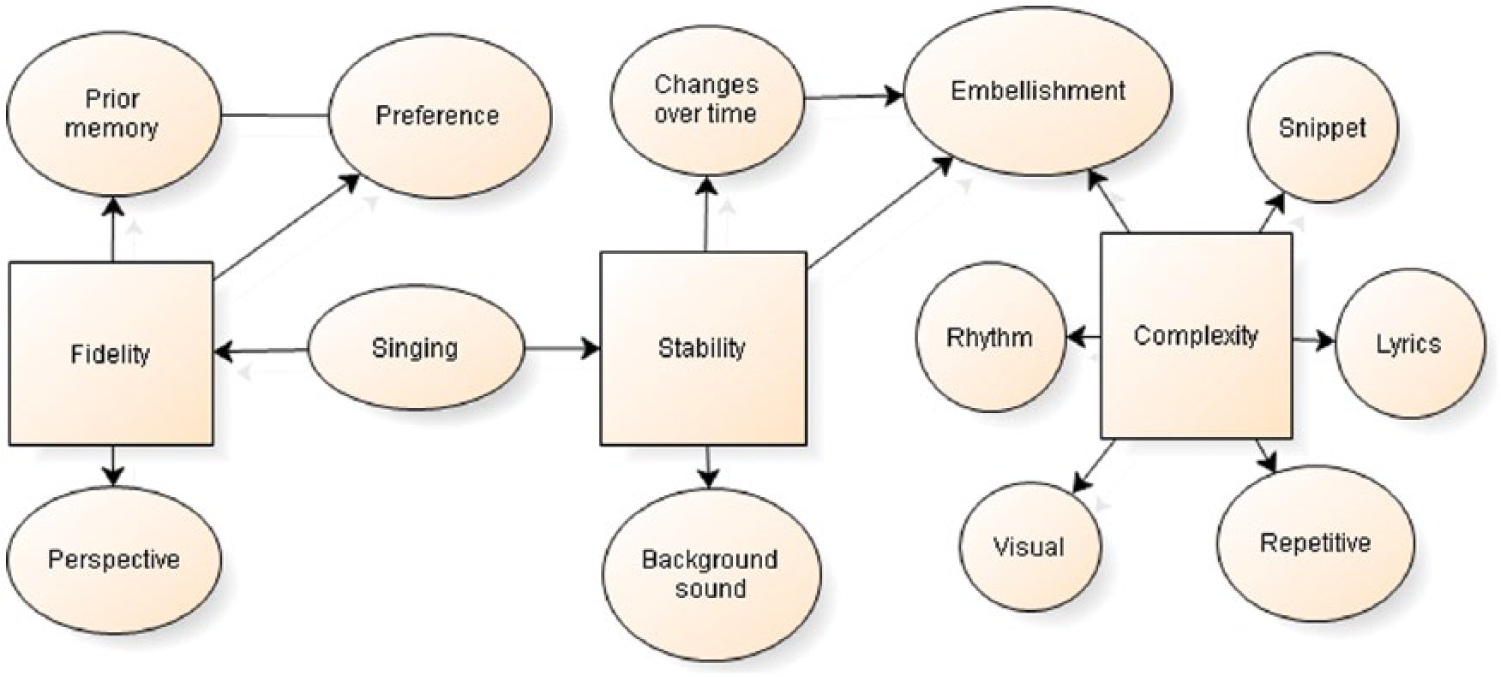
Illustrative model of the themes generated from analysis of the interview analysis within the Form section. Dominant themes are shown in boxes. Subdominant themes are illustrated with circles. Hierarchical links between dominant and sub-dominant themes are illustrated with directional arrows while associations between sub-dominant themes are indicated with straight lines.
I. Fidelity – the form of the INMI is similar to the original music
All participants reported that their INMI was often a faithful replication of the original music in terms of the instrumentation and/or vocals:
M1 – “if I have got in my head a tune that I have been listening to or even a tune from a long time ago that I don’t know very well, I will hear it as I hear it was recorded. I will hear the voices, the words, the instruments as the instruments come in, so I will hear the song I imagine pretty much as I hear it.”
An exception to this pattern was L1 who stated that she often heard a simplified version of an original musical stimulus as INMI:
L1 – “[it would be a] single voice or just somebody just on the piano giving the actual tune as opposed to a whole orchestration of the notes.”
A subdominant theme within the theme of Fidelity was an influence of Preference. In one case, the preferred version of a song tended to feature as INMI:
L1 – “my preference would go for the artist I prefer and their mimic will go on. Like there is a couple of songs which have been done by different artists and when I have them singing in my head I will hear the artist that I like.”
In a second case, M1 reported a distinction between the Fidelity of her preferred INMI compared with that which she found annoying. The annoying INMI, which she referred to as “the ploddy ones,” were low in musical fidelity:
M1 – “If it is one of the ploddy ones I don’t hear an instrument or anything, it is just like my voice humming . . . it is just the notes really . . . it is just the idea of it, it’s almost like my brain is just going like, imagine it’s just like [sings a series of 5 repetitive notes] I can feel my fingers like doing that [holds her hand out fingers down and presses them as if on an imaginary keyboard over a 5 note scale], it’s just like that in my head, I can almost see the pattern of it.”
Another subdominant theme linked to Fidelity was Singing. Two participants reported that singing altered the form of the INMI, transforming it from a veridical experience of the original into the sound of the person’s own voice singing the tune:
M1 – “because I have been humming it too then it is just my voice singing it.”
Another participant reported that her ability to sing gave a close connection to the INMI, one that maintained her Perspective:
H1 – “This morning I heard Carl Orff’s Carmina Burana on BBC Radio 3. Now I sang Carmina Burana . . . I hear the opening chords, and there again that’s the performance, I have that in my head – my version . . . you have a quite different experience of the sound when you’re in it . . . I connect to it in a different way . . . That’s my perspective as a singer and I imagine it’s the same with other musicians.”
II. Instability – the form of INMI alters as a function of time or experiences
Participants had the impression that whilst INMI can remain quite stable over long periods of time there are examples of how it may Change over Time:
M1 – “I would say that when I got out of my car . . . it was very clear, obviously, as I had just been listening to it. Then over my day as I have been absent mindedly whistling it or whatever, you know and just having it in my head the complexity has definitely gone down pretty much to just the tune.”
INMI can also move in and out of the focus of conscious attention, becoming more of a Background sound, depending on the demands of the task at hand:
H2 – “. . . they ebb and flow as to when you’re busy, when you’re mentally busy don’t they, so like anything, subconscious, it sort of goes away if I’m doing my job, it won’t pop up then because I’ll be thinking about other things.”
A final Change over Time, also linked to the next dominant theme of Complexity, was termed Embellishment, where a person experiences extemporization in their INMI:
M1 – “on every long note I will get some, very annoying for me, embellishments . . . very meaningless, just kind of noodling around that note going back to it every time there is a long note. It will just play around, stick to the theme of the tune, but any sustained note will get filled in with a little wobble of some kind, up one note, down two notes, and up one, something very annoying, very meaningless and bland . . . it won’t make me miss a beat in the tune. It won’t make me lose the key of the tune whatsoever . . . like a trill but not a trill.”
III. Complexity – reports on the complexity of the music that is heard, including the number of instruments and the style of musical arrangement.
Some individuals reported hearing complex arrangements such as symphonies and operas while all participants reported low complexity INMI such as jingles, simple melodies (nursery rhymes), bells or sirens:
H1 – “I would hear, for instance, the entire opening chorus (sings) and then you know you hear (singing) and then the whole chorus with the orchestra coming crashing in underneath, probably the first say sixteen measures.”
M1 – “I get annoying ones like Puff the Magic Dragon, and Row, Row, Row Your Boat when I am walking . . . I will hear a siren and that will be going on in my head for a good hour, so that counts as an earworm.”
L1 – “I would find it difficult to have an earworm that was a very complicated piece of classical music.”
Participants described idiosyncratic aspects of the Lyrics and Rhythm. INMI was also frequently associated with very short pieces of music, or Snippets, that were Repetitive.
A final subdominant theme within Complexity was termed Visual, whereby individuals with musical experience referred to occasional simultaneous visual experiences alongside their INMI. These episodes were linked to visual and motor experiences of playing music:
M1 – “I could see it on a stave, and I can see a keyboard doing it as well. Sometimes when it is going on my fingers will actually be twitching to the same tune like that [presses her fingers down as if on an imaginary keyboard] like just the same [sings simple tune and plays with fingers at same time] over and over again and my fingers will be doing the same thing.”
In summary, INMI Form retains many of the qualities ascribed to hearing the music. Individuals with at least moderate musical experience reported sensing concurrent visual and motor representations of the imagined sounds. Although INMI can retain a stable form over time, there were reports that form can break down over time or as a result of singing along, fade in and out of the focus of attention, or could become more elaborate in individuals with a degree of musical experience.
2) Feeling
Three dominant themes described the valence of INMI responses; Positive, Negative and Ambivalent. Each dominant theme comprised a number of subdominant themes where participants provided a justification for their response. A model of the themes is presented in Figure 2.

Illustrative model of the themes generated from analysis of the interview analysis within the Feeling section. Dominant themes are shown in boxes. Subdominant themes are illustrated with circles. Hierarchical links between dominant and sub-dominant themes are illustrated with directional arrows while associations between subdominant themes are indicated with straight lines. Relative sizing in the number of codes is not represented in the figure due to the complexity of illustration with the exception of the relative difference between positive and negative dominant themes (being larger and smaller, respectively).
I. Positive
The majority of INMI was reported to be pleasant or to have positive consequences for participants’ present state. Very often positive INMI was viewed as such because it was Not Intrusive:
L1 – “I’ve never been to a point where I have become angry and cross, frustrated by it. I’ve never been, it’s never driven me to distraction.”
Another subdominant theme was Enjoyable, where INMI modulated the person’s Energy in a favourable way, providing either a stimulating or relaxing effect or because they enjoyed their engagement with the INMI (Singing):
M1 – Energy up – “if I am feeling energetic, like for example today I have had a song going on in my head nonstop but it has been a song that I like and it is making me feel lovely and you know it is a nice thing.”
L1 – Energy down – “it’s almost as though the earworms come in and they just take me, they just manage to certainly calm me down a bit, without me triggering them. Without me calling on them. They seem to just arrive.”
H2 – Singing “that band earworm was almost self-imposed to begin with, so that was almost like I was controlling it because I was singing it, going (singing) oh I like that, I like this song.”
Another aspect of Enjoyment with INMI came from a sense of Nostalgia:
M2 – “. . . they can create a sort of a feeling of reassurance and nostalgia, sort of getting back in touch with something that has been important to me for a long time.”
A related subdominant theme was Part of Me where INMI was described as an important part of everyday life and provided a sense of identity:
M2 – “it’s so intrinsically a part of me, it’s a little bit difficult to imagine what it would be like without them . . . [I get] a feeling that I’m the same person through a long time and this music has been running through my head for all these years and I’m still the same person.”
One subdominant theme that bridged Positive and Negative feelings was Change in Reaction whereby INMI, over time, can change in valence.
H2 – “some of them are nice to start with, and then they get annoying, some of them are annoying to start with and then you become maddened by them.”
II. Negative
Negative experiences of INMI were most often described as mildly irritating. One critical feature of INMI that triggered a negative appraisal was their Repetitive nature:
M1 – “it is the repetitive thing that affects me, like [during] housework . . . it is a bit repetitive so it will very probably be an annoying repeated one.”
The most frequently articulated reason for negative response was a Loss of Control and the sense that an individual was being forced to experience this music Against their Will:
H1 – Against my Will – “if I feel the music is rubbish, but I’m recalling it anyway, there’s a certain degree of annoyance that creeps in.”
H2 – Loss of Control – “they’re involuntary and they can’t be closed down. That’s the thing that’s annoying about them. Anything you can’t control becomes annoying quite soon.”
III. Ambivalent
H1 reported Ambivalence towards the majority of her INMI episodes as she saw them as a part of how her mind worked given her musical career:
H1 – “I don’t give it much thought because it just part of the phenomena that I’m very used to. It is just a part of my inner listening experience and because that is something that I do, professionally, I kind of don’t really think about it. It’s just another type of inner-hearing.”
Overall, each of the participants experienced both mild valence (that is, not extreme) positive and negative episodes of INMI. At times participants described a personal connection to the music, if the INMI triggered associated autobiographical memories and/or a sense of nostalgia (or vice versa) or because they felt that experiencing INMI was a regular part of their life.
Discussion
The present study comprised the first interview study of INMI in people with different musical backgrounds, which focused on exploring the Form and Feelings that individuals experience and attribute to this everyday mental phenomenon. The present sample size is small, rendering group comparisons unreliable, however, the data output is rich and as a result the analysis supports and extends the existing literature regarding the general characteristics, Form and Feeling of INMI and importantly, provides testable hypotheses for future empirical investigations that are grounded in the data.
General characteristics of INMI
Previous data suggested that INMI frequency is lowest in people with the highest levels of musical experience compared to those with more moderate or little experience (Liikkanen, 2008, 2012). This finding is tentatively supported by the present study as H1 and H2 reported very infrequent INMI compared to the other participants. Furthermore, H1 reported the impression that her INMI has receded over the course of her musical career, suggesting a process of dissipation as musical experience increases rather than a pre-existing group difference.
Liikkanen (2008, 2012) proposed that people with high musical experience may encounter less frequent INMI thanks to an increase in conscious control over the episodes. In the present study, however, both H1 and H2 expressed frustrations over Loss of Control with INMI. This finding does not rule out the possibility that some musicians develop effective INMI control strategies but a more parsimonious explanation is found within the theme of Background. Here, individuals reported that INMI faded when they were employed in complex tasks, in some cases when engaged in hearing or playing music. If this is the case then people such as H1 and H2 may report less INMI because they are hearing music more frequently in their jobs.
The length of INMI in the present study was reported in hours rather than minutes, which is longer than average compared to previous reports (Beaman & Williams, 2010; Study 2: Halpern & Bartlett, 2011; Liikkanen, 2008, 2012). However, previous studies have on occasion reported INMI that lasted for hours (Beaman & Williams, 2010; Study 1: Halpern & Bartlett, 2011) and it is logical to conclude that self-selection bias driven by an interest in the subject of the present study may have led to an estimation of length.
INMI form
In the present study, all participants reported that INMI appeared to fade out and/or break down in its form over the course of a day (Instability). The evidence for this “decay” effect suggests that INMI is vulnerable to forgetting, either driven by trace decay or interference from other cognitively demanding tasks (Baddeley, Eysenck & Anderson, 2009). However, INMI decay as described by the six individuals in the present study has differences to traditional conceptions of forgetting (Altmann & Gray, 2002) as INMI could reportedly return to its original high level of Fidelity, such as when attention was no longer occupied. There are clear limitations in interview data with its reliance on retrospective introspection as well as the small sample size, which must all be taken into account when drawing conclusions about temporal processes in particular. However, such data can provide valuable working hypotheses for future studies, one being that INMI represents a temporary activation of a memory representation akin to that described in models of activated long-term memory (Cowan, 1995, 1999); INMI activations themselves may be subject to forgetting while the underlying long-term memory trace for the music remains more stable.
An additional new finding regarding INMI decay was the suggestion that INMI could become more musically embellished as extemporizations were added to the image over time. Elaboration from existing knowledge or “schema” has been regarded as a feature of auditory memory that can occur in the absence of awareness (Intons-Peterson, 1992). Musical memory may prove to be a unique exemplar, whereby auditory imagery extemporization is a regular experience especially for those with musical training. Subconscious musical extemporization based on long-term memory for music could provide a basis for understanding reports of “novel” tunes within musical imagery (Bailes, 2007) and INMI (Liikkanen, 2008, 2012).
Although INMI Instability occurs over time or in response to cognitive demands the theme of Fidelity suggests the majority of the participants in this study experience high veridicality, meaning the music and/or artist vocalizations are clearly identifiable. People with less musical experience may report a simpler form of INMI based on single melody lines or the image of their own voice. Within the theme of Complexity, only individuals with higher levels of musical experience reported very dense musical imagery such as symphonies, but all participants had experience of more simple imagery such as a basic advertising jingle or bell peals.
This finding adds support to the notion that there is individual variability in the fidelity of INMI that is at least partly driven by experience with music. This result supports previous findings that musically experienced individuals are more likely to experience instrumental INMI (Liikkanen, 2008, 2012) and to recall more complex musical imagery components such as rich timbres (Bailes, 2007; Halpern, 2007). This finding can be aligned with literature from the voluntary auditory imagery field where musicians are thought to experience a more robust and/or more faithful representation of multiple components within musical stimuli (Aleman et al., 2000; Halpern, 1992; Janata & Paroo, 2006; Zatorre & Halpern, 2005).
The literature on voluntary musical imagery also suggests that musicians show enhanced activations in brain areas that are associated with motor planning and, on occasion, visual areas (Coffey, Herholz, & Zatorre, 2012; Herholz, Lappe, Knief, & Pantev, 2008; Janata, 2012; Lotze et al. 2003). Previous work has suggested that some participants report a concurrent sensation of visual and/or motor perceptions alongside their general musical imagery (Bailes, 2007) and the present study confirms that this experience can be a part of the phenomenology of INMI. A critical next step would be to determine whether INMI experiences are accompanied by similar co-activation in the brain.
INMI Feeling
Previous studies have shown that the majority of experiences are pleasant (Beaman & Williams, 2010; Halpern & Bartlett, 2011; Liikkanen, 2008, 2012) and data from the present study is consistent with this conclusion. The present study goes beyond this finding to explore why INMI is evaluated as either positive or negative.
Positive INMI was viewed as non-intrusive in nature and supportive for everyday life by stimulating energy or by providing entertainment (Singing). This result is consistent with surveys where singing was found to be associated with frequent but also pleasant INMI (Floridou, Williamson, & Müllensiefen, 2012; Williamson & Müllensiefen, 2012). Two testable hypotheses may be proposed from this finding. Firstly, there may be a direct positive effect of singing along to INMI on later aesthetic appraisal of the experience. Secondly, INMI may have a functional relationship with arousal state whereby it can be triggered unconsciously in order to modulate a person’s psychophysiological arousal level for the task at hand.
Negative INMI was characterized by its Repetitive nature and also a sense of frustration caused by involuntary aspects of the phenomenon. One testable hypothesis from this finding could be that the more repeats or cycles that are present in an INMI experience the more it is likely to lead to distress. Frustration at the uncontrollable aspects of INMI supports previous suggestions that attempts at control make the experience worse, while passive acceptance is the most effective form of defence (Beaman & Williams, 2010). Future investigations of INMI control could target areas of positive and negative reactions to INMI revealed in the present study (that is, singing, encouraging a sense of nostalgia, and consciously extending the image in order to reduce the experience of repeats) in order to minimize potential distress caused by a minority of INMI experiences.
Conclusions
The present article has contributed to the literature by providing first hand intensive interview reports of INMI that support findings with regard to general characteristics of the experience and afford new insights into phenomenology. The high fidelity of INMI was emphasized by all of the participants, indicating that INMI episodes are frequently comparable to an actual music listening experience. Unlike listening however, the memory trace in INMI is susceptible to subconscious alterations in response to changes in cognitive demands, physical responses (such as singing), as well as the passage of time. Musical experience was associated with newly reported INMI phenomena such as co-occurring visual and motor sensations (previously reported in general musical imagery; Bailes, 2007) as well as musical extemporizations. This article has generated a number of testable behavioural hypotheses regarding both form and feeling that will improve understanding of why INMI happens.
Footnotes
Appendix A: Interview schedule ( prompts in italics )
INTRODUCTION: Thank you for taking part in this interview. First, let me assure you that you will remain completely anonymous and that we will not keep any identifiable records of the interview.
You may find some questions silly, far-fetched, or difficult to answer, for the reason that questions that are appropriate for one person are not always appropriate for another. Since there are no right or wrong answers, you should not worry about these but just do the best as you can with them. I am only interested in your opinions and personal experiences. You are more than welcome to interrupt, ask for clarification, and criticize a line of questioning and so on.
We are part of the Music, Mind and Brain group at Goldsmiths, University of London, and we are researching the area of involuntary musical imagery or “earworms.” These are short snippets of music that come unbidden into the mind and that go on to repeat without conscious control. We became interested in earworms since we both have experience of this phenomenon and because there seemed to be a real lack of knowledge as to why this happens and what it is like for different people. In this interview we are really interested to hear about your experiences – learning about them will help us to find out what we all have in common with regards to earworms and what is unique to each individual.
Finally, before we start – have I got your permission to record this interview? This is because I can then listen to what you are saying instead of having to write everything down, and I can also analyse the interview in greater detail. Can I first ask you about your music listening habits:
[Now I would like to move on to think about
[Now we are going to talk a bit about the type of earworm experiences you have just been describing to me. First I would like to know a bit more about their form – so what the sound of the earworm is actually like in your head, and then how this might change as a function of what you are doing or how you are feeling. Is that OK? ]
[Now we are reaching the end stage of the interview and here I would like to ask you a little bit more about how experiencing earworms makes you feel]
Acknowledgements
We thank BBC 6Music, in particular Paul Rodgers, Lisa Kenlock and Shaun Keaveny, for assistance with project promotion and Dr Lauren Stewart for her helpful comments on an earlier version of this manuscript. Thanks also to our reviewers for their guidance and the six participants in this study who generously gave of their time and personal experiences for our benefit.
Funding
This research was supported by a British Academy Research Grant to VJW (SG090316).