







Abstract
The presence of music can both help and hinder performance on a concurrent cognitive task. Music that is low in complexity has been associated with improved performance on language learning tasks, although previous studies have typically used artificial stimuli or tested only short-term recognition. The present study examined the effect of background music as part of an ecologically valid two-week second language learning trial. Participants took a beginners’ CD-based course in either Mandarin Chinese or Arabic, and matched groups (age, gender, verbal intelligence, musical training and working memory ability) were randomly assigned to a CD that contained accompanying music or not. Individuals who chose to learn Chinese performed better on all outcome tests compared to those who learned Arabic. Within the Chinese learners, those who received music CDs performed significantly better on tests of recall and translation compared to those who received no music CDs. No music effects were observed in the Arabic learners or on pronunciation ability in Chinese. This study demonstrates that the presence of certain music can facilitate the first stages of language learning in the real world.
Learning a second language (L2) is a highly valued skill in many cultures, societies and business environments. L2 acquisition is more difficult for adults compared to children (Johnson & Newport, 1989; McLaughlin, 1977; Newport, 1990), a situation that has fostered the development of numerous L2 learning aids. The present paper aims to conduct an ecologically valid trial of one such L2 assistive technology (CDs) and to examine whether the presence of music can support L2 learning.
At the time of writing there were no published research trials of commercially available music-based L2 materials. However, there has been research into the effects of music on cognitive task performance and as such there are a number of potential theoretical mechanisms by which music may be expected to impact on L2 learning. Three such mechanisms will be discussed: distraction versus stimulation, memory and musical experience.
Music as distraction or stimulation
Music has the potential to both hinder and help performance on a secondary task by acting as a disruptive or stimulating agent. Disruptive music makes excess demands on the limited processing capacity of cognitive systems, thereby minimizing available resources for other concurrent tasks (Kämpfe, Sedlmeier, & Renkewitz, 2010; Schellenberg, 2012). Studies in this area have shown negative effects in particular of increasing music amplitude and complexity or ‘information load’ (e.g. familiarity, vocalization, tempo and tonality) on a variety of cognitive tasks (Avila, Furnham, & McClelland, 2012; Furnham & Alas, 1999; Kiger, 1989; Salamé & Baddeley, 1989; Schlittmeier & Hellbruck, 2009; Thompson, Schellenberg, & Letnic, 2012).
Music may be particularly disruptive to concurrent language tasks due to the fact that these stimuli may share cognitive and/or neural resources, by nature of their physical similarity (e.g., acoustic cues and a generative syntax: Ades & Steedman, 1982; Fedorenko, Patel, Casasanto, Winawer, & Gibson, 2009; Zatorre, Belin, & Penhune, 2002) and/or by common brain co-activation (Koelsch, 2012; Koelsch, Gunter, Wittfoth & Sammler, 2005; Patel, 2003, 2008; Schön et al., 2010; Slevc, Rosenberg, & Patel, 2009). The potential for an enhanced dual-task decrement of music on language performance is supported by evidence that concurrent verbal activity can disrupt musical memory performance and vice versa (Schulze & Koelsch, 2012).
In contrast to disruptive music, stimulating music can have a positive impact on task performance (verbal and non-verbal), an effect that is most often ascribed to the music providing a boost in psycho-physiological arousal and mood (Cassidy & MacDonald, 2007; Furnham & Strbac, 2002; Jones, West, & Estell, 2006; Schellenberg, 2005, 2006; Schellenberg, Nakata, Hunter, & Tamoto, 2007; Thompson, Schellenberg, & Husain, 2001).
Music and memory
Music is frequently considered to be an effective tool for improving memory in real-world settings. The use of music in advertising is a common strategy for boosting retrieval (Stewart & Punj, 1998; Tom, 1990; Yalch, 1991) and film music can have a positive impact on memory by acting as a cue for stimuli and mood congruency (Boltz, Schulkind, & Kantra, 1991).
The effects of music on verbal memory have been examined in laboratory and real-world contexts. Wallace (1994) found that the presence of melodies facilitated higher recall of text when unfamiliar ballad excerpts were sung as compared to when they were spoken. Wallace postulated that melody acted to bind new text and melody together, leading to a deeper level of encoding (Craik & Lockhart, 1972), thereby facilitating recall. In addition, the melodies may have improved text recall by reducing the possibility of content confusion. More specifically, the structure of the melody could have narrowed down the range of available syllables for appropriate reconstruction, in effect providing a framework for retrieval (Cason & Schön, 2012).
In a real-world setting, Legg (2009) divided 12–13-year-old students (year 8 in the UK) of French into music and non-music groups. Whilst the non-music group used traditional teaching strategies which involved listening and repeating French words and phrases, the learning materials for the music group had been transformed into sung novel melodies. Students in the music group had significantly higher post-test memory for the L2 materials compared to the non-music group. This finding can be aligned to an earlier study by Thiessen and Saffran (2009), who found that infants learned lyrics better when they were paired with a melody compared to when they were spoken.
Taking this one step further, Schön et al. (2008) demonstrated that music can help adults learn an artificial nonsense language using a statistical learning approach (Saffran, Aslin, & Newport, 1996; Saffran, Johnson, Aslin, & Newport, 1999). Participants in this study listened to a continuous speech stream of an artificial language composed of six randomly combined trisyllabic pseudowords. Subsequent learning of the new language was significantly better when the syllables were presented as songs.
Despite such positive evidence there are contradictory findings that assert a negative effect of music on verbal memory. Salamé and Baddeley (1989) tested verbal recall in the presence of vocal and instrumental music. Participants who heard vocal music performed worse than participants in a silent condition; there was no difference between the silence and the instrumental music conditions. Furthermore, Jäncke and Sandmann (2010) found no beneficial effect of music on verbal learning. Overall, as with the music as distraction/stimulation debate, a delicate balance exists between music that facilitates recall from memory and that which acts as a drain on limited memory resources.
Musical experience
Musical training is a relevant factor for the present study as it has been found to predict enhanced performance on certain language tasks. Schön, Magne and Besson (2004) found that musically trained adults were better at detecting pitch contour violations in music and language stimuli compared to non-musically trained adults (Besson, Schön, Moreno, Santos, & Magne, 2007). Marques, Moreno, Castro, and Besson (2007) reported a similar group difference when examining ability to detect pitch violations in foreign languages. This pattern has been found in children (Magne, Schön, & Besson, 2006; François, Chobert, Besson, & Schön, 2012) and in adult event-related potentials (ERP) studies of language learning (François & Schön, 2011). Finally, musical training has been found to have a positive effect on pronunciation of L2 languages (Milovanov et al., 2009; Milovanov, Pietilä, Tervaniemi, & Esquef, 2010).
Conversely, musical training can impact negatively on an individual’s ability to perform language tasks in the presence of music. Patson and Tippett (2011) reported no effect of background music on language comprehension test scores in a group of non-musically trained adults, while the scores of musically trained adults were significantly worse in the presence of music. The proffered explanation was that musically trained adults recruit more overlapping cognitive networks when processing language and music (Koelsch, 2012; Patel, 2008) and therefore experience an enhanced dual-task decrement when attempting to process from the two different streams at the same time.
Taken together the above findings suggest that musical training and experience may boost language learning skills and that this effect might be most clearly seen in a tone language, where accurate perception and production of pitch contours is crucial to comprehension. However, the presence of music in an L2 task may also negatively impact the L2 learning efforts of musically trained adults compared to non-musically trained adults.
Aims and hypotheses
Overall, the presence of certain music can aid L2 learning but this effect depends on a balance between potential positive (stimulating) and negative (disruptive) influences on performance and an individual’s level of musical training. Previous studies have demonstrated that music can aid verbal memory and learning, but these studies have typically utilized an artificial language or sung words. Few studies have examined the effects of background music on L2 learning and none have tested commercially available L2 materials.
The aim of the present study is to determine whether music has an effect on L2 learning in a tonal (Mandarin Chinese) or non-tonal (Arabic) language. The present study will also measure participants’ ‘musicality’ in order to isolate any effects of music learning on L2 learning performance in the presence or absence of music. For our measure of ‘musicality’ we adopt two scales from the Goldsmiths Musical Sophistication Index 0.9 (Müllensiefen, Gingras, & Stewart, 2011). The study will examine the outcome of an ecologically valid two-week trial. The hypotheses are as follows:
The presence of low-complex background instrumental music will enhance L2 learning, as measured by the ability to recall and translate both words and phrases from a new language.
Level of musicality will have a significant positive association with L2 learning. However, a higher level of musicality is also expected to be associated with poorer performance in music as compared to non-music L2 learning conditions.
If any of the music L2 learning conditions show a positive effect then this may be explained by an increase in self-rated enjoyment and/or sense of achievement.
Method
Design
The experiment comprised a 2 (language: Chinese [tonal] vs. Arabic [non-tonal]) × 2 (music: music vs. no music) between subjects design.
Participants
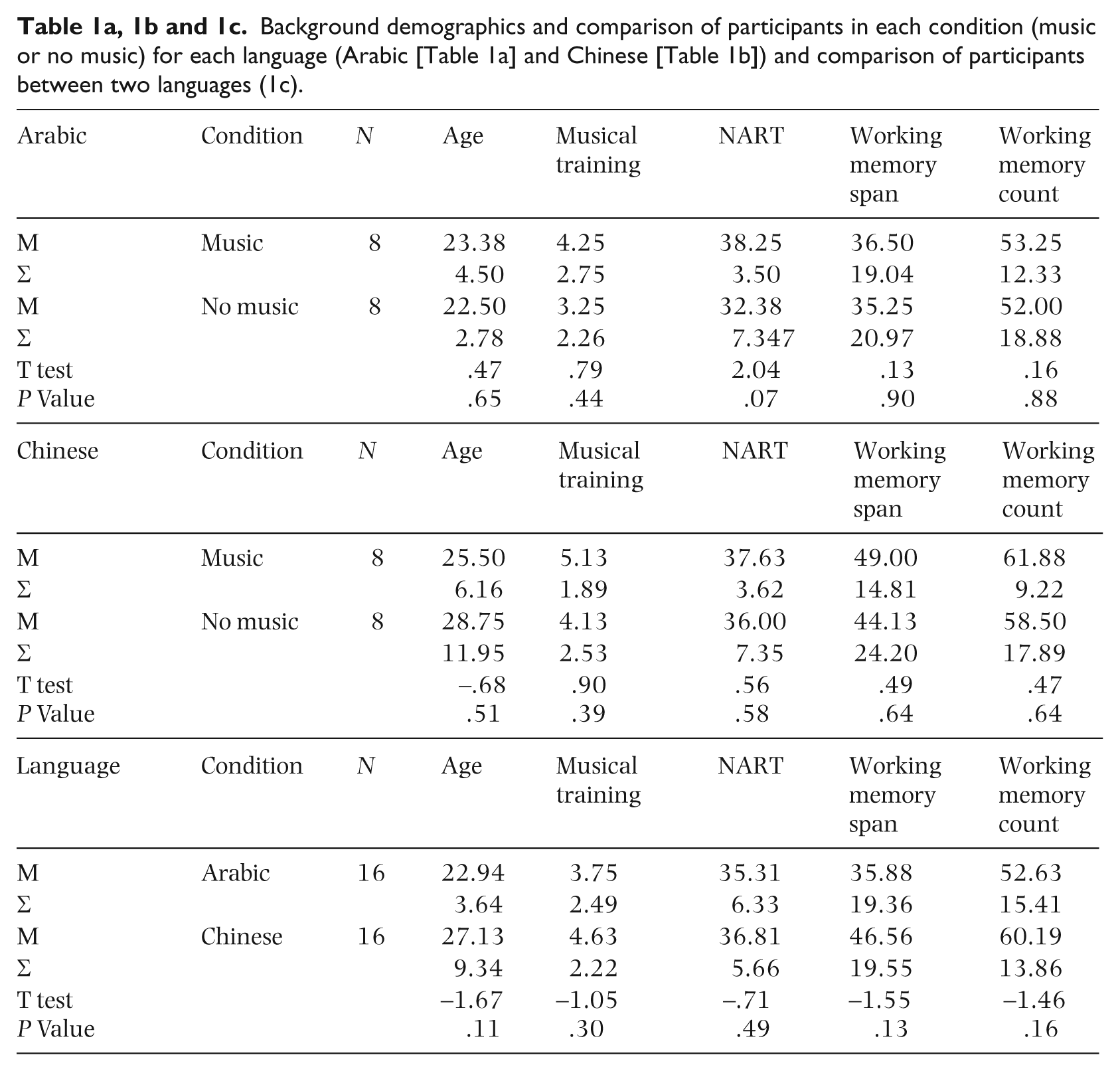
Sixteen participants chose to learn Arabic (eight were randomly assigned to music conditions) and 16 opted to learn Chinese (as above), making a total of 32 participants. Gender was equally distributed between conditions in each language: four male and four female for each Arabic group, and two male and six female for each Chinese group. Measures of age, years of musical training, verbal intelligence (as measured by the National Adult Reading Test [NART]) and working memory did not differ significantly between the groups (all ps > .05). A summary of participant demographics for each language group is presented in Table 1a, 1b and 1c.
People who live in London, United Kingdom (UK), were recruited for the study. They were invited to learn a new language by listening to audio material at home, through flyers around campuses of the University of London, an Internet webpage, online social networking, and word-of-mouth. Only self-rated monolingual native English speakers were eligible to participate, in order to avoid any language learning advantage that might result from being multilingual. Remuneration for participation included two free language CDs, one for the two-week language learning session and another as a gift after the session, travel expenses, and entry into a prize draw to win a language learning hardware device.
Stimuli
Participants completed two preliminary questionnaires before they began the main L2 learning trial: (1) a basic demographics questionnaire (see Appendix 1); and (2) subscales 2 and 3 of the Gold-MSI ver. 0.9 (Müllensiefen, Gingras, & Stewart, 2011; see Appendix 2), which measure self-rated perception and production abilities and history of musical training, respectively.
As part of the learning trial participants were provided with a diary booklet to keep a record of their daily work progress in order to confirm compliance with the learning schedule. They were also provided with a written protocol for the learning sessions with advice on suitable learning environments, and a timetable information sheet, denoting the learning schedule for the two weeks (see Procedure). All these materials are provided in Appendix 3.
The L2 learning materials used in the present study were commercially available CDs produced by Earworms Learning MBT (http://www.earwormslearning.com). These CDs combine L2 learning material and melodies with the aim of facilitating L2 learning. Pilot surveys on social networking sites were conducted to judge the popularity of the available languages to ensure a good level of interest in the study. Non-European based languages were chosen to minimize the chances of previous exposure, since many monolingual English people have been exposed to European languages as part of the normal UK school curriculum. Arabic was selected as the non-tonal language and Chinese (Mandarin) was selected as the tonal language.
Tracks 1–5 from the level one CDs for beginners for each language were chosen for the two-week learning session. This selection was based on pilot work to assess the feasibility of the planned learning schedule (see Procedure). Each audio track has different companion instrumental music that has been specifically composed for the CDs. Both languages have the same music background. The music is described by the composer as medium tempo, ‘easy-to-listen’ tunes that avoid similar frequencies to the human voice, keep low dynamics, use minimal instrumentation and provide a flexible metric framework for the foreign words. Basic instruments such as drums, guitar, and synthesizer sounds are utilized in order to avoid sounds that may be distracting or novel. Changes to tempo, rhythm and amplitude are minimized. Each of the CD tracks has a different musical style/theme in an effort to make the musical background more interesting over repeated exposure.
The verbal language learning materials comprised one native English speaker and one native Arabic or Chinese speaker pronouncing each word or phrase. An explanation of the meaning or a short conversation was often included, in order to place the material in context. 1
The test session comprised both recall and translation sections, where participants were presented with an English item to convert into their new language and vice versa, respectively. Each of the two sections contained a test of 10 words, 10 phrases (more than one word) and 10 numbers, all of which were randomly divided from the original CDs. In order to create the test materials, audio files of tracks 1–5 from the language CDs without background music were cut in Adobe Audition into every word or phrase or number. Finally, as part of the test session participants completed the Automated Operation Span (OSPAN) Task (Unsworth, Heitz, Schrock, & Engle, 2005) and the NART (Nelson, 1982) in order to measure working memory and general intelligence. These tests were used to ensure, post hoc, that the groups were matched and that these factors would not confound any interpretation of the results
Test sessions were completed in a sound-proof room using two computers: a Macintosh laptop was used to play the audio files while a PC laptop and a headset microphone were used to record the participants’ verbal responses to the recall and translation tests and to the NART. The OSPAN task was administered on the PC computer using Eprime. 2
Procedure
Participants initially chose which language they wanted to learn (Arabic or Chinese). They were allowed to choose their L2 language in order to keep motivation level similar between groups, since motivation can significantly impact on L2 learning (Masgoret & Gardner, 2003). Each participant first filled in the two preliminary questionnaires and was then sent their learning diary, timetable, and protocol for the two-week trial (see Appendices).
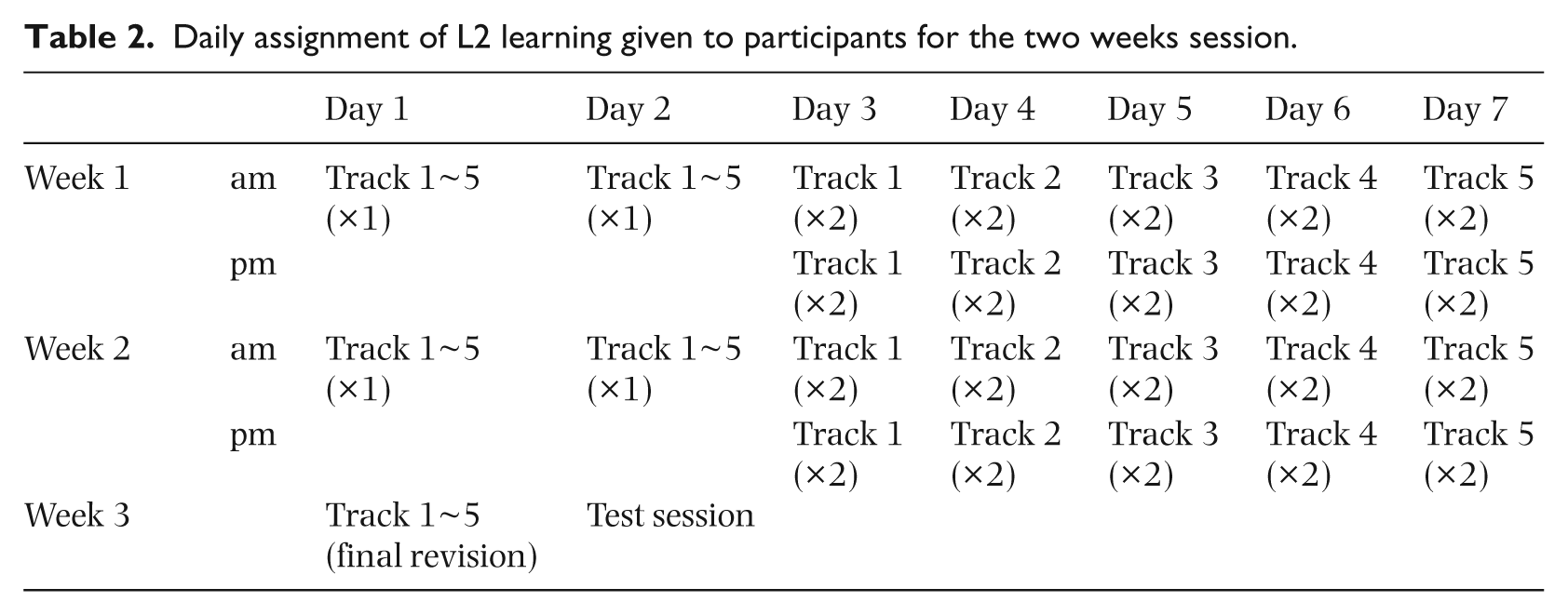
Starting from their preferred date, participants listened to their daily assignment of L2 sessions, as shown in Table 2. On ‘typical’ days they listened to one track twice in the morning and twice again in the evening. On ‘revision’ days they listened to tracks 1–5, once a day. Completing the daily session would take about 20~30 min in total, as each track was 5 min on average. This seven-day procedure for week 1 was repeated once more the next week, making the whole learning session two weeks.
Daily assignment of L2 learning given to participants for the two weeks session.
Participants were given instructions on the type of environment they should try to maintain during the learning session as part of their protocol (see Appendix 3). The aim was to encourage similar learning environments as far as possible while acknowledging the real-world nature of the trial. Participants were advised to focus on the listening and to repeat each word and phrase at least once along the track, avoiding other noises or disturbances. They were also instructed to learn the language solely based on listening to the CDs and to follow the protocol strictly. They were asked to mark their learning diary booklet after they finished each session every day with completed time, and sense of enjoyment and achievement on a 1–7 Likert scale.
After two weeks, participants completed a final revision day of listening to all five tracks and on the following day they attended the laboratory for testing, which took about 40 min in total. The set up of the testing session is shown in Figure 1.
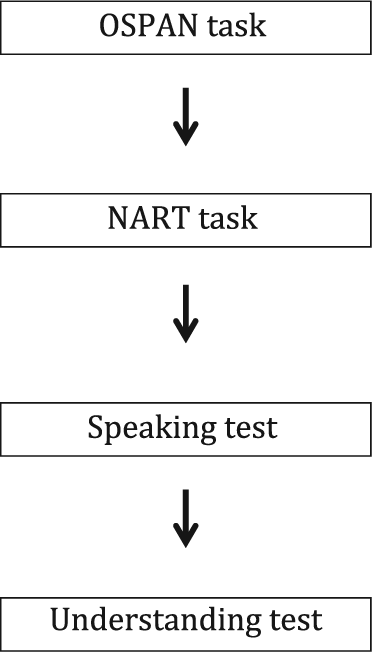
Procedure for the test session, conducted in the lab after the completion of the two-week learning trial.
During the OSPAN task participants memorized letters while answering simple mathematics problems in order to measure their working memory capacity. 3 Participants mentally solved a simple mathematical equation that was presented on a screen and then responded as to whether an answer shown on the subsequent screen was true or false. After they had responded to indicate ‘true’ or ‘false’ a letter was shown immediately on screen for 800ms. This letter was followed by another mathematical problem, then another letter, and so on. At the end of each trial, 12 letters were presented on screen for participants to select from in order to complete their letter recall, in serial order. The test comprised three trials for each sequence length from three to seven, given in random order, making a total of 15 trials for participants. This test takes an average of 15 min to complete.
The NART gives a second indicator of general verbal intelligence, in combination with the working memory task. For this task participants were asked to read out loud a list of 40 English words that all had irregular spellings. Participants were encouraged to guess if necessary and asked to give their final pronunciation clearly so that it could be scored by a native English speaker.
The recall test and translation L2 tests formed the main part of the test session. Both tests require participants to remember words from their new language. For the recall test, participants listened to English words (including numbers) or phrases and replied with the corresponding words or phrases in either Arabic or Chinese. The translation test presented words and phrases in the new language and participants attempted to give the correct word in English. The translation test was always presented second since questions on this test could act as reminders for items presented in the recall test. Participants were given as much time as they wanted to answer questions; each test took an average of 7 min to complete. Lastly, participants rated their overall enjoyment and achievement level of the whole trial on a 1–7 Likert scale.
The recall and translation tests were scored at a later date. Two native speakers for each language gave scores (correct or incorrect) after listening to the recorded answers. For phrases, a half point could be given if more than half of the phrase was correct. Also, native speakers gave ratings for the pronunciation of each participant. They gave a score from 1 to 9, where 1 stands for a very strong foreign accent and 9 stands for very close to native accent, a scoring method similar to that used by Slevc and Miyake (2006). The scores for answers and pronunciations from two native speakers were averaged as one score for each participant.
Results
Initially, a 2 × 3 multivariate analysis of covariance (MANCOVA) was conducted to explore the effects of language (Arabic or Chinese) and music (music or no music) on participants’ performance on all three tasks (recall, translation and pronunciation), with the Gold MSI sub-scales included as covariates. Language significantly predicted performance level, F(3, 24) = 7.834, p < .01, ηp2 = .495, with better performance on all Chinese tests compared to Arabic, as shown in Figure 2.
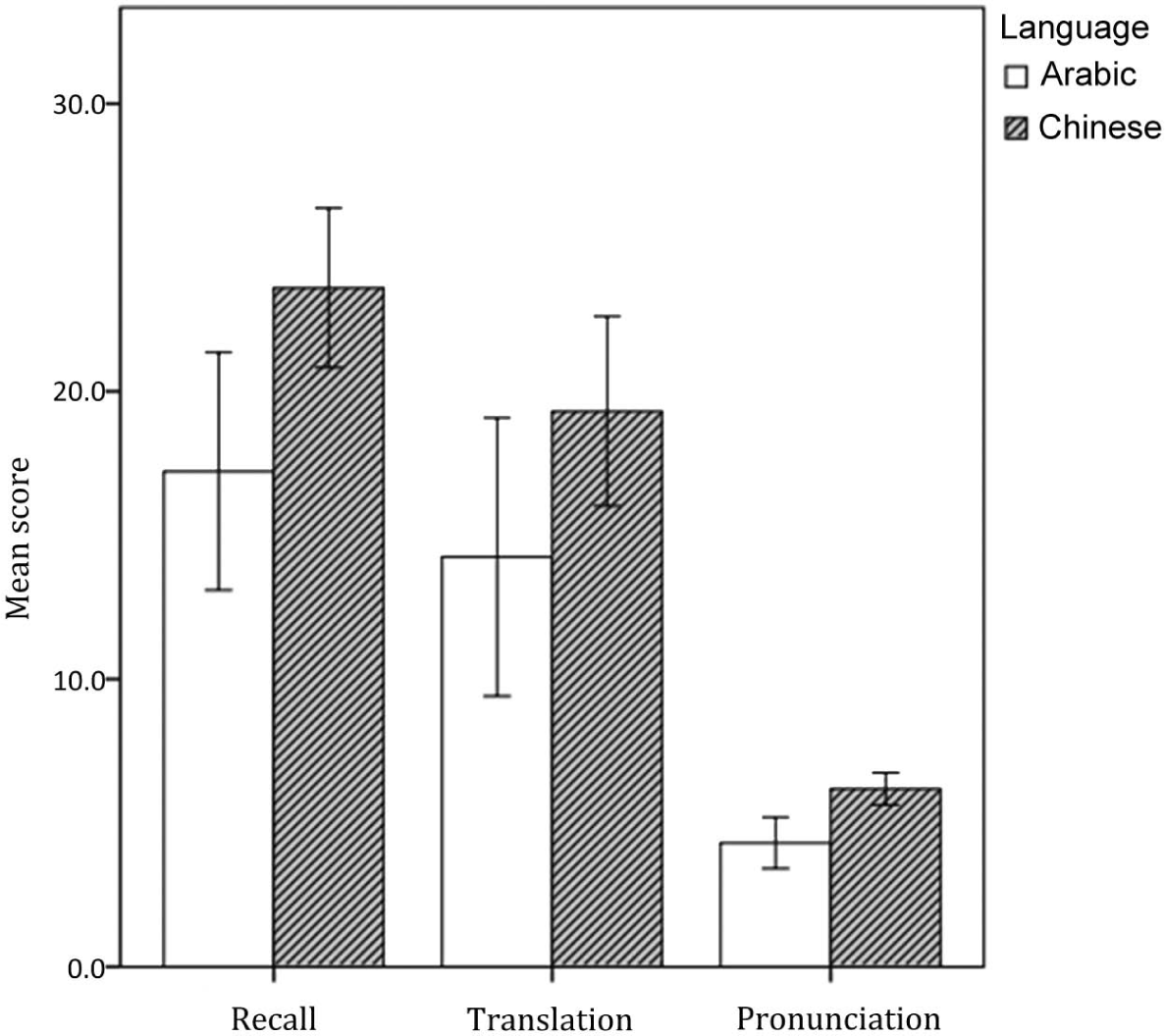
Mean scores comparison of recall test, translation test (maximum score of 30), and pronunciation level (maximum score of 9) between the two languages (Arabic and Chinese) presented with standard error bars.
Levene’s test of equality of homogeneity on the univariate tests was found to be significantly violated in all dependent variables within the MANCOVA, all ps < .05. This result can be attributed to the difference between standard deviations for each score in Chinese and that of Arabic (Table 3). Therefore separate MANCOVAs were carried out for each language, in order to delineate the independent effects of each music condition.
General descriptive statistics for the three L2 learning dependent variables (recall, translation and pronunciation) in music and no music condition for each language (Arabic and Chinese).
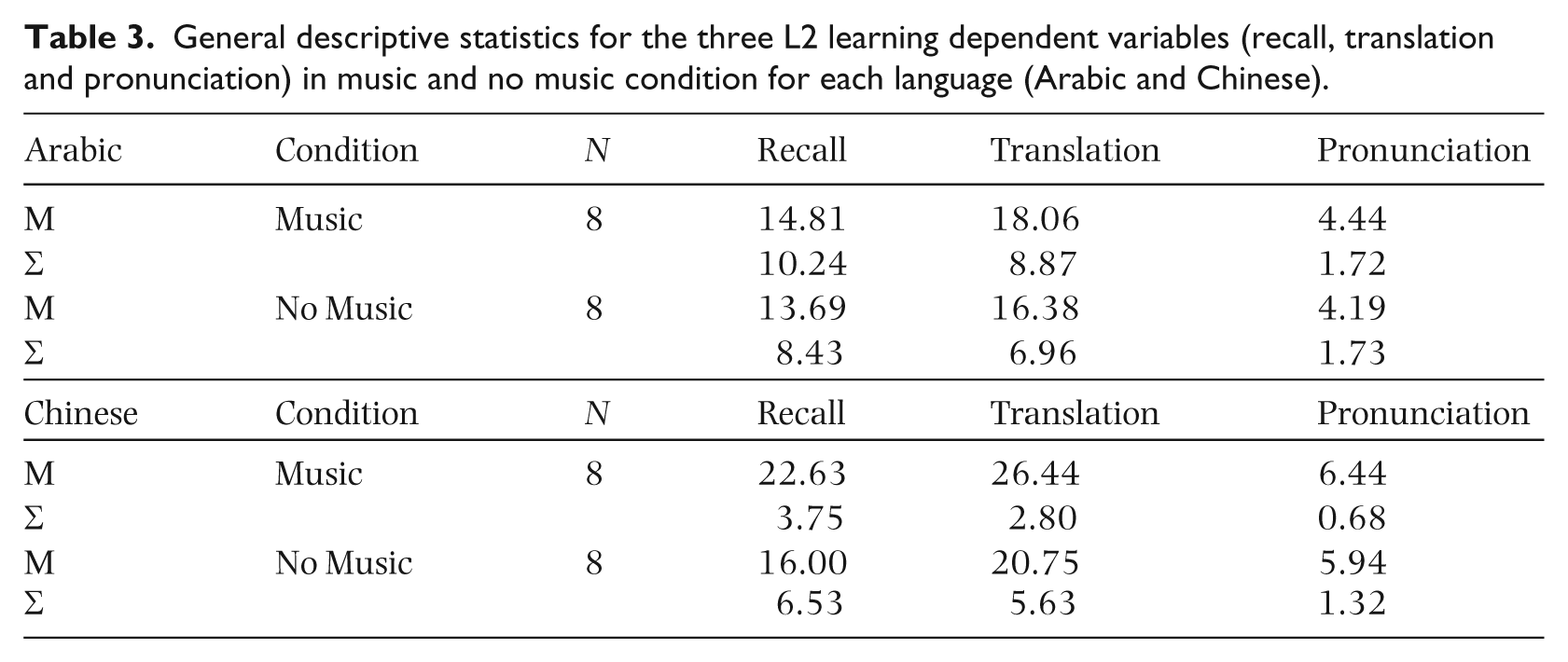
A MANCOVA conducted on the Arabic data found no significant difference between music and no music conditions on L2 learning, and no effect of musicality as a covariate (all ps > .05). A MANCOVA conducted on the Chinese data showed a borderline significance of music on L2 learning performance, F(2, 11) = 3.655, p = .061, η p2 = .399, indicating a positive effect of music on learning Chinese (see Table 3 for general descriptive statistics 3 ). Separate univariate tests found a significant effect of music on both the Chinese recall test, F(1, 12) = 7.757, p < .05, η p2 = .393, and the Chinese translation test, F(1, 12) = 7.118, p < .05, η p2 = .372, as compared to Chinese no music conditions. There was no significant effect of musicality as a covariate on any of the test scores, p > .05. Finally, planned non-parametric comparisons found no effect of music on pronunciation scores in either language (p > .05).
A separate set of multivariate analysis of variance tests (MANOVAs) was carried out to determine the relationship between music and self-rated enjoyment and achievement level. Participants in the music condition showed significantly higher overall achievement level, F(1, 28) = 5.077, p < .05, η p2 = .153, and borderline significance on higher daily enjoyment, F(1, 28) = 3.701, p = .065, η p2 = .117, and overall enjoyment, F(1, 28) = 3.604, p = .068, η p2 = .114, compared to participants in the no music conditions. No significant difference was found between languages on any of these dependent variables, p > .05.
Discussion
The presence of music in any cognitive task represents a double-edged sword: music can significantly interfere with cognitive performance especially when that music is high in complexity and loudness (Kämpfe et al., 2010; Schellenberg, 2012; Thompson et al., 2012); however, the presence of low complex music (non-verbal; stable tonality; minimal changes in tempo and amplitude) has been associated with improvements in task performance (Furnham & Alas, 1999; Jones et al., 2006; Schellenberg, 2005; Schellenberg et al., 2007; Thompson et al., 2001). In particular, evidence has suggested that the presence of music may aid memory for new verbal materials (Legg, 2009; Thiessen & Saffran, 2009; Wallace, 1994). The aim of the present paper was to conduct the first ecologically valid test of L2 learning materials that employ low complex background music.
The presence of music was associated with a significant improvement in performance on recall and translation tasks in Mandarin Chinese but no significant effect on the same measures of L2 learning in Arabic. At present the reason for the difference in the two languages is not clear. One possibility is a floor effect, since overall performance in the Arabic conditions was significantly worse than performance in the Chinese groups. However, future studies could investigate the possibility that the presence of music has a differential effect on tonal L2 learning as compared to non-tonal L2 learning. Future research using electro-physiological measures could also help to further elucidate the effect of music on L2 learning in different languages. This type of method may uncover evidence for implicit learning that could not have revealed by the present behavioral measures (François & Schön, 2010; McLaughlin, Osterhout, & Kim, 2004).
The present study serves as proof of the concept that real-world L2 learning materials can be utilized for testing the impact of music on language-based cognitive performance. The finding of a significant positive music effect in two measures of L2 learning in Chinese (recall and translation), and a general positive effect on enjoyment and sense of achievement, supports future research in this area that more closely explores the content of music-based L2 learning aids. Further studies could explore the role of music type by, for example, comparing especially composed complementary music (as in the present experiment) against music with similar characteristics that was not composed to aid L2 learning. This would allow a systematic investigation of the aspects of low complex music (tonality, rhythms, or timbres) that may maximally promote learning and memory performance.
Further studies could also take ratings of personal reactions to the music. Although the music in the present study was considered ‘neutral’ by most participants it is possible that preferences for tracks could impact on L2 learning. It is unlikely that this variable could explain the differences in learning found between languages in the present study, however, as both learning trials were rated as equally enjoyable by participants.
At this stage it would be speculative to isolate a single mechanism for the significant effects observed. The higher self ratings of enjoyment that we obtained mean that part of the positive L2 learning effect could be attributed to an increase in psycho-physiological arousal during learning episodes (Thompson et al., 2001). However, this is unlikely to be a complete explanation for the improved L2 learning in the Chinese condition, as individuals in Arabic also reported greater enjoyment in the presence of music but no comparable improvement in their learning. Future studies might more closely monitor mood and arousal states during learning episodes to determine the contribution of this effect to overall learning.
The most parsimonious explanation for the significantly better L2 learning in the presence of music relates to level of processing effects (Craik & Lockhart, 1972). The presence of music may have functioned to enrich the context of the learning materials and thereby promoted improved memory consolidation (Schweizer, 1996; Wallace, 1994). One way to explore this hypothesis would be to test memory for the music presented in the learning trials. Improved long-term memory for the music itself, or the existence of primed associations between the music and the L2 materials, would support this supposition as a potential locus of effect.
Another factor to consider is the rhythmic flow of the music which can help in developing a temporal structure to aid linguistic processing. The importance of rhythm in speech processing and perception has been reported in both behavioral and psycho-physiological studies (Cason & Schön, 2012; Port & Quené, 2005). The present study used background music with consistent rhythmic flow alongside the linguistic materials and therefore temporal structure may have become an important cue for L2 learning.
The present study did not find any significant effect of musical abilities or training (as measured using the Gold MSI) on individuals’ L2 learning. Previous research has indicated positive associations between musical experience/training and pitch discrimination skills (Schön et al., 2004) and pronunciation (Milovanov et al., 2009, 2010; Slevc & Miyake, 2006). The apparent discrepancy in findings could be explained by the fact that the previous studies typically relate to perception and production skills after much longer periods of L2 learning than was possible to examine in the present study. It may be that musicality, by the present definition, has little significant impact on short-term L2 learning.
Patson and Tippett (2011) reported a negative influence of musical training on language comprehension task performance in the presence of music. Again, there are differences in experimental protocol when compared to the present study, including the testing time (one session vs. two weeks) and musical complexity, which could explain the disparity in findings. However, one potential hypothesis for future studies is that music has negative effects on musicians’ performance of more complex cognitive tasks such as judging grammar (as in Patson & Tippett, 2011) but that these effects are minimal in simpler tasks such as recall of L2 vocabulary. This theory is supported by evidence that the presence of music is more distracting for musically trained adults as they engage in more advanced analytical listening (Madsen & Geringer, 1990; Oxenham, Fligor, Mason, & Kidd, 2003), thereby usurping more of the limited resources available for complex cognitive processing. If this hypothesis is supported then it would have implications for the role of background music in later stages of L2 acquisition, such as grammar learning.
Overall, the present study has demonstrated that the presence of low complex background music has the potential to facilitate retention of L2 materials in the initial stages of learning Mandarin Chinese, using real-world materials, irrespective of an individual’s level of musicality. The study demonstrates the viability of conducting applied research of L2 learning and supports further studies into the exact mechanisms by which real world music-based materials facilitate everyday cognitive challenges, such as learning a second language.
Footnotes
Appendix 1
Geold MSI subscales 2 and 3
|
|
Completely Disagree | Strongly disagree | Disagree | Neither Agree nor Disagree | Agree | Strongly Agree | Completely Agree |
|---|---|---|---|---|---|---|---|
| 1. If I hear two tones played one after another I have trouble judging which of them is higher. | |||||||
| 2. I have trouble tapping along to the beat when I listen to a song. | |||||||
| 3. I am able to judge whether someone is a good singer or not. | |||||||
| 4. I usually know when I’m hearing a song for the first time. | |||||||
| 5. I would find it difficult to tell the difference between the sound of a flute and a clarinet. | |||||||
| 6. I When I listen to music, I have a hard time hearing whether one note is a different pitch to the next. | |||||||
| 7. I find it difficult to spot mistakes in a performance of a song even if I know the tune. | |||||||
| 8. I can compare and discuss differences between two performances or versions of the same piece of music. | |||||||
| 9. I have trouble recognizing a familiar song when played in a different way or by a different performer. | |||||||
| 10. If I have to clap along to music in a group situation I find it difficult and have to follow other people’s lead. | |||||||
| 11. I can tell when people sing or play out of time with the beat. | |||||||
| 12. I am able to identify what is special about a given musical piece. | |||||||
| 13. I have difficulties distinguishing between musical genres. | |||||||
| 14. I can tell when people sing or play out of tune. | |||||||
| 15. I When I sing, I have no idea whether I’m in tune or not. | |||||||
| 16. I When I hear a piece of music I can usually identify its geme. | |||||||
| 1. I have never been complimented for my talents as a musical performer. | |||||||
| 2. I can’t read a musical score. | |||||||
| 3. I would not consider myself as a musician. | |||||||
|
|
|||||||
| 4. I engaged in regular, daily practice of a musical instrument (including voice) for ______ years. | |||||||
| 5. At the peak of my interest, I practiced ____hours per day on my primary instrument. | |||||||
| 6. I have played or sung in a group, band, choir, or orchestra for _____ years. | |||||||
| 7. I have had formal training in music theory for _____ years. | |||||||
| 8. I have had _______ years of formal training on a musical instrument (including voice) during my lifetime. | |||||||
| 9. can play ______ musical instruments. |

Appendix 3. Learning protocol/timetable and booklet
Acknowledgements
This study has been partly published in conference paper proceedings for the International Conference on Music Perception and Cognition 12. This study was conducted in collaboration with  , who kindly supplied the commercially available language learning materials. We are especially grateful to Marlon Lodge and Renate Elbers-Lodge for their keen enthusiasm and assistance during the course of the study.
Funding
The research was funded in part by a Reg and Molly Buck Award made by the Society for Education, Music and Psychology Research (SEMPRE) to VJW.