







Abstract
The mediating effects of emotion regulation (reappraisal and suppression) were examined in the relationship between music engagement and well-being. Emotion regulation strategies (Emotion Regulation Questionnaire; Gross & John, 2003) and styles of music engagement (Music Use questionnaire; Chin & Rickard, 2012) were assessed in a large diverse sample of 637 participants. A battery of hedonic and eudaimonic well-being measures (International Positive and Negative Affect Schedule Short Form; Thompson, 2007; Satisfaction With Life Scale; Diener, Emmons, Larsen, & Griffin, 1985; Mental Health Continuum-Short Form; Keyes et al., 2008) was also administered. Results demonstrated that the path of mediation was dependent on the type of emotion regulation strategy utilized, as well as the way in which one engages with music. Findings provide initial evidence that engaging with music for the purposes of cognitive and emotion regulation may enhance well-being primarily through the habitual use of cognitive reappraisal. In contrast, various other aspects of music engagement (music listening, engaged production, and social connection) if coupled with a tendency to regulate emotions and thoughts by expressive suppression may yield undesirable well-being outcomes. This study highlights the important role emotion regulation plays in the complex relationship between music engagement and well-being.
Music is a highly engaging activity which has been associated with improved health and well-being in a range of contexts across the lifespan (Batt-Rawden, 2010; Clift & Hancox, 2010; Miranda & Gaudreau, 2011). Research examining the impact of music listening (Miranda & Gaudreau, 2011) and self-selected music (Batt-Rawden, 2010) on health and well-being attributes many of the beneficial effects of music to the cognitive and emotional management of hedonic well-being (Batt-Rawden, 2010; Hanser, 2010; Vink, 2001). One of the pathways through which music engagement can impact on well-being is through the emotion regulatory strategies individuals use. However, to date, no study has examined the mediating role of emotion regulation in the relationship between music engagement and well-being.
Music engagement and emotion regulation
Emotion regulation refers to a heterogeneous set of processes by which individuals may dampen, maintain or intensify emotions according to their goals (Gross & Thompson, 2007). The process model of emotion regulation proposed by Gross (1998) categorizes emotion regulatory strategies into antecedent-focused and response-focused strategies. Antecedent-focused strategies, such as cognitive reappraisal and situation modification, involve changing the meaning of the situation to alter its emotional impact, before the emotion response tendencies set in. Such strategies allow individuals to reduce the experience of negative emotions and the consequent impact (Gross, 1998). Accordingly, reappraisal has been related to better physical and psychological well-being (Gross & John, 2003). Response-focused strategies, such as suppression, refer to modification of the behavioral and physiological aspect of emotional experiences (Gross, 1998). Suppression, or non-expression, of emotions has been found to be negatively associated with physical and psychological well-being (Nyklicek, Vingerhoets, & Denollet, 2002). This could be explained by studies which demonstrate that emotional suppression is associated with increased sympathetic activation of the cardiovascular system (Gross, 1998), and utilizes more cognitive resources than do antecedent strategies (Richards & Gross, 2000). Identifying activities that cultivate more adaptive emotion regulation strategies, such as reappraisal, can therefore be informative in shaping positive interventions aimed at improving health and well-being.
Music is often cited as an effective tool for exploring and regulating emotions (North, Hargreaves, & O’Neill, 2004; Saarikallio, 2011; Wells & Hakanen, 1991). Research has also demonstrated the efficacy of music use for inducing positive affective states (North, Hargreaves, & Hargreaves, 2004), coping with negative affective states (Miranda & Claes, 2009) and achieving desirable moods (Västfjäll, 2002). Previous studies examining the use of music have tended to focus on either music production or reception. Taking a more comprehensive approach towards individuals’ experiences with music could be helpful in clarifying the use of music for emotion regulatory purposes.
Music engagement is defined as the level of active participation in music activities, measured by the frequency and regularity of participation, and the value assigned to the music activity (Chin & Rickard, 2012). This conceptualization of music engagement includes both music production and reception. Such an approach highlights the motivations underlying the ways music is used, rather than how music is experienced or processed. For instance, the common goal of improving one’s mood could be achieved by quite different music activities/processes – music production such as singing or playing an instrument, or music reception, such as listening to music. Chin and Rickard (2012) found that high levels of active music engagement and music listening were associated with greater use of the emotion regulation strategy of cognitive reappraisal. This is not surprising, given that individuals often use music to manage and enhance mood (Juslin & Laukka, 2004; North et al., 2000), cope with anxiety and stress (Bradt & Dileo, 2009; Miranda & Claes, 2009; Pelletier, 2004), and create desirable atmospheres or environments (North et al., 2004). This enhanced ability to be aware of and understand one’s emotions may be honed by frequent engagement with music, as music provides a safe platform for exploring and expressing emotions, both positive and negative (Huron, 2006). The ability to adequately regulate emotions is integral to general well-being and functioning (Elliot, Watson, Goldman, & Greenberg, 2004).
Emotion regulation and well-being
Differential associations have been observed between habitual usage of various types of emotion regulation strategies and adaptive health outcomes (John & Gross, 2004). Antecedent-focused strategies, such as cognitive reappraisal, afford individuals the ability to modify their emotional experience, without notable cognitive, physiological or social costs (John & Gross, 2007). It comes as no surprise then that habitual use of reappraisal is associated with increased experiences of positive emotion, greater self-esteem, life satisfaction and well-being (Gross & John, 2003; Haga, Kraft, & Corby, 2009; John & Gross, 2004). Furthermore, the tendency to use this strategy also correlates with lower levels of negative emotion and depressive symptoms (Gross & John, 2003). A recent meta-analysis of 114 studies examining the relationships between dispositional emotion regulation strategies and psychopathology also reported that reappraisal was associated with fewer psychopathology symptoms (Aldao, Nolen-Hoeksema, & Schweizer, 2010). In contrast, response-focused strategies, such as suppression, require effortful management of emotions as they arise, and are not only negatively associated with measures of life satisfaction, self-esteem, optimism and well-being, but are also correlated with elevated levels of depressive symptoms (Gross & John, 2003). While this emotion regulation style successfully decreases the behavioral expression of negative emotions, it does not modify the individual’s subjective experience of the negative emotions. Instead, response-focused strategies decrease positive emotion experience and compromises social functioning, well-being and physical health (John & Gross, 2004). These strategies have also been strongly associated with more psychopathology symptoms, particularly mood-related disorders (Aldao et al., 2010). It is thus adaptive to habitually use antecedent-focused strategies to down-regulate negative emotions, such as anxiety and anger, without incurring substantial cognitive, physiological or social costs to oneself. Accordingly, antecedent-focused emotion regulation strategies are more likely to predict optimal well-being, and response-focused strategies are predictive of lower levels of well-being.
Music engagement and well-being
Benefits of music engagement across the lifespan are well documented (Rickard & McFerran, 2012). Positive associations between music engagement and health and well-being are evident in adolescents (Miranda & Gaudreau, 2011), adults (Greasely & Lamont, 2006; Saarikallio, 2011) and the elderly (Hays & Minichiello, 2005; Laukka, 2007). Reasons for engaging with music are strikingly similar across the age groups. In particular, music is increasingly recognized for its beneficial effects on physical health and well-being (Hanser, 2010; MacDonald, Kreutz, & Mitchell, 2012; Pelletier, 2004). For instance, several studies have examined the experience of group singing on health, well-being and quality of life. Kreutz and colleagues (2004) demonstrated that group singing increased positive affect and production of salivary Immunoglobulin A (IgA), while lowering negative affect. IgA is a marker of immune function and significant increases of IgA, as found by Kreutz et al., supports the notion that group singing is beneficial for health. In a study of university choral society members, Clift and Hancox (2001) reported six dimensions of benefit associated with singing. They were benefits for well-being and relaxation, breathing and posture, social, spiritual, and emotional benefits, and benefits for the heart and the immune system. Clift and colleagues (2009) explored these benefits in another study involving choral singers in Australia, England and Germany, and reported strikingly similar patterns of results in the three national samples. In a series of qualitative studies with diverse samples of individuals from a range of social backgrounds, Bailey and Davidson (2002, 2003, 2005) presented further evidence of the importance of participating in group singing. Enhanced emotional and physical well-being, increased sense of self-worth and re-engaging with wider social networks, having support to develop social skills and achieve collective goals, as well as learning and focusing on new singing material were themes emerging from the studies (Bailey & Davidson, 2002, 2005). Taken together, these findings highlight the important and unique role engaging with music (in this example, singing) plays in well-being and health.
Of particular interest to the outcome measure of well-being is the use of music for emotion regulation (Chamorro-Premuzic & Furnham, 2007; DeNora, 1999; North et al., 2000; Saarikallio, 2011; Saarikallio & Erkkilä, 2007). Well-being encompasses feelings of happiness (hedonia) (Diener, 2000) and fulfillment of self-concordant goals (eudaimonia) (Ryff & Singer, 2008; Waterman, 1990, 2008). In addition to direct induction of pleasurable affective state, music engagement may also promote hedonic well-being because music facilitates one’s ability to regulate the experience and expression of emotions (Rickard, 2012). Engaging in music activities may allow individuals to achieve an optimal balance of affect and, accordingly, enhance hedonic well-being. Music is also often used to manage one’s environment and facilitate communication with others (Laiho, 2004; North, Hargreaves, & Hargreaves, 2000). This enhanced sense of autonomy and relatedness to others may explain the positive psychological outcomes described by individuals participating in group musical activities such as bands and choirs. Therefore, the tendency to seek opportunities to engage with music to regulate emotions is likely to result in a greater sense of fulfilled personal psychological functioning and social well-being. Importantly, the benefits of music for well-being may also depend on the way in which an individual uses music for this purpose. Miranda and Claes (2009) found that while problem-oriented coping with music was associated with well-being, using music in an emotion-focused or avoidant style to cope with stress was associated with poorer well-being. Encouragingly, Saarikallio (2008) found that when music is used for regulating mood, it is more likely to be for reappraisal than for suppression.
Taken together, research has demonstrated that high levels of music engagement are associated with a greater tendency to use more antecedent-focused emotion regulation strategies, and these strategies predict enhanced well-being. The current study aimed to examine the underlying mechanism of the associations between music engagement and well-being. Firstly, it was predicted that high levels of music engagement would be positively correlated with each subjective index of well-being. Secondly, it was hypothesized that high levels of music engagement would be associated with greater use of the emotion regulation strategy, cognitive reappraisal. Thirdly, it was expected that cognitive reappraisal would be positively associated with well-being, while expressive suppression would be negatively associated with well-being. Finally, it was predicted that emotion regulation would mediate the positive association between music engagement and well-being.
Method
Participants
Six hundred and thirty-seven participants (144 male, 493 female) between the ages of 20 and 58 (M = 23.93, SD = 5.82) took part in this study. Participants were recruited via posters placed in several music venues and tertiary institutions providing music courses in Melbourne, Australia. The majority of participants indicated that they had played a musical instrument (72.84%), and 76% (n = 460) of the sample had received either primary or secondary school lessons, while only 3.8% (n = 24) had tertiary or advanced music training. A fifth of all the participants indicated that they listened to music for less than one hour per day (22.90%), 43.20% indicated between one to two hours per day, 20.40% indicated between three to four hours per day, 7.80% indicated between five to six hours per day, and 5.70% indicated more than six hours of intentional music listening each day.
Materials
Music engagement
The Music Use questionnaire (MUSE; Chin & Rickard, 2012) has 32 items that assess both quality and quantity of different forms of music use, as indicated by three indices and five distinct styles of music engagement. The first Index of Music Training captures an individual’s music background, as assessed by the highest level of formal music training, other types of informal music training, and completion of certified examinations. The second Index of Music Instrument Playing assesses the intensity of practice, measured by the duration and frequency, as well as the regularity of instrument playing. The third Index of Music Listening assesses the intensity of music listening, measured by the weekly frequency and daily duration of intentional music listening. The remaining 24-item scale assessed five distinct styles of music engagement: Cognitive and Emotional Regulation; Engaged Production; Social Connection; Physical Exercise; Dance. A sample item from each of the five styles of music engagement is as follows: “Specific types of music make me feel better”; “Being able to improvise whilst playing music gives me a great sense of satisfaction”; “There is a greater connection with my friends when we like the same music”; “Music provides me with a good pace for exercising”; “Dance is an expression of my feelings”. Responses to item statements were made on a 6-point Likert scale, ranging from “0” (not at all/not applicable to me) to “5” (strongly agree). This scale displays sound reliability with Cronbach’s alpha ranging from .78 to .87 (Chin & Rickard, 2012). In the current study, alpha for the five styles of music engagement was .76, .92, .81, .82, and .75, respectively.
Emotion regulation strategies
The 10-item Emotion Regulation Questionnaire (ERQ; Gross & John, 2003) was used to measure an individual’s tendency to use reappraisal and suppression strategies for emotion regulation. The cognitive reappraisal subscale has six items (α = .79), and a sample item is “When I want to feel less negative emotion, I change the way I’m thinking about the situation”. In this study, the alpha for the reappraisal subscale was .86. The suppression subscale has four items (α = .73), and a sample item is “I control my emotions by not expressing them”. The alpha for this subscale was .78 in the current study. Participants rated each item on a 7-point Likert scale, ranging from “1” (strongly disagree) to “7” (strongly agree).
Well-being
Consistent with past research, hedonic well-being was operationalized using measures of positive affect, negative affect, and life satisfaction (Diener, 2000). Affect was measured using the International Positive and Negative Affect Schedule Short Form (I-PANAS-SF; Thompson, 2007), a 10-item measure, with five items measuring positive affect (PA) and five items assessing negative affect (NA). Participants rated each item using a 5-point scale, from “1” (Never) to “5” (Always). Scores for each subscale were obtained by summing responses from the respective items, with higher scores indicating greater levels of positive affect (α = .80) or negative affect (α = .74). In the current study, alpha for the positive and negative affect subscales were .80, and .75, respectively.
Life satisfaction was measured using the Satisfaction With Life Scale (SWLS; Diener, Emmons, Larsen, & Griffin, 1985). This 5-item measure assesses perceived global life satisfaction. A sample item is “I am satisfied with my life”. Participants indicated their level of agreement with the self-referencing statements on a 7-point scale, ranging from “1” (strongly disagree) to “7” (strongly agree). The psychometric properties of this scale have repeatedly been studied and have been shown to be a valid and reliable measure (Pavot & Diener, 1993). In this study, alpha was .89.
Eudaimonic well-being was measured using the Mental Health Continuum-Short Form (MHC-SF; Keyes et al., 2008). Participants rated this 14-item measure on a 6-point Likert scale, from “never”, “once or twice a month”, “about once a week”, “two or three times a week”, “almost every day”, to “every day”. The MHC-SF comprised three subscales: emotional well-being (3-item), psychological well-being (6-item), and social well-being (5-item), each demonstrating sound psychometric properties, with alpha of .83, .83, and .74, respectively (Lamers, Westerhof, Bohlmeijer, Klooster, & Keyes, 2011). In this study, alpha of the three subscales were .91, .86, and .84, respectively.
Procedure
The questionnaires were made available online via SurveyMethods (www.surveymethods.com). After agreeing to participate in this study, participants were provided with the link to the online questionnaire, where they provided informed consent and completed the survey. All procedures were approved by Monash University Human Research Ethics Committee.
Results
Data were handled and analyzed using SPSS version 19. Participants’ response data and timings were screened for non-serious responding, as per the guidelines recommended for web-based experiments (Reips, 2002). The standardized distribution of variables was examined in order to identify and remedy any potential outliers, and no univariate outliers (+/- 2.96 SDs) were found. Variables were also examined for skewness and kurtosis, and all were found to be normally distributed. Finally, multicollinearity was assessed among the predictor variables, and no violations were identified. Consistent with past research, a composite score for subjective well-being was obtained using the sum of scores of positive affect and satisfaction with life, minus negative affect (Diener, 2000).
Descriptive analyses
Pearson correlations, means, standard deviations and the range of scores of the variables are presented in Table 1.
Intercorrelations, means, standard deviations, and range of scores.
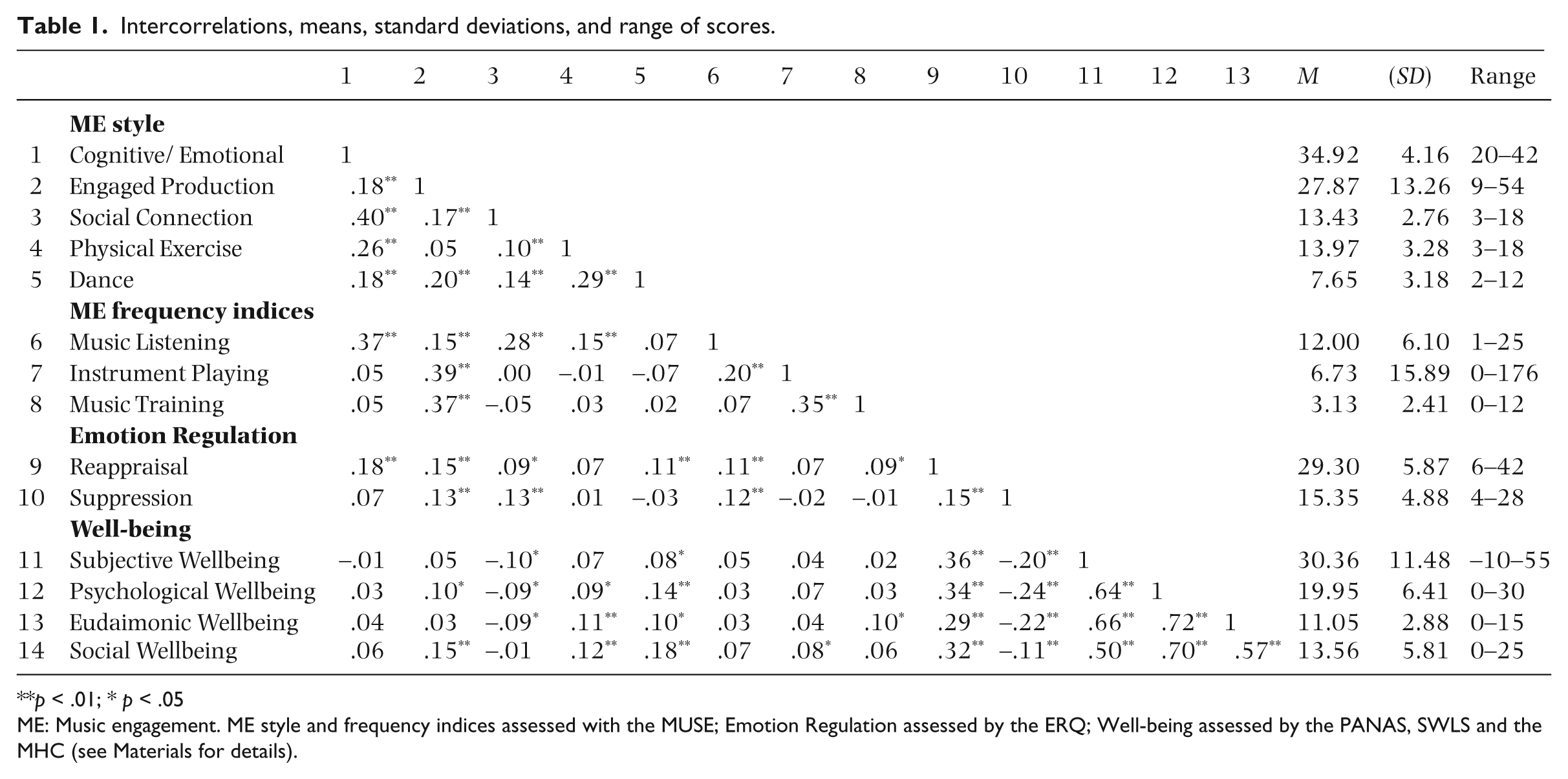
p < .01; * p < .05
ME: Music engagement. ME style and frequency indices assessed with the MUSE; Emotion Regulation assessed by the ERQ; Well-being assessed by the PANAS, SWLS and the MHC (see Materials for details).
Music engagement was associated with a range of well-being measures. Engaged music production was positively correlated with psychological and social well-being. In contrast, use of music for social connection was negatively associated with subjective, psychological and eudaimonic well-being. Physical exercise with music was positively correlated with psychological, eudaimonic and social well-being. Finally, dance was positively correlated with all aspects of well-being.
Music engagement was consistently associated with cognitive reappraisal, with all styles (except physical exercise with music) and indices (except instrument playing) positively correlated. Only engaged production, music for social connection and index of music listening were associated with the emotion regulation strategy of suppression, with all these correlations positive.
The antecedent-focused strategy of cognitive reappraisal was positively associated with all measures of well-being. In contrast, the response-focused strategy of suppression was negatively correlated with all measures of well-being.
Test of mediation
To examine the hypothesis that emotion regulation strategies mediate the relation of music engagement and well-being, the bootstrap test (Preacher & Hayes, 2004, 2008) was conducted for each well-being variable, using the Hayes and Preacher (submitted) mediation script. This is similar in functionality to that used by Preacher and Hayes (2008), but additionally permits analyses of indirect and direct effects in mediation models with a multicategorical independent variable (such as music engagement) by automatically generating the requisite k-1 dummy variables. This method of examining mediation models is increasingly recommended (MacKinnon, Lockwood, Hoffman, West, & Sheets, 2002; Zhao, Lynch, & Chen, 2010) over the traditional Baron and Kenny analyses of mediation or use of the Sobel test, as it allows for unexpected direct effects and potential omitted indirect paths of the same sign as the direct effect, and uses the more rigorous and powerful bootstrap test in examining the indirect effect (Zhao et al., 2010).
Bootstrap resamples (10,000) were used to generate 95% confidence intervals that estimated the size and significance of the indirect effect. The mediation model with music engagement as the independent variable (IV), well-being as the dependent variable (DV) and emotion regulation as the potential mediator variable (M) is shown in Figure 1.
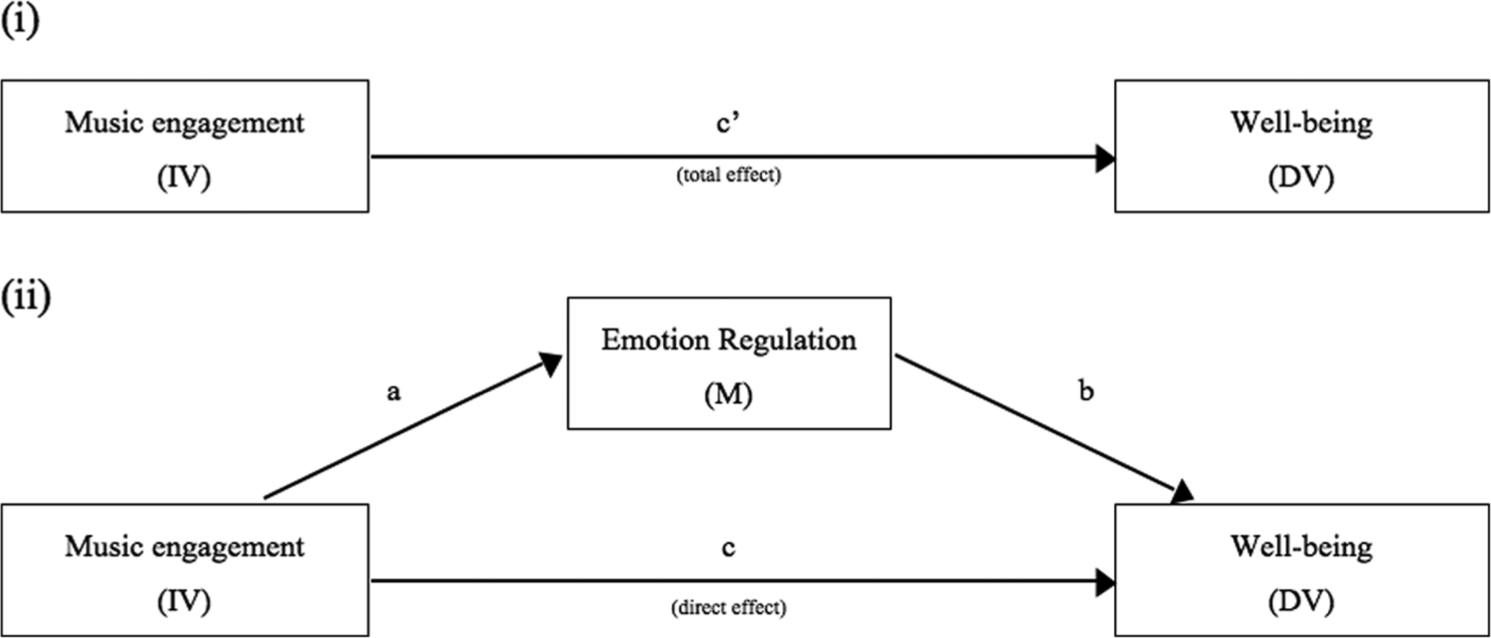
Model of zero–order effect (i) and mediation (ii).
Mediation models with significant indirect effects are presented separately for each well-being variable (see Figure 2). The standardized estimates, errors, and confidence intervals of the indirect effects for each well-being variable are attached in the Appendix. For all analyses, the recommendations of Zhao et al. (2010) were adopted, which in brief, advise the following: (1) If the direct effect ‘c’ only is significant, there is no evidence for mediation, (2) if the indirect effect ‘a x b’ is significant in the absence of a direct effect ‘c’, then there is support for full mediation, (3) if both the direct ‘a x b’ and indirect ‘c’ effects are significant, and of the same sign, there is evidence of complementary mediation – in this case, emotion regulation mediates the relationship between music use and well-being, but there is likely to be other mediator(s) also not included in this analysis, and (4) if both the direct ‘a x b’ and indirect ‘c’ effects are significant, but of a different sign, there is evidence of competitive mediation – in this case, emotion regulation mediates the relationship between music use and well-being (although the sign of relationships differs), but there are likely to be other mediators also not included in this analysis.

(A) Mediator model of Subjective Well-being. (B) Mediator model of Psychological Well-being. (C) Mediator model of Emotional Well-being. (D) Mediator model of Social Well-being. Bold lines represent significant predictions and dotted lines represent non–significant direct effects.
The pattern of results across all four measures of well-being was strikingly similar. Positive indirect-only mediation through cognitive reappraisal was observed between music use for cognitive and emotion regulation and all four measures of well-being. That is, while music use for this purpose did not predict well-being directly, there was a significant and positive indirect prediction of well-being through the emotion regulation strategy of reappraisal. No other form of music use predicted well-being via the reappraisal emotion regulation strategy.
Several forms of music use directly predicted well-being measures: music use for social connection negatively predicted subjective, psychological and emotional well-being, while dance positively predicted psychological and social well-being, and engaged production positively predicted social well-being. Indirect and negative predictions of all measures of well-being were also observed for all forms of music engagement (other than cognitive and emotional regulation) through the expressive suppression emotion regulation strategy, indicating that these forms of music use were associated with poorer well-being via expressive suppression of emotions. Taken together with the direct relationships observed for some of these variables, there was also evidence of complementary and competitive mediation. Specifically, expressive suppression was a complementary mediator of the relationship between social connection and subjective, psychological and emotional well-being. This indicated that while both music use for this purpose and expressive suppression were associated with poorer well-being, there is likely to be at least one other factor contributing to well-being that has not been considered in this study. Well-being was positively predicted by use of music for dance, and this relationship was mediated by expressive suppression in a complementary manner, as use of music for this purpose was also associated with lower levels of this emotion regulation strategy. Expressive suppression was in contrast a competitive mediator of the relationships between engaged production and social well-being. This again suggested that there is some other omitted factor contributing to well-being, but in this case, the prediction of well-being by music use was positive despite mediation by expressive suppression, which negatively predicted well-being.
Discussion
This study, to the best of our knowledge, is the first to examine emotion regulation as a potential mediator in the relationship between music engagement and well-being. We predicted that high levels of music engagement would be positively correlated with well-being and greater use of the emotion regulation strategy of cognitive reappraisal, cognitive reappraisal would be positively associated with well-being, and expressive suppression negatively associated with well-being. We also predicted that emotion regulation would mediate the association between music engagement and well-being, since emotion regulation appears to be a prominent factor in the use of music for improving well-being. Findings provided evidence in support of the hypotheses, although the pathways underlying the relationship between music use and well-being were complex. We demonstrated that the path of mediation was dependent on both the type of emotion regulation strategy employed and the way in which an individual engages with music.
The current study indicates that the tendency to use cognitive reappraisal as an emotion regulatory strategy is consistently associated with higher ratings of emotional, psychological, social and subjective well-being. In contrast, expressive suppression is associated with lower ratings on all measures of well-being. Furthermore, reappraisal not only significantly predicted emotional, psychological, social and subjective well-being but is also the strongest individual predictor of all these indicators of well-being. These findings are consistent with past research (Gross & John, 2003; Haga et al., 2009; Miranda & Claes, 2009) suggesting that the tendency to use different emotion regulation strategies has various implications for well-being. In particular, using music as part of an intentional cognitive strategy (e.g. to find solutions) to regulate emotions appears to be consistently more beneficial for well-being than using music to avoid or suppress emotions. As demonstrated in previous studies (Chamorro-Premuzic & Furnham, 2007; DeNora, 1999; North et al., 2000; Saarikallio, 2011; Saarikallio & Erkkilä, 2007), music is often used for regulating emotions. Overall, results were consistent with past research, with most aspects of music engagement (all except physical exercise and index of music instrument playing) associated with the tendency to use positive and adaptive self-regulatory strategies. This echoes Saarikallio’s (2008) findings that music-related mood regulation strategies associate positively with cognitive reappraisal. In addition, the current findings also indicated that various aspects of music use (engaged production, social connection and index of music listening) were associated with the emotion regulation strategy of expressive suppression. This is not surprising, as music provides a safe platform for expression, exploration and experience of a wide range of emotions (Huron, 2006). For instance, expressive suppression would be beneficial to ameliorate emotional responses to anxiety and stress. The current findings extend this past research by providing evidence for the links between the various ways of engaging with music and tendencies to use emotion regulation strategies.
Music is often cited as an effective way of managing or changing one’s cognitive and emotional state, and the tendency to engage with music for these purposes is reflected in music use for cognitive and emotion regulation score. Presumably, with an improved mood or mental state, there should be associated positive outcomes for general well-being. Intriguingly, no significant direct associations were observed between this particular style of music engagement and any of the well-being measures. Despite the absence of direct associations with well-being measures, when emotion regulation was added to these models as a proposed mediator, associations were evident for all aspects of well-being measured. These results provide initial evidence that engaging with music for cognitive and emotional self-regulatory purposes may enhance well-being primarily through the habitual use of cognitive reappraisal.
In the mediation analyses, both types of emotion regulation strategies were included in one multiple mediation path model. Both reappraisal and suppression are commonly used emotion regulation strategies. The two distinct pathways demonstrate the tendency to use either type of emotion regulation strategy when engaging with music in a particular way. The mediation model predicts differential outcomes based on the way one engages with music, coupled with the type of emotion regulation strategy used. It is likely that the same individual engages with music in a variety of ways and this model demonstrates that when music use predicts expressive suppression, negative well-being outcomes are observed. In contrast, when music use predicts cognitive reappraisal, positive well-being outcomes are more likely to happen. While Saarikallio (2008) found that when used for mood regulation, music was more likely to be used for reappraisal than for suppression, our analyses suggest that expressive suppression may also help to explain the relationship between some other styles of music engagement and well-being. The index of music listening captured the frequency and amount of intentional music listening with which one engages. Direct positive associations between intensity of music listening and all measures of well-being were observed; however, none was statistically significant. Instead, negative indirect-only mediation by expressive suppression was established for all measures of well-being. This means that individuals who might seek to improve their well-being through music listening may not be achieving the intended optimal outcomes because of the type of emotion regulation strategy employed. These findings suggest that greater amounts of music listening, if coupled with a tendency to regulate emotions and thoughts by suppression, may have undesirable well-being outcomes.
Similar trends were observed with social connection, a measure of the tendency to engage with music for the purposes of seeking or improving one’s relationships with others. Apart from social well-being (for which a negative indirect-only mediation was established), complementary mediations between social use of music and the other aspects of well-being (subjective, emotional and psychological well-being) were established. (With both the direct and mediated effects significantly negative, it is likely that the relationships between social connection and subjective, emotional and psychological well-being are also mediated by other factors not considered in this study.) Findings demonstrate that despite the tendency to use music for the purposes of facilitating social relationships, the observed negative evaluation of one’s public and social lives, albeit unintended, could be attributed to the habitual use of expressive suppression. It seems counterintuitive that people who seek deeper connections with others report a greater inclination towards using expressive suppression. However, it is possible that individuals who value social connectedness, and actively seek that, through music, are more likely to control their expression of emotions, so as to foster or maintain social harmony. These findings are consistent with past reports that the inhibition of one’s emotions hindered development of social relationships (Butler et al., 2003). In this study, this was reflected not only in ratings of social well-being but all other aspects of well-being, albeit to a lesser extent. Another possible explanation could be that the desire to use music for social connection might be associated with a need to align one’s identity with that of the group’s, thus potentially suppressing one’s own thoughts and feelings. Alternatively, individuals habitually using music for social connection purposes may be using music as a substitute for ‘real’ friends (Laiho, 2004), which may effectively reduce the strength of their social network and subsequent well-being. Future research is required to examine other theoretically relevant variables not included in the present study (e.g. perceived social support, availability of social support) that may mediate or moderate the associations between music engagement for social connection and emotional, psychological and subjective well-being.
Another aspect of music engagement often overlooked is the active use of music to express oneself through dance. For both emotional and subjective well-being, positive indirect-only mediations through expressive suppression were established. These findings suggest that individuals highly engaged with music through dance, who are subsequently less likely to suppress their emotions, rated their emotional and subjective well-being more favorably. Dancing involves the integration of movement with music, and often allows individuals to express themselves. Facilitation of emotional expression may therefore explain the presence of positive associations with all four aspects of well-being, as well as higher ratings of positive affect. Complementary mediations were established for both psychological and social well-being. (With both direct and mediated effects significantly positive, there is the possibility of an omitted mediator between the relationships of music engagement through dance and psychological and social well-being.) These findings are consistent with an exploratory study examining the perceived benefits of dancing on well-being in a sample of non-professional adult dancers (Quiroga Murcia, Kreutz, Clift, & Bongard, 2010). Further, the current analyses have identified one of the possible mediators in the relationship between music engagement through dance and psychological and social well-being. As dance often occurs in social or group settings, future studies should consider examining factors such as self-esteem, social anxiety or social acceptance.
Perhaps most interesting, however, were the relationships observed between music production and well-being. Engaged production refers to the extent to which individuals engage with music production for mastery of improvisation or playing skills (Chin & Rickard, 2012). This scale does not differentiate levels of musical proficiencies or abilities. Items in this scale measure the quality and importance of music production. High scores indicate an active pursuit of opportunities to engage with musical works at an advanced level, regardless of one’s formal music training background. Negative indirect-only mediation via expressive suppression was established for associations between engaged production and emotional and subjective well-being. This indicates that despite a positive relationship between use of music for this purpose and well-being, engaged production is also associated with poorer well-being when being used to suppress expression of emotions. This may reflect the complex and demanding nature of music performance. As noted by Juslin (2009), a specific type of psychological state, such as being in a composed state of attention or absorption, is required for optimal music performance. It follows that individuals seeking to attain this level of music performance are more likely to consciously control their own emotions, so as to accurately convey the intended emotions of the particular piece of musical work. In an exploration of performers’ experienced emotions during performances, Foxcroft (2011) reported that the five professional pianists unanimously emphasized “the need for strict emotional control throughout a performance”. Findings here also indicated for this style of music engagement, both the direct and mediated effects were significant for associations with both psychological and social well-being. Despite the significantly negative indirect effect, there exists a significantly positive direct effect. This indicates that apart from the tendency to inhibit expression of emotions (which impacts negatively on well-being), engaged production is associated with other factors which are positively associated with well-being. While not identified in the current study, there is clearly a multitude of factors that could be responsible for this, such as developing a sense of accomplishment, achieving meaning out of one’s performance, gaining confidence, self-discipline, and self-worth (Bailey & Davidson, 2005; Hallam & Prince, 2000).
An important consideration here is that statistical mediation does not establish causal direction. While our proposal that music engagement contributes to increased emotion regulation, which in turn contributes to enhanced well-being, was generated from past research, the current data do not preclude other explanations. For instance, habitual use of cognitive reappraisal could make people actively seek out engaging activities or tools that facilitate emotion regulation, which may lead to improved well-being. Another possibility could be that high levels of well-being might increase the likelihood of individuals participating or engaging with music activities. Interestingly, the cognitive reappraisal strategy – but not the expressive suppression strategy – was more likely to be used by individuals who report using music for the purposes of cognitive and emotion regulation. In addition, given the increasing evidence that the antecedent-focused strategy consistently predicts enhanced well-being, it is likely that this proposed mediation model is reflective of the actual relations between music engagement and well-being. While it seems unlikely that the complex nature of the relationships between music engagement and well-being is mainly mediated by one mechanism, further experimental research is required to confirm the sequence of mediation effects found in this study. Whether these different styles of music use and emotion regulation are associated with certain demographics, levels of music training or personalities would also be a research question of interest (e.g. via cluster analyses).
As an exploratory study to examine the role of emotion regulation in the association between music engagement and well-being, this study utilized self-report measures only. Subjective measures of well-being are subject to potential self-report biases and inaccurate portrayal of one’s emotional and psychological state (Koster, Soetens, Braet, & De Raedt, 2008). These limitations may be overcome by integrating objective measures, such as behavioral and neurobiological indices, with subjective measures in future experimental studies. Successful efforts were also made to recruit a large sample of participants, from diverse cultural, socioeconomic and music backgrounds. The majority of the sample was however female and this may limit the generalizability of the findings. Consistent with Saarikallio’s (2008) findings, several low but significant correlations were observed here. This may be due to the complex nature of relationships between music use, emotion regulation, and well-being. In addition, consistent with previous findings (see MacDonald, Kreutz, & Mitchell, 2012), the observed effect sizes were relatively low, which is not surprising given the large number of other predictors of well-being.
Findings here yield new information about the important role emotion regulation plays on the effects of music engagement on well-being. The beneficial effects of music on well-being are only consistently observed in individuals who habitually use cognitive reappraisal, and not expressive suppression. This may have implications for how music is promoted or recommended as a self-regulatory tool for managing emotions and thoughts. Music-based interventions may be enhanced by increasing awareness of one’s use of emotion regulation strategies, readjusting maladaptive strategy usage, and incorporate exercises or training to expand one’s existing repertoire of self-regulatory strategies. In conclusion, this study provided evidence for the hypothesis that the associated well-being outcomes of music engagement is mediated by the type of emotion regulation strategy used, and also varies with one’s music engagement style.
Footnotes
Appendix
Funding
This research received no specific grant from any funding agency in the public, commercial, or not-for-profit sectors.