







Abstract
This article reports on a 10-year longitudinal study of children’s musical identity, their instrumental practice, and subsequent achievement and motivation for playing music. Before commencing learning on their instrument, participants (N = 157) responded to questions relating to how long they thought they would continue playing their instrument. Once learning commenced, practice was measured using the parents’ estimates each year for the first 3 years of learning, and performance was measured using a standardized test. Ten years later, the participants were asked how long they had sustained music learning along with other questions related to their musical development. Those who expressed both a personal long-term view of playing an instrument before they began instruction, and who sustained high amounts of practice in the first 3 years, demonstrated higher achievement and a longer length of time spent in music learning compared to those with a short-term view and low levels of practice. Results suggest that while practice and self-regulation strategies are important, learners who possess a sense of where their future learning might take them and whose personal identity includes a long-term perspective of themselves as a musicians are better positioned to succeed and sustain with their instrumental learning.
The turn of the century has seen researchers in music education and related areas focus their attention on personal, psychological, social, and cognitive factors, rather than innate, fixed traits to explain why only a small number of children are able to sustain the practice necessary to acquire even basic skills on a musical instrument. Much of this shift in focus was spurred by research in the previous decade which details the importance of deliberate practice and its linear relationship with improvement in performance (Ericsson, 1996; Ericsson, Krampe, & Tesch-Romer, 1993). Ericsson and his colleagues were able to distinguish between professional and amateur musicians by the amount of deliberate practice undertaken during the many years required to develop instrumental skills to a high level. Highly-skilled musicians were shown to exert a great deal more effort and concentration during their practice than less-skilled musicians, and were more likely to image, monitor and control their playing (Ericsson, 1996). Ericsson’s initial studies were complemented by other research suggesting that this same principle applies to earlier stages of development. One of the most substantial accounts was undertaken by Sloboda, Davidson, Howe, and Moore (1996) who studied a group of 257 young learners between the ages of 8 and 18 years. They later concluded that “practice is a direct cause of achievement level rather than merely a correlate of it” (Howe, Davidson, & Sloboda, 1998, p. 405). This important focus on the relationship between practice and performance continues in more recent literature concerning the quality of practice (e.g., Lehman & Jørgensen, 2012) and the skills and strategies adopted by those who practice effectively (Nielsen, 2001, 2004). Those who become successful musicians tend to not only accrue more hours of deliberate practice, but think metacognitively about their practice (Hallam, 2001; Hallam & Bautista, 2012), and adopt a range of self-regulatory skills to attain specific goals (McPherson & Zimmerman, 2011; Zimmerman & Schunk, 2008). Thus, the extensive literature on expertise and musical practice has revealed that it is the quality and the quantity of practice that can best predict expertise.
Our own research, however, has broadened from a focus on the accumulation of deliberate practice, to the motivational resources required to sustain such practice over long periods of time. We are also interested in outcomes beyond expertise; for example, young musicians who enter adulthood with a moderate degree of ability, with no interest in a professional career, but who are actively engaged with music as a hobby within their community or family. Previous research studies have examined this range of outcomes from several theoretical perspectives (Evans, McPherson, & Davidson, 2012; McPherson, Davidson, & Faulkner, 2012). The aim of much of this research is to explain how student beliefs about themselves, the task, and their achievement impact on how they pursue long-term goals with perseverance and passion, come to believe in themselves, and develop a positive motivational profile as they learn to cope with the many challenges they face as part of their learning.
Not all learners are able to sustain the amount of deliberate practice required to attain even basic levels of musical ability. Many children in contemporary Western societies learn to play a musical instrument, including many who are privileged enough to be able to access private tuition on an instrument. However, many cease learning within just a few years, only to regret doing so later in life. In one Australian survey, for example, 69% of adult respondents agreed with the statement, “you wish you had learnt to play a musical instrument,” (Nexus Research, 2007, p. 35) while 72% agreed with the statement “you are too old to play a musical instrument” (p. 38). A qualitative research study examined the effects of people who felt “unmusical” and found drastic consequences for those who felt they had poor musical skills, such as self-imposed bans on participation in music activities (Ruddock & Leong, 2005). Giving up music learning can therefore have unfortunate consequences, so it is important for researchers and educators to understand what it is that helps some people maintain the dedication to practice at a level that can sustain active musical involvement into adulthood. Ericsson et al. (1993) refer to the limits on people’s abilities to sustain so much work as a “motivational constraint” because deliberate practice is an activity that has as its main purpose the improvement of performance, and may not be inherently enjoyable or intrinsically motivating in itself. The problem of exactly how to address this motivational constraint continues to elude researchers.
One of the key observations we have made as researchers is that some children are able to articulate music learning as part of their personal identities. In our ongoing observations, and through studying underlying themes in some of our interview data, we observed the tendency that the more successful music learners, especially those who reaped the rewards of musical practice and activities in a number of different ways, were more able, within their first few years of learning, to make sense of musical practice and various other learning related activities as being congruent with their personal identity. We have come to realize that successful music learners possess a strong long-term view of their abilities and profile as musicians, and the current study shows that this may be evident before children commence learning an instrument. This article describes a longitudinal analysis of these observations and discusses their important implications for music learning and teaching.
Background to the current study
The current study is part of a much broader longitudinal study. The children were all in Years 3 and 4 (aged around 7–9 years) in schools in a metropolitan area. Immediately before commencing formal instruction in the school instrumental program, the children completed an extensive interview designed to gather data across a range of dimensions theorized to influence their subsequent learning. As part of these interviews, the children were asked open-ended questions concerning how long they thought they would continue playing their new instrument. The children were able to express clear intentions about how long they thought they would play, such as the following, in response to the question, “how long do you think you will continue playing an instrument?”: I don’t want to be a musician when I grow up. I think I’ll quit when I’m about 13 because when you’re a teenager you’ve got lots of other stuff to do. If there’s a band in high school then I’ll keep learning; if there’s not then I won’t. Until I get old—about 30 years old—then I’ll stop, maybe.
In addition to further discussion with the interviewer, the children were also asked to indicate the response which best represented their prediction of how long they thought they would play their new instrument: “just this year,” “all through primary school,” “until the end of high school,” “until I’m an adult,” or “all my life.” Using these responses, the children were placed into one of three categories: short-term commitment until the end of primary school (35 children, 26%), medium-term which included high school (60 children, 45%), and long-term commitment into adult life (38 children, 29%).
Each mother was interviewed around the time her child was given an instrument, and then another nine times during the following 3 years. The structured interviews with the children and their mothers covered a range of topics, and were typically conducted on an individual, face-to-face basis for the children, and on the phone for the mothers. Estimates of accumulated practice were calculated in hours for each year of the study, based on the mother’s direct reports of her child’s practice across each year. At the end of each of the first 3 school years, the researchers administered standardized performance tests (see Measures).
In the initial analysis after 1 year, McPherson (2000) examined the data on commitment, practice, and the performance measures and found striking results. Previous research had shown a clear relationship between accumulated practice and achievement, which was apparent in the result. But in addition, it appeared that the level of commitment the children expressed before learning commenced interacted significantly with this linear relationship (see Figure 1). Neither commitment nor practice alone was sufficient to achieve highly in the performance measure. This finding highlighted the consequences of children’s expectations and their effect on how quickly they progressed in the first year of learning.
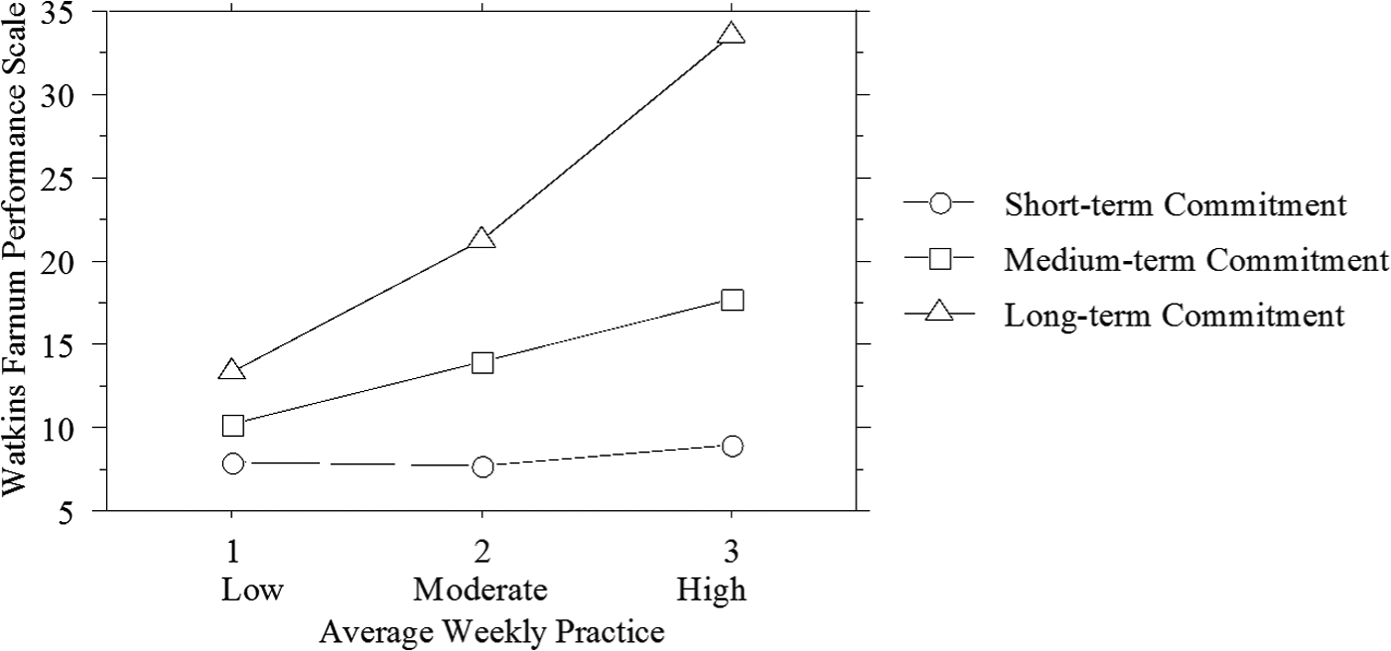
Interaction between commitment and practice. Reprinted from McPherson, G. E. (2000). Commitment and practice: Key ingredients for achievement during the early stages of learning a musical instrument. Bulletin of the Council for Research in Music Education, 147, 122–127.
Purpose
The purpose of the current investigation was (1) to extend the original 1-year findings related to commitment and practice and to examine how these constructs were relevant to sustained musical engagement and attainment over a period of 10 years; and (2) to present a theoretical interpretation of these results as a means of providing a richer context and foundation for future research in the area. We returned to the quantitative data collected in the very beginning of the first year of the study to examine how long the children thought they would continue to play for, and used data gathered over the next 3 years on the amount of practice they sustained, and the results of standardized tests. We also used information gathered over 10 years later to measure how long the children remained engaged in playing their instruments, and what other musical activities they did throughout high school. More specific information on these variables is described under “Measures.”
Method
Participants
The sample of 157 children originally consisted of 87 (55%) females and 70 (45%) males, aged between 7 and 9 years. The participants were about to commence learning music in a primary school band program. They participated in data collection phases in early 1997, late 1997, 1998, and 1999. In 2007, the participants were again contacted to extend the study to a 10-year longitudinal study. One hundred and thirty-five participants responded in the 2007 phase, but actual numbers of participants varied for the individual analyses reported here, based on the available data (not all participants were able to respond to every phase, including performance testing in 1999 and the follow-up contact in 2007).
Procedure
Data on accumulated practice obtained from the first 3 years of learning were used in conjunction with data gathered 10 years after the first lessons to examine whether relationships exist that may have predictive power on variables of interest. In the most recent phase, participants were contacted by phone for a discussion of some basic information about how long they played their instruments and whether they would be willing to complete a survey. We note that the qualitative open-ended responses described above, and later in the discussion, were not analysed as primary data; rather, they are provided here as illustrative examples of the quantitative analysis we conducted.
Measures
Data from the first 3 years of the longitudinal study (citation) were used as the key predictors of musical outcomes over 10 years later, specifically:
School music program
The 8 schools were placed into two categories according to the researchers’ knowledge of the school music program, prior to the analysis taking place: either “basic” school music program (3 schools, n = 46), for a new band program or one that was either under resourced and did not normally play at school functions and thus had a low profile within the school, or “enriched” school music program (5 schools, n = 111) where the band was a prominent activity that was visible and well-integrated over a number of years into the culture of the school.
Prior experience
The participants were assigned to two categories according to whether they had prior experience learning another musical instrument or not.
Identity
We believed the term “commitment” used in the original analysis (McPherson, 2000) was not reflecting the phenomena we were observing with our long-term, longitudinal perspective, so we renamed the variable identity (see Discussion). That analysis also made a distinction between a medium-term commitment (e.g., until the end of high school) and a long-term commitment (e.g., into adult life), but for the current analysis, we felt it was theoretically more appropriate to remove this distinction and treat medium-term and long-term as one category. Thus, a binary category was formed of whether the children expressed a short-term identity (until the end of the year or the end of primary school, 37 students), or a long-term identity (into high school and beyond, 106 students).
Practice
Responses from parents in late 1997, 1998, and 1999 were used to calculate a total accumulated practice value for all 3 years. Participants were divided into two groups of approximately equal size: “low” practice (M = 47.9 hours, SD = 27.5) and “high” practice (M = 158.3 hours, SD = 57.7).
Achievement
The original study measured achievement on the Watkins-Farnum Performance Scale (WFPS), a standardized achievement test of musical competence, at the end of the first school year of music learning. The WFPS is based on musical excerpts which the subject plays through, one by one. The excerpts are scored by a judge according to strict criteria for accuracy of pitch and rhythm. The test continues through the progressively more difficult excerpts, and stops after a score of zero is recorded on any two consecutive excerpts. A random sample of 50 of the excerpts was judged by an independent evaluator, with a reliability score of 0.94. In the present study, we examined the WFPS scores after 3 years of learning, which showed an approximately normal distribution, M = 29.490, SD = 14.418.
Long-term engagement
As a measure of long-term motivation for playing an instrument, we used data gathered from the most recent phase of the study to calculate the school year (grade) in which the participant ceased playing, M = 8.154, SD = 3.280.
Highest AMEB grade
We also analysed the highest grade level the student attained in Australian Music Examinations Board (AMEB) exams (the AMEB is an externally assessed graded system of musical achievement based largely on performing a prescribed range of prepared repertoire). AMEB grades range from preliminary, then 1 to 8 plus several additional awards (associate, licentiate, and fellow). The grades in the sample ranged from 1 to 8. AMEB grades are comparable to similar exam systems such as the Trinity College of London. Grade 8 would be indicative of a minimum level required for entry into a music conservatory in Australia. Thirty-five students undertook AMEB graded examinations, with the highest grade reached being Associate (coded as grade 9), M = 7.000, SD = 2.364.
Results
We began our analyses by examining which children were more likely to express a long-term identity in relation to playing a musical instrument by studying the school culture as well as their prior experience in playing a musical instrument. The effect of the school culture (basic or enriched school culture) on children’s identity (short or long-term identity) was examined using Pearson chi-square analysis. A significant effect was found, χ2(1) = 5.598, p = .028. The odds of students expressing a long-term identity were 2.604 times higher if they belonged to a school with an enriched, visible instrumental program than if they belonged to a school with a basic instrumental program (see Figure 2). We also examined the effect of the children’s prior experiences of learning a musical instrument on their identity (short or long-term identity) using Pearson chi-square analysis. Within this analysis, 72 participants (50%) had no prior experience learning an instrument, while 71 (50%) had some prior experience learning an instrument. A significant effect was found, χ2(1) = 5.919, p = .021. The odds of students expressing a long-term identity were 2.615 times higher if they had prior experience playing a musical instrument (see Figure 3). Experience of music, whether in the social environment, or direct experience with learning an instrument, was therefore associated with children expressing a long-term musical identity.
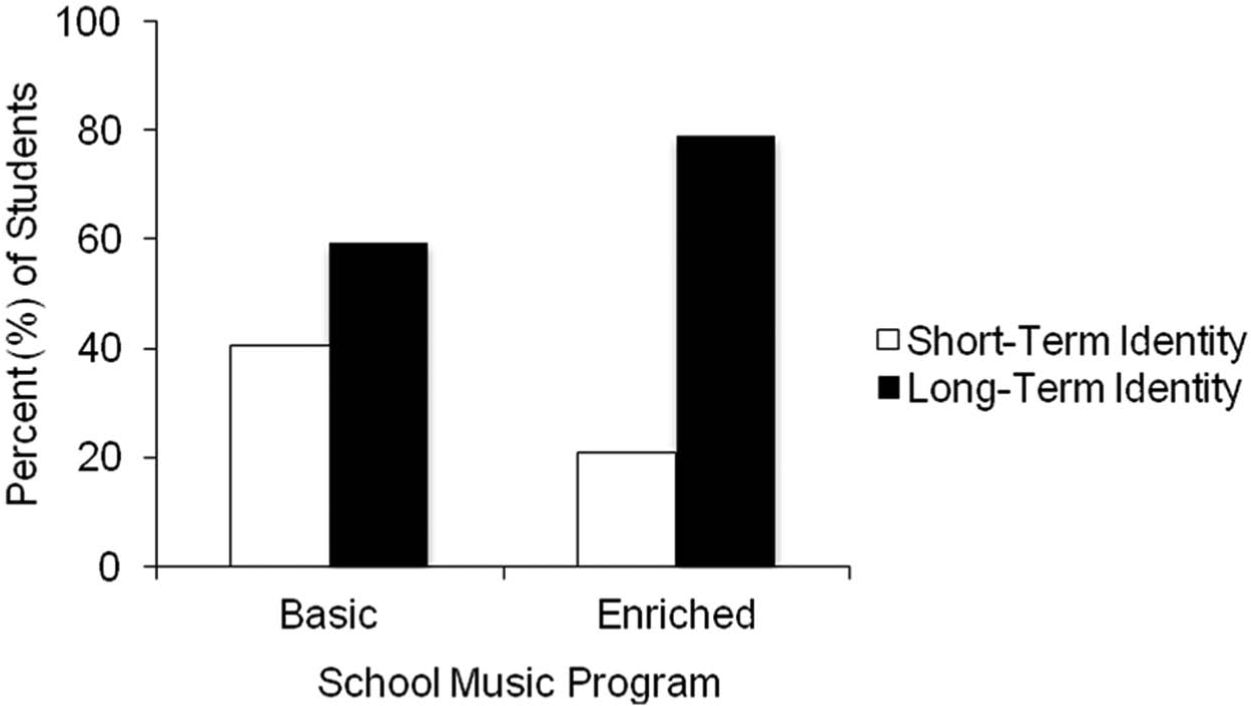
Identity expressed by students before they began learning based on the quality of the school music program
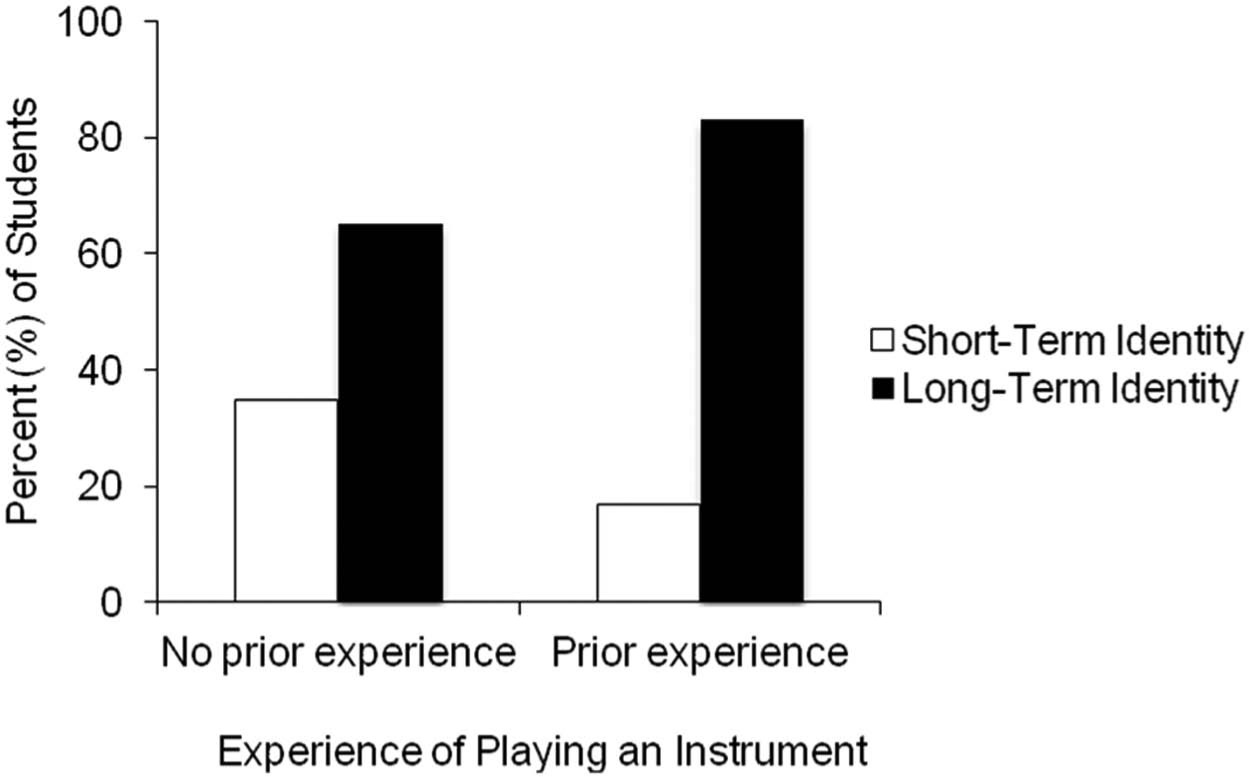
Identity expressed by students before they began learning based on their prior experiences of learning to play a musical instrument
To extend the analysis after 1 year of learning, we analyzed the influence of identity and practice on long-term achievement and engagement. First, a correlation analysis between identity (short and long term) and the practice variable (treated as a continuous variable before it was collapsed into the “low” and “high” practice categories) resulted in Spearman’s rho = .269, p = .002, showing a small to moderate correlation between the identity and practice variables. We performed a 2 × 2 ANOVA to examine performance differences on the WFPS after 3 years of learning, with identity (short and long term identity) and practice (low and high groups) as between-groups factors. Significant effects were obtained for identity, F(1, 96) = 6.662, p = .011, ηp2 = .065; practice, F(1, 96) = 6.023, p = .016, ηp2 = .059; and an identity × practice interaction, F(1, 96) = 7.154, p = .009, ηp2 = .069 (see Figure 4). Participants who indicated a long-term commitment before learning and practiced more in the first 3 years of learning demonstrated better performance on the WFPS after 3 years, indicating that McPherson’s (2000) result held up beyond the initial year of learning.
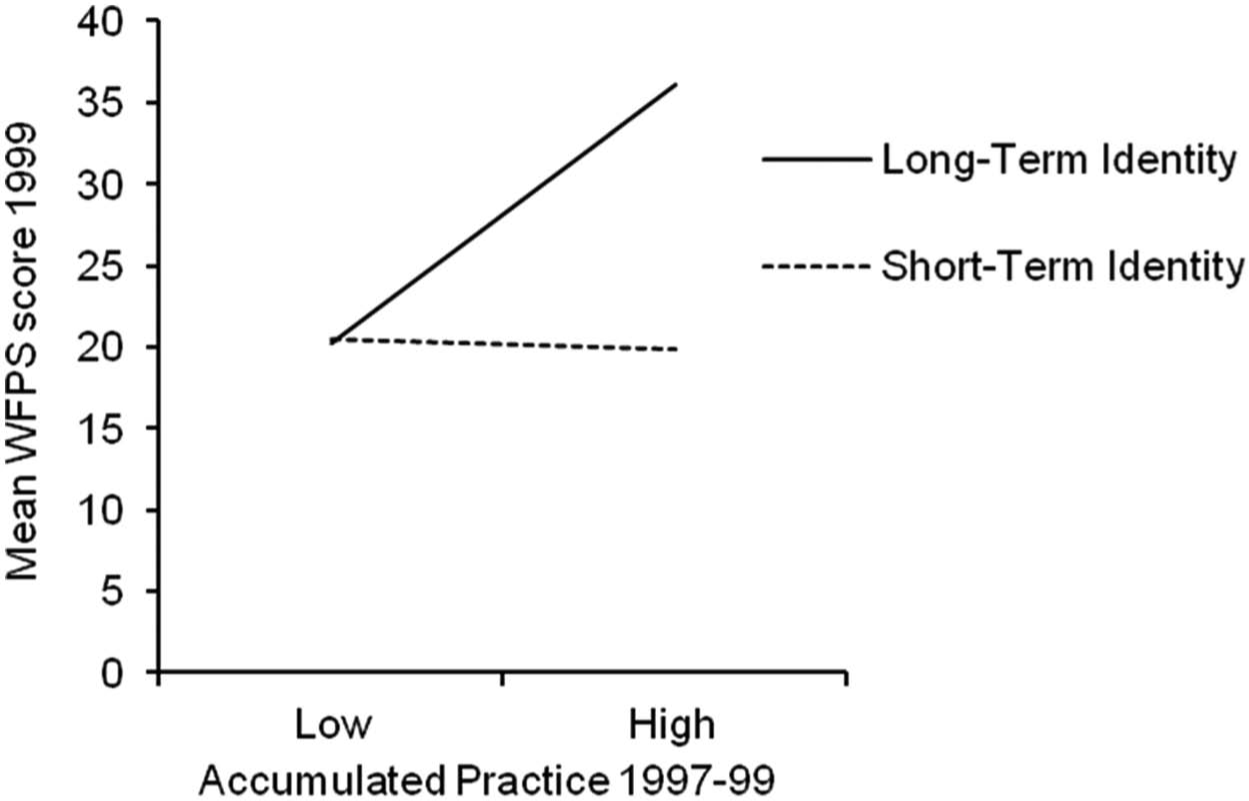
WFPS scores after 3 years of learning
We examined the effects of identity and practice on the school grade in which the participants reported ceasing music learning and playing using a 2 × 2 ANOVA on the school year, again with identity (short and long term identity) and practice (low and high groups) as between-groups factors. Significant effects were obtained for identity, F(1, 115) = 4.168, p = .043, ηp2 = .035; practice, F(1, 115) = 4.867 p = .029, ηp2 = .041; and an identity × practice interaction, F(1, 115) = 6.293, p = .014, ηp2 = .052 (see Figure 5). The result indicates that the combination of a long-term identity and practice has implications beyond performance on standardized tests, and actually predicted participants going further in schooling before ceasing to play and learn music.
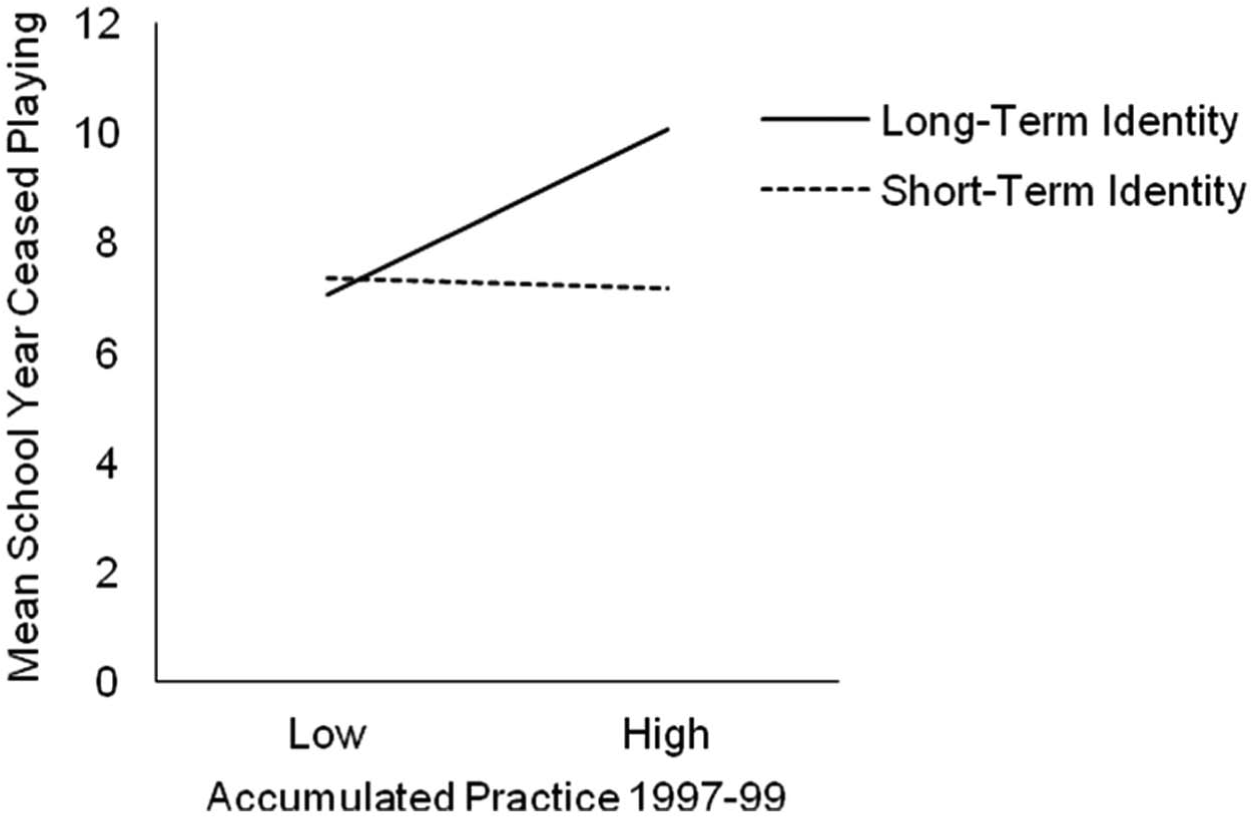
School year in which the participants reported ceasing to learn and play a musical instrument
Finally, we examined the influence of identity and practice for students who participated in the AMEB examination system. We performed a 2 × 2 ANOVA on the highest AMEB grade attained by the participants, again with identity (short and long term identity) and practice (low and high groups) as independent variables. No significant effects could be obtained for identity, F(1, 29) = 2.068, p = .161; practice, F(1, 29) = .769 p = .388; nor the identity × practice interaction, F(1, 29) = 2.305, p = .140. We do note the small number of participants for which this analysis was possible: we had data for only 33 students who completed AMEB examinations, resulting in very small cell sizes (e.g., only 3 participants demonstrated the combination of short term commitment and low practice), severely compromising the validity of a statistical analysis. While Figure 6 depicts sizeable differences between the groups (almost 3 AMEB grades), the data were insufficient to reject the null hypothesis in this instance.
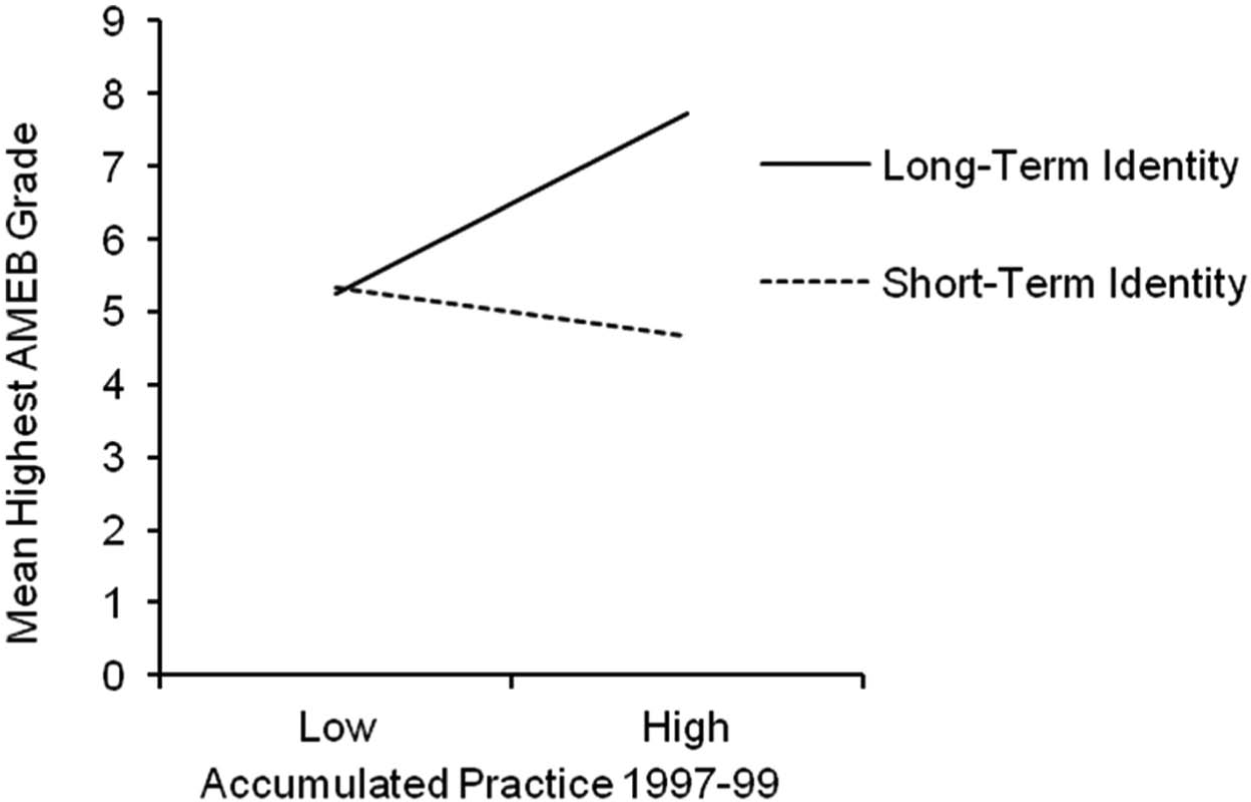
Highest AMEB grade attained by participants
Discussion
Practice is one of the most important activities one can undertake in order to improve performance in any domain, so understanding the immense motivational resources required to sustain consistent and regular deliberate practice over many years is a priority for researchers in music education. We examined whether the identity that children articulated before they began learning an instrument, in combination with the practice they undertook, were important contributors to their achievement and long-term motivation. Striking differences were found between students who expressed a short-term view of themselves playing an instrument and those who expressed a long-term view. Those who practiced more and had an underlying long-term view of themselves as musicians (expressed before they began learning) achieved higher on a standardized test after 3 years of learning, and persisted with music learning and playing for longer than students who had only a short-term view of themselves learning music. Even if the students with a short-term identity sustained similar amounts of practice to those with a long-term identity, they were not able to attain the same results or sustain motivation for as long as those with a long-term identity.
We do note some limitations with our data and analysis, and therefore some cautions with interpreting these findings. We used the technique of splitting the “practice” variable into groups to be used in ANOVA. Such a technique can influence the results due to the effects of aggregating the data into what may be considered somewhat arbitrary categories (“low” and “high”). We chose to split the data at the median, so that the sample was divided into two equal groups. The same technique was used in the original paper reporting the result after 1 year, but that analysis used three approximately equal-sized groups. We used only two groups in this follow-up study because of the limited number of participants due to attrition over the 10-year period. It remains to be seen whether the result should hold up if the study had a much larger number of participants. Our analysis was somewhat pragmatic and exploratory, using data from many years ago, and future research should plan more precise and accurate measures of what we eventually labelled identity, practice, achievement, and long-term persistence. Our analysis shows, however, some very clear effects of identity and practice, however crudely they are defined, and the substantial effect sizes warrant further longitudinal research in the area. We do not present the analysis as a robust, conclusive finding; rather, we wish to emphasize its context in our attempts to understand motivation in music education, which we will build on throughout this discussion. The direct implication for future research is to use methods that precisely and accurately measure the constructs we have described (identity, practice, long-term engagement, the quality of the school band program), larger numbers of participants in longitudinal studies, leading to the possibility of using more robust analytical techniques such as structural equation modelling, in order to build on this examination of motivation in music learning.
One of the most significant questions that arises from this result concerns why children are apparently able to express views of themselves as playing music well into the future from a young age, with relatively little experience in the domain. One straightforward explanation might be that this result may represent a kind of self-fulfilling prophecy on the part of the children – that they were able to “foresee” what they would be doing as an adult, based on how much they liked their prospective instrument or how talented they thought they might be at playing it. However, we believe that such an interpretation is simplistic. Instead, we explore the possibility that what was initially labelled as “commitment’ actually reflects something much richer – a contextualized and well-developed sense of personal identity that the children were able to readily draw upon when asked about their future music-making.
Forming a long-term identity
A central feature of the human experience is a sense of self – an understanding of oneself that is drawn upon in answering the question, “who are you?” (Vignoles, Schwartz, & Luyckx, 2011). Oyserman and James (2011) describe this as a “mental concept, a working theory about oneself, stored in memory, and amended with use” (p. 117). The understanding of one’s own personal identity develops throughout the regular course of life through likes, dislikes, positive experiences of things one is good at, and importantly, social interactions. Identity is the product of social interactions within the family, school, peer groups, and other social circumstances in which children interact with others and learn about themselves (Markus & Nurius, 1986; Oyserman & James, 2011). We speculate in this section the ways in which children in our study may have used images and experiences from their own social environments to form and articulate both their present and future identities.
In our study, the children’s musical identities were demonstrated in various descriptions of how they reported becoming interested in music before they commenced learning. Typical examples included children who reported one or both parents listening to music in the home or car, recollections of dancing, playing games or listening to music whilst helping to prepare a meal, watching television music programs, and observing a parent who played an instrument for relaxation with the child being close by or even being invited to join in with the parent. In such recollections, our students drew from images and experiences in their lives that were based on their experiences of others playing and interacting with music. Such experiences impacted on each child’s sense of what music entailed and how useful or important it might be in the child’s life.
Similarly, the children also drew upon experiences and observations from their school environment. Perceptions were most positive in five “enriched” schools that had a long tradition of music and in which parents were expected to be involved in fund raising committees, or to help with rehearsals or transporting equipment for performances. Children in these schools typically reported hearing the ensemble at their school, seeing other children play certain instruments which they either liked the look of or were attracted to the sound, and learning about the camps and extra-curricular opportunities and performances with which children exposed to music learning were involved. The status of the music ensembles within the school was particularly evident, such that the children reported being attracted to learn an instrument because others had said it was enjoyable or because they saw the band as “special” and wanted to be a part of it.
This anecdotal evidence was supported by the investigation we undertook of two variables that were found to be related to children’s ability to form long-term commitments: their prior experience in playing a musical instrument, and the role of the band program in the culture of the children’s school. This suggests that a school environment impoverished of a visible, successful music program dramatically affects children’s motivation to participate in it. For example, a learner from one of these schools reported, 10 years after he began learning, that none of his siblings had ever played a traditional woodwind instrument, and that he had no exposure even to listening to Western classical music (Evans, 2009). He gave up playing the clarinet within a few weeks, which is not surprising given his lack of understanding of the everyday practices of a clarinetist, in terms of the music that can be performed on this instrument and the role this instrument plays in an ensemble. In the absence of such an environment, the experience of band rehearsals, independent practice, and reading music must have been bewildering. The result in this case was that when he was asked 10 years later, he could not even recall what instrument he had learned. Even if the students in this school were able to establish a long-term image of themselves playing music, evidence suggests that students from socio-economically disadvantaged environments may be less able to make sense of the paths and strategies required to attain the long-term goals they envision (Oyserman, Johnson, & James, 2011).
Consequences of a musical possible self
It is now well established that by the age of 5–7 years, children have developed an ability to understand and articulate their present identities, values, and abilities (Eccles, 2005; Oyserman & James, 2011). Research supports their ability to also consider their future selves and identities (Atance & O’Neill, 2005). The future self is an important component of identity because it energizes action and fuels motivation for current decisions (Markus & Nurius, 1986). When the children in our study responded to the question about how long they thought they would continue to play a musical instrument, the future self may have played a role, in that they may have considered whether their future self would involve identifying themselves as a musician, and whether that was possible based on their current beliefs, abilities, and expectations.
Theories of motivation involving the “future self” make predictions about behavior. When we spoke to one of our participants around 11 years since he began learning, he described some of the major decisions he made throughout his music learning, such as choosing percussion over drum kit in primary school: I liked being more on the band–orchestra side of things than playing drum kit. I was more controlled, serious, studious… I didn’t want to be the person who gave up. I was already getting this idea of what a drummer was as distinct from a percussionist. And I wanted to be a percussionist. (Evans, 2009)
Though this description is retrospective, this student has described the process of consulting his possible self as a source of information about whether the choice of instruments would be appropriate. He appears to have been using his future self as a standard from which to compare the current self, and modifying his thoughts and behaviors (i.e., deciding on which instruments and activities to pursue) based on increasing the fit between his current and future self (Oyserman & James, 2011). However, toward the end of high school, he felt his developing sense of personal identity was becoming vastly different from that of the social environment he was in: I was not liking school by the end of it. More and more just school, but that school. I really liked music. And I really liked spending time with the people in it. But I just sort of had a big collapse in my ability, in my confidence. Music was no longer something I was doing for myself, just something I was doing. I wasn’t able to be myself, which is why I first went into music and art, because they were very much about who I was, but by the end of it, even music performance, that wasn’t really mine anymore. (Evans, 2009)
The increasing incompatibility between this student’s personal identity and social environment proved too challenging, and he eventually pursued other interests. Upon completing high school, he sought social environments that were much more in line with his increasing sense of personal and social identity.
Identity research shows that: once a possible future identity is established, it is only let go of with great reluctance, for example, being told that if one were to pursue a future self, a negative self would result e.g., if one were to pursue becoming a business consultant, they would probably end up being a clerical worker. (Oyserman & James, 2011, p. 125)
While this may be the case more generally, within music learning the situation may be somewhat different, as a substantial number of students give up on learning music with relatively little experience of where it might lead them. Music is surrounded by strong folk-psychological beliefs about the nature of abilities and their acquisition, with the dominant folklore belief being that musical skill is an expression of an innate talent, possessed only by a specially-endowed few (Howe et al., 1998). It is not surprising, therefore, that when students encounter difficulty with their learning, they tend to attribute this to their lack of natural ability rather than effort (see Dweck, 2000). With this attribution, students are more likely to believe that their future self is impossible to attain, and therefore less likely to act in the present moment to rectify the situation (Oyserman, Bybee, & Terry, 2006; Oyserman & James, 2011). Students who believe that they either have musical talent or they do not are more likely to give up on their music learning because of the small probability of attaining a future self who is accomplished in music. Learning classical music is difficult. It takes a substantial amount of time before a child is able to produce a pleasant tone on an instrument, and is accompanied by a host of other complex skills such as reading music, not to mention the self-regulatory strategies necessary to acquire and develop those skills. Indeed, previous research has reported how some parents appeared to have given up on their own children before the children give up on themselves (McPherson, 2009; McPherson & Davidson, 2002).
Therefore, in music, when students experience difficulties and encounter the major transition times in their lives where they decide whether they will continue or quit, they may be much more vulnerable to interpreting the difficulties as resulting in a negative self-identity. With a fixed view of their musical ability, they are more likely to interpret an incongruence between their current and future identity, believing that the future identity is no longer plausible because in the present, they perceive that they are simply not talented or “unmusical.”
Implications for teaching
What can teachers do to help children form a musical possible self? The children in our study who had formed a long-term identity were more likely to come from a school environment that had an active and visible school musical culture, supporting the implication of much of the research carried out on the effects of the social environment. Children who come from environments where the music program is not visible and not an integrated part of the school curriculum may benefit from more explicit discussions at school about the kinds of experiences that they can benefit from in the school band. Children who have not experienced classical music traditions may benefit specifically from band directors contextualizing before learning commences what the concept of a large ensemble is, how the instruments work together, the importance of learning to read music, and the role of the director. In fact, this was another key difference between the basic and enriched instrumental programs with all five enriched programs holding parent-child sessions for the children in the year before instrumental tuition began, so that both parents and their children could see the band perform and explore whether they wished to participate the following year. Another suggestion would be to organize attendance at classical music concerts, or local music competitions where the children can see other students of a similar age demonstrating their accomplishments. Such indoctrination into the practice of music may help in situations where similar music activities are non-existent and where educators see their benefit.
At an individual level, parents and teachers can work with children to craft their future goals. Some literature in positive psychology, for example, demonstrates that interventions such as brief periods of thinking about the future in a positive way can lead to improvements in optimism about the future. One can imagine similar interventions in line with possible musical selves, such as discussing with children what it is to be a musician later in life, the benefits that accrue from the acquisition of new skills, and the social potentials such as making new friends. This may be particularly true for those children who do not have significant social models as a basis from which to imagine their future possible self. Oyserman, Terry, and Bybee (2002), for example, conducted an experiment using an intervention in a school setting, involving a program of activities in which students developed their ability to imagine themselves as successful adults in connection with their school engagement. The researchers found increased levels of engagement at school, clarity of possible selves, and identification of the strategies required to attain those possible selves compared with a control group. Further research would be needed to evaluate the potential for a musical intervention where children would imagine themselves as people who enjoy playing music, who find developing their skills rewarding, and for whom music plays a significant role in their lives.
There exists a relationship between long-term identity and the hierarchical goal setting required for self-regulation. However, some evidence suggests that this relationship may not be as simple as it seems. In a study by de Bilde, Vansteenkiste, and Lens (2011), for example, high school and university students who expressed a long-term “future time” perspective expressed higher use of self-regulatory strategies but also higher levels of external motivation compared to intrinsic motivation. The researchers interpreted the finding to mean that the participants’ future time perspectives created a sense of internal pressure to achieve their goals. McElwee and Haugh (2010) studied university students and found that thinking clearly about the future was associated with more positive affect and more positive thoughts, but thinking frequently about the future was associated with greater negative affect, more negative thoughts about the self, and anxiety. Finally, Hoyle and Sherrill (2006) identified some differences between long term future selves that have immediate impacts on self-regulatory practices and those that do not (see the following section). Considering these preliminary studies and the possible negative implications of some practices, we would therefore suggest caution to practitioners drawing conclusions about strongly encouraging certain kinds of future selves.
Implications for future research
We have found a clear interaction between identity formation and practice when examining several key variables: performance on a standardized scale, and long-term engagement. However, a full understanding of the formation of a musical identity requires more detailed work. The breadth of roles that music can play in the lives of adolescents and young adults is enormous (McPherson et al., 2012), and given that the possible self expressed by a child of around 8 years of age can potentially have such an impact on their subsequent engagement with music, it is worth examining the content of possible selves in detail. We have demonstrated relationships between some key variables (school musical culture and prior experience in playing an instrument) on the students’ formation of long-term commitment, but a full understanding of the role of possible selves requires disentangling the complex social and cognitive factors at play in the formation of this very important set of beliefs.
Another dimension of possible selves that is yet to be explored is that of the “hoped-for self” vs. the “feared self.” Hoyle and Sherrill (2006) theorized that rather than directly influencing motivation and behavior, possible selves are components of self-regulatory processes. Self-regulatory possible selves are distinguishable from self-enhancing possible selves in that the former involve envisioning a long-term self as well as the actions required to attain that long-term self, whereas the latter contribute to positive feelings about the self but do not directly influence current behavior (Oyserman, Bybee, Terry, & Hart-Johnson, 2004). Both types of possible self are directly relevant to the study of music learners. A self-enhancing possible self may come into play at the significant decision points and transitions in the lives of music learners, and self-regulatory possible selves have obvious direct importance for motivating the behaviors required as part of an effective deliberate practice routine. This distinction may therefore prove to be an appropriate framework for further investigation in this area.
Conclusion
Research in recent decades has made it abundantly clear that the best predictor of musical accomplishment is the amount and quality of practice that has been undertaken. A key challenge for music education researchers concerns how people are able to sustain the motivation to undertake such practice. The study reported here has demonstrated the importance of establishing a sense of personal identity in relation to music from the outset of music learning. Self-regulation of practice and day-to-day motivation are critically important, but to energize these facets of motivation and self-regulation, developing musicians may need to contextualize these goals and regulatory strategies within their own personal sense of identity – their own working theory of their self – and to incorporate a long-term view of their self as being somebody for whom music plays a significant role in their life. Our results suggest that social environments in which music plays an active part are conducive to children being able to form a long-term view of themselves as musicians. This long-term view, coupled with regular practice, helped the children in our study to sustain motivation for playing a musical instrument, and helped them to achieve more highly than students who had only a short-term view of themselves as developing musicians. Without a strong sense of personal identity as a musician, and an idea where music learning might take them or at least the role it might play in their lives, children may be unlikely to develop long-term motivation for persisting beyond the early stages of music learning.
Footnotes
Funding
This research was supported by two Australian Research Council Discovery grants, A79700682, and DP0770257.