






Abstract
The objective of the present study was to examine the effects of music and music-video on core affect during and immediately after stationary cycling at the lactate threshold. A randomized, fully counterbalanced, crossover design with three conditions (music, music-video, and a no-music-video control) was adopted. Twenty-four participants exercised at lactate threshold while exposed to music, music-video, and control conditions. Affective valence and perceived activation were assessed every 2 min during a 20-min exercise bout and every 5 min post exercise over a 20-min period. Results indicated that there was a significant condition x time interaction for affective valence. The music-video condition elicited the highest levels of affective valence followed by the music condition and control. There was a main effect of condition for affective valence, wherein the experimental conditions facilitated significantly higher affective valence than control. Significant main effects of time emerged for both affective valence and perceived activation. Regardless of condition, affective valence decreased during the exercise bout and increased immediately post exercise. Conversely, perceived activation increased during exercise and decreased immediately post exercise. The present findings indicate that music and music-video can enhance core affect during exercise at the lactate threshold and the implications for exercise adherence are expounded.
Regular physical activity has been linked to numerous physical and mental health benefits (Chief Medical Officers of England, Scotland, Wales and Northern Ireland, 2011). Despite such benefits, the percentage of people engaging in regular physical activity has remained low over the last two decades (Ekkekakis & Dafermos, 2012), to the extent that its promotion has become a “key public health issue” in the UK (Biddle et al., 2010, p. 5). Using hedonic theory (Kahneman, 1999) as a guiding framework, researchers have emphasized the role of affective responses to exercise as determinants of exercise adherence (Tempest & Parfitt, 2013; Williams, 2008), suggesting that human behaviour is shaped by a tendency to enhance or prolong feelings of pleasure and avoid or minimize feelings of pain (Kahneman, 1999). The present study focused upon core affect, which has been defined as “the most elementary consciously accessible affective feelings” (Russell & Feldman Barrett, 1999, p. 806) and is considered the most general affective construct when compared to emotion and mood (Ekkekakis, 2013).
It has been demonstrated that musical accompaniment has the capacity to influence the affective responses of exercisers and is frequently combined with visual stimuli such as video within modern exercise and sport training facilities (see Hallett & Lamont, 2015; Karageorghis & Priest, 2012a, 2012b; Loizou, Karageorghis, & Bishop, 2014). A distinction can be made between music-and-video and music-video in these settings. Music-and-video can be considered an umbrella term for all instances in which auditory and visual stimuli are experienced concurrently. The use of incongruent stimuli (e.g., music combined with rural scenes) has been the subject of recent investigation (e.g., Barwood, Weston, Thelwell, & Page, 2009; Jones, Karageorghis, & Ekkekakis, 2014). In contrast, the present investigation focused on music-video, a specific form of music-and-video, wherein auditory and visual stimuli are congruent (i.e., the official video of the piece of music that is being played). The paucity of research examining the effects of music-video is rather surprising given its prominence within exercise settings and there are fewer than ten related studies in the literature (e.g., Bigliassi et al., 2014; Hutchinson, Karageorghis, & Jones, 2015). Given that individuals are more likely to participate in exercise programmes that they find to be enjoyable (Greene & Petruzzello, 2015), interventions that are targeted to improve the exercise experience are likely to facilitate exercise adherence. Accordingly, insights into such interventions could hold particular value for health and exercise practitioners.
The circumplex model of affect
In order to capture affective phenomena at a global level, we conceptualize core affect as a dimensional domain, characterized by affective valence (ranging from pleasure to displeasure) and perceived activation, which can be considered as two orthogonal and bipolar dimensions (Russell, 1980). Therefore, different affective states are considered to be combinations of varying degrees of these two constituent dimensions. The circumplex model of affect (Russell, 1980) has been recommended as a conceptual framework to enable measurement of the full range of core affect responses to exercise (Ekkekakis & Petruzzello, 2002) and has been widely used in the field of psychomusicology (e.g., Krause, North, & Hewitt, 2015; North & Hargreaves, 1997; Ritossa & Rickard, 2004). It consists of two dimensions (affective valence and perceived activation) and thus provides four quadrants (a) high-activation pleasant affect (e.g., excitement), (b) high-activation unpleasant affect (e.g., afraid), (c) low-activation unpleasant affect (e.g., sluggish) and (d) low-activation pleasant affect (e.g., peaceful). Categorical measures of affect rely on a set of predetermined scales in order to map individual differences in affect using quantitative differences in item ratings (Ekkekakis & Petruzzello, 2002). Contrastingly, the circumplex affords individuals the freedom to accurately describe their affective experiences, over a prolonged period of time, which allows for an almost unlimited number of individual affective profiles (Ekkekakis & Petruzzello, 2002).
Dual-mode theory of affective responses to exercise
Ekkekakis (2003, 2005) proposed the dual-mode theory to depict the relationship between exercise intensity and affective responses. An underlying premise of this theory is that exercise intensity should be defined according to a fixed metabolic marker, such as the ventilatory threshold or lactate threshold (Rose & Parfitt, 2008); such markers are associated with a host of physiological changes (e.g., increased respiration rate, accumulation of lactic acid). The dual-mode theory posits that affective responses to exercise below the ventilatory threshold/lactate threshold are primarily driven by cognitive factors and are generally positive. Affective responses to exercise proximal to the ventilatory threshold/lactate threshold vary among exercisers, with some reporting positive, and others reporting negative affect. Conversely, at higher intensities above the ventilatory threshold/lactate threshold, interoceptive or bodily-related cues gain salience and affective responses are generally less positive as a physiological steady state becomes difficult or even impossible to maintain (Ekkekakis, Parfitt, & Petruzzello, 2011). Furthermore, upon cessation of exercise that induces a decline in pleasure (such as exercise that exceeds the ventilatory threshold/lactate threshold), the predominant response is expected to be a robust rebound towards pleasure; a phenomenon that has been referred to recently as “the affective rebound” (Ekkekakis, 2013; Jones et al., 2014).
Mechanisms underlying affective responses to exercise with music
A number of mechanisms have been advanced with reference to the affective responses to exercise with musical accompaniment (Karageorghis, 2015; Karageorghis & Priest, 2012a, 2012b). For example, listening to music can influence attentional processing. A distinction has been made between two broad categories of attentional focus, association and dissociation (Morgan & Pollock, 1977). Association is regarded as turning focus towards task-relevant stimuli, whereas dissociation is regarded as turning focus towards task-irrelevant stimuli (Stevinson & Biddle, 1998). It has been hypothesized that dissociative strategies, such as listening to music, attenuate fatigue-related sensations by occupying the limited attentional processing capacity (e.g., Clark, Baker, & Taylor, 2016; Rejeski, 1985).
Music is also capable of evoking a broad range of feelings, among which core affect plays a particularly salient role (Juslin & Västfjäll, 2008). Moreover, many of the psychological constructs that are theorized to mediate musically-induced emotions contain a visual element (Juslin, 2013). For example, emotional contagion describes a process whereby individuals may “catch” the emotions of others when hearing their vocal expressions or seeing their facial expressions (Juslin & Västfjäll, 2008). The use of music-video, wherein the performing artist is usually heard and seen, could be particularly potent in this regard.
In addition to attentional processing and emotional engagement, Mitchell and MacDonald (2006) proposed that music can imbue the listener with a sense of control. Their research focused on the phenomenon of audioanalgesia (i.e., the use of music to reduce the perception of pain) in clinical settings, where there is generally little perceived control over one’s immediate surroundings. The perception of control is also important within an exercise environment and can contribute towards an individual’s overall evaluation of the experience (Rose & Parfitt, 2010).
Affective responses to auditory and visual stimuli during exercise
Karageorghis, Terry, and Lane (1999) developed a conceptual framework to predict the effects of asynchronous or background music use in exercise and sport settings. Their framework underscored the Brunel Music Rating Inventory (BMRI), which has been used to assess the motivational qualities of music. The BMRI was revised to create the BMRI-2 (Karageorghis, Priest, Terry, Chatzisarantis, & Lane, 2006), an instrument that was adopted for the present study and has been shown to be valid and reliable by its originators, as well as by independent researchers (e.g., Clark, Baker, Peiris, Shoebridge, & Taylor, 2016). The BMRI-2 only includes items that pertain to the audible properties of the musical stimulus, often referred to in the literature as intrinsic or congeneric music factors and is accompanied by a series of recommendations to account for some of the extrinsic or extrageneric factors (see Karageorghis et al., 2006, p. 907).
The conceptual frame underlying the study of music in exercise and sport has also been revised recently (Karageorghis, 2015). The revisions were inspired, in part, by theoretical advancements in psychomusicology involving the reciprocal feedback model (Hargreaves, MacDonald, & Miell, 2005), as well as advancements in the domain of exercise and sport (e.g., Bishop, Karageorghis, & Loizou, 2007; Karageorghis et al., 1999; Terry & Karageorghis, 2006). In particular, the Hargreaves et al. (2005) model brought to the fore the interconnectedness of the music, the listener, and the context. Karageorghis (2015) arranged music factors in a hierarchy of intrinsic (e.g., tempo) and extrinsic (e.g., cultural association) factors and presented them as antecedents. Personal factors (e.g., gender) and situational factors (e.g., mode of exercise) were proposed to moderate a number of consequences that include the regulation of affective valence and perceived activation. Moreover, the new theoretical model postulates a series of reciprocal interactions and feedback loops among the antecedents, moderators, and consequences of music use that determine future selection decisions.
Researchers have examined the impact of music on affective responses under varying situational conditions, by employing numerous exercise modalities such as treadmill running (Terry, Karageorghis, Mecozzi Saha, & D’Auria, 2012), group-based classes (Clark, Baker, & Taylor, 2012), and cycle ergometry (Lim, Karageorghis, Romer, & Bishop, 2014). Comparatively, there is a distinct lack of research focused on the mediating role of the listener’s personal characteristics, such as gender, in the context of musically accompanied exercise (Karageorghis & Priest, 2012b). A study by Karageorghis et al. (2010) provides a notable exception given that females were found to derive greater pleasure than their male counterparts when exercising to exhaustion with musical accompaniment. However, in this instance, participants were required to synchronize their movements to the tempo of the music; a motor task that might have been more familiar to the female participants (see, e.g., Cain et al., 2015). There is a strong case for additional research to uncover any possible gender differences in the response to asynchronous music (i.e., without auditory-motor synchronization) during exercise.
Karageorghis et al. (2009) compared motivational music to a no-music control during a treadmill task and reported significantly enhanced affect during the music condition. Furthermore, Elliot, Carr, and Savage (2004) compared motivational music to oudeterous (neutral in motivational terms; see Karageorghis et al., 1999) music and a no-music control condition during a 12-min cycle ergometry protocol. Participants reported significantly higher positive affect during the motivational condition compared to the no-music control. However, the exercise intensity adopted in both of the aforementioned studies warrants further examination. Defining exercise intensity according to the ventilatory threshold/lactate threshold is preferable to the use of percentage of heart rate max (HRmax) or a fixed rating of perceived exertion (RPE; Elliot et al., 2004; Karageorghis et al., 2009). This approach ensures much less inter-individual variability in metabolic state when participants respond to affective measures during exercise (Rose & Parfitt, 2012), thus removing a potential confound when comparing affective responses across individuals and between intensities (Rose & Parfitt, 2010).
Despite the suggestion that the interactive effects of music and visual stimulation are more potent in combination than when presented in isolation (Baumgartner, Lutz, Schmidt, & Jäncke, 2006; Loizou et al., 2014), research examining the interactive effects of music-and-video accompaniment to exercise is scant. The limited findings reveal that music-and-video interventions can promote greater attendance in exercisers at a health club over a 14-week period (Annesi, 2001), increase work output (Barwood et al., 2009) and elicit more positive core affect (Jones et al., 2014). There are numerous limitations associated with such studies, such as the lack of standardization in terms of music intensity (volume) and exercise duration (Annesi, 2001), as well as incongruence between auditory and visual stimuli (Jones et al., 2014). Moreover, Barwood et al.’s (2009) experiment was conducted in a climatic chamber that elicited a “moderate risk of heat illness” (p. 437) and is not representative of most contemporary exercise facilities, which offer climate control.
Recently, three groups of researchers have investigated the impact of music-video accompaniment during exercise (Bigliassi et al., 2014; Hutchinson et al., 2015; Lin & Lu, 2013). Their findings indicate that music-video can reduce participants’ RPE (Bigliassi et al., 2014; Hutchinson et al., 2015; Lin & Lu, 2013), promote a dissociative attentional focus (Hutchinson et al., 2015), increase work output (Lin & Lu, 2013) and enhance core affect (Hutchinson et al., 2015). Nonetheless, a number of limitations can be identified within such studies that include a failure to familiarize participants with sensory deprivation (Lin & Lu, 2013), a lack of consideration towards the motivational qualities of music (Bigliassi et al., 2014) and not examining the influence of auditory and visual stimuli directly at the ventilatory threshold (e.g., Hutchinson et al., 2015). There is, therefore, considerable scope to examine the effects of music-video accompaniment to exercise while accounting for such limitations.
Aims and hypotheses
To date, only two attempts have been made to examine the influence of music-and-video on core affect during and post exercise at an intensity that is fully standardized across participants (Hutchinson et al., 2015; Jones et al., 2014). In these studies, the researchers used intensities below and above the ventilatory threshold. However, to our knowledge, no study to date has investigated such effects at the lactate threshold; the exercise intensity that was adopted for the present study. Core affect is open to individual interpretation and thus relatively malleable when exercising at lactate threshold (Ekkekakis, 2003, 2013). Given the call for pleasure to be added as the “third pillar” of exercise prescription (Guiraud, Labrunee, Gayda, Juneau, & Gremeaux, 2012), interventions aimed to enhance the experience of exercise could prove vital for health and exercise practitioners in their work to combat physical inactivity. The primary aim of the present study was to examine the influence of music and music-video on affective responses during and immediately following cycle ergometry conducted at the lactate threshold. The secondary aim was to examine the degree to which gender moderated the influence of music and music-video on affective responses.
We tested four hypotheses: (a) participants’ affective valence would be most positive (situated in the right-hand quadrants of the circumplex model of affect) in the music and music-video conditions, and least in control (H1); (b) participants’ perceived activation would be the highest (situated in the upper quadrants of the circumplex model of affect) in the music and music-video conditions, and lowest in control (H2); (c) the control condition would be associated with the greatest affective rebound compared to both experimental conditions, owing to participants’ more positive in-task affective state in the music and music-video conditions (H3); and (d) gender would not moderate the influence of music and music-video on affective responses either during or immediately after exercise (H4).
Method
Study design
There were three conditions that were administered using a randomized, fully counterbalanced, crossover design.
Participants
Eligible participants for experimental trials were adults aged 18 years or over who were able to participate safely in exercise in accord with responses to the Physical Activity Readiness Questionnaire (PAR-Q, Canadian Society for Exercise Physiology, 2002). Participants were deemed ineligible if they had a hearing deficiency and/or any visual impairment that could not be overcome through the use of spectacles or contact lenses. Twenty-four undergraduate students were screened for eligibility and recruited (eight women and 16 men; Mage = 21.3 years, SD = 1.2 years). Participants were recreationally active, self-reporting engagement in exercise of more than 4 hr per week (Mtraining = 4.4 hr per week, SD = 1.5 hr per week). Each participant was provided with an information sheet and signed an informed consent form. The study took place at two universities located in the south of England, UK, the review boards of which provided ethical approval.
Interventions
Music and music-video selection
To apply some objectivity in the selection of music for the experimental conditions, ten volunteers (four women and six men) who were homogenous in terms of age (Mage = 22.0 years, SD = 1.0 years) supplied three tracks that they considered to be “motivational” for the purpose of stationary cycling. One of the experimenters assessed the motivational qualities of the music tracks using the BMRI-2 (Karageorghis et al., 2006) to ensure that the music used in experimental trials was relatively homogenous in terms of its motivational qualities. The six tracks with the highest motivational quotients were selected: Levels by Avicci (126 bpm), Titanium by David Guetta ft. Sia (126 bpm), Call On Me by Eric Prydz (126 bpm), Sweet Nothing by Calvin Harris ft. Florence Welch (128 bpm), Human by The Killers (136 bpm), and Zombie Nation by Kernkraft 400 (140 bpm). The official music-videos of the aforementioned tracks were selected for use in the experimental trials.
Preliminary testing
The lactate threshold is the “lowest workload at which the rate of lactate appearance in the blood starts to exceed the rate of removal” (Ekkekakis, Hall, & Petruzzello, 2005, p. 482). Each participant was administered an incremental cycle ergometry test, in which the load was increased by 0.5 kg every 4 min and blood samples were taken from the fingertip during the final minute of each stage in order to calculate lactate threshold. Blood samples were analysed immediately. The D-max method (Cheng et al., 1992) was used to determine lactate threshold, which has high test-retest reliability and correlation coefficients of .77 to .93 (Zhou & Weston, 1997). The D-max was taken as the point at which the slope of the polynomial curve was equal to the slope of the straight line and the appropriate load for the experimental trials was calculated from the lactate threshold. Participants’ affective responses were measured every 4 min during preliminary testing to aid familiarization.
Experimental trial
Experimental testing took place at least 48 hours after the preliminary testing. Participants visited the laboratory on three separate occasions to be exposed to three conditions (a) music, (b) music-video, and (c) control (no music or music-video). Experimental trials took place a minimum of 48 hours apart. Participants were required to avoid caffeine and alcohol, maintain adequate hydration, and gain sufficient sleep during the night prior to testing. Upon entry to the laboratory, each participant had a 5-min period of seated rest, a 5-min warm-up on a cycle ergometer, and then a 20-min cycle at their lactate threshold. Each participant completed a 5-min active cool-down on the cycle ergometer that was followed by a 15-min period of seated rest.
Apparatus
A cycle ergometer (Monark 874E) was used for testing and blood samples (to determine lactate threshold) were analysed using a lactate analyser (Biosen Line-C). Music was administered via over-ear headphones (Sony MDR-V150) at an approximate intensity of 70 dBA, which is deemed safe from an audiological perspective (Health and Safety Executive, 2005). Music and music-video were delivered via a media player (VLC 2.1.0) on a laptop (Toshiba Satellite Pro C850-15T; screen size 15.6 in), placed 1.5 m in front of the participant, slightly below eye level. The headphones and laptop were not used when the control condition was administered in order to maintain external validity.
Outcomes
Core affect measurement
On the basis that we conceptualize affect as a dimensional domain, affective valance was assessed using Hardy and Rejeski’s (1989) Feeling Scale (FS), which has an 11-point scale ranging from (I feel) very good (+5) to very bad (–5). This is an exercise-specific measure that has had its validity demonstrated in a series of studies (Hardy & Rejeski, 1989) and been used extensively in exercise-related research (e.g., Rose & Parfitt, 2008). Perceived activation was measured using the Felt Arousal Scale (FAS, Svebak & Murgatroyd, 1985), which is a single-item, six-point measure ranging from 1 (low arousal) to 6 (high arousal). The validity of the FAS has been demonstrated by van Landuyt, Ekkekakis, Hall, and Petruzzello (2000) and it has been used extensively in the exercise context (e.g., Rose & Parfitt, 2012). Baseline affect was measured following the 5-min period of seated rest. In-task core affect was measured every 2 min during the exercise. Post-task core affect was measured at 0, 5, 10, and 15 min following completion of the cool-down.
Sample size
A power analysis was conducted using G*Power 3 (Faul, Erdfelder, Buchner, & Lang, 2009) to determine an appropriate sample size. Based on a large predicted effect size (ηp2 = .32) derived from Hutchinson et al. (2015), an alpha level of .05, and power at .85, the analysis indicated that 23 participants would be required. To minimize the impact of possible participant attrition and multivariate outliers, one additional participant was recruited.
Data analysis
The data were screened for univariate and multivariate outliers and relevant checks were undertaken to ensure that the data met the parametric assumptions that underlie mixed-model MANOVA. Furthermore, a variety of data transformations were planned for (e.g., square root, logarithm) in case that any of the data needed to be normalized. Pre-task affective measures were examined and planned to be used as covariates if statistical differences emerged across conditions. The affective variables (affective valence and perceived activation) were assessed using a 3 (condition) x 5 (time) x 2 (gender) MANOVA. The means of three in-task time-point ranges were selected for statistical analysis: 2–6 min, 8–14 min and 16–20 min. Post-task time-points selected for statistical analysis were at 0 and 5 min post cool-down. To facilitate a visual interpretation of the findings, the FS and FAS scores were plotted using the circumplex model of affect (Russell, 1980).
Results
There were no outliers identified and the data met most of the assumptions that underlie mixed-model MANOVA. Tests of the distributional properties of the data in each cell of the analysis revealed violations of normality in 13 of the 60 cells (five at p < .05, three at p < .01, and five at p < .001). The sphericity assumption was violated in all F tests and Greenhouse–Geisser adjustments were made accordingly.
Interaction effects
There was no significant higher-order interaction for affective valence or perceived activation (condition x time x gender; see Table 1). There was, however, a two-way interaction for affective valence (p < .001, ηp2 = .20; condition x time; see Table 1), associated with a large effect size. The music and music-video conditions elicited higher affective valence than the control condition at the first two time points during the exercise bout (see Figure 1a). Furthermore, the music-video condition elicited higher affective valence than the music condition at these time-points. There were no significant differences in affective valence for the final in-task measurement point. Immediately following the cool-down, affective valence was significantly higher in the music and music-video conditions when compared to control. There were no significant differences in affective valence across conditions at 5 min post task (see Figure 1a). There was a two-way interaction effect for perceived activation (p = .020, ηp2 = .17; gender x time; see Table 1), associated with a large effect size, wherein perceived activation was higher for males than females at the final in-task measurement point, and significantly lower for males than females at cool-down and 5 min post task.
Descriptive Statistics and Mixed-model MANOVA for Core Affect.
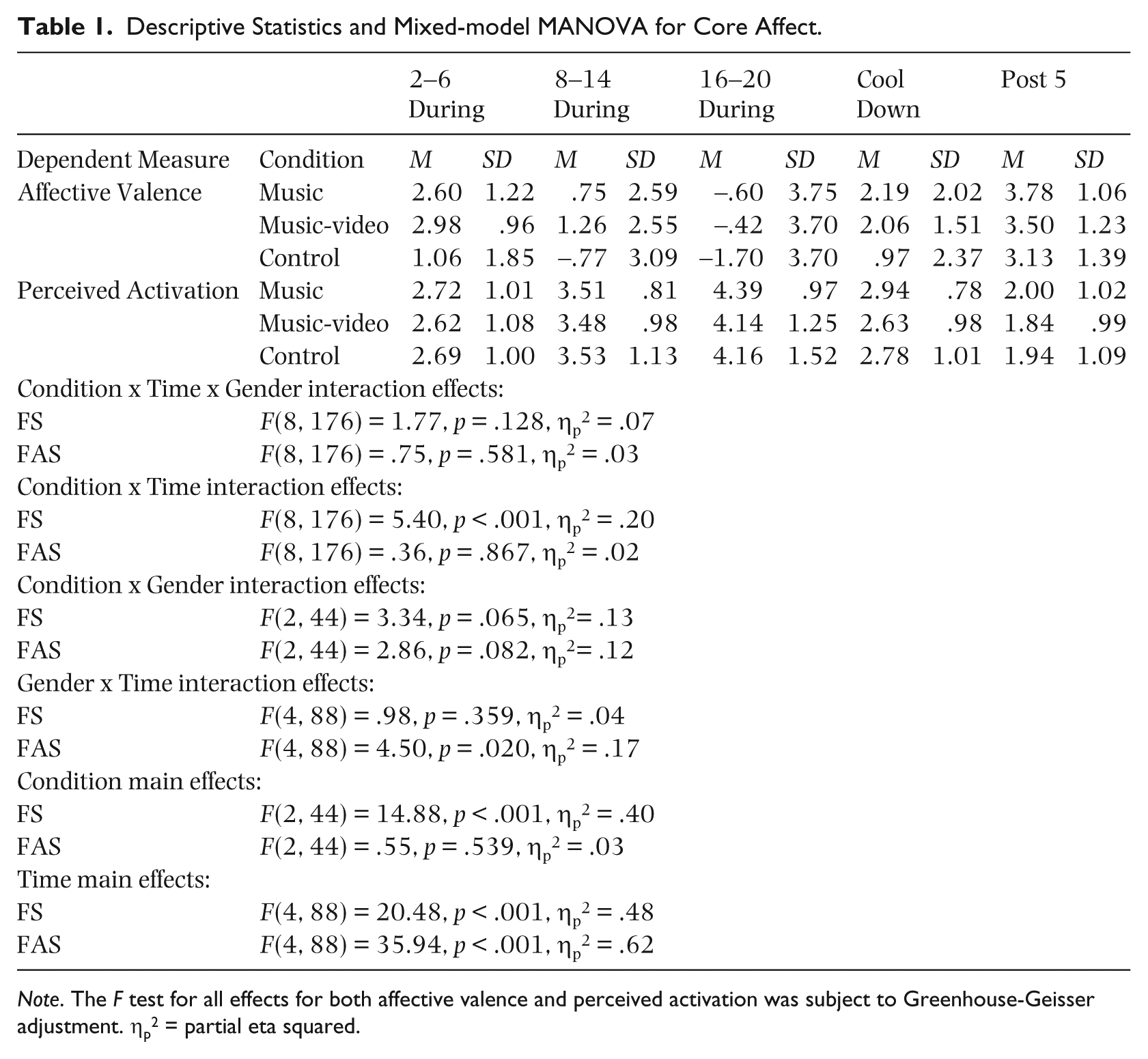
Note. The F test for all effects for both affective valence and perceived activation was subject to Greenhouse-Geisser adjustment. ηp2 = partial eta squared.
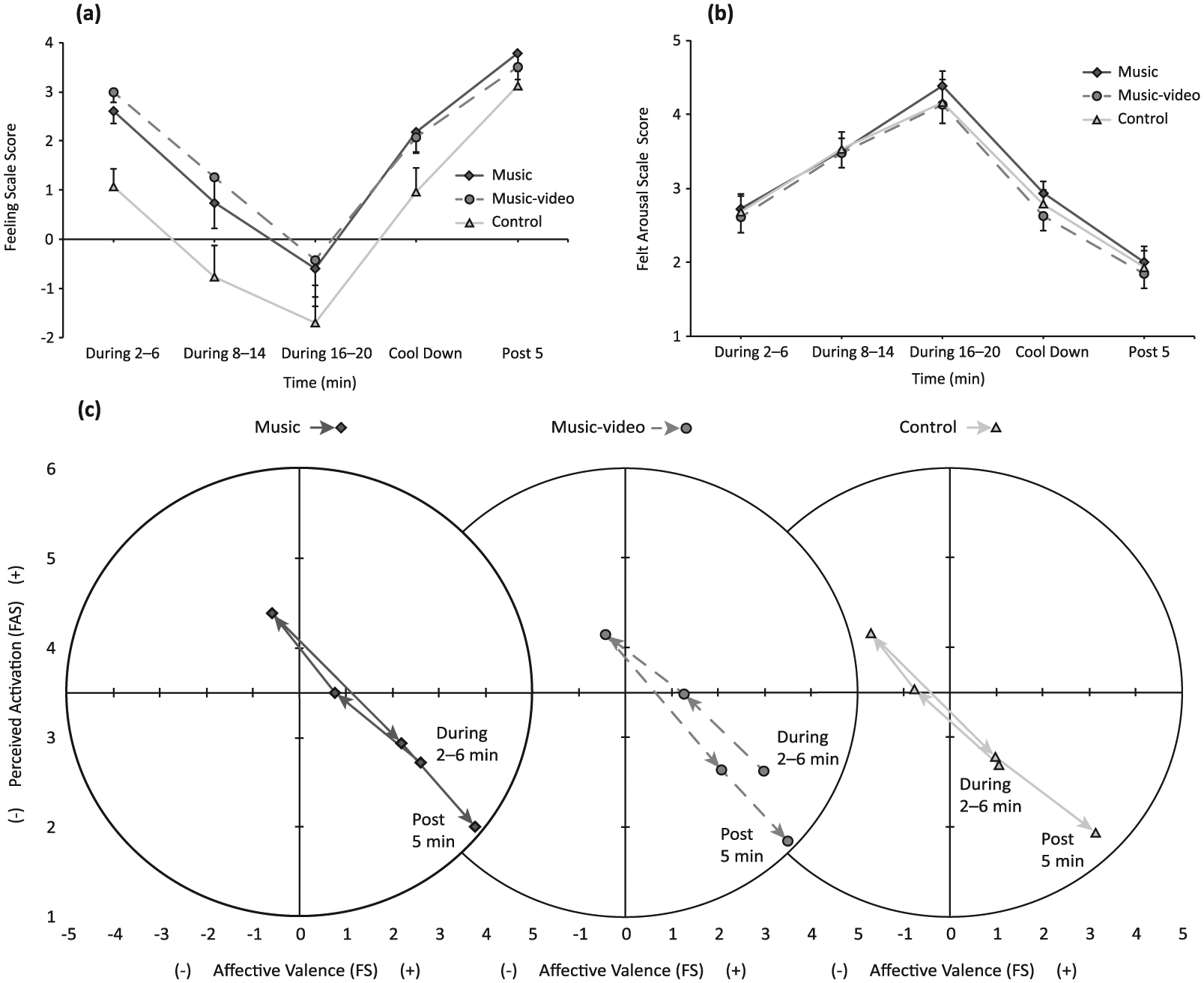
Feeling Scale (FS; a) and Felt Arousal Scale (FAS; b) responses (M and SE) during all conditions, and as an affective circumplex (c).
Main effects
There was a main effect of condition for affective valence (p < .001, ηp2 = .40; see Table 1), associated with a large effect size. Pairwise comparisons showed that affective valence was significantly higher for music when compared to control (p = .001, 95% CI [0.47, 1.94]) and for music-video when compared to control (p = .002, 95% CI [0.47, 2.21]). There was a main effect of time for both affective valence (p < .001, ηp2 = .48) and perceived activation (p < .001, ηp2 = .62; see Table 1), both associated with a large effect size. Affective valence scores decreased incrementally throughout the exercise bout, and then increased immediately after the exercise bout. Affective valence scores were significantly higher 5 min post task compared to the start of the exercise bout (p = .005, 95% CI [0.30, 2.21]). Perceived activation scores increased incrementally throughout the exercise bout and then decreased incrementally following the exercise bout. Perceived activation scores were significantly lower 5 min post task than at the start of the exercise bout (p < .001, 95% CI [–1.20, –0.30]).
Discussion
The main purpose of this study was to examine the influence of music and music-video on core affect (affective valence and perceived activation) during and immediately following cycle ergometry at the lactate threshold. A secondary purpose was to investigate the degree to which gender moderated the influence of music and music-video on affective responses. Results indicated that there was a main effect of condition for affective valence (see Table 1). The music and music-video conditions facilitated more positive affective responses than the control condition, thus H1 was accepted. The hypothesis pertaining to perceived activation (H2) was not accepted given that there was no main effect of condition (see Table 1). Following the exercise bout, the affective rebound was largest in the control condition and therefore H3 was accepted. Finally, H4 was accepted given that gender did not moderate the influence of music and music-video on affective responses either during or immediately after exercise. The present findings should be interpreted with caution given the violations of normality that were evident in the data (13 out of 60 cells [21.7%]).
Affective variables
Affective valence
The present findings indicate that motivational music can elicit more positive affective valence when compared to a control condition, which is echoed in previous research (Karageorghis et al., 2009; Lim et al., 2014; Terry et al., 2012). Moreover, the findings illustrate how the addition of a visual stimulus further enhanced participants’ affective responses during exercise at the lactate threshold, an intensity at which affective responses are hypothesized to be the most malleable (Ekkekakis et al., 2011).
When exercising at, or close to the lactate threshold, internal and external cues compete, given that the capacity for attentional processing is reduced (Tenenbaum, 2001). It is plausible that the music-video condition provided a more salient external cue and consequently promoted a more dissociative attentional focus when compared with music only. Thus, the fatigue-related sensations associated with exercising at the lactate threshold could have been less prevalent in the music-video condition, resulting in a higher affective valence score (cf. Hutchinson & Karageorghis, 2013). What is noteworthy upon a closer examination of the condition x time interaction is the convergence in affective scores at the end of the exercise bout in the two experimental conditions. There is a larger difference evident, albeit non-significant, between the music-only and music-video conditions at the first two in-task measurement points (2–6 min; Mdiff = .38; 8–14 min; Mdiff = .51) when compared to the final in-task measurement point (16–20 min; Mdiff = .18). This is indicative of the reduced attentional processing capacity that is available to exercisers during the final stages of exercise (Tenenbaum, 2001). The benefits reported herein with regard to enhanced affect, are amplified by other recent studies that have investigated the impact of music-video on a range of performance-related and psychophysical variables (Bigliassi et al., 2014; Hutchinson et al., 2015; Lin & Lu, 2013). Accordingly, it is evident that music-video has the potential to influence a range of outcomes that are relevant both to physical performance and health maintenance (cf. Clark et al., 2016; Hallett & Lamont, 2015).
The present findings illustrate the potential efficacy of music-video in enhancing core affect; a benefit of music-only use that has been known about in the exercise domain for some time (see, e.g., Karageorghis & Terry, 1997). Given that the tracks were performed or visually depicted in the music-videos, their emotional salience was heightened and there is thus greater scope for the phenomenon of emotional contagion to occur (Juslin & Västfjäll, 2008). Notably, the findings indicate that, post task, music elicits more positive core affect than music-video (Mdiff = .28). The cessation of exercise was followed by an improvement in affective valence during the cool-down phase and 5 min post exercise in all conditions (see Figure 1a). Nonetheless, the control condition was associated with the most pronounced improvement; affective valence scores were elevated towards those observed in the experimental conditions. This has been referred to as the “rebound phenomenon” and repeatedly identified in the affect literature (e.g., Greene & Petruzzello, 2015; Stych & Parfitt, 2011). The finding is consistent with the dual-mode theory (Ekkekakis, 2003, 2005), which postulates that a robust rebound towards pleasure is expected following the termination of exercise that has induced a decline in affect.
Perceived activation
The experimental conditions had little bearing on perceived activation and a close examination of the findings indicates that participants reported the highest perceived activation in the music condition (see Figure 1b). This finding is consistent with recent research that has examined exercise intensities above the ventilatory threshold (Hutchinson et al., 2015; Jones et al., 2014). Many researchers in this field have suggested that the most-frequently cited goal of music is to influence feelings (Juslin & Laukka, 2004; Laukka & Quick, 2013). In a review of the psychological constructs that mediate musically-induced feelings, Juslin (2013) explained that visual imagery refers to a process whereby feelings are evoked in the listener as a result of the inner images that they conjure up while listening to music. Thus, it is plausible that the physical images contained within the music-videos were deemed to be less stimulating than the participants’ internal images when exercising in the music and control conditions.
The significant main effect of time revealed that all conditions elicited a decrease in perceived activation from the latter stages of the exercise bout to post 5 min (see Figure 1b). This is in accordance with the average post-exercise state that is characterized by a gradual decrease in perceived activation (Ekkekakis, 2003). It also points to a specialist role that music might play in expediting post-exercise recovery through the principle of entrainment, wherein the main pulses of the body such as respiration and heart rate can be “guided” towards resting levels by appropriate musical stimuli (see Karageorghis, 2015).
Moderating influence of gender
The non-significant higher-order interaction for affective valence and perceived activation revealed that gender not did moderate the influence of music and music-video on affective responses during and immediately post exercise. The present results are thus dissimilar to those of Karageorghis et al. (2010) who reported that women exhibited significantly higher affective valence scores than men when exposed to music. The discrepancy in findings might be attributed to differing exercise modalities (cycle ergometry vs. circuit-type exercises to exhaustion), as well as the manner in which the music was used (asynchronous vs. synchronous application). Both of these are task-related situational factors that were theorized to moderate affective responses to music in a recent model (Karageorghis, 2015). For perceived activation, there was a significant (p = .020) gender x time interaction wherein FAS scores significantly increased during and decreased post exercise for men only. One might speculate that this difference has an evolutionary antecedent: Males generally experience stronger psychobiological responses to physical activity given the salience of such responses to the hunting and defending conducted by our male forebears (Lombardo, 2012).
Limitations of the present study
As previously highlighted, there were multiple violations of normality evident in the affective data. Planned transformations would only have served to normalize a proportion of the non-normal data, while rendering other sections of the dataset non-normal. Accordingly, we decided not to run transformations, and the results of the present study should be interpreted with these violations in mind.
We compared affective responses to music and music-video during exercise at the lactate threshold. A further limitation was that a video-only condition was not included, therefore the capacity of video alone in mediating affective responses during and post exercise remains unexplored. Nonetheless, in naturalistic conditions such as health and fitness facilities, it is unlikely that exercisers would watch a music-video without the accompanying sound (see also Hutchinson et al., 2015). Moreover, we did not measure participants’ responses to music and music-video while they were at rest. This was due to a previous suggestion that engagement in exercise influences how individuals respond to music (Karageorghis & Jones, 2014). However, in exercise and health facilities it is highly likely that such stimuli would be present both prior to and following an exercise bout.
Another limitation of the present study was that the music used in the experimental trials was subject to specific selection criteria but the same cannot be said for the video content. Ten volunteers each provided three tracks that they considered to be motivational for stationary cycling and the tracks were subsequently rated by one of the experimenters using the BMRI-2 (Karageorghis et al., 2006). The experimental participants were not afforded the opportunity to rate the music themselves and thus the extent to which they found it motivating for cycle ergometry remains unknown. It has been argued that experimenter-selected music can compromise the perception of control for the listener, which has been identified as one of the mechanisms underlying the efficacy of music in regulating affective responses (Chanda & Levitin, 2013; Mitchell & MacDonald, 2006).
The study was conducted in a laboratory environment and therefore the results may not be directly transferable to real-world settings (Glasgow, Green, & Ammerman, 2007). Indeed, cognitive factors may influence affective responses when exercising in stimulating environments (e.g., an exercise facility or outdoors) when compared to laboratory settings (Rose & Parfitt, 2010). Generalization of the present findings to the wider population may also be limited by the homogenous characteristics of the sample employed (i.e., age and training status), as well as the exercise modality (cycle ergometry).
Practical implications
The present findings provide empirical evidence to support the efficacy of music and music-video as a strategy for enhancing the exercise experience. This is illustrated in Figure 1c wherein only the control condition passed through the low-activation unpleasant quadrant of the circumplex model of affect (Russell, 1980). Affective responses to exercise are generally positive at low intensities, without the need for affect-enhancing strategies (Ekkekakis et al., 2011). However, the potential health benefits (e.g., cardio-respiratory fitness) associated with exercise are more substantial when higher-intensity exercise is performed (Riddoch & O’Donovan, 2006), albeit that this is subject to greater inter-individual variability in affect (Ekkekakis, 2003). Researchers have demonstrated the role of affective responses (both during and after exercise) in facilitating adherence to exercise (Williams, Dunsiger, Jennings, & Marcus, 2012). Habitual engagement in exercise confers several benefits in terms of physical health and mental wellbeing (Biddle et al., 2010). Likewise, at a societal level, raising adherence to exercise is advantageous given the considerable cost burden that has been associated with sedentary lifestyles (Townsend, Wickramasinghe, Williams, Bhatnagar, & Rayner, 2015). The key message for exercise or music therapy practitioners is that music and music-video may contribute to enhanced public health by increasing the appeal of higher-intensity exercise and facilitating adherence.
The affective rebound experienced post exercise by those in the music condition is also noteworthy (see Figure 1a). Practitioners are urged to consider the use of music in parts of exercise facilities that are used outside of the physical workout (e.g., changing facilities, onsite cafes) to enhance the overall experience of exercise. An added benefit to employing both music and music-video within exercise settings is its relative ease of implementation (Jones et al., 2014). From a practical perspective, instructor-led exercise programmes could be delivered via video and combined with music in order to promote positive affective responses to exercise. This is an inexpensive means by which to deliver such programmes, and would allow individuals to exercise at a time and place that is convenient to them. Moreover, there is scope for music and video choices to be made with direct reference to the circumplex model of affect in order that a desired affective state can be engendered by the combination of auditory and visual stimuli (cf. North & Hargreaves, 1997; Ritossa & Rickard, 2004).
Conclusion
This is the first study to demonstrate that music-videos can enhance core affect when exercising at the lactate threshold. From a theoretical standpoint, these findings are important because exercise at intensities proximal to the lactate threshold is associated with considerable affective variability (Ekkekakis, 2003, 2013). A strength of this study is that it focused exclusively on affective responses to exercise. Conversely, it has been suggested that the invasive nature of examining physiological measures (e.g., blood lactate levels) has the potential to negatively influence the effects of music (Karageorghis & Priest, 2012a).
A useful addition to this line of research would be the development of a method for selecting the most appropriate music-videos to accompany exercise. Future researchers may also consider incorporating a video-only and/or music-video-primes condition (see, e.g., Loizou & Karageorghis, 2015) so that a more comprehensive comparison can be made between auditory and visual stimuli. Moreover, it would be worthwhile to assess the influence of such stimuli on affective responses before, during, and post exercise, given the likelihood of such exposure within contemporary exercise facilities. Additional research is necessary to explore and explain the varying influences of music-video between the genders. Affective responses differ according to individuals’ previous exposure to exercise (Stych & Parfitt, 2011), therefore future researchers might also consider replicating the present study with a previously inactive sample.
In conclusion, it appears that music and music-video can be used as a valuable tool to enhance affective responses to exercise. Given the emerging empirical support pertaining to a positive relationship between affective responses to exercise and adherence (e.g., Williams et al., 2012), consideration of the music and music-videos played within exercise facilities is warranted and has positive implications for health and exercise practitioners. It is not only what one hears during exercise but also what one sees that can have a potent influence upon how one feels.
Footnotes
Funding
The authors received no financial support for the research, authorship, and/or publication of this article.