







Abstract
Music is commonly used in political contexts, to strengthen attitudes and group cohesion. The reported research examined reactions to music representing national values or contesting them in individuals with different political orientations, on issues related to national pride, cohesion and free expression. In Study 1, 100 Israeli participants heard three “patriotic” or “protest” songs and rated their agreement with statements regarding them. Beyond a number of main effects of music and of political orientation, several interactions between these two variables were found. For right-wing participants, patriotic music increased pride whereas protest music increased shame and fear of social disintegration. For left-wing participants, protest music led to higher agreement with the right to free expression. Study 2 included 78 participants and repeated the procedure with parallel texts. Main effects of texts were found, but no main effects of political orientation or interactions were found. Results are discussed in terms of the role and impact of music in political settings.
In many political settings such as ads, campaigns and gatherings, music is used as a means to induce emotion and enthusiasm, to strengthen the impact of political messages and to motivate people to engage in a cause, either in support of or protesting national values and policies (Brader, 2005; Laurence, 2015; Street, 2012). At the same time, perception and processing of pro- or counter-attitudinal information is biased by individuals’ prior political attitudes (Taber & Lodge, 2006). The present research aimed to examine the reactions of individuals with different political orientation to songs representing national values or criticizing them.
The issue of the individual’s responses to political music seems of particular relevance at a period in time in which the West is witnessing increased political polarization, with radical right-wing rhetoric and parties gaining influence in the US and Europe (Minkenberg, 2013; Wodak, 2015). However, no previous study has examined this issue. The study was conducted in Israel, where these trends have likewise been accentuated in recent years (Kremnitzer & Krebs, 2011). The reported research examines the ways in which “patriotic” and “protest” songs evoke emotions and thoughts related to identity and social cohesion, and how this effect is moderated by individuals’ political orientation. Specifically, the study aims to answer the questions: Can songs expressing ideas supporting or contesting national values accentuate thoughts and emotions related to listeners’ prior ideological attitudes and political identity? And if so, is this effect attributable to lyrics alone or to their musical setting?
In the following sections, the relationship between political orientation and identity will be reviewed, followed by a brief review of existing literature regarding the role of music in political identity. A discussion of two types of songs, patriotic and protest songs, will then be presented, leading to the specific predictions of the study.
Identity and political orientation
Among the social factors influencing the construction of a sense of identity, values and ideologies play a significant part (Gecas, 2000). Political orientation is considered a stable factor of identity, influenced both by socialization (top-down processes) and by psychological dispositions (bottom-up processes; e.g. Block & Block, 2006; Huddy, 2001; Jost, Federico, & Napier, 2009), with robust personality and ideological differences between right- and left-wing individuals (Carney, Jost, Gosling, & Potter, 2008). For the purpose of the present study, three significant issues, which are relevant to music, and on which right- and left-wing individuals differ, will be considered: a) Feelings of national pride. Right-wing individuals are generally found to be more proud of their nationality and more patriotic than left-wing individuals (Huddy & Khatib, 2007; Ya’ar & Lipsky, 2008); b) Feelings regarding the importance of group cohesion. Right-wing individuals are generally more motivated by concerns about threats to group cohesion, loyalty and homogeneity (Graham, Haidt, & Nosek, 2009; Haidt & Graham, 2007; Janoff-Bulman, Sheikh, & Baldacci, 2008); and c) Finally, the more cognitive aspect of freedom of speech. Previous research has shown that right-wing individuals are generally less supportive of free speech (Davis & Silver, 2004; Lindner & Nosek, 2009; though see: Crawford & Pilanski, 2012). Societies engulfed in intractable conflict, such as Israel, develop an ethos of conflict which emphasizes the importance of social unity and objection to internal conflict. Higher acceptance of this ideology is stronger in right-wing individuals (Bar-Tal, Sharvit, Halperin, & Zafran, 2012).
Although political orientation is generally a stable factor of identity, situational factors may influence its salience. Self-Categorization Theory (Turner, Hogg, Oakes, Reicher, & Wetherell, 1987), as a component of social identity theory (Tajfel & Turner, 1979), focuses on individuals’ assimilation of themselves as part of an ingroup prototype. Identity in this context is considered a dynamic process, and intragroup similarity may be accentuated by situations or stimuli which render a particular social category salient (Hogg, Hardie, & Reynolds, 1995; Hogg & Terry, 2000). One such stimulus, for example, is mortality salience. Although mortality salience generally increases support for right-wing policies (Landau et al., 2004), a number of studies have shown that its effect is moderated by participants’ political orientation (e.g. Greenberg, Pyszczynski, Solomon, & Chatel, 1992; Pyszczynski et al., 2006, study 2). The question thus arises as to whether songs expressing support or contesting national values may likewise elicit different responses in individuals with different ideological perspectives.
Music, identity and political orientation
Responses to music, like formation of identity, are related to the individual within their social context (Frith, 1996/2011). Previous researchers have demonstrated that music can play important roles in the construction and maintenance of both personal and social identity (Hargreaves, Miell, & MacDonald, 2002), bonds people together, and highlights social belonging and pride (Hallam, 2006; Turino, 2008). As a social product, music expresses and symbolizes ideas and ideologies, and embodies political values (Street, 2012). The subjective reaction to it is influenced, among other things, by the degree to which individuals consider the music to represent personal values and express their identity (DeNora, 2000; Giles, Denes, Hamilton, & Hajda, 2009; Schäfer & Sedlmeier, 2009). Confirming the link between political identity and music, various studies have shown differences in musical preferences and taste diversity between individuals with different political orientations (Carney et al., 2008; North & Hargreaves, 2007; Rentfrow & Gosling, 2003).
Like political orientation, music is thus connected to social identity, group cohesion, and ideological values. In a political context, we may distinguish between patriotic songs, which represent and emphasize national values, and protest songs, which represent dissent, and challenge and criticize the accepted views.
Patriotic and protest music
The most obvious example of a song representing the nation is the national anthem. The national anthem is a song composed and recognized first and foremost as a symbol of the nation, and has no prior meaning. Indeed, the national anthem has been found to increase patriotism (Feshbach, 1994), and to evoke more national associations than other songs, similar to those evoked by the national flag (Bodner & Gilboa, 2009a). However, other songs may acquire representational patriotic meaning through their association with national events or contexts.
Music representing the nation and expressing its values is linked to the formation and maintenance of national identity (Biddle & Knights, 2007). Musical ethnocentrism, defined as preference for culture-specific music as opposed to foreign music, has been shown both to play a role in the construction of national identity, and to be stronger in individuals with high national identification (Boer et al., 2013). This type of music is often encouraged by the state through policies in an attempt to enforce national sentiment and patriotism (Connell & Gibson, 2003). In Israel, songs written in the first decades after its creation in 1948 were mobilized by the establishment to serve the development of a sense of nationality. These songs were canonized by their performance in specific social and national contexts, and identification with them signified identification with the state. Many of the songs deal with the defense of the land, wars and the experiences of soldiers (for a review, see Regev & Seroussi, 2004), and emphasize the importance of collective over individual values (Katz, 2014). These songs are still used in official ceremonies and holidays and memorial days. Such songs have been shown to reinforce a sense of national identity and cohesion within different social groups in Israeli society (Bodner & Gilboa, 2009b).
At the same time, popular music, being created within a social context, reflects its time and society’s concerns. It may thus also express dissent and engage and mobilize movements (Eyerman, 2002; Peddie, 2006), functioning as an agent of resistance and opposition (McNair & Powels, 2005). Periods of war or other controversial political affairs may produce musical genres, songs, or musicians, which are recognized as representative of protest movements (Street, 2012). However, protest music in Israel, like in other countries, is less prevalent than other types of music (Weinstein, 2006). Songs protesting Israeli policies regarding the occupation and its military policies started appearing mainly after the first Palestinian uprising (Intifada) and the first Lebanon war, in the 1980s (Steiner, 2001). Defying accepted views of the military and wars, these songs deal with the occupation and with the negative individual experiences of soldiers and citizens.
In spite of the important role music plays in society and in representing national values and dissent, no empirical study has examined the reactions to songs in relation to political identity. The present study thus aimed to fill this gap in the literature and to examine how individuals with different political orientations react to national and protest songs on the three core issues mentioned above: feeling of national pride/shame, concerns regarding social cohesion/disintegration, and thoughts regarding freedom of speech/censure. Several predictions were made:
Main effects of music
Given that patriotic songs are generally an inherent part of socialization among members of Israeli society, it was hypothesized that these songs would evoke more feelings of pride in being Israeli than protest songs. Protest songs, on the other hand, which challenge the accepted values, were predicted to evoke more fear for the disintegration of society, and more need for censorship.
Main effects of political orientation
Individual differences in ideological beliefs and political identity were hypothesized to predict differences between right- and left-wing individuals, with right-wing individuals scoring higher on pride in being Israeli, in their belief in the need for social cohesion (and fear for the disintegration of society), and in their belief in the need to censor certain contents.
Interaction between songs and political orientation
It was hypothesized that political orientation would moderate the effect of type of songs, with songs matching participants’ inclinations accentuating responses. Thus, it was predicted that patriotic songs would evoke more pride and protest songs would evoke more shame in right-wing than in left-wing individuals; protest songs would evoke more fear for the disintegration of society than patriotic songs in right-wing individuals; and protest songs would evoke more agreement with the need to censor certain contents in right-wing individuals.
Study 1
Participants
Data were collected as part of a larger study on music and national identity, which examined the effect of music on issues related to patriotism. One hundred participants took part in the study (mean age = 30.9, SD = 5.25): 51 males (mean age = 31.11, SD = 5.16) and 49 females (mean age = 30.67, SD = 5.39). Participants took part in the study through a sampling company. Deliberate sampling was used, to obtain relatively equal groups of participants with left-wing, centrist, and right-wing political orientation. Thirty-three participants defined themselves as moderate or clear left-wing, 29 as centrist and 38 as moderate or clear right-wing. Participants were assigned to the “patriotic songs” group (20 males, 31 females) or the “protest songs” group (31 males and 18 females), maintaining a similar distribution of political orientation in each group. The patriotic songs group included 18 left-wing, 13 centrist, and 20 right-wing participants. In the protest songs group there were 15 left-wing, 16 centrist, and 18 right-wing participants.
Materials
Music
A pre-test was conducted in order to choose songs for the “patriotic” and “protest” categories. Since militarism is an important aspect in Israeli socialization and the construction of national identity (Furman, 1999; Levy & Sasson-Levy, 2008; Lissak, 2001), all the songs chosen for the pre-test dealt with war and being a soldier. Thirty participants who did not take part in the main study (20 males, mean age = 30.7, SD = 5.67, and 10 females, mean age = 31.8, SD = 5, general mean age = 31.06, SD = 5.4) took part in an online pre-test. Five “patriotic” songs, glorifying soldiers and fighting for the country (Regev & Seroussi, 2004), and five “protest” songs, criticizing these issues, were used. Participants heard the first stanza of each song while viewing its lyrics in white on a black screen, and were asked to rate on a scale from 1 (not at all) to 7 (very much) the degree to which each song may be considered a representative patriotic song, expressing national values, or a protest song, criticizing the nation. Based on participants’ replies, three songs were chosen for each category. Songs and lyrics appear in the Appendix.
For the main study, clips in which the first stanza of each song was played while the lyrics appeared in white on a black screen were prepared. The duration of each final clip was around 3:30 minutes. For each music group, three clips were prepared, in which the order of presentation of the songs was varied.
Questionnaire
Participants listened to the songs and rated their familiarity on a scale from 1 (not at all) to 7 (very much). They then rated their agreement with seven statements regarding reactions evoked by the songs on a scale from 1 (not at all) to 7 (very much). Since framing statements in a positive or negative manner has been found to influence responses and processing (Levin, Schneider, & Gaeth, 1998), six of the items were pairs of items worded either positively or negatively. Two items were related to national pride/shame: “when I hear music like this, I feel proud (positive)/ashamed (negative) of being Israeli”; two items measured issues regarding national cohesion: “when I hear songs like these, I understand the importance of maintaining national cohesion” (positive) and “When I hear songs like these I fear for the disintegration of Israeli society” (negative); and two items measured freedom of expression: “When I hear songs like these I think all opinions should be expressed” (positive) and “When I hear songs like these I think some contents should be censured” (negative). Finally, participants were asked to rate their agreement with the statement: “The songs have a political content”.
Procedure
The study was run online. Participants heard the first stanza of three patriotic or three protest songs while viewing the lyrics. Following that, they rated their familiarity and items related to the songs.
Results
A significant difference in familiarity with the songs was found, t(98) = 9.93, p < .001. Patriotic songs were more familiar (M = 6.53, SD = .85) than protests songs (M = 3.24, SD = 2.19). Within each music type, no significant differences in familiarity with either national or protest songs were found between participants of different political orientations.
Prior to testing hypotheses, correlations were run between the two items in each pair (pride/shame; cohesion/fear for disintegration; freedom of expression/censure) for patriotic and protest songs separately, in order to see whether these can be reduced to three items. Whereas items in each pair were significantly correlated in the protest songs (positive correlation between cohesion and disintegration, r(49) = .286, p = .047; negative correlation between pride and shame, r(49) = -.296, p = .039; negative correlation between freedom of expression and censure, r(49) = -.6, p < .001), no significant correlations were found for the patriotic songs. It was therefore decided to treat each item separately.
A multivariate ANOVA was conducted with song (patriotic/protest) and political orientation (left/center/right) as independent variables, and the items regarding the songs as dependent variables.
Confirming the first hypothesis, a main effect of song was found for pride, F(1, 94) = 19.9, p < .001, partial η2 = .175, and for shame in being Israeli, F(1, 94) = 24.77, p < .001, partial η2 = .209. Patriotic songs evoked more pride, whereas protest songs evoked more shame; for fear for the disintegration of Israeli society, F(1, 94) = 11.68, p = .001, partial η2 = .111, with patriotic songs evoking less fear than protest songs; for the need to censure certain contents, F(1, 94) = 9.41, p = .003, partial η2 = .091, with patriotic songs leading to less belief in the need for censure than protest songs; and for political content of songs, F(1, 94) = 26.36, p < .001, partial η2 = .219. Patriotic songs were rated as less political than protest songs.
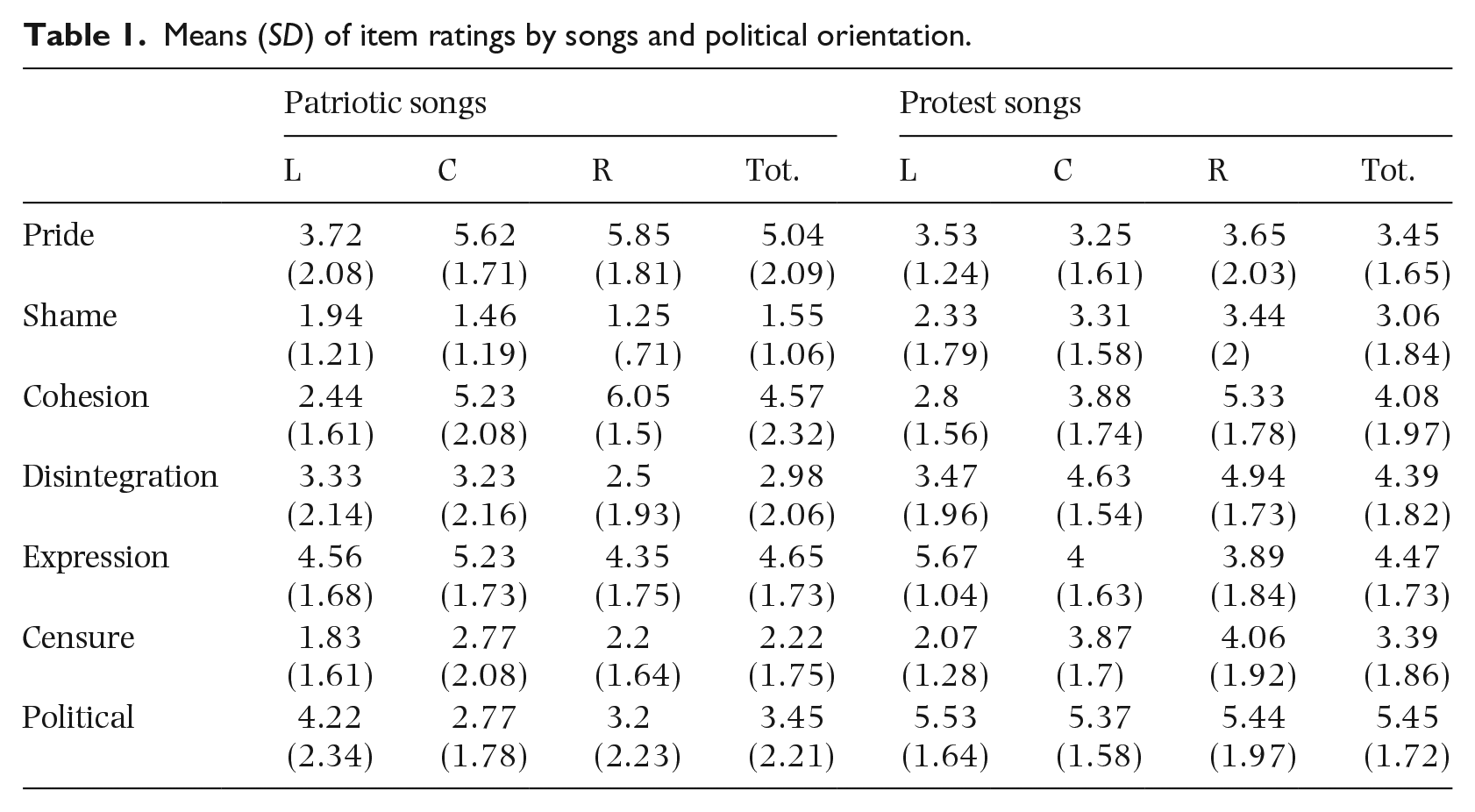
As predicted by the second hypothesis, a main effect of political orientation was found for pride in being Israeli, F(2, 94) = 3.32, p = .04, partial η2 = .066. The more right-wing the participants, the higher the score on this item. Post-hoc tests showed a significant difference between left- and right-wing participants at p = .026; for the importance of maintaining national cohesion, F(2, 94) = 28.67, p < .001, partial η2 = .379. The more right-wing the participants, the more they agreed with this item. Post-hoc tests were significant between all groups at p < .05; for allowing the expression of all opinions, F(2, 92) = 3.17, p = .047, partial η2 = .063. The more right-wing the political orientation, the lower the agreement with this item. Post-hoc tests showed the only difference that approached significance was between right- and left-wing participants (p = .052); for the need to censure certain contents, F(2, 94) = 6.01, p = .003, partial η2 = .113. The more right-wing the political orientation, the higher the score. Post-hoc tests showed all differences significant at p < .05 except between center and right-wing. Table 1 presents means and standard deviations of scores by music and political orientation.
Means (SD) of item ratings by songs and political orientation.
Regarding the third hypothesis, several significant interactions between songs and political orientation were found: a significant interaction between music and political orientation for pride in being Israeli, F(2, 94) = 3.89, p = .024, partial η2 = .077; see Figure 1.
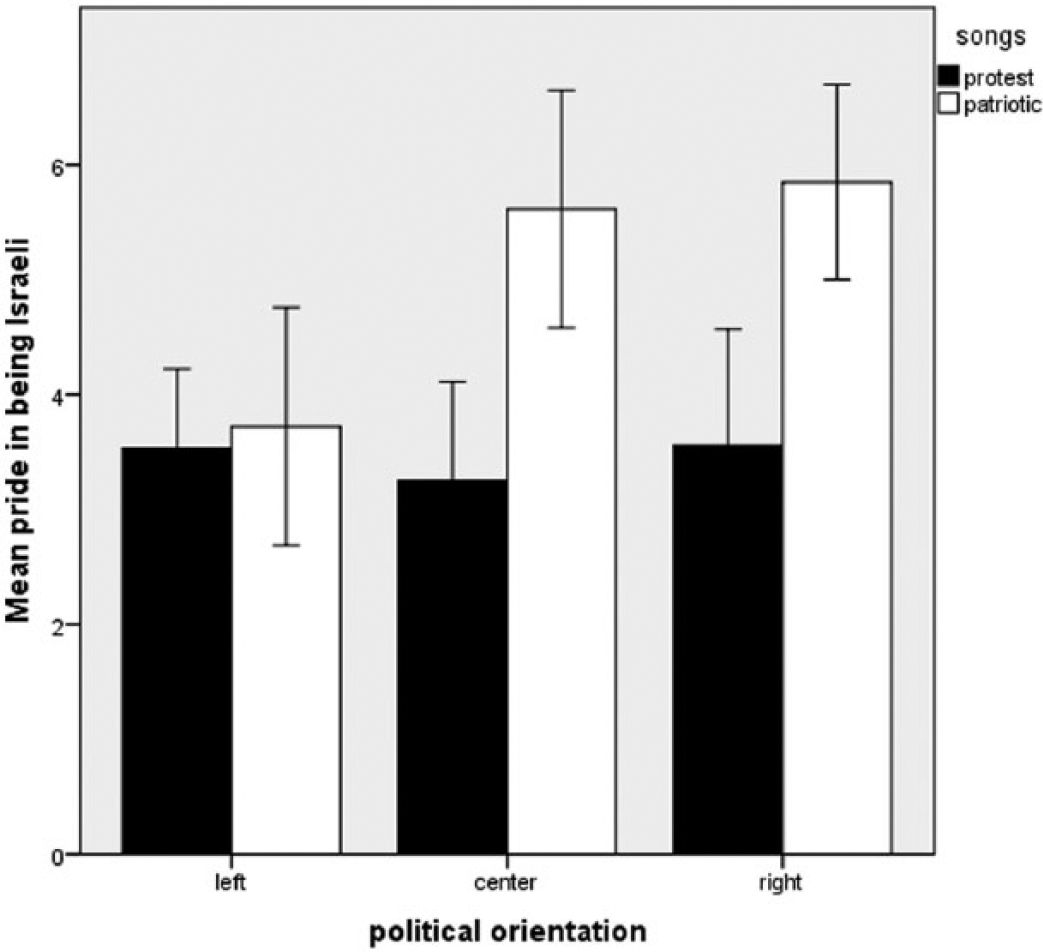
Interaction between songs and political orientation on pride.
Independent samples t-tests within each political orientation on pride in being Israeli between national and protest songs showed that within left-wing participants the difference was not significant, whereas it was for centrist and right-wing participants at p = .001.
Two one-way ANOVAs were conducted within each song type between participants with different political orientation. For the protest songs, the effect was not significant. For patriotic songs the effect was significant, F(2, 50) = 6.82, p = .002. Post-hoc tests showed all differences significant at p < .05 except between centrist and right-wing participants.
A significant interaction was found for shame in being Israeli, F(2,94) = 3.59, p = .031, partial η2 = .071; see Figure 2.
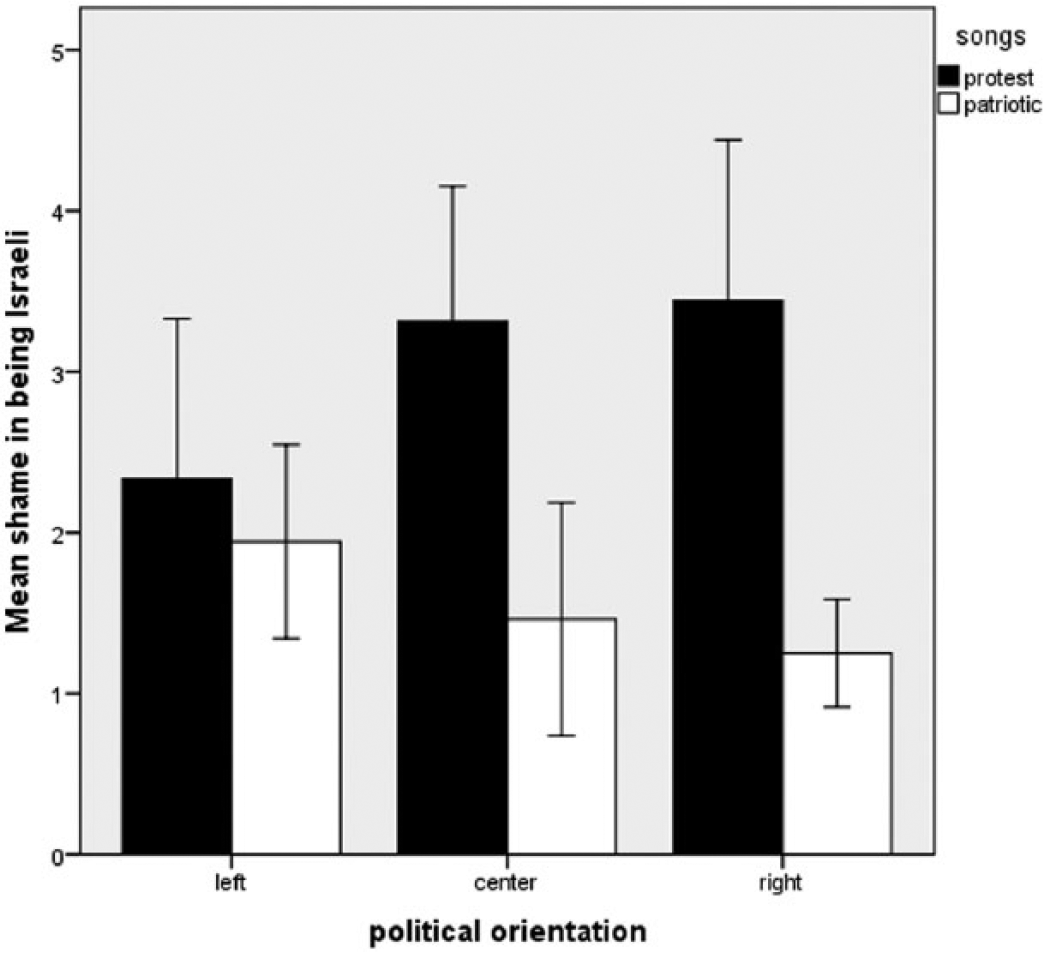
Interaction between songs and political orientation on shame.
Independent samples t-tests on shame in being Israeli between national and protest songs showed that within left-wing participants the difference was not significant, whereas it was for centrist and right-wing participants at p = .002 and p < .001 respectively.
Two one-way ANOVAs were conducted within protest and patriotic songs between political orientations. No significant effect was found within either type of song.
A significant interaction was found on fear for the disintegration of Israeli society, F(2, 94) = 3.18, p = .046, partial η2 = .064; see Figure 3.
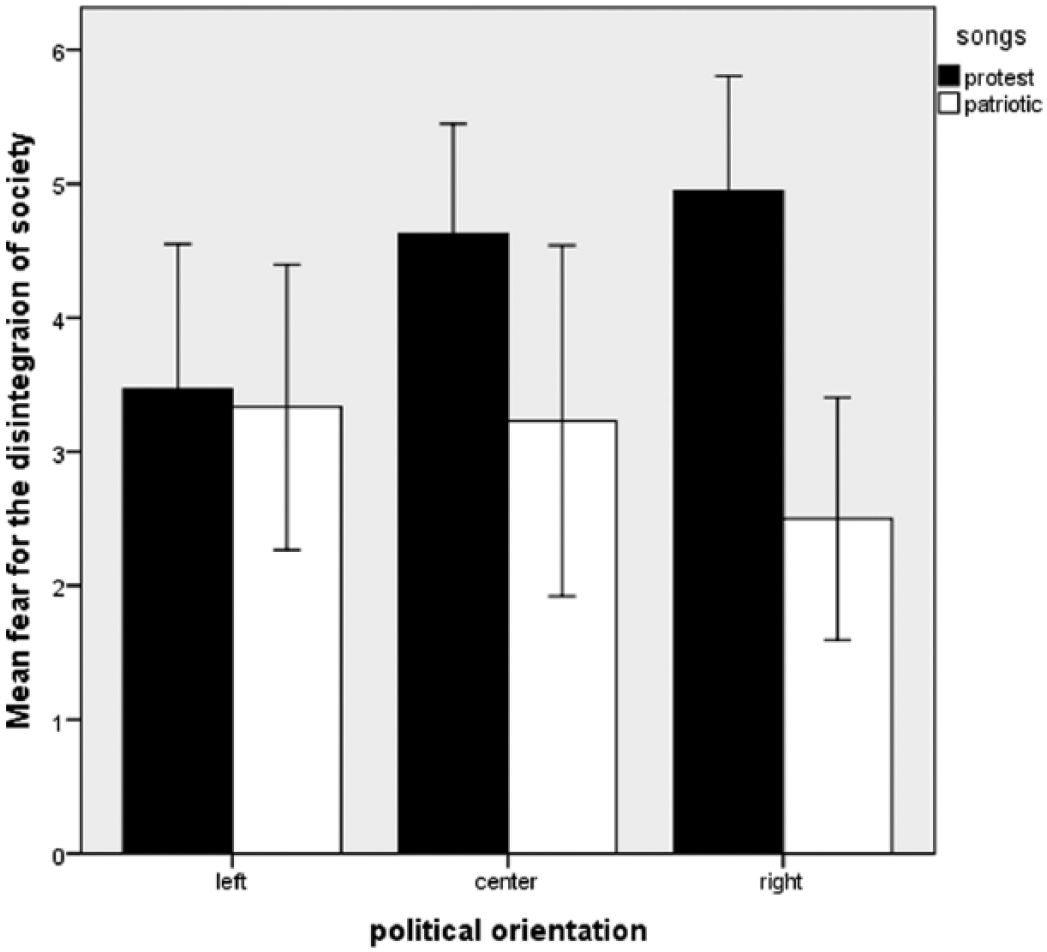
Interaction between songs and political orientation on fear for the disintegration of society.
Independent samples t-tests on fear for the disintegration of Israeli society between patriotic and protest songs showed a significant difference within right-wing participants at p < .001.
Two one-way ANOVAs were conducted within protest and patriotic songs between political orientations. For the protest songs, an effect approaching significance was found, F(2, 48) = 3.14, p = .052. Post-hoc tests showed a significant difference between left- and right-wing participants (p = .05). For patriotic songs the effect was not significant.
Finally, a significant interaction was found on the item referring to allowing expression of all opinions, F(2, 94) = 4.08, p = .02, partial η2 = .08; see Figure 4.
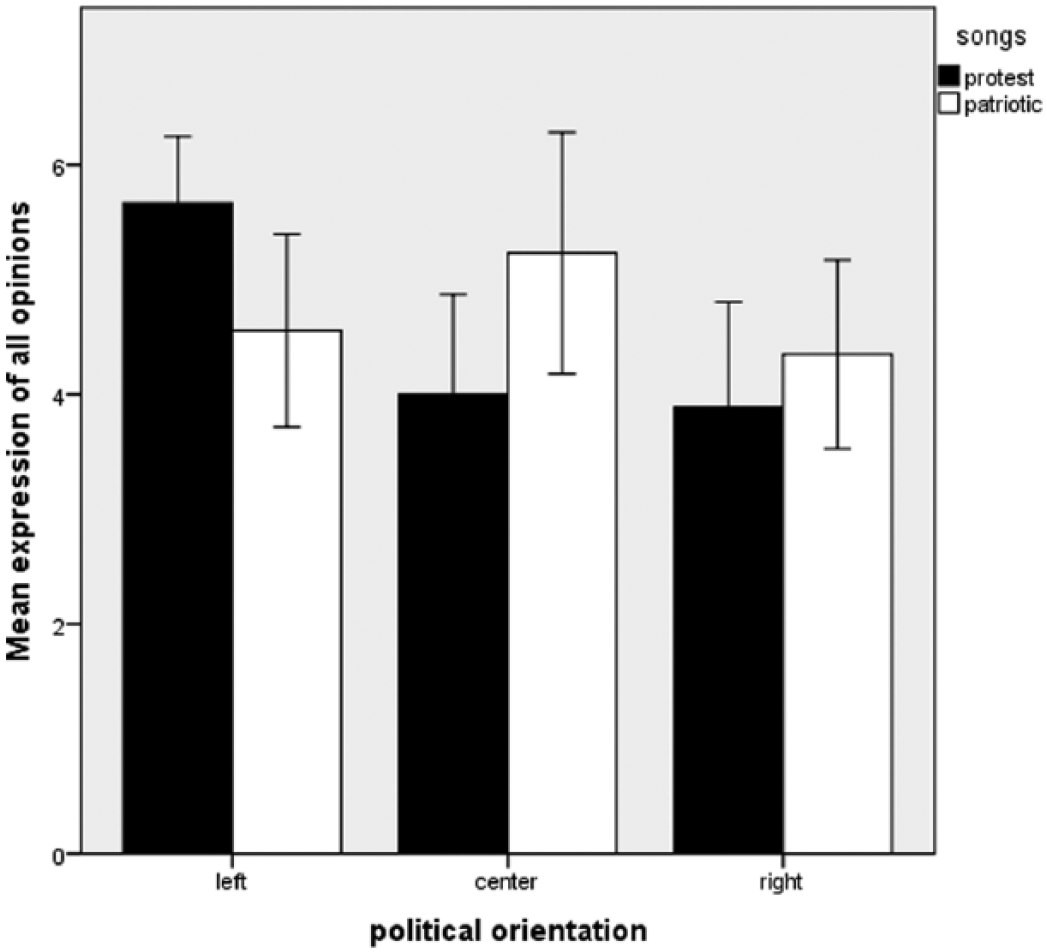
Interaction between songs and political orientation on expression of opinions.
Independent samples t-tests within each political orientation on allowing expression of all opinions between patriotic and protest songs showed that within left-wing participants the difference was significant (p = .034). For centrist and right-wing participants, the differences were not significant.
Two one-way ANOVAs were conducted within protest and patriotic songs between political orientations. For the protest songs, a significant effect of political orientation was found, F(2, 50) = 6.32, p = .004. Post-hoc tests showed significant differences between left-wing participants and centrist and right-wing participants at p < .05. For patriotic songs the effect was not significant.
Discussion
The observed main effects of protest songs, leading to higher agreement on the need to censure certain contents and being evaluated as more political, seem to confirm that such songs are perceived as contesting accepted values (Street, 2012). The patriotic songs, on the other hand, were rated as less political and received lower scores on the need for censorship. These results suggest that, being familiar from childhood, national holidays and memorial days (Regev & Seroussi, 2004), the patriotic songs were perceived as part of a neutral “base-line” within Israeli national identity. Likewise, the main effects of political orientation on the importance of social cohesion and the need to censure certain contents are in line with ideological differences between right- and left-wing individuals on these issues in general (Janoff-Bulman et al., 2008).
Beyond these main effects, three of the four items relating to feelings of national identity and social cohesion yielded a significant interaction between songs and political orientation. A closer look at these interactions reveals that these interactions were due to differences within centrist and right-wing participants. For these participants, patriotic songs led to stronger feelings of pride, while protest music led to stronger feelings of shame and a stronger fear for the disintegration of society. The differences within left-wing participants were not significant. To the extent that right-wing individuals are generally more patriotic and proud of their nationality (Huddy & Khatib, 2007; Ya’ar & Lipsky, 2008), the higher pride and shame evoked by patriotic and protest songs, respectively, seem to reflect opposite sides of the same feeling. The stronger fear for the disintegration of society evoked by protest songs is in line with previous studies, which have shown that when an initial attitude is strong, political messages perceived as opposing it strengthen this initial attitude (Bizer & Petty, 2005). With right-wing individuals being motivated by uncertainty avoidance (Jost, Glaser, Kruglanski, & Sulloway, 2003) and having stronger attachment to group homogeneity and cohesion (Janoff-Bulman et al., 2008), the negative aspect of social disintegration may have created a stronger effect than the positive aspect of social cohesion. Moreover, previous studies have shown that right-wing individuals react more strongly to emotional stimuli than left-wing individuals (Tritt, Page-Gould, Peterson, & Inzlicht, 2014). These effects may thus be related to the items referring to feelings evoked by the two types of songs.
As for the items regarding freedom of speech, an interaction was found on the right to express all opinions. In this case, however, the significant difference was due to differences within left-wing participants. Protest songs led these participants to higher agreement. Left-wing individuals generally believe more in free speech (Davis & Silver, 2004), and are more motivated by social justice (Janoff-Bulman et al., 2008). Listening to songs which express a view which differs from accepted consensus but is in line with their values may have rendered this attitude more salient (Hogg & Terry, 2000).
The results thus suggest that although political orientation is a stable part of identity (Block & Block, 2006; Jost et al., 2009), certain stimuli may influence the salience of attitudes, as proposed by Self-Categorization Theory (Hogg et al., 1995). They demonstrate that songs expressing ideas related to political identity elicit different responses in individuals with different political views, confirming that responses to songs are related to their relationship to personal values and identity (Giles et al., 2009; Schäfer & Sedlmeier, 2009).
However, since all the songs contained lyrics, it is possible that the effects were in fact due to the lyrics and not to their being expressed though music. Although the question of the relative influence of music and lyrics has not been studied in political contexts, lyrics have been shown to intensify the perception of emotion in music, particularly negative ones (Ali & Peynircioǧlu, 2010; Brattico et al., 2011). Likewise, songs with pro- or anti-social lyrics influence cognitions, attitudes and behavior accordingly (e.g. Anderson, Carnagey, & Eubanks, 2003; Greitemeyer, 2008, 2010). The aim of Study 2 was to examine whether texts expressing similar ideas to those expressed in the patriotic and protest songs would lead to similar effects, and to compare these findings with the findings of Study 1.
Study 2
Participants
Seventy-eight participants took part in the study, 39 males (mean age = 35.64, SD = 7.79) and 39 females (mean age = 31.38, SD = 7.76). General mean age was 33.51, SD = 8.01. As in Study 1, participants took part through a sampling company.
As in Study 1, a deliberate sampling was conducted, in order to obtain a relatively equal distribution of political orientations. Thirty-two participants (41%) rated themselves as left-wing, 30 (38.5%) as centrist, and 16 (20.5%) as right-wing. Participants were assigned to protest or patriotic texts groups, maintaining an equal distribution of political orientation. In the protest texts group (22 males and 16 females), 16 participants were left-wing, 15 centrist, and 7 right-wing. In the patriotic texts group (17 males and 23 females), 16 were left-wing, 15 centrist, and 9 right-wing.
Materials
Texts
Since using the lyrics of the songs in Study 1 may have evoked the music for participants who were familiar with them, for each of the songs used in Study 1, a parallel text was written, expressing the same ideas (see the Appendix). Texts were presented in white on a black screen. For each group, three different presentation orders of texts were created.
Questionnaire
The same questionnaire as in Study 1 was used, referring to the texts.
Procedure
Procedure of Study 2 was the same as that of Study 1.
Results
A main effect of text was found for shame in being Israeli, F(1, 72) = 24.92, p < .001, partial η2 = .257, with lower scores for patriotic texts than for protest texts; for fear for the disintegration of Israeli society, F(1, 72) = 4.15, p = .045, partial η2 = .055, with lower scores for patriotic texts than for protest texts; for expression of all opinions, F(1, 72) = 4.77, p = .032, partial η2 = .062, with higher scores for patriotic texts than for protest texts; for the need to censor certain contents, F(1, 72) = 4.69, p = .034, partial η2 = .061, with lower scores for patriotic texts than for protest texts; and for political content, F(1, 72) = 15.67, p < .001, partial η2 = .179. Scores were lower for patriotic texts than for protest texts. Table 2 presents means and standard deviations of item ratings by text type and political orientation.
Means (SD) of item ratings by text and political orientation.
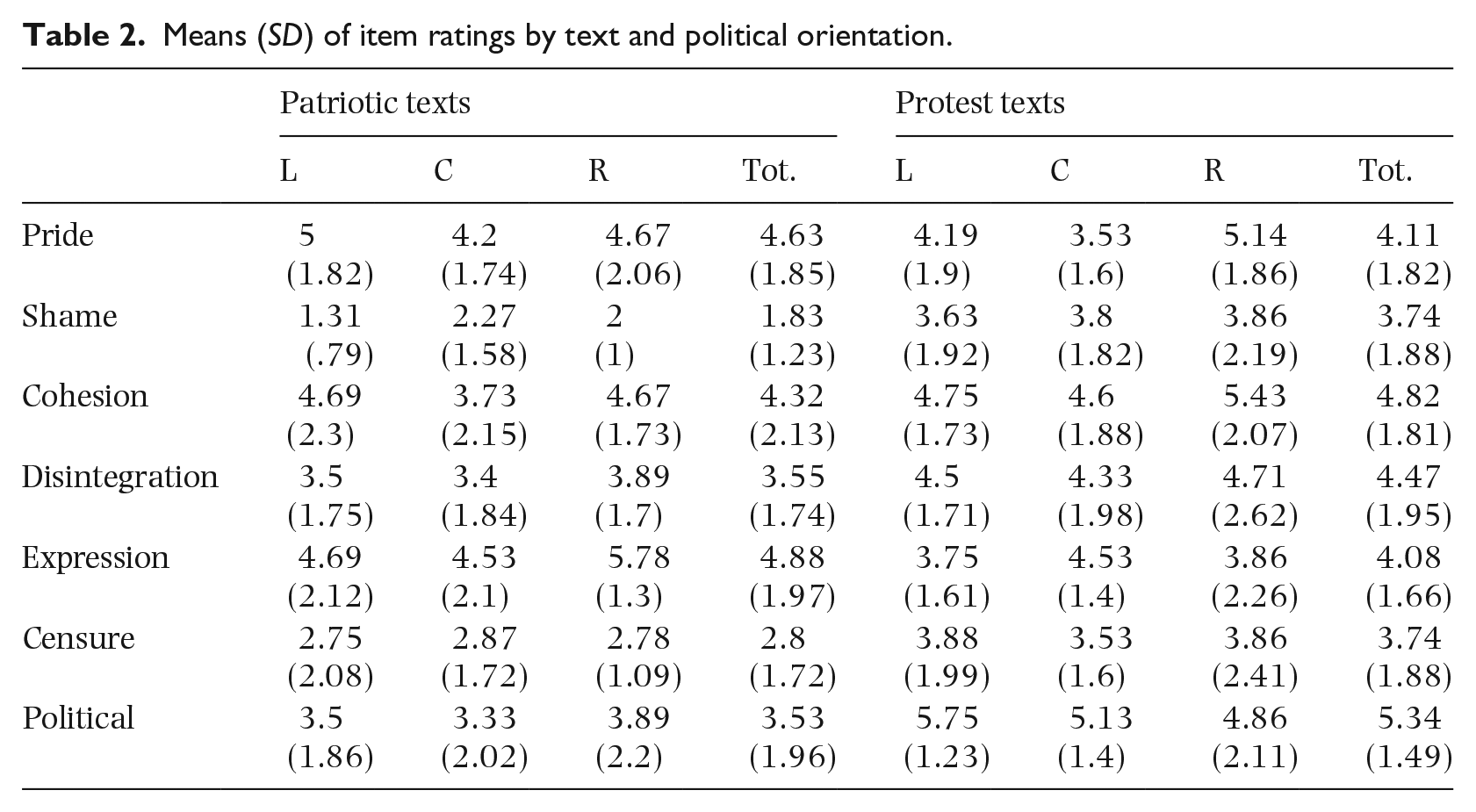
No main effect of political orientation was found on any item, nor any significant interaction between texts and political orientation.
Comparison between Study 1 and Study 2
In light of the interactions found in Study 1, t-tests were conducted within each political orientation between songs and text groups separately for patriotic and protest stimuli.
Left-wing participants
Comparisons of reactions to protest stimuli showed a significant difference for the need for national cohesion, t(29) = -3.27, p = .003, with participants in the songs group scoring lower (M = 2.8, SD = 1.56) than in the text group (M = 4.75, SD = 1.73); for the right to express all opinions, t(29) = 3.89, p = .001, with participants in the songs group scoring higher (M = 5.67, SD = 1.04) than in the text group (M = 3.75, SD = 1.61); and for the need for censorship, t(29) = -2.98, p = .006, with participants in the songs group scoring lower (M = 2.07, SD = 1.28) than in the text group (M = 3.88, SD = 1.99). As for the patriotic stimuli, a significant difference was found for the need for cohesion, t(32) = -3.31, p = .002. Participants in the songs group scored lower (M = 2.44, SD = 1.61) than in the text group (M = 4.69, SD = 2.31).
Centrist participants
For participants who defined themselves as politically centrist, no significant differences were found between those exposed to protest texts or songs. Using the Bonferroni correction, none of the differences in the patriotic stimuli were significant.
Right-wing participants
No significant differences were found for protest stimuli between participants exposed to texts or songs. Likewise, when using the Bonferroni correction, no significant differences were found for patriotic stimuli.
Discussion
The main effects of text found in Study 2 were quite similar to those of songs found in Study 1, suggesting that the songs and texts expressed similar ideas, and that the effects of songs found in Study 1 were partly attributable to their lyrics.
However, no main effects of political orientation and no interaction between texts and political orientation were found. It thus seems that reactions to texts, unlike to songs, did not involve personal identity aspects related to ideology, and evoked reactions conforming to mainstream views.
This interpretation is strengthened by the differences found within left-wing participants who listened to songs (Study 1) and those who read texts (Study 2). Protest songs evoked lower agreement with the need for national cohesion and for censorship, and higher agreement with the right to express all opinions than protest texts. Likewise, patriotic songs led to lower agreement with the need for cohesion than patriotic texts. To the extent that the attitudes evoked by the songs are in line with left-wing ideology, these differences lend support to the conclusion of Study 1, showing that songs may reinforce aspects of identity (Hargreaves, Miell, & MacDonald, 2002) and strengthen opposition (Eyerman, 2002; McNair & Powels, 2005; Peddie, 2006), when they represent personal values (Giles et al., 2009).
General discussion
Given that music is used in a variety of political contexts, understanding its effect on listeners is of particular relevance. The present research attempted to examine the reactions to patriotic and protest songs in individuals with different political orientations. Results suggest that these reactions are mediated by participants’ political orientation, and that similar effects do not occur when the same messages are expressed by texts alone. Three tentative conclusions may be drawn regarding the effect of music in political contexts.
First, results suggest that reactions to these types of songs involve aspects of social identity, rendering them more salient (Hogg & Terry, 2000), and that this effect is not attributable to lyrics alone. The fact that reactions to texts expressing similar ideas were not influenced by political orientation suggests that certain messages expressed through songs may touch individuals in a stronger and more personal way than texts alone, and reactions to them depend on identity and values (Giles et al., 2009; Hallam, 2006). Previous studies have shown that processing of words is influenced by music (Gordon, Schön, Magne, Asténaso, & Besson, 2010), and this may partly explain the stronger impact of songs than parallel texts alone. It should be noted, however, that the patriotic songs used in the study, unlike the parallel texts, were familiar (both music and lyrics) and this may have triggered emotions and cognitions related to events and ceremonies, which were not controlled in the presented study.
The second conclusion relates to the role of music in enhancing the salience of political attitudes, and in particular that of protest songs. Results show that, for left-wing participants, exposure to this type of songs, which express pro-attitudinal messages, led to higher scores on items related to their initial attitudes compared to the same messages expressed in text. This points to the potential significant role music may play in mobilizing and representing dissent (Eyerman, 2002; Peddie, 2006), and expressing views counter to accepted values. Given that protest movements hold positions and opinions diverging from the mainstream, it seems that protest songs may contribute to consolidating identity and engaging in opposition (Martin, 2006; Peddie, 2006).
A third conclusion relates to differences in responses between right- and left-wing individuals.Within the music groups, the effect of songs on right-wing individuals was more prominent in aspects of identity related to emotion, regarding a sense of pride and feelings concerning social cohesion. For left-wing individuals, on the other hand, the effect of songs was more evident in more cognitive aspects, related to the ideological belief in free speech. This conclusion is in line with studies showing that right-wing individuals tend to respond more strongly to emotional stimuli (Tritt et al., 2014). Moreover, the reactions evoked by protest songs in right-wing individuals were evident in the negatively-framed statements, whereas their effect in left-wing participants was in the positively-framed statement. This finding strengthens previous findings regarding differential responses to framing in right- and left-wing individuals (Day, Fiske, Downing, & Trail, 2014, study 2; Feinberg & Willer, 2012, study 3), as well as findings regarding differences in moral motivations between right- and left-wing individuals, with right-wing individuals being more motivated by avoidance of negative outcomes and fear than left-wing individuals (Janoff-Bulman et al., 2007; Jost et al., 2003). Results imply that for right-wing individuals counter-attitudinal songs strengthen initial attitudes and resistance (Bizer & Petty, 2005), whereas for left-wing individuals pro-attitudinal songs strengthen initial attitudes.
Being the first study to empirically examine these questions, the reported research has a number of limitations, which suggest directions for future studies.
The present research seems to suggest that exposure to pro-attitudinal content evokes reactions strengthening existing attitudes, but exposure to counter-attitudinal content does not weaken them. However, reactions were measured after a single exposure to national and protest songs. One of the factors found to influence political polarization is selective exposure to stimuli consistent with initial attitudes and political orientation (Knobloch-Westerwick & Meng, 2009; Stroud, 2010; Tsfati & Chotiner, 2016). At the same time, certain studies show that exposure to diverse positions may increase openness to other views and decrease avoidance of counter-attitudinal information (Levitan & Wronski, 2014). It is possible that multiple exposures to different types of songs, over longer periods of time, may influence individuals’ reactions to songs expressing counter-attitudinal messages.
Second, the songs used in both categories dealt with the military, which, although central in Israeli society (Levy & Sasson-Levy, 2008), is naturally not the sole issue defining national identity and political orientation. Repeating the studies with patriotic and protest songs and texts expressing other social issues would allow us to determine whether songs or texts dealing with other issues lead to similar reactions.
Third, whereas the processes that Israeli society is undergoing are parallel to other places in the West (Minkenberg, 2013; Wodak, 2015), Israel is a country engulfed in intractable conflict, with an ethos that has been built and maintained for many years (Bar-Tal, 2007). Conducting similar studies in other countries, in similar and dissimilar states of affairs, would help determine the degree to which these findings are generalizable.
Finally, although the texts used in Study 2 represented similar contents as lyrics of songs used in Study 1, they were not identical. In order to clearly separate the impact of lyrics and music, repeating the study with unfamiliar songs, which would allow using the same texts with and without music, would be useful. Moreover, manipulating musical parameters such as rhythm, harmony, or musical genre, may shed light on the specific effects musical elements may have on similar types of responses.
Footnotes
Appendix
Funding
The author(s) disclosed receipt of the following financial support for the research, authorship, and/or publication of this article: The author wishes to express her gratitude to the Research Fund of the Research Authority of the College of Management, Academic Studies, Rishon Le Zion, Israel, for the financial support provided for this research.
Ethical approval
Ethical approval for this project was given by the institution [ref. no.: 0049-2014].