







Abstract
This study investigated the effects of musical instrument learning on the concomitant development of cognitive, behavioural and socio-emotional skills in 38 seven- to nine-year-old children. Pre- and post-test measures of intelligence, memory, socio-emotional behaviour, motor ability and visual-motor integration were compared in children who received either extra-curricular musical training (EMT: n = 19) or statutory school music group lessons (SSM: n = 19). Results showed a significant association between musical aptitude and intelligence overall. The EMT group showed a significant increase in IQ (7 points), in comparison to 4.3 points for the SSM group, suggesting an effect of musical learning on intelligence. No effects were found for memory, or for visual motor integration or socio-emotional behaviour. However, significant improvements in gross motor ability where revealed for the EMT group only, for the aiming and catching composite. With regard to the measure of fluid intelligence, these findings support previous studies. The novel use of the Movement Assessment Battery for Children provides evidence that musical learning may support development in a child’s ability to judge distance, consider velocity, focus and use their proprioceptive, interoceptive and exteroceptive nervous systems.
Keywords
Altenmüller and Schneider described performing music as “the most demanding of human accomplishments” (2008, p. 332). Learning to play music(al instruments) requires multi-modal perception, production and integration skills. These include planning and executing complex motor sequences whilst integrating auditory, visual, tactile and interoceptive, exteroceptive and proprioceptive information in a constant dynamic monitoring mode. Multiple brain regions in both hemispheres and neural networks have been associated with structural and functional changes due to, or concomitant with, musical training (see, e.g., Bangert & Altenmüller, 2003; Bengtsson et al., 2005; Imfeld, Oechslin, Meyer, Loenneker, & Jancke, 2009; James et al., 2014; Lee, Chen, & Schlaug, 2002; Mahncke, Bronstone, & Merzenich, 2006; Öztürk, Tasçioglu, Aktekin, Kurtoglu, & Erden, 2008; Schmithorst & Wilke, 2002; Sluming et al., 2002; Stewart et al., 2003). Furthermore, co-activation in subcortical structures such as the basal ganglia and limbic systems suggests musical development may be associated with pleasurable rewards (Herholz & Zatorre, 2012). Therefore, as music is a whole-brain activity, and changes in neural architecture have been observed in line with skill-specific learning, the study of expert adult musicians has contributed to the phenomenon of ‘metaplasticity’ (Stewart, 2008; Wan & Schlaug, 2010). It is within this study of metaplasticity that the notion of transfer effects of learning becomes important in terms of childhood development.
However, as research into the development of these skills in children has been undertaken in various ways, comparative understanding of the findings has been complicated. For example, whilst many studies have included longitudinal designs, these have been undertaken both with and without randomisation to different types of interventions (e.g., Moreno et al., 2011; Schellenberg, 2004), or into music and controls only (e.g., Hyde et al., 2009; Putkinen, Tervaniemi, Saarikivi, de Vent, & Huotilainen, 2014), or participants have been pseudo-randomised 1 (Habibi et al., 2014), or studies have used mixed methods but focused on lived experiences with an emphasis on qualitative data and case studies (McPherson, Davidson, & Faulkner, 2012). This study aimed to explore the concomitant development of cognitive, behavioural and socio-emotional skills during the initial year of musical instrument learning in an ecologically valid setting. Furthermore, the battery of measures was devised to enable consideration of the association between the notion of transfer effects and musical ability.
The term near transfer has been used to suggest that musical training increases discrete local skills, such as fine motor ability (see, e.g., Costa-Giomi, 1999; Costa-Giomi, Flowers, & Sasaki, 2005; Hyde et al., 2009; Lahav, Saltzman, & Schlaug, 2007; Schlaug, Norton, Overy, & Winner, 2005). The term far transfer has been associated with global abilities, or domain general constructs such as executive function or g, measured in terms of IQ (see, e.g., Moreno et al., 2011; Schellenberg, 2004, 2006). However, the notion of transfer effects and musical learning cannot be considered as completely separate from that of aptitude for musical learning (see Ericsson, Krampe, & Tesch-Römer, 1993; Howe, Davidson, & Sloboda, 1998). Furthermore, the propensity to learn and/or practice must be supported by opportunity and temperament in order to be realised. Studies have suggested a heritable genetic disposition towards musicality (including the propensity to practice) of up to 70% (Macnamara, Hambrick, & Oswald, 2014; Mosing, Madison, Pedersen, Kuja-Halkola, & Ullén, 2014; Mosing, Pedersen, Madison, & Ullén, 2014; Ullén, Mosing, Holm, Eriksson, & Madison, 2014). Plomin and Deary (2015) described a process of self-selection as an active model of selected environment, in which genotypes can develop into phenotypes. Only one study of five-year-old children has suggested that musical training may increase musical audiation (Flohr, 1981). However, it remains unclear whether there is genetic predisposition towards musical ability, or the ability to practice music, and/or how much phenotypical behaviour is related to enculturation (see, e.g., Ericsson, 2007; Gregerson et al., 2013; Hambrick et al., 2014; Johnson, 2011; Turner & Ioannides, 2009; Ukkola-Vuoti, Onkamo, Raijas, Karma, & Järvelä, 2009; Ukkola-Vuoti et al., 2013).
Musical enrichment has been associated with an advantage of socio-economic status (SES). That is, increased exposure to music, as well as the provision of musical instrument learning, combines to support the process of enculturation (Hallam & Prince, 2003; Hargreaves, 1986). Alluding to Bourdieu’s concept of cultural capital, Hallam (2010) suggests that a social advantage of musical learning is also likely in terms of the enriched environment provided by parents. This, and the effect of school and relationship with music teachers is an important aspect of developing musical lives, an idea termed musical transactional regulation by McPherson et al. (2012) in their exemplary longitudinal study. To encompass a range of experiences, including the potential effects of socio-economic status (SES), participants for the study were recruited purposefully to incorporate both state and independent schools where extra-curricular musical instrument lessons are offered, but are either heavily subsidised (state schools) or paid for entirely by parents (independent schools). Data were gathered concerning parents’ levels of education, attitude towards musical learning and on the children’s extra-curricular activities, such as sports clubs, hobbies and arts and crafts as well as music.
Several studies have suggested an association between musical aptitude, learning and cognitive ability (Forgeard, Winner, Norton, & Schlaug, 2008; Hyde et al., 2009; Schellenberg, 2004). Furthermore, memory, in particular working memory (WM), is an important cognitive function related to g and executive attention (see, e.g., Conway, Kane, & Engle, 2003; Kyllonen & Christal, 1990). Meinz and Hambrick (2010) suggested musical training makes a positive contribution of 7.4% in terms of WM capacity, but also suggested that this is highly heritable and domain specific. In terms of children’s studies, some small advantages of musical learning in relation to auditory WM and short-term memory have been reported (Ho, Cheung, & Chan, 2003; Lee, Lu, & Ko, 2007; Rickard, Vasquez, Murphy, Gill, & Toukhsati, 2010; Roden, Kreutz, & Bongard, 2012). However, the findings were not equivocal and may be related to the style of musical tuition.
Evidence pertaining to the understanding of how musical instrument learning affects motor and visual skills, and the integration of these (described as visual-motor integration) skills in children has been described as inadequate (McPherson, 2005). Gilbert’s (1980) research (a cross-sectional study of 808 three to six year olds) suggested no particular advantage in motor skill development related to musical training. However, Costa-Giomi (1999; Costa-Giomi et al., 2005) reported a significant increase in performance in measures of motor proficiency in nine-year-old children (N = 117) following two years of piano training in a randomised control trial (RCT) in comparison to a control group who were not learning piano, although this advantage (of musical learning) was not observed in the third year. Following Costa-Giomi, developments in neuro-imaging techniques enabled the inclusion of hypotheses related to the notion of pre-existing differences (aligned to musical aptitude).
Forgeard et al. (2008) then reported results of a longitudinal study in which musically trained children outperformed the control group (of non-musically trained children) in motor learning tasks 2 following 15 months of weekly piano lessons. This was considered evidence of near transfer as the children were learning piano. The results were not only predicted by duration of training but also associated with evidence of early adaptation observed in the pre-central gyrus, corpus callosum and Heschl’s gyrus. Hyde and colleagues (2009) found further evidence that musical training was associated with structural change and better performance on behavioural tasks in six-year-old children. The musically trained group (receiving half-hour weekly piano lessons) significantly outperformed the musically untrained control group on a four-finger motor sequencing task (dominant hand). Analyses showed these results predicted neural adaptations, including an increase in grey matter in the right primary auditory cortex, motor areas (such as the precentral gyrus), and in the midbody of the corpus callosum. Conceptually and methodologically it is important to be able separate priming effects, which occur during encoding and time-on-task, from the concept of near transfer in order to be able to identify which specific skills might contribute either therapeutically and/or educationally. Klingberg (2010) suggested that relying upon a direct measurement of musical skill amounts to a positive bias and does not test for near transfer of ability.
Schlaug and colleagues (2005) have suggested that musical notation training is spatial and that the process of learning therefore enhances spatial reasoning. In adults, music notation reading has been correlated with increased grey matter volume and an activation response associated with the temporal cortex in visual-spatial processing tests (Gaser & Schlaug, 2003). Activation in the parietal cortex was also present even when musical notation was simply observed, rather than being performed by musicians (Stewart et al., 2003). Jäncke (2006) suggested that musical notation reading could lead to an increased ability to understand the association between particular visual-spatial shapes and particular sounds and/or musical actions. This is not to say that other musical skills, for example the ability to learn pieces “by ear” and “off by heart”, are not also exigencies of musical learning that require some visual aspects (for example musicians must be aware of the precise placement of fingers, such as on a fret board). However, only two studies of children have investigated the development of visual-spatial perception in association with musical learning. Hurwitz, Wolff, Bortnick, and Kokas (1975) reported a significant increase in visual-motor integration associated with musical training, but as their study was cross-sectional they could not claim any level of causality. Furthermore, Hurwitz and colleagues studied children learning via the Kodály method, which does not require musical notation reading and requires intense levels of parental involvement, known to be an important contributing factor to musical achievement in children (Sloboda & Howe, 1991). Orsmond and Miller (1999) tested 58 children (three and a half to seven years old) before and after four months of Suzuki training, using the Beery Visual Motor Integration test (Beery VMI: Beery, 1989). They reported significant improvements and a significant interaction between group, sex and duration of learning for this measure. However, the children in that study had learned via the Suzuki method which, like the Kodály method, does not use musical notation in the early stages and also includes a high reliance on parental inclusion.
Overall, Mehr and colleagues (2013) have suggested that there is a bias towards reporting the positive effect of musical training. They claimed that in the five RCTs published there is insufficient evidence of transfer effects associating musical training with improved cognitive abilities (such as improved literacy). Therefore, it is appropriate to briefly discuss the co-occurring issues of participant selection and/or randomisation, and motivation (to conduct and participate in) musical studies.
Whilst RCTs offer protection against bias, they cannot necessarily account for motivation to learn, and if this major variable is negated methodologically, how can findings be used in any meaningful way? Costa-Giomi (1999) noted this when discussing her research, an RCT study specifically aimed to provide pianos and lessons to underprivileged children in North America. After finding some positive effects of training after two but not three years, she considered that after an initial surge, enthusiasm for learning and practice waned – only 78 participants (of 117) completed the study. This is related in the literature to ideas regarding the autotelic value of practice (Elliott, 1993) and Allport’s (1961) concept of functional autonomy whereby motive becomes drive, and also builds on the work of Dweck (1986) with regard to motivational behaviours. Dweck persuasively argues that measuring performance on a task in itself does not take into account psychological factors that may influence the outcome. She suggests the move towards a social-cognitive approach to learning has shifted the emphasis towards cognitive mediators such as motivational patterns in terms of goal-orientated behaviours. McPherson et al. (2012) further suggest that understanding the nature of musical learning at a fundamental level is imperative, including aspects which can be described as intellectual, creative, social, perceptual and physical. As they convey, musical learning does not take place in isolation. Therefore, whilst this study was quasi-experimental, ecological validity was considered carefully. Children participate in all sorts of activities (such as computer games, cookery, crafts, swimming etc.), which may all contribute to these aspects of development. Therefore, data relating to the number of hours per week the children took part in activities (including music) were gathered (parent report).
Hypotheses
The first hypothesis for this study is that, in line with Gordon’s assertion, the Primary Measures of Music Audiation (PMMA: Gordon, 1986) will not be correlated with the Wechsler Abbreviated Scale of Intelligence (WASI: Wechsler, 1999). The second hypothesis is based on Gordon’s theory that musical aptitude does not stabilise until the age of nine years and is a result of a combination of innate ability and an enriched musical environment (Gordon, 1986). Here, the opportunity arises to compare whether extra-curricular musical training has more of an effect on musical audiation than statutory school music. Therefore, Hypothesis 2 predicts that the extra-curricular music training (EMT) group will increase performance significantly more than the statutory school music (SSM) group on the PMMA over time due to musical training.
The third hypothesis predicts that the EMT group will outperform the SSM group on the overall measure of intelligence as measured in IQ points by the WASI and on measures of auditory WM as measured using the Children’s Memory Scale (CMS; Cohen, 1997). Furthermore, with regard to the specific subtests of the WASI, the EMT group should outperform the SSM group on both vocabulary and matrix reasoning but not on similarities or block design.
With regard to behavioural measures, Hypothesis 4 asserts that the EMT group will perform significantly better than the SSM group on measures of fine and gross motor ability (as measured using the Movement Assessment Battery for Children, Henderson, Sugden, & Barenett, 2007), and also visual-motor integration and motor coordination as measured using the Beery VMI and Motor Coordination (Beery MC; but no differences between groups over time are predicted for Visual Perception [Beery VP] Beery, 2004).
Finally, Hypothesis 5 predicts that parents and teachers will report higher levels of socio-emotional wellbeing as measured using the Behavioural Assessment System for Children (BASC; Reynolds & Kamphaus, 2004) in the children in the EMT group in comparison to the SSM group.
Methods and measures
In order to establish whether pre-existing differences related to musicality were apparent, trainable and/or whether musical aptitude was associated with any changes observed in the cognitive measures, the Primary Measure of Musical Audiation (PMMA: Gordon, 1986) was included as a measure specific to this age group. The PMMA is an auditory test in two parts: 40 items of melodic and rhythmic same/different tasks (10 minutes each). They were administered in that order at separate times during the battery. To measure cognitive abilities, standardised tests of intelligence and memory were used. These were Wechsler’s Abbreviated Scale of Intelligence (WASI: Wechsler, 1999) and the Children’s Memory Scale (CMS: Cohen, 1997). The WASI is a well-known test using various tasks to measure vocabulary, similarity (concepts of likeness) for verbal IQ and block design and matrix reasoning to measure performance IQ. For this study, all four parts were administered to obtain the full scale IQ. The CMS included word lists and digit span tasks, as well as sequencing (such as saying the months of the year backwards). It took approximately 15–20 minutes to administer both the WASI and the CMS. To address issues surrounding criticisms of tapping paradigms in children’s musical learning studies (see Sloboda, 2000) a novel measure of fine and gross motor abilities, the Movement Assessment Battery for Children (MABC-2: Henderson, Sugden, & Barnett, 2007) was chosen. This includes measures of manual dexterity (such as a pin board task), aiming and catching (e.g., throwing a ball against the wall and catching it), and balance (hopping, for example). This took up to 30 minutes to complete. To test the effects of musical learning on visual-motor integration domain, the Beery Visual Motor Integration test (Beery, 2004) was used. The Beery consists of three parts: Visual Motor Integration (VMI – a copying drawing task, 10–15 minutes), Visual Perception (a timed shape matching task, 3 minutes), and Motor Coordination (timed and guided drawing tasks, 5 minutes). The Behavioural Assessment System for Children (BASC-2: Reynolds & Kamphaus, 2004) was used to provide an alternative perspective (parents and teachers) from the self-report data associated with socio-emotional wellbeing, in part due to the age of the children. The questionnaires (different for parent/teacher) consist of 150–170 questions about the child’s behaviours, reflecting for example the child’s adaptability. The questions are divided into Clinical and Adaptive groupings. For full descriptions of this battery, see Rose (2016).
The PMMA and Beery tests were administered in small groups, whilst all other tests were administered individually. The Research Ethics Committee at Goldsmiths, University of London granted ethical approval for these studies.
Music group was the between-subjects factor and time was the within-subjects factor in the study. Independent t-tests or one-way analysis of variance (ANOVA) tested group differences at Time 1 (baseline). Repeated measures ANOVA was used to observe differences over time (main effects) and interactions between groups. Statistical tests were conducted using the Statistical Package for Social Sciences (SPSS Version 22, IBM Corp: IBM, 2013). Planned post hoc analysis (paired samples t-tests, or where the assumptions for parametric analyses were not met, Wilcoxon signed-rank tests) were performed to determine change over time for each group. Bonferroni’s method was used to correct p-value for multiple comparisons on a measure-by-variable basis. Variance in reported sample sizes is due to missing data. A cut-off level of the mean plus or minus three standard deviations was chosen for exclusion based on statistical rather than clinical norms. The size of the participant sample (N = 38) is comparable with that of many published studies within the field (see, e.g., Fujioka, Ross, Kakigi, Pantev, & Trainor, 2006; Norton et al., 2005; Overy, 2003; Schlaug et al., 2009). Due to recruitment limitations, a post hoc power analysis was performed. For paired samples t-tests, this suggested that in order to detect an effect size d = .3 (comparable to other studies), with an alpha level of .01, with this sample size there would be a critical value of t = 2.43 (power = .29). For these parameters, the effect size would have to reach .55 to achieve a power value above .80. However, when the alpha level was .05 there would be a critical value of t = 1.69 amounting to power of .57. To achieve .8 power, the effect size would need to reach .45. To detect a significant effect using bivariate correlation, the Pearson coefficient would need to be r = .71 to reach a power value of .80. For repeated measures ANOVA, a partial eta-squared value of ηp2 = .15 would be equivalent to an effect size of .42 at a power value of .80 for this sample size.
Participants and procedure
Participants were recruited from four schools (two state and two private/independent) from diverse areas across the UK. One state school specialised in performing arts where the music programme is subsidised, though parents/caregivers were expected to pay £1 towards each lesson.
From the initial 44 participants recruited, 38 completed all measures. The age of the children (21 females) ranged from 85–103 months (from seven years old) and spanned Year 3 to Year 4 (UK). At Time 1 (baseline) the groups were not statistically significantly different in age (p = .16), or handedness (p = .41), or sex distribution, χ2(1, N = 38) = 0.11, p = .74.
Half had either self- or parentally selected to begin extra-curricular music lessons amounting to > 1 hour per week over and above statutory music provision, henceforth known as the extra-curricular music tuition (EMT) group. The other half, the statutory school music (SSM) group received only statutory music group lessons of < 1 hour per week.
The instruments the 19 EMT children reported learning were: seven keyboard/piano, three guitar, two trumpet/horn, one drum kit, and six multiple instruments. Of these six, two were simultaneously learning piano and drums, two were learning both piano and violin, one was learning piano, violin and singing and one was learning piano and guitar.
Music teachers were asked to provide notes on the children’s lessons, though only two did. However, the authors followed up the students and found 14 students had passed their Grade 1 examinations, or continued to work towards them – and only one student had given up playing entirely (flute). Two students had given up one of their instruments (drum kit and piano), but another had started learning an additional instrument (clarinet). Therefore, whilst individual experiences of teaching and learning cannot be conveyed, the uptake of examinations at least suggests a focus on a performance-based criterion including some understanding of written musical notation.
Results
Table 1 presents data relates to SES, schools and parental levels of education and investment in musical education for their children. No statistical differences were found between school groups and SES groups when using postcode data 3 (see, e.g., Hyndman et al., 1995; Morley, Till, Ogilvie, & Turner, 2015; Noble et al., 2007). However, analysis of the parents’ levels of education (Table 2) revealed the EMT group had achieved significantly higher levels, t(32) = −3.41, p = .002 (equal variances not assumed).
Parental descriptive data.
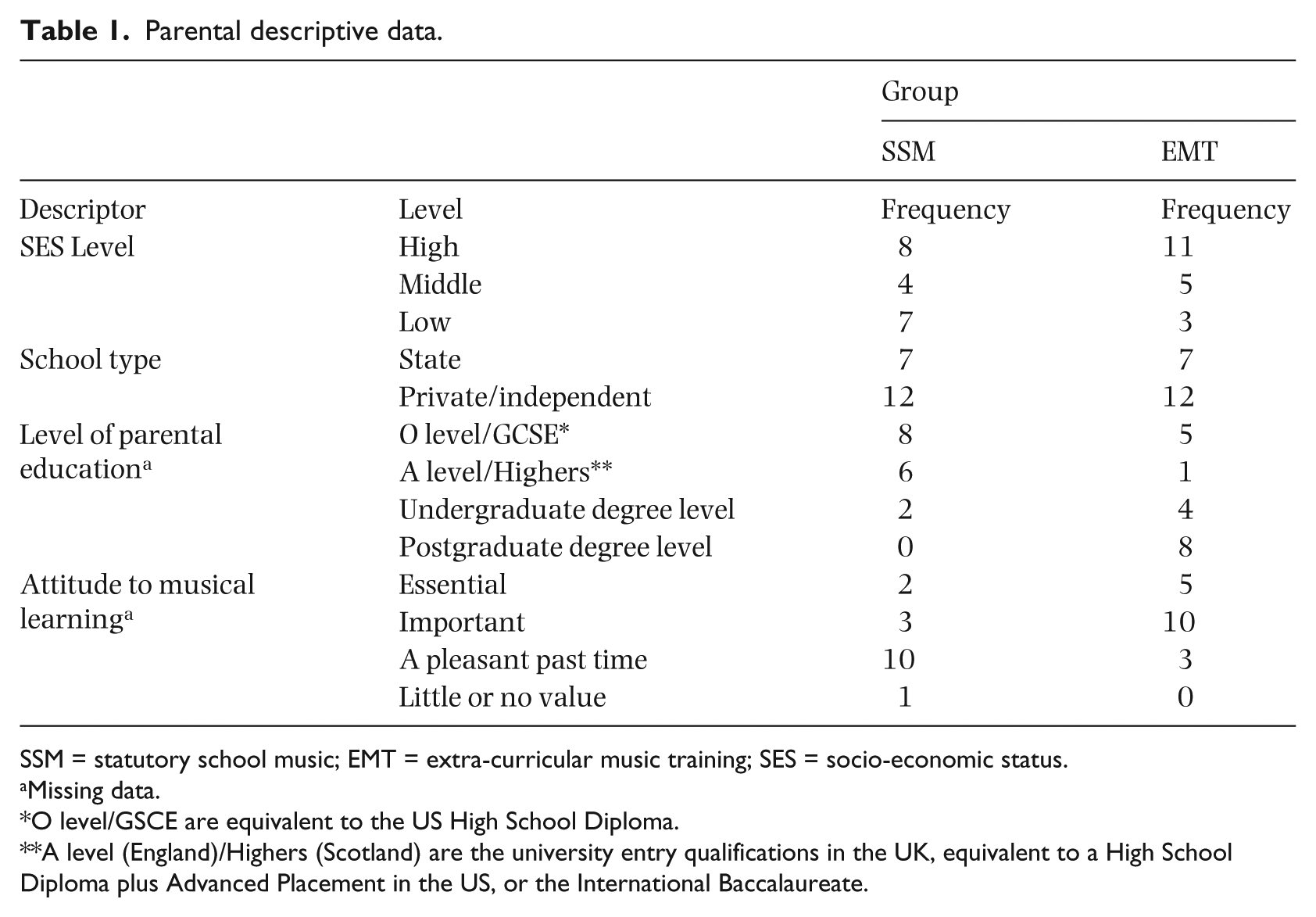
SSM = statutory school music; EMT = extra-curricular music training; SES = socio-economic status.
Missing data.
O level/GSCE are equivalent to the US High School Diploma.
A level (England)/Highers (Scotland) are the university entry qualifications in the UK, equivalent to a High School Diploma plus Advanced Placement in the US, or the International Baccalaureate.
Total hours of weekly activity participation as reported by parents.
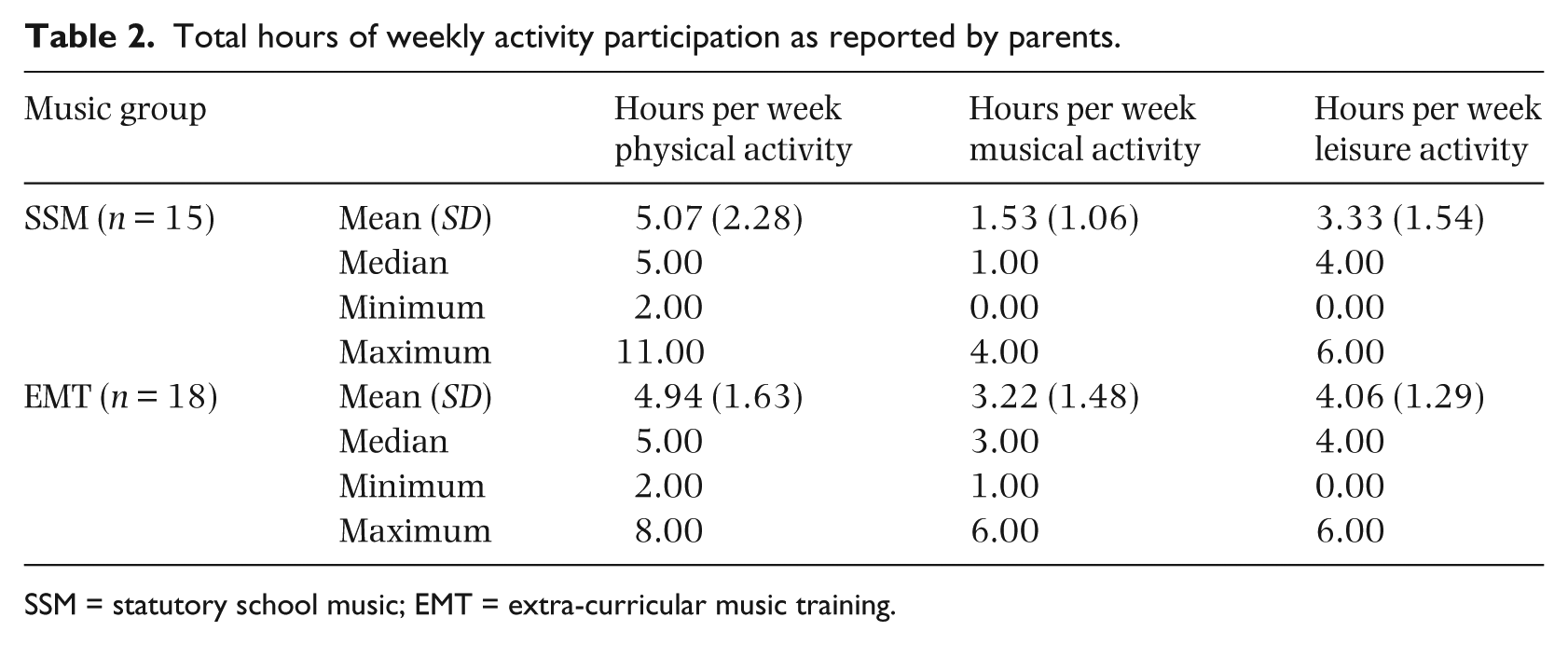
SSM = statutory school music; EMT = extra-curricular music training.
The EMT group parents placed a significantly higher importance on musical learning than those in the SSM group, t(32) = 2.86, p = .008.
Table 2 shows the data reported by parents relating to non-academic activities. A statistically significant difference between groups was revealed for musical activity t(31) = −3.70, p = .001, but not for leisure activity t(29) = −1.43, p = .16 or physical activity t(31) = .18, p = .89.
Table 3 presents the results from the entire battery of measures. For the measure of musical aptitude, there was a main effect of time but no interaction between groups, PMMA composite, F(1, 35) = 29.94, p < .01, ηp2 = .46, and for tonal, F(1, 35) = 10.40, p < .01, ηp2 = .23, and for rhythm, F(1, 35) = 16.54, p < .01, ηp2 = .32.
Results of battery of measures.
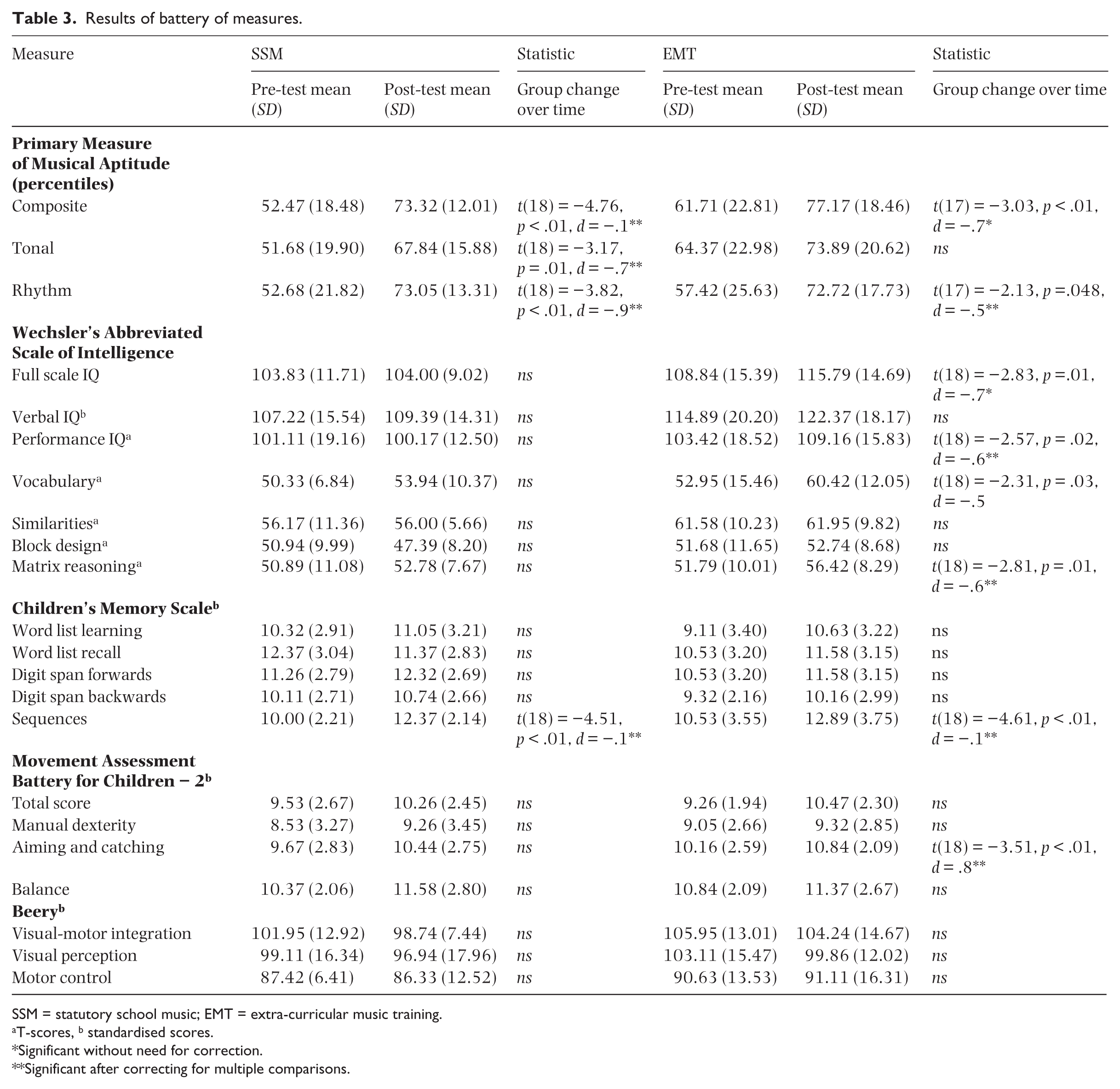
SSM = statutory school music; EMT = extra-curricular music training.
T-scores, b standardised scores.
Significant without need for correction.
Significant after correcting for multiple comparisons.
For the measure of g (WASI), there was also a main effect of time F(1, 35) = 5.67, p = .02, ηp2 = .14. Only one subtest, matrix reasoning, showed a significant main effect of time, F(1, 35) = 6.67, p = .01, ηp2 = .16. Planned post hoc analyses revealed a significant increase in IQ points for the EMT group only, t(18) = −2.83, p = .01, a mean change of 6.95 points in comparison to the SSM group, which improved by .17 points on average. The effect size of this change for the EMT group was d = −.7 (SSM d = −.02).
The only significant effect for the Children’s Memory Scale was for the subtest sequences, in which both groups improved.
There was a main effect of time F(1, 36) = 5.05, p = .03, ηp2 = .12 but no interaction between groups for the total score of the MABC-2. There was also a main effect of time for the subtest aiming and catching, F(1, 35) = 8.94, p < .01, ηp2 = .20. Planned post hoc analyses revealed a significantly increased performance for the EMT group for aiming and catching, t(18) = −3.51, p < .01, d = .8. The SSM group also marginally increased performance, t(17) = −2.08, p = .053, d = .2.
No significant changes were revealed for the Beery tests.
For the BASC, there were no significant changes over time for either group for the teacher and parent composite scores (Behavioural Symptoms Index, Externalising Problems, Internalising Problems, School Problems and Adaptive) or for any of the clinical and adaptive scales. However, some systematic differences were revealed between groups. Teachers reported lower levels of Internalising Problems for the EMT group, t(25) = 2.61, p = .01, and also for the Anxiety scale, t(23.54) = 3.31, p < .01, equal variance not assumed. Parents reported a significant difference between groups at baseline (SSM M = 56.33, SD = 5.89; EMT M = 49.00, SD = 6.18, p < .01), and this continued as a systematic difference over time, t(27) = 2.49, p = .02, with the EMT group showing significantly lower scores on the Aggression scale.
A significant correlation between the PMMA composite and WASI full scale IQ was revealed for the difference between pre and post test r = .28, p = .05. To correct for measurement error (and therefore avoid Type II errors) this result was disattenuated using Osbourne’s (2003) equation revealing a true association, Tr = .34, for this relationship. None of the musical and cognitive aptitude subtests were correlated. PMMA rhythm and MABC-2 balance were significantly correlated, Tr = .60, p = .02. The Beery Visual Perception measure was also correlated with the PMMA composite, Tr = .58, p < .01.
Discussion
In this study a battery of tests measured cognitive, behavioural and socio-emotional development of children during their first year of learning their musical instruments. The aim was to investigate the concomitant development of skills that have been associated with musical learning, rather than to look at singular concepts of transfer effects. Participants were not randomised to music groups because motivation to choose to learn a musical instrument was seen as an important and ethical factor in this (unfunded) study. Socio-economic status, sex and age were equally balanced between groups.
The key findings of this study were that the EMT group showed a significant increase in IQ, in particular fluid intelligence, as measured using matrix reasoning. A significant association between musical aptitude and intelligence overall was revealed. Furthermore, significant improvements in gross motor abilities were apparent for the EMT group only (aiming and catching composite). However, no effects of the first year of musical learning were found for fine motor skills, memory, or for visual-motor integration or socio-emotional behaviour.
Relating the results to the hypotheses, the first investigated Gordon’s (1986) claim that performance on the PMMA is not related to intelligence (Radocy & Boyle, 1979, p. 272, agreed with this claim). However, the results revealed that musical audiation is significantly correlated with intelligence. This supports previous findings suggesting that the PMMA is positively associated (at a low magnitude) with the concept of g. Shuter (1968) reviewed 65 studies and found a positive correlation between musical aptitude and intelligence tests (r = .35). The disattenuated correlation coefficient found herein concurs (Tr = .34), further suggesting that this sample size was adequate to replicate previous findings.
The second hypotheses considered the trainability of audiation. According to Gordon, audiation develops as a result of an enriched musical environment. Though Gordon did not specifically state whether it is trainable or not, he did suggest audiation stabilises around the age of nine years. Here the opportunity arose to compare whether the absolute scores of the EMT group increased more than those of the SSM group. However, whilst the EMT group scored higher on all PMMA scores at baseline, their scores were not significantly higher than the SSM scores. Further, as both groups increased their composite scores significantly (and to a level congruent with 80% power based on the post hoc power analysis), the results suggest that extra-curricular music training does not necessarily significantly influence PMMA performance over time in this age group. Whilst one explanation of this could be that ceiling effects prevented the EMT scores from increasing at Time 2 relative to Time 1, observation of the histograms for both groups at both pre- and post-test suggest this was not the case. Unfortunately it is not possible to compare this finding with an older sample as the PMMA changes to the IMMA at the age of nine, and is not directly comparable. However, as shown in Flohr (1981) and Schlaug et al. (2005), there is some evidence suggesting the effect of musical training is stronger in younger children than older children, perhaps due to differences in neural developmental trajectories (Giedd & Rapoport, 2010).
The third hypothesis predicted that the EMT group would outperform the SSM group on the overall measure of intelligence as measured in IQ points by the WASI as was reported in Schellenberg’s (2004) findings. Schellenberg reported a seven-IQ-point increase for his musical group and a four-IQ-point increase for his control group. The results of this study showed the same IQ-point increase for the EMT group but a less than one-point increase for the SSM control group. However, a seven-point change is less than half of one standard deviation. Whilst the effect size for this change overall (IQ) was very small (ηp2 = .14), the effect size for the specific test (matrix reasoning) for the EMT group was large (d = .6). Furthermore, the critical t-value (t = 2.43) for an alpha value of .01 from the post hoc power analysis (< .8) indicates this finding is robust. As no differences were found at Time 1 for either of these factors for age, sex or schools and for SES as inferred by a combination of postcode and parental education levels (analysed as a coded variable), this suggests the in-building of heterogeneity to the research design has been an effective solution against threats to internal validity consummate with quasi-experimental conditions (Mitchell & Jolley, 2012). One further point regarding the significance of the findings presented here is that this advantage is apparent after only one year of training (amounting to approximately 14 hours on average over the duration of one academic year per participant).
Also in relation to Hypothesis 3, the CMS was used to determine whether EMT in the first year had an effect over and above SSM lessons on measures of auditory memory. According to the CMS, learning and memory are the ability to acquire (new) information, retain and access (stored) information and incorporate the ability to direct and sustain attention/concentration (Cohen, 1997, p. 11). The word list subtests of the CMS are divided into word list learning (four trials), and word list recall, which requires the participant to recall the original list (of unrelated words) after a distracter word list has been presented. Our results suggested a trend toward improvement in performance for both groups over time for word list learning, ostensibly a simple span measure of auditory short term memory (STM). For word list recall, which requires some consolidation to long-term memory (following a distractor list of different words), there were no statistically significant findings. For the digit span subtests, there were also no significant differences between groups. Further exploration of the effect of musical instrument learning and types of memory (possibly using more thorough n-back tasks) will be necessary for future research with regard to transfer effects.
The sequences task of the CMS requires participants to repeat a set of semantically grouped either numbers or words (such as the days of the week forwards and backwards) under timed conditions. This task assesses the ability to mentally manipulate and sequence auditory/verbal information as quickly as possible, thereby “placing a heavy demand” on WM (Cohen, 1997, p. 151). Both groups made significant improvements on this subtest. When reporting this finding to the participants’ teachers, none were surprised as the focus during that year (based on the Key Stage 2 Curriculum in the UK) was on learning sequences, with specific practice, for example, on learning the months of the year. This may be of interest in light of Klingberg’s assertions related to the concept of transfer. Similarly, behavioural tests were included because, in order to explore the assumption that the acquisition of a domain-specific skill is directly linked to more distant or global skills, measures of near transfer must be distinct from the skills being specifically trained (Klingberg, 2010). These tests were the MABC-2 (Henderson et al., 2007) and the Beery VMI, VP and MC (Beery, 2004). The MABC-2 is a standardised test used to evaluate motor skill in children and adolescents. The measure assesses sensorimotor functioning and motor coordination; specifically focusing on gross motor ability (e.g., jumping, catching), fine motor ability (e.g., drawing, writing) and motor coordination. The test yields a global score (MABC-2 Total) and three component scores: manual dexterity (MD), balance, and aiming and catching (A&C). Changes in gross motor skills associated with musical learning have not been tested before. The use of the MABC-2 is novel within the field. The Beery test is designed to assess the extent to which individuals aged between two and 18 years can integrate their visual and motor abilities (hand–eye coordination). It includes three tests (VMI, VP and MC), but there is no overall score for the Beery.
Regarding the fourth hypothesis, which predicted that the EMT group would perform significantly better than the SSM group on measures of fine and gross motor skills over time as measured using the MABC-2, the analysis of the data for the MABC-2 Total overall measure of motor ability, revealed a main effect of time, with both groups improving, but no significant difference between SSM and EMT groups. For the second-level composite measures of the MABC-2, the A&C composite, a significant main effect of time was observed and planned post hoc analyses revealed a significant improvement in the EMT group. The improvement in the SSM group approached significance level. The composite scores were made up of various tasks, which are subsequently described as third-level tasks. The A&C composite included two third-level tasks: throwing a bean bag onto a target and throwing and catching a ball. The MD composite included pegboard, sewing and drawing a trail tasks. The balance component included balancing on a board, hopping and walking along a marked line.
The analysis of the data from the task level for A&C showed that the EMT group outperformed the SSM group on the bean bag task at the second time point. This task required participants to throw a bean bag onto a marked target across a distance of approximately two metres, requiring hand–eye coordination and judgment regarding velocity, distance and target focus. Whilst the SSM group decreased their performance scores on this task over time, the magnitude of this decrease was not significant. Regarding the ball throwing and catching tasks, there was a main effect of time but no interaction. Planned post hoc analysis revealed a trend towards significance level in both groups. As the data for this test were not normally distributed, this was also analysed using non-parametric tests. These revealed that the EMT group improved bean bag throwing over time, whilst the SSM group showed no increase in performance on that task. In contrast, the SSM group improved on ball throwing and catching over time whilst no change was observed for the EMT group.
The analysis of the data from the manual dexterity component failed to reveal any differences between groups or over time. For the balance component, as participants achieved ceiling-level performance (for the tasks of hopping on each leg and walking along a straight line), these tasks were not analysed.
In summary, whilst the overall analysis of the MABC-2 data showed a significant improvement over time for both groups, the second-level composite of aiming and catching suggests there were differences between groups. The analysis of the data from the tasks revealed a difference between groups for ball throwing and catching and bean bag throwing onto a marked target. The EMT group outperformed the SSM group on the bean bag task and the SSM group outperformed the EMT group on the ball task. Similarities between these tasks include an understanding of velocity and focused attention, whilst differences between the tasks centre on reaction in order to receive/catch the ball. In Forgeard et al. (2008) and Hyde et al. (2009), a direct effect of piano training on finger tapping and sequences was observed over a slightly longer experimental period. Whilst direct comparison with the finger-tapping paradigm would be invalid due to the mixed instruments learned by the participants in the EMT group, it is noted that no fine motor skills effects were observed in our music training group. One study which did include gross motor and movement skills (Derri, Tsapakidou, Zachopoulou, & Kioumourtzoglou, 2001) reported that ten, twice-weekly music and movement interventions resulted in a significantly greater improvement in locomotor skills such as running, jumping and skipping in the experimental group compared with the control group of 68 four to six year olds. Derri and colleagues used the Test of Gross Motor Development (Ulrich, 1985). However, it could be argued that these movements are too far removed from the musical task, or similar to the intervention training, to indicate successful near/far transfer of acquired skills, which is the focus of this study.
Regarding visual-motor integration (VMI), visual perception (VP) and motor coordination (MC) as measured using the Beery test, analyses revealed no significant main effects over time, or interactions between music groups. Failure to replicate the findings of Orsmond and Miller (1999) was not surprising as their study reported statistical significance based on changes over time in raw, rather than standardised scores, which are now available for the Beery. Hypothesis 4 specifically predicted that there would be no difference between groups during the experimental period for visual perception. These data support this prediction as measured using the Beery VP.
The final hypothesis considered the development of socio-emotional wellbeing from the perspective of the parents and form teachers (rather than music tutors), rather than using self-report. Regarding changes in behaviours over one academic year, neither teachers nor parents reported any significant positive or negative changes for the composites or scales of the BASC-2. However, the data did suggest some systematic differences between groups. Teachers reported that children in the EMT group scored significantly lower than the children in the SSM group for the composite of Internalising Problems, as well as for the clinical scales Aggression, Anxiety, Conduct Problems, Depression and Hyperactivity. However, once the statistics had been corrected for multiple comparisons, only the scale Anxiety remained significantly lower for the EMT group in comparison to the SSM group. The teachers did not report significant systematic differences between EMT and SSM groups overall for the clinical or adaptive composites or scales. The only scale where parents reported a systematic difference between groups was for Aggression, on which the EMT group scored significantly lower than the SSM group. Whilst this finding did not withstand correction for multiple comparisons, the trend towards significance supports other studies suggesting an effect of musical activity in promoting pro-social behaviours (Croom, 2014; Hille, Arnold, & Schupp, 2014; Kirschner & Tomasello, 2010; Moore, Burland, & Davidson, 2003; Rabinowitch, Cross, & Burnard, 2012), though the methodologies and age groups involved in those studies are very different. It is important to note that this sample includes children in mainstream education in the UK. It was therefore unsurprising that the BASC-2 scores suggested normal behaviours over the experimental period for most of the participants.
In addition to addressing the hypotheses, there are several points raised by this study that require comment. Firstly, the data suggested that the only reported difference between groups was the amount of musical activity they undertook each week and their parents’ positive attitude towards musical learning. These are critical data, not only contributing towards the ecological validity of the study, but also providing further evidence towards the important role of parents. The context within which musical learning takes place cannot be underestimated as an effective factor as, for example, Davidson, Howe, Moore, and Sloboda (1996), and Sloboda and Davidson (1996) have shown. Further qualitative data can be found in Rose (2016) which supports the importance of the alignment of positive social, biological, and psychological syzygies in the development of musical learning, as described in McPherson et al. (2012).
Limitations
Some of the tests used were, with hindsight, less suitable than others. For example, two tasks on the MABC-2 were very easy for the majority of this typically developing sample. Children hit ceiling on the hopping and walking the line tasks, which contribute to the balance component. Therefore, this composite may not be an accurate measure of change over time. With regard to the Beery tests, scores for the whole sample reduced over time suggesting participants were not attending. Exploration of this matter suggested the children did not find them engaging. For future studies, alternative measures for visual-motor integration and balance should be identified. Finally, it may be that another measure of musicality would have produced different results. Gordon’s PMMA could be described as a measure of short-term musical memory. As was seen in the CMS results, this aspect of cognition was no different between groups. This may be because learning by rote (for example for performance) is not necessarily an educational tool utilised in the tradition of Western music learning, at least not at this stage (McPherson et al., 2012). In light of the results suggesting musical learning provides an advantage for matrix reasoning (i.e., pattern matching) type tests, perhaps future studies should consider Karma’s (2007) Music Test of auditory structuring abilities, as this test reports to measure the ability to hear set patterns in sounds.
Conclusion
The results suggest that, in this sample, individual musical lessons during the first year of learning provide an advantage not only to cognition in terms of fluid intelligence (i.e., problem solving), but also with regard to proprioception (muscular, tendon and joint), exteroception (afferent information pertaining to the mouth, skin and eyes), and possibly towards interoception (concerning the internal organs, such as the inner ear for balance). We argue that the variety of instruments included in the study suggests an overall benefit of understanding the force of pressure exerted causing an effect and being able to temper that accordingly. In musical terms this may be realised as beginning to understand that if one blows, strums or hits too hard or soft, the instrument does not resonate correctly and make the desired sound. Further research may show a direct relationship between the types of skills developed according to instrument, and this has implications in terms of the provision of interventions.
However, the temptation of studying the effects of musical learning with regard to the notion of transfer effects traps us in a false positive in a similar way that beliefs about innate talent did 20 years ago. As McPherson et al. (2012) suggest, “Highly valued outcomes of schooling such as self-discipline, being able to work with others and in a team, problem-solving, and creative thinking are all effectively learned and enhanced through musical participation” (p. 3). It may be that it is these transferable extra-musical skills, more so than transfer effects per se, that provide enduring qualities we can value as part of musical learning, alongside the music itself of course.
Footnotes
Funding
The authors received no financial support for the research, authorship, and/or publication of this article.