







Abstract
The purpose of this study was to compare the effectiveness of and preference for different auditory stimuli in supporting mindfulness meditation. Undergraduate non-musicians (N = 57) listened to four different auditory stimuli guiding them in a mindfulness meditation: script only (i.e., Script), steady beat (i.e., Beat), beat and harmonic progression (i.e., Harmony), and beat, harmony, and melody (i.e., Melody). This study used a within-subjects repeated-measures design with the four conditions counterbalanced and randomized across participants. Participants rated responses using the Mindful Attention Awareness Scale (MAAS), completed the Absorption in Music Scale (AIMS), and ranked auditory stimuli according to preference and usefulness for mindfulness meditation. A repeated-measures analysis of covariance (ANCOVA) on the MAAS scores, using the AIMS as a covariate, indicated no statistically significant difference between auditory stimuli. However, with the AIMS removed, the analysis revealed significant differences between stimuli, indicating that levels of absorption in music may moderate participants’ responses to auditory stimuli for mindfulness meditation. Friedman analyses of variance (ANOVAs) and post hoc analyses indicated that participant rankings of usefulness and preference were significantly different among conditions, with the Melody and Harmony conditions ranked highest.
Mindfulness is the intentional awareness of the internal and external happenings in the present moment, without judgment, rejection, or attachment to the moment (Kabat-Zinn, 2012). Mindfulness is a natural human capacity that may be improved with practice (Steinfeld & Brewer, 2015), and is a skill that involves monitoring and control, and requires attention and inhibition of elaborative processing (Bishop et al., 2004). In a state of mindfulness, thoughts and feelings are observed as events in the mind or passing states in the body, without over-identifying with them or reacting to them, thus, introducing “space” between perception and reaction, and allowing for a more reflective response (Bein, 2015; Bishop et al., 2004, p. 232). Mindfulness is not limited to meditation (Steinfeld & Brewer, 2015) and is documented in a wide variety of experiences (Csikszentmihalyi, 1990; Ives-Deliperi, Solms, & Meintjes, 2011; Linehan, 2015; Rathus & Miller, 2015). In addition to attention awareness, mindfulness practice may also develop compassion and empathy in participants (Condon, Desbordes, Miller, & DeSteno, 2013; Feldman & Kuyken, 2011; Shapiro, Schwartz, & Bonner, 1998). Although descriptions of mindfulness vary, they share a basic structure of focusing attention on an internal or external “object” (e.g., breath, body sensations), being distracted from the object, noticing and acknowledging the distraction, and returning attention back to the object (Bishop et al., 2004; Kabat-Zinn, 1990; Steinfeld & Brewer, 2015).
In a state of mindfulness, participants engage cognitive mechanisms commonly localized in the prefrontal cortex, the limbic system, and the default mode network (DMN; that is, a pattern of activity of the resting brain, commonly observed in the precuneus/posterior cingulate cortex, medial prefrontal cortex, and parietal cortex, characterized by low-frequency oscillations, and associated with self-referential thoughts and introspection; Broyd et al., 2009). Mindfulness stimulates the cognitive control areas of the brain in the prefrontal cortex involved with selective attention, executive functioning, monitoring behavior, preventing undesirable actions, regulating emotion, and dealing with fear and uncertainty in making decisions (Barnhofer et al., 2009; Linehan, 2015). Mindfulness also decreases the influence of the amygdala, the alarm central in the limbic system involved with “fight or flight” responses and intense emotions (Bein, 2015; Ives-Deliperi et al., 2011). In addition, mindfulness quiets brain regions in the DMN that become overactivated during self-referential thinking, decreasing depression-related processes such as rumination (Barnhofer et al., 2009; Brewer & Garrison, 2014; Broyd et al., 2009).
Music, when structured appropriately, may support mindfulness meditation. Dvorak (2019) identified three ways to use music for mindfulness practice: (a) music as a support for mindfulness meditation, (b) music as a focus for mindful listening, and (c) music as a focus for mindful active engagement. Music as a support for mindfulness meditation is the “use of music specifically designed, composed, or selected, based on the best available research, to support internal and external responses for mindfulness meditation practice” (Dvorak, 2019). In this category, participants focus on the meditation while music supports and enhances participant experience without distracting attention from the “object” of focus (e.g., breathing, verbal instructions). Music as a focus for mindful listening is “listening to music mindfully, observing sounds and silences, and paying attention to specific musical elements present in the moment” (Dvorak, 2019). Music becomes the object for meditation (Steinfeld & Brewer, 2015) or source of contemplation (Eckhardt & Dinsmore, 2012; Graham, 2010; Kabat-Zinn, 1990; Lesiuk, 2016). Music as a focus for mindful active engagement is “playing, singing, moving, or creating music in which the participants observe, describe, and/or participate one-mindfully, nonjudgmentally, and effectively” (Csikszentmihalyi, 1990; Dvorak, 2019; Linehan, 2015; Rathus & Miller, 2015; Steinfeld & Brewer, 2015).
In this study, music as a support for mindfulness meditation was investigated. A first step in this line of research was to create and investigate musical stimuli appropriately structured for this practice. Previous research in music perception has indicated that increased key clarity, less melodic salience and melodic violations, less timbral complexity, and more rhythmic clarity (i.e., more stable pulse) elicited significantly less activation in the precuneus, posterior cingulate cortex, and lingual gyri, all part of the DMN (Alluri et al., 2012; Spada, Verga, Iadanza, Tettamanti, & Perani, 2014). In other words, a musical stimulus with less ambiguity seemed to elicit less activation of the DMN, consistent with the effect of mindfulness meditation (Barnhofer et al., 2009; Brewer & Garrison, 2014; Broyd et al., 2009).
Predictable music not only lessens activation of the DMN but also decreases emotional activation and processing, important aspects of mindfulness meditation practice. For example, decreased key clarity (i.e., increased tonal ambiguity or complexity) was found to activate cortical and subcortical areas related to emotion processing, the claustrum and anterior cingulate, in particular (Alluri et al., 2012). Although at first consideration, melodic, harmonic, and rhythmic ambiguity would be intuitively “unpleasant,” Alluri and colleagues (2012) found that it created tension, which the participants interpreted as pleasing. Although the practice of mindfulness involves maintaining a non-judgmental and emotionally neutral stance, attempting to elicit a pleasant/unpleasant response with music could interfere with focus on the script, especially for novice practitioners. Avoiding highly emotional activation by avoiding melodic salience, melodic violations, and harmonic and rhythmic ambiguity would seem reasonable when creating music stimuli to support mindfulness meditation. In addition to this predictability, familiarity and preference are important aspects to consider.
Familiarity and preference seem to supersede the effect of some of musical features in neural activation. Familiar music chosen to elicit “nostalgia” showed increased activations in the reward system and the inferior frontal gyrus (part of the DMN)—brain areas related to autobiographical memories (Barret & Janata, 2016). That is, familiar music seemed to increase DMN activation (e.g., eliciting autobiographical memories), which, even if pleasant, is contrary to the desired state of mindfulness. Interestingly, these effects were moderated by measured personality traits: people who were “nostalgia-prone” showed decreased activation in the reward system, and more negative affect, whereas less “nostalgia-prone” participants showed increased activation in the reward system, experiencing nostalgia as positive.
Preferred music, in turn, elicited activation in the DMN (left angular gyrus) and dorsolateral prefrontal cortex regardless of music features (Garza-Villarreal et al., 2015; Kay et al., 2012; Wilkins, Hodges, Laurienti, Steen, & Burdette, 2014). Similar to familiarity, preference seemed to elicit judgment and emotional processes that are contrary to a mindful state. In addition, music preference may be connected to the complexity of the stimulus. Berlyne (1971) proposed that music preference follows an inverted U shape (i.e., the Wundt curve) where low levels of complexity elicit low levels of arousal, with limited preference. As the complexity increases, arousal and preference increase to an optimal point. If complexity continues to increase, preference decreases until it becomes displeasure (Berlyne, 1971; Chmiel & Schubert, 2017). Thus, music with lower levels of complexity may elicit low levels of arousal and support mindfulness meditation.
As mentioned, idiosyncratic responses to music, as well as personality traits, seem to moderate the effects of musical stimuli (Barret & Janata, 2016; Hernandez-Ruiz, James, Noll, & Chrysikou, 2018; Sandstrom & Russo, 2013). Particularly, the ability and willingness to be “drawn in deeply [by a musical stimuli]” (i.e., absorption in music) is a trait that could explain dissimilar findings in music perception and music intervention research (Sandstrom & Russo, 2013). Absorption in music, as defined by the Absorption in Music Scale (AIMS), is a composite variable that measures participants’ understanding of emotion in music, their willingness to be drawn into a sensory stimuli, and their propensity to be influenced by music (Sandstrom & Russo, 2013). Controlling for participants’ ability to immerse themselves in the music experience seemed essential to understand the potential effect of musical stimuli to support mindfulness meditation.
Although researchers and practitioners use music in a variety of mindfulness experiences (e.g., Eckhardt & Dinsmore, 2012 ; Lesiuk, 2015), no study exists to date that compares the effect of music stimuli specifically constructed for mindfulness meditation. Therefore, the purpose of this study was to compare the effectiveness of and preference for different auditory stimuli in supporting mindfulness meditation. The researchers developed four auditory stimuli with a script to guide participants in the mindfulness meditation exercise. Three of the conditions also included a musical stimulus at different levels of complexity: a steady beat (i.e., Beat), the steady beat and a harmonic progression (i.e., Harmony), and the steady beat, the harmonic progression, and a melody (i.e., Melody). The research questions comprised the following:
Do different auditory stimuli of varying complexity (i.e., Script, Beat, Harmony, and Melody) have a different effect on mindfulness meditation, as reported by participants?
Does level of absorption in music moderate participants’ responses to the stimuli (Script, Beat, Harmony, and Melody)?
What type of stimuli (Script, Beat, Harmony, and Melody) was considered by participants to be more useful for mindfulness meditation?
What type of stimuli (Script, Beat, Harmony, and Melody) was most preferred by participants for mindfulness meditation?
Based on previous literature, researchers hypothesized that a musical stimulus of low timbral complexity, minimal melodic or harmonic complexity, with a steady beat, and unfamiliar to the participants (i.e., original composition) would support the mindfulness meditation exercise. Researchers also hypothesized that gradually increasing melodic, harmonic, and timbral complexity would be correlated with decreasing mindfulness efficiency. Two cognitive mechanisms were hypothesized to be at work in the music stimuli. The first mechanism relates to the deactivation of the DMN through the elimination of autobiographical references (i.e., unpreferred and unfamiliar music; Barret & Janata, 2016; Garza-Villarreal et al., 2015; Janata, 2009; Kay et al., 2012; Wilkins et al., 2014), through eliminating melodic references (Alluri et al., 2012), and through maintaining a minimum of timbral complexity (Alluri et al., 2012; Sridharan, Levitin, Chafe, Berger, & Menon, 2007).
The second mechanism was the deactivation of the reward system, through eliminating temporal, melodic, and harmonic ambiguity which, even if pleasurable, might induce emotional and evaluative processes (Alluri et al., 2012; Spada et al., 2014). In other words, unfamiliar music with a steady beat; slow to moderate tempo; repetitive, simple, non-syncopated rhythm; predictable, consonant harmonies; pleasing timbre; and constant dynamics may decrease amygdala function and increase activation of cognitive control areas (Alluri et al., 2012; Barret & Janata, 2016; Sena Moore, 2013; Spada et al., 2014). Music structured according to these guidelines may allow the music to support mindfulness meditation without distracting attention from the meditation itself.
Method
Study design
This study had a within-subjects repeated-measures design. The four conditions of auditory stimuli (Script, Beat, Harmony, and Melody) of increasing complexity (i.e., adding harmony and melody to the beat) were counterbalanced and randomized across participants, with a 3-min pause interspersed between each condition to avoid carry-over effects and to allow time to answer a brief questionnaire. All participants received all conditions in one session. The total testing period for each of the participants was approximately 30 min long, and participants were tested in groups of four at a time in a music perception laboratory.
Recruitment and informed consent
The study received approval from the University of Kansas Human Research Protection Program (#00141275) prior to participant enrollment. Participants were recruited through an online student recruitment system (SONA Systems Software, 2018) and received research credit in a psychology course. To avoid interference with mindfulness experiences, students were asked to refrain from alcohol, drugs, and medication consumption (except contraceptives) 36 hours prior to the study, and caffeine or exercise 3 hours prior to the study. When students arrived at their scheduled appointment, the researchers explained the informed consent, allowed time for questions, and invited the students to participate. Participants signed the informed consent document prior to completing the study.
Participants
Participants were college students (N = 57) at a large Midwestern university selected if they were (a) over the age of 18, (b) enrolled in a psychology class, (c) enrolled in SONA, (d) able to speak, read, and write in English, (e) non-musicians with less than 5 years of music experience, and (f) with no significant hearing loss that impacted their ability to listen to music using headphones at 55 dB. Participants majoring in music were pre-screened and excluded from the study because previous research demonstrated different responses to music between musicians and non-musicians (e.g., Bernardi, Porta, & Sleight, 2005).
Measures
Demographic form
Participants responded to an online demographic questionnaire for age, gender, major, vision, hearing, first language, socioeconomic status, year in school, and previous musical experience. This information was gathered for population description and explored for patterns.
Absorption in music (AIMS)
The 34-item AIMS (Sandstrom & Russo, 2013) measures the individual’s level of immersion in an emotional experience while listening to music. A person’s level of absorption in music may help explain dissimilar findings in psychological and physiological responses to music (Sandstrom & Russo, 2013). Using a 5-point Likert-type scale, with 1 = strongly disagree and 5 = strongly agree, participants responded to questions such as “When I hear good music, I tend to lose my train of thought and forget what I was thinking about.” Researchers included this scale as a covariate, as absorption in music may moderate the effect of the music on the mindfulness meditation experience.
The AIMS has good internal consistency (Cronbach’s α ranging .92–.94), and strong test–retest reliability (.86, p = .001). Convergent validity is supported by its correlation with similar scales such as the Tellegen Absorption Scale (.76, p = .01; Tellegen & Atkinson, 1974) and the Musical Absorption Scale (.74, p = .01; Nagy & Szabó, 2004; Sandstrom & Russo, 2013). A test of criterion validity revealed that emotional responses correlate well with the AIMS scale, as desired; however, the AIMS scale did not correlate with measures of empathy or music training, indicating that absorption in music happens regardless of music training (Sandstrom & Russo, 2013).
Mindful Attention Awareness Scale
The Mindful Attention Awareness Scale (MAAS; Brown & Ryan, 2003) assessed participants’ mindful state after each condition by asking them to rate their experience through seven Likert-type scales of 6 points (almost always to almost never experienced). For the purposes of the MAAS construction, Brown and Ryan (2003) defined mindfulness as “enhanced attention to and awareness of current experience of present reality” (p. 822). The MAAS has a sample alpha of .87, and a test–retest intraclass correlation of .81 (p = .0001). The previous authors also tested a State version of this measure (with slightly modified wording of Questions 3, 8, 10, 13, and 14) and found it to have an internal consistency of .92. For the present study, a slightly different adaptation was performed, excluding Question 8 (due to similarity to Question 10), and with three more questions (1, 5, and 11 in the original) to reflect in-the-moment mindful states while performing the intervention. An example question includes “It seemed I was ‘running on automatic’, without much awareness of what I was doing.” Although we did not conduct consistency tests, the similarity with Brown and Ryan’s (2003) version indicate that this adaptation was appropriate for our purposes.
Ranked rating of usefulness and preferences
At the end of the study, participants also ranked the four auditory stimuli in order of usefulness and preference. In response to the question “Which track helped you follow the mindfulness exercise the best?” participants ranked the four responses from 1 = most useful to 4 = least useful. In response to the question “Which audio track would you prefer to use when practicing the mindfulness meditation exercise?” participants ranked the stimuli from 1 = most preferred to 4 = least preferred.
Materials
An ante hoc analysis of the literature led to the creation of an original composition that included a mindfulness meditation script (see Appendix 1) with four different auditory stimuli (https://soundcloud.com/mindfulness-music/sets/mindfulness-music-stimuli/s-fO0Wl) of varying levels of complexity: script only (Script); script and steady beat (Beat); script, steady beat, and harmony (Harmony); and script, steady beat, harmony, and melody (Melody). The script focused on the mindfulness skill of observing; included common mindfulness words, phrases, and images found in the literature (Kabat-Zinn, 1990; Linehan, 2015; Rathus & Miller, 2015); and was used previously in clinical settings by the first author. The researchers designed the music as a support for mindfulness meditation to maintain attention, decrease emotional arousal, and enhance participant experience without distracting from the meditation. The music included a steady beat in the bass, as the simplest rhythmic pattern; moderate tempo; repetition of an 8 bar musical phrase with a repetitive motif; simple, non-syncopated rhythm in the melody; predictable, consonant harmonies; pleasing timbre; and constant dynamics (Alluri et al., 2012; Gadberry, 2011; Gaston, 1951; Holbrook & Anand, 2009; Sena Moore, 2013; Radocy & Boyle, 2003; Spada et al., 2014; Sridharan et al., 2007; Thaut, McIntosh, & Hoemberg, 2015). The stimuli were recorded on a Yamaha MOXF8 using string settings of bass, cello, and viola at the same loudness levels. The script was recorded in a professional sound studio; all tracks were mixed and sound levels adjusted by a sound engineer. Participants listened to the recordings on an iPad with Sony MDR-7506 Dynamic Stereo headphones on the same mid-level volume.
Procedure
Upon arrival to the laboratory, participants provided their informed consent. Data collection was done in groups of two to four participants; the researchers briefly commented on confidentiality regarding the session. The participants were seated in separate cubicles facing a wall such that they could not make eye contact with other participants and had at least two feet of separation between them. They proceeded to complete the online demographic questionnaire and AIMS. Researchers provided headphones to each participant and showed them how to start the online process (i.e., music stimuli and questionnaires) on the iPads previously set up for this purpose. The participants followed the instructions provided in the audio tracks. The researchers sat out of sight and monitored the process, providing technical assistance if needed.
Participants were asked to sit quietly for 5 min while the audio track provided instructions for the mindfulness exercise. Immediately after the track was over, each participant was prompted to respond to the MAAS-adapted questionnaire online. This procedure was repeated for the remaining three conditions, each interspersed with the MAAS-adapted questionnaire. When the last MAAS-adapted and Preference/Usefulness rating questions were answered, the participants took off the headphones. Researchers debriefed participants and thanked them for their participation.
Results
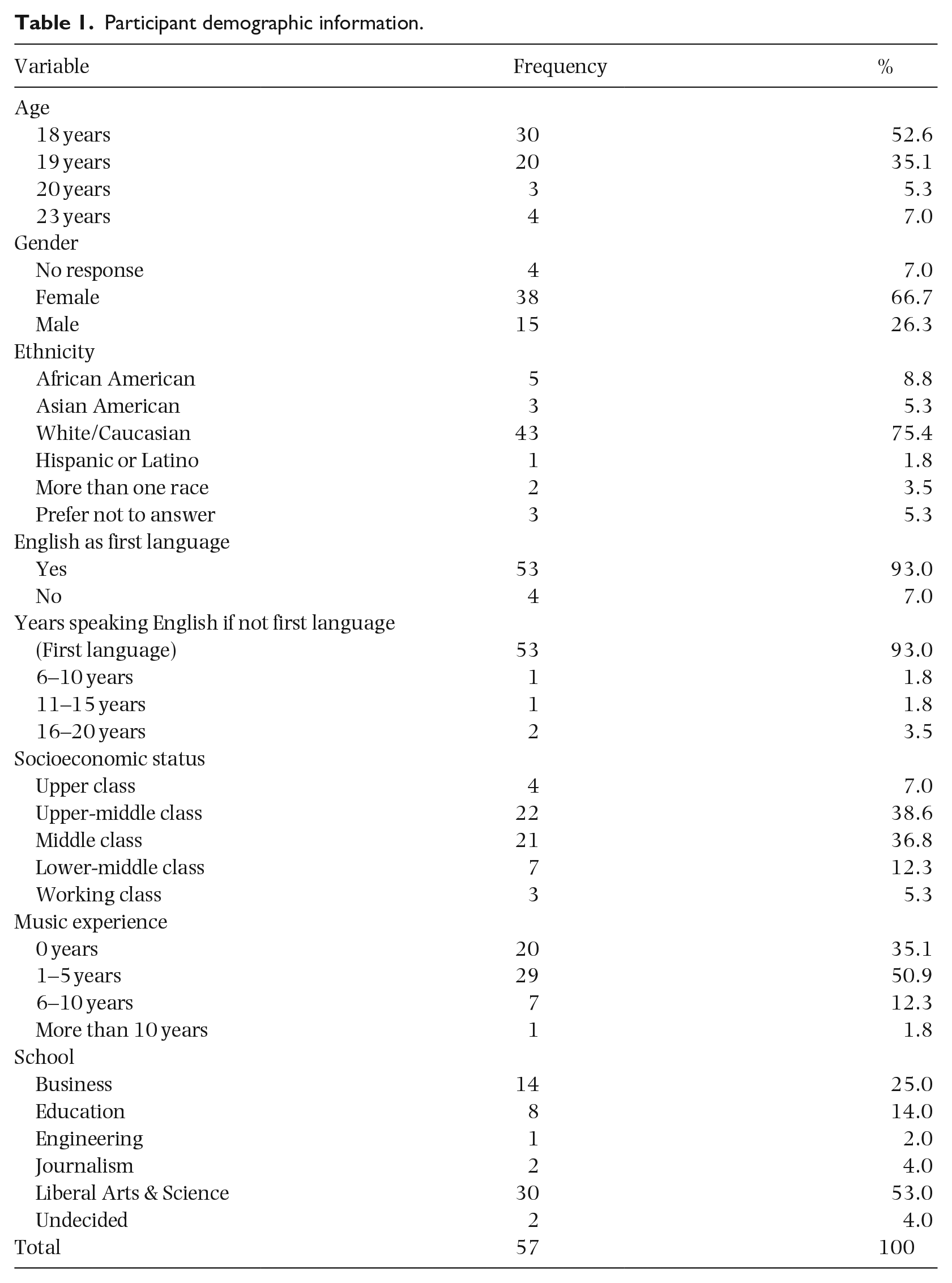
Participants (N = 57) were mainly female (66.7%) and Caucasian (75.4%), from middle and upper-middle socioeconomic status (75.4%). Most of them (86%) had less than 5 years of music experience, but 12.3% (n = 7) had between 6 and 10 years, and 1.8% (n = 1) had more than 10 years of music experience. Further participant information is available in Table 1.
Participant demographic information.
A priori power analyses with online computational programs G*Power and GLIMMPSE (Kreidler et al., 2013)—which allows for calculations of linear models with baseline covariates—indicated that a sample size between 52 (GLIMMPSE) and 54 (G*Power) would yield a power of .95 (α = .05), and a sample size of 32 (GLIMMPSE) to 35 (G*Power) would yield a power of .80 (α = .05). Our sample size (N = 57) exceeded the minimum requirements for a well-powered study.
To investigate our first question, whether different auditory stimuli (Script, Beat, Harmony, Melody) had a different effect on self-reported mindfulness meditation, descriptive statistics and a repeated-measures analysis of variance (RM-ANOVA), α = .05, of the MAAS scores were conducted. An exploration of outliers on all variables indicated the presence of an outlier in the Harmony and Melody conditions, which was excluded from analysis. Shapiro–Wilk tests indicated normal samples for the MAAS in all conditions. Following Sullivan and Artino’s (2013) recommendations and given our large sample size (N = 57), MAAS scores were analyzed with parametric tests. Results with a Greenhouse–Geisser correction due to violation of sphericity indicated a significant within-subjects effect, F = 6.304, p = .001, η2 = .103, Power = .934, between conditions on mindfulness meditation (see Table 2 for the means, standard errors, and confidence intervals of each condition).
Mean, standard error, and confidence intervals of MAAS scores per condition.
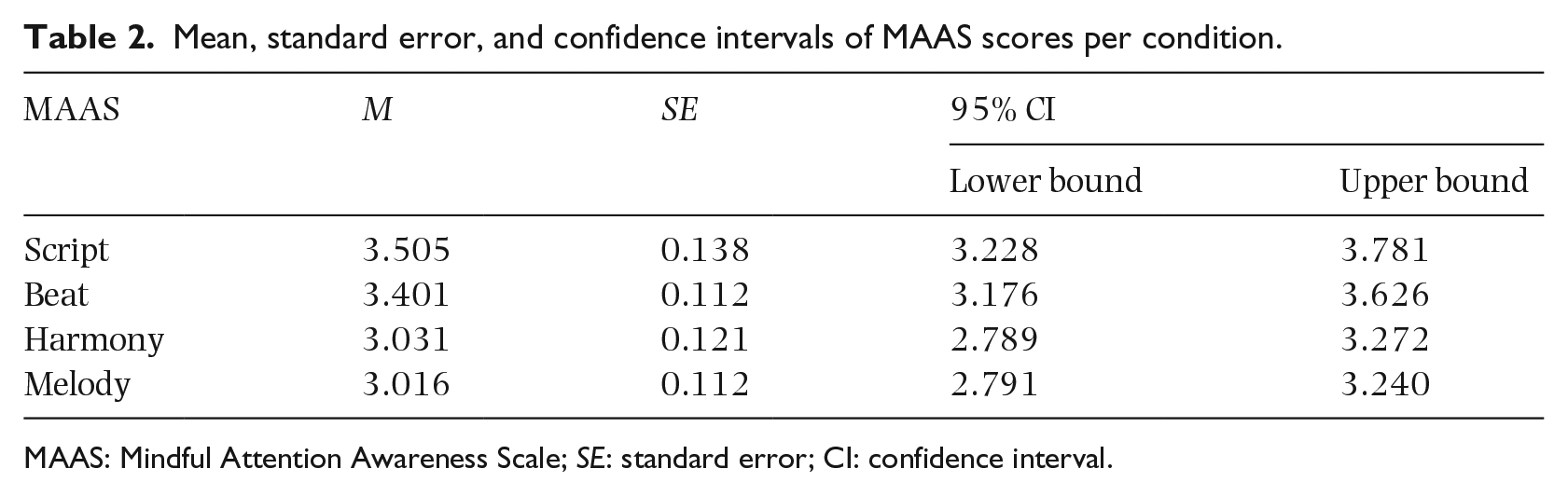
MAAS: Mindful Attention Awareness Scale; SE: standard error; CI: confidence interval.
Post hoc analyses with Bonferroni corrections for multiple comparisons revealed significant pairwise differences between the Script and the Harmony conditions (p = .042); the Script and the Melody conditions (p = .029); the Beat and Harmony conditions (p = .041); and the Beat and Melody conditions (p = .022; Figure 1).
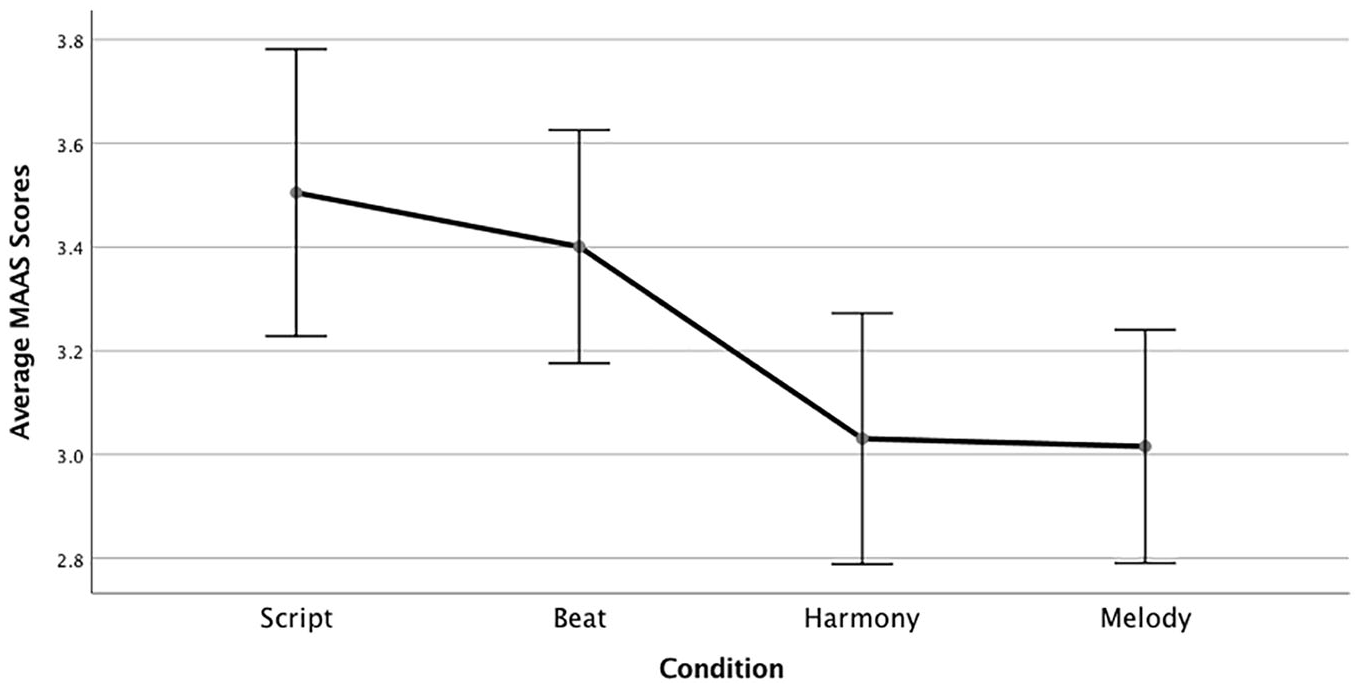
Average scores on the MAAS per condition. Error bars represent the 95% CI. Covariates appearing in the model are evaluated at the following values: AIMS = 108.16.
Due to a suspected moderating effect of Absorption in Music on the MAAS scores (i.e., second research question), a repeated-measures analysis of covariance (RM-ANCOVA) was conducted on the MAAS scores, with the scores from the AIMS as a covariate (α = .05). Results from the RM-ANCOVA, again with Greenhouse–Geisser correction, showed no significant difference between auditory stimuli, F(2.458, 132.736) = 1.102, p = .344, η2 = .02, Power = .265, and no interaction with Absorption in Music, F(2.458, 132.736) = .458, p = .674, η2 = .008, Power = .131. The significant within-subjects effect that became non-significant when the covariate was added supports the hypothesis of a possible moderating effect of Absorption in Music over the MAAS scores. Thus, the relationship between music and mindfulness meditation may be moderated by individuals’ ability to allow music to draw them into an emotional experience. 1
To investigate our third research question, how participants rated the usefulness of the different auditory stimuli, they were asked to rank the four audio tracks (conditions) from most to least useful. Results of a non-parametric Friedman ANOVA (α = .05) of the rankings indicated a significant difference between auditory stimuli, χ2 = 25.863, N = 57, p < .001. Post hoc analyses with Wilcoxon Signed Rank test and Bonferroni corrections for multiple comparisons (α = .008) revealed significant differences between Script and Harmony conditions (Z = –3.24, p = .001), Script and Melody conditions (Z = –3.09, p = .002), Harmony and Beat (Z = –3.00, p = .003), and Melody and Beat (Z = –3.01, p = .003). In other words, participants ranked Harmony and Melody conditions as more useful than Script and Beat to support mindfulness meditation (see Figure 2).
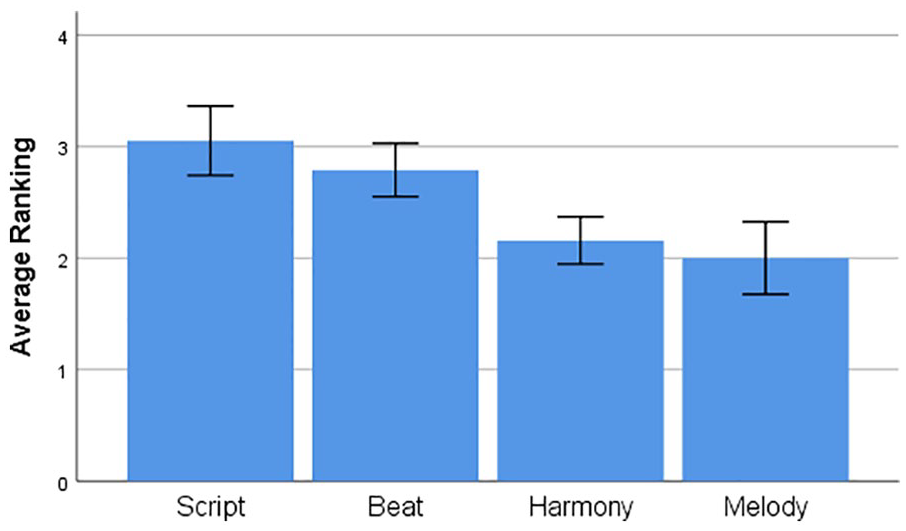
Average ranking of Usefulness per condition. Error bars represent the 95% CI.
To investigate our fourth research question, how participants rated their preference for the different auditory stimuli, they were asked to rank the four audio tracks (conditions) from most to least preferred. Results of a Friedman ANOVA (α = .05) of the rankings showed a significant difference between auditory stimuli, χ2 = 60.305, N = 57, p < .001. Post hoc analyses with Wilcoxon Signed Rank test and Bonferroni corrections for multiple comparisons (α < .008) revealed significant differences between Script and Harmony, Z = -4.64, p < .001, Script and Melody, Z = -4.16, p < .001, Harmony and Beat, Z =-4.83, p < .001, and Melody and Beatconditions, Z = -4.30, p < .001. According to the rankings, participants preferred Harmony and Melody conditions over Script and Beat to support mindfulness meditation (see Figure 3).
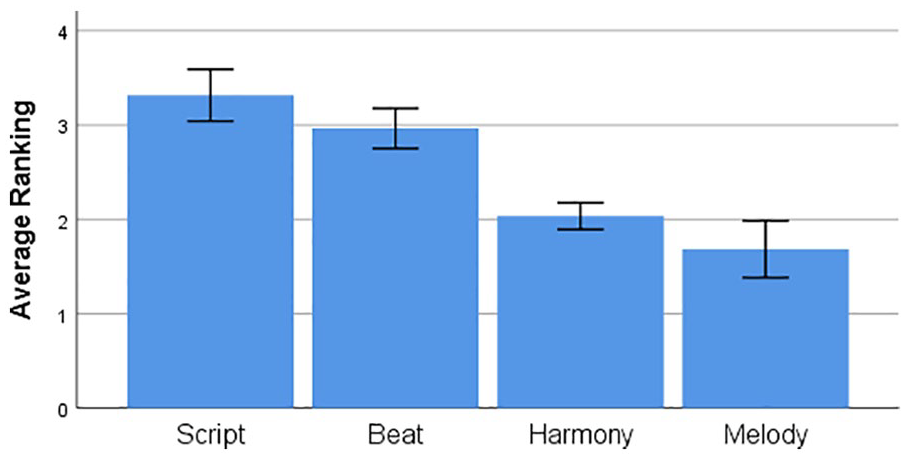
Average ranking of Preference per condition. Error bars represent the 95% CI.
Discussion
The researchers designed the music stimuli in this study to support mindfulness meditation. Four conditions of increasing complexity were created: voice with instructions (Script), script with bass playing a pulse (Beat), script with bass and string ensemble (Harmony), and script with bass, string ensemble, and a viola playing a simple melody (Melody). The first hypothesis—increasing music complexity would decrease mindfulness—was supported by participant responses. We found significant differences between conditions: the least complex stimuli with script and beat elements seemed to support mindfulness meditation better for these participants (see Figure 1), but only when participants’ absorption in music was not considered. On the contrary, participants’ rankings of the stimuli for preference and usefulness (Research Questions 3 and 4) were not congruent with the previous results and seemed to supersede musical features, consistent with Barret and Janata (2016). Participants ranked the Melody and Harmony stimuli as most useful (Figure 2) and most preferred (Figure 3) when compared to Script and Beat. This disparity between MAAS scores and participants’ rankings could have occurred for several reasons.
First, the stimuli with harmony and melody were more recognizable as music. Participants read the term “music stimuli” in the informed consent document; this may have influenced their expectations and overall cognitive appraisal of the stimuli used in the study. Participants perhaps expected harmonic and melodic elements in the stimuli; their absence in the Script and Beat conditions may have violated musical norms and assumptions of certain listeners. Second, the added harmonic and melodic complexity could have been above the optimal level of complexity (Berlyne, 1971) for the listeners to allow for focus on the meditation. Third, participants were novices, and most had never practiced mindfulness before this study; their lack of meditation experience could have affected the results. These participants may have been focused on aspects of the music and not the mindfulness itself based on previous experiences listening to music with a script (e.g., music-assisted relaxation). These participants could have also rated their preference for the music per se, not the preference for music to support their mindfulness meditation. Further research studies with different music stimuli, levels of complexity, music timbres, and levels of mindfulness practice (e.g., novice, advanced, expert) are needed to clarify these results.
Consistent with previous research (Barret & Janata, 2016; Hernandez-Ruiz et al., 2018), we found that the characteristics of the participants—such as level of absorption in music—affected their response to the music experience (Research Question 2). The MAAS scores among conditions were not significantly different when Absorption in Music was included as a covariate. This non-significant result supports the hypothesis that a participant’s level of immersion in an emotional experience while listening to music moderated the effect of music on the mindfulness meditation experience in this study. In other words, how people generally respond to music—their personal characteristics and disposition to music—affected their response to this mindfulness intervention. Researchers rarely discuss predisposition to music, but how people enter into a music experience may have an effect on the intervention itself and should be considered and controlled for in research settings and treatment planning.
Limitations, delimitations, and assumptions
Limitations included collection of data over a single semester in a music perception lab with several participants. Although participants were separated by partitions and used headphones with iPads, it is possible that they could hear or be distracted by the other people in the room, thus affecting their mindfulness outcomes. The lack of data regarding the extent of previous experience with mindfulness meditation is another limitation of this study given that this element could impact participants’ responses to the exercise in this study. This information should be elicited and factored into the analysis in future studies. Delimitations included using undergraduate non-musicians with limited mindfulness experience. Future research could study responses of musicians or those with more mindfulness experience to the stimuli, as well as differences in the responses of participants with specific personal characteristics, such as level of absorption in music. For assumptions, researchers assumed participants answered honestly and paid attention to the four stimuli used in the study.
Implications for clinical practice and research
The researchers crafted the music stimuli in this study from evidence in the literature to support mindfulness meditation. Specifically composed melodic and harmonic elements were ranked as most useful and preferred. However, increasing complexity in music—beyond that studied in this project—should be approached with caution. Clinicians are encouraged to identify the optimal complexity needed for their clients to support mindfulness meditation, and to craft their music stimuli with the recommendations (e.g., steady beat; moderate tempo; repetition; simple, non-syncopated rhythm; predictable, consonant harmonies; pleasing timbre; and constant dynamics) from this study.
Researchers and therapists using music may want to consider including a tool such as the AIMS—or a modified shorter version—in pre-screenings or assessments to determine differences in participants’ level of immersion in an emotional experience while listening to music. Participants’ levels of absorption in music may explain differences in music intervention research studies and clinical practice, and variability in psychological and physiological responses to music when presented with the same or similar stimuli (Hernandez-Ruiz et al., 2018; Sandstrom & Russo, 2013). In addition, future research could determine potential differences between non-musicians versus musicians in their absorption levels and thus their responses to music interventions.
Studying the impact of personal characteristics and disposition to music—and their effects on participants’ responses to music interventions—could allow clinicians and researchers to better understand and clarify outcomes. However, the AIMS itself may be too long, difficult, or time-consuming for some participants to complete individually or with support. Researchers may want to consider modifying the AIMS or creating an equivalent for music therapy clinical practice with fewer, more targeted responses that could help practitioners quickly and consistently identify absorption levels in music.
Conclusion
In this study, we created and investigated the effect of auditory stimuli at increasing levels of complexity (script, beat, harmonic progression, and melody) on mindfulness meditation, and participants’ preference for and perception of usefulness of the music to support this mindfulness exercise. The two least complex stimuli created for this study (Script and Beat) seemed at the ideal level of complexity to support the meditation, but the most complex (Harmony and Melody) were the most preferred and most useful as rated by participants. Importantly, absorption in music was a significant moderator of the effect of the musical stimuli, and other factors such as experience with mindfulness meditation and musical expertise may have impacted our results. Further research including these variables is needed.
Footnotes
Appendix 1
Acknowledgements
The authors would like to thank Andrea Greenhoot and Judy Eddy from the University of Kansas Center for Teaching Excellence, Nikki Perry and John Augusto from the University of Kansas Center for Undergraduate Research, sound engineer Jim Barnes and the Lawrence Public Library Sound + Vision Studio, Mike Vitevitch for assistance with SONA, the music therapy and music education students who assisted as data collectors, and all of the non-musician undergraduate students who participated in the research study.
Declaration of conflicting interests
The author(s) declared no potential conflicts of interest with respect to the research, authorship, and/or publication of this article.
Funding
The author(s) disclosed receipt of the following financial support for the research, authorship, and/or publication of this article: Funding for this study was provided by the University of Kansas Center for Teaching Excellence and the University of Kansas Center for Undergraduate Research.

Notes
a
This script focuses on the mindfulness skill of observing and includes common mindfulness words, phrases, and images found in the literature (Kabat-Zinn, 1990; Linehan, 2015; Rathus & Miller, 2015).