







Abstract
The purpose of this research was to examine the effects of musical pantophagy, classical music consumption, and initial receptivity to select musical examples on changes in preference rating resulting from a program of repeated exposure. Participants included undergraduate students enrolled in a section of music appreciation at a large Southeastern university (n = 67). Data were collected using a research designed preference rating measure (PRM) administered during a 5-week period within which there were eight test measures. Participants were divided into quartiles. Pre- to post-test measures resulted in a general positive trend for all participants. Comparisons of Q1 (lowest pantophagy) and Q3 (highest pantophagy) on PRMs 1–8 yielded no differences between groups, and PRM 8 was significantly different from PRM 1 for both groups. The same comparisons for Q1 (non-Classical music consumption) indicated significant difference with large effect size and for Q1 (lowest initial receptivity) indicated significant difference. Results suggest that regardless of musical pantophagy, repetition is an effective means by which to increase affective response to music, and that students who do not currently consume formal art music and who have low initial receptivity may report greater increases in affective response to music over time.
In recent years, research has concentrated upon the effect of repeated exposure on preferences (Johnston, 2015; Madison & Schiolde, 2017; Radocy, 1982; Walker, 1980; Zajonc, 1968). The effect of familiarity with music has been well documented and confirms that an individual’s preference for musical examples may be increased via repeated exposure (Bartlett, 1973; Evans, 1966; Getz, 1966; Haber & Hershenson, 1965; Hargreaves, 1984; Jacoby & Dallas, 1981; Johnston, 2015; Madison & Schiolde, 2017; Moskovitz, 1992; Radocy, 1982; Walker, 1980; Whittlesea, Jacoby, & Girard, 1990; Zajonc, 1968) and that in many cases, there is a point of diminishing return (Berlyne, 1974; Britten, 1996; Burke & Gridley, 1990; Crozier, 1974; Getz, 1966; Gordon & Gridley, 2013; Hargreaves, 1984; Heyduk, 1975; Hunter & Schellenberg, 2011; North & Hargreaves, 1995; Orr & Ohlsson, 2001; Radocy, 1982; Schellenberg, Peretz, & Vieillard, 2008; Schubert, 2010; Verveer, Barry, & Bousfield, 1933). Chimel and Schubert (2017) reviewed investigations from the previous 117 years, categorizing 87.7% as compatible with the inverted U model proposed by Berlyne, in which reduction in subjective complexity and increases in pleasingness occur as a result of repeated exposure to a moderate level of arousal, decreasing to a point of over-saturation in which the stimulus is displeasing. While it is generally accepted that broad musical taste and preference are desirable (Droe, 2006; Gates, Madsen, Jellison, & Yarborough, 2000; Johnston, 2015; O’Brien, 1986) and that music educators have opportunity to assist students in developing positive attitudes toward new music and an expanded basis from which to make future choices (Anderson, 1975; Bradley, 1971; Droe, 2006; Finnas, 1989; Gates et al., 2000; Johnston, 2015; Leblanc, 1983; Shehan, 1985). Few studies have investigated the effect of liberal musical taste on potential changes resulting from a program of repeated exposure. Are there differences in the ways in which persons with broad music taste and preference respond to unfamiliar musical stimuli?
In extant affective research, taste is generally defined as a long-term and enduring valuation of music (Abeles & Chung, 1996; Britten, 1996; Finnas, 1989; Hargreaves et al., 2006; Johnston, 2015; Macdonald, Hargreaves, & Miell, 2002; Russell, 1997), whereas preference is consistently defined as degree of liking or disliking of a musical stimulus (Bradley, 1972; Britten, 1996; Droe, 2006; Getz, 1966; Hargreaves, 1984; Leblanc, Jin, Simpson, Stamau, & McCrary, 1998; Moskovitz, 1992; O’Brien, 1986; Peery & Peery, 1986; Price, 1988; Radocy, 1982; Shehan, 1985). Investigators have examined breadth of musical taste in multiple ways., indicating that persons with musical training have higher preference for art music, persons from higher social classes like a greater number of different music genres, and persons with musical training have more broad preferences (Baumann, 1960; Birch, 1963; Bryson, 1996; Davis, 2015; Elvers, Omigie, Fuhrmann, & Fischinger, 2015; Emmison, 2003; Geringer, 1982; Geringer & McManus, 1979; Hargreaves, Messerschmidt, & Rubert, 1980; Kelly, 1961; Keston & Pinto, 1955; Peterson & Kern, 1995; Price & Yarbrough, 1987; Scheussler, 1948; K. Van Eijck, 2001). Others have likened broad consumption to musical omnivorism, but define the construct inconsistently. Peterson and Simkus (1992) defined cultural omnivores as persons in high-status occupations who like a wide variety of genres and who cross genre boundaries, while persons in low-status jobs demonstrate narrower taste. Peterson (2005) reinforced these claims, as did Bryson (1996), Van Eijck (2001), Ollivier (2008), and Marsh (2012). Michelson (2013) suggested “if there is such a thing as a ‘natural habitat’ for cultural omnivores, it would be a college campus” (p. 4). Peterson and Kern (2006) suggested highbrow listeners enjoy classical music and opera while eschewing other forms, but omnivores enjoy highbrow music as well as middle and lowbrow forms. Elvers et al. (2015) report greater liking of sophisticated music by expert listeners, and also greater appreciation in general while possessing an omnivore taste. They suggest that this omnivorism may result from familiarity with a variety of musical styles. Bryson (1996) suggested education was a greater predictor of omnivorism than occupation, and Relish (1997) reported that education is correlated with broader musical taste. Peterson and Kern (1995) and Warde, Wright, and Gayo-Cal. (2007) suggested that omnivorism is linked to receptivity, and Leguina, Widdop, and Tampubolon (2016) define taste breadth as musical eclecticism that is generally compatible with the idea of cultural omnivorism.
Although much research assumes a priori that broad musical taste and preference are desirable, Finnas (1989) suggests need for analysis of the potential advantages of taste pluralism, asserting more attention should be paid to initial attitudes. Schmidt (1975) and Hargreaves (1984) described no increase in preference after a program of repeated exposure, although they reported that participants’ initial attitudes were negative, and Espeland and Skardahl (1975) reported poorest results for students who initially exhibited the lowest attitudes. If broad music taste and preference are desirable, what is the effect of this pluralism on preference for unfamiliar music and on changes in preference resulting from exposure?
Preference is herein defined as degree of liking or disliking and taste as a more stable and long-term representation of preferences. In addition, we propose a new term and define taste pluralism as degree of musical pantophagy, implying consumption of a wide variety of music rather than consumption of one type juxtaposed against another, or consumption of whatever is incidentally available. Furthermore, we define a program of repeated exposure as consisting of repeated presentation of musical examples that are in this case limited to the Romantic Era.
We hypothesized that repeated exposure would increase mean preference ratings for all participants, and that after a program of repeated exposure, participants identified as the most pantophagous or who consume classical music would exhibit less increase in preference as a result of greater familiarity with varied musical styles and with music similar to test examples. We further hypothesized that the most initially receptive participants would exhibit greater increases in preference than those identified as the least initially receptive, and that those who consume classical music will exhibit the greatest degree of musical pantophagy.
We relied upon five research questions to guide the study:
Are there differences in self-report preference ratings between the most pantophagous and least pantophagous participants before and after a program of repeated exposure to musical examples?
Are there differences in self-report preference ratings between participants who currently consume classical music and participants who do not, before and after a program of repeated exposure to musical examples?
Are there differences in self-report preference ratings between the most initially receptive and least initially receptive participants before and after a program of repeated exposure to musical examples?
What is the relationship between musical pantophagy and initial receptivity?
What is the relationship between musical pantophagy and current consumption of classical music?
Method
Participants
The population consisted of undergraduate non-music majors who self-enrolled in a music appreciation course at a large Southeastern university. A nonrandom sample in one section of the course was utilized (n = 67). The course met on a Tuesday/Thursday schedule. Of participants, there were 34 males and 33 females and the mean age of participants was 18.9 (SD = 1.07). A majority of participants (58%) reported participation in at least some previous private study of music, while 91% reported prior experience in a musical ensemble.
Demographic survey and test instrument
We designed a demographic survey instrument (DSI) for the purpose of identifying potential variables of interest, including year of study, gender, age, prior private music instruction, prior musical ensemble participation, and current musical taste as indicated by types of current consumption. The sixth item on the demographic survey asked participants to select the types of music they currently listened to from among the categories of rock, country, hip-hop, classical, gospel, folk, and jazz while providing a space to list other categories not represented. The seven genres we presented were representative of the major areas of consumption for most people, as indicated by Van Eijck (2001), who suggested that musical genres can be structured on the basis of three discourses (highbrow, pop, and folk), and (Rentfrow et al., 2012) who asserted that there are five factors defined by preference for either classical and jazz music, rock and heavy metal music, rap and hip-hop music, country music, and new age and electronic music.
Similarly to Leblanc, Colman, McCrary, Sherrill, and Malin (1988), Moskovitz (1992) and Rentfrow and Gosling (2003), we relied upon self-report as a valid measure of individual music preferences and developed a preference rating measure (PRM) that included 10 items to accompany the aural presentation of musical examples. The PRM comprised a Likert-type scale ranging from 1 (dislike) to 6 (like) for each of the 10 examples, to exclude the possibility of a neutral response. Written instructions directed participants to indicate their level of preference for each example by circling a number on the scale. Each example was represented by: “Example 1,” and so on, and then followed by the Likert-type scale.
Selection of musical examples
The focus of this investigation was not to examine musical preference in relation to historical period. Representative examples were limited to the Romantic Era to avoid potential presentation of similar music during course instruction, as the test period was early in the semester and the Romantic Era was the last to be presented.
Musical examples were selected based on data from three textbooks utilized in music appreciation courses: Music: An Appreciation (Kamien, 2005), Music: An appreciation (Kamien, 2008), and The Enjoyment of Music (Forney & Machlis, 2007). We selected representative composers (Pyotr Tchaikovsky, Johannes Brahms, Franz Schubert, Franz Liszt, and Antonin Dvorak) based on frequency of inclusion in the texts and determined that composers were of eminence and likely to be representative of composers typically studied in music appreciation courses.
We attempted to eliminate style variables by selecting a single historical period (Romantic Era), uniform genre (orchestral), and uniform texture (homophonic). We attempted to control for tempo by selecting two sets of 10 examples, one fast and one slow from each of the five composers. Similarly to Leblanc and Cote (1983), we measured tempo with an aural/visual metronome. Excerpts display relative uniformity of tempo (fast examples: 146–171 bpm and slow examples: 59–75 bpm). Because research aims consider changes between pre- and post-tests, rather than for individual selections, we made no effort to quantify differences in instrumentation among selections.
Excerpts were edited to control for volume and each was faded in and out uniformly. There were 10 s of intervening silence between excerpts. Eight CDs containing excerpts in random orders were produced. CDs contained a total run time of 11 min and 50 s.
Pilot study
We conducted a pilot study with a sample of undergraduate students (n = 56) who voluntarily chose to enroll in a music appreciation course at the same university. The purpose of the pilot was to determine level of familiarity reported for examples, as a result of the fact that researchers have demonstrated correlation between familiarity and preference. We designed a survey which required participants to indicate level of familiarity with each of 10 musical examples as “very familiar,” “somewhat familiar,” or “not at all familiar.” Of 56 participants, none reported “very familiar,” four (7.14%) reported “somewhat familiar” with the slow Tchaikovsy, one (1.78%) reported “very familiar” with the fast Dvorak, and one (1.78%) reported “very familiar” with the fast Liszt. We concluded test examples were appropriately unfamiliar to examine changes in preference rating resulting from repeated exposure.
Procedures
Test sessions were conducted across a 5-week period within which there were eight Tuesday/Thursday measures. PRMs 1 through 8 presented a set of 10 musical examples. PRM 1 functioned as pretest, PRMs 2–7 as repeated exposure, and PRM 8 as post-test.
On the first day of testing, the DSI was administered in paper format during the first 5 min of the class period. Upon completion, the DSI was collected, and participants were given instructions for completion of PRM 1, including the length of each example and the intervening silence between examples. Participants were instructed to listen to each example and then to indicate response on the test form during intervening silence. Following verbal instructions, PRM 1 was administered. The test procedure was repeated during PRMs 2 through 8.
Results
Introduction
This section presents quantitative comparisons of musical pantophagy, classical music taste, and receptiveness based on data from the DSI. Data were examined to investigate group comparisons of pantophagy based on the number of music choices selected by participants (Question 1), classical music taste (Question 2), receptiveness based on initial PRM 1 scores (Question 3), and to examine relationship between pantophagy and receptivity, and between pantophagy and classical music taste (Questions 4 and 5). Survey data were assessed for normality of distribution for the entire sample and by group and reliability (Cronbach’s alpha, 1951). Group comparisons of survey ordinal data were calculated (Table 1).
Quantitative Tests.

PRM: preference rating measure; RQ: research question.
Definitions
Musical pantophagy was defined by the number of music choices indicated by participants on the DSI. Participants were able to select types of music currently consumed from seven provided (rock, country, hip-hop, classical, gospel, folk, or jazz), then had the option to add other types. The number of types was calculated as a total sum. The sum of choices indicated by participants separated the composite mean scores from the survey into quartiles. The first quartile (Q1) denotes the lower quartile based on number of music choices (Q1 includes the scores of participants with the least number of choices to the 25th percentile), and the third quartile (Q3) denotes the upper quartile based on the number of music choices (75th percentile of scores to the highest score based on number of music choices).
Classical music taste was indicated by the participants on the DSI. Participants who selected classical music as currently consumed were included in the classical music taste (CMT) group. Alternatively, individuals who did not select classical music were separated into the non-classical music taste (NCMT) group.
Receptiveness was defined by initial preference scores on PRM 1. Composite mean scores were calculated for each participant and then separated by quartiles. The first quartile (Q1) denotes the lower quartile of PRM 1 scores (Q1 includes the lowest score to the 25th percentile), and the third quartile (Q3) denotes the upper quartile of PRM 1 scores (Q3 includes the 75th percentile to the highest score).
Statistical analyses of quantitative comparisons
Comparisons of PRM 1 and 8 scores of the same group were calculated utilizing the Wilcoxon signed ranks test (two-tailed, alpha = .05). The Wilcoxon signed ranks test is a nonparametric statistical test that compares two related samples. This test is appropriate for comparison of data that are measured at the ordinal variable level. Comparison of ordinal scores on the PRMs involving two unrelated groups were examined by the Mann–Whitney U Test with a Bonferroni correction to address Type 1 error (two-tailed, alpha = .006). The effect size is determined by calculating the correlation coefficient (r) to determine the strength or magnitude of the findings. Effect size classifications range from small (r = .10) to very large (r = .70; J. A. Rosenthal, 1996; R. Rosenthal, 1984). Correlations of scores were calculated using the Spearman rank-order correlation coefficient test to determine the relationship between variables (Table 1).
Normality
Normality of distributions for the entire sample (PRM 1 through 8) was examined by tests of skewness and kurtosis. Results indicated that preference ratings for PRMs 1 through 8 were normally distributed and variables did not deviate from the acceptable range (–2/ + 2). Tests of skewness and kurtosis in assessing normality for the comparison groups indicated that the data for the PRM 1 receptiveness (bottom 25% quartile) comparison deviated from the acceptable range of –2 to + 2. The PRM 1 (bottom 25% quartile) Receptiveness data were subjected to Shapiro–Wilk’s test resulting in a deviation from normality (p = .009). In light of the scale of the data (ordinal), number of individuals in the comparison groups, and PRM1 receptiveness group deviating from an acceptable range, nonparametric statistical tests were utilized to examine quantitative comparisons.
Reliability
Cronbach’s (1951) alpha was calculated for PRM1 through PRM8. The alpha coefficients for all preference rating tests were above .70 and were consistent with satisfactory reliability for a scaled assessment tool. PRM 1’s reliability score was .83; PRM 8’s alpha coefficient was .80. PRM 2–7 reliability scores ranged from .81 to .85.
Research question 1: Quantitative comparisons of musical pantophagy
RQ1a. Pantophagy: Comparison of Q1 and Q3 of PRM 1–8 scores. Composite mean scores were calculated for PRM 1 through 8 for Q1 (least number of indicated music types consumed) and Q3 (highest number of indicated music types consumed; Figure 1) and compared. The results of the Mann–Whitney U test indicated no differences between the composite mean scores for PRMs 1–8 (Table 2).
RQ1b. Pantophagy: Comparison of PRM 1 and 8 scores for Q1. Composite mean scores of PRM 1 were compared with composite mean scores of PRM 8 for Q1. The results of the Wilcoxon signed ranks test indicated that there was a difference between the composite mean score of PRMs 1 (M = 3.46) and 8 (M = 4.25) for Q1, Z = –3.39, p = .001, with a large effect size (–.82).
RQ1c. Pantophagy: Comparison of PRM 1 and 8 scores for Q3. Composite mean scores of PRM 1 were compared with composite mean scores of PRM 8 for Q3. The results of the Wilcoxon signed ranks test indicated that there was a difference between the composite mean score of PRMs 1 (M = 3.46) and 8 (M = 4.08) for Q3, Z = –2.67, p = .008, with a large effect size (–.74).
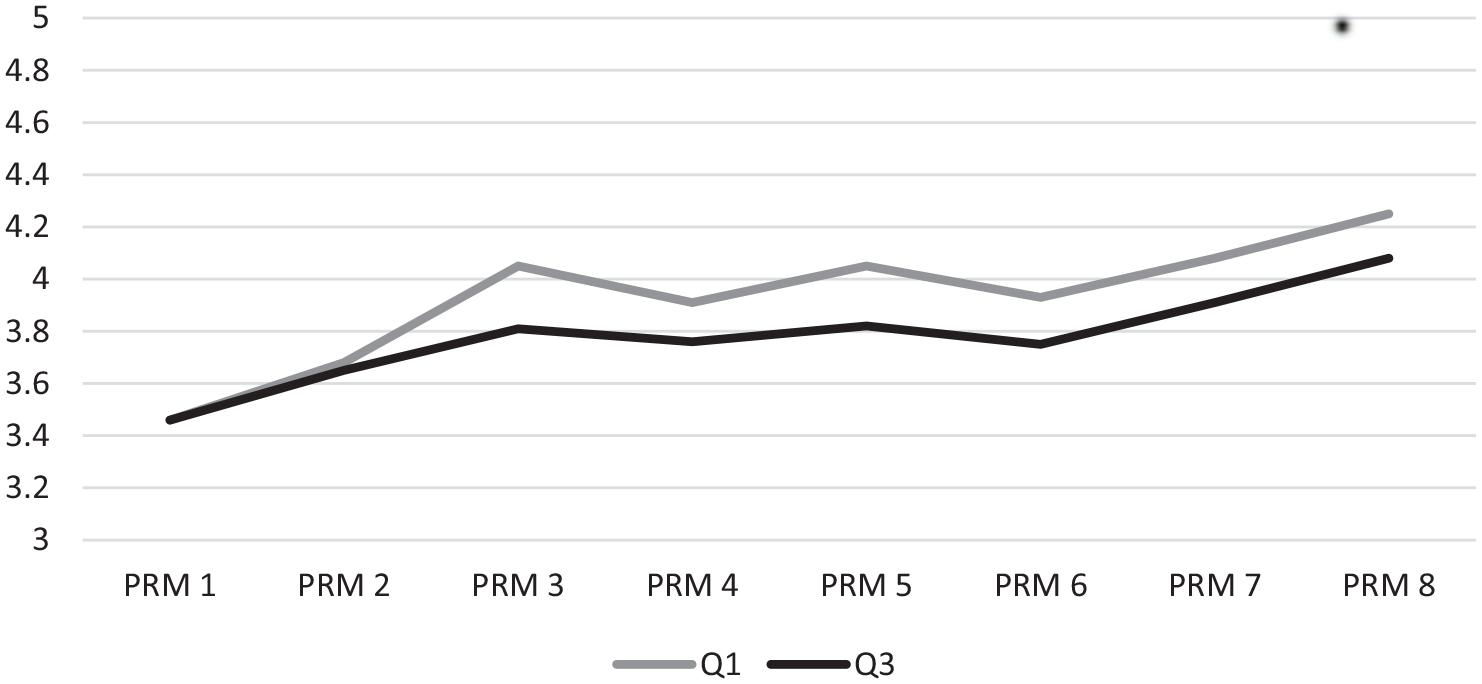
Composite Mean Scores of PRMs 1–8 for Q1 (Least Pantophagous) and Q3 (Most Pantophagous).
Comparison of PRM 1–8 Composite Mean Scores Between Q1 (Least Pantophagous) and Q3 (Most Pantophagous).

PRM: preference rating measure; RQ: research question.
Q1: n = 17; Q3: n = 13; Items are based on a 6-point Likert-type scale from 1 (strongly dislike) to 6 (strongly like).
Research question 2: Quantitative comparisons of classical music taste
RQ2a. Classical music taste: Comparison of PRM 1–8 scores. Composite mean scores were calculated for PRM 1 through 8 for NCMT and CMT (Figure 2) and compared. The results of the Mann–Whitney U test indicated that there were no differences between the composite mean scores of PRMs 1–8 (Table 3).
RQ2b. Non-classical music taste: Comparison of PRM 1 and 8 scores. Composite mean scores of PRM 1 were compared with those of PRM 8 for NCMT. The results of the Wilcoxon signed ranks test indicated that there was difference between the composite mean score of PRMs 1 (M = 3.49) and 8 (M = 4.10) for the group, Z = –5.521, p < .001, with a large effect size (–.72).
RQ2c. Classical music taste: Comparison of PRM 1 and 8 scores. Composite mean scores of PRM1 were compared with those of PRM 8 for CMT. The results of the Wilcoxon signed ranks test indicated that there was no difference between the composite mean score of PRMs 1 (M = 3.60) and 8 (M = 3.94) for the group, Z = –1.424, p = .154.
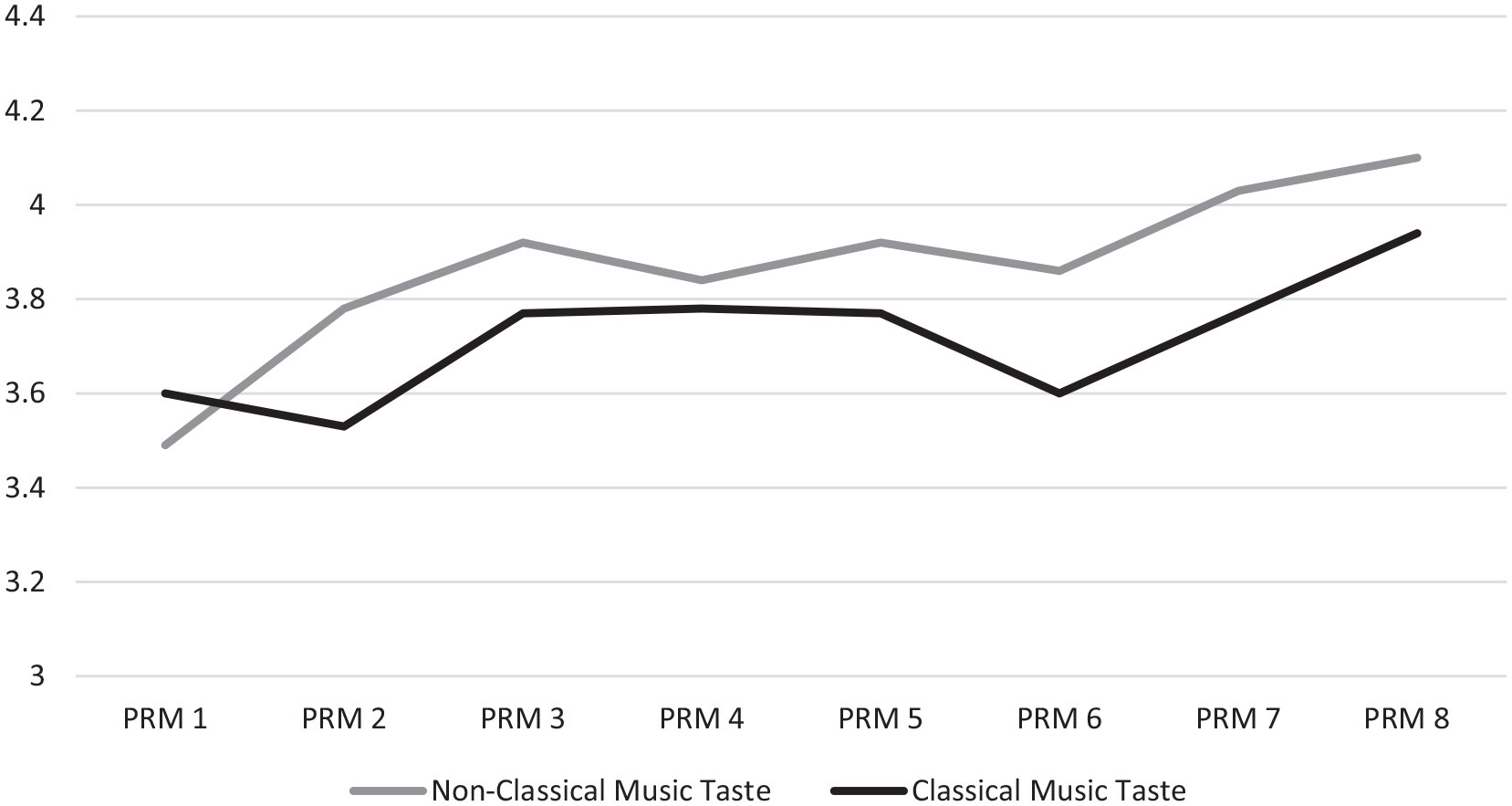
Composite Mean Scores of PRMs 1–8 for Non-Classical Music Taste and Classical Music Taste Groups.
Comparison of PRM 1–8 Composite Mean Scores Between Non-Classical Music Taste and Classical Music Taste Groups.

PRM: preference rating measure; SD: standard deviation; NCMT: non-classical music taste.
Non-classical music taste: n = 58; classical music taste: n = 9; items are based on a 6-point Likert-type scale from 1 (strongly dislike) to 6 (strongly like).
Research question 3: Quantitative comparisons of initial receptiveness
RQ3a. Receptiveness: Comparison of Q1 and Q3 of PRM 1–8 scores. Composite mean scores of preference ratings were calculated for PRMs 1 through 8 for groups Q1 and Q3 (Figure 3) and compared. The results of the Mann–Whitney U test indicated that there were significant differences between the composite mean scores of groups Q1 and Q3 for PRMs 1–8 (Table 4).
RQ3b. Receptiveness: Comparison of PRM 1 and 8 scores for Q1. The composite mean scores of preference ratings of PRM 1 were compared with those of PRM 8 for group Q1. The results of the Wilcoxon signed ranks test indicated that there was a difference between the composite mean score of PRMs 1 (M = 2.67) and 8 (M = 3.65) for the Q1 group, Z = –3.49, p < .001, with a large effect size (–.82).
RQ3c. Receptiveness: Comparison of PRM 1 and 8 scores for Q3. For group Q3, the composite mean scores of PRMs 1 and 8 were compared. The results of the Wilcoxon signed ranks test indicated that there was no difference between the composite mean score of PRMs 1 (M = 4.42) and 8 (M = 4.48) for the Q3 group, Z = –.988, p = .323.
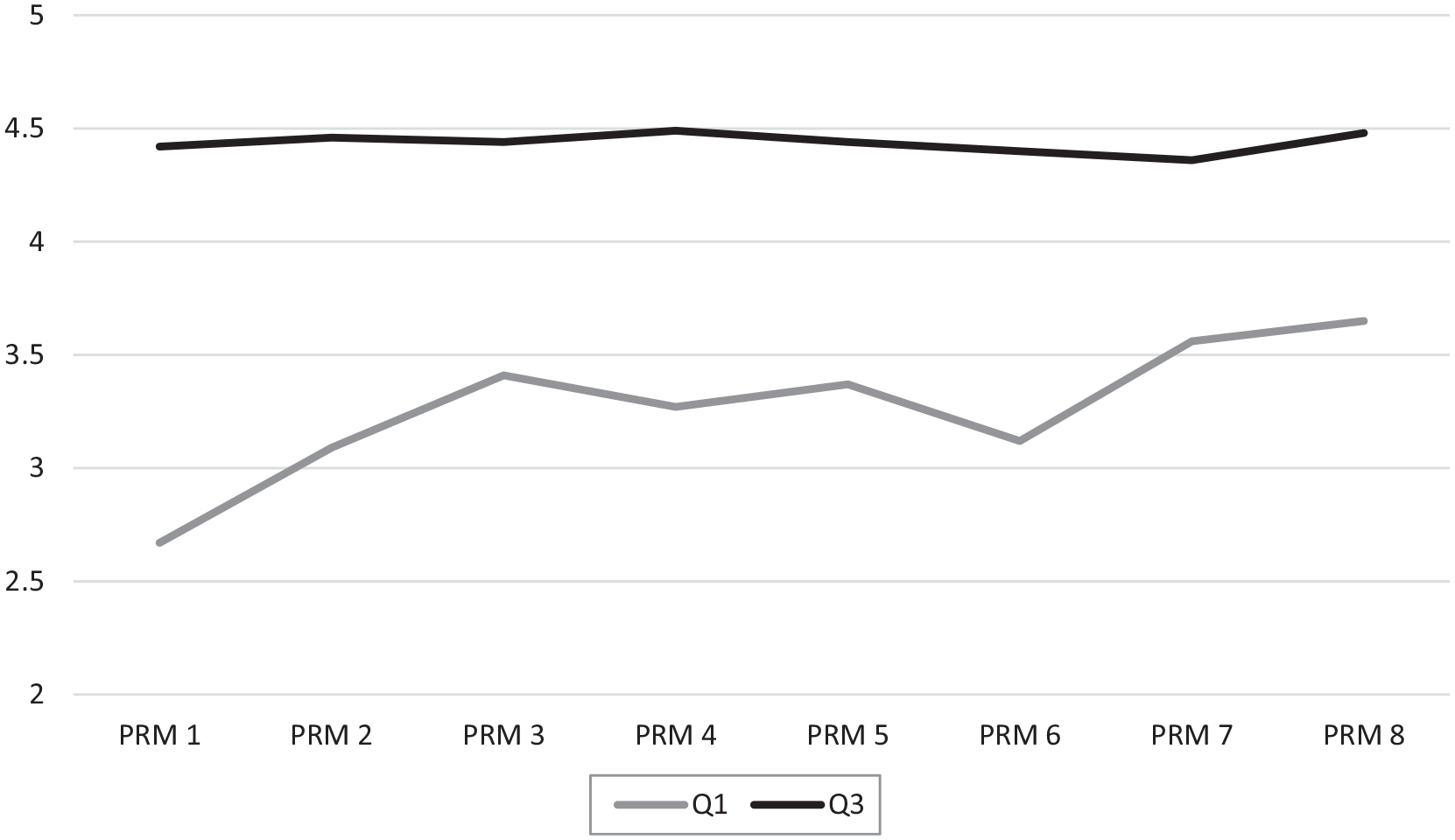
Composite Mean Scores of PRMs 1–8 for Q1 (Least Receptive) and Q3 (Most Receptive).
Comparison of PRM 1–8 Composite Mean Scores Between Q1 (Least Receptive) and Q3 (Most Receptive).

PRM: preference rating measure; SD: standard deviation.
Q1: n = 18; Q3: n = 16; items are based on a 6-point Likert-type scale from 1 (strongly dislike) to 6 (strongly like).
A significant difference between Q1 and Q3 of PRM 1 was expected due to the defined parameter of receptiveness.
Research question 4: Relationship between musical pantophagy and initial receptivity
Spearman’s rank-order correlation coefficient test was calculated to determine the relationship between 67 participants’ quartile ranking based upon the number of music choices indicated on the DSI and initial receptivity, as indicated by PRM 1 scores. There was no significant association between initial receptivity and quartile ranking, rs = .015, p = .907.
Research question 5: Relationship between musical pantophagy and classical music taste
Spearman’s rank-order correlation coefficient test was calculated to determine the relationship between 67 participants’ classical music taste and musical pantophagy. There was a medium, positive association between musical pantophagy and classical music taste as delimited by quartile and, rs = .326, p = .007.
Discussion
Results for Research Question 1 indicated that there were no significant differences between Q1 (least pantophagous) and Q3 (most pantophagous), suggesting that musical pantophagy did not have a significant impact upon preference changes. Ratings for all participants increased from baseline. Comparisons of PRMs 1–8 for Q1 yielded highly significant difference between pre- and post-tests with a 22.8% increase and for Q3 yielded highly significant difference with a 17.9% increase. Although differences between groups were not significant, Q1 exhibited greater preference increases than Q3. This finding supports our hypothesis that more pantophagous participants possess greater familiarity with a broad range of music, and that increase in familiarity via repeated exposure may have a less substantial effect. Initial ratings for both groups were equivalent (3.46). This finding does not support our hypothesis that the most pantophagous participants would exhibit greater initial receptivity. Despite lack of significant difference between the two groups, ratings for both increased. This finding supports previously reported investigations of the positive effects of repeated exposure, but does nothing to elucidate the effect of broad musical taste on receptivity to and response to new music. Repeated exposure may increase preference, but possessing broad music taste did not in this case increase preference more significantly than for those who reported less broad taste.
Results for Research Question 2 indicated that there were no significant differences between participants who reported CMT and NCMT, suggesting that current consumption of classical music did not have a significant impact on preference changes. Ratings for all participants increased from baseline. Comparisons of PRMs 1–8 for NCMT yielded highly significant difference between pre- and post-tests with a 17.48% increase and for CMT yielded no significant difference with a 9.44% increase. CMT began with higher mean scores indicating greater receptivity than NCMT on PRM 1 (3.60 vs 3.49), but NCMT exhibited a stronger positive trend, surpassing scores for CMT by the second presentation. Similar to Research Question 1, this finding supports our hypothesis that participants who consume classical music may possess greater familiarity with music similar to test examples, and that increase in familiarity via repeated exposure may have a less substantial effect. As above, despite lack of significant difference between NCMT and CMT, ratings for both increased. This finding supports previously reported investigations of the positive effects of repeated exposure on musical preference. In addition, for both Research Questions 1 and 2, if preference change resulting from repeated exposure is linked to familiarity, it is reasonable to predict greater preference change over time among those for whom test examples are more unfamiliar.
Results for Research Question 3 indicated that there were significant differences between Q1 (least initially receptive) and Q3 (most initially receptive), suggesting that initial receptivity had a significant impact on changes in preference. Comparison of PRMs 1–8 for Q1 yielded highly significant difference between pre- and post-tests with a 36.7% increase and for Q3 yielded no significant difference with a 1.36% increase. This finding does not support our hypothesis that the most initially receptive participants would exhibit greater increases in preference than the least initially receptive. Of interest is that of all groups, ratings for Q3 remained virtually static across presentations and exhibited the least amount of change from pre- to post-test. Of additional interest is the fact that of all groups, preference ratings for Q1 exhibited the greatest change, increasing 36.7% from pre- to post-test.
Results for Research Question 4 indicated that there was no significant association between musical pantophagy and degree of initial receptivity as indicated by PRM 1 scores. This finding is not in support of our hypothesis that the most pantophagous participants would exhibit the greatest initial receptivity and may suggest that breadth of musical taste is not a good predictor of receptivity to future unfamiliar music. Results for Research Question 5 indicated a medium, positive association between musical pantophagy and classical music taste. This finding is in support of our hypothesis that participants who consume classical music would exhibit greater musical pantophagy.
Summary
This investigation sought to elucidate whether there are differences in the ways in which persons with broad musical taste and preference (musical pantophagy) respond to unfamiliar musical stimuli before and after a program of repeated exposure. In addition, we sought to examine potential differences in the ways in which persons who consume classical music respond versus persons who do not, and we questioned if there were differences for those who are most initially receptive. Furthermore, we wondered if we would find relationship between musical pantophagy and initial receptivity to unfamiliar music, or between musical pantophagy and consumption of classical music.
All groups examined exhibited positive attitudinal change toward test examples in the form of increased preference ratings. These results are in alignment with extant literature suggesting repeated exposure to musical examples results in an increase in preference (Bartlett, 1973; Evans, 1966; Getz, 1966; Haber & Hershenson, 1965; Hargreaves, 1984; Jacoby & Dallas, 1981; Johnston, 2015; Madison & Schiolde, 2017; Moskovitz, 1992; Radocy, 1982; Walker, 1980; Whittlesea et al., 1990; Zajonc, 1968). Although level of complexity was not the focus of the present investigation, results may peripherally support research indicating that repetition results in an increase in familiarity, reduction in complexity, and increase in preference (Droe, 2006; Hargreaves, 1984; Winkielman & Berridge, 2003). Results further support investigations suggesting that regardless of degree of initial receptivity, positive changes in preference may observed via repeated exposure.
Our investigation did not indicate significant difference between the most pantophagous and least pantophagous participants, although participants who indicated the most narrowly defined music taste and preference exhibited greater positive change than those who indicated the broadest taste and preference. If familiarity is a function of repeated exposure and if preference increases with familiarity, it is logical that participants who have more narrowly defined tastes and preferences may exhibit greater change as a result of unfamiliarity with disparate music. Interestingly, participants who indicated the broadest taste and preference did not exhibit greater initial receptivity to test examples. These results are contrary to the works of Peterson and Kern (1995) and Warde et al. (2007) who suggested that omnivorousness is linked to receptivity.
Our findings support the hypothesis that persons who consume classical music may be more familiar with music similar to test examples than non-consuming counterparts, and that they may therefore exhibit lesser preference change than those who do not consume classical music. In addition, we noted a medium, positive association between consumption of classical music and breadth of musical taste and preference. Previous investigators asserted that musical omnivores consume classical music (Peterson & Kern, 2006; Peterson, 2005; Peterson & Simkus, 1992) and Elvers et al. (2015) suggested that musical omnivorism may be a result of familiarity with a variety of musical styles. Our findings peripherally support these assertions.
Finnas (1989) suggested a need for analysis of the potential advantages of taste pluralism, asserting that more explicit attention should be paid to initial attitudes toward music. We observed no significant difference in initial receptivity between the most pantophagous and least pantophagous participants, questioning the advantage of taste pluralism in relationship to initial attitudes toward unfamiliar music. Initial receptivity did have a significant impact on changes in preference resulting from a program of repeated exposure, however, these results suggest that although breadth of musical taste and preference may not be a predictor of initial receptivity, low degree of initial receptivity is a significant predictor of positive preference change resulting from repeated exposure. Schmidt (1975) and Hargreaves (1984) reported no preference change when participants’ initial attitudes were negative and Espeland and Skardahl (1975) reported the poorest change in preference for those who exhibited the lowest initial attitudes. The results of our investigation do not support their findings.
The implications of the present study are of potential importance for educators who desire to positively impact student attitudes toward music. Regardless of variables, such as current breadth of taste and preference, whether or not students currently like or consume music similar to literature often found in music appreciation courses, or whether or not students are initially receptive to unfamiliar music, repetition is an effective tool by which positive attitudinal change in the form of preference may be achieved. As Johnston (2015) noted, music appreciation courses typically present material in survey format with little repetition, but repetition of a limited number of musical examples may be more effective in positively impacting student attitudes toward unfamiliar music. Although the results of this investigation suggest that students who are the least initially receptive may display greater increases in preference resulting from repeated exposure, further research is needed to elucidate the role that musical pantophagy may play in initial receptivity and in changes in preference over time. It is often assumed a priori that broad musical taste and preference are desirable (Droe, 2006; Gates et al., 2000; Johnston, 2015; O’Brien, 1986), but in the case of receptivity to unfamiliar music, the present investigation does not indicate benefit.
Of final interest is the fact that there was significant change for students who did not listen to classical music, suggesting that their unfamiliarity with formal art music may be predictive of greater positive change in preference resulting from a program of repeated exposure. This suggests that instructors of music appreciation should seek to expose their students to unfamiliar genres and classifications of music while focusing on repetition of a limited number of examples.
Limitations
As Johnston (2015) noted, using students enrolled in music appreciation courses can be problematic, as these students may possess greater acuity for music. In addition, the study design would have been stronger if participants in both groups had been completely randomized. Furthermore, the population represented in this study consisted of undergraduate non-music majors at a large Southeastern university who self-select to participate in courses. Any generalizability that may be inferred is limited to this population, although findings of previous research suggest that similar results may be observed with younger populations and with different kinds of music. We recommend replication of the present investigation with different populations, and with musical examples from disparate genres.
In addition, there are issues inherent in preference measurement. Most instruments are self-report, and although it is common for researchers to treat these instruments as valid forms of measurement, it is difficult to know how self-report responses compare with actual behavior. The study design would be strengthened by the use of continuous-measurement technology rather than relying upon self-report.
Furthermore, it is important to consider the ecological validity (Szpunar et al., 2004) of musical stimuli, and the impact of presentation of an excerpt versus an entire movement or work. The present study utilized ecologically valid excerpts, but although the effects of repetition on preference for musical excerpts are well documented, it is possible that different results would be noted with the presentation of an entire work in a classroom setting. Such a thing would have been prohibitive for the present researchers as a result of the time that would be utilized in regularly scheduled courses, but it is our opinion that future research should utilize complete works, when possible.
