







Abstract
The objectives of the current study were to obtain four physiological measures sensitive to stress and compare the nature of their decline after a stress task while listening to different sounds. Particular focus was placed on examining the ability of the song “Weightless”, which has been heralded as “the most relaxing song in the world,” to reduce acute stress as measured physiologically. A single-subjects design was deployed with 57 university students acting as participants. Outcome measures were skin conductance, heart rate, respiration rate, and respiration depth that were obtained during a 4-min rest period containing the sound conditions (silence, monaural beats [6 and 16 Hz], aircraft noise,“Weightless”) and referenced to a proceeding stress task. “Weightless” and the 6-Hz monaural beat had significantly lower mean skin conductance than the reference condition (silence), but no differences were noted for rate of decline or final asymptote. Furthermore, after 4 min, “Weightless” was associated with a 36.09% decrease in skin conductance level, favorable to that reported by the song’s creators. In terms of heart rate decline, “Weightless” was no more effective than any other of the sound conditions, while for respiration rate, it was significantly less effective than silence and the 6-Hz monaural beat. Overall, there was evidence that the song “Weightless” was an effective tool to reduce acute stress.
The modulation of adaptive psychophysiological responses to personal and environmental challenges is achieved through a dynamic and complex interaction between the two branches of the autonomic nervous system: the parasympathetic and sympathetic nervous systems. While the parasympathetic branch is involved in functions that do not require immediate action such as rest and digestion, the sympathetic branch is involved in immediate energy mobilization for when rapid action is required. Stress describes the internal state of an individual experiencing strain or pressure from external (i.e., stressors) or internal (i.e., negative emotions) events that demand resources beyond the individual’s coping capacity, and is characterized by sympathetic dominance. The use of music to reduce stress by inhibiting the sympathetic nervous system has been promoted in some quarters (Lee et al., 2016; McPherson et al., 2019) and is commonly used as an acoustic relaxant in systematic desensitization and graduated exposure therapy (Tan et al., 2012). The “undoing hypothesis” proposes that positive emotional states facilitate the restoration of parasympathetic dominance following stress and sympathetic arousal (Fredrickson et al., 2000).
Music therapy is the use of music as an intervention to achieve a therapeutic goal, including stress reduction. In the music therapy context, it has been noted that larger increases in heart rate (HR) are experienced when melancholic, as opposed to uplifting, music is heard (Sokhadze, 2007). Furthermore, these findings are consistent with the circumplex model of emotion (Russell, 1980), which posits that it is the perceived affective properties of the music that determines stress reduction. Of relevance, one study reported that low arousal/high valance music is more effective at inducing recovery from stress than high arousal/low valence music (Sandstrom & Russo, 2010).
Medical settings are inherently stressful for both patients and staff, and substantial efforts have been made to reduce acute stress in clinical environments (Sandstrom & Russo, 2010). Music has been intensely studied in clinical settings as a means to either relax patients and/or counteract their perceptions of pain (Roy et al., 2008), and the stress-reducing effects of music have been demonstrated in numerous clinical populations (Andrade & Bhattacharya, 2003; de la Rubia Ortí et al., 2018; Yurkovich et al., 2018). Two studies have reported distinct clusters of responders and non-responders when investigating the efficacy of music to relax patients in high stress medical environments such as emergency departments (Chan et al., 2009; Hernandez-Ruiz et al., 2020). Specifically, Chan et al. reported that physiological arousal was not as effectively reduced in young employed males. However, one difficulty encountered in clinical settings is that the use of public address systems to play music means the personalization of music is not possible. As such, the challenge is to identify pieces of music that are effective in reducing stress for most people.
It has been reported that between 5% and 8% of annual healthcare costs in the United States are linked to substandard management practices causing stress in subordinates, which translated to 120,000 preventable deaths per annum (Goh et al., 2016). This, coupled with the emergence of other life stressors has led to the development of a stress-reduction industry in the last 50 years including music therapy in the clinical domain, though the use of music to promote health and improve wellbeing can be traced back to cultures the world over since antiquity. Recently, a piece of music called “Weightless” (by Marconi Union) has been heralded as “the world’s most relaxing song,” and reportedly was a collaboration between musicians and music therapists aiming to apply scientific theory to reinstate parasympathetic dominance (Passman, 2016). The song was the creation of Mindlab International, a consumer-science organization who claimed that by systematically reducing the tempo, the song reduces anxiety by 65% and normal “physiological resting rates” by 35% (https://themindlab.co.uk). While established research indicates that an inverse relationship exists between tempo and sympathetic arousal (Bernardi et al., 2006), the claims promoting “Weightless” have not been independently verified nor the original data published. “Weightless” can be listened to online through the URL https://www.youtube.com/watch?v=UfcAVejslrU.
Cortical models of autonomic function have indicated that brain states associated with higher frequency electroencephalographic signatures are coupled to increases in sympathetic nervous activity. A recent approach to manipulating brain activity comes in the guise of acoustic stimulation using monaural and binaural “beats.” Beats are described as a pulsating wave and are produced by summing together two acoustic waves of slightly different frequencies and have been reported to entrain brain activity by many (e.g., Pratt et al., 2010; Vernon, 2009) but not all (López-Caballero & Escera, 2017) of the studies reported in the literature. Of relevance to the current study, the autonomic activity associated with “Weightless” would be expected to mirror beat frequencies that match spontaneous frequencies in the brain associated with states of relaxation (e.g., alpha), but not those beat frequencies hypothesized to produce more aroused brain states (e.g., beta or gamma).
The current study employs a single-subjects design that alternately presents participants with episodes of stress punctuated with opportunities for rest. Studies show that, following a stressful task with measureable increases in sympathetic activity, a short rest period of silence (≈ 4 min) returns physiological values back to pre-stressor levels (Alvarsson et al., 2010), this being known as a recovery function. Each rest period involves exposure to silence or one of four sound conditions: two sounds that were hypothesized to induce parasympathetic dominance (“Weightless” or 6-Hz monaural beats) and two inducing sympathetic dominance (aircraft noise and 16-Hz monaural beats). Aircraft noise was used as it is a known acoustic stressor (Basner et al., 2017) and potent arouser of sympathetic activity (Medvedev et al., 2015).
The occurrence of an emotion can be interpreted objectively using skin conductance (SC), which is more sensitive to arousal state and indicative of sympathetic activation, and by using HR which is reported to reflect auditory valence (Cuthbert et al., 1996; Sokhadze, 2007). We would expect a stress-inducing task to increase sympathetic arousal, marked by a faster HR and higher SC. For the relaxation intervals, we expect HR and SC to progressively reduce, albeit at different rates, as it is reported that post-stressor exposure to music has an immediate effect on SC, whereas HR recovers more slowly (Sandstrom & Russo, 2010). The central hypothesis is that “Weightless” will significantly reduce HR, SC, and respiratory correlates of stress following a stressor. Additionally, we hypothesize that “Weightless” will be associated with lower post-stressor physiological activity than either a reference condition (silence) or a sound that typically induces negative emotions (aircraft noise). Furthermore, monaural beats of 6 Hz (i.e., purported to be calming) and 16 Hz (i.e., purported to be arousing) were employed on the basis of past studies (see López-Caballero & Escera, 2017 for a review). Thus, we would expect the effect of “Weightless” to be more similar to the 6-Hz beats than the 16-Hz beats.
Method
Participants
Data were obtained from 57 university students enrolled in a health sciences degree and who were recruited through the use of advertising posters and flyers distributed across their resident campus. There were 14 males and 43 females, with a mean age of 25.67 years (SD = 6.08). None of the participants reported abnormal hearing or medical conditions that might confound physiological measurements. Participants were instructed to avoid rigorous exercise, or the consumption of food, caffeine, alcohol, or cigarettes, for 2 hr prior to the experiment. This study was approved by the Auckland University of Technology Ethics Committee (AUTEC).
Materials
Four diverse examples of auditory stimuli and one reference condition (i.e., silence) were selected for use, each with the duration of 4 min. The four auditory stimuli consisted of samples of 6-Hz (theta) and 16-Hz (beta) harmonic monaural beats (Pigeon, 2017); a montage recording of aircraft taking off and landing; and the first 4 min of the song “Weightless” by Marconi Union. The sampling rate of all four sound recordings was 44.1 kHz, and monaural beats were chosen as reportedly that entrain cortical activity more effectively than binaural beat stimuli (Orozco Perez et al., 2020). Each sound file was conditioned in Audition 1.5 (Adobe Systems), scaled to a sound pressure level (SPL) of 64 dB SPL and played through insert headphones.
Physiological measures
Data acquisition hardware consisted of a 24-bit Nexus-10 analogue-to-digital converter (Mind Media BV) measuring SC level, the electrocardiogram (ECG) from which HR was derived, and both respiration depth (RD) and rate (RR). The Nexus-10 unit was controlled by its accompanying software, Biotrace+ (Mind Media BV). For both SC and ECG sensors, pre-gelled silver-silver Chloride (Ag-AgCl) electrodes were used, and the area of the skin for electrode placement was exfoliated and then cleaned beforehand using isopropyl alcohol. SC was measured by attaching an electrode to the middle finger and another to the fourth finger of the non-dominant hand. These electrodes were positioned on the volar surface of the medial phalanges. The ECG was obtained using a conventional three-lead set-up (i.e. standard lead II placement) and HR was calculated from interbeat intervals. Respiration data were obtained using a respiratory belt fastened in the abdominal position at the height of the umbilicus. SC, ECG, and respiration data were sampled at rates of 32, 2048, and 128 Hz, respectively.
Stress task
The stress task lasted 2 min and consisted of two 60-s components, with an arcade-type game common to both. In the arcade game, the participant used the mouse to control a cross-hair gun-sight and was required to shoot targets that would appear and then disappear in random locations on a video monitor positioned in front of the participant. At the top of the arcade screen, the number of shots made by the participant was displayed alongside the number of successful shots (i.e., hits). Participants were instructed to maximize the number of hits. The time the targets were displayed was adjusted to maintain a hit rate of approximately 80% by applying a three-down one-up adaptive procedure (Levitt, 1971). This approach was employed to control for differences in skill across participants. The stress task was always accompanied by eerie music and mildly disturbing backgrounds (e.g., haunted house or natural disaster scenes) changing every 10 s.
For the first minute, the participant was required to divide attention between the arcade game and the Stroop task (Stroop, 1935). For the Stroop task, a randomized single word symbolizing a color (“black,” “red,” “blue,” “yellow,” “green,” “brown,” or “purple”) appeared at the bottom of the screen for 5 s. The font was in a randomly assigned color, for example, the word “black” appearing in red font. The participant was required to verbally state the color of the word while the research assistant stood behind and provided feedback contingent on response: “correct,” “incorrect,” or “missed” (if later than 5 s). For the second minute, the participant was required to divide attention between the arcade-shooting and a simple arithmetic task that replaced the Stroop task, as mental arithmetic tasks have been demonstrated to be potent stressors (Karthikeyan et al., 2011). Two random numbers ranging between 1 and 99 appeared for 5 s as a simple addition or subtraction problem, for example, “53 + 21 = 102” or “32 – 45 = 13.” However, these equations were formulated to be correct only 50% of the time, and the task of the participant was to verbally indicate whether the equation was true or false. Again the Research Assistant stood behind the participant and declared the responses as “correct,” “incorrect,” or “missed.”
Procedure
A single-subjects design was utilized in the current study. Here, a single independent variable was employed as a within-subjects variable, with various physiological measures acting as dependent variables. Following a briefing, a participant was tethered to the physiological sensors and then seated comfortably in a sound-attenuating chamber. To adapt participants to the experimental environment and to ensure the fidelity of the physiological recordings, a 10-min baseline period ensued during which the participant relaxed in the absence of the Research Assistant and stimuli. During the stress task, the Research Assistant was present in the booth with a clipboard recording responses. Appraisal has been shown to increase stress levels (Creswell et al., 2014). At the termination of the stress task, the Research Assistant exited the experimental chamber, and a 4-min rest period began. During the rest period, the participant sat still listening to one of the five sound conditions until the commencement of the next stress task. The order of the five sound conditions was randomized across participants, and after the fifth rest period, the experiment was terminated (Figure 1).
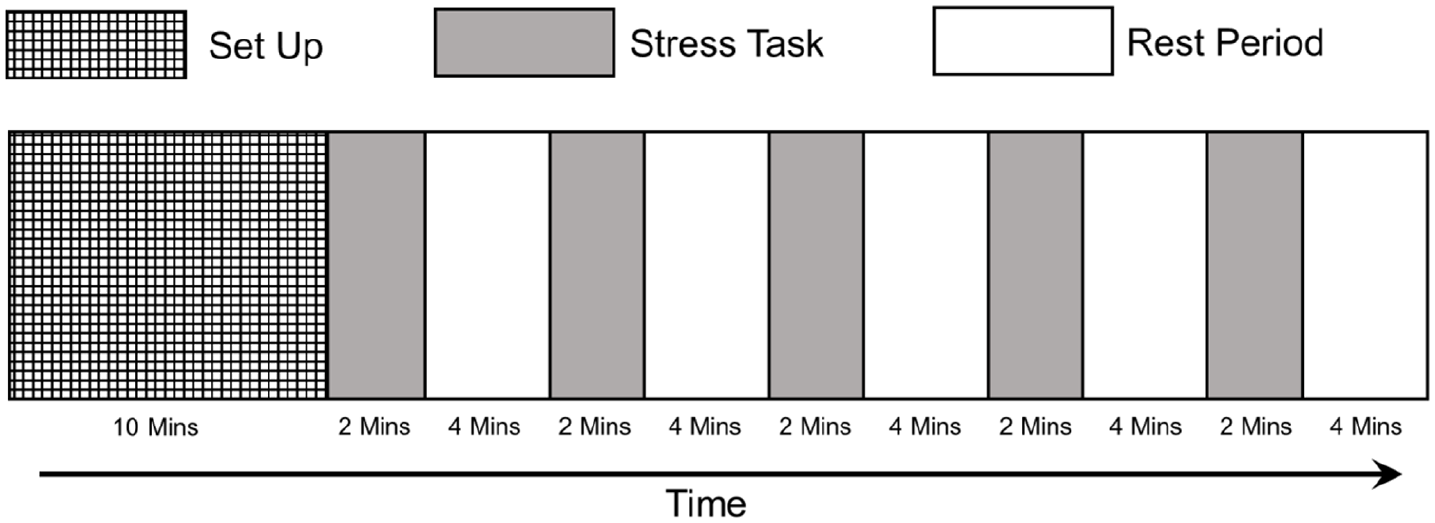
Overview of the Experimental Procedure.
Data analysis
Recovery functions for physiological measures obtained during the rest periods were calculated as changes from mean measurements over the final minute (i.e., seconds 60–120) of the preceding stress task. Thus for SC, which is measured 32 times per second, the 1,920 measurements (i.e., 32 samples/s × 60 s) obtained from the last minute of the preceding stress task were averaged, and then this average was subtracted from each of the 7,680 SC measurements obtained during the rest period to produce a recovery function. These relative measures are denoted ΔE, indicating a change in physiological value relative to the last minute of the stress task, and for ease of pictorial depiction, the rest-period measurements of ΔE were averaged into 10-s bins. HR was investigated across the entire rest period and, consistent with best practice (Bradley & Lang, 2000; Lang & Bradley, 2013), for the first 6 s of the rest period (hereafter acute HR). SC was modeled with a logistics-based equation derived post hoc using Table Curves 2.5 (Systat Software):
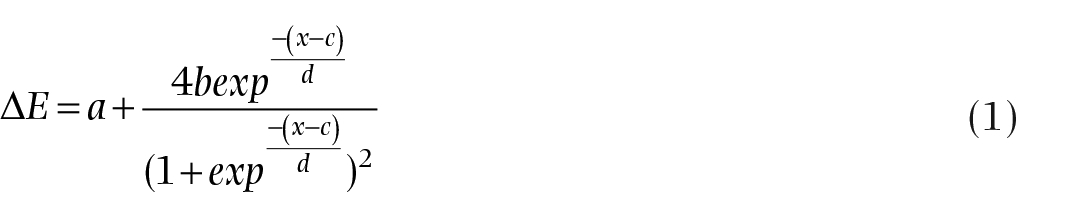
In Equation (1), the parameter a shifts the function vertically and determines the value of the y-axis asymptote, b determines the distance between the peak of the function relative to the asymptote, c is the position of the vertex relative to the x-axis, and d reduces the density of the peak and smooths the function out so that the asymptote is approached at a slower rate. Bootstrapping was performed in SPSS to standard errors.
To determine statistical differences across the sound conditions, two sets of ANOVAs were performed while controlling for gender. The first set explored differences across the physiological measures, while the second set of analyses was undertaken on the four coefficients obtained using Equation (1). Both parametric and non-parametric bivariate tests indicate no main effect of gender or age on the data, likely due to the low number of males for the former, and a lack of variability for the latter. Consequently, these two variables were excluded from the analysis to preserve statistical power. As To assess effect size, partial eta-squared (
Results
The physiological recovery functions for each of the five rest periods (each corresponding to a different sound condition) are displayed in Figure 2. For SC, HR, and RR, there is an initial increment in activity, while for RD, this trend is not evident. For the acute HR, the functions differ notably across sound conditions, possibly due to differences to the affective features of the sound conditions. The mean change in physiology across each sound condition is displayed in Table 1, with the following outcomes for repeated measures ANOVAs conducted across the five sound conditions: SC, F(4, 224) = 2.754, p = .028,
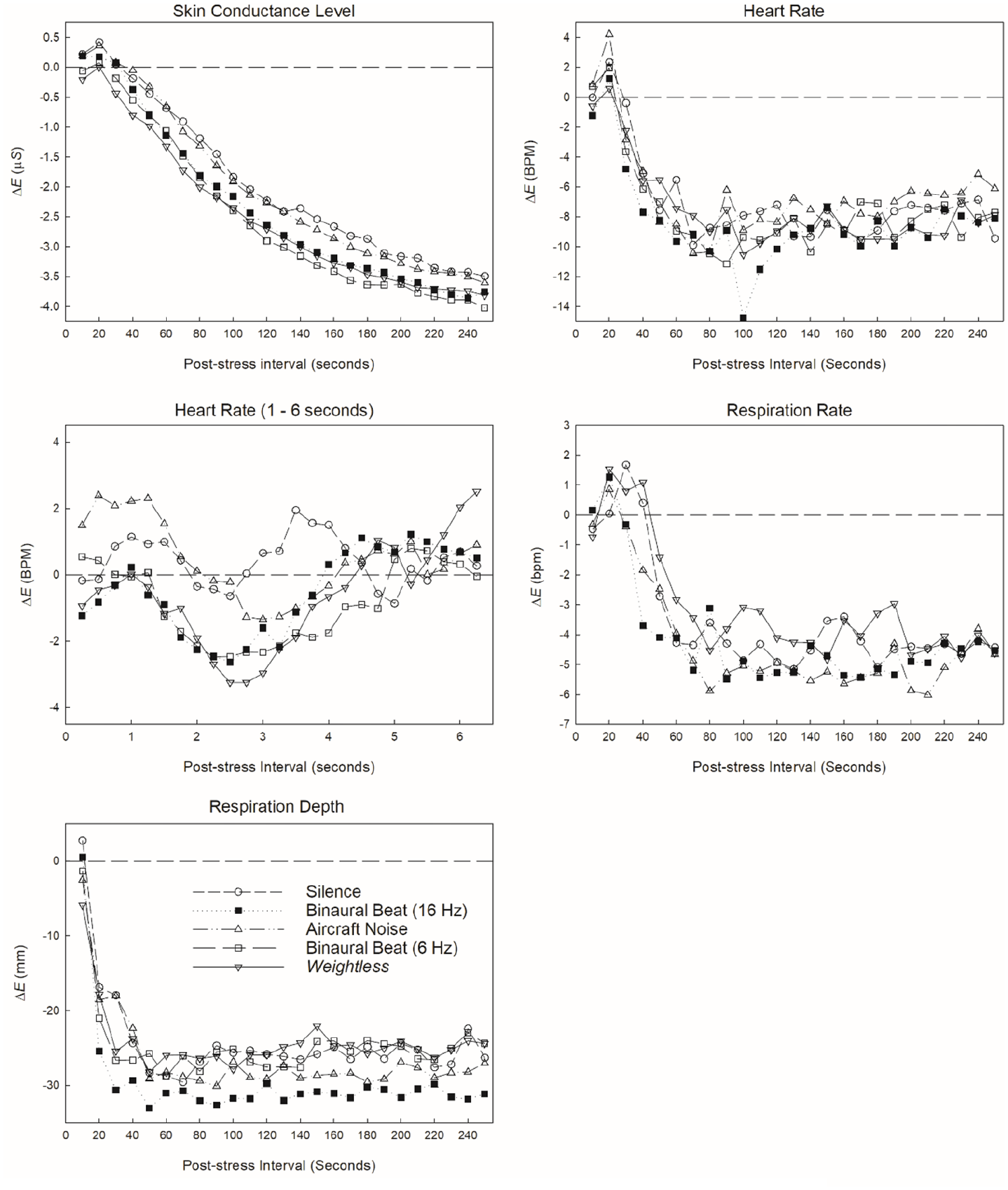
Average Physiological Change (ΔE), Obtained During the Rest Period Following the Stress Task, for the Five Sound Conditions.
Descriptive Statistics for Changes in SC (µS), HR (Beats Per Minute), RR (Breaths Per Minute), and RD (mm) for Each Sound Condition Over the Entire Rest Period.
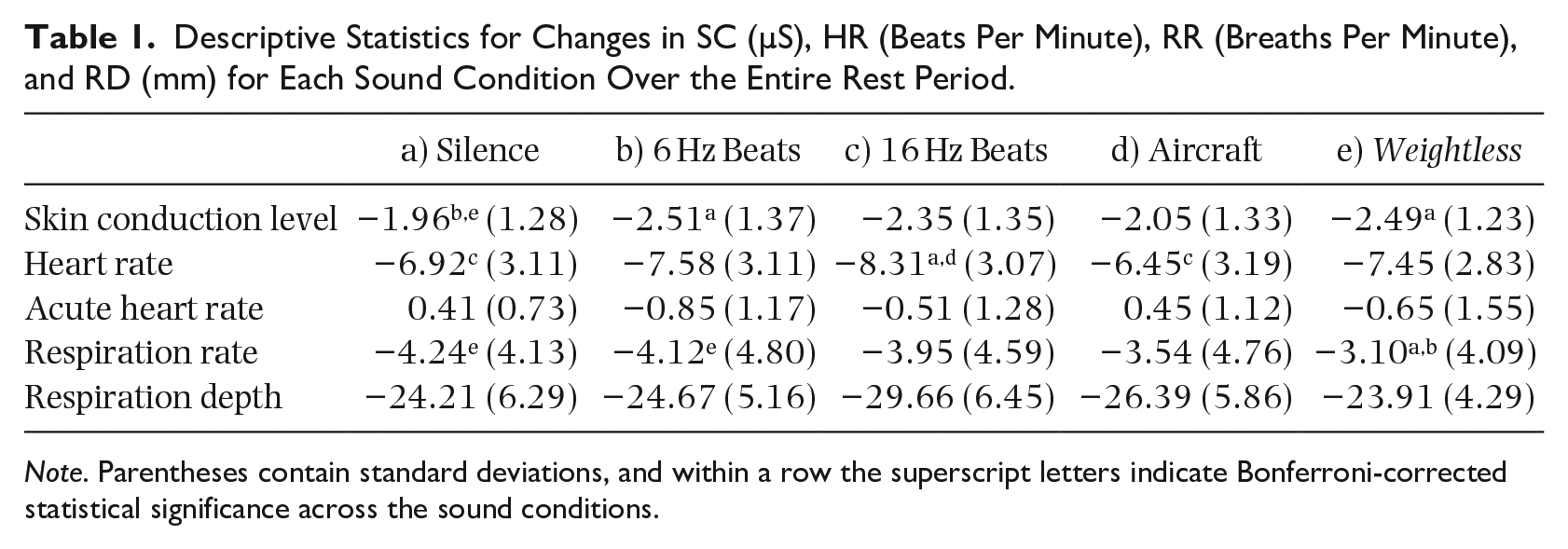
Note. Parentheses contain standard deviations, and within a row the superscript letters indicate Bonferroni-corrected statistical significance across the sound conditions.
The physiological recovery of SC following the stress task is further documented in Figure 3. Here, the solid curve is the best-fitting function expressed in Equation (1), while the solid circles are from Figure 2. Visual inspection indicates that the functions are a relatively good fit to the empirical data. Repeated measures ANOVAs were performed across the five sound conditions, one for each of the four model parameters obtained using the pooled SC data (re: Figure 3). Preliminary analysis of pooled data suggested that 6 Hz and “Weightless” had larger overall reductions in skin conductance level (SCL) compared to silence, 16-Hz beats, and aircraft noise. However, no significant differences were found in the mean parameter values across the sound conditions for any of the parameters: a, F(4, 224) = .12, p > .05,
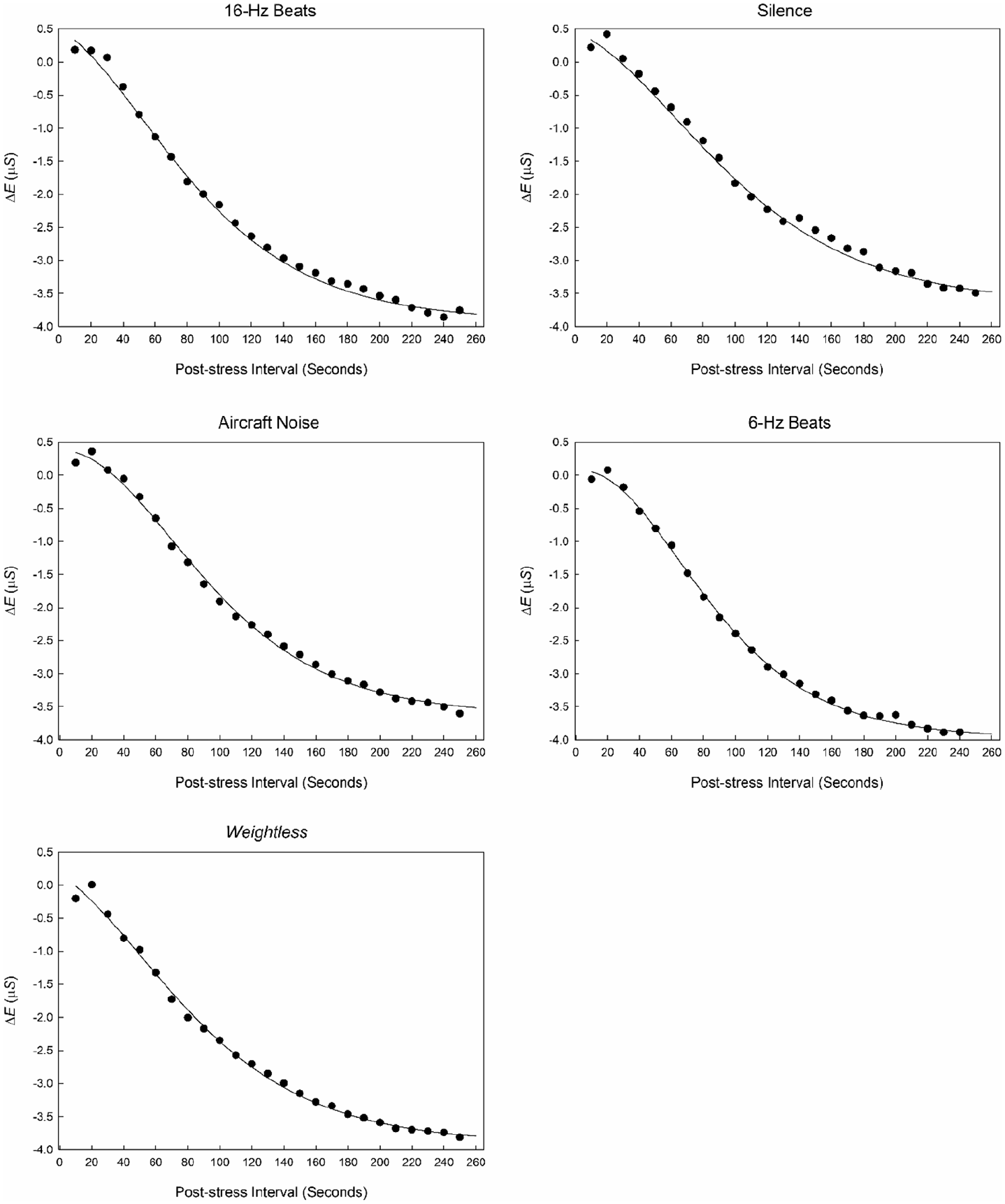
Best-Fitting Model (re: Equation [1]) for Pooled SC Data during Rest Periods.
Discussion
In this study, we investigated the influence of sound on SC, HR, and respiration as participants transitioned between stress and relaxation states, with particular scrutiny placed upon “the most relaxing song in the world,” “Weightless”. Considering the entire rest period, it was noted that mean SC was significantly higher for the reference condition (i.e., silence) compared to both “Weightless” and the 6-Hz monaural beats (re: Table 1). This finding was consistent with the study’s main hypotheses, whereby “Weightless” was purported to calm the sympathetic nervous system indirectly by the entrainment of HR, and the 6-Hz monaural beat by inducing a frequency-following response of the brain leading to a calm state. However, when considering the asymptotes of the five functions (Table 2: parameter a) and rate of change (parameter d), there was no statistical evidence of “Weightless” being the superior relaxant.
Mean Parameter Estimates from Bootstrapping the SC Data.
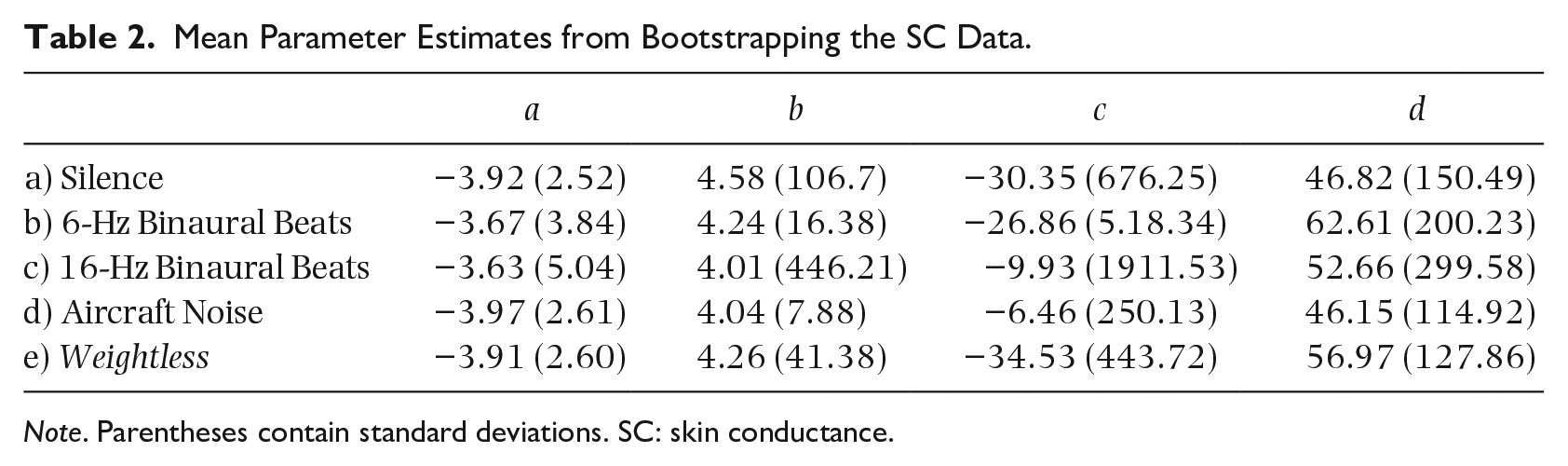
Note. Parentheses contain standard deviations. SC: skin conductance.
While others only found significant differences with SC in their study of music, we also noted a significant effect of sound condition on HR and RR (Hernandez-Ruiz et al., 2020). For HR, the 16-Hz monaural beat condition showed a greater decrease than both the reference (i.e., silence) and aircraft noise. This is an unexpected finding, as in theory, beats of this frequency would be expected to induce a state of high arousal and thus increase HR (López-Caballero & Escera, 2017). Pertinently, it would be predicted that the arousing effects of 16-Hz beats would be similar to that of aircraft noise and less than that of silence, though there is emerging evidence in the literature that silence can also serve to increase rumination and cognitive arousal (Lui & Grunberg, 2017). Regardless, in terms of HR, “Weightless” was not found to induce greater parasympathetic recovery, and while others have reported that tranquil music has the agency to reduce HR (e.g., Ellis & Thayer, 2010), there is a noted inconsistency in the findings published in the music literature (Sokhadze, 2007). Speculatively, this could be due to the manner in which the acoustic features of music, such as tempo, can entrain HR differently than say noise or silence (van der Zwaag et al., 2011).
Of additional interest, the plot of acute HR for “Weightless”, which captures the first 6 s of the rest period and thus phasic changes, is qualitatively very similar to the function published by Bradley and Lang (2000: their Figure 5) for highly arousing and unpleasant stimuli. However, no significant differences were noted across the conditions in terms of acute HR. Lang and Bradley (2013) adopted the Defense Cascade Model to humans. They argue that an initial change in the soundscape, the postencounter stage, involves reflexive attentional mechanisms that have developed across the course of human evolution. It is this postencounter stage that would be captured in the acute HR condition, and our finding indicates that in terms of stress relief and therapeutic intervention, sound may influence mental states when tonic rather than phasic. As such, more research is needed using the stress-recovery paradigm to determine windows of electrophysiological recovery and the optimal length of songs needed to provide a meaningful therapeutic effect. Of note, with modern ambulatory listening device, there is potential for music to be used as an acute relaxant in whatever context individuals may find themselves.
When examining RR, “Weightless” was associated with less recovery than both silence and the 6-Hz monaural beats (see Table 1). Prima facie this finding appears to contradict the SC data for “Weightless”, and though such inconsistencies are common in the music literature investigating physiological correlates (e.g., E. Labbé et al., 2007; López-Caballero & Escera, 2017), it does not contradict the data for the 6-Hz beats condition. Past studies indicate that higher RRs are associated with arousal and emotional tension (Masaoka & Homma, 1997), especially when participants are exposed to stressors (Conrad et al., 2007). Respiration is regulated by autonomic nuclei in the brainstem and by higher order processes that permit voluntary control of breathing. Furthermore, the respiratory and cardiac systems are closely linked (e.g., respiratory sinus arrhythmia), and just as music tempo can drive HR, it could potentially also be directing respiration. Irrespective, our measure of RR does not support the proposition that “Weightless” is effective at reducing acute stress.
More broadly, documenting the ability of music to influence physiological markers of emotional states has occurred for the best part of a century (Hyde & Scalapino, 1918; C. Labbé et al., 2021); though in a review, Hodges (2010) reported that methodological inconsistencies make the literature difficult to synthesize and interpret. For example, tonic changes in physiological activity (i.e., 1–6 s after stimulus onset) may reflect different psychophysiological processes than longer duration phasic changes (Lang & Bradley, 2013), given that emotions are typically transient and of a stimulus-response nature, while mood is more pervasive but can likewise influence physiology as it transitions between states (Khalfa et al., 2002). While we present both phasic (i.e., acute) and tonic changes for HR in the current study, albeit with non-significant findings for the former, it is perhaps the phasic data from SC level that is of most interest here. The SC measure reflects emotional arousal rather than valance (Bradley & Lang, 2000), and in relation to the circumplex model of emotion (Russell, 1980), the reduction in SC level while listening to “Weightless” likely reflects a decrease in sympathetic activity. As such, this reduction is consistent with the “undoing” hypothesis (Fredrickson et al., 2000), suggesting that “Weightless” may be relaxing individuals by substituting negative emotions with positive emotions.
The limitations of the current study should be considered when interpreting the study’s findings. First, it should be noted that the sample consisted predominantly of student volunteers providing data in a laboratory setting. Furthermore, they were mostly young adults reporting good health, and while this narrow range of individual differences was of utility, it does not afford generalizations to either general or clinical populations. Second, the gender imbalance in the sample means that the main and simple effects of gender could not be elucidated in the current study, as was the case with age. Thus, future research increasing the sample size and broadening the variables of interest would be useful. Third, more direct measures of the sympathetic inputs in the heart using techniques such as thoracic electrical bioimpedance may serve to give a clearer picture of autonomic activity.
Conclusion
In summary, we found mixed evidence for the notion that “Weightless” is an effective reducer of stress worthy of inclusion in clinical practice. SC, an exclusive measure of sympathetic activity, was significantly reduced relative to a stressor, and this decrease (≈ 36%) was comparable to the claims of the creators of “Weightless” who reported a 35% decrease in physiological activity from resting states (Passman, 2016). However, our measures of HR and RR obtained with “Weightless” were not significantly decreased relative to the other sound conditions, and overall “Weightless” was not as effective as the monaural 6-Hz beats in reducing physiological arousal. Future research is required to disentangle the effects of music upon the autonomic nervous system in order to best create acoustic interventions able to provide a measureable therapeutic improvement. However, based on the current SC data, it can be argued that “Weightless” has potential utility as a relaxant in systematic desensitization techniques, and as a general relaxant as stress-reducing intervention in its own right.
Footnotes
Acknowledgements
The authors would like to acknowledge all of the participants who gave up their time to participate in this study.
Declaration of conflicting interests
The author(s) declared no potential conflicts of interest with respect to the research, authorship, and/or publication of this article.
Funding
The author(s) received no financial support for the research, authorship, and/or publication of this article.
