







Abstract
The past few decades have seen formal jazz degrees become more established in university music programs in the United States. As these universities strive to provide an exemplary education experience for jazz degree majors, it is especially important to thoughtfully inquire into the personal and environmental elements that led students to pursue a jazz degree. The purpose of this multiple case study is to examine the identities of four undergraduate jazz performance majors and the factors that guided their selection of major upon matriculation. Data collection included six interviews with each participant, reflective practice journals, and university small group jazz rehearsal field notes. The theoretical framework of music performer identity as framed by Davidson was used as the basis for this study. Cross-case themes that emerged as part of this theoretical framework include (1) the importance of aural music learning; (2) environments that promoted creative music-making; (3) the crucial importance of jazz recordings; (4) music as a social or communal activity; (5) attraction toward musical experimentation and variation. Study results suggest that both universities and K–12 music programs can actively prepare and engage students who are interested in jazz.
Embedded within colleges and universities are departments or schools of music, the curricula of which are often grounded in the centuries-old conservatory Western-classical tradition (Kingsbury, 1988; Myers, 2017; Nettl, 1995). However, in the past half-century, more universities, colleges, and music conservatories have begun to offer formal degrees in jazz performance with greater frequency (Porter, 1989). As Dobbins (1988) notes, within formal jazz degree programs, there exists a tension between the conventions reified by the monolithic institutional structure of the university and the history of jazz as an American folk or “street” music. As a result, university jazz majors often have different prior musical experiences and desire different musical outcomes from their Western-classical colleagues.
There is, however, scant extant literature that specifically addresses the identities of jazz musicians. Dobson (2010) completed one of the few research studies to examine career-related psychological differences between classical and jazz musicians from university students to professionals in the first 10 years of their careers. Using an interpretive phenomenological analysis (Smith et al., 2009), Dobson (2010) found that both classical (n = 9) and jazz musicians (n = 9) focus on instrumental technique. However, Dobson (2010) found that the study’s classical musicians identified more with objective accuracy and perfectionism whereas, due in large part to the improvisation component, jazz musicians identified more with personal autonomy and experimentation. In addition, several authors and researchers (Berliner, 1994; Faulkner & Becker, 2009; Monson, 1996) have documented a rough set of cultural norms shared among most jazz performers. Such norms include but are not limited to the specific musical roles, the order of improvised solos, and ornamentation of known melodies.
For at least the past century, jazz has had a distinct focus on improvisation (Read, 2014). Although jazz differs from most current Western-classical performances in this practice (Berkowitz, 2010), researchers have indicated that artist-level jazz musicians must also internalize a great deal of knowledge and skill through rigorous practice (Berkowitz, 2010; Berliner, 1994; Pressing, 1984; Sudnow, 1978). Wilson and MacDonald (2005) discovered a similar theme as part of two focus group interviews of professional Scottish jazz musicians. As part of the thematic analysis, participants noted that both “mastery” and “mystery” are required for improvisation (p. 347). More specifically, “mastery” is communicated through deft application of skills and knowledge. “Mystery”, on the contrary, is an instinctive and uncontrolled reflection of a jazz improviser’s unique generative personality (Berkowitz, 2010; Berliner, 1994; Sudnow, 1978). In her detailed ethnography of master jazz improvisers, Monson (1996) noted that the instrument one plays might have an influence on personality and “may be cited in explanation of the player’s attitudes, modes of thinking, and musical perceptions” (p. 27). Similarly, Kemp (1996) discussed how professional players of certain instruments might have common personality traits and how distinct genres of music (such as rock, jazz, and pop) might be associated with professional musicians’ personalities as well. In an autobiographical reflection, Monson (2008) addressed the pervasive influences of race and gender as part of her journey as a white, female, lesbian African American studies professor. West (2022) has similarly addressed the importance of race and gender identity in jazz education, citing influential musicians who have bucked traditions such as Vijay Iyer and Terri Lynne Carrington.
The undergraduate years of a student often represent a unique time as this period in their life embodies a transition point between formal schooling and a chosen vocation, parental supervision, and an independent adult life known as “emerging adulthood” (Arnett, 2004). Students are required to select a major in college that purportedly defines both their personal and vocational interests (Aldosary & Assaf, 1996). Directly or indirectly, the selection of that major is the result of fluid identity traits and cultural experiences (Syed, 2010). It also places a young adult in the center of an academic and social culture that continues to shape their identities (Reinharz, 1979; Turino, 2008) and influence their decisions regarding ultimate career choice.
Iberra (1999) discussed how “provisional selves” individuals “try out” different identities to help facilitate success in their chosen fields: “wholesale” (adopting the characteristics of a successful role model) and “selective” (adopting a range of characteristics from multiple successful figures). Influential figures, including colleagues and family, would confirm or reject those identities. As an extension of Iberra’s (1999) study in a music context, Davidson and Burland (2006) interviewed 20 musicians to determine how influential figures during adolescence (teachers, peers, and parents) and one’s relationship with music affect their decisions to pursue a professional life as a musician and influence their identities as musicians. Although all of the participants used music to support their identities by providing a means of emotional expression during the transition from adolescence to young adulthood, their self-beliefs and attributions coupled with feedback from others influenced their emergent musician identities by confirming or rejecting their musical characteristics, thus leading the participants to confirm or reject those characteristics themselves and influencing their choice of music as a vocation or avocation. Similarly, Hargreaves et al. (2002) developed an influential theoretical framework for musical identity. More specifically, Hargreaves et al. (2002) classified two overarching types of influence on the formation of a music identity: Identities in Music (IIM), which involves influential others such as family, friends, teachers, and community, and Music in Identities (MII), which involves social and cultural constructs such as gender, nationality, and ethnicity.
Within research regarding the identities of pre-professional musicians, Carter (2008) examined the formation and development of four undergraduate composition majors’ identities. In a cross-case analysis, he noted five themes across the participants: (1) positive financial and emotional support from parents; (2) being raised in households that valued music and the arts; (3) participation in school music ensembles that performed sophisticated literature; (4) enthusiasm for the act of composition; and (5) competitions serving as a means of validating their work as composers. In addition, Carter found that the participants composed as a means of expressing their identities as persons and musicians, and the student and professional composer environments in which they interacted provided a sense of socialized group identity and influenced their identities as composers.
Although researchers have explored the attributes of performer identity (Bennett, 2008; MacDonald et al., 2012; Perkins, 2013) and music student identity (e.g., Aróstegui, 2004; Aróstegui & Louro, 2009; McClellan, 2018; Roberts, 2000, 2003), there is a lack of research examining how musical identity development informs the decisions of university music students to select their major. Although university jazz degrees in the United States have become more prevalent since the 1960s (Porter, 1989), jazz performance majors, in particular, choose their programs after spending most of their pre-collegiate schooling in a music education system grounded in Western European classical practices, then matriculate into collegiate schools of music that are primarily influenced by and serve to reinforce those same practices (Dobbins, 1988). Exploring the identities of collegiate students who choose a jazz performance major could assist researchers in understanding what factors influence collegiate music students to choose a major. These findings also could be of great assistance to collegiate schools of music faculty and administrators.
Therefore, the purpose of this study was to examine the musical identities of four undergraduate jazz performance majors and the factors that guided their selection of major upon matriculation. Research questions included: (1) What elements influenced the participants to choose a jazz performance major? (2) How do those elements influence participants’ musical identities and musical identity development?
Theoretical framework
In light of the participants’ dedication to jazz performance, the researchers used the framework of Music Performer Identity as framed by Davidson (2002) to assist with the design of the interview protocol and the thematic analysis of data. This framework explores factors that contribute to performers’ musical identities and include:
Influence of environmental factors on the development of the solo performer, including the role of emotional experience during performing that can create a desire for lifelong engagement with music;
Casual but frequent exposure to music and performance contexts: exploring music through experimentation in a non-threatening environment;
Role of key others, including fellow musicians, teachers, peers, and family, in creating external motivation to participate in musical activities;
Motivation and personality to perform influenced by self-esteem and confidence in one’s ability;
Motivation and personality to change.
Method and participants
One of the researchers provided participation flyers to the chair of the university jazz program at a large Midwestern university in 2012, who then distributed them to all of the institution’s undergraduate jazz performance majors. Participants were recruited through convenience sampling (Robson, 2002). Two participants volunteered as part of a pilot study and four volunteered to be part of the main study.
The same researcher then used the pilot study to refine the interview protocol through two 60-min semi-structured sessions. After refining the interview protocol, the researcher proceeded with a series of six 60-min interviews with four participants. To address some of the dynamic, fluid elements of identity (Baxter, 2016; Hall, 1996; Kouhpaeenejad & Gholaminejad, 2014; Wenger, 1998), the interview methodology involved an identical protocol for the first four interviews after which two individualized interviews were prepared for each participant based on the themes of their individual answers in the previous four interviews (Abramo, 2009; Seidman, 2019). At the first interview, each participant was told that the interviews were meant to explore what influenced the participants’ decision to pursue a jazz performance degree and how each participant perceived their ideas, philosophies, and dispositions when it comes to jazz performance.
Yin (2017) advocates for a cross-case synthesis approach when a study presents two or more cases to establish patterns and find connections between two or more categories. Thus, one of the researchers transcribed, coded, and analyzed interviews for cross-case themes manually without the use of coding software (Miles et al., 2014), as well as employed member checks (Merriam & Tisdell, 2016) to confirm the accuracy of the transcriptions and coding process while employing a peer review process to ensure trustworthiness (Lincoln & Guba, 1985; Merriam & Tisdell, 2016). One of the researchers started by reading the transcripts in full several times, after which, he made independent inductive observations in the margins (Agar, 1980). The researcher determined whether these observations consolidated into larger themes, and after these themes were identified, both within-case and cross-case themes were identified to address the nuance of the cases (Creswell, 2005). Presence of cross-case themes aligned with the existing framework of Davidson’s (2002) Music Performer Identity and, as such, the researchers made the decision to focus on how cross-case themes specifically illuminated the individual cases (Yin, 2017). Coding began as an open coding process (Corbin & Strauss, 2014), then transitioned to a constant comparative coding process where data were examined for emerging themes (Corbin & Strauss, 2014). We achieved data triangulation (Merriam & Tisdell, 2016) through observations of participants in their small group “jazz combos” and using individual reflective journals. Small group “jazz combo” observations were typically an hour in length and included audio recordings and researcher field notes (Emerson et al., 2011). At these sessions, the researcher served as a passive observer taking notes and did not intervene in any way. Participants also submitted reflective journals that documented their individual practice regiment and activities, assignments from their private studio teachers, and short- and long-term musical goals. Interestingly, the combo observations and practice journals were most effective in terms of cross-referencing and stimulating interview themes. One example is when one participant referenced the social/communal nature of jazz identity by citing a moment of interpersonal tension in a combo rehearsal that the researcher observed.
Participants
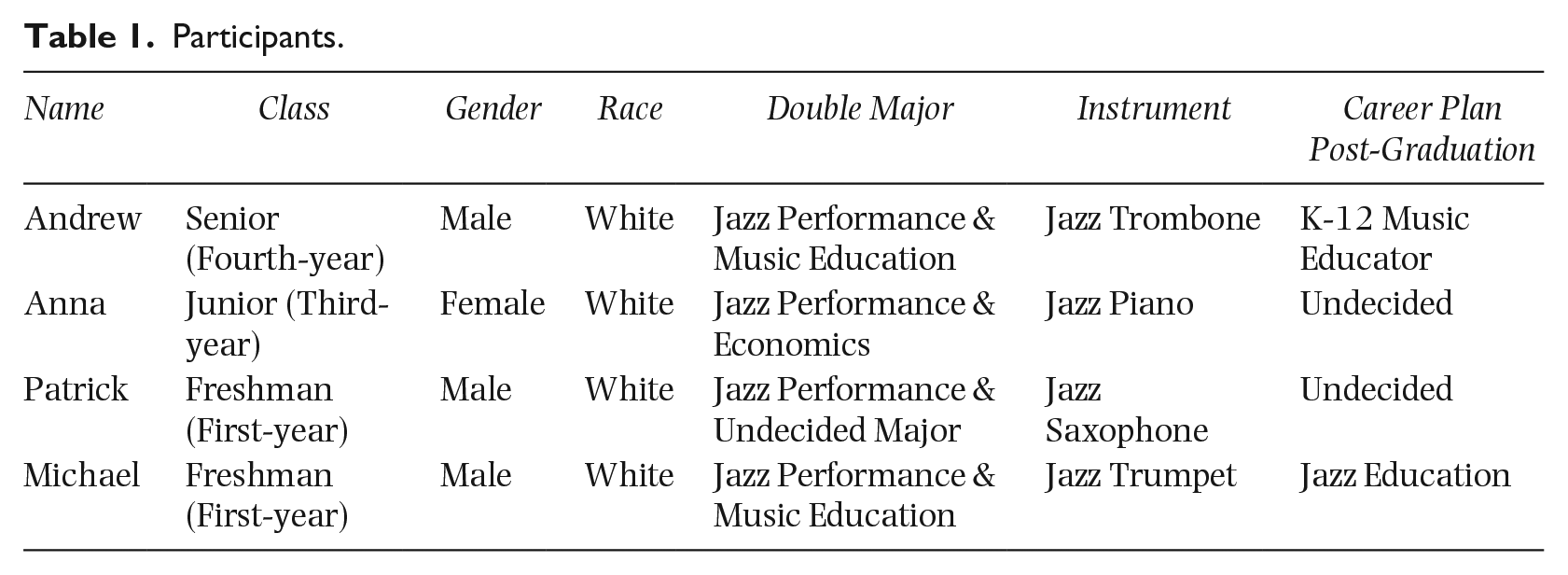
Four participants agreed to partake in the study. Background information is included in Table 1. The study was approved by the Institutional Review Board and participants provided written informed consent. All four participants were given pseudonyms to provide anonymity.
Participants.
Findings
Cross-case themes that emerged included (1) the importance of aural music learning; (2) environments that promoted creative music-making; (3) the crucial importance of jazz recordings in defining musical identity; (4) music as a social or communal activity; and (5) attraction toward musical experimentation and variation.
The importance of aural music learning
One of the key emergent themes was the importance of aural learning in jazz skill development. The participants in this study all described the critical nature of aural music learning to their interest in performing jazz. Patrick specifically noted that he was immediately drawn to a degree in jazz saxophone performance over a degree in classical saxophone performance due to the differing aural approaches. He said, “When you’re practicing classical stuff you always have the music in front of you, and the style requires more controlled playing . . . When you’re playing jazz the challenge is different because you’re trying to learn things by ear and be able to think stuff while you’re playing it.” In particular, participants noted how the spontaneous and emergent nature of group jazz required an interest in aural discernment and interaction. Patrick described how aural flexibility within a group setting was one of the things that attracted him to jazz saxophone performance and then a degree program in jazz performance: You’ve got to be able to hear what anyone else is doing if you want to improvise well because it’s not . . . the solo isn’t just the person playing the notes, it’s the person playing the notes in conjunction with what the rhythm section is doing and playing off of them. That’s part of the really cool solos . . . the moments when they interact.
For Patrick, a particularly appealing requirement of jazz performance includes a heightened sense of not only what members of the group play, but how they are contributing to the greater whole and responding accordingly, thus requiring proficiency in aural skills. Michael described how aural skills allow him to hear spontaneous harmonic variation in the context of his university’s small jazz combo:
How important do you think it is to do things by ear as a jazz musician?
I think it’s pretty important. Because I can tell in our combo if I play some upper extension of the chord, then I can hear our guitar player, play a substitution with that note in it, and I know that he’s listening to what I’m playing.
Similar to Patrick, Michael noted the necessity of aural skills facility in jazz performance. Such skills enable participants to have musically rewarding and challenging experiences within the jazz idiom.
Several participants described some anxiety with regard to the voluminous knowledge of jazz theory, which not only shares many commonalities with traditional Western theory but also features some idiomatic characteristics, such as a focus on modal harmony and a unique nomenclature. Andrew described how, particularly during the beginning stages of jazz instruction, aural sensitivity was blended with intuition to make up for any “deficits” in jazz theory knowledge:
Where do you think you first learned about jazz theory?
Uh, I guess I started at a high school jazz camp. Somehow, I had some
understanding of chords, but a lot of higher level stuff I still feel is beyond me, but a lot of it has been coming in college—you know, filling the holes . . . I had a sense of how to read [chord] changes but mostly it was a lot by ear.
Andrew’s aural skills and musical intuition assisted with his performance of jazz lead sheets and helped to compensate for his lack of formal jazz theory knowledge, which he was continuing to accumulate at the time of data collection. He also described how transcribing improvised solos by jazz greats assisted with learning jazz theory:
So, how has listening to jazz trombone players helped you with [learning jazz theory]?
A lot of transcribing . . . hearing how they would pace a solo is a big thing and also what they would do . . . the parts on the [chord] changes that I can’t work my way around, what they would do. It’s like, “Oh, he’s not actually playing every chord, he’s playing every other chord, or he’s just held the seventh because it’s the third later.” Stuff like that . . . little tricks to get out of rough spots.
Although directly engaging with music from a strictly aural perspective assisted Andrew with understanding and applying important jazz theory concepts, Anna’s middle school piano teacher encouraged her to learn from jazz method books. Whereas she could not say for sure why this teacher chose this approach, she hypothesized that he was leaning on a classical tradition of piano lessons: And he kind of held back and didn’t really tell me like, “Oh, by the way, you should transcribe and listen to recordings,” and like, “This is how to learn to play,” and I was trying to learn from books, but it wasn’t working.
She believed that this method of instruction excluding aural phenomena was possibly detrimental to her jazz development. Both Andrew and Anna described their university jazz experiences as opportunities to do a deep dive into aural jazz learning, particularly in the form of transcription assignments from their applied studio teachers.
Environments that promoted creative music-making
Participants cited environments, organizations, and venues that promoted creative jazz exploration as a key component of their development and subsequent pursuit of a jazz degree. They described groups/venues where creative music-making/improvisation was encouraged (Bailey, 1992), as well as the importance of reciprocal group interaction and learning (Monson, 1996). Historically, communal spaces where musicians have exchanged ideas have always been hotbeds for jazz mentorship and learning (Gioia, 1997; Rodriguez, 2018). In the 1940s, Minton’s Playhouse in Harlem hosted jam sessions that served as a trial-by-fire learning space for youngsters who wanted to learn the cutting-edge bebop ideas of Charlie Parker and Dizzy Gillespie (Davis & Troupe, 1989). Similar historical spaces include Storyville in New Orleans and Central Avenue in Los Angeles. In this study, Patrick described an influential program that was run by the MacPhail Center for Music in Minneapolis: Well, the clubs, like the Artist Quarter [a now-defunct jazz club in St. Paul, Minnesota], run these youth artist series. We would get a gig for that . . . There were some people who worked on a foundation board with the Dakota [music venue in Minneapolis] that was focused on jazz education. And we knew one [person] because she helped us out a lot with our combo. She was in charge of setting up a lot of . . . local festivals. Smaller local jazz festivals would always have youth stages. So, we would talk to her, we would get on that.
These influential board members facilitated access and provided authentic performance spaces for students to perform and deepen their improvisation and group interaction skills. In some ways, this appears to give younger students the opportunity to experience some of the informality of a jam session environment without the occasional harsh treatment of less experienced players that has been historically documented in jam sessions (Berliner, 1994).
Another type of influential environment is the youth jazz camp, which usually has a staff of musicians and provides attendees with in-depth exposure to the idiom. Anna described a particular jazz camp that informed her development as a jazz musician: They’re [jazz camp faculty] really good musicians. They’re great teachers, and . . . I gained some confidence because the teacher’s like, “Oh, Anna, I’m going to give you a solo, if you sound good, if you can do it, you can do it. It’s not a huge deal.”
Anna lauded the teachers at her jazz camp and believed that one teacher’s gentle invitation and encouragement to perform an improvised solo stoked her interest and confidence in jazz. Andrew described how his All-State experience with celebrated jazz trumpeter Terell Stafford as guest conductor contributed directly to his motivation for a jazz degree program. He stated, “I guess the definitive one would’ve been when I was at All State, and it was with Terell Stafford. I was just like, I know I want to go into education, and I want to go into jazz, I’m sure of that.” In a separate interview, Andrew expanded on this, “There’s some aspect of jazz teachers, especially where, how they’re engaged and interact with the group is just different than other teachers that I’ve had.”
Supportive and influential environments for the participants were not limited to public venues and formal educational endeavors. Andrew described how some of his first forays into jazz occurred because he would go to a friend’s house to play alternatives to typical concert band trombone parts: I started probably 5th grade or 6th grade—early . . . it was one of my good friends in school. His mom was a teacher and trombone player . . . so I went to her for a while and it was really easy because half the time I would already be there with my friends. We worked on jazz improv stuff and stuff outside of what I was playing in school . . . stuff that was not the boring band parts that you get used to as trombone players.
Michael was a dual major in jazz trumpet performance and music education and relished the opportunity to study two facets of jazz education in college. He pointed out that it is important for jazz teachers to let their students explore and try out creative ideas. He noted that he had teachers who successfully used this approach with him and hoped to use it in the future as a school music teacher, particularly when he taught beginning jazz improvisers: You need to allow room for students to discover things on their own . . . I think, like any art form, it can be really forced. Like the pleasure of doing it, the satisfaction of doing it, leaves . . . As far as what a perfect jazz education would be, you would have to start something that could enable the students to be satisfied with what they’re doing. You could just play a vamp of one chord. It could be a first improv lesson and just tell them to play on the scale. And then, if I was giving a private lesson with another trumpet player, I could play piano, and if they play something, I could interact with them, and try to make it obvious that we were interacting with each other.
Similarly, Anna attributed some of her success as a jazz major to her university small group combo coach. Anna underscored many of the same teaching traits as Michael suggested for jazz teachers: I really respect what he’s [Anna’s small group combo coach] doing. He’s a teacher and he’ll show us a lot of stuff but he also respects our opinion. It’s not just saying you’re wrong all the time and letting us hear that we’re wrong [laughs]. Like, “Let’s try that,” and “Okay, maybe that didn’t work,” but you just keep trying stuff and that’s how you learn. It’s cool to have people expressing confidence in you and being like, “This is really fun and you don’t sound that bad, just go for it.” I think that makes people work harder.
Crucial importance of recordings in defining musical identity
All the participants highlighted the importance of jazz recordings as fundamental building blocks for jazz learning. They noted that aural learning is so essential and jazz styles are so idiomatic that recordings serve as valuable learning resources, particularly when students are geographically separated from bustling jazz hubs (MacDonald & Wilson, 2006). Anna noted how her attempts to recreate improvised music on recordings were helpful for her education as an aspiring jazz musician: I went to the library and just got so much jazz . . . It was like, “I need to listen to this,” and I took out every CD . . . just through that, I learned so much. More than anything my high school teacher ever taught me. It was all improvised music. There’s so much to listen for in everything. So much—all these different textures—all these different ways to play piano, or improvise or anything . . . listening to jazz was this intellectual discovery experience; you really had to listen.
Michael pointed out that his high school jazz band teacher actually assigned recordings to students: Our teacher had a listening playlist every quarter, which is, I think, a great pedagogical tool, because he would put a lot of classic recordings. One of our listening things was just “The Atomic Mr. Basie” and sometimes in class, he would play a track, because not all students were going home to listen to it.
Patrick described how he and his friends bonded and found common ground over more contemporary recordings that piqued their interest: All the people that I hung out with in the jazz group listened to similar kinds of things. We were really into the [Brian Blade] Fellowship group, everybody listened to Kenny Garrett, Bill Frisell, John Scofield . . . a lot of groups that were really folk-influenced.
In a separate interview, Patrick noted that recordings influenced the desire to pursue a university jazz degree for him and high school peers, “. . . most of us [who] went on to study music in college, we took our musical cues of what we’d listen to . . . and shared music among each other rather than the teacher influencing what we listen to and how we approach things.” Andrew described his formative years as listening to an eclectic set of recordings across many different music genres. He pointed out that, as a jazz performance major, he eventually found it necessary to do very detailed jazz listening and transcriptions, particularly recordings of seminal jazz trombonists: In high school and middle school, I didn’t really listen [to jazz] that much or that consistently. I wasn’t thinking specifically about who would play what or what specific musicians would sound like. But then, when I got to college, I started really figuring out how to listen to people, how to understand people’s approaches. Then, it would be like, “Oh man, this is what Curtis [Fuller] would play, like, this is what Dexter Gordon would play.”
He also pointed out that jazz recordings illustrate important performance practices that set the standard for common procedures in jazz: “I feel like we have more access to the definitive recordings. Like, we’re doing Horace Silver, so get the recording of Horace Silver. But it’d be hard to find a recording of Brahms’s Piano Concerto by Brahms.”
Michael noted that there is greater stylistic variation among the archetypal jazz trumpeters than there is among classical trumpeters, a paradigm that is mostly embraced in university jazz programs with students who embrace different jazz role models. Using Miles Davis and Dizzy Gillespie as examples, he suggested that the personal, idiomatic sounds of many legendary jazz musicians appeal to many jazz students: For classical, there’s a model sound, whether it be Chris Martin [New York Philharmonic] or any other classical trumpet player’s sound. I think there’s a very concrete, real kind of model to strive for. But, in jazz, there are so many different trumpet sounds. You can listen to Dizzy [Gillespie] and know it’s him or Miles [Davis] and know it’s him. One note, you know it’s Miles. And I’d like to—it’s a lofty goal—but for my playing to be recognizable for an audience.
Jazz as a social/communal activity
The participants also described how social interactions and performance opportunities with like-minded jazz enthusiasts were essential to their development and subsequent jazz degree pursuits. This aligns historically with many aurally transmitted folk music forms including jazz (Bailey, 1992; Berkowitz, 2010; Berliner, 1994; Green, 2002, 2008). Particularly in earlier years, jazz was more frequently learned informally in a social setting, where much jazz learning and development occurred at jam sessions (Berliner, 1994; Monson, 1996). In particular, the participants in this study described learning jazz in student- or peer-directed settings, such as informal teacherless rehearsals at school or sessions at friends’ houses.
Participants such as Anna described how, in high school, she and other students who enjoyed performing jazz would naturally gravitate toward each other. These students would naturally seek out the opportunity to go to jazz performances and play tunes that they heard on recordings. She and other participants described the process as socially organic, not the result of any school music requirements: I was finding kids to play with from towns around me and I would go to their houses and we’d just play music and, like, go to concerts together and, it’s just really cool, the social aspect of playing and listening . . . that was totally independent, that wasn’t for any class or anything . . . Yeah, those are primarily things that happened without teachers.
Participants also described how jazz rehearsals or performances can reflect the personal give-and-take communication of an informal social gathering. Andrew described how his university jazz combo rehearsal that one of the researchers observed experienced some of the tension associated with group social dynamics because of an individual’s interest in cutting-edge jazz developments but, in retrospect, noted that the university jazz setting is an opportunity for students to expand their horizons and musically challenge themselves with peers. This was particularly true when a pianist in the group repeatedly encouraged the group to perform more contemporary or “avant-garde” music even though it was more common for the university’s jazz program to feature more “straight ahead” jazz: The piano player [in the university combo], he keeps [asking] “Have you listened to Jacob Sacks?” And we’re like, “No!” [Laughs] “I haven’t!” He’s, like, he’ll do that [bring Jacob Sacks music to rehearsal] and we’ll be like, “Why is it C with a sprinkle of E? What does that mean?” He’s like, “Oh, Ornette [Coleman] would do that kind of this way.” He has . . . there’s depth to it. I mean it’s combining, so it’s interesting. I think some of the people in the group, it’s not their world.
Attraction toward musical variation and experimentation
All of the participants described a natural attraction to musical variation and experimentation. Some of the participants referred to this as “doodling,” a label the participants used to describe practice room experimentation, as opposed to clearly delineated practice objectives (Healy, 2014; Hsieh, 2012; MacDonald et al., 2012). Dobson’s (2010) phenomenology study underscored that some jazz musicians value the concept of experimentation and personal expression over performance perfection whereas Wilson and MacDonald (2005) described how Scottish jazz musicians emphasized “mystery” over “mastery” at times (p. 9). Similarly, Kratus (1991) highlighted the importance of early exploration in his theoretical framework of improvisation development.
Participants in this study described how musical variation and experimentation made their practice more interesting. Michael and Andrew referred to this type of practice as “doodling”:
And it was more fun for me to practice something more abstract than just arpeggios . . . the unknown and the cliché—the unpredictability, and fickleness of jazz that was appealing to me. I doodle all the time, like doodling jazz or a different style, like Latin straight eighths or something funky. I like to do it when I learn different chords and stuff for a diminished 7 [chord]. On trumpet, that helps me get the chords under my fingers.
I guess there’s little stuff like taking an exercise I’m used to and slurring it instead or not tonguing at all so it’s all little things. It’s like, how does it feel to go from as high as I can play to as low as I can play? How does it feel to actually try to hit those notes and make them sound good? And then just kind of doodling somewhat melodic improvisation, just fooling around.
Michael also noted that this interest in musical experimentation specifically motivated him to a university jazz performance major: I definitely wanted to be a jazz trumpet major at the university. I played in classical ensembles all through high school and I enjoyed it, but it didn’t really have as big an effect as jazz did. But I just enjoyed listening to it [jazz] more, and it was more fun for me to practice . . . I think I might get bored playing arpeggios and scales . . . the unpredictability and fickleness of jazz, that was appealing to me.
As a pianist, Anna described how much of her experimentation is used to try out different chord voicings: And even just experimenting with dissonance and how, like, what sounds. . .how something sounds over something else. Yeah, I guess, I mean, I was going to say sometimes, I’m really interested in one sort of, like, type of chord. Like, “Oh, I’m really into a Minor 11 chord, how can I play that and improvise in that style?” So it will start off as an exercise but sometimes it just goes into whatever I’m playing at the time or whatever I feel like playing . . . and then it ends up just being really fun [laughs]. I’ll find a voicing that I really like and I’m like, “Oh, what sounds good over this?”
Michael stated his belief that experimentation must have been essential to jazz innovators such as trumpeter Woody Shaw: When I listen to Woody Shaw, he definitely has made mistakes before because he’s using crazy substitutions and his lines are so—I think they’re ingenious—so I don’t think he would have gotten to that level without making mistakes in the process.
Discussion
We used Davidson’s (2002) Music Performer Identity framework to address the first research question, “What elements influenced the participants to choose a jazz performance major?” Davidson cited the influence of environmental factors on the development of the solo performer, including the role of emotional experience during performing that can create a desire for lifelong engagement with music. Study participants cited this in terms of Environments That Promoted Creative Music-Making, particularly with the themes of musical environments that encouraged or allowed them to participate in jazz improvisation, an experience that they enjoyed and subsequently wished to do on a regular basis. Interestingly, the nature of the environments varied from school music programs to camps to community programs but, in all instances, the participants were provided with a setting that allowed and, in many instances, emotionally encouraged self-efficacy and confidence toward jazz improvisation and guided participants to an undergraduate jazz degree.
From the perspective of listening, the Crucial Importance of Recordings in Defining Musical Identity provided participants with casual but frequent exposure (Davidson, 2002) to jazz music, which was particularly important if the given participant did not live near a central jazz performance hub such as New York, Chicago, or New Orleans. All participants noted that their interest in aurally exploring the unique music qualities of recordings by seminal jazz recording artists encouraged their desire to further their explorations as part of an undergraduate jazz degree. Participants also stated that environments such as high school, camp, and community programs allowed students to explore jazz improvisation in an encouraging and, in some cases, judgment-free setting on a regular basis and boosted their desire to experience this on a more regular basis as undergraduate jazz majors. This is also borne out by historical examples, where jazz greats have commonly used recordings and live jam sessions as a means to develop their craft (Berliner, 1994; Dobbins, 1988).
Participants noted the critical importance of “key others” (Davidson, 2002), both expert mentors and peers who encouraged them in jazz improvisation. Interestingly, these “key others” ranged from adult teachers to peers. Participants found these key others in the context of Environments That Promoted Creative Music-Making in the form of teachers or peers in a jazz education setting. Participants also found key others in Jazz As A Social/Communal Activity, particularly loose musical sessions with peers that allowed them to explore and experiment. The key others found in both Environments That Promoted Creative Music-Making and Jazz As A Social/Communal Activity were integral to their Attraction Toward Musical Variation and Experimentation by providing encouragement toward this type of musical exploration. Participants described how, along with the appeal of the dual degree option, their specific interest in a jazz degree program at their university was spurred by an interest to learn from key others in the form of reputable, experienced jazz instructors and an opportunity to perform on a regular basis with like-minded peers. The desire of students to pursue their “provisional selves” by studying with successful jazz role models echoes findings from researchers such as Iberra (1999), while social jazz feedback from peers encouraged them to consider jazz as a vocation, a theme echoed by Davidson and Burland (2006).
Davidson (2002) described a “motivation to perform” as part of a music performer identity. In this study, this motivation was expressed through the lens of jazz performance through the participants’ active desire to focus on the Importance of Aural Music Learning and an Attraction Toward Musical Variation and Experimentation. Patrick described how the spontaneous aural interaction made jazz more appealing than classical performance for him and reinforced his desire to explore this interaction further as part of an undergraduate jazz program. Michael specifically described how he would find unvarying trumpet exercises monotonous and dull and sought out an undergraduate degree as part of a motivation to improvise and develop a personal sound on a regular basis.
Participants demonstrated their motivation and personality to change (Davidson, 2002) as part of their desire to pursue a jazz degree program. Having thrived in their pre-college Environments That Promoted Creative Music-Making, participants looked to further engage these environments by studying with reputable jazz musicians. The participants’ university showcased many nationally recognized jazz faculty, which participants described as part of their justification for going to this specific university. All the participants enrolled in a jazz degree with the hope that experienced faculty would be able to introduce new ideas and develop new performance skills. Andrew specifically noted how he was inspired by his All-State experience with the great jazz trumpeter Terell Stafford and hoped to have similar experiences as a jazz major. Anna was taking applied studio lessons with a nationally recognized jazz pianist and, while she enjoyed the lessons and the teacher’s general demeanor, she expressed a desire for the teacher to challenge her more, a possible outgrowth of her motivation and desire to change (Davidson, 2002).
For the second research question, “How do those elements influence participants’ musical identities and musical identity development?” participants articulated that the Crucial Importance of Recordings was of great influence. Unlike Western-classical recordings that often feature different interpretations of the same piece of music (e.g., the Bach Cello Suites), professional jazz recordings often feature unique improvisations within an idiomatic style. Participants also stated that listening to recordings allowed them to determine what stylistic characteristics they enjoyed and wanted to emulate, in contrast to styles that did not excite them, serving as a catalyst for the development of a musical identity. Participants noted that recordings boosted their motivation to change (Davidson, 2002), which then prompted them to identify musical goals associated with significant jazz role models (Iberra, 1999). In particular, Anna cites a specific Oscar Peterson recording that challenged her piano technique but motivated her to become a jazz pianist.
Participants noted that their identities were developed by a natural attraction to musical unpredictability, particularly in the form of the Importance of Aural Music Learning and an Attraction Toward Musical Variation and Experimentation. All of the participants described an eagerness to engage in jazz music aurally, a form of performance motivation influenced by self-esteem and confidence in one’s ability (Davidson, 2002). Andrew described how, earlier in his development, he used his aural prowess to improvise over chord changes despite an admitted lack of music theory knowledge. The participants also described an affinity to musical exploration, a point that Patrick and Michael highlighted as a source of a continual joyful experience (Davidson, 2002). Similarly, trombonist Andrew described how he would frequently vary his articulation in the context of brass warm-ups and exercises while pianist Anna enjoyed experimenting with different harmonic voicings, practices that were mentioned in the interviews and confirmed by their practice reflection journals. The participants also described “key others” (Davidson, 2002), particularly in the context of Environments That Promoted Creative Music-Making who validated and encouraged their desire to improvise.
Additionally, participants cited the spontaneous process of Jazz as a Social/Communal Activity as integral to their identification as jazz performers. In particular, Michael and Patrick underscored how they embraced the spontaneous, emergent musical events that occur in a small group jazz setting. Patrick noted that he enjoyed how a small jazz group can be flexible with musical elements such as harmony and rhythm in a way that is not necessarily possible with a chamber ensemble. Michael described his joy at the capricious nature of jazz, specifically how both the soloist and rhythm section can respond to something like chord upper extensions. Both Patrick and Michael’s examples highlight Davidson’s (2002) emphasis on casual but frequent exposure to music and performance contexts through experimentation in a non-threatening environment.
Study limitations
Although this research represents one of the first focused case studies forays into jazz identity, it should be noted that the data only reflect one university’s undergraduate experiences. Different universities showcase different program curricula and feature different faculty contributions. Future studies could address undergraduate jazz major identities at different university programs. This study also did not specifically examine undergraduate jazz or musical identity through the lens of gender, race, or socioeconomic status. Particularly because this study interviewed three males and one female, all of whom are white, future studies might address these important identity attributes. Although there was one female participant in this study (Anna), she did not cite gender as being very influential in her jazz development. She noted that males definitely far outnumbered females at the many jazz programs she experienced (particularly for instrumentalists) but she always found herself more ensconced in the musical skills she felt she had to master. Performing a jazz identity study with more female participants could yield interesting data, particularly in light of recent publications such as that by Pellegrinelli et al. (2021). Finally, the particular university used in this research study was somewhat unique in terms of the ease with which students could enroll in dual majors. As a result, one can make the case that participants felt less locked into a future jazz performance career. It would be interesting to collect data at a university jazz performance program that does not feature such dual major programs. Also, as Andrew noted when he referenced his small group combo rehearsal, the university jazz program attended by the study participants focuses primarily on what is colloquially referred to as “straight ahead jazz.” It would be interesting for future research to examine the identities of jazz undergraduates at a university or program that embraces avant-garde jazz.
Implications
Even though the results presented in this study are unique to a particular cross-section in terms of race, gender, and class, the data contain implications for both school and university music education programs. Although one cannot generalize the themes of the five study participants to a larger population of students, the themes provide examples of ways that music educators can possibly stoke and develop the interest of enthusiastic jazz students. With current technological options, music educators can easily provide students with access to jazz recordings. They can also provide a setting where students can explore music aurally and experiment freely. If there is an external opportunity for students to participate in this kind of setting, such as a music camp or a community organization, the music teacher may be able to refer students to such an organization. It is also important for the music education community to consider the issues of race and class in terms of access to such opportunities. Music educators can also possibly provide a time and space for interested students to explore jazz in a casual jam session setting.
University music education programs can utilize these findings by framing methods by which preservice music teachers can engage students in jazz learning through aural activities and musical experimentation. University jazz programs for middle and high school students can also be of great benefit, as demonstrated by study participants such as Andrew who benefited from such programs.
Supplemental Material
sj-docx-1-pom-10.1177_03057356241229439 – Supplemental material for Undergraduate jazz majors’ music identities: A multiple case study
Supplemental material, sj-docx-1-pom-10.1177_03057356241229439 for Undergraduate jazz majors’ music identities: A multiple case study by Daniel Healy and Daniel J. Albert in Psychology of Music
Footnotes

References
Supplementary Material
Please find the following supplemental material available below.
For Open Access articles published under a Creative Commons License, all supplemental material carries the same license as the article it is associated with.
For non-Open Access articles published, all supplemental material carries a non-exclusive license, and permission requests for re-use of supplemental material or any part of supplemental material shall be sent directly to the copyright owner as specified in the copyright notice associated with the article.
