







Abstract
This article investigates the role of early experiences in shaping the musical identities of 15 individuals with a diverse range of self-reported musical skills, ranging from none to professional level. Participant interviews were recorded, transcribed, and analysed for emerging and superordinate themes. Topics covered in the interviews included participants’ relationship with music, significant early musical memories, and experiences with music-making (particularly early experiences). Twelve of the 15 participants also attended a series of music workshops in either Italy (Calabria) or Scotland (Glasgow). The workshops were focused on integrating both musically experienced and inexperienced participants in collaborative musical activities. Analysis revealed 13 emergent themes that were grouped into three superordinate themes: early exposure and family influence; experiences with music education; participation and playfulness. These themes highlight how participants’ early experiences of music are remembered in detail and represent important moments in the participants’ lives. Early listening experiences were reported as positive and linked with family memories. Early musical education experiences were often reported as negative leading to lifelong self-beliefs of being ‘unmusical’. Results suggest that positive experience with musical engagement can overcome the debilitating effects of early negative experience of music, highlighting musical identities as dynamic (amenable to change) and situated (context-dependent).
This article, titled after the famous song by Yusuf Cat Stevens, 1 explores the importance of early experiences with music by investigating the musical identities of 15 individuals with a wide variety of music-making expertise, from those with no expertise to working professionals. It draws on data gathered during an EU-funded research project, developed in collaboration between the University of Calabria in Italy and the University of Edinburgh in Scotland, called LoMus, Local Sound for a New Musicality – Enhancing Musical Participation Through a Local Sonic Practice. The aim of the project is to investigate ways of making music that can be suitable for both musically experienced and inexperienced individuals with the goal of developing an inclusive musical practice that builds a common space where individuals with different experiences and skills can meet and collaborate. As part of this two-year project, this article reports on specific data gathered in Italy (Calabria) and Scotland (Glasgow). In terms of developing a new type of musical practice, a key concern is participants’ own beliefs about their musicality, or in other terms their musical identities. The study of musical identities has seen growing interest in the past 20 years and refers to the role of music in shaping identities both in terms of music participation activities and in everyday life (MacDonald et al., 2002, 2017). Musical identities have been described as consisting of two features: identities in music – self-beliefs of music skills and abilities; and music in identities – how music functions as a psychological resource for self-perception and social relating (Hargreaves et al., 2002; MacDonald & Saarikallio, 2022).
Music has an important role in shaping identities and there is significant interest in investigating the role of music as a crucial aspect of identity across the lifespan. Hargreaves and Lamont (2017) identified four ‘transition points for musical identity’, at infancy, early childhood, adolescence and in old age, demonstrating how musical identity is constantly renegotiated throughout the entire life span. Much work has been done in exploring musical identities and musicality in early childhood. Trehub (2023) reviewed the available evidence on musicality and music-related abilities in infancy in relation to various aspects, such as perception (Trehub & Degé, 2015), learning (Hannon & Trehub, 2005), use of music as mood regulator (Corbeil et al., 2016), infant music-making and dance (Kim & Schachner, 2023) or singing (Gudmundsdottir, 2020). Early exposure to music (Gerry et al., 2012; Mendoza & Fausey, 2022; Trainor, 1996; Trehub et al., 2016; Zentner et al., 2010) and children’s musicality (Zimmerman & Miller, 2004) have also been major objects of study, alongside studies of children’s musical identities (Lin, 2017; MacGlone et al., 2021; Tafuri, 2017). These investigations showed children’s engagement with music and traits of musicality at a very early age, providing evidence of universal musicality. They also highlighted the sophisticated and nuanced manner in which family interactions and social contexts crucially influence the development of musical skills and identities. For example, Davidson and Borthwick (2002) utilised family script theory to show how informal family communication around early musical experiences are important in shaping the development of musical identities. They also showed how parents’ support plays a major role in children’s music development and perception of musicality. Also, Goopy (2024) investigated musical identities in relation to music education using a narrative inquiry approach and showed the importance that music has in shaping adolescent boys’ developing sense of self. Work by Gabrielsson and Bradbury (2011) highlighted the importance of music in helping shape memories of key life moments, linking important life events with particular memories for songs. Sloboda (2004) also highlighted the importance of childhood memories of music, discussing how experiences of music (both positive and negative) produce effects on musical development.
While the research above highlights the importance of early experiences of music in the development of musical identities, there is still much to be learned about how memories of childhood musical engagement influence individuals’ relationship with music across the lifespan. This article investigates these early memories and experiences via interviews with both experienced musicians and self-defined non-musicians. We explore how early memories of music contribute to shaping people’s relationship with music both as listeners and as performers. For example, it has been speculated that early negative experiences of music can often become internalised and lead to self-categorizations of being unmusical, with early non-contingency experiences (experiences of failure) in music possibly leading to lifelong beliefs of not being musical (MacDonald, 2015, 2021).
The potential for early experiences of musical engagement to have beneficial and/or negative effects leads to a discussion of what might be termed ‘healthy’ musical identities. MacDonald and Saarikallio (2024) proposed that a healthy musical identity should be an aim of music education. A healthy musical identity implies that individuals can engage in musical activities or musicking, as defined by Small (2011), 2 without recourse to feelings of inadequacy, insecurity, feelings about being unmusical, not coming from a musical family or not being good enough. Musical engagement, within a healthy musical identities framework, may facilitate the development of feelings of competence and agency (Stolp et al., 2022; Wassrin, 2019). Healthy musical identities may also be related to wider beneficial self-perceptions such as personal growth, self-esteem and social relatedness (Mas-Herrero et al., 2013; Schäfer et al., 2013).
This work is conducted within the common ground between ethnomusicology and psychology of music. The authors are a scholar with a long history in psychology of music and an ethnomusicologist with an extensive research practice around sound and sounding objects, and both have significant experience in community music work, combining psychological qualitative research methods with a holistic ethnographic approach.
Method
Ferlaino (in press) presents evidence of self-reported non-musicians who possess both receptive and productive musical abilities that are expressed in the decoding and making of sounds beyond music – for example, hunting calls, birdsongs, and ritual sounds. These skills, commonly associated with musicality, are expressed in these individuals through the use of sound-producing objects. This author highlights that traits commonly attributed to musicality appear also when music-making is not involved. He also shows that seemingly rudimentary sound making objects are able to convey strong personal, social and symbolic meaning via musical engagement. Therefore, in our workshops, we opted for using easy-to-play sounding objects to facilitate musical participation of individuals who might be inhibited by the presence of conventional musical instruments.
In Sounds Like Music 3 (the Scottish based workshops and interviews – see supplementary materials), we invited participants to bring objects whose sound was meaningful to them. These objects could be any item, tool or device that was capable of producing a sound that the participants deemed meaningful or interesting, including a musical instrument. All workshops began with participants giving a short introduction to their object, outlining why it was meaningful. This was an important part of the workshop as it helped set evocative contexts within which participants could create and relate musically. In LoMus Lab 4 (the Italian based workshops and interviews 5 –see supplementary materials), the participants would experiment with Calabrian sounding objects, traditional sound-producing devices which include ritual objects, toy instruments, propaedeutic instruments, 6 and objects that are re-functionalised to make sound. During the workshops, the participants would make music with a free and exploratory approach, with no limitations imposed on which sounds and musical parameters to use. Rather, participants were invited to listen to theirs and the others’ sounds and respond as they liked. The workshops in Scotland (Glasgow) were facilitated by both co-authors with the lead author facilitating the majority of the workshops in Calabria (the co-author facilitated one workshop in Calabria). The Universities of Edinburgh and Calabria granted official ethical approval for this work.
The data consists of information that emerged in the workshop sessions and in one-to-one interviews with the participants which were all recorded and transcribed. Interviews in Italian were also translated into English for enhanced accessibility. Each music-making session included self-reflective moments in which the participants were invited to relate freely on the music they just played. They provided information regarding the aesthetic content of the performance, their perceived role in the music-making process, the relationship with the objects and their sound, emerging formal or emotional features of the music, and the nature of the interactions within the group.
The interviews involved 15 individuals (5 male, 10 female): 12 workshop participants – six in Glasgow 7 and six in Calabria 8 – and three individuals who volunteered to take part in our research in Glasgow but were unable to attend the workshops. Sounds Like Music took place at the Glad Café 9 in Glasgow and it was advertised through flyers and posters around town and social media posts. LoMus Lab took place at Università della Calabria and it was advertised through the University’s social media as an activity open to all students and staff. The interviewees were all adults: Eight of them had no or little music-making experience; three were music students; three were professional musicians of which one was not working anymore; one was an amateur musician who was active in the Glasgow improvised scene but preferred to self-define as a non-musician. Participants 1–9 were individuals who participated in the Glasgow workshops; Informants 10–15 were participants in the Calabrian workshops. All informants consented to use their names except for Participants 1 and 2.
Data collection and analysis drew on qualitative methods, which consisted of unstructured ethnographic interviews, audio documentation of the workshop sessions and thematic analysis (Denzin & Lincoln, 2005). The interviews took the form of a conversation on topics such as the interviewee’s relationship with music (what music they like and listen to, how important is music in their every-day life, how they ‘use’ music); significant early memories, or possibly the very first ones, associated with music; the interviewee’s experiences with making music or learning an instrument (whether they had an opportunity to learn an instrument, how was their experience with learning or making music); sounds they found interesting or meaningful (which ‘non-musical’ sounds they like, why and what effects they produce). 10 Although these topics were identified in advance, a dialogic approach was adopted which helped to let interviewees develop their own narrative that facilitated unexpected relevant information to emerge. Interviews with Italian participants were undertaken in Italian and the transcripts translated into English. The transcripts of the workshop sessions and the interviews were interrelated and analysed in accordance with criteria outlined by Denzin and Lincoln (2005) to establish emerging themes. Both co-authors read and analysed the data, and triangulation techniques, which included the discussion of particular extracts and possible meanings attached, were employed to enhance the reliability and validity of the results. Analysing the data of individuals with such a broad variety of musical histories from the inexperienced to the professional brought to light an interesting number of commonalities, especially regarding early exposure to music and experiences with music-making.
Results
Analysis revealed 13 emergent themes that were successively grouped into three superordinate themes: early exposure and family influence; experiences with music education; participation and playfulness (Figure 1).
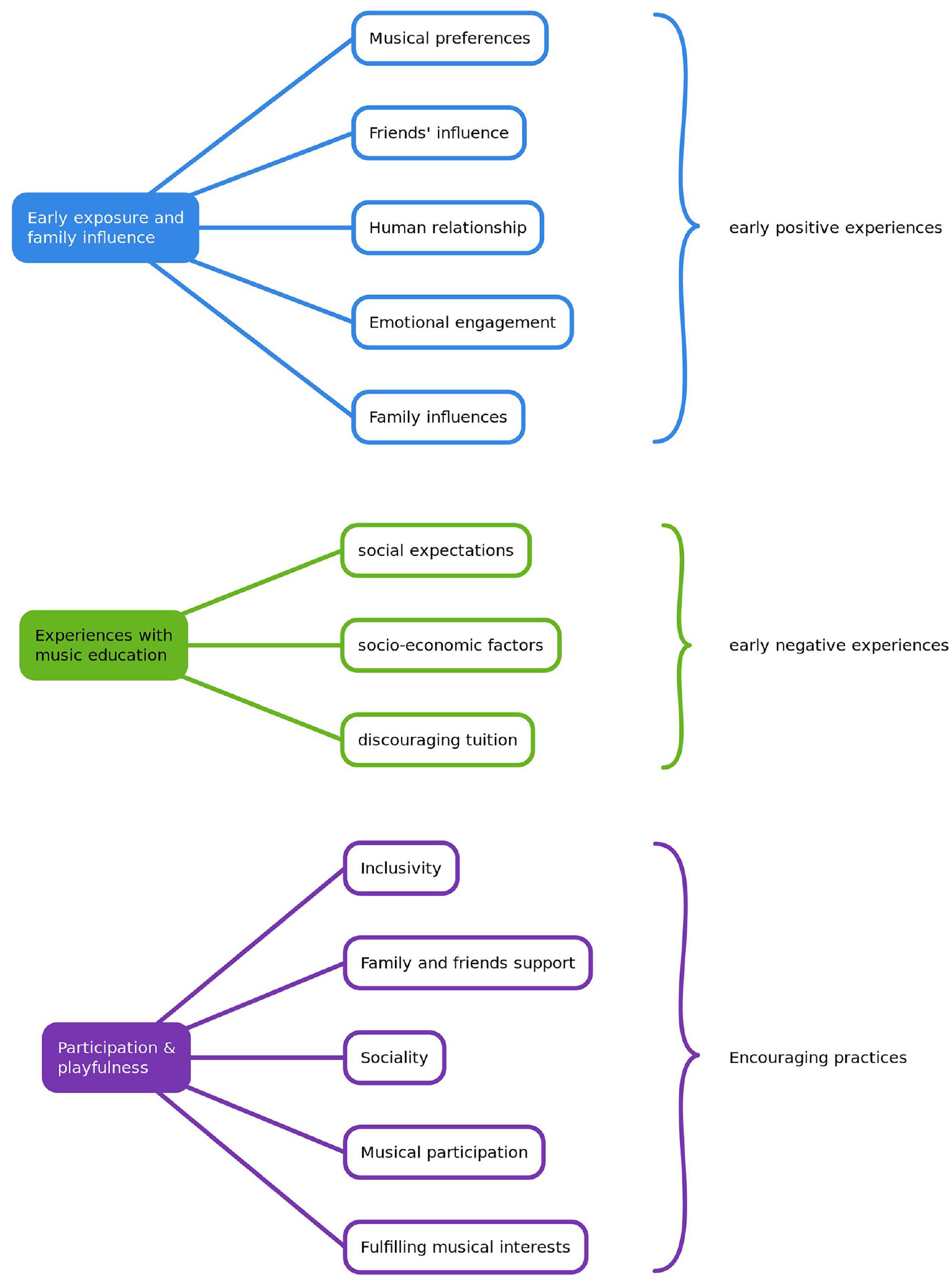
Diagram of Themes and Superordinate Themes.
Early exposure and family influence mostly concerns the informants’ early memories of music and the contribution of family and close relationships in the definition of their musical identities. These experiences were consistently positive across all the informants. Experiences with music education groups the informants’ early experiences of music tuition, making music and learning an instrument. We found mostly negative experiences that seemed to detrimentally influence the participants’ relationship with music-making throughout their lives. Much to our surprise, we consistently encountered negative experiences with music tuition both in the non-musicians and in those who pursued a musical career. Participation and playfulness groups a series of positive experiences related to welcoming socio-musical practices that seem to have determined a particularly encouraging shift in the informants’ approach to music-making. It is beyond the scope of this article to exhaustively discuss all the emergent themes and superordinate themes. In the following sections, we focus on the three superordinate themes with relevant extracts as supporting evidence.
Early exposure and family influence
All the informants had a long-standing relationship with music, either as listeners or as musicians. They reported all being music lovers, passionate and curious listeners with a wide variety of musical interests across genres and styles. The informants also elaborated on the way they ‘used’ music, mostly as an emotional regulator and as a complement of social interactions.
The participants remembered experiencing music with people who were significant in their life: family members singing or musicking at gatherings, being sung nursery rhymes in their infancy, records being played specifically to them within the family. All informants were able to quickly recollect early memories of music, which often dated back to infancy. The clarity with which the participants recalled these memories was striking, with specific songs, artists, places and occasions recalled in intricate detail. It is even more striking considering that in some cases these memories date back over 50 years.
Particularly significant for the social and personal musical identity aspects was Debbie’s early memory of music. Her memory involved the song Where’s your mama gone? (Chirpy Chirpy Cheep Cheep)
11
which reminded her of her mother who died when she was a child. She described the memory as funny and sad at the same time. She talked of her love-hate relationship with the song, which reminded her of her mother, and in particular the devastating effects of her mother’s sudden death, but she also used it to attract the attention of the other children and make new friends. In her early memory, music was the soundtrack of a shattering event but also a vehicle for consciously shaping her social identity: It’s sad and funny at the same time. [. . .] My mum died when I was three. And at the time [. . .] there was a song out called ‘Where’s Your Mama Gone? Chirpy, chirpy, cheep, cheep.’ [LAUGHS] So it’s a really early memory of my mum dying . . . and that song. And I used to hate the song. But I love it. But . . . when I was a wee girl, I kind of hated it. I used to love it. But I hated it. But I think I liked it for attention. I used to use it as an attention tool. Oh, that song reminds me of my mum. [. . .] To make people like me, I thought they had to feel sorry for me. [. . .] So, when I was seven, I told them my mum died, right? And I said, ‘I don’t like this song getting people singing this song. Because it makes me sad.’ And it was that song. So they would think, oh, she’s a poor wee soul.
Vivid memories of music, inextricably linked to family relationships and important moments in people’s lives, were evident in the interviews. We can draw commonalities among the interviewees’ memories of music: they are early, so much that they sometimes date back to infancy; they are cherished and important; they accompany the informants for their entire life; they are enjoyable, often associated with good feelings; they are related to family and friendship as they almost always involve close relationships. These data emphasise the importance of early experiences of music. For Debbie for instance, it was a lifelong memory through which she cherished her relationship with her mother and navigated relationships with peers and friends. Where’s Your Mama Gone was about her relationship with her mother, how she remembered her mother and her mother’s death. She also used music in a very sophisticated psychological way: to manage her own emotions and feelings about her loss but also to gain attention from other people and navigate through social relationships. Similarly for Mark, some musical styles provided a means of cherishing his father’s memory. We deduce that music is a crucially important device that helps form some of the earliest and most important memories of our life and influences who we are. These data demonstrate how our musical identities develop at a very early age and how they are strongly influenced by social relationships.
What is particularly striking is that these memories are consistently positive for all informants. Even when the memories are associated with tragic events (such as the case of Debbie) or some type of discomfort (such as the case of Cassandra) they are still described as being important and cherished.
Experiences with music education
In our interviews we also investigated the interviewees’ early memories of music-making or taking music lessons. The participants’ experiences of music tuition or learning music were rarely positive: they reported difficulties encountered beyond music itself. Two participants, despite wanting to learn music, could not develop their musical skills because of socio-economic barriers. For them, access to music-making was hindered by a lack of economic resources alongside, and possibly related to, a lack of support from their family. These informants reminded us that making music can be an elitist activity that is reserved for those who have resources to afford an instrument and the time to learn it. Our use of sound-producing objects in the workshops is an attempt at overcoming these types of socio-economic barriers.
Among those who were fortunate enough to access music-making, almost everybody had negative experiences. Some informants discussed receiving uninteresting music tuition. Carlotta talked of a teacher who could not help her ‘make sense’ of the music she had to study. She felt put off by being only told what to study without being provided ways to ‘humanise the score’. Others encountered teachers who lacked the sensitivity to cultivate the pupils’ musical interests or to establish a personal connection with them. Mark had ‘quite formal’ piano lessons in his early teens with the teacher focusing exclusively on classical music. His interest in rock and pop was entirely overlooked and he ended up perceiving the lessons and consequent practice as a punishment. The impossibility of establishing a connection between music tuition and Mark’s musical interests as a pupil still influences Mark’s relationship with present-day music-making, with various failed attempts at learning piano throughout his life.
In some cases, interviewees reported their teachers openly discouraged their musical development. Christopher felt unfit for making music for years, after he was explicitly told he did not have the appropriate personal characteristics for playing an instrument. As a child, he encountered uninteresting music teachers who did not encourage his music development. His schoolteacher’s expectations did not meet his actual musical practice and he felt judged negatively. Later on, Christopher’s guitar teacher told him he was unfit for music, an experience that influenced his relationship with music-making throughout his life. He was told he did not have ‘the natural ability to pick out a note and repeat it’, which led him to stop playing music. Peter said that his mother was told she was tone deaf by her music teacher, a story that influenced his early relationship with music. Simonetta discussed failing the fifth-year exam in piano at the conservatoire after being convinced by her teacher that she had a chance of passing it: At a certain point, the maestro comes up, taps me on the shoulder twice and says: ‘Go away’. [. . .] [one of the committee members] said: ‘By showing up for the exam, you humiliated not only yourself but also the institution’. [. . .] I really felt terrible. So much so that, a few years later, my sister took her compimento medio exam in Campobasso. [. . .] Me outside the conservatoire: ‘I’m not going in. No, I’ll wait for you outside’. [. . .] It took my whole stomach. I felt physically sick.
Simonetta overcame this musical malaise and started anew with a different instrument some years later. But once again feelings of being unfit for music surfaced, despite having a respectable musical career.
Some informants elaborated on the social pressure and the overwhelming expectations projected on them by their parents or their music teachers. Carlotta described feeling a ‘somewhat violent pressure’ in having to play piano. Cassandra felt inadequate when attempting at making music. Being around friends who studied music, she felt judged for her lack of technical knowledge and her ignorance of music and musical terminology. She said she was still now affected by this uncomfortable feeling even when trying to talk about music. Social pressure and expectations projected on music-making and learning appeared prominently in John’s memories. He had to stop taking clarinet lessons because of health-related issues which weakened him for years. Withdrawing from taking lessons led John to feel unworthy of making music, although his family strongly encouraged and supported his passion. ‘At the time’ the feeling of having ‘failed something’ ‘was terribly serious’ and extended into his other musical interests with a keyboard and tape recorders, with which he loved making music. The social pressure deriving from not having kept up music lessons: got to a point where I thought that if I died [. . .] and somebody found my tapes, they would discover that I’d been doing this. And so I wiped them all.
Only after years and thanks to the encouragement of a very close friend, he ‘discovered that there was another way of doing music that wasn’t about feeling you failed’.
Of the 15 participants, only one reported no negative early experiences with music tuition. It was striking that these negative experiences appeared consistently and also for participants who developed their musical skills, some of whom became professionals. Similarly to the positive experiences discussed previously, these negative early experiences influenced participants’ relationship with music and have accompanied them throughout their lives. These negative memories, recalled in detail, highlight the need for music education to focus on the development of healthy musical identities, meaning the ability to engage in musical activities without feeling inadequate or unmusical.
Participation and playfulness
Some participants had the opportunity of being involved in music-making in ways that they found more appealing, whether at the Sounds Like Music and LoMus Lab workshops or earlier in life. In such situations, the informants often commented positively on the inclusive and participatory aspect of these music settings as a major factor in their enjoyment. Feeling part of a musical group, an entire community or simply feeling drawn into the learning process, appears to be fundamental to a stimulating music-making experience. The feeling of being part of a group through music, the sense of freedom experienced in participatory music settings and feeling that every voice is equally important, set adequate conditions for enjoying music-making. Sociality and participation were mentioned as a positive factor in musical experiences, especially in those participants who felt previously overwhelmed by expectations and social pressure.
Participant 1, whose musical activities were virtually non-existent until adulthood, told of being invited to join music sessions and play pandereta 12 while attending Asturian community meetings in Spain. Participant 1 made music for the first time because of the participatory settings of those sessions. She felt that music was part of the social life of the community and a vehicle for human relationships. For Peter, feeling part of the socio-creative process was fundamental in his music-making experience. He reported looking for a sense of distributed creativity even in the music he listened to. Commenting on the workshop session, Peter pointed out the feeling of relating to each other and to a common experience of music-making. Christopher said Sounds Like Music was the first time in which he played ‘with another group of people’. His comments on his participation in the workshop mentioned the intense level of interaction with the other participants.
We registered a similar shift in John’s musicality when he told of being invited by a close friend and collaborator to play clarinet to test their recording equipment. The friend’s encouragement helped John overcome his sense of guilt for not having studied music in a canonical way. He attributed the shift to the sentiment of intimacy with his friend, to having ‘no inhibition about being daft in front of her’.
Connected to the sense of participation, another positive factor reported was a sense of playfulness in the music being played or in the approach to making music. Joining a house where her fellow tenants would make music freely marked a shift in Anna B’s music-making experience. In her words, the lack of pressure made everyone feel ‘motivated to play more’. Anna B’s comments about the workshop recalled the same sense of participation and playfulness, with the feeling of a ‘coming together of each individual person’ and intersection of each individual’s path.
Feeling part of the performing or the learning process seems to be a common experience for the informants who developed their musical skills. These experiences seem to mark a shift in their perception of their musicality and allow them to overcome previous negative experiences. Similarly, we registered a grown musical confidence for inexperienced participants in our workshops. Sometimes their words revealed their joyful surprise at being able to make music, as, reported by Cassandra: I’m playing and I don’t feel inept. That already means a lot. [. . .] It literally opened up a world to me because I didn’t think, in the first place, that I could do it myself.
Similarly, Christopher said, ‘It took me a minute to realise I had actually started playing’. These data show how it is important to facilitate positive experiences with music-making to develop healthy musical identities. In summary, meaningful experiences of music-making are fundamental for encouraging participants’ engagement with music. A welcoming, encouraging, inclusive learning environment, tailored on the personal and musical needs of the individual are fundamental for developing healthy musical identities. With Sounds Like Music and LoMus Lab, we attempted to reach out to people who did not access music-making, give them a positive experience and test if we can enhance their relationship with music within a healthy musical identities framework.
Discussion
These data show that early memories of music mark fundamental moments in the participants’ lives and influence their musical identities both in regard to identities in music and music in identities. Some of these experiences stand as clear examples of the importance of early memories of music in defining the informants’ identities. Where’s Your Mama Gone established a lifelong memory for Debbie concerning her mother’s death; she used the song as a psychological resource to help her process loss and grief and to navigate through social relationships. Similarly, Frank Sinatra’s music became a way for Mark to cherish the memory of his father. For John, significant memories of music throughout his life always include a family member or a close friend, highlighting how music is wedded to his social and personal identity.
However, negative experiences with music-making and learning equally affect participants’ identity and their relationship with music. For John the fear of having the world know of his experimentations with tape music affected both his identity in music (not feeling worthy of making music because of his lack of ‘canonical’ training) and the role of music in his identity (the fear of being labelled negatively because of his experimentations with sound). Similarly, Christopher’s attributed musical ineptitude is a lifelong scar that led him to abandon his dreams of creating his ‘own music’. The clarity of detail with which these memories are recollected speaks of their significance as much as the long-lasting effects of these experiences.
The memories of negative experiences these individuals encountered with music-making and learning are equally significant. Some informants encountered uninspiring tutors who neglected their pupils’ musical interests and personalities. They were unable to conform to inflexible music education systems and the teachers were not able or interested in building their tuition around the pupil’s musical and personal needs. For some informants, this led to a loss of interest and a lifelong feeling of being unfit for music-making. In some cases the informants were explicitly told they were unfit for music with devastating consequences on the musical identities of these individuals. For Simonetta, the event, being ‘tapped on the shoulder’ by the ‘maestro’ and told to ‘go away’, is psychologically damaging. This account is exquisitely evocative as the scenario includes an influential male figure, representing the music establishment, telling a younger less powerful female to stop making music and ‘go away’. The informants’ negative experiences seem to carve deep into their relationship with music and hinder their confidence in making music. It is striking that these early negative musical experiences persist in the memory of many informants and instil a sense of resigned incompetence. Early non-contingency experiences related to music-making can be difficult to overcome. In many situations, we learn through non-contingencies. For example, when learning to drive or learning use new technology we will often make mistakes; however, encouragement and support helps us to persist and progress. We navigate non-contingencies via persistence to progress. However, in the examples presented here, we observe people who have a non-contingency experience, mediated by an influential figure (a teacher), and decide not to play music, perceiving themselves as unmusical or unworthy of participating in musical activities. Participants retain the memory of this negative experience for many years, in some cases decades, which becomes a significant factor in their musical identities.
The participants’ experiences of the workshops highlight to some extent the dynamic nature of music identities and the possibility for change. The Musical Identities in Action (MIIA) framework (MacDonald & Saarikallio, 2022) highlights musical identities as dynamic, embodied and situated. Key factors in our analysis are the dynamic and situated characters of musical identities. Being dynamic means that identities are ‘constantly evolving, dialogical, and actively performed’, whereas being situated foregrounds that they are ‘emergent from interaction with social contexts, technologies, and culture’ (MacDonald & Saarikallio, 2022, p. 729). Our research draws both on the analytical value and the empirical, applied potential of MIIA framework.
In our data, the dynamic and situated character of musical identity is particularly evident in informants who overcame the musical non-contingencies, either at our workshops or earlier in life, to engage with music along a number of dimensions. Finding a supportive, welcoming, inclusive environment marked a clear shift in their relationship with music, for example, finding a teacher who helped her feel part of the learning and creative process made Carlotta perceive that ‘the piano is no longer my enemy’ while John’s profound sense of intimacy, the lack of ‘inhibition about being daft’ in front of his friend, helped him overcome his musical block. The non-musicians’ data, too, point towards a shift in their musical identity as a consequence of a changed cultural and social context that offered more encouraging and welcoming practice for music-making, for example, Participant 1 being invited to play pandereta in the Asturian gatherings. The music workshops pivot on the dynamic (therefore changeable) and situated (context-dependent) nature of musical identity: the welcoming atmosphere and the participatory and playful approach to music-making seem to have a positive impact on the participants’ perception of their musicality, for example, Cassandra not feeling ‘inept’ and being surprised at her ability to engage musically. Participants’ experiences at the workshops highlight the dynamic aspect of musical identity since their positive experiences signal a change. A welcoming and encouraging practice can contribute to heal the scars produced by early negative experiences, thus leading to healthy musical identities.
When comparing the participants’ data concerning early exposure to music with their experiences of music-making, two opposite feelings are revealed: a profound love for music and painful experiences that instil a sense of insecurity towards fully engaging in music. This feeling made us think more and more of Cat Steven’s song The First Cut is the Deepest. In the song, a person feels afraid of fully embracing a new love because of previous negative experiences. The song skilfully depicts this tension as well as the desire to overcome the insecurity towards loving again. Similarly, our informants show a wish to engage more and give themselves fully to music and overcome the sense of insecurity induced by early negative experiences. Early memories cut deep in the participants’ identity and accompany them throughout their lives. The positive memories are dear and cherished and contribute to the participants’ love for music. However, memories of the harsh reality they experienced weaken their confidence towards music-making. Nevertheless, we also have evidence that it is possible to heal the scars left by musical non-contingency experiences and contribute to building a healthy musical identity.
Even though we did not expressly enquire about strong memories (Gabrielsson & Bradbury, 2011), the participants’ earliest memories of music appear to be strong and constitute key life moments that contribute to shaping the individual’s identity. Music helps shape adolescents’ sense of self (Goopy, 2024) but produces both positive and negative effects depending on the individual’s experiences with music and music education. Furthermore, our results, showing how negative early experiences in music education can affect musical identities over the lifespan, resonate with Forbes et al. (2024) who, employing a musical identities framework, demonstrated how negative events affecting individuals’ identities in music can have a strong impact on their identities overall. Goopy (2023) also demonstrated parents’ role in shaping, and the consequent possible negative effects on, adolescents’ musical identities. The support of family as discussed by Davidson and Borthwick (2002) and Sloboda (2004) is fundamental for musical development but it can also produce a negative effect when it is perceived as an imposition, as in the present study in the case of Anna B. Friends, close relationships and insightful teachers are also fundamental for developing a healthy relationship with music. Unlike Woody et al. (2019), we have examples indicating that musical identities of adults can be changed by shifting the context in which music-making occurs. These findings do have implications for music education in terms of how early experiences influence musical identities and the role musical identities have in influencing ongoing engagement with music from both listening and participation perspectives. The development of healthy musical identities has been suggested as a key goal for music education (MacDonald & Saarikallio, 2024). Our research contributes to existing literature showing that healthy engagement with music and music-making contribute to the shaping of individuals’ identities and their wellbeing. This research points to the importance of ensuring that learners’ initial experiences of music are positive and rewarding.
Music is a powerful psychological resource used to help shape identities and in particular early and significant memories of life and family. Early music experiences are profoundly important in shaping self-beliefs of musicality and negative experiences can provide lifelong self-beliefs of unmusicality. This brings us back to the title of the article – The First Cut is the Deepest – highlighting the profound effect that early musical experiences have upon our beliefs about our own musical potential. However, as the results of this article demonstrate, given the dynamic and situated nature of musical identities these beliefs are amenable to change given the appropriate type of positive music engagement.
Supplemental Material
sj-jpg-1-pom-10.1177_03057356251336147 – Supplemental material for The first cut is the deepest: Exploring the importance of early musical experiences in the development of musical identities
Supplemental material, sj-jpg-1-pom-10.1177_03057356251336147 for The first cut is the deepest: Exploring the importance of early musical experiences in the development of musical identities by Christian Ferlaino and Raymond MacDonald in Psychology of Music
Supplemental Material
sj-jpg-2-pom-10.1177_03057356251336147 – Supplemental material for The first cut is the deepest: Exploring the importance of early musical experiences in the development of musical identities
Supplemental material, sj-jpg-2-pom-10.1177_03057356251336147 for The first cut is the deepest: Exploring the importance of early musical experiences in the development of musical identities by Christian Ferlaino and Raymond MacDonald in Psychology of Music
Footnotes
Funding
The author(s) disclosed receipt of the following financial support for the research, authorship, and/or publication of this article: This work has been funded by the European Union under the Marie Skłodowska Curie Action Post-doctoral Fellowship for the research project Local Sound for a New Musicality – Enhancing Musical Participation through a Local Sonic Practice (LoMus). LoMus is developed at Università della Calabria in collaboration with the University of Edinburgh.

Data Availability Statement
Supplemental material
Supplemental material for this article is available online.
Notes
References
Supplementary Material
Please find the following supplemental material available below.
For Open Access articles published under a Creative Commons License, all supplemental material carries the same license as the article it is associated with.
For non-Open Access articles published, all supplemental material carries a non-exclusive license, and permission requests for re-use of supplemental material or any part of supplemental material shall be sent directly to the copyright owner as specified in the copyright notice associated with the article.


