







Abstract
Musical experience offers psychological, social, and emotional benefits, which depend on individual variability in response to music. These benefits are known as musical rewards. This article examines the musical rewards experienced by future music educators across different educational levels (primary, secondary, and conservatory) during their undergraduate and postgraduate studies. The Barcelona Music Reward Questionnaire (BMRQ) was administered to a sample of 164 future teachers. The results indicate that students score highly on musical rewards, particularly in music seeking and emotional evocation. Furthermore, differences between groups and genders were identified on certain BMRQ scales. The article concludes that understanding these rewards can contribute to improving the training of music educators at various educational levels and provides some teaching guidelines to enhance the development of these competencies.
Rewards are stimuli or consequences that are presented after the execution of a desired behavior, with the aim of reinforcing and increasing the likelihood that such behavior will be repeated in the future. Rewards play a fundamental role in human motivation and behavior, as they can influence decisions and personal satisfaction (Deci & Ryan, 2000).
The musical phenomenon, in all its facets (performing, listening, and creating), provides individuals with a plethora of psychological rewards, both personally and socially, which could explain its persistence and value across cultures and generations (Mas-Herrero et al., 2013). Moreover, individual differences in response to musical stimuli lead to variability in obtaining these rewards (Fuentes-Sánchez et al., 2023). This variability in how the human brain decodes pleasure profoundly influences people’s relationship with music (Hargreaves, 2000). For instance, in adolescents, musical reward is associated with aspects such as identity formation or emotional development, whereas in adulthood, it is more linked to social cohesion or general well-being (Campbell et al., 2007; Creech et al., 2014).
Despite these clear benefits, not everyone reacts pleasantly to musical stimuli. In this regard, we must consider the population affected by musical anhedonia (Mas-Herrero et al., 2013). We should also take into account those individuals who have unfortunately received inadequate musical education, which may have led to anxiety, frustration, and low self-esteem as a form of trauma, distancing them from musical practice (Bradley & Hess, 2022). Excessive pressure and the lack of an approach adapted to their abilities can transform a creative experience into a source of stress.
This work aims to support faculty involved in the training of primary, secondary, and conservatory music teachers by providing evidence that can inform the design of learning activities aimed at strengthening less developed dimensions of musical reward. In line with Benito Blanco and Pastor Comín (2022), who emphasize the role of cooperative learning and emotional experience in music teacher education, this approach seeks to foster more holistic and reflective musical development among future educators. Although recent research with pre-service teachers has begun to show that musical interventions and perceived reward are related to variables such as metacognition and openness to musical experiences (Toto et al., 2023), the role of musical reward has not yet been systematically examined as a differentiating factor within initial teacher education. Understanding how future teachers experience musical reward is therefore essential for identifying potential imbalances and designing compensatory pedagogical strategies during their training.
While the concept of musical reward has been robustly operationalized and validated in the general population through instruments such as the Barcelona Music Reward Questionnaire (Cardona et al., 2022; Mas-Herrero et al., 2013), its application to the field of music teacher education remains limited. Existing research on pre-service music teachers has predominantly focused on pedagogical beliefs, emotional experiences, learning strategies, or professional identity development, without explicitly addressing how distinct dimensions of musical reward may shape motivation and engagement during training (Anttila et al., 2016; Ketonen & Lonka, 2012). Although emerging studies suggest that musical reward may play a role in reflective practice and professional growth (Benito Blanco & Pastor Comín, 2022; Toto et al., 2023), they do not examine whether these reward dimensions differ according to future professional pathways. As a result, there is a lack of comparative empirical evidence regarding how pre-service teachers in primary education, secondary education, and conservatory contexts experience musical reward, despite the substantial differences in their educational settings and pedagogical demands. This gap limits the development of targeted, context-sensitive pedagogical interventions in initial music teacher education.
Musical Reward Systems in Musical Experience
To better understand individual differences in musical reward, Mas-Herrero et al. (2013) developed the Barcelona Music Reward Questionnaire (BMRQ), which categorizes musical reward into five major factors: Musical Seeking, which refers to the extent to which individuals pursue music-related activities; Emotion Evocation, which assesses the emotional impact of music on individuals; Mood Regulation, which measures the ability to use music as an emotion regulator; Sensory-Motor, which evaluates the capacity to spontaneously synchronize body movements with music; and Social Reward, which captures the extent to which music serves as a means of social bonding. Subsequently, the authors added a sixth factor related to Absorption in Music, defined as an effortless and non-volitional deep involvement with music, characterized by a focused and narrowed attention that reduces awareness of the self and surroundings, often leading to feelings of unity, transcendence, and complex emotional experiences (Cardona et al., 2022).
Regarding musical seeking, relevant differences exist in how listeners find, share, and seek information about musical pieces, composers, performers, or other specific information (Selfhout et al., 2009). This interest is linked to intellectual satisfaction and is one of the primary uses of music (Lonsdale & North, 2011). Beyond how individuals seek and use music, engaging in music practice contributes to open-mindedness and enhances the cultural competence of participants, particularly through the preservation of cultural heritage and identity (Bond, 2017; Bonneville-Roussy et al., 2013; Norton & Matsumoto, 2018).
Another type of reward is emotional evocation through perception and emotional contagion (Murphy et al., 2023; Sloboda, 2001). Personal appreciation and sensitivity to music influence how each individual perceives emotions (Fuentes-Sánchez et al., 2023). Pleasurable music can evoke emotional responses with physiological changes such as shivers, activating specific brain areas that can release dopamine and serotonin (Mori & Iwanaga, 2015; Sescousse et al., 2013). Additionally, a listener may perceive the emotional valence of music as if they were the author or performer, feeling and expressing those emotions vicariously. In the case of episodic memory, music can evoke a personal memory that subsequently elicits a strong emotional response, allowing it to be remembered and even relived (Ferreri & Rodriguez-Fornells, 2017).
Closely related to evocation is mood regulation, which involves using music to change or intensify a person’s own emotions (Cook et al., 2019). Some studies position this musical reward as the primary reason people use music, as it helps them to reverse or decrease a negative emotional state or increase the intensity and arousal of a positive one (Lonsdale & North, 2011).
Another form of reward is related to sensorimotor activity elicited by music, such as social dancing and synchronizing with others to move to the beat of music (Fiveash et al., 2023). Acting and moving together in time creates a sense of group engagement and embodied social coherence between what a member does and the group (Paladino et al., 2010).
Musical social reward refers to all the benefits related to interpersonal interaction present in any collective musical phenomenon, such as being part of a musical group or attending a concert (Lamont, 2011; Oriola-Requena et al., 2021). Among these benefits are the development of good social skills and relationships, effective communication, etc. Some authors have even argued that music is fundamentally a social phenomenon rather than an emotional one, and this would be the main reason we enjoy music (Nummenmaa et al., 2021).
Another reward related to music is absorption in music, that is, states of total immersion with a strong peak of emotions during listening, where attention is focused, as in the state of flow (Gabrielsson, 2011). These flow states are of critical importance, especially in musical improvisation (Forbes, 2021). Conversely, performance anxiety would be negatively associated with flow (Cohen & Bodner, 2019).
Music Teacher Training in Spain
Formal music teacher training in Spain largely coincides with other developed countries, such as France, Germany, or the United Kingdom, and is structured around three educational levels: primary education, secondary education, and conservatories. To become a primary school music teacher, one must complete the primary education degree comprising 240 ECTS credits, of which around 32 are related to specific music training (Orden ECI/3857/2007, 2007). For teaching music in secondary education, it is most common to complete the 240 ECTS credits that make up any higher music education at a conservatory (instrument, pedagogy, composition, etc.) or the 240 ECTS credits of a musicology degree at a university, followed by a specific 60 ECTS credits university master’s degree in teacher training (Orden ECI/3857/2007, 2007). Finally, to obtain a degree in music pedagogy, one needs to have completed the 240 ECTS credits that make up this degree in a higher music conservatory (Ley 1/2024, 2024).
The relationships and circumstances established in these three types of music education are logically different. Thus, during primary education, a high degree of vocation is observed among teachers, which is closely related to a positive socio-affective climate in the classroom. This favorable environment translates into notable professional satisfaction among educators. In general, primary school teachers experience many positive emotions, in their classes, such as enthusiasm, satisfaction, or interest (Anttila et al., 2016).
In contrast, secondary school teachers seem more concerned with managing the socio-affective climate that often threatens their classes and knowledge transmission, rather than developing positive emotions in their own right. Emotional understanding and personal knowledge and recognition are more difficult to achieve (Pastore & Luder, 2021). Additionally, teachers of specific subjects such as music tend to approach interpersonal relationships in more distant ways (Hargreaves, 2000).
The context of higher conservatories is completely different because it is non-compulsory education in which students attend out of interest and voluntarily. The students are adults, so the social climate is usually positive and easier to manage. All of this contributes to a positive work environment in their classes (Lee & McNaughtan, 2017).
Willems (2004) highlighted the benefits for music teachers, noting that they would be the first to experience the therapeutic effects associated with musical engagement. However, the rewards derived from musical experience in the education of these three types of teachers can be different, given the differences in their study plans and even their admission profile. Despite the limited number of studies on these aspects, generally focused on learning strategies, outcomes, or emotions (Ketonen & Lonka, 2012; Rowe et al., 2015), it should be noted that positive emotions are generally reported (61%), especially in individual activities (54%) and activities related to the major/specialization and practical classes in this university studies (Anttila et al., 2016). Given the potential influence of musical rewards on motivation and the professional development of future teachers, it is necessary to examine how these rewards manifest and what individual differences pre-service students display according to their professional orientation (Mas-Herrero et al., 2013; Toto et al., 2023).
Based on all the aforementioned points, we aim to address the following research questions: What musical rewards do future music teachers gain from musical experiences? Are there differences in the rewards obtained by music pre-service teachers in primary education, secondary education, and conservatories? What types of activities can be incorporated into the training of future music teachers to enhance these musical rewards?
Thus, the objective of this research is to analyze the musical rewards of future music teachers, comparing them based on their respective educational contexts, in order to propose activities that foster the development of these rewards.
Method
This study adopts an exploratory, cross-sectional design utilizing quantitative data. This design was chosen because it allows for the identification of patterns and relationships among variables at a specific point in time, providing a preliminary yet rigorous understanding of the phenomenon under study. An exploratory approach is particularly suitable when investigating topics that have received limited prior attention, as it enables the generation of hypotheses and future lines of research (Cohen et al., 2018; Creswell & Creswell, 2018). The methodology involved the collection of numerical data through a structured questionnaire, which was analyzed to detect trends and associations that contribute to answering the research questions formulated after the literature review.
Participants
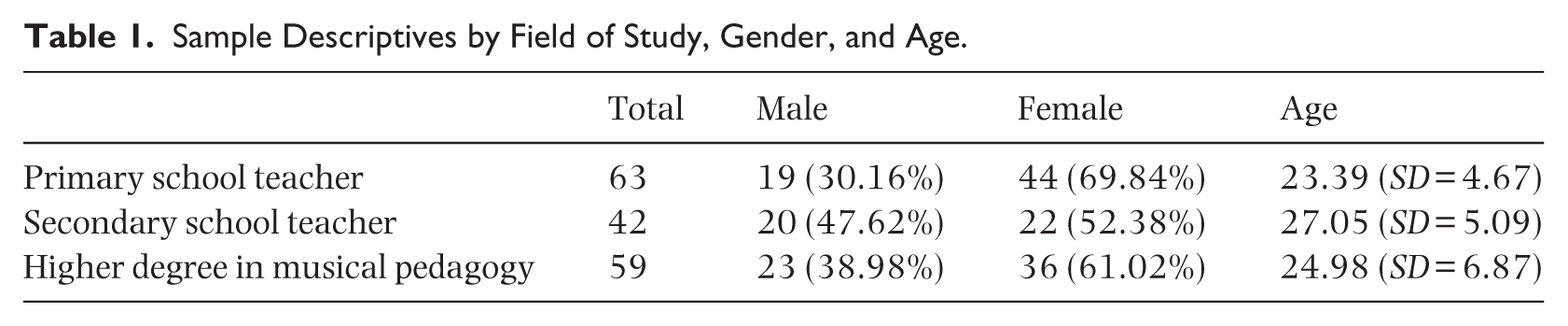
The final sample consisted of 164 students (102 females, 62.19%) with a mean age of 24.90 years (SD = 5.80) from four universities and three higher conservatories from Spain (see Table 1). The selection of universities and conservatories was based on their accessibility to the research team. Therefore, a non-probability convenience sampling method was used.
Sample Descriptives by Field of Study, Gender, and Age.
Instrument: Barcelona Music Reward Questionnaire (BMRQ)
This study used the revised version of the Barcelona Music Reward Questionnaire (BMRQ) developed by Cardona et al. (2022). This version was selected because it represents a more elaborated and psychometrically refined instrument compared to the original Spanish/English version by Mas-Herrero et al. (2013). Cardona et al. (2022) conducted a comprehensive validation of the BMRQ across several languages, including Spanish, which was the version administered in this study. The instrument consists of 24 items rated on a 5-point Likert scale, where [1] = strongly disagree, [2] = disagree, [3] = neither agree nor disagree, [4] = agree, and [5] = strongly agree. Two of the items are negatively worded and were reverse-scored during data processing.
The BMRQ assesses sensitivity to musical reward across six factors: Musical Seeking, Emotion Evocation, Mood Regulation, Sensory-Motor, Social Reward, and Music Absorption. Each factor comprises four main items, for instance, “Music makes me want to dance,” associated with the Sensory-Motor (SM) factor, and “When I share music with someone, I feel a special connection with that person,” linked to the Social Reward (SR) factor. The scoring of the BMRQ considers the weight of each item across all factors, rather than only the one with the main loading (Cardona et al., 2022).
The English version of the BMRQ demonstrates reliabilities ranging from .78 to .93, with an overall Cronbach’s alpha coefficient of .92. In the Spanish version, reliability values ranged from .81 to .92, with an overall Cronbach’s alpha of .93. From this validated framework, Saliba et al. (2016) developed a French version, Wang et al. (2023) a Chinese version, Honda et al. (2023) a Japanese version, Carraturo et al. (2023) an Italian version, Witek et al. (2023) a Danish version, and Pereira and Bortoloti (2023) a Brazilian version. In our study, a Confirmatory Factor Analysis (CFA) and Cronbach’s alpha (α = .91) indicated excellent internal consistency, with results aligning closely with those from previous validation studies.
Scoring followed the procedure described by Ten Berge et al. (1999). First, participants’ raw item responses were standardized into Z scores using the means and standard deviations from the baremation sample. Then, factor scores for each of the six facets were obtained by multiplying standardized item scores by their corresponding factor weights and summing the products. Finally, factor scores were transformed into T scores (M = 50, SD = 10) to facilitate interpretation and comparability across facets, with higher values indicating greater sensitivity to musical reward. To adapt the instrument to our study, participants were also asked to provide sociodemographic information, including gender, age, and current field of study.
Procedure
Researchers administered the survey virtually through the Formsite platform. To contact participants, the research team approached the faculty of various educational institutions. The respective faculties distributed the survey to students via institutional email, requesting their participation.
In accordance with the principles outlined in the University authors’ Code of Integrity in Research and the Belmont Report, an explanation of the research was provided within the survey, along with a question regarding informed consent. All participants were informed that participation was voluntary and that declining or withdrawing would result in no negative consequences. Data resulting from the research were stored in compliance with Regulation (EU) 2016/679 of the European Union of April 27, relating to the protection of individuals concerning the processing of personal data, as well as the Research Data Management Policy of the University of the authors.
Data Analysis
At the initial stage, a descriptive analysis was conducted for the six factors under study. Subsequently, statistical differences among the three student groups were examined using ANOVA and Tukey’s post hoc test, while gender differences were analyzed using the Welch’s t-test. Sample adequacy was verified in all cases. It met the assumptions of normality, homogeneity, and independence.
The researchers performed all analyses using the open-source statistical analysis software R version 4.2.2 and various external packages. All responses and analyses conducted can be accessed at https://rpubs.com/dcalderon/1355871
Results
As all data are available on the aforementioned website, this section focuses on the most significant findings.
As shown in Table 2, participants obtained the highest score in Musical Seeking (MS), while the lowest score was in Sensory-Motor (SM). However, in the case of conservatory students, they obtained the lowest score in Mood Regulation (MR). Statistical differences between groups were found only in Mood Regulation (MR).
Scores and Standard Deviations by Field of Study.
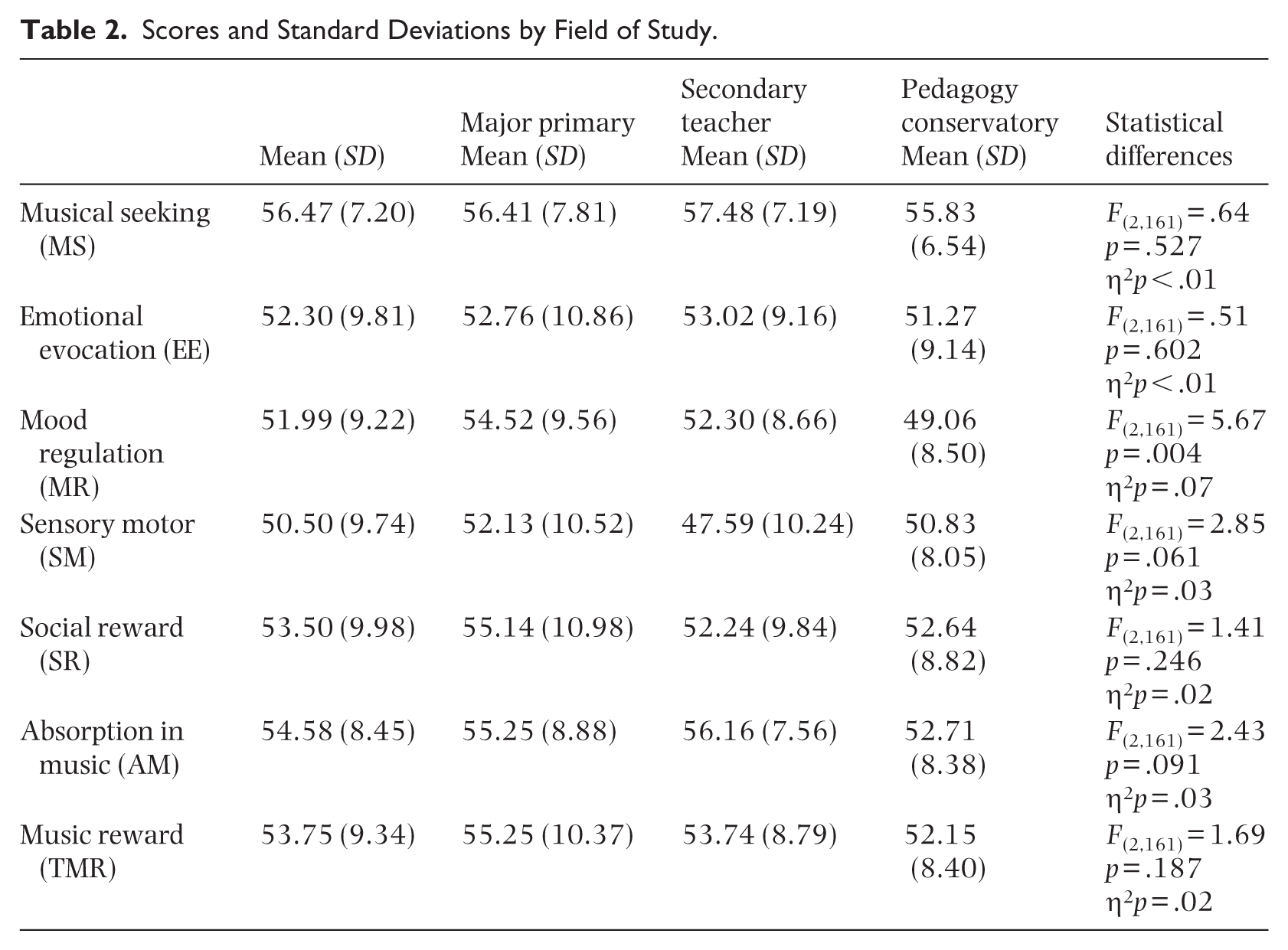
The analysis of mean differences using the Tukey test indicated that only primary education students with a major in music and conservatory music pedagogy students differed significantly (p < .001) in the case of Mood Regulation (MR). Figure 1 displays the means, quartiles, and distribution of responses by field of study.
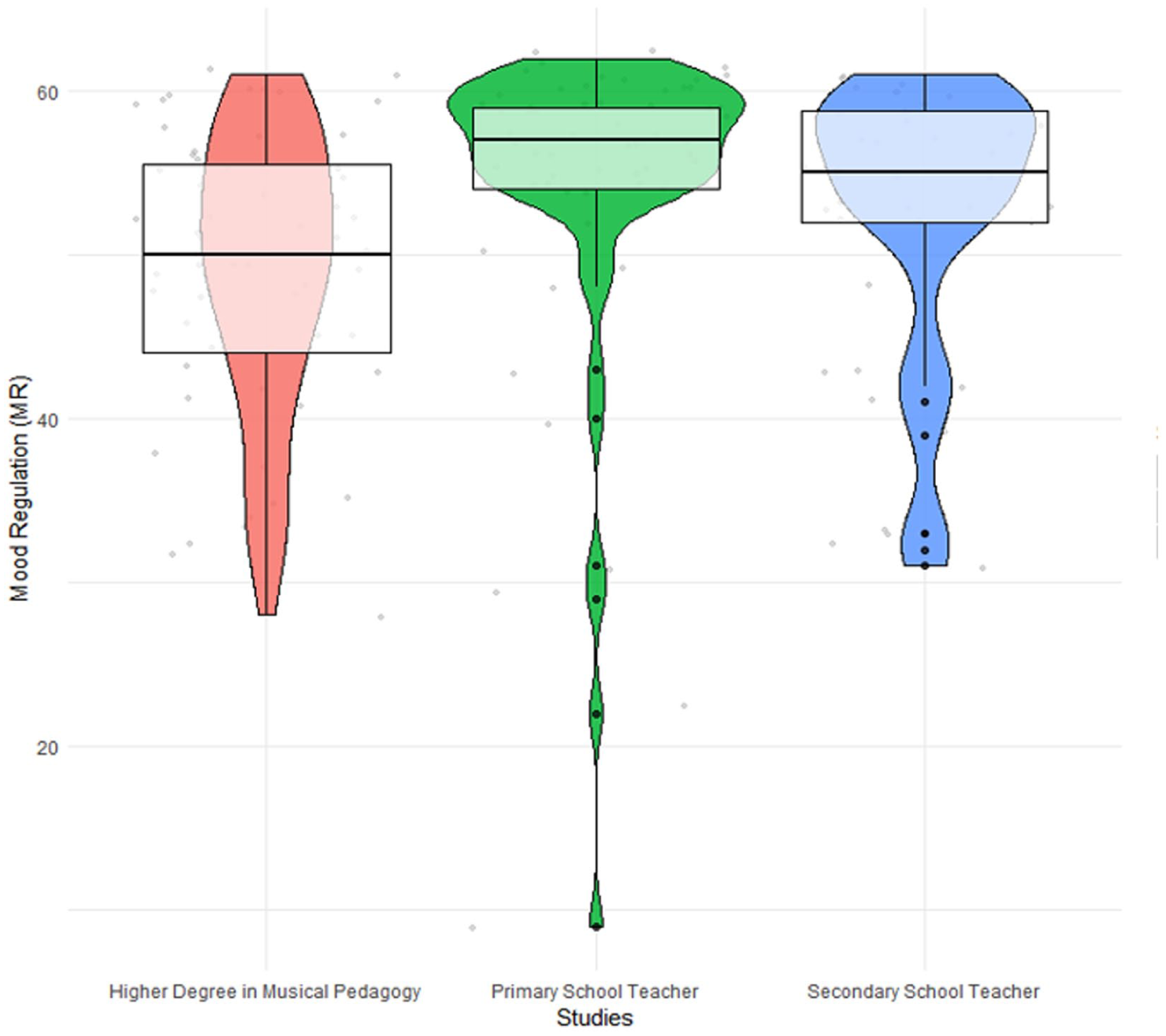
Medians, quartiles, and distribution of mood regulation by field of study.
Based on gender, the Welch test revealed significant differences only in Emotional Evocation (EE) (Female = 53.59 vs. Male = 50.16; t(109.14) = 2.09, p = .03; Cohen’s d = .35) and Sensory-Motor (SM) (female = 52.05 vs. male = 47.95; t(116.06) = 2.58, p = .01, Cohen’s d = .42). Regarding field of study, no differences were reported between students majoring in primary music education and those in master’s programs in secondary education.
Age did not correlate with any other variable (p > .05 in all cases) either in the entire sample or when divided by field of study.
Discussion
An objective of this study was to understand the types of musical rewards among three groups of music teacher students (primary education, secondary education, conservatory). The average scores obtained on the scales are high, which aligns with the findings reported by Fuentes-Sánchez et al. (2023) regarding the differences between musicians and non-musicians, as measured by the BMRQ. Concerning Social Reward (SR), highlighted by these authors as most relevant in musicians, our data did not emphasize it, perhaps because the training of our participants is not as performance-oriented as that of the participants in their study.
The propensity for Absorption in Music (AM) also shows high level, contrasting with findings by Wrigley and Emmerson (2013) who discovered that many music students did not experience flow states, hindered by negative moods and performance anxiety (Rakei et al., 2022). Our case could be explained by the way music is treated, without renouncing its rewards in the broadest sense, as these students have chosen teaching over performance.
The highest score was found in Musical Seeking (MS), while the lowest was in Sensory-Motor (SM). This distribution seems logical considering the orientation of the education of the students, focused mainly on cognitive, reflective, and interpretative aspects, with physical work taking a back seat. In the case of Sensory-Motor (SM), gender differences were found, with women scoring higher than men, consistent with findings by Mas-Herrero et al. (2013), Cardona et al. (2022), and Fuentes-Sánchez et al. (2023), possibly due to higher dance confidence levels among women in the age group of our students (Boer et al., 2012). In Western countries, the practice of dancing among men begins later than among women, although later they reach levels of confidence close to those of women (Lovatt, 2011).
The results show higher scores on all scales compared to the general population, like other studies such as Mas-Herrero et al. (2013), where significant differences were found in Musical Seeking (MS) and Emotional Evocation (EE), indicating a unique attitude among those who engage in music compared to those who do not. It is logical to comment that Musical Seeking (MS) is one of the primary purposes for listening to music, especially regarding shared musical preferences, creating deep social bonds among individuals and increasing social attraction between them (Selfhout et al., 2009). The students in our sample use music in classes, selecting repertoires for teaching activities, exploring different styles and authors, and creating musical environments in interdisciplinary activities. Their choices reflect their musical identity, making the search for music a personal expression and an important part of their teaching style. Moreover, it has been observed that the search for music is related to more enjoyable experiences and their musical level (Gold et al., 2013; Gruhn et al., 2017).
Regarding Emotional Evocation (EE), higher in the three groups studied compared to the general population, coincides with the works of Mas-Herrero et al. (2013) and Witek et al. (2023), and could be due to a greater exposure to music in all its aspects, which will be directly proportional to its emotional use. Some studies indicate Emotional Evocation (EE) as more characteristic of performers than music teachers (Gruhn et al., 2017), which is logical because the interpretation is highly linked to expression. It could be that the data from our study largely reflect the academic context in which our students learned music: their orientation has mostly been as potential performers for years, and only in the last stage of their education they have abandoned this orientation, just when they participated in our study. Therefore, Emotional Evocation (EE) remains a fundamental element in choosing music education as a profession. In Emotional Evocation (EE), gender differences were found, with higher scores among women in our sample, results that coincide with other studies (Cardona et al., 2022; Mas-Herrero et al., 2013) and seem consistent with literature. In this sense, differences between men and women in the expression and perception of emotions, both through music and in general, have been identified (Brody & Hall, 2008). From an early age, disparities in gender roles and stereotypes are observed, evidenced by the diversity of facial gestures and verbalizations. In the musical realm, some studies indicate that women tend to experience greater emotional intensity associated with certain musical aspects, such as aversive stimuli (Nater et al., 2006).
Age did not correlate with any of the BMRQ scales, despite studies by Mas-Herrero et al. (2013), Belfi et al. (2022), and Cardona et al. (2022), suggesting decreases in musical reward over the lifespan, especially from age 48 onwards. The explanation likely lies in the fact that age differences are not as pronounced in our sample as in the studies cited.
Another objective of this study was to seek differences between the three student groups (primary education, secondary education, conservatory) regarding musical rewards. The Tukey test indicated that only primary education music students and conservatory music pedagogy students differed significantly in the case of Mood Regulation (MR). Emotional regulation is one of the primary uses of music, according to studies by Lonsdale and North (2011). Music could be one of the key elements in the emotional education of future teachers, especially in primary education, as it provides key tools and strategies to tackle their professional tasks and contribute to the integral development of the individual, benefiting not only the teacher but the entire educational and social community.
In this regard, primary education teacher students are particularly sensitized to the use of emotional strategies to promote the well-being of their future students and the teacher themselves (García Vila et al., 2022). The prolonged time dedicated to curricular practices in schools exposes them to situations where self-control is a key tool in their daily work. It is logical, therefore, that conservatory music pedagogy students require fewer resources and, therefore, score lower in this regard. A healthy educational environment promotes well-being through a harmonious passion for music (Bonneville-Roussy & Vallerand, 2020). Unfortunately, in classical music studies, perfectionist obsession and performance anxiety persist (Butkovic et al., 2015), which can negatively impact students’ well-being (Evans, 2015).
The findings suggest that future music educators tend to experience high levels of musical reward. Such rewards may place them in a favorable position to face the social and educational changes that have occurred over recent decades, which require teachers to demonstrate strong cognitive, emotional, and social competencies (Benito Blanco & Pastor Comín, 2022). The differences observed among the three groups of students appear to be consistent with their respective contexts and anticipated professional paths.
Given that music is not a primary reward and depends heavily on learning (Zatorre, 2015), the musical experiences during university studies for teacher training should enable future teachers to recognize and expand the rewards they experience, whether through musical knowledge, emotional evocation and regulation, social reward, musical absorption, or flow. In this regard, the faculty of these degree programs might consider using the BMRQ as an indicative tool to guide students in identifying their musical rewards and to design activities that help strengthen the less developed ones, although this potential application has not been empirically tested.
Likewise, the ongoing professional development of these students, especially in the form of mentoring (Conway, 2003) or collaborative teacher study groups (Johnson & Stanley, 2021), could include professional development in its socio-emotional dimension, strengthening the rewards described in this study. Reflecting on teaching practice will be essential for “becoming” a good teacher (Bautista et al., 2015), something that requires teacher educators to prioritize attention to the quality of one’s own teaching.
We propose the following teaching guidelines and activities aimed at developing and strengthening the rewards described in the context of music teacher training:
Teaching repertoire creation for both performance and listening will be one of the fundamental aspects of any music teacher training, regardless of the level at which they will teach, adapted to the characteristics, interests, and pedagogical needs of their students (Rotjan, 2021). To achieve this, it will be necessary to seek out pieces that vary in difficulty, cultural origin, styles and genres, instrumental ensembles, etc. It is also important to incorporate works by female composers to highlight the role of women in musical creation. This will allow students to increase the reward related to Musical Seeking (MS).
To strengthen Emotional Evocation (EE), we can introduce the concept of aesthetic emotion in class, in this case, through the perception and interpretation of music. The goal is for future teachers to make these types of emotions visible in their classrooms, helping students recognize the emotional benefits they can gain from music, such as improving emotional vocabulary or expression (Menninghaus et al., 2019).
Regarding Mood Regulation (MR), most people use music listening as an emotional regulator in their daily lives. To improve this reward, future teachers should be emphasized that the more music is known and performed, the greater the options for regulation. Therefore, it is crucial to introduce students to a variety of genres and musical styles that can assist in their emotional regulation (DeNora, 2000). For example, through reflection and analysis of different pieces, we can teach students to create a playlist as a musical first-aid kit to enhance the emotional climate of classrooms, considering various aspects such as students’ background, interests, and culture.
Sensory-Motor (SM) rewards can be addressed by incorporating activities involving body expression that require movement, such as dances, choreography, and body percussion (Hallam, 2010). In conservatories, this can be complemented through the non-verbal communication present in all performances, whether individual or collective.
Social Reward (SR) is most prominent in all collective performance activities. Skills such as prosocial behavior, cooperation, collaboration, and empathy are instinctively developed (Ros-Morente et al., 2019). Future teachers should be aware of this development and make it conscious in their lessons so that students can reflect on it and appreciate it.
Music is an enhancer of well-being. For this reason, emphasis should be placed on its potential as a source of entertainment and aesthetic enjoyment, so that future teachers can motivate students to engage with music both inside and outside the classroom. For example, participating in a musical group they identify with, listening to and enjoying music they like, dancing with friends, etc. These types of musical activities can easily lead to a state of flow that enhances the reward of Absorption in Music (AM), characterized by a sense of freedom, joy, commitment, and skill that improves the happiness of those involved (Dingle et al., 2021).
To provide a more integrated synthesis of the analysis and findings, the results indicate that future music teachers tend to experience high levels of musical reward across emotional, social, and cognitive dimensions. This pattern suggests that their engagement with music transcends purely academic or professional demands and is rooted in deep personal, affective, and identity-related processes. Such findings reinforce the notion that musical engagement during teacher education plays a central role in shaping professional identity, motivation, and well-being, positioning music education as a multidimensional space for personal growth rather than merely a vehicle for skill acquisition.
From a theoretical perspective, these results align with contemporary frameworks that conceptualize musical reward as a multidimensional construct shaped by learning histories, educational trajectories, and sociocultural contexts, rather than as a uniform or purely innate response to music (Mas-Herrero et al., 2013; Zatorre, 2015). The prominence of Musical Seeking and Emotional Evocation among participants is consistent with previous studies highlighting the role of music in identity construction, emotional meaning-making, and cognitive engagement within educational and professional pathways (Fuentes-Sánchez et al., 2023; Hargreaves, 2000). At the same time, the comparatively lower scores observed in Sensory-Motor reward, together with the limited differentiation across training pathways, suggest that embodied and movement-based dimensions of musical experience may be underrepresented in formal music teacher education, despite their documented importance for musical engagement, social bonding, and well-being (Hallam, 2010; Wrigley & Emmerson, 2013). In this sense, the findings extend prior research on pre-service music teachers—traditionally focused on emotions, motivation, or pedagogical beliefs (Anttila et al., 2016; Ketonen & Lonka, 2012)—demonstrating that musical reward offers a valuable analytical lens for understanding how motivation, engagement, and professional orientation are configured during initial teacher training.
Importantly, the results suggest that musical reward should not be interpreted merely as a by-product of musical activity, but rather as a formative variable that can be intentionally nurtured through pedagogical design. This perspective has direct implications for music teacher education, as it supports the development of training programs that deliberately address emotional, social, and embodied dimensions of musical experience, alongside cognitive and technical competencies. Such an approach may contribute to more differentiated and context-sensitive models of teacher education across primary, secondary, and conservatory settings, which are known to differ substantially in their educational cultures and professional expectations (de Vugt, 2017). Although this study is situated within the Spanish context, these structural distinctions are broadly shared across European systems, suggesting that the conclusions may be meaningfully transferred to other international contexts with appropriate contextual adaptation.
The study also opens several avenues for future research. One particularly promising direction concerns the relationship between musical reward and personality traits, as previous studies have linked dimensions such as openness to experience, extraversion, and agreeableness to musical engagement and reward-related processes (Wang et al., 2023). Longitudinal and qualitative approaches could further illuminate how musical reward evolves throughout teacher training and professional practice, for instance by comparing pre-service and in-service teachers or by incorporating reflective journals to capture subjective changes in musical experience over time. Additionally, future research should address issues of equity in access to music, including socioeconomic, cultural, and familial factors, which may significantly shape opportunities for musical engagement and, consequently, the development of musical reward.
This study is not without limitations. The reliance on self-report measures introduces the possibility of social desirability bias and subjective interpretation. Moreover, the single-country focus and cross-sectional design limit the generalizability of the findings and preclude causal inferences. No additional validity analyses were conducted for the instrument within this specific sample. Future studies should therefore adopt cross-cultural, longitudinal, and mixed-methods designs to further assess the stability, scope, and applicability of these results.
Ultimately, music education plays a profound role in individuals’ psychological well-being and professional development across the lifespan. For future music teachers, the capacity to experience and cultivate musical reward may not only sustain their own motivation and resilience, but also enhance their ability to foster meaningful, emotionally rich musical experiences for their students. In this sense, musical reward may indeed constitute one of the most enduring and transformative outcomes of music education.
Footnotes
Acknowledgements
This work is part of the Teaching Innovation Project recognized by the Universitat de Barcelona.

Ethical Considerations
Informed consent was obtained from all individual participants included in the data collection process. All data were handled in compliance with current legislation on data protection and confidentiality, in accordance with Regulation (EU) 2016/679 of the European Parliament and of the Council (General Data Protection Regulation, GDPR), as well as Organic Law 3/2018 of 5 December on the protection of personal data and the guarantee of digital rights (LOPDGDD). All data were processed using identification codes to ensure the anonymity and confidentiality of participants and results, in line with the principles of the Belmont Report and the Code of Good Research Practice of the Universitat de Barcelona.
Consent to Participate
Written informed consent was obtained from all individual participants included in the study.
Funding
The authors disclosed receipt of the following financial support for the research, authorship, and/or publication of this article: This work is part of the Teaching Innovation Project “Musical Pedagogical Competencies in Initial Teacher Education” (2022PID-UB/014) recognized by the university of the authors.
Declaration of Conflicting Interests
The authors declared no potential conflicts of interest with respect to the research, authorship, and/or publication of this article.