






Abstract
Titles play a crucial role in shaping perception in visual art, but their influence in auditory art remains underexplored. This study used two experiments to investigate how music training and the presence of music influence the perception of music titles. Experiment 1 asked participants to judge titles without accompanying music clips. The results showed that music majors showed a strong preference for concrete titles, likely due to their psychological proximity to music concepts, while this effect was absent in the no musical training group. Experiment 2 introduced music clips (classical and modern) to explore how music types affect title perception. The results revealed that abstract titles were favored for classical music, which was perceived as temporally distant, whereas concrete titles were preferred for modern music, which was perceived as closer and more tangible. These findings provide preliminary evidence that psychological distance, as proposed by Construal Level Theory (CLT), interacts with musical expertise and music style to shape title perception, offering new insights into the interpretation of auditory art.
Keywords
When attending musical performances, concerts, and salons, audiences often rely on program booklets, particularly the titles of musical pieces, to gain an initial understanding of what they are about to hear. This reliance is well-founded, as extensive research in the visual arts has consistently shown that titles can significantly influence how people understand and process art, shaping their preferences, purchasing decisions, and aesthetic experiences (Millis, 2001; Russell, 2003).
Titles serve not only for identification but also as a guide to the interpretation of an artwork (Franklin, 1988). As a key element of artworks, artists pay close attention to the titles under which their works are presented (Gombrich, 1985; Welchman, 1997). Titles can pre-activate semantic schemas that guide top-down processing and have been shown to influence the viewer’s interpretation and significantly alter the perception of an artwork. Even without affecting visual processing, titles can shift how viewers understand and engage with a painting (Franklin et al., 1993). This priming not only influences which features observers selectively attend to but also shapes their evaluative baseline. These findings suggest that titles play a significant role in shaping audience interactions with art, beyond the purely visual aspects. For instance, Millis (2001) found that metaphorical titles led to greater aesthetic experience than no title, random titles, or descriptive titles. Specifically, his results showed that titles increased understanding of illustrations and photographs and improved the quality of the aesthetic experience, including liking, interest, and elicited thoughts and emotions. This phenomenon is referred to as the “elaboration effect.” Millis concluded that titles increase the aesthetic experience only if they contribute to a rich and coherent representation.
In addition, previous studies have also found that different types of titles can affect the perception of artworks differently, with research showing that descriptive titles negatively impact auction prices, while more elaborate titles have a positive effect. These results can be explained through Paivio’s (1971) dual-coding theory. This theory posits that elaborative titles activate both verbal and imagistic codes, thereby enriching comprehension and deepening aesthetic experience (Millis, 2001). Dual-coding theory offers a mechanistic account: concrete or imagery-evoking words enter a pictorial code in addition to the verbal code, yielding a denser associative network that feels more meaningful. At the perceptual level, the distinction between concrete and abstract titles dovetails with global–local processing theory (Navon, 1977): high-level, “distant” features invite a global reading, while concrete, detail-oriented cues foster local processing.
The impact of titles also depends on artwork style and viewing duration. For shorter viewing times, descriptive titles are more effective at facilitating quick understanding. In contrast, elaborative titles enhance cognitive engagement and understanding during longer viewing periods, especially for abstract artworks (Leder et al., 2006). Notably, in auction settings, elaborate titles for abstract paintings significantly raise hammer prices. In the case of unknown artists, descriptive titles reduce auction prices, while the absence of a title has a positive impact (Park et al., 2022).
Beyond visual art, titles belong to a wider class of contextual (or “source”) information that shapes how listeners decode and evaluate music. Listeners are highly sensitive to the broader context surrounding music, including not only the title but also information about the performer and the composer (Thompson et al., 2023). Research consistently shows that various types of contextual information, which are often presented alongside music, can significantly shape listeners’ judgments. This includes details about the musician (Anglada-Tort & Müllensiefen, 2017), the composer (Steinbeis & Koelsch, 2009), or program notes (Margulis, 2010).
However, how titles shape and influence music perception remains a particularly intriguing area of investigation. Studies have found that song titles play a key role in memory and meta-memory for music (Bartlett & Snelus, 1980; Korenman & Peynircioğlu, 2004; Peynircioğlu et al., 2008). Different types of titles also influence the aesthetic experience of music. For example, Anglada-Tort and colleagues (2019) explored how linguistic fluency and affective associations in titles influence aesthetic and value judgments of music. Their findings showed that easily pronounceable titles led to more positive evaluations, while negative titles resulted in lower judgments than neutral or positive titles. These results suggest that titles in music, similarly to visual art, play a critical role in shaping listeners’ judgments.
Although the source-effects framework catalogs what contextual cues matter, it remains underexplored when titles exert the strongest influence and upon whom. Construal Level Theory (CLT) helps explain when a given cue exerts greater impact by modulating psychological distance. CLT posits that people mentally represent objects or events at varying levels of abstraction depending on their psychological distance, a construct encompassing temporal, spatial, social, and hypothetical dimensions (Trope & Liberman, 2010). Distant events are construed abstractly (focusing on central, high-level features), while proximal events are processed concretely (emphasizing peripheral, detail-oriented features). Applied to the visual arts, Durkin et al. (2020) found that abstract artworks were more likely to be associated with distant temporal or spatial settings than representational works. For example, participants were more likely to assign abstract paintings to a gallery opening in the future (“in a year”) compared to representational paintings, which were associated with near-future settings (“tomorrow”). Importantly, this link between abstraction and psychological distance appears robust across expertise levels, although experts may be more inclined toward abstract, interpretive processing due to their training.
In the context of CLT, prior experience with visual art also plays a role in how individuals engage with abstract versus descriptive stimuli. Durkin et al. (2020) found that novices and experts alike showed similar tendencies in assigning abstract works to distant contexts, indicating that psychological distance and abstraction may transcend expertise. CLT also suggests that those with more experience or training tend to engage in more abstract, interpretive thinking, while those with less experience may prefer concrete, straightforward information (Durkin et al., 2020). This theory has already demonstrated its influence in the context of visual arts, particularly painting. These studies illustrate the applicability of CLT in explaining how psychological distance influences the perception of abstract versus representational works in visual art.
In the auditory arts, CLT can similarly be applied to investigate and explain how listeners engage with music, much like how it has been applied to visual art. For example, Hansen and Melzner (2014) demonstrated that sound patterns reflecting abstractness, such as reverberation or harmonic novelty, promoted abstract thinking, while familiar, concrete sounds encouraged detail-oriented processing. This relationship between auditory stimuli and construal levels suggests that abstract music titles might evoke a sense of psychological distance, fostering more conceptual engagement with the music. In contrast, descriptive titles, by providing specific contextual cues, could encourage listeners to focus on the concrete, tangible elements of a musical piece.
Although the impact of titles on the perception of visual art has been widely studied, the influence of factors such as the listener’s experience, the temporal distance of the work, and the abstractness or descriptiveness of the titles on title perception in auditory art remains underexplored. Specifically, how these factors shape the perception of titles and influence cognitive and emotional engagement with music has yet to be fully understood. Thus, this study aims to investigate how title information, specifically abstract and descriptive titles, influences listeners’ perception of music. It also explores how music training shapes this title perception, providing further insight into how experience and context shape the auditory aesthetic experience. Understanding title effects is not only theoretical; streaming-service data show that titles influence click-through when listeners scroll playlists (Steffens & Anglada-Tort, 2025). Our findings therefore speak directly to music discovery algorithms and consumer choice.
The Present Study
The present study aims to explore how title perception in music is influenced by the abstractness or descriptiveness of titles, and also to examine the impact of music training and the temporal context of the music. This research builds on previous work in visual arts, where titles have been shown to guide interpretation and alter aesthetic experience (Franklin, 1988; Franklin et al., 1993). However, while the role of titles in visual art perception has been widely studied, how abstract and descriptive titles influence listeners’ engagement with music remains underexplored, especially in relation to listeners’ levels of musical experience and the period in which the music was composed.
The first objective of this study is to determine whether individuals with professional music training differ from those without such training in their perception and judgment of abstract versus concrete music titles. We propose that the depth and duration of musical study heighten listeners’ sensitivity to the source and contextual cues embedded in titles, which in turn shifts their preference between abstract and concrete titles. To isolate this effect, Experiment 1 presented the titles alone, forcing participants to rely exclusively on top-down processing. When bottom-up musical information is absent, concrete titles are expected to assume greater significance. Music-trained individuals, equipped with rich schematic knowledge, can map explicit title details onto anticipated structural features and are therefore predicted to prefer concrete labels. Individuals with no musical training, who lack comparable schemas, may display no consistent bias. This design provides a stringent test of CLT, which posits that greater psychological proximity, created here through years of training, moves information processing toward a more concrete and detail-oriented level.
To investigate this hypothesis, the first experiment does not include musical excerpts and instead presents abstract and concrete titles in isolation. The rationale behind this approach is to isolate the effect of title perception itself, free from the potential influence of the music. By removing auditory cues, the study aims to focus purely on how participants, based on their level of musical expertise, interpret and evaluate the titles as music titles. This setup allows for a clear comparison of how music-trained individuals and individuals with no musical training engage with abstract and descriptive titles without the added complexity of auditory information. It ensures that any differences in perception can be attributed to title information alone, without the interaction of musical elements.
The second objective of the study is to assess whether the temporal context of the music affects title perception, specifically, whether the piece is classical or modern. In this experiment, musical professionals are included to provide context for the titles. This experiment builds upon the first by introducing auditory stimuli, which allows for a more realistic evaluation of how titles and music interact. Based on CLT, it is anticipated that classical music, being temporally distant, will prompt more abstract thinking and thus align more with abstract titles. On the contrary, modern music, which is temporally closer, might encourage listeners to favor more descriptive titles that provide clear and direct information.
Including music in the second experiment enables the study to assess whether the interaction between the title type (abstract or concrete), the time period of the music (classical or modern), and the music training (music major vs. no musical training) shapes title perception differently when participants are exposed to both auditory and title information. The introduction of auditory material not only provides context for the titles but also allows participants to engage with the music in a more direct and experiential way. This auditory experience makes the task more immersive and realistic, reflecting how individuals typically encounter titles in real-world musical settings. Furthermore, it enables the study to investigate whether music training influences how participants integrate auditory and title information when making judgments about abstract and descriptive titles. By exploring how the variables of title type, music period, and musical expertise interact with the presence of auditory stimuli, the study can provide deeper insights into the cognitive and emotional engagement involved in title perception.
By examining both abstract and descriptive titles across musical works from different time periods, and considering the role of music training and auditory material, this study aims to contribute to the understanding of title perception. The research examines how the factors of musical expertise, the time period of the music, and the abstractness or descriptiveness of titles influence the way titles are perceived. Through these experiments, the study seeks to expand our understanding of title perception in auditory contexts and contribute to a broader application of CLT in music.
Experiment 1
Experiment 1 aimed to explore how music training and different types of titles affect the likelihood of a text being perceived as suitable for use as a music title.
Method
Participants
We recruited 202 adult student participants online for testing, and they received compensation for their participation. Data from 14 participants were excluded due to non-compliance with the instructions. The final sample consisted of 188 participants, with an equal distribution of 94 with music training and 94 without, ensuring a balanced representation of both groups in the experimental design. The participants, comprising 76 males and 112 females with an average age of 20.67 years (SD = 2.04), were divided into two groups. Participants with music training were defined as university music majors with over 5 years of professional music training, while individuals with no musical training were non-music majors with fewer than 5 years of extracurricular music education. The study was approved by the Ethics Review Board of South China Normal University (approval number: SCNU-PSY-2024-096).
Design
Experiment 1 used a 2 (music training: music training group vs. no musical training group, between-subjects factor) × 2 (title type: concrete title vs. abstract title, within-subjects factor) mixed factorial design. The dependent variable was the probability of text being rated as suitable for musical titling.
Material
To investigate the impact of music training experience on the perception of titles across musical works from different time periods, we required a set of musical titles representing both abstract and concrete types. A material rating task was conducted to ensure clear distinctions between abstractness and concreteness, while controlling for other factors such as Eastern versus Western stylistic orientation and emotional evocation.
Thirty-two college students, aged 18–28, were recruited for the material rating. None participated in the formal experiment. All were right-handed, had normal or corrected-to-normal vision, and did not have dyslexia. Participants were compensated for their time, and the study adhered to ethical guidelines set by the Institute Ethics Committee, South China Normal University.
The participants rated a set of 52 musical titles on a 10-point scale for three attributes: (i) degree of concreteness (0 = highly abstract; 10 = highly concrete), (ii) emotional evocation (0 = no emotion felt; 10 = strong emotion felt), and (iii) stylistic orientation (0 = strongly Eastern style; 10 = strongly Western style). The goal was to select titles that were distinguishable in terms of abstractness and concreteness while ensuring comparability in emotional evocation and stylistic orientation to avoid bias in the experimental outcomes.
The material rating experiment revealed a significant difference in the degree of concreteness (concrete title: 7.48 ± 0.41; abstract title: 4.30 ± 0.72) on title types, Cohen’s d = −5.446, p < .010. However, no significant differences were found for emotional evocation, Cohen’s d = −0.274, p = .328 or stylistic orientation, Cohen’s d = 0.324, p = .248. The average emotional evocation score was 5.76 (SD = 2.01), and the stylistic orientation score was 5.23 (SD = 2.36), indicating consistency in these dimensions across titles (see Figure 1).
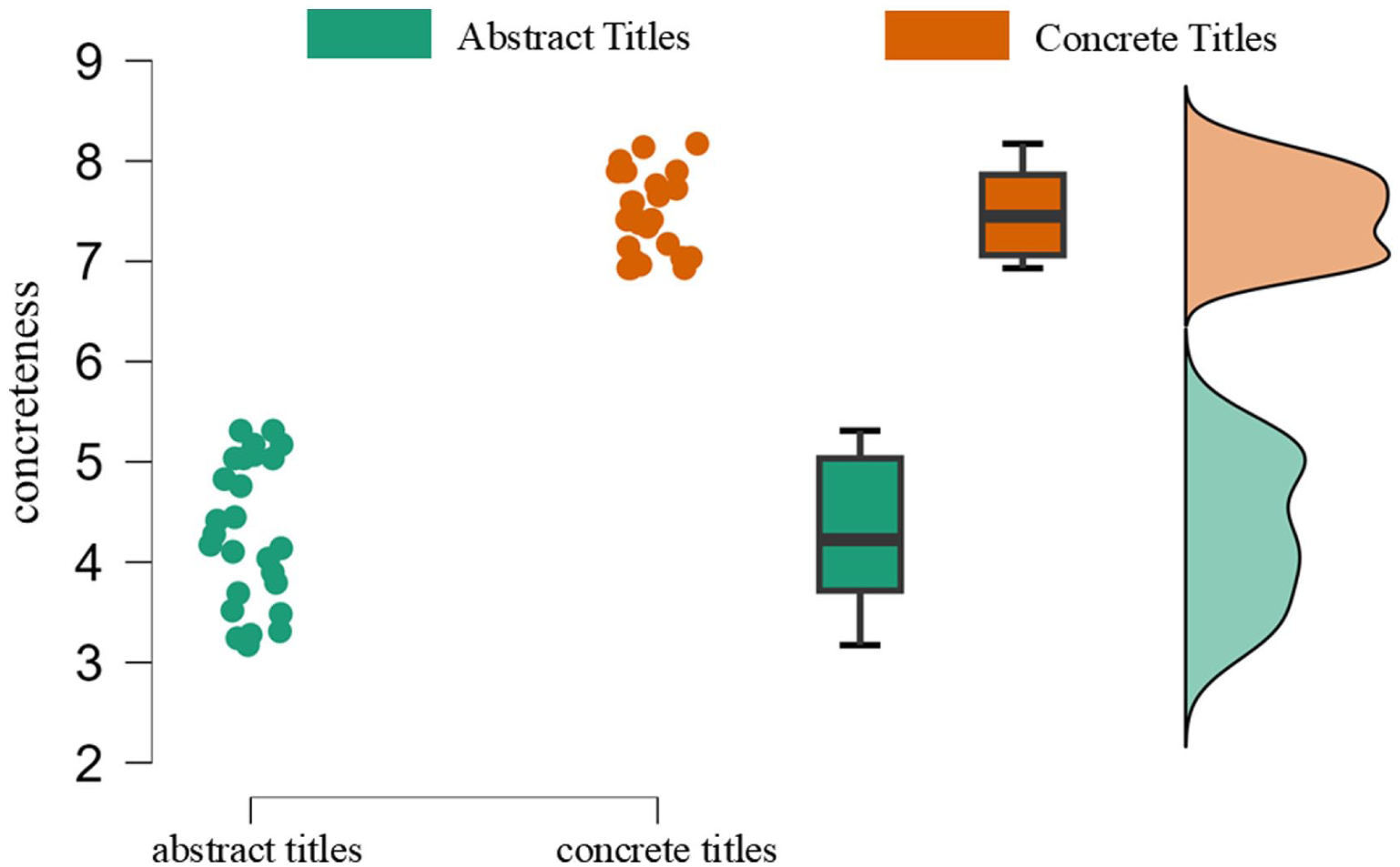
Raincloud plot of concreteness for abstract titles versus concrete titles.
To control for potential confounding factors, we conducted a word frequency analysis of 102 linguistic, emotional, cognitive, social, and structural features, including parts of speech (e.g., nouns, verbs, adjectives), emotional expressions (e.g., positive/negative emotions), and grammatical complexity. A t-test revealed no significant differences in the frequency distribution between abstract and concrete titles, t (101) = 0.14, p = .079. These results suggest that the differences in abstractness and concreteness were not influenced by word choice or grammar.
Based on the material ratings, we selected titles from the top 50% of both abstract and concrete categories for use in the formal experiment. Specifically, 13 titles representing the highest levels of abstractness and 13 representing the highest levels of concreteness were chosen.
Procedure
Participants completed an online experiment to examine how individuals with different levels of music training, specifically music majors and individuals with no musical training, perceive concrete versus abstract musical titles. The 52 titles were evenly distributed across two questionnaires, each presenting the titles in one of two orders. Participants were randomly assigned to one of the questionnaires, ensuring a balanced response distribution. They rated each title on a 9-point scale, where 1 indicated “extremely unlikely” and 9 indicated “extremely likely” in terms of suitability as a musical title. Participants were not informed that the study was focused on the concreteness versus abstractness of the titles. This was intentional to minimize potential demand characteristics and avoid priming participants to pay special attention to this specific dimension, which could have biased their judgments. The procedure lasted approximately 20 min, with data automatically collected. Participants were compensated upon completion of the experiment.
Results and Discussion
A Repeated-Measures analysis of variance (ANOVA) revealed a significant main effect of music training, F(1, 186) = 4.88, p = .028, η2 = 0.02. However, the main effect of title type was not significant, F(1, 186) = 0.22, p = .642, η2 < 0.01. Interestingly, a significant interaction between music training and title type was observed, F(1, 186) = 7.49, p = .007, η2 = 0.01.
The interaction between music training and title type is shown in Figure 2. A simple effects analysis revealed that in the music training group, concrete titles were more likely to be judged as suitable musical titles (M = 6.25, SD = 1.16) compared to abstract titles (M = 6.00, SD = 1.18), F(1, 186) = 5.13, p = .025, Cohen’s d = 0.22. However, no significant difference was found between concrete (M = 5.70, SD = 1.05) and abstract titles (M = 5.88, SD = 1.22) in the no musical training group, F(1, 186) = 2.58, p = .110, Cohen’s d = −0.15.
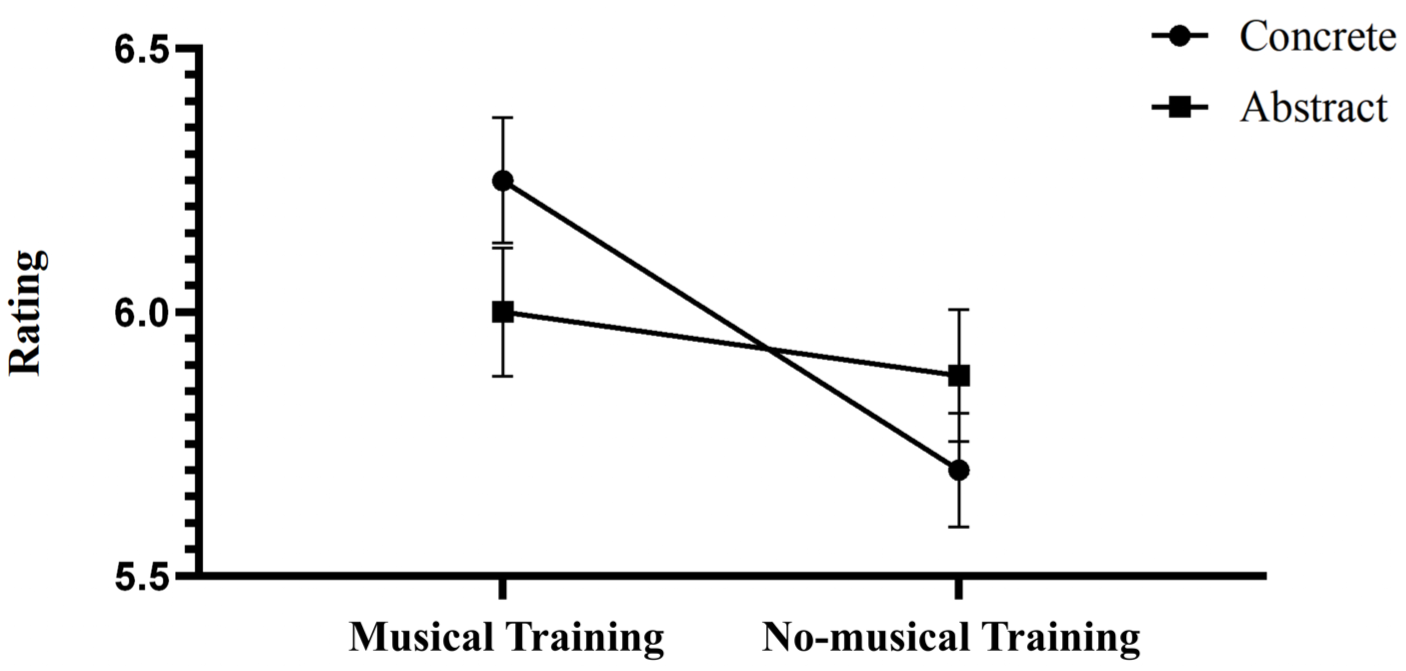
The interaction between music style and participants across different expertise groups (Error bars represent ± 1 SE).
In the silent-title task of Experiment 1, a setting that relied entirely on top-down processing, music majors judged concrete titles more appropriate, showing that extensive training sharpens sensitivity to source cues. Concrete labels supply diagnostic details that musicians can quickly map onto their rich schematic knowledge, which boosts processing fluency, whereas abstract labels offer little leverage without accompanying audio and leave non-majors largely indifferent. Expertise therefore amplifies the general preference for concreteness when no bottom-up information is available, and this finding accords with CLT, which states that psychological proximity encourages detail-oriented mental representations.
Experiment 2
Experiment 2 aimed to investigate how the temporal context of music (classical vs. modern) and music training influence title perception, and explored whether classical music was more likely to be endowed with an abstract title, and modern music was more likely to be endowed with a concrete title.
Method
Participants
Seventy-two Chinese undergraduates (M = 20.83 years, SD = 2.04; 22 males, 50 females) provided usable data for Experiment 2, drawn from an initial pool of 82 recruits. The 10 excluded individuals either skipped entire task blocks, provided identical ratings across all items, or failed an embedded attention-check item. Of the 72 participants, 39 were music majors and 33 had no musical training, classified according to the same criteria employed in Experiment 1. All participants were prescreened to rule out auditory impairments and amusia.
Design
Experiment 2 used a 2 (music training: music training group vs. no musical training group, between-subjects factor) × 2 (title type: concrete title vs. abstract title, within-subjects factor) × 2 (music style: classical vs. modern, within-subjects factor) mixed design.
Materials
Twenty-six 10-s music excerpts were chosen by five postgraduate students (three MA, two PhD; M age = 26.1, SD = 2.3) from the School of Music and were classified by date of composition into 13 classical and 13 modern clips. The stimulus set comprised twenty-six 10-s excerpts, balanced across style and performing forces. For each group, we selected five solo pieces, five ensemble pieces, and three vocal excerpts, yielding thirteen modern and thirteen classical clips.
Modern Corpus (Post-1900)
Modern was defined strictly by composition date after 1900. The selection spanned accessible popular or light-classical works, for example, the tango pieces Charmaine (2008) and El Gaucho (c. 2001), alongside structurally demanding modernist or concert works such as Holst’s The Planets (1914) and Górecki’s Symphony No. 3 (1976). Other items include Jenkins’s Adiemus (1994), Copland’s Twelve American Preludes (1944), and Villa-Lobos’s Symphony No. 1 (1926). This blend preserves a clear temporal boundary while avoiding systematic bias in musical complexity.
Classical Corpus (Pre-1900)
Classical excerpts were drawn from the Baroque, Classical, and Romantic eras. Examples include Bach’s Brandenburg Concerto (1721), Mozart’s Requiem K. 626 (1791), Beethoven’s Symphony No. 5 (1808), Berlioz’s Symphonie fantastique (1830), and Verdi’s Nabucco (1842). We also included Rachmaninoff’s Vespers (1915) because, despite its 20th-century date, its liturgical style and listener associations align more closely with 19th-century sacred repertoire. Like the modern set, the classical corpus mixes solo instrumental pieces, chamber or orchestral movements, and vocal excerpts, ensuring that instrumentation does not confound comparisons.
To confirm that structural complexity did not differ across the two sets, five conservatory graduates with at least 4 years of formal analysis training rated every 10-s excerpt on a 9-point complexity scale (1 = very simple, 9 = very complex). After two hearings per clip in a blind session, their ratings were averaged and compared with a one-way ANOVA. The result was non-significant (p = .122) with a small effect size (η2 = 0.10), indicating that the modern and classical corpora were matched in perceived complexity. Together, they provide a clear temporal contrast without favoring any particular level of structural difficulty.
After hearing each excerpt twice, the raters jointly created two clip-specific titles, one concrete and one abstract, following the operational definitions from Experiment 1; for example, in the Garden (concrete) versus Essence of Flora and Fauna (abstract). A senior conservatory professor then reviewed and approved every title for stylistic accuracy. These pre-written, clip-matched titles ensured tight experimental control while providing participants with a clear two-choice comparison for each of the 26 stimuli. Each clip had a duration of 10 s. To counterbalance potential order effects, the presentation of titles was varied: for half of the participants, the concrete title appeared first, followed by the abstract title, while for the other half, the abstract title was presented before the concrete one. Moreover, the titles were carefully crafted by experts in the field to ensure that they accurately reflected the musical content and captured the intended emotional tone, thereby enhancing the ecological validity of the experimental design.
To verify that concreteness was the only manipulated dimension, we conducted paired t-tests on word count, lexical frequency, and emotional valence across the 26 matched title pairs. Results showed no significant differences across any of these dimensions (all ts < 1.81, all ps > .08). These checks confirmed that abstract and concrete titles were matched on all measured linguistic variables, leaving concreteness as the sole systematic contrast.
Procedure
The experiment was conducted online using the Tencent Meeting platform. Participants listened to a series of 26 music clips, comprising 13 classical and 13 modern pieces. To ensure precise responses, each music clip was played twice. After listening, participants rated a set of titles, which were semantically related but presented in two different forms: concrete and abstract. Each title was rated on a scale from 0 to 100, with higher scores indicating that the title was more suitable for the music clip (see Figure 3).
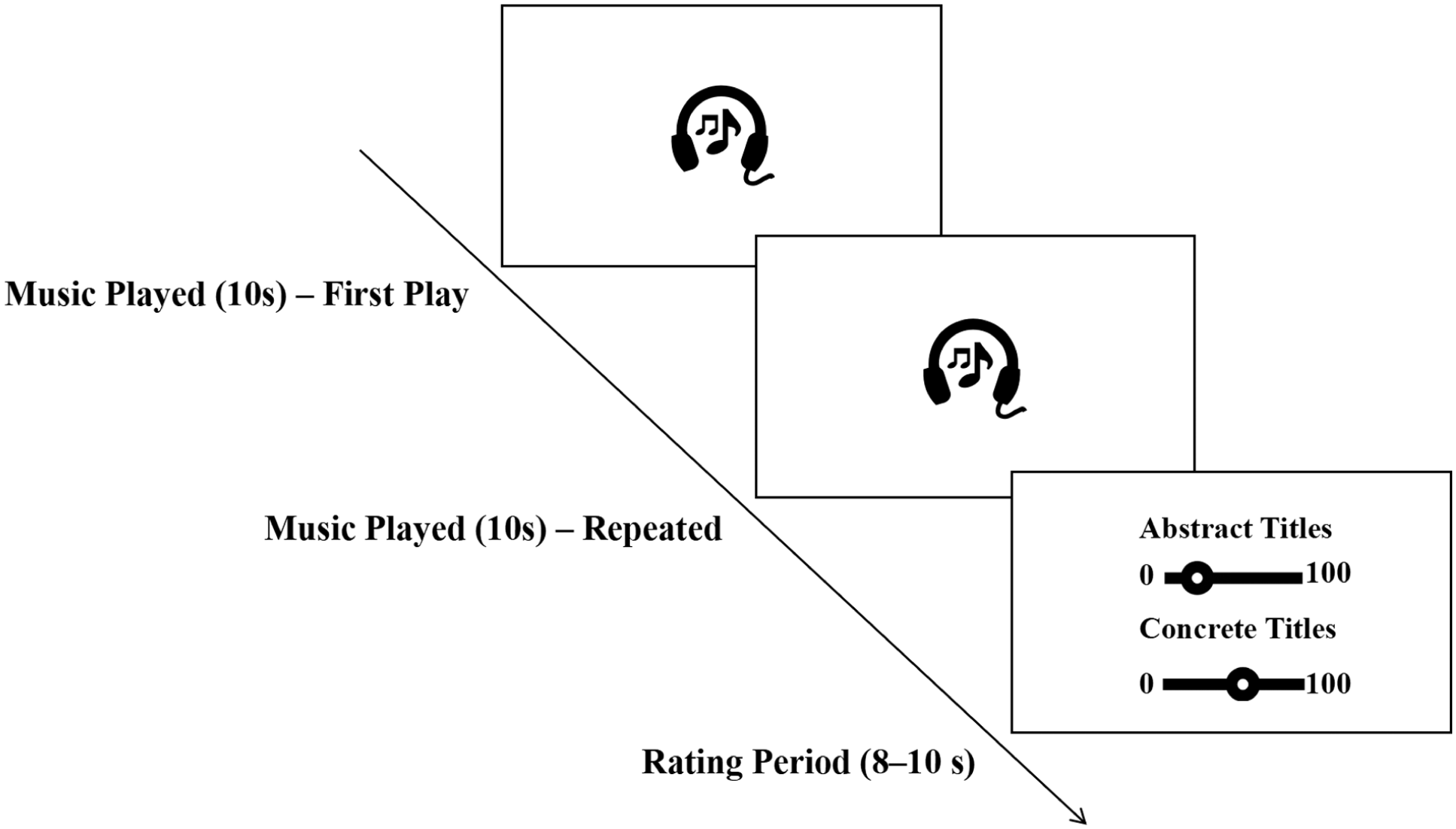
The procedure of Experiment 2.
Data Analysis
Data were analyzed using JASP 0.17.2.1 with repeated measures ANOVA to examine the main effect of music training, the main effect of title types, and the interaction on the probability of text being rated as suitable for musical titling.
Results and Discussion
A mixed-design ANOVA was conducted to compare title type (concrete vs. abstract) and music style (classical vs. modern) across two participant groups (music majors, the no musical training group). The results revealed significant main effects for both title type and music style. For title type, F(1, 70) = 37.30, p < .001, η2 = 0.04, abstract titles were rated higher than concrete titles. For music style, F(1, 70) = 119.81, p < .001, η2 = 0.29, classical music received significantly higher ratings than modern music. However, the one-way ANOVA indicated that the effect of the group was not statistically significant, F(1, 70) = 0.284, p = .595, η2 < 0.01.
A significant interaction between music style and title type was found, F(1, 70) = 85.34, p < .001, η2 = 0.17. In the classical music condition, abstract title was more likely to be judged as a suitable musical title (M = 65.76, SD = 10.34) than concrete title (M = 48.53, SD = 8.64), F (1, 70) = 115.34, p < .001. Conversely, in the modern music condition, concrete title was more likely to be judged as a suitable musical title (M = 45.28, SD = 11.06) than abstract title (M = 39.49, SD = 9.00), F(1, 70) = 14.50, p < .001. These findings suggest that title type had a different impact depending on the music style (see Figure 4).
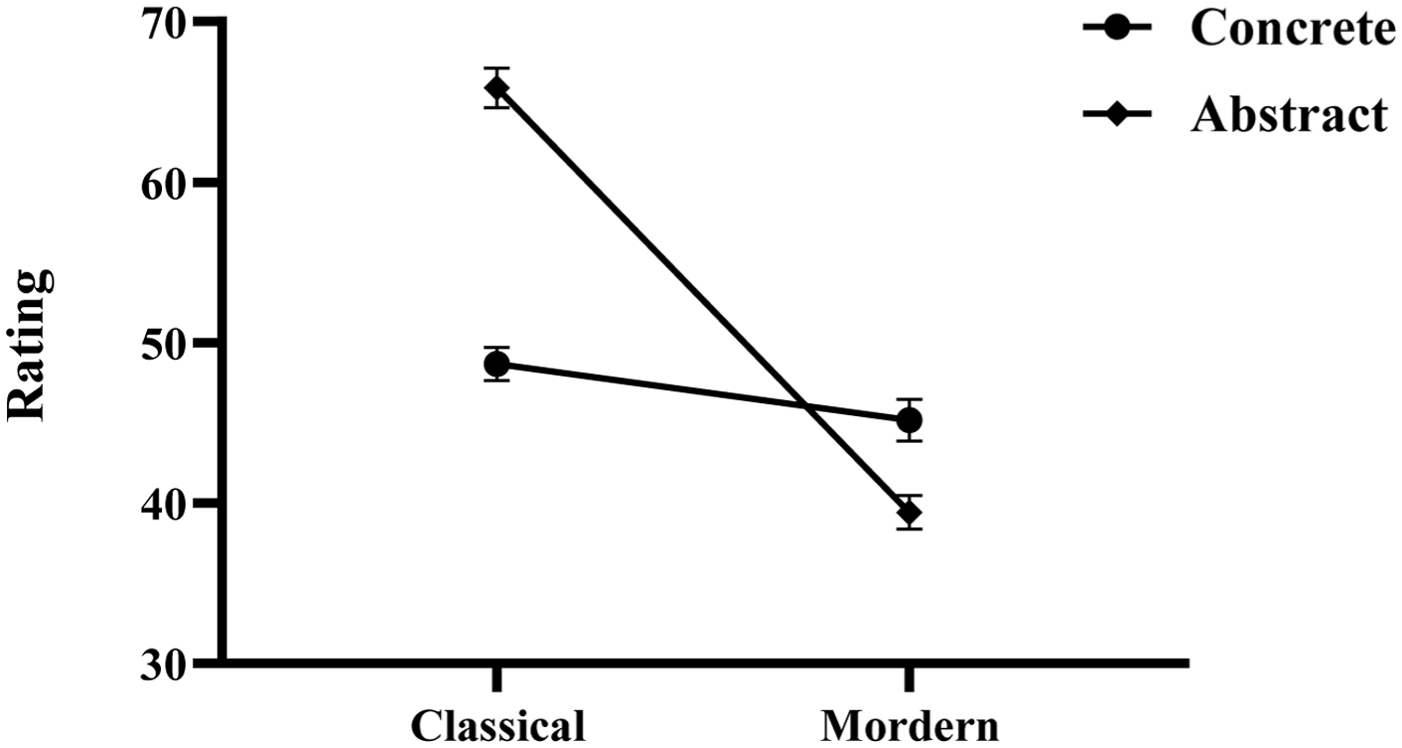
The interaction between music style and title type on the ratings of participants across different expertise groups (Error bars represent ± 1 SE).
Additionally, there was a marginal significant interaction between music type and music training, F(1, 69) = 3.98, p = .050, η2 = 0.01. This suggests potential differences in ratings between music training and no musical training, depending on whether the title was abstract or concrete. Specifically, we found that the no musical training group (M = 58.92, SE = 1.15) was more likely to assign higher suitability ratings to titles to classical music than music training group (M = 55.64, SE = 1.06), F(1, 70) = 91.24, p = .039. However, music training group (M = 43.39, SE = 1.25) was more likely to assign higher suitability ratings to titles to modern music than the no musical training group (M = 41.20, SE = 1.36), F(1, 70) = 38.72, p = .240.
The three-way interaction among music style1, title type, and music training was not significant, F(1, 69) = 5.85, p = .819, η2 < 0.01. This indicates that the combined effect of music style, title type, and participant type did not further complicate the patterns observed in the previous interactions. For song-level differences in listener ratings, see Figure 5.
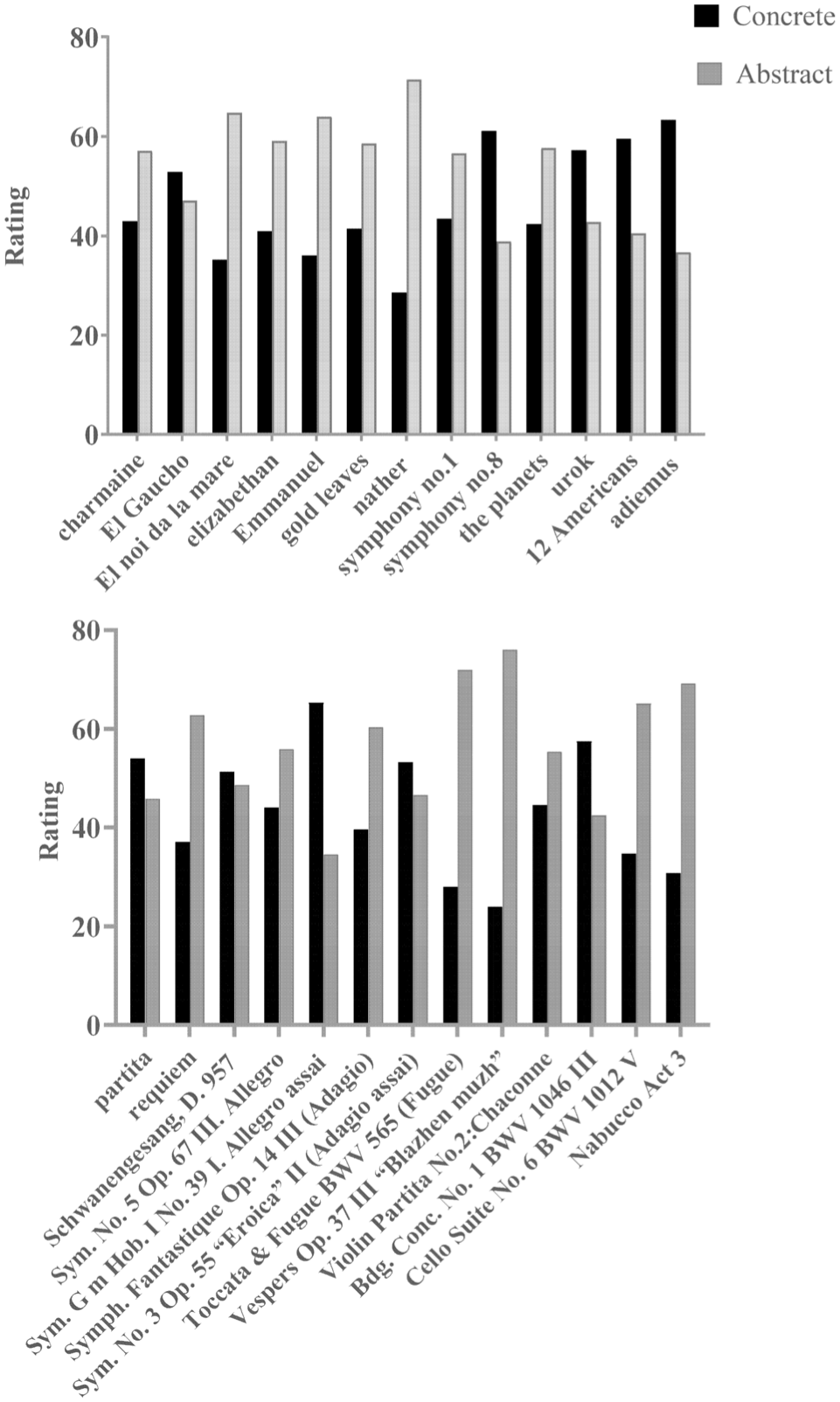
Song-level impact of title concreteness. (a) (upper panel) Mean listener ratings for concrete (black) versus abstract (gray) titles across 13 modern excerpts (M1–M13). (b) (lower panel) Mean listener ratings for concrete (black) versus abstract (gray) titles across 13 classical excerpts (C1–C13).
General Discussion
Musical titles, like their visual art counterparts, are powerful contextual/source cues that guide interpretation (Thompson et al., 2023). However, while most studies on titles have focused on visual art, auditory art has received little research attention. The extent to which music training and the presence of different types of musical materials shape the perception of abstract versus concrete titles remains unclear. In this study, we investigated the impact of music training and the inclusion of different types of musical materials on participants’ judgments of abstract and concrete titles in auditory art. Specifically, we examined how participants with varying levels of music training categorize and perceive these titles in the context of auditory stimuli. Overall, we found that both music training and the inclusion of musical materials significantly influenced participants’ assessments, with abstract titles being more likely to be assigned to distant contexts.
This conclusion was supported by two experiments exploring different dimensions of the participants’ judgments. Experiment 1 focused on the interaction between title type and music training, and Experiment 2 extended this by considering the interaction among title type, music type and music training. Taken together, these studies reveal a robust link between the perceived abstractness of the titles and their categorization in more distant or abstract contexts, regardless of participants’ prior music training when musical clips were present.
In Experiment 1, when musical titles were presented without accompanying music clips, the results revealed a clear distinction between music majors and the no musical training group. Music majors were more likely to judge concrete titles as suitable titles for music, whereas the no musical training group did not exhibit this preference for either title type. This finding contrasts with previous research by Durkin et al. (2020), which did not find significant perceptual differences between experts and non-experts when it came to abstract art. However, within the framework of CLT, the tendency of music majors to favor concrete titles can be explained by their rich music training experience and psychological proximity to music-related concepts.
These results demonstrate that contextual (source) cues shape music appreciation and that the level of musical training modulates this effect. Titles function as metadata that listeners map onto their existing schema repertoires. Because musicians possess rich domain-specific schemas, concrete wording supplies highly diagnostic information that is swiftly integrated through top-down processing. By contrast, the comparatively sparse schemas of non-musicians give the same wording little leverage, producing neutral responses to both abstract and concrete titles. Thus, when no auditory context is available, expertise simultaneously narrows psychological distance and magnifies the impact of source cues, whereas limited training leaves listeners unconvinced by either type of title.
Within the CLT framework, even without hearing any music, music majors’ extensive training familiarizes them with structural and conceptual musical elements. This familiarity allows them to interpret musical titles in a more descriptive manner. Even in the absence of actual auditory stimuli, their stronger connection to the music results in a closer psychological distance to music-related concepts, which influences them to process titles in a more tangible, descriptive way. In contrast, the no musical training group did not show a strong preference for abstract or concrete titles in Experiment 1. This suggests that without specific musical context, non-experts may find it difficult to engage deeply with the titles, leading to less bias in their judgments. For them, abstract titles may seem too distant and intangible, while concrete titles may not hold the same immediate appeal, likely due to a lack of expertise in interpreting music through descriptive labels. Their psychological distance from music, due to less exposure and training, may contribute to their neutral stance on the type of titles that should be used.
Beyond the laboratory, our findings have clear implications for music consumption and playlist design. Recent evidence shows that familiar titles can steer listener choices in search contexts (Steffens & Anglada-Tort, 2025). Accordingly, we recommend that curators calibrate titles to the listener’s expertise: when addressing highly trained audiences, such as conservatory students and classical music aficionados, use concrete, content-specific wording with added care, because these listeners are especially sensitive to subtle musical cues. For broader, non-expert audiences, comparable engagement often requires supplementary signals—descriptive tags, mood labels, or situational prompts—that translate technical information into accessible listening frames.
Admittedly, classical and modern works follow quite different naming traditions. Classical titles are packed with technical detail, like genre and number, key, opus or catalog code, sometimes even a movement’s tempo marking (e.g., Symphony No. 3 in E-flat major, Op. 55; Allegro from String Quartet No. 14), whereas modern releases gravitate toward evocative, marketing-friendly phrases such as Blinding Lights or Midnight City. It would therefore be reasonable to suspect that musicians prefer concrete labels simply because this descriptive classical lexicon is the one most familiar to them.
However, these stylistic differences do not translate into a bias toward concreteness or abstractness. We extracted 530,642 modern track names from the Million Song Dataset and 1,025 classical titles from public catalogs; 602 classical and 554 randomly selected modern titles contained only words with concreteness ratings in Brysbaert et al. (2014) and were retained. Averaging word-level scores produced a title-level concreteness index. Across the corpus, the distribution (M = 3.07, SD = 0.79) mirrored the grand mean of the norms (M = 3.03), and a one-way ANOVA comparing repertoires (modern vs. classical) confirmed no significant difference, F(1, 1,154) = 0.39, p = .530, η2 ≈ 0.0003. Thus, naming practices diverge stylistically across eras, but neither repertoire is systematically more concrete or abstract.
Experiment 2 aimed to compare the effects of auditory cues on the processing of music titles by introducing music clips alongside the presentation of titles. The introduction of music clips was essential for providing auditory cues that allowed participants to anchor their judgments in a more concrete musical context. These auditory cues included music clips from different periods, specifically classical and modern genres, which added temporal diversity to the stimuli. This variation in musical periods was intended to examine how different periods of music influence the perception and interpretation of titles. This addition shifted participants’ decision-making processes, particularly regarding the influence of music style (classical vs. modern) and music training. Both music majors and the no musical training group showed more similar judgments once the clips were introduced, indicating that the auditory context anchored evaluations to the specific piece rather than to general title–style conventions and thereby reduced psychological distance.
Experiment 2 aimed to compare the effects of auditory cues on the processing of music titles by introducing music clips alongside the presentation of titles. The inclusion of these clips served to contextualize the titles within a concrete musical framework, offering participants auditory information to ground their judgments. Specifically, the music clips were drawn from both classical and modern genres, introducing temporal and stylistic diversity into the stimuli. This variation was intended to explore how music from different historical periods influences the perception and interpretation of accompanying titles.
The addition of auditory cues notably shifted participants’ evaluative processes. Auditory anchors reduced psychological distance, aligning the two groups’ ratings. According to the Elaboration Likelihood Model (ELM; Petty & Cacioppo, 1986), listening heightened involvement, pushed participants toward central processing, and weakened the persuasive power of titles as peripheral cues. Within the CLT frame, classical music—temporally and stylistically distant—elicited abstract associations, whereas modern music, being closer, favored concrete ones. Rather than relying solely on general knowledge or abstract associations between title types and musical styles, which is something music majors might be more familiar with. However, listening to the actual music appeared to increase engagement for all participants, including those with no musical training. The presence of auditory input grounded their evaluations in the specific features of each piece, prompting participants to assess the appropriateness of titles in relation to the music itself rather than drawing on prior knowledge or stylistic expectations.
This shift in evaluative focus likely reduced psychological distance by making the task more immediate and context specific. As a result, the judgments of music majors and the no musical training groups became more aligned, suggesting that the inclusion of music helped bridge the gap between different levels of musical expertise by providing a shared perceptual basis for interpretation.
The ELM (Petty & Cacioppo, 1986) offers a useful framework for understanding this phenomenon. According to the model, the extent to which individuals are influenced by superficial cues, such as titles, depends on their level of cognitive involvement and motivation. When engagement is low, individuals are more likely to rely on peripheral cues like titles to guide their judgments. In contrast, when engagement is high, as in the case of listening to actual music, individuals are more likely to process information through the central route, focusing on the substantive content of the message. In this context, the presence of auditory stimuli likely increased participants’ involvement, which in turn diminished the relative influence of prior knowledge and led to more similar evaluative strategies across groups.
For music majors, the psychological distance between themselves and the music, as conceptualized through CLT, was a significant factor in shaping their title judgments. According to CLT, more temporally distant events are perceived as more abstract, while events that are closer in time are perceived as more concrete. Our findings align with this hypothesis: classical music, being temporally and stylistically distant, seemed to trigger more abstract processing. Both types of participants were more inclined to perceive abstract titles as more suitable for classical music. Abstract titles may align with the symbolic and thematic interpretations commonly associated with classical works. In this context, music majors are more likely to engage with classical music at a higher level of abstraction, considering the broader themes and emotions conveyed by the music rather than its specific sensory details.
On the contrary, when listening to modern music, which is closer to the present in both temporal and stylistic dimensions, both the music and no musical training group preferred concrete titles. Modern music, with its often direct and accessible nature, might prompt more literal and descriptive processing. Concrete titles reflect the immediate and tangible qualities of the music more easily, such as rhythm, tempo, and harmony. In this case, music majors may find it easier to connect to modern music using clear, descriptive labels that correspond to the sensory experience of the music.
The findings from both experiments support the relevance of CLT in the perception of musical titles. CLT suggests that psychological distance—whether temporal, spatial, social, or hypothetical—shapes how we perceive and interpret events or stimuli. In the context of auditory art, this framework can be extended to understand how participants perceive abstract versus concrete titles in relation to music style and their training.
Taken together, the results converge with classic source-effects findings and support a CLT interpretation of psychological distance. Our present study suggests that music majors, with their deeper familiarity with the historical context and conceptual depth of classical music, tend to engage with the latter more abstractly. On the contrary, the no musical training group, who may rely more on intuitive, everyday processing of music, favor concrete titles for classical pieces, but are more willing to use abstract titles for modern music, which they perceive as closer and more personally relatable. This interplay between expertise, music style, and psychological distance underscores the complex relationship between music training and contextual cues in shaping judgments about music titles. The findings highlight the potential of CLT as a framework for understanding how temporal and stylistic factors influence cognitive processes in music perception and categorization. Future research could further explore how these processes unfold at the neural level, examining how expertise and psychological distance interact during the perception of auditory art.
Beyond laboratory ratings, title design has tangible commercial consequences. Streaming service log data indicate that recognizable or image-evoking titles attract more clicks when listeners browse playlists (Steffens & Anglada-Tort, 2025). Our findings suggest that modern tracks may benefit from concrete, sensory titles, whereas classical releases could leverage abstract or evocative wording that resonates with listeners’ expectation of temporal distance. Recommender systems could thus optimize title presentation dynamically, tailoring concreteness to user expertise and genre.
While this study provides valuable insights into the influence of music training and auditory cues on the perception of music titles, there are several limitations that should be addressed in future research. Firstly, the categorization of musical experience and training was not sufficiently detailed. Participants were broadly classified as music majors and no musical training, but within these groups, there may be varying degrees of musical expertise and exposure that were not accounted for. Future studies should employ a more nuanced classification system to capture the diversity of music training and experience, allowing for a more precise analysis of its effects on title perception.
Secondly, the neural mechanisms underlying the perception induced by abstract versus concrete titles remain unclear. While this study demonstrates behavioral differences in how titles are processed, it does not elucidate the underlying cognitive and neural processes. Future research should incorporate neuroimaging techniques, such as functional magnetic resonance imaging (fMRI) or magnetoencephalography (MEG), to investigate the brain regions and neural pathways involved in the perception and interpretation of music titles. Understanding these mechanisms would provide a deeper understanding of how expertise and contextual auditory cues interact to shape cognitive responses to music titles.
Additionally, future studies could explore the role of other forms of psychological distance, such as spatial or social distance, in the perception of music titles. Expanding the scope of CLT to include these dimensions could offer a more comprehensive framework for understanding the multifaceted nature of music perception. By addressing these limitations, future research can build on the findings of this study to further elucidate the complex interplay between music training, auditory cues, and the perception of music titles, ultimately enhancing our understanding of auditory art perception.
Moreover, the ecological validity of the rating task used in Experiment 2 is limited. The structured evaluation of music-title pairings in a controlled laboratory setting may not accurately reflect how individuals engage with music and interpret titles in everyday listening situations. Future research should consider adopting more naturalistic and immersive methodologies, such as real-world listening scenarios or longitudinal approaches, to better capture the complexity and authenticity of music perception as it unfolds outside the laboratory.
Finally, although our “classical” and “modern” excerpts were categorized primarily by date of composition or arrangement, we acknowledge that musical style can transcend historical period. Future research could benefit from including recently composed works that emulate classical styles to disentangle the effects of perceived temporal distance from stylistic cues.
Footnotes

Ethical Considerations
This study was approved by the Ethics Review Board of South China Normal University (SCNU-PSY-2024-096) on October 18, 2024. Participants were given information sheets and required to provide written informed consent before participating.
Funding
The authors disclosed receipt of the following financial support for the research, authorship, and/or publication of this article: This research was supported by the Guangdong Planning Project of Philosophy and Social Science (grant number GD23XXL14). This study was also supported by the Striving for the First-Class, Improving Weak Links and Highlighting Features (SIH) Key Discipline for Psychology in South China Normal University.
Declaration of Conflicting Interests
The authors declared no potential conflicts of interest with respect to the research, authorship, and/or publication of this article.
Data Availability Statement
The datasets presented in this article are not readily available because they are restricted to the author team in accordance with the Ethics Review Board of South China Normal University. Requests to access the datasets should be directed to the corresponding author.