






Abstract
Music artists play a crucial role in shaping both regional and global sonic trends. While technological and cultural shifts are often credited with driving musical change, less is known about how an artist’s age influences stylistic evolution. Here, we examine how acousticness, that is, the extent to which a track features acoustic instrumentation, varies across an artist’s career. Using data from Spotify’s API, we analyse 45,478 tracks from 190 artists with a Generalised Additive Mixed Model (GAMM) to assess the relationship between acousticness and artist age, controlling for release year and genre. Results reveal a consistent positive association between artist age and acousticness, with artists tending to produce more acoustic music as they age, irrespective of their genre. However, the release year shows a strong negative effect, with newer music increasingly characterised by fewer acoustic features, likely reflecting broader industry trends such as digital production and evolving listener preferences. Our findings suggest a dynamic interplay between individual artistic development and external cultural forces, where ageing artists gravitate towards more organic sounds, even as popular music trends continue to favour synthetic production.
Music is a fundamentally temporal and cultural phenomenon, subject to the shifting tides of individual development and societal trends. Among the many factors that shape the creation and reception of musical works, the role of the artist’s age remains surprisingly underexplored. Although there exists a growing body of literature on age-related changes in musical preferences (Bonneville-Roussy et al., 2013; North & Hargreaves, 2007) and performance capabilities (Gembris, 2006), relatively little is known about how an artist’s age impacts the structural and acoustic characteristics of their recorded output. In the era of large-scale, metadata-rich music databases, such as those provided by Spotify and the Million Song Dataset (Bertin-Mahieux et al., 2011), it is now feasible to examine these questions with empirical precision.
Age, both as a biological and social construct, is intricately linked to changes in cognitive function (Salthouse, 2004), emotional regulation (Carstensen et al., 2003), and aesthetic sensibilities (Kamenetsky et al., 2016). These developmental changes may, in turn, influence how music is composed, performed, and produced across the lifespan. Anecdotal and historical accounts suggest that many artists undergo a recognisable transformation in musical style as they age, often shifting from high-energy, genre-defining early works to more introspective, acoustic, or minimalistic forms in later life (Wilson, 2006; Zwaan et al., 2009). While such qualitative observations abound in biographical literature, quantitative studies examining specific audio features as a function of artist age remain sparse.
A notable precedent in this line of inquiry is the work of Interiano and colleagues (2018), who demonstrated systematic changes in tempo, loudness, and valence across decades of popular music. Similarly, Serra and colleagues (2012) provided evidence for a homogenisation of musical features over time, but did not examine age-related effects at the level of individual artists. Instead, prior research has tended to aggregate data across songs and years without accounting for the artist’s developmental trajectory. This limitation precludes insights into how age-specific factors may shape the acoustic design of a song.
In related work, Krause and North (2017) examined the lyrical content of popular songs across artists’ careers, finding that maturity was associated with more complex and emotionally nuanced language. From a production standpoint, advances in recording technology and changing audience preferences have been posited as additional factors driving shifts in musical texture and instrumentation (Tzanetakis & Cook, 2002). More recently, in a study of a large corpus of popular recordings, Luck and Ansani (2026) found evidence of a downwards trend in song tempo as a function of artist age. Yet, the interaction between individual ageing and specific acoustic properties such as timbre, dynamic range, or instrumentation has not been directly tested.
One promising avenue for examining such change is via an audio feature known as acousticness, a computational measure that reflects the degree to which a track is perceived as acoustic in nature. As operationalised in the Spotify API, acousticness ranges from 0 (non-acoustic) to 1 (highly acoustic) and is derived from spectral and temporal cues indicative of acoustic instrumentation (Spotify for Developers, 2024). This measure offers a valuable proxy for exploring artist-level shifts in production choices, especially as they relate to the use of electronic versus traditional instruments.
Preliminary analyses suggest that certain artists, most notably those in the singer-songwriter or folk traditions, might begin their careers with lower acousticness values and gravitate towards more acoustic sounds with age (Serra et al., 2012). However, other genres might demonstrate the opposite trend, or no clear trajectory at all. For instance, pop artists operating in heavily synthesised genres might continue to rely on digital instrumentation regardless of age, thereby maintaining consistently low acousticness scores.
Theoretical support for age-related increases in acousticness comes from socioemotional selectivity theory, which posits that ageing individuals place greater value on emotionally meaningful experiences and interpersonal connections (Carstensen et al., 1999). In the musical domain, acoustic instrumentation is often perceived as more intimate, raw, and emotionally expressive (Juslin & Västfjäll, 2008), which might explain an artist’s inclination towards acoustic textures later in life. Furthermore, age-related decline in auditory acuity and sensitivity to high-frequency sounds (Humes et al., 2012) might render complex or high-energy mixes less appealing for both the artist and their ageing fan base, reinforcing the preference for simpler, acoustic arrangements.
From a pragmatic standpoint, acoustic performances might also be more feasible for older artists who face physical limitations in staging high-energy productions or engaging in extensive touring schedules. The phenomenon of the “unplugged” performance, exemplified by MTV’s unplugged series, has frequently featured older artists seeking to re-interpret their earlier work in a stripped-down, acoustic format (Kotarba, 2005). These reinterpretations are not merely stylistic; they often signify a deeper artistic reflection and recalibration, potentially signalling a general shift in musical values that accompanies ageing.
Taken together, these observations motivate a more systematic inquiry into the relationship between artist age and acousticness in recorded music. By examining a large corpus of artist discographies annotated with both age and audio feature data, we contribute to a growing literature on the life-course dynamics of musical creativity. Our findings have implications not only for music psychology and developmental science but also for understanding broader patterns of cultural production and consumption across the lifespan.
In this study, we test three hypotheses:
Method
Sample
To construct a representative data set reflecting the global music industry, the initial sample of songs was drawn from the 20 largest national music markets by revenue (Boman, 2021). India was excluded due to limited representation in Spotify’s catalogue, while Switzerland was added to ensure comprehensive coverage of the central European market, particularly Austria and Germany. To reduce the Western-centric bias, two additional categories were included: one representing African markets and another for Arab countries. Furthermore, a separate category (“various artists”) was created to include performers with extensive careers not captured by the regional markets.
The final data set encompassed 22 market categories: the United States, Canada, Japan, Germany, the United Kingdom, France, South Korea, Australia, Brazil, China, the Netherlands, Italy, Spain, Sweden, Norway, Denmark, Switzerland, Mexico, Argentina, Africa, Arab countries, and Various artists. Within each market, best-selling albums and their performers were identified via publicly available resources on Wikipedia. To qualify for inclusion, artists were required to have a career span of at least 20 years and to have recordings available on Spotify. Both studio and live recordings were included.
Ten artists per market were selected using the following prioritised sources:
Wikipedia lists of best-selling artists by market.
Wikipedia lists of best-selling albums and associated performers.
General overview pages of regional music scenes.
Other supplementary sources identifying regionally relevant artists.
Playlists were manually curated for each selected artist based on the discography presented in Wikipedia. Compilation albums, re-releases, and remastered tracks were excluded to minimise redundancy. Live recordings were retained as they are likely to reflect the artist’s aesthetic preferences at the time of performance. Only tracks with durations between 1 and 10 min were included, thereby excluding extreme outliers and focusing on conventional song lengths in popular music.
This selection process yielded a final sample comprising 45,478 tracks from 190 artists.
Measures
Acousticness
The primary response variable was acousticness, drawn from Spotify’s audio features data set via the Spotify for Developers API (Spotify for Developers, 2024). Acousticness is a continuous and bounded variable ranging from 0 to 1, indicating the algorithmic confidence that a track is acoustic. Higher values denote a greater likelihood of a track being predominantly acoustic in nature. While acousticness has been used in broader feature-based studies of genre and music preferences (Barone et al., 2017; Duman et al., 2022), it has not previously been examined as a function of artist age. A representation of the acousticness distribution of the 25 most prolific artists in our data set can be found in Figure S2 of the Supplemental Materials.
Predictors of Acousticness
The focal predictor was the artist’s age at the time of each track’s release, enabling direct examination of Hypothesis 1 (increased acousticness with age). Birth years for solo artists were sourced manually. For bands, the birth year of the principal or lead member was used. The process of determining the lead member consisted of two phases: in the first phase, we asked ChatGPT-4o, a generative AI tool developed by OpenAI (2024), by providing it with the list of the involved artists. In the second phase, we manually checked a random sample of ≈ 85% of the artists through Wikipedia and other trusted sources. In all cases, ChatGPT’s results were confirmed by our manual check. The artist’s age at the time of recording was calculated by subtracting the release year of each song from the artist’s year of birth. Tracks with missing or ambiguous birth year data were excluded.
To account for historical and technological shifts in music production, which would be potential confounds for age-related effects on acousticness, release year was included as a covariate in all models (consistent with Luck & Ansani, 2026). Temporal effects are particularly relevant to Hypothesis 2, which posits that age effects remain robust despite such industry-wide trends.
Because musical style and production practices vary significantly across genres (Mauch et al., 2015), genre was also included as a covariate. Prior work has shown that acousticness is among the most predictive features in distinguishing genre categories (Barone et al., 2017). Genre was assumed to be stable over an artist’s career.
To categorise genre while avoiding the granularity and inconsistency of Spotify’s 1000+ genre tags, the STOMP classification (Rentfrow et al., 2011) was employed. This five-factor taxonomy reflects psychological and sociocultural dimensions of music preference:
Mellow: electronica/dance, new age, world.
Unpretentious: pop, country, religious.
Sophisticated: blues, jazz, bluegrass, folk, classical, gospel, opera.
Intense: rock, punk, alternative, heavy metal.
Contemporary: rap, soul, R&B, funk, reggae.
Due to the concentration of tracks in specific sub-genres within the “sophisticated” category, Jazz and Folk were treated as discrete genre classes in the final model. The inclusion of the age-by-genre effect enabled direct testing of Hypothesis 3, which anticipates differential age effects across genres.
Statistical Modelling and Model Selection
Consistent with Luck and Ansani (2026), a Generalised Additive Mixed Model (GAMM) (Wood, 2017) was employed to capture potentially non-linear relationships between acousticness and the predictors. The model used penalised likelihood estimation to balance flexibility and generalisability, and was fit using the glmmTMB package in R (Brooks et al., 2017), which supports non-Gaussian distributions and mixed effects structures.
Given the bounded nature and skewed distribution of the acousticness variable, a beta regression framework with a logit link function was adopted. This approach ensures predictions remain within the valid [0, 1] interval and allows for flexible estimation of marginal effects.
Random intercepts for artists and random slopes for the age term were specified for artists to account for within-artist variability, as exploratory analysis revealed substantial heterogeneity (Figure 1). The necessity for smooth functions was evaluated by comparing models with and without spline terms on the time-based covariates. Similarly, other competing models were built and compared to inspect the necessity for the random slope for the age term and the age-by-genre interaction effect (as per Hypothesis 3). Model selection was guided by the Bayesian Information Criterion (BIC), which penalises complexity while favouring goodness-of-fit (Ding et al., 2018; Gareth et al., 2013). Model comparison and visual inspection of marginal predictions (Figure 2) indicated that the effect of release year was non-linear and thus was modelled using a smooth term. In contrast, the relationship between age and acousticness was approximately linear and, therefore, included as a linear term.
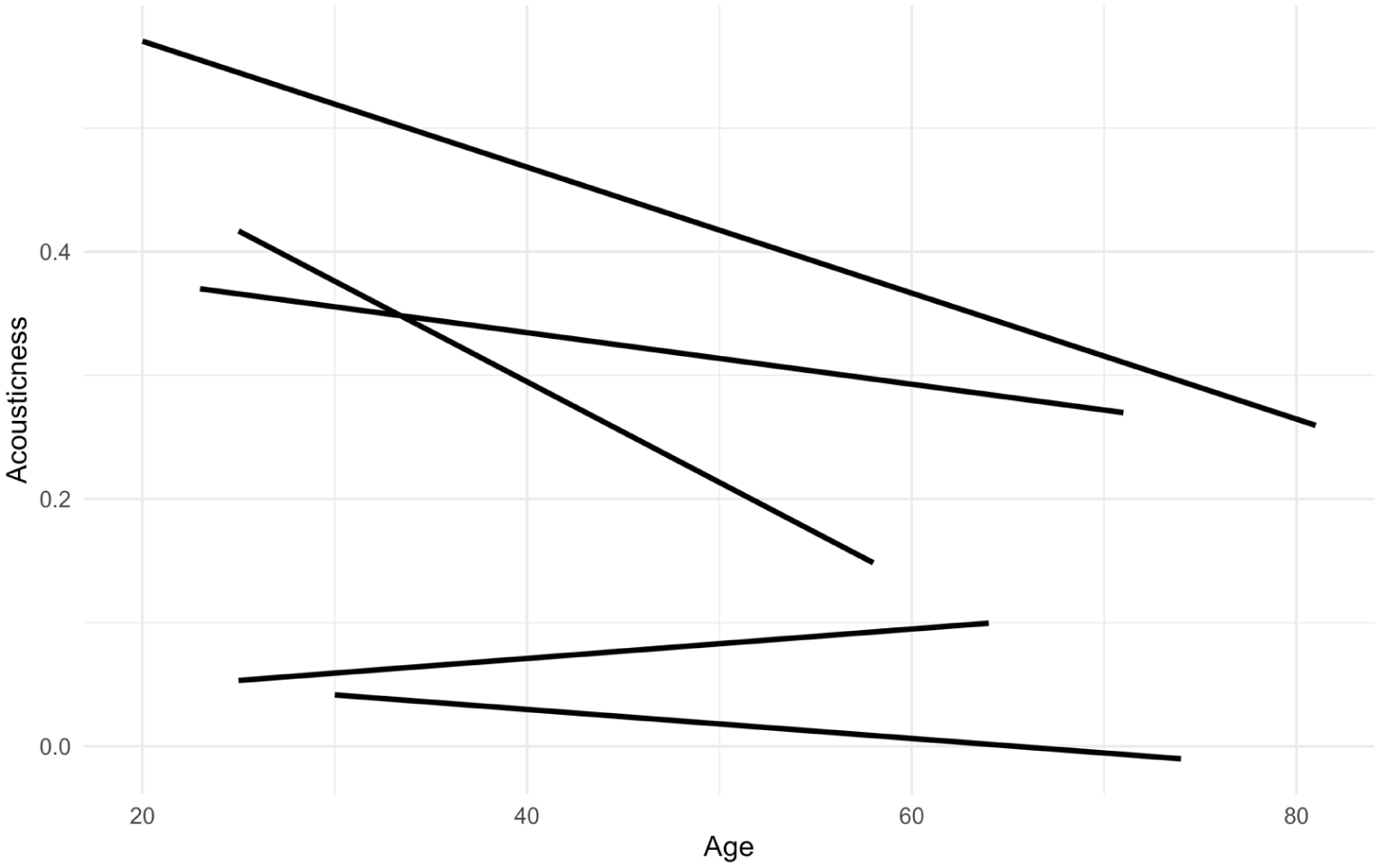
Linear trends of acousticness during the careers of five randomly selected artists from the data set.
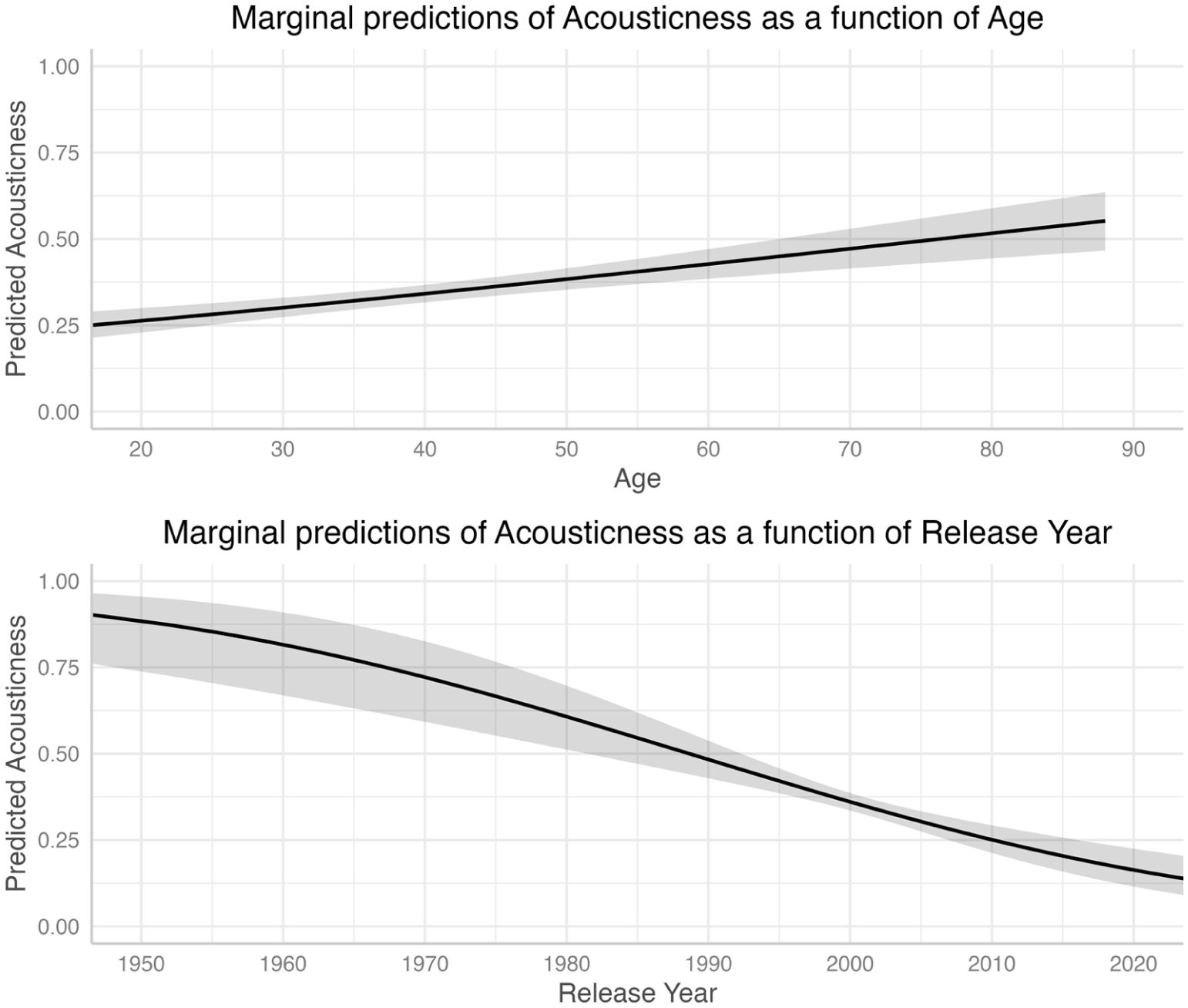
Marginal predictions of acousticness as a function of age (upper) and release year (lower).
Model diagnostics were conducted using the DHARMa package (Hartig, 2024). Simulated residuals were checked against expected distributions using QQ-plots and residual-versus-predicted value plots, all of which supported the model’s assumptions. Random effects were confirmed to approximate normality (see Model Diagnostics in the Supplementary Materials, Figure S3).
Interpretation and Inference
Model parameter estimates, 95% confidence intervals, and p-values were computed for all coefficients. Genre estimates were interpreted relative to the “Unpretentious” category. To facilitate interpretation of the log-odds coefficients from the beta regression, these were exponentiated to yield odds ratios (ORs). For continuous predictors such as age and release year, the OR indicates the multiplicative change in the odds of the outcome being closer to 1 (higher acousticness) rather than to 0, for each one-unit increase in the predictor. OR values above 1 indicate a positive association, while those below 1 indicate a negative association. Confidence intervals that included 1 were considered non-significant.
Finally, model-derived marginal effects on the response scale were used to visualise and interpret the overall trajectory of acousticness across the artist’s lifespan, providing direct insight into Hypotheses 1–3.
Results
The best-performing model in the model comparison (Table 1) included the following predictors: artist age (linear term), release year (smooth term), and genre (categorical factor with six levels).
Model Comparison Results.
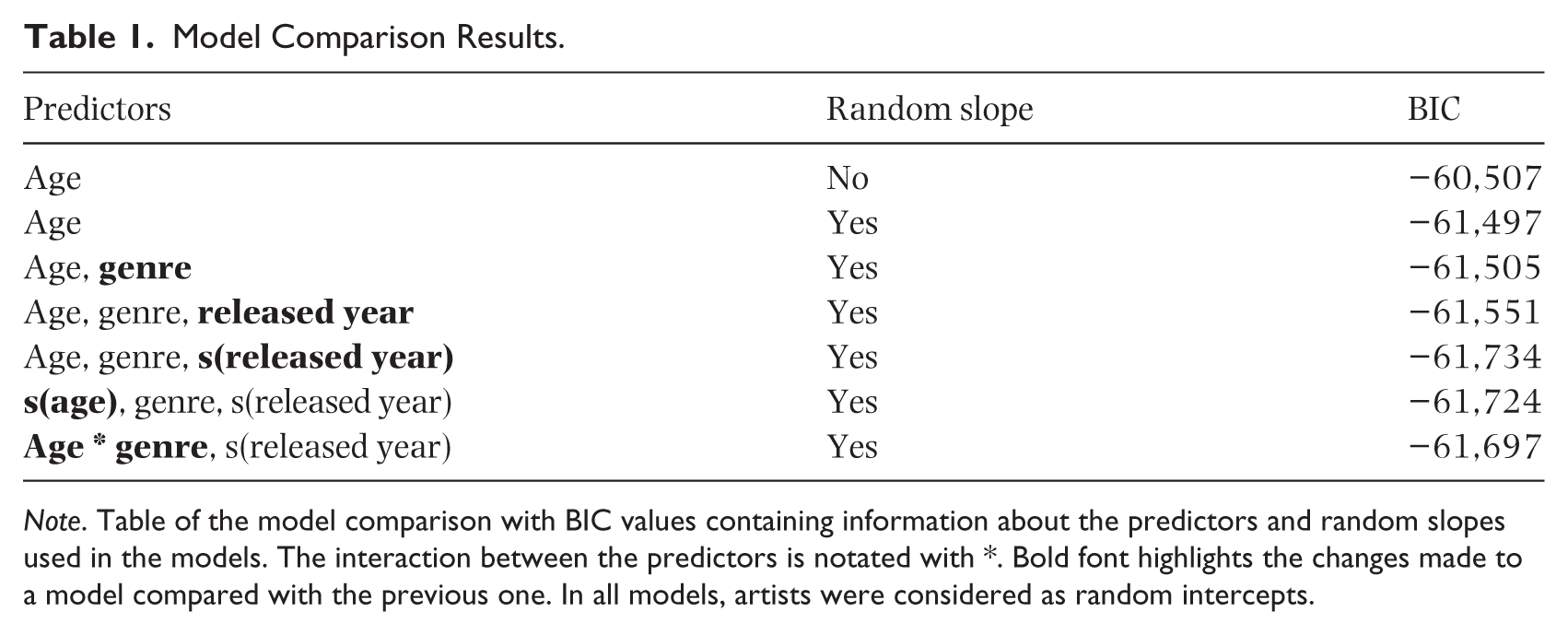
Note. Table of the model comparison with BIC values containing information about the predictors and random slopes used in the models. The interaction between the predictors is notated with *. Bold font highlights the changes made to a model compared with the previous one. In all models, artists were considered as random intercepts.
The potential interaction between artist age and genre (as per Hypothesis 3) was also evaluated beyond model comparison. However, the interaction did not reach statistical significance (p = .545) and was not included in the final model.
Both time-related predictors, artist age and release year, were found to significantly influence the acousticness of songs. In line with Hypothesis 1, artist ageing was associated with a modest but statistically significant increase in acousticness (OR = 1.02, 95% confidence interval (CI) = [1.01, 1.03], p < .001). This estimate is related to the unpretentious genre (i.e., the model’s reference genre). To have a more general estimate net of the effect of genre, we computed the marginalised slope of age at the decade level, which resulted in b10-year = 0.04, 95% CI = [0.02, 0.05]. This suggests that, net of the effect of the release year, artists tend to incorporate more acoustic elements into their music as they grow older, and, in greater detail, that the levels of acousticness exhibit a 4-point increase for every decade (out of a hundred). Conversely, the release year exhibited a significant non-linear association with acousticness (OR = 0.43, 95% CI = [0.32, 0.59], p < .001 from 1960 to 2020), consistent with Hypothesis 2. This suggests a pronounced temporal decline in acousticness across the music industry, likely reflecting broader shifts in production aesthetics and listener preferences over time.
Genre also emerged as a significant covariate of acousticness. Specifically, folk music showed a markedly higher level of acousticness relative to the reference genre, unpretentious (OR = 5.92, 95% CI = [2.44, 14.35], p < .001), while intense music (e.g., rock, punk and metal) was associated with substantially lower acousticness (OR = 0.30, 95% CI = [0.23, 0.38], p < .001). Other genre categories – jazz, mellow, and contemporary – did not differ significantly from unpretentious in their acousticness levels. It is worth mentioning that these comparisons are made while controlling for the effects of age and release year; as such, we encourage the readers not to interpret these as total effects of genre on acousticness. Doing so would result in the so-called Table 2 Fallacy (Westreich & Greenland, 2013). A more detailed analysis of the relationship between genres and acousticness is provided in Figure S1 and Table S1 of the Supplemental Materials).
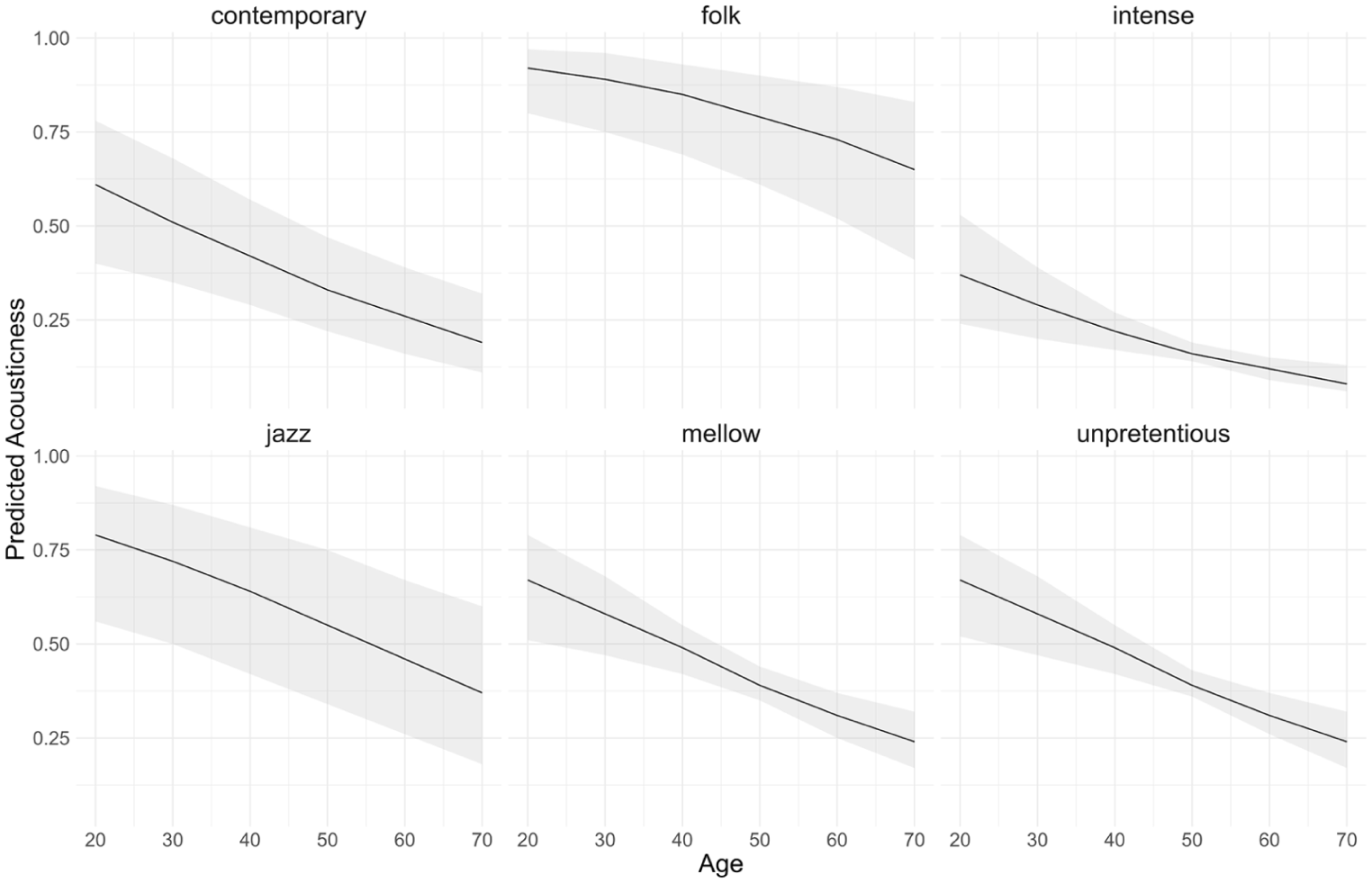
Figure 3 illustrates predicted acousticness values across artist age, revealing a consistent upward trajectory within each genre. This indicates that, irrespective of genre, as artists age, they tend to produce more acoustically rich music than they did when they were younger. However, when controlling for both age and release year (Figure 4), it becomes evident that the effect of ageing is partially offset by the temporal decline in acousticness across decades.
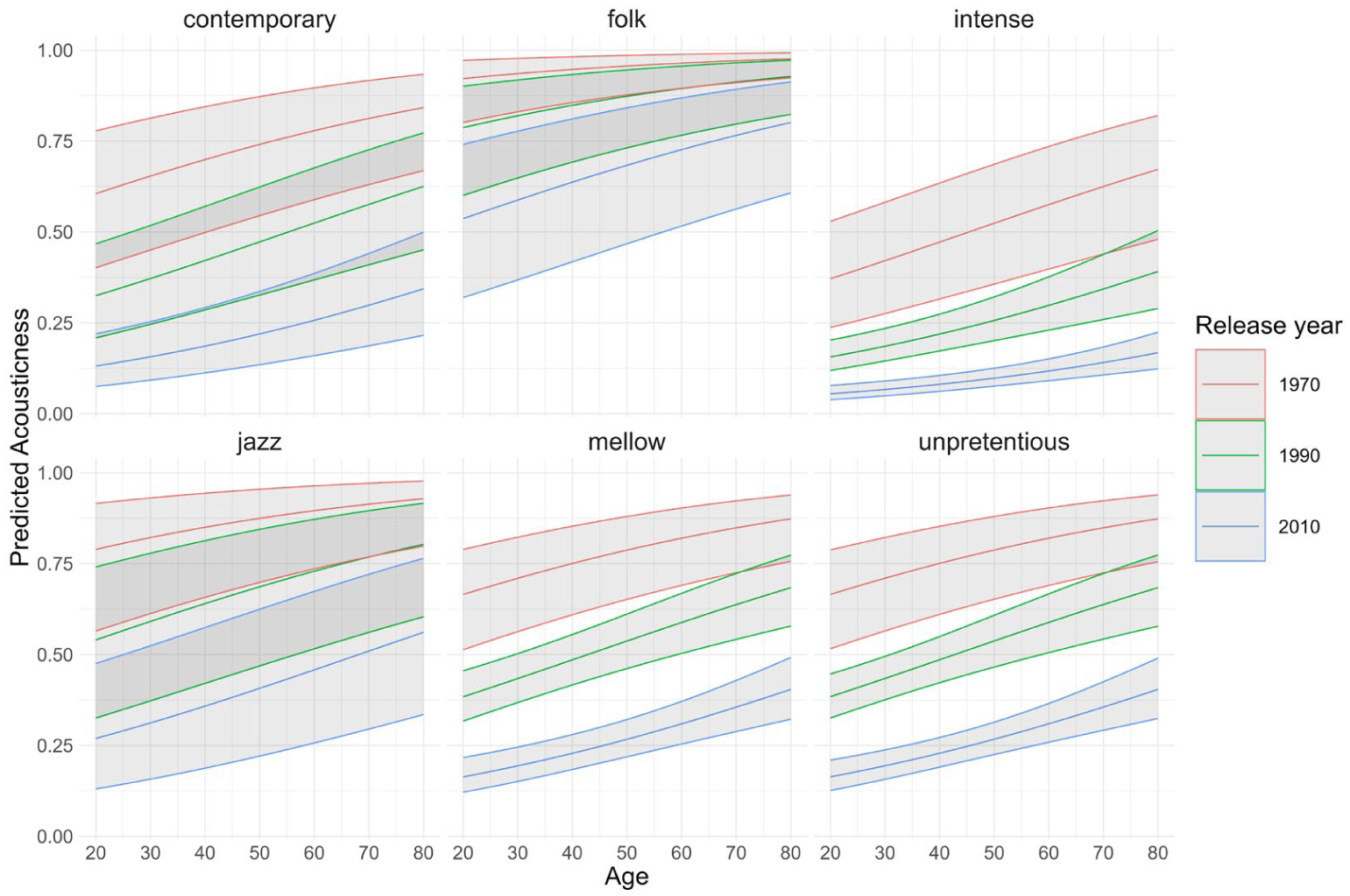
Predicted acousticness as a function of artists’ age, genre, and three release year points.
Predicted acousticness over the lifespan of an artist born in 1950.
For instance, among artists classified within the unpretentious genre, the model predicts that a 20-year-old artist releasing music in 1970 would produce songs with an average acousticness of 0.67 (95% CI = [0.52, 0.79]). By contrast, the same artist at age 40 in 1990 would have an average acousticness of 0.49 (95% CI = [0.42, 0.55]), declining further to 0.31 (95% CI = [0.26, 0.37]) by age 60 in 2010. This equates to a 27% decrease from age 20 to 40, and a further 37% decrease by age 60, amounting to a cumulative 54% reduction over four decades.
Folk music displayed the highest overall acousticness values across all time points, and changes over time were comparatively attenuated. For folk artists aged 20, 40, and 60 in the years 1970, 1990, and 2010, respectively, the predicted acousticness values were 0.92 (95% CI = [0.55, 0.80]), 0.85 (95% CI = [0.69, 0.93]), and 0.73 (95% CI = [0.52, 0.87]), reflecting a total decrease of just 21% across four decades.
By contrast, intense music exhibited the lowest baseline acousticness and the steepest decline with age and time. A 20-year-old artist producing music in 1970 in this genre would be expected to have an acousticness score of 0.37 (95% CI = [0.24, 0.53]), dropping to 0.22 (95% CI = [0.17, 0.27]) by age 40 in 1990, and further to 0.12 (95% CI = [0.09, 0.15]) by age 60 in 2010. This corresponds to a 41% drop in the first 20 years and a 45% drop in the next 20 years, a cumulative 68% decline, making intense the genre most sensitive to time-based changes.
The genres mellow, contemporary, and jazz showed patterns that broadly paralleled unpretentious, with jazz slightly exceeding and contemporary slightly underperforming relative to the reference genre in terms of acousticness, although these differences did not reach statistical significance.
Collectively, these results confirm that both artist ageing and broader temporal trends significantly influence the acoustic characteristics of popular music, with the strength and direction of these effects varying across genres, which may reflect genre-specific characteristics or structural patterns in the data, even in the absence of a statistically significant age-by-genre interaction.
Discussion
We examined how the acousticness of recorded songs changes over the course of an artist’s career, testing three key hypotheses: first, that acousticness increases as artists age; second, that songs have become less acoustic over time due to broader industry- and culture-related trends; and third, that the relationship between age and acousticness is moderated by musical genre. Our results provided support for the first two hypotheses, demonstrating the value of combining artist-level temporal data with large-scale audio feature analysis to reveal life span dynamics in music production.
Consistent with Hypothesis 1, we observed a statistically significant, linear increase in acousticness as a function of artist age. This pattern held across multiple genres and decades, suggesting a general tendency for musicians to favour more acoustic soundscapes later in their careers. While previous research has examined changes in musical tempo (Luck & Ansani, 2026), lyrical complexity, or emotional tone across the career trajectory of artists (Krause & North, 2017), the present findings represent some of the first empirical evidence linking age-related stylistic change to measurable acoustic characteristics in recorded music.
This shift could reflect a number of psychological and sociocultural processes. Ageing is associated with greater emotional regulation and a shift in motivational priorities towards meaning and authenticity (Carstensen et al., 1999; Charles & Carstensen, 2010). These shifts could plausibly drive older artists to adopt production choices that convey intimacy or rawness, features typically associated with acoustic instrumentation (Juslin & Västfjäll, 2008). Moreover, anecdotal accounts frequently describe a return to one’s “roots” or “stripped-back” aesthetics among older artists, often framed as an expression of artistic maturity (Bennett, 2006; Shuker, 2016). Our findings provide quantitative support for these qualitative observations.
At the same time, and in support of Hypothesis 2, we identified a strong negative relationship between release year and acousticness, such that newer songs tend to exhibit lower acousticness scores than older ones. This aligns with broader accounts of the music industry’s stylistic evolution. The increasing integration of digital technologies in music production since the 1980s has enabled, and perhaps incentivised, the use of electronic over acoustic instrumentation (Théberge, 1997; Warner, 2003). In a similar vein, Interiano et al. (2018) report that contemporary popular music has become louder and more rhythmically homogenous over time, and our findings extend this work by demonstrating a clear decline in acoustic instrumentation.
Together, these dual findings illustrate a tension between individual artistic development and broader industry trends. While ageing encourages a shift towards more acoustic soundscapes, prevailing industry practices and audience expectations pull in the opposite direction. This could create an aesthetic dilemma for older artists, especially those seeking to remain commercially viable within a sonically evolving market.
Despite the lack of a significant age-by-genre interaction, some support for Hypothesis 3 might come from the inspection of the marginal predictions (Figure 4). Folk music, which has traditionally prioritised acoustic instrumentation, displayed both the highest overall acousticness values and the slowest rate of decline across time and age. This genre’s relative insulation from broader industrial trends is consistent with previous findings that folk, classical, and jazz genres are more resistant to the structural homogenisation seen in mainstream pop (Serra et al., 2012). Conversely, intense genres (e.g., rock, punk, and metal) showed the steepest declines in acousticness over time, indicating greater susceptibility to the digitisation and electrification of production.
Although jazz, mellow, and contemporary genres did not differ significantly from the baseline unpretentious category in our statistical model, descriptive trends suggest subtle genre-specific dynamics. These might be obscured by Spotify’s genre labelling, which tends to be broad and sometimes inconsistent. Future work could benefit from more granular classification schemes or artist-level genre reassignment across time.
From a modelling perspective, the decision to use artist age and release year rather than birth year or other time-related variables was both theoretically and statistically justified. Age captures the internal developmental arc of an artist, while release year reflects external cultural and industry forces. Although birth year and release year contain similar temporal information, age offers a more interpretable measure of artistic maturation, which was central to our hypotheses. Although birth year could also serve as a temporal covariate, it conflates age with cohort effects, which might be better explored in a complementary generational analysis.
Several limitations of this study merit discussion. First, we relied on Spotify’s acousticness metric, which, though widely used, is derived from proprietary algorithms, the exact parameters of which remain undisclosed. Acousticness represents a confidence score between 0 and 1, estimating whether a track is primarily acoustic (Spotify for Developers, 2024). While this metric is useful for large-scale comparative analysis, its probabilistic nature means it cannot be interpreted as a definitive measure of instrumentality. Nevertheless, its validity is supported by prior studies using Spotify’s audio features to predict genre and listener preferences (Barone et al., 2017; Duman et al., 2022).
Second, genre assignment introduced a degree of ambiguity. Artists’ output frequently crosses genres, and genre boundaries can shift over time (Lena & Peterson, 2008). Our decision to assign each artist a single genre, and one presumed stable across their career, was a necessary simplification that might nonetheless obscure intra-artist stylistic evolution. Future studies might adopt track- or album-level genre labels, or explore genre fluidity as a dynamic outcome.
Third, we used the age of the lead artist as a proxy for creative influence within a band. While pragmatic, this approach overlooks the role of external songwriters, producers, and collaborative dynamics, which are particularly prevalent in pop and hip-hop genres (Watson, 2014). A more precise method could involve linking individual songs to their primary composers and producers, although this would require extensive metadata beyond what is readily accessible.
In addition, cultural and geographic factors were not directly modelled. As musical traditions and production norms vary significantly across regions, the absence of geographic information limits our ability to assess the influence of local cultural contexts. Given the globalisation of music markets and the increasing presence of non-Western music in streaming platforms, future research could benefit from stratifying analyses by cultural or national origin (Baker & Istvandity, 2016).
We might also propose several fruitful directions for future research. First, acousticness is only one dimension of musical structure. Future work might examine how other audio features, such as energy, valence, or mode, evolve over an artist’s lifespan, and whether they co-vary with acousticness in predictable ways. Second, longitudinal studies of individual artists would allow for a finer-grained analysis of stylistic evolution, complementing the population-level trends reported here. Third, listener reception data, such as streaming behaviour, playlist inclusion, or concert attendance, could be leveraged to assess how changes in acousticness affect commercial performance and audience engagement.
Finally, our results invite philosophical questions about authenticity, ageing, and artistic identity. To what extent do artists conform to or resist the aesthetic imperatives of their cultural moment? How does the acoustic turn later in life relate to broader life span theories of creativity, emotional regulation, and self-concept (Carstensen et al., 1999; Simonton, 1990)? Exploring these questions through interdisciplinary frameworks could yield a deeper understanding of the life course of artistic expression.
In conclusion, this study provides compelling evidence that acousticness increases as artists age, even as music in general becomes less acoustic over time. These trends are further shaped by genre conventions, revealing the layered influences of individual development and cultural change. By quantifying how sound evolves across the life span of artists, our research contributes to a growing literature at the intersection of music psychology, cultural analytics, and developmental science.
Supplemental Material
sj-pdf-1-pom-10.1177_03057356261451421 – Supplemental material for Age Against the Machine: How Artist Maturation Counters the Decline of Acousticness in Popular Music
Supplemental material, sj-pdf-1-pom-10.1177_03057356261451421 for Age Against the Machine: How Artist Maturation Counters the Decline of Acousticness in Popular Music by Juho Leppänen, Alessandro Ansani, Santeri Salmirinne, Sara-Alexandra Uusitalo and Geoff Luck in Psychology of Music
Footnotes

Funding
The authors disclosed receipt of the following financial support for the research, authorship, and publication of this article: This work was supported by the Research Council of Finland (Grant Nos. 346210, 356841, 368151).
Declaration of Conflicting Interests
The authors declared no potential conflicts of interest with respect to the research, authorship, and/or publication of this article.
Data Availability Statement
Supplemental Material
Supplemental material for this article is available online.
References
Supplementary Material
Please find the following supplemental material available below.
For Open Access articles published under a Creative Commons License, all supplemental material carries the same license as the article it is associated with.
For non-Open Access articles published, all supplemental material carries a non-exclusive license, and permission requests for re-use of supplemental material or any part of supplemental material shall be sent directly to the copyright owner as specified in the copyright notice associated with the article.
