







Abstract
While the growth of family business (FB) research is undisputable, knowledge gaps have been recognized, notably, regarding the lack of a strategic management theory, and a predominance of quantitative over qualitative methods when researchers examine FBs. This study seeks to address these research gaps. First, the study proposes a framework based on the knowledge-based view framework and the dynamic capabilities approach to examine adaptation to adversity and to a changing business environment through the case of Hawkshead Relish Company, a family firm operating in the United Kingdom. Second, it employs a qualitative approach. Face-to-face interviews, on-site observations and archival information of the firm helped reveal the association between dynamic capabilities, knowledge acquisition, networking and innovation. Sensing, seizing and transforming were manifested within and through the organization’s strategy and practice. Overall, the framework emphasizes how the above associations are applicable to family firms when adapting to adversity and change.
Introduction
The academic literature provides numerous ways to conceptualize family businesses (FBs) (Astrachan et al., 2002; Carr and Sequeira, 2007; Sharma, 2004). An acknowledged conceptualization, which is adopted in this study, was brought forward by Chua et al. (1999). They defined FBs as those firms managed and/or governed with the objective to pursue and shape the vision ‘of the business held by a dominant coalition controlled by members of the same family…in a manner that is potentially sustainable across generations…’ (p. 25).
Studies also recognize the socio-economic relevance of FBs. For example, Astrachan and Shanker (2003) examined FBs’ effect on the United States’ economy, particularly through contributions to gross domestic product (GDP) and employment. Poza and Daugherty (2014) posit that FBs represent 80% or more of existing businesses in the United States, Latin America, Europe and Asia. Aligned with Astrachan and Shanker (2003), Poza and Daugherty (2014) note that FBs contribute to over 50% of GDP in most advanced economies, and in employing most of their population. Thus, FBs represent the backbone of many economies (Neubauer and Lank, 1998).
One essential factor determining the survival of family and other firms is their level of adaptability to address existing and emergent challenges. In an organizational context, adaptability is conceptualized ‘as the ability of an organisation to change itself…in order to survive in the face of external changes which were not predicted…when the organisation was designed’ (Tomlinson, 1976: 533). The academic literature has to some extent discussed adaptability in the context of FBs. Indeed, Björnberg and Nicholson (2007) explain that adaptability is essential for regulating and integrating change in family systems concerning their inner or outer environment, as well as for solving their problems. Chirico and Salvato (2008) underline the importance of ‘recognizing enablers of dynamic organizational adaptation’ (p. 169), especially for FBs, as triggers of sustainable competitive advantage. Despite various publications, earlier research (Hatum and Pettigrew, 2004) recognizes ‘a dearth of studies on organizational adaptation and change in family firms’ (p. 237).
While the FB field has grown exponentially (Hair and Sarstedt, 2014), there is a need to gain further knowledge in various dimensions. For example, knowledge gaps are recognized with regard to theory development. Essentially, while progress has been made both empirically and theoretically to gain understanding of strategic decision-making in FBs, ‘there is still no strategic management theory’ (Barros et al., 2016: 149) for these firms. This knowledge gap is particularly important in the present research. Moreover, strategic management is intrinsically related to actions and thinking conducted under conditions of significant unpredictability (Cole, 1997) that require adaptation (Tomlinson, 1976). A further knowledge gap concerns the limited use of qualitative methodologies in contemporary FB studies, with Hair and Sarstedt (2014) asserting that ‘quantitative methods are becoming a dominant analytical tool applied in empirical studies in family business research’ (p. 1).
The present study will seek to address the research gaps identified above. Fundamentally, the study is concerned with the identification of mechanisms that support family firms’ adaptation to changing environments. First, the case of the Hawkshead Relish Company (HRC), a UK family firm, will be discussed employing a qualitative approach, primarily through interviews, complemented with observations and archival data. The study thus responds to calls for more qualitative inquiries in FB research (e.g. Hair and Sarstedt, 2014). The following overarching research questions (RQs) are examined: How does the studied family firm adapt to: adversity, notably, after a major external event, which radically affected the FB? a changing business environment, for instance, alternative ways of consumption, such as social media, or the potential consequences of Brexit? Specifically, what mechanisms does the firm rely upon to adapt?
Eliciting new insights concerning adaptation to adversity and to a changing business environment could be illuminating and therefore beneficial for other family firms, government business development agencies, chambers of commerce and/or business associations. Adversity has been associated with recessions or business cycles (Srinivasan et al., 2005), whereas a changing business environment is linked to shifting business strategies or organizational requirements (Kennerley et al., 2003).
Second, the study will propose a theoretical framework to help explain family firms’ adaptation to an increasingly changing business environment. Aligned with contemporary FBs research (Chirico and Salvato, 2008; Memili et al., 2015; Zahra et al., 2006), the study will adopt the dynamic capabilities approach (DCA) (Eisenhardt and Martin, 2000; Teece et al., 1997) and the knowledge-based view (KBV) of the firm (Grant, 1996, 2013; Nickerson and Zenger, 2004). Thus, an additional RQ is proposed. To what extent does the proposed framework contribute to the understanding of FB adaptation to adversity? a changing business environment?
The proposed framework will seek to narrow another research gap highlighted by Barros et al. (2016), who implied that there was a lack of strategic management theory in the FB literature. Moreover, while the framework is specifically proposed to study and reflect upon FBs, it could also serve as a guide to research non-family-owned businesses.
Literature review
Dynamic capabilities and the DCA
The focus of this study on FB adaptation, including its emphasis on adaptation to changing environments, supports the adoption of the DCA to gain a more nuanced understanding of FBs’ contemporary practices alongside the various dimensions driving them. This decision is in agreement with contemporary research (e.g. Boyd and Hollensen, 2012; Chirico and Nordqvist, 2010; Chirico et al., 2012; Wang, 2016).
Pioneering work by Teece et al. (1997) defines dynamic capabilities (DCs) as a firm’s ability to build, reconfigure and integrate external as well as internal firm competences and in a bid to respond to ‘rapidly changing environments’ (p. 516). DCs conform to a set of identifiable and specific processes, including alliancing, strategic decision-making or product development (Eisenhardt and Martin, 2000). Consequently, the DCA can help assess firms’ methods and sources of wealth capture and creation (Teece et al., 1997). The term ‘dynamic’ refers to situations of rapid change in market forces or in technology, where the capability to renew competences is required in order to attain congruence with such changing environments (Teece et al., 1997). Capabilities highlight the central role of strategic management, notably, in integrating, reconfiguring and adapting resources, skills and functional competences and that enable firms to match the demands of the changing environment (Teece et al., 1997). For instance, a capability can represent the foundation for diversifying into a new product market (Teece et al., 1997).
Competences, which include systems integration or quality, are constituted when firm-specific assets are brought together in clusters of groups or individuals, which enable ‘distinctive activities to be performed’ (Teece et al., 1997: 516). Some FBs are particularly apt creating unique core competencies, for instance, establishing close relationships with external stakeholders who have access to resources, and all of which results in a stronger business focus (Breton Miller and Miller, 2006). Resources are defined as ‘firm-specific assets that are difficult if not impossible to imitate’ (Teece et al., 1997: 516), and include specialized production facilities, or trade secrets.
Helfat and Peteraf (2003) explain that DCs comprise change and adaptation because they reconfigure, integrate or build capabilities and resources. In fact, DCs underscore higher level activities that enable firms to direct their ‘ordinary activities toward high-payoff endeavors’ (Teece, 2014: 328), which, in line with Teece et al. (1997), requires managing a firm’s resources to shape or address the rapid pace of change. Moreover, some firm routines and DCs allow established businesses to adapt to changing environments, and to exploit changes through strategic, organizational or technological innovations (Helfat et al., 2007).
DCs fall under three clusters of adjustments and activities, also referred to as ‘orchestration processes’ (Teece, 2014), that need to be executed expertly for firms to excel:
Sensing, which entails assessing and identifying opportunities;
Seizing, or the process of mobilizing resources to exploit and capture value from opportunities; and
Transforming, which emphasizes the significance of continued renewal.
As the increase in trade has resulted in ‘greater specialization and more rapid competitive responses’ (Teece, 2012: 1396), the importance of DCs has also increased. In a more recent contribution, Teece (2014) proposed a logical structure of the DCA. This framework suggests that managerial decisions (sensing, seizing and transforming) are crucially dependent on DCs and heterogeneous and imperfectly mobile firm resources, particularly those that are valuable, rare, imperfectly imitable and non-substitutable (VRIN) (Barney, 1991). Furthermore, Teece’s (2014) model theorizes that ‘organizational capabilities drive enterprise performance’ (p. 334); these capabilities are supported by and shape VRIN resources. In essence, the existence of VRIN resources, strong DCs and good strategy is both sufficient and necessary for any firms’ long-term financial success (Teece, 2014).
While DCs are perceived as essential for firms to withstand dynamic environments, to date, limited research has been conducted to understand FBs-related DCs (Wang, 2016).
The KBV
The importance of knowledge for organizations and its relationships to DCs also justifies the consideration of the KBV framework. As with the DCA, this decision is in accord with contemporary FB research, including contributions by Memili et al. (2015), Zahra et al. (2007) and Woodfield and Husted (2017), who posit that knowledge-sharing is a core activity in most firms, and particularly central to FBs. Another justification for the adoption of the KBV is based on its inherent links to the DCA. Indeed, Zahra et al. (2007) explain that organizational knowledge, coupled with substantive capabilities, can help identify those DCs that are needed ‘to adapt to emerging conditions’ (p. 926).
Knowledge formation and problem-solving are core elements in Nickerson and Zenger’s (2004) proposed knowledge-based theory. They argue that a manager’s main knowledge-based goal is to achieve above-normal profits, by constantly discovering new solutions and decision-making that emerges ‘from unique combinations of existing knowledge’ (p. 618). The problem-solving aspect Nickerson and Zenger (2004) refer to is strongly associated with innovation, which is defined as ‘the process of bringing any new, problem-solving idea into use’ (Kanter, 1983: 20), including by reorganizing or improving communication.
The seminal contribution by Grant and Baden-Fuller (1995), which drew from the work of various scholars (e.g. Hedlund, 1994; Nonaka, 1994; Spender, 1992), established some ‘rudiments’ of the KBV in the form of five main assumptions:
Knowledge represents the main productive resource of the firm, notably, contributing to its strategic importance and to adding value.
Knowledge includes skills, know-how, technology and information. Furthermore, a distinction should be made between explicit and tacit knowledge. Nonaka’s (1994) research, which is underpinned by and extends Polanyi’s (1966) contribution, classifies human knowledge into two streams. First, explicit knowledge is codified knowledge, which can be easily recorded and transmitted through formal language (Chuang et al., 2016; Nonaka, 1994). Second, tacit knowledge is deeply rooted in commitment and action, (Nonaka, 1994); it is more personal, subjective, experiential and, more difficult to communicate and formalize than explicit knowledge (Chuang et al., 2016; Leonard-Burton and Sensiper, 1998).
Individuals acquire knowledge, and, in the case of tacit knowledge, individuals store knowledge.
Humans are affected by time and cognitive limitations. For this reason, they ‘must specialize in their acquisition of knowledge’ (Grant and Baden-Fuller, 1995: 18). However, there is a trade-off, in that often it is necessary to sacrifice breadth of knowledge in order to increase depth of knowledge.
Creating value by transforming inputs into outputs (production) generally demands the application of many forms of specialized knowledge (Grant and Baden-Fuller, 1995).
A further influential theoretical discovery (Grant, 1996) formulated various characteristics of knowledge, with clear implications for the firm’s management of knowledge. Moreover, various key characteristics are relevant to the use of knowledge within firms to create value (Grant, 1996). These characteristics include transferability, capacity for aggregation, appropriability, specialization in knowledge acquisition and knowledge requirements of production (Grant, 1996).
For example, transferability of knowledge is significant within a firm as well as between firms. Importantly, because the operationalization of transferability can be challenging, it can represent a key resource, particularly through tacit knowledge. This type of knowledge can mainly manifest itself mainly through application and practice; as a result, its transfer can be slow, uncertain and costly (Grant, 1996). Therefore, it would be difficult for other firms to imitate or acquire; moreover, it would demand duplication of systems, culture or employees (Nonaka et al., 2000). In this way, as a firm-specific capability, tacit knowledge can potentially become a source of firms’ competitive advantage (Grant, 1996; Nonaka et al., 2000).
Proposed theoretical framework
Based on the DCA and KBV of the firm, a theoretical framework (Figure 1) is proposed in the context of a family firm. The framework recognizes the significance of growth and generational renewal as elements that affect ways in which the family firm faces numerous challenges. Essentially, the framework indicates that adversity and/or the changing business environment affects the FB, and provides potential responses to address these challenges. The DCA, for instance, emphasizes the firm’s ability to build or integrate internal and external capabilities (Teece et al., 1997), as well as processes, including alliancing or product development (Eisenhardt and Martin, 2000). The element of alliancing is also associated with networking, and aligns with research by Weerawardena et al. (2007). In their conceptualization, these authors affirm that DCs are routines through which firms learn from various sources, including from their networks of relationships, from the market, and internally, or within firms themselves. The orchestration of processes, which include sensing, seizing and transforming (Teece, 2014), is also considered crucial as response and adaptive alternatives.
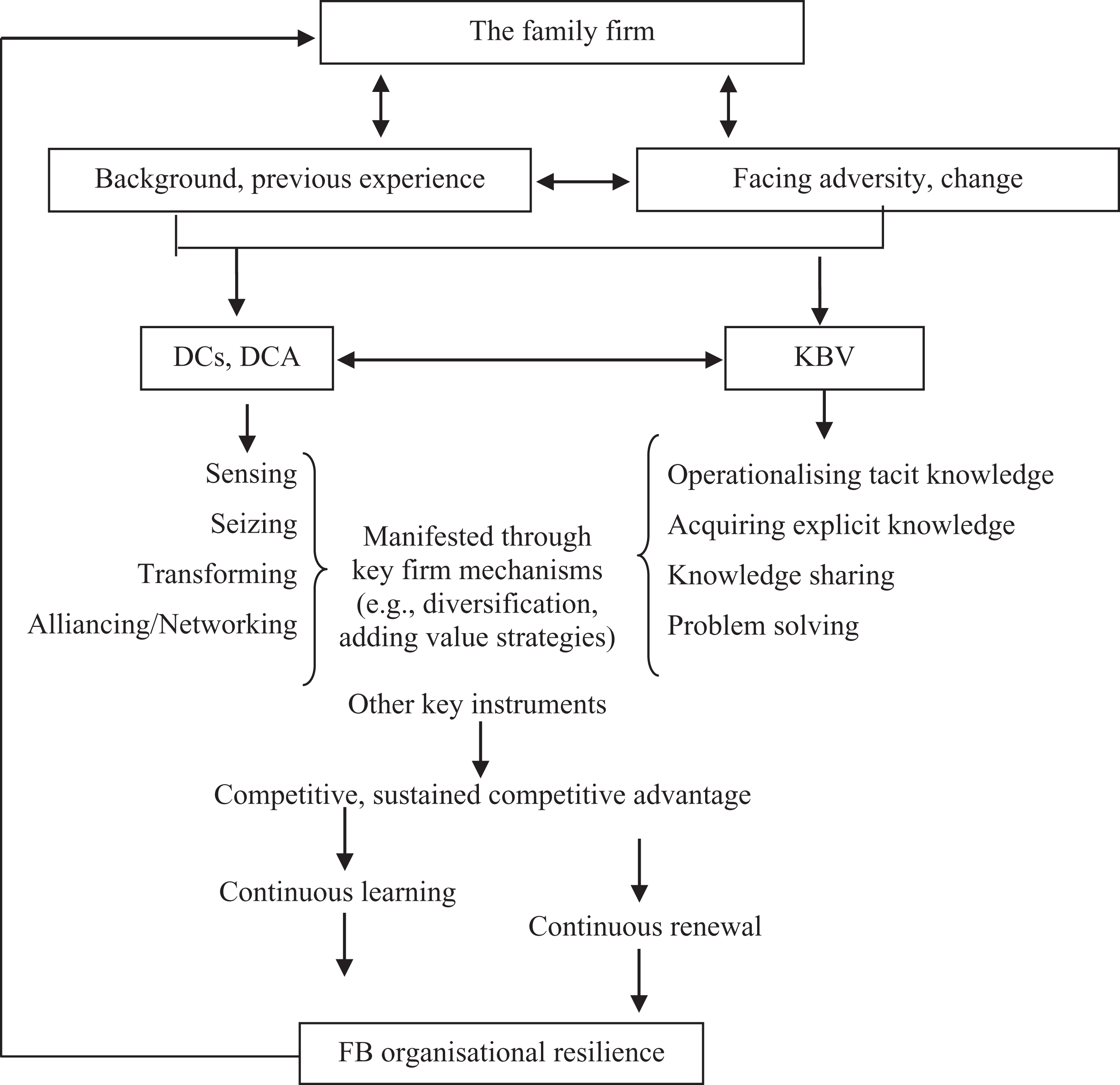
The DCA and KBV in response to adversity and change in the context of FBs. Source: Eisenhardt and Martin, 2000; Grant, 1996; Grant and Baden-Fuller, 1995; Nickerson and Zenger, 2004; Nonaka et al., 2000; Teece et al., 1997; Teece, 2014; Weerawardena et al., 2007. DCA: dynamic capabilities approach; KBV: knowledge-based view; FB: family business.
The KBV complements the DCA and DCs in various ways. Fundamentally, the FB’s knowledge, particularly tacit knowledge, represents a valuable resource (Grant, 1996), and a key mechanism which can help the firm to respond to challenges and contribute to its long-term sustainability. Arguably, knowledge evolves through years of experience, overcoming obstacles, and part of the acquired explicit knowledge may eventually become tacit knowledge. This transition can be illustrated through other essential mechanisms, such as the FB’s efforts to diversify through exports or, aligned with the DCA (Eisenhardt and Martin, 2000), through new product development. These two forms of diversification, as well as other forms of problem-solving (Nickerson and Zenger, 2004), underline that knowledge is a key productive resource, which can contribute to added value (Grant and Baden-Fuller, 1995). Thus, given the complexities for potential competitors to replicate, imitate or acquire such tacit knowledge (Nonaka et al., 2000), knowledge represents a fundamental source of competitive firm advantage.
The identification, enhancement and maximization of key mechanisms associated with knowledge would benefit and be reinforced by continuous learning and renewal. These elements help build the foundations for a FB’s future competitiveness and resilience. Moreover, developing and building resilience has significant implications for the FB, notably, by becoming prepared to withstand future cycles of change and adversity (Figure 1).
Methodology
Adopted research design
This study examines how a FB responds to adversity and a changing business environment through the lens of the DCA and KBV, and from the perspective of members of a family firm. The unit of analysis, or what or who is being studied (Babbie, 2016: 97), is therefore represented by family members’ perceived responses to adversity and to a changing business environment. The case of HRC, a family firm operating in the United Kingdom, is investigated. Thus, the study adopts a single case methodology. Single cases can be ‘unusually revelatory…they offer opportunities for unusual research access’ (De Massis and Kotlar, 2014: 18). Case studies represent the preferred method when ‘how’ or ‘why’ questions are asked, when the researcher has limited control over events and when ‘the focus is on a contemporary phenomenon within a real-life context’ (Yin, 2009: 2). Case studies can contribute to theory building, and include interviews, observations, documentation and archival records as data collection methods (Eisenhardt, 1989).
This study also takes an inductive approach, a research strategy which essentially entails using specific readings of raw data to develop themes, models or concepts; these result from the interpretation of raw data (Jebreen, 2012; Thomas, 2006). Furthermore, a decision was made to employ a purposive sampling method, ‘a random selection…within the segment of the population with the most information on the characteristic of interest’ (Guarte and Barrios, 2006: 277). By choosing a purposive sampling approach, the researcher relies on her/his judgment or experience (Guarte and Barrios, 2006). Similarly, Marshall (1996: 523) indicates the value that purposive sampling has as it ‘actively selects the most productive sample to answer the research question’, recognizing ‘that some informants are “richer” than others’.
In the case of this research, the HRC matched the ‘characteristic of interest’ (Guarte and Barrios, 2006). Fundamentally, the company (a) has operated for over a decade, thereby overcoming several obstacles, (b) has an international presence and c) has earned wide recognition, both nationally and internationally. An extensive search through UK business associations and industry databases for FBs matching these characteristics led to HRC. This firm matches the purposive criteria of the study as a ‘productive sample’ (Marshall, 1996) that best reflects the issues around FBs with a strong potential for rich information to be gathered around overcoming uncertainty.
HRC was contacted in May of 2016 through email communication. The first message sent to the attention of the company’s ownership summarized the objectives of the study, and made an invitation for the FB to participate. Upon receiving a formal response accepting the invitation, in June of 2016, a first visit was made to the company. This visit allowed for the research team to conduct a 60-min interview, which was complemented by a tour of the facilities and additional printed company information. In December of 2016, a second meeting took place, this time at the researchers’ university, and entailed a 1-h interview by one of the company’s owners. A second, 3-h visit was arranged in March of 2017. This visit, which provided opportunities to interview other family members, and a marketing manager, extended and updated the data collected in 2016.
Similarly, a second meeting at the researchers’ university was arranged with one of the owners in November of 2017; again, this 1-h interview complemented and updated previous data. In total, five individuals participated (Table 1). Clearly, the number of interviewees is limited. However, within the FB, these individuals formed the core of the family, and had most experience and knowledge of the FB at the time of the research. Data triangulation was achieved through on-site observations and by gathering company information.
Demographic characteristics of HRC members.
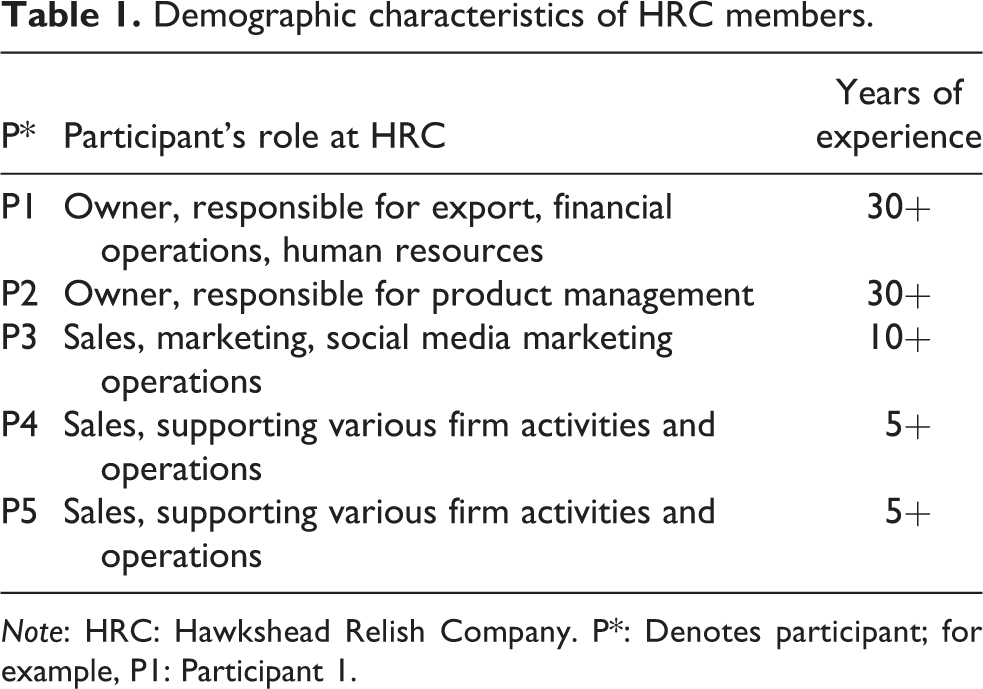
Note: HRC: Hawkshead Relish Company. P*: Denotes participant; for example, P1: Participant 1.
The protocol in the meetings and visits included gathering demographic information (e.g. the size of the firm, new developments in exports, production volume and marketing efforts), and posing questions related to the study’s aims. A review of the pertinent FB literature, particularly contributions concerning firm adaptation and resilience (e.g. Brewton et al., 2010; Chirico and Salvato, 2008, 2016 ; Chirico et al., 2011; Chrisman et al., 2011; Stafford et al., 2013), was consulted to gain understanding in the process of developing the RQs. Fundamentally, the following questions were asked: How does your FB manage to adapt? For instance, how does your firm adapt to: adversity? changes occurring in your business environment? Specifically, what mechanisms do you rely upon to adapt?
All the interviews were digitally recorded with the agreement of the interviewees, and transcribed by members of the research team, which allowed for accuracy and consistency. According to Francis et al. (2010), no agreed method exists to determine data saturation, or the state when gathering additional evidence offers little in the form of new insights, themes or perspectives ‘in a qualitative research synthesis’ (Suri, 2011: 72). Given the size of the FB, and that its most knowledgeable and experienced members participated, the study aligns with the notion proposed by O’Reilly and Parker (2013) that ‘the adequacy of the sample is…not determined solely on…the number of participants but the appropriateness of the data’ (p. 195). Similarly, data triangulation would further ensure robustness of findings.
The qualitative data were analysed undertaking qualitative content analysis, a research method employed to interpret ‘through the systematic classification process of coding and identifying themes or patterns’ (Hsieh and Shannon, 2005: 1278). Thus, qualitative content analysis entails creating categories (Graneheim and Lundman, 2004), and is also suggested as appropriate in case study research (De Massis and Kotlar, 2014; Kohlbacher, 2006).
Through examining the qualitative data set, a number of prevalent issues were identified and coded around a specific idea or theme. These ideas were examined across the different data sources (interviews, observation and documentation), where consistent themes were noted and re-examined by the entire research team. This process enabled consistency in terminology and helped remove the potential for bias. Similarly, in line with the considerations above for saturation (Francis et al., 2010), the prevalent content across the data collected revealed a number of consistently recurring issues. These findings were utilized in the development and understanding of the FB, and led to the framework proposed in the study.
Demographic characteristics of participants
All four family members, the two company owners, their two daughters and a member of staff who was managing the firm’s social media marketing at the time of the study, participated. P1 and P2 had established the company in 2002; their daughters (P4 and P5) joined them during their school years, and today, they are fully involved in the business. Both P1 and P2 grew up in family-owned businesses; for instance, P1 previously worked in her father’s firm and had a formal background in several trades. P3 had more than 10 years of experience in sales and marketing. The HRC has 28 staff; its size therefore corresponds to the European Commission’s (2003) definition of small enterprises, or those businesses that employ between 10 and 49 individuals.
Results and discussion
Adapting to adversity
The proposed framework (Figure 1), which provides a visual structure of relationships between the two adopted theories and the ways in which these are manifested, suggests potential implications for FB resilience. Furthermore, the framework aligns strongly with the results in various ways.
First, the interviews identified various forms of adaptation that have helped HRC build resilience amidst adversity and the changing business environment. Already the establishment of HRC was significantly influenced by the need to adapt. Indeed, P1 and P2 reflected on the developmental stages of the family’s previous venture, owning a successful coffee shop and a bistro in the township of Hawksbay, Cumbria. Through the existing pool of skills and experience of the FB owners, which included new food product development such as reviving a local ancient bread recipe to producing and jarring artisan relishes, the firm experienced growth between 1999 and 2001. In the process of growing, the FB, as its surrounding community, was severely affected by an unpredictable event: P1:…in 2001 the foot and mouth epidemic hit…we thought ‘well, that is terrible for the farmers and for the animals…‘ and did not really think beyond that. The following morning…we did not have a single customer the whole day. And we did not have one the next day, or the next day, or the next…It was just catastrophic, from having a thriving business to having no business literally overnight…it was just shocking. We had a massive overdraft…We lived there, the business was there…suddenly, we were in a process of finding ourselves potentially without a home to live in, without a business, and [having] two small children…
Various innovative or new problem-solving ideas (Kanter, 1983) were formulated, for instance, in new products that were trialled during the time which followed the foot-and-mouth disease outbreak. A key complementing element was the consideration of family and other networks to support the new venture’s promotion and sales. The networking element also became evident in negotiating with the local bank for relief while the new business grew, and in how repayments could be made. P1 and P2 acknowledged the bank’s decision to delay the family’s repayments as ‘a major catalyst that really propelled into moving the focus of the business…to something we could actually be in control of’.
Adapting to a changing business environment
In addition to responding to adversity, the findings also provide strong evidence of HRC’s initiatives and efforts in adapting to a changing business environment. Indeed, at the time of the study, the firm was focusing on various fronts, one of which was concerned with an increasingly online-based consumer market. This growing phenomenon enables HRC to gain exposure and potentially maximize business opportunities (P5): Because social media is linked to your website, the more responses and chatter you get on social media…it’s like electricity, its feeding through that website…its visibility. With regard to wholesale we do exhibitions…I look to see why buyers are going to those events and if they are applicable to our products. I’m certainly not going to spend several thousand pounds on something if the buyers are not going to be there. So you really, really have to do your research.
Exploring and gathering data of new or current consumer trends, or monitoring the groups of followers on social media platforms, also demanded constant effort and investments, particularly in the form of human resources and time. Indeed, during the site visits, it was observed that interchangeably, P3 and P5 were involved in social media marketing and communications. However, these investments were not only required to keep up with the more modern requirements of the age of online communication, but importantly, they also illustrated the firm’s leadership position, especially in seeking to be closer to its customers, learn from them. This position had implications for new product development, and other commercial opportunities (P3): on the first of each month I write down how many followers we have had…how much it [the firm’s followership] is growing. If we are doing a campaign during a month I can see how much it affects us.
A more recent phenomenon, Brexit, also demanded careful consideration, as it could potentially become a threat to the FB. Indeed, some of the market reactions following the Brexit announcement were perceived to be affecting the FB already. As the firm’s key person for food preparation, P2 understood some of the impacts: …we have suffered…the Brexit vote…because of the fluctuation in currency. Partly also because of general increases in the price of some products…sugar has gone up 36% through June and September [of 2016]. So that’s a big impact that has to be allowed for.
Arguably, the knowledge gained, especially among HRC’s owners, by surviving and learning from numerous earlier obstacles, and by improving through achievements, was a key factor for the firm to undertake swift action and minimize the perceived impacts of Brexit. Moreover, as a means to respond to adversity, the importance of networking and product consistency (Table 2) once again emerged. Networking appeared to evolve, from being a crucial aspect to aid in establishing HRC, towards enabling the firm to grow further. With regard to Brexit, the existing networks were perceived to support the firm to withstand any potential repercussions (P1): ‘All of our customers in the EU have confirmed that they will continue to stock our products’.
Adaptation to adversity, and main links to the DCs/DCA and KBV.
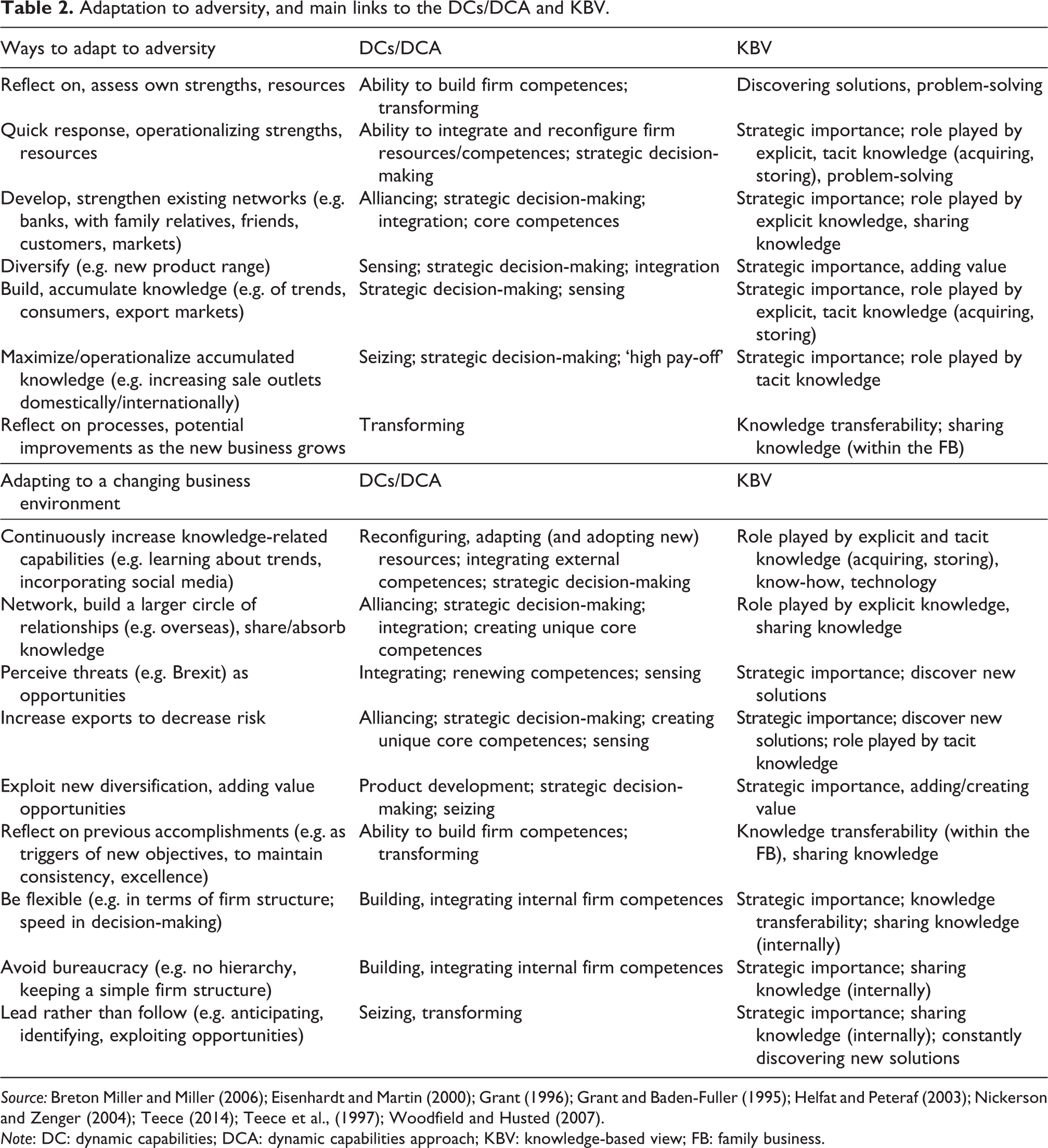
Source: Breton Miller and Miller (2006); Eisenhardt and Martin (2000); Grant (1996); Grant and Baden-Fuller (1995); Helfat and Peteraf (2003); Nickerson and Zenger (2004); Teece (2014); Teece et al., (1997); Woodfield and Husted (2007).
Note: DC: dynamic capabilities; DCA: dynamic capabilities approach; KBV: knowledge-based view; FB: family business.
At the same time, recent risk management efforts to minimize Brexit’s potential threats even further were uncovered; these encompassed the increase in focus on exports into large and lucrative markets, including the Middle East or United States (P1) ‘so that we are not so dependent on the European market, if that was to become a problem…’ These findings are partly in accord with research by Ren and Zhu (2016). These authors found that learning initiatives taken on by motivated and relevant family members can reflect dynamic process involving business innovation, growth and personal learning.
Today, apart from selling its products to numerous high-end food stores in the United Kingdom, the firm exports to 36 countries. HRC’s ability and focus on building and strengthening networks is also partly in agreement with Breton Miller and Miller (2006), who explain the significance for FBs to build strong relationships with external stakeholders as a means to access resources, in this case, revenues through exporting to international markets. Within the context of networking, maintaining existing links and relationships enables HRC to access ongoing knowledge about its current markets. Similarly, establishing new networks allows for expanding its export horizon. These conclusions are associated with Grant (2013), who posits that one of ‘the knowledge-based analysis of alliances views their purpose as accessing rather than acquiring partners’ knowledge’ (Grant, 2013: 546). In addition, accessing knowledge enables greater use of knowledge resources (Grant, 2013).
With a distinctive brand image based on its consistent quality and an increasing number of awards and recognition, both nationally and internationally, new opportunities emerged to diversify into activities and markets that were previously untapped. In fact, participants identified a significant increase in ‘private label’, or the manufacturing foods for other companies whose facilities, operations or production processes and capacities are limited (P1): ‘The private label…that has really happened in the last two years…and it is growing rapidly’. Again, these undertakings are in line with the sensing and seizing processes (Teece, 2014) as well as with the elements of operationalizing existing resources and capabilities to support adaptation and change (Helfat and Peteraf, 2003).
This diversification alternative also illustrates the company’s flexibility, which was revealed as yet another form of adaptation to a changing business environment. Diversifying is also discussed in the context of capabilities (Teece et al., 1997) and DCs, namely, in product development and strategic decision-making (Eisenhardt and Martin, 2000). Flexibility, which was recognized among participants as one of the pillars upon which HRC was building its success, allowed the FB to make quick decisions without going through bureaucratic processes (P1): ‘Being able to be that flexible to twist and turn is really important…we can move direction really easily.…we don’t have a corporate hierarchy, or a family structure…it’s all done as a family’. The acquired knowledge and expertise, together with flexibility, further became crucial, as they enabled the FB to recognize and tap into business opportunities, and satisfy market demands: …people will come to us with a concept but they are not sure how to get it made. So I have to come up with a way of meeting their imagination, or other times it may be a written brief that I receive from them…Then some people come with a whole concept, like a whole range that they want done…So when we fully ascertain what they want, and sometimes it can be entirely different from what we started with…you have to really wow them…
An alignment between these findings and the KBV can also be established. In fact, the KBV considers the essence of organizations in terms of the promotion of ‘efficiency of knowledge generation and knowledge application’ (Grant, 2013: 555). Furthermore, this process requires both integration and specialization of knowledge (Grant, 2013). Thus, once again, reflecting on past experience appeared to be invaluable for the FB’s members to understand and interpret the future in regard to strategic thinking and execution.
Looking forward, HRC’s culture and values were perceived to contribute to the FB’s current and future efforts to adapt to a continuously changing and dynamic business environment. As previously suggested, the firm’s values, together with its culture, were also important mechanisms. Values were reflected in different ways and manifested in participants’ strong commitment to opportunity seeking and growth: P1: It is about leading, not following; it’s about doing things differently…it’s not sitting still. We have to keep on top of our game…you cannot stop. P3:…we recognise that we need to increase our capacity in order to grow.
Essential mechanisms for HRC to adapt
As demonstrated in the previous sections, the proposed framework (Figure 2) is illustrated through the findings in several nuanced ways. Notably, DCs and the DCA are demonstrated first in the rebuilding and reconfiguration processes HRC undertook. Similarly, the KBV emerged through processes in which the FB accumulated and shared knowledge, and in exploiting and operationalizing tacit knowledge in various activities that helped the firm to gain competitive advantage.
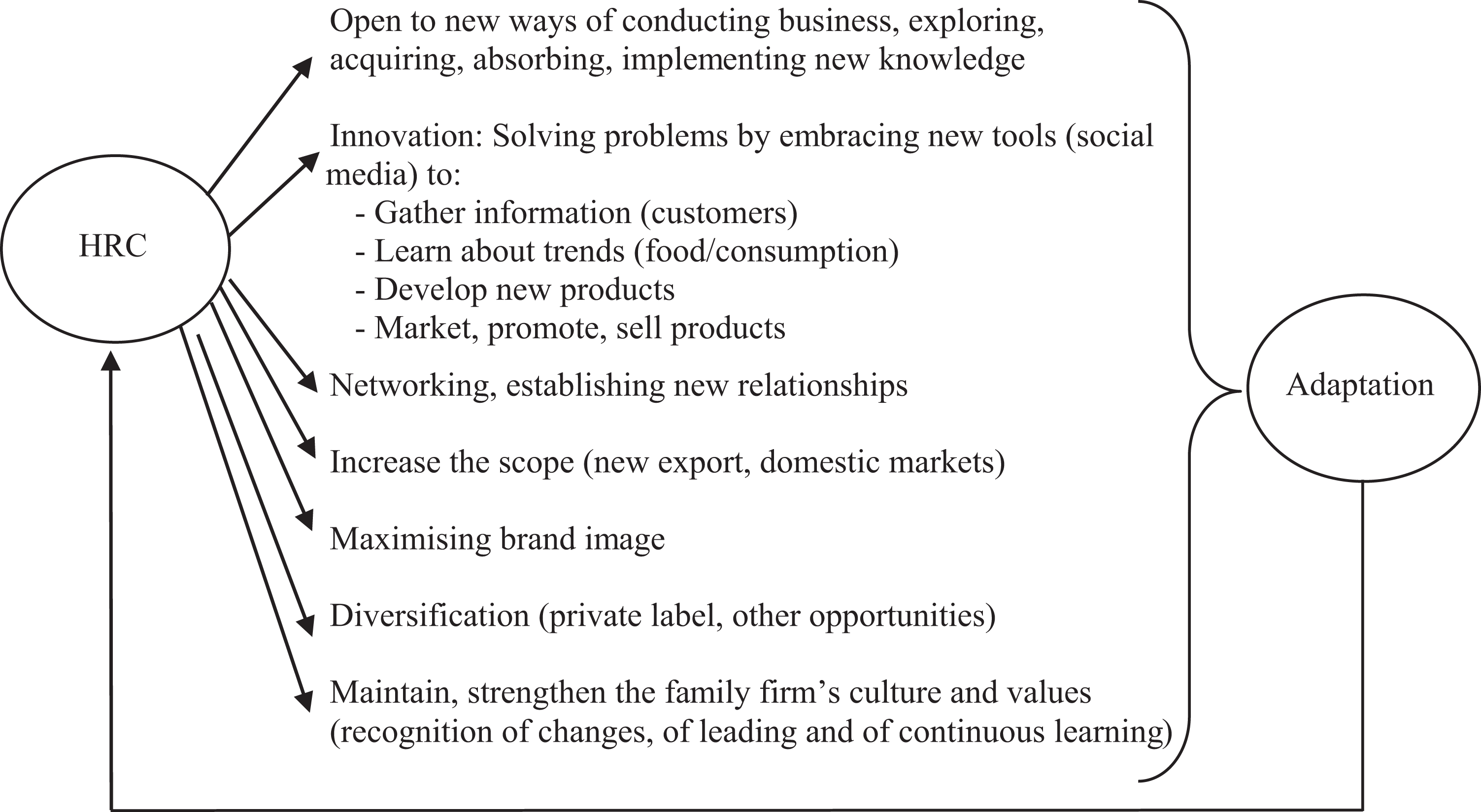
Key mechanisms that HRC relies to adapt and respond to change. HRC: Hawkshead Relish Company.
Furthermore, the DCA helps explain some of the steps taken by the FB towards rebuilding and adapting to a major destructive event. For example, strategic decision-making, product development as well as alliancing (Eisenhardt and Martin, 2000) in the form of networking are demonstrated in various ways. Making the crucial decision to restart a new business, networking with the bank, family and other individuals to promote and sell their products and maximizing the available resources, particularly knowledge and skills, to develop new products strongly align with the DCA paradigm. These forms of adapting are also in agreement with Teece et al. (1997), in diversifying and, overall, in renewing competences and achieving congruence in a changing environment.
Equally, the KBV further emerged from the interviews in more recent forms. In fact, after several years of refining the business concept, the firm acquired valuable knowledge and experience in food production and competed for numerous awards, with notable and consistent success. As the interviewees acknowledged, gaining exposure and recognition by winning awards drew media interest and raised the profile of the firm. Importantly, the prestige gained allowed the FB to apply and obtain a grant, purchase larger equipment for product manufacturing and cater for growing demand, while at the same time improving the consistency of their products. Part of the data triangulation process (i.e. on-site observations) helped confirm the impact of investments from grants and own finances to modernize and increase the FB’s critical mass.
In accord with Grant and Baden-Fuller (1995), explicit and tacit knowledge clearly added to the FB’s strategic direction and contributed to adding value to its products while developing and growing the firm. Moreover, the acquired and constantly flowing knowledge, including explicit knowledge through new ways of communicating (social media), enabled the firm to reflect on, consider and potentially incorporate additional elements and practices to add value or diversify. Over time, by experimenting and creating recipes, or by strengthening existing or establishing new networks, tacit knowledge was accumulated. This knowledge helped the FB to innovate and adapt. Also important was the way in which members of the FB reflected on accomplishments and what seemed to work for the firm. For instance, P5’s comment illustrated how both the operationalization of explicit and tacit knowledge formed part of the FB’s competitive advantage: …we do everything in-house. So I have this amazing advertising opportunity, but I have to have the advert in in two hours…if we outsourced that to a design agency we would be waiting days for that advert to come back. We do it here and that’s the benefit. So if we want to put something out, we can literally do it within minutes; so we are very manoeuvrable…we are very on it. I have worked in much bigger firms, and that…just would not happen.
While the family overcame the loss of its previous venture by adapting in various ways (Table 2), other more recent events further highlight the importance of continuous adaptation as a mechanism to survive and thrive. Figure 2 illustrates that as many as seven different mechanisms emerged from the interview content. One of these mechanisms was based on the continuous exploration and acquisition of new knowledge, which was later manifested in various achievements, including in new product development. HRC’s pool of knowledge was significantly augmented, for instance, when the owners conducted business transactions or presentations domestically and/or internationally. Valuable knowledge was also acquired through the firm’s ability and commitment to establishing industry, government and institutional relationships and networks.
In various cases, however, the mechanisms were interrelated. In fact, being open to learn and acquire new information entailed strong emphasis on solving problems through innovative approaches, such as increasing the firm’s involvement in social media to achieve various key strategic goals. This involvement has played a vital role, with implications for its knowledge and product base, which have also affected its handling and understanding of the supply chain, particularly downstream to reach end consumers.
In the absence of literature on social media adoption among family firms, research conducted among small and medium enterprises (SMEs) was considered to identify motivations for social media adoption. For instance, McCann and Barlow (2015) found that the desire to experiment with social media and the fact that customers are increasingly using it were the main reasons for SMEs’ management to embrace this platform. Another study (Meske and Stieglitz, 2013) revealed that social media adoption improved SMEs’ knowledge management and helped support collaboration among members of staff.
Furthermore, located at significant geographic distance from major UK cities, HRC’s ownership was able to identify the crucial need to increase its connectivity. To a great extent, social media allows the firm to overcome geographic barriers and create stronger links with its consumers, suppliers and overall, with the wider consumer community.
Finally, as previously suggested, maintaining a strong family culture and values within the firm were also central mechanisms that went beyond strategy to represent the core thinking and ethos of HRC. Regarding firm culture, the following illustration epitomizes the firm’s concern for its staff, to the point of sacrificing growth for lifestyle and well-being (PA1): …we got to a point where we could not physically make enough products from that small kitchen, and we started to look for sites. By that time we had also built a really good group of people who were working for us. We did not want to site ourselves on an industrial state miles away. We live here, all the staff live here, and it was important for us as well to stay here because of those roots…
Conclusions
This study proposed a theoretical framework grounded on the DCA and KBV paradigms to investigate FBs’ adaptation to adversity and to a changing business environment, by collecting data through interviews, observations and documentary reviews, and by applying case study methodology on HRC in the United Kingdom. In doing so, the study sought to address various knowledge gaps in the academic literature. For instance, there is a prevalence of quantitative over qualitative methodologies to examine FBs (Hair and Sarstedt, 2014). In addition, despite the significance of DCs in contributing to firms’ adaptation to dynamic business environments, few studies have attempted to understand DCs in the context of FBs (Wang, 2016).
The study’s findings revealed the crucial role that both DCs and knowledge-based attributes have on the studied FB. Similarly, there was also a clearly identified alignment between the findings, the DCs literature (e.g. Eisenhardt and Martin, 2000; Teece, 2014; Teece et al., 1997) and the KBV literature (Grant and Baden-Fuller, 1995; Nickerson and Zenger, 2004). As illustrated in various comments and the summarization of the results (Table 2), facing the destruction of their livelihood, HRC’s owners fully capitalized on the available resources, particularly to integrate and reconfigure existing organizational resources and competences. These attributes were complemented by innovative strategies and ‘orchestration processes’ such as sensing and transforming (Teece, 2014), as well as by problem-solving initiatives. The strategies were further aided by tacit knowledge accumulated through earlier entrepreneurial experiences.
The adaptive strategies, which resulted in various forms of competitive advantage (e.g. product quality, recognition, tacit knowledge, networks, exporting markets), were reinforced and strengthened in light of more contemporary challenges (e.g. Brexit, changes in the food market). Indeed, the summary of the findings (Table 2) identified the importance of strengthening networks, perceiving threats as opportunities and adopting new ways of communicating and promoting. Other emerging key strategies and initiatives included flexibility alongside keeping the firm’s structure as simple as possible to help facilitate communication and quick decision-making.
Implications
Various implications can be drawn from the findings. From a practitioner perspective, the findings identify key initiatives and strategies that FBs’ ownership and members could consider in the face of adversity and rapid changing environments. Moreover, the findings highlight firms’ DCs and knowledge-based resources that could guide and inspire FBs’ owners and managers to become resourceful, developing networks, maximizing their skills and capabilities, as well as their firms’ resources. The findings also illustrate the significance for FB entrepreneurs to reflect on their firm’s strengths, achievements or path to recovery after overcoming adversity, as a catalyst for further growth and competitive advantage. Overall, the results highlighting HRC’s capabilities and responses to challenges could be useful for governmental business development agencies and associations in guiding FB entrepreneurs in the process of recovery or new venture creation.
The findings also suggest the value that FBs should place on building up capacities and capabilities which could provide different avenues of innovation and adaptation through a proactive approach to dealing with uncertainties. Given the need to be flexible to change and adversity, it would equally be important to develop strategies that reflect adaptability and build upon the strengths in the firm’s capabilities and knowledge resource. For FB owners, these steps entail a deeper understanding of the external environment they operate in, as well as strong knowledge of the strengths of their firm.
The findings of the present study also have theoretical implications. Essentially, the proposed framework (Figure 2) provides a representation of the associations between the DCA, the KBV and the firm’s adaptation path. Firstly, the framework guides understanding concerning a FB undergoing significant transformations to adapt to the dynamic and increasingly complex business environment. The framework suggests the strong links between the FB’s background and experience and facing or addressing new challenges. The two dimensions manifested by the firm’s previous history and the changing business environment are strongly associated with DCs, the DCA and KBV.
For example, the findings revealed the continuous learning and experimenting processes the firm was undertaking. These processes gave way to taking into account key mechanisms to respond to complexities in the market and the business, which were reflected, for instance, by the potential consequences of Brexit. The extension provided by Figure 2 further indicates the usefulness of the theoretical framework in facilitating analysis and reflection of a family firm’s responsive measures to dynamic business environments. Among other fundamental key mechanisms was embracing innovative practices to solve problems, as the case of its involvement with social media applications demonstrates.
Overall, the framework adds depth, rigour and understanding of real-life manifestations of different ways to adapt, which align with the various elements encapsulated by the DCA and KBV. Consequently, the framework provides an insightful baseline and guide to examine adaptation and resilience that could enable the identification of strategies and initiatives employed by FBs. Furthermore, given the suggested lack of a strategic management theory to study FBs (Barros et al., 2016), the framework could be considered as a starting point in future FB research.
Limitations and future research
While the study provides useful insights, both from a practitioner and theoretical perspective, exploring the firm at various points in time (2016–2017), it has limitations. Fundamentally, it only investigates one company, which prevents comparisons or contrasts with other domestic or international FBs. At the same time, only members of the firm were interviewed. Nevertheless, these limitations could be overcome in future research.
First, future studies could identify and include other firms that have adapted to adversity, overcoming major disruptions and/or have adapted to the rapid changes of a globalized business environment. New knowledge from various firms could confirm/disconfirm the findings and theoretical proposition of the present study, and also extend the knowledge, both empirical and theoretical, with regard to adaptation, DCs and knowledge-based strategies. Second, further studies could also examine firms from the perspectives of other stakeholders, including local suppliers, town halls or even employees. Doing so could provide other perspectives, including entrepreneurial characteristics and strengths that could not be captured from solely interviewing FB members.
In order to confirm or disconfirm the usefulness of the proposed theoretical framework, future research could also focus on investigating adaptation among FBs adopting the DCA and KBV paradigms. Alternatively, and in response to Barros et al. (2016), researchers could seek to refine and develop a strategic management theory specifically focusing on FBs. Moreover, given the socio-economic importance and contribution of this group of firms, there is significant value in making further strides in the theoretical development of FB field.
Footnotes
Declaration of Conflicting Interests
The author(s) declared no potential conflicts of interest with respect to the research, authorship and/or publication of this article.
Funding
The author(s) received no financial support for the research, authorship and/or publication of this article.