







Abstract
Although research on leader humility is developing into a prominent literature, the majority of studies have focused on the dyadic or individual rather than collective outcomes of leader humility. Thus, our understanding of the influencing mechanisms and boundary conditions of leader humility remains limited, particularly on the collective work outcome of team creativity, which requires more voluntary effort from employees. Drawing on social cognitive theory and social interdependence theory, our study investigates how leader humility promotes team creativity through team creative efficacy, with the moderation of a contextual factor, task interdependence. We used a sample of 84 teams and 393 employees surveyed in two waves of data collection. Overall, our study yields a mediated moderation model in which the positive indirect effect of leader humility via team creative efficacy on team creativity is stronger when team task interdependence is low rather than high. This study extends our understanding of how leader humility may influence work teams collectively and how the effectiveness of such a leader characteristic may be influenced by a structural factor of the work team. Other theoretical contributions and practical implications are also discussed.
Keywords
Introduction
Leader humility, generally considered to be an individual characteristic, is treated as a virtue in many organizational contexts (Morris et al., 2005; Ou et al., 2014). Leaders with high humility willingly admit their mistakes and weaknesses, tend to learn and maintain an open mind, and appreciate others’ strengths and contributions (Ou et al., 2018; Owens and Hekman, 2012). Despite the positive influence of leader humility on employee performance (Collins, 2001; Owens and Hekman, 2012; Rego et al., 2019) and creativity (Hu et al., 2017; Wang et al., 2017), the ways in which leader humility influences a work unit as a whole and the boundary conditions of them are underexplored. Considering that humble people may be perceived as less willing to use power proactively, leader humility may have limitations in certain collective work settings in which leader involvement and centralization is needed (Bunderson, 2003). Thus, the literature is lacking of a discussion on a more comprehensive interactive influence of leader humility and structural factors of the work team on collective outcomes. Such a limitation can be especially salient to work outcomes that require intrinsic motivation and confidence, such as creativity (Tierney and Farmer, 2002; Zhang and Bartol, 2010).
Compared to individual and organizational levels of investigation, the influence of leader humility and its mechanism at the team level can be more complex, although it has been less discussed in the literature. Despite Rego et al.’s (2019) findings that leader humility can enhance team processes, the motivational influence of leader humility on team characteristics as a whole has remained a black box. As the positive impact of leader humility comes from its motivational function in a work context, it is compelling to decipher the motivational process by investigating the shared psychological state that emerges on a work team under humble leadership (Ou et al., 2014; Rego et al., 2017). Employing social cognitive theory (SCT) and social interdependence theory (SIT), our study investigates the collective motivational influence of leader humility on team creativity through elevating a creativity-relevant collective confidence of the team—a.k.a. team creative efficacy.
According to the SCT, human behaviors can be induced by building up confidence toward certain tasks—that is, self-efficacy and collective efficacy—because confidence on completing the tasks would make one more persistent in overcoming difficulties and searching for better solutions (Bandura, 1991, 2015). As research on collective efficacy has shown, team leaders may play an important role motivating employees by enforcing the forming of team efficacy, a collective shared confidence (Chen and Bliese, 2002; Gully et al., 2002; Tasa et al., 2007; Walumbwa et al., 2004). Thus, we argue that as a leader characteristic, humility plays a unique role in forming team creative efficacy by recognizing employees’ creativity-related achievements, setting a role model for them to be more open to new ideas, and reducing fears of making mistakes so that new and useful ideas are delivered at the team level (Rego et al., 2019; Shin and Eom, 2014; Wang et al., 2017; Zhang and Kwan, 2018).
In addition, structural features may play an important role in order for leader humility to have a positive and effective influence on a work unit. Specifically, the SIT argues that the level of interdependence among team members has an influence on how they behave (De Jong et al., 2014; Tjosvold, 1985a). Such task interdependence reflects how much team members rely on each other to accomplish their tasks (Kiggundu, 1981; Saavedra et al., 1993). Thus, we propose that as a major structural feature, task interdependence is an important contextual factor for the positive influence of leader humility on team creative efficacy (Liu et al., 2017). That is, when task interdependence is high, leader humility might be perceived as lacking in sufficient involvement and efficiency in integrating team effort and forming team creative efficacy. At the same time, leader humility will facilitate team creative efficacy more efficiently when task interdependence is low, and there is less need for leader involvement (Li et al., 2016). By integrating the SCT with the SIT, we propose a mediated moderation model in which the indirect relationship between the interactive effect of leader humility and task interdependence and team creativity is mediated by team creative efficacy.
Our study makes three major contributions. First, the study enriches our understanding on the connotation of humility. A humble leader is not a leader with low self-esteem who may have a negative influence on followers’ confidence, but rather an individual with accurate self-evaluation (Morris et al., 2005; Tangney, 2000). Based on such a connotation, our study investigates the influence of leader humility on team shared cognition on their own collective entity. Our work provides the leader humility literature with a theoretical rationale and empirical evidence supporting the idea that leader humility has a positive influence on team shared confidence rather than a negative influence. By linking leader humility to team creative efficacy, our study reveals the important role a specific leader characteristic may play in shaping team characteristics through within-team social interactions between the leader and followers.
Second, this article extents our understanding of the SIT and the interactive influence of leader characteristics and team structural factors by recognizing task interdependence as a boundary condition for its positive prediction on team creative efficacy. Task interdependence serves as a substitute of leader humility, such that teams with high task interdependence rely less on their humble leader. Leaders with high humility emphasize less intervention and trust of self-management among team members, which is considered an inefficient approach when leaders are in charge of teams with high task interdependence. Our study answers the call for more research on the potential limitations of leader humility in certain organizational contexts (Ou et al., 2018; Tangney, 2009). In addition, most previous studies using the SIT have argued that a leader’s proactive participation, such as allocation of resources, has a stronger influence on team activities when members need to rely on each other (e.g., Barnett and McCormick, 2016; Hambrick et al., 2015; Liden et al., 2006). Our study extends such understanding by indicating that leader characteristics are important, but the influence of such characteristics varies in different team interaction contexts. We argue that the positive indirect effect of leader humility on team creativity via team creative efficacy can be influenced by the task attributes of task interdependence (Bruning and Campion, 2018; Herrmann and Felfe, 2013; Kiggundu, 1981).
Third, our research extends the SCT literature by studying the mediating effect of team creative efficacy on the relationship between leader humility and team creativity. At the individual level, previous literature has shown that leader humility can be an antecedent of employee self-efficacy (Mao et al., 2019; Owens et al., 2019). Nevertheless, at the team level, previous studies have merely focused on whether and how team composition (Cheng and Yang, 2014), team climate (Kim and Shin, 2015), and leader behaviors (e.g., Zhang and Kwan, 2018) influence the forming of shared team confidence. Our model demonstrates that leader characteristics, such as leader humility, not only can be important antecedents of individual self-efficacy but also antecedents of shared team confidence, such as team creative efficacy. The mediating effect of team creative efficacy reveals that the motivational impact of leader humility on the emerged team state is a major mechanism in how it influences team creativity.
Theory and hypotheses
Leader humility
Based on philosophical and humanistic roots, management scholars have made a substantial effort to expand the construct of humility into the organizational context (Davis et al., 2011; Morris et al., 2005; Ou et al., 2014; Owens et al., 2011, 2013). Individuals with humility feel less entitled but more self-transcendent (Ashton and Lee, 2005; Kesebir, 2014; Morris et al., 2005; Tangney, 2002). They are aware of their own limitations, recognize the value of others without reluctance, and continuously seek self-improvement (Ou et al., 2018). In this way, humble individuals influence others by easing their anxieties, assuring their self-confidence, and encouraging them to share (Choi, 2004; Hu et al., 2017; Lin et al., 2017; Rego et al., 2019). Because of the positive influence that humble individuals make on other people, an increasing amount of research has focused on the impact of such leaders in the workplace (e.g., Rego et al., 2018; Nielsen and Marrone, 2018; Ou et al., 2018).
Humble leaders have a transcendent self-view and think more of collective interests (Grenberg, 2005; Ou et al., 2014, 2018). Compared to other leaders, humble leaders recognize the dignity and equality of employees as well as their own limitations, and thus tend to have accurate self-evaluations (Owens et al., 2013; Richards, 1988, 1992). They do not feel the need to show superiority (Owens and Hekman, 2012) and are willing to share credit with all contributors (Exline and Geyer, 2004). Humble leaders are able to appreciate employees’ accomplishments without feeling threatened (Exline et al., 2004; King and Hicks, 2007), and when employees make mistakes, humble leaders are more likely to forgive them (Davis et al., 2010). Literature on leader humility has recognized its influence in facilitating employee outcomes such as employee voice, work engagement, job satisfaction, job performance (Basford et al., 2014; Lin et al., 2017; Owens et al., 2013), and collective outcomes, such as team effectiveness, team creativity, team performance, and firm performance (e.g., Chiu et al., 2016; Hu et al., 2017; Owens and Hekman, 2016; Ou et al., 2018; Rego et al., 2018).
Leader humility and team creative efficacy
The construct of team creative efficacy—a core variable demonstrating the motivational mechanism of leader humility in our model—is rooted in and developed by the SCT. According to Bandura’s (1977a, 1977b) major arguments on the SCT, one’s belief in specific tasks—a.k.a. self-efficacy—is predictive of individual performance. On the basis of this principle, Tierney and Farmer (2002) developed the construct of creative self-efficacy, which has been positively associated with individual creative performance (Gong et al., 2009; Tierney and Farmer, 2002, 2011). Along with a personal belief in one’s specific capacity, the SCT’s collective mode of agency further posits that a work team may also form a shared belief in their collective capability to successfully perform a specific task, which Lindsley et al. (1995) refer to as team efficacy. Team efficacy is a work team’s shared perception of its capability to successfully perform a specific task (Bandura, 1997). In this sense, team creative efficacy is a form of collective efficacy in which team members hold a belief in their shared ability to generate creative ideas (Shin and Eom, 2014; Shin and Zhou, 2007).
Like other types of collective efficacy, team creative efficacy is not simply the sum of individual creative self-efficacy (Bandura, 2000; Gully et al., 2002). Believing that “We can create” is different from believing “I can create” (Prussia and Kinicki, 1996). Compared to individual creative self-efficacy—primarily developed by one’s judgment derived from an individual’s concept of the ability to create—team creative efficacy is a judgment on team ability to generate creativity as a collective work outcome (Klein and Kozlowski, 2000; Taggar and Seijts, 2003). To form team creative efficacy, members need to develop a perception through social interaction in which they form a shared understanding of the team’s effectiveness, efficiency, and ability to come up with novel and useful ideas (Chen and Bliese, 2002; Liao et al., 2010). With a shared perception of high creative ability, the work team may reach high synchronization in the production of team creativity (Bandura, 2002a; Gully et al., 2002).
Given that humility is effectively beneficial when a leader possesses it (e.g., Collins, 2001; Ou et al., 2014, 2018; Owens and Hekman, 2012), we propose that humble leaders are capable of promoting collective creative efficacy. First, compared to self-focused leaders, humble leaders are more likely to recognize the novelty and usefulness of employees’ ideas (Wang et al., 2017). Humble leaders display appreciation of employees’ voice, feedback, and new ideas (Lin et al., 2017; Owens et al., 2013). They recognize and embrace employees’ unique knowledge and skill sets and encourage them to speak up and share ideas (Hu et al., 2017; Lin et al., 2017). Such encouragement and positive feedback carry a message of potency, persuades employees to believe in their capacity to create, enhances a shared confidence in creativity, and regulates the persistence to overcome obstacles during completion of creativity relevant tasks (Dimotakis et al., 2017). A humble leader’s acknowledgment and encouragement could help employees find a shared purpose and value from their efforts to create novel and useful ideas as a team, recognize their creativity-relevant accomplishments, and strengthen their confidence in creativity (Drazin et al., 1999; Van Der Vegt and Bunderson, 2005).
Second, drawing on the SCT, a team can learn from a humble leader’s openness through a modeling process (Ou et al., 2018; Rego et al., 2019). By expressing an appreciation of new ideas, a humble leader recognizes team effort on creativity and provides an example for team members (Baer and Oldham, 2006). Encouraged by such openness, the work team is more likely to form a shared value of openness and a knowledge-sharing climate (Dewett, 2006; Gilson et al., 2013). Exposure of more shared information among members will promote team creativity efficacy (Choi, 2004; Gong et al., 2013; Grosser et al., 2017; Richter et al., 2012).
Third, creativity comes with uncertainty, risks, and challenges to the status quo (Dewett, 2006; George, 2007). Admitting his or her own mistakes and weaknesses, a humble leader reduces team anxiety by taking responsibility of final work outcomes, thus sending signals to team members indicating that it is acceptable to make mistakes and makes members feel psychologically safe to create (Gonçalves and Brandão, 2017; Hu et al., 2017). By admitting mistakes, leader humility may also help avoid intra-team tension to shirk blame and increase team cohesion when facing failures in producing collective creativity. Additionally, when others make mistakes, humble people are more likely to forgive and express positive other-oriented emotions, such as empathy, compassion, and love (Davis et al., 2010). Thus, leader humility strengthens team creative efficacy and promotes creativity by reducing anxiety in the environment and promoting a positive emotional state in which employees feel safe and have the psychological fortitude to face the challenges of collective creativity (Bandura, 2012; Hu et al., 2017).
Compared to self-focused leaders, humble leaders embrace a collective vision rather than mere concern for personal good (House and Aditya, 1997). They inspire team members with such a vision in social interactions. Such leaders not only influence employees individually but also create shared understanding and collective creative efficacy. Thus, we hypothesize,
The moderating effect of task interdependence
On a work team, conflicts and incongruities may exist among individual objectives, as well among collective and individual goals (Chen et al., 1998; Greer et al., 2011; Wu et al., 2015). Therefore, tasks are structured interdependently or independently to determine how individuals interact, which in turn creates different work outcomes (Jia et al., 2014; Johnson and Johnson, 2005). As an important structural-task feature, task interdependence refers to the degree to which team members rely on and interact with each other to accomplish tasks (Kiggundu, 1981; Saavedra et al., 1993).
According to the SIT, social interdependence exists when task interdependence exists and the outcomes of individuals are affected by each other’s actions (Johnson et al., 1989). In teams with high task interdependence, task completion relies highly on within-team cooperation that often causes less autonomy (Langfred, 2005). On such teams, tasks require leaders’ frequent participation with resource allocation to facilitate the team process to achieve and strengthen desirable interactions, such as cooperation (Hu and Liden, 2011; Liden et al., 2006). Thus, drawing on the SIT and the leadership literature, in teams with high task interdependence, effective leaders are supposed to promote positive work outcomes by facilitating cooperative behaviors among employees (Tjosvold, 1985b; Vidyarthi et al., 2014). However, since leader humility may demonstrate encouragement for employee initiation and a decentralized leader role, the efficiency of leader humility in facilitating positive work outcomes will be limited in teams with high task interdependence.
According to the SCT, a leader’s influence on team efficacy development relies on his or her ability to enhance group processes (Chen and Bliese, 2002; Kim and Shin, 2015; Mulvey and Klein, 1998). High task interdependence requires employees to initiate or to receive task interactions for and from coworkers (Kiggundu, 1981). On such teams, leaders are expected to play more of an integrator role that facilitates collaboration and information processing by setting goals and allocating resources (Crawford and LePine, 2013; Kozlowski, 1999). When a humble leader admits his or her own weaknesses, accepts employees’ ideas, and puts employees under the spotlight instead of himself or herself, such behaviors may be interpreted as withdrawing from involvement and partially undermines the leader’s role in integrating team processes (Sedikides and Jackson, 1990).
In teams with low task interdependence, employees can exert specified knowledge in creativity-relevant activities independently and work with less leader intervention (Longfred, 2005). On such teams, employees are supposed to complete tasks more independently. As Wong and Giessner (2018) argued, employees’ interpretation of leader behaviors may depend on whether such behaviors meet their expectations. When leaders express humility on less interdependent teams, employees are less likely to interpret it as withdrawing from necessary involvement and more likely to interpret it as encouragement of an autonomous climate as expected and thus develop collective efficacy on creativity more efficiently (Van Der Vegt and Janssen, 2003; Zhang and Bartol, 2010). Therefore, we argue that when task interdependence is high, leader humility would still be functional but less efficient in facilitating a collaborating climate in which employees create new ideas together (Černe et al., 2014). Conversely, when task interdependence is low, the assuring and encouraging effect of leader humility is more likely to form a consistent and larger influence on the shared confidence of the ability to create out of team work. In other words, compared to high task interdependent teams, leader humility is more in need in teams with low task interdependence.
The mediating effect of team creative efficacy
Although previous studies argue that leader humility may promote employee confidence in creative tasks, its influence on team creativity may differ from individual creativity. Distinct from individual creativity, team creativity is more influenced by collective characteristics, such as team efficacy, but not members’ individual self-efficacy (Paulus and Dzindolet, 2008; Taggar, 2002). Specifically, as the SCT argues, team efficacy represents a shared belief in team outcomes produced by members’ collective actions and influences the amount and direction of collective effort rather than individual engagement (Bandura, 2002b; Cheung et al., 2020). With higher collective efficacy, team members will be more persistent in overcoming obstacles and have a larger range of information searching so that their work outcomes will be improved accordingly (Tierney and Farmer, 2002). Focusing on creativity, elevated team creative efficacy will promote the collective effort of a work unit in completing creativity-relevant tasks (Shin and Eom, 2014). For example, Ford (2000) argued the important motivational influence that shared belief may play in predicting collective outcomes of creativity.
We contend that team creative efficacy mediates the interactive effect of leader humility and task interdependence as a motivational process. As previously noted, leader humility can enhance a team environment to embrace openness, make employees feel safer when proposing new ideas, and encourage members to challenge the status quo (Lin et al., 2017). Based on the SCT, leader humility sends information cues to facilitate a shared confidence on creativity among team members (Hu et al., 2017). However, whether leader humility could effectively influence team creative efficacy depends on the structure of the task (e.g., task interdependence). According to the SIT, leader humility is less effective in promoting team creative efficacy in teams with high task independence in which more leader involvement is needed to strengthen positive interactions and prevent negative interactions.
With team creative efficacy promoted, the collective motivation of employees to create is also promoted (Ford, 2000). In such teams, members are motivated to interact more positively and proactively (Shin and Eom, 2014) and share information more willingly and effectively (Shin and Eom, 2014). With more frequently exchanged information and exposure to new ideas, elevated team creative efficacy increases the opportunity of team creativity (Shin et al., 2012). Thus, we propose,
Figure 1 demonstrates the overall theoretical framework of the study.
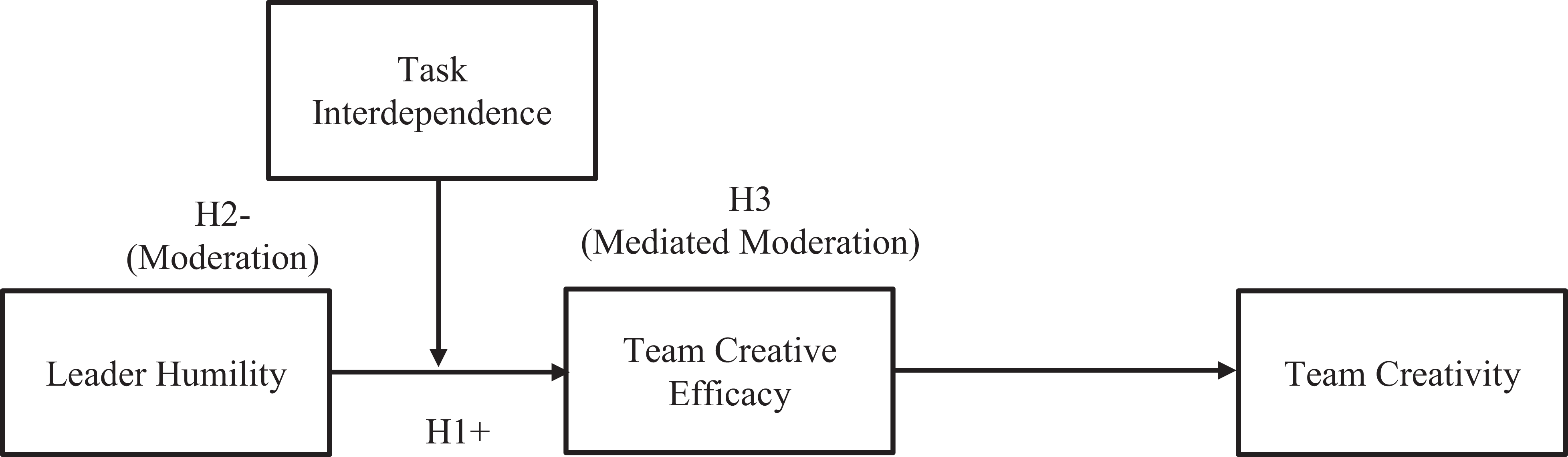
Theoretical framework. Leader humility is reported by employees in wave 1; team creativity is reported by leaders in wave 2; the rest of the variables are reported by employees in wave 2; task interdependence, team creative efficacy, and leader humility are aggregated variables.
Method
Participants and procedure
Study participants came from eight companies in a major city in Northeast China. The industries included telecommunication services, real estate, financial services, and pharmaceutical. We surveyed at least one work team from each company in the following departments: R&D, marketing, finance, administration, and IT. In addition, we surveyed at least 10 work teams in each company. Introduced by the CEO or human resource management department, we focused on work teams that had demanded at least a certain level of creativity as well as the expectation that all team leaders work with their followers in the same workplace. Altogether, our sample yielded 100 work teams with at least one leader and three employees each.
Variables were rated from different sources and surveyed in two waves. In the first wave, employees evaluated leader humility. Two weeks later, in the second wave, leaders evaluated the teams as a whole, as well as the employee creativity of each team member. Team members reported task interdependence and team creative efficacy in the second wave. Leader humility, task interdependence, and team creative efficacy was later aggregated to the team level.
We initially distributed 100 leader questionnaires and 600 employee questionnaires. After two waves of data collection, we received 476 usable questionnaires, with 84 from leaders and 393 from employees (the final response rate was 84% for leaders and 65.5% for employees). The average team size was 5.68. Of the leaders, 59 (70.2%) were male and 25 (29.8%) were female. Of the employees, 250 (63.6%) were male and 143 (36.4%) were female. The average age of the leaders was 45.3 years (SD = 6.2); the average age of the employees was 36.1 years (SD = 9.2). The average education of the team leaders was 15.8 years (SD = 1.5) while the average education of the employees was 15.6 years (SD = 1.2).
Measure
Using 7-point Likert-type scales ranging from 1 (strongly disagree) to 7 (strongly agree), we measured leader humility, task interdependence, team creative efficacy, and team creativity. All measures were translated into Chinese and revised by three bilingual students that studied management following a standard procedure of translation and back translation (Brislin, 1980).
Leader humility
The nine-item scale from Owens and Hekman (2012) was used to measure leaders’ humility. One typical item was, “My supervisor is willing to learn from others.” The Cronbach’s α for these questions was 0.89. Because leader humility was considered a group variable, Rwg, ICC(1), and ICC(2) were tested to verify its between-group variance. Two intra-class correlations (ICCs) were used, as ICC(1) indicated the extent of agreement among the members’ ratings of the same group and ICC(2) indicated whether groups could be differentiated based on the variables of interest (James, 1982). The Rwg mean for team creative efficacy was 0.90, ICC(1) was 0.50, and ICC(2) was 0.82. All indicators were within an acceptable range, demonstrating significant between-group variance.
Team creative efficacy
Team creative efficacy was measured by revising Tierney and Farmer’s (2002) three-item scale. The objectives of these items were revised from “my” into “our team.” A sample item was, “I have confidence in our team’s ability to solve problems creatively.” The Cronbach’s α was 0.92. Rwg mean for team creative efficacy was 0.89, ICC(1) was 0.41, and ICC(2) was 0.71. All indicators were within an acceptable range, demonstrating significant between-group variance.
Task interdependence
We used a five-item measure according to previous literature (Van der Vegt et al., 2000). An example item was, “I need information and advice from my colleagues to perform my job well.” The Cronbach’s α for these questions was 0.75. Rwg mean for team creative efficacy was 0.86, ICC(1) was 0.45, and ICC(2) was 0.81. All indicators were acceptable.
Team creativity
Farh et al.’s (2010) four-item scale measured team creativity. A sample item was, “The team output demonstrates that the team is capable of using existing information or resources creatively (in executing the project).” The Cronbach’s α was 0.95.
Control variables
Previous studies (e.g., Shalley et al., 2004; Shin and Zhou, 2007) have shown that demographic variables can be associated with both individual and team outcomes. Therefore, we controlled key variables such as leader age, leader sex, and leader education level (years of education received) (Shin and Zhou, 2007). Since organizational tenure (Ng and Feldman, 2010) and task types (Chang et al., 2012; Kim et al., 2010) has certain influence over employee creativity and team creativity—especially when R&D teams have more creativity-relevant tasks in their daily work—we controlled for team tenure and task types (R&D teams are coded as 1 while the rest teams are coded as 0) at the team-level analysis.
Analytic strategy
The data of our study were of a nested structure where one leader had more than one employee and the primary relationships were tested at the team level. First, we conducted a series of confirmatory factor analyses (CFA) to ensure the distinct factor structure of our research model variables. Second, to avoid a biased standard error estimate caused by a potentially shared variance derived from nonindependence with work teams, we tested our hypotheses with a multilevel structural equation model (MSEM) using Mplus 8.1. We computed 95% confidence intervals (CI) using parameter bootstrapping (20,000 replications) by R software based on the estimates and standard deviation (SD) of the regression coefficients from MSEM analyses (Preacher et al., 2010). The proposed indirect-effect hypotheses and moderation hypotheses were supported if the CI of the effect did not include zero.
Results
Table 1 presents the descriptive statistics, correlations, and scale reliabilities. Leader humility is significantly correlated with team creativity (γ = 0.38, p < 0.01), and team creative efficacy is significantly correlated with team creativity (γ = 0.46, p < 0.01).
Means, standard deviations, and correlations.
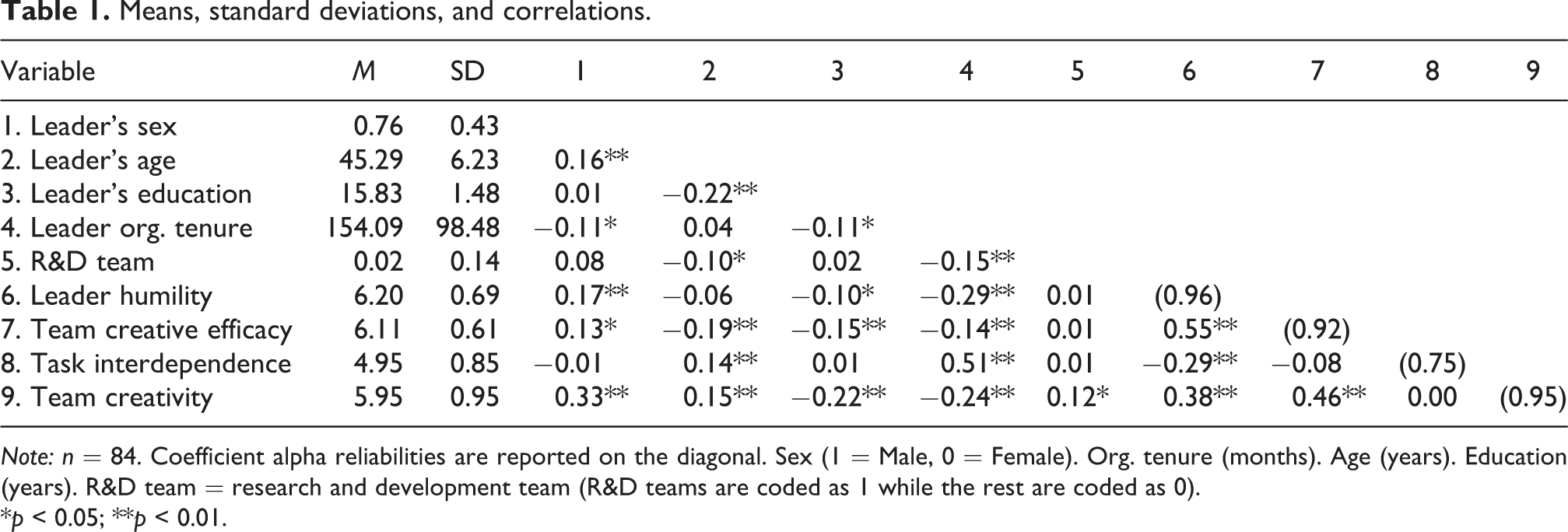
Note: n = 84. Coefficient alpha reliabilities are reported on the diagonal. Sex (1 = Male, 0 = Female). Org. tenure (months). Age (years). Education (years). R&D team = research and development team (R&D teams are coded as 1 while the rest are coded as 0).
*p < 0.05; **p < 0.01.
A confirmatory factor analysis was conducted using Amos 17.0 to establish the discriminant validity of measures. The results show that the hypothesized four-factor (Model 1) (leader humility, task interdependence, team creative efficacy, and team creativity) model fit the data well, χ2 (186) = 298.84, CFI = 0.94, RMSEA = 0.09, and show a significantly better fit than other three-factor models (Model 3) in which task interdependence and team creative efficacy is combined as one factor. As an example, the hypothesized four-factor model is significantly better than the three-factor model, χ2 (187) = 436.11, CFI = 0.88, RMSEA = 0.13. The four-factor model also had a significantly better fit than a one-factor model in which all items were loaded onto one latent factor χ2 (189) = 895.93, CFI = 0.65, RMSEA = 0.21. Overall, the results support the distinctiveness of our constructs. Table 2 presents our results.
CFA used to examine factor structure of the study scales.
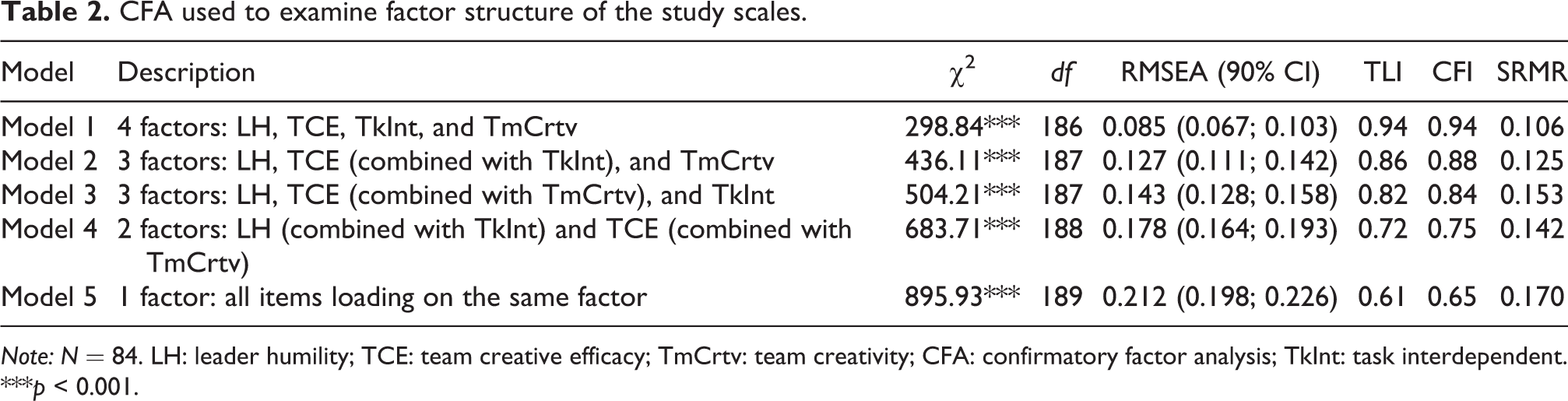
Note: N = 84. LH: leader humility; TCE: team creative efficacy; TmCrtv: team creativity; CFA: confirmatory factor analysis; TkInt: task interdependent.
***p < 0.001.
To test Hypotheses 1 and 2, we used a regression analysis to test the relationship of leader humility, team creative efficacy, and task interdependence. Table 3 presents the results. Hypothesis 1 proposed a positive relationship between leader humility and team creative efficacy. To test this hypothesis, we entered control variables in M1 and entered leader humility in M2. As shown in M2 of Table 3, the estimated parameter of leader humility on team creative efficacy is 0.45, p < 0.01. Thus, hypothesis 1 is supported.
Regression analyses results for leader humility, task interdependence, and team creative efficacy.
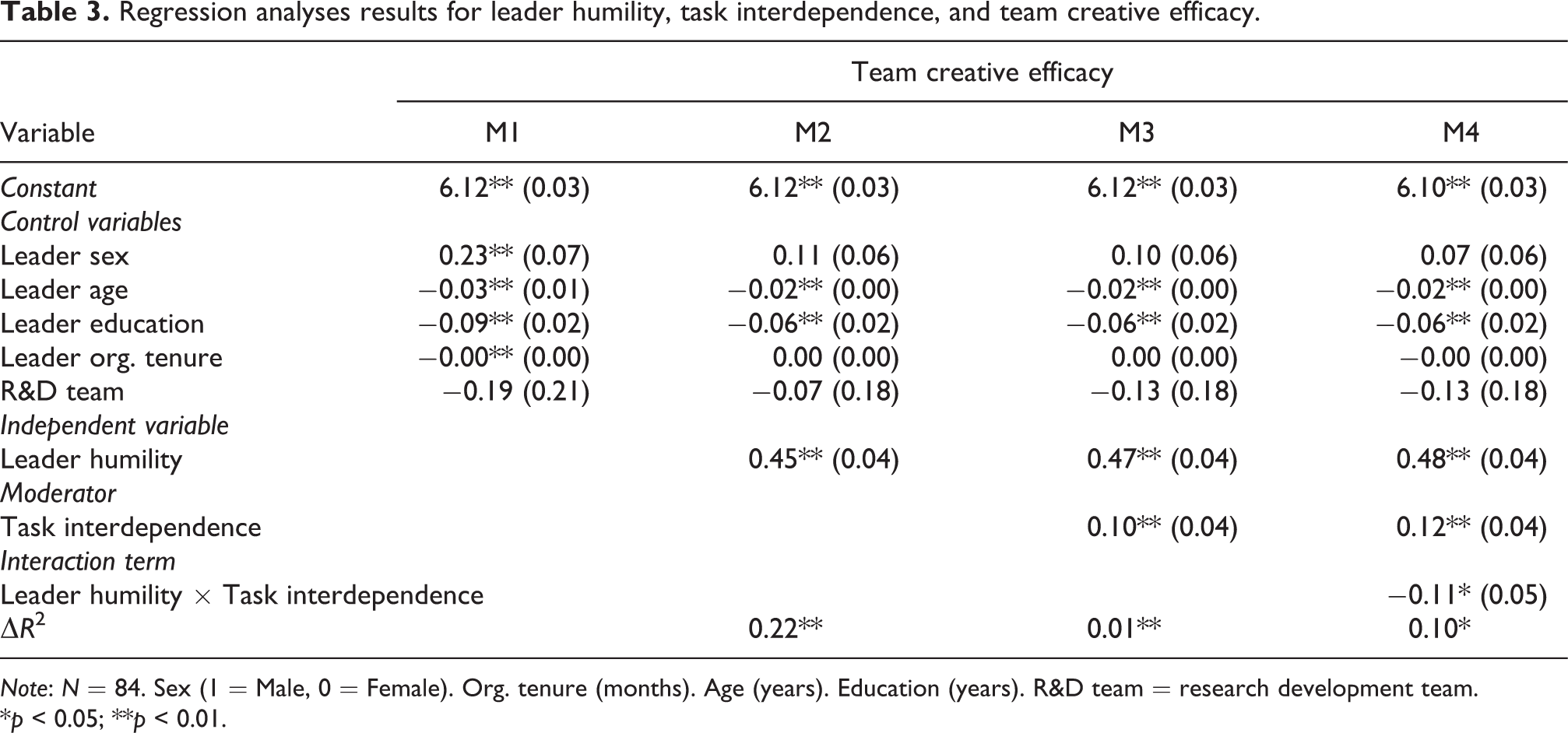
Note: N = 84. Sex (1 = Male, 0 = Female). Org. tenure (months). Age (years). Education (years). R&D team = research development team.
*p < 0.05; **p < 0.01.
Hypothesis 2 proposed that task interdependence moderates the positive relationship between leader humility and team creative efficacy such that the positive relationship becomes stronger when task interdependence is low rather than high. Leader humility, task interdependence, the interactive term, and control variables were mean centered. Since the moderating effect of task interdependence is on the team level, we first tested it by testing the null model with control variables (Table 3, M1). Second, we entered the independent variable, leader humility (Table 3, M2). We then entered moderator, task interdependence (Table 3, M3), and last, the interaction term (Table 3, M4). As Table 3 M4 shows, the estimated parameter of the interaction term is −0.11, p < 0.05. Figure 2 shows the results of a simple slope test. As illustrated in Figure 2, the relationship between leader humility and team creative efficacy is positive when task interdependence is low (b = 0.69, p < 0.01), with the slope becoming increasingly less steep when task interdependence is high (b = 0.49, p < 0.01). The findings show that task interdependence buffered the positive effect of leader humility on team creative efficacy, which supports hypothesis 2.
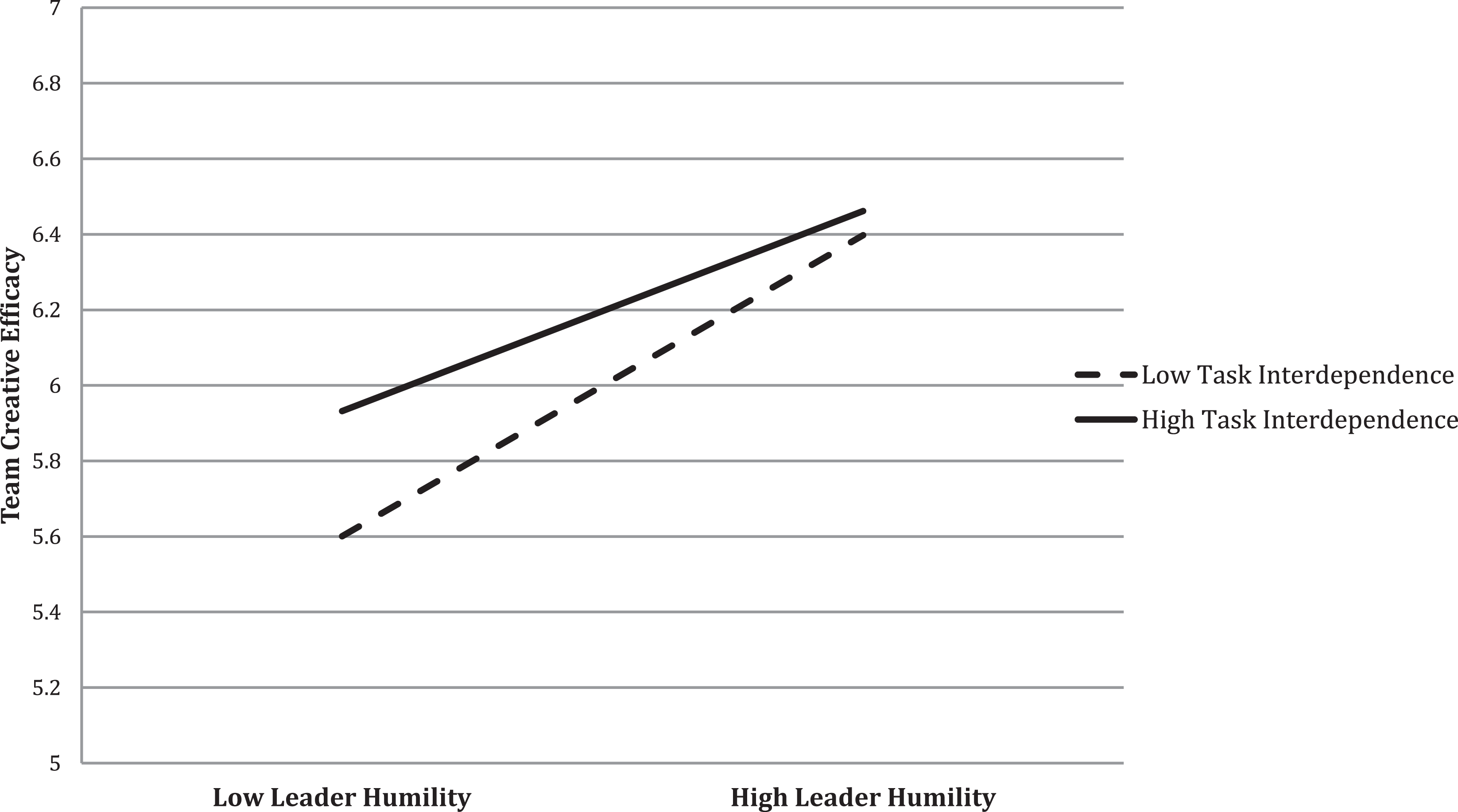
Interactive effects of leader humility and task interdependence on team creative efficacy.
To test the mediated moderation model proposed by hypothesis 3, we compared differences between the conditional indirect effects under different levels of task interdependence. As Table 4 shows, the difference between the conditional indirect effects of the path (Leader humility → Team creative efficacy → Team creativity) under high task interdependence (1 SD above average) and low task interdependence (1 SD below average) is significant (difference = −0.01, SE = 0.05, p = 0.045; 95% CI = [−0.21, −0.01]), thus hypothesis 3 is supported.
Summary of conditional indirect effects.
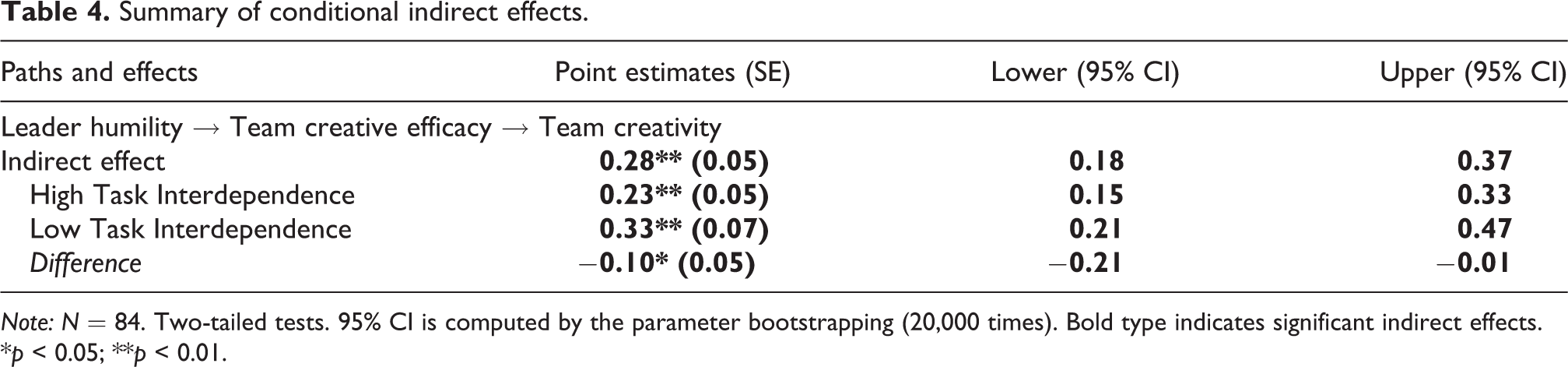
Note: N = 84. Two-tailed tests. 95% CI is computed by the parameter bootstrapping (20,000 times). Bold type indicates significant indirect effects.
*p < 0.05; **p < 0.01.
Discussion
We examined the mediated moderation effect of leader humility on team creativity. The findings indicate that leader humility is positively associated with team creative efficacy. Moreover, the positive effect of leader humility on team creative efficacy is buffered by task interdependence, such that the slope of a positive relationship between leader humility and team creative efficacy is steeper when task interdependence is at lower levels. Finally, team creative efficacy mediates the interactive effects of leader humility and task interdependence on team creativity. In other words, we provide empirical evidence to support the mediating effect of team creative efficacy on the interactive effects of leader humility and task interdependence on team creativity.
Theoretical contributions
The findings of this research provide some theoretical contributions and managerial implications. First, our study further demonstrates that the connotation of humility implies accurate rather than low self-evaluation (Morris et al., 2005; Rego et al., 2018; Tangney, 2000). Employing the SCT, our theoretical framework supports an understanding of humility that advances the argument that leader humility promotes, rather than undermines, team creative efficacy. In spite of the general consensus that leader humility is a nonaggressive personal characteristic, such humility produces a positive impact on collective efficacy by comforting, assuring, and encouraging employees that through social interactions, they can better integrate shared common goals and make efforts toward these goals. This mechanism may be particularly essential when the task is creativity relevant, because suggesting novel ideas is often risky and requires intrinsic motivation (Amabile, 1983). However, the mechanism is not limited to the team work outcome of creativity and may also be applied to any other task with high uncertainty. Future studies can look into the influence of leader humility on such collective outcomes.
Second, the moderating effect of task interdependence in our research model extends both the leadership literature and the SIT literature. The interactive effect of leader humility and task interdependence has shown that the outcomes of intra-team interactions are not determined merely by the strength of leadership but also by leader characteristics. As a personal characteristic, leader humility indicates a tendency of less leader involvement or leader initiation. With such a tendency, although the relationship between leader humility and team creative efficacy is positive, humble leaders become less efficient when task interdependence is high rather than low. Our findings further indicate that the influence of leader characteristics in integrating collective goals and coordinating collective actions may vary under different team social-interdependent settings. The buffering effect of task interdependence in our findings extends our understanding of leader humility and, as such, calls more attention to its limitation (Ou et al., 2018; Tangney, 2009).
Third, by studying the mediating effect of team creative efficacy, our study extends the SCT and indicates that collective efficacy can be influenced by a specific leader characteristic, such as humility. The majority of previous studies investigating antecedents of collective efficacy at the team level have focused on either team attributes, such as team knowledge, size, leadership climate, and group norms (Chen and Bliese, 2002; Cheng and Yang, 2014; Kim and Shin, 2015; Watson et al., 2001), or leader behaviors, such as leader empowerment, initiating-structure behavior, and the presence of servant leadership (Hu and Liden, 2011; Jung and Sosik, 2002; Taggar and Seijts, 2003). Nevertheless, our findings on the motivation influence of leader humility over team creative efficacy imply that a leader’s personal traits may play a more fundamental role in the formation of shared team confidence.
Practical implications
Both the processes and outcomes of activities that aim for creativity are associated with uncertainty. Such uncertainty might not only intimidate individual employees, it could also stop them from working together toward new ideas. According to our findings, leader humility can increase team creativity by elevating team creative efficacy. Therefore, it is better to appoint humble leaders to teams in which the collective confidence of employees on creativity needs boosting—for instance, a newly formed R&D project team. However, humility is not a panacea for collective confidence on creativity-related tasks. It is more productive to appoint a humble leader to teams with less task interdependence so that leader humility increases team creativity more efficiently. For instance, to appoint a humble editor in an environment where journalists can work independently most of the time, or a dean where faculty members only occasionally cooperate, could increase their shared belief in team creativity as opposed to appointing a humble leader to a marketing team or a consulting project where members must work closely to deliver the outcome.
Additionally, management could, if possible, redesign the task structure and make team members’ job less interdependent to maximize the positive influence of a humble leader on team creativity. A humble leader can maximize team creative efficacy and creativity-related work outcomes of the team as a whole by breaking a collective task into individual ones. For example, when a humble leader is organizing followers to design a new car, rather than working on the design as a whole from the start, the leader could ask one follower to work on the internal design and another to conduct mode design so that both employees have confidence that the ultimate product design can be creative inside and out and their collective creativity has been used most productively.
Limitations and future research directions
In spite of our contributions, this study should note a few limitations. First, although this article discusses the influence of leader humility on creativity, it is extremely limited to a meso-perspective within the context of a work team. The conclusion reached from this study might not be generalized to a higher managerial level (Kline and Boyd, 1991; Klein and Kozlowski, 2000). In our research paradigm, leader humility is often measured by the aggregation of employee perception; yet, employees may have different expectations of leader humility for managers at different levels. Thus, the influence of leader humility may vary according to employees’ shared schema for managers in different positions. For instance, frontline employees may be more motivated when their CEO is humble than when their team leader is humble. Meanwhile, a higher-level manager’s humility may influence an employee’s perception of lower-level managers as well. If a higher-level manager is humbler than the employees’ direct supervisor, it may undermine the supervisor’s effectiveness in forming team creative efficacy. With an enlarged study sample, the multilevel impact of leader humility could be tested at other managerial levels. In addition to the aforementioned research questions, future studies can answer the question of whether humility of top management has a positive influence on organizational creativity and if so, could such an influence cascade to lower levels.
Second, our data are collected from China, a nation of high collectivism and high-power distance, where humility is considered a more salient personal merit (Chung and Mallery, 1999; Earley, 1989; Ou et al., 2014). However, the relationship between leader humility and team creative efficacy may not be positive in certain cultures. For example, in an individualistic culture in which people are more egocentric and performance-oriented, humility may be interpreted as incompetence. Thus, future studies could either look into the possible “too-much-of-a-good-thing” effect of leader humility with data collected from a high collectivism culture or the possible negative effect of leader humility on team creative efficacy in a high individualistic culture. Additionally, preference for social interdependence may vary in different cultures and therefore, the buffering effect may also be attenuated in a culture where people are more self-sufficient.
Third, in our study, we only examined the moderating effect of task interdependence. Given that task interdependence is at most a fundamental contextual factor, future research is encouraged to explore other boundary conditions to enrich the literature with a better understanding of the potential limitations of leader humility. For example, dispersion of employee humility on a team, over an organizational culture, or within income gaps of a country could be investigated. In addition, the influence of leader humility and the contextual influence of task interdependence may not be static in a work team. As Wellman (2017) argued, groups form different patterns of interaction and schema of leadership influence early in the life of a group. With a longitudinal design, future study could also investigate the changes of our main effects and moderating effects on a work team over time.
Conclusion
Our study found that leader humility was positively associated with team creative efficacy. Task interdependence was found to decrease the slope of positive relationship between leader humility and team creative efficacy. Team creative efficacy mediated the interactive effect of leader humility and task interdependence on team creativity. Our study contributes to the literature of leader humility, the SCT, and the SIT. We call for more research on the effects of leader characteristics on collective creativity and boundary conditions of the effects during social interaction processes.
Footnotes
Data availability statement
The data that support the findings of this study are available on request from the corresponding author. The data are not publicly available due to privacy or ethical restrictions.
Declaration of conflicting interests
The author(s) declared no potential conflicts of interest with respect to the research, authorship, and/or publication of this article.
Funding
The author(s) received no financial support for the research, authorship, and/or publication of this article.
