







Abstract
Acceptance of ecotourism is still a topic of great concern for vulnerable regions. Often described as a credible response to the problems of natural resource reduction and the development of inappropriate practices that degrade natural landscapes, ecotourism has nevertheless often failed to live up to expectations due to a number of factors. These include the inefficiency of public policies, failure to encourage local initiatives and the difficulty of reconciling the interests of all stakeholders living or working within an ecotourism area. This article aims, through a qualitative study, to better understand the problems of accepting ecotourism by conceptualising it as a social innovation and then analysing the influence and role of various stakeholders in ensuring its acceptance. The results highlight obstacles to the acceptance of ecotourism, namely the shortcomings of public policies, the controversial situations that arise from interaction between the main players and the problems of participatory governance.
Introduction
A good number of researchers have focussed on studying ecotourism by demonstrating, in particular, that it provides solutions for the social, economic and environmental problems caused by mass tourism (Coria and Calfucura, 2012; Dekhili, 2018; Hunt et al., 2015; Jeffrey and Jalani, 2012; Leroux, 2010; Mbongui-Kialo et al., 2015; Su et al., 2014; Weaver and Lawton, 2007). According to Weaver and Lawton (2007), ecotourism contributes to the environmental protection and to the improvement of the living conditions of communities through its capacity to transform natural and cultural resources into a sustainable competitive advantage for those territories which accept it (Leroux, 2010; Masberg and Morales, 1999). It appears to encompass features that can have a positive impact on the economic, political and social aspects of countries that see it as an anchorage point, favourable to economic growth (Clifton and Benson, 2006). Lozato-Giotart et al. (2012) explain that ecotourism can play a crucial role in the socio-economic development of a territory by creating a lot of jobs and promoting the development of infrastructure at both local and national level.
Although several studies have brought to an understanding that ecotourism can have a positive impact on the environment and on rural communities (Coria and Calfucura, 2012; Masberg and Morales, 1999; Weaver and Lawton, 2007), they do not, however, enable to identify and understand the factors or elements likely to explain the acceptance or rejection of ecotourism in territories where the wide variety of stakeholders constitutes an obstacle to understanding collective initiatives. Although literature does indeed indicate that several stakeholders are aware of the need to protect environmental heritage (Pupion, 2010) and underlines the importance of setting up a model for participatory governance , few studies have looked at the question of acceptance of ecotourism in terms of social innovation (SI) whose success depends on the behaviour of the various players who are influenced by, or have an influence on the dynamics of a territory (Mitroff, 1983). One of the few studies that have attempted to look at SI in this context did not directly focus on ecotourism but rather on the SI that it generates within specific protected territories (Mbongui-Kialo, 2020). To fill this gap, this paper draws on stakeholder theory to develop the argument that ecotourism, which is a form of tourism that has low environmental impact and is largely beneficial to the host populations (Gagnon and Gagnon, 2006), is itself an SI as it blurs the traditional boundaries between the social, economic and environment dimensions. This, in turn, allows to better understand the problems of accepting ecotourism by conceptualising it as SI and then analysing the influence and role of various stakeholders in ensuring its acceptance.
According to Van der Have and Rubalcaba (2016), SI refers to the design and implementation of new solutions that create social value and aim to improve the welfare and wellbeing of individuals and communities. Social innovation is also the result of a collaboration between different actors, interpersonal activities or social interactions to meet one or more common goals (Correia et al., 2018). Research suggests that it is not possible to design and implement SI effectively without the involvement of significant stakeholder groups (Murawska, 2019). Considering ecotourism as an SI allows a study of its diffusion within a social body, which can provide keys for understanding the brakes or reluctance, influencing factors and the players whose role could be a driving force. This article aims, therefore, to take a holistic approach to ecotourism by conceptualising it as an SI. By doing so, this article seeks to go further and provide not only the reading of a social phenomenon, making it possible to better understand it, but could also provide keys for actions and support to better take into account the role of players in the process of acceptance or rejection of this new form of SI. The time when the State alone takes on the role of great territorial architect is over (Pupion, 2010).
Today, the management or governance of ecotourism territories is largely dependent on the degree of collaboration of the various stakeholders, and relies more on a process of interaction and negotiation between a wide variety of players, whose objectives are just as varied (Donaldson and Preston, 1995; Freeman, 1984). In this context, stakeholder theory seems to be an important element in developing SI, allowing a better understanding of the nature of the challenges, the needs of beneficiaries as well as in analysing the diffusion process of ecotourism. Indeed, stakeholder theory offers a framework for understanding and evaluating an SI’s relationship with other actors in its ecosystem (Phillips et al., 2003). Stakeholder approach has been applied in many areas such as rural development (Simmons 1994), public management (Litvin 2005) and tourism development (Aas et al., 2005). In this research it provides a means of blending together SI with ecotourism (Mbongui-kialo, 2020). Although this is not a new focus of study in academia, it was found that research on the subject is still fragmented. However, through different analyses presented by a great deal of authors (Correia et al., 2018; Gabor, 1970; Gurviez and Sirieix, 2013; Mbongui-Kialo, 2020; Taylor, 1970; Van Der Have and Rubalcaba, 2016) and the statements of other authors, it was possible to observe that the common concepts around SI are those that refer to the design and implementation of new solutions which implies conceptual, process, product or organisational change, that meet an objective or a need of a certain group of people, therefore presenting itself as a way to mitigate social problems and as an essential factor for development and social equity and for collective well-being (Taylor, 1970; Bouchard, 1999; Gurviez and Sirieix, 2013; Van Der Have and Rubalcaba, 2016). Thus, this paper aims to help shed light on the problems of accepting ecotourism within a protected territory. Based on a predominantly exploratory qualitative study consisting of 33 semi-structured interviews with several stakeholders, it seeks to answer the following question: how does the conceptualisation of ecotourism as an SI help to better understand and analyse the problems of acceptance or rejection of ecotourism?
The study is structured as follows: the first part focusses on a review of the literature on ecotourism and SI. More specifically, this paper proposes to conceptualise ecotourism as an SI so as to analyse the dissemination process of SI’s and the influence of stakeholders at an ecotourism level. In the second part, the paper presents the research methodology which is based on a predominantly exploratory qualitative study carried out within a national park in Gabon. In the third part, the main results are analysed and interpreted so as to understand the meaning the players give to their actions in the territory studied. Finally, the fourth part discusses the main results with regard to the conceptual and practical interest of this study.
Theoretical research framework
Over the last two decades, the term ‘stakeholder’ has become one of the most frequently used concepts in the management literature (Pajunen, 2011). On the one hand, literature refers to stakeholders when they are interested in the external environments of firms and other organisations (Rowley and Moldoveanu 2003). On the other hand, there is an extensive body of literature aiming at creating and criticising stakeholder theory. This stream of research can also be seen to include various considerations of how and why stakeholders affect, or are affected by, the actions of organisations, how stakeholders should participate in the innovation diffusion (Mbongui-Kialo, 2020), and how stakeholders can or should influence the organisations or the success of an innovation (Rowley and Moldoveanu 2003). Indeed, while there are several arguments concerning what stakeholder theory is, or is not, the existing body of research has verified that stakeholders matter (Laplume et al., 2008). Owing to the fact that stakeholder theory can focus on the interest and wellbeing of those who can assist the territory in achieving their objectives (Phillips et al., 2003), the theoretical part of this article enables not only to understand that ecotourism can be conceptualised as an SI but also to analyse the literature on SI dissemination so as to better understand the failure or success of ecotourism with regard to the influence of the various stakeholders (Freeman, 1984; Donaldson and Preston, 1995).
Ecotourism, a true social innovation
The notion of SI is experiencing renewed attention both from social and solidarity economy organisations, from public institutions and from academics. It has its uses in times of economic, social or environmental crisis, having emerged at the turn of the 1970s to designate the first wave of experimentation (Gabor, 1970; Taylor, 1970). Even if an SI can have several definitions, the literature seems to agree on the fact that it designates new ways of ‘doing things’ with the objective of meeting social needs (Taylor, 1970 cited by Gurviez and Sirieix, 2013). Often perceived as a social practice with the main aim of transforming society on a larger scale (Cajaiba-Santana, 2014), an SI makes it possible to propose solutions in the fight against economic and social inequalities (Gabor, 1970). According to Bouchard (1999, p.2), SI is presented as a new practice developed to improve a situation or solve a social problem and which has found a taker at the level of institutions, organisations and communities. It is a real catalyst for change likely to participate in improving the living conditions of abandoned communities through initiatives where profit is not the prime objective.
A more careful analysis of the literature shows that the SI issue can be approached through three main principles (Béji-Bécheur and Fosse-Gomez, 2004; Bouchard, 1999; Gurviez and Sirieix, 2013). First of all, it can manifest itself in the development of new responses to new or poorly satisfied social needs under current market conditions. It then provides a response to societal needs that are scarcely met or not at all. It then refers to a governance model that involves the participation and the cooperation of all stakeholders, including those who experience problematic situations that the SI intends to resolve (Gurviez and Sirieix, 2013). Finally, it highlights a strong territorial anchoring which makes it possible to develop local initiatives and to mobilise a wide variety of local players (companies, local communities, public authorities, associations, etc.) to boost economic and social development of that territory. These three main principles bring about a break in how retail businesses operate with them taking into account not only economic issues but also social and environmental issues. They also highlight a desire for social transformation and an aspiration for change, articulated at several levels, that is, individual, organisational and territorial levels (Cloutier, 2003). As such, the SI shares the same desires as ecotourism, whose objective is to participate in environmental protection, the improvement of living conditions in communities and territorial enhancement (Masberg and Morales, 1999: p.289).
Ecotourism appeared in the 1980s thanks to the Mexican architect Héctor Ceballos-Lascuráin (Ballantyne and Packer, 2013) and is the direct consequence of an awareness of the ecological (Coria and Calfucura, 2012) and social issues of local populations. Ecotourism helps preserve and conserve the physical characteristics of the destination environment, provides economic opportunities for local communities and avoids unfavourable social and cultural impacts (Clifton and Benson (2006); Flagestad and Hope, 2001). Like any new practice, ecotourism has brought about considerable changes in the perception and organisation of mass tourism. Ecotourism sets out to differentiate itself from tourism with consequences that seriously harm the environment (Jeffrey and Jalani, 2012; Leroux and Pupion, 2014; Mbongui-Kialo et al., 2015) and aims to promote travel and movement within natural and unspoiled areas (Masberg and Morales, 1999: p.289), promote visitor education, generate funds for the conservation and well-being of host populations and directly (or indirectly) support the economic development of the territories visited (Leroux, 2010; Jeffrey and Jalani, 2012). It is essential to maintain a balance between economy, environment, culture and local traditions. According to Leroux and Pupion (2014, p.72), ‘it must enforce a certain equity in the distribution of resources and benefits, and in the consideration of its impact’. In this sense, it brings about a break in how retail businesses operate with them taking into account not only economic issues but also social and environmental issues. In a way, it is a new form of SI whose objective is to provide a social answer to the problems for which the market logic remains ineffective. Approaching the SI issue from a fair trade perspective, Gurviez and Sirieix (2013) identify three SI characteristics: (a) an innovative or non-standard character; (b) the general objective of responding to social needs; and (c) cooperation between different player networks. These three criteria meet the expectations of ecotourism more broadly as presented in the literature, that is, improvement of the living conditions of local populations (Moulaert et al., 2005), awareness of ecological (Coria and Calfucura, 2012) and social issues of local populations (Masberg and Morales, 1999), change in the rules of mass tourism and involvement of all stakeholders (Van der Yeught, 2009). Ecotourism leads to the more specific concept of stakeholders that are defined as groups who can influence or are influenced by a project (Harrison et al., 2010). Taking into account stakeholders theory in this study seems to be essential to understand the success or the failure of SI (Jones et al., 2018), and also to focus on ecotourism stakeholders with different interests and power (Donaldson and Preston, 1995; Freeman, 2010; Amiri et al., 2022). As such, stakeholders are often not completely passive but are co-creators of value and participate (or not) in the diffusion of ecotourism. Like other forms of SI, ecotourism also offers the possibility of combatting economic inequalities by aiming to develop a new social arrangement or a new balance (Gabor, 1970). It thereby constitutes a possible response to the problem of environmental degradation and that of the pauperisation of rural communities, often overlooked by public authorities (Flagestad and Hope, 2001; Jeffrey and Jalani, 2012; Mbongui-Kialo et al., 2015; Dekhili, 2018).
Making social innovations known is a complex process
Making innovations known is generally defined as ‘the process by which, as time passes, an innovation is communicated to members of a social system, through certain channels’ (Rogers, 2003: p.5). According to Gatignon and Robertson (1985), the work of dissemination tries to explain the flow of information, ideas, practices, products and services within cultures or even markets or market segments. In this way, an innovation spreads across society following a process which affects different player categories, from the most enthusiastic to the most reluctant (Rogers, 2003). For Denis et al. (2002), there is an accumulation, often nebulous, of cultural, social and political factors that accompany the process of dissemination and acceptance of an innovation. Although acceptance of technological innovation is strongly marked by the role of entrepreneurs, market launch and product standardisation, the SI offers another approach that invites to revisit the forms of ownership by players and institutions. In this way, acceptance of SI can be achieved through groupings of players, by the promotion of inspiring practices or by the support of public authorities, all at different levels. For Béji-Bécheur and Fosse-Gomez (2004), this clearly illustrates the difficulty for a new concept to emerge and spread when calling into question existing social and economic standards. Indeed, the different players often refuse to adopt an SI that would lead to a change in lifestyle. In highlighting the major role for co-optation strategies in handling controversies between stakeholders which block the dissemination of an SI, Mbongui-Kialo (2020) makes the point that there can be no dissemination without a proactive approach. However, despite providing interesting results, his study is limited to SIs resulting from ecotourism, hence the interest of adopting a broader approach that will enable ecotourism itself to be seen as coming under the definition of an SI.
When seen as an SI, ecotourism becomes a new approach to the tourism industry which combines environmental protection, sustainable development and the participation of local communities in projects which enhance the areas visited (Lequin, 2003). Indeed, to facilitate acceptance by all stakeholders, it is essential that the values it represents are compatible with all stakeholders’ values. To be effective, an innovation must be rooted in values that legitimise its acceptance (Denis et al., 2002). It is not enough to look simply at the potential advantages that it represents for the user or the recipient but also to ensure that an analysis of the obstacles to its acceptance makes it possible to unify all stakeholders. In other words, it is also necessary to examine the implications of ecotourism for the various stakeholders who will have to collaborate in its implementation in the field. Following this reasoning, some players recommend combining interpersonal communication with media communication so as not to merely publicise a brand name but promote an SI and its various advantages and thus facilitate acceptance (Béji-Bécheur and Fosse-Gomez, 2004).
Insofar as ecotourism constitutes a new approach to the tourism industry which combines environmental protection, sustainable development and participation of local communities, its acceptance as an SI is achieved through a complex process which involves a variety of players. In this context, the fate of ecotourism will depend not only on the intensity of the controversies but also on the active participation of all stakeholders and their willingness to make changes in the reality they perceive. This is the notion of incentive that Callon (1986) spoke of and which is not limited to partners only but to all the players involved in the controversies arising from the SI. The dissemination, but above all the acceptance of the SI, will therefore result from collective actions and from an increasingly broad interest which may even have an impact on the governance of ecotourism territories.
Territorial governance and the influence of stakeholders
Past research works consider anyone to be a stakeholder if they fulfil any one of the following three criteria (1) the actor must have the potential to be positively or negatively affected by the activities of an organisation and/or is concerned about the organisation’s impact on their or others’ well-being; (2) the actor can withdraw, or grant resources needed for the organisation’s activities; or (3) the actor is valued by the organisation’s culture (Freeman, 1984; Rowley and Moldoveanu 2003; Jones et al., 2018). In line with these authors, a stakeholder is considered, in this paper, as a person or an individual who can affect or be affected by the introduction of ecotourism in the territory. In this context, the stakeholders must be carefully identified because each group has its own interests and duties, so the diffusion and the acceptance of ecotourism cannot be achieved without any of them (Byrd 2007). According to Harrison and John (1994), the nature of the relationship between all the stakeholders can vary owing to the fact that each stakeholder group has its own set of expectations, needs and values. Focussing on sustainable tourism, Sassenberg (2009) indicates that the sustainable tourism development is contributed by four stakeholders: local community, business organisation, authorised governance and research institute. The idea of collaboration between actors (Byrd, 2007) can also be applied in developing regions although the study of Aas et al. (2005) in Luang Prabang (Laos) showed that promoting and maintaining the collaboration of a great deal of stakeholders in a developing region was a real challenge, because their interests and benefits are hardly met at the same point (Sinh et al., 2016). Ecotoursim or any other kind of tourism development project is usually implemented by the top group (public administrations) whose decisions are always different from those of the bottom group, the community’s decisions (Sinh et al., 2016)). From another perspective, the refusal to take into account the interests of other stakeholders often leads to conflicts and may be the cause of the failure of certain initiatives and SI in developing countries. From the ecotourism perspective, arguably, the theory’s crucial role of Freeman (2010) is the ability to recognise its key concepts in which the first is the need to be conceptualised by the top group in order to fully appreciate all the stakeholders’ interests in the acceptance of the ecotourism. Stakeholder theory (Freeman, 2010) has been utilised to help explain actors’ perceptions and attitudes towards ecotourism and its impacts. Usually, only the most obvious stakeholders, institutional stakeholders (public authorities, international institutions, etc.), economic stakeholders (the various economic operators) and finally ethical stakeholders (ethical pressure groups such as associations, NGOs, etc.) are taken into account rather than the various types of groups which affect or are affected by the ecotourism service. However, a helpful stakeholder map, which is adapted from Freeman (2010) for an ecotourism initiative, is constructed as follows (Figure 1): Ecotourism stakeholder map (adapted from Freeman (2010).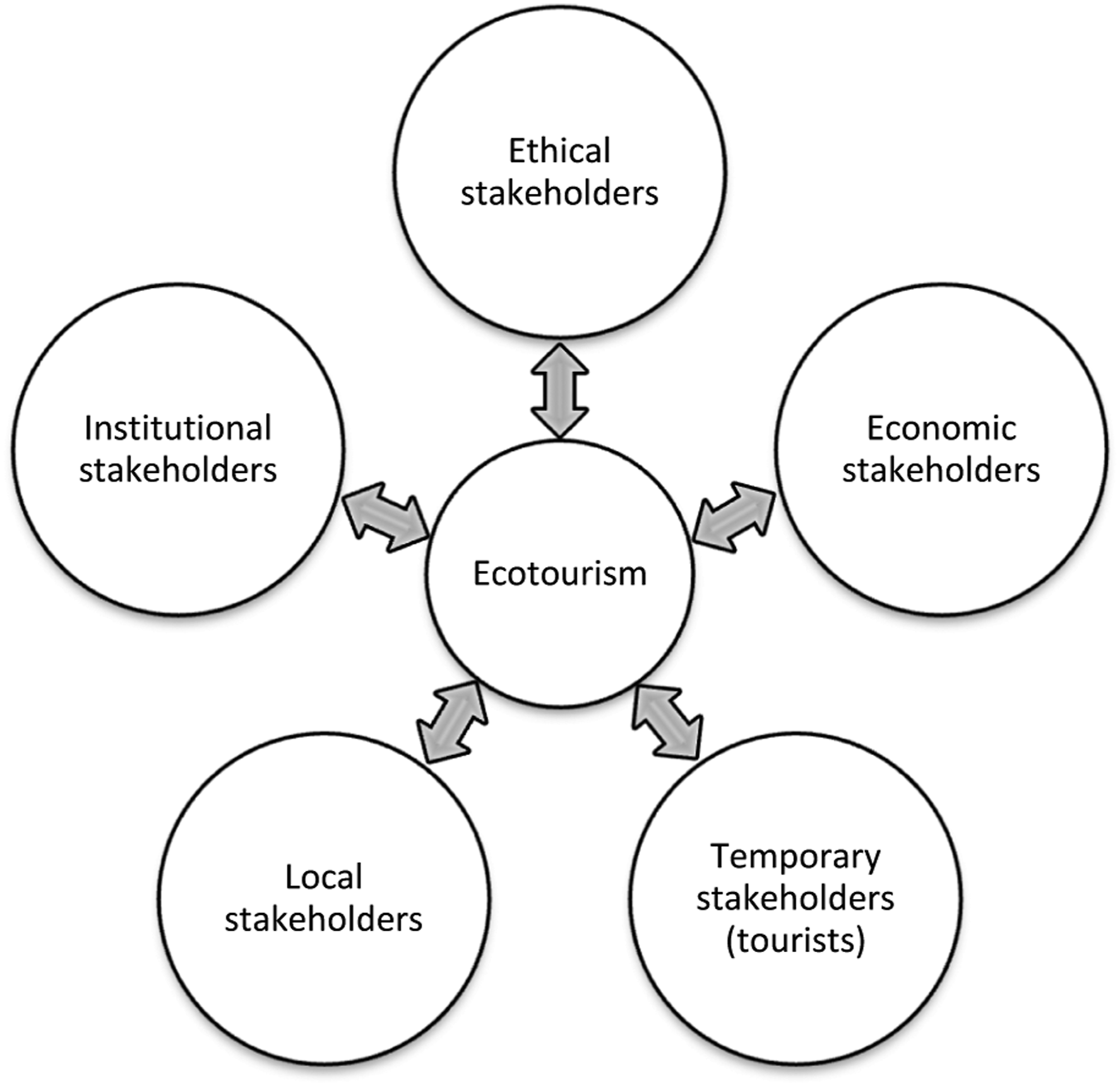
Donaldson and Preston (1995) distinguish three dimensions (descriptive, instrumental and normative) which provide a deep understanding of the notion of stakeholder. In the case of ecotourism, the descriptive dimension makes it possible to describe and explain the players’ behaviour as well as the relationships they maintain between themselves and with their environment. It not only enables a description of how stakeholders influence or are affected by the decisions that are taken (Freeman, 1984) but also describes the way in which players’ interests are taken into account, because their values, their beliefs and their lifestyle constitute important information for anticipating and predicting their individual and collective behaviour (Donaldson and Preston, 1995). The normative and instrumental dimensions occupy an important place in the analysis of Donaldson and Preston (1995) since they make it possible, on the one hand, to identify the moral or philosophical principles which justify taking into account players’ interests and, on the other hand, enable to understand the nature of the connections existing between the different forces (e.g. between associations and local populations or between economic operators and NGO’s). Taking these three dimensions into account seems essential for a better analysis of the conflicting interests of the forces involved, and consequently to offer an interesting framework for understanding the mechanisms leading to acceptance of ecotourism.
The main attraction in the national park is the sea turtle, and many visitors come to admire it and witness its incredible nesting. A variety of activities (sport fishing, beach walking, camping, swimming, surfing, etc.) have emerged around this marine reptile and attract some 300 tourists every weekend (Mbongui-kialo et al., 2015). Several stakeholders often with divergent interests are involved in this national park, whose wildlife and plant resources are today under threat. It is a fragile territory, victim of human activity and the increasingly massive arrival of tourists is deeply damaging to the integrity of a territory that has remained very rural to this day. This is a population that is often disadvantaged due to unemployment among young people and a lack of infrastructure. The Pongara National Park suffers seriously from population decline, unemployment and constant degradation of the natural environment (degradation of beaches, endangered wildlife, disrespect of certain local beliefs, etc.). The public authorities (the State and the authorities responsible for managing the national park), which are nevertheless supposed to play an important role in the governance of the national park, do not seem capable of galvanising all stakeholders around ecotourism.
The national park seems to be the victim of intensive tourism which undermines the integrity of the sites visited for various leisure activities (Leroux and Pupion, 2014). This results in worrying consequences for the territory, that is, ecotourism fails to live up to expectations due to a number of factors (Coria and Calfucura, 2012; Hunt et al., 2015) of which one among the most important of which is the problem of governance with the consequential difficulty of gaining acceptance of ecotourism and therefore of disseminating it within the Pongara National Park. For example, the recurrence of conflicts leads a minority of people (generally the State and economic operators) to grab all the benefits generated by ecotourism. This situation clearly shows that beyond the strategies of the players involved, the national park is faced with a multitude of problems: lack of support from all stakeholders, absence of a qualified workforce, lack of mechanisms for an equitable distribution of economic benefits and land tenure insecurity (Coria and Calfucura, 2012). Further, despite the interest of tourists in ecotourism, most of them believe that ecotourism imposes too many constraints. For François-Lecompte and Prim-Allaz (2011), tourists are looking for authenticity, simplicity, encounters and contact with nature. Thus the promotion of ecotourism must not be solely through arguments linked to sustainability but also to pleasure, authenticity and associated experiences. Ecotourism must rhyme with pleasure and not with effort. According to Pupion (2010), tourist destinations base their competitive advantage on the exploitation of natural resources that they promote through the activities offered to tourists. Therefore, it is important for the promoters of ecotourism activities to develop the natural and cultural capitals and, facilitate their enjoyment by the tourists, while preserving them from destructive environmental practices. Taking these elements into account can have a positive impact on governance of the national park (Fiorello and Bo, 2012; Van der Yeught, 2009). Indeed, based on the example of the Cinque Terre National Park in Italy, Van der Yeught (2009) shows that taking into account all stakeholders in a governance system will promote the long-term success of an ecotourism approach. The establishment of participatory governance therefore seems to be an important element in laying the foundations for a balance between the reasoned opening of resources and the sustainability of ecosystems while contributing to the economic development of Pongara National Park and to the well-being of the local communities (Leroux, 2010).
Research methodology
Qualitative research methodology is considered to be suitable when the researcher, either investigates a new field of study or intends to ascertain and theorise prominent issues (Corbin and Strauss, 2008). For the study of SI acceptance problems, the present research chose a unique case study built on a predominantly exploratory qualitative approach (Yin, 2003). According to Hoang and Antoncic (2003), this research calls for a qualitative approach because it allows the study of complex phenomena. This is particularly the case with this study, which seeks to understand the influence of different stakeholders in the process of accepting SI. In addition, the qualitative research enabled to collect data from individuals and study their perceptions, beliefs and attitude towards ecotourism (Riley and Love, 2000; Yin, 2011). In order to get an insight into the complexities of the process of accepting SI, the paper employed a qualitative approach whose data collection was made possible through semi-structured interviews. Following the recommendations of Huberman and Miles (1991), the article started from the theoretical framework in order to provide the essential questioning necessary for the preparation of the qualitative analysis. It is for this reason that a review of the scientific literature was conducted, whilst highlighting two main limitations: the majority of studies do not consider ecotourism as an SI even though it has all the characteristics, and they do not specifically address issues related to stakeholder influence set against an SI in protected territories.
r esearch context
The study is conducted in Gabon which is one of the smallest and least populous countries of Africa, but retains a large area of African rainforest. Most of the population of 1.7 million is urban, approximately 85 of the forest area remains intact, whilst deforestation rate is around 0.1% annually (FAO, 2010). Gabon is also an oil exporter, and has one of the highest Gross Domestic Product (GDP) per capita in Africa. It has experienced strong economic growth over the past decade, driven in particular by oil and manganese productions. On average, over the past 5 years, the oil sector has accounted for 80% of exports, 45% of GDP and 60% of budget revenue. However, the country is facing a decline in its oil reserves. The Gabonese government has therefore based its new strategy on economic diversification. This situation has led the rulers to create 13 national parks to develop ecotourism and minimise global warming. Among these parks, is the Pongara National Park (PNP) located not very far from Libreville (the political capital). Pongara National Park covers an area of 929 km2 and combines forest, savannah and a sweeping expanse of beautiful wild beaches. It is a breeding site for Leatherback sea turtles. In fact, hundreds of leatherback turtles trundle up the beach to lay their eggs between November and March, this is one of the best places in the world to see them. Pongara National Park is an insightful and ‘particularly revelatory’ case (Eisenhardt and Graebner, 2007) due to the fact that it is a fragile territory and the arrival of massive tourists profoundly damages its integrity. Several stakeholders with divergent interests intervene in this national park in which the fauna and the flora are now threatened. Pongara National Park is also the victim of rural exodus, unemployment and environmental degradation (beach degradation, endangering wildlife, disregarding certain local beliefs, etc.). There is need for intervention in this area where government and commercial enterprises are not present. Aware of this, institutional stakeholders (State officials and managers of the national park) felt the need for social projects to enable the park and its residents improve the living conditions of local communities by introducing Ecotourism.
D ata collection
Data collection was made possible through thirty-three (33) semi-structured interviews administered face-to-face with several players operating in this national park. Eight (8) of the interviewees were members of local communities and familiars with the problematic of sustainability and eco-tourism. Three (3) were experienced members of local association who had a holistic view of problems faced by all the stakeholders. Three (3) were members of NGOs supporting eco-tourism activities and the well-being of local communities within the national park. Four (4) were public administration members who are supposed to take care for those in need and develop ecotourism in order to minimise global warming consequences. Seven (7) were local businesses operating in the tourism industry. And eight (8) of the interviewees were tourists who come to visit the beautiful and natural environment of PNP. The in-depth interviews were conducted on the issue of Ecotourism and its acceptance, in order to have a broader view of stakeholders’ practices. This selection of interviewees allows to obtain insights about the role of Ecotourism in PNP from multiple perspectives. The 33 interviews varied in duration but averaged 45 min. Each interview lasted between 30 and 60 min. They were administered face-to-face. Thanks to the ability to clearly structure questions, listen attentively (Clough and Nutbrown, 2007) and encourage the interviewees to talk freely, the researchers were able to collect the desired information. Typically, the interviews were conducted in situ.
Data analysis
All interviews were audio-recorded and transcribed verbatim to facilitate the qualitative analysis process (Hillman et al., 2018). On completion, interview transcripts were double-checked for accuracy and completeness of the interview record and copies of written records were sent to respective interviewees for comment or correction, as suggested by Harding (2013). Any personally identifiable information was removed, and participants’ names were replaced by pseudonyms to preserve their anonymity. The transcripts were not returned to participants for comment or correction. Grammatical imperfections were retained at this stage to reflect their voices. Each transcript was read several times in the familiarisation process while simultaneously listening to the audio recordings that helped clarify ambiguities. Analysis was ongoing and iterative as it was undertaken concurrently with data collection, which allowed to check for saturation. A generic coding was adopted: an intermediate coding system compared to conceptual and inductive coding. More exactly, the transcriptions were coded based on partly pre-defined and partly emerging themes. Following the approach developed by Huberman and Miles (1991), data analysis was carried out in the following stages: data collection, data reduction, data presentation, development and verification of conclusions. Many round trips were made between the different stages. Finally, the interpretative approach was favoured for this research, because it appeared to be the most appropriate for meeting research targets (Perret and Seville, 2003).
Presentation and analysis of the results
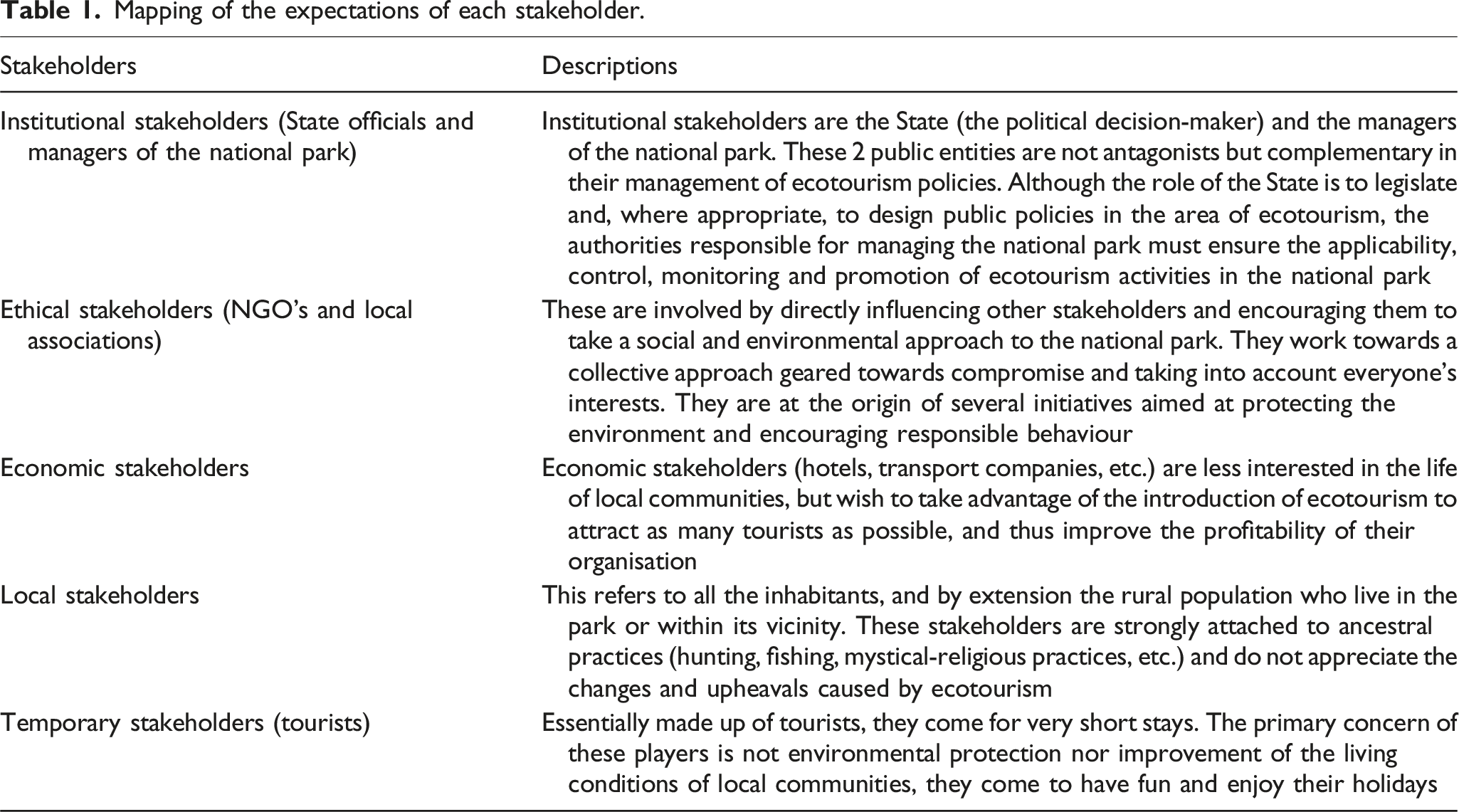
Mapping of the expectations of each stakeholder.
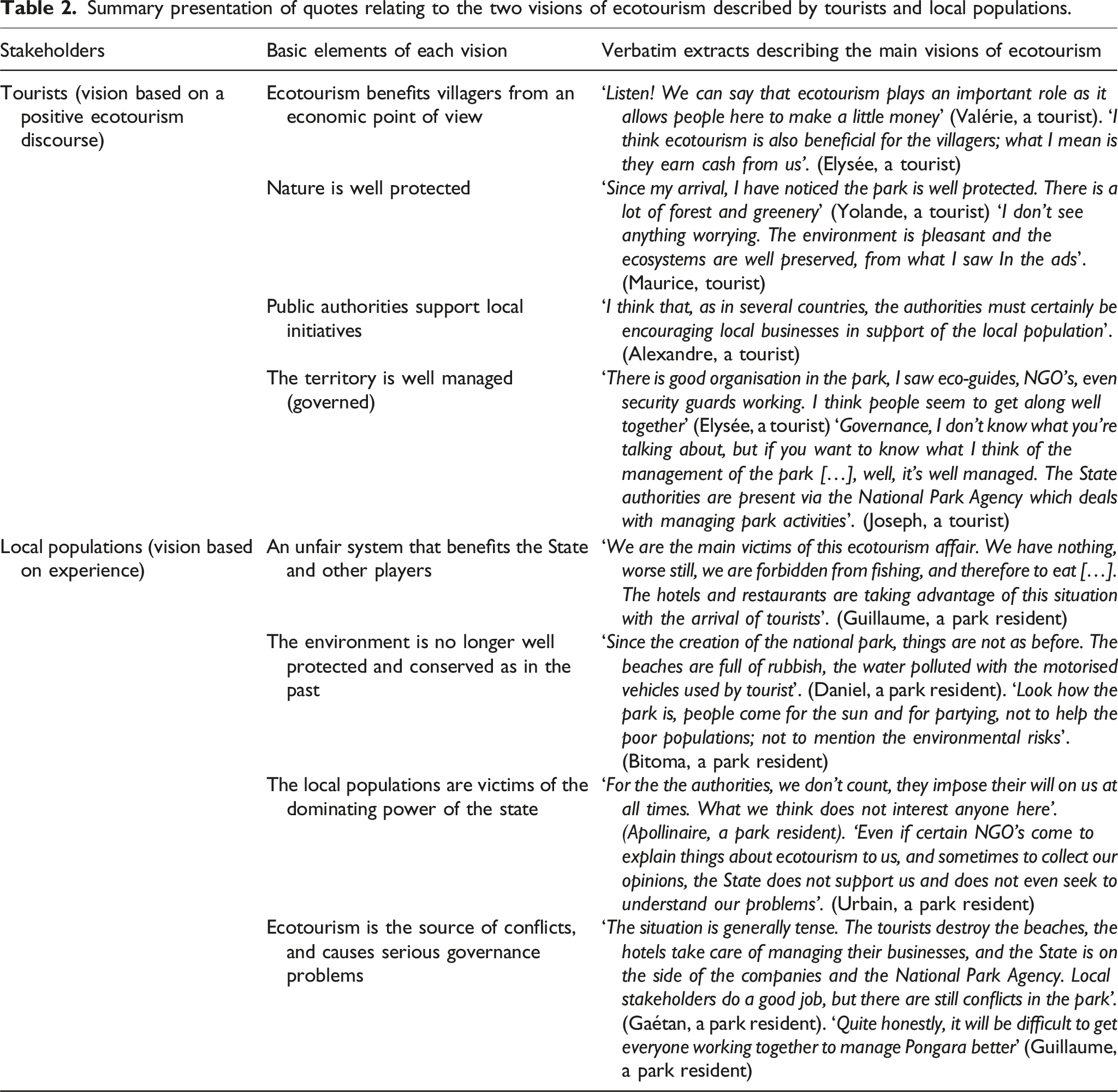
Summary presentation of quotes relating to the two visions of ecotourism described by tourists and local populations.
Awareness campaigns remain limited, but threatening messages aimed at local communities are widespread. Participatory territorial governance (Leroux and Pupion, 2014), particularly at local level, still seems underdeveloped. This weakness means there are not enough positive results that would lead to an acceptance of ecotourism. Analysis of what respondents said not only helps to better understand the failure of ecotourism but also to identify governance issues in the light of stakeholders’ divergent interests. Non-governmental organisations and local associations deplore the negative impact of human activities and multiply initiatives promoting acceptance of ecotourism. With this in mind, several initiatives have been put in place to help control the negative impacts related to attendance, facilitate the construction of the ecotourism offer that is safe for the park, support project leaders at local level and encourage initiatives aimed at training local communities. As a result the ethical stakeholders have initiated ‘solidarity actions’ aimed at encouraging economic and local stakeholders and tourists to participate in the preservation and enhancement of animal, plant and cultural diversity. For example, they have invited economic stakeholders to awareness campaigns to protect the marine turtles that come to nest in the park. The aim of this invitation was to promote responsible behaviour towards sea turtles, which are regularly victims of the irresponsible behaviour of certain tourists who do not hesitate to approach turtles so as to stroke them. With this awareness-raising initiative, they also wanted to encourage economic stakeholders to integrate issues of fauna and flora protection in all the design phases of tourist offerings. The initiatives put in place do not only concern the economic operators. Tourists are regularly solicited and invited to get involved, on a voluntary basis, in a concrete way in actions to preserve and restore biodiversity. Getting involved is an eco-responsible approach where they rediscover the natural heritage through ‘protective’ eyes: ‘… it feels weird to be in the shoes of a person who protects the environment. It’s super nice to share that with people you don’t necessarily know… […], I think that from now on I will pay attention to what I do during the holidays’ (Elysée, tourist).
The multiplication of ‘unifying’ initiatives can, if adopted by a large number of stakeholders, promote acceptance of ecotourism (Leroux and Pupion, 2014). These initiatives have made it possible to come to compromises by erasing the main points of disagreement, in particular with certain economic and local stakeholders. Bringing together some of these two categories of stakeholders has made it possible to reintegrate people who have been excluded from employment for several years, and to contribute to environmental protection. This is what Albert (member of a local association) seems to explain: ‘People come to thank us all the time, because many people lost their jobs a long time ago. Our initiative is very very helpful…’. The end result is that these initiatives provide the population with an income while offering tourists a friendly atmosphere. There is therefore a kind of reconciliation between the need to encourage local initiatives and the need to protect the natural environment. However, even though these initiatives are generally well received, it should be noted there is not always a favourable response from certain economic operators and even certain tourists. This is what Hughes (a civil servant at the forestry economy ministry) points out: ‘there are still unfortunately a good number of companies and especially tourists who do not respect what I call the philosophy of ecotourism’. Failure to respect the principles of ecotourism is likely to pose a governance problem given the divergent interests of all stakeholders. As a reminder, let us recall that the participation of all stakeholders in a governance system promotes the success of ecotourism (Van der Yeught, 2009). In this sense, making ecotourism a part of a governance system means the stakeholder networks can be seen as influencing factors for decisions likely to promote territorial development (Lequin, 2003). The respondents' comments go against the principles of governance because most of them have noticed an upsurge in acts and behaviours considered irresponsible and whose negative consequences deeply affect natural resources: ‘This park is experiencing enormous problems due to human activity. […]. Tourists and hotel professionals are those mainly responsible for this deplorable situation’ (Marielle, head of a local association). This situation is not limited just to tourists and economic players, not all the forces involved are playing the game, primarily because of the divergence of their points of view. Many different stakeholders are blaming each other for the problems that plague the national park: ‘The water and forestry officers and hoteliers accuse us of practising illegal hunting and fishing […], that is to say that for them it is we (the villagers) who are the outlaws…’ (Apollinaire, a park resident). Host communities are harmed because they have the impression that ecotourism, whose main mission is above all to meet social needs (Gurviez and Sirieix, 2013), does not contribute to improving their living conditions but rather results in degrading them further. This situation results in the emergence of a conflictual situation which does not favour collaboration nor collective actions likely to lay the foundations for participatory governance. This conflictual situation is accentuated by the lack of ecotourism organisation and planning by tourism professionals: ‘I went out twice with my wife and my two nephews with a flashlight and some provisions to go for a walk on the beach in the hope of meeting a turtle’ (Alexandre, a tourist); ‘When we arrived, it was the receptionist who told us it was possible to go out at night and watch the turtles or camp on the beach’ (Valérie, a tourist). Although recognising that it is primarily a problem of governance that slows down acceptance of this new SI, it is also true to believe that the collective dimension is not sufficiently integrated into ecotourism promoters’ approach. However, a collective dimension would facilitate acceptance of ecotourism (considered here as an SI) thanks to organising collective initiatives based more on the choice of a clear positioning in line with the ecotourism logic, attracting new tourists, developing partnerships with local stakeholders, identifying good practices to support host communities and, finally, making tourists aware of the need to respect natural resources. Moreover, given the strong involvement of NGOs and stakeholders in park life, they could participate in resolving conflicts opposing the different stakeholders: ‘The objective is to make them aware of the need to adopt a behaviour aimed at safeguarding nature, because their future is at stake and that of future generations’ (Anicet, employee of a state agency). It is only at the cost of a strong implication of all players that the SI will produce the expected results: ‘After all, what I mean is that it is necessary to involve all those who live their daily lives in Pongara. Because, I think everyone has a say and a role to play here’ (Florent, head of a state agency). In the light of these results, it seems that the implementation of a group and collective-oriented logic could play an important role in gathering together all the players around ecotourism projects.
The results thus show a constellation of divergent interests and at the same time explain that the interests of the majority of players are legitimate, insofar as what they defend is in line with the role they must play depending on their status (Donaldson and Preston, 1995). But to appease conflicts and above all facilitate the acceptance of ecotourism, all stakeholders must make concessions and adhere to the logic of participatory governance. It is therefore essential that all collaborative efforts be valued and that no interest be above other interests (Clarkson, 1995) if everyone wants to be part of a lasting logic of collective construction that would promote the acceptance of ecotourism. This is pointed out by Guillaume, a park resident who campaigns for everyone’s interests to be taken into account without necessarily favouring some and neglecting others: ‘…, but if some win and others lose then I can tell you eh, success is not guaranteed’. However, a fair treatment of interests will involve compromises leading to the emergence of collective mechanisms capable of building reasonable arrangements. These arrangements will give ecotourism a little more credibility, and then it will be possible to provide concrete answers to the problems of various players.
Discussion
Previous research has considerably improved the understanding of the role played by SI in combatting poverty, the degradation of natural resources or even socio-demographic changes (Bouchard, 1999; Gabor, 1970; Gurviez and Sirieix, 2013; Taylor, 1970), leaving open the question of the acceptance of ecotourism which, by definition, can nevertheless be seen as an SI. Mbongui-Kialo (2020) attempted to approach the question from the angle of SIs generated by ecotourism. Although the author’s papers have made it possible, through a strategy of cooptation, to better understand the process of SI appropriation, they have, however, shown the weakness of taking into account only part of the problem. To fill this gap, this paper has opted for a broader approach focussing attention on ecotourism as an SI concept. Indeed, any acceptance of ecotourism comes up against various pitfalls which do not allow it to deliver all the expected benefits. Despite efforts for environmental preservation and conservation made by a number of players (Fiorello et al., 2014; Jeffrey and Jalani, 2012; Leroux and Pupion, 2014; Mbongui-Kialo et al., 2015; Pupion, 2010), acceptance seems to be linked to governance problems at the national park (Moulaert et al., 2005). This research suggests that acceptance of ecotourism must come about through the behaviour of all the players in the national park, who at the moment are pitched against each other in opposition (Mitroff, 1983). Of all the stakeholders, the most significant opposition is visible among the local population and the tourists each of whom having a different vision of ecotourism. This is understandable because the local population lives and experiences ecotourism on a daily basis, not in its media dimension but in reality. They quickly understood that the promise of a better life touted by public policies was nothing more than a series of constraints imposed without any real quid pro quo. On the other hand, the tourists, convinced by the media and institutional discourse have a more positive vision of ecotourism, and probably everything seems to them to be allowed by the tourism professionals. They can go and watch sea turtles laying eggs, camp on the beach, practice sport fishing, etc., without any special precautions. This result confirms and complements the work of François-Lecompte and Prim-Allaz (2011) who explains that tourists do not want to give up their pleasure, because they go on holiday to rest and feel free, not to live under any restraint. All the same, this poses the problem of the role of public authorities in promoting ecotourism. Indeed, faced with the problems of poverty, the increase in economic and social inequalities and the degradation of fragile areas, the State must adopt a more pragmatic approach aimed at protecting local communities whilst improving the attractiveness of the park. Because, as the local communities live in a territory with significant natural resources on which they are dependent, it is essential that the State and other ecotourism promoters invest more to support the most fragile people and facilitate compromises (Mbongui-Kialo, 2020) in order to minimise the main points of disagreement, by applying a framework rooted in values which are common to all stakeholders (Leroux and Pupion, 2014; Van der Yeught, 2009).
The results of this research lead to a more general discussion on the acceptance of ecotourism. They seem to reveal theoretical and managerial interests. Recommendations for new actions can then be proposed in order to overcome problems with which the various ecotourism players are confronted. Indeed, regarding ecotourism as an SI offers a more interesting analysis of public policies, in particular development policies regardless of the category considered (local, social, environmental, etc.). Considering that the stakeholder theory has received vast interest in earlier literature, it is obvious that the approach used in this paper in this context provides the greatly needed insight that contributes to the understanding of the diffusion of SI in sensitive territories. From its inception, the stakeholder theory was not developed to promote policies or organisational behaviour associated with social goals such as SI or taking care of the environment. It is a management theory based on moral treatment of stakeholders and not a moral theory that also happens to be relevant to management (Freeman, 1984). Although recognising that the theory has now splintered in a number of directions and is interpreted in a number of different ways. Nonetheless, using stakeholder theory to conceptualise Ecotourism as an SI in order to understand the process of accepting or rejecting Ecotourism seems to be something new in the literature. The conceptualisation of ecotourism as an IS helps to better understand its acceptance process and constitutes a real originality, in particular in the tourist field – still quite poor at a theoretical level. Certainly, SI, a trigger in the process of social transformation (Moulaert et al., 2005), offers an interesting conceptual framework to understand the process of acceptance of ecotourism in a sensitive territory that is a territory of experimentation using several initiatives, and above all where several stakeholders are active (Donaldson and Preston, 1995; Freeman, 1984). The results fit with the conclusions of work contributed by Masberg and Morales (1999) and underline the emergence and existence of divergent interests which do not facilitate effective action in favour of developing ecotourism. It also shows that if ecotourism is faced with difficulties, it is because not all players are interested (Callon, 1986) in this new SI which is changing their way of life. By deciding to conceptualise ecotourism as an SI, the paper comes up against the issue of territorial governance, by demonstrating that if the ecotourism approach creates problems, it is also because it is not fully applied and, above all, their promoters do not take into account the concerns of players upstream from the process. All this makes collective action difficult and governance of the territory impossible. Because, beyond the debates on ecotourism and the approaches developed, it must not only be carried out in a consensual manner but also in such a way as to facilitate the adhesion of all stakeholders following a constructive logic while respecting the interests of everyone (Clarkson, 1995; Donaldson and Preston, 1995; Freeman, 1984).
The managerial contributions of this research are all based on the observation that a collective construction of SI initiatives must be seen by all players (companies, public administrations, NGOs, local associations, investors, etc.) as an essential concern likely to have a positive effect on governance of the destination territory. As this is an SI at territorial level, the collaboration of all players is a prerequisite that must be systematically taken into account in decision-makers’ strategies (see e.g. Fiorello and Bo, 2012; Su et al., 2014). Because, if this study reveals that ecotourism is not accepted, and that the SI has therefore been less effective, this can be brought down to the difficulty in collectively building effective initiatives. Ecotourism diffusion issues facing the PNP have intensified calls for public leaders to address the needs of multiple stakeholders (Gurviez and Sirieix, 2013; Mbongui-Kialo, 2020). Non-governmental organisations and local associations have taken actions to demonstrate their commitment to achieving this goal. Before Institutional stakeholders can address the needs of the many disparate stakeholders, managers of the national park must first clearly understand their needs, and actively engage with them. They must set up a kind of « stakeholder orientation » which refers to the degree that managers incorporate the interests of various stakeholders (Jones et al., 2018). In PNP, stakeholder orientation can promote stakeholder management capacity by enabling closer interaction with stakeholders to integrate their interests into organisational decisions. However, to be more effective, decision-makers must have a better understanding of multiple stakeholders’ interests and influence (Harrison et al., 2010). Surely, beyond the traditional strategies of individuals in fragile areas, it would be more than interesting to ‘politicise’ the territories in order to govern better, that is to say to rely on knowledge of the environment and nature and the intrinsic and extrinsic characteristics of each player to meet the objectives of attractiveness and management of protected areas. Basically, politicisation of the territory must have the main aim of promoting the behaviour and practices useful for participatory governance. If properly implemented, this politicisation can enable a better stakeholder orientation that will provide better outcomes (Harrison et al., 2010; Jones et al., 2018). Therefore, it may be possible to create Assemblies at a territorial level where each community elects its own representatives, who sit locally to decide on the main orientations and to refine or adapt State policies to the local context. However, to ensure the functioning of such an Assembly, ecotourism promoters should seek to identify the profile of each category of players, that is, their needs, expectations, interests and possible obstacles to an acceptance of ecotourism. Once the Assembly has been organised and the representatives elected, the State can transform everyone into ecotourism promoters, and thus give the territories and its players (local populations, companies, NGO’s, local associations, State agencies established locally, etc.) the possibility of organising a collective strategy of structural participatory governance, a place of expression for the community and a framework for the development of common economic and social development projects for the benefit of the territory.
Conclusion and avenues for further research
This article wanted to show that beyond approaches based on stakeholders and tourism, ecotourism can be understood as a SI, requiring acceptance by a variety of stakeholders with different operating logics. By deciding to focus on ecotourism as an IS, the present research shows that if the presence of ecotourism generates problems, it is because of public authority’s numerous shortcomings in the design of ‘ecotourism’ policies. Indeed, the ineffectiveness of public policies at a local level has generated enormous problems which have had a negative impact on local communities and natural resources. By wanting to make the host communities entirely dependent on ecotourism (Leroux and Pupion, 2014), the public authorities have underestimated the complexity of such an innovation in a fragile territory. Before introducing an SI, it would have been interesting to understand that ecotourism is a complex and multidimensional phenomenon composed of a very strong human, environmental, social and economic dimension. It would have been, probably, more prudent to present it as an additional source of income. Moreover, by not making governance a priority and considering the territory as an active entity which must draw its development potential from the preservation of its local resources, the State has contributed to the rejection of ecotourism.
As with any study, limitations need to be considered in the interpretation of results. A focus on ecotourism, and its acceptance as an SI, provides new insights into the process of accepting or rejecting SI, though not exclusively, in the ecotourism context. The study was conducted in the specific context of an African country. As Lincoln and Guba (1985) remind us, theory emerging from interpretative research can be transferred to contexts sharing key characteristics. In this sense, this setting is transferrable and representative of other developing countries (Gümüsay and Bohné, 2018) both within and without the ecotourism context, and that this theoretical framework can serve as a springboard for more theorising on the process of accepting or rejecting SI in developing countries. Although the results seem to provide interesting lessons, it is nevertheless advisable to relativise the scope of these conclusions, given certain limitations. First of all, the paper adopted an approach based on a convenience sample whose objective was to have a diversity of points of views on a subject rarely studied in the literature. Although recognising that this survey aimed to clarify a problem that has been scarcely studied, it is necessary to recall that it is founded on a qualitative approach based on a predominantly exploratory case study. Based only on a single case, this study could be seen as unreliable and might have less value. Fortunately, this is not the case since the paper analysed the very specific situation in Gabon, and the particularity of the study area can be seen as an archetypal situation, even an ideal-typical situation. The qualitative approach is deemed appropriate for an in-depth study of phenomena, and enabled to identify the issue and contribute to enriching the literature which has paid very little attention to the theory of stakeholders and the SI relative to ecotourism. This approach, however, calls for caution regarding the nature of the theoretical contributions. The empirical material of this article consists of only a single case, which therefore limits any possible generalisation. Nevertheless, it offers interesting research perspectives with regard to the results and the literature used. As a first step, it would be very interesting to repeat the same study using a quantitative approach in order to test the propositions put forward in this study. Secondly, it seems essential to carry out new research which would study, for example, the role of ‘social management’ in a more general IS system.
Footnotes
Declaration of conflicting interests
The author(s) declared no potential conflicts of interest with respect to the research, authorship, and/or publication of this article.
Funding
The author(s) received no financial support for the research, authorship, and/or publication of this article.