







Abstract
Extending the Attention-based View (ABV) to firms’ alliances, this study examines the relationship between the degree of attention to a focal alliance by alliance members and its success. We also examine how two contextual factors of collaboration, relational embeddedness and concentration of governance, affect this relationship in the context of U.S. venture capital syndicates. We find that attention increases the chances of syndicate success, that relational embeddedness of partners enhances the positive effect of attention, and that concentrated syndicate governance negatively moderates the effect of attention. This study joins the nascent stream of literature that emphasizes the importance of organizational factors in outcomes of inter-firm alliances and contributes to the integration of insights from the ABV and alliance research traditions to build a more comprehensive understanding of alliance success factors.
Keywords
Introduction
The Attention-based View (ABV, Ocasio, 1997, 2011; Ocasio and Joseph, 2005; Ocasio et al., 2018) has emerged as a major theoretical perspective and generated insightful empirical research in a wide variety of organizational contexts ranging from top-management teams (Cho and Hambrick, 2006) and decision-making (e.g., Laureiro-Martinez, 2014) to strategic adaptation (Joseph and Ocasio, 2012) and corporate governance (Tuggle et al., 2010). Organizational attention 1 is defined as “the distinct focus of time and effort by the firm on a particular set of issues, problems, opportunities, and threats, and on a particular set of skills, routines, programs, projects, and procedures” (Ocasio, 1997: 188). Studies in the ABV tradition established that key organizational behaviors, such as strategic change and competitive response, are conditioned and mediated by attention allocated to them within organizations (Cho and Hambrick, 2006; Levy, 2005; Ocasio, 2011; Ocasio and Joseph, 2005).
Prior research in the ABV tradition, however, was conducted within the confines of individual organizations. A significant rise in recent decades of strategic alliances and other forms of inter-firm collaborative arrangements as a way of doing business and achieving competitive advantage poses important new questions concerning the role of attention in inter-organizational settings. Because inter-firm relations are not managed by administrative fiat exercised inside a single firm but by agreement among independent entities and, therefore, are not subject to the same intra-organizational structures and processes that ABV has focused on, the following questions become important. Does attention matter for outcomes of inter-firm alliances where factors such as alliance experience (Powell et al., 1996), history of prior relations with partners (e.g., Rowley et al., 2000), and alliance governance structures (e.g., Oxley, 1997) come to the fore as opposed factors that have been shown to moderate attention within organizations, such as organizational hierarchy, the chain of command, and administrative processes? How do contextual factors in inter-firm collaboration impact the effects of attention on collaborative outcomes? What structures and processes specific to inter-firm collaborative arrangements shape attention and its effects on the performance of alliances?
Finding answers to these questions is important for the following reasons. Research in organizational behavior has brought to prominence behavioral factors and has significantly reshaped organizational theory and our understanding of organizational phenomena and outcomes. A lack of examination of these factors in the context of alliances implies that current theories of inter-firm collaboration may omit important behavioral explanatory factors. Advice dispensed to business practitioners regarding alliance management may likewise not sufficiently account for behavioral factors, which may undermine firms’ ability to successfully manage their alliances. Indeed, several researchers have observed that factors emphasized by theories of organizational behavior have been neglected in the collaborative strategy literature to its detriment (e.g., Makarevich, 2018; Reuer and Ragozzino, 2006; Thomas et al., 1997).
This study contributes to the integration of behavioral factors in analyses of alliance performance. Building on literature in both the ABV and strategic alliances scholarly traditions, we examine the relationship between attention to alliances by its members and alliance success, as well as the role of two contextual factors of collaboration: relational embeddedness and concentration of alliance of governance.
Using the U.S. venture capital (VC) industry as our empirical setting, we suggest that attention of VC syndicate members to the focal syndicate facilitates resource allocation to the syndicate and thus improves its performance. Regarding the context of collaboration, we first examine how the history of prior collaborative relations (relational embeddedness) among alliance members impacts the relationship between attention and alliance success. Using insights from prior research, we theorize that the positive effect of attention on alliance success is enhanced when partners share a history of collaboration which allows them to build on familiarity, operational cohesion, and trust.
We then address the question of how another contextual factor, the concentration of alliance governance, affects the relationship between attention and performance in alliances. We argue that concentrated alliance governance has a positive effect on alliance success and that attention and concentrated alliance governance act as substitutes in performing the function of mustering resources that improve the chances of alliance success. As a result, we hypothesize that attention negatively moderates the effect of concentrated governance. Specifically, we suggest that, in the VC industry, when syndicate governance is diffused, attention increases the probability of syndicate success, and when syndicate governance is concentrated, attention decreases it. The results of our empirical analyses lend support to our theorizing.
Another contribution of this study is in elaborating how contextual factors of inter-firm collaboration (relational embeddedness of partners and alliance governance, in particular) interact with attention in affecting alliance performance. More generally, this study suggests that incorporating the ABV into the study of inter-organizational contexts contributes to producing a more comprehensive understanding of factors that affect alliance performance.
This study also has implications for management practitioners. Our results show that both VC firms seeking to syndicate investments and start-up companies seeking VC funding should be mindful of the level of attention of VC firms to a focal syndicate, relational embeddedness of syndicate members, and the syndicate governance structure because these factors and their interaction will affect syndicate success.
Theory and hypotheses
This study lies at the intersection of two research traditions, the Attention-based View (ABV) and inter-firm alliance research. The ABV has emerged from the Carnegie School of Organizational Behavior (Cohen et al., 1972; March and Olsen 1979; Simon, 2013[1947]; Simon and March, 2015), an intellectual tradition whose main premise is that behavioral factors play an important role in organizational phenomena and outcomes. Since Ocasio’s (1997) seminal article, studies in the ABV tradition established that key organizational behaviors, such as strategic change or competitive response are conditioned and mediated by attention allocated to them within organizations (Cho and Hambrick, 2006; Levy, 2005; Ocasio, 2011; Ocasio and Joseph, 2005). The ABV has been very successful in elaborating intra-firm factors that direct and focus attention as well as impact its effect on important organizational behaviors and outcomes. However, its insights have not been applied or tested in inter-organizational settings or brought to bear on issues of importance in these settings, such as factors of success of inter-firm alliances.
At the same time, the burgeoning literature on inter-firm alliances has made great strides in uncovering alliance success factors. Scholars have used a number of theoretical approaches which include the Resource-based view (RBV, e.g., Dussauge et al., 2000; Eisenhardt and Schoonhoven, 1996; Gulati, 2007; Gulati et al., 2009; Hamel et al., 1989) that focuses on complementarity of partners’ resources; transaction cost perspective that emphasizes the risk of partner opportunism in alliances (Das and Teng, 2000a; Gulati, 1995; Parkhe, 1993); the alliance governance perspective (e.g., Ahmadjian and Oxley, 2013; Larson, 1992; Oxley, 1997; Park and Russo, 1996; Park and Ungson, 2001) that focuses on the role of monitoring mechanisms, alliance governance structures, and managerial skills of alliance partners; and the relational view (e.g., (Dyer and Singh, 1998; Gulati, 1995, 1998) that emphasizes the embeddedness of alliances partners in the history of prior relationships with one another, as well as a broader network of bilateral and multilateral ties. These approaches have significantly advanced our understanding of factors affecting alliance outcomes, but there is a significant omission: a number of researchers have observed that factors emphasized by organizational behavior theories have been neglected (e.g., Makarevich 2018; Reuer and Ragozzino 2006; Thomas et al., 1997). We lack a sufficient understanding of how behavioral factors impact alliance outcomes or moderate the effects of factors emphasized by other approaches, such as the RBV.
In the following sections, we draw on both the ABV and research on alliances with the goal of integrating their insights and closing the gaps in both literatures. Our theorizing is guided by the conceptual scheme outlined below.
Conceptual scheme of the study
Our point of departure is the central finding in the ABV literature that attention can facilitate the allocation of resources to an organizational problem (e.g., Cho and Hambrick, 2006) or an organizational unit (e.g., Bouquet and Birkinshaw, 2008). Extending this logic to the context of inter-firm alliances, we hypothesize that greater attention to a particular alliance by its members results in greater allocation of discretionary resources to the alliance and, in turn, leads to its better performance (H1 in Figure 1). Conceptual scheme of the study.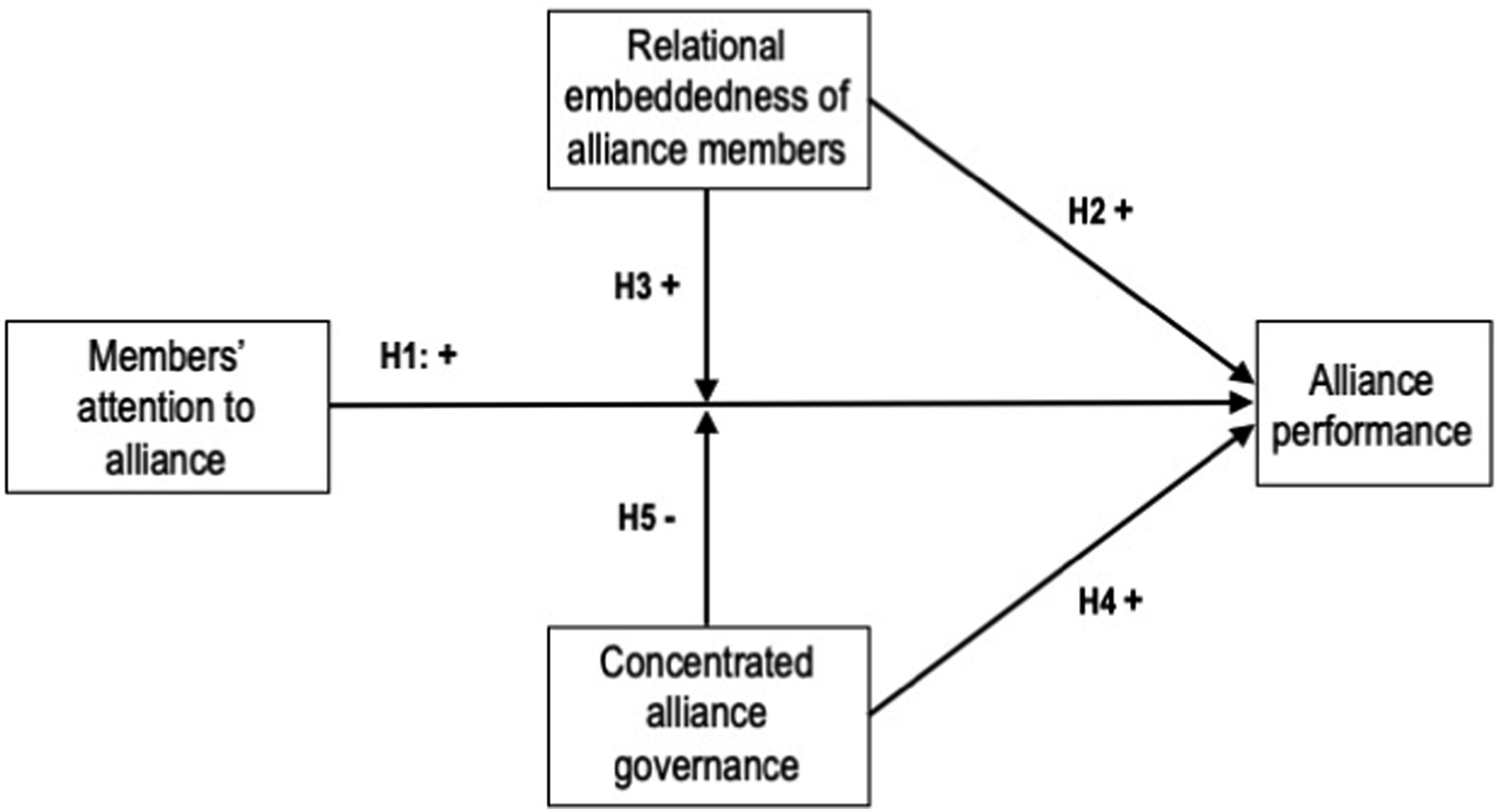
The ABV emphasizes that effects of attention are shaped by contextual factors (Ocasio, 1997). Building on this notion and drawing on the literature on inter-firm alliances, we examine the effects of two factors identified as crucial in the context of alliances: relational embeddedness of alliance members and concentration of governance. Drawing on prior research on alliances that emphasized the positive role of social cohesion among partners in collaborative outcomes, we hypothesize that relational embeddedness has a positive effect on alliance performance (H2). We then hypothesize that relational embeddedness positively moderates the relationship between attention and alliance performance, so that attention in alliances with high relational embeddedness of members has a greater positive effect on alliance performance, compared to alliances with low relational embeddedness of members (H3). Building on recent research on alliance governance, we hypothesize that more concentrated alliance governance has a positive effect on alliance performance (H4). Finally, we theorize the joint effects of attention and concentrated alliance governance and suggest that these factors act as substitutes. As a result, we suggest that concentrated governance negatively moderates the relationship between attention and alliance performance (H5), such that attention in alliances with diffused governance has a positive effect on performance and it has a negative effect in alliances with concentrated governance. Figure 1 illustrates the conceptual scheme of the study.
Venture capital syndicate members’ attention and venture success
Prior research in the ABV showed that organizational performance depends on the allocation of attention. For example, when organizations face competing goals that demand their resources, they achieve higher performance on the goals that receive greater attention (e.g., Greve, 2003; Shipilov and Li, 2008). One mechanism through which attention leads to better performance is via the deployment of more and/or better resources. This is illustrated, for example, in Bouquet and Birkinshaw’s (2008) analysis of attention in multinational enterprises (MNEs). The authors concluded that organizational attention has a “supportive” dimension which results in greater allocation of discretionary resources to subsidiaries by the headquarters. Even though this insight was formulated in the context of an individual organization, we hypothesize that the effect of attention on performance will hold in intra-organizational settings as well.
In our empirical context, the VC industry, VC firms create value in ventures not only by providing financial resources, but—and arguably more importantly—through monitoring, coaching, providing developmental advice, setting strategic priorities and performance milestones, and facilitating access to crucial resources (e.g., Banatao and Fong, 2000; Feld and Mendelson, 2011; Gompers and Lerner, 2004). Greater attention by VC firms comprising a syndicate translates into time and effort spent on providing higher quality and/or more discretionary resources like mentoring, coaching, and advising on issues important to venture development, higher intensity of the value-adding activities that VCs perform, and, in turn, likely leads to higher venture performance. Similarly, ventures that receive more attention from VC syndicate members are likely to receive more support in the form of access to more or higher quality third parties such as industry experts, consultants, service providers, and media outlets, and more help in establishing critical partnerships. The bottom line is that more and/or better resources provided to a venture as a result of greater attention to it by syndicate members likely increase the chance of the venture’s success. Following this line of reasoning, we put forward:
Greater alliance members’ attention to a focal alliance increases the probability of a supported venture’s success.
Contextual factors of inter-firm collaboration and the effect of attention
The notion that the effect of attention is impacted by contextual factors has been a central tenet of the ABV since its inception (Ocasio, 1997). Ensuing research has uncovered that administrative, managerial, and social structures within organizations all shape how attention is focused and allocated, as well as its effect on important organizational outcomes. For example, Ocasio and Joseph (2005) found that the C-suite plays a critical role in attention allocation; Rerup (2009) showed that attention to critical issues such as regulatory compliance is impacted by the chain of command within organizations; Rhee and Leonardi (2018) showed that informal intra-organizational networks affect what ideas organizational attention is focused on; and Ocasio et al. (2018) found that the content, process, and practices of intra-organizational communication impacted the effect of attention.
While providing a wealth of information on how contextual factors shape the effect of attention within organizations, findings from this prior research do not help much in understanding how contextual factors in inter-firm settings shape, impact, or moderate the effects of attention. Unlike individual organizations, inter-firm alliances are not governed by internal chains of command, the C-suite of any one organization, or intra-organizational communication channels. Extending ABV to inter-firm settings 2 requires identifying contextual factors of collaboration that impact the effect of attention, as opposed to factors that pertain to the setting of a single organization.
Research on alliances has identified a number of factors that determine success of inter-firm collaboration which include the complementarity of partners’ resources (Dussauge et al., 2000; Gulati et al., 2009; Park and Russo, 1996) managerial skill and experience in collaborative work (Powell et al., 1996); the history of prior relationships among alliance partners (relational embeddedness), as well as their connections to the broader network of bilateral and multilateral ties (e.g., Dyer and Singh, 1998; Gulati, 1995, 1998); and alliance governance structures and monitoring mechanisms (e.g., Ahmadjian and Oxley, 2013; Larson, 1992; Oxley, 1997). In this study, we focus on two of these factors.
The relational view (e.g., Dyer and Singh, 1998; Granovetter, 1985; Burt, 2007) emphasizes the importance of the prior history of collaborative relations (relational embeddedness) between partners and postulates that embeddedness of actors in a network of relations with one another shapes their behavior and impacts the outcomes of their collaboration. The alliance governance view (e.g., Ahmadjian and Oxley, 2013; Larson, 1992; Oxley, 1997; Park and Russo, 1996; Park and Ungson, 2001) emphasizes the governance structure of alliances for their success. In the following sections, we elaborate on why attention likely moderates the effects of these two factors on alliance success and outline mechanisms behind such moderation. We formulate hypotheses both about the main effects of these two factors in our empirical setting and their interaction with attention.
Relational embeddedness and the effect of attention on alliance performance
Relational embeddedness refers to the history of collaborative relationships between actors and can be defined as “direct cohesive ties” between actors (Gulati, 1998). It is developed in the course of repeated interaction (Granovetter, 1985; Rowley et al., 2000) and is characterized by the intensity and duration of the relationship (Granovetter, 1985). Firms that have an extended history of frequent and intense collaborative interactions become relationally embedded with one another. Relational embeddedness has been shown to affect trust between alliance partners (Uzzi, 1996), the choice of governance structure in alliances (Gulati, 1995), partner selection (Meuleman et al., 2010), and firm and alliance performance (Rowley et al., 2000). Prior research has also established that relational embeddedness facilitates collaboration among alliance partners. Repeat interactions imply familiarity with partners’ personnel, routines, decision-making processes, and other aspects of doing business, which is essential for reaching an agreement on important alliance decisions and overall more effective collaboration. Furthermore, research in economic sociology reveals that the behavior of firms differs depending on whether interactions happen in the context of ongoing, long-term relationships or discrete, “arm’s-length” ones (e.g., Uzzi, 1996, 1997). Specifically, firms adhere to more collaborative modes of interaction and rely on trust when exchanges occur within embedded relationships (Granovetter, 1985; Macaulay, 1963). (For example, Uzzi (1997) found that partners in embedded relationships were more likely to disclose information to their partners even if it put them at a strategic disadvantage). Overall, relational embeddedness facilitates the operational cohesion of an alliance and more collaborative behavior of alliance members, which likely increases the chance of alliance success. Following this line of reasoning, we advance:
Relational embeddedness of syndicate members has a positive effect on the probability of a supported venture’s success.
3
Relational embeddedness also likely moderates the effect of attention on the success of alliances. Prior research has found that relational embeddedness facilitates a more productive sharing of knowledge and expertise among partners (e.g., Dhanaraj et al., 2004; Ebers and Maurer, 2014; Zhou et al., 2022). Because attention results in the allocation of additional discretionary resources (Bouquet and Birkinshaw, 2008) which include non-pecuniary resources such as knowledge and expertise, relational embeddedness of partners likely facilitates a more productive deployment of these resources. For example, in our empirical setting, coaching and mentoring provided to a supported start-up by different members of a syndicate need to be well integrated to be effective. This is achieved more easily when partners have a cohesive relationship and experience in dealing with one another and adjusting to each other’s way of conducting business—all of which is facilitated by relational embeddedness. Expertise allocated to a venture as a result of greater attention to it by members of an alliance is likely to have a greater effect in a more cohesive alliance. Similarly, a better understanding of partners’ strengths, weaknesses, and available resources (whether internal firm resources or access to third-party resources) that results from relational embeddedness is likely instrumental in alliance members’ own decisions regarding the type and amount of discretionary resources to allocate to the venture. As a result, a more efficient discretionary resource allocation can be expected. Accordingly, we advance:
Relational embeddedness of alliance members enhances the positive effect of attention on alliance success, such that greater attention to a VC syndicate with more relationally embedded members results in a higher probability of a supported venture’s success than with less relationally embedded members.
Concentrated alliance governance and the effect of attention on alliance performance
Governance of alliances can be concentrated or diffused. In cases where governance is concentrated (by agreement among partners and/or legal instruments of control, such as alliance equity shares), some members have a greater say in how an alliance is steered, while other members play a supporting role. In alliances where governance is diffused, members have equal roles in alliance management. This distinction has important implications for the performance of alliances.
In our empirical setting, the VC industry, the success of an alliance depends to a large extent on investors’ ability to reach a timely consensus on key decisions (Feld and Mendelson, 2011; Lerner, 1994) and to provide a supported start-up with clear and coherent guidance (Gompers and Lerner, 2001). Because members of a syndicate can have different views on how a venture should advance (e.g., what product features should be developed, what strategy should be employed, what partnerships pursued, etc.), achieving cohesive guidance can be challenging (Feld and Mendelson, 2011).
Ma et al. (2013) found that in VC syndicates where a way to overcome syndicate member’s differences (through status order or ownership structure) was lacking, signals from investors to venture management were incoherent and the syndicates’ efficiency suffered. A power configuration within a syndicate that does not provide for distinct leadership is more likely to result in alliance stalemates and undermine its success. By contrast, concentrated syndicate governance can be instrumental in facilitating venture success. Lead investors perform the function of resource orchestration and process management (e.g., Wright and Lockett, 2003). They have larger ownership rights in a syndicate and can legitimately claim a greater say in how a syndicate is managed. This provides a way to overcome investors’ differences and ensure coherent signals to start-up management as well as a more consistent venture development strategy (Ma et al., 2013). This, in turn, is likely to result in superior venture performance. Accordingly, we put forward:
Concentrated governance of a VC syndicate increases the chances of a supported venture’s success.
The interplay of attention and concentrated alliance governance
The discussions above leading to Hypotheses 1 and 4 suggest that attention and concentrated alliance governance each perform the function of mobilizing resources in alliances. This suggests that there may be an interaction between these two factors. More specifically, these factors likely substitute for one another in their effect on alliance performance.
In the VC industry, when the governance of a syndicate is diffused and thus a syndicate lacks the benefits of resource coordination and process management that concentrated governance provides, the attention of syndicate members will likely make a greater difference in syndicate performance. Members’ greater attention to a syndicate likely results in more deliberate and focused syndicate participation, which likely helps to overcome the disadvantages of diffused governance. Greater attention likely prompts syndicate members to put more time and effort into organizing resources, coordinating with co-investors, and managing syndicate processes. As a result, in syndicates with diffused governance, a lack of the mobilizing function of concentrated governance may be overcome by greater attention of syndicate members and likely leads to an increase in the chances of syndicate success.
By contrast, in syndicates with concentrated governance, the function of resource orchestration and focusing of attention is fulfilled by lead investors. Per Hypothesis 4, this should lead to better overall venture performance. The positive effect of attention by syndicate members on venture performance will likely be smaller in this case, however. Indeed, it may be negative, as increased attention of syndicate members resulting in their more deliberate participation in a syndicate and efforts at orchestrating collaboration and managing syndicate processes may clash with the governance style of lead investors. With increased attention to a syndicate, members may not wish to play a supporting role and just follow a leader. They may be more prone to insist on their point of view regarding venture development and try to exert a bigger influence on the venture management process, which may jeopardize the overall effectiveness of venture guidance and interfere with its performance. In other words, greater attention by syndicate members combined with concentrated syndicate governance may result in a situation where there are “too many cooks in the kitchen” that undermines the chances of venture success. Following this line of reasoning, we propose:
Attention negatively moderates the relationship between concentrated syndicate governance and a supported venture’s success, such that when syndicate governance is diffused, attention increases the probability of success and when governance is concentrated, attention decreases it.
Method
The empirical setting: the venture capital industry
We situate our study in the U.S. VC industry. Venture capital firms take investment risk by funding new entrepreneurial ventures in exchange for equity and earning a return through “exit” events, such as an IPO, an acquisition, or a buy-out (e.g., Gompers and Lerner, 2001, 2004). VC firms rarely invest alone and usually form co-investment alliances 4 with other firms, that is, VC syndicates (over 86% of all VC investments are syndicated, based on our data described below). This creates conditions in which VC firms develop a history of collaboration with other firms. Each member of a syndicate owns a certain equity share in a supported venture. A syndicate may have lead investors, that is, syndicate members who have a larger ownership stake in a focal venture than other investors (co-investors) and who usually pioneer the venture and form a syndicate. Venture equity distribution, however, may also be approximately equal among syndicate members.
Data and model
Data for this analysis come from the VentureXpert Database (SDC Platinum) compiled by Thompson Financial. The database is a comprehensive source of data on venture investments around the world and includes detailed information on the dates of rounds of VC investments, recipient companies, as well as amounts invested by each investor. Because information for the period between 1946 and 1979 was entered retroactively, it is not as reliable as data for the subsequent period (Sorenson and Stuart, 2008). We therefore use data starting from the year 1980.
We define our sample as all VC syndicates (i.e., alliances of VC firms consisting of more than one VC investor) formed in the U.S. between 1980 and 2020. Because of access and the right-censoring issue explained below, we use 2015 as the final year of the sample. There were 11,657 VC syndicates in the sample thus defined. Due to missing data, we lost about 14% of all syndicates, so our final sample size is 10,025. Because we are modeling a binary outcome variable (IPO event of a start-up company), we use the logistic regression model as the most appropriate for our analyses. The model takes the following form

Methodological challenges
We needed to address two methodological challenges to make our analysis robust. First, since there is a lag between the end of a syndicate investment period and an IPO event (if any), we do not observe all IPO events with our data: some start-ups have not had sufficient time to reach the IPO maturity stage. This results in a right-censoring issue in our data. We deal with it by excluding syndicates where the time between the last round of financing and the end of the observation period (2020) was less than (T + 2SD) computed on the subsample of companies with an IPO event (where T is the mean and SD is the standard deviation of time to IPO after the last round of investing). 5
Second, industry segments in which start-ups funded by VC syndicates operate are not homogenous with respect to the probability of an IPO. Some industries are fertile ground for many (and quick) IPOs (e.g., hi-tech) while others (e.g., agriculture) are less so. To account for this heterogeneity and also other industry factors that may confound the relationship between attention and the probability of an IPO, we include fixed effects for industry segments in all our models.
Variables in the analysis
All variables in our analyses are computed using a 3-year moving window (except for variables capturing firms’ experience and history of interaction which we specify below) and lagged by 1 year. 6
Dependent variable
The dependent variable in this analysis is the success of a VC syndicate. We operationalize it by the probability that a venture supported by a focal VC syndicate undergoes an initial public offering (IPO). IPOs are unambiguous indicators of venture success (Gompers and Lerner, 2001; Pollock and Gulati, 2007) and are a natural measure of VC syndicate success, because IPOs are highly coveted by VCs as they not only boost investment returns but also, as highly visible events, enhance VC firms’ reputation (Pfarrer et al., 2010) and facilitate future deal flow (Hochberg et al., 2007).
Independent variables
In operationalizing our main independent variable, attention to a focal syndicate, we build on the notion of “weight” introduced by Bouquet and Birkinshaw (2008). Bouquet and Birkinshaw found that in multinational enterprises (MNEs) subsidiaries that had greater “weight” based on their strategic importance in the MNE network received more attention from the headquarters. Adapting this logic to VC industry settings, we use the “weight” of a focal venture in VC firms’ investment portfolio as a measure of attention it receives from VC firms. Specifically, we use the average proportion of amounts invested by syndicate members in a focal syndicate of the total amounts invested by them over the past 3 years. We use the total amount invested in a start-up supported by a syndicate, not individual rounds of financing. Formally, the attention variable is operationalized as follows:
Relational embeddedness
Following prior research on relational embeddedness in the venture capital industry (e.g., Meuleman et al., 2010), we operationalize relational embeddedness by the number of start-ups in whose financing at least two members of a focal syndicate worked together previously. Thus, this variable is based on pairwise counts of prior collaborations and equals the sum of all prior start-ups on which a pair of syndicate members collaborated.
Concentrated alliance governance
We use syndicate equity concentration to operationalize this variable. In VC syndicates, equity may be distributed equally among members or concentrated if some members invest more than others (lead investors). Because equity corresponds to the ability of VC firms to exercise control of the venture, the concentration of equity distribution reflects the structure of syndicate governance. We operationalize concentrated governance with the Herfindahl–Hirschman Index (HHI), a measure used widely in economic and management research:
Control variables. We control for a wide range of factors that can potentially confound the effects of our independent variables. In particular, to isolate the effect of attention and the moderating variables, we include variables that capture the “quality” of the supported start-up, characteristics of syndicate members, and industry- and time period-specific variables.
An important alternative explanation we need to account for is that a venture’s intrinsic “quality” (i.e., investment potential) may affect both the probability of an IPO and (self-) selection of VC firms to a syndicate. By intrinsic quality, we understand the potential of a start-up to become successful and generate a high return for investors. In the VC industry, factors such as an experienced entrepreneurial team, “traction” with customers, and protected intellectual property (e.g., a patent) are considered markers of a high-quality start-up. We capture venture quality by the following two control variables:
Patent assignee venture
Patents assigned to a venture provide an unambiguous indication of its innovativeness. We used data on all patents assigned by the U.S. Patent and Trademark Office since 1976 from https://www.patentsview.org and included a dummy variable for ventures that at some point in their existence were assigned a patent.
Time to syndication
This variable captures the time (in months) that passed between a focal start-up’s founding date and its first round of VC investment. This variable may indicate the perceived quality of a start-up because start-ups considered more promising may be able to secure VC investment quicker and thus have a shorter time to syndication.
As pre-syndication variables, both Patent assignee venture and Time to syndication variables are useful in controlling for intrinsic characteristics of a focal start-up (e.g., quality of the entrepreneurial idea, start-up team, market potential, etc.) that affect the probability of an IPO because post-syndication variables (e.g., syndicate size, the combined experience of syndicate members, etc—see below) reflect inputs of VC firms in a venture’s chances of achieving an IPO.
We operationalize Syndicate size with the total number of VC firms investing in a focal start-up across all rounds. We control for Syndicate duration with time (in months) between the first and last investment rounds in a focal start-up as it may reflect the effectiveness of the syndication process which might confound the effect of attention. We control for Average syndicate VC firms’ age using the number of years that passed since each syndicate member’s founding until the year of the last round of investment in a focal syndicate because firm age correlates with operational routines, bureaucracy, and inertia (Carroll and Hannan, 2000) and affects audiences’ perception of firms (Cattani et al. 2008), which may affect the probability of a start-up IPO.
In the VC industry, network connections affect the probability of achieving an IPO (Matusik and Fitza, 2012). To ensure that our results are not biased by network effects, we include a variable for the Average network degree of syndicate members. We also use average Bonacich centrality to control for syndicate members’ Average network centrality (e.g., Shipilov et al., 2011).
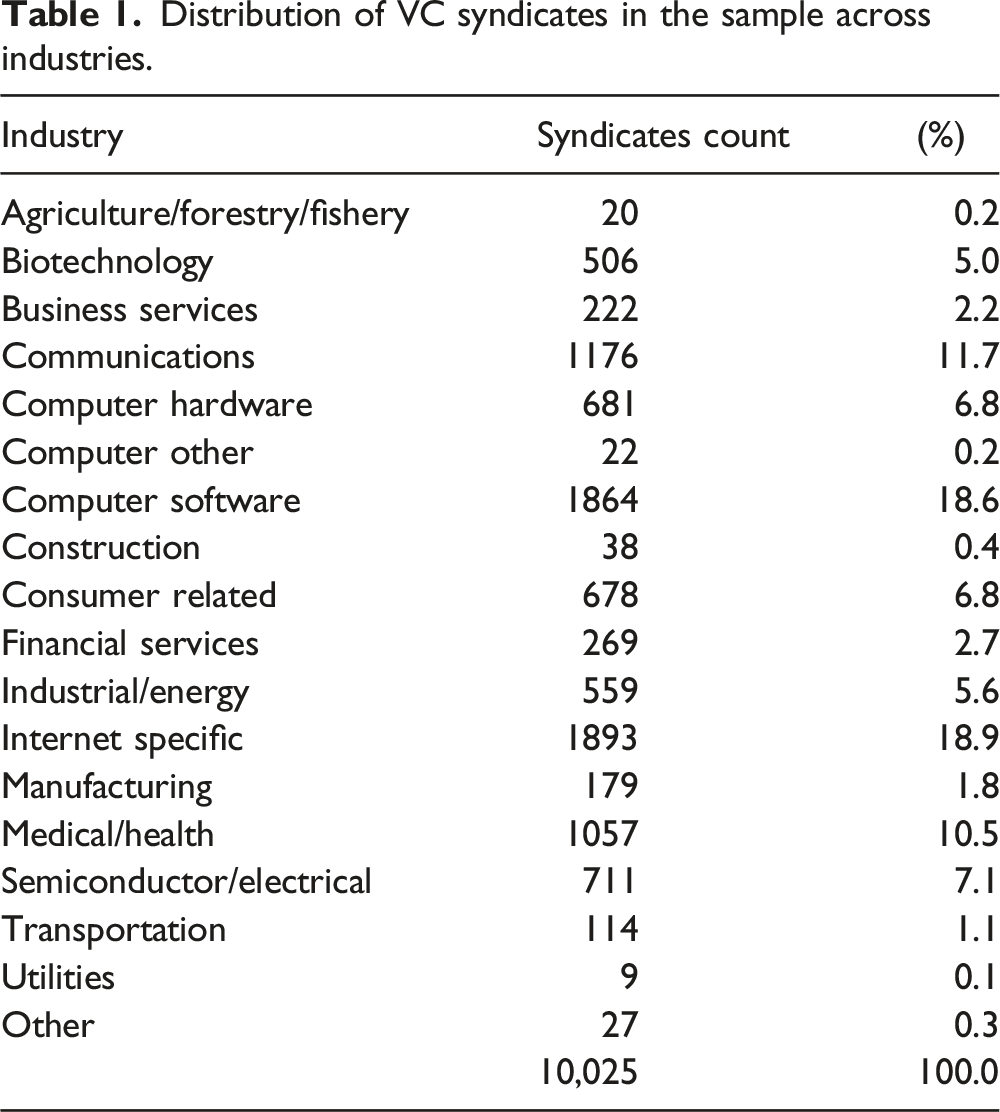
Distribution of VC syndicates in the sample across industries.
Results
Descriptive statistics: variables in the analysis.
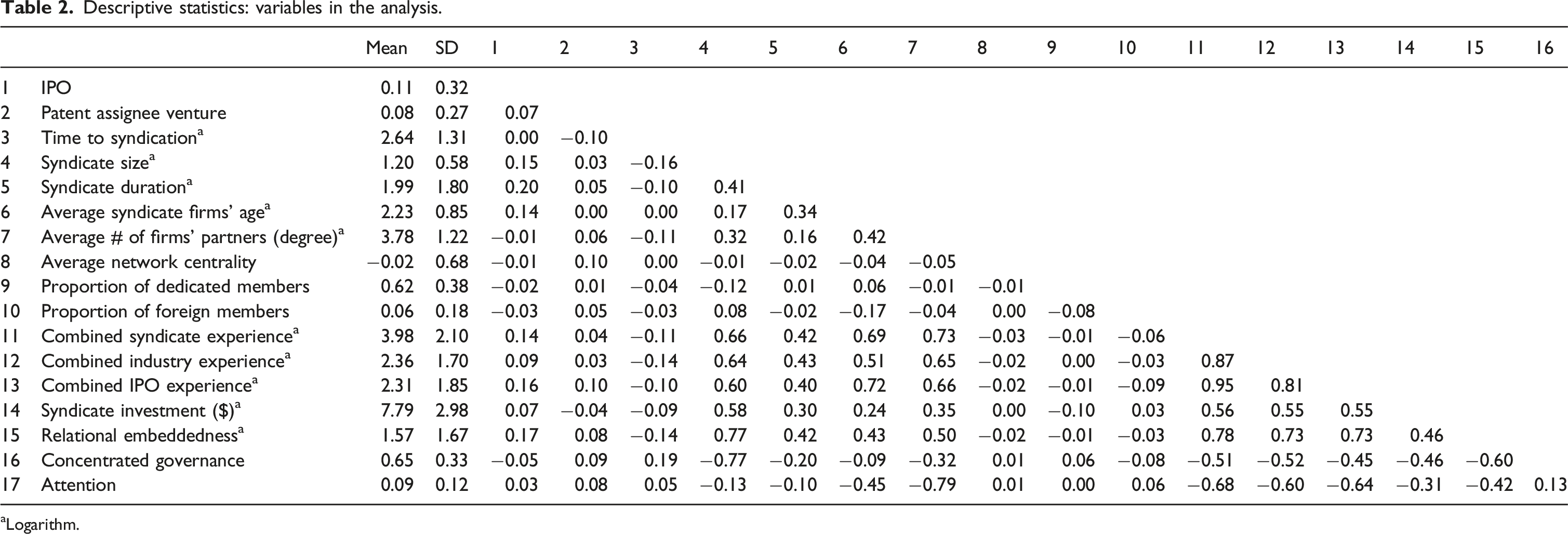
aLogarithm.
Fixed-effect logistic regressions of the probability of a start-up IPO.
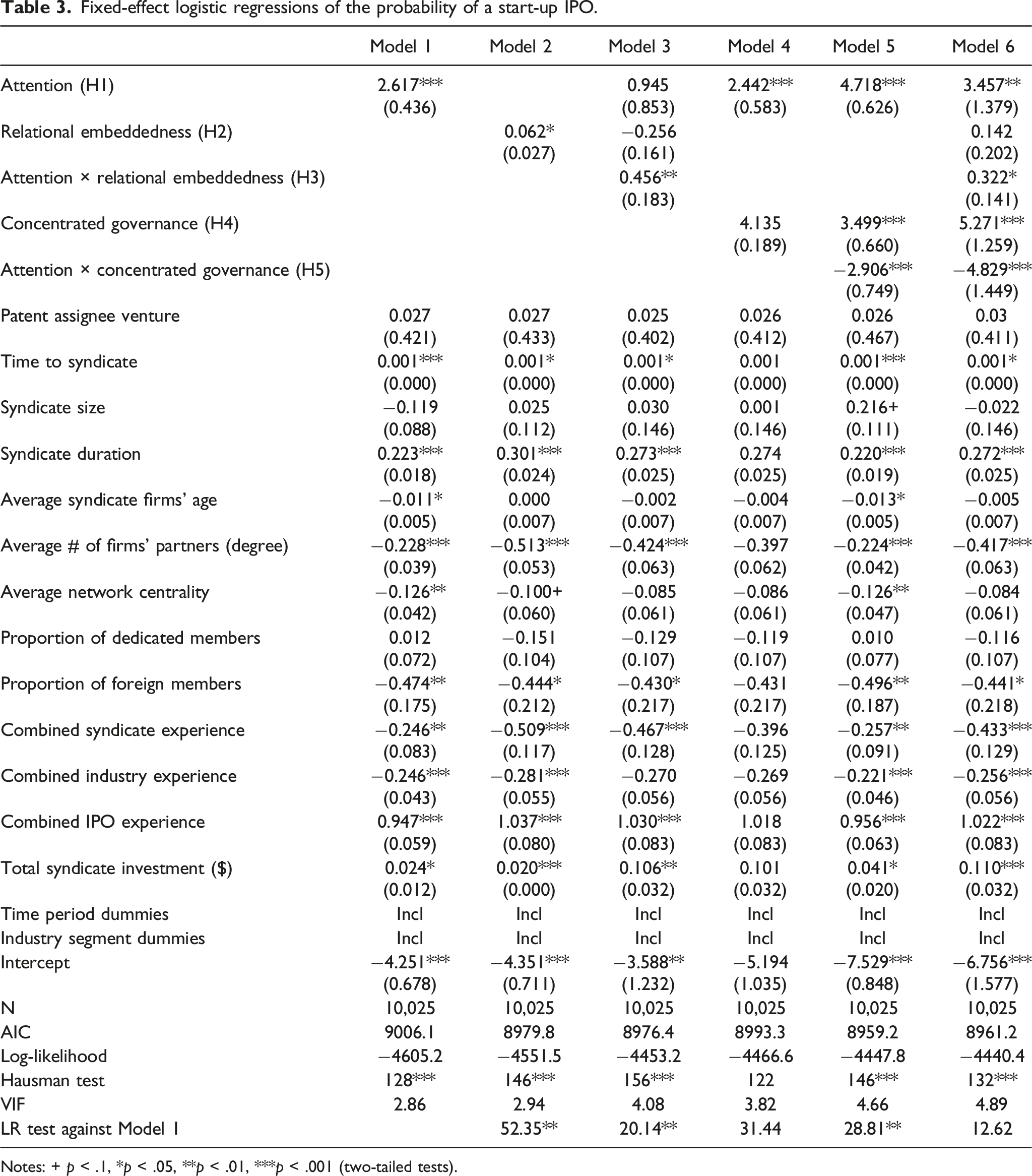
Notes: + p < .1, *p < .05, **p < .01, ***p < .001 (two-tailed tests).
Model 4 adds the main effect of the Concentrated governance variable to the control variables and the independent variable. The positive and highly statistically significant (at p < .05 level) coefficient on this variable indicates that concentrated syndicate governance increases the probability of achieving an IPO. This lends support to Hypothesis 4. Model 5 tests Hypothesis 5 by including the (Attention × Concentrated governance) interaction term. The negative and highly statistically significant coefficient on the interaction term indicates that attention and concentrated governance moderate each other’s effects on the probability of a syndicate achieving an IPO. Model 6 is the full model that includes all interactions and main effects simultaneously. Each of the interaction terms in Model 6 retains its statistical significance and direction from prior models indicating that the main effect of attention and its interactions with moderating variables hold when controlling for the effects of all other variables in the model.
Model fit statistics are displayed at the bottom of Table 3. We also perform LR tests comparing Models 3–6 to the baseline model, Model 1, and find that each of the models improves significantly on the baseline specification of Model 1. This further confirms that our primary independent variable, Attention, and its interactions with the two moderating variables are significant in explaining variation in the probability of VC syndicates achieving an IPO.
Robustness tests
To ensure the robustness of our analyses, we performed the following tests. We test for multicollinearity issues by calculating variance inflation factors (VIFs) for all models presented in Table 3. All models’ VIFs are below the rule-of-thumb cut-off of 5 (Belsley et al., 2005). We also rerun the models with control variables Average # of firms’ partners and Syndicate size excluded since they are correlated at over 0.75 with our Independent or moderator variables. Excluding these variables did not change the substantive results of our analyses, so we retained them in our models. Based on these tests, we conclude that our analyses are not distorted by multicollinearity.
We performed the Hausman test for each model to confirm our choice of fixed-effect versus random-effect models. All test statistics (reported in Table 3) are highly statistically significant (at the standard p < .05 level), which leads us to reject the null-hypothesis that random-effect models would be adequate and thus confirms that our choice of fixed-effect models was justified.
Graphical illustration of results
To ease interpretation of interaction effects corresponding to our hypotheses, we graphically represent them in Figure 2, based on predicted values. Probability of a start-up IPO based on interactions of syndicate members’ attention with selected independent variables. (a) Hypothesis 1. The main effect of attention. (b) Hypothesis 2. The interaction of attention and relational embeddedness of syndicate members. (c) Hypothesis 3. The main effect of distinct syndicate leadership. (d) Hypothesis 4. The interaction of attention and distinct syndicate leadership.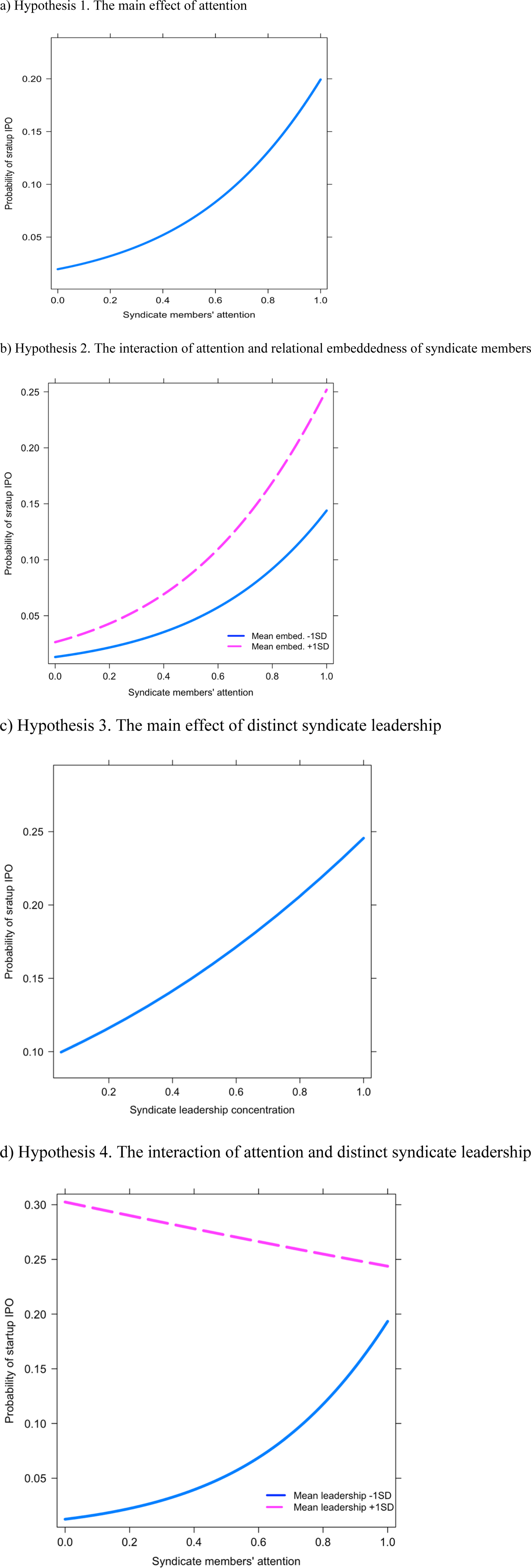
Graph (a) in Figure 2 shows that as attention of syndicate members increases, the probability of a start-up IPO rises from around 2% to 19%. Graph (b) illustrates that in syndicates composed of highly relationally embedded members (mean + 1SD), attention has a stronger positive effect than in syndicates composed of weakly relationally embedded partners, increasing the probability of an IPO from 14% to 26% at the highest level of attention.
Graph (c) in Figure 2 depicts the main effect of concentrated governance and illustrates that syndicates with concentrated governance are more likely to achieve an IPO compared to syndicates with diffused governance (an increase from 10% to 24%).
Graph (d) illustrates the moderating effect of attention on the effect of concentrated governance. At low levels of the concentrated governance variable (mean – 1SD), that is, diffused governance, greater attention to the syndicate results in an increase in the probability of an IPO from 2% to 19%. At high levels of the concentrated governance variable (mean + 1SD), greater attention to the syndicate results in a decrease in the probability of an IPO from 31% to 24%. The graph thus shows that attention moderates the effect of concentrated governance on syndicate success in a way that is consistent with Hypothesis 5. Overall, the results of our analyses lend support to Hypotheses 1–5.
Discussion
This study breaks new ground by embarking on the task of extending the ABV tradition to inter-organizational settings. We set out to explore the relationship between a behavioral factor previously developed in intra-organizational settings, attention, and alliance performance. We hypothesized that attention to an alliance by its members increases the probability of its success and that this effect is moderated by two contextual factors of collaboration: relational embeddedness of partners and concentrated alliance governance. We examined these conjectures empirically in the context of the U.S. VC industry and found support for them. Specifically, we found that greater attention of syndicate members to a focal syndicate increased the chances of a supported start-up reaching an IPO. This effect is significant both statistically and substantively: an increase in attention from the lowest to the highest level results in about a 17% increase in the probability of an IPO.
We also find that relational embeddedness of alliance members enhances the positive effect of attention. This result provides additional evidence to the argument made in prior studies (e.g., Rowley et al., 2000) that relational embeddedness of partners facilitates collaboration, and it adds to the literature by showing a direct positive effect of relational embeddedness on alliance performance. In contrast to studies that focused on the main effect of relational embeddedness or its interactions with alliance members’ resource inputs (e.g., Uzzi, 1996, 1997), our study makes a new contribution by showing that attention moderates the effect of relational embeddedness on collaborative outcomes.
We also find that attention and concentrated alliance governance act as substitutes for one another, and therefore attention increases the chances of alliance success in cases where governance is diffused. One effect regarding this interaction is rather counterintuitive: when alliance governance is concentrated, more attention to the alliance reduces the probability of success. We attribute this effect to a clash in alliance governance approaches: greater attention by syndicate members makes them more involved in syndicate governance, which can interfere with the alliance management efforts of alliance leaders. Yet, concentrated governance is beneficial: in our empirical setting, at every level of attention more concentrated governance results in a higher probability of a venture undergoing an IPO. This finding echoes the finding of Ma et al. (2013) that clashes in alliance leadership reduce alliance efficiency.
The results of this study have implications for research on inter-firm alliances. Prior studies in this stream of research did not give consideration to attention as a factor of alliance performance. By contrast, our study indicates that attention plays an important role in the success of alliances, and we suggest a mechanism (increased resource allocation) through which this effect is obtained. More broadly, this study suggests that the undertaking of incorporating the ABV, which was originally developed in intra-organizational settings, into the study of inter-firm context holds great promise and can allow us to produce a more comprehensive understanding of factors affecting alliance performance.
This study has practical implications for venture capital firms syndicating with partners and start-up companies seeking venture capital investors. Because attention increases the probability of syndication success, VC firms with higher levels of attention to a focal syndicate will make better funders and syndicate partners. In addition, both VC firms seeking to syndicate investments and start-up companies seeking VC funding should pay attention to both relational embeddedness of syndicate members and the syndicate governance structure because these factors will also affect syndicate success and moderate the effect of attention. The operationalization of the variables in our analysis offers a practical way to do so: one may consider the relative weight of a focal venture in partners’ investment portfolios, the history of their prior collaboration, and the equity distribution in a syndicate.
Limitations of the study and directions for future research
Our study, like most, has some limitations which represent opportunities for future research efforts. First, with our dataset, we are not able to observe the actual behaviors of partners in VC syndicates that correspond to greater (or lesser) allocation of attention. We assumed the same mechanism behind the link between attention and performance as was suggested in prior studies (e.g., Bouquet and Birkinshaw, 2008) in the context of intra-organizational attention allocation, that is, that attention leads to the allocation of discretionary resources which, in turn, improves performance. While we believe this mechanism operates in our and other empirical settings, we are not able to observe or test it explicitly. There also may be other mechanisms besides discretionary resource allocation. For example, greater attention to an alliance may have a signaling effect that communicates to third parties the value of a particular venture and thus prompts those parties to provide resources and/or deal with the venture on more favorable terms. With our data we are not able to uncover those potential other mechanisms or adjudicate between them, so we leave it up to future research to do that. One way to address this issue would be through an in-depth analysis of alliance interactions, as some studies have done in examination of other topics (e.g., Guler, 2007). We believe there is plenty of room here for micro-level and observational research that can yield valuable insights. A study of actual interactions in alliances among members with regard to attention allocation would enrich our understanding of how micro behaviors differ depending on the level of attention among alliance members and produce a more nuanced understanding of the impact of attention on alliance outcomes.
Another limitation is that we only tested our hypotheses in the empirical context of VC syndicates. Our theorizing is intentionally general enough to be applicable in a variety of settings. We attempted to formulate our hypotheses and findings in a way that is not specific to either an industry or a type of alliance and we believe that VC syndicates are similar in many respects to other types of inter-firm alliances (e.g., strategic alliances among technology firms). However, there still may be some important differences. Specifically, VC syndicates are focused on collaboration for the benefit of a third party (a supported start-up), which may alter the dynamics of collaboration or introduce nuances in resource allocation to an alliance. Thus, future research would do well to extend this line of work to other types of inter-firm collaborative arrangements and to other industries and contexts (e.g., cross-border alliances, joint ventures, short- vs long-term collaborations, etc.) to validate the robustness of our findings.
In this study, we only focused on two contextual factors of collaboration which we hypothesized were relevant to the effects of attention on alliance performance. Many other factors that pertain to the context of collaboration should be considered in terms of how they shape, mediate, or, perhaps, counteract the effects of attention in alliances.
More broadly, the changing nature of organizing and the rise of inter-firm alliances, partnerships, and other flexible forms of organization occurring in recent decades open significant opportunities for research in the ABV tradition. Among the most interesting questions, in our view, are the following. How is attention focused and directed when multiple organizations are involved? How does the structure of collaborative arrangements affect the focusing and managing of attention and its effects on important organizational and collaborative outcomes? The literature on strategic alliances and other types of inter-firm collaboration has generated an array of factors that affect collaborative success. Considering those through the prism of the ABV can generate a more fine-grained understanding of both the impact of attention and its interactions with the context and structures of inter-firm collaboration.
Footnotes
Declaration of conflicting interests
The author(s) declared no potential conflicts of interest with respect to the research, authorship, and/or publication of this article.
Funding
The author(s) received no financial support for the research, authorship, and/or publication of this article.
