







Abstract
Succession is a challenging issue for family business survival. This article focuses on one aspect of succession in family business by investigating non-family successors who lead family business succession. By selecting family firms in Taiwan as case studies, we investigate the involvement, role, and identity of non-family successors managing family business succession, how they engage with other stakeholders influenced by social/cultural norms, and what factors influence the transition with possible different outcomes. A conceptual model is presented that outlines family succession managed by non-family members.
Keywords
Introduction
One of the most important research areas in family business is management succession. Succession is central to business survivability (Calabro et al., 2021; Hauck and Prügl, 2015), and it has been defined as the transition between the management and ownership of the company to the next generation of family members (Bower, 2007). Following such definition, prior studies have focused on succession between incumbents and successors, or in other words, between the senior generation (model 1) and junior generation (model 2) (Daspit et al., 2021). However, due to serious factors preventing intra-family business succession (Ahrens, 2020; Ahrens et al., 2018; Zybura et al., 2024), there is an increasing number of family business successions relying on non-family successors to lead and manage family business transition (Ahrens et al., 2019), which could be defined as the 1.5 model of family business succession between incumbent and successor of family members, and this is the focus of our research.
Given family firms often struggle to smoothly transfer leadership and ownership from generation to generation (e.g., Ahrens, 2020; Ahrens et al., 2018; Zybura et al., 2024), with only 30% of family firms surviving the transition (Baltazar et al., 2023), many have argued that the responsibility for providing succession lies with the founder or owner (Reif et al., 2025). Others have focused on the experience of the next generation (Nelson and Constantinidis, 2017; Short, 2009) and the relationship with their parents (Minichilli et al., 2014; Naldi et al., 2013; Swab et al., 2020). Royer et al. (2008) present a contingency model of family business succession and suggest that family members are better successors than non-family members in situations where family business-specific experiential knowledge is essential to gain competitive advantage. In contrast, more recent studies discover that non-family successors seem to deliver better performance (Ahrens et al., 2019; Royer et al., 2008; Umans and Corten, 2022). Consequently, various publications compare family and non-family successors to identify reasons for discrepancies in firm performance (Ahrens et al., 2019; Minichilli et al., 2014). For example, Ahrens et al. (2019) find that the successor’s family background is positively related to post-succession firm performance, but non-family members’ human capital, such as leadership experience and other successor attributes, could be the root of better performance. However, prior studies have given limited attention to the involvement, role, and identity of non-family members as professionals in family business succession and their interaction with other key players within a specific social/cultural environment. Hence, regarding discrepancies and gaps in the current literature, we developed this study to explore the following key research questions: (1) What are the involvement, role, and identity of non-family successors managing family business succession? (2) How do they engage with other stakeholders influenced by social/cultural norms? and (3) What are the factors influencing the transition with possible different outcomes?
In this study, we selected five family firms in Taiwan as case studies and investigated how they adopt flexible strategies to employ professional agents managing family business succession. Taiwan is an island economy with a majority of businesses family owned (i.e., more than 70%) (Chiang et al., 2022). To examine how these firms adapt to such challenges, we conducted fieldwork in Taiwan in December 2024 with onsite visits, observation, archival research, and interviews. We analyzed their approach to dealing with challenges, looking specifically at their adoption of non-family members managing the business transition. Our conceptual framework centers on role identity theory and social exchange theory, which provide the underpinnings regarding the ways external professionals identify themselves in the process of family business succession and their relationships and interactions with founders/owners, the potential next-generation successors, and other related stakeholders.
In sum, the present research seeks to make several important contributions related to sustainable family business development with an orderly business succession process. First, we explore the involvement, role, and identity of external professionals in managing the process of family business succession in terms of their engagement and performance with novel evidence. Second, this study investigates the influence of business and social/cultural norms on relationship building and interactions among the major actors in the process of business transition. By doing so, we could discover a critical yet underexplored boundary condition, namely, the degree to which external professionals evolve in synchrony with family firms’ business environment and their social/cultural norms aligned with societal and cultural expectations.
Underpinning literature review
Family business succession, while extensively studied, presents a unique theoretical and practical challenge when the successor originates from outside the family. This study explores a critical gap: how non-family successors construct a legitimate leadership identity and navigate the socio-emotional exchanges inherent in taking over a familistic enterprise. To address this, we employ an integrative framework of Role Identity Theory (RIT) and Social Exchange Theory (SET). This review first critically synthesizes succession literature to reveal a bias toward intra-family dynamics and then establishes how RIT and SET together provide a powerful lens to analyze the micro-processes of external succession, particularly within the strong cultural context of Taiwan.
Succession literature: From foundational models to an unexplored frontier
Succession is rightly understood as a multi-stage, process-oriented phenomenon involving complex role transitions between incumbents and successors (Handler, 1994; Le Breton-Miller et al., 2004). Foundational models, such as the life-cycle stages from owner-management to power transfer, and the concept of mutual role adjustment (Handler, 1994; Reif et al., 2025), have been instrumental. These studies correctly identify critical jeopardizing factors—relational, financial, and process-related—that can derail transitions (Massis et al., 2008; Reif et al., 2025).
However, this foundational corpus exhibits a significant limitation: it predominantly assumes a family successor. The focal issues—parent-child dynamics, sibling rivalry, and emotional separation—are rooted in the familial relationship (Massis et al., 2008). Consequently, the literature is less equipped to explain the trajectory of a non-family actor, a “professional manager” (Beckhard and Burke, 1983), who must enter this emotionally charged system without the inherent legitimacy of kinship. Recent work has begun to address non-family elements, often focusing on governance or performance outcomes (e.g., Zybura et al., 2024). Yet, a crucial micro-level perspective remains underdeveloped: the process through which an external candidate internalizes the successor identity and earns socio-emotional legitimacy within the family firm.
This gap is particularly salient given contemporary challenges. Recent research highlights that succession planning is often postponed due to profound relational and emotional obstacles (Ferrari, 2023), a scenario when turning to a non-family successor may become a strategic necessity. Furthermore, the involvement of external advisors is known to significantly shape succession outcomes (Bertschi-Michel et al., 2021), suggesting that the integration of any external actor is a delicate exchange process. The current literature, however, lacks a focused theoretical apparatus to dissect the identity and exchange mechanisms at the heart of non-family succession, which this study aims to provide.
Theoretical framework: Integrating identity construction and social exchange
To illuminate this unexplored frontier, we integrate two complementary theoretical lenses. First, RIT posits that an individual’s self-concept is derived from the roles they occupy within a social structure, guided by the expectations attached to those roles (Stets and Burke, 2000). For succession, leadership identity construction is paramount (Miscenko et al., 2017). RIT is uniquely suited to our study because it moves beyond structural position to explain the internal cognitive and emotional work of a non-family successor. This individual must reconcile the inherent “outsider” label with the “successor/leader” identity, a process fraught with potential role conflict. Their challenge is not merely to act as a leader but to see themselves, and be seen, as the legitimate heir—a process of identity verification that is central to acquiring authority and reducing legitimacy deficits (Li et al., 2023; Miscenko et al., 2017). RIT thus allows us to probe the question: How does the non-family successor cognitively classify their position and internalize the norms of a role traditionally reserved for family?
Second, SET complements this internal view by framing succession as a series of reciprocal, trust-based transactions between multiple actors (Cropanzano and Mitchell, 2005; Daspit et al., 2016). The process involves exchanges of critical resources: tacit knowledge, business networks, social capital, and ultimately, authority (Bell and Pham, 2021). These exchanges are governed by norms of reciprocity, creating systems of obligation and shared understanding (Long and Mathews, 2011).
SET is crucial for analyzing how legitimacy is externally granted. The non-family successor enters an existing web of familial exchanges and must establish new “terms of trade.” Success depends on building trust and demonstrating value in a currency the family recognizes—whether economic or socio-emotional. SET shifts the focus from the individual’s identity alone to the interactive dyads and triads (e.g., successor-incumbent, successor-family members, and successor-advisors) where the “deal” of succession is negotiated. It explains how shared schemata—common vision, language, and solidarity—are built across the family boundary, facilitating the transfer of knowledge and power (Bell and Pham, 2021).
Integrating RIT and SET provides a holistic framework. RIT explains the internalization of the successor role, while SET explains the relational exchanges that make that internalization possible and legitimate. Identity is shaped through social verification, and successful exchanges are contingent on perceived identity. This combined lens is ideally suited to dissect the core problem of non-family succession: the co-construction of a legitimate leader identity through iterative social exchanges in a familistic context.
Justifying the context: Taiwan as a theoretical catalyst
The choice of Taiwan is not merely a geographical setting but a theoretical amplifier. Its strong Confucian norms of familism, hierarchy, and paternalism present an extreme case where the tensions between “family” and “non-family” are most pronounced. In this context, the cultural scripts for succession are deeply familial, making the entry of an external successor theoretically more problematic—and thus, more revealing. Studying this process in Taiwan allows us to observe how deeply held cultural norms influence both the identity aspirations of the successor (RIT) and the calculus of exchange for the incumbent family (SET). It pushes our theoretical framework to its limits, offering rich insights into how cultural context moderates the micro-processes of non-family succession.
In summary, existing succession literature lacks a focused analysis of the micro-foundations of non-family succession. By integrating RIT and SET, this study is positioned to address a precise gap: How does a non-family successor in a strong familism culture construct a legitimate successor role identity through the iterative social exchange processes of succession? The following qualitative case study methodology is designed to capture these complex, processual dynamics.
Method
Qualitative research by case study
Given the exploratory nature of our research questions, a qualitative, multi-case study design was deemed essential. This approach is suited to investigating complex, processual “how” questions within their real-life context, allowing for rich, empirical description and theory development (Eisenhardt, 1989; Yin, 2008). Our focus on the under-researched phenomenon of non-family succession within the specific cultural context of Taiwan further necessitates an in-depth, contextualized inquiry that captures socio-emotional and relational dynamics (Gioia et al., 2013).
Case selection and rationale
We employed a theory-informed purposive sampling strategy (Eisenhardt and Graebner, 2007) to select cases that were “information-rich” regarding our core phenomenon. The primary selection criterion was that the firm was actively engaged in a leadership succession process where a non-family professional held the designated successor role or was the newly appointed CEO. This ensured direct relevance to our research question.
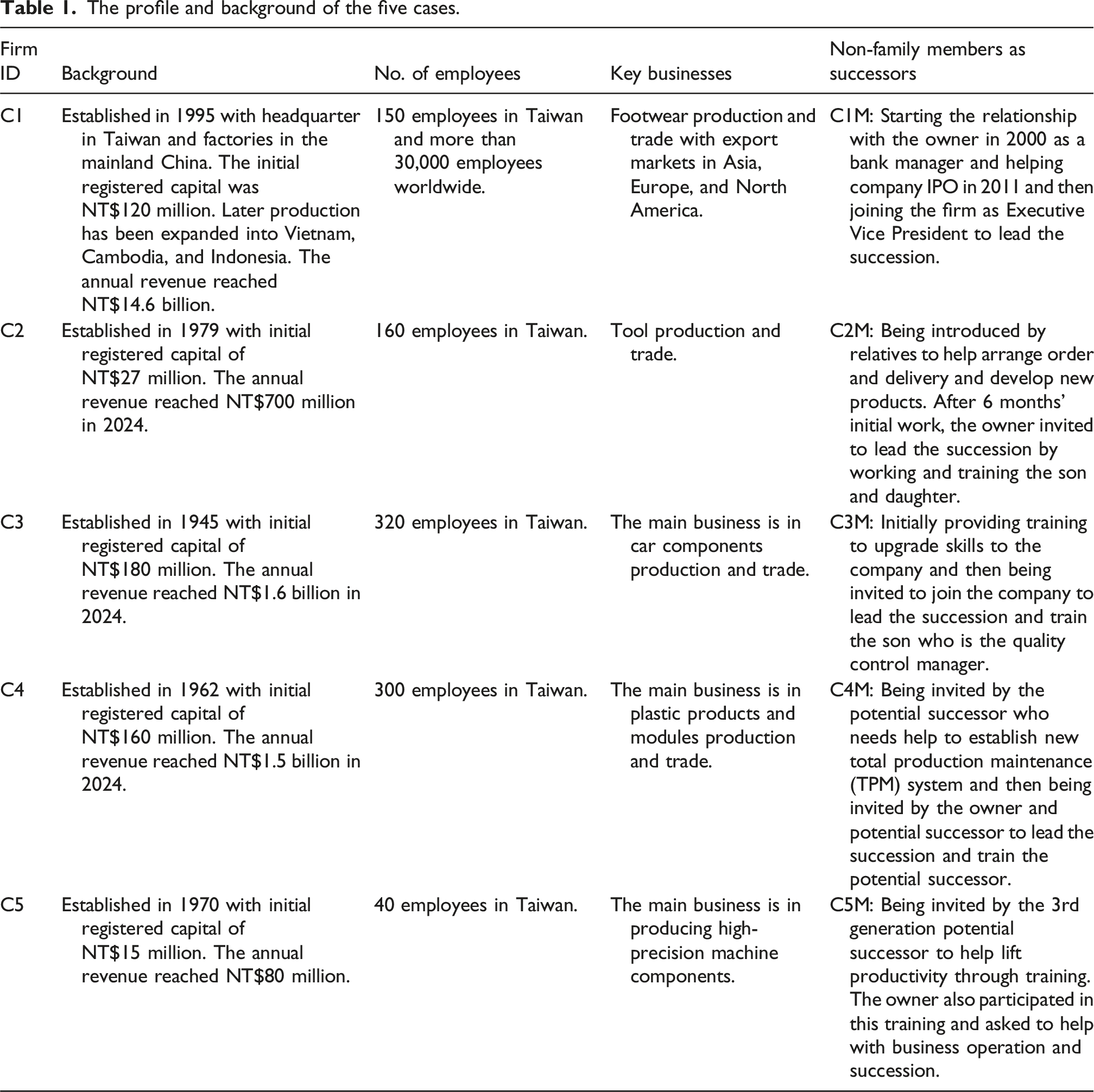
To enhance analytical generalizability and uncover potential patterns, we sought variation across key dimensions likely to influence the succession experience. Our final sample of five Taiwanese family firms varied by: - Industry: Manufacturing (footwear, tools, auto components, plastics, precision machinery). - Firm Size and Revenue: Ranging from 40 to over 30,000 employees globally, and annual revenue from NT$80 million to NT$1.6 billion. - Company Generation: From 1st/2nd generation to 3rd/4th generation firms. - Succession Stage: Ranging from early integration to full power transfer.
The profile and background of the five cases.
Data collection
Data collection occurred from December 2024 to January 2025 and relied on triangulation from multiple sources to build a comprehensive understanding and ensure construct validity (Yin, 2008). First, semi-structured interviews were carried out (average duration: 75 min) with 15 key informants in the five succession cases. We developed an interview guide around thematic areas derived from our theoretical framework: - Succession Context: Triggers for choosing a non-family successor, initial expectations. - Role Identity Processes: The successor’s self-perception, challenges to legitimacy, interactions shaping their role. - Social Exchange Dynamics: Key relationships (with incumbent, family members, advisors), exchanges of knowledge/authority/trust, critical incidents. - Cultural Nuances: Influence of Taiwanese/Confucian norms on behaviors and expectations.
Interviews were conducted in Mandarin Chinese by at least two researchers. To ensure accuracy and cross-linguistic equivalence, the interview guide was first developed in English, translated into Chinese by bilingual researchers, and back-translated for verification (Hayashi et al., 2019). All interviews were audio-recorded, professionally transcribed verbatim in Chinese, and then translated into English for analysis, with the original transcripts retained for reference.
Second, archival data and documentation were collected and reviewed. We reviewed internal documents (e.g., succession planning memos, organizational charts from different periods), company websites, press releases, and industry reports. This data provided contextual background and allowed for triangulation with interview accounts regarding timelines and structural changes.
Third, we also conducted brief on-site observations of the firm’s premises and interactions during visits, adding contextual notes on the organizational environment.
Data analysis
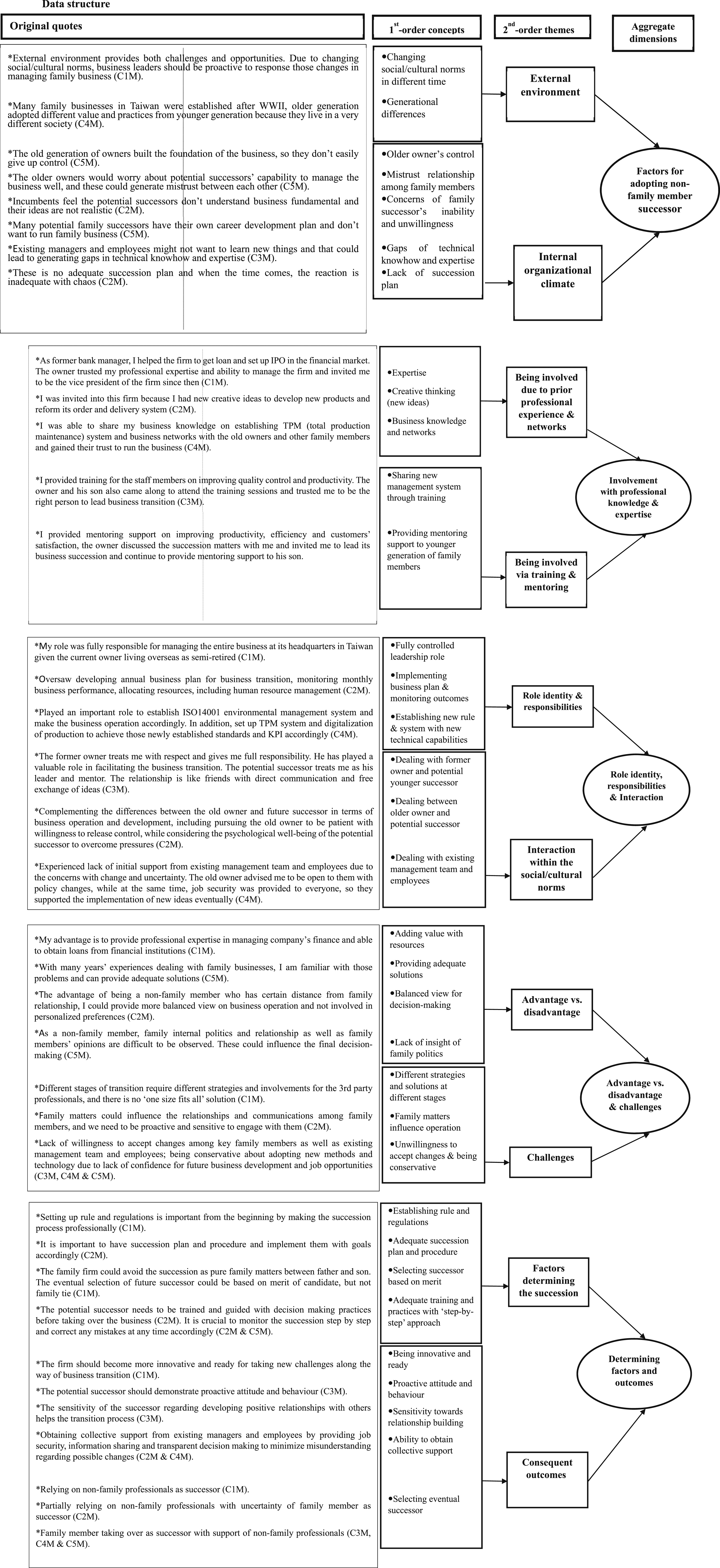
We followed an iterative, abductive approach, moving between our empirical data, emerging themes, and the sensitizing concepts of RIT and SET (Gioia, 2021; Gioia et al., 2013). The analysis proceeded in three systematic stages, visualized in Figure 1. Stage 1: Within-case analysis and first-order coding. Each case was treated as a standalone narrative. We immersed ourselves in the raw data (interview transcripts, notes, and documents) for each firm, performing open coding to identify informants’ own terms, actions, and concerns (e.g., “feeling like an outsider,” “proving my worth through a crisis,” “the founder’s gradual release of control”). This produced a rich set of first-order concepts. Stage 2: Cross-Case Thematic Analysis and Second-Order Themes. We compared first-order concepts across all five cases to identify recurring patterns and distinctions. Through constant comparison, we abstracted these empirical codes into more conceptual second-order themes. Stage 3: Aggregation into theoretical dimensions. In this final stage, we iterated between the second-order themes and our theoretical framework. We asked: how do these themes collectively speak to the core processes in our research question? This led to the aggregation of themes into overarching theoretical dimensions that directly address the interplay of identity and exchange. Data structure.
Research rigor and positionality
We employed several strategies to ensure the trustworthiness of our study, including (1) Credibility: Achieved through data triangulation (interviews, documents, observations), member checking (sharing summaries with key informants for verification), and peer debriefing among the research team. (2) Dependability and confirmability: A detailed audit trail was maintained, including raw data, coding notes, and analytical memos documenting the decision path from data to findings. The multi-stage coding process involved regular discussions among authors to challenge interpretations and reduce individual bias. (3) Transferability: We provide the detailed description of the cases and context in Table 1, so readers can assess the potential transfer of findings to other settings.
Regarding positionality, our research team consisted of non-Taiwanese academics and Taiwanese scholars. We acknowledge that our external/internal perspectives influenced the research. Our prior knowledge of theory sensitized us to certain dynamics but also posed a risk of seeing only what we expected. To mitigate this, we actively engaged in reflexivity, continually questioning our assumptions, prioritizing informant terms in early coding, and seeking disconfirming evidence throughout the analysis.
Findings
Our analysis reveals the process of non-family succession as a multi-stage journey, from the initial triggers to the final outcomes. The data is structured into five aggregate dimensions that capture this holistic process, as illustrated in Figure 1.
External environment and internal organizational climate
The decision to engage a non-family successor is precipitated by a confluence of external shifts and internal family-system tensions. Informants highlighted that changing social and cultural norms create a generational divide in business attitudes and aspirations. As C1M explained, a 20- to 30-year age gap leads to “very different attitudes and directions,” while C4M noted that younger generations “want to do things differently.” This external socio-cultural shift exacerbates internal organizational climate issues rooted in family dynamics.
Key internal triggers include the older owner’s reluctance to cede control (“The first generation... do not easily give up control”—C5M) and a resulting climate of mistrust regarding a potential family successor’s capability (“worried about potential successors’ inability”—C5M; “ideas are not realistic”—C2M). This is compounded by the unwillingness of next-generation family members to join the business (C5M), gaps in technical know-how between loyal employees and modern requirements (C3M), and a critical lack of formal succession plans, leading to reactive chaos when transition becomes urgent (C2M). This dimension establishes the context of necessity that creates the opening for an external professional.
Entry process of non-family professionals
Non-family professionals do not enter the succession role abruptly; they earn access through a trust-based, incremental entry process grounded in social exchange. We identified two primary pathways.
First is entry via prior professional experience and networks, where the professional’s external expertise serves as the initial “currency” for exchange. For example, C1M entered through providing banking and IPO services, C2M through product development, and C4M by sharing knowledge on TPM systems. As C4M stated, this demonstrated value “gained their trust to run the business.”
Second is entry via training and mentoring, where the professional’s role as an educator and coach establishes credibility and relationship capital. C3M entered by training staff and family on quality systems and C5M by providing mentoring support on operational efficiency. In both pathways, the underlying mechanism is the same: the professional offers a critical resource (expertise, new systems, and training) in exchange for trust and organizational access, initiating the succession relationship.
Role identity, responsibilities, and interaction within socio-cultural norms
Upon entry, non-family successors must construct a legitimate leadership identity while navigating complex socio-cultural expectations. Their role identity and responsibilities are comprehensive, encompassing full operational control (C1M), strategic planning and monitoring (C2M), and implementing new management systems (C4M). This formal authority, however, is exercised within a web of relationships governed by local norms.
Their interactions within socio-cultural norms reveal a critical, multi-faceted mediating function. Successors act as bridges between the incumbent and next generation (“complementing the gaps... between the old owner and future successor”—C2M), as mentors to the family heir (“treats me as his leader and mentor”—C3M), and as change agents who must secure employee buy-in by providing job security and transparent communication (C4M). These interactions are imbued with cultural codes of respect, patience, and collective wellbeing, requiring the successor to be both a professional manager and a sensitive socio-cultural intermediary.
Advantages versus disadvantages and challenges
Non-family successors operate with a distinct set of structural advantages and disadvantages. Their advantages stem from their external professional capital: the ability to add value with specialized resources (C1M), provide objective, balanced views free from family politics (C2M), and leverage extensive networks for problem-solving (C5M).
Conversely, their core disadvantage is a lack of insight into family politics and relationships, which can obscure decision-making contexts (C5M). This inherent position shapes the specific challenges they face: there is no universal solution, requiring tailored strategies for each succession stage (C1M); they must manage the pervasive influence of “family matters” on business operations (C2M); and they must overcome organizational resistance to change and technological adoption from both family and non-family employees (C3M, C4M, and C5M). Their effectiveness hinges on navigating this paradox—leveraging external objectivity while developing deep relational sensitivity.
Factors determining succession and consequent outcomes
The final dimension concerns the factors that determine the succession trajectory and its consequent outcomes. Key factors determining succession move beyond family sentiment to emphasize professionalization: establishing formal rules and merit-based selection (C1M), creating detailed succession plans and procedures (C2M), and adopting a deliberate, step-by-step approach with training and guided practice (C5M). Success also depends on cultivating proactive attitudes, relationship-building sensitivity (C3M), and securing collective support through transparency and job security (C2M and C4M).
These factors shape three distinct consequent outcome models, representing different resolutions of the identity and exchange processes: - The Professional Succession Model (C1): The non-family successor becomes the permanent solution, with succession professionalized and removed from family ties. - The Provisional Guardianship Model (C2): The non-family successor acts as a guardian amid intra-family uncertainty, with the ultimate succession outcome unresolved. - The Bridge-to-Family Model (C3, C4, and C5): The non-family successor’s role is transitional, successfully preparing a family member to take over, thereby fulfilling the classic succession ideal through external facilitation.
These models demonstrate that “successful” non-family succession is not a single endpoint but a spectrum of possible outcomes, each valid based on how the preceding dimensions of context, entry, identity, and challenges are navigated.
Discussion
This study investigated non-family members taking leadership roles in family business succession. We sought to address three key research questions: (1) What are the involvement, role, and identity of non-family successors managing family business succession? (2) How do they engage with other stakeholders influenced by social/cultural norms? and (3) What are the factors influencing the transition with possible different outcomes? The findings illuminate key aspects of the overall situation of family business succession in Taiwan, including the involvement of external professionals and relationship building with other stakeholders, the role identity and responsibilities of those professionals, the advantages and disadvantages as well as challenges confronting them, and key factors influencing the succession process with possible different outcomes. Our findings enable us to advance a new conceptual framework emphasizing the interplay among these key issues. This conceptualization is presented in Figure 2. This proposed framework represents several implications for theory and practice, which are discussed next. Conceptual framework of non-family successors led family business succession.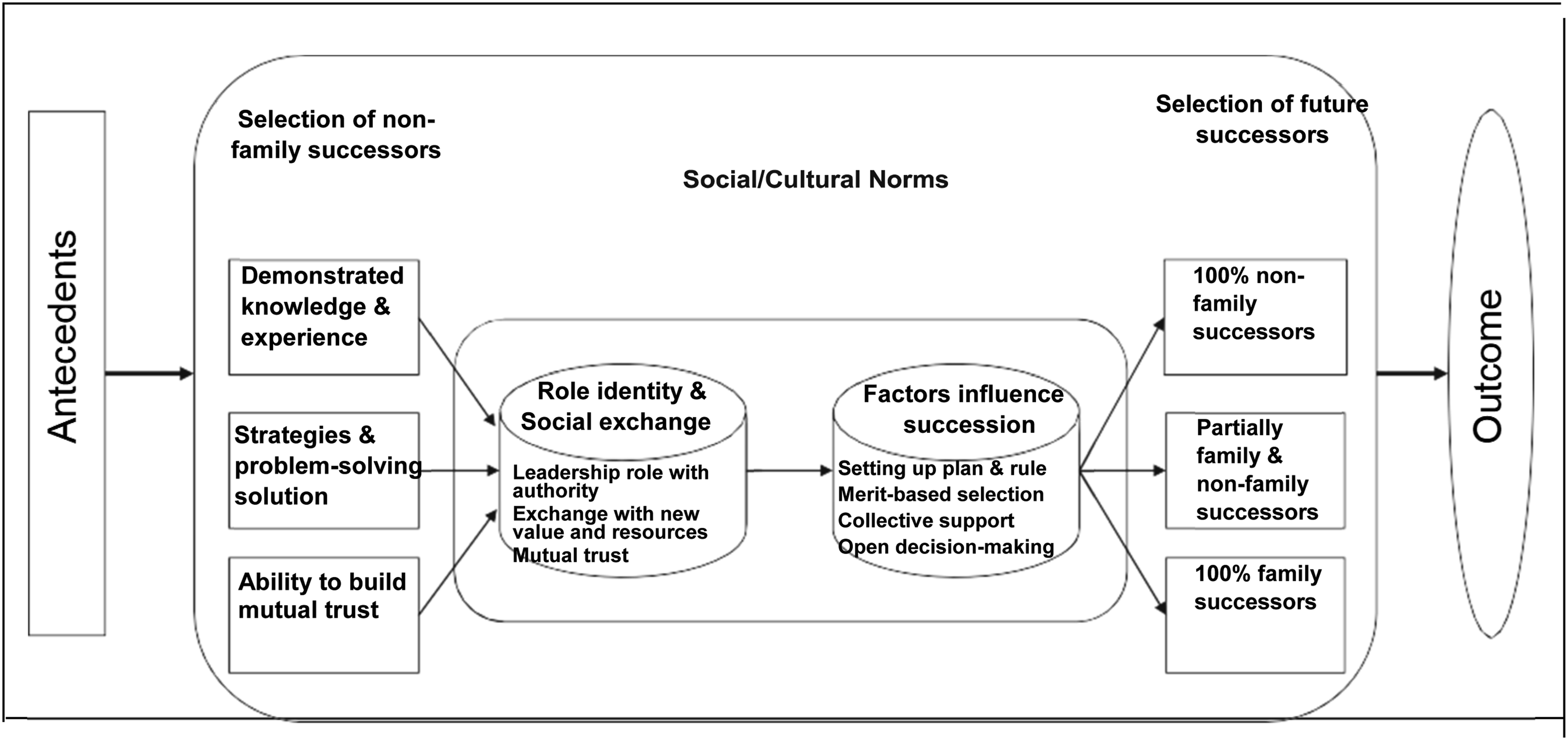
Implications for theory
This study set out to investigate the complex process through which non-family successors navigate leadership succession in family businesses. Moving beyond the predominant focus on intra-family dynamics, our findings reveal succession as a dual-track journey of internal identity construction and external relationship negotiation, critically mediated by cultural context. This perspective allows us to advance theoretical understanding by refining, integrating, and contextualizing the core frameworks of RIT and SET. Our research links these elements together with clear evidence to support the outcomes presented in Figure 2. This study goes beyond prior work on dyadic analysis between family and non-family successors (Ahrens et al., 2019; Reif et al., 2025; Royer et al., 2008; Umans and Corten, 2022) by exploring how these professionals identify themselves during the succession process and their relationships and interactions with other stakeholders. Based on our findings, several important contributions related to sustainable family business development and an orderly business succession process can be identified.
First, our findings clarify the specific antecedents that make non-family succession not just an option but a necessity as demonstrated in Figure 2. Though prior literature has listed generic succession challenges (Massis et al., 2008), we specify and theorize two interconnected triggers: (1) a socio-cultural generational rift that creates divergent business visions and (2) an internal climate of mistrust and capability gaps within the family system. These are not isolated factors but a combined context that disrupts the traditional familial “script” for succession, creating the vacuum that a non-family professional fills. This refines succession theory by identifying the specific conditions under which the logic of succession shifts from kinship-based to competence-based.
Second, our findings critically extend RIT by illuminating how identity verification operates for an actor lacking inherent familial legitimacy. For the non-family successor, the successor identity is not a given social position but a project to be earned. We find that they cannot rely on kinship scripts; instead, they engage in identity work using “professional currency”—demonstrable expertise in finance, operations, or quality systems. This professional value becomes the foundational “deposit” against the “deficit” of familial belonging. Furthermore, we extend the notion of role identity beyond a singular “leader” construct. The non-family successor’s identity is often plural and mediating: they are simultaneously the operational leader, the trusted advisor to the incumbent, and the mentor to the next generation. This tripartite identity emerges as a strategic adaptation to fill both functional and relational gaps within the family system. Our study thus contributes to RIT by demonstrating how role identity in contested successions is not static but dynamically negotiated and often hybrid, evolving in direct response to the socio-emotional needs of the business family.
Third, our analysis refines SET by embedding it within the familistic context of Taiwan. Exchanges in this setting are not purely economic or calculative; they are infused with socio-emotional value and governed by cultural norms like xinren (trust) and guanxi (relationships). We observe a distinct exchange sequencing: initial transactions of expertise for access (e.g., C1M’s banking help) establish a platform for the core exchange of performance for control. The incumbent’s gradual release of authority is reciprocated not just by profits but by the successor’s stewardship of business stability and family harmony.
Critically, the exchange network must expand beyond the founder. Successors must engage in reciprocal exchanges with employees (e.g., offering job security for support) and with potential heirs (offering mentorship for alignment). This illustrates that the “succession deal” is a multi-party, multi-currency negotiation. Our findings challenge a dyadic view of exchange in succession, showing instead that the non-family successor must become a node in a reconfigured exchange network, where success depends on balancing economic and socio-emotional currencies across different stakeholders.
Fourth, a primary theoretical contribution of this study is the explicit integration of RIT and SET to explain non-family succession. We demonstrate that identity and exchange are mutually constitutive processes. The successor’s professional identity (RIT) is the crucial “resource” they bring to the initial social exchange (SET). Conversely, the trust and authority granted through successful exchanges (SET) are the very mechanisms that verify and solidify the successor’s internalized identity (RIT). One informant’s role as a mediator (an identity) was possible only because of the trust-based exchanges (social capital) they had cultivated. This integrated lens resolves the artificial separation between the internal “self” and external “relationships,” offering a more holistic framework for understanding leadership transitions in emotionally charged kinship-based systems.
Fifth, our findings allow us to move beyond a binary view of succession success/failure to propose a typology of non-family succession pathways, each representing a different outcome of the identity-exchange interplay, namely, the Professional Succession Model; the Provisional Guardianship Model; and the Bridge-to-Family Model. This typology contributes to succession literature by providing a more nuanced lens to evaluate outcomes, where the non-family successor’s role can be permanent, interim, or facilitative, each valid based on the family’s specific constellation of resources and relationships.
Finally, our study answers the calls to contextualize management theory (Zhu et al., 2017). The Taiwanese context, with its Confucian norms, did not merely influence behavior; it constituted the very rules of the identity and exchange game. The generational rift amplified by shifting cultural norms created the space for an external actor. The successor’s ability to code-switch—enforcing professional meritocracy while respecting familial hierarchy and fostering guanxi—was not an add-on but a core competency. This underscores that theories of succession must account for how cultural logics shape the valuation of “resources” in exchange and the scripts available for “identity” construction.
Implications for practice
For practice, non-family successors should adopt a “step-by-step” approach to manage challenges emerging in business transition, such as developing appropriate plan, rules, and regulations, adopting adequate strategies at different stages of transition, and avoiding “one size fits all” solutions. Given that family matters influence relationships and communications, these professionals need to be proactive and sensitive in engaging other stakeholders.
Furthermore, they must vigilantly manage resistance from existing managers and employees by adopting open communication and transparent decision-making processes. By providing training, information sharing, and job security, employees’ attitudes and behaviors can be positively influenced. Finally, non-family successors should maintain open and direct communication with older owners and young potential successors to achieve smooth business transition based on mutual trust. On the other hand, older owners should adopt a more hands-off approach to allow professionals to lead succession transitions, while younger potential successors should be proactive in learning, accumulating business experience, and building relationships with others.
Conclusion
Taiwan’s family businesses have played an important role in economic development since WWII, with some unique characteristics. One such element is the increasing number of family business successions under the leadership of non-family members (Baltazar et al., 2023; Reif et al., 2025). This form of succession can be identified as a 1.5 model between the older and younger generations within a family business. The possibilities for business transition under non-family members’ leadership and their transformation from outsider to insider substitutes need further investigation. The transformation of business leaders during succession especially requires understanding all stakeholder relationships and internal firm processes. To acquire this idiosyncratic knowledge, non-family successors need to demonstrate work- and industry-specific experience, as well as the capability to build mutual trust relationships and provide adequate strategies and problem-solving solutions.
Prior studies have indicated that many family businesses fail in succession, but a clear explanation remains elusive (Reif et al., 2025). Unsuccessful internal family business successions thus pose societal and economic problems as much as family issues. Our study demonstrates that greater support from external professionals with superior knowledge and expertise can assist family firms during this critical transition phase. Future research should investigate possibilities to improve relationship building, direct communication, awareness of knowledge types and succession rationales, and identification of internal and external capabilities, as well as explore ways to transform outsiders into substitute family business leaders.
Our research has moved past describing the “what” of non-family succession to theorize the “how.” By integrating RIT and SET, we have developed a framework that captures the dual-process nature of this transition: the internal battle for legitimate identity and the external negotiation of trust-based exchanges, both deeply embedded in cultural soil. Our resulting typology of succession pathways provides scholars and practitioners with a refined vocabulary to assess and navigate these complex transitions. While limited to the Taiwanese context, our emphasis on cultural embeddedness invites future research to test and adapt this integrative framework in other settings, ultimately building a more robust, context-aware understanding of how family businesses can successfully pass the baton beyond the family circle.
Footnotes

Funding
The authors received no financial support for the research, authorship, and/or publication of this article.
Declaration of conflicting interests
The authors declared no potential conflicts of interest with respect to the research, authorship, and/or publication of this article.