







Abstract
Criticism seems to be a recurring and significant characteristic of public engagement exercises – as reflected both in general political discussion and in the academic literature on public engagement with science. This article suggests that rather than being a distraction from the main business of ‘technical democracy’, criticism lies at the heart of public engagement and in that way should be seen not simply as an unwelcome and unanticipated by-product but rather as a key constituent. Taking inspiration from previous science and technology studies’ treatments of ‘bottom line’ moves and also from Boltanski and Thévenot’s sociology of critical capacity, this article adopts an approach to radical critique that explores its ‘dynamic-yet-patterned’ character. Building upon a ‘translation’ model, but also a framework taken from the martial arts, a reconstruction is offered of one empirical study of lay membership on scientific advisory committees. Conclusions are drawn concerning not only the analysis of critical dialogue around engagement but also the implications for democratic practice.
Keywords
Within the recent history of public engagement with science (PES), the British ‘GM Nation?’ debate often receives special prominence. Held during the Summer of 2003 and involving a series of public discussions at every level concerning the commercial growing of genetically modified (GM) crops, it represents a landmark in the United Kingdom’s intermittent experimentation with the ‘new’ scientific governance (Irwin, 2006). The focus in this article is less on the mechanics of such an exercise or its actual outcomes than on the very predictable aftermath to ‘GM Nation?’. Despite its impressive scale, the GM debate has not generally been judged a success. Thus, a House of Commons committee reported that lack of time and money impeded the whole activity. Other public and political criticisms have been that it failed to engage with a wider array of people, that it was primarily a legitimatory exercise and that it lacked clarity of focus (Council for Science and Technology, 2005; House of Commons, Environment, Food and Rural Affairs Committee, 2003).
The criticisms that followed the ‘GM Nation?’ exercise were harsh but by no means exceptional. In the academic literature on PES, numerous accounts have been published over the past decade that criticize particular engagement activities while often expressing a commitment to a wider principle of ‘democratization’. 1 Thus, PES studies regularly conclude that the issues put to the public are limited, that the actual involvement of the public is marginal and that institutional actors resist engagement by insisting that both science and innovation should remain unquestioned and beyond serious democratic control.
One good example is the social scientific evaluation of the ‘GM Nation?’ exercise carried out by Tom Horlick-Jones et al. (2007). After a systematic and methodologically rigorous analysis, Horlick-Jones et al. offer a summary of their findings (p. 175). Starting with the observation that the ‘debate process was undermined by poorly drafted aims and objectives’, they list a further eight points of criticism – including the apparent ‘failure to engage with the broad mass of hitherto disengaged members of the lay public’ and the suggestion that ‘it is not at all clear how the findings were used in the government’s decision-making process, or what was the relative weight given to the debate in comparison with other factors’ (p. 175).
In a specific contribution to PES research, Rothstein (2007) has analysed the UK Food Standards Agency (FSA) Consumer Committee – a body disbanded after just 3 years. This initiative can be seen as a pioneering attempt to ensure wider representation within the Agency’s operation – including so-called ‘lay’ members and those appointed by consumer organizations. However, Rothstein notes that the committee ‘played only a relatively minor role in shaping the evidential basis of decision making’ (p. 590) and that members were ‘insufficiently integrated into the agency’ (p. 599). In a separate study, Goven (2003) has explored the use of the consensus conference in New Zealand, arguing that participants’ attempts to problematize socio-technical issues were constrained by the ‘dominant frame of scientific and economic rationality’ (p. 437). Meanwhile, Kerr, Cunningham-Burley and Tutton have analysed a series of public events that featured genetics, concluding that a ‘deferential partnership’ tends to develop within such events, where, at best, public input can only supplement accepted forms of scientific expertise. As they conclude:
This makes us question the extent to which lay people can ever expose scientific error and hubris, given that the layness we found was so fragile, easily compromised and so readily aligned with expert positions by both scientific experts and others. (Kerr et al., 2007: 408)
In a related vein, Brian Wynne has criticized recent moves to ‘restore’ public trust in science by establishing dialogue of a kind that ignores the underlying science policy institutional culture (Wynne, 2006; see also Stirling, 2008). As Wynne (2006: 219) expresses this: ‘Perhaps an appropriate final observation … is to note the intrinsic futility of trying instrumentally to engender public trust in science, whether by “public engagement”, dialogue, or any other means’.
Now, the fact that PES research has often adopted a critical approach to actual engagement exercises does not mean that this is all PES does. Many PES studies are extremely nuanced in their analysis. Rothstein, for example, notes that
care is needed in judging the overall success and failure of participative processes … The multiple dimensions in which participative processes can be judged provide considerable scope for the glass of participative regulation to be half-full or half-empty depending on the protagonists’ dispositions. (Rothstein, 2007: 604)
It must also be acknowledged that not all PES studies seek to make direct normative statements about the legitimacy of particular engagement exercises but some (actually, a growing number) consider instead their ‘eventfulness’ and ‘mobilization’ (Felt and Fochler, 2010; Horst and Michael, 2011; Lezaun and Soneryd, 2007). Considering both social scientific and more public/political discussions, it must also be stressed (as we will shortly discuss with particular reference to the work of Boltanski and Thévenot, 1999, 2006) that ‘criticism’ can take many different forms – from challenges to the inherent ‘democracy’ of what are typically small-scale activities to accusations that such initiatives are expensive and time-wasting. Within social scientific discussions, the basis for criticism can vary according to different methodological and theoretical traditions: from ‘neutral’ attempts at contrasting outputs with stated intentions to more obviously ‘pro democracy’ perspectives.
In this article, we do not argue against full-hearted and well-informed critique, either in public debate or in scholarly analysis. Equally, we do not aim to reduce all criticism to one analytical category. On the contrary, we suggest that the phenomenon of criticism in this area deserves further attention in both academic and political terms. From our perspective, the (often implicit) evocation of the highest principles that engagement might ideally fulfil can make it difficult to acknowledge and pay serious attention to the varieties of engagement that are very much less than perfect but still somehow ‘good’ (or, at least, ‘good for thinking about’). Furthermore, the hardening of positions in conflicts about engagement, knowledge and democracy can diminish rather than encourage fresh perspectives and new modes of action.
A sense of impasse now pervades many public engagement exercises, with critical arguments counterbalancing the political enthusiasm for further initiatives. To be more precise, this can be considered a double impasse. On the one hand, science and technology studies (STS) scholarship often falls into a pattern of ‘case study followed by critical assessment’. On the other hand, policymakers can become frustrated with a sense that whatever they do will be criticized by the social scientists (especially when engagement initiatives may involve some professional risks for the civil servants involved).
In this article, we wish to explore this impasse as a phenomenon in itself. Our argument here is that STS research needs to find a relationship to public engagement that moves beyond criticism alone. By reinforcing familiar discursive tracks, STS researchers may be contributing to a wider unease about the utility and legitimacy of public engagement but without seeking to transcend it. Our purpose in this article is not to advocate or support engagement activities – nor to rehearse the potential merits of well-established initiatives. Instead, we wish to pursue some alternative approaches to criticism in this area. We suggest that one way of moving forward is to view criticism not simply as negative and an end point but as constitutive and performative. This is also a way of arguing that PES should have many stories to tell beyond simply squeezing its analysis into a certain form of post hoc critique (for a related argument, see March, 2010).
One important aspect of our treatment is a preliminary consideration of the relatively consistent and stable forms of agreement/disagreement that occur in engagement exercises – and of the discursive situations and practices in which, and through which, these forms find expression. While PES research often builds towards a kind of ex cathedra judgment concerning what was good or bad about an initiative, we present criticism and disagreement as key constituents of engagement exercises (for a related – and contributory – discussion of ‘critical inquiry’ as a constituent practice within the laboratory, see Lynch, 1982). Going further, we suggest that far from being a distraction from the main business of ‘technical democracy’, criticism has an important role to play in terms of calling attention to ‘something being at risk’. In that way, critical debates are crucial elements of the engagement and not diversions from it.
Thus, we aim to highlight the spirit of challenge and scrutiny; a spirit that is so characteristic of engagement exercises in practice. In the case of the UK GM debate, critique, contestation and mutual accusation did not simply emerge after the debate, when critical scholars picked through the ruins, but were present from the very start – indeed, even before the exercise had begun – bringing, we would argue, considerable energy, drama and sense of significance to the event. In sharp illustration of the anticipation of disagreement prior to any disagreement occurring, one of us was approached before the GM debate to advise a stakeholder group on the best timing for its eventual walk out. In fact, this walk out never took place – but its widespread anticipation brought a certain frisson to the activities that followed.
Dynamic perspectives on critique
One source of inspiration for STS treatments of disagreement and dispute is the classic article, ‘Death and Furniture’, by Edwards et al. (1995). That article considers an analogous case of a debate in which one party attempts to terminate discussion by arguing that the opposing party falls short of certain standards. Specifically, ‘Death and Furniture’ explores how realist philosophers (and non-philosophers who take a realist stance) employ particular kinds of ‘bottom line’ rhetorical argument against social constructionists. ‘Furniture’ in the title alludes to the argumentative technique through which realists pound on the table and declare that this, surely, is not a social construction. ‘Death’ recalls another common move, through which the realist evokes murder and the Holocaust to demand the concession that these horrific realities surely are not mere social constructions. The implication is that by refusing to acknowledge such realities, social constructionists are either plainly ridiculous or morally bankrupt. Even worse, the social constructionists’ failures to engage such realities encourage an irresponsible relativism, a quietism that ultimately contributes to acts of terror, since it furnishes no solid basis on which to speak out against external evil. The point in the present context is that the realist and constructionist positions emerge as incompatible – indeed incommensurable – with one another. ‘Bottom line’ moves – whether banging on a table or pointing to the mismatch between the conclusions of the United Kingdom’s public debate over GM foods and the subsequent official policy statement – are hard to refute when they lay down a blunt challenge to ‘Answer that!’.
The ‘death and furniture’ discussion has considerable value in directing our attention to the manner in which certain polarized disputes may not be resolvable. Social constructionists might argue that table-thumping is a manoeuvre on a particular physical level where solidity can be demonstrated. Solidity and knocking would look very different if viewed on an atomic scale. Similarly, social constructionists might suggest that the ‘bottom line’ evocation of death is no less situated. Edwards et al. remind us that death is actually contested terrain: there are discussions over the afterlife, survival of the spirit, the precise moment of brain death, killing in war, justifiable homicide and so on. Thus, while realists insist on the existence of ‘underlying realities’ format, social constructionists insist on emphasizing the rhetorical nature of the realists’ claims to be able to see ‘how it really is’.
With their focus on rhetorical moves, Edwards and his colleagues recast what seem to be ‘principled differences’ between polar philosophical positions as a series of situated claims and arguments. Akin to analytical projects developed in post-structuralism (Foucault, 1969), ethnomethodology (Garfinkel, 1967) and various strands of discourse analysis (e.g. Edwards and Potter, 1992), they thus analyse disagreement as a situated, interactional and textual practice that unfolds over time. Their account of ‘critical encounters’ opens up a way of thinking about criticism as a dynamic series of moves and countermoves, rather than simply a final assessment and post hoc appraisal. With its treatment of discourse in a polarized ‘two position’ format, their analysis does, however, have the considerable disadvantage in the present context of paying less attention to possible points of compromise, hesitancy and shifting argumentation. Our sense is that while ‘critical disappointment’ is very common in the area of public engagement, this should not necessarily be equated with polarized ‘for/against’ positions. Instead, even the most vociferous critics of individual exercises such as ‘GM Nation?’ often continue to support the overarching goal of enhanced democratic engagement with science and technology.
A more elaborate theoretical approach to disagreement and justification can be found in the so-called sociology of critique developed by French sociologist Luc Boltanski and his collaborators (Boltanski, 2011; Boltanski and Chiapello, 2005; Boltanski and Thévenot, 1999, 2006). The point of departure for Boltanski was his unease with the treatment of critique in the critical sociology of Bourdieu (see, for example, Shapiro, 2010). In Bourdieu’s (1977) view, lay members of society are necessarily ‘ignorant’ – or ‘misled’ – with regard to social practice: they experience practice at one level but do not fully conceive the social processes hovering over and shaping, for example, a critical exchange (p. 19; see also Lynch, 1993: 31–33). The hidden mechanisms that influence practice, such as ‘fields’ and ‘habitus’, can only be disclosed by the professional sociologist. It is therefore also the sociologist who must assume the role as social critic. Boltanski, by contrast, observed that lay actors themselves seem perfectly able to criticize as well as justify actions. Based on this observation, he launched a large-scale empirical attempt to identify the moral vocabularies upon which actors in modern Western society draw (see Table 1). The resulting list of vocabularies, or ‘orders of worth’, represents a set of qualitatively distinct types of critique/justification.
Orders of worth: summary of moral vocabularies identified by Boltanski and Thévenot (2006) and Boltanski and Chiapello (2005)
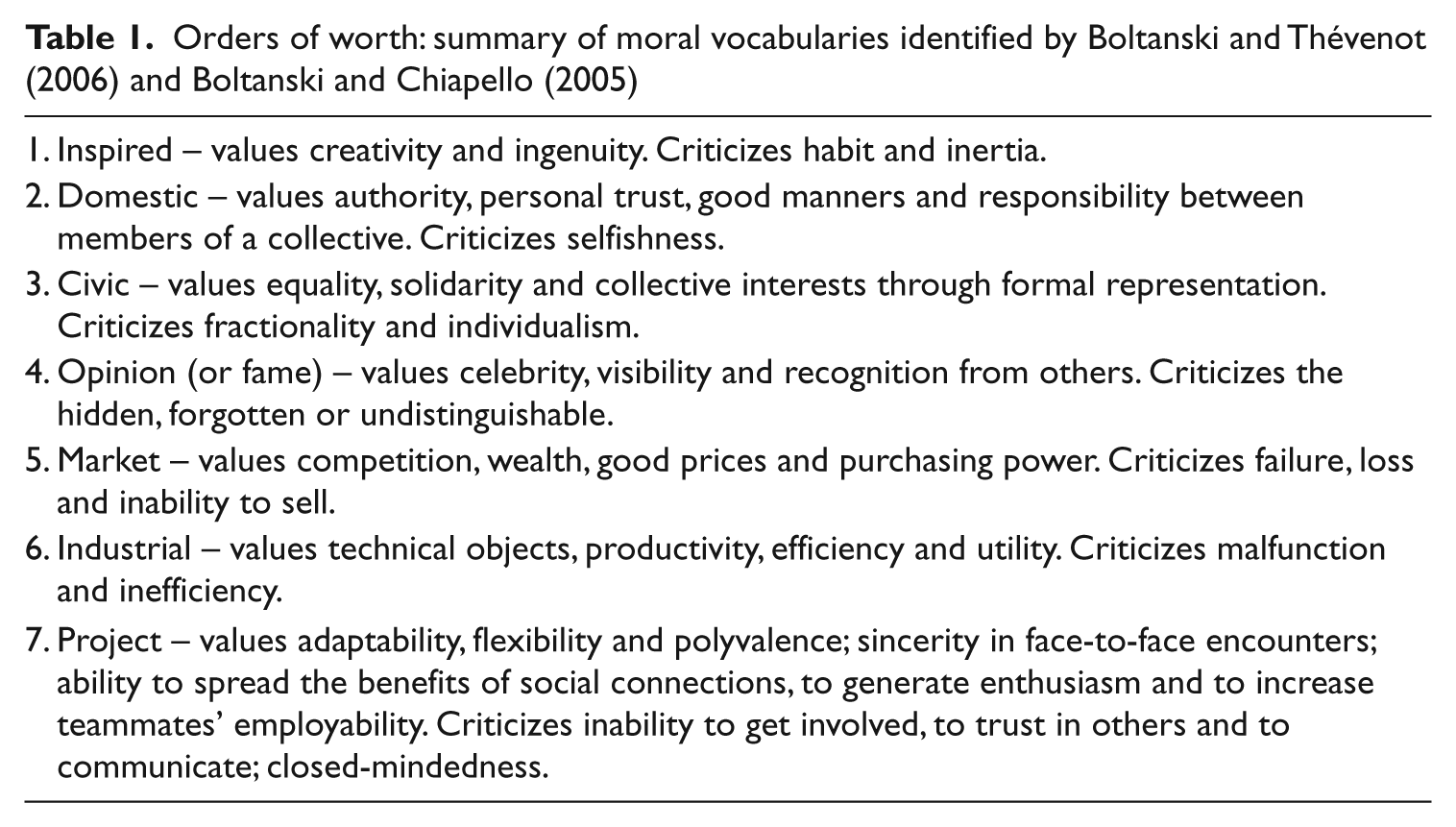
One can immediately associate parts of Table 1 with some of the well-known positions in PES debates. Thus, critical STS scholars tend to articulate criticism of the ‘civic’ kind, stressing in particular the lack of appropriate representation and the technocratic arrogance of scientific and political elites. Proponents of PES exercises often counter this ‘civic’ critique by arguing that engagement activities do in fact ensure some form of representation and that such endeavours entail a general commitment to a greater level of civic equality. In addition to giving ‘civic’ justifications, PES proponents frequently mobilize the ‘industrial’ order of worth. In this mode, they describe their PES exercises as information-gathering processes, which over time and with appropriate fine-tuning will become more efficient and productive. But critics also use this register when they point to moments when information is not effectively collected, summed up or brought forward to policymakers.
PES debates therefore can be seen to support the Boltanskian argument that all participating actors – not merely critical PUS scholars or other professional social scientists – possess the capacities to criticize and justify. Furthermore, the examples indicate that proponents of PES exercises have several chords to play and therefore rarely get cornered by criticisms that draw upon a single order of worth. For this reason, the debates around PES exercises continue indefinitely, rather than end with a knock-down argument. One other implication from the sociology of critique is that criticism and justification tend to ‘cluster’ within certain forms. This suggests that there may be some predictability, or at least a recurrent pattern, within the apparent diversity of criticisms. It may therefore be sociologically interesting to investigate empirically the distribution of forms of critique as well as the movement, transformation and responses to critique. An analysis of precisely this nature is presented by Boltanski and Chiapello (2005) in The New Spirit of Capitalism, in which they explore how capitalism managed to reinvigorate itself between the 1960s and the 1980s by countering, circumventing and incorporating particular forms of critique.
While we take inspiration from this perspective, our approach to criticism in engagement exercises is not to accommodate different voices into a pre-agreed framework. Instead, we would like to direct our empirical focus precisely to the critical moves themselves and their interaction. While Boltanski and colleagues identify general orders of justification that can be broadly employed in support of various arguments, our attention is on the dynamics of critical encounters, the specific moves and the consequences of criticism, both for STS analysis and public policy. Just as we take from Edwards et al. (1995) the idea that critical arguments should be viewed as dynamic and processual, rather than used as final assessments, we take from Boltanski and his colleagues the idea that critical capacities are available to all participants, that participants may deploy several mutually incompatible registers to critique or justify their arguments and finally that broader sociological analysis can be made of the forms of critique.
This set of ideas, we suggest, may set the stage for a fresh perspective on PES debates. Although the analysis of ‘forms of critique’ may draw us towards a somewhat distant and structuralist account, we should not forget that PES debates can be lively, shifting and adversarial. To emphasize this dynamic spirit of PES exercises, we have sought further inspiration from various fields of human performance – including dance involving (at least) two partners, musical duets and various sporting activities, as well as Hilgartner’s (2000) well-known account of expert advice as public drama. In all of these areas, there are broadly predictable and broadly agreed rules (e.g. concerning the pattern of moves and the relationship between participants) but the operation of these rules also requires energy, innovation and dynamism. As an illustration of what we have in mind, we can offer a quotation from a study of the martial art of kendo. The description below depicts the mental state of two skilled partners during one particular form of training session (known as ‘kendo kata’):
… [the aggressor] instigates his attack with the feeling of ‘This is what I am going to do’. [The defender] responds: ‘Yes, OK, just try it’. [The aggressor] does. [The defender] counters: ‘There, see what you’ll get if you try’, and, with zanshin (awareness): ‘Now try that again and I’m ready’. [The aggressor]: ‘Yes, I can see that, but, if you relax your awareness just a little, just once, then I am ready to attack again’. [The defender]: ‘I know that and I remain aware’. (Budden, 2000: 23)
What we find intriguing in this scene is not merely the constant effort to reflect meaningfully upon one’s own – and one’s opponent’s – next move (which actually in kendo kata follows a defined pattern) but especially the mutual monitoring and awareness that bring drama and intensity to the encounter (which otherwise would simply function as a series of carefully choreographed moves). In kendo kata, the fighters are armed with wooden swords, and only a limited number of forms of attack are allowed. For this reason, a skilled participant has a margin of anticipation as well as a series of well-rehearsed defensive moves. This means that the attacker may, in turn, anticipate what the defender anticipates. It is within these parameters that an actual kendo contest unfolds. Skilled practitioners therefore not only recognize individual moves, such as a strike aimed at the head, but they also perform characteristic sequences that emerge from a series of interactions and mutual anticipations, such as turning a defensive position into a dominant stance.
PES proponents and their critics do not engage in kendo kata, and yet we find it plausible that their form of adversarial interaction contains some of the same aspects: a bounded pattern of critical moves, certain opportunities to anticipate criticism and characteristic sequences that arise out of the interaction between the opponents as they attempt to counter one another’s moves. In the following, we will pursue these ideas through an empirical example.
Making moves on engagement
In order to pursue our goals of (a) making criticism a phenomenon in itself and (b) capturing its dynamic-yet-patterned character, we will now turn our attention to one case of public engagement in the United Kingdom. We draw on research conducted between 2007 and 2008, which investigated the potential role of so-called lay members of influential scientific advisory committees (SACs). Through a qualitative study combining interviews, focus groups and observations, we followed the first tentative steps of several SACs in finding roles for members of the public in expert policy processes. The findings of this research are covered elsewhere (Jones et al., 2008; Jones and Irwin, 2010). For our purposes in this article, the interactions we had with committee members and policymakers provide a source of active reflection and debate about publics, science and the value of engagement. We have drawn statements from numerous interviews and discussions with the study participants and turned these voices into an exchange between two protagonists: an exchange that encapsulates many of the critical questions that have been raised about the merits of current experiments in engagement. In doing so, we provide a consciously stylized, simplified and composite account of this exchange that, although synthetic, allows us to mobilize talk about engagement in a way that focuses on the shaping and patterning of critical discourses.
In taking this approach, we have drawn upon earlier STS attempts to foreground the active and dialogical nature of discourse in empirical accounts of science. Doing so, as Gilbert and Mulkay (1984) have suggested, shifts our focus away from reading participant voices as either unitary or authoritative accounts about a phenomenon. Instead, we are directed to interaction and the flexible use of interpretative forms as resources mobilized in negotiating consensus about an aspect of socio-scientific life. However, highlighting the active and flexible nature of discourse is not the same as suggesting that these conversations take place without boundaries, or that they are entirely subjective, or fleeting. Rather we can interpret discourse not only as dynamic but also as coalescing in and around repetitive forms and arguments. Drawing upon kendo kata as a metaphor for debates over PES, we can read discourse as a series of moves involving flows of argument and counterargument in a mutually dependent, but also bounded, performance of critique. Our construction of a debate over engagement may be synthetic, but it is not entirely artificial in the way it shows how arguments are brought forward, mobilized and tested.
One means of finding form in debates around public engagement is to view a public engagement exercise as a chain of crucial translations (see, for example, Blok and Elgaard Jensen, 2011; Callon et al., 2001; Latour, 2004). A larger public is translated into a smaller group of people who will then take part in an engagement exercise in order to articulate their view on a specific ‘engagement matter’. This engagement matter in turn is the result of a different translation process, which takes its starting point from a ‘higher level’ decision-making body. This body has for some reason decided to translate one of its broader concerns into a ‘matter’ to be put before the public. The chain of translation just described (larger public – representatives – articulated views – ‘engagement matter’ – concerns of a decision-making body) is now open to external critique at any point. This is very different from the categories articulated by Boltanski and Thévenot, but, importantly, it adheres to the notion that criticism can take certain repetitive forms, at least in terms of its focal points or targets. On this basis, we can consider four common ‘moves’ in debates over public engagement.
Contesting representativeness. Representativeness, the translation of a wider public will or good through the participation of engaged citizens, is often challenged – and from many directions, including the very question of what ‘representativeness’ might mean in this context. Thus, it can be claimed that the necessarily small group of people within an engagement exercise fails to represent the broader public in some important respect. Any demographic variable can be evoked to make this argument. But the argument can also hinge on specific conditions or events during the engagement event, which, one might argue, would challenge the independence of the engagement exercise by seducing, confusing, intimidating or in some other way estranging the participants who represent the public at large.
Contesting communication and articulation. A second critical move questions the ‘conditions of speech’ and hence the participants’ ability to articulate their views in a proper and meaningful manner. Engagement exercises sometimes face the allegation that the matter put before the participants did not lend itself properly to deliberation or reflection. It may have been too complicated, too constrained, too artificial or too superficial. Any of these factors can in principle hamper the participants’ ability and willingness to form or express an opinion. It is unsurprising that in many engagement exercises, the ‘framing’ of the topic or issue can represent a fundamental constraint with crucial consequences for the outcomes (Irwin, 2001).
Contesting impacts and outcomes. The criteria for success of an engagement exercise – the capacity to lead to tangible outcomes and meaningfully impact scientific governance – also provide a fertile domain for critique and debate. Following an engagement exercise, it is commonly argued that there is no sufficiently strong connection between what was communicated and debated by participants and what will be taken into account by a higher level decision-making body. The policy disconnect is asserted on the grounds that the participants’ views were not properly registered, interpreted, acted upon or summarized. It may also be argued that the disconnect is caused by the decision-making body’s inability or unwillingness to receive or relate to the articulations made by the participants during the exercise. In this sense, engagement exercises are criticized for restraining public participation and bounding the policy process within a technocratic ethos.
Contesting democracy. The relationship between any specific exercise and a larger sense of the democratic society is often a focus for critique and challenge. On that basis, it can be suggested that the public engagement exercise is a diversion from other activities and that by severely restricting the possibilities for fuller scrutiny and choice making, it offers only the appearance of openness and dialogue. Accordingly, such an exercise is held to be (whether deliberately or not) a source of legitimation for a pre-decided policy conclusion.
Debating the ‘lay’
To explore the critiques made at each of these points of translation, we present a conversation between two protagonists engaged in a critical discussion of the potential roles and impacts of having lay members join SACs. 2 This conversation takes place in the context of encouraging policymakers in the United Kingdom to experiment with a variety of forms of public engagement. The lingering failures of the government response to BSE (Bovine Spongiform Encephalopathy, the so-called ‘mad cow disease’), combined with the persistence of a series of further controversies, including disputes over the regulation of agricultural biotechnologies, generated an opportunity for reflection and potential change. Starting in the late 1990s, the call was for greater openness and transparency, the frank admission of uncertainty, the inclusion of a broader range of scientific opinions and the rebuilding of public trust in scientific advisory processes (Irwin, 2006). SACs had themselves been the subject of considerable critical attention, as they were accused of being opaque and exclusionary, and of imposing technocratic agenda upon a range of complex and normatively contested policy scenarios. Concerned with the persistence of controversy and the loss of public legitimacy in the policy process, the government was motivated to reappraise how scientific advice was accessed and employed. More specifically, policymakers were motivated to take up the challenge issued by Lord Phillips in his influential report from the BSE Inquiry that suggested (among other points) that ‘a lay member can play a valuable role on an expert committee’ (Phillips et al., 2000: 1290; see also Jones, 2004).
The following dialogue between two protagonists, or kendoka, was pieced together with actual extracts from the previous research project. Following the kendo kata tradition, we refer to the protagonists as ‘Uchidachi’ and ‘Shidachi’. This slightly theatrical ploy should be a reminder to read the following exchange as a performance of critique in a mutually dependent flow of moves and countermoves. It should also be apparent that we have not (or at least not entirely) forced participants to conform to the four ‘mega moves’ presented above. Instead, and as one might expect within highly contextualized encounters, a process akin to bricolage takes place. Thus, the first quotation from our empirical study can be read as contesting both the ‘representativeness’ and the ‘communication and articulation’ of the exercise:
Uchidachi: Lay members can make the work of SACs more transparent and aware of the social and policy issues surrounding their work. Lay members can provide some common sense. Where committees get into really esoteric things that are frightfully interesting, but maybe have no real relevance to the great majority of people in so far as they may be affected, then there is a role to play there.
Here, our first kendoka initiates a move by arguing that SACs without lay members are seen to lack public accountability and transparency and are overly narrow in their treatment of wide ranging and complex policy issues. Uchidachi thus presents the inclusion of lay members in a particular policy context as a bridge between scientific knowledge and wider publics. Participants in our research often defined lay roles in relation to public witnessing, communication and representation on committees (Jones and Irwin, 2010). Accordingly, lay members are a means of counteracting an exclusionary and socially disengaged policy tradition characterized by invocation of the objective authority of scientific expertise:
Shidachi: There’s a danger then of having fourteen non-representational people who were there to communicate the science and only one representational person who is there to represent the general public.
Having anticipated the attack (since this is so much part of the recurrent discussion in this area), Shidachi counters by contesting the representativeness of the exercise. Can a single member hope to represent the public interest? And should we even be discussing ‘representativeness’ when this is fundamentally a scientific matter? Uchidachi responds:
Uchidachi: Everybody brings to this committee baggage. If you’re here long enough you will soon see some assumptions coming out of people fairly consistently. Some members are overtly conservative for example. So if there’s the faintest doubt about a product, it’s precaution to the fullest extent.
In this countermove, members with scientific credentials are themselves cast as representatives of particular social values and viewpoints.
In a second exchange of move and countermove, a contest emerges over the articulation and framing of dialogue within the committee room. Shidachi now asks how a lay member would be able to express herself in relation to the complicated technical matters being discussed and with highly trained scientists all around. At the same time, non-expert discourses are accused of being a distraction from the committee’s main business of speaking truth to power:
Shidachi: But, they will be out of their depth. It’s very much just pure science. A lay person might just muddy the waters.
Responding, Uchidachi first defends his own capacity, insisting that he has the capacity to speak and that he is not intimidated by the scientists and their expertise. Then, he counters by asserting that the real barriers to participation and open communication are not related to a lack of expertise but rather to a dearth of ‘room and space’. There is just too much on the agenda. This suggests that the whole engagement exercise works, or might work, given some adjustment:
Uchidachi: I’m used to working with committees. I do committees week in, week out … I know how to say what I think and express my view. Now, as a lay member on this committee, I have not always found that easy. I find myself sort of tongue-tied, unable to say what I think. It has actually been quite a difficult experience for me. Normally I’m somebody you can’t shut up. So, why did I feel intimidated? Was it the expertise of other people? Not really. Is it the structure of the committee? Sometimes … It’s a bit frustrating … They simply haven’t got room and space to take on these broader issues because they’ve got enough on their plate, just to decide whether a regulatory package, whether the risk assessment is being done properly or not.
Our encounter now shifts to a third series of moves, this time based around conflicts over the impacts and outcomes of an advisory process that was opened up to include some form of public contribution. Is there any chance that government will hear, or even notice, the lay participants’ voices among all the scientists in the SACs? After all, the SAC is supposed to offer scientific advice. How could anyone imagine that lay members will play a consequential role in terms of developing policy? What would a ‘lay’ member actually contribute to the advisory process?
Shidachi: What would they do? The purpose of scientific advisory committees is to make sure the people making the policy actually understand what they need and actually draw in the right sort of stuff.
This move typifies a recurring theme in our research. While committees often supported the intentions of ‘lay membership’, when such roles were considered in practice, or in relation to the core function of committees (conveying scientific advice), ruptures emerged, which threatened to undermine initial positive valuations. The purpose of a committee, as Shidachi suggests, is to make sure that governments are able to access the ‘right’ information or, as we might infer from her statement, the right ‘facts’. The lay member is thus cast to the margins of the advisory process: a gesture of openness, but one that essentially is inappropriate in a scientific context.
Faced with this move, Uchidachi acknowledges the strength of the attack:
Uchidachi: Because of the nature of the role, by definition as a lay member you’re not an expert. So, there’s something impenetrable. Something that’s impossible to get over. I mean, I don’t know. But no, I’ve not found it an easy role. I think there should be a wider group of lay members. I would be happier to be more of an expert.
But then, Uchidachi counters by suggesting that one can define expertise in less rigid terms:
Uchidachi: It may be useful to have a member who is an expert in another kind of thinking and questioning, for example in ethics.
In a move to close the encounter, Shidachi makes a final attack (an attempt at a ‘knock-down argument’) by pushing home the assertion that advisory committees are not the location of democratic engagement. Indeed, a commonly voiced argument is that democracy is appropriate for ‘political’ activities (especially parliamentary debates) and that policy activity should take place in a ‘rational space’ in which qualified experts deliberate:
Shidachi: I do think that there might be a, a kind of fundamental problem here which is if the political establishment is interested in having lay people on scientific committees, then their interest in doing that is presumably grounded upon the idea that they should be representative. This actually goes against the fundamental principles of any SAC – that people are not representative apart from representing their disciplines as it were; that they’re bringing their expertise.
With this final cut, the exercise draws to a close. Shidachi may have made the final move, and we can imagine she will feel satisfied with the strength of her attack. However, we should be cautious in inferring that she has emerged as the victor. We might equally imagine a reassertion of the openings first created by Lord Phillips, returning to and honing previous arguments, anticipating counter critiques and defences. Thus, while we have traced an approximately linear trail through our four framings, or discursive patterns, a more iterative and circular approach to the exercise might also be appropriate.
If we consider this exchange from the perspective of kendo kata, then it should not be viewed in terms of winning or losing, but rather as a matter of spirit, of flow and of the energetic encounter between committed participants. What this suggests is that critical discussion around public engagement should be seen, not entirely or even primarily, as concerned with reaching some agreed resolution, but also as a practice with rules, consequences and frameworks of its own.
While the conversations we had with participants exhibit rules and frameworks, we can also note that they involve a mutual exploration of the subject through a testing of arguments, both for and against lay membership. In this context, it was common for participants to provide contradictory perspectives about lay membership. For instance, as our kendoka dialogue illustrates, lay members were seen to bring valuable ‘public’ perspectives to the committee table, while participants simultaneously worried about maintaining the objective scientific authority of the committee. Our qualitative research did not always reveal clearly drawn sides but rather demonstrated participants’ willingness to explore alternative possibilities, albeit within the framework of reasonably familiar lines of criticism and defence. When considering critiques of PES more widely, we can view them not simply as ex cathedra, post hoc expressions of negativity but as important expressions of changing perceptions and practices. Criticism is a situated action with uncertain but sometimes practical consequences, which in turn can be analysed and explored as a social phenomenon. Expressing that point somewhat differently, criticism, rather than voicing negative prospects and possibilities that must be overcome before meaningful action can occur, has potential value (and relevance) as a meaningful action in its own right.
Finally, in this section, we must note that the engagement exercise we have used as source material for our synthetic dialogue has persisted so far. We cannot know if it will continue, but we can turn its persistence into a series of empirical questions. How much criticism can this engagement exercise withstand? And what kinds of further defensive moves will it be able to develop? By asking these kinds of questions, we take on board the pragmatic lessons from Edwards, Potter and Ashmore and from Boltanski and Thévenot.
Conclusion: from critical STS to an STS of criticism
The aim of this article is simple. We wish to find a way to intensify our interest in engagement exercises (and especially in the evaluation of engagement exercises) and to consider criticism as a creative and performative process (albeit, and as we have emphasized, one that typically takes place within certain formats and frameworks). Using the case of lay membership within SACs as our starting point, we would now like to speculate in more general terms about how an ‘STS of criticism’ might be conducted and developed. We suggest three initial steps:
An STS of criticism must, as its first move, identify a series of standard points of attack in engagement exercises. In this article, we have drawn on our knowledge of both previous PES debates and the PES literature, and we deployed the heuristic of defining PES as a series of translations: a series that will inevitably be attacked at the joints (so to speak). Other heuristics may be possible, and it may also be possible to deduce the standard points of attack from a more systematic empirical analysis of previous criticisms offered against PES exercises.
It is necessary to trace the immediate responses to the standard attacks. In this case, we traced such responses through an artificial contest and related the predictable points of attack to responses that were already contained in the participants’ accounts of their activities. This sort of juxtapositioning is possible since speakers routinely orient and justify themselves in relation to real or imagined critical audiences (cf. Boltanski and Thévenot, 2006; Edwards and Potter, 1992; Garfinkel, 1967). The immediate responses as well as the standard attacks may, of course, also be investigated ‘in the wild’; that is, through observations of the exchange of words or texts between proponents and critics of particular engagement exercises.
An STS of criticism should investigate the higher order games that arise when standard attacks are repeatedly met by standard responses. At its simplest, the responses become quicker, better rehearsed and more ‘automatic’. But often, if not always, a mutual learning process will take place: critics move forward with a sense of what the response will be and the respondents in turn anticipate what will be the subsequent critique. The SAC case illustrates both of these respects. Some responses are fairly automatic: ‘I can speak for the public because I see myself as an ordinary person’. Other responses take potential criticism into account: ‘On this committee I sometimes find myself sort of tongue tied’; ‘Now you might think that I’m unable to speak my view, but I have in fact proven my ability to do just that on other committees’.
These examples from the SAC case exemplify the kinds of material and analysis that an STS of criticism can explore once it has worked itself up from defining standard points of attack and immediate responses to these attacks. It is possible, however, to develop the analytical scope a good deal further.
Thus, higher order exchanges might involve displacements in time and space. Participants do not simply respond to criticisms. They refer to other persons, other occasions and to events that will only materialize in the future. In this respect, engagement exercises are nothing like a kendo encounter, where both participants are co-present. Instead, it might be quite an empirical challenge to trace the crowd of actors and the multitude of sites that carry the criticisms and responses relating to a particular type of engagement exercise.
But the complications do not end here. Another source of complexity relates to the kinds of delegation identified by actor–network theory (Callon, 1986; Latour, 1987; Law, 1986). Human actors often extend their reach by substituting more durable materials or technologies for their immediate actions. Once a speed bump is in place, the local police officer can turn her attention elsewhere (Latour, 1991). Similarly, it is possible for both critics and proponents of particular engagement exercises to find ways to ‘materialize’ or ‘technologize’ their actions, so that these actions indeed operate as ‘technologies of democracy’ (Rose, 1999). Any kind of ‘method’, ‘approach’ or ‘proper procedure’ for the work of identifying lay members, inviting them to meetings, allowing them to articulate their views, registering the views or bringing the views further may be considered as a way to firm up actions by lending the force of established rules, written instructions and binding agreements. Another example of how actors bring in other types of material to strengthen their positions may be the frequent reference to reports, surveys and policy documents. It is one thing to say ‘I’m not sure you have told me everything’. It is much more powerful to say ‘Lord Phillips’ report has made it clear that the time of closed and inward-looking governance processes must come to an end’. These examples clearly do not exhaust the possible ways in which critics and proponents can invoke authorities to reinforce or substitute for their own actions and utterances. Our intention has merely been to indicate that close attention to a broader range of materialities can expand the ways we analyse criticisms, responses and evolving anticipations around engagement exercises.
Especially important in making this case is to avoid any suggestion that PES accounts should become normatively neutral or seek to be merely descriptive. We are aware of the criticism that pragmatism of the kind advocated here can lead to ‘quietism’ (see, for example, Burningham and Cooper, 1999, or the debate addressed by Lynch, 2009). Our argument, instead, is that analysis of the sort that recognizes the flow of discussion, the processes of critique and counter-critique and the absence of final ‘knock-down’ moves opens up fresh possibilities for the democratic scrutiny of science, technology and innovation. In terms of politics and policy, rather than continuing along familiar tracks, we believe that it is time to explore new paths. The approach to criticism described here is an invitation to do so, with more creative and imaginative thinking about the underlying principles behind democratic engagement and about the practical forms that engagement exercises take. Thus, we can consider the extent to which institutional initiatives can actively seek to draw upon – and indeed actively encourage – critical discussion, rather than insulating themselves from criticism. In what ways can argumentative exchange be developed as a positive asset for public engagement? Along similar lines, it is important to pay attention to the balance in particular contexts between the ‘patterned’ (or ‘framed’) character of public engagement and the opportunities for dynamic expression and critical exploration – an argument akin to Andy Stirling’s (2008) treatment of ‘opening up’ and ‘closing down’. Of course, such moves towards acknowledging the value of criticism can be consequential, both for the design of engagement activities and for the cultural and organizational principles upon which contemporary scientific governance is built.
If, as we have suggested, critique is performative in this context, then STS accounts run the obvious risk of reinforcing the very activities and tendencies they criticize – thus allowing both policy actors and academic analysts to settle into comfortable lines of discussion and established modes of operation. Ultimately, this article is an argument both for a fresh perspective on the phenomenon of critique and for fresh reflections on relations between science and its publics.
Footnotes
Acknowledgements
We thank our anonymous referees for their critical scrutiny and collegial commitment. Like many SSS authors before us, we have hugely benefitted from Mike Lynch’s editorial attention.
Notes
Biographical notes