







Abstract
In September 2013, President Correa balanced himself on a felled log over an oil waste pit in the Ecuadorian Amazon. Extending a bare hand dripping with crude, he launched La Mano Sucia de Chevron campaign, demanding accountability for decades of contamination. This article explores the role of bodily knowledge in witnessing industrial contamination and struggles for environmental justice. Situating the mano sucia in the history of activism in the region, I show how the juxtaposition of different hands within the same motif reveals profoundly asymmetric relationships to the toxic entanglements that oil produces. Dirtied hands reveal the co-production of toxicity and power in extractive landscapes: At times throughout this article, the gesture calls for corporate accountability and distributive environmental justice, at other times, it reveals the systemic production of material, social and political distance between the accrual of benefit and the production of harm in an industrial-capitalist order. While drawing on the central role of bodily knowledges in apprehending environmental harm, I argue that bodily knowledges must also be examined for their specific relationships to forms of power and exploitation, and for their potential for appropriation by other parties – even when dedicated to condemning environmental injustice.
It was an unusual morning on 17th September 2013, for this old oil well in the middle of the Ecuadorian Amazon. The waste pit, normally abandoned, had been cleared of its cover of debris and cordoned off with yellow tape. The clatter of bugs and birds had been supplanted by piped-in music; the edges of the forested bank along the well platform were covered with hundreds of onlookers. In front of them, then-President Rafael Correa balanced himself on a felled log suspended over 3 meters of old crude oil, and addressed residents of the region, journalists, and government officials from the Aguarico 4 waste pit: Ecuador, Latin America, the whole world: This is one of the great lies, the arrogance of those transnational companies that believe that with dollars they can destroy countries, that they can destroy the jungle, that they can destroy life. This is 30 years after Texaco, now Chevron, says that they remediated what they damaged …. There are around a thousand pits like this one in our Amazon that were never remediated …. Other [pits] they covered with a layer of dirt in order to trick the Ecuadorian state, the people of Ecuador. This is the greatest, or one of the greatest, environmental disasters in the history of the planet. It is 85 times worse than the British Petroleum spill in the Gulf of Mexico, 18 times worse than the Exxon Valdez spill off the coast of Alaska … We are going to show the world the lie of Chevron, once Texaco. We are going to show the world the dirty hand of this oil company.
1
President Correa then knelt to stick his gloved hand into the black slop of the waste pit. Sticky and mixed with fallen leaves, the oil clung to the glove. Rising, he thrust his right hand outright, fingers spread and palm open, to the audience crouched on the opposite bank: ‘This pit’, he continued, ‘is is close to me, to all of our Amazon’.
Behind Correa, a young man from the region was brought out to demonstrate the dimensions of the pit he was standing on for the president. The man stepped onto the surface from the far side. With each step, the pit reeled beneath him, rising in black waves that never crest. Decaying crude oil mixed with decades of fallen plant matter is at once liquid enough to undulate, yet solid enough to sustain the weight of the man as he lurches across. Stopping behind the President, the man reached down, barehanded, and punched the fern-covered surface. Emerging with a handful of crude held high above his head, he extended his hand in the same forthright gesture, several meters behind the log where President Correa stood. The crowd cheered.
Not to be outdone, and well known for his charisma in front of a crowd, President Correa took off his crude-covered surgical glove: ‘Just as the compañero here muddied his hand, I also muddy mine. As our compatriots have muddied theirs for decades’. The crowd whistled with delight as Correa repeated the same action he had just performed, but this time with no barrier – symbolic or synthetic – between his naked hand and the contents of the pit, or as he intimated through the action, between himself and those living with toxic waste pits in the region. Shouts erupted: ‘Bravo, Presidente!’ President Correa waved his hand covered in crude for the cameras: For what our Amazon has lived through, our communities, throughout decades of exploitation by this company. We are going to use against this arrogance, those millions, those transnationals, Chevron-Texaco, the most lethal weapon ever invented: the truth. Here is the truth, fellow citizens. To the whole world, here is the truth of Chevron-Texaco.
In baring himself to the public and drawing a connection between his own dirtied hand with fellow Amazonians who have been exposed to pollution, Correa used his hand to index the poisoned bodies of those – human and nonhuman alike – that have lived in the wake of oil operations here for the past half-century. Here, as in other moments, Correa had been an outspoken critic of the extract-and-dump practices of Texaco in Ecuador, and of the unequal burdens of climate change for the global south. This moment at the waste pit kicked off the La Mano Sucia de Chevron (The Dirty Hand of Chevron) campaign. The campaign, which employed the dirtied hand motif condensed into a hashtagable meme, 2 sought to enroll supporters in efforts to hold Chevron accountable for decades of environmental damage in the region.
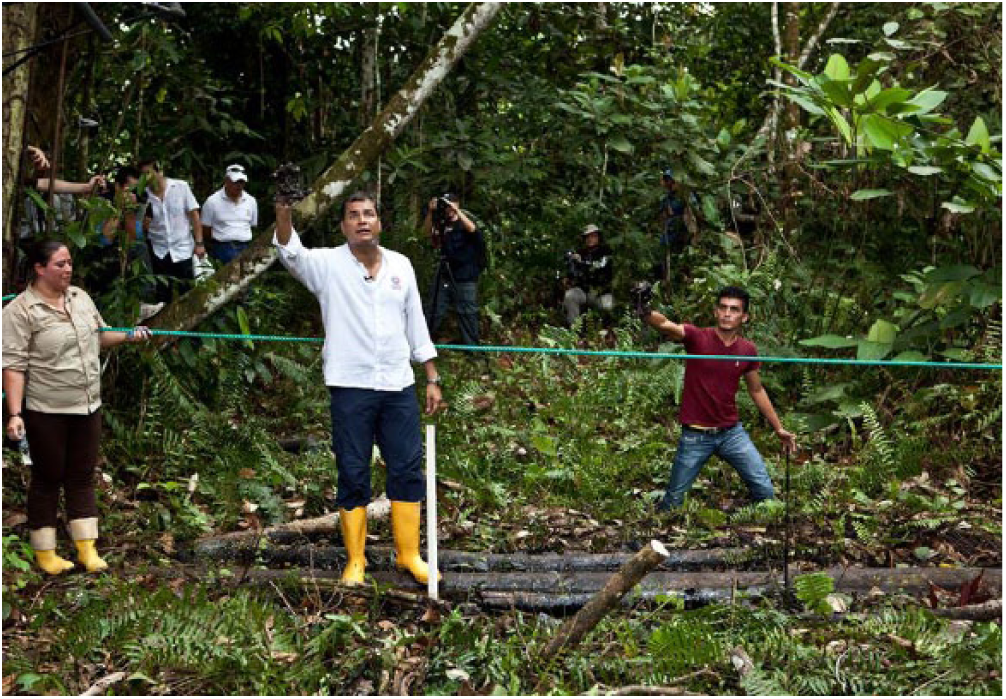
Rafael Correa launches La Mano Sucia de Chevron campaign on 17 September 2013.
In what follows, I situate the mano sucia gesture within the history of activist work in this region in order to explore the role of bodily knowledge in witnessing industrial contamination and struggles for environmental justice. Drawing on ethnographic observations of President Correa’s La Mano Sucia campaign, the testimonials of a man living down the road from the pit who suffers from persistent health problems, toxic tours led by a local resident-activist, and the termination of an initiative to keep oil in the ground in the Yasuní National Park, I show how the same gesture does different work in revealing toxicity and complicity – work that depends on the position of the bearer to the burdens of pollution and the benefits of extraction. There is not one mano sucia in this text, but many. I aim to let the hands illustrate the profoundly asymmetric relationships to the toxic entanglements that oil produces. In some cases, individuals chose to symbolically ‘expose’ themselves to the media, mobilizing the accumulated, lived knowledge of others through their gesture; others offered their hand as an evidentiary gesture of their own painful experiences of toxicity. In drawing them together, my aim is to disentangle the multiple hands of La Mano Sucia in order to call attention to the profound differences in toxic burdens encapsulated within a single motif. Dirtied hands reveal the co-production of toxicity and power in extractive landscapes: At times in this article, the gesture calls for corporate accountability and distributive environmental justice, at other times, it reveals the systemic production of material, social and political distance between the accrual of benefit and the production of harm in an industrial-capitalist order.
A growing recognition of the permeability of bodies and toxicants, alongside the employment of lay practices of knowledge production in environmental justice struggles have mobilized the experiential to condemn poisonous assemblages of capitalism, pollution, and inequality. Building on work on ‘embodied health movements’ (Brown et al., 2004), efforts to decolonize scientific practice (Benjamin, 2013; Dunbar-Ortiz, 2015; TallBear, 2013 Tuck and Yang, 2012, 2013), and theorization of toxic materiality (Chen, 2012; Shapiro, 2015; Tuana, 2008), I argue that gestures of ‘bodily knowledge’ – those forms of knowing that emerge through the cohabitation with toxic chemicals in oil extraction – are not always the uncomplicated evidentiary claims they might seem. The mano sucia is best read provocatively for its references beyond the hand to larger structures of capitalism, extraction and inequality from which crude oil is extracted, and within which toxicity (and distance from it) is produced in certain places, bodies, and relations. Finally, hands – and the knowledges they embody – point us to the profoundly unequal burdens of contamination and benefit derived from oil. While emphasizing the central role of bodily knowledges within practices of studying and acting upon the adverse effects of toxicants on living organisms, at the same time, I use the hand to point to how such knowledge does not come without cost. Efforts to mobilize the experiential as a means of political contestation demand our attention as they reconfigure and generate burdens of exposure, waste and vulnerability in the late industrial present (Fortun, 2012).
Building on two years of ethnographic fieldwork in the Ecuadorian Amazon, 3 the stories recounted here attest to the need to expand the boundaries of what counts as ‘harm’ in oil production (Fiske, 2017a, 2017b). Positioned against corporate and state insistence on narrow conceptions of causality and responsibility in industrial exposures, this article is intended not so much as a rebuke of a specific oil company or an individual political actor, but rather as an opportunity to explore complicities with the oil complex and the complexity of denunciation more broadly. What the dirty hand of the Mano Sucia campaign reveals is not simply the ‘hidden’ contamination in jungle soils, but rather a politics in which bodily knowledge of toxicity wields the most authority when spoken for by those in positions of power. In the contaminated present that we occupy, all of our hands are dirtied. However, the multiple meanings contained within La Mano Sucia illustrate the necessity of attending to the relative vulnerabilities and privileges which shape possibilities for life in the toxic present. As such, it is a call to be observant of the appropriation of practices and knowledges borne out of environmental suffering by those in positions of power, even when seemingly used for good.
Toxic effects
The past half-century has marked a dramatic transformation of the northeastern region of the Ecuadorian Amazon. Responding to land crowding in the Sierra and a drought in the southern highlands in the 1960s, government officials mistakenly equated abundant jungle flora for rich agricultural soils, and thus saw in the vast territory east of the Andes the nation’s next breadbasket (Wasserstrom and Southgate, 2013). At the same time, Ecuador was on the brink of becoming an oil-producing nation. Politicians imagined that oil – through the infrastructure and revenue it would bring – would be a means of facilitating colonization of unconquered border territory. All told, the processes of oil development and state-sponsored colonization resulted in the arrival of more than 200,000 colonists to the Amazon, who claimed more than 4,500,000 hectares of land (Lucero, 2008; Sawyer, 2004) which was the ancestral territory of indigenous nationalities living in the region. This period marked the beginning of the territorial expansion of extraction in the Amazon, which shaped the profoundly unequal distribution of the harmful effects of toxicants on the one hand, and the national benefits of revenues resulting from oil production on the other.
Through a joint venture between Ecuador and Texaco, oil operations began in the Ecuadorian Amazon in the 1960s, in an area roughly the size of Rhode Island. 4 Rampant dumping of crude oil and production liquids into local waterways and the routine burning of oil byproducts resulted not only in massive environmental contamination but also in health problems for indigenous and peasant farmer communities. Over the course of 20 years of operations, Texaco drilled 339 wells and built 18 production stations, to extract an estimated 1.5 billion barrels of crude (Kimerling, 2006: 449). In 1993, a group of lawyers filed a lawsuit against Texaco on behalf of 30,000 Amazonians (Aguinda v. Texaco). Asking for reparations for environmental, health, and cultural damages, the suit brought unprecedented international attention to the region. In 2011, the court found Chevron (which purchased Texaco in 2001 in a $45 billion merger) guilty and fined the company $9.5 billion. Despite this landmark ruling, the case has not yet been brought to a close. Chevron no longer has any holdings in Ecuador, and thus the Aguinda sentence could not be executed there. As a result, the plaintiffs have taken the case to countries where Chevron has operations (such as Argentina and Canada) seeking a ruling by a third-party court to claim the financial settlement. In the years since the 2011 ruling, there has been a lengthy appeals process, including several additional lawsuits in which Chevron sued the Ecuadorian state for interference in the Aguinda legal process, as well as a successful Racketeer Influenced and Corrupt Organizations Act (RICO) lawsuit brought by Chevron against plaintiff attorney Steven Donziger for fraud in 2014 (Barrett, 2014). At the time of writing this text, whether or not the plaintiffs will ultimately be able to collect the settlement remained uncertain.
‘Black gold’ was imagined as heralding an era of national prosperity, yet it also led the way for contentious struggles over health, territory and contamination. Tracking the refiguration of oil development through capitalist logics in the 1990s (Sawyer, 2004), scholars have underscored central concerns around territorial displacement and institutional corruption that emerged in relation to extraction (Gerlach, 2003; Guzmán-Gallegos, 2012). Since the inception of the Aguinda lawsuit in 1993, much of this scholarship has pivoted around struggles over health, human rights, and political organizing in relation to oil (Beristain et al., 2009; Bustamante, 2007; Kimerling, 2006; San Sebastián and Córdoba, 2000; Sawyer, 2008; Valdivia, 2007). Others have worked in conjunction with groups like Frente de Defensa de la Amazonía to scientifically demonstrate the links between environmental contamination and harm to human health in the Amazon (Hurtig and San Sebastián, 2004; San Sebastián and Córdoba, 2000, 2001). Following Texaco’s exit from Ecuador in 1993, national and foreign oil companies expanded operations, and extraction has become the object of growing political and social controversy. Ecuador introduced its first comprehensive environmental regulation in 2001 (Regulation 1215), resulting in new audit practices and increased state involvement in industry operations.
Since the 2000s, debates around oil have been shaped by competing articulations of extractivism (Riofrancos, 2017a). The rise of leftist leaders such as Correa, combined with historically high prices for oil, enabled promises of fighting the ‘pathologies of poverty’ (TeleSur, 2013) by investing in education, healthcare, and infrastructure, while at the same time furthering commitments to advancing the extractive horizon of the nation. With the initiation of novel projects to fight climate change such as the Yasuní-ITT Initiative, the 2008 codification of the rights of nature in the constitution and commitments to plurinationalism, debates over the future of resource extraction and the promotion of national sovereignty have taken on renewed fervor in the last decade. Thus, La Mano Sucia campaign comes at a particular moment in Ecuadorian history, articulated in relation to a landmark trial against Chevron (which was won locally by plaintiffs but is in no way ‘closed’), and within the broader context of the simultaneous environmental and extractive commitments of President Correa. La Mano Sucia, as an activist gesture, celebrity motif and presidential campaign, is thus an intervention into the public negotiation of toxicity in relation to the future of oil development in Ecuador.
To understand the transformations of life wrought by extractive industries today, we must be attentive to what Nixon (2011) terms slow violence, a ‘violence that occurs gradually and out of sight, a violence of delayed destruction that is dispersed across time and space, an attritional violence that is typically not viewed as violence at all’ (p. 2). A slow spill has its own power, one which is not necessarily weaker than an eruption. As scholars working in environmental justice, political ecology, and anthropology have repeatedly demonstrated, toxicants always traverse pre-existing contours of position and power, including, but not limited to race, class, gender, and geography. 5 In the case of Ecuador, the state-sponsored displacement of indigenous nationalities, precarious settlement of colonist communities alongside oil operations, and utter lack of industry regulation and adequate health services in the first two decades of operations compounded emerging inequalities in health, wealth and education in the region.
Pollution from petroleum production is characterized by the presence of hydrocarbons in the surrounding soil and water. Hydrocarbons are highly toxic to both people and animals. In the process of being spilled, dumped, leached or burned, the molecular components of crude oil and chemicals added during the extraction process are disassociated from the substance itself, traveling through ecosystems and accumulating in the bodies of organisms. The toxicants used and produced in oil production cross boundaries, from the plastic industrial membranes installed to contain the contents of waste pits to the fleshy ones covering bodies. These chemical compounds, often in varying combinations, effect changes that are unanticipated and forceful. However, identifying, measuring and demonstrating exposures to toxicants outside of the laboratory is a problem. ‘Cocktails’ of chemicals, changes in industry practices, dispersion throughout air or water over time, the movements of people between locations and jobs and daily activities all make tracing and demonstrating exposures exceedingly difficult. As a result, the matter of the toxic exposure of residents in the Amazon remains a subject of legal, scientific, and public controversy, despite the nearly 20-year lawsuit dedicated to the matter. 6
Contamination in the Amazon is emblematic of life in the ‘new age of toxicity’ (Walker, 2011: ix). Toxic figures inhabit a range of social and political discourses well beyond their environmental or biological provenance, ‘leaking out of nominal and literal bounds while retaining their affective ties to vulnerability and repulsion’ (Chen, 2011: 266). From the proliferation of toxic compounds in our soil (Lyons, 2016), water (Davis, 2003), air (Harrison, 2011), vegetables and bodies (Lundqvist et al., 2006), to the formaldehyde derived adhesives in the flooring, walls and carpentry of the average American home (Shapiro, 2015), and the flame retardants sprayed on baby mattresses and couches (Liboiron, 2016; Miller, 2017), the chemical constitution of post-industrial life has become remarkably ordinary. As ‘chemically transformed beings’, we are linked by molecular relations that extend beyond the organic realm of hydrocarbons and bodies to the relations between landscapes, production and consumption (Murphy, 2008: 696–697).
A growing body of scholarship has asked how we account for the affective and relational processes of toxic exposures within this profoundly contaminated world. The focus of this work is attuned to the micro-level, low-dose, chronic, multiple and cumulative effects of toxic chemical compounds, querying the boundaries of bodies, environments and the materials of everyday life (Murphy, 2016; Povinelli, 2017; Roberts, 2017; Shapiro and Kirksey, 2017). Shapiro (2015: 369), for instance, describes tracking indistinct and distributed changes to bodies and environments as the ‘chemical sublime’, in which even minor encounters demand ethical consideration and practical intervention. Similarly, Tuana (2008) explores the capacity of toxins to transgress boundaries. Whether through their accumulation in the fatty tissue of fish to their movement through the air and into our lungs, toxic travels remind us that distinctions between subject and object, human and non-human are not fixed. The capacity for toxins to affect us, Chen (2012: 159) suggests, involves the shifting relations of both affect and being affected that are central to the experience of being exposed to a chemical. As human subjects, we are profoundly vulnerable to ostensibly inanimate particles. Such relational recountings remind us that the very compounds used in the extraction and production of petrochemical products that produce adverse effects on organisms and environments are also what sustain our lives today (Todd, 2017).
Throughout my fieldwork, interlocutors spoke at length of health problems resulting from exposure to chemicals used in oil production, such as skin lesions after bathing in contaminated water, or difficulty breathing in the presence of gas flares. Upon arrival to the region, the majority of settlers had no knowledge that crude oil or the chemical compounds used in its production could be harmful to their health. As one woman described her first decades living in the region, ‘we were unconcerned, out there swimming in oil’. Yet residents soon came to learn of the violence of toxicity through first-hand experiences with health problems, dying farm animals, withering crops, polluted rivers, air thick with smoke, and increasing social conflict (Beristain et al., 2009; Fiske, 2016; Kimerling, 1991; San Sebastián et al., 2001; San Sebastián and Córdoba, 2000). Despite the obviously harmful nature of these experiences for those present, bodily claims occupy a precarious place in evidentiary hierarchies. While people living alongside industrial operations may be the first to detect problems, and are essential in providing the ‘contextual’ information that informs where certain chemicals should be tested for (those very insights necessary for science to ‘work’), such bodily claims are also systematically excluded from official forms of knowledge production. For example, in the case of Ecuador, initiatives in popular epidemiology to engage residents as collaborators in scientific work have been met with derision for being weak and biased and for failing to demonstrate a precise cause-effect relationship (Hurtig and San Sebastián, 2005; Kelsh et al., 2009; San Sebastián and Córdoba, 2000; Sever, 2005). In particular, studies in the region sparked significant disciplinary debate over whether epidemiology should be ‘scientific’ or ‘action-oriented’, and questioned the invocation of the precautionary principal in cases of plausible environmental exposure without causal demonstration (Terracini, 2005). Lacking legal and scientific legitimacy, bodily claims – and the engagement of lay collaborators’ lived knowledge of a place – are often called upon only to bolster other forms of evidentiary practice.
A growing awareness of the structures which produce toxic relations between bodies and industries, along with the enrollment of lay practices of knowledge production in environmental struggles, and the widespread failures of regulatory science and law (Boudia and Jas, 2014), have marshaled bodily experience to condemn poisonous assemblages of capitalism, pollution, inequality and climate change. The experiential has been claimed as a mechanism to challenge and decolonize science. Diverse examples range from community-driven environmental movements (Checker, 2005) and bucket-brigades to monitor air toxics (Ottinger, 2010), to the do-it-yourself practices developed by radical feminists of the US women’s health movement in the 1970s (Murphy, 2012), to the medical activism of the Black Panther party to challenge discrimination (Nelson, 2011), or to the push to mobilize personal experience as data in biomedical or epidemiological citizen science research (Buyx et al., 2017; Strasser and Mahr, 2017), in which lay individuals use their bodies in order to make certain inequalities, diseases or vulnerabilities visible.
Shapiro (2015) argues that the human apprehension of chemicals is a simultaneously sensuous and epistemic process; a form of ‘bodily knowledge’ that accounts for the costs of extraction, industry and inequality (p. 387). The mano sucia gesture, used for years in activism by activists in this region prior to Correa’s debut, is derived from the knowledge of toxicants that comes from a life alongside industry, of waste pits covered over, of personal struggles to carve a life out of contaminated earth. Bodily knowledge emerges through the worldly relations that the hand points us to, with all the material and metaphorical intimacies that they imply. Building on the above scholarship, and moving beyond the obvious demonstrative potential of the gesture, I examine the mano sucia as part of a contradictory populist politics promoting both extractionism and the social good, as an appeal to action, and most of all, as a call to critical inquiry: Who has borne the burden here? Who has benefited from the production of this toxic waste?
Before proceeding, a caveat: the dirtied hand – as a gesture implying an embodied knowledge of pollution – is not the straightforward evidentiary claim it might appear to be. My intention in using the mano sucia as an entry into the politics of witnessing industrial contamination is not simply to invert an evidentiary pyramid by arguing that the body has a more privileged relation to truth than other forms of evidence. While not recognized in official scientific or legal forums, bodies are still vested with a peculiar social authority, for the primacy of – ‘it happened to me’, or, ‘I saw it with my own eyes’ – lends immediacy to truth claims based on experience. Yet bodies are suggestible and even misleading; most relevant to the discussion here, they are situated. In recognizing and substantiating the importance of bodily knowledges in struggles for environmental justice, I do not aim to promote a wise or more authentic ‘local’ body over numbers, samples or other forms of evidence of harm. Rather, I insist on the situatedness of all accounts: from the technical to the experiential, from relative positions of power and proximity to pollution. Interrogation of this positionality by juxtaposing the various dirty hands at stake in a single motif points us to the politics of this toxic world: the co-production of toxicity and power in struggles for life with extraction.
Álvaro: ‘I keep living so I can tell you about it’
I opened this text with the inauguration of La Mano Sucia de Chevron campaign. However, President Correa was not the only person offering testimony that morning. I’d like to shift focus, drawing attention to a moment of far less fanfare that occurred just prior to Correa’s opening speech at the Aguarico 4 well. 7
Amidst the surrounding chaos awaiting President Correa’s arrival, a group of journalists were interviewing Álvaro Jimenez, a man who lived in the area.
8
Álvaro stood, pulling up the bottoms of his silver track pants with his hands in order to expose his legs. They were scaly and red, skin flaking off in large patches. The journalists crouched to zoom in on his body with their lenses, panning slowly up to show his equally raw arms, hands and neck. Meanwhile, he spoke. His words were fast, pouring out in a hurried stream of a story that he had recounted many times before. He barely paused for breath: Of course, I have consumed, I’ve cooked with, I’ve drank, I’ve washed in it, I’ve consumed and will continue consuming [this water]. Here on the Aguarico, [the river] is completely contaminated due to the exploitation [of oil] by the Chevron-Texaco Company. Using low quality technology, they saved millions of dollars and now we see all the treated water, all the oil that they dumped directly into the streams. Not just people were harmed. This also harmed the environment, the fauna, and people have gotten sick here. Many people don’t want to come forward and give testimonies. It’s been more than 18 years, [and this has been seen on] many different television channels. Many journalists from all over the world [have come], and people are tired now and they don’t want to give [interviews]. Many compañeros who lived with cancer have died. I’ve seen them die here, and well, I keep living so that I can tell you about it.
He paused. One journalist asked if he could take some close-ups of the man’s wounds. Álvaro nodded and continued talking, adjusting his clothing to allow the cameras a clear view of his exposed skin. ‘This is a product of contamination’, he said, indicating his sores. ‘These are unknown diseases’. He began to name the people in his community who, in his view, had died as a result of pollution.
Yet, Álvaro, a poor campesino who had arrived in the region in the 1970s and knew intimately the wounds inflicted by oil development, was not the star of this show. Minutes later, a caravan of PetroEcuador trucks pulled into the platform from the access road. President Correa emerged, in yellow rubber boots and a white guayabera with the rainbow swirl of the ‘Ecuador loves life’ logo on its front pocket, underscoring his competing commitments to promote a broader social good and environmental rights with the funds gained from continued extraction. He waved at the crowd as triumphant music played in the background. Accompanied by officials from the Ministry of the Environment, Correa made his way over to tour the waste pit and make the speech condemning Chevron.
In the weeks following the launch of Correa’s La Mano Sucia campaign, various invited celebrities also made appearances at the Aguarico 4 site. Mia Farrow, Alexandra Cousteau, Jean-Luc Mélechon, Amba Jackson, Danny Glover, Luis Eduardo Aute, Alberto Almeida, Antonia Juhasz, Montserrat Ponsa, and Eugenio Cedeño each ceremoniously dipped a gloved hand into the pit and presented their blackened palm to the camera as a visual denunciation of Chevron. While at the waste pit, the celebrities made public statements, expressing disgust. Many were surprised upon seeing and smelling the waste pit in person. As René Pérez, lead singer for the hip hop group Calle 13, commented, ‘This is the first time that I see this with my own eyes, that I’ve smelled and felt this kind of contamination … and it is horrible’ (EFE, 2014).
The celebrities held their crude-covered hands high for the cameras as they made claims about the contamination based on what they had seen and touched. By bringing outsiders to tour the Aguarico 4 waste pit and touch pollution in vivo, Correa’s La Mano Sucia campaign constructed a celebrity version of an Amazonian toxic tour, in which the person doing the denouncing had only that moment come to learn – in his or her (gloved) flesh – what contamination was. In the spectacle of the campaign’s opening day, Correa was himself a celebrity denouncer, a tourist in his own country.
In this part of the Amazon, certain people are known for their willingness to speak publically about oil contamination. I met many such individuals during my fieldwork, too many to include here: clinical staff who spoke of experiences caring for sick patients, the mother of a teenager diagnosed with leukemia whose house is a few dozen meters from a well, and plaintiffs in the Aguinda lawsuit who had lost children after drinking contaminated water or who had miscarriages after washing laundry in streams that ran with production waters. Álvaro is one of these figures, famous locally for his decades of suffering from unexplained illnesses. However, many of those present in the audience of the La Mano Sucia launch could have spoken from personal experience of diseases they attribute to contamination or of the spills near their homes.
For the journalists, the visible lesions on Álvaro’s body made him particularly credible in the context of Correa’s La Mano Sucia campaign. If it were not for the visible manifestation of exposures to toxicants in the flesh, it is unlikely the journalists would have interviewed him. His verbal testimony was secondary – even seemingly inconsequential – to the visual traces that pollution had left on his body. But ultimately, neither he nor any of the other residents who had lived with oil operations were politically captivating enough to officially participate in La Mano Sucia campaign. Instead, celebrities – whose bodies had never known the effects of crude oil – made visible a reality that they only discovered upon arrival in the Amazon. While celebrities indexed contamination through their outstretched hands and indignant words, Álvaro’s body was rendered evidence of toxic nature itself, reinforcing the manifestation of the effects of exposure to contamination in particular bodies and not others.
To be the object rather than source of vision is to be evacuated of agency (Haraway, 1997: 32). If the modest witness of the 17th century was credible because his body was invisible as an unmarked, white, elite, male ‘gentleman’ who could conveniently occupy a ‘culture of no culture’ (Haraway, 1997, drawing on Shapin and Schaffer, 1985), the Amazonian resident’s credibility as witness is reduced in this example to corporeal proof. Compared to the invited celebrity witnesses, Álvaro has little recourse – he has few economic resources, and no political footing to speak from. His body serves as the principle way he can make claims to the media that are recognized as legitimate.
Witnessing practices have material consequences for how toxic burdens are mitigated, or not. For instance, Álvaro is mindful that his testimonials have provided little to no help to meet his family’s daily needs or to address his health condition. As he told me a few months later while discussing that morning of La Mano Sucia, What is the information for? That is what all my friends, my spouse, neighbors say …. they say to me, ‘Like an idiot you collaborate. Like an idiot you take off your clothes, like an idiot you expose yourself. It’s time for them to help you. They come from all over the world, and they make money off these interviews, with these videos, and you, you’re just being used’.
Limited socio-economic resources make families like Álvaro’s especially vulnerable to repeated exposures in this place (for example, families with enough financial resources can purchase bottled water for drinking and cooking, have the opportunity to move further away from oil operations, or to seek health care in places like Quito). Those who are most vulnerable to contamination are also those who are least equipped to alleviate that burden.
In the coverage of La Mano Sucia campaign, Álvaro was peripheral compared to the celebrity speakers. His experiences were spoken for by invited celebrities; then, when invited to speak by the journalists, his voice was rendered secondary to his bodily lesions (Tuck and Yang, 2013). Why was his body recognized as an authoritative form of proof for those reporting on the day, yet his verbal account not? In her account of asylum seekers in France, Ticktin (2011) explores the construction of the morally legitimate suffering body that is the object of humanitarian intervention. Medical and scientific appraisals of bodies are necessary so that an asylum-seeking individual can be seen as worthy of humanitarian intervention, to receive legal residence papers. She argues that suffering is made legible through the form of the racialized, gendered body of the Global South, demanding a response through evidence of physical torment. Such constructions render suffering subjects as Other – bodies that are best spoken for rather than as witnesses who can speak (Ticktin, 2011: 15–16). In thinking through Álvaro’s demonstration for the journalists in the frame of the unfolding La Mano Sucia campaign, we see that while celebrities were invited to denounce harm that was previously alien to them, those who had lived with contamination and continue suffer its effects were visible only as supporting figures. His body became an impromptu exhibition of what others had to say on the matter. What La Mano Sucia campaign launch and surrounding media coverage reveal then, is not so much the ‘hidden’ contamination in jungle soils, but rather a politics in which bodily knowledge of the toxic effects of oil wields the most weight when spoken for by those who are politically and materially insulated from toxic violence.
The embodied nature of the mano sucia gesture points us to the ways that ‘bodily knowledges’ such as those seen in Álvaro’s testimony often come at great personal – and even collective – cost. Simply put, there are burdens implied through the engagement of bodily knowledges in the politics of denunciation that require further consideration beyond their potential to disrupt and contest powerful structures – whether in activist work, citizen science initiatives, political campaigns, or as the subject of ethnography.
Donald: La Mano Sucia and the toxic tour
La Mano Sucia campaign borrowed heavily in both form and content from what are known as ‘toxic tours’ in the region. One of the principle means through which outsiders have come to know about contamination in the Amazon is through tours in which a guide brings participants – students, lawyers, environmental activists, journalists and foreign tourists – to visit contaminated sites. Amazonian toxic tours have been closely aligned with the plaintiffs in the longstanding Aguinda v. Texaco lawsuit, and rely on local figures, as guides and witnesses, who speak of their first-hand experiences with contamination. I situate the history of the mano sucia gesture in practices like toxic tours as an opening into the politics of who can demonstrate and denounce contamination.
Toxic tours began as a civic forum for education and social change in the form of expeditions to polluted spaces in the United States, most often led by members of communities that had been historically disadvantaged and bore an undue burden of industrial pollution (Pezzullo, 2009). Toxic tours emerged in the environmental justice movement in the mid-1980s, as activists in North America began to articulate the ways in which race, class, and environmental assault were tightly linked. The movement theorized how certain spaces came to be seen as ‘appropriately polluted’ (Higgins, 1994) or as ‘human sacrifice zones’ (Bullard and Benjamin, 1999), pointing out the consistent siting of toxic waste sites in low-income communities of color (Commission for Racial Justice, and United Church of Christ, 1987). The idea of a ‘toxic tour’ was to invite outsiders into spaces they would not normally go, in order to bridge spatial, political, racial, and affective distance by presenting a first-hand demonstration of places where the ‘other’ lived, worked and played. Often, representatives of communities suffering from the effects of pollution are central proponents of these tours.
While toxic tours in Ecuador do not share the same lineage as the US environmental justice movement, the Amazonian toxic tour is not far afield from toxic tours in other sites (Checker, 2005; Di Chiro, 2003; Pezzullo, 2009). In the late 1980s, peasant farmers in Sucumbíos and Orellana began to organize to address the region’s political and economic marginalization, demanding land titles, better roads, and social services. Oil development was largely unregulated and state social investment in the region was conspicuously absent despite the growing population of settlers. Concerns of residents, activists, missionaries and others and were mounting about environmental contamination from the innumerable oil spills and routine dumping that characterized the first two decades of the industry. One of the groups born out of this community organizing was the Frente de Defensa de la Amazonía (FDA), founded in 1994 in part to respond to the call for civic support put out by the plaintiffs of Aguinda v. Texaco. Much of this work emphasized the fact that Texaco was a US corporation. Groups argued that Texaco had made cost-saving decisions in their operations in Ecuador because they believed it to be a place beyond the rule of law, decisions that the company would not have made if operating at home. Advocates for the plaintiffs framed the case through a critical analysis of disparities of power and wealth between the United States and Ecuador.
Following the filing of the Aguinda lawsuit in Ecuador in 2003, an increasing number of journalists, lawyers and students came to Lago Agrio with questions, asking to see the Texaco sites under dispute. Often, they were referred to the office of the FDA, the most prominent national NGO supporting the case. There they met Donald Moncayo, who had grown up in the first oil camp Texaco drilled in Ecuador, just outside Lago Agrio. Donald knew the area intimately. As a child, he had watched Texaco’s early operations. He knew which streams had been contaminated by spills and where old waste pits had been covered over. At first his activities were largely informal; if someone arrived with questions, he frequently volunteered to show them around. As he conducted more and more tours, this task became his vocation. One participant suggested the name ‘toxic tour’, and that is the term by which these events are known now. Today, Donald’s principal role at the non-profit Selva Viva is to run the toxic tours. While he is paid by the organization as an employee, there is no fee charged for the tour itself. Participants are only responsible for paying the transportation for the day. 9 In the past decade, the toxic tours led by Donald have evolved into a principal means for plaintiffs to tell their stories to outsiders as part of their struggle for justice.
The Aguarico 4 waste pit features frequently in Donald’s toxic tours, largely because it is an accessible, open-air pit. Generally, Donald leads groups through the brush to the edge of the pit. There, he will pause in the speckled light of the forest to tell them about the well they are visiting. Formerly operated by Texaco as part of the consortium, this land belongs to PetroEcuador, who today is responsible for operating the well which is used to re-inject waste water deep beneath the surface. The waste pit sits just off to the side of the platform; its accessibility makes it an ideal spot for these tours. Although difficult to tell while present on the site, the surrounding marsh and forest – part of the ancestral territory of the Cofán nationality – is still used extensively for hunting and fishing, and nearby settlements have cleared land for farming and raising animals.
Describing Texaco’s operational practices, Donald will then indicate the boundaries of the pit, which can be difficult to recognize at first because of the growth around its edges. Yet, with practice, the eye becomes accustomed to finding these overgrown rectangles in the forest. This pit is about 3 meters deep, he’ll begin, as the students gather before him. In 1974, Texaco drilled this well and operated it for many years until it later became dry. 10
Following this, Donald uses some ‘props’ to build his case. Finding a long stick, perhaps one he has used before on that site – recognizable because the end is already stained a telltale black – he will then ease the stick into the pit until it hits bottom. Here he allows participants to ‘discover’ the pit’s depth on site. Look, he’ll say, gesturing towards the pit, this is business. They didn’t cover it over, they just dumped it here. They saved a huge amount of money by doing it this way. In the tours, he stresses how the company’s technical practices spread contamination by illustrating how he and others encounter pollution in their daily lives. His point is not just that these waste pits still contain crude oil that needs to be cleaned up, but that the resulting contamination has migrated well beyond the pit boundaries.
Then, taking groups around to the back corner of the pit, Donald will go on to explain the function of the so-called ‘gooseneck’ 11 drainage pipe, the design of which was a major point of contention in the lawsuit. After inviting participants to step out onto logs floating on the surface, Donald will dig his gloved hand into the crude slop and extend it for visitors to inspect. This gesture, repeated in hundreds of toxic tours, has been routinely captured by journalists.

Donald Moncayo shows toxic tour participants the crude oil present in one of many waste pits in the Ecuadorian Amazon.
As in any job, Donald has developed a repertoire of tools for communicating the history of contamination to outsiders. The most iconic of these is the crude-covered hand. Donald’s picture, face out of focus and obscured behind his black hand, regularly accompanies articles in newspapers and magazines and has made countless appearances on activist websites and blogs. The hand makes contamination – which, when sitting in the mud at the bottom of a stream or distributed across the surface of water can be evasive – visible for the viewer. It is a striking, personal gesture that denounces the legacy of oil.
Growing up in the Lago oil camp near some of the first wells drilled in the Amazon, some of Donald’s earliest memories are of the tremendous clouds of black smoke that billowed from burning waste pits, and of the family laundry turning black after it was hung outside. As a child, he would walk to school barefoot on the hot pipeline in order to avoid ruining his shoes on oil-slicked roads. He remembers countless times that his family’s crops were lost after oil spills, or that he found farm animals suffering or dead after drinking contaminated water from nearby streams. Donald recounts how, at the age of 13, his mother passed away from symptoms of acute toxic exposure after washing laundry in a stream contaminated by a recent spill of production waters near his house. Taking over responsibility for the family farm with his siblings, he saw his community divided by disputes over land, jobs and spills – first with Texaco, then with PetroEcuador. Over the years, Donald’s awareness of the toxicity surrounding him became more acute. Today, living across the street from an oil flare that burns 24 hours a day, he continues to live with the persistent fear that the air his family breathes might one day make them sick.
The toxic tour that Donald leads implies a critique of the relations of power, pollution, and justice that extend beyond the Amazon. He draws attention not only to the enduring presence of contamination in a particular place, but also to the ways those toxicants travel: which river this stream connects to, the family that lives a few kilometers below that became sick and had to move away in search of medical care, and the sale of agricultural products grown in contaminated Amazonian soil for national and international markets. The toxic tour articulates the details of immediate struggles within a broader political economy, highlighting the symbolic and material patterns of pollution and injustice in life in oil producing regions (Pezzullo, 2009: 23). Donald’s toxic tour, involving the details of daily life with oil operations – such as the number of farm animals lost by falling into uncovered waste pits – combines personal and anecdotal knowledge to denounce the legacy of oil pollution in his home. This narration makes it possible for visitors whose lives are geographically and culturally distant from the Amazon to relate to the weight of Texaco’s practices, forging a space of shared connection between outsiders and the lives of Amazonian residents.
In his work on the attunement of bodies to domestic chemical exposures, Shapiro writes of Linda, a woman who develops what he calls a ‘chemically aware body’ born out of professional monitoring practices and heightened attention to her own symptoms of exposure. Linda’s chemical attunement illustrates that the material transformations that occur through exposures cannot be separated from the intellectual processes of detecting chemicals in the environment. Likewise, when Donald raises his oiled hand for audiences, he draws on a lifetime of experiences such as those recounted here, through which he became increasingly attuned to the toxicity surrounding him, and now knits together with references to laboratory test results for Total Petroleum Hydrocarbons, legal documents and the technicalities of industrial practices, in order to counter claims that contamination is not present. Raising his hand as a delicate instrument of touch and sensing, he mobilizes accumulated bodily experiences to denounce historic injustices. His hand speaks to toxic relations that exceed the boundaries of any singular waste pit.
Toxic tours are supposed to make contamination evident. Participants bear witness to rivers, soil and bodies – human and animal – damaged from oil operations. To my eyes, the tour given to President Correa as part of La Mano Sucia campaign by two government officials (Paola Carrera, then of the Program for Environmental and Social Remediation, and Lorena Tapia, then-Minister of the Environment) was remarkably similar to other such tours I had witnessed. Practices derived from specific, local forms of bodily knowing and dwelling in a place, such as the showing of the hand covered with oil in toxic tours, are also subject to appropriation. What becomes clear by paying attention to variations on the toxic tours in the Amazon – from Donald’s toxic tour to La Mano Sucia campaign’s riff on it – is that the positions of those involved reveal the profoundly unequal toxic burdens borne by some bodies and not others. The theatrics of La Mano Sucia campaign were successful in part because of the trope of publically ‘revealing’ crude oil in a place of such great natural beauty. Yet, what does it mean when the claims that carry the most political weight are derived from the privileges of living a life removed from those very realities? What happens when the dirtied hand – as a gesture of denunciation or as a symbol of struggle – is appropriated by those who know very little of contamination in the flesh?
Correa: Extractivism and environmentalism
The inauguration of La Mano Sucia campaign was not the first time that Correa, an outspoken critic of American imperialism, had publically condemned the legacy of Chevron. Known as a left-leaning environmentalist, Correa’s tenure as president was part of a trend of progressive governments that came to power through alliances with social and indigenous movements in South America (De la Torre, 2013a, 2013b). In critiques of the forms of development common in Latin America in the 1980s and 1990s, Correa and leaders like Evo Morales and Hugo Chavez denounced export dependency, enclave economies and the power of foreign companies (Gudynas, 2009; Kennemore and Weeks, 2011). In Ecuador, this shift was most visible through a commitment to increased social investment in the form of free education, new roads and efforts to fight poverty through the ‘citizen’s revolution’ of the Alianza País political party. In 2008, the new constitution renewed hopes for strengthening progressive social and environmental movements on the national stage (Becker, 2011). Despite these changes, extraction remained a principle source of revenue for progressive states, and even expanded to new sectors (Riofrancos, 2017b). Oil remains prominent in Ecuador’s political economy, today accounting for approximately 50% of export earnings; more than 65% of the Amazon is zoned for drilling (Finer et al., 2008).
Throughout his time in office, Correa’s stance towards the environment grew more complicated. For instance, while expanding extraction by the state oil company and building up the mining sector in the southern Andes, Correa was also a proponent of novel environmental initiatives, such as the campaign to protect the Ishpingo-Tambococha-Tiputini (ITT) block of the Yasuní Wildlife Reserve in the Amazon. The initiative, which began in 2007, proposed to combat climate change by leaving 850 million barrels of heavy crude oil in Amazonian subsoil in exchange for 50% of potential revenue (valued at $3.6 billion) from the international community (Bass et al., 2010; Larrea, 2009; Larrea and Warnars, 2009; Rival, 2010). Yet, after six years of promoting the initiative, on the 15th of August 2013, Correa announced that he was ending the Yasuní-ITT campaign, due to lack of revenue from the international community (Fiske, 2017b). Just one month later, he launched La Mano Sucia de Chevron campaign that opened this article. In sum, in the same period, Correa opened the door to oil extraction in one of the most bio-diverse regions of the world with one hand, and launched an international campaign to denounce the history of Texaco with the other.
Returning to the opening moment at Aguarico 4, the young man who was brought out to indicate the boundaries of the pit to Correa did not see himself as playing a central role in La Mano Sucia launch. Born at the end of the 1990s, he has spent his entire living amidst the oil wells and pipelines that surround Lago Agrio. When called to walk across the pit, he stopped and spontaneously dipped his hand into the crude (Personal communication, 2014). Although he was following the President’s lead, the act of putting his bare hand in crude oil was itself unremarkable for him – oil is a substance that many people in this region encounter in their daily lives. But the moment proved critical in the production of La Mano Sucia campaign. By doing so – no glove to cover his hand and without hesitation – he called upon the President to prove his commitment to the cause he had just described in his speech. In other words, he forced Correa’s hand.
The Mano Sucia moment was a seemingly dramatic show of commitment in the history of environmental cleanup in the Amazon. The President’s dirtying of his own hand was supposed to bridge the symbolic and spatial difference that marks the distribution of pollution. Yet, the bare hand also complicated the campaign, aside from serving as a media stunt. Shouts from the audience called for the President and the young man to shake hands. The young man moved forward, stepping up to balance on the log alongside Correa. Their mutual commitment was affirmed in a crude-covered handshake. While in the light of the La Mano Sucia campaign the gesture seemed to solidify Correa’s commitment with the Amazonian cause for clean up, it also underscored the dual work of his other hand in opening the Yasuní-ITT to drilling just one month prior.
Correa’s launch of La Mano Sucia on the heels of his announcement to end of the Yasuní-ITT initiative illustrated his contradictory posture on environmental justice and extraction, as well as the tensions between his technocratic and messianic forms of leadership (De la Torre, 2011, 2013a). The double work of the hand in both La Mano Sucia campaign and the Yasuní-ITT initiative was not lost on the public. In one cartoon by the artist Rafa, the top frame shows a caricatured Correa standing in an oil pit, defiantly holding out his hand in solidarity: ‘Me mancho las manos’ (I dirty my hands). In the frame below, Correa self-assuredly washes his hands in a pool of water from the Yasuní: ‘Me lavo las manos’ (I wash my hands). Playing on this duality, in another cartoon signed ‘JCO’, a male figure faces an audience with his right hand prominently outstretched in denunciation against Chevron. The left hand – also blackened by crude like the right – is held hidden behind his back with the tag ‘Yasuní?’ The image suggests that a political sleight of hand is at work: the ‘leftist’ environmentally forward politics that decries oil is disingenuous about its investments in extractive futures.
La Mano Sucia is a charismatic symbol, in part because it is derived from lived experiences with toxicity such as those captured by Donald’s toxic tours. In drawing Correa, other celebrities, Donald, and Álvaro into the same frame, my intent is not to ‘level’ the kinds of knowledge invoked when different actors present their dirtied hands. Rather, I aim to draw attention to the critical differences within the gesture. La Mano Sucia campaign was a captivating event precisely because of its ability to leverage the existing currency of the dirtied hand as a representation of life alongside oil operations and as a critical rebuke of industries that engender environmental injustice. To uphold one’s own oiled hand is to mobilize the experiences that are embedded in the gesture. In doing so, the hand directs our attention not only beyond the crude to the political economic structures that profit from toxicity, but also back to bearer and his or her own complicities with the oil complex.
In Ecuador, extraction has been reframed for national development in largely the same historical moment that nature has been accorded constitutional rights, and in which one of the largest environmental lawsuits ever brought found a US-based oil company guilty of damages worth $8.6 billion. The launch of La Mano Sucia campaign just a month following the termination of the Yasuní-ITT proposal illuminates the complexity of denunciation, and the complicities of leftist political movements with the oil complex. Yet beyond simply undercutting Correa’s commitments to environmental cleanup, such toxic entanglements show that while the motif of La Mano Sucia may seem to travel lightly from Quito to the Aguarico, from a toxic tour to an internet meme, not all manos sucias are the same. 12
Conclusion
Central to movement, perception and meaning, the hand is a fundamental means through which we engage with and experience the world. Hands have long been linked symbolically to questions of morality and responsibility, and the hand is often figured in relation to the self (Hertz, 1973). 13 Throughout this article, I have used the mano sucia an entry point for probing the struggles over the unequal production of power and waste in the extractive present, figured here through the corporeal act of dipping one’s own hand into crude. It is perhaps precisely because of the experiences of toxicity and embodied commitment for justice implied through the gesture that the juxtaposition between those who bear the burden of pollution and those who are granted the authority to speak for it, and between events like the end of the Yasuní-ITT and the denunciation of Chevron, that its appropriation is so troubling.
Claims of harm resulting from exposure to oil contamination are mediated through embodied performances like these moments on the Aguarico 4 well platform. By placing the accounts of Correa, the celebrities, Donald and Álvaro side by side, we see that the gesture of the mano sucia does different work in revealing toxicity depending on the witnesses’ relation to the benefits and burdens of extraction. When Donald raises his oiled hand for audiences, he draws on a lifetime of experiences alongside industry. It is a gesture of perception that draws its authority as a truth claim from his position as a resident of the area, as a plaintiff, and as an activist with the FDA. Donald points us to the necessity of understanding the porosity of chemicals, and the impacts of oil beyond the boundaries of a single pit to the surrounding soil, water and lives of the region. In Álvaro’s informal testimony for the journalists, his body – alienated by the zoom of the camera lenses – was mobilized as evidence, while his account of a life shaped by contamination was rendered secondary. In attending to his words, Álvaro renders legible the relations that link him to those who are no longer living, telling of the human suffering that accompanies these histories of extraction and exposure. These accounts point beyond the crude on the hand to the entanglements of daily life and the oil complex. By contrast, the invited celebrities discovered the reality of contamination with their oiled hands. The spectacle was in their surprise, illustrating not their personal knowledge of pollution but rather their distance from it. In the case of Correa, the gesture – in light of his recent closure of the Yasuní-ITT initiative – served to highlight his own dueling commitments to the nation, extraction, and natural-cultural patrimony of the Amazon. Thus, the mano sucia gesture calls us to be more deliberate in our consumption of accounts of environmental harm: Who is granted the authority to speak, and who is spoken for, in public struggles over extraction and toxicity?
Bodily labor – whether recording corporeal symptoms in citizen science projects, ‘bucket brigades’ to monitor pollution in environmental organizing, or providing testimony based on personal experience in cases of injustice – is often upheld as a liberating or empowering endeavor by which people seize the tools of knowledge production. Without arguing against the possibility of this, I have shown that in the mobilization of bodily knowledge, the socio-political positioning of the bodies doing the ‘knowing’ matters a great deal. What the dirtied hand makes evident depends on the relative position and power of the bearer; denunciations of the burdens borne of toxicity and inequality are always entangled with the responsibilities we all bear from living in, and benefiting from, this polluted world.
Intimate, quotidian knowledge is essential to apprehending what has happened in this place, and the violence of these extractive histories (Nixon, 2011). The people who live in the Amazon are often the best positioned to point to all the places that normative models of toxicological testing fail. They can tell you what the scientists who study contamination here are not able to capture, or show you the physical traces of old production practices which are now obsolete. Others offer painful accounts of battles with cancer or endless legal struggles to have old spills cleaned up. Part of what individuals like Álvaro show us most clearly, however, is that bodily knowledges are not without expense. The burdens are felt acutely by those called upon, again and again, to offer their case – whether rhetorically or in the flesh.
Making the relations of toxicity legible is always a political act. Ethnographically grounded explorations of how the politics of witnessing intersects with efforts to recount and denounce the material and social traces of toxicants complicate what it means to make a claim with one’s body, or in this case, with one’s hand. Within landscapes of exposure, any politics of bearing witness to the harmful effects of toxicants that elicits testimony from or speaks for those who have suffered the most from oil operations – while doing nothing to alleviate this violence – does not advance struggles for justice. The use of vernacular, corporeal experience – and the gestures, memes, motifs and images used to index that experience by others – is never simply about speaking the ‘truth’ or providing a ‘local account’, nor is it only about the ‘opening-up’ of science and politics to new forms of knowledge production. Rather, it can perpetuate forms of structural violence and create new toxic burdens. Bodily knowledges must be examined for their specific relationships to forms of power and exploitation, and for their potential for appropriation by other parties – even when dedicated to condemning environmental injustice.
Footnotes
Acknowledgements
This article would not have been possible without the labor and love that Donald Moncayo dedicates to educating others about contamination through toxic tours. I am indebted to him and to many residents of Sucumbíos and Orellana who spent time recounting their life experiences and struggles with toxicity with me; I regret that I cannot list them by name here for reasons of confidentiality. I am grateful for the careful reading and insight provided on earlier versions of this article from Margaret Wiener, Peter Redfield, Rudi Colloredo-Mansfeld, Barry Saunders, Dragana Lassiter, Paolo Bocci, Diana Gómez, Cassandra Hartblay, Michael Cepek, Vincent Joos and Andrea Ricci, as well as two anonymous reviewers and the indispensable editorial support of Sergio Sismondo and Nicole Nelson. Thomas Widger and Alice Mah organized fruitful workshops on toxicity in 2017 that have informed my thinking on this matter. Special thanks to Max Liboiron, Manuel Tironi, and Nerea Calvillo for their initiative, feedback and organization of this special issue.
Funding
The research for this article was generously supported by the National Science Foundation, Social Science Research Council, Wenner-Gren Foundation, Institute for the Study of the Americas at the University of North Carolina at Chapel Hill, and UNC Graduate School.