






Abstract
Between 1967 and his death in 2018, Jimmy Rogers, a unique figure in the UK’s black self-help movement, dedicated himself to the welfare of black young people via basketball. Through Rogers’ own words and oral histories of individuals who knew him, this article traces his path from Liverpool 8, where he introduced organised basketball in 1967, to London, where he established the Brixton Topcats basketball club in response to the ‘riots’ of 1981. Rogers learnt through his own life of hardship – of being brought up ‘in care’ – the need for discipline, self-belief and self-reliance. And he used these experiences and his basketball skills to mentor generations of dispossessed young black men and later women, who found, through his clubs, an antidote to a world of institutional racism, economic hardships, and heavy-handed policing. At a time of drastic cuts in youth services, he showed the importance of alternative community-led youth provision to black working-class inner-city residents.
Keywords
Not enough attention has been paid in the UK to the self-help activism in post-war ‘black’ communities to meet needs which were not being met by a racist national and local state or were being caused by them – be it by educational neglect, lack of housing provision, or brutalising policing from the 1960s to the 1980s. Particularly when the ‘second generation’ came of age, with expectations of rights and a future, the need to meet those needs became clearer. Drawing sometimes on traditions brought from home countries, all kinds of groups emerged from within communities to meet the needs that a racist state threw up – advice centres, supplementary schools, skills classes, hostels – and a plethora of agencies were organised, ranging from The Black University to the Martin Luther King Foundation and the Harambee Project. 1 In addition to providing social provision to young blacks being excluded in one way or another by society, people were catering to the need for political and cultural sustenance too: bookshops like Bogle L’Ouverture and Soma, publishing imprints like New Beacon, arts centres like Keskidee and Tara Arts.
Wedged politically between militant black parties and exclusivist white local provision, a whole host of community figures who dedicated their lives to giving back to their communities, have gone unsung – from Sybil Phoenix who fostered perhaps hundreds of young black children, Pansy Jeffrey who started the first black ‘housing association’, to Brother Herman, who tried to stop the jailing of a generation of young black youths, and himself ended up in jail.
Deprivation in inner-cities, compounded by institutional racism across education, housing, youth provision and policing, fed into a mood of disillusionment, particularly for children navigating the care system. And the intimations of the anger of a failed generation of young black people threaded through the 1970s – the Mangrove, the Metro, Brockwell Park, Chapeltown, Notting Hill Carnival. But 1981, when some thirty-five inner-cities burst into flames of anger at persistent neglect, racism and hostile policing, revealed the situation in stark relief.
The article below is based on conversations and interviews with and about another unsung hero – Jimmy Rogers – who used sport, specifically basketball, as a way of involving young black disaffected youth in two key black areas, Liverpool 8 and Brixton. 2 The historical retrieval of this man’s specific contribution to black youth and basketball is set against his unique journey as a black boy through the harsh British care system of the 1940s.
The Editors
Introduction
Jimmy Rogers’ death from lung cancer on 1 October 2018 elicited no obituaries in the national press. Of major news outlets, only The Guardian and the BBC published online articles in response to his passing. These acknowledged his ‘fatherly’ stature within basketball circles in Britain, as well as the impact he had on young people in Brixton: ‘How Jimmy Rogers’ basketball club inspires thousands’; 3 ‘Brixton Topcats coach Jimmy Rogers dies leaving an All-Star legacy and thousands of winners in the game of life’. 4 The sentiment was echoed by a smattering of public figures. 5 People like Rogers often go unacknowledged outside the communities in which they serve; in death, their lives are readily forgotten, dismissed by the establishment as insignificant or unknowable. Ultimately, then, it will fall to those who knew Rogers to elevate his story – a process initiated by the outpouring of tributes paid by friends and protégés in the wake of his death.
This article will continue that process by chronicling Rogers’ life both in his own words and using oral testimony from some of the individuals who knew him. 6 Those who knew Jimmy as a community leader, mentor and basketball coach reveal what it was like to be a black young person growing up in Brixton and Liverpool in the 1970s and ’80s. Rogers was an anchor to multiple community-led, grassroots initiatives, including two predominantly black basketball teams for young people, Atac and Brixton Topcats, as well as the New Education Recreation Association – all of which, in various ways, empowered young people through sport and community organising at times of raw racism and political upheaval.
James Aggrey Rogers was born in Wales on 17 December, 1939. He would never meet his father, an African American merchant seaman, nor his mother, a Welsh Barbadian dancer, and grew up the only black child in an orphanage in Newcastle upon Tyne, an experience he described as one of ‘survival’. ‘I learnt the golden rules, you have to be able to run, you have to be able to fight. Couldn’t fight, couldn’t run, you were dead.’
7
At age 13, he was placed with a foster family in a mining village in County Durham; at 15, he joined the British Army as a ‘boy soldier’, at which point his relationship with the family abruptly ended: I wasn’t invited back to Brenda and Tom’s house . . . that was a big shock . . . [Brenda] was the first person who showed me love . . . who showed me a whole heap of stuff, about not losing your temper, about being proud of yourself, a black man, years ahead of time she was . . . and I wasn’t going to see Mimi, Brenda’s mother again, and that was devastating, devastating that, and the misbehaviour that followed you can guess. Interviewer: Why didn’t they invite you back? When I was younger, I had stolen from them once, apologised to them, told them, and Mimi, aunt Miriam, I promised I’d never steal again: ‘I’m sorry, I’m sorry’, and she loved me, and I said I’m sorry . . . What I didn’t know was that Tom, who was a pig, uncle Tom, who was a swine, and he just assumed, ‘He’s never going to change’, ‘We’re not inviting him back’, so I’m going on leave and imagine that, I’m not seeing Aunt Mimi again. I went nuts, went nuts.
8
Although the focus of this article is on Rogers the community leader, the mentor and basketball coach, rather than on his upbringing or private life, the emotional turbulence of his early life sheds light on where Rogers’ desire to support young people came from. Self-discipline and, particularly, his diligent approach to basketball, which he began playing with little instruction as a schoolboy in Newcastle, were strategies Rogers employed to resist the discord of his early life. He spoke, for example, of his decision made at the age of 12, to run to and from school daily – a distance of almost ten miles – and later, while in the army, where he eventually became his regiment’s fitness instructor, of spending nights alone in the sports hall, endlessly practising his shot. 9 ‘Drive the body!’ would become his motto and trademark incantation: ‘that saying rings in every Brixton player’s head’, recalled Marvin Addy, one of Rogers’ former players. ‘If you’re at the gym you’ll push one more time; if you’re running lengths, you’ll go another length; if you’re going through hard times in life you just get up. I think that’s what he’s done for everyone.’ 10 It seems Rogers’ desire to help young people through sport was rooted in his childhood experience: if basketball could provide solace, joy and a sense of purpose in his own troubled life, then surely it could do the same for others.
By telling Rogers’ story, this article will attempt to present a fuller picture of ‘inner-city’ life for young black people growing up in Liverpool 8 and Brixton at the time. Tracing his path from Liverpool 8, where he introduced organised basketball in 1967, to London, where he established the Brixton Topcats basketball club in response to the ‘riots’ of 1981, it charts the positive influence Rogers had on countless young lives.
Liverpool 8 – deprivation compounded by institutional racism
On the evening of 21 August 1970, Jimmy Rogers was stopped by two police officers while walking with his wife on Sandon Street, in Toxteth, part of ‘Liverpool 8’. ‘I told them I hadn’t committed any offence and I was on my way home’, he later told the Liverpool Free Press, ‘as I turned to go one of them grabbed me and said: “Oh are you? Funny guy?”’. 11 One of the officers proceeded to search Rogers, finding on him some letters and a comb. He also withdrew from Rogers’ jacket pocket a small piece of silver paper. ‘Sheila, my wife, said to him, “You’ve just planted that.” The police officer then told me he was arresting me because he believed it was cannabis.’ 12 Rogers was taken to the Main Bridewell in Cheapside, charged with possession and held in custody overnight.
That a black man was stopped and searched for no discernible reason was by no means an uncommon occurrence in Liverpool at the time. A 1971 report of the recently-established Liverpool Community Relations Council (LCRC),
13
then headed by Toxteth-born anti-racist campaigner Dorothy Kuya,
14
said it dealt overwhelmingly with allegations by the black community of persecution by the police: of forty complaints recorded between September 1970 and May 1971, seventeen were of unfair arrest, twelve were of harassment and eleven were of violence committed either before or after being charged.
15
‘There is a pressing problem of relationships between Liverpool police and Black people’, stated the report.
16
But Rogers’ arrest was more than a routine case. Remarkably, he had served for two years as the coach of the Liverpool Police basketball team until just a few months before his arrest. That same year, in fact, he had led the team to a national championship – then the highest achievement in the sport in Britain. While Rogers’ connection to the Liverpool police may have aided his eventual acquittal, by jury, of being in possession of drugs (a chief superintendent who served as manager of the basketball team was called as a character witness) it did him no such favours when first held in Cheapside: In comes the sergeant in the drug squad . . . and he said, ‘Hello Jimmy, what are you doing here?’, and I said something like, ‘One of your bastards just set me up here.’ And he said to me, ‘I’m sorry Jimmy, we didn’t know it was you.’ I flipped, I went off, completely off. I started lashing out, screaming. I was gone, completely gone, and they were beating the shit out of me but I can’t feel anything . . . The next day I was in hospital. I had broken this, broken that. . .
17
The story of Rogers’ arrest helps bring into focus the cross-currents of fear and oppression that tore at the social fabric of Liverpool in the 1970s. Beyond police mistreatment, many black people in the city found themselves trapped in ‘patterns of discrimination and disadvantage’, which had become ‘institutionalised and hardened over a very long period of time’, in the words of the North West Race Relations Board. 18 Inequitable access to satisfactory housing, employment and education among black residents underpinned a general atmosphere and a specific geography of racial division: the 1976 National Dwelling and Housing Survey showed that more than 70 per cent of Liverpool’s black and minority ethnic population lived in five wards in and around Liverpool 8, a small district to the south of the city centre. 19
Deprivation compounded by institutional racism and that encountered in wider society – to leave the bounds of Liverpool 8 was, for many residents, to expose themselves to verbal and physical abuse 20 – fed a mood of disillusion in the black community. 21 This was particularly true of young people in the city, who were singled out by police and excluded from the job market in disproportionate numbers. In 1972, the Runnymede Trust stated that 32 per cent of Liverpool-born black youths were unemployed; by the end of the decade, the Merseyside Community Relations council (MCRC) suggested the figure was between 70 and 80 per cent. 22 It was out of this distinctive context that the lifework of Jimmy Rogers sprang.
Between 1967 and his death in 2018, Rogers dedicated himself to the welfare and success of young people in Liverpool 8 and the similarly beleaguered inner-London district of Brixton. ‘Inner-city’ districts such as Brixton and Liverpool 8 have long been saddled with an injurious territorial stigma. 23 Belying the complexities of place and change over time, racialised public depictions often presented them as sites of hopelessness, poverty and, particularly, criminality and unrest after the spring and summer of 1981, when ‘riots’ led by black youth against police brutality and inner-city deprivation and racism spread across the UK. 24 Such racialised depictions rarely said anything meaningful of the lives and experiences of those living within the areas described: largely unheard went the voices of black and working-class residents; largely ignored were the many faces of political activism and grassroots community engagement, including black women’s centres, welfare projects, and social groups. 25
The state of provision for black youth
It was through sport that Rogers sought to engage young people, and to instil in them values of discipline, resilience and self-empowerment. As education campaigner Gus John points out, what little there was in the way of black-centred youth work in Britain in the 1970s and ’80s was often built upon an armature of racism: whether consciously or unconsciously, it subscribed to the state’s characterisation of black youth as ‘problems’ or as a ‘threat’. 26 Rogers tacitly rejected such labels. As someone who had experienced firsthand what it felt like to be isolated, rejected and deemed ‘second-rate’, Rogers aspired to create through basketball a space in which young black men and women could shed the weight of ‘deviant’ or ‘inferior’ ascriptions and develop patterns of resistance.
Rogers first set eyes on Liverpool 8 as a teenager, during a brief stay in the city while on leave. The fascination was immediate, and enduring: he visited it at every opportunity and, after a brief stint playing professional basketball in West Germany, where he had been stationed (he left the army aged 24), he settled there in 1966. ‘The place to be was Liverpool, Toxteth’, he said. ‘I fell in love with it. Never seen poverty like it in my life but I fell in love with it, black people, scousers, loved it.’ 27 The poverty Rogers saw was very real. As indicated above, everyday life in Liverpool 8 was typified by deprivation and racial disadvantage. And yet, as a district steeped in black history and culture, and possessing a certain bohemian reputation, it was not without its attraction, either for locals or impressionable newcomers like Rogers. John Belchem wrote: ‘Liverpool blacks were reluctant to vacate the relative security of the Granby Triangle [at the centre of Liverpool 8] with its networks of ethnic collective mutuality, shebeens, clubs and other compensatory delights.’ 28
Rogers found work on the assembly line at the Ford Motor Company in Halewood, at a time when black employees constituted just 2 per cent of the manufacturing workforce across seventeen of Liverpool’s major factories, pointing to the discriminatory nature of employment in the early ’60s. 29 He continued to play competitive basketball for a club in Stretford, Greater Manchester, and for the Liverpool YMCA team. In 1968, he was selected for the Great Britain basketball team, and was also asked by Liverpool Police to join its ranks, in order that he qualify to play for its National League squad. ‘I wasn’t doing that’, he said. ‘Everybody in Toxteth hated the police. Everybody.’ 30 (There was long-term tension between the community and the police due to the history of police harassment, intimidation and brutality inflicted on the Liverpool 8 black community. 31 ) Instead, Rogers agreed to coach the team. This was also the year in which Rogers started down the pedagogical path that would come to define the rest of his public life. Fed up with the glaring absence of black people involved with basketball in the city, and with the scarcity of youth provision in Liverpool 8 – ‘There was nothing else at all for young black people, nothing, nothing at all’ 32 – Rogers introduced evening training sessions for young people at Paddington Comprehensive, a purpose-built ‘multiracial’ secondary school opened in 1968. 33 Unsurprisingly, it was an endeavour that was met not without prejudice nor derision: ‘I went to the local education offices . . . and the guy turns round and says, “Why do you want to teach these coloured kids in Toxteth?”. . . That was my first instance of that nonsense that was going on in Liverpool, when I started to teach basketball.’ 34
The state of provision for black youths in Liverpool during this period was, if not as lamentable as Rogers indicated, severely lacking nevertheless. A 1968 report produced by the Liverpool Youth Organisations Committee, Special but Not Separate, stated that of fifty youth groups surveyed in the city, ‘coloured teenagers will only be found in perhaps five or six’. 35 It went on to say that a youth club (unnamed) found on the outskirts of Liverpool 8 operated a ‘member imposed’ colour bar. 36 It was widely known that Stanley House Community Centre, on Upper Parliament Street, presented the best – and safest – bet for black youth club-goers in the city. Established by philanthropists in the early 1940s as a centre for ‘coloured people and their friends’, 37 and expanded to include a youth club in 1963 – ‘what is believed to be Britain’s first black youth club for coloured teenagers’, stated the Liverpool Daily Post – its membership was almost entirely black, even if its management and the majority of its staff were not. 38 The revamped club offered a number of activities, including boxing and dance classes in its new gymnasium; football and netball were played in its outdoor quad. The centre also housed a coffee bar, juke box and music room – the chart-topping black political band, The Real Thing, had its beginnings in Stanley House. 39 Yet, for all its successes (the club was singled out for praise in Special but Not Separate) and its applied and symbolic importance to black residents in the Granby area, it was closed in 1972, less than a decade after it had been opened. This was despite ‘growing concern and anger over the lack of facilities for young people in Liverpool 8’, according to the Liverpool Free Press. 40
The closure of the youth club was telling. It had been beleaguered from the start by limited funding and police complaints (and incursions). But it was the attitudes of Stanley House management and its distant executive that did most to grease the wheels of its untimely demise: youth worker Chris Elphick, who was eager to transfer operational powers at the club to those in Liverpool 8, said that young people were often insulted and treated with disdain by staff and leadership alike. 41 ‘The obvious need is for local black people to run these clubs’, observed the LCRC. 42 What provision there was for young black people was framed not as an opportunity for positivity or flourishing, but rather as an investment against delinquency: ‘Not to deface walls, not to damage cars, not to harass pensioners through noisy behaviour’, were the stated aims for the young people involved in one detached youth project. 43 It was a cynical approach, based on prejudicial cultural assumptions, and one that supplemented the already myriad ways in which young black people in Liverpool were pathologised and set apart.
Paul Ambrosius was 15 when he met Jimmy Rogers, in the sports hall of Paddington Comprehensive: he comes over to us and says, ‘Are you lot interested in basketball?’ And we’re all like – there’s about eight of us or something – and we’re going, ‘Yeah, we’re brilliant’, we’re all giving it large about how great we are and stuff but he didn’t laugh, he just let us . . . He said: ‘Has anybody got a jump shot? Who can shoot it?’, and we’re all heaving up these bricks, you know. And then he goes, ‘Hey, that’s not bad that’, and, ‘Try it with your fingertips though and try to get it high’, and then we all tried and maybe it went in or something, I don’t know, but it was the gentle sort of understanding way, that he didn’t take the piss out of us for missing, and the fact that he adjusted it in a hot second . . . and we were just like, ‘Wow, shit, somebody that’s able to do some shit’, you know, and then it was a case of, ‘I’ll tell you what, you fancy coming down here and I’ll give you a training session next week?’, ‘Yeah’, and we all turned up.
44
Ambrosius was born in Liverpool 8 in 1953. His mother was white Irish; his father, a black American GI, was never a part of his life.
45
Like many of his friends in the area, Ambrosius inhabited, for the best part of his formative years, a world of poverty, violence and low expectations. Money was scarce – ‘The money came in on Monday from the benefits and . . . it would all be gone by Wednesday, so consequently, pretty much we were starving at the weekend’
46
– and fighting plentiful: ‘I remember being involved in race riots as a seven-year-old . . . bottles and bricks and knives out every evening and running battles.’
47
At age 11, Ambrosius and his family moved a mile out of Toxteth to Liverpool 7, where there was a much smaller black presence: ‘Growing up between the age of 11 and 17 we had people trying to set the curtains on fire, putting fireworks through the letterbox, all that stuff, writing graffiti on the door and the walls . . . I was having to fight every day for the first two years.’ By the time he met Rogers, at age 15, Ambrosius had been temporarily excluded from Paddington Comprehensive, and could count himself as part of a growing cohort of young black people in Liverpool who found themselves exiled from the social world: We were wild kids. I think we would have survived, most of us would’ve survived our sort of early life, but [Rogers] got us as the age of 15, 16. I mean we were doing things like, you know, we were stealing cars, we were robbing people, we were doing all that kind of stuff . . . so I was ripe for needing to be sort of taken in hand and pointed in the right direction, and that’s Jimmy, that’s down to Jimmy, and I think, ‘Ah, blimey what would have happened?’ I would have either been in a car wreck or would have been in some jail or other.
48
For many young black people in Liverpool and across Britain in the 1960s and ’70s, youth workers too often represented ‘alien bodies who . . . do little more than assist the State in controlling their lives and tempering their conduct’, in the words of Gus John. 49 Rogers, on the other hand, was a friend and mentor to the young people he worked with, and, as Ambrosius described, ‘something of a father figure for want of a better term, for a number of us in that team, who had no fathers’. 50
The creation of ‘Atac’
By 1969, what Rogers began as informal training sessions had evolved into ‘Atac’ (Figure 1)
51
– one of the few (if not the only) predominantly black basketball teams in Britain at the time. Tim Martyn-Jones was a friend and teammate of Rogers. He said: Jimmy came to Liverpool and basically started the black thing going, you know, the teams there were white . . . they were middle-class and the rest of it, black kids just didn’t do anything like that . . . And actually, generally, spreading out from there, getting black kids playing wherever he goes to. I mean Jimmy going down to Brixton was the same sort of thing.
52
By 1970, Atac was one of the most successful junior teams in the country; it lost to the eventual champions, Doncaster Panthers, in the quarter finals of the National Junior Championship that year. For Ambrosius, his relationship with Rogers, and by extension, his horizon-broadening experience with Atac, had set him on a transformative path: I literally stopped the shit . . . literally at the point of starting basketball with Jimmy. It was an epiphany for me. It was a complete road to Damascus, put the brakes on, nothing dodgy after that . . . I got focused, up to that point I’d never been focused on anything in my life . . . all sorts of things got in the way of me having the wherewithal or the self-confidence to do that.
53
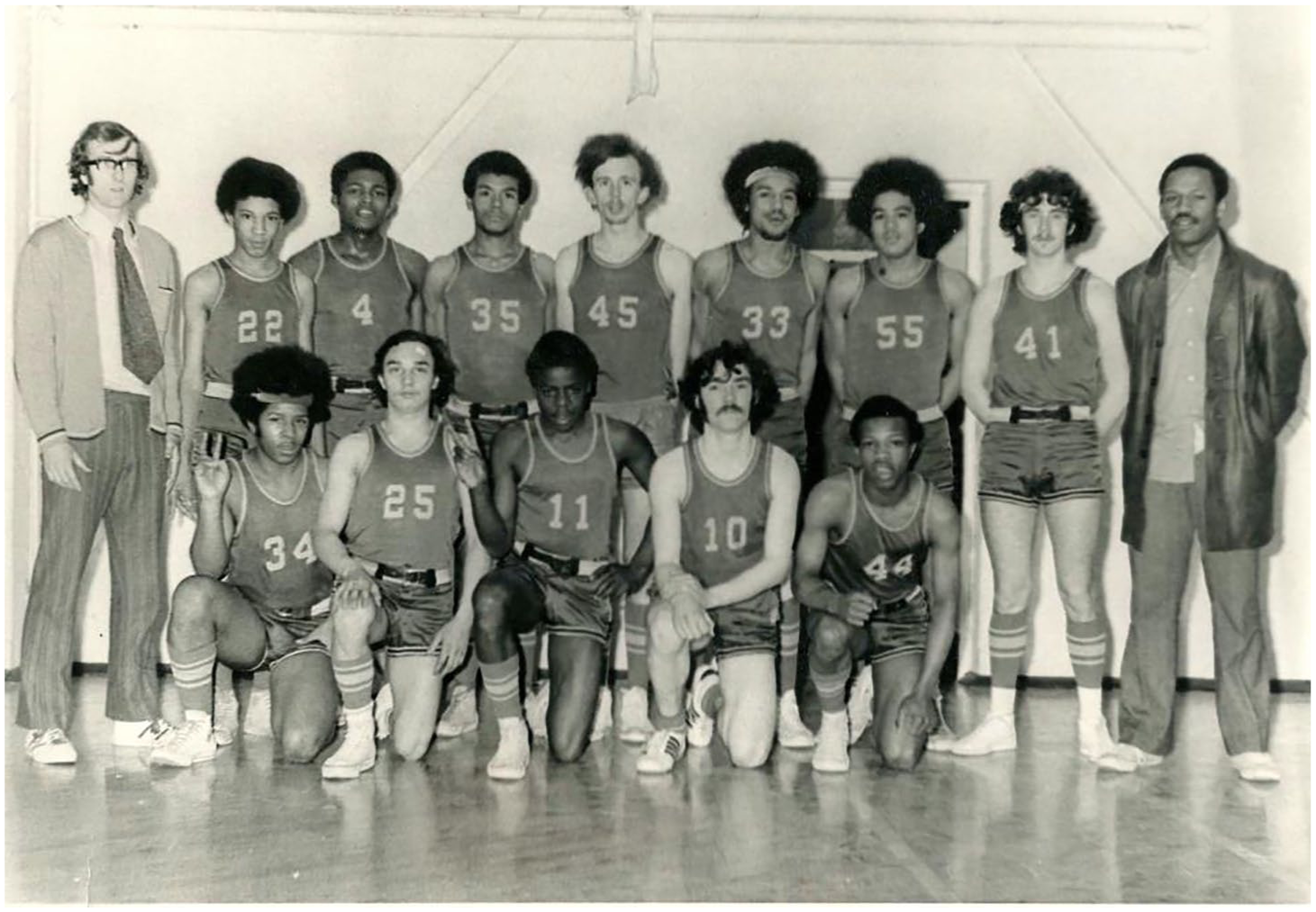
Atac c.1971. Jimmy Rogers is on the far right; Paul Ambrosius wears 33; Tim Martyn-Jones is on the far left. Photo reproduced with the permission of Ambrosius.
In 1971, Ambrosius was selected for the North of England junior basketball team and, with the assistance of Rogers, began volunteering for the LCRC. This led to a permanent youth and community worker position in Liverpool 7. In 1975, aged 22, he became a social worker in Liverpool 8 for the Black Social Workers’ Project, housed within the city’s Social Services Department. 54 On the strength of his work with Atac, Rogers had himself accepted a full-time position at the LCRC, as a Community Relations Officer with Special Responsibility for Youth. Here, working under Dorothy Kuya, he continued to supply positivity, support and validation for young people in Liverpool 8.
Like Rogers, Vincent Edwards grew up in the care system. He was born in Boston in Lincolnshire in 1957, to a white British mother, a hotel worker, who gave him up for adoption. He never met his father, also a black American GI. At 4 years old, Edwards was moved to a children’s home in Penketh, Warrington, where he was the lone black ward. Eventually fostered and then adopted by white parents living on the ‘white side’ of Liverpool 8, and as a pupil at a majority white school in Dingle, in the south of the city, he had had minimal contact with other black people growing up: ‘I was alert the whole time . . . I felt so exposed and self-conscious and all like that, but again, it was, you know, my introduction to Jimmy that helped with that.’
55
It was an introduction arranged by Edwards’ parents, worried as they were about his desire to grow an afro, which, according to Edwards, they associated with ‘troublemakers’: So they took me down to see Jimmy in his capacity as community relations officer, and . . . he was kind of like, you know, the first black guy I’d kind of seen really because I’d had hardly any contact with black people. So I remember sitting there thinking, ‘Oh God, this is just going to be another, “Why do you want to grow your hair like that? You’re not like them” kind of thing.’ And I remember distinctly my Mum said to Jimmy, ‘Vincent wants to grow an afro, you see, and we’ve said you don’t really need to grow an afro because you haven’t got an afro have you?’ And he said, ‘Do you know what Mr and Mrs Edwards? If I could grow an afro I’d have the biggest afro in Liverpool!’ At which point I went, ‘Oh! Hang on a minute!’ So that was the first kind of connection really. It seems a small thing but it was kind of significant because it was me meeting Jimmy, it was my introduction to the black community, it was reassurance to my Mum and Dad that I wasn’t going wayward, so it covered all those kinds of things and Jimmy kind of facilitated that. So he then said to me, said to them, ‘Well why don’t you bring him down to Atac?’
56
As we have seen, growing up young and black in Liverpool during the period in question was a difficult experience for many. The atmosphere of prejudice, fear and mistrust black youths faced outside of Liverpool 8 was compounded by the lack of positive opportunity and youth provision inside of it. Prejudice, and the pathological stereotypes ascribed to young black people by white society, were not only experienced as external constraints, but became a part of their self-conception.
57
Atac was a rare source of pride and purpose for those involved. They were still stopped by the police, in instances ranging from the egregious to the mundane: ‘We were stopped on a weekly basis, just because we had bags, because we were going to training.’
58
But in Rogers they had someone that could relate to their situation, that had experienced it firsthand, and who made them feel special in spite of it: Jimmy instilled in us that we did have a chance. We almost felt slightly elite in a way because we’d all been mentored, if you like, by Jimmy. And the basketball club was a community within a community, very much so, and so we all felt privileged in that way.
59
‘From resistance to rebellion’ – Brixton in the 1980s
In her history of black Lewisham, Longest Journey, Joan Anim-Addo described the 1970s and ’80s as ‘nightmare years’ for racism across the country. 60 With prominent national politicians heaping on their own brand of toxicity – from Enoch Powell’s 1968 ‘rivers of blood’ speech, to Thatcher’s declaration, in 1978, that Britain ‘might be rather swamped by people with a different culture’ – far-right groups such as the National Front (NF) were gaining traction in increasingly economically depressed urban areas like Lewisham – precisely the places in which black people tended to live and work. The media hailed Powell’s speech, and as a consequence racism was a recurring feature of daily life. ‘Asians and West Indians were abused and attacked, their property damaged, their women and children terrorised. Police harassment increased, the fascists went on a rampage and Paki-bashing emerged as a national sport’, wrote A. Sivanandan. 61 Black communities regularly found themselves caught on the horns of discrimination in the spheres of housing and education, and via antagonistic policing. On 13 August 1977 in Lewisham, between 500 and 1,000 NF supporters attempted to march, with a police escort, to protest against the supposed increase in black ‘mugging’ (another media construct) from New Cross to Lewisham town centre. This led to violent clashes with counter protestors in a display known as the ‘Battle of Lewisham’. 62 And, on 18 January 1981, the New Cross fire saw fourteen young black people aged between 14 and 22 killed by a possible racist arson attack. 63 In response to the fire, a day of action saw 10,000 people, mostly black, marching through the heart of London.
The New Cross fire left a lasting impression on young black people in the area and fed into a growing cynicism about their place in the world. As New Cross resident Annette Hinds, who knew several people killed in the fire, recalled: That was a shock, and I mean the word was at the time that this is a racist attack, so that was a really dark period, you know, ’cause those kids were young, sixteen average age at that time when that happened, so it was kind of grim, it was really grim, and you were kind of taught that you were at the bottom of the pile, you really were, that’s what you felt.
64
Annette Hinds was 18 at the time of the fire, and in search of a positive distraction: I heard that there was basketball in this club called Moonshot. Moonshot was a big club in New Cross years ago, youth club, and me and Glennis [her friend Glennis Baptiste] . . . we said, ‘Let’s go’, and we did, we started to go, and there’s this man Jimmy.
65
By the late 1970s, Rogers had left the MCRC to work on an action research project centring on black youth in Liverpool.
66
When the project came to an end, he was unable to find work in the city, and moved to Brixton to take up a job managing a community housing scheme, in 1980. Quickly finding ‘no inner-city kids playing basketball to a reasonable level in London’, and frustrated by the dearth of black players in the youth programme at Crystal Palace – then the powerhouse club in Britain – where Rogers briefly coached, he began to roll-out training sessions in inner London for young men (as he had in Liverpool 8) but also for young women.
67
Hinds said: I don’t remember any white kids at that time in New Cross. It literally was all blacks. A lot of the girls played netball, and the guys, the guys actually played basketball in their school . . . and so we were taught from scratch, which was the best way, we learnt the Jimmy Rogers way, you know, and yeah, looking back on it now you think, ‘Oh my God what that man actually did for us’. . . as I said to you, before anything like this started you were already feeling like, ‘Well, we’re at the bottom of the pile here’, but he came with this energy and this passion, this new skill, and his method of teaching was very humorous as well, extremely humorous.
68
It was Rogers’ vision that these sessions should develop into something much larger – a black-led club, free of any elitist or exclusionary attitudes that would attract participants from across inner London. His vision gained greater clarity in the wake of the substantial and prolonged ‘riots’ in Brixton, led by black youth against police brutality and inner-city deprivation, 10–12 April 1981, leading the government to commission a public inquiry into their cause under Lord Scarman. Beginning in the St Paul’s area of Bristol in April 1980, the ‘riots’ spread across the UK, including Toxteth in Liverpool, Moss Side in Manchester, Handsworth in Birmingham and Brixton in London. By July 1981, black and white working-class young people in over thirty towns and cities in the UK were rioting against the police, but also a range of structural factors including unemployment, housing, education and cuts to services. 69
Brixton’s large black community had been subject to heavy-handed policing for years, but this became more pronounced under the auspices of the notorious ‘Operation Swamp 81’ – ‘these were just ordinary kids who said I’ve had enough’, stated Rogers. 70 Yet the anger felt by young black people in Brixton ran deeper than racist forms of policing and criminalisation. Just as in Liverpool 8, access to an adequate education, training or jobs was hard to come by: in 1981, for example, it was estimated that unemployment among black males aged 16 to 19 in Brixton stood at 55 per cent. 71 The state and availability of youth projects in the area was similarly dismal. While black-led groups like the Muhammad Ali Sports Development Association (MASDA) and, especially, the Railton Road Youth and Community Centre, were active, various studies found the provision of youth and recreational facilities in Lambeth to be lacking overall. ‘It is clear that such opportunities do not at present exist for young people in Brixton to the extent that they ought’, wrote Lord Scarman, in the report of his inquiry into the 1981 disorders. 72
The New ERA – addressing the lack of youth provision
A month after the disturbances, in May 1981, Rogers and his friend Courtenay Griffiths organised a meeting of more than sixty young people at a community centre in Brixton. 73 Griffiths, who later became a prominent QC, was at the time a young barrister who well understood the stings of racial injustice: ‘I can recall being slapped about in a police box in the middle of Coventry City precinct’, he told The Independent, in 2002. 74 The pair had met and got to know one another at a series of black youth conferences put on by the Community Relations Commission in the early 1970s. 75 Here, the failure of youth provision as a means of addressing alienation among young people was often the topic du jour. ‘We wanted a proper youth provision, and a safe youth provision’, said Ambrosius – a guest of Rogers’ at a number of the conferences, ‘and there was discussions around the way disturbances would inevitably occur if black youth wasn’t properly catered to’. 76 The May meeting in Brixton launched Rogers’ and Griffiths’ new undertaking – the New Educational and Recreation Association, known as New ERA. Its aims, as set out in its constitution, were to ‘advance the education of young persons resident in Brixton (and surrounding areas) through providing programmes for physical recreation’ in order to ‘alleviate some of the frustration of life in a somewhat depressed and deprived environment’. 77
The New ERA was not, like some projects established in the aftermath of the uprisings, a way of ‘buying off trouble’, or a product of a particular ideology that presumed young black people were deficient in some way. 78 Nor did it succumb to the defeatism exhibited by many municipal authorities at the time, which, in the face of revenue cuts and an unsympathetic central state, ‘lost the conviction and determination to be part of the solution’, in the words of Herman Ouseley, then Principal Race Relations Adviser for the Greater London Council. 79 Rather, New ERA was a positive, grassroots venture aimed at empowering oppressed young people through sport and community organising (Figure 2). The New ERA should be viewed in the context of the rich legacy of community-led and community-funded initiatives across the UK that stepped in when the education system failed black children, such as the numerous supplementary schools that were set up from the 1960s onwards to provide extra classes for children in English, mathematics and black studies. 80
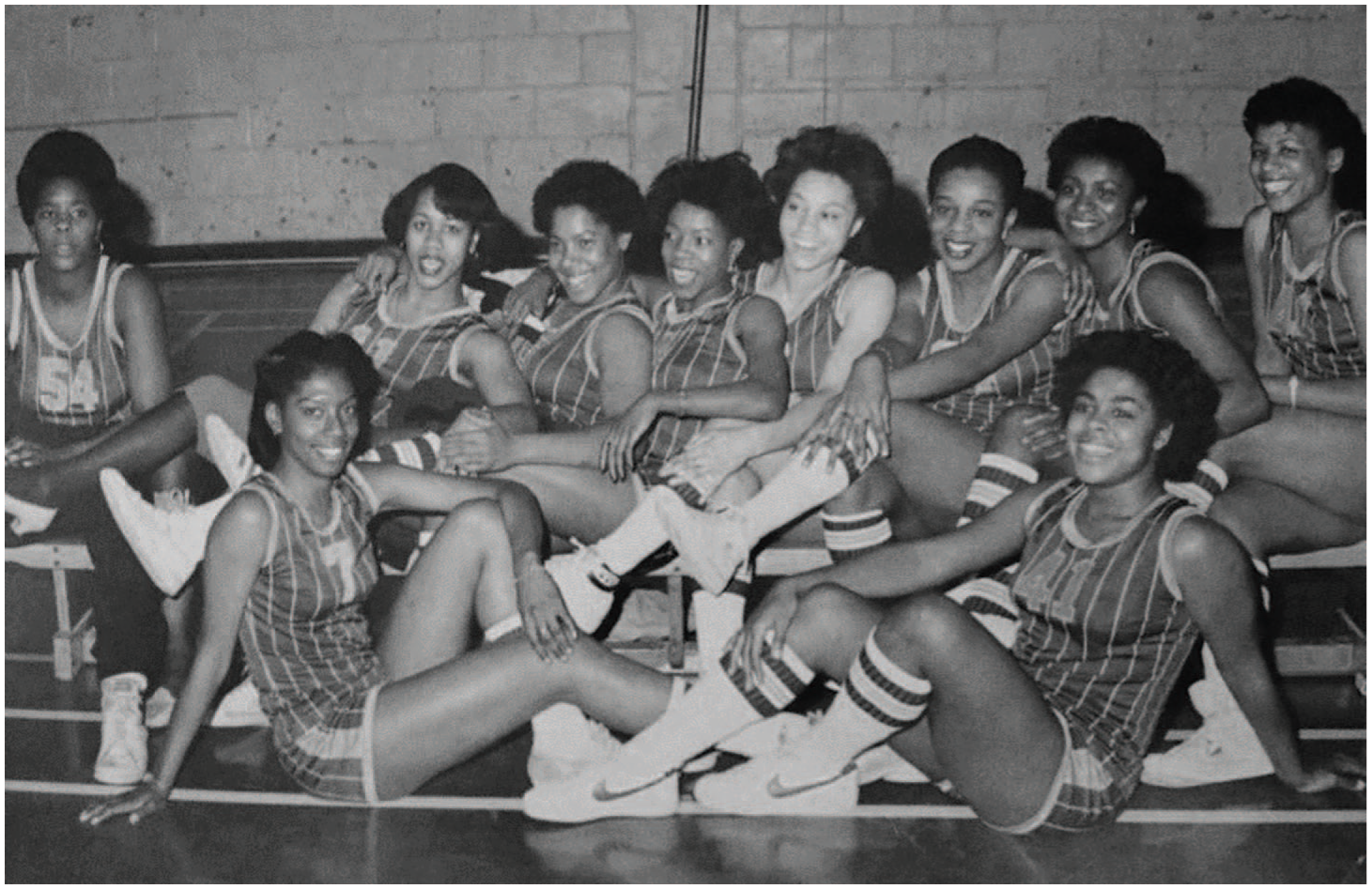
The New ERA ladies basketball team, c.1982. Annette Hinds is on the back row, third from the right. Photo reproduced with the permission of Annette Hinds.
For Hinds, who had left school aged 16 – ‘I remember they had careers teachers and they just didn’t give a shit . . . just totally dismissed me’
81
– and was working as an administrative assistant in the civil service, her involvement with New ERA was a way of negotiating some of the obstacles being young and black in inner London presented. Like many of its members, she was asked to join the New ERA committee, and even served as its chairperson. Moreover, she was encouraged by Griffiths to pursue her ambition of a career in law: He said to me, ‘Yeah, you can do this.’ I think he was the first barrister I’d ever met, I didn’t know any barristers, certainly didn’t know any black ones. And he was the one who said to me, ‘Annette, you can do this, you could be a barrister’, you know.
82
In 1984, New ERA launched Brixton Basketball Club; in 1985, the club moved into the newly built Brixton Recreation Centre (BRC) – an occasion celebrated in August that year by a visit from professional basketball player, Michael Jordan, who Rogers had met during a trip to America. Other than the complimentary use of the BRC, New ERA and Brixton Basketball Club received little support from Lambeth council, and sustained itself with members’ fees, club subscriptions, community fundraising, and through the determination of Rogers. ‘That was largely down to Jimmy and his charismatic way’, said Hinds. ‘He was great at attracting publicity, and meeting other people and organisations.’
83
The club put on training sessions, camps during school breaks (‘We couldn’t afford to go on holidays and it’s not like we would travel anywhere in the summer. We would go to Jimmy’s camp, and Jimmy’s camp would be from nine o’clock to five o’clock, every single day’),
84
and ran various teams at a junior and senior level. Needless to say, it soon established itself as a mainstay in the community: Brixton was run by black people . . . it was a black team as far as society or the powers that be were concerned. And we moved to Brixton Rec – that was the brand-new Brixton Rec at the time – and it was a perfect time, it was ’85, because Brixton was in an awful mess, you know, there was an awful lot of crap going on in Brixton, but we went there, and it was great, it was great! And so people from the Brixton area started to join in everything we were doing there, and it basically just grew from there.
85
1985 saw more uprisings in Brixton following the police shooting of Dorothy ‘Cherry’ Groce during a house search for her son. Groce was paralysed by the gunshot, and died in 2011 from complications caused by her wounds.
86
Just as in 1981, external representations of the ensuing ‘riots’ nourished racist imaginaries and fomented public fear over safety and disorder that had lasting consequences for the young people and communities they vilified, not least the justification of so-called hard policing tactics. The Times, for example, called for a beefed-up police presence in Brixton in the wake of the conflict: ‘The ghetto must be policed . . . with strength and firmness.’
87
Yet, as Hinds pointed out, for those living in the area – especially those young black people relentlessly hounded by the police – external representations bore little relation to reality: Brixton had this dreadful reputation but . . . the people who were fearful, you know, they weren’t going to get stopped by the police – the fear was when the police stopped you and roughed you up, you know . . . I, God forbid, I’ve never had that experience because I think it more applied to young men, you know, but, yeah, a lot of people would not go to Brixton for fear of being mugged and all that shit – it was just rubbish.
88
Soon after the disturbances, Rogers renamed the club ‘Brixton Topcats’, after the eponymous cartoon character, Top Cat, who was perpetually harassed by the police – an experience to which many of Rogers’ players could relate. Andrea Congreaves, who played for the women’s team as a 16-year-old, recalled: The guys coming from training would be walking out of Brixton Rec . . . and because the police station is literally right around the corner, it would be like, ‘What are you doing? Why are you out so late?’. . . and it’s frustrating, because you’re sitting there going, ‘Jeez . . . these guys have just been playing basketball, they ain’t causing no problems, they’re just trying to go home.’
89
For Congreaves, who travelled to the club from Sutton, where she was one of only two black pupils at her all-girls high school, playing for the Topcats in the late ’80s felt like a lifeline: At school every day was a nightmare . . . I used to get bullied all the time, one, because I was short, two, because I was black, and three, because I was quiet and quite, you know, reserved . . . walking into Brixton was, it felt like family, that’s the best way to describe it. It felt like family. I didn’t feel alone . . . and it felt like, it didn’t matter if I screwed up, and it didn’t matter if I made a mistake, I had a hand on my shoulder saying, ‘It will be alright, come on now, get yourself together, it will be alright.’
90
Paul Mundy-Castle, who moved with his mother and brothers to Brixton from Nigeria in 1990, when he was 15, also evoked a familial quality when discussing Rogers and the club: I didn’t have a dad growing up – my Dad wasn’t here so in a way Jimmy became a bit of a surrogate dad for a lot of us ’cause he was always, ‘What’s going on in school? What are you doing in school?’. . . ‘Have you done your homework, son?’ . . . and I think that you always understood with Jimmy that he cares about what else you were getting involved with.
91
Care, as Edwards and Hinds pointed out, was Rogers’ organising principle; teaching basketball – which encompassed lessons of discipline, teamwork and resilience – was the way he administered this care.
92
Mundy-Castle said: I lived in Somerleyton which is in Coldharbour Lane which is a horrendous estate, the worst estate in London at the time, but I had basketball, and basketball allowed me to navigate a path through . . . I mean Jimmy’s house was an open door, we could go to Jimmy’s house anytime – we had to go there to make sandwiches for the away teams, you know, so Jimmy’s house was our house if I’m really honest, so he was a constant figure in a world that was always moving.
93
Mundy-Castle said Rogers’ advice proved significant when he was stopped and searched and then arrested in Tooting when he was 17. The officers involved had presumed the silver-coloured filings of a McDonald’s scratch card they found in his pockets were drugs. They put Mundy-Castle in the back of a police car, where one [officer] was punching me in the side of my ribs . . . I realised he wanted a reaction, you know. But I had conversations with Jimmy about stuff like that, you know . . . Impulsively I just wanted to give him an elbow but had I done that and it cut his mouth or nose, all of a sudden you’ve assaulted a police officer, so I always knew the challenges because we were quite open about talking about them . . . Jimmy was always about you hold your humanity, you respect yourself and, you know, I think that type of life lesson lots of young people wouldn’t get, so they accept the narrative.
94
‘I’ve never turned a kid away, never thrown a kid out’
The composition of Brixton and Liverpool 8 among other inner urban areas has of course changed dramatically in Rogers’ lifetime. In Brixton, for example, numerous market-led ‘regeneration’ projects and an influx of middle-class residents have driven up property prices and fixed the area with a whiter, ‘more presentable’ face: ‘The Ritzy [a cinema in Brixton] . . . you can go to the Ritzy, you don’t even see black people sometimes.’ 95 But gentrification has done little to address the deep-seated inequalities still experienced by Brixton’s black working classes. As of 2016, Lambeth was the twenty-second most deprived borough in England, with more than 87,000 people living in poverty after housing costs; Coldharbour ward, of which Brixton is comprised, and which contains the highest proportion of black residents in Lambeth, is by far the most deprived ward in the borough. 96 The disproportionate and dehumanising police targeting of black youths has also shown little sign of abating. A 2018 report by Amnesty International found the Met Police’s ‘Gangs Matrix’ – a database of suspected ‘gang’ members in London launched as part of a highly politicised response to the 2011 ‘riots’ – to be ‘racially discriminatory’ and ‘stigmatising’. 97 Meanwhile, official figures from the London Mayor’s Office showed that black people were 4.3 times more likely than whites to be stopped by the police in the capital in 2018, compared with 2.6 times more likely in 2014. 98
This dismal snapshot of racial disadvantage and discrimination in contemporary London has only been aggravated by a 44 per cent cut to the youth service budget at a council level since 2011. According to a 2018 report by Sian Berry, a London Assembly member, the cuts, handed down by central government, forced the closure of eighty-one youth centres and projects in the capital over this period. 99 But even before the Conservative government’s austerity programme took hold, the youth provision safety net had been steadily pulled from under young people in disadvantaged areas. Concerning the situation in Lambeth, Simon Hallsworth’s 2005 study of street crime in Britain lamented the paucity of services available. What provision there was in the borough, said Hallsworth, had been ‘decimated in recent decades by regular and sustained cuts to youth services . . . [and were] often too expensive for young people on poor estates to use’. 100 It is in this sense that the Topcats, anchored by Rogers, has proved an invaluable exception. Over the years it has produced dozens of professional players and England and Great Britain internationals, including Congreaves, Mundy-Castle (now a headteacher) and NBA player, Luol Deng – perhaps the most recognisable name of all the Topcats alumni. Given the lack of funding the club received, each basketball success should be looked upon as a considerable achievement. And yet the club, which is still thriving, has always been defined by so much more, not least by its commitment to inclusion and accessibility.
At a time of life when their identity was thrown into sharpest focus, Rogers helped young black people build positive conceptions of themselves and each other and in turn diminish or reject the conceptions attached to them by wider society. Rogers (Figure 3) was fondly dubbed the ‘Bishop of Brixton’, according to Marvin Addy, because of his sonorous voice: ‘It sounds like God talking. Deep, very deep, as soon as he speaks everyone in the whole sports hall will hear it. He can’t whisper . . . couldn’t whisper to save his life.’ 101
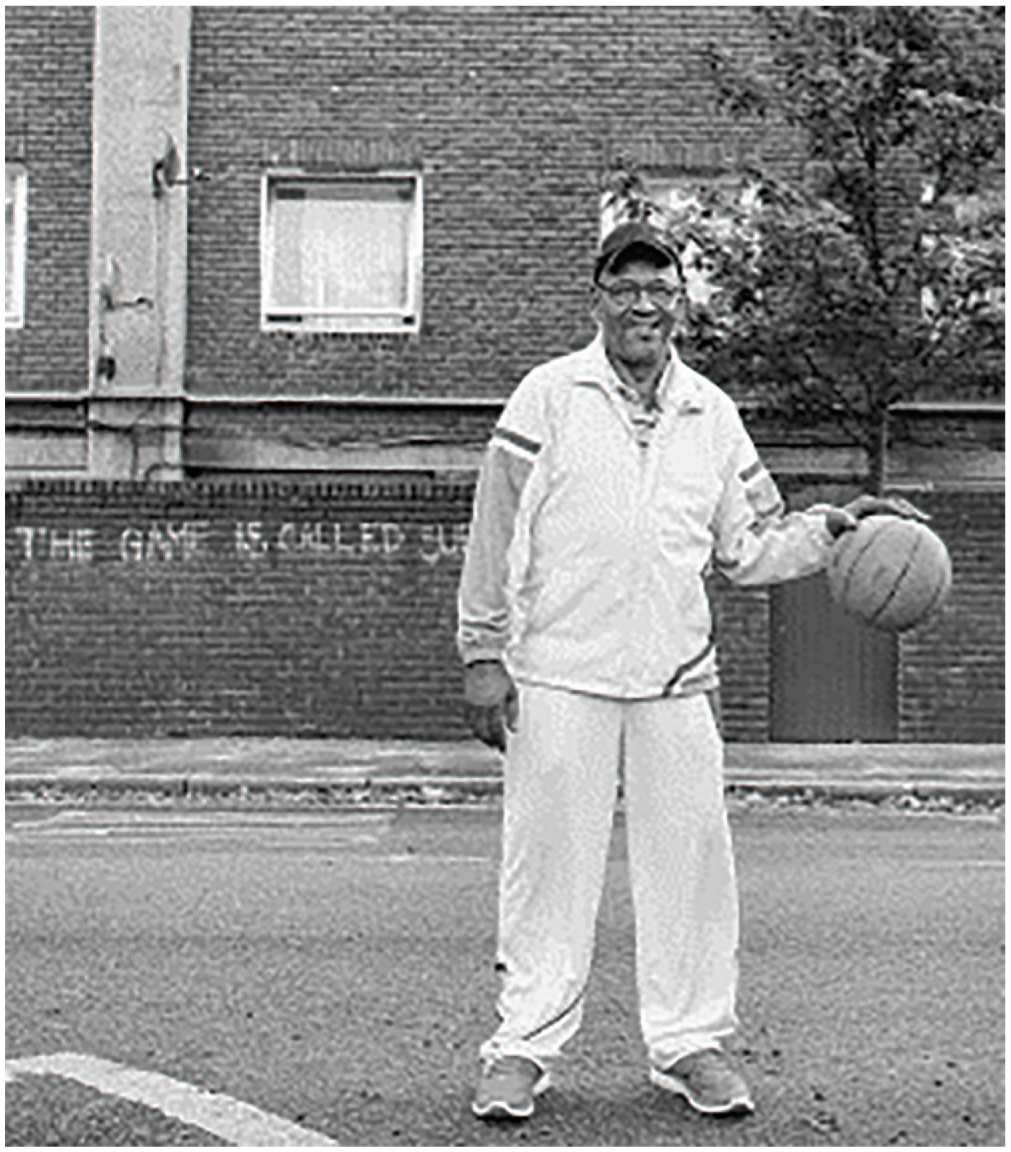
Jimmy Rogers, Brixton, c. 2000. Photo reproduced with the permission of Brixton Topcats.
But as someone who knew firsthand the burden of rejection, racism, and low expectations, and who, as a young man, shouldered much of this burden alone, Rogers understood what it took to survive in a hostile world, and how to engineer successes in spite of it. ‘He taught us camaraderie’, said Hinds, ‘He taught us discipline, he taught us we could be anything we wanted to be.’ 102
Footnotes
Michael Romyn is an oral history co-ordinator for the Sporting Memories Foundation. He received an AHRC-funded PhD from Birkbeck, University of London, in 2018 and his most recent article is ‘“London Badlands”: the inner city represented, regenerated’, The London Journal, March 2019.