







Abstract
In this paper, three fundamental formulae of strength of materials are derived by the application of the theorem of minimum of strain energy. In the first example the torsion of non-homogeneous circular bar is considered. The second example deals with the in-plane bending of non-homogeneous curved beam. The third one is concerned with the pure bending of non-homogeneous elastic prismatic bars.
Introduction
Energy methods are useful in solving many complicated problems of structural mechanics through two major approaches: approximate solutions of boundary value problem by Ritz method and formulation of governing equations of finite element analysis.1–3 Another important application of energy methods is the derivation of approximate equations for a given boundary value problem of elasticity. In this paper, the theorem of minimum of strain energy is used to derive the formula of stress distribution as a function of cross-sectional coordinates and the applied load for torsion of circular bar, for in-plane bending of curved beam and for non-symmetrical bending of prismatic beam. In all cases, the structural members are non-homogeneous. Theorem of the minimum of strain energy, which will be used here, can be formulated as:4,5 The strain energy U of an elastic body in equilibrium under the action of prescribed forces in an absolute minimum for the true stresses on the set of all values of the functional U determined by the statically admissible stresses. The statically admissible stresses satisfy all the equations of equilibrium.4,5
Torsion of circular bar
In this section the Saint-Venant torsion of non-homogeneous circular bar is considered. The shear modulus depends on the radial coordinate r (Figure 1). The length of the beam is L and the applied torque is denoted by T. We assume that according to the Saint-Venant's theory of torsion of circular bar
Saint-Venant torsion of circular bar.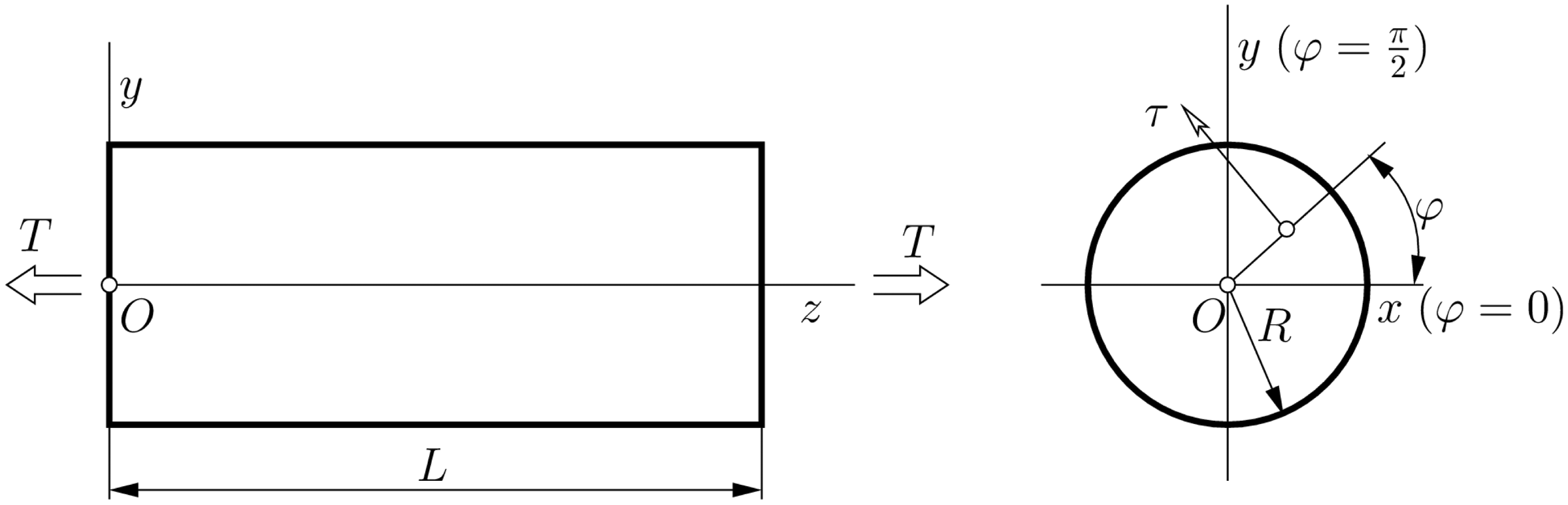

In equation (1),
Here, we must note, the stress field satisfies the equation of mechanical equilibrium and traction boundary condition which are in this problem formulated as3,4



In equation (4)

In order that we get the distribution of shearing stress as a function of radial coordinate r we look for the minimum of the strain energy per unit length of bar under the subsidiary condition 5. The method of Lagrange multiplier will be used.1,5 We consider the next functional


Since

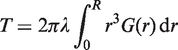
Let
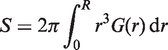
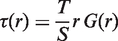

The strain energy per unit length of circular bar in terms of the applied torque is as follows

The validity of formula (13) follows from equations (4) and (11). Equation (13) shows that S is the torsional rigidity of the non-homogeneous circular bar. By the use of Prandtl formulation of Saint-Venant torsion, equations (10) and (11) were derived by Horgan and Chan. 6
It is known that the rate of twist ϑ can be computed as1,5,6

Comparison of equation (12) with equation (14) shows that
In-plane bending of non-homogeneous curved beam
Figure 2 shows the non-homogeneous curved beam which has uniform curvature. Its material is linearly elastic, isotropic and non-homogeneous. The applied bending moment is denoted by In-plane bending of curved beam.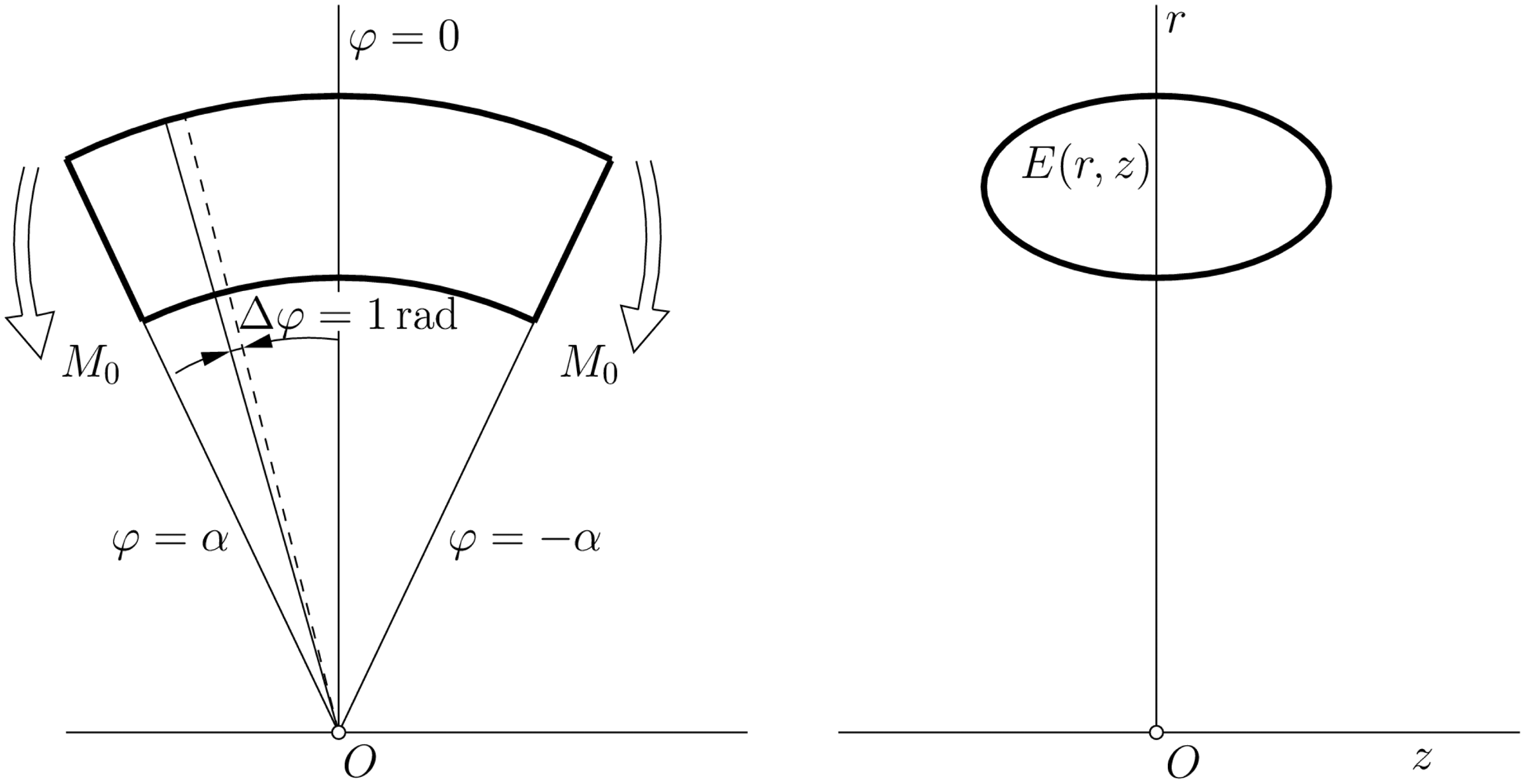

The cross section A of the curved beam is shown in Figure 2. In the strength of materials the equilibrium equations are formulated under the next assumptions for in-plane bending



The strain energy per unit polar angle
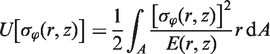
In order that we get the distribution of normal stress as a function of cross-sectional coordinates

The stationarity condition of

Since
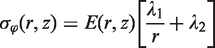

In the next we define some cross-sectional properties that are


By the use of cross-sectional properties introduced by equations (24) and (25) from equations (22) and (23) we obtain the formula of normal stress
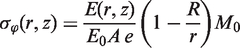
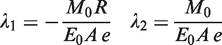
Substitution for
Pure bending of non-homogeneous bar
Figure 3 shows the non-homogeneous bar which is subjected to bending moment Pure bending of non-homogeneous bar.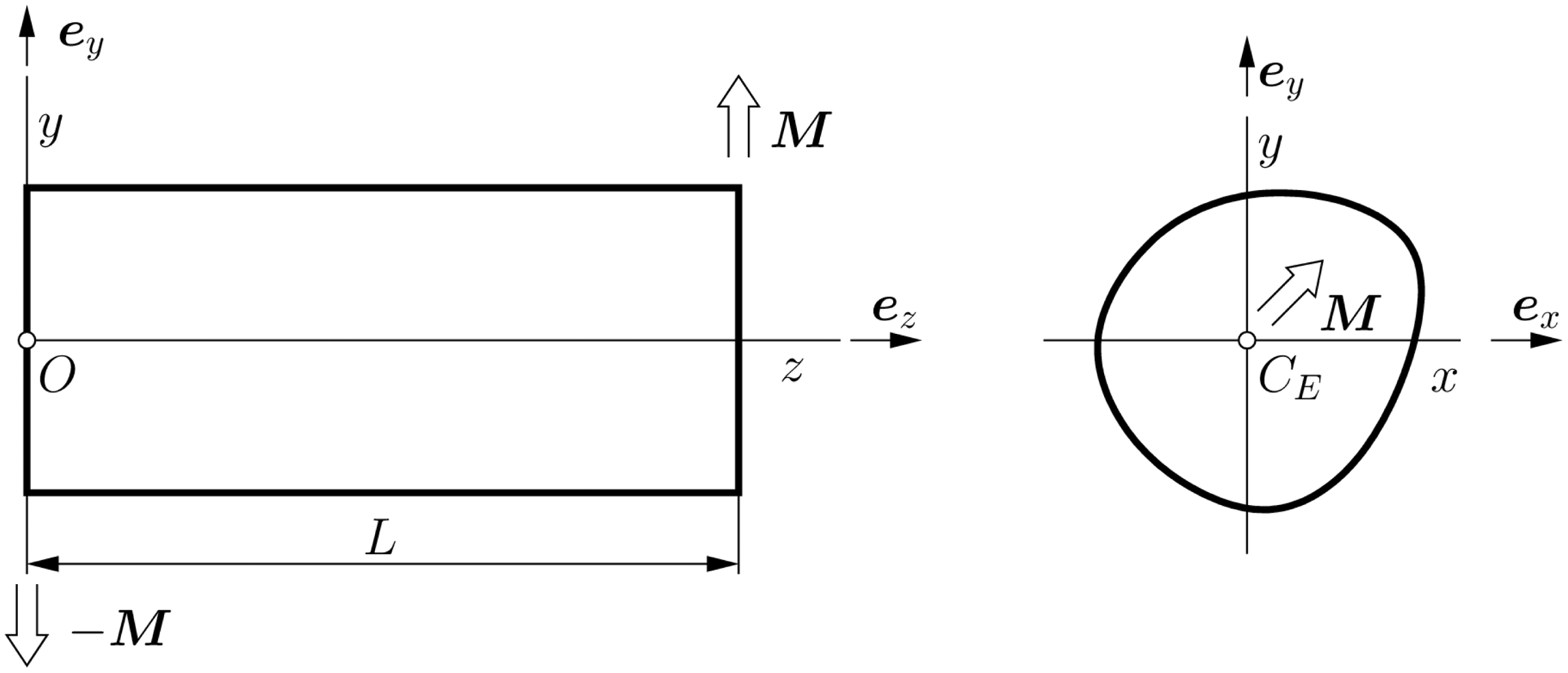

In the framework of strength of materials the equilibrium stress field is characterized by the equations in this case



Equations (29)–(31) refer to the coordinate system

Our aim is to search the minimum of U under the subsidiary conditions 30 and 31. The method of Lagrange multipliers will be used. We define a new functional which contains the constraints given by equations (30) and (31)

In equation (31) the scalar product of two vectors is denoted by dot. The necessary condition of minimum is formulated by the variational equation

Since


Substitution of equation (35) into equation (361) gives


Let

The neutral axis (zero line of stresses) goes through the E-weighted centre of cross section (Figure 4). The direction of the neutral axis n is given by the unit vector Illustration of the neutral axis.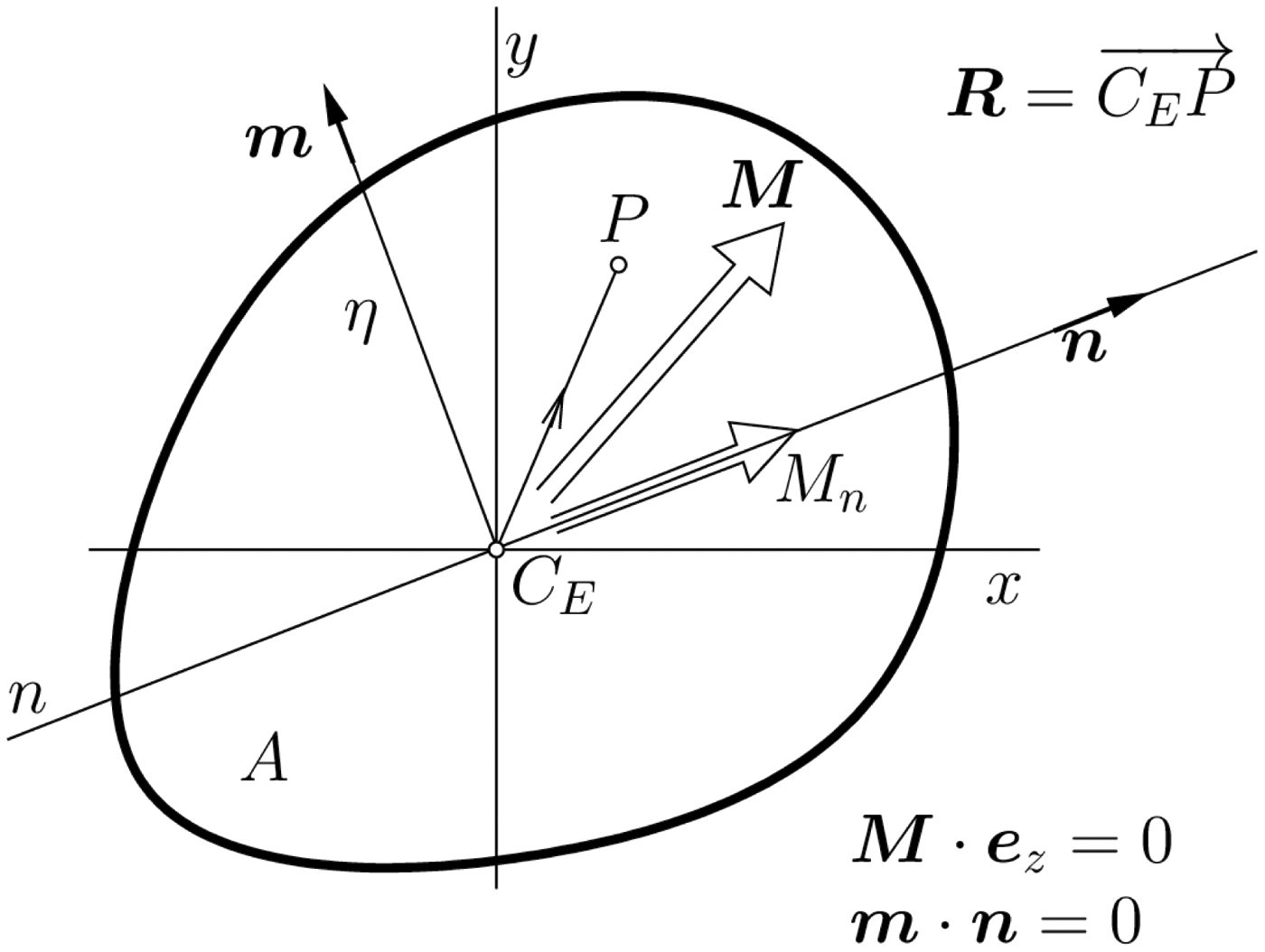

In equation (40) circle between the two vectors denotes their dyadic product and


By a simple calculation from equation (40) we get

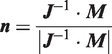
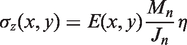
From equation (43) we have


Let
A recommendation for the method presented to use in teaching of elasticity
We recommend to introduce the presented method of the derivation of considered formulae of strength of materials in the study of first-year graduate level course in elasticity, where the students get to know on the essential variational methods of the linearized theory of elasticity such as principle of minimum of potential energy, principle of minimum of complementary energy, principle of minimum of strain energy etc. Traditionally taught energy methods are primarily applied to look for the approximate solutions of a given boundary value problem of elasticity by means of Ritz method. In this paper we give examples how the theorem of the principle of minimum of strain energy can be used to obtain the well-known formulae of mechanics of solids. This type of application of energy methods does not exceed the level of a first-year graduate course in elasticity.
Conclusions
The paper illustrates the applications of energy methods by three examples in the field of strength of materials. Examples refer to non-homogeneous structural members. By the use of principle of minimum of strain energy the stress distributions are determined for torsion of circular bar, for in-plane bending of curved beam and for pure bending of prismatic beam. The presented approaches do not follow the direct methods used in textbooks of strength of materials and elasticity.
Footnotes
Acknowledgements
This research was (partially) carried out in the framework of the Center of Excellence of Innovative Engineering Design and Technologies at the University of Miskolc.
Conflict of interest
None declared.
Funding
This research received no specific grant from any funding agency in the public, commercial, or not-for-profit sectors.