







Abstract
This article addresses the interplay of e-learning (through the Internet) and manufacturing engineering education (at the undergraduate level). As is the case in other engineering programs, e-learning in manufacturing engineering must harmonize the aspects of near-future employment needs, academic discipline-based learning, and outcome-oriented learning. Thus, a procedure is presented for preparing the e-learning contents using the Internet-embedded concept maps. Examples are cited whenever necessary to make the description as clear as possible. Numerical results that show the students’ learning behaviors are also reported, providing more insights into the effectiveness of the proposed concept map-based e-learning approach for educating the undergraduate students with the knowledge of manufacturing engineering. Because there is no unique, preferable solution for developing e-learning content, this study may help other engineering programs beyond manufacturing engineering to develop systems for implementing the e-learning in a befitting manner (i.e. integrating the aspects of near-future employment needs, academic discipline-based learning, and outcome-oriented learning).
Introduction
The realities of contemporary engineering education are often shaped by the interplay of academic discipline-based education, near-future employment needs, governance and the quality assurance of engineering education, and e-learning. This is schematically illustrated in Figure 1. Certain salient points of the interplay of these facets are described below.
Some facets of contemporary engineering education.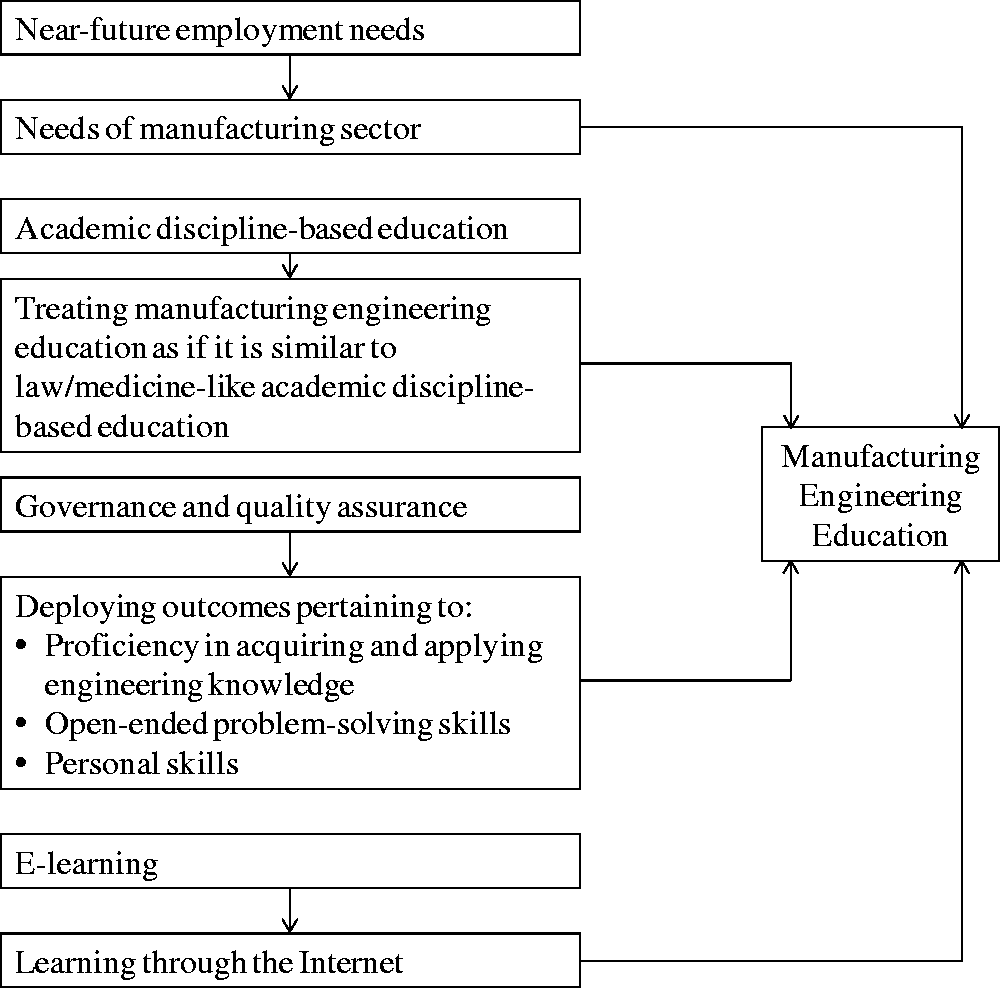
First, consider the facets of academic discipline-based education and near-future employment needs. Duderstadt 1 has explained the interplay of these two facets in detail while elucidating a roadmap for future engineering practice, research, and ducation. Duderstadt 1 has noted that society and technology continuously change at a rapid speed, and the engineers must adapt to remain relevant. Thus, practicing engineers require themselves to engage in lifelong learning in a systematic manner, similar to those in medicine and law. Thus, undergraduate engineering education must have a broader base and operate as if it is an academic discipline similar to the liberal arts, natural sciences, law, or medicine. At the same time, engineering education cannot ignore the knowledge and skills that potential employers expect from their newly recruited graduates. Ignoring this would create unnecessary complexity in obtaining the best from the employees in a rapid and reliable manner. Therefore, the interplay of academic discipline-based education and near-future employment needs establish certain realities of contemporary engineering education. Consider the third facet, i.e. governance and quality assurance of engineering education. To ensure the desired quality of engineering education and its governance, engineering degree programs currently follow an outcome-oriented approach.2–4 This approach employs certain carefully chosen outcomes, which pertain to the proficiency of acquiring and applying engineering knowledge (the ability to apply basic engineering science and mathematics knowledge in formulating and solving engineering problems), open-ended problem-solving skills (the ability to design and materialize engineering systems that meet the real-world constraints), and personal skills (presentation skills in all oral, verbal, and written forms, ethical responsibility, teamwork ability, and life-long learning ability). Therefore, a curriculum that deploys the abovementioned outcomes and an assessment procedure to monitor and evaluate whether the students have achieved the outcomes in the appropriate manner are essential ingredients of an engineering program. If the outcomes are not achieved to the desired levels, the engineering program must make necessary arrangements that ensure the opposite. This way, numerous engineering programs have become more effective in achieving their goals. 3
The final facet is e-learning. Engineering education, as with other academic disciplines, attempts to obtain the best from the information technology (i.e. from the Internet facilities). The integration of information technology with (engineering) education creates a learning paradigm called e-learning. In e-learning, the learners learn from the carefully designed learning content that is made available to them through a suitable information technology infrastructure (e.g. Internet, multimedia, virtual reality system, and other similar means). Using an e-learning system, one can learn a subject at anytime from anywhere at a minimal cost. The learners can also interact with the instructors and other learners through the e-learning system. Accordingly, numerous studies have been conducted on e-learning system development, implementation, and evaluation.5–8 To better understand, certain selected works are briefly described as follows. Simões et al. 9 have described a system to develop the personalized systems for e-learning. Martínez-Caro 10 has considered students’ demographic and physiographic factors, as well as student–teacher interaction factors, in e-learning and has shown certain means to develop an effective e-learning system. Hammami and Mathkour 11 have described a framework to develop the systems for achieving e-learning. Jovanovic and Jovanovic 12 have described an e-learning system to learn an advanced programming language. Violante and Vezzetti 13 have described a methodology to evaluate the learners’ satisfaction level in e-learning using the Kano model. 14 Lau et al. 15 have described an e-learning system that employs website-based tutorial sessions that are designed for the industrial engineering students. Watanuki and Kojima 16 have described a system that uses virtual reality and web-embedded multimedia systems that help learn engineering skills to perform casting operations. Lee and Low 17 have described a website-based e-learning system that provides tutorial sessions to learn solid modeling from the perspective of Computer-Aided Design (CAD). Kamp et al. 18 have described both positive and negative aspects of e-learning referring to a given e-learning system. Benchicou et al. 19 have provided insights into the institute-wide challenges in adopting and implementing e-learning. Aichouni et al. 20 have described an e-learning system by which the learners access the learning content (on metrology) using the Internet, which ensures a high learning satisfaction. Papathanassiou et al. 21 have described how an e-learning system for maintenance management training helps provide high quality education at an affordable price. Despite all these works, it remains true that no unique, best-of-the-world solution exists for developing an Internet-based engineering course. Therefore, customized approaches must be considered for each course category to maximize the impact of the web-based educational process.
Let us recall the facet of near-future employment needs. Regarding near-future employment needs, the needs that underlie the manufacturing sector (refer to Figure 1) cannot be avoided because manufacturing is one of the essential ingredients of the economic well-being of a society, and a large number of engineers are likely to pursue their careers in numerous sectors of manufacturing. Therefore, certain engineering degree programs (particularly, the undergraduate mechanical engineering degree program) need to prepare students with the knowledge and skills of manufacturing and other related subject matters.22–24 Although an educational program considers the needs of the manufacturing sector as near-future employment needs, the program must not ignore the other three facets, i.e. an academic discipline-based education, the governance and quality assurance of a degree program, and e-learning (Figure 1). This article is written based on this contemplation.
In particular, Internet-aided manufacturing engineering education from the perspective of undergraduate mechanical engineering degree programs is considered. The remainder of this article is organized as follows: “Manufacturing engineering education” section describes the scenarios of manufacturing engineering course offerings at numerous undergraduate mechanical engineering programs around the world. The goal is to elucidate a must-be structure for manufacturing engineering education. “Internet-aided manufacturing engineering education” section describes how to develop Internet-aided manufacturing engineering e-learning content utilizing the idea of concept mapping. The goal is to implement the learning notion called meaningful learning (also explained). A simple procedure is also described to make the content making process systematic in the same section. “Implementation” section describes the results of e-learning implementation using the learning content prepared with the aid of the procedure described in “Internet-aided manufacturing engineering education” section. The final section provides the concluding remarks of this study.
Manufacturing engineering education
An overview of manufacturing engineering education that has been active in European universities can be found from the study by Boud et al. 24 Manufacturing process related subjects (e.g. knowledge and skills related to a manufacturing process called casting 16 ) and other related subjects (e.g. industrial engineering, 15 CAD, 17 metrology 20 ) have earned attention from the perspective of e-learning. In addition, the best practices, while offering courses related to computer-aided manufacturing (CAM) engineering, have been studied by certain educators,25–29 among which certain works also emphasize e-learning.26,28 However, this section revisits the course contents of manufacturing engineering education from the context of mechanical engineering undergraduate degree programs. The goal is to outline a desired structure of manufacturing engineering education that accommodates both academic discipline-based learning and near-future employment needs.
Sources of manufacturing engineering course contents.
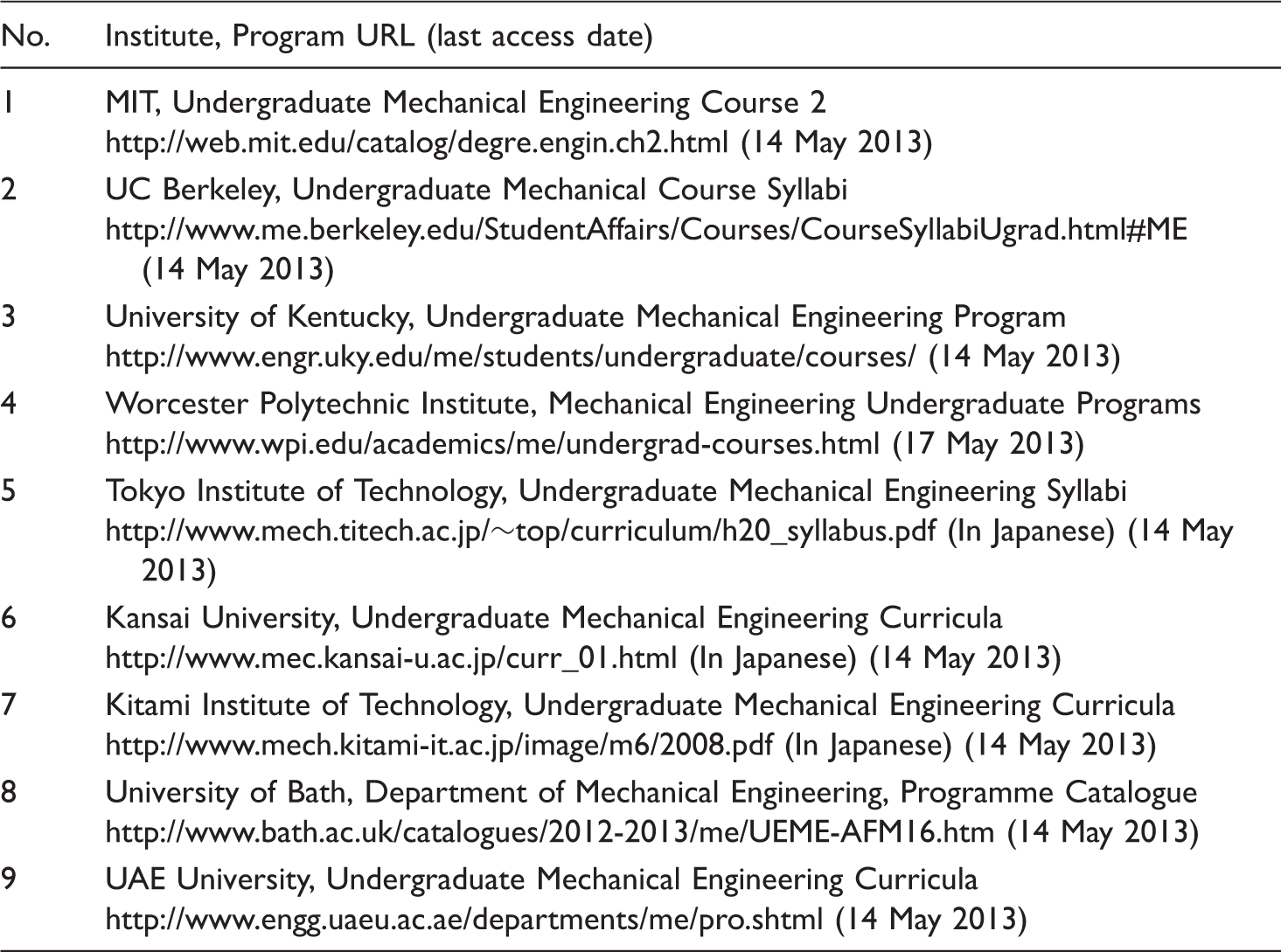
The nature of the courses can be classified as follows:
Hands-on oriented courses Engineering science-oriented courses Engineering practice-oriented courses Computational science-oriented courses
Hands-on oriented courses offer students an opportunity to perform manufacturing processes (e.g. drilling, hand-sawing, arc welding, and sheet-metal forming) and produce a part/product by themselves. In most cases, these courses have no prerequisites and are offered in the early second-year of the degree program. The main objective is to familiarize students with the aspects of design for manufacturing. In certain cases, the course content extends beyond the manufacturing processes and addresses certain aspects of engineering-practice-oriented courses (explained later) and computational-science-oriented courses (explained later). For example, a hands-on course may include controlling a robot arm to perform a given assembly task or writing Numerical Control (NC) programs to run Computer Numerical Control (CNC) machine tools for machining a given shape. The objective of including such advanced content is to make the students aware of the role of computer-controlled devices in manufacturing. Because the hands-on courses have no prerequisites (i.e. students have no analytical background of the course content), it is difficult to evaluate the students based on the educational outcomes. 2 A better alternative is to integrate the content of hands-on courses with the engineering-science/practice or computational science-oriented courses. Engineering science-oriented courses usually educate students in the analytical knowledge of manufacturing processes. The usual course names are “Introduction to Manufacturing Processes” (introductory course), and “Introduction to Precision Engineering” (advanced course). A course on the introduction to manufacturing processes addresses such manufacturing processes as turning, grinding, drilling, milling, casting, molding, welding, bulk deformation (e.g. forging), and metal forming. The main objective is to make the students sufficiently competent in applying the knowledge of heat/mass transfer, solid/fluid mechanics, engineering materials, and design processes while analyzing, improving, and selecting the manufacturing processes. Hands-on experience related to casting, orthogonal metal cutting, tool-life, and cutting force are also covered in such courses. These courses are offered in the late second year or early third year of a degree program. The fundamental courses of mechanical engineering related to heat/mass transfer, solid/fluid mechanics, engineering mathematics, engineering materials, and engineering design often become the prerequisites of these courses. Conversely, the advanced courses on manufacturing processes (i.e. precision engineering related courses) address the high precision and functional surface generation processes, surface topography, phenomena related to micro/nano level material removal processes using abrasives/chemical processes, and non-traditional machining for creating relatively complex shapes or shapes with special features (e.g. shapes with high aspect ratio at micro/nano level) and surface coating. The prerequisites of such courses are the introduction to manufacturing processes, mechanical vibration, and introduction to control engineering. The knowledge of advanced geometry, crystal structures of (hard) engineering materials (e.g. technical ceramics), and surface metrology is needed to grasp the contents of these courses fully. These courses are offered as technical electives in the late third year or early fourth year of a degree program. Practice-oriented engineering courses usually educate students regarding the analytical knowledge of manufacturing systems and operations research. A typical name for such courses is Introduction to Manufacturing Systems or Computer Integrated Manufacturing. The course contents mainly focus on the optimization of a given manufacturing process, cost-related issues, work analysis of assembly tasks, hazards, quality control, and stochastic natures of manufacturing processes. Certain courses often cover the issues of manufacturing systems architectures (e.g. flexible manufacturing systems) and automation, as well as the rules and regulations regarding manufacturing. The issue of dimensional or surface metrology is also included unless otherwise covered in the manufacturing process-related courses. These courses are offered as technical electives in the late third year or early fourth year of a degree program. The typical prerequisites are courses in introduction to manufacturing processes, introduction to control engineering, engineering statistics, CAD, and others similar to these. Occasionally, the course contents of engineering practice-oriented courses overlap with the course contents of computational science-oriented courses (explained below). Computational science-oriented courses usually educate students with the analytical knowledge of CAM (in certain cases, Computer-Aided Engineering (CAE)). The usual course names are Introduction to CAM, CAD/CAM, and Rapid Tooling. The theoretical knowledge of subtractive manufacturing processes (e.g. turning, milling, and drilling), additive manufacturing (e.g. stereolithography [laser curing] and 3D printing), computer graphics, geometric modeling (constructive solid modeling and shape modeling by parametric curves/surfaces), and CNC technology are needed to grasp the contents of such courses. In addition, the hands-on experience of computer programming and CAD packages are needed to perform well in such courses. Hands-on sessions often include tool-path generation, NC programming, and rapid prototyping, as well as shape accuracy measurement by using the coordinate measuring machine. The typical prerequisites are Introduction to Manufacturing Processes, CAD, Introduction to Control Engineering, Dynamics, and Introduction to Machine Element Design. These courses are offered in the late third-year or early fourth-year of the degree program as technical electives. One of the problems in offering computational science-oriented courses (e.g. CAD/CAM) in mechanical engineering programs is that students often find the content difficult due to the lack of sufficient background in computer graphics and programming. Therefore, well-designed content that covers the fundamentals of computer graphics and programming must be added.
Based on the scenario of the current manufacturing course offering, as described above, a desired course structure is proposed, as schematically illustrated in Figure 2.
The must-be structure of manufacturing engineering courses.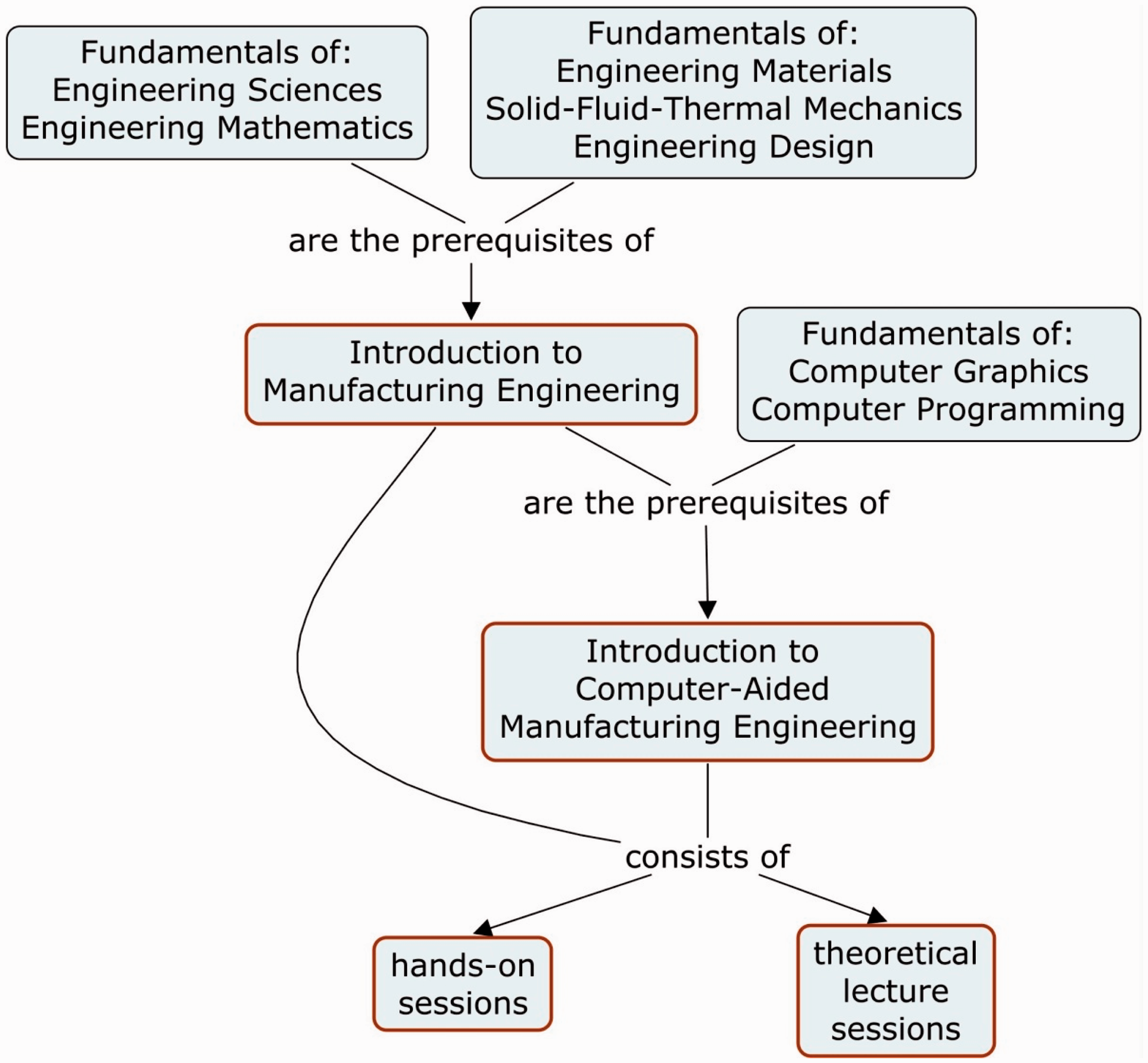
Thus, the structure is valid for the undergraduate mechanical engineering degree program. As observed in Figure 2, there are two main courses, Introduction to Manufacturing Engineering and Introduction to Computer Applications in Manufacturing Engineering. Both courses educate students by preparing students with theoretical knowledge and hands-on experiences. The prerequisites of the former course are the engineering science and mathematics-related courses, whereas the prerequisites of the latter course are the former course and computer graphics/programming related courses.
Internet-aided manufacturing engineering education
This section describes certain critical issues that pertain to Internet-aided manufacturing engineering education. The phrase “Internet-aided manufacturing engineering education” refers to supporting the must-be structure of courses shown in Figure 2 with the aid of Internet-embedded content to achieve e-learning, ensuring, at the same time, both academic discipline-based learning and outcome-oriented learning (Figure 1). The quality assurance and governance issue (outcome-oriented education), if required, should also be incorporated. Numerous approaches can be considered to solve the problems related to the abovementioned Internet-aided manufacturing engineering education, as described in the studies of e-learning.5–21 However, the central issue is nothing but learning itself; others simply follow. As such, the remainder of this section views the e-learning problem (i.e. Internet-aided manufacturing engineering education) as a problem of learning.
Learning can be viewed as rote learning or meaningful learning, as suggested by Ausubel in the 1960s.31,32 Rote learning refers to learning by memorizing the contents, and it occurs very fast; however, the learner forgets the contents very quickly. Conversely, meaningful learning is a process that relates new information to an existing knowledge structure of a learner, and the learner must choose to do this.32,33 This means that an emotional engagement to learn new knowledge underlies the meaningful learning. Thus, in meaningful learning, the learning occurs in a slow manner; however, the learner remembers the contents for a long time. Consequently, meaningful learning has earned a great deal of attention from both researchers and practitioners in education. To achieve meaningful learning, Novak introduced a methodology called “concept mapping” in the late 1970s,33,34 in which a concept means a perceived regularity or pattern in events, objects, or records of events or objects designated by a label. 33 Thus, a concept map is a network of certain selected concepts. The visual representation of a concept map is a human-friendly representation of the existing knowledge regarding an issue (i.e. an individual’s knowledge structure). The concept map must provoke a learner to add a new concept that refers to the existing chunk of knowledge (i.e. the concept map itself).33–35 Thus, the two most important aspects of meaningful learning, the well-structured representation of existing knowledge (i.e. a concept map) and the emotional attachment to learning new knowledge (adding a new concept to the existing concept map) can be achieved by employing a methodology called concept mapping.33–35 Regarding the educational practices, concept mapping has been shown to be an effective means for educating learners in schools, corporate sectors, and technical professions, and in higher education (e.g. biomedical engineering 36 and sustainability 37 ). Regarding manufacturing engineering, it has been shown that concept maps are equally effective in knowledge management for building the Internet-aided manufacturing systems38,39 (The issue of manufacturing system building using concept maps is beyond the scope of this article. Therefore, this issue is not discussed further here.). However, there are tools, e.g. CmapTools developed by Florida Institute for Human & Machine Cognition40,41 by which one can build, access, and search concept maps using the Internet. Thus, the concept maps (particularly the concept maps built by using CmapTools) can support what-, how-, and where-to-know for a given subject matter. 38
However, to systematize the process of building the concept maps for the Internet-aided manufacturing engineering education, the following procedure is proposed. Among others, the proposed procedure emphasizes two aspects simultaneously. The first aspect is to represent the knowledge as if the manufacturing education is (moderately) an academic discipline-like education (e.g. medicine and law).
1
The other aspect refers to the focus question-based concept mapping.33,41 Therefore, the proposed procedure of building concept maps consists of the following three major steps:
Step 1: Building an atomic concept map based on a focus question. Step 2: Integrating a given atomic concept map with the academic discipline-based concept maps. Step 3: Representing certain concept maps in a non-trivial manner.
To understand Step 1, consider the atomic concept map shown on the right-side in Figure 3.
An atomic concept map for manufacturing education.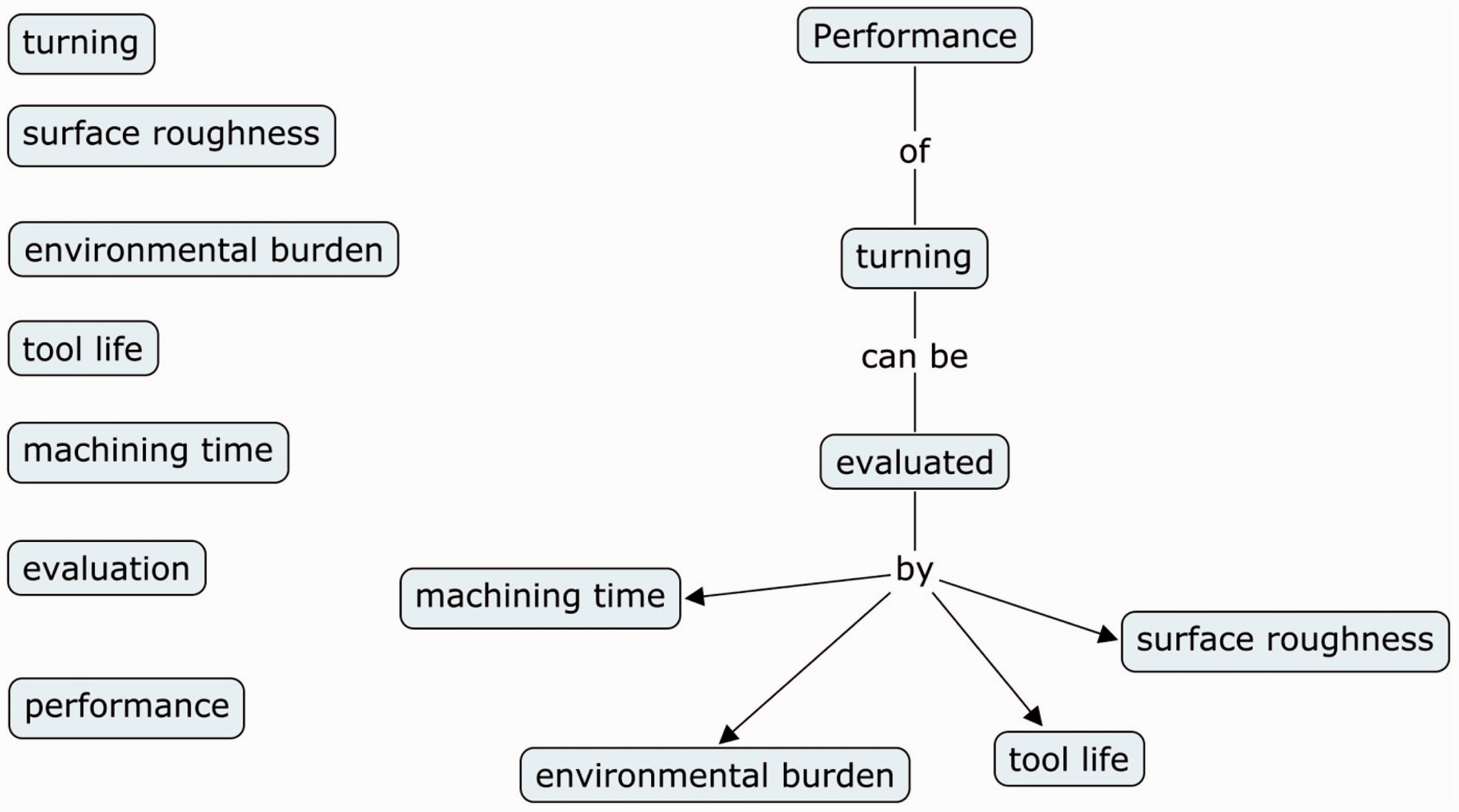
The concept map is an atomic one in the sense that there is one focus question (i.e. performance evaluation of turning) (As previously noted, turning is a subtractive manufacturing process.). The related concepts are turning, surface finish, environmental burden, tool-life, machining time, evaluation, and performance, as shown on the left-side in Figure 3. This atomic concept map may not make any sense to a learner, i.e. the learner may not be familiar with the meaning of the concepts. To make it more meaningful to the learner, other concept maps, which explain the meaning of the underlying concepts, need to be integrated. This integration is performed in Step 2. Thus, the goal in Step 2 is to raise the atomic concept map to a level where the learner can understand it from the perspective of certain universes (i.e. the manifestation of certain academic disciplines). The general procedure is schematically illustrated in Figure 4.
Atomic concept map with respect to academic discipline-based concept maps.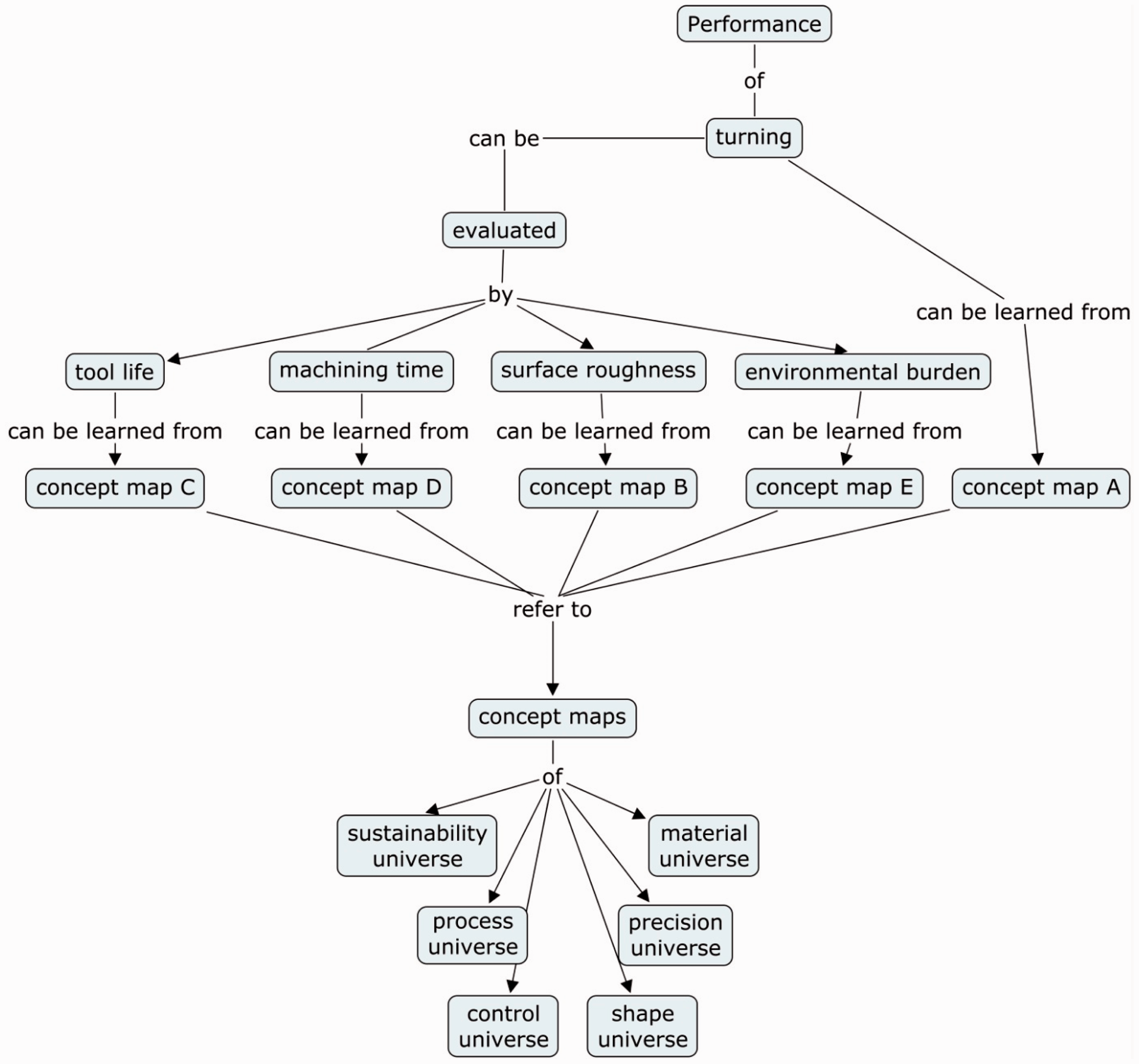
As observed in Figure 4, certain concepts of the atomic concept map shown in Figure 3 are further linked to other concept maps, A, … , E. These concept maps (A, … , E) are again linked to certain academic discipline-based concept maps. For manufacturing engineering education, it has been found that academic discipline-based concept maps are solely the concept maps that explain the process, material, shape, precision, control, and sustainability universes. Here, the process universe means the knowledge of different manufacturing processes based on addition (e.g. powder deposition and laser curing), subtraction (e.g. machining and grinding), formation (e.g. casting, drawing, forging, forming, and other bulk deformation), joining (e.g. welding and soldering), and surface treatment (e.g. chemical/physical vapor deposition, plating, and deburring). The process universe also includes the phenomena that underlie the manufacturing processes. Conversely, here, the shape universe means the knowledge of different engineering shapes (3D Complex, axisymmetric, prismatic, dished/flat sheet, and thick/thin/slender/hollow object), how to model them (constructive solid modeling, free-form curve/surface, tool-path, and convex-hull), what type of manufacturing processes are needed to manufacture them and why. The material universe refers to the different engineering materials (metals and alloys, glasses, technical ceramics, rubber, wood, polymers, and composites), their usages, and general properties. Precision universe means the knowledge of surface/dimensional metrology and phenomena related to different scales, namely macro, meso, micro, and nano. The control universe includes the knowledge of control engineering, CNC technology, and machine tools’ structures and dynamics. The sustainability universe means viewing the activities of manufacturing from a broader perspective, such as safety, cost, energy, exergy, greenhouse gas emission, resource depletion (land, material, and water), and risk. (Note that, in certain undergraduate programs, the sustainability universe is emphasized more explicitly by offering a course dedicated to sustainable manufacturing.) Figure 5 shows a sample concept map that integrates shape, material, and process universes with the concept of turning. Therefore, if the learner links the atomic concept map in Figure 3 with the concept map in Figure 5 and attempts to learn the concept called turning, the learning becomes meaningful.
A concept map of turning with respect to process, material, and shape universes.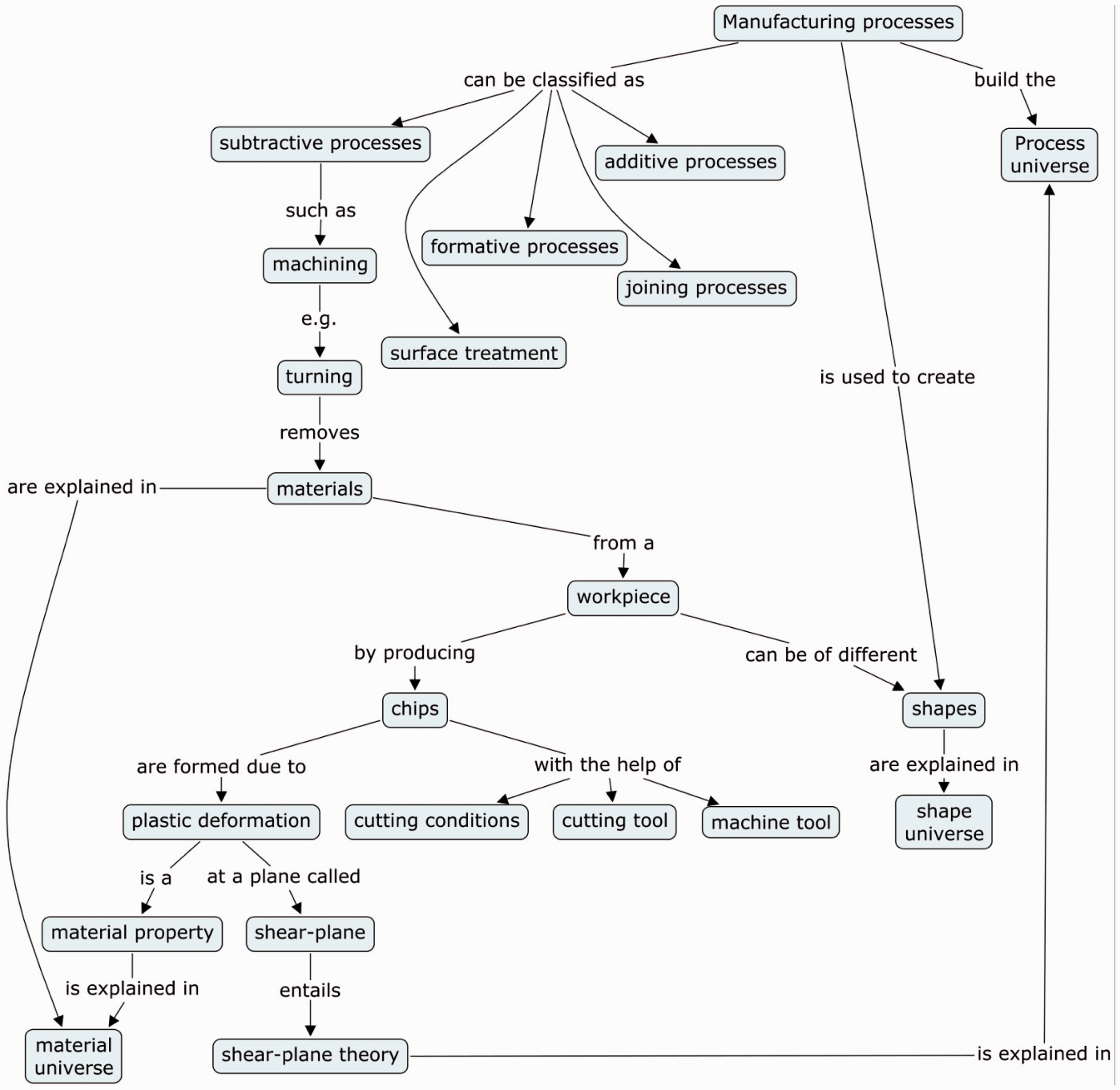
In addition, if the learner wants to learn more, i.e. if the learner wants to learn how to improve the accuracy of the shape produced by turning, s/he should link precision universe with shape and process universes. Moreover, if the learner wants to know whether a shape can be produced in a sustainable manner, s/he must use the knowledge represented in a sustainability universe and link it with the process and shape universes. If it appears that the learners find the content difficult to understand, it means that the knowledge in the different universes is not represented in a befitting manner or the linking concept maps (the concept maps links an atomic concept map with concept maps of the universes) are not formulated in a befitting manner. Similar to the concept maps turning, the other concept maps for tool-life, machining time, surface roughness, and environmental burden can also be expanded accordingly. In the last step, i.e. Step 3, the concept maps created for learning a definite subject matter (here, a manufacturing process called turning) are linked in a non-trivial manner so that the learners do not readily understand the focus questions used, i.e. the atomic concept maps used to create the whole. Figure 6 shows one of the concept maps that link all concept maps in a non-trivial manner for teaching/learning turning. The map is built using the CmapTools.40,41 The icons attached to certain concept maps contain documents (textural or graphical contents), video clips, and web links, which direct the learners to the details of the subject matter. The concept map clearly shows that the various aspects (focus questions) of turning (operation, cutting mechanism, cutting conditions, cutting tools, and tool life) are ultimately related to certain contents in the shape, material, process, and sustainability universes. The learners can be requested to add contents (textural, graphical, and/or video contents) as a result of their respective learning process, replacing those in the concept map shown in Figure 6. The learners can be requested to modify the concept map (Figure 6) based on their understanding and use different labels that represent the same set of concepts. In the group discussion, the students may exchange views, which justify why they preferred to use different labeling. The learning evaluation can be performed based on the modified concept maps by the learner. It is worth noting that the textural, graphical, and video contents are available on the Internet through the courtesy of professional societies, video-sharing websites, and machine/cutting tool manufacturers. Occasionally, the content that is available from the commercial software can also be used. Further details of the content creation using the above resources are not described in this article because of unavoidable circumstances (e.g. copyright regulations). Similar content (Figure 6) can be created for other subject matters that underlie the course structure shown in Figure 2, which supports the manufacturing engineering education at the undergraduate level. In summary, to create e-learning content for manufacturing engineering learning/teaching, the framework shown in Figure 7 can be used.
AnInternet-embedded concept map for learning the process called turning. The e-learning content creation framework for manufacturing engineering education.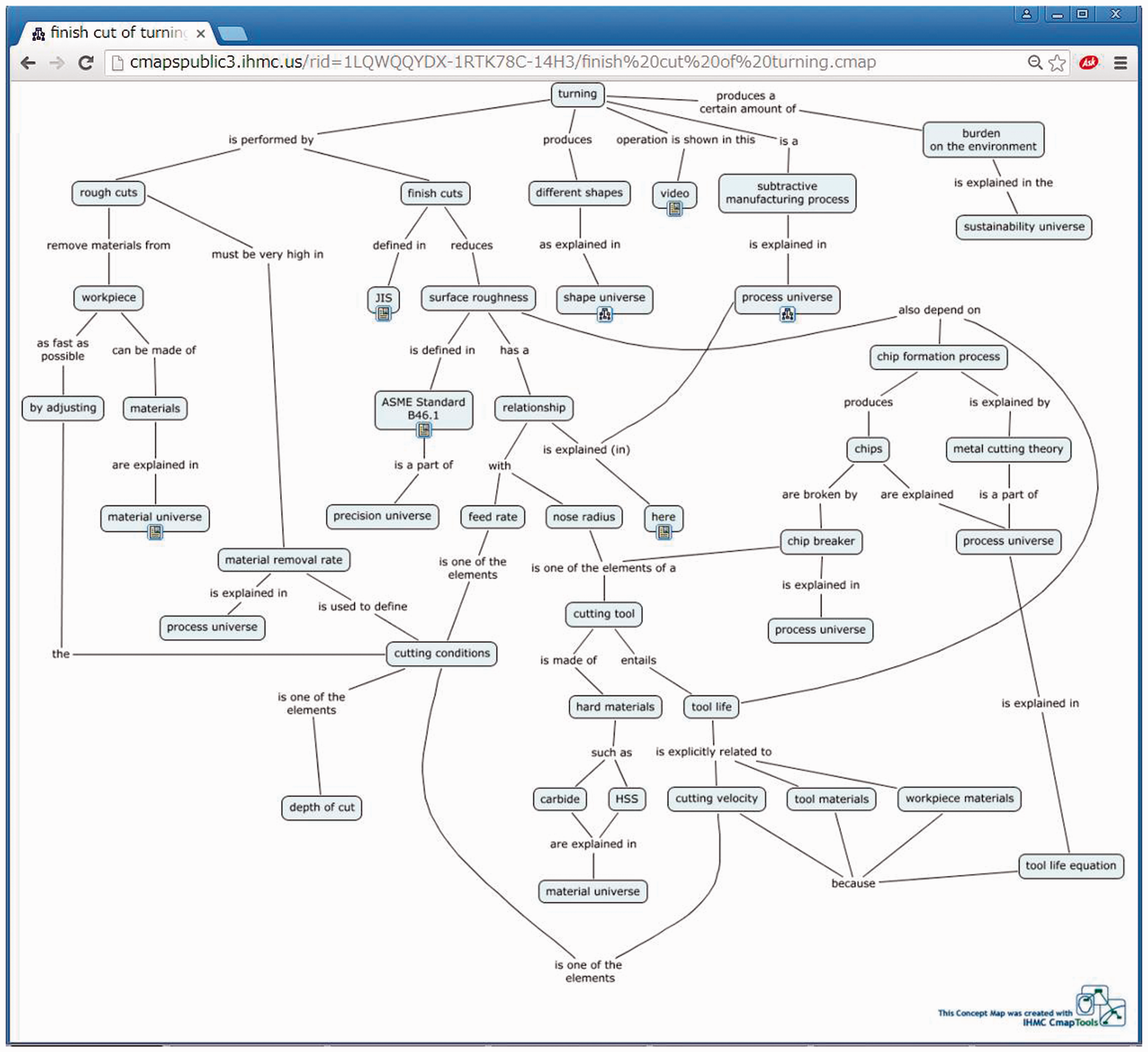
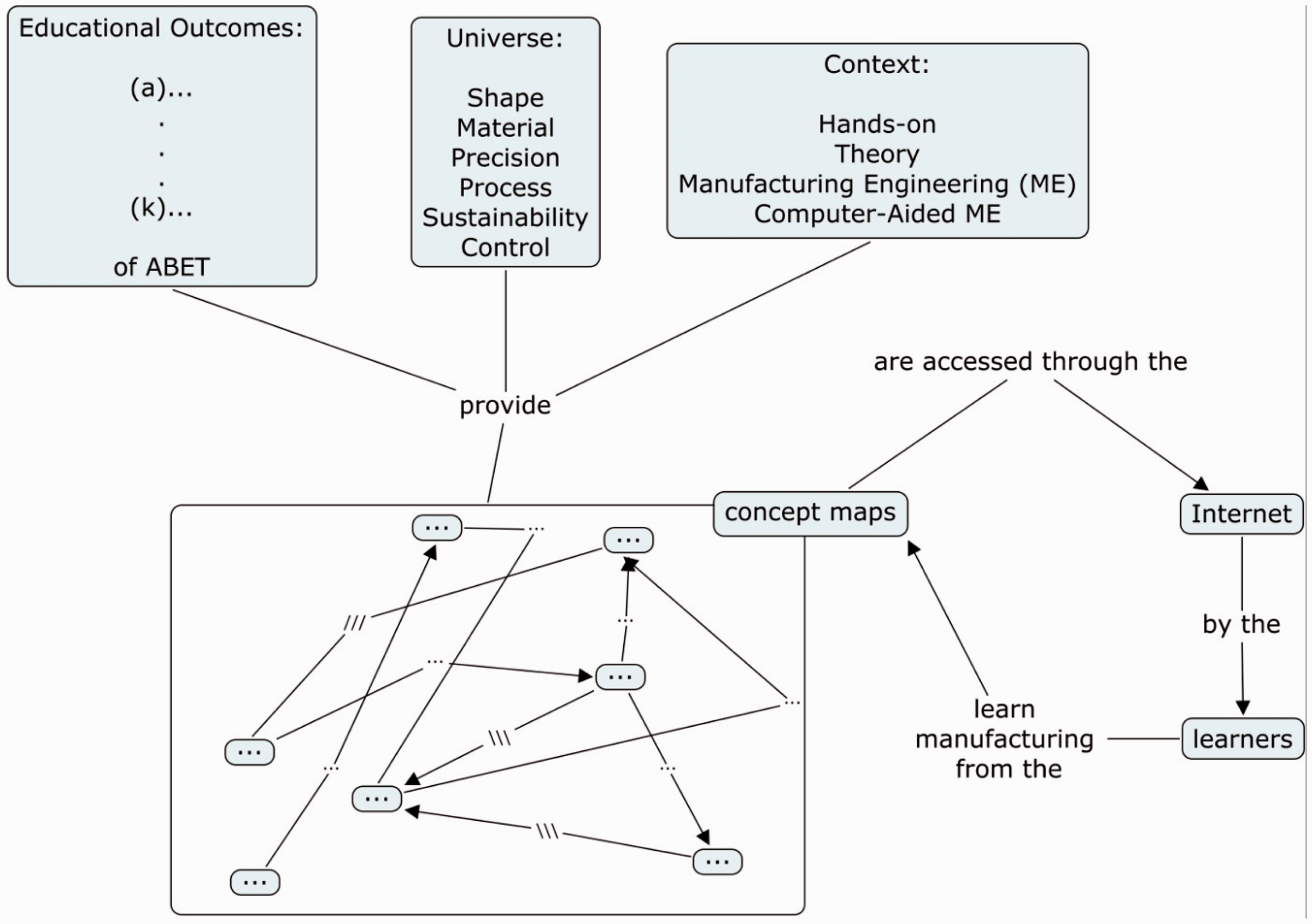
As observed in Figure 7, one needs to integrate the aspects of educational outcomes, universe (shape, material, precision, process, sustainability, and control), and context (hands-on, theory, introduction to manufacturing engineering, and introduction to CAM engineering) to create the concept maps.
Implementation
The author has been implementing the concept map-based e-learning for second-year undergraduate students of a mechanical engineering degree program at Kitami Institute of Technology, Japan. The remainder of this section describes certain learning results obtained that refer to a subject matter called turning (the most well-known and well-studied subtractive manufacturing process). It is worth noting that other subject matters that pertain to a course called Introduction to Manufacturing Processes have also been covered by using the concept map-based contents. The concept maps have been prepared using the procedure explained in the previous section.
Figure 8 schematically illustrates the structure of the concept maps that were disclosed to the students who took the course called Introduction to Manufacturing Processes. Using the CmapTools, the concept maps were prepared in Japanese because most students were from Japan. As observed in Figure 8, the subject matter was the manufacturing process called turning. The focus questions included turning, cuts (finish and rough), cutting conditions, tool-life, surface roughness, feed rate, cutting velocity, chip, chip breaker, chip breaker shape, and chip breaker feature selection. The concept maps of cuts, feed rate, chip, chip breaker, chip breaker shape, and chip breaker feature selection were made to be interlinked. Consequently, the concept maps related to the chip (chip breaker, chip breaker, shape, and chip breaker feature selection) and concept maps related to tool-life and surface roughness have automatically become interlinked. The students were requested to view the concept maps. After a week, the students were requested to answer the questions listed in Table 2 through an online system. Out of 89 students, 85 students answered the questions on time.
The structure of the concept maps for the case study. Learning questions.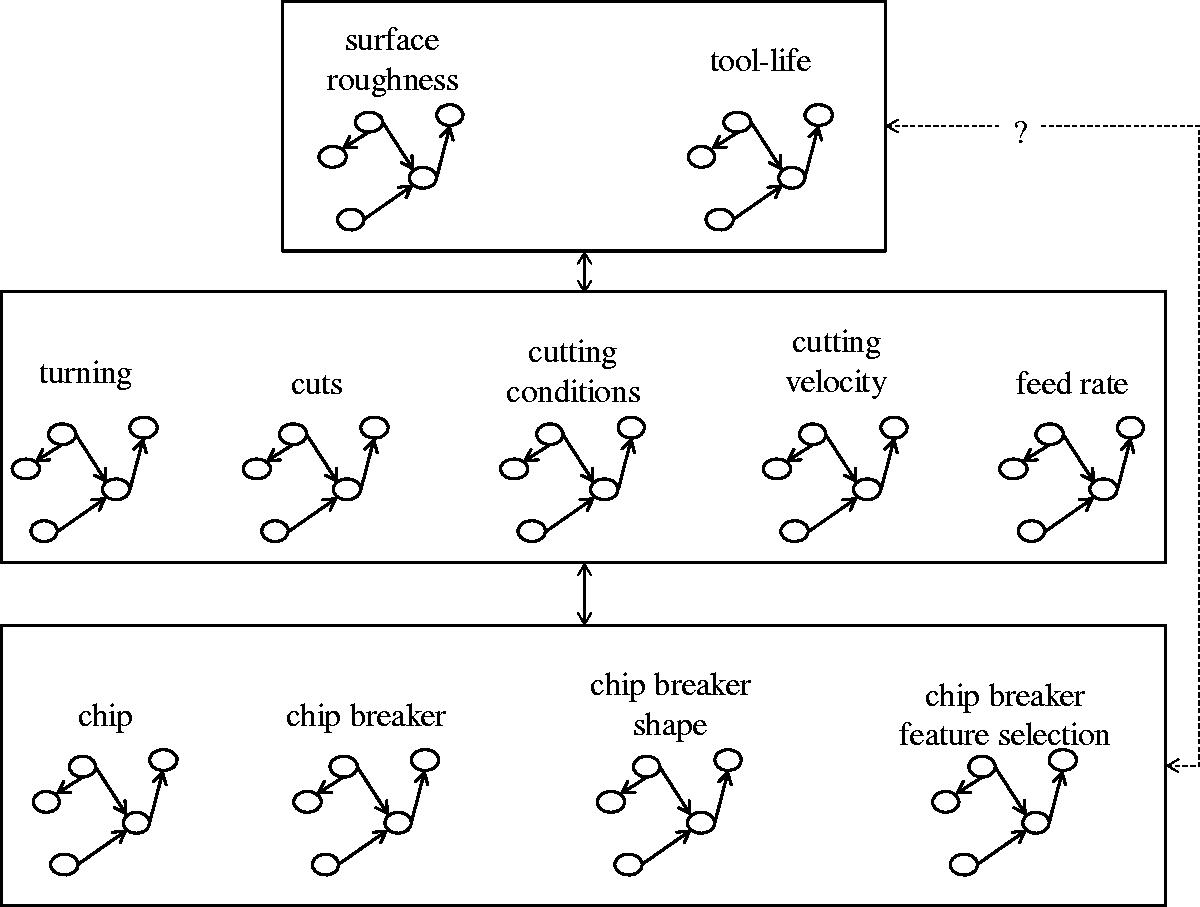
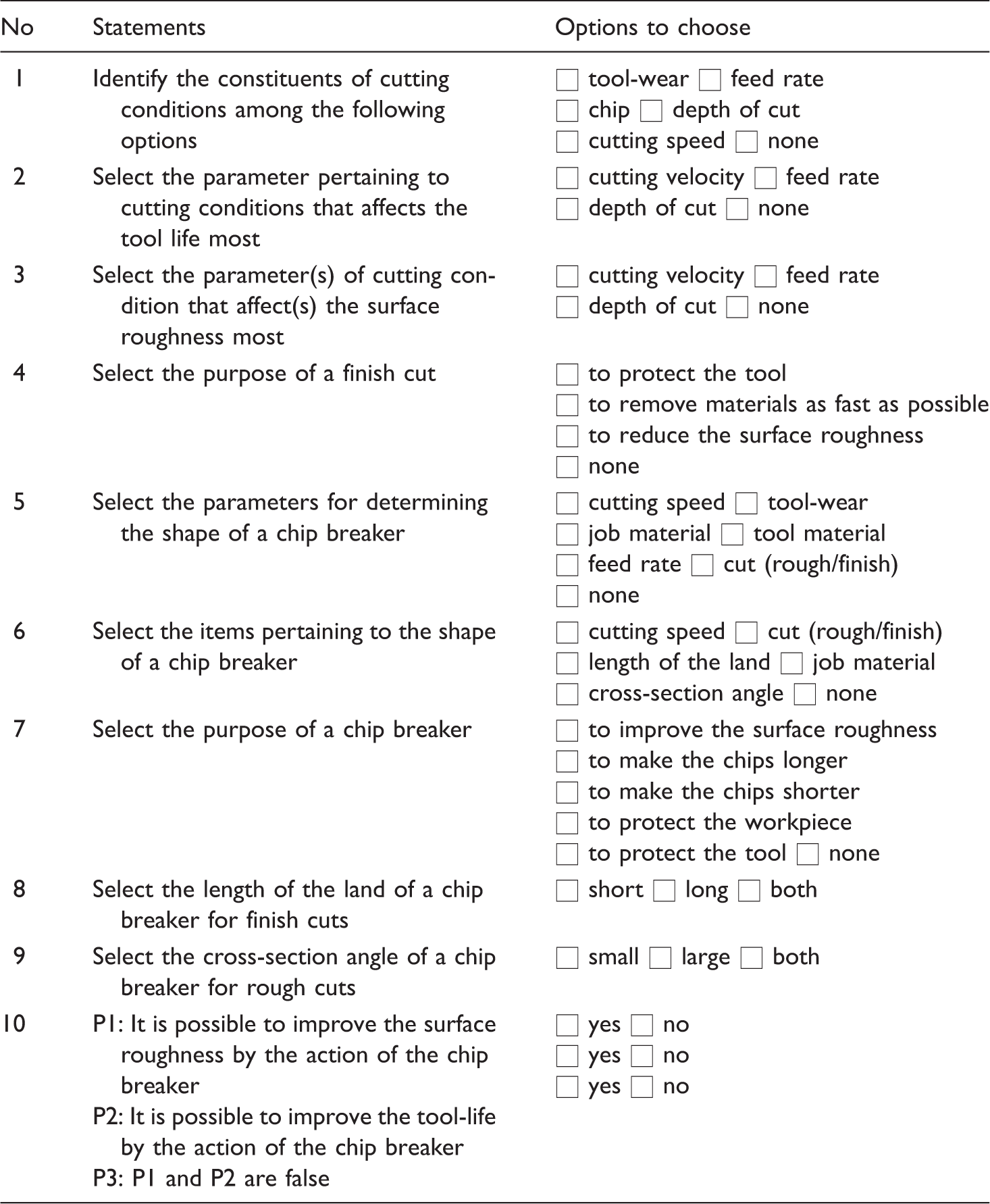
Note that the questions 1 to 4 are relatively easier to answer, whereas questions 5 to 9 are moderately difficult to answer because the chip-related focus questions are not covered as much as the other focus questions (role of finish and rough cuts, cutting conditions, surface finish, and tool-life) in an undergraduate degree program. Among all the questions, question 10 is the most difficult one to answer because the propositions (P1: It is possible to improve the surface roughness by the action of the chip breaker; P2: It is possible to improve the tool-life by the action of the chip breaker; P3: P1 and P2 are false.) imply that the chip breaker can improve the surface roughness and tool-life, which is not clearly shown in the concept maps that were supplied to the students (Figure 8). This finding means that the underlying concepts are not explicitly related to each other as far as the supplied concept maps are concerned. It is worth noting that, according to one of the concept maps, the shape of a chip breaker depends on the cuts (rough and finish). In addition, using two other concept maps (cutting conditions and cuts), the relations among tool-life, cutting conditions, and cuts can be established. This statement means that there is a relation between chip breakers, which may affect the tool-life. Similar arguments hold for the surface roughness. Therefore, the students should have answered in favor of the propositions P1 and/or P2 in question 10. This statement means that whether the students could associate a concept (chip breaker) with other apparently unrelated concepts (tool-life and surface finish) as a result of meaningful learning can be verified by the experimentation (Figure 8 and Table 2).
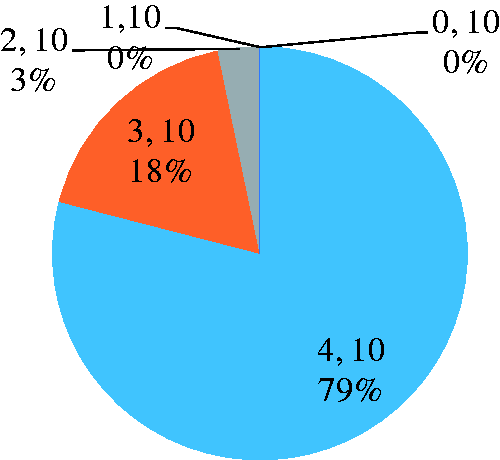
Figure 9 shows the results of the correct answers regarding questions 1–4, whereas Figure 10 shows the results of the correct answers regarding questions 1–4 and question 10. As observed in Figure 9, all four questions were answered correctly by 71% of the students, any combination of the three questions were answered correctly by 16% of the students, any combination of the two questions were answered correctly by 8% of the students, and one of the questions of these four was answered correctly by 5% of the students. Consequently, there were no students who could not answer at least one of the questions correctly. Compared with the results shown in Figure 9, the results shown in Figure 10 depicts a different type of learning pattern. The percentage of the correct answers increases to 79% (Figure 10) from 71% (Figure 9) when the results of the correct answers regarding the question 10 were added to the results of the correct answers regarding all four of questions 1–4. Similarly, the percentage of the correct answers increases to 18% (Figure 10) from 16% (Figure 9) when the results of the correct answer regarding question 10 were added to the results of the correct answers regarding three questions of questions 1–4. Conversely, the percentage of the correct answers decreases to 3% (Figure 10) from 8% (Figure 9) when the results of the correct answer regarding question 10 were added to the results of the correct answers regarding two questions of questions 1–4. This learning behavior (Figures 9 and 10) simply means that successful learning regarding the relatively general concepts leads to meaningful learning regarding other specific concepts (here, successful learning regarding the general concepts associated with questions 1–4 leads to meaningful learning regarding the relatively specific concepts associated with question 10).
Learning results regarding questions 1–4 (0 = none of the questions, 1 = one of the questions, 2 = any combination of two questions, 3 = any combination of three questions, 4 = all four questions). Learning results regarding questions 1–4 and question 10 (0, 10 = none of the questions out of questions 1–4 and question 10; 1, 10 = one of the questions out of questions 1–4 and question 10; 2, 10 = any combination of two questions out of questions 1–4 and question 10; 3, 10 = any combination of three questions out of questions 1–4 and question 10; 4, 10 = all four questions 1–4 and question 10).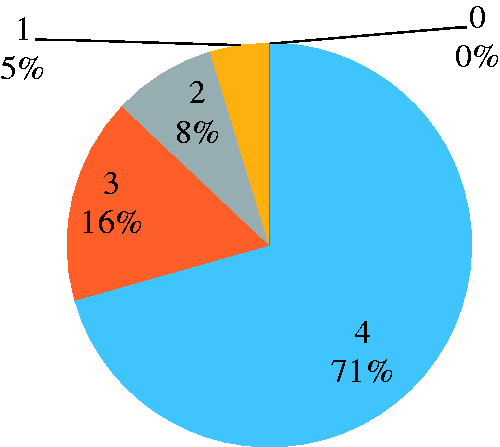
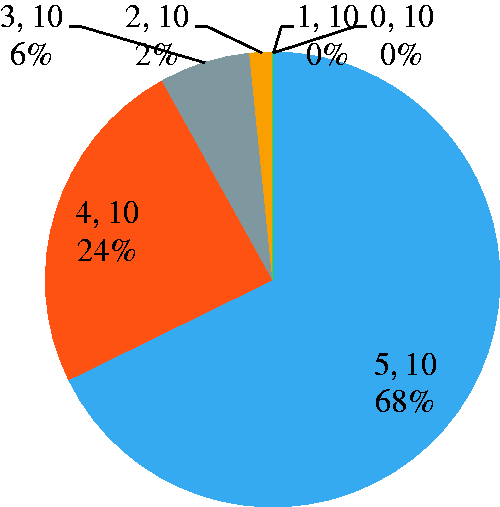
However, Figure 11 shows the results of the correct answers regarding questions 5–9, whereas Figure 12 shows the results of the correct answers regarding questions 5–9 and question 10, as listed in Table 2. As observed in Figure 11, all five questions 5–9 were answered correctly by 57% of the students, any combination of the five questions were answered correctly by 19% of the students, any combinations of the three questions were answered correctly by 5% of the students, any combination of the two questions were answered correctly by 5% of the students, and one question was answered correctly by 6% of the students. Consequently, none of the questions were answered correctly by 8% of the students. Compared with the results shown in Figure 11, the results shown in Figure 12 shows a different type of learning behavior, which is similar to that of Figures 9 and 10, as described above. In particular, the percentage of the correct answers increases to 68% (Figure 12) from 57% (Figure 11) when the results of the correct answers regarding question 10 were added to the results of the correct answers regarding all five of questions 5–9. Similarly, the percentage of the correct answers increases to 24% (Figure 12) from 19% (Figure 11) when the results of the correct answers regarding question 10 were added to the results of the correct answers regarding four questions of questions 5–9. In addition, the percentage of the correct answers increases to 6% (Figure 12) from 5% (Figure 11) when the results of the correct answers regarding question 10 were added to the results of the correct answers regarding three questions of questions 5–9. Conversely, the percentage of the correct answers decreases to 3% (Figure 12) from 8% (Figure 11) when the results of the correct answers regarding question 10 were added to the results of the correct answers regarding two questions of questions 5–9. The trend remains the same for other cases shown in Figures 11 and 12. As such, these learning results (Figures 11 and 12) simply mean that successful learning regarding the relatively general concepts leads to meaningful learning regarding other specific concepts (here, successful learning regarding the general concepts associated with questions 5–9 leads to meaningful learning regarding the relatively specific concepts associated with question 10).
Learning results regarding questions 5–9 (0 = none of the questions, 1 = one of the questions, 2 = any combination of two questions, 3 = any combination of three questions, 4 = any combination of four questions, 5 = all five questions). Learning results regarding questions 5–9 and question 10 (0, 10 = none of the questions out of questions 5–9 and question 10; 1, 10 = one of the questions out of questions 5–9 and question 10; 2, 10 = any combination of two questions out of questions 5–9 and question 10; 3, 10 = any combination of three questions out of questions 5–9 and question 10; 4, 10 = any combination of four questions out of questions 5–9 and question 10; 5, 10 = all five questions 5–9 and question 10).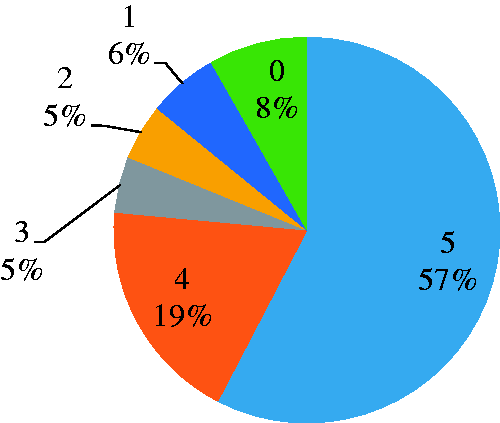
Concluding remarks
Engineering education, particularly manufacturing engineering education, often suffers from the pressure of near-future employment needs. However, for this agile world, emphasis must be accorded to the academic discipline-based education that creates learned professionals; this enhances lifelong learning. The content of this article elucidates how to balance these two critical facets, near-future employment needs, and academic discipline-based education, from the perspective of manufacturing engineering and e-learning. Using an e-learning system, one can learn about a subject at anytime from anywhere at a minimal cost. There is no unique, best-of-the-world solution for developing an Internet-based engineering course. The procedure for creating e-learning contents using concept maps described in “Internet-aided manufacturing engineering education” section to support the must-be structure of manufacturing engineering education described in “Manufacturing engineering education” section must accompany to obtain the best that the Internet offers now. The implementation of concept map-based e-learning in manufacturing engineering, as described in “Implementation” section, can also be extended to prepare students of other engineering fields. This issue remains open for further investigation. However, professional societies that represent different manufacturing sectors must come forward and help build the concept maps of different universes (process, shape, material, control, and sustainability) that educators should integrate with their concept maps. Otherwise, meaningful learning in manufacturing will be moderately difficult to achieve in the ensuing years.
Footnotes
Acknowledgements

Declaration of Conflicting Interests
The author(s) declared no potential conflicts of interest with respect to the research, authorship, and/or publication of this article.
Funding
The author(s) received no financial support for the research, authorship, and/or publication of this article.