







Abstract
Literature shows that the cooperative learning pedagogy increases engineering students’ performance in a traditional lecture-based course. This study investigated whether a similar positive effect on student performances would be found in a hybrid course that implemented the cooperative learning pedagogy. To examine this question, this study compared the performance of engineering students taught with and without the cooperative learning pedagogy in a sophomore-level Mechanics of Materials course that implemented the hybrid format. The study findings showed that cooperative learning offered no additional increase in performance for students. Student characteristics (e.g. gender, class load in the semester, attendance, previous GPA) did not influence this finding. However, many students reported that they enjoyed working in teams, preferred including the cooperative learning pedagogy in hybrid courses and suggested that similar engineering courses be taught using the cooperative learning pedagogy.
Introduction and literature review
Hybrid engineering courses employ a mixture of teaching and learning pedagogies that are expected to improve student engagement and performance in courses. For example, the teaching pedagogies used in hybrid courses allow instructors to provide lectures prior to scheduled class meetings, through a combination of online videos and electronic materials. This gives instructors more time in class to focus on facilitating student learning, for example, by explaining and discussing key concepts, solving example problems, and assigning student-centered activities. The learning pedagogies used in hybrid courses allow students to study at their own pace (e.g. by fast-forwarding or replaying parts of videos) for their own needs (e.g. using videos to prepare for exams or complete homework (HW) problems), which can increase student performance, foster classroom engagement, and teach students to cultivate habits of independent learning.1,2 Hybrid courses help students learn disciplined study habits, master new materials on their own, and prepare for class meetings, all of which increase their intellectual development.3,4
It is commonly believed that all of the teaching and learning pedagogies employed in hybrid courses are equally effective in improving student performance, compared to performance in lecture-based (i.e. non-hybrid) courses. But is this assumption true? Studies3,5 have examined a combination of several components of hybrid courses (e.g. online videos, classroom technology, active learning pedagogy, and peer instruction/team-based learning), but because they do not disaggregate which component had the main causal effect on student performance, they cannot be used to answer this question. There is thus a critical need for empirical studies identifying these methods, to help faculty make rational choices about which components will reliably improve student outcomes in hybrid engineering courses.
According to Bishop and Verleger, 6 the pedagogy used in the student-centered activity portion of hybrid courses can determine course success or failure. One pedagogy commonly used in this portion is cooperative learning (CL). CL encourages students to work in teams to complete assignments and to maximize all the team members’ learning.7,8 In engineering courses, CL generally involves completing either problem set assignments during a class or project assignments, which may take several weeks or months. 7 Completing problem set assignments in teams gives students’ opportunities to discuss lecture content, ask each other questions, share insights, challenge each other’s understandings, resolve differences of opinion, and collaborate to solve problems. In addition, having students work in groups improves instructional efficiency because it allows instructors to answer multiple students’ questions at one go rather than per individual student.
Extensive reviews of studies on the CL pedagogy in traditional lecture-based engineering classes have overwhelmingly shown that it has a positive effect on all aspects of student outcomes.9–11 This literature shows that students who work on assignments or projects in groups exhibit higher academic performance, higher-level critical thinking skills, better relationships with peers, and greater intrinsic motivation to study engineering compared to students working alone.7,8 It is reasonable to predict, based on these studies, that the CL pedagogy could also improve student learning in hybrid courses.
Studies3,12,13 have examined student performance in hybrid courses that implemented the CL pedagogy. However, these studies compared the performance of students from both hybrid courses and lecture-based courses, which brings their findings into question because at least some of the positive effect of CL in the hybrid courses could be due to the other teaching and learning pedagogies that the courses incorporated. For example, improved performance in the hybrid courses studied could have been related as much to the use of online videos, in-class instructor facilitation of student learning, and student-centered activities as to the use of CL. Studies of hybrid courses that control for all potential influential components except the CL component are needed. Examining one influential component at a time can inform faculty whether or not it led to better student performance.
The goal of this study was to take the first step toward providing quantitative and qualitative data about the effectiveness of incorporating the CL pedagogy on improving student performance in hybrid engineering courses. Quantitative data were obtained by (1) comparing the performance of students taught with and without the CL pedagogy in a hybrid engineering course, as measured by student grades and (2) comparing student performance to student characteristics (gender, transfer status, credit hours taken in the semester, class attendance, and academic preparation in terms of grades achieved in a prerequisite course and cumulative GPA). Qualitative data were obtained by examining students’ attitudes about whether incorporating the CL pedagogy helped them to learn the course materials, as reflected in students’ course evaluations.
The course examined in this study, Mechanics of Materials (MoM), was selected because it has been taught with the hybrid approach14,15 or the lecture-approach supplemented with the CL pedagogy 16 in many universities. Many engineering disciplines require their students to take a MoM course early in their studies because success in upper-class engineering courses is predicated on a strong grasp of the analyses and applications of concepts taught in this course. Being a required course, it usually has a high student enrollment, which can negatively affect student performance. This is important because, given research has shown that many students decide whether to stay in engineering during their first two years of study, 17 and students’ experiences in their MoM course can be a critical determinant in their motivation to persist in their engineering studies. Implementing a pedagogy that enhances student performance in a hybrid MoM course could reverse traditional attitudes about this course and build student confidence, engagement, and retention in engineering.
Study goal and research questions
This study examined (1) the overall effect of CL on student performance and (2) whether particular student characteristics (e.g. cumulative GPA, prerequisite course grade, credit hour taken) influence the efficacy of CL for given students. The data were obtained from a teaching project that incorporated the CL pedagogy into one of two large hybrid sophomore-level MoM sections taught at a large, research-intensive Midwestern university in U.S., using a quasi-experimental design.
Using quantitative and qualitative approaches, the following research questions were investigated:
Quantitative research questions
Do students’ final scores and grades differ between the hybrid plus CL section and the hybrid-only section? Are the differences in students’ final scores in a hybrid plus CL section and a hybrid-only section explained by student characteristics (i.e. gender, transfer status, credit hours taken in the semester, class attendance, and cumulative GPA prior to the class)?
Qualitative research question
What are students’ attitudes toward a hybrid MoM course that includes the CL pedagogy? What are students’ reasons for having either positive or negative attitudes about a hybrid MoM course that includes the CL pedagogy?
Given previous studies showing the benefits of the CL pedagogy9–11 in traditional lecture-based engineering courses, it was predicted that students in the hybrid MoM course who were taught with the CL pedagogy would have higher performance than students who were not taught with it. It was also predicted that students would have positive attitudes toward the CL pedagogy. It was impossible to make research-driven predictions, however, given the absence of studies examining the effect of using the CL pedagogy in hybrid courses on student performance and attitudes.
Method
Description of the studied course
The study was conducted at a large Midwestern research-intensive university with an engineering student enrollment of 9645. The examined MoM course is a three-unit course introducing concepts of mechanics (e.g. stress, strain) to sophomore engineering students. In the last three years, over 850 students across various engineering disciplines (e.g. Aerospace, Agricultural and Biological, Mechanical, and Civil) took the MoM course annually.
In fall 2016, five MoM sections were offered. One instructor taught two sections using a hybrid approach, and these sections were examined in this study. Students registered for one of the two MoM sections through a university course registration website that showed only the instructor name and a general course description. There was no indication on the website whether a section implemented only a hybrid approach or a hybrid approach combined with the CL pedagogy. Students enrolled in the two sections had contact hours with the instructor every Monday, Wednesday, and Friday for 50 min over the 16-week semester. A typical breakdown of a class period was a 5-min in-class quiz, a 5-min quiz review, a 15-min mini-lecture, and 25-min in-class exercise (i.e. student-centered activities). The section meeting at 9 a.m. was the control section (i.e. hybrid-only), and the one meeting at 12:10 p.m. was the intervention section (i.e. hybrid plus CL).
The study aimed to vary only the CL component between the two hybrid MoM sections while controlling for as many potential influential hybrid pedagogy variables as possible. Therefore, the two sections had the same teaching assistant (TA) and shared the same syllabus, course materials (e.g. lecture slides and online videos), and physical classroom. Furthermore, both sections were assigned the same in-class exercises, HW problems, and individual assessments (in-class quizzes, exams).
The only difference between the two sections was how students worked on the in-class exercises. The intervention section implemented the CL pedagogy, and the control section did not. Specifically, students in the intervention section were assigned to groups of four in the second week of the class, following the procedure outlined in Felder et al. 18 and Felder and Brent 19 for creating effective CL groups. To form teams, the CATME Team-Maker program (https://catme.org/login/index) was used which collected students’ gender, race, cumulative GPA, pre-requisite course grade (i.e. Statics), enrolled credit hours in the semester, status (e.g. sophomore or Junior), age, and engineering disciplines (e.g. aerospace or mechanical) data and assigned students in teams of four based on the criteria set by the instructor. One of the criteria for forming the team was to ensure no teams had one minority student (e.g. female or underrepresented student). Another, criterion was to have teams consisting of members with a range of student academic performances set by using students’ cumulative GPA and pre-requisite course grade. The enrolled credit hours, student status, and age variables were not considered in the team formation criteria given their lack of variation (i.e. a majority of students were taking between 13 and 16 credit hours, were sophomores or juniors, and were 20 or 21 years old). Once the team assignments were made available to students, student teams were asked to sit in a designated section of the classroom and remain together for the entire semester. In the first class session when the students sat with their teams, approximately half of the class period was spent discussing the purpose of CL pedagogy and effective ways to work in teams. Then, throughout the semester, students were asked to work with their group members to solve in-class exercises and encouraged to ask their team members before asking questions to the TA or the instructor. Additionally, students were informed to reach out to the instructor if there were any team problems or issues during the semester. In the control section, however, students were asked to complete the in-class exercises individually but were neither encouraged to nor discouraged from collaborating with other students.
Students in both sections were informed of and encouraged to use the resources provided by the instructor, including online videos and lecture materials. The in-class exercises consisted of two problem-solving activities that students (control section) and teams (intervention section) had to complete in about 25 min. Though experts would have considered these problems to be introductory in nature, for students they were challenging to complete within the allotted time. Problems were designed to test multiple concepts, including those discussed on the day of the class as well as those from previous classes. Students in the control section submitted their work individually, whereas students in the intervention section submitted only one complete solution set as a team.
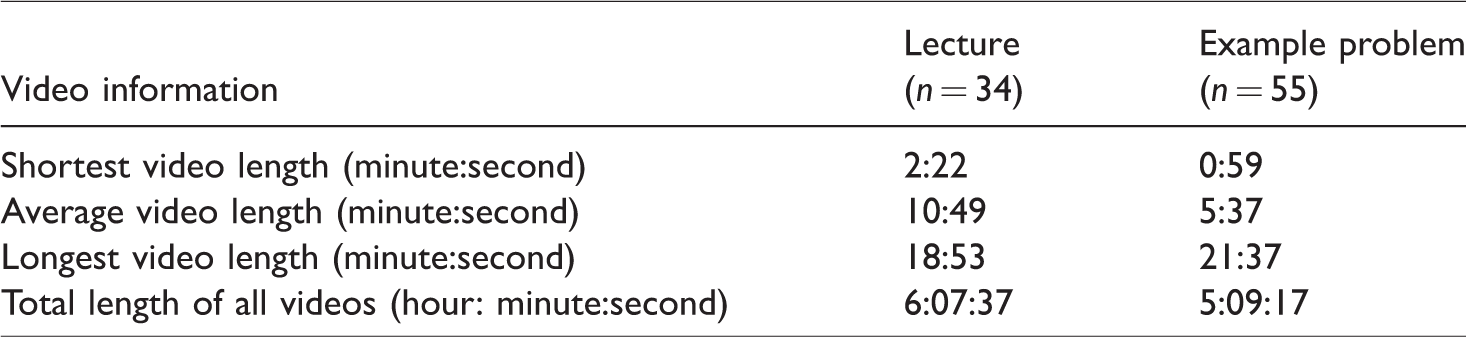
Both sections had access to 89 videos that the instructor created in spring 2016. The videos consisted of PowerPoint lecture slides with a voiceover narration by the instructor. There were 34 lecture videos and 55 example problem videos. Each topic had one assigned lecture video and one to three assigned example problem videos, which students were required to watch prior to each class. Information about the videos can be found in Table 1. The 89 videos were first used in an eight-week summer, 2016 online MoM course offered by the instructor who taught both of the studied MoM sections. At the end of that summer semester, the videos were edited in preparation for their use in the fall, 2016 MoM hybrid course (e.g. long pauses in the narration and a long segment on writing solutions that had no explanations were removed).
Lecture and example video length information.
Description of the study participants
The hybrid plus CL section and the hybrid-only section had an initial enrollment of 98 and 73 students, respectively. Fifteen students were excluded from the study (n = 9 for the hybrid plus CL section, n = 6 for the hybrid-only section) for the following reasons: They dropped out of the course (n = 3 for hybrid plus CL section, n = 2 for the hybrid-only section) or they did not take one or more exams required in the course (n = 6 for the hybrid plus CL section, n = 4 for the hybrid-only section). Following this exclusion, 89 and 67 students remained in the hybrid plus CL section and the hybrid-only section, respectively. These students’ demographic information, obtained from the registrar’s office, is presented in Table 2.
Descriptive statistics.
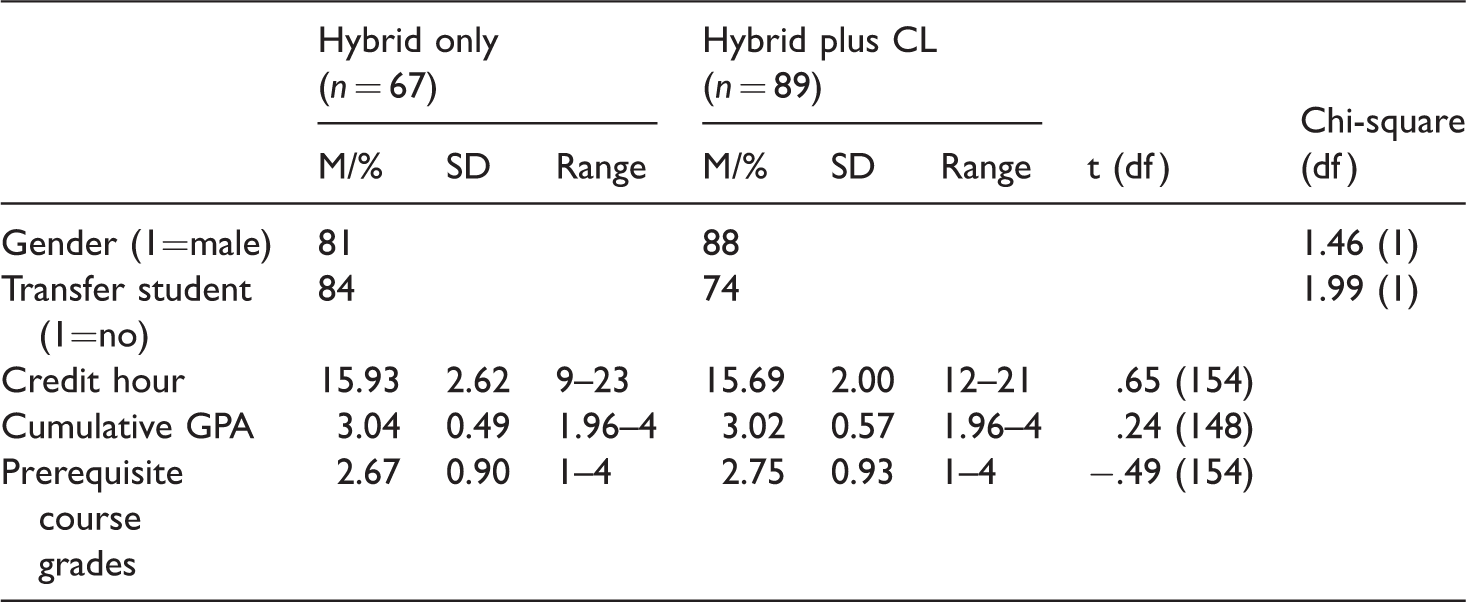
CL: cooperative learning; SD: standard deviation.
As shown in Table 1, a majority of students in both sections were male and were non-transfer students. On average, students took approximately 16 credit hours in the semester, and the number of credit hours students took did not differ between the two sections (t = .65; p > .05). The students in the two sections did not differ in terms of their overall cumulative GPA prior to the MoM course (t = .24; p > .05) or their prerequisite course grades (t = −.49; p > .05).
I: Quantitative measurements (class assessments and attendance)
To determine the effect of CL on student performance (RQ 1 and RQ 2), students’ final grades, calculated from the three mid-term exams and one final exam, in-class quizzes, online and supplemental HW problems, and attendance, were used to measure course performance.
Each mid-term exam was 90 min long and consisted of three problems. The final exam was 120 min long and consisted of four problems. The four exams were worth 70% of students’ total grade. Both the intervention and the control section took the same exams at the same time on the same day, eliminating any sharing of exam questions between students in the two sections. An in-class exam called “Exam 0” was administered to determine students’ knowledge of the subjects taught in the prerequisite Statics class. Exam 0 was worth 5% of students’ total grade. In-class quizzes were administered almost every day and consisted of three to four multiple-choice or short answer questions. The quizzes were worth 3% of students’ total grade. Students had weekly online HW problems and supplemental HW problems. Every week students were assigned nine online HW problems taken from the class textbook. Students were also assigned three supplemental HW problems during the course, which were slightly more complex than the online HW problems. Students were given two weeks to solve each supplemental HW problem. The online and supplemental HW accounted for 10 and 3% of students’ total grade, respectively. Student class attendance made up the final 9% of the total grade. Students’ scores were translated into grades using the A, B, C, D, F per university policy and using the following criteria: 90–100% was A, 80–89% was B, 70–79% was C, 60–69% was D, and below 59% was F.
II: Qualitative measurements (course evaluation (mid-term and final))
To determine the attitudes of the hybrid plus CL students toward the CL pedagogy in a MoM hybrid course (RQ 3), student responses to open-ended questions in-class and end-of-semester course evaluations were examined.
In week 10 of the 16-week semester, the instructor asked students to complete a hard-copy in-class evaluation form over a 20-min time period. The form asked students to respond to open-ended questions about what they particularly liked or disliked about the course and what aspects of the course had been most helpful in learning the materials. The evaluation form did not ask students to write their names, hence the responses were anonymous.
In addition to the in-class evaluation, during the last week of the semester, the university emailed an online evaluation form to the students. The replies of students in the hybrid plus CL section to the “Please add additional comments if desired” question were examined to determine their attitudes about the CL pedagogy that had been used in their section. Students had approximately one week to complete and return the evaluation, and their responses were kept anonymous. Of the 95 students enrolled in the intervention section, 80% (76/95) completed the in-class evaluation and 61% (58/95) completed the final course evaluation.
I: Quantitative analysis
To compare the final scores of students in the two MoM sections, correlation analyses, chi-square analyses, and regression analyses were run. Correlation analyses were run between section types (i.e. hybrid plus CL section vs. hybrid-only section) and students’ final course scores. The chi-square test was used to examine whether the distribution of students’ final course grade (A, B, C, D, or F) differed between the two sections. A series of regression analyses was run to examine whether the differences in students’ final course scores for the two sections differed by student characteristics (gender, transfer status, credit hour taken in the semester, class attendance, and cumulative GPA prior to taking this MoM course). To do that, five interaction terms (each student characteristic X section) were created. Each interaction term was examined in a separate model.
II: Qualitative analysis
Student responses were analyzed in five steps. First, every student response to the examined questions in the two evaluation forms was read. Second, all responses were read again, and student responses related to any aspect of CL (e.g. working in groups) were highlighted. Third, the highlighted responses were separated into groups based on whether they showed a positive or a negative attitude toward the CL experience. Fourth, the positive and negative responses were copied into separate documents, and two members of the research team read the responses multiple time to determine the reasons why students had positive or negative attitudes toward CL. Fifth, the most likely identified reasons and student responses that supported those reasons were grouped together. Once the responses were organized into reasons, a third member in the research group confirmed the placement of responses among the identified reasons. When all three members agreed with the identified reasons and that the responses were correctly aligned to reasons, the findings were summarized.
Results
All student data were collected after receiving approval to conduct the study from ISU’s Institutional Review Board.
I. Quantitative findings: Student outcomes (hybrid plus CL section vs. hybrid-only section)
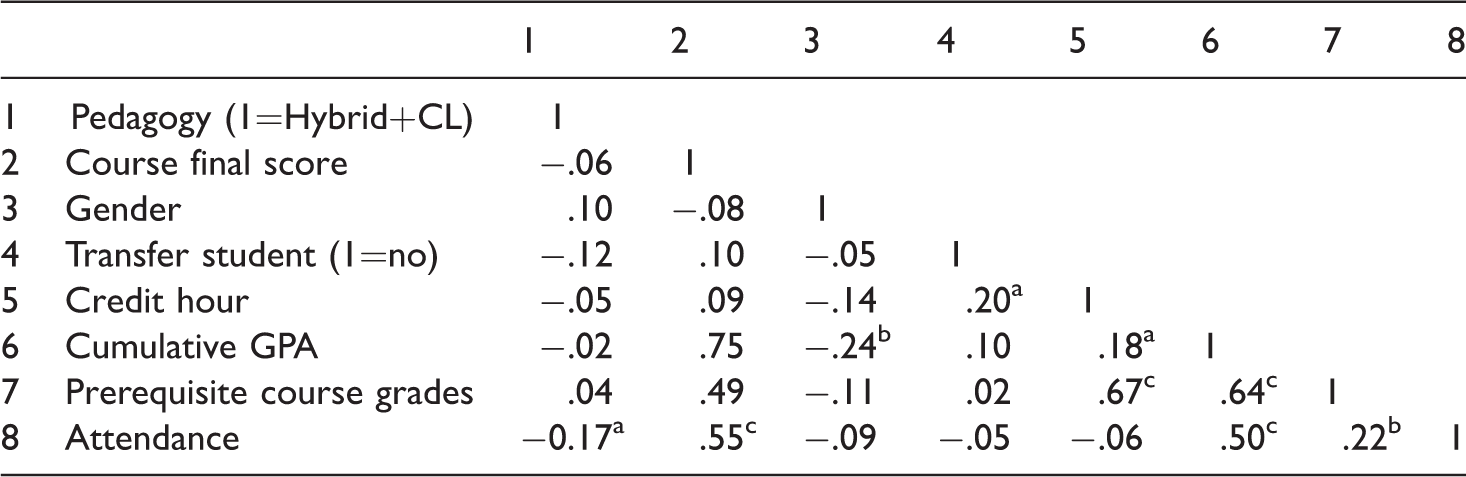
As shown in Table 3, the correlation between section types and students’ final scores was found to be insignificant. In other words, no evidence was found that placement in either section led to statistically different final course scores. Correlations among student characteristics can be found in Table 3.
Correlation table (N = 156).
ap < .05.
bp ≤ .01.
cp ≤ .001.
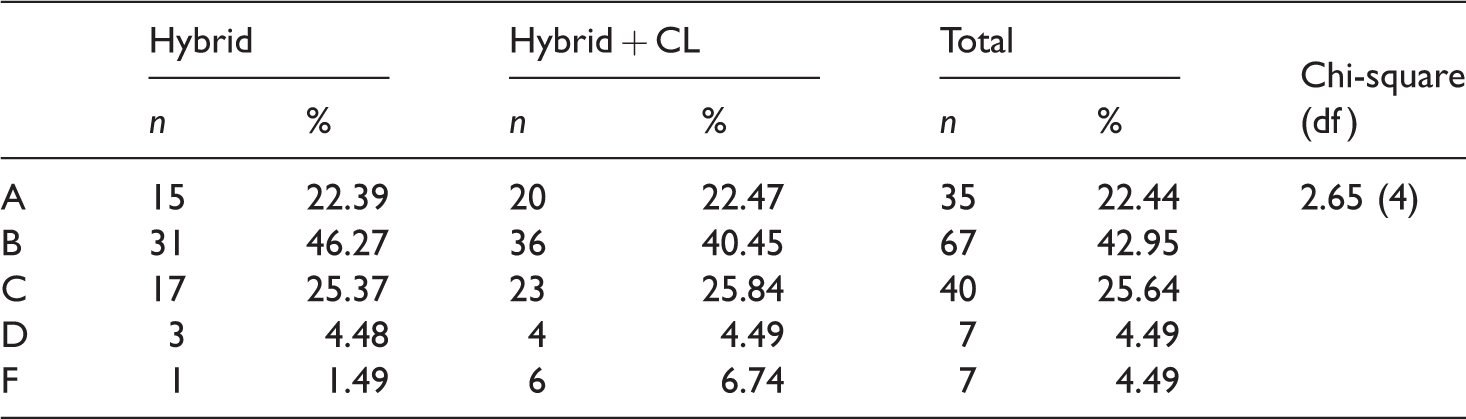
The chi-square test (see Table 4) further showed that the distribution of students’ final letter grades did not differ between the hybrid plus CL section and the hybrid-only section. For both sections, approximately 22% students received an A, 40–46% students received a B, 25% students received a C, 5% received a D, and 1–7% students received an F.
Distribution of student final grades by pedagogy.
CL: cooperative learning.
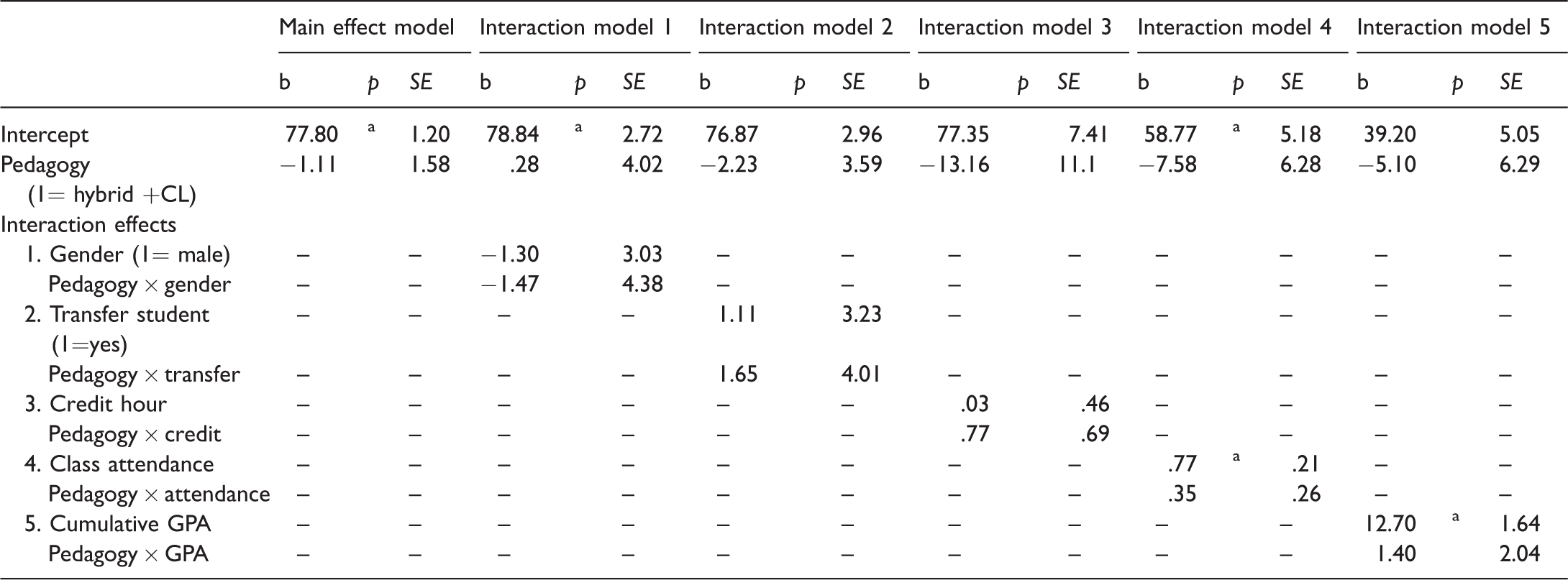
As shown in Table 5, students in both sections had similar (no different) final scores, regardless of their gender or transfer status, the credit hours they took in the semester, their class attendance, and their cumulative GPA prior to this class.
Regression analyses (N = 156).
CL: cooperative learning.
Note: ap ≤.001. Pedagogy was coded as “1” = hybrid + CL section and “0” = hybrid-only section. SE: Standardized Error.
II. Qualitative findings: Student attitudes about CL (hybrid plus CL section)
A majority of students in the intervention section enjoyed working in groups and liked having access to online materials. The following sample student responses illustrate this finding: “I particularly like the group layout and the flipped classroom setup. I wish all my classes were this way.” “I really like the group work and availability of useful material on blackboard.” “The lecture slides, videos, in class assignments and quizzes have been the most helpful aspects of this course. I also enjoy having a team to work on the in-class assignments.” “I have a fantastic group and it helps me a ton to be able to ask them questions as we work through [in-class assignment] problems.” “[The class times] allow a lot of opportunity for students to work in teams, practice a concept and review a concept.” “In class assignments are effective especially with peers also providing input and clearing up any false misconceptions.” “In class assignments really help the learning. I like talking through problems with my group.” “One of my favorite things about the class set up is the group work and the groups are put into because it creates a support system and facilitates collaboration.” “The flipped structure of the class was very effective to my learning because it allowed me to work on problems with very easy access to help, including the instructor, the TA, and classmates.” “I had a great group and it definitely helped my learning to be able to bounce ideas off of them and we were often able to explain difficult concepts to each other. I always felt prepared to do the homework assignments after working through the in class assignments with my group members.” “I like the style that this class uses. Having online lectures and in class quizzes and assignments definitely makes me more accountable for keeping up with the content. The group are also helpful to learn the material the best, being able to work through problems with other people. Overall really like the format and the way this class is run.” “I really enjoy the structure of the class with having the videos and notes available before the class period and then transitioning into the quizzes and worksheets. The team structure is also a great thing because it allows me to [bounce] ideas off of other people.” “I like how the lectures are recorded because I can go back and watch them when I get stuck. I also like how we work in groups because then it gives me a chance to figure out what I am struggling with and I can ask questions.” “I sometimes feel as it is easy to take a back seat and one person ends up solving it, then when it comes time for homework I feel less prepared.” “I liked the concept of the in-class group, but it didn't help me learn because my group worked so much faster than I did that I couldn't keep up, even with answering questions.” “I enjoy the style of the course: lecture videos, brief summary, group problems. However, I feel the group assignments loses one aspect. When we need help, there are only two [the instructor and the TA] of you and usually the quality of help you can give is limited because you two are busy.”
Discussion
The quantitative results showed that the final scores and course letter grades of students taught in the hybrid plus CL section did not differ significantly from those of students taught in the hybrid-only section (RQ1). Furthermore, students performed similarly in both sections regardless of their gender, transfer status, credit hour taken in the semester, class attendance, and cumulative GPA prior to taking the MoM course (RQ2).
These findings are inconsistent with those of previous studies, which showed better performance for students taught in engineering classes that implemented CL. However, it should be noted that these studies examined students taught in traditional lecture-based courses, not in hybrid courses.
It is possible that online videos may have provided students with benefits that they would otherwise have gained from working in teams. The videos provided to students in both the hybrid-only section and the hybrid plus CL section may have served as resources when learning new concepts, applying the concepts to solve problems, and studying/reviewing the concepts for exams. From the students’ perspective, access to the videos was equivalent to having access to the instructor, an attitude exemplified in the following student response: “I really enjoyed the lecture videos. It was extremely helpful to have them whenever I was struggling with a HW problem. It is akin to having the professor sitting next to you while you complete your assignments.” Because students in hybrid courses had 24/7 access to videos, much of their learning could have been accomplished through watching them. In other words, the benefits gained by students in the intervention section via teamwork may have also been gained by students in the control section via watching the videos. A possible reason for this effect could be that hybrid-only students were able to use the videos to review or confirm their understanding of concepts, whereas hybrid plus CL students were able to accomplish this via conversations with team members. Therefore, it is possible that working in teams may not profoundly affect student performance in hybrid courses because of student access to online resources.
Another possible explanation for the lack of difference in student performance between the two sections could be that students in the hybrid-only section formed their own informal groups to solve in-class assignments. It was observed that students in the hybrid-only section often worked with friends sitting next to them while solving problems during the student-centered activity portion of the course, and the class took place in an environment conducive to the natural formation of teams (i.e. it contained moveable individual chairs and desks). These students may have used these informal teams to ask questions, check their understandings, and compare their solutions. Therefore, although the instructor did not assign formal teams in the control section, students may nevertheless have gained the advantages of teamwork through these informal groups, resulting in no differences in performance between the students in the hybrid plus CL section and the hybrid-only section.
These findings and observations show that in large introductory hybrid engineering courses that include student activities centered on solving introductory problems, the benefits of working in teams may possibly be gained from access to online videos and the formation of informal groups. In summary, the benefits of working in teams may not themselves alone result in improved student performance in hybrid courses.
However, despite the evidence that CL has no effect on student performance, students taught in the hybrid plus CL section enjoyed working in teams with their peers. Students mentioned several reasons for enjoying working in teams and described how it assisted them to learn concepts and complete group assignments (RQ3). Students suggested incorporating the CL pedagogy into other engineering mechanics courses.
These positive attitudes about the CL pedagogy are encouraging, because previous studies showed that positive student attitudes toward courses lead to multiple positive long-term student outcomes, including increased student engagement, motivation, and retention in engineering fields.20,21 In addition, the fact that most students in the intervention section enjoyed a required introductory sophomore-level MoM class that has traditionally been despised points to the advantages of teaching this and other similarly disliked courses with the hybrid plus CL approach. Pedagogical methods that lead to positive student learning experiences deserve to be implemented even though their benefits may not be immediately evinced in improved student grades because they can have long-term positive effects on students.
As mentioned in the results section, one group of students did not like working in groups. Possible ways to help these students and their team may include encouraging them to work together and to develop a supportive team learning environment, ensuring that instructor and TA support are distributed evenly among teams (possibly by regular instructor feedback to the TA on how to best support student teams), and encouraging students to contact the instructor if a team is dysfunctional or they have ideas about how to improve the effectiveness of student teams.
Future work
It would be worthwhile to examine the long-term outcomes of students taught in hybrid courses that implemented the CL pedagogy. The enjoyment that students experience in these classes may lead to better long-term outcomes for their engineering education, compared to outcomes for students taught in hybrid-only or lecture-only courses. Studies comparing outcomes for students who have taken multiple courses taught with the hybrid plus CL approach and students who have not would also be of interest. Students who have taken multiple hybrid plus CL courses may show enhanced development not only in academic performance but also in professional skills (e.g. communication and teamwork), which may profoundly affect their experiences in advanced classes (e.g. senior design projects) or even their future careers.
It would also be interesting to compare student outcomes in hybrid-only and hybrid plus CL sections when in-class assignments include not only short problem-solving activities but also a week- or month-long class project. Assignments that require more time to complete and high-level analytical and critical thinking may require more team synergy and effort than those that are short and introductory. Students who are working in teams with such long-term projects may experience more in-depth discussions and acquire higher-level problem-solving skills, leading to improved overall class performance compared to that of students working alone.
Finally, examining the effect of student team composition on individual student performance would be of value. For example, do teams of students with diverse characteristics (e.g. gender, GPA, and ethnicity) lead to better individual student performance than teams of students with similar characteristics? Such a study would help instructors understand how to best form student teams in hybrid courses that integrate the CL pedagogy.
Limitations
Study limitations should be noted. First, different numbers of students were enrolled in the two sections. The intervention section had 98 students, and the control section had 73 students. As class size affects student learning and performance, this difference may have affected the study findings. Second, the control and intervention sections met with the instructor at different times of day (9 a.m. and 12:10 p.m., respectively). It is possible that the time of the day of these meetings could have affected students’ attention span and motivation. Third, the study was done by one instructional team in one course at one institution. More studies are needed by other instructional teams from current studied institutions, and other institutions who are implementing the CL pedagogy in hybrid courses are needed to ensure the generalizability of the findings.
Conclusion
Previous studies have suggested that the CL pedagogy benefits engineering students’ performance in traditional lecture-based courses. This study examined whether a similar positive effect on student performance would be found in a hybrid course that incorporated the CL pedagogy. To test this question, this study compared student performance in two sections of a large sophomore-level engineering class, one taught with the hybrid format plus the CL pedagogy and the other taught using the hybrid format only. The study findings showed that CL offered no additional increase in student performance for students in the hybrid plus CL section. Student characteristics (gender, transfer student status, class load in the semester, attendance, previous GPA) did not influence this finding. However, many students in the hybrid plus CL section reported that they enjoyed working in teams, preferred including the CL pedagogy in hybrid courses, and suggested that similar engineering courses be taught using the CL pedagogy.
Footnotes
Declaration of conflicting interests
The author(s) declared no potential conflicts of interest with respect to the research, authorship, and/or publication of this article.
Funding
The author(s) disclosed receipt of the following financial support for the research, authorship, and/or publication of this article: This work was supported by the Miller Faculty Fellowship from Iowa State University.